Tiger Paper, April 1972
Item
comments at college-wide p.&b.
appeal hearing:
— I Don't Care If Stu-
dents Kick My Door
Down
— We Can't Afford The
Luxury Of A Teacher
Who Speaks Only
Spanish
— We Won't Go To The
Gor'lo Come'To Us.
From the beginning, the people who
struggled to build the Black and Puerto Rican
Studies Program understood the need for
autonomy. They knew that if it was to be a
force for their liberation it would have to be
controlled by those who participated in it.
From the beginning, the administration,
which had fought against the creation of this
program, understood the need to keep Black
and Puerto Rican Studies under its thumb. It
made clear that such a program would be
tolerated only if the administration could
manipulate it for its own colonial purposes.
From that day to this, the administration
has seized every opportunity to retake the
program from its creators. It fired the first
Coordinator of Puerto Rican Studies, Migdalia
de Jesus Torres de Garcia. She was too
independent. It removed the first Coordinator
of Black Studies, Onwuchekwa Jemie. He was
too independent. It tried to fire Sonya
Sanchez. She was too outspoken. And now
the administration has struck again. Jose
Antonio Irizarry, one of the most respected
faculty members in the program, has been
notified that as of September he is “free to
look for another job’. This, despite the fact
that Puerto Rican Studies will have three new
teaching slots to fill in the Fall.
FREE LEGAL SERVICES
Student Government—Third World
Coalition has contracted with a lawyer
to provide free legal advice to any
student who wants it. The lawyer will be
available for consultation in the Student
Government office off the “A” lounge
between the hours of 5 pm and 8 pm on
Mondays and Wednesdays. In a week or
two, Student Government—TWC hopes
to provide the same service in one of the
buildings uptown. Posters will announce
the time and place.
Students should not hesitate to use
the service. The lawyer will advise any
student on any legal problem that he or
she may have.
Gheito, The | Ghetto Has
MANHATTAN COMMUNITY COLLEGE
APRIL, 1972
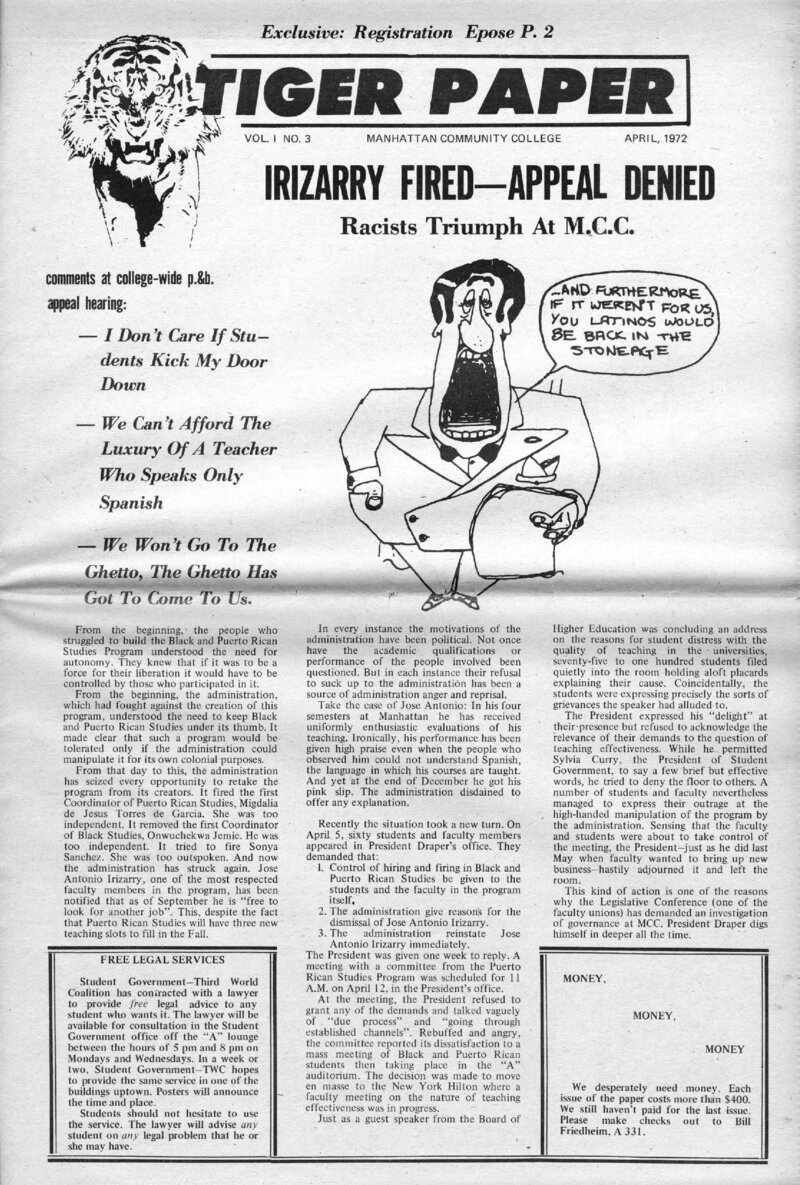
IRIZARRY FIRED—APPEAL DENIED
Racists Triumph At M.C.C.
In every instance the motivations of the
administration have been political. Not once
have the academic qualifications or
performance of the people involved been
questioned. But in each instance their refusal
to suck up to the administration has been a
source of administration anger and reprisal.
Take the case of Jose Antonio: In his four
semesters at Manhattan he has received
uniformly enthusiastic evaluations of his
teaching. Ironically, his performance has been
given high praise even when the people who
observed him could not understand Spanish,
the language in which his courses are taught.
And yet at the end of December he got his
pink slip. The administration disdained to
offer any explanation.
Recently the situation took a new turn. On
April 5, sixty students and faculty members
appeared in President Draper’s office. They
demanded that:
1. Control of hiring and firing in Black and
Puerto Rican Studies be given to the
students and the faculty in the program
itself,
2. The administration give reasons for the
dismissal of Jose Antonio Irizarry.
3.The administration reinstate Jose
Antonio Irizarry immediately.
The President was given one week to reply. A
meeting with a committee from the Puerto
Rican Studies Program was scheduled for 11
A.M. on April 12, in the President’s office.
At the meeting, the President refused to
grant any of the demands and talked vaguely
of “due process” and “going through
established channels”. Rebuffed and angry,
the committee reported its dissatisfaction to a
mass meeting of Black and Puerto Rican
students then taking place in the “A”
auditorium. The decision was made to move
en masse to the New York Hilton where a
faculty meeting on the nature of teaching
effectiveness was in progress.
Just as a guest speaker from the Board of
iF sv WEREN'T FOR US,
SS RE
You LATINOS WoULO
SE BACKIN +HE
STONEPGE
Higher Education was concluding an address
on the reasons for student distress with the
quality of teaching in the ~ universities,
seventy-five to one hundred students filed
quietly into the room holding aloft placards
explaining their cause. Coincidentally, the
students were expressing precisely the sorts of
grievances the speaker had alluded-to.
The President expressed his “delight” at
their:presence but refused to acknowledge the
relevance of their demands to the question of
teaching effectiveness. While he_ permitted
Sylvia Curry, the President of Student
Government, to say a few brief but effective
words, he tried to deny the floor to others. A
number of students and faculty nevertheless
managed to express their outrage at the
high-handed manipulation of the program by
the administration. Sensing that the faculty
and students were about to take control of
the meeting, the President—just as he did last
May when faculty wanted to bring up new
business—hastily adjourned it and left the
room.
This kind of action is one of the reasons
why the Legislative Conference (one of the
faculty unions) has demanded an investigation
of governance at MCC. President Draper digs
himself in deeper all the time.
MONEY,
MONEY,
MONEY
We desperately need .money. Each
issue of the paper costs more than $400.
We still haven’t paid for the last -issue.
Please make checks out to Bill
Friedheim, A 331.
PAGE TWO
a ealeeeeenaanenaianeneneea
—
TIGER PAPER
REGISTRATION EXPOSE:
The following article was written by an
individual well placed to discuss the insane
manipulations that go on behind the scenes at
registration. For obvious reasons, the author
wishes to remain anonymous.
* * &
As most of you through bitter experience
know, something is rotten in the Registrar’s
Office. The problems date back many years,
but did not become critical until May of 1971
when various incidents converged to create a
crisis which became apparent during last
September’s registration.
In May, Mr. Gerald Coté; the then
incumbent Registrar, resigned his position
after nearly four futile years of fighting the
upper administration for adequate support
and the staffing he needed to run his office as
he saw fit. (He is currently Registrar at
Queensborough where, with full
administrative support, he has speeded up
registration by half.) Coincidental with this,
the administration did not renew the contract
of Mr. James Anastos, the manager of the
Data Processing Laboratory, which is the
chief supporting unit of the Registrar’s Office.
(What is fed into the machines and what
comes out pretty much determines what your
semester program and semester grades are.
The machines are only as good as the
i i them; the information fed
them is only as good as the programs which
interpret it; and the programs are only as
good as the programmers who write and
organize them.) Mr. Anastos was a fine
organizer and programmer who stayed until
his job was done and who delivered on time.
He was the first man to bring order to the
D.P. Lab, but he didn’t get along with Prof.
Marvin Kushner, the Chairman of the Data
Processing Department, so the college did not
renew his contract. (It later turned out that
because of a technicality in timing, the
administration had to rehire him for a year.
But such are the jungles of petty bureaucratic
power that the administration prevented him
from returning as manager of the D.P. Lab,
instead placing him in the Dean of
Administration’s Office for the past year
where he does random makeshift assignments
which do not utilize his programming skills.
In the meantime, morale and efficiency in the
Data Processing Lab have deteriorated.)
Shortly after Cote resigned, through some
mixup or miscalculation work-study funds for
student aides were cut off. The Registrar’s
Office, because of critical understaffing, has
always had to depend on the help of eight to
ten student aides per semester to do some of
the daily alphabetizing, filing and other
drudge work necessary to keep large masses of
paper in order.
in May then, understaffed and
overwhelmed, Manhattan Community College
had no registrar, no associate registrar
(although an opening had been available for a
couple of years; but the upper administration
had never seen fit to fill it), no manager in its
chief supporting unit, and no student aides.
All this followed immediately upon
President Draper’s unilateral decision to
eliminate the Evening Division (a. few
personality conflicts there, too) and
consolidate the college into his much-vaunted
“single school” concept. As is usual with such
decisions, he set a-plan into motion before
any of the attendant critical details were
worked out or even considered. President
Draper’s decision effectively eliminated an
Evening Division staff of about ten people; he
set up no mechanisms to fill the vacuum
thereby created; and, by default, the
Admissions and Registrar’s Offices were
expected to absorb work previously handled
by the Evening Division. All this with no
registrar, mo associate registrar, no lab
manager, and no student aides.
One of the important side effects of
President Draper’s decision was that it
confused the general fee structure. The Board
of Higher Education, which has the sole
authority for determining fees, ruled in the
summer of 1970 that all day students pay a
$47 general fee, and all evening students pay a
$17 general fee. Since MCC is now a “single
school” the day-evening distinction is no
longer operative. The question arises as to
how the college should administer the general
fee. No official decision has been made—a
critical detail lef unattended which affects us
President Draper allowed the Registrar’s
Office to function without an active head
.from May until August. At the beginning of
August Donald Makuen, Dean of Students
and with no registrar’s experience, was named
Acting Registrar, and Mr. Harold J. Hope was
hired as Associate Registrar. Between them,
and acting on orders from above, they began
setting up the disaster that was the Fall 1971
registration.
ORGANIZED CONFUSION
Hope and Makuen inherited a certain
amount. of confusion, For example, the
college was supposed to print schedules in
June for mailing to all students. The
Registrar’s Office cannot finalize or “lock in”
a schedule until all departments submit their
lists of classes which are arranged like a
master jigsaw puzzle, given all the rooms and
times available. Throughout the summer (in
fact, right up until a week before classes
began) departments submitted and
resubmitted schedule changes. In addition,
the space committee (chaired by Prof.
Kushner) which helps to determine what
rooms are available, submitted its report in
the middle of August (best rooms going to
Data Processing), taking away rooms in which
classes were already scheduled. This meant
that the Registrar’s Office could not put
together a final schedule until the very last
minute.
During ,the .summer, of , 1971, the
Department of Student Life held freshman
orientation during which entering students
indicated their class preferences for the Fall.
This was to help “block program” them; that
is, set up their schedules. The Registrar’s
Office
considering English Composition I as four
credits. Then in July, President Draper for
financial reasons (to get the same number of
English instructors to teach more sections)
block-programmed students
unilaterally and without consulting the
appropriate committees changed English
Composition I to three credits. Not only did
this vitally, affect all. curricula, but it). -——
invalidated all the block-programming done
during freshman orientation. All this work
had to be redone, and the administration
assigned Dean Sample Pittman to do it.
Dean Pittman began the job of
programming 1000 entering freshmen but in
the meantime, departments’ were _ still
submitting schedule changes, cancelling out
the block programs as soon as they were
done. As a result many freshmen entering in
Fall 1971 received a block program riddled
with conflicts and errors which the college
told them they had to follow.
TO THE TOILET
Then acting upon the recommendations of
the space committee, the administration
began rearranging rooms and offices a week
before classes started. So when the semester
began, no one knew what room or office was
where, and one class reputedly met for its
first session in a toilet.
When Fall registration began, final
schedules and room assignments were still in
chaos, and even though the school’s “chief
reorganizer” had merged day and evening, he
neglected to schedule any administrative staff
[IF THis iS
.)
THIS IS PURE VULGARITY:
em ec ec ee ee es es a a a a a a a a ss S08
me eS ec ee ee ee
_—
re-registerin
wit PRR ee
TIGER PAPER
to work at night until well over a month after
classes began. It was decided to hold: the
registration in both the A and B Buildings,
with a labyrinthine physical flow that would
do honors to a psychologist trying to drive
white rats bananas. The Business Office,
afraid of losing money from “resourceful”
students who would slip through without
paying, decided that students would pay
before registering, then take their chances.
This meant that students paid $47 ahead of
time to register for 12 or more credits, only
to go through, find classes closed, and end up
taking nine or ten credits. They still have not
received their just refunds.
Chaos ensued. There was no master set of
registration programs. So the college passed
out changes of program to everyone who
asked, compounding the confusion.
Then, as befits the bureaucratic mind,
instead of cleaning up the mess, the college
set up a committee to plan for the next
registration. President Draper insisted on a
mail registration over the objections of all the
registrar’s staff. Professor Kushner came up’
with a mechanized plan. The machinery was
set in motion, untried, and with significant
details, as usual, left for further consideration.
_The Registrar’s Office was still without a
registrar.
The first step of the mail registration was
pre-registration. The pre-registration would
not guarantee anyone any classes; it was
designed to give an-indication of students’
wants. It meant that the entire subordinate
registrar’s staff had to spend all their time
working on pre-registration instead of trying
to straighten out the mess that had been the
Fall registration.
“YOYOS” AND “TURKEYS”
After about a 40% return’ on
pre-registration, the information culled was
fed into the computers to aid in setting up a
Spring schedule. Of course, the 40% was
meaningless and students were _ still
i i th.
a
WSS ‘as
actually registering, while the cards they were
‘turning in were simply thrown away. (Mr.
Hope, who refers to students variously as
“yoyos” and “‘turkeys” was heard to remark,
“This pre-registration doesn’t mean anything
anyway. it’s a Pavlovian exercise in
conditioning.”’)
Then the mail registration proper began.
Because of the mess during Fall registration,
many students were not on file, so they
received no information. To correct these
omissions, Mr. Hope decided on a mail audit,
with the burden of proof on the student.
NNGHH?S
A storPeD up?
f
THE INSIDE DOPE
Hope, who works in mysterious ways only
understood by him, based the audit on
information drawn from the already
incomplete and partially incorrect files. Quite
predictably, then, students who were not on
file did not receive a mail audit. Those who
did and who returned all materials in
sufficient time were still not guaranteed
classes. (The alternate course cards were—like
the pre-registration forms—for nothing. They
were intended for nothing save the
appearance of an alternative. They too were
thrown away.) There was a “‘bug” in the
untried data processing program, so that a
majority of students only received part of the
program they had requested.
Further chaos ensued. Many students who
had properly pre-registered (only to have their
pre-registrations thrown away) and then
properly registered by mail received a partial
program if they received one at all. No
provision had been made to cover these
contingencies. The college set up emergency
measures (changes of program everywhere
ZZ
with no organization or central control),
compounding the problem.
HOPE AND DESPAIR
In the meantime, the registrar’s staff was so
tied up processing mail registrants, that it had
to fit in the usual end-of-semester work where
it could. Final grade rosters.were incomplete
and. ct (for obvidus; reasons the mail
audit had been ufsuccessful in correcting all
students’ progtams)., Mr. Hope handled the
processing of final marks. Unfortunately, he
did not process about 30 separate sections of
grades, meaning that students in these classes
received I’s (Incompletes). Furthermore, he
assigned FA (Failure due to absence) to
students who were incorrectly listed on
certain rosters and for whom instructors had
indicated “‘never heard of them.” The Faculty
Council did away with the FA grade over a
year and a half ago.
When final marks were run and mailed
(late) nearly one in every four students
received an incorrect grade report.
Meanwhile, back’ at Pavlov’s laboratory,
there was a manual registration consisting
mostly of changes of program for those who
had already registered, adding another
unnecessary 10,000 pieces of paper for an
overburdened registrar’s staff, who had no say
in how anything finally was managed, to
process.
Mail registration was a disaster. Final grades
were incorrect. Students were furious, turning
their anger at the registrar’s secretaries who
NNNNGGHHHS *
FEEL. -LIKE'M.. GONNA,
ita
refer all complaints to the registrar
cme eee ee ee ee we ce ee er cc es a a a a ae ae ae ee
-PAGE THREE,
quite literally had no control, could do little,
and whose time was so completely absorbed
responding to the students’ understandable
but misdirected indignation that it was
impossible for them to do any other work.
Because final grades were incorrect, the
Registrar’s Office could not update students’,
permanent records. This meant transcripts
had to be delayed—and are still delayed.
Virtually no transcripts have gone out. this
semester. Grades couldn’t be corrected
because of the mail registration, plus the
10,000 changes of program that had to be
processed.
An insane merry-go-round of incompetence
and still no registrar. The college rejected the
most competent and experienced candidate
because he didn’t have the necessary advanced
degree.
NEPOTISM
To make matters worse, the assistant
registrar who evaluated candidates for
graduation was transferred to Academic
Advisement’ and his position was filled
unofficially by Dean Makuen’s wife (who had
no experience with such work) despite City
University regulations against such nepotism.
Undeterred by previous disasters, President
Draper again decided over the objections of
the entire registrar’s staff to go with another
mail registration for Fall 1972. It will begin
shortly.
Finally, a Registrar has been hired. He is
Mr. Donald Ferguson, formerly the Registrar
at Baruch. Last semester the Registrar’s Office
at Baruch closed-for two weeks because their
registration had been so disastrous. Baruch
did not begin to send out final grades for last
Fall until March because there had been
unaccountable errors in processing them in
January. Mr. Ferguson’s first official action
was to issue an edict cancelling all vacation
leaves for people in the Registrar’s Office. He
made the decision in Rome, where he himself
was on vacation. Evidently, his leave was
extended, because as this is written, he still
has not appeared.
PAGE FOUR
Tiger Paper
Tiger Paper is published whenever possible by an editorial collective
of Manhattan Community College faculty.
Tenured members of the editorial collective: Kathy Chamberlain, Bill
Friedheim, Jim Perlstein, Mike Rosenbaum, Naomi Woronoy.
Untenured Members: anonymous to protect them against adminis-
trative harassment.
Staff Photographer: Robert Churchill (all photographs are his, except
where otherwise indicated.)
Typeset at O. B. U., member of the Industrial Workers of the World.
Printed by union labor.
EDITORIAL
The sad fact is that over the past few years
this faculty has had_little to be proud of, Asa
group, we have swallowed a nauseating dose
of administrative manipulation, harassment
and intimidation.
Last week it looked as if the administration
had another noxious brew prepared for us.
The President had called another one of his
“faculty meetings”. We were to be asked to
make a choice: either end Open Admissions at
Manhattan, or accept larger classes and longer
teaching hours. Once again we were told to
pit our interests against those of the poor and
the Third World who make up the student
body.
The B.H.E. and this administration were
telling us to fight each other over the scraps
from the table, telling us exactly the same
thing the ruling circles tell anyone who
expects anything decent in this life: “We wish
you well. But you'll have to take what you
need out of the hides of your brothers and
sisters.”
Its a shrewd . game, because * the
administration can’t lose. Either we, rather
than they, have to shoulder the responsibility
for ending Open Admissions, or we impose a
“speed-up” and “‘stretch-out” on ourselves,
while they reap the benefits of what they like
- to call “productivity increases.”
But the worst is over. There were strong
voices of protest against this cynical
administration ploy. And, fortuitously,
additional funds from the state and city made
the move hard to justify. The ‘“‘faculty
meeting” was cancelled. 2
The respite, however, is only temporary.
We know from bitter experience that the
people who make society’s decisions put
human needs low on the list of priorities. It is
only a matter of time before students and
faculty are asked to go at each other again.
But the struggle need not occur. Resources
are in plentiful supply. Only their allocation is
a problem. We can eliminate that problem by
drastically reordering social priorities.
A first step in that direction is adoption of
a “non-negotiable” demand: Decent Wages,
Decent Working Conditions, and Open Admis-
sions!
Interlandi, L.A. Times
“It’s Phase 2 dinner--leftovers!”’
STUDENT EVALUATIONS
3/13/72
Recently the Board of Higher Education
made a policy change. It wants student
opinions of our teaching effectiveness taken
Dissenting Opinion
into account when jadministraters— inake
decisions about promotion, reappointment
and tenure.
The Faculty Council Instruction
Committee is making up a short form that
students will use to rate our courses and our
teaching.
The form is not finished yet. Some changes
in the questions will be made, but as per one
written proposal, students will be asked to
give their opinions of the following items
relating to teaching effectiveness.
1. Instructor’s ability to stimulate interest.
2. Instructor’s personality.
3. Instructor’s knowledge of what he is
teaching.
4. Instructor’s fairness in rating students.
5.Instructor’s preparedness (is he
well-prepared for class).
6.Instructor’s tolerance of differing
opinions.
7.Instructor’s rating as a teacher,
compared with others.
I feel there are three reasons why these
questions are unsatisfactory for measuring
student opinions of our teaching. 1) The
results won’t be well-defined. 2) It isn’t a
valid measure. And, for these two reasons,
3) students will lose interest in the matter of
rating.
Reason 1. The results. will not be
well-defined. Two different administrators
can look at the same results, and come to a
different conclusion regarding an instructor’s
teaching effectiveness.
Administrator 1, seeing that students rate
instructor X_ satisfactory or high on
“personality,” ‘“‘knowledge of subject,”
“fairness in rating students,” “preparedness
for class,’ and “tolerance of differing
opinions,” can conclude that instructor X is
an effective teacher as perceived by students.
Administrator 2, seeing that students rate
the same instructor low on “ability to
stimulate interest,” and low when “compared
with other teachers,’ can conclude that X is
an ineffective teacher.
The results are open to differing
interpretations and for that reason they are
not well-defined.
_ TIGER PAPER
Reason 2. These seven questions are
unsatisfactory even if we average them, so
that there is a final . . . grade (A, B,C, D or F)
that is well-defined.
This is because most of the seven questions
do not correlate highly with effective teaching
as perceived by students. This makes the
seven questions taken together, invalid as a
measure. That is, because they don’t correlate
with what they are supposed to measure, they
don’t measure it.
Reason 3. Finally, if all of this is true,
within a few semesters students will lose
interest in the form, because it does not
accurately represent their opinions of
instructors. As they see ineffective instructors
get satisfactory ratings, they will turn off to
the whole thing, subverting the intent of the
Board of Higher Education in having student
ratings in the first place.
I can see two possible solutions to the
problem.
Solution 1. Find questions that correlate
highly with effective teaching as perceived by
students. One study gives the following five
items the highest rank:
1. Is a dynamic and energetic person.
2. Explains clearly.
3. Has an interesting style of presentation.
4. Has genuine interest in students.
5. Seems to enjoy teaching.
These five “components of effective
teaching as perceived by students” had the
highest “factor coefficients” according to one
study.
These five questions may not seem
satisfactory to some, but there’s a lot more
experimental evidence behind them than
there is behind our seven questions.
Perhaps we should call in statisticians to
find what components have the highest factor
coefficients with our students.
Solution 2. This is a simple solution. Ask
this one question:
“How do you grade your instructor’s
teaching effectiveness? very high, high,
medium, low, very low.”
Each student has his own opinion as_to—
not even know why one teacher seems
effective and another not.
But the results of this one question will be
well-defined. They will be valid—by
definition. And students will take care and
interest in filling out the form since it will
accurately reflect their opinions.
If we want more information from them, if
we want to know why they think we are
ineffective—use another short form to gather
this kind of information.
C. Sutton
MAILROOM INSANITY
Dean Pittman has decided to save MCC
money by making it difficult (and extremely
unpleasant) for staff and faculty to Xerox and
mimeograph material in the mail room.
When the hapless staff or faculty member
arrives at the mail room, he or she is curtly
ordered to go back to another building and
get the signature of his or her chairman before
the copies can be mimeographed. To make
Xeroxing impossible, each department has
been given an accutron which keeps track of
how many copies on the Xerox that
department has transgressed. Accompanying
the accutron is a letter informing the
department that the purpose is to force
everyone (except the deans) to use other
methods of duplicating materials, and that Big
Brother is watching you if you don’t. ...
But aren’t there other, more sensible ways
to save MCC money? Dean Pittman’s salary
would pay for a very large stack of copies,
and a Xeroxed algebra problem does a lot
more for MCC than Pittman.
Name Withheld
eT
* TIGER PAPER
PAGE FIVE
U.S. Out Of Indochina Now!
The war is heating up again. Nixon blames
the other side and asks us to believe that he is
sending bombers above the DMZ solely as a
response to the recent North Vietnamese
Army (NVA) offensive. Still, the great
majority of Americans want the U.S. to get
out of Indochina. Nixon says we are getting
out. But he’s lying. Although some ground
troups have come home from Vietnam, Nixon
has been escalating the air war ever since he
—_=<
&
Palante/1.NS
took office.
Did you know that Nixon has dropped
more bombs on Indochina than Johnson? 3.2
million tons since 1969!—more than the
entire tonnage dropped during World War II
and the Korean War combined. 250 pounds of
TNT for every Indochinese man, woman, and
child. 22 tons for every square mile of the
Indochinese people’s land.
And the air war is still growing. In
November and December 1971 the U.S.
dropped 110,000 tons of bombs in Indochina,
more than a ton a minute. During the first
three months of 1972, before the current
NVA offensive, U.S. air raids over North
Vietnam topped the number of raids for all of
1971. In the week before Nixon went to
China as a “‘man of peace” the U.S. carried
out the heaviest bombing of North Vietnam
in two years. And now the raids are the most
intensive since 1968.
Who’s Nixon fighting the war for? Not for
us, not for the Indochinese people. They’ve
suffered, and we are suffering too—over
50,000 sons and brothers dead, ever-higher
taxes, rising prices, unemployment (400,000
Vietnam veterans can’t find jobs!), and
cutbacks in public services such as education
and welfare—cutbacks which like unemploy-
ment always hit low-income, Black, and Latin
people hardest.
The cost of imperialism has always been
borne by the people. Nixon would like to
keep us silent so he can have a free hand to
continue the air war, a war that is paid for
with Indochinese blood and the hard-earned
dollars of American working people. We can’t
Troop replacements.
let him do it. We must make our feelings
known and tell him that we see through his
lies.
DEMAND:
1. THE IMMEDIATE, TOTAL, UNCONDI-
TIONAL WITHDRAWAL OF ALL U.S.
TROOPS AND AIR POWER FROM
INDOCHINA.
.THE RIGHT OF THE VIETNAMESE
AND INDOCHINESE PEOPLE TO SET-
TLE THEIR OWN AFFAIRS.
.NO MORE MONEY FOR THE INDO-
CHINA WAR, OUR TAXES TO BE
SPENT FOR OUR __LIVES—
EDUCATION, HOUSING, HEALTH,
JOBS!—NOT INDOCHINESE DEATHS.
M.C.C. VETS SPEAK OUT
Members of the Tiger Paper collective
recently tape recorded several conversations
with veterans of the war in Indochina who are
now attending MCC. The vets were asked to
talk about how their experiences changed
their views about the war, the Indochinese
people, themselves and their country. :
SKEETER BIBB
I had funny feelings about the war. Deep
down inside I felt that it was incorrect for us
to go over there and fight the Vietnamese
people. But I didn’t. think there was a chance
that I would escape the draft and I wasn’t
ready to dodge it, so I went in hoping that I
might be lucky and that I wou dn’t have to go
to Vietriam and serve in the infantry. Part of
me, then, was against the w’” before I went
in.
After I got in, I became convinced that the
military was a racist institution. When I first
went in, the lieutenants and the sergeants,
who were mostly white, made racist remarks
' against Black and Latin veterans. 1 also
“experienced
racism through the special
privileges that whites had over Blacks. They
got the best jobs. My friends and I were on
constant KP and doing all the dirty work. ...
In the service, I received a very heavy
propaganda thing about communism and
about the Vietnamese people. After I went
through my training, even though I felt that
the United States was bad, I felt that
communism was even worse. So I went to
Vietnam thinking I was doing myself and my
country a favor.
But I went there and the same stuff was
happening. Most Black and Latin Gls were in
the field. They had the worst jobs. Most of
the clerks there who had it easy, who stayed
on the base, were white. It was very hard for a
Black dude to escape going into the field.
After six months, though, and a lot of
senseless killing, I began to question myself.
Bloods around me ‘were questioning
themselves. So we used to get together and
talk about the war. We realized that what the
Vietnamese people were going through was
similar to what we were going through in our
lives in our communities at home. It was a
gradual thing, but it built up and built up.
In the middle of my tour, after about six
months, I decided not to fight in the war any
more.
One of the things that touched that off was
that my company was in a fire fight. We were
supposed to protect a woodline. We had a lot
of planes and a lot of artillery going in there
attacking this village. So I was given the order
to fire on these people, who were mostly
women, old men, and kids. Like my whole
platoon refused to fire. Like we had big
machine guns and whatever, so we could have
wiped the people out with no problem. So it
became clear to me what was happening.
Myself and a lot of other guys refused to
fight in the service. That’s when the bulk of
the trouble came down from the military. I
was put under confinement awaiting a
court-martial for refusing to fight. . .
I was lucky enough to escape the service
with just a reduction in grade... and lucky
enough to get an honorable discharge. The
key reason I wasn’t court-martialed was
because a lot of guys were doing the same
thing I was doing and it would have looked
bad if a whole company was court-martialed
for refusing to fight... .
That was the beginning of my militancy
and radicalism. The Army and Vietnam
cleared up -a lot’ of things about who the
enemy really was. And after I got out I began
to see the connections. between the war,
imperialism, racism and capitalism. It was all
related. :
ve
/ BACK HOME IN THE STATES, NEGROES ARE
e AT THE END OF THE LINE, BUT HERE IN
VIETNAM 175 DIFFERENT—WE PUT You
RIGHT UP FRONT!!
= =
PAGE SIX
TIGER PAPER
M.C.C. VETS SPEAK OUT
FAREL JOVARD.
By accident, my unit killed eight Gls in
Cambodia. The NVA [North Vietnamese
Army] kicked-our ass the same night, so we
got pulled out of the shit for a while. On the
way back to the base camp we stopped in an
Iz [liberated zone] for a hot meal and some
reporter was asking whether it was worth it.
The question made no sense to me.
I spent eleven months in Nam, nine months
in line batteries (mobile artillery) as a medic.
The attitude that I found in my situation was
to be good to yourself and go home; do
whatever is necessary to avoid death, injury or
bad time. I don’t recall much hatred, even
when shooting or getting shot at. Mostly fear.
I was pretty embarrassed about my situation,
the jobs we had and the way people would
look at us sometimes. Wearing a uniform
makes you an accomplice to anyone who
brings peé on these folks.
I like the country maybe more than I do
this one now. Sometimes I feel like the war is
coming home. If there is a next time, I want
to know who the real enemy is, then work it
out one way or the other.
FELIX VELAZQUEZ
I joined when I was seventeen. I quit high
school to do so. I went to Great Lakes for
training, and I was stationed in Rhode Island
and Japan before I went to Vietnam. In Japan
they asked for volunteers and since’ nobody
volunteered I was one of the ones who was
“volunteered.”
I experienced racism in the army even
before Vietnam. I saw the division of labor. I
saw who the shit jobs were given to—mostly
Blacks and Puerto Ricans. I saw the favoritism
in terms of who was selected to go to certain
types of schools. It usually depended upon
your petty officer and the kind of reports he
filled out on you.
When I got to Vietnam, the racism was
clarified. There was out-and-out racism by the
U.S. servicemen. I can’t blame it all on them.
We have to understand that orders came from
the top and feelings came from the top.
Vietnamese were called gooks and they
were always goofed on. Their language was
made fun of. They always took it kind of
cool. I always thought that they were a bunch
of fools, until I began to see how the whole
. Vietnam war operated.
The Vietnamese are not, like everybody
thinks, in a civil war. It is not north against
south. They are not fighting one another with
the U.S. on one side. They are both, south
and north, fighting the U.S., trying to kick
the U.S. out of there the same way they
kicked the French out.
I began to understand this as certain things
happened. I can recall a particular incident
when I was stationed in Danang, on hill 327.
We guarded a fuel dump. There was a Marine
base next to ours that gave us most of the
protection for this fuel dump. We had JP4, jet
fuel. A gallon of this is equivalent to 25
pounds of dynamite. We had 55,000 drums
with 55 pounds in each drum, so you can see
all of the power that was concentrated in this
small two-acre fuel dump. Surrounding the
fuel dump were a couple of companies—
Marines on one side and Army on the other.
One of the Marine camps, one night, got
attacked and while those mortars were being
fired, five Viet Cong were inside the fuel
dump: planting bombs. They were all killed
... when they tried to get out, they were
spotted and they were killed.
Two of these people worked in there. To
this day, the Marines cannot figure how the
other three got in. Of the two who worked
there, one was the barber and the other did
shit jobs, like cleaning plates and picking up
garbage.
You begin to ask, how many more
Vietnamese are like that. You begin to listen
to what they have to say about the war. And
you begin to realize that what they are saying
is true—they are fighting for the liberation of
their country, to get their country back. ...
The majority of the people, the women,
the children and the men that work in the
fields, that work every day, are Viet Cong.
They are the ones who are fighting this war.
Vietnam is nothing but the extension of a
worldwide war that is going on right now in
South America, Africa, Asia and Europe by
people trying to rid themselves of exploiters.
... The U.S. is in Vietnam because it is very
rich in natural resources and because it is a
strategic point, right next to China.
Another thing I learned in Vietnam is to
understand my country, my history. I began
to relate the war to what is happening in
Puerto Rico. I began to realize that if it is
happening in Vietnam, it is going to happen
some day in Puerto Rico. I began to
understand .the independence movement—
something that both my mother and my
father talked against, as a bunch of crazy
nationalists—I began to understand what that
was.
Commies con't release out
shel-down piles ..-
HOUSING
The cost of one aircraft carrier would
pay for public housing for 270,000
people. Thé price of the four aircraft
carriers now stationed off the shore of
North Vietnam would cover the cost of
housing over 1,000,000 people.
Instead of calling the Vietnamese fools, I
began to admire them. The Vietnamese
people know who their enemy is. In Puerto
Rico, we still have to tell a lot of people who
the enemy is.
I began to realize how clear those people
are, how brilliant those people are, because
the U.S. is powerful—it does have a lot of
planes and a lot of guns. But it is very
beautiful to see these planes and tanks and
guns useless. It is very good to see what power
to the people means.
I want to point out that I didn’t see all of
these things right there. But a seed was
planted. Things didn’t click until I got back to °
the States. I was on drugs for a while. I went
through a lot of changes before I realized how
the Vietnamese liberation struggle had
changed my life.
DAVE SAUNDERS
(Dave was stationed with the United States
Air Force in Okinawa, a point from which
American bombers flew sorties over
Indochina. During the interview, he
documented in great detail the racism he
personally confronted in the Air Force. His
experiences forced him to raise serious
questions about himself and his country. At
the conclusion of the interview, he made a
particularly moving statement about how the
U.S. was treating the Okinawans.)
When I was‘over there, the government said
that we were there to protect the Okinawans.
But before we were there, before World War
II, the Okinawans had a culture. They were
happy. They were close to the land and to
nature. They had a community. They did not
have any syph or gonorrhea or clap until
America stepped on her soil. The Americans
said you were to think like Americans.
I used to cry. Here were the Okinawans,
happy, peaceful people. Our country said we
were there to protect them, but the
Okinawans didn’t want us there.
Pll tell you, brother, anybody who has
been overseas and who has dealt with the
Orientals, they are the -most peaceful, lovable
people you’ll ever want to meet. And America
says we are over there to protect them. I
didn’t see nothing wrong over there. The only
thing that was wrong was America.
- they won't
miei pilots...
=
Well sss
TIGER PAPER
OBA BABATUNDI
I was in the Marine Corps. The Marine
Corps radically changed my outlook on the
situation in America. Before I went into the
service, I was not that patriotic but I still
thought that in going to Vietnam I was
fighting for America and even Black America,
but I was quickly disillusioned by the fact
that when I entered the service it was a
cesspool of racism, oppression and
discrimination. ... |
When I went to Vietnam, my M.O.S., my
military job, was as a cook; I was told when |
got there that there were no cooks needed,
that all they needed were infantry men. In the
infantry, I found that the overwhelming
number of Marines were Black. We did the
fighting and the whites did the back-up
work—I am talking in terms of numbers and
percentages.
You had certain requirements there. For
example, you had to be wounded three times
before you could cut your stay in Vietnam,
Of course it is utterly impossible to sustain
three wounds without coming back in a box.
- This was one of the oppressive requirements _
to keep you there... .
There was racism in terms of rank. I stayed
in one rank for two years... .
From the service, I can now clearly see
what direction this country is going in. If we
as Black and Third World people and whites
who are sympathetic to our cause do not
mobilize against the imperialism and
expansionism of the United States, we will
find ourselves being engulfed in this society
and ... being used as weapons to defend the
white-ruling class. ...
Realizing this also changed my attitude to
the Vietnamese. My reactions to them were
very negative in that I still had the
programmed view of what America had
thought of the Vietnamese: as weak and as
inferior. ... It really didn’t change until I got
out of the service and realized that these were
brothers and sisters that were fighting for the
liberation of their land as other oppressed
people are fighting.
It only heightens my determination to be
RICHARD McGRADE
Down South, I was having a whole lot of
problems with the officers because I didn’t
hate the Bla¢k guys in my unit. I thought
about all the pressures I was getting from
other people but never realizing how to deal
with them, or why they even existed in the
first place. So it wasn’t really until after I got
out of the service and I started talking to a lot
of my friends that we started to get our heads
together and do some research and some
reading.
First, | was recommended by a student
who used to go here to read Soul on Ice by
Eldridge Cleaver. He said it was a Black book,
but it was a very different Black book from
the kinds of things that had been written. So I
read it and like, it just blew my mind. I
followed the Panthers a lot. I used to buy
their papers religiously. And from there it was
going to demonstrations and talking to
different people and going to meetings of
diffesent organizations. And then I would
relate them back to my army life.
Fo put it very briefly, I think anyone who
is not in the ruling class and who is in the
army, he is serving like in complete
contradiction to his own needs. Because the
army is only responding. They are a tool of
the ruling class. We can’t tell the army where
to go, or what to do—but they can! So like, if
workers were on strike, the army could be
brought in to stop them from picketing, to do
their jobs, whatever—like the post office
strike. And you know, I realize that could be
my father. You know, who feeds me? And it’s
just against your interests to even serve in the
army at all.
Well, actually they’re police. They’re just
like a gigantic police force and they police the
world instead of a particular city—I mean in
the interests of the rich. If you’ve ever seen
se =
thousand guards around him. People in the
army. And -we’re paying them to guard Nixon.
And why are they guarding Nixon? They’re
guarding him against us. Because he’s so
fucked up anyway. Somebody here might
want to do a job on him the way he does on
all those working people in Vietnam.
But all over the world they’re just eee
eople. That’s all they do, They’re corraling.
They're keeping - fen” in. Tike, vcanee. “once
they get out of line then they’re a threat to
the ruling class, and they just can’t have that.
KENNETH BRENNAN
I was drafted in September of 1967. I was
18 years old; I boosted up my draft—went
down to my draft board and told them I
wanted to be drafted, because I felt I was
going to be anyway. I wasn’t prepared to go
to college, at least I thought I wasn’t; I
figured I’d get the Army over with. Quite a
few of my friends from my neighborhood in
the West Bronx went into the service right
away to get it over with.
I really. didn’t think too much about
Vietnam and the war until I got into advanced
training where all of us talked more about it.
Some hoped we wouldn’t go to Vietnam;
some wanted to go, couldn’t wait to go. A lot
of them, the main reason they joined the
Army was to go to Vietnam—I think because
they were young. I was young too. I guess we
were a little gung-ho; there were 500,000 men
over there and we felt we'd like#to get into it
and fight, too, but we really didn’t know
what fighting was all about... . i
A lot of being gung-ho, though, had to do
with the fact that you really had no choice. I
mean, you had to do what they told you to
do, so you sort of made yourself gung-ho;
otherwise you’d be stepped on by the
sergeants, the drill sergeants. You had to be
gung-ho in your performance with weapons,
and then it sort of grew on you, and all of a
sudden you were John Wayne....
But as soon as I got to Vietnam my
attitude began to change, not about the war
itself, but about me in it. In basic infantry
training, you were just a soldier, and only
once in a while you’d be called by your name.
When I got to Vietnam I found out it was
even worse; you were just a number. They
gave you a number the first day in Vietnam,
and for five days you were that number—you
felt like you were just a humber on a piece of
iple of
paper. That affected me ce
fellows from basic trainis went over
with me. To us it felt: lil ‘What are we
doing? We’re just humbers here. What if we
get blown away here, will they just write offa
like Nixon passing by, he has like ten
involved in
society, because I realize that I did a lot of
wrong in Vietnam in the name of America.
straightening out American
bs OP aa
number?”’.. .
While I was in the Army, from 1967 to
1969, I agreed with the war. But right now I
don’t agree with it at all. At the time I was in
the service, | guess I was brainwashed. In basic
training we were told the “Charlie’s gonna get
ya,” Charlie Cong, Viet Cong, and that he was
after us, because we were Americans and lived
in the U.S., and that we had to kill Charlie
before he ki
kill, to kill the Viet Cong, or the North
Vietnamese soldiers, and that’s really all I had
on my mind, I was put in a situation where I
had to fight; you know, you had to fight, or
get killed and go to jail or whatever. You had
to do what you were told to do. When I came
back from the service I guess I still saw it that
way. Then little by little I began to see the
light, and then I saw that 1 didn’t really feel
we should be over there. I think we’re just
there for monetary reasons. Big business more
or less runs this country, and what are they
going to do if they can’t produce two tons of
ammunition every day? There are people
making money on the war, and that’s one of
the main reasons we’re in there right now.
Like I said before, I was sort of gung-ho, but
now I see the light, and I wouldn’t want
anybody to. go over now. We should get out,
just pack up and go.
HEALTH CENTERS
The - $52.5. million worth of
helicopters lost in the 1971 Laos.
invasion would have paid for seventeen
local health center, each treating 40,000
patients a year.
killed us. We were trained just to.
a
PAGE EIGHT
TIGER PAPER
ON CHINA: Intervie
Susan Warren, the head of the U.S.-China
People’s Friendship Association, is a noted
speaker, teacher, and writer on China. In the
60’s she spent a year and a half traveling
widely in China. She returned there in
September 1971 for a three-month visit.
Because “so many deeds cry out to be
done” in our own problem-ridden country,
the Tiger Paper staff thought it would be
valuable to interview someone with
knowledge of the ways China solved—or is in
the process of solving—some of its problems.
We also asked her to answer some of the
typical questions that Americans have about
China.
Some good reading on China: Jack Belden,
China Shakes the World; William Hinton,
Fanshen, and “‘Fanshen Re-examined in the
Light of the Cultural Revolution” (a New
England Free Press pamphlet); Dr. Joshua
Horn, Away with all Pests: An English
Surgeon in People’s China; Edgar Snow, Red
Star Over China. A longer, annotated reading
list is available for 20 cents from the National
Peace Literature Series of the American
Friends Service Committee, 160 N. 15th St.,
Philadelphia, Pa.
m
ARE VISITORS SHOWN ONLY WHAT THE
GOVERNMENT WANTS THEM TO SEE?
TIGER ~~ PAPER: There ~are a- lot .of
misunderstandings about China. For instance,
some people said after the Nixon visit that
travelers to China only see what the Chinese
want them to see, that there are probably all
kinds of things-like colonies of people who
all have venereal disease-hidden off
someplace away from the public eye, so how
can anyone get a really good picture of
China?
SUE WARREN: Well, I think it’s true that
very often they take you to places that are
advanced in some ways. That’s quite natural,
and something that we would probably do
too; we show visitors certain things we’re
proud of. But in China there have been so
many visitors who have gone to so many
different kinds of places! I myself went to
places in 10 or 12 different provinces—in the
northeast, in central China, in western China,
in Szechuan, in southern China, in
Canton-and I doubt very much that they
would be able to make up all of that. And,
also, when you’re in the streets, there’s no
one who bothers to steer you to this place or
that. You can wander, you can talk to anyone
in the stores and shops and so forth, though
generally—partly because the language is such
an obstacle to most people who come—they
will take you to places of special interest to
you. They ask you what you want to see, and
they’re very good about filling these requests.
But it’s very rare that they won’t take you to
a place. There’s such a wide range of places
: that you go that I don’t think one need fear
getting a distorted picture.
VENEREAL DISEASE ERADICATED
IN CHINA
You said something about venereal disease.
Now that’s something I happen to know
something about because I know one of the
doctors who was very deeply involved in
initiating and carrying out the
anti-venereal-disease campaign in China—Dr.
George Hatem, known also as Dr. Ma Hai-Teh,
an American doctor of Syrian descent who
went to China in his 30’s. Edgar Snow writes
about him in Red Star Over China and The
Other Side of the River.
He told me personally how widespread
venereal disease had been. Take a city like
Shanghai, for instance...The prostitutes in
Shanghai had’ a 70 percent venereal disease
rate! This is just the rate for prostitutes; it
was of course much more widespread in the
population as a whole.
The situation now is that medical students
have a very difficult time finding specimens of
venereal disease so that they can study it. This
is a fact. And it’s something that nobody,
whether friendly to China or not, denies
anymore.
IS THERE FREEDOM IN CHINA?
TIGER: Another common idea Americans
have is that there’s no freedom at all in
China—that people have no freedom to
choose their jobs, that the government
manipulates the people to keep them doing
what it wants them to, and they have nothing
to say about the way they live.
WARREN: Well, I think you first have to
say something about the fundamental
question of the relation.of people to their
government. Here in the U.S. the government
in essence represents only a small minority,
and acts only for the benefit of a very small
group of powerful financial interests. So the
large majority of Americans really cannot and
do not look at the government as theirs and
actually don’t participate in making the kinds
of decisions that affect their lives-and I mean
those really very down-to-earth decisions, in
the factories, in the universities.
In China the people’s feeling that the
government is theirs is extremely strong.
Whoever goes there can’t miss it. The fact is
that the Chinese leadership, the Chinese
Communist Party, in the whole course of its
revolutionary struggle has based itself on what
is called the mass line. The mass line in
essence means a closeness to the people and a
listening to- their expression of their own
needs, and then generalizing these needs
expressed by the people themselves, and then
once more bringing ideas back to the people
for carrying out in practice. So the people feel
the government is theirs and is acting in their
interest... .
You could say a number of things about
the question of, let’s say, a person being
forced to stay on a job, whether he or she
likes it or doesn’t like it. One thing is that
one’s liking or not liking particular work very
often is affected by an understanding of what
the work is for, what it contributes to the
total picture. If you’re dedicated to the total
advancement and progress of the country and
agree that it’s necessary, it has some effect on
your attitude toward the work. But it isn’t
true that an individual’s particular capabilities
and desires aren’t taken into account at all.
They are to some extent. But the social
interest comes first. And the people as a
whole accept this.
TIGER PAPER
; With Susan Warren
Then there is the fact that a job in China is
quite different from a job here. Here it’s only
very rarely that people are able to do
satisfying work. Here a job is mostly for being
able to live in a very elementary sense. And
very often people here hate the work they
have to do and feel that the job has nothing
really to do with their lives.
“JOB” HAS A NEW MEANING IN CHINA
In China, a job is not only the work that you
do. A worker of any kind is a total person.
They’re involved in all kinds of projects with
the people they work with—in study,
recreation, and in cultural activities. What you
get from all the people, whether you see them
in a commune or in a factory, is the sense of a
whole person, not just a part of a person
whose life is devoted to turning a screw. That
is important too, but it’s not the totality of
the worker’s life and not the totality of the
worker’s’ job either. In China today there’s a
great deal of actual innovation and
development by workers of all kinds—of the
machinery they use, of new ingenious devices
that will shorten their labor—in other words,
work has a very creative aspect. So the word
“job” has a new meaning. People who have
this kind of job and this feeling for it do not
feel forced. They feel that working where
they’re needed is an added contribution to
the whole advancement of the country, and
this is what they want.
TIGER: You speak of the worker as a whole
person engaged with other people in a whole
range of activities. Does that mean that most
people who work in, say, a factory or a
hospital live near that place? And is there a
whole community located around the factory
or the hospital?
HOUSING
WARREN: Yes, very often there are housing
developments located around a plant or
hospital and so forth, although sometimes
some workers do live further away; for
instance, when a wife works in one place and
a husband in another, they have to choose
whose workplace to live near. But in general,
people do live relatively close to their work.
And there’s not only housing available, there
are theaters, shops—a whole community.
Specifically I’m thinking.now of an auto plant
I visited up in Changchun, in the northeast,
the area they used to call Manchuria. There
was a very beautiful housing development
around that. Of course it’s not so near the
plant that there’s no difference between
where you’re working and where you’re
living. But it’s quite close to it, within walking
distance. And this project had apartments
with balconies, and even some Chinese
pagoda-type roofs. I also remember down in
Shanghai, in one of its so-called satellite cities,
Minhong, they had brought a boiler factory
from Shanghai, and with it-the experienced
workers of that factory. There was a beautiful
housing development there. I have slides of
that, just to prove it’s all bona fide!
DRUGS IN OLD AND NEW CHINA
TIGER: Could you explain briefly the
history of how old China got involved with
drugs? the outsiders who brought in opium,
and then how the problem was solved... ?
WARREN: Well, in the early 19th century
China was selling a lot of goods—fine silks and
spices and all kinds of things which the West
had to pay for in silver. This became a drain,
and the West wanted to find something else to
create a balance of payments, so to speak.
They did this by bringing opium into China
from Western colonies in the Far East.
They sold the Chinese the opium and so
didn’t have to pay for Chinese goods in silver.
They literally forced opium on the Chinese
people. This was in the early 1800’s—and it
resulted in the Opium War of 1840, after
which China was forced to have an “Open
Door” to foreign ¢xploitation. The Chinese
people and certain Chinese leaders resisted
this, particularly a man named Lin Tse-Hshu,
a Chinese official but a man with social
feeling and consciousness. He tried very hard
to stop the opium traffic. But it was too big
for him, very big business, just as drugs are
here in the West today.
Well, the point is that using opium became
more and more widespread as the misery of
the Chinese people increased under the
onslaught of imperialism. Drugs were
probably used more in China than in any
other place in the world.
But it wasn’t too long after the People’s
Republic of China came into being in 1949
that opium traffic really stopped. It was dealt
with so firmly that it was stopped quite
quickly. They simply closed all the areas of!
possible entry of any opium, and_ they
stopped the growth of poppies. They also, of
course, educated people against opium use. A
very great part of it was that pecople’s
consciousness began to change in this new
society. Their material life changed and their
confidence in themselves, their belief in their
future, grew. All of this, coupled with steps
taken by the government, stamped out drug
use. It doesn’t exist any more in a country
where it had been the greatest problem.
TIGER: Do you think it would be possible
to eliminate drug traffic here in the U.S. now?
WARREN: Well, I -don’t think the U.S.
government would take the kind of drastic
steps needed. In China you have both an
economic system, and a government devoted
to that system, which excludes profit,
excludes the raising of money, the getting of
money as the main ideal. Here in the West and
in the U.S., while there is much lip service
given to doing something about the drug
problem, the fact is that people in very high
places, officials and others, are profiting by it,
in astronomical sums. Therefore, just like
every other problem under a system where
profit comes first, the chance of really wiping
it out root and branch is not very hopeful.
TIGER: What about the rehabilitation of
addicts?
WARREN: I think the educational aspect
was of very great importance, the actual
working with people who were addicted,
trying to change their view.
TIGER: Did the new society consider opium
addicts and prostitutes shameful people, the
dregs of society?
PAGE NINE
WARREN: No, no. Absolutely not. In fact,
they were considered victims, terrible victims,
of the old society. Especially prostitutes,
because during the frequent famines and
droughts, peasants actually sold girls—little
girls of 12, 13, 14—for a few handfuls of
grain. And as the addicts and prostitutes
began to understand what the old system had
done to them and what the new system was
doing to eradicate it, they began to
participate more in their own rehabilitation.
PRISONS AND CRIME
TIGER: China’s prison system is another
topic that people here are interested
in—because of the recent prison uprisings
which brought to light the terrible conditions
in U.S. prisons.
WARREN: Well, as a matter of fact I visited
a prison in Peking on my first trip to China.
It’s sometimes thought that there is no crime
in China. There is some. But there’s no doubt
that it’s very, very reduced. As I recall there
were something like 160 people in the Peking
prison while I was there, in a city of about 6-7
million, about 10 million if you count the
surrounding areas.
PAGE.TEN.. .
ON CHINA:
There were some political prisoners among
them. The Chinese make no bones about the
fact that those people who are enemies of
socialism—I mean enemies who actively do
things and organize against socialism, not who
just have different ideas or thoughts—are
considered public enemies. Then there were
others in the prison for crimes such as
theft—that is, relatively large theft, because if
someone stole something like an item from a
commune or a factory, that would be dealt
with by a talking-to, persuasion, ideology.
While it would be considered wrong, it
wouldn’t be considered a matter for jailing or
a trial. I heard of an instance when someone
stole a bicycle, and in such a case the
collective goes to work: the people where he
works or in his commune discuss why he did
it, they talk it out with him and try to get
him to understand what he did and why it
was wrong. It’s a matter of education, of
understanding, and it’s only for larger thefts
that you find people in prison. Occasionally
there are crimes of violence committed. But
this is very rare.
TIGER: In the very large cities, are people
afraid to go out at night or in terror of people
breaking in or of mugging and rapes, like we
are in New York?
WARREN: It’s so far from that, that if I say
what it’s really like people might not believe
me—but I’ll say it anyhow. The fact is, and
it’s generally accepted—even people who went
over with Nixon wrot€é about this—that
nobody would think of locking doors or, on
the other hand, of taking something that
didn’t belong to them. In fact when I wanted
to throw something away I had to make
absolutely sure to put it where it would be
understood that I was throwing it away;
otherwise people might follow me to give it
back.
On the streets there just isn’t any evidence
of crime. The only thing I’ve ever seen was
traffic policemen having a discussion with
someone about breaking traffic laws, or a
little Red Guard speaking to someone about
spitting, saying “It’s really not healthy; it’s
not good for people.” There’s still a lot of
spitting in China!
POLLUTION
TIGER: How do the Chinese deal with
questions of air pollution and that kind of
thing? I believe that some of the reporters
who went over with Nixon commented on the
cleanness of Peking, the lack of industrial
pollution, of car exhaust, and so on.
WARREN: The cities are very clean. In a
_ city like Shanghai, where the population is
something like 8 or 9 million, it’s so clean you
could almost eat off the streets. But it’s not
true there’s no air or water pollution. For
instance, in the Whangpoo River down near
Shanghai, and generally in highly
industrialized areas, there is water pollution;
and you do see factories belching smoke. The
Chinese are more and more aware of this as a
problem. Because China is not so highly
industrialized it’s not a major problem like it
is here, but it can become one. But more and
more the Chinese are taking definite steps to
eliminate pollution. Mainly they’re using all
waste material, for a whole range of different
products.
WOMEN
TIGER: Could you say something about the
status of women in China?
WARREN: When you talk about women in
China, just as with most everything else there,
if you’re talking about where people are
headed, you have to talk about where they
came from. You couldn’t understand about
women in China otherwise. While woman’s
position has been an inferior one generally, in
China’ it was almost like being chattel,
property. Questions of life and death were
decided by husband, then by son. Forced
marriages, child » marriages, beatings, the
servitude toward a mother-in-law. (This was
one of the ways, I guess, that women got back
their own! They waited to become a
mother-in-law so they could abusé a new
daughter-in-law.) Life was miserable for
everyone, but for women abysmal. Today
women’s lives have changed completely. They
are participating in every part of life in every
way: in communes, as teachers, as doctors,
and in leading positions in revolutionary and
party committees. Yet there is very much
further to go toward the full liberation of
women. Mao said this in conversation with
Snow. is
Custom and tradition is very, very strong.
In some places there is still unequal pay.
These are things that have to be and will be
corrected by the women and the men there.
The problems are regarded as something to be
struggled against. Mostly I think problems
remain because of tradition—the hangovers.
Women néed to come forward, men need to
recognize women’s abilities.
DIVORCE COURTS
On the other hand, you see what’s happening
in the divorce courts, for instance. In every
single session I attended, the woman wanted
to divorce the man, not the other way
around. The people who conducted the
hearings were always two women and one
man. The women, because of the prior
oppression and still not full equality, would
always lean over backwards to the woman’s
side of things, although they do try where
possible to create understanding between
people. If it’s not possible in the end and
people want a divorce, they get it.
A woman in one of these cases was very
avid about getting a divorce. As they were
looking into the case and trying to create
some understanding of the man’s position, she
stood up with her hands on her hips and said,
“Am I liberated or am I not?” The people
hearing the case tried to calm her down and
said, “Yes, you are! But still it is required that
we understand each other and not be
enemies.”
ABORTIONS
On the last trip I saw a number of women
who were having abortions. I actually was at
an operation conducted with acupuncture
used as anesthesia for a tubular sterilization.
A young woman of 34 had 3 children. Her
health wasn’t good and she didn’t want any
more children, so she and her husband
decided that a tubular sterilization was in
order. Without any fuss or hassle whatsoever,
she was able to get the operation in an almost
family-like atmosphere, without cold’ profes-
pokes a and without any psychological
damage.
I was at a commune, Hsia Shih-Yu, about
5 or 6 hours north of Peking. It was originally
one of those very-poor communes, stony and
drought-ridden, where they had terraced the
land and created orchards. They were giving
me apples all the time, the most delicious
apples.
TIGER PAPER
I stayed at the home of a peasant woman.
Her neighbor was the head of the Women’s
Association and she came in too, and there
was my wonderful interpreter, Fei Chun. We
four women started talking. These women
were very down to earth. One was a widow
with five sons. She talked about how in the
old days she would have starved to death, or
at the very least become a beggar. But now
she was a woman who had a house and whose
sons were working in the commune. She said
that before she’d come to this commune, she
felt that the sky was closing in on her, the
situation was so bad under the old system,
before liberations days. She actually became
part of the movement then, in the pre-1949
days.
They also spoke about the resistance of the
men to women working in the fields. The men
actually believed that women coming into the
fields would spoil the crops. This was
something that they had to work to break
down. One woman told me a story of the man
who was in charge of collecting manure, night
soil, which is a key thing in China. The
women wanted to collect night soil, and he
was against it. He would drive his little cart
through the fields where people were picking
up the manure and to prove that the women
were incapable of keeping up, he would drive
especially fast so that they would have to
chase him! This made hard work for them,
but they were determined not to be defeated.
And they succeeded!
DOES CHAIRMAN MAO
LIVE LIKE A KING?
TIGER: Going back to misconceptions, one
that you sometimes hear is that Mao lives like
a king in contrast to the peasants and
workers.
WARREN: Mao is one of the greatest people
of our time and is loved by the Chinese
people. He has confidence in and love for
them and they return those feelings. This is
something that you feel whenever talking to
the people. Edgar Snow, who has had a
number of conversations with Mao, in his
book The Other Side of the River said that
even though the place where Mao lives is
within the Imperial Palace, it could be
compared to the modest house of an
insurance salesman in Long Island. Hugh
Sidey, who wrote about this recently in Life
Magazine, right after the Nixon visit, said the
room where Mao works and also sleeps is the
simplest, barest kind of room and mostly
contains the papers, books and magazines
needed for his work. This is the kind of room
I saw at the end of October when I was in
Chingkanshan on the Kiangsi-Hunan border
which was the first Red Base that Mao and
the Red Army went to after the 1927
betrayal by Chiang Kai-shek. The room where
Mao stayed was exactly the same: just a room
with a bed, a desk, places for books, just like
what he has now.
TIGER PAPER
PUERTO RICAN
WOMEN RAP
ABOUT WOMEN’S LIBERATION
Doreen Alvarez, a student at Manhattan
Community College, called together a group
of Puerto Rican women and taped their
discussion about women’s _ liberation,
machismo, racism, the media... The
following are excerpts from that tape.
ALICIA: I think the Puerto Rican woman is
oppressed in two ways. First of all, she is
oppressed economically. And then in Puerto
Rico she’s got a neo-colonial mind, which is
even worse to deal with. In order for her to
understand what machismo means, you’ve
really got to hammer it down to her.
EVELYN: But what does machismo mean?
It’s hard to define.
CARMEN: Being a slave... almost a slave.
EVELYN: To what?
CARMEN: To your husband.
JUDY: I can define it. It’s really submitting
all your beliefs to the man _ you
love... submitting whatever you believe in
and letting it go because of the man you love.
It’s being oppressed and kept down by a man.
What that does is just inhibit the whole
person as a being, personality, everything.
CARMEN: Like with women who have to go
out and work. The men still do not regard the
fact they are working women, that they have
responsibilities outside of their home and that
they don’t always feel like coming home to
cook and to clean and to cater to him.
EVELYN: And whatever the woman does at
home isn’t considered work. It’s considered
her responsibility as a wife, a mother. These
are the things she has to do whether she’s
working or dying or no matter what... she
has no way to escape that.
* * & *K *
JUDY: I remember when I got pregnant. José
and I both went to the doctor. I got
examined. Then we went into the consulting
room and the doctor said, ““You’re pregnant.”
I started to cry—man, I didn’t want to be
pregnant. José had the biggest grin on his
face. He was so happy. And it was just ego
inflating. You know, when we came out he
said, “I did it! I did it! I got somebody
pregnant....I made you produce.” He
thought the belly was never going to show.
EVELYN: And he’s not the one that’s going
to suffer anything, especially with his parents.
CARMEN: The woman’s the one who is
always supposed to be the sinner, the enticer.
* * * ok *
CARMEN: It’s the most gigantic threat in the
world to see women as men’s equals. The
competition would be unbearable! It would
be too much! Besides, society has always said
that women are nothing. . . biologically
inferior, smaller brains.
EVELYN: “It’s probably her time of the
month and you know how women get .. .”
CARMEN: No, men _ never understand
women to that extent.
EVELYN: Yes! a lot of men do use that.
Like they say women couldn’t be President
because they’d have to be out a few days
every month. Some women do go through a
lot of suffering because of it, but men have
their things too.
ALICIA: Hemorrhoids.
JUDY: Hangnails.
CARMEN: Athlete’s foot.
ALICIA: But man is the resuit of what
society has put on him. His being oppressed
makes him oppress us. But then, if a man
really has his head on straight, he can realize
that although he’s being oppressed by society,
that doesn’t mean he has to oppress his wife.
* *£ *£ *£ *
1954- Western Hemisphere
Conference held in which
U.S. tries to hide exe
ploitation and colonial
status of Puerto Rico.
Puerto Rican patriots
answer when Lolita Leb-
ron, factory worker,
and three compadres
enter U.S. House of
Reps., open fire on
legislators, wound-
ing 5 and sending
all scurrying for
cover. All 4 pat-
riots now serving
more than 50
year prison
sentences
each, 3
EVELYN: The beginning of liberation has to
be where the woman is aware of her
oppression. And that’s why the women’s
movement has a lot of things that I don’t dig.
Women’s liberationists on TV sometimes
come across so masculine, so aggressive, just
too defensive. If you put these kinds of
women on TV, all the women at home who
don’t know what it is think they’re nothing
but a lot of screaming cachaperras, a bunch of
screaming gay women who want to be men.
CARMEN: But the media _ intentionally
portrays that image so that the women on the
outside will say, “Why, they’re nothing but a
bunch of sick chicks.” The same way the
Daily News and all these newspapers exploit
women’s liberation. The media’s run by men
and because of the fact that men are
threatened by women’s liberation, they show
a very bad image of it. So a lot of women are
going to reject it without even getting into it.
ALICIA: How are they going to support
women’s lib., I mean real true women’s
liberation, a people’s liberation, when
exploitation of women has to do with
money? The media’s not going to give up
their beliefs. They’re not going to lose money
on us for nothing! You’ve seen all those
stupid commercials: “‘You’ve come a long
way, baby” and all that shit...and Eve
cigarettes.
EVELYN: In magazines, in all kinds of
advertisements, the woman is made to look
like the sex object. She’s the one who has the
hot pants and the body... .
ALICIA: Do you think that for once they’re
going to bring out something that’s going to
be really good for the people? They want to
make money. Make money first.
CARMEN: That’s why you find that a lot of
women’s liberationists are getting very
political. Also, they can finally see what has
been done to us as Third World people.
EVELYN: I always wonder what it is that
turns off Puerto Rican women? From the
_ whole movement and from — women’s
liberation.
CARMEN: In Vanidades, the Latin American
magazine, they talk about how women’s
liberation is going into different homes. And
then they interview various Latin American
and Puerto Rican women. One woman talks
about how she could never accept women’s
liberation because it’s a complete threat to
her marriage; she would never respect her
husband if he washed one plate. Do you know
why? She believes she can’t deal with
anything else but housework. So it really is a
threat if the man comes home and does
something, because then what will she have?
ALICIA: We can talk here forever and we can
have meetings and films on the streets and
leaflets, but when women sit down to watch
that stupid novela, that soap opera, on TV,
there ain’t gonna be nothing. And another
thing about novelas is that they usually have
servants who are Black. There are Black
PAGE ELEVEN.
Puerto Rican actors but they don’t use them.
When they need a Black, they paint him.
These programs are like 200 years behind so
that Puerto Rican women will get the message
200 years from now!
CARMEN: When you see a novela you see
shit happening. You think that one day you’ll
wear glass slippers and you’ll have a mink coat
and you'll have a Black slave too, honey.
They make you think like that. They make
you compete against your next door
neighbor, who has greener grass and better
flowers and the biggest barbecue.
The thing is, that’s why machismo affects
our men more than others, because of all the
oppression and exploitation that has been put
upon Puerto Rican men. A wife becomes a
piece of property. Because of these times, a
woman is all they can show for themselves. So
the better a woman performs sextally,
householdwise, any-wise, the more a man’s
ego is boosted. Like the man who brings his
fuckin’ friend over to show him how clean his
house is and how good his wife cooks.
JUDY: Or the man who says, “I go out every
Friday and Saturday and she’s still there.”
CARMEN: After they come back from the
factories, these men are a bitch to live with.
They come home and. they want to feel like
they are a boss to somebody, so they kick us
around. 7
ALICIA: This is not done because they don’t
mean to. They mean to do all this shit.
CARMEN: But it’s also unconscious. The
man doesn’t even realize that this is only a
reaction to what society is putting on him.
Going to the factory, then home to boss his
wife, then the wife bitches to the kids: it’s a
whole continuing process.
And again because of the economy—the
bored wife sits .-home and _ watches
commercials all day long and because she’s so
bored she’s got to go out and buy the new
Tide and the new Brillo.
ALICIA: We’re going to have to work with
women, and the only way we’re going to
work with them is...
EVELYN: First by writing books, by putting
out literature. There’s hardly a goddamned
thing written by a Puerto Rican woman. Did
you know that?
ALICIA: There’s a lot of shit written by a lot
of older women. You know, all these women
who say, well, the only way we’re going to get
there is by voting.
CARMEN: But you know, one of the
heaviest leaders of women’s liberation is
Lolita Lebron. She is getting their shit
together in prisons. The authorities told her
that if she stops politicizing people and trying
to get women together as a group of
oppressed people, as Third World people, that
they will release her from prison. But she
would have to refuse to partake in any
political action. And she has not r@nounced
her feelings. She has accomplished more in
prison awaking women!
PAGE: TWELVE
WHY NIXON
HAS HIS EYE
ON FOREST HILLS
Rallies ...a torchlight parade ...a bout of
rock-throwing at construction company
trailers... demands for the impeachment of
the Mayor...charges of racism from the
Black chairman of the City Housing
Authority, countercharges of bureaucratic
bulldozing and scorn for Jewish rights from
the white president of a Queéns residents’
association. .. .
The.scene, in case you didn’t recognize it,
is normally peaceful Forest Hills, for the last
several months roused to fury by city plans to
locate a low-income housing project on its
middle-income turf. Far from being a purely
local matter, the conflict has reached all the
way to Albany and Washington and even to
the White House itself: President Nixon,
according to his aides, considers what’s
happening in Forest Hills of “national
significance.”
FOREST HILLS OF
SIGNIFICANCE” ? ??
“NATIONAL
Why?
A clue to the answer lies in s statement by
Jerry Birbach, president of the Forest Hills
Residents Association (FHRA), prime
opponent of the project; the fight in Forest
Hills, he said in December, is “‘the struggle of
the middle class... throughout the nation.”
Not an isolated fight, that is, and by no means
the first. Similar conflicts have broken out in
other communities as the Department of
Housing and Urban Development (HUD) has
pursued its “‘scatter-site” policy of building
Federally-financed low-income housing in
middle-class . territory to break up
race-and-income zoning. Birbach’s dramatic
phrase points to the fact that middle-class
resistance against the claims of poor
Americans—and particularly non-white
Americans—is rapidly stiffening. And that’s
the process Richard Nixon is encouraging,
only waiting to see how far the middle class is
willing to go before he jumps in to lead them.
For—as his anti-busing and anti-welfare
programs make clear—racism and suppression
of the poor are key priorities on Nixon’s
domestic agenda.
THE OCTOBER CRISIS
The battle that erupted in Queens last
October has been in the making ever since
1967, when the New York City Housing
Authority (CHA) announced plans to build a
housing project for 2500-2800 low-income
people, many of them Black or Puerto Rican,
on 8.4 acres of vacant Forest Hills land. Local
residents, eventually organized into the Forest
Hills Residents Association whose members
and active supporters now number about
2000, tried vainly to stop the project at
city-agency hearings and in the courts, citing
numerous and familiar reasons: the project
was wasteful and poorly designed, would
cause overcrowding of local facilities, bring
crime and large-scale drug addiction into the
neighborhood, lower property values,. and
destroy the Jewish, middle-class nature of the
community. In November and December, as
construction was finally beginning, the FHRA
in desperation decided to take to the streets.
They got the public forum they wanted,
and then some. The media swarmed around,
and a powerful ally came forth in the shape of
Conservative Senator James Buckley, who
took the FHRA’s cause straight to HUD
Secretary George Romney in Washington.
Romney agreed personally to review the
$29.9 million project, since the bonds for it
would be financed by HUD money. When
Romney okayed the project in late
November, Buckley wrote directly to
President Nixon, and in mid-February
arranged a meeting between Nixon aides and
opponents of the project. The opponents
came away satisfied they had received a
sympathetic hearing.
In the meanwhile, however, piledriving at
the Forest Hills site continued. The FHRA
went back to ccurt, and in February it
succeeded in having construction halted. State
Judge Irving Saypol ruled that the current
plan for the 840-unit project—three 24-story
buildings—was so different from the original
one that the project had to be resubmitted to
the City Planning Commission and the Board
of Estimate. As of April 9, the decision on the
CHA appeal had not come down. If Saypol’s
ruling stands, the project will probably never
be built, at least not in Forest Hills. The City
Planning Commission might pass it again, but
odds are that the Board of Estimate won’t.
(With the FHRA outcries ringing in their ears,
the Board after two earlier approvals canceled
a low-income project for Lindenwood,
Queens, to avoid a similar fight with residents
there.) If by some fluke the project did pass
the Board again, there may be another hurdle
to jump: in March the State Assembly passed
a bill, made retroactive to cover the Forest
Hills case, requiring a county-wide
referendum on all low-income projects. Since
there are no counties where poor. or
non-white people are a voting majority, the
Assembly clearly intended to __ give
exclusionary power to the white middle class.
According to the New York Times, such a bill
is “probably unconstitutional’—which is
perhaps one measure of how far the white and
anti-poor forces are willing to go.
RACISM IN FOREST HILLS
The FHRA and its supporters have insisted
that their opposition to the project is not
racist, and they cite community acceptance of
middle-income Blacks to prove it. (Only 393,
about | percent, of the 38,000 people in the
project district are Black. A total of 364
Blacks live in all the three adjacent districts
combined. If any Puerto Ricans at all live in
or near Forest Hills, the Times has not seen fit
to print the figures. Since the median rent in
the district is $200-250, the vast majority of
Blacks and Puerto Ricans are quietly and
legally priced out.)
What many Forest Hills residents have
admitted (see Times and Village Voice
coverage) is hostility to Blacks and Puerto
Ricans that are poor, particularly in any
numbers and more particularly those on
welfare. Media interviewers have reported
open racist sentiment, including
Southern-style expressions of anger at “forced
integration,” while FHRA president Jerry
Birbach has charged the city with
“transplanting a malignant tumor to a
healthy, viable community.” Yet FHRA
members also defend their opposition to the
project on the ground that project-dwellers
will not be integrated into the community;
the three high-rise structures, they say, will be
an island of poverty ina sea of affluence, and
TIGER PAPER
thus recreate a ghetto situation. District
Democratic Congressman Benjamin Rosen-
thal’s description of the project as “‘ ‘fortress’
housing . . . impersonal human warehouses” is
probably correct—but it clearly wasn’t a
question of design that moved FHRA mem-
bers into the streets, rather where the build-
ings would be erected.
In reporting racism—open or hidden,
conscious or unconscious—among the Forest
Hills opposition, the media have rubbed hard
on an old New York sore: the FHRA consists
largely of Jews, is led by a Jewish real-estate
man, is supported by the 53-group Queens
Jewish Community Council, and wants
(among other things) to preserve the Jewish
character of Forest Hills. A few Jewish groups
and individuals have sided with the Housing
Authority but not enough to cancel the
impression cultivated by the media that it’s
Jews, rather than the class of men at the head
of the capitalist system, who are the enemy of
the poor and non-white.
In turn, especially in this period of
economic crisis (cutbacks in public welfare
spending coupled with higher taxes, inflation,
unemployment), Forest Hills residents are led
by the workings of the system to see the poor
and the non-white as their main rivals for the
scarce resources of decent housing, safety,
good education, and city services generally.
- ass Sa:
orn »
JURGAN RENEWAL sig
EVICTION ii
*NoT!CE af
=
| [recocaTion
| | DEPARTMENT
WWAWAVAWAY
Saas
DIVIDE AND CONQUER
Forest Hills, in short, is a tailor-made
situation for dividing those who can be
divided, along as many lines as possible, in
order to let the real enemy escape. In the
scramble, no one notices why resources for a
decent life are so scarce for so many in the
world’s wealthiest nation. They are kept
scarce by the highly unequal distribution of
wealth (income, goods, services), with a
handful of men at the top creaming off the
largest share and controlling the allocation of
the rest. It is to serve the imperialist interests
of that handful, whom Nixon represents, that
more than half the people’s taxes is spent on
the war/death machine instead of life needs.
(The cost of two of the four U.S. aircraft
carriers presently stationed off North
Vietnam would have paid to house all the
500,000 people on the waiting list for public
housing in New York City.)
MANAGING CLASS CONFLICT
In pursuing a divide-and-conquer policy
between classes (as distinct from sowing
division within classes, e.g., dividing the
welfare poor from low-income workers, and
Third World from whites in each group),
Nixon has to operate with some caution—at
least for the moment. The basic role of the
government in a class society is to manage the
conflict between classes in order to protect
the position of the class at the top. Criticism
and rage have to be directed away! from the
ruling class while maintaining the belief of the
other classes that the system can sooner or
TIGER-PAPER
NIXON SAID: A
PRESIDENTIAL AIDE
MUST LISTEN TO ALi
WHO COME To THE
WHITE HOUSE, AS
THEY DO IN GREAT
NUMBERS +”
later satisfy their needs.
Not an easy task, as was indicated by HUD
Secretary Romney after he reaffirmed the
Forest Hills project in late November: A
successful~ program must avoid causing
the majority of Americans to dig in their
heels. If that happens, if they insist on
the status quo, then believe you me
we're through. On the other hand, there
must be sufficient tangible progress so
minority Americans, at least most of
them, will decide that the problem is
going to be solved within our present
structure. (Time Magazine, 12/6/71)
Translated, that means that the middle groups
(including the majority of whites) have to be
persuaded to allow some of the scarce
resources to be devoted to the needs of the
people at the bottom—or the people at the
bottom may become disillusioned, with the
capitalist system and start thinking about
alternatives.
In a time when resources are less scarce
than they now are, this may be a more or less
workable policy. But when the economic
crunch comes, it isn’t, and the top-class
leaders have to choose which group to cut
loose. Nixon has clearly decided to cut off the
group at the bottom—the poor and non-white.
And precisely because the expectations of this
group were raised by the results of the
popular movements of the 60’s, cutting them
off means not only stopping the flow of
resources to them, but putting them firmly
back in their ‘“‘place” through social
repression.
And that’s the national significance of
Forest Hills. Ruling-class figures like Nixon
and Rockefeller do some of their own dirty
. work, but they can’t do too much or the
nature of the system would be exposed. Their
main strategy at the moment seems to be to
get middle groups to be their stalking horses
against the lower ones. Racism and fear of
falling down the economic ladder exist to be
stirred into motion, and once middle-group
fear and hatred come out in the open they
can be labeled the “will of the majority”
which leaders like Nixon must humbly obey.
It’s a democratic country, after all—for some
of us anyway.
PAGE: THIRTEEN
wee and after
takin care
of BUSINESS,
Nixon aides
welcome the
FHRA..ce
WHERE DO WE GO FROM HERE ?
Many people in communities like Forest
Hills will undoubtedly let themselves be
manipulated by Nixon and Co. because
relative to those at the bottom they do
benefit from capitalism. But some may refuse
to go along because they see that artificially
scarce resources, unequal distribution of
wealth and power, and continuous war abroad
and strife at home in the end punish all
except a very few.
Whether Nixon’s domestic — strategy
succeeds, however, depends mostly on the
reaction of the people it’s designed to
oppress, including the students at MCC. There
seems no real choice but struggle—against
forces like FHRA, yes, but even more
important, against the true enemy, the class
system and all of its corporate and political
leaders and defenders.
Noite: Facts, figures, quotations related to
Forest Hills come from the New York Times,
Village Voice, Time, Newsweek—the capitalist
establishment press.
Pa arene rm 4
VERSUS VERSES
THE SHORT, SAD TALE
OF CINDERELLA MAKUEN
Dear Fairy Godfather,
You went a bit too far
When you tried to turn my wife into
Assistant registrar.
DON’T I KNOW YOU
FROM SOMEPLACE
OR
RICHARD GONZALEZ, I PRESUME?
Another dean
Is on the team—
A face we’ve seen before
So we got back
Another hack;
Now we have fools galore.
DON AND SAM
Don and Sam (the President’s man)
appear to be having a battle:
For Makuen, said Pitt,
Likes students a bit,
and that’s hardly the way
to treat cattle!
by Alice
The Committee on Academic Governance,
tightly controlled by the administration since
its creation, is almost ready to make its
recommendations. The President ‘and the
deans selected all of its members; most of the
teachers on the committee are full or
associate professors; none are lecturers or
instructors. The Board of Higher Education,
evidently miffed because the committee has
taken so long to complete its work, is sending
a representative to help it write the final
draft. Student members, carefully hand
picked like all the others, have stopped
attending meetings, obviously aware that
someone is pulling the strings behind the
scenes.
HAPPENING?
- Notes on Madhatter Community College
The administration still has not removed these
dangerous, ugly pipes at the Children’s
Center.
No one should have any illusions about the
restraints placed on presidential power. At
Kingsborough Community College, the presi-
dent removed all department chairmen for
“the good of the college.” To date, Draper
has removed three chairmen here at MCC
while two others have resigned.
The City university claims that it is strapped
for funds, yet it has money to distribute
thousands of clove scented (yes, clove
scented!) calendars announcing “Happenings
at CUNY” for the month of April.
Want to know how to save money by
spending money? At the April 12th faculty
meeting in the Hilton Hotel, President Draper
told us how. He noted that teachers and
students: shouldn’t be concerned because he
was renting conference rooms in posh hotels
for faculty meetings: the Hilton, after all, was
charging less than either the Americana or the
Squire Inn. Just think of all the money we
could save if he called three or four more
faculty meetings this semester.
PAGE FOURTEEN
TIGER PAPER
THE CHILDREN’S CENTER
FROM THE STAFF
The Children’s Center, at 1595 Broadway,
second floor, has been in operation for almost
a year. We have overcome a great many
problems and are now better able to serve the
students and faculty at MCC.
LAST YEAR: PROBLEMS
We opened last. spring with one child, who
played with every piece of equipment we had
in the space of ten. mintues. Mountains of
paperwork and red tape piled up on the desk
The MCC CHILDREN’S CENTER was
created by long hard effort of MCC students,
particularly the Women’s Liberation Club and
‘Third World Coalition. The following
interview. with two students describes what
that effort, and the work of _ the
CHILDREN’S CENTER staff, has achieved
for MCC women and their children.
TIGER PAPER: Pat, you said the Center is a
great experience for your daughter, for all the
kids. In what way?
PAT: Well, for one thing, it’s not like a
school. The kids follow a program, but a
schedule isn’t put on them, except for things
like lunch and naps, because kids don’t always
feel like doing the same thing at the same
time. And at the Center kids of different ages
play together. In some centers the kids are
grouped by age, with one teacher per group,
whereas at MCC, everyone is together, with
several counselors at a time playing with the
kids.
The people at the Center are great, they’re
really involved with the kids. You know, you
walk in, and if you didn’t look at the
grown-up’s size, you’d think he or she was
one of the kids, which makes the kids feel
terrific. And they teach them good songs and
games. i
LARRY: Right, the supervision of the kids
is really great. They know the kids need a
certain amount of attention, need to express
themselves and have someone to express
themselves to. At the Center someone’s
always there so that the kid won’t feel out of
place. All the kids belong. All the kids get an
abundance of recognition. Everyone has a
worth, everyone gets treated the same.
PAT: The Center has been good for the kids
in other ways, too. Kids learn from each
other, that’s well known. You throw a bunch
of them together and they’re bound to learn.
For instance, my daughter Debbie talks better
now; she’s only three, but after being with
older kids, she’s realized she can’t just stand
there and mumble. The kids want to know
what she’s saying, so she has to make herself
understood.
LARRY: Another thing: before she went to
the Center she was mostly around adults.
When she got to the Center she found it
wasn’t just grown-ups. she wanted to
communicate with, have fun with. It was
really a beautiful change for her to find
people her own age that she had things in
common with, that she could grow with.
PAT: And being around other kids even
affects things like eating problems. A lot of
mothers have commented how their kids now
don’t resist eating what’s put in front of them
so much, because at the Center everyone eats
pretty. much the same thing. A kid can’t say
“that isn’t good for me” or “I don’t like that”
when he see others eating it: Kids are like
that.
LARRY: The Center helps with the
daily. On one occasion we found ourselves in
the halls of the A Building while one
administrator ran through the halls with a
bullhorn, and another provoked a fight with
one of the students. (It was good to see
administration and students working so
closely together.) On another day we found
ourselves without student aides because their
Work-Study allotments had run out. So, by
taking turns to go to the bathroom, we
managed to keep the Center in operation.
THIS YEAR: PROGRESS
We’ve come a long way sirice those days.
The Center is now open from 8:00 A.M. to
10:00 P.M., Monday through Thursday.
Breakfast is served every morning from 9:30
:
discipline problem, too. At home Debbie
would say “I want to do this” or “I don’t,
want to do that” and might rant and rave
until she got her way. At the Center she can’t
have her way all the’ time, and that’s good
discipline for the future.
PAT: At home it’s really hard to explain to
her that she can’t have everything she wants,
that everything isn’t hers, because there are
no other kids to share with. But at the Center
she can’t go through that possessive thing, and
it’s starting to change her at home, too.
LARRY: The Center even helps in things
like teaching the use of the bathroom. Most
kids go through a stage of fearing to use the
bathroom or to Speak out about needing to
go. The Center staff pays attention to that; if
a child hasn’t used the bathroom in some
time, they'll take him. The kids become
thoroughly habituated to using the bathroom
whenever necessary, even if they’re in the
middle of play or an interesting TV program.
And that sort of thing really helps in the kid’s
home life.
TIGER PAPER: Helps the mother and the
child both. How else does the Center function
for the mothers?
PAT: Well, there are weekly meetings for the
mothers, on Wednesdays from 12 to 2, where
they can bring up problems about their kids,
like eating and discipline. But also some
women have started to bring out their own
personal problems. That isn’t the main reason
for the Wednesday meetings, but the people
at the Center feel that helping the mother
personally also helps the children.
Sometimes when women come out with
their personal problems you can actually see a
release; just the unburdening helps them, even
to 10:00. We have a heavy parents’ session
where people get into their own problems as
well as_ their children’s. That’s every
Wednesday at 12:15, and lunch is served. Our
educational programs have been greatly
expanded, so’the children are able to learn in
a relaxed atmosphere.
We're still growing and learning from
other’s examples. Our program is—and always
will be—open to all ideas and suggestions. We
want you to be a part of us. So bring your
toilet-trained children to 1595 Broadway, or
come over and check us out yourself. Or call
_us at 262-2143 just to talk. The children will
be looking for you. Don’t disappoint them.
Yours In Power,
Dorothy Randall
PARENTS LIKE IT, TOO.
if the advice about solutions doesn’t. Most
women can’t talk to their husbands; first of
all, a man isn’t going to understand because
he’s not in the same position; and second, a
woman thinks, ‘‘well, if I talk about this he’s
going to say I’m complaining, I’m nagging.”
Many women don’t want to talk to sisters or
parents either, because they might have to
face remarks like “I knew that marriage
wasn’t going to work.’ And other housewives
and mothers around the neighborhood might
think you can’t keep your home life
straightened out, so you don’t want to talk to
them either. But at the Center, the workers
and the other mothers don’t make you feel
any of that; they let you know that everyone
has problems, that you can really talk about
yours, and that everyone really cares about
them. 2
You really get help too. For instance, a
person who’s having trouble with her husband
can get names of places to go. Or you can get
advice on a child’s dental problem, or about
financial trouble. The Center picks up on
those individual problems and .then does
things useful to all the mothers. A few days
after a dental problem was raised, the bulletin
board had a clipping about a dental discovery,
a list of dentists, and so on. And after
someone’s financial difficulty came out in a
Wednesday meeting, the Center set up a list of
jobs, part-time, full-time, summer jobs.
TIGER PAPER: And all of this came about
because of student effort. Larry, you were
here last year. Can you describe how the
Center was created?
LARRY: At the beginning of last year, the
Women’s Liberation Club and Third World
Coalition started hounding the administration
about a day-care center for the mothers who
couldn’t come to school because they
TIGER PAPER PAGE FIFTEEN
couldn’t afford child-care. At the first the
administration didn’t want to have anything
to do with a Children’s Center; they were
totally opposed to it, didn’t want to give out
the funds. But TWC stood in front of the
President’s office and demanded it, didn’t just
ask ‘‘Mr. Charlie, please ...”’ but demanded
it. Even after the Center was agreed to, the
administration dragged their feet, just kept
throwing curve balls to buy themselves time.
For instance, after the charter for the Center
was written and all the paper work was done,
they’d say something was missing or had to be
reworded, and the President would delay
signing the papers for a month or two, or the
signed papers would sit in the secretary’s desk
for 2 or 3 weeks. It took a good year to
actually get the Center started.
TIGER PAPER: You mean, if the Women’s
Liberation Club and TWC_ hadn’t kept
pushing, there wouldn’t be a Children’s
Center?
LARRY: Right. I don’t think the
administration would give the students
anything. If the students want or need
something, they’ve got to go after it.
CAPITALISM:
settee ~ YOU MAKE IT, THEY TAKE IT
filas ter yeni te BY wget ere
YOU “TURTY FIVE DOLLARS) HE MACHINES
A DAY To TELL Him
To WORK FASTER:
i
PAGE SIXTEEN
TIGER PAPER
CALL MADE FOR INVESTIGATION
REPRESSION IS A MESSY BUSINESS
Repression is always a messy business and
it is sometimes embarrassing. Those who rule
Our governments, industries and _ schools
would rather govern by “consent” than by
, Tepression. But as more and more people
become aware that decisions are made against
their ‘interests, they become less and less
willing to submit voluntarily to authority.
Repression becomes authority’s last resort.
That’s what happened at MCC over the past
few years—repression has mushroomed. Some
of it has been gross, such as the jailings of
dozens of students and two faculty. But much
of it involves subtler ways of manipulating
and controlling.
Some of our faculty began to see this
when, .in May of 1971, they requested the
University to examine the governance of
MCC, Our unions, too, have become aware of
escalating repression—especially under ” the
economic crisis which helps to silence
dissenting voices on threat of job loss at a
time when jobs are virtually non-existent The
Legislative Conference has publicly requested
the University to consider the repressive
tactics of the MCC administration.
We congratulate the LC on its bold move.
We feel that this is a historic moment, an
essential first step in helping those in power
to understand that we will not allow them to
govern against our interests. Today, under a
united union banner, this protest is especially
meaningful. ~
But we must also remember that the
University is hardly a disinterested party.
Asning the University to examine the
governance of MCC istike asking ITT to come
to the aid of the workers in one of its
hundreds of subsidiaries.
We cannot wait for the University to
—————-provide justice; we must. struggle together
against every incident in which a student,
staff or faculty member is touched. by the
repressive activities of our administration.
Don'T You
KNow Youre
A PEASANT?
Following is the letter from the LC to
Chancellor Kibbee demanding examination of
the governance of MCC.
The Legislative Conference strongly
recommends an investigation into the
governance of Manhattan Community
College, with particular reference to the
following:
1. The resignation of two department
chairmen, the disregard of departmental
elections in the appointment of three
chairmen, and the selection of three other
chairmen who are deans, have resulted in
fe J
presidential control over the College
Personnel and Budget Committee and the
abrogation of faculty prerogatives in the
selection of department chairmen.
2. Twenty-three members of the
instructional staff were recommended by
their department and the College P & B
Committee for promotion to Assistant
Professor this year. Twenty-two of them were
promoted. The one who was not promoted is
an editor of Tiger Paper, a newspaper
published by members of the faculty which
has been critical of the administration and has
been publicly criticized by the President
before the College P & B Committee.
; Bur, IMA
S .YOU HAVE HUMAN BEING
No Rights!
3. Without allowing discussion, debate or
the opportunity to respond to his charges, at
the Faculty Council meeting of February 16,
1972, the President publicly censured two
members of the instructional staff for serving
on the BMCC Association after they had been
duly and legitimately elected to the Faculty
Council and by the Faculty Council to the
BMCC Association.
4. In contravention of Article XIX of the
LC-BHE Agreement, the administration
pressed criminal trespass charges against two
members of the instructional staff who are
editors of Tiger Paper. These charges were
subsequently thrown out of court for
insufficient evidence ‘after causing great
mental anguish and anxiety. Harassment of
these individuals has continued.
5. The composition, activities and
proposals, if any, of the College’s Affirmative
Action Committee, which was mandated for
each college by the Board of Higher
Education, have not been made known to the
College community.
6. Dismissals in the Puerto Rican Studies
Program followed demands for departmental
autonomy and an exposure of the drug abuse
problem that exists at the College.
7. The Faculty Council, chaired by the
President, does not reflect the will of the
College community and does not function as
a viable governance body. The Governance
Task Force, appointed by the administration
rather than elected by the faculty, has failed
to revise the non-functioning governance
structure and has failed to comply with the
mandate of the Board of Higher Education to
devise a new governance plan.
-A petition signed by at least one third of
the faculty asked then-Chancellor Albert
Bowker to investigate the governance of
Manhattan Community College in May 1971. ~
Since then, the governance of. the College has
deteriorated further and demands- more
urgently than ever an investigation by the
University.
UNION MERGER: A PLUS?
The Legislative Conference (LC) and the
United Federation of College Teachers
(UFCT) have announced that if their
memberships approve, they are merging.
The new organization will serve as the
bargaining agent for all faculty at the City
University. It will maintain affiliations with
both the American Federation of Teachers
(AFT, AFL-CIO) and the National Education
Association (NEA).
In May of 1973 the members of the LC and
UFCT will elect a single set of officers to head
the new federation. Until then, the two
unions will have parallel but cooperative
structures; the officers will share equally in
the governance of the merged organization.
At MCC, the officers of the college’s LC and
UFCT chapters will participate equally in the
administration of a combined campus unit.
Considering management’s tremendous
power—in this instance the BHE and the
college administrations that serve a$ its agents
on the various campuses—a united front of
faculty is essential if teachers are to assert
themselves as a positive force in the
governance of the university. In the past, the
BHE not only played the LC against the
UFCT, but pitted both against the students.
Now, a single bargaining agent can forge the
cooperation necessary to counterbalance the
power of the massive and organized
administrative bureaucracy of the BHE and
the chancellor’s office. Union meetings, for
example, could in essence be real faculty
meetings where teachers could gather to
discuss their business without having the
president chair and _- structure their
deliberations.
There is always the danger, though, that
unless members struggle to make the new
union militant and democratic, it could’
become an institutionalized part of the status
quo, stabilizing labor relations for the BHE
through formal contracts while creating the
illusion that it is protecting the interests of its
membership. The ultimate question, then, is
not what the union in and of itself can do for
its members, but whether faculty have the
necessary perception, commitment and
energy to transform it into an organization
which not only will defend them against
administrative excesses, but will also act with
other progressive forces to serve the best
interest of the students and _ their
communities.
appeal hearing:
— I Don't Care If Stu-
dents Kick My Door
Down
— We Can't Afford The
Luxury Of A Teacher
Who Speaks Only
Spanish
— We Won't Go To The
Gor'lo Come'To Us.
From the beginning, the people who
struggled to build the Black and Puerto Rican
Studies Program understood the need for
autonomy. They knew that if it was to be a
force for their liberation it would have to be
controlled by those who participated in it.
From the beginning, the administration,
which had fought against the creation of this
program, understood the need to keep Black
and Puerto Rican Studies under its thumb. It
made clear that such a program would be
tolerated only if the administration could
manipulate it for its own colonial purposes.
From that day to this, the administration
has seized every opportunity to retake the
program from its creators. It fired the first
Coordinator of Puerto Rican Studies, Migdalia
de Jesus Torres de Garcia. She was too
independent. It removed the first Coordinator
of Black Studies, Onwuchekwa Jemie. He was
too independent. It tried to fire Sonya
Sanchez. She was too outspoken. And now
the administration has struck again. Jose
Antonio Irizarry, one of the most respected
faculty members in the program, has been
notified that as of September he is “free to
look for another job’. This, despite the fact
that Puerto Rican Studies will have three new
teaching slots to fill in the Fall.
FREE LEGAL SERVICES
Student Government—Third World
Coalition has contracted with a lawyer
to provide free legal advice to any
student who wants it. The lawyer will be
available for consultation in the Student
Government office off the “A” lounge
between the hours of 5 pm and 8 pm on
Mondays and Wednesdays. In a week or
two, Student Government—TWC hopes
to provide the same service in one of the
buildings uptown. Posters will announce
the time and place.
Students should not hesitate to use
the service. The lawyer will advise any
student on any legal problem that he or
she may have.
Gheito, The | Ghetto Has
MANHATTAN COMMUNITY COLLEGE
APRIL, 1972
IRIZARRY FIRED—APPEAL DENIED
Racists Triumph At M.C.C.
In every instance the motivations of the
administration have been political. Not once
have the academic qualifications or
performance of the people involved been
questioned. But in each instance their refusal
to suck up to the administration has been a
source of administration anger and reprisal.
Take the case of Jose Antonio: In his four
semesters at Manhattan he has received
uniformly enthusiastic evaluations of his
teaching. Ironically, his performance has been
given high praise even when the people who
observed him could not understand Spanish,
the language in which his courses are taught.
And yet at the end of December he got his
pink slip. The administration disdained to
offer any explanation.
Recently the situation took a new turn. On
April 5, sixty students and faculty members
appeared in President Draper’s office. They
demanded that:
1. Control of hiring and firing in Black and
Puerto Rican Studies be given to the
students and the faculty in the program
itself,
2. The administration give reasons for the
dismissal of Jose Antonio Irizarry.
3.The administration reinstate Jose
Antonio Irizarry immediately.
The President was given one week to reply. A
meeting with a committee from the Puerto
Rican Studies Program was scheduled for 11
A.M. on April 12, in the President’s office.
At the meeting, the President refused to
grant any of the demands and talked vaguely
of “due process” and “going through
established channels”. Rebuffed and angry,
the committee reported its dissatisfaction to a
mass meeting of Black and Puerto Rican
students then taking place in the “A”
auditorium. The decision was made to move
en masse to the New York Hilton where a
faculty meeting on the nature of teaching
effectiveness was in progress.
Just as a guest speaker from the Board of
iF sv WEREN'T FOR US,
SS RE
You LATINOS WoULO
SE BACKIN +HE
STONEPGE
Higher Education was concluding an address
on the reasons for student distress with the
quality of teaching in the ~ universities,
seventy-five to one hundred students filed
quietly into the room holding aloft placards
explaining their cause. Coincidentally, the
students were expressing precisely the sorts of
grievances the speaker had alluded-to.
The President expressed his “delight” at
their:presence but refused to acknowledge the
relevance of their demands to the question of
teaching effectiveness. While he_ permitted
Sylvia Curry, the President of Student
Government, to say a few brief but effective
words, he tried to deny the floor to others. A
number of students and faculty nevertheless
managed to express their outrage at the
high-handed manipulation of the program by
the administration. Sensing that the faculty
and students were about to take control of
the meeting, the President—just as he did last
May when faculty wanted to bring up new
business—hastily adjourned it and left the
room.
This kind of action is one of the reasons
why the Legislative Conference (one of the
faculty unions) has demanded an investigation
of governance at MCC. President Draper digs
himself in deeper all the time.
MONEY,
MONEY,
MONEY
We desperately need .money. Each
issue of the paper costs more than $400.
We still haven’t paid for the last -issue.
Please make checks out to Bill
Friedheim, A 331.
PAGE TWO
a ealeeeeenaanenaianeneneea
—
TIGER PAPER
REGISTRATION EXPOSE:
The following article was written by an
individual well placed to discuss the insane
manipulations that go on behind the scenes at
registration. For obvious reasons, the author
wishes to remain anonymous.
* * &
As most of you through bitter experience
know, something is rotten in the Registrar’s
Office. The problems date back many years,
but did not become critical until May of 1971
when various incidents converged to create a
crisis which became apparent during last
September’s registration.
In May, Mr. Gerald Coté; the then
incumbent Registrar, resigned his position
after nearly four futile years of fighting the
upper administration for adequate support
and the staffing he needed to run his office as
he saw fit. (He is currently Registrar at
Queensborough where, with full
administrative support, he has speeded up
registration by half.) Coincidental with this,
the administration did not renew the contract
of Mr. James Anastos, the manager of the
Data Processing Laboratory, which is the
chief supporting unit of the Registrar’s Office.
(What is fed into the machines and what
comes out pretty much determines what your
semester program and semester grades are.
The machines are only as good as the
i i them; the information fed
them is only as good as the programs which
interpret it; and the programs are only as
good as the programmers who write and
organize them.) Mr. Anastos was a fine
organizer and programmer who stayed until
his job was done and who delivered on time.
He was the first man to bring order to the
D.P. Lab, but he didn’t get along with Prof.
Marvin Kushner, the Chairman of the Data
Processing Department, so the college did not
renew his contract. (It later turned out that
because of a technicality in timing, the
administration had to rehire him for a year.
But such are the jungles of petty bureaucratic
power that the administration prevented him
from returning as manager of the D.P. Lab,
instead placing him in the Dean of
Administration’s Office for the past year
where he does random makeshift assignments
which do not utilize his programming skills.
In the meantime, morale and efficiency in the
Data Processing Lab have deteriorated.)
Shortly after Cote resigned, through some
mixup or miscalculation work-study funds for
student aides were cut off. The Registrar’s
Office, because of critical understaffing, has
always had to depend on the help of eight to
ten student aides per semester to do some of
the daily alphabetizing, filing and other
drudge work necessary to keep large masses of
paper in order.
in May then, understaffed and
overwhelmed, Manhattan Community College
had no registrar, no associate registrar
(although an opening had been available for a
couple of years; but the upper administration
had never seen fit to fill it), no manager in its
chief supporting unit, and no student aides.
All this followed immediately upon
President Draper’s unilateral decision to
eliminate the Evening Division (a. few
personality conflicts there, too) and
consolidate the college into his much-vaunted
“single school” concept. As is usual with such
decisions, he set a-plan into motion before
any of the attendant critical details were
worked out or even considered. President
Draper’s decision effectively eliminated an
Evening Division staff of about ten people; he
set up no mechanisms to fill the vacuum
thereby created; and, by default, the
Admissions and Registrar’s Offices were
expected to absorb work previously handled
by the Evening Division. All this with no
registrar, mo associate registrar, no lab
manager, and no student aides.
One of the important side effects of
President Draper’s decision was that it
confused the general fee structure. The Board
of Higher Education, which has the sole
authority for determining fees, ruled in the
summer of 1970 that all day students pay a
$47 general fee, and all evening students pay a
$17 general fee. Since MCC is now a “single
school” the day-evening distinction is no
longer operative. The question arises as to
how the college should administer the general
fee. No official decision has been made—a
critical detail lef unattended which affects us
President Draper allowed the Registrar’s
Office to function without an active head
.from May until August. At the beginning of
August Donald Makuen, Dean of Students
and with no registrar’s experience, was named
Acting Registrar, and Mr. Harold J. Hope was
hired as Associate Registrar. Between them,
and acting on orders from above, they began
setting up the disaster that was the Fall 1971
registration.
ORGANIZED CONFUSION
Hope and Makuen inherited a certain
amount. of confusion, For example, the
college was supposed to print schedules in
June for mailing to all students. The
Registrar’s Office cannot finalize or “lock in”
a schedule until all departments submit their
lists of classes which are arranged like a
master jigsaw puzzle, given all the rooms and
times available. Throughout the summer (in
fact, right up until a week before classes
began) departments submitted and
resubmitted schedule changes. In addition,
the space committee (chaired by Prof.
Kushner) which helps to determine what
rooms are available, submitted its report in
the middle of August (best rooms going to
Data Processing), taking away rooms in which
classes were already scheduled. This meant
that the Registrar’s Office could not put
together a final schedule until the very last
minute.
During ,the .summer, of , 1971, the
Department of Student Life held freshman
orientation during which entering students
indicated their class preferences for the Fall.
This was to help “block program” them; that
is, set up their schedules. The Registrar’s
Office
considering English Composition I as four
credits. Then in July, President Draper for
financial reasons (to get the same number of
English instructors to teach more sections)
block-programmed students
unilaterally and without consulting the
appropriate committees changed English
Composition I to three credits. Not only did
this vitally, affect all. curricula, but it). -——
invalidated all the block-programming done
during freshman orientation. All this work
had to be redone, and the administration
assigned Dean Sample Pittman to do it.
Dean Pittman began the job of
programming 1000 entering freshmen but in
the meantime, departments’ were _ still
submitting schedule changes, cancelling out
the block programs as soon as they were
done. As a result many freshmen entering in
Fall 1971 received a block program riddled
with conflicts and errors which the college
told them they had to follow.
TO THE TOILET
Then acting upon the recommendations of
the space committee, the administration
began rearranging rooms and offices a week
before classes started. So when the semester
began, no one knew what room or office was
where, and one class reputedly met for its
first session in a toilet.
When Fall registration began, final
schedules and room assignments were still in
chaos, and even though the school’s “chief
reorganizer” had merged day and evening, he
neglected to schedule any administrative staff
[IF THis iS
.)
THIS IS PURE VULGARITY:
em ec ec ee ee es es a a a a a a a a ss S08
me eS ec ee ee ee
_—
re-registerin
wit PRR ee
TIGER PAPER
to work at night until well over a month after
classes began. It was decided to hold: the
registration in both the A and B Buildings,
with a labyrinthine physical flow that would
do honors to a psychologist trying to drive
white rats bananas. The Business Office,
afraid of losing money from “resourceful”
students who would slip through without
paying, decided that students would pay
before registering, then take their chances.
This meant that students paid $47 ahead of
time to register for 12 or more credits, only
to go through, find classes closed, and end up
taking nine or ten credits. They still have not
received their just refunds.
Chaos ensued. There was no master set of
registration programs. So the college passed
out changes of program to everyone who
asked, compounding the confusion.
Then, as befits the bureaucratic mind,
instead of cleaning up the mess, the college
set up a committee to plan for the next
registration. President Draper insisted on a
mail registration over the objections of all the
registrar’s staff. Professor Kushner came up’
with a mechanized plan. The machinery was
set in motion, untried, and with significant
details, as usual, left for further consideration.
_The Registrar’s Office was still without a
registrar.
The first step of the mail registration was
pre-registration. The pre-registration would
not guarantee anyone any classes; it was
designed to give an-indication of students’
wants. It meant that the entire subordinate
registrar’s staff had to spend all their time
working on pre-registration instead of trying
to straighten out the mess that had been the
Fall registration.
“YOYOS” AND “TURKEYS”
After about a 40% return’ on
pre-registration, the information culled was
fed into the computers to aid in setting up a
Spring schedule. Of course, the 40% was
meaningless and students were _ still
i i th.
a
WSS ‘as
actually registering, while the cards they were
‘turning in were simply thrown away. (Mr.
Hope, who refers to students variously as
“yoyos” and “‘turkeys” was heard to remark,
“This pre-registration doesn’t mean anything
anyway. it’s a Pavlovian exercise in
conditioning.”’)
Then the mail registration proper began.
Because of the mess during Fall registration,
many students were not on file, so they
received no information. To correct these
omissions, Mr. Hope decided on a mail audit,
with the burden of proof on the student.
NNGHH?S
A storPeD up?
f
THE INSIDE DOPE
Hope, who works in mysterious ways only
understood by him, based the audit on
information drawn from the already
incomplete and partially incorrect files. Quite
predictably, then, students who were not on
file did not receive a mail audit. Those who
did and who returned all materials in
sufficient time were still not guaranteed
classes. (The alternate course cards were—like
the pre-registration forms—for nothing. They
were intended for nothing save the
appearance of an alternative. They too were
thrown away.) There was a “‘bug” in the
untried data processing program, so that a
majority of students only received part of the
program they had requested.
Further chaos ensued. Many students who
had properly pre-registered (only to have their
pre-registrations thrown away) and then
properly registered by mail received a partial
program if they received one at all. No
provision had been made to cover these
contingencies. The college set up emergency
measures (changes of program everywhere
ZZ
with no organization or central control),
compounding the problem.
HOPE AND DESPAIR
In the meantime, the registrar’s staff was so
tied up processing mail registrants, that it had
to fit in the usual end-of-semester work where
it could. Final grade rosters.were incomplete
and. ct (for obvidus; reasons the mail
audit had been ufsuccessful in correcting all
students’ progtams)., Mr. Hope handled the
processing of final marks. Unfortunately, he
did not process about 30 separate sections of
grades, meaning that students in these classes
received I’s (Incompletes). Furthermore, he
assigned FA (Failure due to absence) to
students who were incorrectly listed on
certain rosters and for whom instructors had
indicated “‘never heard of them.” The Faculty
Council did away with the FA grade over a
year and a half ago.
When final marks were run and mailed
(late) nearly one in every four students
received an incorrect grade report.
Meanwhile, back’ at Pavlov’s laboratory,
there was a manual registration consisting
mostly of changes of program for those who
had already registered, adding another
unnecessary 10,000 pieces of paper for an
overburdened registrar’s staff, who had no say
in how anything finally was managed, to
process.
Mail registration was a disaster. Final grades
were incorrect. Students were furious, turning
their anger at the registrar’s secretaries who
NNNNGGHHHS *
FEEL. -LIKE'M.. GONNA,
ita
refer all complaints to the registrar
cme eee ee ee ee we ce ee er cc es a a a a ae ae ae ee
-PAGE THREE,
quite literally had no control, could do little,
and whose time was so completely absorbed
responding to the students’ understandable
but misdirected indignation that it was
impossible for them to do any other work.
Because final grades were incorrect, the
Registrar’s Office could not update students’,
permanent records. This meant transcripts
had to be delayed—and are still delayed.
Virtually no transcripts have gone out. this
semester. Grades couldn’t be corrected
because of the mail registration, plus the
10,000 changes of program that had to be
processed.
An insane merry-go-round of incompetence
and still no registrar. The college rejected the
most competent and experienced candidate
because he didn’t have the necessary advanced
degree.
NEPOTISM
To make matters worse, the assistant
registrar who evaluated candidates for
graduation was transferred to Academic
Advisement’ and his position was filled
unofficially by Dean Makuen’s wife (who had
no experience with such work) despite City
University regulations against such nepotism.
Undeterred by previous disasters, President
Draper again decided over the objections of
the entire registrar’s staff to go with another
mail registration for Fall 1972. It will begin
shortly.
Finally, a Registrar has been hired. He is
Mr. Donald Ferguson, formerly the Registrar
at Baruch. Last semester the Registrar’s Office
at Baruch closed-for two weeks because their
registration had been so disastrous. Baruch
did not begin to send out final grades for last
Fall until March because there had been
unaccountable errors in processing them in
January. Mr. Ferguson’s first official action
was to issue an edict cancelling all vacation
leaves for people in the Registrar’s Office. He
made the decision in Rome, where he himself
was on vacation. Evidently, his leave was
extended, because as this is written, he still
has not appeared.
PAGE FOUR
Tiger Paper
Tiger Paper is published whenever possible by an editorial collective
of Manhattan Community College faculty.
Tenured members of the editorial collective: Kathy Chamberlain, Bill
Friedheim, Jim Perlstein, Mike Rosenbaum, Naomi Woronoy.
Untenured Members: anonymous to protect them against adminis-
trative harassment.
Staff Photographer: Robert Churchill (all photographs are his, except
where otherwise indicated.)
Typeset at O. B. U., member of the Industrial Workers of the World.
Printed by union labor.
EDITORIAL
The sad fact is that over the past few years
this faculty has had_little to be proud of, Asa
group, we have swallowed a nauseating dose
of administrative manipulation, harassment
and intimidation.
Last week it looked as if the administration
had another noxious brew prepared for us.
The President had called another one of his
“faculty meetings”. We were to be asked to
make a choice: either end Open Admissions at
Manhattan, or accept larger classes and longer
teaching hours. Once again we were told to
pit our interests against those of the poor and
the Third World who make up the student
body.
The B.H.E. and this administration were
telling us to fight each other over the scraps
from the table, telling us exactly the same
thing the ruling circles tell anyone who
expects anything decent in this life: “We wish
you well. But you'll have to take what you
need out of the hides of your brothers and
sisters.”
Its a shrewd . game, because * the
administration can’t lose. Either we, rather
than they, have to shoulder the responsibility
for ending Open Admissions, or we impose a
“speed-up” and “‘stretch-out” on ourselves,
while they reap the benefits of what they like
- to call “productivity increases.”
But the worst is over. There were strong
voices of protest against this cynical
administration ploy. And, fortuitously,
additional funds from the state and city made
the move hard to justify. The ‘“‘faculty
meeting” was cancelled. 2
The respite, however, is only temporary.
We know from bitter experience that the
people who make society’s decisions put
human needs low on the list of priorities. It is
only a matter of time before students and
faculty are asked to go at each other again.
But the struggle need not occur. Resources
are in plentiful supply. Only their allocation is
a problem. We can eliminate that problem by
drastically reordering social priorities.
A first step in that direction is adoption of
a “non-negotiable” demand: Decent Wages,
Decent Working Conditions, and Open Admis-
sions!
Interlandi, L.A. Times
“It’s Phase 2 dinner--leftovers!”’
STUDENT EVALUATIONS
3/13/72
Recently the Board of Higher Education
made a policy change. It wants student
opinions of our teaching effectiveness taken
Dissenting Opinion
into account when jadministraters— inake
decisions about promotion, reappointment
and tenure.
The Faculty Council Instruction
Committee is making up a short form that
students will use to rate our courses and our
teaching.
The form is not finished yet. Some changes
in the questions will be made, but as per one
written proposal, students will be asked to
give their opinions of the following items
relating to teaching effectiveness.
1. Instructor’s ability to stimulate interest.
2. Instructor’s personality.
3. Instructor’s knowledge of what he is
teaching.
4. Instructor’s fairness in rating students.
5.Instructor’s preparedness (is he
well-prepared for class).
6.Instructor’s tolerance of differing
opinions.
7.Instructor’s rating as a teacher,
compared with others.
I feel there are three reasons why these
questions are unsatisfactory for measuring
student opinions of our teaching. 1) The
results won’t be well-defined. 2) It isn’t a
valid measure. And, for these two reasons,
3) students will lose interest in the matter of
rating.
Reason 1. The results. will not be
well-defined. Two different administrators
can look at the same results, and come to a
different conclusion regarding an instructor’s
teaching effectiveness.
Administrator 1, seeing that students rate
instructor X_ satisfactory or high on
“personality,” ‘“‘knowledge of subject,”
“fairness in rating students,” “preparedness
for class,’ and “tolerance of differing
opinions,” can conclude that instructor X is
an effective teacher as perceived by students.
Administrator 2, seeing that students rate
the same instructor low on “ability to
stimulate interest,” and low when “compared
with other teachers,’ can conclude that X is
an ineffective teacher.
The results are open to differing
interpretations and for that reason they are
not well-defined.
_ TIGER PAPER
Reason 2. These seven questions are
unsatisfactory even if we average them, so
that there is a final . . . grade (A, B,C, D or F)
that is well-defined.
This is because most of the seven questions
do not correlate highly with effective teaching
as perceived by students. This makes the
seven questions taken together, invalid as a
measure. That is, because they don’t correlate
with what they are supposed to measure, they
don’t measure it.
Reason 3. Finally, if all of this is true,
within a few semesters students will lose
interest in the form, because it does not
accurately represent their opinions of
instructors. As they see ineffective instructors
get satisfactory ratings, they will turn off to
the whole thing, subverting the intent of the
Board of Higher Education in having student
ratings in the first place.
I can see two possible solutions to the
problem.
Solution 1. Find questions that correlate
highly with effective teaching as perceived by
students. One study gives the following five
items the highest rank:
1. Is a dynamic and energetic person.
2. Explains clearly.
3. Has an interesting style of presentation.
4. Has genuine interest in students.
5. Seems to enjoy teaching.
These five “components of effective
teaching as perceived by students” had the
highest “factor coefficients” according to one
study.
These five questions may not seem
satisfactory to some, but there’s a lot more
experimental evidence behind them than
there is behind our seven questions.
Perhaps we should call in statisticians to
find what components have the highest factor
coefficients with our students.
Solution 2. This is a simple solution. Ask
this one question:
“How do you grade your instructor’s
teaching effectiveness? very high, high,
medium, low, very low.”
Each student has his own opinion as_to—
not even know why one teacher seems
effective and another not.
But the results of this one question will be
well-defined. They will be valid—by
definition. And students will take care and
interest in filling out the form since it will
accurately reflect their opinions.
If we want more information from them, if
we want to know why they think we are
ineffective—use another short form to gather
this kind of information.
C. Sutton
MAILROOM INSANITY
Dean Pittman has decided to save MCC
money by making it difficult (and extremely
unpleasant) for staff and faculty to Xerox and
mimeograph material in the mail room.
When the hapless staff or faculty member
arrives at the mail room, he or she is curtly
ordered to go back to another building and
get the signature of his or her chairman before
the copies can be mimeographed. To make
Xeroxing impossible, each department has
been given an accutron which keeps track of
how many copies on the Xerox that
department has transgressed. Accompanying
the accutron is a letter informing the
department that the purpose is to force
everyone (except the deans) to use other
methods of duplicating materials, and that Big
Brother is watching you if you don’t. ...
But aren’t there other, more sensible ways
to save MCC money? Dean Pittman’s salary
would pay for a very large stack of copies,
and a Xeroxed algebra problem does a lot
more for MCC than Pittman.
Name Withheld
eT
* TIGER PAPER
PAGE FIVE
U.S. Out Of Indochina Now!
The war is heating up again. Nixon blames
the other side and asks us to believe that he is
sending bombers above the DMZ solely as a
response to the recent North Vietnamese
Army (NVA) offensive. Still, the great
majority of Americans want the U.S. to get
out of Indochina. Nixon says we are getting
out. But he’s lying. Although some ground
troups have come home from Vietnam, Nixon
has been escalating the air war ever since he
—_=<
&
Palante/1.NS
took office.
Did you know that Nixon has dropped
more bombs on Indochina than Johnson? 3.2
million tons since 1969!—more than the
entire tonnage dropped during World War II
and the Korean War combined. 250 pounds of
TNT for every Indochinese man, woman, and
child. 22 tons for every square mile of the
Indochinese people’s land.
And the air war is still growing. In
November and December 1971 the U.S.
dropped 110,000 tons of bombs in Indochina,
more than a ton a minute. During the first
three months of 1972, before the current
NVA offensive, U.S. air raids over North
Vietnam topped the number of raids for all of
1971. In the week before Nixon went to
China as a “‘man of peace” the U.S. carried
out the heaviest bombing of North Vietnam
in two years. And now the raids are the most
intensive since 1968.
Who’s Nixon fighting the war for? Not for
us, not for the Indochinese people. They’ve
suffered, and we are suffering too—over
50,000 sons and brothers dead, ever-higher
taxes, rising prices, unemployment (400,000
Vietnam veterans can’t find jobs!), and
cutbacks in public services such as education
and welfare—cutbacks which like unemploy-
ment always hit low-income, Black, and Latin
people hardest.
The cost of imperialism has always been
borne by the people. Nixon would like to
keep us silent so he can have a free hand to
continue the air war, a war that is paid for
with Indochinese blood and the hard-earned
dollars of American working people. We can’t
Troop replacements.
let him do it. We must make our feelings
known and tell him that we see through his
lies.
DEMAND:
1. THE IMMEDIATE, TOTAL, UNCONDI-
TIONAL WITHDRAWAL OF ALL U.S.
TROOPS AND AIR POWER FROM
INDOCHINA.
.THE RIGHT OF THE VIETNAMESE
AND INDOCHINESE PEOPLE TO SET-
TLE THEIR OWN AFFAIRS.
.NO MORE MONEY FOR THE INDO-
CHINA WAR, OUR TAXES TO BE
SPENT FOR OUR __LIVES—
EDUCATION, HOUSING, HEALTH,
JOBS!—NOT INDOCHINESE DEATHS.
M.C.C. VETS SPEAK OUT
Members of the Tiger Paper collective
recently tape recorded several conversations
with veterans of the war in Indochina who are
now attending MCC. The vets were asked to
talk about how their experiences changed
their views about the war, the Indochinese
people, themselves and their country. :
SKEETER BIBB
I had funny feelings about the war. Deep
down inside I felt that it was incorrect for us
to go over there and fight the Vietnamese
people. But I didn’t. think there was a chance
that I would escape the draft and I wasn’t
ready to dodge it, so I went in hoping that I
might be lucky and that I wou dn’t have to go
to Vietriam and serve in the infantry. Part of
me, then, was against the w’” before I went
in.
After I got in, I became convinced that the
military was a racist institution. When I first
went in, the lieutenants and the sergeants,
who were mostly white, made racist remarks
' against Black and Latin veterans. 1 also
“experienced
racism through the special
privileges that whites had over Blacks. They
got the best jobs. My friends and I were on
constant KP and doing all the dirty work. ...
In the service, I received a very heavy
propaganda thing about communism and
about the Vietnamese people. After I went
through my training, even though I felt that
the United States was bad, I felt that
communism was even worse. So I went to
Vietnam thinking I was doing myself and my
country a favor.
But I went there and the same stuff was
happening. Most Black and Latin Gls were in
the field. They had the worst jobs. Most of
the clerks there who had it easy, who stayed
on the base, were white. It was very hard for a
Black dude to escape going into the field.
After six months, though, and a lot of
senseless killing, I began to question myself.
Bloods around me ‘were questioning
themselves. So we used to get together and
talk about the war. We realized that what the
Vietnamese people were going through was
similar to what we were going through in our
lives in our communities at home. It was a
gradual thing, but it built up and built up.
In the middle of my tour, after about six
months, I decided not to fight in the war any
more.
One of the things that touched that off was
that my company was in a fire fight. We were
supposed to protect a woodline. We had a lot
of planes and a lot of artillery going in there
attacking this village. So I was given the order
to fire on these people, who were mostly
women, old men, and kids. Like my whole
platoon refused to fire. Like we had big
machine guns and whatever, so we could have
wiped the people out with no problem. So it
became clear to me what was happening.
Myself and a lot of other guys refused to
fight in the service. That’s when the bulk of
the trouble came down from the military. I
was put under confinement awaiting a
court-martial for refusing to fight. . .
I was lucky enough to escape the service
with just a reduction in grade... and lucky
enough to get an honorable discharge. The
key reason I wasn’t court-martialed was
because a lot of guys were doing the same
thing I was doing and it would have looked
bad if a whole company was court-martialed
for refusing to fight... .
That was the beginning of my militancy
and radicalism. The Army and Vietnam
cleared up -a lot’ of things about who the
enemy really was. And after I got out I began
to see the connections. between the war,
imperialism, racism and capitalism. It was all
related. :
ve
/ BACK HOME IN THE STATES, NEGROES ARE
e AT THE END OF THE LINE, BUT HERE IN
VIETNAM 175 DIFFERENT—WE PUT You
RIGHT UP FRONT!!
= =
PAGE SIX
TIGER PAPER
M.C.C. VETS SPEAK OUT
FAREL JOVARD.
By accident, my unit killed eight Gls in
Cambodia. The NVA [North Vietnamese
Army] kicked-our ass the same night, so we
got pulled out of the shit for a while. On the
way back to the base camp we stopped in an
Iz [liberated zone] for a hot meal and some
reporter was asking whether it was worth it.
The question made no sense to me.
I spent eleven months in Nam, nine months
in line batteries (mobile artillery) as a medic.
The attitude that I found in my situation was
to be good to yourself and go home; do
whatever is necessary to avoid death, injury or
bad time. I don’t recall much hatred, even
when shooting or getting shot at. Mostly fear.
I was pretty embarrassed about my situation,
the jobs we had and the way people would
look at us sometimes. Wearing a uniform
makes you an accomplice to anyone who
brings peé on these folks.
I like the country maybe more than I do
this one now. Sometimes I feel like the war is
coming home. If there is a next time, I want
to know who the real enemy is, then work it
out one way or the other.
FELIX VELAZQUEZ
I joined when I was seventeen. I quit high
school to do so. I went to Great Lakes for
training, and I was stationed in Rhode Island
and Japan before I went to Vietnam. In Japan
they asked for volunteers and since’ nobody
volunteered I was one of the ones who was
“volunteered.”
I experienced racism in the army even
before Vietnam. I saw the division of labor. I
saw who the shit jobs were given to—mostly
Blacks and Puerto Ricans. I saw the favoritism
in terms of who was selected to go to certain
types of schools. It usually depended upon
your petty officer and the kind of reports he
filled out on you.
When I got to Vietnam, the racism was
clarified. There was out-and-out racism by the
U.S. servicemen. I can’t blame it all on them.
We have to understand that orders came from
the top and feelings came from the top.
Vietnamese were called gooks and they
were always goofed on. Their language was
made fun of. They always took it kind of
cool. I always thought that they were a bunch
of fools, until I began to see how the whole
. Vietnam war operated.
The Vietnamese are not, like everybody
thinks, in a civil war. It is not north against
south. They are not fighting one another with
the U.S. on one side. They are both, south
and north, fighting the U.S., trying to kick
the U.S. out of there the same way they
kicked the French out.
I began to understand this as certain things
happened. I can recall a particular incident
when I was stationed in Danang, on hill 327.
We guarded a fuel dump. There was a Marine
base next to ours that gave us most of the
protection for this fuel dump. We had JP4, jet
fuel. A gallon of this is equivalent to 25
pounds of dynamite. We had 55,000 drums
with 55 pounds in each drum, so you can see
all of the power that was concentrated in this
small two-acre fuel dump. Surrounding the
fuel dump were a couple of companies—
Marines on one side and Army on the other.
One of the Marine camps, one night, got
attacked and while those mortars were being
fired, five Viet Cong were inside the fuel
dump: planting bombs. They were all killed
... when they tried to get out, they were
spotted and they were killed.
Two of these people worked in there. To
this day, the Marines cannot figure how the
other three got in. Of the two who worked
there, one was the barber and the other did
shit jobs, like cleaning plates and picking up
garbage.
You begin to ask, how many more
Vietnamese are like that. You begin to listen
to what they have to say about the war. And
you begin to realize that what they are saying
is true—they are fighting for the liberation of
their country, to get their country back. ...
The majority of the people, the women,
the children and the men that work in the
fields, that work every day, are Viet Cong.
They are the ones who are fighting this war.
Vietnam is nothing but the extension of a
worldwide war that is going on right now in
South America, Africa, Asia and Europe by
people trying to rid themselves of exploiters.
... The U.S. is in Vietnam because it is very
rich in natural resources and because it is a
strategic point, right next to China.
Another thing I learned in Vietnam is to
understand my country, my history. I began
to relate the war to what is happening in
Puerto Rico. I began to realize that if it is
happening in Vietnam, it is going to happen
some day in Puerto Rico. I began to
understand .the independence movement—
something that both my mother and my
father talked against, as a bunch of crazy
nationalists—I began to understand what that
was.
Commies con't release out
shel-down piles ..-
HOUSING
The cost of one aircraft carrier would
pay for public housing for 270,000
people. Thé price of the four aircraft
carriers now stationed off the shore of
North Vietnam would cover the cost of
housing over 1,000,000 people.
Instead of calling the Vietnamese fools, I
began to admire them. The Vietnamese
people know who their enemy is. In Puerto
Rico, we still have to tell a lot of people who
the enemy is.
I began to realize how clear those people
are, how brilliant those people are, because
the U.S. is powerful—it does have a lot of
planes and a lot of guns. But it is very
beautiful to see these planes and tanks and
guns useless. It is very good to see what power
to the people means.
I want to point out that I didn’t see all of
these things right there. But a seed was
planted. Things didn’t click until I got back to °
the States. I was on drugs for a while. I went
through a lot of changes before I realized how
the Vietnamese liberation struggle had
changed my life.
DAVE SAUNDERS
(Dave was stationed with the United States
Air Force in Okinawa, a point from which
American bombers flew sorties over
Indochina. During the interview, he
documented in great detail the racism he
personally confronted in the Air Force. His
experiences forced him to raise serious
questions about himself and his country. At
the conclusion of the interview, he made a
particularly moving statement about how the
U.S. was treating the Okinawans.)
When I was‘over there, the government said
that we were there to protect the Okinawans.
But before we were there, before World War
II, the Okinawans had a culture. They were
happy. They were close to the land and to
nature. They had a community. They did not
have any syph or gonorrhea or clap until
America stepped on her soil. The Americans
said you were to think like Americans.
I used to cry. Here were the Okinawans,
happy, peaceful people. Our country said we
were there to protect them, but the
Okinawans didn’t want us there.
Pll tell you, brother, anybody who has
been overseas and who has dealt with the
Orientals, they are the -most peaceful, lovable
people you’ll ever want to meet. And America
says we are over there to protect them. I
didn’t see nothing wrong over there. The only
thing that was wrong was America.
- they won't
miei pilots...
=
Well sss
TIGER PAPER
OBA BABATUNDI
I was in the Marine Corps. The Marine
Corps radically changed my outlook on the
situation in America. Before I went into the
service, I was not that patriotic but I still
thought that in going to Vietnam I was
fighting for America and even Black America,
but I was quickly disillusioned by the fact
that when I entered the service it was a
cesspool of racism, oppression and
discrimination. ... |
When I went to Vietnam, my M.O.S., my
military job, was as a cook; I was told when |
got there that there were no cooks needed,
that all they needed were infantry men. In the
infantry, I found that the overwhelming
number of Marines were Black. We did the
fighting and the whites did the back-up
work—I am talking in terms of numbers and
percentages.
You had certain requirements there. For
example, you had to be wounded three times
before you could cut your stay in Vietnam,
Of course it is utterly impossible to sustain
three wounds without coming back in a box.
- This was one of the oppressive requirements _
to keep you there... .
There was racism in terms of rank. I stayed
in one rank for two years... .
From the service, I can now clearly see
what direction this country is going in. If we
as Black and Third World people and whites
who are sympathetic to our cause do not
mobilize against the imperialism and
expansionism of the United States, we will
find ourselves being engulfed in this society
and ... being used as weapons to defend the
white-ruling class. ...
Realizing this also changed my attitude to
the Vietnamese. My reactions to them were
very negative in that I still had the
programmed view of what America had
thought of the Vietnamese: as weak and as
inferior. ... It really didn’t change until I got
out of the service and realized that these were
brothers and sisters that were fighting for the
liberation of their land as other oppressed
people are fighting.
It only heightens my determination to be
RICHARD McGRADE
Down South, I was having a whole lot of
problems with the officers because I didn’t
hate the Bla¢k guys in my unit. I thought
about all the pressures I was getting from
other people but never realizing how to deal
with them, or why they even existed in the
first place. So it wasn’t really until after I got
out of the service and I started talking to a lot
of my friends that we started to get our heads
together and do some research and some
reading.
First, | was recommended by a student
who used to go here to read Soul on Ice by
Eldridge Cleaver. He said it was a Black book,
but it was a very different Black book from
the kinds of things that had been written. So I
read it and like, it just blew my mind. I
followed the Panthers a lot. I used to buy
their papers religiously. And from there it was
going to demonstrations and talking to
different people and going to meetings of
diffesent organizations. And then I would
relate them back to my army life.
Fo put it very briefly, I think anyone who
is not in the ruling class and who is in the
army, he is serving like in complete
contradiction to his own needs. Because the
army is only responding. They are a tool of
the ruling class. We can’t tell the army where
to go, or what to do—but they can! So like, if
workers were on strike, the army could be
brought in to stop them from picketing, to do
their jobs, whatever—like the post office
strike. And you know, I realize that could be
my father. You know, who feeds me? And it’s
just against your interests to even serve in the
army at all.
Well, actually they’re police. They’re just
like a gigantic police force and they police the
world instead of a particular city—I mean in
the interests of the rich. If you’ve ever seen
se =
thousand guards around him. People in the
army. And -we’re paying them to guard Nixon.
And why are they guarding Nixon? They’re
guarding him against us. Because he’s so
fucked up anyway. Somebody here might
want to do a job on him the way he does on
all those working people in Vietnam.
But all over the world they’re just eee
eople. That’s all they do, They’re corraling.
They're keeping - fen” in. Tike, vcanee. “once
they get out of line then they’re a threat to
the ruling class, and they just can’t have that.
KENNETH BRENNAN
I was drafted in September of 1967. I was
18 years old; I boosted up my draft—went
down to my draft board and told them I
wanted to be drafted, because I felt I was
going to be anyway. I wasn’t prepared to go
to college, at least I thought I wasn’t; I
figured I’d get the Army over with. Quite a
few of my friends from my neighborhood in
the West Bronx went into the service right
away to get it over with.
I really. didn’t think too much about
Vietnam and the war until I got into advanced
training where all of us talked more about it.
Some hoped we wouldn’t go to Vietnam;
some wanted to go, couldn’t wait to go. A lot
of them, the main reason they joined the
Army was to go to Vietnam—I think because
they were young. I was young too. I guess we
were a little gung-ho; there were 500,000 men
over there and we felt we'd like#to get into it
and fight, too, but we really didn’t know
what fighting was all about... . i
A lot of being gung-ho, though, had to do
with the fact that you really had no choice. I
mean, you had to do what they told you to
do, so you sort of made yourself gung-ho;
otherwise you’d be stepped on by the
sergeants, the drill sergeants. You had to be
gung-ho in your performance with weapons,
and then it sort of grew on you, and all of a
sudden you were John Wayne....
But as soon as I got to Vietnam my
attitude began to change, not about the war
itself, but about me in it. In basic infantry
training, you were just a soldier, and only
once in a while you’d be called by your name.
When I got to Vietnam I found out it was
even worse; you were just a number. They
gave you a number the first day in Vietnam,
and for five days you were that number—you
felt like you were just a humber on a piece of
iple of
paper. That affected me ce
fellows from basic trainis went over
with me. To us it felt: lil ‘What are we
doing? We’re just humbers here. What if we
get blown away here, will they just write offa
like Nixon passing by, he has like ten
involved in
society, because I realize that I did a lot of
wrong in Vietnam in the name of America.
straightening out American
bs OP aa
number?”’.. .
While I was in the Army, from 1967 to
1969, I agreed with the war. But right now I
don’t agree with it at all. At the time I was in
the service, | guess I was brainwashed. In basic
training we were told the “Charlie’s gonna get
ya,” Charlie Cong, Viet Cong, and that he was
after us, because we were Americans and lived
in the U.S., and that we had to kill Charlie
before he ki
kill, to kill the Viet Cong, or the North
Vietnamese soldiers, and that’s really all I had
on my mind, I was put in a situation where I
had to fight; you know, you had to fight, or
get killed and go to jail or whatever. You had
to do what you were told to do. When I came
back from the service I guess I still saw it that
way. Then little by little I began to see the
light, and then I saw that 1 didn’t really feel
we should be over there. I think we’re just
there for monetary reasons. Big business more
or less runs this country, and what are they
going to do if they can’t produce two tons of
ammunition every day? There are people
making money on the war, and that’s one of
the main reasons we’re in there right now.
Like I said before, I was sort of gung-ho, but
now I see the light, and I wouldn’t want
anybody to. go over now. We should get out,
just pack up and go.
HEALTH CENTERS
The - $52.5. million worth of
helicopters lost in the 1971 Laos.
invasion would have paid for seventeen
local health center, each treating 40,000
patients a year.
killed us. We were trained just to.
a
PAGE EIGHT
TIGER PAPER
ON CHINA: Intervie
Susan Warren, the head of the U.S.-China
People’s Friendship Association, is a noted
speaker, teacher, and writer on China. In the
60’s she spent a year and a half traveling
widely in China. She returned there in
September 1971 for a three-month visit.
Because “so many deeds cry out to be
done” in our own problem-ridden country,
the Tiger Paper staff thought it would be
valuable to interview someone with
knowledge of the ways China solved—or is in
the process of solving—some of its problems.
We also asked her to answer some of the
typical questions that Americans have about
China.
Some good reading on China: Jack Belden,
China Shakes the World; William Hinton,
Fanshen, and “‘Fanshen Re-examined in the
Light of the Cultural Revolution” (a New
England Free Press pamphlet); Dr. Joshua
Horn, Away with all Pests: An English
Surgeon in People’s China; Edgar Snow, Red
Star Over China. A longer, annotated reading
list is available for 20 cents from the National
Peace Literature Series of the American
Friends Service Committee, 160 N. 15th St.,
Philadelphia, Pa.
m
ARE VISITORS SHOWN ONLY WHAT THE
GOVERNMENT WANTS THEM TO SEE?
TIGER ~~ PAPER: There ~are a- lot .of
misunderstandings about China. For instance,
some people said after the Nixon visit that
travelers to China only see what the Chinese
want them to see, that there are probably all
kinds of things-like colonies of people who
all have venereal disease-hidden off
someplace away from the public eye, so how
can anyone get a really good picture of
China?
SUE WARREN: Well, I think it’s true that
very often they take you to places that are
advanced in some ways. That’s quite natural,
and something that we would probably do
too; we show visitors certain things we’re
proud of. But in China there have been so
many visitors who have gone to so many
different kinds of places! I myself went to
places in 10 or 12 different provinces—in the
northeast, in central China, in western China,
in Szechuan, in southern China, in
Canton-and I doubt very much that they
would be able to make up all of that. And,
also, when you’re in the streets, there’s no
one who bothers to steer you to this place or
that. You can wander, you can talk to anyone
in the stores and shops and so forth, though
generally—partly because the language is such
an obstacle to most people who come—they
will take you to places of special interest to
you. They ask you what you want to see, and
they’re very good about filling these requests.
But it’s very rare that they won’t take you to
a place. There’s such a wide range of places
: that you go that I don’t think one need fear
getting a distorted picture.
VENEREAL DISEASE ERADICATED
IN CHINA
You said something about venereal disease.
Now that’s something I happen to know
something about because I know one of the
doctors who was very deeply involved in
initiating and carrying out the
anti-venereal-disease campaign in China—Dr.
George Hatem, known also as Dr. Ma Hai-Teh,
an American doctor of Syrian descent who
went to China in his 30’s. Edgar Snow writes
about him in Red Star Over China and The
Other Side of the River.
He told me personally how widespread
venereal disease had been. Take a city like
Shanghai, for instance...The prostitutes in
Shanghai had’ a 70 percent venereal disease
rate! This is just the rate for prostitutes; it
was of course much more widespread in the
population as a whole.
The situation now is that medical students
have a very difficult time finding specimens of
venereal disease so that they can study it. This
is a fact. And it’s something that nobody,
whether friendly to China or not, denies
anymore.
IS THERE FREEDOM IN CHINA?
TIGER: Another common idea Americans
have is that there’s no freedom at all in
China—that people have no freedom to
choose their jobs, that the government
manipulates the people to keep them doing
what it wants them to, and they have nothing
to say about the way they live.
WARREN: Well, I think you first have to
say something about the fundamental
question of the relation.of people to their
government. Here in the U.S. the government
in essence represents only a small minority,
and acts only for the benefit of a very small
group of powerful financial interests. So the
large majority of Americans really cannot and
do not look at the government as theirs and
actually don’t participate in making the kinds
of decisions that affect their lives-and I mean
those really very down-to-earth decisions, in
the factories, in the universities.
In China the people’s feeling that the
government is theirs is extremely strong.
Whoever goes there can’t miss it. The fact is
that the Chinese leadership, the Chinese
Communist Party, in the whole course of its
revolutionary struggle has based itself on what
is called the mass line. The mass line in
essence means a closeness to the people and a
listening to- their expression of their own
needs, and then generalizing these needs
expressed by the people themselves, and then
once more bringing ideas back to the people
for carrying out in practice. So the people feel
the government is theirs and is acting in their
interest... .
You could say a number of things about
the question of, let’s say, a person being
forced to stay on a job, whether he or she
likes it or doesn’t like it. One thing is that
one’s liking or not liking particular work very
often is affected by an understanding of what
the work is for, what it contributes to the
total picture. If you’re dedicated to the total
advancement and progress of the country and
agree that it’s necessary, it has some effect on
your attitude toward the work. But it isn’t
true that an individual’s particular capabilities
and desires aren’t taken into account at all.
They are to some extent. But the social
interest comes first. And the people as a
whole accept this.
TIGER PAPER
; With Susan Warren
Then there is the fact that a job in China is
quite different from a job here. Here it’s only
very rarely that people are able to do
satisfying work. Here a job is mostly for being
able to live in a very elementary sense. And
very often people here hate the work they
have to do and feel that the job has nothing
really to do with their lives.
“JOB” HAS A NEW MEANING IN CHINA
In China, a job is not only the work that you
do. A worker of any kind is a total person.
They’re involved in all kinds of projects with
the people they work with—in study,
recreation, and in cultural activities. What you
get from all the people, whether you see them
in a commune or in a factory, is the sense of a
whole person, not just a part of a person
whose life is devoted to turning a screw. That
is important too, but it’s not the totality of
the worker’s life and not the totality of the
worker’s’ job either. In China today there’s a
great deal of actual innovation and
development by workers of all kinds—of the
machinery they use, of new ingenious devices
that will shorten their labor—in other words,
work has a very creative aspect. So the word
“job” has a new meaning. People who have
this kind of job and this feeling for it do not
feel forced. They feel that working where
they’re needed is an added contribution to
the whole advancement of the country, and
this is what they want.
TIGER: You speak of the worker as a whole
person engaged with other people in a whole
range of activities. Does that mean that most
people who work in, say, a factory or a
hospital live near that place? And is there a
whole community located around the factory
or the hospital?
HOUSING
WARREN: Yes, very often there are housing
developments located around a plant or
hospital and so forth, although sometimes
some workers do live further away; for
instance, when a wife works in one place and
a husband in another, they have to choose
whose workplace to live near. But in general,
people do live relatively close to their work.
And there’s not only housing available, there
are theaters, shops—a whole community.
Specifically I’m thinking.now of an auto plant
I visited up in Changchun, in the northeast,
the area they used to call Manchuria. There
was a very beautiful housing development
around that. Of course it’s not so near the
plant that there’s no difference between
where you’re working and where you’re
living. But it’s quite close to it, within walking
distance. And this project had apartments
with balconies, and even some Chinese
pagoda-type roofs. I also remember down in
Shanghai, in one of its so-called satellite cities,
Minhong, they had brought a boiler factory
from Shanghai, and with it-the experienced
workers of that factory. There was a beautiful
housing development there. I have slides of
that, just to prove it’s all bona fide!
DRUGS IN OLD AND NEW CHINA
TIGER: Could you explain briefly the
history of how old China got involved with
drugs? the outsiders who brought in opium,
and then how the problem was solved... ?
WARREN: Well, in the early 19th century
China was selling a lot of goods—fine silks and
spices and all kinds of things which the West
had to pay for in silver. This became a drain,
and the West wanted to find something else to
create a balance of payments, so to speak.
They did this by bringing opium into China
from Western colonies in the Far East.
They sold the Chinese the opium and so
didn’t have to pay for Chinese goods in silver.
They literally forced opium on the Chinese
people. This was in the early 1800’s—and it
resulted in the Opium War of 1840, after
which China was forced to have an “Open
Door” to foreign ¢xploitation. The Chinese
people and certain Chinese leaders resisted
this, particularly a man named Lin Tse-Hshu,
a Chinese official but a man with social
feeling and consciousness. He tried very hard
to stop the opium traffic. But it was too big
for him, very big business, just as drugs are
here in the West today.
Well, the point is that using opium became
more and more widespread as the misery of
the Chinese people increased under the
onslaught of imperialism. Drugs were
probably used more in China than in any
other place in the world.
But it wasn’t too long after the People’s
Republic of China came into being in 1949
that opium traffic really stopped. It was dealt
with so firmly that it was stopped quite
quickly. They simply closed all the areas of!
possible entry of any opium, and_ they
stopped the growth of poppies. They also, of
course, educated people against opium use. A
very great part of it was that pecople’s
consciousness began to change in this new
society. Their material life changed and their
confidence in themselves, their belief in their
future, grew. All of this, coupled with steps
taken by the government, stamped out drug
use. It doesn’t exist any more in a country
where it had been the greatest problem.
TIGER: Do you think it would be possible
to eliminate drug traffic here in the U.S. now?
WARREN: Well, I -don’t think the U.S.
government would take the kind of drastic
steps needed. In China you have both an
economic system, and a government devoted
to that system, which excludes profit,
excludes the raising of money, the getting of
money as the main ideal. Here in the West and
in the U.S., while there is much lip service
given to doing something about the drug
problem, the fact is that people in very high
places, officials and others, are profiting by it,
in astronomical sums. Therefore, just like
every other problem under a system where
profit comes first, the chance of really wiping
it out root and branch is not very hopeful.
TIGER: What about the rehabilitation of
addicts?
WARREN: I think the educational aspect
was of very great importance, the actual
working with people who were addicted,
trying to change their view.
TIGER: Did the new society consider opium
addicts and prostitutes shameful people, the
dregs of society?
PAGE NINE
WARREN: No, no. Absolutely not. In fact,
they were considered victims, terrible victims,
of the old society. Especially prostitutes,
because during the frequent famines and
droughts, peasants actually sold girls—little
girls of 12, 13, 14—for a few handfuls of
grain. And as the addicts and prostitutes
began to understand what the old system had
done to them and what the new system was
doing to eradicate it, they began to
participate more in their own rehabilitation.
PRISONS AND CRIME
TIGER: China’s prison system is another
topic that people here are interested
in—because of the recent prison uprisings
which brought to light the terrible conditions
in U.S. prisons.
WARREN: Well, as a matter of fact I visited
a prison in Peking on my first trip to China.
It’s sometimes thought that there is no crime
in China. There is some. But there’s no doubt
that it’s very, very reduced. As I recall there
were something like 160 people in the Peking
prison while I was there, in a city of about 6-7
million, about 10 million if you count the
surrounding areas.
PAGE.TEN.. .
ON CHINA:
There were some political prisoners among
them. The Chinese make no bones about the
fact that those people who are enemies of
socialism—I mean enemies who actively do
things and organize against socialism, not who
just have different ideas or thoughts—are
considered public enemies. Then there were
others in the prison for crimes such as
theft—that is, relatively large theft, because if
someone stole something like an item from a
commune or a factory, that would be dealt
with by a talking-to, persuasion, ideology.
While it would be considered wrong, it
wouldn’t be considered a matter for jailing or
a trial. I heard of an instance when someone
stole a bicycle, and in such a case the
collective goes to work: the people where he
works or in his commune discuss why he did
it, they talk it out with him and try to get
him to understand what he did and why it
was wrong. It’s a matter of education, of
understanding, and it’s only for larger thefts
that you find people in prison. Occasionally
there are crimes of violence committed. But
this is very rare.
TIGER: In the very large cities, are people
afraid to go out at night or in terror of people
breaking in or of mugging and rapes, like we
are in New York?
WARREN: It’s so far from that, that if I say
what it’s really like people might not believe
me—but I’ll say it anyhow. The fact is, and
it’s generally accepted—even people who went
over with Nixon wrot€é about this—that
nobody would think of locking doors or, on
the other hand, of taking something that
didn’t belong to them. In fact when I wanted
to throw something away I had to make
absolutely sure to put it where it would be
understood that I was throwing it away;
otherwise people might follow me to give it
back.
On the streets there just isn’t any evidence
of crime. The only thing I’ve ever seen was
traffic policemen having a discussion with
someone about breaking traffic laws, or a
little Red Guard speaking to someone about
spitting, saying “It’s really not healthy; it’s
not good for people.” There’s still a lot of
spitting in China!
POLLUTION
TIGER: How do the Chinese deal with
questions of air pollution and that kind of
thing? I believe that some of the reporters
who went over with Nixon commented on the
cleanness of Peking, the lack of industrial
pollution, of car exhaust, and so on.
WARREN: The cities are very clean. In a
_ city like Shanghai, where the population is
something like 8 or 9 million, it’s so clean you
could almost eat off the streets. But it’s not
true there’s no air or water pollution. For
instance, in the Whangpoo River down near
Shanghai, and generally in highly
industrialized areas, there is water pollution;
and you do see factories belching smoke. The
Chinese are more and more aware of this as a
problem. Because China is not so highly
industrialized it’s not a major problem like it
is here, but it can become one. But more and
more the Chinese are taking definite steps to
eliminate pollution. Mainly they’re using all
waste material, for a whole range of different
products.
WOMEN
TIGER: Could you say something about the
status of women in China?
WARREN: When you talk about women in
China, just as with most everything else there,
if you’re talking about where people are
headed, you have to talk about where they
came from. You couldn’t understand about
women in China otherwise. While woman’s
position has been an inferior one generally, in
China’ it was almost like being chattel,
property. Questions of life and death were
decided by husband, then by son. Forced
marriages, child » marriages, beatings, the
servitude toward a mother-in-law. (This was
one of the ways, I guess, that women got back
their own! They waited to become a
mother-in-law so they could abusé a new
daughter-in-law.) Life was miserable for
everyone, but for women abysmal. Today
women’s lives have changed completely. They
are participating in every part of life in every
way: in communes, as teachers, as doctors,
and in leading positions in revolutionary and
party committees. Yet there is very much
further to go toward the full liberation of
women. Mao said this in conversation with
Snow. is
Custom and tradition is very, very strong.
In some places there is still unequal pay.
These are things that have to be and will be
corrected by the women and the men there.
The problems are regarded as something to be
struggled against. Mostly I think problems
remain because of tradition—the hangovers.
Women néed to come forward, men need to
recognize women’s abilities.
DIVORCE COURTS
On the other hand, you see what’s happening
in the divorce courts, for instance. In every
single session I attended, the woman wanted
to divorce the man, not the other way
around. The people who conducted the
hearings were always two women and one
man. The women, because of the prior
oppression and still not full equality, would
always lean over backwards to the woman’s
side of things, although they do try where
possible to create understanding between
people. If it’s not possible in the end and
people want a divorce, they get it.
A woman in one of these cases was very
avid about getting a divorce. As they were
looking into the case and trying to create
some understanding of the man’s position, she
stood up with her hands on her hips and said,
“Am I liberated or am I not?” The people
hearing the case tried to calm her down and
said, “Yes, you are! But still it is required that
we understand each other and not be
enemies.”
ABORTIONS
On the last trip I saw a number of women
who were having abortions. I actually was at
an operation conducted with acupuncture
used as anesthesia for a tubular sterilization.
A young woman of 34 had 3 children. Her
health wasn’t good and she didn’t want any
more children, so she and her husband
decided that a tubular sterilization was in
order. Without any fuss or hassle whatsoever,
she was able to get the operation in an almost
family-like atmosphere, without cold’ profes-
pokes a and without any psychological
damage.
I was at a commune, Hsia Shih-Yu, about
5 or 6 hours north of Peking. It was originally
one of those very-poor communes, stony and
drought-ridden, where they had terraced the
land and created orchards. They were giving
me apples all the time, the most delicious
apples.
TIGER PAPER
I stayed at the home of a peasant woman.
Her neighbor was the head of the Women’s
Association and she came in too, and there
was my wonderful interpreter, Fei Chun. We
four women started talking. These women
were very down to earth. One was a widow
with five sons. She talked about how in the
old days she would have starved to death, or
at the very least become a beggar. But now
she was a woman who had a house and whose
sons were working in the commune. She said
that before she’d come to this commune, she
felt that the sky was closing in on her, the
situation was so bad under the old system,
before liberations days. She actually became
part of the movement then, in the pre-1949
days.
They also spoke about the resistance of the
men to women working in the fields. The men
actually believed that women coming into the
fields would spoil the crops. This was
something that they had to work to break
down. One woman told me a story of the man
who was in charge of collecting manure, night
soil, which is a key thing in China. The
women wanted to collect night soil, and he
was against it. He would drive his little cart
through the fields where people were picking
up the manure and to prove that the women
were incapable of keeping up, he would drive
especially fast so that they would have to
chase him! This made hard work for them,
but they were determined not to be defeated.
And they succeeded!
DOES CHAIRMAN MAO
LIVE LIKE A KING?
TIGER: Going back to misconceptions, one
that you sometimes hear is that Mao lives like
a king in contrast to the peasants and
workers.
WARREN: Mao is one of the greatest people
of our time and is loved by the Chinese
people. He has confidence in and love for
them and they return those feelings. This is
something that you feel whenever talking to
the people. Edgar Snow, who has had a
number of conversations with Mao, in his
book The Other Side of the River said that
even though the place where Mao lives is
within the Imperial Palace, it could be
compared to the modest house of an
insurance salesman in Long Island. Hugh
Sidey, who wrote about this recently in Life
Magazine, right after the Nixon visit, said the
room where Mao works and also sleeps is the
simplest, barest kind of room and mostly
contains the papers, books and magazines
needed for his work. This is the kind of room
I saw at the end of October when I was in
Chingkanshan on the Kiangsi-Hunan border
which was the first Red Base that Mao and
the Red Army went to after the 1927
betrayal by Chiang Kai-shek. The room where
Mao stayed was exactly the same: just a room
with a bed, a desk, places for books, just like
what he has now.
TIGER PAPER
PUERTO RICAN
WOMEN RAP
ABOUT WOMEN’S LIBERATION
Doreen Alvarez, a student at Manhattan
Community College, called together a group
of Puerto Rican women and taped their
discussion about women’s _ liberation,
machismo, racism, the media... The
following are excerpts from that tape.
ALICIA: I think the Puerto Rican woman is
oppressed in two ways. First of all, she is
oppressed economically. And then in Puerto
Rico she’s got a neo-colonial mind, which is
even worse to deal with. In order for her to
understand what machismo means, you’ve
really got to hammer it down to her.
EVELYN: But what does machismo mean?
It’s hard to define.
CARMEN: Being a slave... almost a slave.
EVELYN: To what?
CARMEN: To your husband.
JUDY: I can define it. It’s really submitting
all your beliefs to the man _ you
love... submitting whatever you believe in
and letting it go because of the man you love.
It’s being oppressed and kept down by a man.
What that does is just inhibit the whole
person as a being, personality, everything.
CARMEN: Like with women who have to go
out and work. The men still do not regard the
fact they are working women, that they have
responsibilities outside of their home and that
they don’t always feel like coming home to
cook and to clean and to cater to him.
EVELYN: And whatever the woman does at
home isn’t considered work. It’s considered
her responsibility as a wife, a mother. These
are the things she has to do whether she’s
working or dying or no matter what... she
has no way to escape that.
* * & *K *
JUDY: I remember when I got pregnant. José
and I both went to the doctor. I got
examined. Then we went into the consulting
room and the doctor said, ““You’re pregnant.”
I started to cry—man, I didn’t want to be
pregnant. José had the biggest grin on his
face. He was so happy. And it was just ego
inflating. You know, when we came out he
said, “I did it! I did it! I got somebody
pregnant....I made you produce.” He
thought the belly was never going to show.
EVELYN: And he’s not the one that’s going
to suffer anything, especially with his parents.
CARMEN: The woman’s the one who is
always supposed to be the sinner, the enticer.
* * * ok *
CARMEN: It’s the most gigantic threat in the
world to see women as men’s equals. The
competition would be unbearable! It would
be too much! Besides, society has always said
that women are nothing. . . biologically
inferior, smaller brains.
EVELYN: “It’s probably her time of the
month and you know how women get .. .”
CARMEN: No, men _ never understand
women to that extent.
EVELYN: Yes! a lot of men do use that.
Like they say women couldn’t be President
because they’d have to be out a few days
every month. Some women do go through a
lot of suffering because of it, but men have
their things too.
ALICIA: Hemorrhoids.
JUDY: Hangnails.
CARMEN: Athlete’s foot.
ALICIA: But man is the resuit of what
society has put on him. His being oppressed
makes him oppress us. But then, if a man
really has his head on straight, he can realize
that although he’s being oppressed by society,
that doesn’t mean he has to oppress his wife.
* *£ *£ *£ *
1954- Western Hemisphere
Conference held in which
U.S. tries to hide exe
ploitation and colonial
status of Puerto Rico.
Puerto Rican patriots
answer when Lolita Leb-
ron, factory worker,
and three compadres
enter U.S. House of
Reps., open fire on
legislators, wound-
ing 5 and sending
all scurrying for
cover. All 4 pat-
riots now serving
more than 50
year prison
sentences
each, 3
EVELYN: The beginning of liberation has to
be where the woman is aware of her
oppression. And that’s why the women’s
movement has a lot of things that I don’t dig.
Women’s liberationists on TV sometimes
come across so masculine, so aggressive, just
too defensive. If you put these kinds of
women on TV, all the women at home who
don’t know what it is think they’re nothing
but a lot of screaming cachaperras, a bunch of
screaming gay women who want to be men.
CARMEN: But the media _ intentionally
portrays that image so that the women on the
outside will say, “Why, they’re nothing but a
bunch of sick chicks.” The same way the
Daily News and all these newspapers exploit
women’s liberation. The media’s run by men
and because of the fact that men are
threatened by women’s liberation, they show
a very bad image of it. So a lot of women are
going to reject it without even getting into it.
ALICIA: How are they going to support
women’s lib., I mean real true women’s
liberation, a people’s liberation, when
exploitation of women has to do with
money? The media’s not going to give up
their beliefs. They’re not going to lose money
on us for nothing! You’ve seen all those
stupid commercials: “‘You’ve come a long
way, baby” and all that shit...and Eve
cigarettes.
EVELYN: In magazines, in all kinds of
advertisements, the woman is made to look
like the sex object. She’s the one who has the
hot pants and the body... .
ALICIA: Do you think that for once they’re
going to bring out something that’s going to
be really good for the people? They want to
make money. Make money first.
CARMEN: That’s why you find that a lot of
women’s liberationists are getting very
political. Also, they can finally see what has
been done to us as Third World people.
EVELYN: I always wonder what it is that
turns off Puerto Rican women? From the
_ whole movement and from — women’s
liberation.
CARMEN: In Vanidades, the Latin American
magazine, they talk about how women’s
liberation is going into different homes. And
then they interview various Latin American
and Puerto Rican women. One woman talks
about how she could never accept women’s
liberation because it’s a complete threat to
her marriage; she would never respect her
husband if he washed one plate. Do you know
why? She believes she can’t deal with
anything else but housework. So it really is a
threat if the man comes home and does
something, because then what will she have?
ALICIA: We can talk here forever and we can
have meetings and films on the streets and
leaflets, but when women sit down to watch
that stupid novela, that soap opera, on TV,
there ain’t gonna be nothing. And another
thing about novelas is that they usually have
servants who are Black. There are Black
PAGE ELEVEN.
Puerto Rican actors but they don’t use them.
When they need a Black, they paint him.
These programs are like 200 years behind so
that Puerto Rican women will get the message
200 years from now!
CARMEN: When you see a novela you see
shit happening. You think that one day you’ll
wear glass slippers and you’ll have a mink coat
and you'll have a Black slave too, honey.
They make you think like that. They make
you compete against your next door
neighbor, who has greener grass and better
flowers and the biggest barbecue.
The thing is, that’s why machismo affects
our men more than others, because of all the
oppression and exploitation that has been put
upon Puerto Rican men. A wife becomes a
piece of property. Because of these times, a
woman is all they can show for themselves. So
the better a woman performs sextally,
householdwise, any-wise, the more a man’s
ego is boosted. Like the man who brings his
fuckin’ friend over to show him how clean his
house is and how good his wife cooks.
JUDY: Or the man who says, “I go out every
Friday and Saturday and she’s still there.”
CARMEN: After they come back from the
factories, these men are a bitch to live with.
They come home and. they want to feel like
they are a boss to somebody, so they kick us
around. 7
ALICIA: This is not done because they don’t
mean to. They mean to do all this shit.
CARMEN: But it’s also unconscious. The
man doesn’t even realize that this is only a
reaction to what society is putting on him.
Going to the factory, then home to boss his
wife, then the wife bitches to the kids: it’s a
whole continuing process.
And again because of the economy—the
bored wife sits .-home and _ watches
commercials all day long and because she’s so
bored she’s got to go out and buy the new
Tide and the new Brillo.
ALICIA: We’re going to have to work with
women, and the only way we’re going to
work with them is...
EVELYN: First by writing books, by putting
out literature. There’s hardly a goddamned
thing written by a Puerto Rican woman. Did
you know that?
ALICIA: There’s a lot of shit written by a lot
of older women. You know, all these women
who say, well, the only way we’re going to get
there is by voting.
CARMEN: But you know, one of the
heaviest leaders of women’s liberation is
Lolita Lebron. She is getting their shit
together in prisons. The authorities told her
that if she stops politicizing people and trying
to get women together as a group of
oppressed people, as Third World people, that
they will release her from prison. But she
would have to refuse to partake in any
political action. And she has not r@nounced
her feelings. She has accomplished more in
prison awaking women!
PAGE: TWELVE
WHY NIXON
HAS HIS EYE
ON FOREST HILLS
Rallies ...a torchlight parade ...a bout of
rock-throwing at construction company
trailers... demands for the impeachment of
the Mayor...charges of racism from the
Black chairman of the City Housing
Authority, countercharges of bureaucratic
bulldozing and scorn for Jewish rights from
the white president of a Queéns residents’
association. .. .
The.scene, in case you didn’t recognize it,
is normally peaceful Forest Hills, for the last
several months roused to fury by city plans to
locate a low-income housing project on its
middle-income turf. Far from being a purely
local matter, the conflict has reached all the
way to Albany and Washington and even to
the White House itself: President Nixon,
according to his aides, considers what’s
happening in Forest Hills of “national
significance.”
FOREST HILLS OF
SIGNIFICANCE” ? ??
“NATIONAL
Why?
A clue to the answer lies in s statement by
Jerry Birbach, president of the Forest Hills
Residents Association (FHRA), prime
opponent of the project; the fight in Forest
Hills, he said in December, is “‘the struggle of
the middle class... throughout the nation.”
Not an isolated fight, that is, and by no means
the first. Similar conflicts have broken out in
other communities as the Department of
Housing and Urban Development (HUD) has
pursued its “‘scatter-site” policy of building
Federally-financed low-income housing in
middle-class . territory to break up
race-and-income zoning. Birbach’s dramatic
phrase points to the fact that middle-class
resistance against the claims of poor
Americans—and particularly non-white
Americans—is rapidly stiffening. And that’s
the process Richard Nixon is encouraging,
only waiting to see how far the middle class is
willing to go before he jumps in to lead them.
For—as his anti-busing and anti-welfare
programs make clear—racism and suppression
of the poor are key priorities on Nixon’s
domestic agenda.
THE OCTOBER CRISIS
The battle that erupted in Queens last
October has been in the making ever since
1967, when the New York City Housing
Authority (CHA) announced plans to build a
housing project for 2500-2800 low-income
people, many of them Black or Puerto Rican,
on 8.4 acres of vacant Forest Hills land. Local
residents, eventually organized into the Forest
Hills Residents Association whose members
and active supporters now number about
2000, tried vainly to stop the project at
city-agency hearings and in the courts, citing
numerous and familiar reasons: the project
was wasteful and poorly designed, would
cause overcrowding of local facilities, bring
crime and large-scale drug addiction into the
neighborhood, lower property values,. and
destroy the Jewish, middle-class nature of the
community. In November and December, as
construction was finally beginning, the FHRA
in desperation decided to take to the streets.
They got the public forum they wanted,
and then some. The media swarmed around,
and a powerful ally came forth in the shape of
Conservative Senator James Buckley, who
took the FHRA’s cause straight to HUD
Secretary George Romney in Washington.
Romney agreed personally to review the
$29.9 million project, since the bonds for it
would be financed by HUD money. When
Romney okayed the project in late
November, Buckley wrote directly to
President Nixon, and in mid-February
arranged a meeting between Nixon aides and
opponents of the project. The opponents
came away satisfied they had received a
sympathetic hearing.
In the meanwhile, however, piledriving at
the Forest Hills site continued. The FHRA
went back to ccurt, and in February it
succeeded in having construction halted. State
Judge Irving Saypol ruled that the current
plan for the 840-unit project—three 24-story
buildings—was so different from the original
one that the project had to be resubmitted to
the City Planning Commission and the Board
of Estimate. As of April 9, the decision on the
CHA appeal had not come down. If Saypol’s
ruling stands, the project will probably never
be built, at least not in Forest Hills. The City
Planning Commission might pass it again, but
odds are that the Board of Estimate won’t.
(With the FHRA outcries ringing in their ears,
the Board after two earlier approvals canceled
a low-income project for Lindenwood,
Queens, to avoid a similar fight with residents
there.) If by some fluke the project did pass
the Board again, there may be another hurdle
to jump: in March the State Assembly passed
a bill, made retroactive to cover the Forest
Hills case, requiring a county-wide
referendum on all low-income projects. Since
there are no counties where poor. or
non-white people are a voting majority, the
Assembly clearly intended to __ give
exclusionary power to the white middle class.
According to the New York Times, such a bill
is “probably unconstitutional’—which is
perhaps one measure of how far the white and
anti-poor forces are willing to go.
RACISM IN FOREST HILLS
The FHRA and its supporters have insisted
that their opposition to the project is not
racist, and they cite community acceptance of
middle-income Blacks to prove it. (Only 393,
about | percent, of the 38,000 people in the
project district are Black. A total of 364
Blacks live in all the three adjacent districts
combined. If any Puerto Ricans at all live in
or near Forest Hills, the Times has not seen fit
to print the figures. Since the median rent in
the district is $200-250, the vast majority of
Blacks and Puerto Ricans are quietly and
legally priced out.)
What many Forest Hills residents have
admitted (see Times and Village Voice
coverage) is hostility to Blacks and Puerto
Ricans that are poor, particularly in any
numbers and more particularly those on
welfare. Media interviewers have reported
open racist sentiment, including
Southern-style expressions of anger at “forced
integration,” while FHRA president Jerry
Birbach has charged the city with
“transplanting a malignant tumor to a
healthy, viable community.” Yet FHRA
members also defend their opposition to the
project on the ground that project-dwellers
will not be integrated into the community;
the three high-rise structures, they say, will be
an island of poverty ina sea of affluence, and
TIGER PAPER
thus recreate a ghetto situation. District
Democratic Congressman Benjamin Rosen-
thal’s description of the project as “‘ ‘fortress’
housing . . . impersonal human warehouses” is
probably correct—but it clearly wasn’t a
question of design that moved FHRA mem-
bers into the streets, rather where the build-
ings would be erected.
In reporting racism—open or hidden,
conscious or unconscious—among the Forest
Hills opposition, the media have rubbed hard
on an old New York sore: the FHRA consists
largely of Jews, is led by a Jewish real-estate
man, is supported by the 53-group Queens
Jewish Community Council, and wants
(among other things) to preserve the Jewish
character of Forest Hills. A few Jewish groups
and individuals have sided with the Housing
Authority but not enough to cancel the
impression cultivated by the media that it’s
Jews, rather than the class of men at the head
of the capitalist system, who are the enemy of
the poor and non-white.
In turn, especially in this period of
economic crisis (cutbacks in public welfare
spending coupled with higher taxes, inflation,
unemployment), Forest Hills residents are led
by the workings of the system to see the poor
and the non-white as their main rivals for the
scarce resources of decent housing, safety,
good education, and city services generally.
- ass Sa:
orn »
JURGAN RENEWAL sig
EVICTION ii
*NoT!CE af
=
| [recocaTion
| | DEPARTMENT
WWAWAVAWAY
Saas
DIVIDE AND CONQUER
Forest Hills, in short, is a tailor-made
situation for dividing those who can be
divided, along as many lines as possible, in
order to let the real enemy escape. In the
scramble, no one notices why resources for a
decent life are so scarce for so many in the
world’s wealthiest nation. They are kept
scarce by the highly unequal distribution of
wealth (income, goods, services), with a
handful of men at the top creaming off the
largest share and controlling the allocation of
the rest. It is to serve the imperialist interests
of that handful, whom Nixon represents, that
more than half the people’s taxes is spent on
the war/death machine instead of life needs.
(The cost of two of the four U.S. aircraft
carriers presently stationed off North
Vietnam would have paid to house all the
500,000 people on the waiting list for public
housing in New York City.)
MANAGING CLASS CONFLICT
In pursuing a divide-and-conquer policy
between classes (as distinct from sowing
division within classes, e.g., dividing the
welfare poor from low-income workers, and
Third World from whites in each group),
Nixon has to operate with some caution—at
least for the moment. The basic role of the
government in a class society is to manage the
conflict between classes in order to protect
the position of the class at the top. Criticism
and rage have to be directed away! from the
ruling class while maintaining the belief of the
other classes that the system can sooner or
TIGER-PAPER
NIXON SAID: A
PRESIDENTIAL AIDE
MUST LISTEN TO ALi
WHO COME To THE
WHITE HOUSE, AS
THEY DO IN GREAT
NUMBERS +”
later satisfy their needs.
Not an easy task, as was indicated by HUD
Secretary Romney after he reaffirmed the
Forest Hills project in late November: A
successful~ program must avoid causing
the majority of Americans to dig in their
heels. If that happens, if they insist on
the status quo, then believe you me
we're through. On the other hand, there
must be sufficient tangible progress so
minority Americans, at least most of
them, will decide that the problem is
going to be solved within our present
structure. (Time Magazine, 12/6/71)
Translated, that means that the middle groups
(including the majority of whites) have to be
persuaded to allow some of the scarce
resources to be devoted to the needs of the
people at the bottom—or the people at the
bottom may become disillusioned, with the
capitalist system and start thinking about
alternatives.
In a time when resources are less scarce
than they now are, this may be a more or less
workable policy. But when the economic
crunch comes, it isn’t, and the top-class
leaders have to choose which group to cut
loose. Nixon has clearly decided to cut off the
group at the bottom—the poor and non-white.
And precisely because the expectations of this
group were raised by the results of the
popular movements of the 60’s, cutting them
off means not only stopping the flow of
resources to them, but putting them firmly
back in their ‘“‘place” through social
repression.
And that’s the national significance of
Forest Hills. Ruling-class figures like Nixon
and Rockefeller do some of their own dirty
. work, but they can’t do too much or the
nature of the system would be exposed. Their
main strategy at the moment seems to be to
get middle groups to be their stalking horses
against the lower ones. Racism and fear of
falling down the economic ladder exist to be
stirred into motion, and once middle-group
fear and hatred come out in the open they
can be labeled the “will of the majority”
which leaders like Nixon must humbly obey.
It’s a democratic country, after all—for some
of us anyway.
PAGE: THIRTEEN
wee and after
takin care
of BUSINESS,
Nixon aides
welcome the
FHRA..ce
WHERE DO WE GO FROM HERE ?
Many people in communities like Forest
Hills will undoubtedly let themselves be
manipulated by Nixon and Co. because
relative to those at the bottom they do
benefit from capitalism. But some may refuse
to go along because they see that artificially
scarce resources, unequal distribution of
wealth and power, and continuous war abroad
and strife at home in the end punish all
except a very few.
Whether Nixon’s domestic — strategy
succeeds, however, depends mostly on the
reaction of the people it’s designed to
oppress, including the students at MCC. There
seems no real choice but struggle—against
forces like FHRA, yes, but even more
important, against the true enemy, the class
system and all of its corporate and political
leaders and defenders.
Noite: Facts, figures, quotations related to
Forest Hills come from the New York Times,
Village Voice, Time, Newsweek—the capitalist
establishment press.
Pa arene rm 4
VERSUS VERSES
THE SHORT, SAD TALE
OF CINDERELLA MAKUEN
Dear Fairy Godfather,
You went a bit too far
When you tried to turn my wife into
Assistant registrar.
DON’T I KNOW YOU
FROM SOMEPLACE
OR
RICHARD GONZALEZ, I PRESUME?
Another dean
Is on the team—
A face we’ve seen before
So we got back
Another hack;
Now we have fools galore.
DON AND SAM
Don and Sam (the President’s man)
appear to be having a battle:
For Makuen, said Pitt,
Likes students a bit,
and that’s hardly the way
to treat cattle!
by Alice
The Committee on Academic Governance,
tightly controlled by the administration since
its creation, is almost ready to make its
recommendations. The President ‘and the
deans selected all of its members; most of the
teachers on the committee are full or
associate professors; none are lecturers or
instructors. The Board of Higher Education,
evidently miffed because the committee has
taken so long to complete its work, is sending
a representative to help it write the final
draft. Student members, carefully hand
picked like all the others, have stopped
attending meetings, obviously aware that
someone is pulling the strings behind the
scenes.
HAPPENING?
- Notes on Madhatter Community College
The administration still has not removed these
dangerous, ugly pipes at the Children’s
Center.
No one should have any illusions about the
restraints placed on presidential power. At
Kingsborough Community College, the presi-
dent removed all department chairmen for
“the good of the college.” To date, Draper
has removed three chairmen here at MCC
while two others have resigned.
The City university claims that it is strapped
for funds, yet it has money to distribute
thousands of clove scented (yes, clove
scented!) calendars announcing “Happenings
at CUNY” for the month of April.
Want to know how to save money by
spending money? At the April 12th faculty
meeting in the Hilton Hotel, President Draper
told us how. He noted that teachers and
students: shouldn’t be concerned because he
was renting conference rooms in posh hotels
for faculty meetings: the Hilton, after all, was
charging less than either the Americana or the
Squire Inn. Just think of all the money we
could save if he called three or four more
faculty meetings this semester.
PAGE FOURTEEN
TIGER PAPER
THE CHILDREN’S CENTER
FROM THE STAFF
The Children’s Center, at 1595 Broadway,
second floor, has been in operation for almost
a year. We have overcome a great many
problems and are now better able to serve the
students and faculty at MCC.
LAST YEAR: PROBLEMS
We opened last. spring with one child, who
played with every piece of equipment we had
in the space of ten. mintues. Mountains of
paperwork and red tape piled up on the desk
The MCC CHILDREN’S CENTER was
created by long hard effort of MCC students,
particularly the Women’s Liberation Club and
‘Third World Coalition. The following
interview. with two students describes what
that effort, and the work of _ the
CHILDREN’S CENTER staff, has achieved
for MCC women and their children.
TIGER PAPER: Pat, you said the Center is a
great experience for your daughter, for all the
kids. In what way?
PAT: Well, for one thing, it’s not like a
school. The kids follow a program, but a
schedule isn’t put on them, except for things
like lunch and naps, because kids don’t always
feel like doing the same thing at the same
time. And at the Center kids of different ages
play together. In some centers the kids are
grouped by age, with one teacher per group,
whereas at MCC, everyone is together, with
several counselors at a time playing with the
kids.
The people at the Center are great, they’re
really involved with the kids. You know, you
walk in, and if you didn’t look at the
grown-up’s size, you’d think he or she was
one of the kids, which makes the kids feel
terrific. And they teach them good songs and
games. i
LARRY: Right, the supervision of the kids
is really great. They know the kids need a
certain amount of attention, need to express
themselves and have someone to express
themselves to. At the Center someone’s
always there so that the kid won’t feel out of
place. All the kids belong. All the kids get an
abundance of recognition. Everyone has a
worth, everyone gets treated the same.
PAT: The Center has been good for the kids
in other ways, too. Kids learn from each
other, that’s well known. You throw a bunch
of them together and they’re bound to learn.
For instance, my daughter Debbie talks better
now; she’s only three, but after being with
older kids, she’s realized she can’t just stand
there and mumble. The kids want to know
what she’s saying, so she has to make herself
understood.
LARRY: Another thing: before she went to
the Center she was mostly around adults.
When she got to the Center she found it
wasn’t just grown-ups. she wanted to
communicate with, have fun with. It was
really a beautiful change for her to find
people her own age that she had things in
common with, that she could grow with.
PAT: And being around other kids even
affects things like eating problems. A lot of
mothers have commented how their kids now
don’t resist eating what’s put in front of them
so much, because at the Center everyone eats
pretty. much the same thing. A kid can’t say
“that isn’t good for me” or “I don’t like that”
when he see others eating it: Kids are like
that.
LARRY: The Center helps with the
daily. On one occasion we found ourselves in
the halls of the A Building while one
administrator ran through the halls with a
bullhorn, and another provoked a fight with
one of the students. (It was good to see
administration and students working so
closely together.) On another day we found
ourselves without student aides because their
Work-Study allotments had run out. So, by
taking turns to go to the bathroom, we
managed to keep the Center in operation.
THIS YEAR: PROGRESS
We’ve come a long way sirice those days.
The Center is now open from 8:00 A.M. to
10:00 P.M., Monday through Thursday.
Breakfast is served every morning from 9:30
:
discipline problem, too. At home Debbie
would say “I want to do this” or “I don’t,
want to do that” and might rant and rave
until she got her way. At the Center she can’t
have her way all the’ time, and that’s good
discipline for the future.
PAT: At home it’s really hard to explain to
her that she can’t have everything she wants,
that everything isn’t hers, because there are
no other kids to share with. But at the Center
she can’t go through that possessive thing, and
it’s starting to change her at home, too.
LARRY: The Center even helps in things
like teaching the use of the bathroom. Most
kids go through a stage of fearing to use the
bathroom or to Speak out about needing to
go. The Center staff pays attention to that; if
a child hasn’t used the bathroom in some
time, they'll take him. The kids become
thoroughly habituated to using the bathroom
whenever necessary, even if they’re in the
middle of play or an interesting TV program.
And that sort of thing really helps in the kid’s
home life.
TIGER PAPER: Helps the mother and the
child both. How else does the Center function
for the mothers?
PAT: Well, there are weekly meetings for the
mothers, on Wednesdays from 12 to 2, where
they can bring up problems about their kids,
like eating and discipline. But also some
women have started to bring out their own
personal problems. That isn’t the main reason
for the Wednesday meetings, but the people
at the Center feel that helping the mother
personally also helps the children.
Sometimes when women come out with
their personal problems you can actually see a
release; just the unburdening helps them, even
to 10:00. We have a heavy parents’ session
where people get into their own problems as
well as_ their children’s. That’s every
Wednesday at 12:15, and lunch is served. Our
educational programs have been greatly
expanded, so’the children are able to learn in
a relaxed atmosphere.
We're still growing and learning from
other’s examples. Our program is—and always
will be—open to all ideas and suggestions. We
want you to be a part of us. So bring your
toilet-trained children to 1595 Broadway, or
come over and check us out yourself. Or call
_us at 262-2143 just to talk. The children will
be looking for you. Don’t disappoint them.
Yours In Power,
Dorothy Randall
PARENTS LIKE IT, TOO.
if the advice about solutions doesn’t. Most
women can’t talk to their husbands; first of
all, a man isn’t going to understand because
he’s not in the same position; and second, a
woman thinks, ‘‘well, if I talk about this he’s
going to say I’m complaining, I’m nagging.”
Many women don’t want to talk to sisters or
parents either, because they might have to
face remarks like “I knew that marriage
wasn’t going to work.’ And other housewives
and mothers around the neighborhood might
think you can’t keep your home life
straightened out, so you don’t want to talk to
them either. But at the Center, the workers
and the other mothers don’t make you feel
any of that; they let you know that everyone
has problems, that you can really talk about
yours, and that everyone really cares about
them. 2
You really get help too. For instance, a
person who’s having trouble with her husband
can get names of places to go. Or you can get
advice on a child’s dental problem, or about
financial trouble. The Center picks up on
those individual problems and .then does
things useful to all the mothers. A few days
after a dental problem was raised, the bulletin
board had a clipping about a dental discovery,
a list of dentists, and so on. And after
someone’s financial difficulty came out in a
Wednesday meeting, the Center set up a list of
jobs, part-time, full-time, summer jobs.
TIGER PAPER: And all of this came about
because of student effort. Larry, you were
here last year. Can you describe how the
Center was created?
LARRY: At the beginning of last year, the
Women’s Liberation Club and Third World
Coalition started hounding the administration
about a day-care center for the mothers who
couldn’t come to school because they
TIGER PAPER PAGE FIFTEEN
couldn’t afford child-care. At the first the
administration didn’t want to have anything
to do with a Children’s Center; they were
totally opposed to it, didn’t want to give out
the funds. But TWC stood in front of the
President’s office and demanded it, didn’t just
ask ‘‘Mr. Charlie, please ...”’ but demanded
it. Even after the Center was agreed to, the
administration dragged their feet, just kept
throwing curve balls to buy themselves time.
For instance, after the charter for the Center
was written and all the paper work was done,
they’d say something was missing or had to be
reworded, and the President would delay
signing the papers for a month or two, or the
signed papers would sit in the secretary’s desk
for 2 or 3 weeks. It took a good year to
actually get the Center started.
TIGER PAPER: You mean, if the Women’s
Liberation Club and TWC_ hadn’t kept
pushing, there wouldn’t be a Children’s
Center?
LARRY: Right. I don’t think the
administration would give the students
anything. If the students want or need
something, they’ve got to go after it.
CAPITALISM:
settee ~ YOU MAKE IT, THEY TAKE IT
filas ter yeni te BY wget ere
YOU “TURTY FIVE DOLLARS) HE MACHINES
A DAY To TELL Him
To WORK FASTER:
i
PAGE SIXTEEN
TIGER PAPER
CALL MADE FOR INVESTIGATION
REPRESSION IS A MESSY BUSINESS
Repression is always a messy business and
it is sometimes embarrassing. Those who rule
Our governments, industries and _ schools
would rather govern by “consent” than by
, Tepression. But as more and more people
become aware that decisions are made against
their ‘interests, they become less and less
willing to submit voluntarily to authority.
Repression becomes authority’s last resort.
That’s what happened at MCC over the past
few years—repression has mushroomed. Some
of it has been gross, such as the jailings of
dozens of students and two faculty. But much
of it involves subtler ways of manipulating
and controlling.
Some of our faculty began to see this
when, .in May of 1971, they requested the
University to examine the governance of
MCC, Our unions, too, have become aware of
escalating repression—especially under ” the
economic crisis which helps to silence
dissenting voices on threat of job loss at a
time when jobs are virtually non-existent The
Legislative Conference has publicly requested
the University to consider the repressive
tactics of the MCC administration.
We congratulate the LC on its bold move.
We feel that this is a historic moment, an
essential first step in helping those in power
to understand that we will not allow them to
govern against our interests. Today, under a
united union banner, this protest is especially
meaningful. ~
But we must also remember that the
University is hardly a disinterested party.
Asning the University to examine the
governance of MCC istike asking ITT to come
to the aid of the workers in one of its
hundreds of subsidiaries.
We cannot wait for the University to
—————-provide justice; we must. struggle together
against every incident in which a student,
staff or faculty member is touched. by the
repressive activities of our administration.
Don'T You
KNow Youre
A PEASANT?
Following is the letter from the LC to
Chancellor Kibbee demanding examination of
the governance of MCC.
The Legislative Conference strongly
recommends an investigation into the
governance of Manhattan Community
College, with particular reference to the
following:
1. The resignation of two department
chairmen, the disregard of departmental
elections in the appointment of three
chairmen, and the selection of three other
chairmen who are deans, have resulted in
fe J
presidential control over the College
Personnel and Budget Committee and the
abrogation of faculty prerogatives in the
selection of department chairmen.
2. Twenty-three members of the
instructional staff were recommended by
their department and the College P & B
Committee for promotion to Assistant
Professor this year. Twenty-two of them were
promoted. The one who was not promoted is
an editor of Tiger Paper, a newspaper
published by members of the faculty which
has been critical of the administration and has
been publicly criticized by the President
before the College P & B Committee.
; Bur, IMA
S .YOU HAVE HUMAN BEING
No Rights!
3. Without allowing discussion, debate or
the opportunity to respond to his charges, at
the Faculty Council meeting of February 16,
1972, the President publicly censured two
members of the instructional staff for serving
on the BMCC Association after they had been
duly and legitimately elected to the Faculty
Council and by the Faculty Council to the
BMCC Association.
4. In contravention of Article XIX of the
LC-BHE Agreement, the administration
pressed criminal trespass charges against two
members of the instructional staff who are
editors of Tiger Paper. These charges were
subsequently thrown out of court for
insufficient evidence ‘after causing great
mental anguish and anxiety. Harassment of
these individuals has continued.
5. The composition, activities and
proposals, if any, of the College’s Affirmative
Action Committee, which was mandated for
each college by the Board of Higher
Education, have not been made known to the
College community.
6. Dismissals in the Puerto Rican Studies
Program followed demands for departmental
autonomy and an exposure of the drug abuse
problem that exists at the College.
7. The Faculty Council, chaired by the
President, does not reflect the will of the
College community and does not function as
a viable governance body. The Governance
Task Force, appointed by the administration
rather than elected by the faculty, has failed
to revise the non-functioning governance
structure and has failed to comply with the
mandate of the Board of Higher Education to
devise a new governance plan.
-A petition signed by at least one third of
the faculty asked then-Chancellor Albert
Bowker to investigate the governance of
Manhattan Community College in May 1971. ~
Since then, the governance of. the College has
deteriorated further and demands- more
urgently than ever an investigation by the
University.
UNION MERGER: A PLUS?
The Legislative Conference (LC) and the
United Federation of College Teachers
(UFCT) have announced that if their
memberships approve, they are merging.
The new organization will serve as the
bargaining agent for all faculty at the City
University. It will maintain affiliations with
both the American Federation of Teachers
(AFT, AFL-CIO) and the National Education
Association (NEA).
In May of 1973 the members of the LC and
UFCT will elect a single set of officers to head
the new federation. Until then, the two
unions will have parallel but cooperative
structures; the officers will share equally in
the governance of the merged organization.
At MCC, the officers of the college’s LC and
UFCT chapters will participate equally in the
administration of a combined campus unit.
Considering management’s tremendous
power—in this instance the BHE and the
college administrations that serve a$ its agents
on the various campuses—a united front of
faculty is essential if teachers are to assert
themselves as a positive force in the
governance of the university. In the past, the
BHE not only played the LC against the
UFCT, but pitted both against the students.
Now, a single bargaining agent can forge the
cooperation necessary to counterbalance the
power of the massive and organized
administrative bureaucracy of the BHE and
the chancellor’s office. Union meetings, for
example, could in essence be real faculty
meetings where teachers could gather to
discuss their business without having the
president chair and _- structure their
deliberations.
There is always the danger, though, that
unless members struggle to make the new
union militant and democratic, it could’
become an institutionalized part of the status
quo, stabilizing labor relations for the BHE
through formal contracts while creating the
illusion that it is protecting the interests of its
membership. The ultimate question, then, is
not what the union in and of itself can do for
its members, but whether faculty have the
necessary perception, commitment and
energy to transform it into an organization
which not only will defend them against
administrative excesses, but will also act with
other progressive forces to serve the best
interest of the students and _ their
communities.
Title
Tiger Paper, April 1972
Description
This edition of the Tiger Paper includes: interviews with BMCC students who were veterans of the Vietnam War, criticism of the college's registration process, a front page article detailing the firing of a professor, and an interview regarding recent developments in China.The Tiger Paper, which billed itself as "Manhattan Community College's only underground newspaper," was published between 1971 and 1974 by a group of radical faculty members at BMCC. The paper, whose name was a play on the quip of Mao Tse-tung that "U.S. imperialism is a paper tiger," addressed struggles both internal and external to the college while emphasizing the connections between them.
Creator
Tiger Paper Collective
Date
April 1972
Language
English
Rights
Creative Commons CDHA
Source
Friedheim, Bill
Original Format
Newspaper / Magazine / Journal
Tiger Paper Collective. Letter. 1972. “Tiger Paper, April 1972”, 1972, CUNY DIGITAL HISTORY ARCHIVE, accessed September 5, 2026, https://stephenz.tailc22a4b.ts.net/s/cdha/item/240