Tiger Paper, April 1973
Item
STUDENTS
FIGHT
TUITION
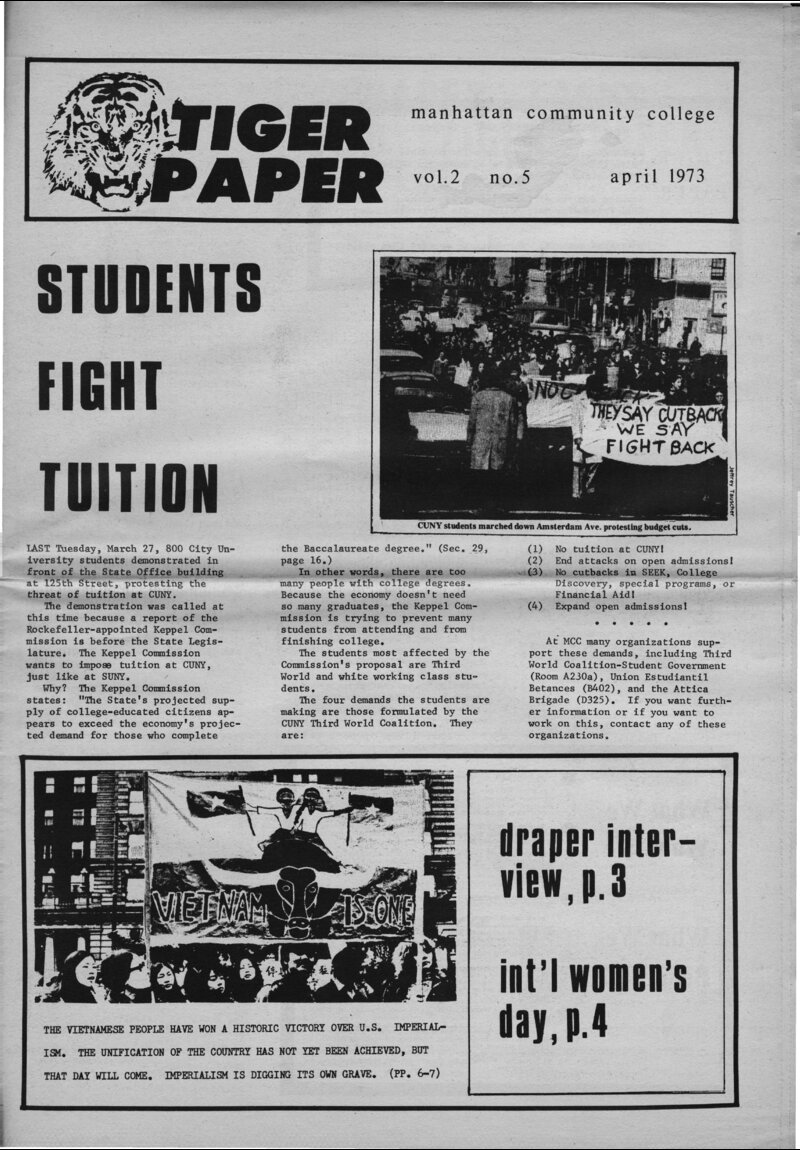
LAST Tuesday, March 27, 800 City Un-
iversity students demonstrated in
front of the State Office building
at 125th Street, protesting the
threat of tuition at CUNY.
The demonstration was called at
this time because a report of the
Rockefeller-appointed Keppel Com-
mission is before the State Legis-
lature. The Keppel Commission
wants to impose tuition at CUNY,
just like at SUNY.
Why? The Keppel Commission
states: "The State's projected sup-
ply of college-educated citizens ap-
pears to exceed the economy's projec-
ted demand for those who complete
manhatt
vol.2
CUNY students marched down Amsterdam Ave. protesting budget cuts.
the Baccalaureate degree." (Sec. 29,
page 16.)
In other words, there are too
many people with college degrees.
Because the economy doesn't need
so many graduates, the Keppel Com-
mission is trying to prevent many
students from attending and from
finishing college.
The students most affected by the
Commission's proposal are Third
World and white working class stu-
dents.
The four demands the students are
making are those formulated by the
CUNY Third World Coalition. They
are:
THE VIETNAMESE PEOPLE HAVE WON A HISTORIC VICTORY OVER U.S. IMPERIAL—
ISM. THE UNIFICATION OF THE COUNTRY HAS NOT YET BEEN ACHIEVED, BUT
THAT DAY WILL COME, IMPERIALISM IS DIGGING ITS OWN GRAVE. (PP. 6-7)
an community college
no.5 april 1973
sayrsne, AaaHar
cea tata
(1) No tuition at CUNY!
(2) End attacks on open admissions!
~(3). No cutbacks in SEEK, College
Discovery, special programs, or
Financial Aid!
(4) Expand open admissions!
At MCC many organizations sup-
port these demands, including Third
World Coalition-Student Government
(Room A230a), Union Estudiantil
Betances (B402), and the Attica
Brigade (D325). If you want furth-
er information or if you want to
work on this, contact any of these
organizations,
draper inter-
vieW p.3
int'l women’s
lay, p.4
=a
PAGE TWO
VOLUME 2, NUMBER THREE
TIGER
PAPER
ty and staff.
Tenured members of the collective:
DECEMBER, 1972
Tiger Paper is published whenever possible by an edit-
orial collective of Manhattan Community College facul-
Kathy Chamberlain,
Bill Friedheim, Mary Kellogg, Jim Perlstein, Naomi
Woronov.
Untenured members:
anonymous to protect them against
administrative harassment.
students and faculty
The President and his Deans are
stepping on people as if they were
afraid repression might go out of
style tomorrow.
In the past four weeks alone, we
have seen:
--mass arrests of students and fa-
culty who were engaged in legiti-
mate protest.
--wild raving by Dean Pittman,
open court, accusing arrested
students of membership in the
Black Liberation Army, murders of
police, and drug pushing.
--illegal suspensions of all
arrested students without a hear-
ing.
--delayed disciplinary hearings with-
out public notice, held at changing
times in changing locations.
--letters from the President and the
Deans whipping up hysteria around
alleged physical threats against
the faculty by students.
--interference with the content of
the syllabi and exams of faculty
members.
--efforts by the administration to
assemble political dossiers on
individual faculty.
6
What We
Want
What We
Believe
Administration threatens
The repressive tactics of the
administration aren't hard to ex-
plain. First, the administration is
unwilling to respond positively to
demands for a community-oriented
curriculum under joint student-fa-
culty control, because it would mean
the erosion of the administration's
own dictatorial powers. Second, the
administration is unwilling to
struggle to gain the additional funds
needed to meet the financial, medical,
legal and housing problems that stu-
dents bring with them from home.
Because the administration will
not respond to legitimate discontent
in a positive way, the administration
tries to crush it with lies, threats
and intimidation.
The administration doesn't care at
all that its tactics are usually il-
legal. The admnistration doesn't
care, because it knows that the police
and the courts and the Board of
Higher Education never question
whether arrests, summonses and sus-
pensions are called for. The admin-
istration knows that officialdom is
always considered right, and that
ordinary people are always considered
wrong.
(Cont'd top of next column)
in
WE SUPPORT THE LIBERATION STRUGGLES OF ALL OPPRESSED NATIONALITIES.
At MCC in 1973 this means that we actively support the struggle for
autonomous Black and Latin American Studies Departments, that we
oppose racism in all its forms, whether it be tracking, text and cur-
riculum bias, or administration-faculty attitudes.
WE SUPPORT THE FIGHT AGAINST IMPERIALIST WARS OF AGGRESSION, (BY
IMPERIALISM WE MEAN THE ECONOMIC &/OR POLITICAL &/OR CULTURAL CONTROL
OF ONE COUNTRY BY ANOTHER).
At MCC in 1973 this means that we actively support
campus struggles for an end to continued aggression in
Indochina. We actively support the strvgele for the
national liberation of Puerto Rico, and the struggles
for national liberation on the continent of Africa.
WE SUPPORT THE STRUGGLES FOR DEMOCRATIC RIGHTS AND OPPOSE THE
GROWTH OF FASCIST REPRESSION.
At MCC in 1973 this means that we support a governance proposal that
will give genuine power to students, staff and faculty. We demand an
end to the use of police, academic dismissal, and financial blackmail
as a way of solving problems.
WE SUPPORT THE FIGHT FOR THE LIBERATION OF WOMEN,
At MCC in 1973 this means that we actively support free health care
and counseling for all MCC people, a greater leadership role for
women at the college, continuation and expansion of child care and
women's studies, and an end to the tracking of women into clerical
programs.
WE SUPPORT THE STRUGGLE AGAINST RULING CLASS ATTACKS ON THE PEOPLES
LIVING STANDARDS.
At MCC in 19/3 this means that we actively support the demands for
higher wages and improved working conditions for staff and faculty.
We support expanded financial aid and expanded work-study at higher
pay for students. We support the struggle for a non-profit bookstore
and cafeteria. We support the struggle for free transportation for all
between campuses.
‘TIGER PAPER
* * * e+ % *% % % * %
It's true that sooner or later
there is some kind of a hearing,
Pittman gets laughed at, and the ri-
diculous charges--whatever they are--
get thrown out.
But in the meantime, students and
faculty have been harassed, tied up
in endless bureaucratic proceedings,
and denied their right to an educa-
tion or threatened with the loss of
their jobs.
But there isn't any reason to get
discouraged. There is a Black and a
Puerto Rican Studies Program. There
is a child care center. Students do
have greater control over their funds
in the BMCC Association. Jose Antonio
Irizarry has been rehired. In spite
of the harassment, the arrests and
the suspensions--over a number of
years now--people have struggled and
have won on many important issues.
FERRER RRRHRH
Letter to the editor
(In a letter to the faculty dated
March 1, President Draper stated,
"Representations have been made to
me that there exists considerable
concern and fear among members of
the faculty in reference to being
physically assaulted by students."
He requested that faculty “commun-
icate to my office any instances
when you have been either threaten-
ed or actually been the victim of
physical assault or violence by
anyone at the College."
The following letter speaks to
the issues raised by the President.)
To the editor of Tiger Paper:
A San Quentin Warden once said, "If
we would get a better class of in-
mates, we could run a better prison."
President Draper's March 1, 1973
letter addressed to the faculty re-
veals his weaknesses as a leader,
educator and administrator. His of-
fice can function only by alarming
his faculty and playing upon their
fears.
To assert his "authority", his pro-
mise to deal appropriately with all
"offenders" is an open invitation
for further harassment, intimidation
and provocation, which can only wid-
en the gap between the two classes--
teacher and student.
According to my experiences, as a
white, middle-aged, female fresh-
man, I have only wittnessed a real
working relationship between stu-
dents and educators--a desire to
learn on one side and an eagerness
to teach on the other.
The President's letter only serves
to undercut this relationship by
pitting faculty against students.
Frieda Josephs
636 Brooklyn Avenue
Brooklyn, New York
TIGER PAPER
ON THE RECENT ARRESTS:
Draper: I met, long before this
incident occured, with a group of
students. We had a very_nice con-1d
versation,. [But On FERIIS™ 7. They
were taking over the telephones and
when the calls would come in, ‘they
would say, "Black Studies", and it's
just that they had disrupted the of-
fice. We just couldn't function
there. Now, I think that's going
too far. One expected this’to hap-
pen back in the 60's but now students
have found new patterns in trying to
achieve their ends. And I certainly
would like for them to talk rather
than to resort to tactics of this
Mature...
I think that I do everything I
possibly can to talk to students.
I really do. I don't know whether
you're aware of it, but I deliber-
ately go out of this office to walk
down the hall, to sit in the lounge.
I TALK to students; I try to find out
what they're thinking. I walk over
into the Student Government Office
on occasion; I sit down with them.
Tiger Paper: I don't think that
calling in the police is going to
pave the way for better understand-
ing.
Draper: It's a terrible thing to do,
to call in the police. I agree with
you.
Tiger Paper: Why did you do it?
Draper: Because I felt that the stu-
dents had reached a point where they
couldn't listen to reason and they
were adversely affecting the total
college.
WHEN IS A DOOR NOT A DOOR? __
Draper: A lot of people don't think
my door's open. But my door has
really been open.
Tiger Paper: It was locked the other
day.
Draper: It certainly was.
But let me say this. Anybody who
wants to see the President can see
the President. But more than that,
I think that's true of the Dean of
the College, of the Dean of the Fac-
ulty. I think it's also true of the
Dean of Liberal Arts.
DRAPER
important.
issue.
us at ext. 3733.
ON THE SUSPENSIONS:
Tiger Paper: The students who were
arrested were also suspended, as I
understand it. Don't you think that
that constitutes double jeopardy,
being punished twice?
Draper: This question has often come
up for discussion. But the courts
take the view that they don't want
to hear these cases unless there has
been some kind of discjplinary action
by the college. It is for this rea-
son that the University set up
disciplinary procedures for all col-
leges to observe.
Tiger Paper: Shouldn't it be that
students would have a hearing first
and then be suspended if found guilty?
Why would they be suspended before
they had a hearing?
Draper: Under normal circumstances
what you're saying is the case.
There would be a hearing and the nor-
mal decision process would follow.
But where students are disrupting
the college, preventing the college
from operating effectively, we have
to do something immediately. And
that calls for immediate suspension.
Then their cases are heard....
Tiger Paper: Suspensions mean you
have to stay out of class, which |
means you overcut and fail the cour-
ses...
Draper: You're talking about the
regulation as to the limitation on
the number of absences. Oh yes,
that's true.
Tiger Paper: And then if the stu-
dents violated the suspensions and
came back, they could be arrested
again. It's like four possible pun-
TO. TIGER PAPER
On March 15th Tiger Paper interviewed Edgar Draper, Pres.
of MCC. Because the transcript of the talk is 21 pages
long, we excerpted a few of the comments we consider most
More of this interview will appear in the next
If you want to see the complete transcript, call
PAGE THREE -
TALK
ishments for simply sitting in your
office. It seems to me it's very ex-
treme punishment.
Draper: No teacher would ever fail
a student who was out because of
suspensions.
Tiger Paper: I've heard to the con-
trary.
Draper: No, this is not going to
happen. These are excused absences
and such students will certainly be
given consideration.
Tiger Paper: Can we quote you on
the excused absences?
Draper: I'll
consult with the Dean of Faculty and
if you think there's real confusion
we'll send out a memorandum to the
entire faculty.
JUST ASK...
Draper: ..-MCC is working on a splen-
did new campus. It's going to cost
about $64 million; it will be locat-
ed at Chambers Street and the West
Side Highway...-
Tiger Paper: Are you aware that some
of the students and faculty have
been saying that they think, in terms
of open admissions students, that
this location. is dan unsatisfactory |
location; that it's too far from a
lot of the neighborhoods that people
live in?
Draper: I would imagine that if the
community, or those neighborhoods,
would request a community college,
serious consideration would be given
to having community colleges in these
neighborhoods. I think those neigh-
borhoods ought to request the Board
of Higher Education to build commun-
ity colleges in those areas.
TATA A IE ST ESET A I LEE, PS ST SE ST ETS TS EI ESET FTA ELE LL ED,
‘As we go to press nothing
Z - has been done to improve
dooms M502 and302. )
Tiger Paper: What would you say ab-
out slum conditions at MCC? For ex-
ample, one classroom, M502, has an
enormous hole in the wall, and there
is a lot of noise because of plaster
and other things constantly falling
inside the wall.
Draper: "Slum"is an institutional
word that grows out of the sociolo-
gical analysis of a community. And
I don't think the 70th Street Assoc-
iation, of that building, would con-
‘sider that community a slum, But
there are conditions in that build-
ing that need to be improved. We
certainly have been working on them,
I'm not familiar with the room M502,
but we have been through that build-
ing to correct the most serious con-
ditions...Generally, we've taken care
of the serious problems in that build-
ing and I shall personally make a
visit tomorrow to M502 to see what
the problem‘is! Because I'm amazed
that there is a room in that build-
ing that you would consider a slum,
The large hole there, those things
continually dropping, and so on--
this amazed me. I shall check it
tomorrow and make sure it$ corrected.
Tiger Paper: The room below M502,
the reading laboratory, has big
holes in the wall also. I don't
think these kinds of conditions are
unique to room 502.
Draper: Well, I know that we've had
some difficulty with the facilities.
I suppose this college, as a commun-
ity college, is fortunate in compari-
son with many others. Many community
colleges in this country have gotten
started in barns, in out-of-the-way
places, but we got started in mid-
town Manhattan, one of the finest
facilities that one can find...
Reading Lab--M302
PAGE FOUR
INTER
ei
ON MARCH 7, over one hundred people
celebrated International Women's Day
at MCC. June Mosca, speaking for the
MCC Attica Brigade which sponsored
the event, gave a brief history of
the holiday. She emphasized that gen-
uine women's liberation cannot be won
without fighting to transform a soc-
iety which oppresses all working
Barbara Masekela
Barbara Masekela,:a South African
woman, gave a clear example of this
concept. She noted that in South Af-
rica Black women are legally owned by
their fathers, their husbands, or ev-
en by their sons, (if both father and
husband are dead). However, Barbara
said, women establish their position
as human beings not by fighting ag-
ainst their men, but by playing a sig-
nificant role in the political strug-
gles of their people--in a nation
where thousands of Black men are jail-
ed daily, and then forced to serve
their jail terms doing slave labor
for white farmers!
+
Vivian Rivera-Puerto Rican
Socialist Party
June Mosca-Attica Brigade
Sandra Jehnson-Black Workers’
ongress
Vivian Rivera of the Puerto Rican
Socialist Party also spoke of the imp-
ortance of not separating the liber-
ation struggles of women from those
of all oppressed people. But she not-
ed that male chauvinism has helped to
hold back the great strength and ab-
ilities of Puerto Rican women. These
attitudes also help uphold white sup-
remacy and imperialism here, in Puerto
Rico, and all over the world.
Vivian also talked about the spec-
ial kinds of oppression Third World
women suffer; for example, on the job,
and by being used as experimental
guinea pigs for American drug compan-
ies.
The wages of Third World women are
the lowest of any group of workers in
this country. Puerto Rican women of-
ten end up working under slave condi-
tions in New York's garment district.
Even these jobs are constantly jeopar-
dized by a company policy called "Run-
away Shops."
In the last three years, 141,000
workers in the garment industry have
lost their jobs. Rather than give
these workers a living wage, the com-
panies have moved their shops (the
"runaway shops')to the South, where
workers. are not yet so well organiz-
ed and can be forced to work for much
lower salaries.
Vivian went on to say that, with-
out their knowledge or consent, Third
World women are used as subjects for
drug experiments, In Puerto Rico
birth control pills were handed out
liberally (so they could be tested on
Puerto Rican women) ten years before
they were introduced on the American
market.
Sandra Johnson of the Black Workers
Congress talked about how women, esp-
ecially Third World women, are used
Youngest woman in the audience
TIGER PAPER
as a cheap labor force in the U.S.,
and are manipulated through welfare,
child care and workfare.
First, she said, Third World men
can only get jobs with salaries so
low thay cannot support their fami-
lies, Women, then, have to work to
support themselves and their children.
But their salaries are too low to
pay for babysitters, and they cannot
use the city day-care centers unless
they are on welfare.
If they then have to go on welfare,
there is a reason for this "service"
being available to them: now they
can be forced on to“workfare", that
is, to take jobs formerly held by
working women and perform them for no
salary--just to get their welfare
checks, Forbidden to join unions or
to organize in any way, they now do
the jobs of workers who had these
rights.
Sometimes women who have been fir-
ed from already low-paying jobs, or
who have been forced to quit because
they had no access to child care,
have found themselves, on workfare,
back at their old jobs for half the
money! :
After the speakers, the Attica
Brigade showed "The Women's Film",
which illustrates how the leadership
of working women in the women's lib-
eration movement is a great source of
strength for everyone.
WOMEN'S
LIBERATION:
2 DIRECTIONS
THE STRUGGLE for the liberation
of women in the U.S. today is moving
in two main directions. One line ap-
proaches women's liberation as an is-
sue separate from all others. The
other, recognizing that women cannot
be free in an unfree society, links
the liberation of women to the strug-
gles of all oppressed people in Amer-
ica.
The line that focuses on women a-
lone is a well-publicized movement. _
It is the fight for equal job oppor-
tunity, equal pay; for acceptance as
responsible human beings in the leg-
al, social, and political structure
of this country. It is the fight for
democratic rights under capitalism.
The importance of this segment of
the women's movement cannot be under-
estimated. Thousands of women through-
out the country raised the
consciousness that op pression and
exploitation of women
exist$ this movement contributed
greatly to the politicization of many
women and men. (cont'd page 8
TIGER PAPER
AT MCC
Sojourner Truth,
a Slave until 1827,
then a domestic servant--always a
great feminist and abolitionist--
spoke these words in response to a
minister who argued that women were
poor, helpless creatures not entit-
led to civil rights:
That man over there says women need
to be helped into carriages and lif-
ted over ditches, and to have the
best place everywhere. Nobody ever
helps me into carriages or over
puddles, or gives me the best place--
and ain't I a woman?
Look at this arm! I have ploughed
and planted and gathered into barns,
and no man could head me--and ain't
I a woman?
I could work as much and eat as much
as a man--when I could get it--and
bear the lash as well. And ain't I
a woman?
I have borne thirteen children, and
seén most of ‘em sold off to slavery,
and when I cried out with my mother's
grief, none but Jesus heard me. And
ain't I a woman?
(photo by Bay Area Worker)
Women’s Day in San Fiaiiale-steenvitbzonlon of
speech by ex-slave Sojourner Truth
March 8 was proclaimed an inter-
national working women's holiday in
1910 by the International Socialists
Congress. It was proposed in honor
of the women of New York's Lower
East Side who had been fighting since
1857 for improved working conditions.
PAGE FIVE
YESTERDAY AND TODAY
The ruling class in America promotes its own history, ideology and culture. The
history of those who have fought on the other side (the side of the masses of
working people) is very threatening. One especially threatening area is the his-
tory of the often militant pag ed in these struggles.
Currently, workers ig ico (85% of whom are
arah plants in Texas and
a vicious, i Q Aipic p tion from the
bosses' point
workers, i Q y mturer of pants-
and its h
cause the
like A & S's, ike support
as refused to ag
gathering strength here. The co
tive ba ning with the workers. They ear
more money is through the premiw
m sew on six belts a minute igwe
she is promised a few cents
living conditions are part of
There, le. ©9 a week
(for an a eerrid five to a room, with Oilet fac-
ilities, ynkeys, Poles, and Wops" st as in
the Farah p m introduced to speed ork, which led
8 workers,
in history. It
clash between the
half of whom
aroused public
strikers, scabs ai
The strike was successful greatly due
Q tactic was declared illegal
under martial law, readily d Oppenheim was inspired by
the Lawrence women to write the follow
As we come marching, marching in the beauty of the day,
A million darkened kitchens, a thousand mill lofts gray,
Are touched with all the radiance that a sudden sun discloses,
For the people hear us singing: "Bread and roses! Bread and Roses!
As we come marching, marching, we bring the greater days.
The rising of the women means the rising of the race.
No more the drudge and idler--ten that toil whereone reposes,
But a sharing of life's glories: Bread and roses! Bread and roses!
PAGE SIX
VICTORY
FOR
VIETNAM
PRESIDENTIAL SWEETALK about "peace
with honor" and the phony heroics of
carefully staged POW returns cannot
turn a U.S. defeat in Vietnam into a
victory.
Nixon is trying to fool us by
playing upon our understandable sym-
pathy for men long separated from
their families. The majority of
POW's, however, are elite Air Force
officers who volunteered to bomb
North Vietnam "back into the stone
age".
They failed. Yet Nixon has them
come back to brass bands, free auto-
mobiles and paid vacations because
he wants to cover up the defeat of
the U.S., and take attention off the
determined
to
struggle
determined
LWANT 1 THANK
AND
i}
CHIEF AUD HIS
“POLICY OF PEACE
other returning veterans--the hund-
reds of thousands of working class
and Third World soldiers who came
home as victims of this brutal war:
many of them addicted to heroin, ma-
ny more unable to find jobss over
50,000 maimed and crippled, and
49,000 dead.
The recently signed cease~fire
accords do not bring "peace with hon-
or" to the U.S. Instead they lay the
groundwork for a total victory by
the Vietnamese people in two impor-
tant ways: |
(1) They clear the path to re-
unification of the North and
South by establishing the prin-
ciple that Vietnam is a single,
TIGER PAPER
ete jee ces THE RN
IN CHEF
THANK You
TH
PeBterns
independent, sovereign nation.
(2) They call for withdrawal of
U.S. troops from South Vietnam
while those of the Democratic
Republic of Vietnam (North Viet-
nam) and the Provisional Revol-
utionary Government (PRG-
South Vietnam) remain in place.
Without U.S. air and ground forces,
the puppet Thieu regime might as well
pack its bags and head for the French
Riviera.
The Saigon dictatorship faces de-
feat on two fronts. Politically,
it does not have the popular support
mecessary to survive a peace. Mili-
tarily, if it decides to renew the
fighting by continuing its massive
violations of the accords, the lib-
eration forces will overwhelm it.
History shows that even massive
American military and economic aid
cannot prop up a puppet army that
has low morale, an incredibly high
desertion rate and a corrupt officer
corp (which sells most of its U.S.
equipment on the black market). It
is no match for a well disciplined
people's army whose high purpose
and self reliance enable it to make
infinitely more effective use of its
relatively limited resources.
The main enemy of the Vietnamese
people, however, is not Thieu. He
and his puppet government are only
front men who faithfully serve and
do the dirty work of the real enemy:
the small elite of monopoly capital-
ists who rule the U.S. and who try
to make super-profits off the backs
of hundreds of millions of people
throughout the world.
American imperialism, having suf-
fered a defeat in Indochina, is now
trying to reverse its losses by in-
creasing exploitation at home. That
is why the big defense contractors
cheer Nixon when he increases the
military budget by $5 billion and
cuts back over 100 social service
programs, The ordinary taxpayer
foots the bill.
There is a lesson in all of this.
If a tiny underdeveloped nation can
defeat the Goliath of American imp-
erialism overseas, then we can cut
it down to size here at home, too.
In the words of one famous revolu-
tionary, "Dare to struggle, dare to
win!"
sures Feiffer, Village Voice
TIGER PAPER
RIAL
IMONOPOLY CAPITA
.--Imperialism is a word that is often used,
but rarely defined. ‘If people are to come
to grips with what's going on in this world,
it is important that they understand what
imperialism means. That is why, in the ar-
ticle that follows, we try to explain what
it is, point out why it is so dangerous,
and show why its fall is inevitable...
PROFIT IS THE MOVING ‘force behind capitalism.
John D. Rockefeller (Nelson's grandfather) couldn't
stop after he made his first million. He went on to
make another three billion.
The big capitalist, just like the little one, can+
not survive unless he continues to turn a profit. Ev-
en the biggest of the big, a multi-billion dollar corp-
oration like General Motors, cannot let up. If it does,
its competitors, such as Ford and Toyota, will move in,
take over its markets, and drive it out of business.
Competition forces the capitalist to wheel and deal
endlessly for profit. If he falters, competition can
destroy him. Yet if he succeeds, his success brings
him face to face with an important contradiction built
‘into the capitalist system — overproduction and under-
comsumption.
An economy that puts profit before human need can-
not help but create tremendous extremes in wealth and
poverty. (In the U.S., for example, less than a dozen
corporations account for nearly 50% of the gross nat-
ional product. At the other end of the scale, the in-
dome of 50% of all American families falls below the
federal government's "maintenance level''--the average
income needed to maintain a family with the basic nec-
essities of life.) As a result, the corporate rich
have the wealth necessary to produce a tremendous am=-
ount of goods for the market. The poor, however, do
not have the money to buy them,
This contradiction becomes clearer when we see that
the capitalist, constantly pressed by his competition,
is forever trying to increase his profits by cutting
his labor costs. He does this by keeping wages to a
minimum and with the resulting profits, buying machines
that enable him to lay off part of his work force. He
now makes an even greater profit. The problem is that
the ordinary consumers,whose wages or unemployment
place a limit on what they can buy, do not have the
purchasing power to consume everything that an economy
based solely on profit is capable of producing.
To get out of this double bind of competition and
overproduction, the big capitalists
(1) force the small capitalists out of business
and create monopolies, so that they can control
production, prices, wages and markets, as well as
limiting competition to the giant corporations;
and
(2) expand overseas in order to control vital raw
materials, obtain new markets for goods that they
cannot sell at home, and find investment outlets
for their profits.
This stage of capitalism, the one we live under now,
is called monopoly capitalism. It is the highest stage
of capitalism and is the same thing as imperialism.
Ho Chi Minh, the father of the Vietnamese revolution,
put it most clearly, when he said that imperialism is
a two-headed leech, one head sucking the blood of wor-
kers and oppressed races at home and the other that of
colonized peoples abroad.
In its push for super profits, imperialism has
_killed two million Indochinese and 50,000 Americans in
South East Asia. It buys chromium (necessary for the
production of jet planes) from the racist Rhodesian
government, directly exploits Puerto Rico as a colony
and tries to overthrow a freely elected government in
Chile (the ITT-CIA scandal). Here in the U.S. it
spends billions on advertising to create an artificial
demand for useless and often harmful products such as
vaginal deodorants, cosmetics, Geritol and electric
toothbrushes--because that's where the big money is.
They don't build low cost ‘housing or needed schools be-
PAGE SEVEN
cause there are no super profits in that.
Monopoly capitalism brings the productive forces of
the system to their fullest development. A monopoly
such as General Motors, with its money, machines, ex-
perts and assembly line work force, can produce and
distribute more automobiles, more efficiently than
10,000 small capitalistscould putting together cars
by hand in backyard garages throughout the country.
But while GM is capable of producing cheap, long last-
ing, pollution-free automobiles, it won't. It is more
profitable to market shoddy and over-priced products.
Gillette has the technology to make a razor blade that
will last 50 years. However,we will never see it bec-
ause it would destroy Gillette as a money-making opera-
tion.
Monopoly capitalism has built productive forces that
are capable of freeing the world's entire population
from want and hunger. Instead, however, the system
uses technology to create instruments of death--napalm,
jet planes, "H'" bombs--and line the pockets of a few
imperialists with super profits.
If we look at recent history, we can see concretely
how basic contradictions in the imperialist system are
working to bring about its certain destruction.
Imperialism has set itself against the majority of
humankind. By expanding capitalist exploitation over-
seas, it overextends itself and makes enemies on many
fronts. At the same time, the drive for control of
the world's markets pits the imperialist powers (like
the U.S., Japan, West Germany) against one another,
weakens them and leaves them open to eventual defeat.
When the war in S.E. Asia weakened the American
dollar, the other big capitalist powers, particularly
Japan and West Germany, were quick to take advantage
and forced a devaluation. (In 1914 and again in 1939,
competition between imperialist powers actually esca-
lated into World Wars.)
The defeat of U.S.‘ imperialism in Vietnam has ser-
ved as an example and inspiration to other oppressed
peoples. A revolutionary tide is beginning to sweep
the Third World as liberation forces near victory in
Portugese Guinea, Angola and Mozambique (all in Africa)
and in Laos and Cambodia.
At home, the ruling circle of monopoly capitalists
creates still more enemies by making the masses of
working people pay for their losses abroad--with in-
flation, wage control, and cutbacks in government spen-
ding on housing, health, education and welfare, while
funding for defense is increased.
But people fight back--at Wounded Knee, in Watts
and Detroit, at Southern University and in the coal
mines of West Virginia, Pennsylvania and Kentucky.
Black and Brown workers take the lead in the hospital
unions, in the lettuce fields and grapevineyards of
California, in the Farah strike and in almost every
basic American industry. The struggle continues to
widen.
Imperialism is digging its own grave. The better
we organize, the more we fight, the sooner we can put
it to death.
TIGER PAPER
THE LOWDOWN ON
IT'S OUTRAGEOUS. MCC students did
not receive their fall grade reports
until March 7, nearly six weeks into
the spring semester. =
Worse yet, in spite of extra work
by people in the Registrar's office,
the reports are full of errors--incor-
rect grades, omission of courses tak-
en, wrongly computed grade-point aver-
ages. It may be months before most
of these errors are corrected, we were
told. Some may never be set right un-
less students themselves alert the
Registrar to possible mistakes.
The whole mess began a year ago
when the administration ordered, and
then totally bungled, a mail registra-
tion for the Fall 1972 semester. Be-
cause mail registrants never got any
official confirmation that they were
enrolled, many registered a second
time in September, not always for the
Same courses and sections.
Straightening out the double reg-
istrations slowed up the preparation
of accurate class lists (rosters).
So did the fact that an entire drawer
full of IBM cards for non-matriculat-
ing students was permanently lost
somewhere in the wilds between the M
Building on 70th St. and the A Build-
ing on 51st. Nearly 1000 registrations
had to be redone by hand in the Regis-
trar’s office.
Regular student drops and adds dur-
ing the first month of the Fall term
had to be processed, too, amidst con-
fusions caused by cancelled and newly
created sections.
womens
liheration:coxrp
from page four
The right of women to control their
own bodies, and the right to equal
pay for equal work are examples of
important struggles which are being
won by the many women working in this
direction. :
It's becoming increasingly clear,
though, that this line of the movement,
seeking women's democratic rights un-
der capitalism, is not dealing with
the fundamental oppression of women
as a whole. The middle-class and
mostly white women who are identified
as leaders of this part of the move-
ment emphasize those forms of oppres-
sion experienced by their own class.
On the abortion issue, for example,
they fight for women's right to ob-
tain abortions, but not for free a-
bortions, which would especially ben-
efit low-income women. In employment,
they seem to be fighting only for the
same privileges as middle-class men--
in other words, to get a few more
high positions for women like them-
selves. But adding a few women to
the top of the wage pyramid can do
nothing to improve the continually
worsening conditions of the majority
of women.
There is another force in the wom-
en's liberation movement, however,
that is moving to confront these con-
ditions. Seeing that women are ex-
ploited not only psychologically and
The people working in the Regis-
trar's office put in several Satur-
days trying to undo the mess caused
by the chaotic registrdtion and the
troubles in Data Processing. (They
didn't receive extra pay for this
work, but only "compensatory" time
off.) But when instructors turned
in final grades, there were still
about 1500 adds and 2000 drops to be
hand-processed in the Registrar's of-
fice, each involving several time-
consuming steps and possibilities for
new errors to creep in.
Nevertheless, the work could have
been done in time to issue grade re-
ports promptly--if the administration
hadn't set up two additional road-
blocks.
The first was scheduling the start
of the second semester--and a new re-
gistration--a week earlier than any
other school in CUNY.
The second, and main, reason for
the delay was Pres. Draper's get-tough
order that every single W grade--about
2000 of them--had to be checked to see
if the student either had officially
withdrawn from the course or was an
entering freshman. Every other W,
Draper ordered, had to be changed to
an F. Because the symbols indicating
entering-freshman status hadn't been
included on the rosters, some fresh-
All students who think that
their grade reports may con-
tain an error should file a
The
grade-challenge form.
forms are available at the
Registrar's office, A 307,
9 a.m.-5 p.m.
sexually, but also because of race,
or because of degrading, low-paying
job situations, this force in the
movement regards its struggles as a
vital part of the fight to change the
conditions of all oppressed people
in America. While trying to deal with
specifically women's issues and strug-
gling to change anti-woman attitudes
among ‘men, these women are fighting
side by side with men to change the
system. :
One clear example of the differ-
ence in direction between the middle-
class and working-class lines in the
women's movement can be seen in the
recent strike of the maids at Colum-
bia University.
The maids at Columbia were paid
$118 a week for the same work that
janitors did for $136. When the men
demanded higher wages they were told
they could be replaced by women who'd
take a lower salary. When the women
demanded wages equal to the men's, 23
of them were fired and replaced by 15
male workers.
Women's liberation groups on the
Columbia campus argued that the strike
was a women's issue only, and that
men should be excluded from the strug-
gle.
The maids themselves, however, saw
the issue as part of the larger work-
er's struggle, and insisted that the
janitors be included in decision-mak-
ing and action. This is the course
that was followed, and it was the
right one.
PAGE EIGHT
LATE GRADES
men entitled to W's got F's instead.
A get-tough order came down on
incompletes (I's) as well. Official
policy, made by the Faculty Council,
is that all incompletes must be made
up by the first day of the semester
following the one in which the I was
given. This rule, which is much str-
icter than at most other schools, was
never enforced before. Now it's be-
ing applied drastically, and without
warning to either students or faculty.
Many students who were given I's nev-
er even knew it, because the I's were
changed into F's before the grade re-
ports went out.
The inefficiency of Draper and his
administration is an insult and a
scandal. But the sudden get-tough
academic policy is a positive threat,
another hidden attack on Open Admis-
sions. Taken together with lack of
adequate financial aid, slum condi-
tions, and inadequate counseling ser-
vices, it means that MCC students
have to be practically superhuman to
survive. The school is run against
them, not for them. If the Board of
Higher Education wanted things to be
different, they would have gotten rid
of Draper and his crew long ago.
@09OS80
Evening students who can-
not get to the Registrar's
office before 5 p.m. should
call (262-3580) and ask that
a form be sent to them.
Through this united struggle, the
men came to understand how their
slightly higher salaries and token
privileges were used against them.
With working-class women in the lead-
ership, the workers saved the jobs
of the 23 maids and also those of
the 15 newly hired janitors. In the
future, the university will not be
able to pit the men ‘against the wom-
en in their fight for better condi-
tions. Clearly, seeing women's is-
sues as part of the workers' move-
ment benefits everyone.
Newspapers, magazines, and TV por-
tray the women's movement as totally
middle class, and ignore the strug-
gles of Third World and white working-
class women. This is no accident.
The media serve the interests of the
capitalist structure. If pressured
to do so, the capitalist system can
survive the addition of a few women
to its corporate and governmental
elite. But capitalism cannot afford
to lose great numbers of women as
home-oriented and beauty-oriented
consumers, or as the cheapest and
most easily available reserve labor
force.
It certainly cannot afford the
threat which would be posed by women
fighting together, and along with
men, for a better life for themselves
and for all people--a solution that
would change this whole capitalist
society.
POSH SHHSISSSTSSOSHHOGS
FIGHT
TUITION
LAST Tuesday, March 27, 800 City Un-
iversity students demonstrated in
front of the State Office building
at 125th Street, protesting the
threat of tuition at CUNY.
The demonstration was called at
this time because a report of the
Rockefeller-appointed Keppel Com-
mission is before the State Legis-
lature. The Keppel Commission
wants to impose tuition at CUNY,
just like at SUNY.
Why? The Keppel Commission
states: "The State's projected sup-
ply of college-educated citizens ap-
pears to exceed the economy's projec-
ted demand for those who complete
manhatt
vol.2
CUNY students marched down Amsterdam Ave. protesting budget cuts.
the Baccalaureate degree." (Sec. 29,
page 16.)
In other words, there are too
many people with college degrees.
Because the economy doesn't need
so many graduates, the Keppel Com-
mission is trying to prevent many
students from attending and from
finishing college.
The students most affected by the
Commission's proposal are Third
World and white working class stu-
dents.
The four demands the students are
making are those formulated by the
CUNY Third World Coalition. They
are:
THE VIETNAMESE PEOPLE HAVE WON A HISTORIC VICTORY OVER U.S. IMPERIAL—
ISM. THE UNIFICATION OF THE COUNTRY HAS NOT YET BEEN ACHIEVED, BUT
THAT DAY WILL COME, IMPERIALISM IS DIGGING ITS OWN GRAVE. (PP. 6-7)
an community college
no.5 april 1973
sayrsne, AaaHar
cea tata
(1) No tuition at CUNY!
(2) End attacks on open admissions!
~(3). No cutbacks in SEEK, College
Discovery, special programs, or
Financial Aid!
(4) Expand open admissions!
At MCC many organizations sup-
port these demands, including Third
World Coalition-Student Government
(Room A230a), Union Estudiantil
Betances (B402), and the Attica
Brigade (D325). If you want furth-
er information or if you want to
work on this, contact any of these
organizations,
draper inter-
vieW p.3
int'l women’s
lay, p.4
=a
PAGE TWO
VOLUME 2, NUMBER THREE
TIGER
PAPER
ty and staff.
Tenured members of the collective:
DECEMBER, 1972
Tiger Paper is published whenever possible by an edit-
orial collective of Manhattan Community College facul-
Kathy Chamberlain,
Bill Friedheim, Mary Kellogg, Jim Perlstein, Naomi
Woronov.
Untenured members:
anonymous to protect them against
administrative harassment.
students and faculty
The President and his Deans are
stepping on people as if they were
afraid repression might go out of
style tomorrow.
In the past four weeks alone, we
have seen:
--mass arrests of students and fa-
culty who were engaged in legiti-
mate protest.
--wild raving by Dean Pittman,
open court, accusing arrested
students of membership in the
Black Liberation Army, murders of
police, and drug pushing.
--illegal suspensions of all
arrested students without a hear-
ing.
--delayed disciplinary hearings with-
out public notice, held at changing
times in changing locations.
--letters from the President and the
Deans whipping up hysteria around
alleged physical threats against
the faculty by students.
--interference with the content of
the syllabi and exams of faculty
members.
--efforts by the administration to
assemble political dossiers on
individual faculty.
6
What We
Want
What We
Believe
Administration threatens
The repressive tactics of the
administration aren't hard to ex-
plain. First, the administration is
unwilling to respond positively to
demands for a community-oriented
curriculum under joint student-fa-
culty control, because it would mean
the erosion of the administration's
own dictatorial powers. Second, the
administration is unwilling to
struggle to gain the additional funds
needed to meet the financial, medical,
legal and housing problems that stu-
dents bring with them from home.
Because the administration will
not respond to legitimate discontent
in a positive way, the administration
tries to crush it with lies, threats
and intimidation.
The administration doesn't care at
all that its tactics are usually il-
legal. The admnistration doesn't
care, because it knows that the police
and the courts and the Board of
Higher Education never question
whether arrests, summonses and sus-
pensions are called for. The admin-
istration knows that officialdom is
always considered right, and that
ordinary people are always considered
wrong.
(Cont'd top of next column)
in
WE SUPPORT THE LIBERATION STRUGGLES OF ALL OPPRESSED NATIONALITIES.
At MCC in 1973 this means that we actively support the struggle for
autonomous Black and Latin American Studies Departments, that we
oppose racism in all its forms, whether it be tracking, text and cur-
riculum bias, or administration-faculty attitudes.
WE SUPPORT THE FIGHT AGAINST IMPERIALIST WARS OF AGGRESSION, (BY
IMPERIALISM WE MEAN THE ECONOMIC &/OR POLITICAL &/OR CULTURAL CONTROL
OF ONE COUNTRY BY ANOTHER).
At MCC in 1973 this means that we actively support
campus struggles for an end to continued aggression in
Indochina. We actively support the strvgele for the
national liberation of Puerto Rico, and the struggles
for national liberation on the continent of Africa.
WE SUPPORT THE STRUGGLES FOR DEMOCRATIC RIGHTS AND OPPOSE THE
GROWTH OF FASCIST REPRESSION.
At MCC in 1973 this means that we support a governance proposal that
will give genuine power to students, staff and faculty. We demand an
end to the use of police, academic dismissal, and financial blackmail
as a way of solving problems.
WE SUPPORT THE FIGHT FOR THE LIBERATION OF WOMEN,
At MCC in 1973 this means that we actively support free health care
and counseling for all MCC people, a greater leadership role for
women at the college, continuation and expansion of child care and
women's studies, and an end to the tracking of women into clerical
programs.
WE SUPPORT THE STRUGGLE AGAINST RULING CLASS ATTACKS ON THE PEOPLES
LIVING STANDARDS.
At MCC in 19/3 this means that we actively support the demands for
higher wages and improved working conditions for staff and faculty.
We support expanded financial aid and expanded work-study at higher
pay for students. We support the struggle for a non-profit bookstore
and cafeteria. We support the struggle for free transportation for all
between campuses.
‘TIGER PAPER
* * * e+ % *% % % * %
It's true that sooner or later
there is some kind of a hearing,
Pittman gets laughed at, and the ri-
diculous charges--whatever they are--
get thrown out.
But in the meantime, students and
faculty have been harassed, tied up
in endless bureaucratic proceedings,
and denied their right to an educa-
tion or threatened with the loss of
their jobs.
But there isn't any reason to get
discouraged. There is a Black and a
Puerto Rican Studies Program. There
is a child care center. Students do
have greater control over their funds
in the BMCC Association. Jose Antonio
Irizarry has been rehired. In spite
of the harassment, the arrests and
the suspensions--over a number of
years now--people have struggled and
have won on many important issues.
FERRER RRRHRH
Letter to the editor
(In a letter to the faculty dated
March 1, President Draper stated,
"Representations have been made to
me that there exists considerable
concern and fear among members of
the faculty in reference to being
physically assaulted by students."
He requested that faculty “commun-
icate to my office any instances
when you have been either threaten-
ed or actually been the victim of
physical assault or violence by
anyone at the College."
The following letter speaks to
the issues raised by the President.)
To the editor of Tiger Paper:
A San Quentin Warden once said, "If
we would get a better class of in-
mates, we could run a better prison."
President Draper's March 1, 1973
letter addressed to the faculty re-
veals his weaknesses as a leader,
educator and administrator. His of-
fice can function only by alarming
his faculty and playing upon their
fears.
To assert his "authority", his pro-
mise to deal appropriately with all
"offenders" is an open invitation
for further harassment, intimidation
and provocation, which can only wid-
en the gap between the two classes--
teacher and student.
According to my experiences, as a
white, middle-aged, female fresh-
man, I have only wittnessed a real
working relationship between stu-
dents and educators--a desire to
learn on one side and an eagerness
to teach on the other.
The President's letter only serves
to undercut this relationship by
pitting faculty against students.
Frieda Josephs
636 Brooklyn Avenue
Brooklyn, New York
TIGER PAPER
ON THE RECENT ARRESTS:
Draper: I met, long before this
incident occured, with a group of
students. We had a very_nice con-1d
versation,. [But On FERIIS™ 7. They
were taking over the telephones and
when the calls would come in, ‘they
would say, "Black Studies", and it's
just that they had disrupted the of-
fice. We just couldn't function
there. Now, I think that's going
too far. One expected this’to hap-
pen back in the 60's but now students
have found new patterns in trying to
achieve their ends. And I certainly
would like for them to talk rather
than to resort to tactics of this
Mature...
I think that I do everything I
possibly can to talk to students.
I really do. I don't know whether
you're aware of it, but I deliber-
ately go out of this office to walk
down the hall, to sit in the lounge.
I TALK to students; I try to find out
what they're thinking. I walk over
into the Student Government Office
on occasion; I sit down with them.
Tiger Paper: I don't think that
calling in the police is going to
pave the way for better understand-
ing.
Draper: It's a terrible thing to do,
to call in the police. I agree with
you.
Tiger Paper: Why did you do it?
Draper: Because I felt that the stu-
dents had reached a point where they
couldn't listen to reason and they
were adversely affecting the total
college.
WHEN IS A DOOR NOT A DOOR? __
Draper: A lot of people don't think
my door's open. But my door has
really been open.
Tiger Paper: It was locked the other
day.
Draper: It certainly was.
But let me say this. Anybody who
wants to see the President can see
the President. But more than that,
I think that's true of the Dean of
the College, of the Dean of the Fac-
ulty. I think it's also true of the
Dean of Liberal Arts.
DRAPER
important.
issue.
us at ext. 3733.
ON THE SUSPENSIONS:
Tiger Paper: The students who were
arrested were also suspended, as I
understand it. Don't you think that
that constitutes double jeopardy,
being punished twice?
Draper: This question has often come
up for discussion. But the courts
take the view that they don't want
to hear these cases unless there has
been some kind of discjplinary action
by the college. It is for this rea-
son that the University set up
disciplinary procedures for all col-
leges to observe.
Tiger Paper: Shouldn't it be that
students would have a hearing first
and then be suspended if found guilty?
Why would they be suspended before
they had a hearing?
Draper: Under normal circumstances
what you're saying is the case.
There would be a hearing and the nor-
mal decision process would follow.
But where students are disrupting
the college, preventing the college
from operating effectively, we have
to do something immediately. And
that calls for immediate suspension.
Then their cases are heard....
Tiger Paper: Suspensions mean you
have to stay out of class, which |
means you overcut and fail the cour-
ses...
Draper: You're talking about the
regulation as to the limitation on
the number of absences. Oh yes,
that's true.
Tiger Paper: And then if the stu-
dents violated the suspensions and
came back, they could be arrested
again. It's like four possible pun-
TO. TIGER PAPER
On March 15th Tiger Paper interviewed Edgar Draper, Pres.
of MCC. Because the transcript of the talk is 21 pages
long, we excerpted a few of the comments we consider most
More of this interview will appear in the next
If you want to see the complete transcript, call
PAGE THREE -
TALK
ishments for simply sitting in your
office. It seems to me it's very ex-
treme punishment.
Draper: No teacher would ever fail
a student who was out because of
suspensions.
Tiger Paper: I've heard to the con-
trary.
Draper: No, this is not going to
happen. These are excused absences
and such students will certainly be
given consideration.
Tiger Paper: Can we quote you on
the excused absences?
Draper: I'll
consult with the Dean of Faculty and
if you think there's real confusion
we'll send out a memorandum to the
entire faculty.
JUST ASK...
Draper: ..-MCC is working on a splen-
did new campus. It's going to cost
about $64 million; it will be locat-
ed at Chambers Street and the West
Side Highway...-
Tiger Paper: Are you aware that some
of the students and faculty have
been saying that they think, in terms
of open admissions students, that
this location. is dan unsatisfactory |
location; that it's too far from a
lot of the neighborhoods that people
live in?
Draper: I would imagine that if the
community, or those neighborhoods,
would request a community college,
serious consideration would be given
to having community colleges in these
neighborhoods. I think those neigh-
borhoods ought to request the Board
of Higher Education to build commun-
ity colleges in those areas.
TATA A IE ST ESET A I LEE, PS ST SE ST ETS TS EI ESET FTA ELE LL ED,
‘As we go to press nothing
Z - has been done to improve
dooms M502 and302. )
Tiger Paper: What would you say ab-
out slum conditions at MCC? For ex-
ample, one classroom, M502, has an
enormous hole in the wall, and there
is a lot of noise because of plaster
and other things constantly falling
inside the wall.
Draper: "Slum"is an institutional
word that grows out of the sociolo-
gical analysis of a community. And
I don't think the 70th Street Assoc-
iation, of that building, would con-
‘sider that community a slum, But
there are conditions in that build-
ing that need to be improved. We
certainly have been working on them,
I'm not familiar with the room M502,
but we have been through that build-
ing to correct the most serious con-
ditions...Generally, we've taken care
of the serious problems in that build-
ing and I shall personally make a
visit tomorrow to M502 to see what
the problem‘is! Because I'm amazed
that there is a room in that build-
ing that you would consider a slum,
The large hole there, those things
continually dropping, and so on--
this amazed me. I shall check it
tomorrow and make sure it$ corrected.
Tiger Paper: The room below M502,
the reading laboratory, has big
holes in the wall also. I don't
think these kinds of conditions are
unique to room 502.
Draper: Well, I know that we've had
some difficulty with the facilities.
I suppose this college, as a commun-
ity college, is fortunate in compari-
son with many others. Many community
colleges in this country have gotten
started in barns, in out-of-the-way
places, but we got started in mid-
town Manhattan, one of the finest
facilities that one can find...
Reading Lab--M302
PAGE FOUR
INTER
ei
ON MARCH 7, over one hundred people
celebrated International Women's Day
at MCC. June Mosca, speaking for the
MCC Attica Brigade which sponsored
the event, gave a brief history of
the holiday. She emphasized that gen-
uine women's liberation cannot be won
without fighting to transform a soc-
iety which oppresses all working
Barbara Masekela
Barbara Masekela,:a South African
woman, gave a clear example of this
concept. She noted that in South Af-
rica Black women are legally owned by
their fathers, their husbands, or ev-
en by their sons, (if both father and
husband are dead). However, Barbara
said, women establish their position
as human beings not by fighting ag-
ainst their men, but by playing a sig-
nificant role in the political strug-
gles of their people--in a nation
where thousands of Black men are jail-
ed daily, and then forced to serve
their jail terms doing slave labor
for white farmers!
+
Vivian Rivera-Puerto Rican
Socialist Party
June Mosca-Attica Brigade
Sandra Jehnson-Black Workers’
ongress
Vivian Rivera of the Puerto Rican
Socialist Party also spoke of the imp-
ortance of not separating the liber-
ation struggles of women from those
of all oppressed people. But she not-
ed that male chauvinism has helped to
hold back the great strength and ab-
ilities of Puerto Rican women. These
attitudes also help uphold white sup-
remacy and imperialism here, in Puerto
Rico, and all over the world.
Vivian also talked about the spec-
ial kinds of oppression Third World
women suffer; for example, on the job,
and by being used as experimental
guinea pigs for American drug compan-
ies.
The wages of Third World women are
the lowest of any group of workers in
this country. Puerto Rican women of-
ten end up working under slave condi-
tions in New York's garment district.
Even these jobs are constantly jeopar-
dized by a company policy called "Run-
away Shops."
In the last three years, 141,000
workers in the garment industry have
lost their jobs. Rather than give
these workers a living wage, the com-
panies have moved their shops (the
"runaway shops')to the South, where
workers. are not yet so well organiz-
ed and can be forced to work for much
lower salaries.
Vivian went on to say that, with-
out their knowledge or consent, Third
World women are used as subjects for
drug experiments, In Puerto Rico
birth control pills were handed out
liberally (so they could be tested on
Puerto Rican women) ten years before
they were introduced on the American
market.
Sandra Johnson of the Black Workers
Congress talked about how women, esp-
ecially Third World women, are used
Youngest woman in the audience
TIGER PAPER
as a cheap labor force in the U.S.,
and are manipulated through welfare,
child care and workfare.
First, she said, Third World men
can only get jobs with salaries so
low thay cannot support their fami-
lies, Women, then, have to work to
support themselves and their children.
But their salaries are too low to
pay for babysitters, and they cannot
use the city day-care centers unless
they are on welfare.
If they then have to go on welfare,
there is a reason for this "service"
being available to them: now they
can be forced on to“workfare", that
is, to take jobs formerly held by
working women and perform them for no
salary--just to get their welfare
checks, Forbidden to join unions or
to organize in any way, they now do
the jobs of workers who had these
rights.
Sometimes women who have been fir-
ed from already low-paying jobs, or
who have been forced to quit because
they had no access to child care,
have found themselves, on workfare,
back at their old jobs for half the
money! :
After the speakers, the Attica
Brigade showed "The Women's Film",
which illustrates how the leadership
of working women in the women's lib-
eration movement is a great source of
strength for everyone.
WOMEN'S
LIBERATION:
2 DIRECTIONS
THE STRUGGLE for the liberation
of women in the U.S. today is moving
in two main directions. One line ap-
proaches women's liberation as an is-
sue separate from all others. The
other, recognizing that women cannot
be free in an unfree society, links
the liberation of women to the strug-
gles of all oppressed people in Amer-
ica.
The line that focuses on women a-
lone is a well-publicized movement. _
It is the fight for equal job oppor-
tunity, equal pay; for acceptance as
responsible human beings in the leg-
al, social, and political structure
of this country. It is the fight for
democratic rights under capitalism.
The importance of this segment of
the women's movement cannot be under-
estimated. Thousands of women through-
out the country raised the
consciousness that op pression and
exploitation of women
exist$ this movement contributed
greatly to the politicization of many
women and men. (cont'd page 8
TIGER PAPER
AT MCC
Sojourner Truth,
a Slave until 1827,
then a domestic servant--always a
great feminist and abolitionist--
spoke these words in response to a
minister who argued that women were
poor, helpless creatures not entit-
led to civil rights:
That man over there says women need
to be helped into carriages and lif-
ted over ditches, and to have the
best place everywhere. Nobody ever
helps me into carriages or over
puddles, or gives me the best place--
and ain't I a woman?
Look at this arm! I have ploughed
and planted and gathered into barns,
and no man could head me--and ain't
I a woman?
I could work as much and eat as much
as a man--when I could get it--and
bear the lash as well. And ain't I
a woman?
I have borne thirteen children, and
seén most of ‘em sold off to slavery,
and when I cried out with my mother's
grief, none but Jesus heard me. And
ain't I a woman?
(photo by Bay Area Worker)
Women’s Day in San Fiaiiale-steenvitbzonlon of
speech by ex-slave Sojourner Truth
March 8 was proclaimed an inter-
national working women's holiday in
1910 by the International Socialists
Congress. It was proposed in honor
of the women of New York's Lower
East Side who had been fighting since
1857 for improved working conditions.
PAGE FIVE
YESTERDAY AND TODAY
The ruling class in America promotes its own history, ideology and culture. The
history of those who have fought on the other side (the side of the masses of
working people) is very threatening. One especially threatening area is the his-
tory of the often militant pag ed in these struggles.
Currently, workers ig ico (85% of whom are
arah plants in Texas and
a vicious, i Q Aipic p tion from the
bosses' point
workers, i Q y mturer of pants-
and its h
cause the
like A & S's, ike support
as refused to ag
gathering strength here. The co
tive ba ning with the workers. They ear
more money is through the premiw
m sew on six belts a minute igwe
she is promised a few cents
living conditions are part of
There, le. ©9 a week
(for an a eerrid five to a room, with Oilet fac-
ilities, ynkeys, Poles, and Wops" st as in
the Farah p m introduced to speed ork, which led
8 workers,
in history. It
clash between the
half of whom
aroused public
strikers, scabs ai
The strike was successful greatly due
Q tactic was declared illegal
under martial law, readily d Oppenheim was inspired by
the Lawrence women to write the follow
As we come marching, marching in the beauty of the day,
A million darkened kitchens, a thousand mill lofts gray,
Are touched with all the radiance that a sudden sun discloses,
For the people hear us singing: "Bread and roses! Bread and Roses!
As we come marching, marching, we bring the greater days.
The rising of the women means the rising of the race.
No more the drudge and idler--ten that toil whereone reposes,
But a sharing of life's glories: Bread and roses! Bread and roses!
PAGE SIX
VICTORY
FOR
VIETNAM
PRESIDENTIAL SWEETALK about "peace
with honor" and the phony heroics of
carefully staged POW returns cannot
turn a U.S. defeat in Vietnam into a
victory.
Nixon is trying to fool us by
playing upon our understandable sym-
pathy for men long separated from
their families. The majority of
POW's, however, are elite Air Force
officers who volunteered to bomb
North Vietnam "back into the stone
age".
They failed. Yet Nixon has them
come back to brass bands, free auto-
mobiles and paid vacations because
he wants to cover up the defeat of
the U.S., and take attention off the
determined
to
struggle
determined
LWANT 1 THANK
AND
i}
CHIEF AUD HIS
“POLICY OF PEACE
other returning veterans--the hund-
reds of thousands of working class
and Third World soldiers who came
home as victims of this brutal war:
many of them addicted to heroin, ma-
ny more unable to find jobss over
50,000 maimed and crippled, and
49,000 dead.
The recently signed cease~fire
accords do not bring "peace with hon-
or" to the U.S. Instead they lay the
groundwork for a total victory by
the Vietnamese people in two impor-
tant ways: |
(1) They clear the path to re-
unification of the North and
South by establishing the prin-
ciple that Vietnam is a single,
TIGER PAPER
ete jee ces THE RN
IN CHEF
THANK You
TH
PeBterns
independent, sovereign nation.
(2) They call for withdrawal of
U.S. troops from South Vietnam
while those of the Democratic
Republic of Vietnam (North Viet-
nam) and the Provisional Revol-
utionary Government (PRG-
South Vietnam) remain in place.
Without U.S. air and ground forces,
the puppet Thieu regime might as well
pack its bags and head for the French
Riviera.
The Saigon dictatorship faces de-
feat on two fronts. Politically,
it does not have the popular support
mecessary to survive a peace. Mili-
tarily, if it decides to renew the
fighting by continuing its massive
violations of the accords, the lib-
eration forces will overwhelm it.
History shows that even massive
American military and economic aid
cannot prop up a puppet army that
has low morale, an incredibly high
desertion rate and a corrupt officer
corp (which sells most of its U.S.
equipment on the black market). It
is no match for a well disciplined
people's army whose high purpose
and self reliance enable it to make
infinitely more effective use of its
relatively limited resources.
The main enemy of the Vietnamese
people, however, is not Thieu. He
and his puppet government are only
front men who faithfully serve and
do the dirty work of the real enemy:
the small elite of monopoly capital-
ists who rule the U.S. and who try
to make super-profits off the backs
of hundreds of millions of people
throughout the world.
American imperialism, having suf-
fered a defeat in Indochina, is now
trying to reverse its losses by in-
creasing exploitation at home. That
is why the big defense contractors
cheer Nixon when he increases the
military budget by $5 billion and
cuts back over 100 social service
programs, The ordinary taxpayer
foots the bill.
There is a lesson in all of this.
If a tiny underdeveloped nation can
defeat the Goliath of American imp-
erialism overseas, then we can cut
it down to size here at home, too.
In the words of one famous revolu-
tionary, "Dare to struggle, dare to
win!"
sures Feiffer, Village Voice
TIGER PAPER
RIAL
IMONOPOLY CAPITA
.--Imperialism is a word that is often used,
but rarely defined. ‘If people are to come
to grips with what's going on in this world,
it is important that they understand what
imperialism means. That is why, in the ar-
ticle that follows, we try to explain what
it is, point out why it is so dangerous,
and show why its fall is inevitable...
PROFIT IS THE MOVING ‘force behind capitalism.
John D. Rockefeller (Nelson's grandfather) couldn't
stop after he made his first million. He went on to
make another three billion.
The big capitalist, just like the little one, can+
not survive unless he continues to turn a profit. Ev-
en the biggest of the big, a multi-billion dollar corp-
oration like General Motors, cannot let up. If it does,
its competitors, such as Ford and Toyota, will move in,
take over its markets, and drive it out of business.
Competition forces the capitalist to wheel and deal
endlessly for profit. If he falters, competition can
destroy him. Yet if he succeeds, his success brings
him face to face with an important contradiction built
‘into the capitalist system — overproduction and under-
comsumption.
An economy that puts profit before human need can-
not help but create tremendous extremes in wealth and
poverty. (In the U.S., for example, less than a dozen
corporations account for nearly 50% of the gross nat-
ional product. At the other end of the scale, the in-
dome of 50% of all American families falls below the
federal government's "maintenance level''--the average
income needed to maintain a family with the basic nec-
essities of life.) As a result, the corporate rich
have the wealth necessary to produce a tremendous am=-
ount of goods for the market. The poor, however, do
not have the money to buy them,
This contradiction becomes clearer when we see that
the capitalist, constantly pressed by his competition,
is forever trying to increase his profits by cutting
his labor costs. He does this by keeping wages to a
minimum and with the resulting profits, buying machines
that enable him to lay off part of his work force. He
now makes an even greater profit. The problem is that
the ordinary consumers,whose wages or unemployment
place a limit on what they can buy, do not have the
purchasing power to consume everything that an economy
based solely on profit is capable of producing.
To get out of this double bind of competition and
overproduction, the big capitalists
(1) force the small capitalists out of business
and create monopolies, so that they can control
production, prices, wages and markets, as well as
limiting competition to the giant corporations;
and
(2) expand overseas in order to control vital raw
materials, obtain new markets for goods that they
cannot sell at home, and find investment outlets
for their profits.
This stage of capitalism, the one we live under now,
is called monopoly capitalism. It is the highest stage
of capitalism and is the same thing as imperialism.
Ho Chi Minh, the father of the Vietnamese revolution,
put it most clearly, when he said that imperialism is
a two-headed leech, one head sucking the blood of wor-
kers and oppressed races at home and the other that of
colonized peoples abroad.
In its push for super profits, imperialism has
_killed two million Indochinese and 50,000 Americans in
South East Asia. It buys chromium (necessary for the
production of jet planes) from the racist Rhodesian
government, directly exploits Puerto Rico as a colony
and tries to overthrow a freely elected government in
Chile (the ITT-CIA scandal). Here in the U.S. it
spends billions on advertising to create an artificial
demand for useless and often harmful products such as
vaginal deodorants, cosmetics, Geritol and electric
toothbrushes--because that's where the big money is.
They don't build low cost ‘housing or needed schools be-
PAGE SEVEN
cause there are no super profits in that.
Monopoly capitalism brings the productive forces of
the system to their fullest development. A monopoly
such as General Motors, with its money, machines, ex-
perts and assembly line work force, can produce and
distribute more automobiles, more efficiently than
10,000 small capitalistscould putting together cars
by hand in backyard garages throughout the country.
But while GM is capable of producing cheap, long last-
ing, pollution-free automobiles, it won't. It is more
profitable to market shoddy and over-priced products.
Gillette has the technology to make a razor blade that
will last 50 years. However,we will never see it bec-
ause it would destroy Gillette as a money-making opera-
tion.
Monopoly capitalism has built productive forces that
are capable of freeing the world's entire population
from want and hunger. Instead, however, the system
uses technology to create instruments of death--napalm,
jet planes, "H'" bombs--and line the pockets of a few
imperialists with super profits.
If we look at recent history, we can see concretely
how basic contradictions in the imperialist system are
working to bring about its certain destruction.
Imperialism has set itself against the majority of
humankind. By expanding capitalist exploitation over-
seas, it overextends itself and makes enemies on many
fronts. At the same time, the drive for control of
the world's markets pits the imperialist powers (like
the U.S., Japan, West Germany) against one another,
weakens them and leaves them open to eventual defeat.
When the war in S.E. Asia weakened the American
dollar, the other big capitalist powers, particularly
Japan and West Germany, were quick to take advantage
and forced a devaluation. (In 1914 and again in 1939,
competition between imperialist powers actually esca-
lated into World Wars.)
The defeat of U.S.‘ imperialism in Vietnam has ser-
ved as an example and inspiration to other oppressed
peoples. A revolutionary tide is beginning to sweep
the Third World as liberation forces near victory in
Portugese Guinea, Angola and Mozambique (all in Africa)
and in Laos and Cambodia.
At home, the ruling circle of monopoly capitalists
creates still more enemies by making the masses of
working people pay for their losses abroad--with in-
flation, wage control, and cutbacks in government spen-
ding on housing, health, education and welfare, while
funding for defense is increased.
But people fight back--at Wounded Knee, in Watts
and Detroit, at Southern University and in the coal
mines of West Virginia, Pennsylvania and Kentucky.
Black and Brown workers take the lead in the hospital
unions, in the lettuce fields and grapevineyards of
California, in the Farah strike and in almost every
basic American industry. The struggle continues to
widen.
Imperialism is digging its own grave. The better
we organize, the more we fight, the sooner we can put
it to death.
TIGER PAPER
THE LOWDOWN ON
IT'S OUTRAGEOUS. MCC students did
not receive their fall grade reports
until March 7, nearly six weeks into
the spring semester. =
Worse yet, in spite of extra work
by people in the Registrar's office,
the reports are full of errors--incor-
rect grades, omission of courses tak-
en, wrongly computed grade-point aver-
ages. It may be months before most
of these errors are corrected, we were
told. Some may never be set right un-
less students themselves alert the
Registrar to possible mistakes.
The whole mess began a year ago
when the administration ordered, and
then totally bungled, a mail registra-
tion for the Fall 1972 semester. Be-
cause mail registrants never got any
official confirmation that they were
enrolled, many registered a second
time in September, not always for the
Same courses and sections.
Straightening out the double reg-
istrations slowed up the preparation
of accurate class lists (rosters).
So did the fact that an entire drawer
full of IBM cards for non-matriculat-
ing students was permanently lost
somewhere in the wilds between the M
Building on 70th St. and the A Build-
ing on 51st. Nearly 1000 registrations
had to be redone by hand in the Regis-
trar’s office.
Regular student drops and adds dur-
ing the first month of the Fall term
had to be processed, too, amidst con-
fusions caused by cancelled and newly
created sections.
womens
liheration:coxrp
from page four
The right of women to control their
own bodies, and the right to equal
pay for equal work are examples of
important struggles which are being
won by the many women working in this
direction. :
It's becoming increasingly clear,
though, that this line of the movement,
seeking women's democratic rights un-
der capitalism, is not dealing with
the fundamental oppression of women
as a whole. The middle-class and
mostly white women who are identified
as leaders of this part of the move-
ment emphasize those forms of oppres-
sion experienced by their own class.
On the abortion issue, for example,
they fight for women's right to ob-
tain abortions, but not for free a-
bortions, which would especially ben-
efit low-income women. In employment,
they seem to be fighting only for the
same privileges as middle-class men--
in other words, to get a few more
high positions for women like them-
selves. But adding a few women to
the top of the wage pyramid can do
nothing to improve the continually
worsening conditions of the majority
of women.
There is another force in the wom-
en's liberation movement, however,
that is moving to confront these con-
ditions. Seeing that women are ex-
ploited not only psychologically and
The people working in the Regis-
trar's office put in several Satur-
days trying to undo the mess caused
by the chaotic registrdtion and the
troubles in Data Processing. (They
didn't receive extra pay for this
work, but only "compensatory" time
off.) But when instructors turned
in final grades, there were still
about 1500 adds and 2000 drops to be
hand-processed in the Registrar's of-
fice, each involving several time-
consuming steps and possibilities for
new errors to creep in.
Nevertheless, the work could have
been done in time to issue grade re-
ports promptly--if the administration
hadn't set up two additional road-
blocks.
The first was scheduling the start
of the second semester--and a new re-
gistration--a week earlier than any
other school in CUNY.
The second, and main, reason for
the delay was Pres. Draper's get-tough
order that every single W grade--about
2000 of them--had to be checked to see
if the student either had officially
withdrawn from the course or was an
entering freshman. Every other W,
Draper ordered, had to be changed to
an F. Because the symbols indicating
entering-freshman status hadn't been
included on the rosters, some fresh-
All students who think that
their grade reports may con-
tain an error should file a
The
grade-challenge form.
forms are available at the
Registrar's office, A 307,
9 a.m.-5 p.m.
sexually, but also because of race,
or because of degrading, low-paying
job situations, this force in the
movement regards its struggles as a
vital part of the fight to change the
conditions of all oppressed people
in America. While trying to deal with
specifically women's issues and strug-
gling to change anti-woman attitudes
among ‘men, these women are fighting
side by side with men to change the
system. :
One clear example of the differ-
ence in direction between the middle-
class and working-class lines in the
women's movement can be seen in the
recent strike of the maids at Colum-
bia University.
The maids at Columbia were paid
$118 a week for the same work that
janitors did for $136. When the men
demanded higher wages they were told
they could be replaced by women who'd
take a lower salary. When the women
demanded wages equal to the men's, 23
of them were fired and replaced by 15
male workers.
Women's liberation groups on the
Columbia campus argued that the strike
was a women's issue only, and that
men should be excluded from the strug-
gle.
The maids themselves, however, saw
the issue as part of the larger work-
er's struggle, and insisted that the
janitors be included in decision-mak-
ing and action. This is the course
that was followed, and it was the
right one.
PAGE EIGHT
LATE GRADES
men entitled to W's got F's instead.
A get-tough order came down on
incompletes (I's) as well. Official
policy, made by the Faculty Council,
is that all incompletes must be made
up by the first day of the semester
following the one in which the I was
given. This rule, which is much str-
icter than at most other schools, was
never enforced before. Now it's be-
ing applied drastically, and without
warning to either students or faculty.
Many students who were given I's nev-
er even knew it, because the I's were
changed into F's before the grade re-
ports went out.
The inefficiency of Draper and his
administration is an insult and a
scandal. But the sudden get-tough
academic policy is a positive threat,
another hidden attack on Open Admis-
sions. Taken together with lack of
adequate financial aid, slum condi-
tions, and inadequate counseling ser-
vices, it means that MCC students
have to be practically superhuman to
survive. The school is run against
them, not for them. If the Board of
Higher Education wanted things to be
different, they would have gotten rid
of Draper and his crew long ago.
@09OS80
Evening students who can-
not get to the Registrar's
office before 5 p.m. should
call (262-3580) and ask that
a form be sent to them.
Through this united struggle, the
men came to understand how their
slightly higher salaries and token
privileges were used against them.
With working-class women in the lead-
ership, the workers saved the jobs
of the 23 maids and also those of
the 15 newly hired janitors. In the
future, the university will not be
able to pit the men ‘against the wom-
en in their fight for better condi-
tions. Clearly, seeing women's is-
sues as part of the workers' move-
ment benefits everyone.
Newspapers, magazines, and TV por-
tray the women's movement as totally
middle class, and ignore the strug-
gles of Third World and white working-
class women. This is no accident.
The media serve the interests of the
capitalist structure. If pressured
to do so, the capitalist system can
survive the addition of a few women
to its corporate and governmental
elite. But capitalism cannot afford
to lose great numbers of women as
home-oriented and beauty-oriented
consumers, or as the cheapest and
most easily available reserve labor
force.
It certainly cannot afford the
threat which would be posed by women
fighting together, and along with
men, for a better life for themselves
and for all people--a solution that
would change this whole capitalist
society.
POSH SHHSISSSTSSOSHHOGS
Title
Tiger Paper, April 1973
Description
This issue of the Tiger Paper leads with a story describing student demonstrations against the "threatened" implementation of tuition across CUNY campuses. It also features articles centered around "International Women's Day" and the Vietnam War, as well as a piece on late grade reporting at BMCC.The Tiger Paper, which billed itself as "Manhattan Community College's only underground newspaper," was published between 1971 and 1974 by a group of radical faculty members at BMCC. The paper, whose name was a play on the quip of Mao Tse-tung that "U.S. imperialism is a paper tiger," addressed struggles both internal and external to the college while emphasizing the connections between them.
Contributor
Friedheim, Bill
Creator
Tiger Paper Collective
Date
December 1972
Language
English
Publisher
Tiger Paper Collective
Rights
Creative Commons CDHA
Source
Friedheim, Bill
Original Format
Newspaper / Magazine / Journal
Tiger Paper Collective. Letter. “Tiger Paper, April 1973.”, CUNY DIGITAL HISTORY ARCHIVE, accessed September 5, 2026, https://stephenz.tailc22a4b.ts.net/s/cdha/item/241