Tiger Paper, October 1973
Item
manhattan community college
vol.3. no. |
october, 1973
“THIS PLACE IS
JUST ONE BIG
OBSTACLE COURSE
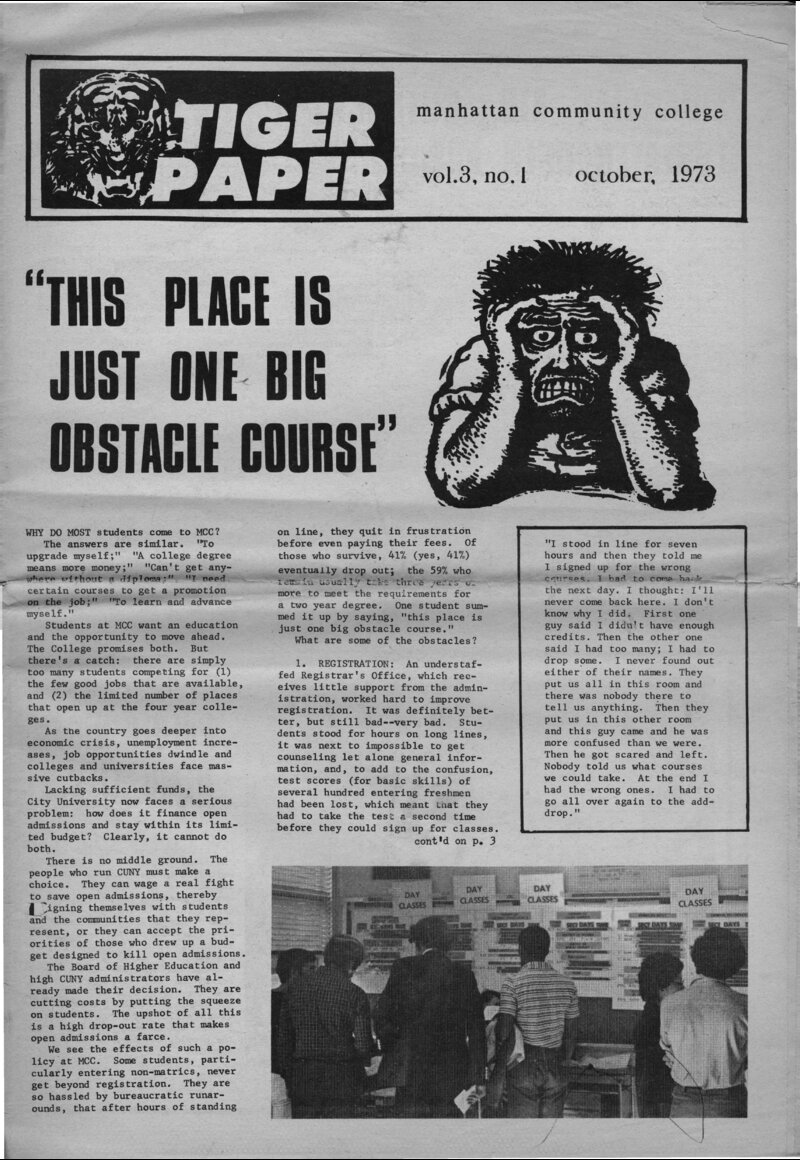
WHY DO MOST students come to MCC?
The answers are similar. "To
upgrade myself;" "A college degree
means more money;" '"'Can't get any-
_—where without a diploma: "T need |
; certain courses to get a promotion
_won the job;" "To learn and advance
myself."
Students at MCC want an education
and the opportunity to move ahead.
The College promises both. But
there's a catch: there are simply
too many students competing for (1)
the few good jobs that are available,
and (2) the limited number of places
that open up at the four year colle-
ges.
As the country goes deeper into
economic crisis, unemployment incre-
ases, job opportunities dwindle and
colleges and universities face mas-
sive cutbacks.
Lacking sufficient funds, the
City University now faces a serious
problem: how does it finance open
admissions and stay within its limi-
ted budget? Clearly, it cannot do
both.
There is no middle ground. The
people who run CUNY must make a
choice. They can wage a real fight
to save open admissions, thereby
§ cigning themselves with students
and the communities that they rep-
resent, or they can accept the pri-
orities of those who drew up a bud-
get designed to kill open admissions.
The Board of Higher Education and
high CUNY administrators have al-
ready made their decision. They are
cutting costs by putting the squeeze
on students. The upshot of all this
is a high drop-out rate that makes
open admissions a farce.
We see the effects of such a po-
licy at MCC. Some students, parti-
cularly entering non-matrics, never
get beyond registration. They are
so hassled by bureaucratic runar-
ounds, that after hours of standing
on line, they quit in frustration
before even paying their fees. Of
those who survive, 41% (yes, 41%)
eventually drop out; the 59% who
rem iu usually thks “three yestrs oz
more to meet the requirements for
a two year degree. One student sum-
med it up by saying, "this place is
just one big obstacle course."
What are some of the obstacles?
1. REGISTRATION: An understaf-
fed Registrar's Office, which rec-
eives little support from the admin-
istration, worked hard to improve
registration. It was definitely bet-
ter, but still bad--very bad. Stu-
dents stood for hours on long lines,
it was next to impossible to get
counseling let alone general infor-
mation, and, to add to the confusion,
test scores (for basic skills) of
several hundred entering freshmen
had been lost, which meant that they
had to take the test a second time
before they could sign up for classes.
cont'd on p. 3
"I stood in line for seven
hours and then they told me
I signed up for the wrong
canrses. JT had to comeback _
the next day. I thought: I'll
never come back here. I don't
know why I did. First one
guy said I didu't have enough
credits. Then the other one
said I had too many; I had to
drop some. I never found out
either of their names. They
put us all in this room and
there was nobody there to
tell us anything. Then they
put us in this other room
and this guy came and he was
more confused than we were.
Then he got scared and left.
Nobody told us what courses
we could take. At the end I
had the wrong ones. I had to
go all over again to the add-
PAGE 2
FINANGIAL AID CUTBACKS
THREATEN OPEN ADMISSIONS
OPEN ADMISSIONS was forced on CUNY
in 1969 by the struggles of Black
and Latin students at City College,
with the support of high school stu-
dents and the people in their com
unities.
Ever since, the State and the
Board of Higher Education and the
CUNY administrators have been try-
ing to pretend that the whole thing
was their idea, while at the same
time trying every possible means to
sabotage Open Admissions. One of
the best ways to do that is by cut-
ting financial aid.
It looks terrific! Anyone who
wants to, they tell students, can
go to college. If you don't go,
they tell students, it's your own
damn fault. If you don't make it
through, it's because you're too la-
zy or too dumb.
What they don't tell students is
how poor people can make it through
college with no jobs and smaller and
smaller amounts of financial aid dur-
ing this period of ever-rising prices.
Manhattan Community College provides
a very good example of how "Open" Ad-
missions is turning into "revolving
door" admissions.
There are more than 12,000 full
- and part-time students at MCC, If
last year's figures hold, about 88%
of them come from families earning
less than $7,500 a year.
This year, by October, nearly
5,000 students will have applied for
financial aid. About 2,000 of them
(including 700 College Discovery
students) will receive some federal
funds. Of the students receiving
financial aid, the average family
income is around $4,500. 42% are
from families with incomes of $0-
$3,000.
And year after year, the federal
government allocates less and less
money. Here is the comparative sto-
ry for last year and this year:
'72-'73 '73-'74 Difference
Work-Study Funds:
$674,000 $438,000 -$136,000
(Unlike past years, there will be no
work-study increases over the year.
If you use up your grant, that's it.)
Supplemental Educational
Opportunity Grant:
$458,000 $437,000 ~-.$21,000
Nursing Loans:
$ 89,000 $ 51,000 ~- $38,000
Nursing Scholarships:
$ 61,000 $ 26,000 ~- $35,000
Basic Opportunity Grant (for first—
time freshmen only): Applied for
through federal gevernment, not the
school. The maximum grant is $452,
PUERS0 Ri CO HAS THE RIGHT:-T0-BE FREE
TIGER PAPER
but it was funded at a 75% cut over
original budget, and is mainly aimed
at middle-income students in high
tuition schools.
National Defense Student Loans:
About 400 students will receive
these. There is actually an inc-
rease from an average grant of $500
to $650, because the school is per-
mitted to reloan money paid back by
previous MCC students owing money
on this loan.
As the financial aid office puts
it, we're not helping "needy stud-
ents," just the absolutely neediest
students.
If the City, State or Federal
government announced the end of Op-
en Admissions tomorrow, we would
all be out in the streets protest-
ing. We must not allow them to eat
away quietly at Open Admissions by
preventing Third World and white
working class people from going to
school. :
We must not allow ourselves to
be fooled by the "lack of money"
trick: in Vietnam we have spent as
much as $7 million in one day for
artillery, mortars, machine gun and
rifle bullets alone, while the en-
tire financial aid budget for MCC
this year is $1.2 million. We must
first understand why financial aid
is being cut, then join in the org-
anizations and demonstrations ag-
ainst these cutbacks.
Open Admissions was won through
struggle. To keep it we must con-
tinue ‘to” -attagste “Getting enough”
financial aid is one important
first step.
PUERTO RIGAN
DEMO AT UN.
MCC students were among the more
than 1000 people who marched to the
United Nations on September 24.
_The marchers demanded that the UN
General Assembly consider Puerto
Rico a colony of the U.S.--with t; )
same rights to decolonization as oth-
er possessions of imperialist coun-
tries. In spite of the rain, spir-
its were high during the march
through the lower East Side. Speak-
ers at the rally stressed the fact
that the struggle of the Puerto Ri-
can people is reaching a new level--
with the plan for a superport on the
island, the growing resistance of
the people, and their world wide
support.
TIGER PAPER
Frustration.
that all Social Science courses
Registration would have been less
of a hassle for working mothers if
the College was really committed to
4
J
Entering freshmen and non-matrics find
except one are closed.
@QODSOCSSOHSO
"Then I went to this class and
had four different teachers in
the first week. Then they told
me to come on different days.
So now I have classes for six
hours straight with no break.
They say it's too late to
change it now. I don't know
what to do."
"They told me I had to take
‘this six-hour course for no
credit at all. Six hours!
I said, ‘nothing doing honey,
I ain't coming here at all.'
So this teacher went and check-
ed my score on the placement
test. She came back and said.
I only had to do three hours."
SOOVSOSHSOEHE
"T stood in that line hour af-
ter hour. The room got packed
full and people started getting
angry and swearing and such. I
PAGE
REGISTRATION
STUDENTS
SPEAK OUT
€ndless lines and closed courses.
’ 7% etchant einen
oeeresseeeoos
"They tell you you can't be no-
thing if you don't go to school.
Just sweep the streets or some-
thing. Then you get here and
they treat you like dirt. I got
so mad I threw my books down on
the floor and cried for twenty
minutes. And I'm not a cry ba-
by. I was just do damn mad.
People were mad and swearing
serving students, and had provided
child care in the "B" Building.
obstacles --
cont’d from p.1
2. REQUIRED COURSES: As a rule,
these courses close early in regis-
tration. Hence many students find
that in order to meet the require-
ments for graduation, they must en-
roll in courses during the summer,
or go to MCC an extra semester or
two, or take these subjects at times
that conflict with their jobs.
3. FINANCIAL AID: Most MCC stu-
dents need financial help. But
there is little money available and
it's an incredible hassle to get
some (see accompanying article).
4. REMEDIAL PROGRAMS: Some of
the programs are staffed by dedica-
ted people who are teaching students
necessary basic skills. But in gen-
eral, the remedial curriculum has
didn't know what would happen."
been handicapped by inadequate fac-
ilities, improperly trained person-
nel, foul-ups in room and course
assignments and, in the case of the
math lab, no credit for the work
students put in.
5. CAREER PROGRAMS: Because jobs
are so scarce, the career programs
at MCC are in trouble. For example,
in response to budget cuts, the city
hospitals have reduced their nursing
staffs. In turn, MCC has now tail-
ored its nursing program to fit the
shrinking job market. The result is
that there is a long waiting list
'to get into the program. To stay on
the list, a student must enroll at
MCC. Sometimes this means two years
of liberal arts courses tacked on
to two years of nursing--that is
four years to complete a two year
degree.
6. FINANCIAL PENALTIES: Many
students find it impossible to com-
plete their degree requirements with-
in the usual(?) two years and with-
like. This teacher said,'don't
swear at me.' But I was mad."
out at least one curriculum change.
Why, then, does the college assess
stiff financial penalties to stud-
4ents who (1) take more than four
‘credits beyond the number necessary
for graduation, and (2) change cur-
‘riculum more than once.
7. PHYSICAL FACILITIES: The
physical setting of a school creates
a very definite atmosphere. The
slum conditions at MCC state a clear
message - the college does not real-
ly care about its students.
The difficulties confronting stu-
dents at MCC seem overwhelming. Yet
some surmount the obstacles, stick
it out to graduation and actually
succeed in getting a good education.
But they must fight for everything
that they get. i
Until we change the system and
the misplaced priorities that crea-
ted these conditions, MCC will con-
tinue to be just one big obstacle
course.
3
ol
TIGER PAPER first started publishing
in Fall,1971, when the MCC adminis-
tration prevented Third World Coali-
tion (the student government at the
time) from putting out the student
newspaper. Somebody, we felt, had to
be a watchdog on the administration
which was - and still is - ignoring
the needs and rights of the students,
faculty and staff. A fresh coat of
paint on the walls of the B, D and L
buildings can't cover up the adminis-
tration's disregard for most of the
people in our school,
We had two other reasons for cre-
ating TIGER PAPER. We wanted to
print news of important events and
struggles outside MCC which connect
with the situation here. And we
wanted to be able to discuss the
broader political, social and econo-
mic questions that lie behind the
probléms at MCC,
When Prometheus (TWC student news-
paper) was able to publish again, we
saw ourselves as working in alliance
with it, in the immediate and long-
run interests of the students, as well
as of the faculty and staff.
Now vwe are going it alone again asa
newspaper that takes MCC problems
seriously. At least that's the
impression we got from the first
issue of BMCC Press. In contrast
to BMCC Press, we will not be
printing any articles on big commer-
cial rip-offs like the Watkins Glen
rock festival (how many MCC students
actually went to it?? or relate to
it at all?), and we will not publish
any photos of women in bikini bathing
suits, Unlike the Press, when we
write about financial aid, we are go-
ing to focus on the aid cutbacks,
where they're coming from, and how
they undermine open admissions.
In other words, we don't exist
to feed people soothing syrup. The
MCC administration and the Board of
Higher Education do enough of that
on their own,
TIGER PAPER has a definite politi-
cal viewpoint (every newspaper does).
Our articles directly or indirectly
reflect our understanding of the pres-
ent U.S. system as an imperialist
system, based on exploitation and
white supremacy both at home and
abroad, Our country has some of. the
forms and appearances of democracy,
but the main reality is division in-
to unequal classes. Government poli-
cies are designed to serve the inter-
ests of the small group at the top.
People don't learn that in the
schools, because education, too, is or-
ganized to maintain the system,
Tiger
ty and staff.
Untenured members:
Tiger Paper is published whenever possible by an edit-
orial collective of Manhattan Community College facul-
Tenured members of the collective: Kathy Chamberlain,
Bill Friedheim, Mary Kellogg, Naomi Woronov.
anonymous to protect them against
administrative harassment.
TIGER PAPER*
Paper
PSC FIGHTS
POLLACK'’S PLAN
When Dean Pollack's now famous
memo of Sept. 18, 1973 ("I am happy
to announce a new divisional struc-
ture for the College's departments,
effective immediately.")came down,
there was a general outcry of pain
from the faculty at this autocratic
display. The decision had been made
without making even a pretense of
consulting the faculty. (The fact
is that the City University by-laws
‘clearly state that such a decision
can be made only by the faculty.)
In. response to this outcry, the
Executive Board of the PSC has been
calling meetings, writing letters,
and otherwise struggling against the
administration's self-proclaimed
right to make such a unilateral de-
Letter to the editor
Open Letter to Head of Finan-
cial Aid Office
..-Early in October I had an
appointment with the Financial Aid
office regarding my Basic Education
Opportunity Grant. When I had called,
one of your employes told me the of-
fice is open from 9:30 to 12. On
the day of my appointment I arrived
at 10. The lady at the front desk
told me, "We're not taking anyone
else." I told her I had an appoint-
ment; she just said, "Come back to-
morrow,"' and walked away.
That incident might be unimport-
ant to you; but I think she could at
least have waited to hear if I had
something else to say. She wasn't
busy either.
_that the issue is "not clear" (a fa-
miliar tactic), that this is an "ad-
ministrative matter" rather than an
academic one, and therefore does not
have to go to the faculty. But any
discussion of the proposed reorgani-
zation with the administration im-
mediately discloses that the purpose
is purely one of "instructional de-
velopment" or "curriculum planning".
It is so clear that these issues are
academic in nature, that the faculty
has the support not only of the cen-
tral office of the PSC, but also of
the Board of Higher Education.
The PSC has made a good begin-
ning in this struggle. We hope that
the union will continue to fight
back.
|
cision. The administration claims
That had been my fifth visit to
the office. Your staff doesn't take
into consideration that the students
are having financial problems, or
else they wouldn't act as they do
towards the students. The members
of your staff are just inconsider-
ate.
I thought I would bring this in-
cident to your attention, because it
is humiliating they way your staff
operates. I hope you'll be able to
get some changes made in the near
future.
Elese Escoffery
NOTE: FILING FOR MATRICULATION
Non-matrics who will have completed
12 or more credits by the end of this
term can file now for matriculation
for the Spring Term. Deadline for
turning in application and High
School (or Equivalency) records is
“TIGER PAPER
SLUM SCHOOL?
1 A gaping hole and exposed wiring in the ceiling
of an "L" Building classroom.
2 Who says that there isn't a seat for every MCC
student?
3 In the "A" Lounge there is plenty of floor to sit
on.
4 Some call it the MCC campus. Others call it the
Porno district.
5 Administrative and faculty offices are housed in
the Uris Building, a luxurious new skyscraper...
6.. mite students go to classes in antiquated fac-
ilities like this. No, it's not a medieval castle--
it's the 'M" Building. In winter the boiler periodic-
ffally breaks down, and at press time, none of the bath-
rooms worked.
r Entrance to the "D" Building.
& Sardine time. Over a thousand students go in and
out of the "B" Building every hour. Yet there are
only two elevators for this 7-story building.
PAGE 5
‘PAGE 6
WHAT DOES BOONE'S FARM or Ripple
Wine have in common with iceberg
lettuce and Farah men's pants?
It's not a riddle but a lesson
in exploitation under U.S. imperi-
alism. Every time you buy one of
those items, you're helping a pro-
fit-hungry boss and hurting a work=-
ing man or woman.
The workers that pick the wine
grapes. and the lettuce and make
the Farah pants are mostly Chicano
(Mexican-American) and Filipino;
85% of the Farah employees are wo-~
men. They are on strike against
low pay and intolerable working con-
ditions, and for recognition of
their unions.. But the owners re-
fuse to meet the workers' demands.
Non-white people and women have tra-
ditionally been a-cheap labor supply
for big business, and big business
wants to keep it that way.
How cheap is cheap?
Willie Farah pays $1.70 an hour
to start; in 20 years you might pull
a fat $2.20 an hour. If you fall
behind the breakneck production rate,
though, you'll be fired. Medical
benefits? $14 a day--after 5 years
on the job. No maternity benefits,
and back to starting salary when
you return to the job, no matter
how many years you worked before
your pregnancy.
4000 Farah workers have been on
strike for 18 months to win their
right to a union that can fight
these conditions.
How cheap is cheap for the farm
workers? $1.85 an hour. Until 1970,
they didn't even come close to that,
and had no benefits or job security
at all. But a 5-year campaign of
strikes and boycotts forced the grow-
ers to recognize the United Farm Wor-
kers Union and won $2 an hour pay,
benefits, and better working condi-
tions.
The growers didn't give up, how-
ever, Looking for a way to bust the
UFWU, they began making deals with
the Teamsters Union leadership be-
hind the backs of the workers. Last
April when the hard-won UFWU con-
tracts expired, the growers began
TIGER PAPER
OUTSIDE MACY'S Department Store, on October 18th, more
than 100 people from the Attica Brigade, the Puerto Ri-
can Students Union, and the Black Anti-Imperialist Stu-
dent Caucus marched and leafletted to protest. Macy's
buying of scab pants from the Farah Company in Texas
and New Mexico.
Inside Macy's, sixteen people were arrested, for al-
legedly destroying scab pants so Macy's could not sell
them.
nies.
Six of those arrested are now charged with felo-
Here at MCC, on Wednesday, October 31, two of the
Chicano women who are on strike at the Farah plant in
El Paso, Texas, will speak to students about their str-
uggle, why it is important to all of us, and what role
students can play in helping them win their fight.
to sign up with the Teamsters. The
UFWU resumed their strike and boy-
cott campaign, this time to win back
all that the Teamstér deals’ took
away. :
The California growers and Willie
Farah in Texas and New Mexico have
used everything from court orders to
goon squads, armed guards, cops, and
attack dogs to destroy the strikes
and the union movement. In August
two striking farmworkers were shot
to death by sheriffs working in the
interests of the growers. Many hun-
dreds of Farah and farm workers have
been beaten and/or jailed on high
bail for picketing and demonstrating.
The terror tactics and the use of
scab labor have not broken the
strikes.
Farah's sales are way down, and
he's desperately trying to make up
his losses throughja*big advertising
campaign--at taxpayer expense. (Part
of a government grant to the National
Cotton Industry was turned over to
Farah to pay for his sponsorship of
the King-Riggs tennis match and the
Mets- Oakland playoffs.)
The owners are hurting. But they
have to be hurt more, right in their
pocketbooks, the only place they
feel anything.
What can we here in New York do?
A lot. The struggle of the workers
themselves is their ‘most powerful
weapon. ‘But consumer boycotts can
make it stronger. Nationwide don't-
buy campaigns are under way against
Farah pants and against non-union
wine, grapes and lettuce.
SUPPORT THE FARAH WORKERS~--
DON'T BUY FARAH PANTS.
--Check for the following labels,
all made by Farah: Farah, Supar,
Exence, Dare, Ambassador.
--Don't shop at stores that sell
PRODUCTS!
Farah pants--for example, Macy's,
A & S, Gertz. Urge store owners ae
and managers to stop dealing with
Farah completely until the company =~
recognizes the union (Amalgamated
Clothing Workers).
SUPPORT THE UNITED FARM WORKERS
UNION.
--Don't buy iceberg lettuce.
--Don't buy table grapes.
--Don't shop at Safeway or A&P,
which keep dealing with anti-
UFWU growers. Tell the managers
you won't shop in their stores as
long as they buy non-union produce.
--Don't buy wines made from non-
UFWU grapes: Boone's Farm, Ripple,
and Thunderbird (and all other
Gallo labels); White River Farms
(sold under about 25 different
names, including Cresta,Blanca
and Roma; check labels carefully);
Weibel, Beringer, Wente, Sebastiani,
Martini, Charles Krug, Mondavi.
The more effective the boycotts,
the faster the owners will get the
message to meet the demands of the
farmworkers and the women at Farah!
‘TIGER PAPER
TIGER PAPER is opening its
pages to anti-imperialist stud-
ent organizations at MCC. We
urge such organizations to sub-
mit material to us, c/o Bill
Friedheim, Social Science Dept.,
"H" Building. The following
article was written by Third
—__World—Coalition...___
BECAUSE OF THE SITUATION we find our-
selves in at MCC, namely a college
where more than 70 percent of the
student population is Black, Latin
and Asian, and where survival de-
pends heavily on financial aid, open
‘admissions, child care and remedial
programs, it becomes necessary that
the Third World students unite under
common principles to struggle around
common goals.
LAST SUMMER Freddie Gilmore super-
vised the pilot project for the new
Remedial Mathematics Program at MCC.
She kept all the records and super-
‘vised all the tutors who were work-
ling with the students. She was res-
|ponsible for assigning the tutors,
jand for instructing them in the tech-
niques used in the program. But she
was not hired in any title which de-
scribed or rewarded the work she was
doing.
She performed this invaluable
service to the College as a "900
Hour" College Assistant--the lowest
‘paying, most insecure job position
at the school. As soon as anyone
in this position has worked 875
hours, he or she is automatically
fired, to prevent possible protec-
tion by any union contract.
Freddie took this risk because
We know through experience that
when we confront a common enemy to-
gether, that is, in great numbers,
we get better results than when we
make the attempt as individuals.
This is the truth behind the saying
"In unity, there is strength."
It must be made clear that our
common enemy here at MCC is the ad-
ministration. The administration
does not represent the interests of
the students, but rather of those
who appointed it. It is the repre-
sentative of "big money" here at
MCC. If it really represented the
interests of students, MCC would
not be the big hassle it is.
If the students are to get any-
thing, the administration must give
up something, and we all know they
will not give up anything easily.
For example, in 1972, President Dra-
per spent $10,000 of the students'
money for his inauguration. That
RIP-OFF
she had been told twice last Spring
that she would continue to supervise
the Math Lab this year, in the posi-
tion of College Laboratory Technic-
ian--a regular full-time job cover-
ed by the PSC (teacher's union) con-
tract.
This fall, Freddie was told that
the College Lab Technician title was
impossible. But she has been work-
ing all fall in the Math Lab, and
is the only one with the experience
and over-all view necessary to keep
the program going.
When the Math department discover-
ed how Freddie was being treated, a
struggle began to get her the title
and pay which should be hers. The
request for the College Lab Techni-
cian line will soon go to the admin-
istration. We hope this injustice
will be rectified quickly.
PAGE 7
money could have been spent for stu-
dents' needs, such as a new cafeter-
ia downtown, library facilities,
new nursing-program equipment, etc.
Only unity among students can push
ahead our struggle for real democ-
ratic rights. There must be a cer-
tain kind of machinery built up to
put this unity into practice: a co-
alition made up of clubs, student
organizations and interested indiv-
iduals.
Such a vehicle of unity is TWC--
Third World Coalition--a coalition
formed three years ago of Third
World clubs united around certain
principles. TWC accomplished many
things, including a child care cen-
ter, a raise in work-study salary,
book scholarships, foreign student
loans, trips abroad to Africa and
Latin America, the reinstatement of
several progressive Black and Puerto
Rican teachers who had been fired by
the racist college-wide Personnel
and Budget Committee.
We have also made mistakes--some-
thing which happens to any organiza-
tion. But we can learn from these
mistakes so that they will not be
made again. For example, TWC recog-
nizes that it didn't involve enough
students in the struggles for a stu-
dent-controlled bookstore and for an
adequate child care center; as a re-
sult, the administration started
leasing the bookstore to a profit-
making corporation again, and also
never gave the child care center
the space and resources it needed.
We must make sure that from now on
the majority of students are involv-
ed in all the actions of TWC.
TWC is now striving to involve
all student clubs and individual
students for the purpose of strug-
gling around certain points of unity.
They are:
1. We support the national lib-
eration struggles of Asia, Africa
and Latin America for the right of
self-determination.
2. We are against all forms of
cacism. We have seen from practice
that when Black, Latin and Asian
fight together against our common
enemy we are a lot stronger than
when we fight separately, or against
each other.
3. We demand autonomous Black,
Puerto Rican and Asian Studies De-
partments with 50/50 student-faculty
control.
4. We are anti-sexist. We see
that once sisters leave MCC they are
forced to take the lowest-paying jobs.
We see men and women as being equal.
"Women hold up half the sky" (Mao).
5. We support the right of Third
World people to enter and finish col-
lege. No cutbacks in financial aid
(C.D., SEEK, work-study), hands off
Open Admissions. "They say cutback,
we say FIGHTBACK."
6. We support and will fight a-
longside of the struggles around bet-
ter housing, health care, education
and employment. We support the strug-
gles of the working class for better
working conditions.
We have recorded a brief summary
and analysis of TWC which is avail-
able upon request. For more infor-
mation, contact TWC through the
Puerto Rican Studies office, D208.
TIGER PAPER
THIRD
WORLD
STUDIES
UNDER
| ALTAGK
Nationally
A WAVE OF militant strikes in 1969-
70, led by Black students with the
support of all students, demanded
that the universities create Black
and Puerto Rican Studies programs,
and Third World centers. In most
cases university administrations
were forced to give in to these de-
mands, but have since then spent
their time trying to counter the
threat of these programs' effective-
ness. Wherever students and faculty
have won concessions, these gains
have been followed by racist and re-
pressive attacks.
Denying autonomy to Black and
Puerto Rican Studies departments,
firing part-time instructors, shut-
ting down Third World centers, and
cutting back programs which enable
Third World and working class stu-
dents to attend college--are examp-
les of a nation-wide, racist attack
on the right of Third World students
to a decent education, responsive to
their needs.
At Antioch College in Ohio the New
Directions Program, won in the late
"60s which gave financial aid to
Third World and working class stu-
dents at Antioch, has just been cut
back and taken away, despite strong
student and faculty resistance.
At the University of Wisconsin-
Madison over 5000 students supported
the fight to prevent the administra-
tion from shutting down the Third
World centers, won as a result of a
militant student strike in 1969.
At the University of Illinois the
administration has just seized all
records of newly admitted Puerto Ri-
can students, in an attempt to take
control away from the Puerto Rican
community group which had been try-
ing to get more Latin students admit-
ted into the university.
At City College (CUNY) the Black
Studies program has been severely
cut back. As of January, all part-
time instructors will be fired--
without replacements-- thus elimat-
ing half the courses offered.
At both Illinois and at City Col-
lege, students are taking strong ac-
tion against the college administra-
tions. :
_These attacks are not isolated, un-
connected issues, but are clearly vis-
ible results of a policy which is at-
tempting to divide students and fac-
ulty along racial lines, setting them
up for further attacks--such as tui-
tion hikes and more cuts in financial
aid.
But both Third World and white stu-
dents and faculty are becoming more
aware of how programs won in the '60s
are being sabotaged, and of the nat-
ure and implications of these attacks.
Resistance has already been shown ar-
ound the country, and is growing,
bringing in still more students and
faculty.
At MCC
WHY HAS ENROLLMENT in Black and Puer-
to Rican Studies dropped by about
250 students this term? Some of the
reasons are clear from the following
facts:
Every year students and faculty
PAGE 8
have raised demands for independent
Black and Puerto Rican Studies Depart-
ments. The administration has con-
sistently resisted this. Instead,
it has placed control of the Black
Studies program in the hands of an
Oxford scholar with (as one student
put it) "a European understanding of
Black people". Instructors with a
real understanding of the conditions
of Black people in this country are
hired only part-time, and then fir-
ed. Classes taught by Sonia Sanchez
and Jéhn Glenn were jammed--often
with over 40 students wanting to en-
roll, yet these instructors are no
longer here.
Black and Puerto Rican Studies
has been reorganized by Dean Pollack
into the "humanities division" at
MCC. This division includes the Eng-
lish Department--over which Pollack
is systematically taking control--
thus giving even less weight to
Black and Puerto Rican Studies.
Black and Puerto Rican Studies
courses have been used to satisfy re-
quirements in English (English III),
Social Science, Art, Music, and elec-
tive credits. But Black and Puerto
Rican Studies courses cannot be taken
in most curricula. Students in A.A.S.
programs, like Secretarial Science,
Health Technology, and Data Process-
ing cannot even take English III (for
which Black Literature can be substi-
tuted. And this term, Puerto Rican
Literature can no longer be used to
fulfill the English III requirement.
Liberal Arts is the only program
with enough electives to enable stu-
dents to take Black and Puerto Rican
Studies courses. And this term, for
the first time since Open Admissions,
less than half the entering freshmen
have been admitted into Liberal Arts
--reflecting an effort to track more
students into 2-year, and often dead-
end programs.
Finally, Black and Puerto Rican
Studies have not been publicized or
explained. A new student would have
to read the footnotes in the catalog
to know how the courses can be used.
All of the above represent more
subtle tactics than have been used on
some other campuses (see accompanying
article), which have attempted to
drop Black and Puerto Rican Studies
altogether. This is partly due to
MCC's history of militancy in the
face of direct attacks.
In the Spring of 1969 students
joined to form the Third World Coa-
lition, for the immediate purpose of
dealing with racism at the College.
The "B" Building was seized in order
to press demands for more Third World
staff, and a separate Third World De-
partment. Many students and faculty
realized that racism was neither
right nor in their own interest, and
supported the struggle.
Since 1969, more students and fac-
ulty have fought for independent
Black and Puerto Rican Studies Depar-
tments, for the reinstatement of José
Irizarry (a progressive Puerto Rican
Studies instructor, fired for polit-
ical reasons), for the replacement
of the Chairman of Black Studies,
and against racist attacks on Open
Admissions.
The administration's new "subtle"
attempts to phase out Black and Puerta
Rican Studies can be resisted in
the same militant manner.
vol.3. no. |
october, 1973
“THIS PLACE IS
JUST ONE BIG
OBSTACLE COURSE
WHY DO MOST students come to MCC?
The answers are similar. "To
upgrade myself;" "A college degree
means more money;" '"'Can't get any-
_—where without a diploma: "T need |
; certain courses to get a promotion
_won the job;" "To learn and advance
myself."
Students at MCC want an education
and the opportunity to move ahead.
The College promises both. But
there's a catch: there are simply
too many students competing for (1)
the few good jobs that are available,
and (2) the limited number of places
that open up at the four year colle-
ges.
As the country goes deeper into
economic crisis, unemployment incre-
ases, job opportunities dwindle and
colleges and universities face mas-
sive cutbacks.
Lacking sufficient funds, the
City University now faces a serious
problem: how does it finance open
admissions and stay within its limi-
ted budget? Clearly, it cannot do
both.
There is no middle ground. The
people who run CUNY must make a
choice. They can wage a real fight
to save open admissions, thereby
§ cigning themselves with students
and the communities that they rep-
resent, or they can accept the pri-
orities of those who drew up a bud-
get designed to kill open admissions.
The Board of Higher Education and
high CUNY administrators have al-
ready made their decision. They are
cutting costs by putting the squeeze
on students. The upshot of all this
is a high drop-out rate that makes
open admissions a farce.
We see the effects of such a po-
licy at MCC. Some students, parti-
cularly entering non-matrics, never
get beyond registration. They are
so hassled by bureaucratic runar-
ounds, that after hours of standing
on line, they quit in frustration
before even paying their fees. Of
those who survive, 41% (yes, 41%)
eventually drop out; the 59% who
rem iu usually thks “three yestrs oz
more to meet the requirements for
a two year degree. One student sum-
med it up by saying, "this place is
just one big obstacle course."
What are some of the obstacles?
1. REGISTRATION: An understaf-
fed Registrar's Office, which rec-
eives little support from the admin-
istration, worked hard to improve
registration. It was definitely bet-
ter, but still bad--very bad. Stu-
dents stood for hours on long lines,
it was next to impossible to get
counseling let alone general infor-
mation, and, to add to the confusion,
test scores (for basic skills) of
several hundred entering freshmen
had been lost, which meant that they
had to take the test a second time
before they could sign up for classes.
cont'd on p. 3
"I stood in line for seven
hours and then they told me
I signed up for the wrong
canrses. JT had to comeback _
the next day. I thought: I'll
never come back here. I don't
know why I did. First one
guy said I didu't have enough
credits. Then the other one
said I had too many; I had to
drop some. I never found out
either of their names. They
put us all in this room and
there was nobody there to
tell us anything. Then they
put us in this other room
and this guy came and he was
more confused than we were.
Then he got scared and left.
Nobody told us what courses
we could take. At the end I
had the wrong ones. I had to
go all over again to the add-
PAGE 2
FINANGIAL AID CUTBACKS
THREATEN OPEN ADMISSIONS
OPEN ADMISSIONS was forced on CUNY
in 1969 by the struggles of Black
and Latin students at City College,
with the support of high school stu-
dents and the people in their com
unities.
Ever since, the State and the
Board of Higher Education and the
CUNY administrators have been try-
ing to pretend that the whole thing
was their idea, while at the same
time trying every possible means to
sabotage Open Admissions. One of
the best ways to do that is by cut-
ting financial aid.
It looks terrific! Anyone who
wants to, they tell students, can
go to college. If you don't go,
they tell students, it's your own
damn fault. If you don't make it
through, it's because you're too la-
zy or too dumb.
What they don't tell students is
how poor people can make it through
college with no jobs and smaller and
smaller amounts of financial aid dur-
ing this period of ever-rising prices.
Manhattan Community College provides
a very good example of how "Open" Ad-
missions is turning into "revolving
door" admissions.
There are more than 12,000 full
- and part-time students at MCC, If
last year's figures hold, about 88%
of them come from families earning
less than $7,500 a year.
This year, by October, nearly
5,000 students will have applied for
financial aid. About 2,000 of them
(including 700 College Discovery
students) will receive some federal
funds. Of the students receiving
financial aid, the average family
income is around $4,500. 42% are
from families with incomes of $0-
$3,000.
And year after year, the federal
government allocates less and less
money. Here is the comparative sto-
ry for last year and this year:
'72-'73 '73-'74 Difference
Work-Study Funds:
$674,000 $438,000 -$136,000
(Unlike past years, there will be no
work-study increases over the year.
If you use up your grant, that's it.)
Supplemental Educational
Opportunity Grant:
$458,000 $437,000 ~-.$21,000
Nursing Loans:
$ 89,000 $ 51,000 ~- $38,000
Nursing Scholarships:
$ 61,000 $ 26,000 ~- $35,000
Basic Opportunity Grant (for first—
time freshmen only): Applied for
through federal gevernment, not the
school. The maximum grant is $452,
PUERS0 Ri CO HAS THE RIGHT:-T0-BE FREE
TIGER PAPER
but it was funded at a 75% cut over
original budget, and is mainly aimed
at middle-income students in high
tuition schools.
National Defense Student Loans:
About 400 students will receive
these. There is actually an inc-
rease from an average grant of $500
to $650, because the school is per-
mitted to reloan money paid back by
previous MCC students owing money
on this loan.
As the financial aid office puts
it, we're not helping "needy stud-
ents," just the absolutely neediest
students.
If the City, State or Federal
government announced the end of Op-
en Admissions tomorrow, we would
all be out in the streets protest-
ing. We must not allow them to eat
away quietly at Open Admissions by
preventing Third World and white
working class people from going to
school. :
We must not allow ourselves to
be fooled by the "lack of money"
trick: in Vietnam we have spent as
much as $7 million in one day for
artillery, mortars, machine gun and
rifle bullets alone, while the en-
tire financial aid budget for MCC
this year is $1.2 million. We must
first understand why financial aid
is being cut, then join in the org-
anizations and demonstrations ag-
ainst these cutbacks.
Open Admissions was won through
struggle. To keep it we must con-
tinue ‘to” -attagste “Getting enough”
financial aid is one important
first step.
PUERTO RIGAN
DEMO AT UN.
MCC students were among the more
than 1000 people who marched to the
United Nations on September 24.
_The marchers demanded that the UN
General Assembly consider Puerto
Rico a colony of the U.S.--with t; )
same rights to decolonization as oth-
er possessions of imperialist coun-
tries. In spite of the rain, spir-
its were high during the march
through the lower East Side. Speak-
ers at the rally stressed the fact
that the struggle of the Puerto Ri-
can people is reaching a new level--
with the plan for a superport on the
island, the growing resistance of
the people, and their world wide
support.
TIGER PAPER
Frustration.
that all Social Science courses
Registration would have been less
of a hassle for working mothers if
the College was really committed to
4
J
Entering freshmen and non-matrics find
except one are closed.
@QODSOCSSOHSO
"Then I went to this class and
had four different teachers in
the first week. Then they told
me to come on different days.
So now I have classes for six
hours straight with no break.
They say it's too late to
change it now. I don't know
what to do."
"They told me I had to take
‘this six-hour course for no
credit at all. Six hours!
I said, ‘nothing doing honey,
I ain't coming here at all.'
So this teacher went and check-
ed my score on the placement
test. She came back and said.
I only had to do three hours."
SOOVSOSHSOEHE
"T stood in that line hour af-
ter hour. The room got packed
full and people started getting
angry and swearing and such. I
PAGE
REGISTRATION
STUDENTS
SPEAK OUT
€ndless lines and closed courses.
’ 7% etchant einen
oeeresseeeoos
"They tell you you can't be no-
thing if you don't go to school.
Just sweep the streets or some-
thing. Then you get here and
they treat you like dirt. I got
so mad I threw my books down on
the floor and cried for twenty
minutes. And I'm not a cry ba-
by. I was just do damn mad.
People were mad and swearing
serving students, and had provided
child care in the "B" Building.
obstacles --
cont’d from p.1
2. REQUIRED COURSES: As a rule,
these courses close early in regis-
tration. Hence many students find
that in order to meet the require-
ments for graduation, they must en-
roll in courses during the summer,
or go to MCC an extra semester or
two, or take these subjects at times
that conflict with their jobs.
3. FINANCIAL AID: Most MCC stu-
dents need financial help. But
there is little money available and
it's an incredible hassle to get
some (see accompanying article).
4. REMEDIAL PROGRAMS: Some of
the programs are staffed by dedica-
ted people who are teaching students
necessary basic skills. But in gen-
eral, the remedial curriculum has
didn't know what would happen."
been handicapped by inadequate fac-
ilities, improperly trained person-
nel, foul-ups in room and course
assignments and, in the case of the
math lab, no credit for the work
students put in.
5. CAREER PROGRAMS: Because jobs
are so scarce, the career programs
at MCC are in trouble. For example,
in response to budget cuts, the city
hospitals have reduced their nursing
staffs. In turn, MCC has now tail-
ored its nursing program to fit the
shrinking job market. The result is
that there is a long waiting list
'to get into the program. To stay on
the list, a student must enroll at
MCC. Sometimes this means two years
of liberal arts courses tacked on
to two years of nursing--that is
four years to complete a two year
degree.
6. FINANCIAL PENALTIES: Many
students find it impossible to com-
plete their degree requirements with-
in the usual(?) two years and with-
like. This teacher said,'don't
swear at me.' But I was mad."
out at least one curriculum change.
Why, then, does the college assess
stiff financial penalties to stud-
4ents who (1) take more than four
‘credits beyond the number necessary
for graduation, and (2) change cur-
‘riculum more than once.
7. PHYSICAL FACILITIES: The
physical setting of a school creates
a very definite atmosphere. The
slum conditions at MCC state a clear
message - the college does not real-
ly care about its students.
The difficulties confronting stu-
dents at MCC seem overwhelming. Yet
some surmount the obstacles, stick
it out to graduation and actually
succeed in getting a good education.
But they must fight for everything
that they get. i
Until we change the system and
the misplaced priorities that crea-
ted these conditions, MCC will con-
tinue to be just one big obstacle
course.
3
ol
TIGER PAPER first started publishing
in Fall,1971, when the MCC adminis-
tration prevented Third World Coali-
tion (the student government at the
time) from putting out the student
newspaper. Somebody, we felt, had to
be a watchdog on the administration
which was - and still is - ignoring
the needs and rights of the students,
faculty and staff. A fresh coat of
paint on the walls of the B, D and L
buildings can't cover up the adminis-
tration's disregard for most of the
people in our school,
We had two other reasons for cre-
ating TIGER PAPER. We wanted to
print news of important events and
struggles outside MCC which connect
with the situation here. And we
wanted to be able to discuss the
broader political, social and econo-
mic questions that lie behind the
probléms at MCC,
When Prometheus (TWC student news-
paper) was able to publish again, we
saw ourselves as working in alliance
with it, in the immediate and long-
run interests of the students, as well
as of the faculty and staff.
Now vwe are going it alone again asa
newspaper that takes MCC problems
seriously. At least that's the
impression we got from the first
issue of BMCC Press. In contrast
to BMCC Press, we will not be
printing any articles on big commer-
cial rip-offs like the Watkins Glen
rock festival (how many MCC students
actually went to it?? or relate to
it at all?), and we will not publish
any photos of women in bikini bathing
suits, Unlike the Press, when we
write about financial aid, we are go-
ing to focus on the aid cutbacks,
where they're coming from, and how
they undermine open admissions.
In other words, we don't exist
to feed people soothing syrup. The
MCC administration and the Board of
Higher Education do enough of that
on their own,
TIGER PAPER has a definite politi-
cal viewpoint (every newspaper does).
Our articles directly or indirectly
reflect our understanding of the pres-
ent U.S. system as an imperialist
system, based on exploitation and
white supremacy both at home and
abroad, Our country has some of. the
forms and appearances of democracy,
but the main reality is division in-
to unequal classes. Government poli-
cies are designed to serve the inter-
ests of the small group at the top.
People don't learn that in the
schools, because education, too, is or-
ganized to maintain the system,
Tiger
ty and staff.
Untenured members:
Tiger Paper is published whenever possible by an edit-
orial collective of Manhattan Community College facul-
Tenured members of the collective: Kathy Chamberlain,
Bill Friedheim, Mary Kellogg, Naomi Woronov.
anonymous to protect them against
administrative harassment.
TIGER PAPER*
Paper
PSC FIGHTS
POLLACK'’S PLAN
When Dean Pollack's now famous
memo of Sept. 18, 1973 ("I am happy
to announce a new divisional struc-
ture for the College's departments,
effective immediately.")came down,
there was a general outcry of pain
from the faculty at this autocratic
display. The decision had been made
without making even a pretense of
consulting the faculty. (The fact
is that the City University by-laws
‘clearly state that such a decision
can be made only by the faculty.)
In. response to this outcry, the
Executive Board of the PSC has been
calling meetings, writing letters,
and otherwise struggling against the
administration's self-proclaimed
right to make such a unilateral de-
Letter to the editor
Open Letter to Head of Finan-
cial Aid Office
..-Early in October I had an
appointment with the Financial Aid
office regarding my Basic Education
Opportunity Grant. When I had called,
one of your employes told me the of-
fice is open from 9:30 to 12. On
the day of my appointment I arrived
at 10. The lady at the front desk
told me, "We're not taking anyone
else." I told her I had an appoint-
ment; she just said, "Come back to-
morrow,"' and walked away.
That incident might be unimport-
ant to you; but I think she could at
least have waited to hear if I had
something else to say. She wasn't
busy either.
_that the issue is "not clear" (a fa-
miliar tactic), that this is an "ad-
ministrative matter" rather than an
academic one, and therefore does not
have to go to the faculty. But any
discussion of the proposed reorgani-
zation with the administration im-
mediately discloses that the purpose
is purely one of "instructional de-
velopment" or "curriculum planning".
It is so clear that these issues are
academic in nature, that the faculty
has the support not only of the cen-
tral office of the PSC, but also of
the Board of Higher Education.
The PSC has made a good begin-
ning in this struggle. We hope that
the union will continue to fight
back.
|
cision. The administration claims
That had been my fifth visit to
the office. Your staff doesn't take
into consideration that the students
are having financial problems, or
else they wouldn't act as they do
towards the students. The members
of your staff are just inconsider-
ate.
I thought I would bring this in-
cident to your attention, because it
is humiliating they way your staff
operates. I hope you'll be able to
get some changes made in the near
future.
Elese Escoffery
NOTE: FILING FOR MATRICULATION
Non-matrics who will have completed
12 or more credits by the end of this
term can file now for matriculation
for the Spring Term. Deadline for
turning in application and High
School (or Equivalency) records is
“TIGER PAPER
SLUM SCHOOL?
1 A gaping hole and exposed wiring in the ceiling
of an "L" Building classroom.
2 Who says that there isn't a seat for every MCC
student?
3 In the "A" Lounge there is plenty of floor to sit
on.
4 Some call it the MCC campus. Others call it the
Porno district.
5 Administrative and faculty offices are housed in
the Uris Building, a luxurious new skyscraper...
6.. mite students go to classes in antiquated fac-
ilities like this. No, it's not a medieval castle--
it's the 'M" Building. In winter the boiler periodic-
ffally breaks down, and at press time, none of the bath-
rooms worked.
r Entrance to the "D" Building.
& Sardine time. Over a thousand students go in and
out of the "B" Building every hour. Yet there are
only two elevators for this 7-story building.
PAGE 5
‘PAGE 6
WHAT DOES BOONE'S FARM or Ripple
Wine have in common with iceberg
lettuce and Farah men's pants?
It's not a riddle but a lesson
in exploitation under U.S. imperi-
alism. Every time you buy one of
those items, you're helping a pro-
fit-hungry boss and hurting a work=-
ing man or woman.
The workers that pick the wine
grapes. and the lettuce and make
the Farah pants are mostly Chicano
(Mexican-American) and Filipino;
85% of the Farah employees are wo-~
men. They are on strike against
low pay and intolerable working con-
ditions, and for recognition of
their unions.. But the owners re-
fuse to meet the workers' demands.
Non-white people and women have tra-
ditionally been a-cheap labor supply
for big business, and big business
wants to keep it that way.
How cheap is cheap?
Willie Farah pays $1.70 an hour
to start; in 20 years you might pull
a fat $2.20 an hour. If you fall
behind the breakneck production rate,
though, you'll be fired. Medical
benefits? $14 a day--after 5 years
on the job. No maternity benefits,
and back to starting salary when
you return to the job, no matter
how many years you worked before
your pregnancy.
4000 Farah workers have been on
strike for 18 months to win their
right to a union that can fight
these conditions.
How cheap is cheap for the farm
workers? $1.85 an hour. Until 1970,
they didn't even come close to that,
and had no benefits or job security
at all. But a 5-year campaign of
strikes and boycotts forced the grow-
ers to recognize the United Farm Wor-
kers Union and won $2 an hour pay,
benefits, and better working condi-
tions.
The growers didn't give up, how-
ever, Looking for a way to bust the
UFWU, they began making deals with
the Teamsters Union leadership be-
hind the backs of the workers. Last
April when the hard-won UFWU con-
tracts expired, the growers began
TIGER PAPER
OUTSIDE MACY'S Department Store, on October 18th, more
than 100 people from the Attica Brigade, the Puerto Ri-
can Students Union, and the Black Anti-Imperialist Stu-
dent Caucus marched and leafletted to protest. Macy's
buying of scab pants from the Farah Company in Texas
and New Mexico.
Inside Macy's, sixteen people were arrested, for al-
legedly destroying scab pants so Macy's could not sell
them.
nies.
Six of those arrested are now charged with felo-
Here at MCC, on Wednesday, October 31, two of the
Chicano women who are on strike at the Farah plant in
El Paso, Texas, will speak to students about their str-
uggle, why it is important to all of us, and what role
students can play in helping them win their fight.
to sign up with the Teamsters. The
UFWU resumed their strike and boy-
cott campaign, this time to win back
all that the Teamstér deals’ took
away. :
The California growers and Willie
Farah in Texas and New Mexico have
used everything from court orders to
goon squads, armed guards, cops, and
attack dogs to destroy the strikes
and the union movement. In August
two striking farmworkers were shot
to death by sheriffs working in the
interests of the growers. Many hun-
dreds of Farah and farm workers have
been beaten and/or jailed on high
bail for picketing and demonstrating.
The terror tactics and the use of
scab labor have not broken the
strikes.
Farah's sales are way down, and
he's desperately trying to make up
his losses throughja*big advertising
campaign--at taxpayer expense. (Part
of a government grant to the National
Cotton Industry was turned over to
Farah to pay for his sponsorship of
the King-Riggs tennis match and the
Mets- Oakland playoffs.)
The owners are hurting. But they
have to be hurt more, right in their
pocketbooks, the only place they
feel anything.
What can we here in New York do?
A lot. The struggle of the workers
themselves is their ‘most powerful
weapon. ‘But consumer boycotts can
make it stronger. Nationwide don't-
buy campaigns are under way against
Farah pants and against non-union
wine, grapes and lettuce.
SUPPORT THE FARAH WORKERS~--
DON'T BUY FARAH PANTS.
--Check for the following labels,
all made by Farah: Farah, Supar,
Exence, Dare, Ambassador.
--Don't shop at stores that sell
PRODUCTS!
Farah pants--for example, Macy's,
A & S, Gertz. Urge store owners ae
and managers to stop dealing with
Farah completely until the company =~
recognizes the union (Amalgamated
Clothing Workers).
SUPPORT THE UNITED FARM WORKERS
UNION.
--Don't buy iceberg lettuce.
--Don't buy table grapes.
--Don't shop at Safeway or A&P,
which keep dealing with anti-
UFWU growers. Tell the managers
you won't shop in their stores as
long as they buy non-union produce.
--Don't buy wines made from non-
UFWU grapes: Boone's Farm, Ripple,
and Thunderbird (and all other
Gallo labels); White River Farms
(sold under about 25 different
names, including Cresta,Blanca
and Roma; check labels carefully);
Weibel, Beringer, Wente, Sebastiani,
Martini, Charles Krug, Mondavi.
The more effective the boycotts,
the faster the owners will get the
message to meet the demands of the
farmworkers and the women at Farah!
‘TIGER PAPER
TIGER PAPER is opening its
pages to anti-imperialist stud-
ent organizations at MCC. We
urge such organizations to sub-
mit material to us, c/o Bill
Friedheim, Social Science Dept.,
"H" Building. The following
article was written by Third
—__World—Coalition...___
BECAUSE OF THE SITUATION we find our-
selves in at MCC, namely a college
where more than 70 percent of the
student population is Black, Latin
and Asian, and where survival de-
pends heavily on financial aid, open
‘admissions, child care and remedial
programs, it becomes necessary that
the Third World students unite under
common principles to struggle around
common goals.
LAST SUMMER Freddie Gilmore super-
vised the pilot project for the new
Remedial Mathematics Program at MCC.
She kept all the records and super-
‘vised all the tutors who were work-
ling with the students. She was res-
|ponsible for assigning the tutors,
jand for instructing them in the tech-
niques used in the program. But she
was not hired in any title which de-
scribed or rewarded the work she was
doing.
She performed this invaluable
service to the College as a "900
Hour" College Assistant--the lowest
‘paying, most insecure job position
at the school. As soon as anyone
in this position has worked 875
hours, he or she is automatically
fired, to prevent possible protec-
tion by any union contract.
Freddie took this risk because
We know through experience that
when we confront a common enemy to-
gether, that is, in great numbers,
we get better results than when we
make the attempt as individuals.
This is the truth behind the saying
"In unity, there is strength."
It must be made clear that our
common enemy here at MCC is the ad-
ministration. The administration
does not represent the interests of
the students, but rather of those
who appointed it. It is the repre-
sentative of "big money" here at
MCC. If it really represented the
interests of students, MCC would
not be the big hassle it is.
If the students are to get any-
thing, the administration must give
up something, and we all know they
will not give up anything easily.
For example, in 1972, President Dra-
per spent $10,000 of the students'
money for his inauguration. That
RIP-OFF
she had been told twice last Spring
that she would continue to supervise
the Math Lab this year, in the posi-
tion of College Laboratory Technic-
ian--a regular full-time job cover-
ed by the PSC (teacher's union) con-
tract.
This fall, Freddie was told that
the College Lab Technician title was
impossible. But she has been work-
ing all fall in the Math Lab, and
is the only one with the experience
and over-all view necessary to keep
the program going.
When the Math department discover-
ed how Freddie was being treated, a
struggle began to get her the title
and pay which should be hers. The
request for the College Lab Techni-
cian line will soon go to the admin-
istration. We hope this injustice
will be rectified quickly.
PAGE 7
money could have been spent for stu-
dents' needs, such as a new cafeter-
ia downtown, library facilities,
new nursing-program equipment, etc.
Only unity among students can push
ahead our struggle for real democ-
ratic rights. There must be a cer-
tain kind of machinery built up to
put this unity into practice: a co-
alition made up of clubs, student
organizations and interested indiv-
iduals.
Such a vehicle of unity is TWC--
Third World Coalition--a coalition
formed three years ago of Third
World clubs united around certain
principles. TWC accomplished many
things, including a child care cen-
ter, a raise in work-study salary,
book scholarships, foreign student
loans, trips abroad to Africa and
Latin America, the reinstatement of
several progressive Black and Puerto
Rican teachers who had been fired by
the racist college-wide Personnel
and Budget Committee.
We have also made mistakes--some-
thing which happens to any organiza-
tion. But we can learn from these
mistakes so that they will not be
made again. For example, TWC recog-
nizes that it didn't involve enough
students in the struggles for a stu-
dent-controlled bookstore and for an
adequate child care center; as a re-
sult, the administration started
leasing the bookstore to a profit-
making corporation again, and also
never gave the child care center
the space and resources it needed.
We must make sure that from now on
the majority of students are involv-
ed in all the actions of TWC.
TWC is now striving to involve
all student clubs and individual
students for the purpose of strug-
gling around certain points of unity.
They are:
1. We support the national lib-
eration struggles of Asia, Africa
and Latin America for the right of
self-determination.
2. We are against all forms of
cacism. We have seen from practice
that when Black, Latin and Asian
fight together against our common
enemy we are a lot stronger than
when we fight separately, or against
each other.
3. We demand autonomous Black,
Puerto Rican and Asian Studies De-
partments with 50/50 student-faculty
control.
4. We are anti-sexist. We see
that once sisters leave MCC they are
forced to take the lowest-paying jobs.
We see men and women as being equal.
"Women hold up half the sky" (Mao).
5. We support the right of Third
World people to enter and finish col-
lege. No cutbacks in financial aid
(C.D., SEEK, work-study), hands off
Open Admissions. "They say cutback,
we say FIGHTBACK."
6. We support and will fight a-
longside of the struggles around bet-
ter housing, health care, education
and employment. We support the strug-
gles of the working class for better
working conditions.
We have recorded a brief summary
and analysis of TWC which is avail-
able upon request. For more infor-
mation, contact TWC through the
Puerto Rican Studies office, D208.
TIGER PAPER
THIRD
WORLD
STUDIES
UNDER
| ALTAGK
Nationally
A WAVE OF militant strikes in 1969-
70, led by Black students with the
support of all students, demanded
that the universities create Black
and Puerto Rican Studies programs,
and Third World centers. In most
cases university administrations
were forced to give in to these de-
mands, but have since then spent
their time trying to counter the
threat of these programs' effective-
ness. Wherever students and faculty
have won concessions, these gains
have been followed by racist and re-
pressive attacks.
Denying autonomy to Black and
Puerto Rican Studies departments,
firing part-time instructors, shut-
ting down Third World centers, and
cutting back programs which enable
Third World and working class stu-
dents to attend college--are examp-
les of a nation-wide, racist attack
on the right of Third World students
to a decent education, responsive to
their needs.
At Antioch College in Ohio the New
Directions Program, won in the late
"60s which gave financial aid to
Third World and working class stu-
dents at Antioch, has just been cut
back and taken away, despite strong
student and faculty resistance.
At the University of Wisconsin-
Madison over 5000 students supported
the fight to prevent the administra-
tion from shutting down the Third
World centers, won as a result of a
militant student strike in 1969.
At the University of Illinois the
administration has just seized all
records of newly admitted Puerto Ri-
can students, in an attempt to take
control away from the Puerto Rican
community group which had been try-
ing to get more Latin students admit-
ted into the university.
At City College (CUNY) the Black
Studies program has been severely
cut back. As of January, all part-
time instructors will be fired--
without replacements-- thus elimat-
ing half the courses offered.
At both Illinois and at City Col-
lege, students are taking strong ac-
tion against the college administra-
tions. :
_These attacks are not isolated, un-
connected issues, but are clearly vis-
ible results of a policy which is at-
tempting to divide students and fac-
ulty along racial lines, setting them
up for further attacks--such as tui-
tion hikes and more cuts in financial
aid.
But both Third World and white stu-
dents and faculty are becoming more
aware of how programs won in the '60s
are being sabotaged, and of the nat-
ure and implications of these attacks.
Resistance has already been shown ar-
ound the country, and is growing,
bringing in still more students and
faculty.
At MCC
WHY HAS ENROLLMENT in Black and Puer-
to Rican Studies dropped by about
250 students this term? Some of the
reasons are clear from the following
facts:
Every year students and faculty
PAGE 8
have raised demands for independent
Black and Puerto Rican Studies Depart-
ments. The administration has con-
sistently resisted this. Instead,
it has placed control of the Black
Studies program in the hands of an
Oxford scholar with (as one student
put it) "a European understanding of
Black people". Instructors with a
real understanding of the conditions
of Black people in this country are
hired only part-time, and then fir-
ed. Classes taught by Sonia Sanchez
and Jéhn Glenn were jammed--often
with over 40 students wanting to en-
roll, yet these instructors are no
longer here.
Black and Puerto Rican Studies
has been reorganized by Dean Pollack
into the "humanities division" at
MCC. This division includes the Eng-
lish Department--over which Pollack
is systematically taking control--
thus giving even less weight to
Black and Puerto Rican Studies.
Black and Puerto Rican Studies
courses have been used to satisfy re-
quirements in English (English III),
Social Science, Art, Music, and elec-
tive credits. But Black and Puerto
Rican Studies courses cannot be taken
in most curricula. Students in A.A.S.
programs, like Secretarial Science,
Health Technology, and Data Process-
ing cannot even take English III (for
which Black Literature can be substi-
tuted. And this term, Puerto Rican
Literature can no longer be used to
fulfill the English III requirement.
Liberal Arts is the only program
with enough electives to enable stu-
dents to take Black and Puerto Rican
Studies courses. And this term, for
the first time since Open Admissions,
less than half the entering freshmen
have been admitted into Liberal Arts
--reflecting an effort to track more
students into 2-year, and often dead-
end programs.
Finally, Black and Puerto Rican
Studies have not been publicized or
explained. A new student would have
to read the footnotes in the catalog
to know how the courses can be used.
All of the above represent more
subtle tactics than have been used on
some other campuses (see accompanying
article), which have attempted to
drop Black and Puerto Rican Studies
altogether. This is partly due to
MCC's history of militancy in the
face of direct attacks.
In the Spring of 1969 students
joined to form the Third World Coa-
lition, for the immediate purpose of
dealing with racism at the College.
The "B" Building was seized in order
to press demands for more Third World
staff, and a separate Third World De-
partment. Many students and faculty
realized that racism was neither
right nor in their own interest, and
supported the struggle.
Since 1969, more students and fac-
ulty have fought for independent
Black and Puerto Rican Studies Depar-
tments, for the reinstatement of José
Irizarry (a progressive Puerto Rican
Studies instructor, fired for polit-
ical reasons), for the replacement
of the Chairman of Black Studies,
and against racist attacks on Open
Admissions.
The administration's new "subtle"
attempts to phase out Black and Puerta
Rican Studies can be resisted in
the same militant manner.
Title
Tiger Paper, October 1973
Description
This issue of the Tiger Paper explores the effects of financial aid reductions alongside CUNY's "Open Admission" policy, details class registration troubles at BMCC, and advocates for the boycott of "scab products."The Tiger Paper, which billed itself as "Manhattan Community College's only underground newspaper," was published between 1971 and 1974 by a group of radical faculty members at BMCC. The paper, whose name was a play on the quip of Mao Tse-tung that "U.S. imperialism is a paper tiger," addressed struggles both internal and external to the college while emphasizing the connections between them.
Contributor
Friedheim, Bill
Creator
Tiger Paper Collective
Date
October 1973
Language
English
Publisher
Tiger Paper Collective
Rights
Creative Commons CDHA
Source
Friedheim, Bill
Original Format
Newspaper / Magazine / Journal
Tiger Paper Collective. Letter. “Tiger Paper, October 1973.”, CUNY DIGITAL HISTORY ARCHIVE, accessed September 5, 2026, https://stephenz.tailc22a4b.ts.net/s/cdha/item/247