"Wide Deficiencies Seen at Manhattan Community"
Item
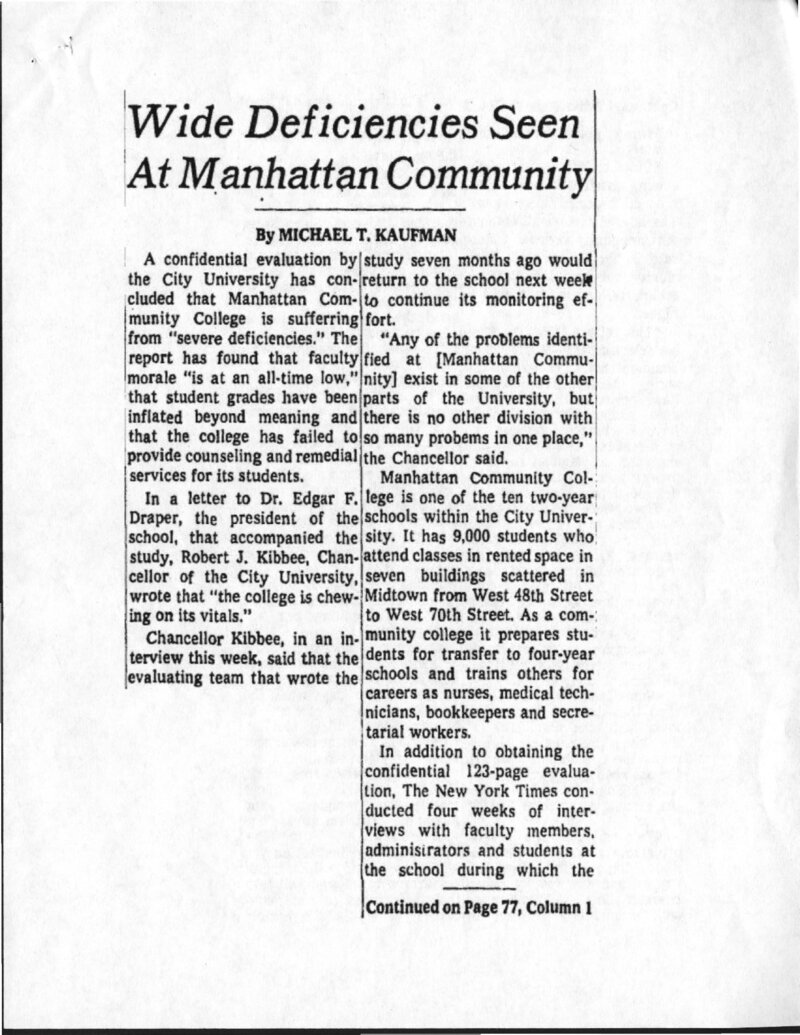
Wide Deficiencies Seen
At Manhattan Community
By MICHAEL T, KAUFMAN
A confidential evaluation by/study seven months ago would)
the City University has con-jreturn to the school next weet
cluded that Manhattan Com-jto continue its monitoring ef
munity College is sufferring} fort.
from “severe deficiencies.” The} “Any of the problems identi
report has found that faculty/fied at [Manhattan Commu-
morale “is at an all-time low,”|nity] exist in some of the other!
that student grades have been|parts of the University, but!
inflated beyond meaning and|there is no other division with
that the college has failed to!so many probems in one place,” ,
‘provide counseling and remedial|the Chancellor said.
| services for its students. Manhattan Community Col.
In a letter to Dr, Edgar F,|lege is one of the ten two-year:
Draper, the president of the|Schools within the City Univer-
school, that accompanied the|sity. It has 9,000 students who
study, Robert J. Kibbee, Chan-jattend classes in rented space in
cellor of the City University,/seven buildings scattered in
wrote that “the college is chew-/Midtown from West 48th Street
ing On its vitals.” to West 70th Street. As a com-
Chancellor Kibbee, in an in-/Munity college it prepares stu-
terview this week, said that the/dents for transfer to four-year
evaluating team that wrote the|Schools and trains others for
careers as nurses, medical tech-
nicians, bookkeepers and secre-
arial workers.
In addition to obtaining the
confidential 123-page evalua-
tion, The New York Times con-
ducted four weeks of inter-
views with faculty members,
adminisirators and students at
the school during which the
Continued on Page 77, Column 1
1, Col. 3|buy $20 tickets to what they!
a ee contended was a public-rela-|
following points were d0cu-itions gimmick intended to mask
mented: t the|@iling. morale.
wadie intan ee failed 2 Se
carried out team
their state accreditation exams. led two vice Bc MB of
The administration at Manhat- he City University who a0
tan Community says the failure}several weeks at the college,
munity colleges; the Chancel- inin ®
siege g records, The language of
cellor’s office reports that it is|their findings often Sout be.
higher. : yond the dispassionate jargon
QThe college is having trou-|of such reports. They charged
ble selecting a valedictorian at Dr. Draper, for example, with
commencement exercises this|failure “to recognize the most
spring because 14 students/serious morale problems.
have perfect straight A aver-| The conclusions, wrote the
ages. Other colleges usually examiners, are in direct con-
have at the most one or twoiflict with Dr. Draper's state-|
such students and some faculty/ment that ‘We are effectively
members at Manhattan Com- —s the challenge in the
munity point to this as an in-/area of college morale,’”
dex of debased standards. In a letter to the Chancellor}:
QTwo years ago student fees|sent after he had read the eval-|:
were used to buy two automo-juation, Dr. Draper took issue}:
biles for student government|with the findings of the exam-
leaders. Other student feesliners. “It was not professional
were used to send 40 students|nor objective,” he wrote. “One
on a trip to Africa. A faculty;would suspect that the investi-
investigating committee report-/gating team had the prima
ed that “while monies were im-jgoal of discrediting our ad-
properly expended, pursuit of|ministration.”
the situation would not be in} Dr. Draper complained that
the best interests of the over-jat least one of the examiners
all student body.” bore him a personal grudge e
’ @Some faculty members con-|ing back to the days when t
tend that deans falling out ofjexaminer was a student at
favor with the administration|Morgan State College and Dr.
are given meaningless duties, reap a was a business manager
or as the evaluation contends,|at the Maryland school, i
“re-assigned to nonfunctional] In an interview this week,
titles." Some of these deans/Dr. Draper said that college
are earning as much as $40,000)morale was “wonderful” and
a year... attributed criticism to a “dis-
§Two months ago several)gruntled few.” ;
professors picketed a testimo-| “In any large institution you
nial dinner for President}will always find a handful of!
Draper and the faculty union|embi types who will take},
charged the administration|their grievances to the news-
with intimidating teachers’ to|papers,” said the 52-year-old ;
leducator who became president|of the City University have en-
lof the college three years ago./Tolled all high school gradu:
| The interview took place in|@tes, large numbers of whom,
i , ; educators say, are unpreparec
ithe college's administrative of-|f47 college work Somes of
fices on the fourth floor of :
= in — — at 1633 ar A Fg ”
roadway, One o com- 5
plaints of the evaluators was hier bel oe i on Lon
‘that _— —. which include| formal ents of Develop-
ae yg epartment — mental Skills In which students
jand registrar, “are in @jare regular instruction ir
‘building where the management /fndamental subjects. General-
explicitly required the collegelj, these students receive mini:
to keep student traffic to alma! or no college credit for
— ian aac ea such courses.
in supportin,
low. morale, the Chancellor's|coltge inert were on tard
remediation classes until las!
fall. Ipstead students, some of
ag ne at the sixth-grade
or lower, were registered
in the regular college courses
of their choice. rg ober —
supposed to spot students hav-
ing trouble and to work in-
formally with these men and
women,
. Dr, Draper has attributed the
lack of a formal approach to
were a ta the evaleaten’ pub.|temedial education to the al-
lished by the college, ‘ice leged intransigence of a former
also was obtained by The|dean of faculty, Dr. Eric James,
Times, showed that faculty de-|!t was Dr. James, a former
cisions on appointments were|Ambassador to Liberia, who
revised in only three of 170|had originally brought Dr. _
cases. Draper to the school as his
However, an official of the@ssistant dean.
faculty's union, the Professional| The rift between the two men
Staff Congress, the|@pparently cut deeply into the
listing did not include three|College community. “It was a
Sea ie ate eat eT cen tes onigenee
s of facu ie
pl lly y that ended when Dr. James
By far the largest section ofjleft the school to become a
the evaluation report dealt with|professor of public administra.
problems in remedial education|tion at Baruch College two
and it is in this area thatjyears ago.
In the evaluation the
examiners disputed Dr. Draper's
view.
“Contrary to Dr. Draper's
confusing.” It noted a h
turnover in deans, said there
was a “lack of consultative
process in the appointment of
new Officers,” and alleged
faculty decisions on appoint-
ment and tenure often were
disregarded.
Dr. Draper said these charges
stated belief.” the report said,| tional - abilities, “For instance,
“the tabs oe godin many jobs in our society (shop
: + | attendant, service-station at-
evidence of Dr. James's unwill- tendant, warehousemen’s as-
ingness to implement a remedial) sistant, etc.) call for a fourth-
proram. Actually, it was the] grade reading level, And The
President, who, on numerous| New York Times's news sec-
occasions, expressed his lack of| tions are written at a ninth-
faith and opposition to remedia-| Btade level.
ae . i Assignments Are Shifted
fave. compeavence or tiis| At his testimonial dinner at
— = — report, WAS) the Americana Hotel on March
at marks bore no relation) 29, President Draper. said that
ship to the performances of the dean of faculty, Myron F
students,” In addition teachers! yy” potiock had created a de
at the school told The Times) velopmental skills .. program,
of being encouraged to pass “which: we believe, ranks
and move along students who, among the best in the nation.”
because of academic de-
ficiencies, had difficulty with Yet two months earlier Dean
Pollock was sharply denounced
ve oe ai pressure in a memorandum by Mervyn
Keizer, the associate dean he
from the Chancellor's office | 24 hired to head the program.
formal remediation program was Dean Keizer and four of his top
instituted at Manhattan Com- aides had been removed from
munity for the last fall term.
direct respons'bility for the
ee tau wana Tear gram by Dean Pollock. ‘That
— se | move came four months after
sa too man that the| Dean Pollock had brought in
were exempted and that the) nos, Keizer to take over the
cut-off requirement was t00/ -ooram from Rawn Spearman.
high. They also said that by| noo, Spearman had been hired
awarding regular credits for Sept. 1, and relieved of his
the courses it was possible for Taice duties on Sept. 29, but
students to receive 15 points, remains at the school.
Or one quarter of the credits “in their letter to President
needed for eee ioc Mas- Draper, Dean Keizer and his
tering simple reading and arith-| ‘aides accused’ the admninistre-
In rebuttal to these charges,| ne bod por Ange berg ners
the —_ school administration for administration failures,
wrote: “It should be img The charges of student mis-
out that most laymen have a) .nonding of funds range back to
somewhat confused idea of the ae tone nineteen-sixties when
relationships which exist be- tp. college was brought to a
tween reading level and func-' condstill by political demon-
tional - abilities, “For instance, trations led by a student gov-
strations led by a student gov-
ernment ae the Third
World Coalition. The current
student government contends
that this spent a reserve
fund of $350,000 and that as
a result the student coffers are
now bare.
Of these funds, $4,400 were
used to pay for two Pontiacs
that were stered to
president and treasurer of the
Student Government.
the matter came to light two
years ago, one of the cars was
sold for $1,000, The other was
mysteriously bombed in Catons-
ville, Md., where some students
had gone on a trip.
Another disbursement was
made to send delegations of
ost and in one case a
nonstudent, to political meet-
ings in Puerto Rico and New
Orleans.
In an interview, President
Draper said he thought some
of the spending was “inap-
jate,” but he explained
that the allocation of student
funds, which was-raised from
the $60 4 year each student
is required to pay, were gov-
erned not by the administra-
— by a student-faculty
Student activities at the
schoo] have long been conten-
tious and only last week the
results of a student government
election were impounded pend-
~ 8 review by the Honest
Ballot Association. It is al-
leged that one slate of candi-
dates used college funds to
send campaign literature to the
homes of 5,000 students.
Another recent tempest on
the campus has involved the
testimonial dinner for President
Draper, In the interview, Dr.
pointed out that the at-
ance at the testimonial din-
ner of 237 of the school’s more
ithan 500 faculty members was
an index “of our very fine
the morale.” He said he was sur-
prised when his aides planned
When |the event and said he felt “it
was a spontaneous thing aris-
jing from the faculty as a re-
jsponse to the charges by a
‘handful of discontents.”
| The dissidents and admitted
discontents sees it Uifferently.
produced. memorandums
in which department chairmen
were requested to sell tickets
for the dinner, which was
scheduled just before decisions
On reappointment and tenure
were expected.
A faculty committee on the
dinner met regularly and the
minutes of one such pone
show that a recently tenure
student counselor volunteered
$800 to pay for a band. The
union newsletter described the
dinner this way:
“The testimonial for the
President, being contrived
under the aegis of several
highly paid members of his im-
mediate staff, with the assist-
ance of some equally well-paid
satraps in other departments of
the college, is the latest chapter
in the unfolding drama at
Borough of Manhattan Commu-
nity College.
“The testimonial for the
President, cit contrived
under the of several
highly Ss maers of his im-
mediate staff, with the assist-
ance of some equally well-paid
, Satraps in other departments of
‘the college, is the latest chapter
in the unfolding drama at
— of Manhattan Commu-
nity College.
“The idea, of course, is to
create a positive image in the
eyes of the new members of
‘the new Board of Higher Edu-
‘cation. Perhaps they think that
a toast will distract the new
‘board members from the grave
; issues at the College and the
| thick file on the President's
‘ abuses,
“All hail the President. Let
him have a toast. Let him have
‘French toast, buttered toast,
‘Melba toast and all the mil-
_quetoasts the board can stom-
wach, Let him use ee Xerox
‘machines and the -
meter and let him hire AT e
_ ballrooms in New York for his
‘name's sake. But let him see—
and let the new members of the
board see—that none of this
has anything to do with run-
ning a college.”
NY Times, May 17, 1974 — page 1
At Manhattan Community
By MICHAEL T, KAUFMAN
A confidential evaluation by/study seven months ago would)
the City University has con-jreturn to the school next weet
cluded that Manhattan Com-jto continue its monitoring ef
munity College is sufferring} fort.
from “severe deficiencies.” The} “Any of the problems identi
report has found that faculty/fied at [Manhattan Commu-
morale “is at an all-time low,”|nity] exist in some of the other!
that student grades have been|parts of the University, but!
inflated beyond meaning and|there is no other division with
that the college has failed to!so many probems in one place,” ,
‘provide counseling and remedial|the Chancellor said.
| services for its students. Manhattan Community Col.
In a letter to Dr, Edgar F,|lege is one of the ten two-year:
Draper, the president of the|Schools within the City Univer-
school, that accompanied the|sity. It has 9,000 students who
study, Robert J. Kibbee, Chan-jattend classes in rented space in
cellor of the City University,/seven buildings scattered in
wrote that “the college is chew-/Midtown from West 48th Street
ing On its vitals.” to West 70th Street. As a com-
Chancellor Kibbee, in an in-/Munity college it prepares stu-
terview this week, said that the/dents for transfer to four-year
evaluating team that wrote the|Schools and trains others for
careers as nurses, medical tech-
nicians, bookkeepers and secre-
arial workers.
In addition to obtaining the
confidential 123-page evalua-
tion, The New York Times con-
ducted four weeks of inter-
views with faculty members,
adminisirators and students at
the school during which the
Continued on Page 77, Column 1
1, Col. 3|buy $20 tickets to what they!
a ee contended was a public-rela-|
following points were d0cu-itions gimmick intended to mask
mented: t the|@iling. morale.
wadie intan ee failed 2 Se
carried out team
their state accreditation exams. led two vice Bc MB of
The administration at Manhat- he City University who a0
tan Community says the failure}several weeks at the college,
munity colleges; the Chancel- inin ®
siege g records, The language of
cellor’s office reports that it is|their findings often Sout be.
higher. : yond the dispassionate jargon
QThe college is having trou-|of such reports. They charged
ble selecting a valedictorian at Dr. Draper, for example, with
commencement exercises this|failure “to recognize the most
spring because 14 students/serious morale problems.
have perfect straight A aver-| The conclusions, wrote the
ages. Other colleges usually examiners, are in direct con-
have at the most one or twoiflict with Dr. Draper's state-|
such students and some faculty/ment that ‘We are effectively
members at Manhattan Com- —s the challenge in the
munity point to this as an in-/area of college morale,’”
dex of debased standards. In a letter to the Chancellor}:
QTwo years ago student fees|sent after he had read the eval-|:
were used to buy two automo-juation, Dr. Draper took issue}:
biles for student government|with the findings of the exam-
leaders. Other student feesliners. “It was not professional
were used to send 40 students|nor objective,” he wrote. “One
on a trip to Africa. A faculty;would suspect that the investi-
investigating committee report-/gating team had the prima
ed that “while monies were im-jgoal of discrediting our ad-
properly expended, pursuit of|ministration.”
the situation would not be in} Dr. Draper complained that
the best interests of the over-jat least one of the examiners
all student body.” bore him a personal grudge e
’ @Some faculty members con-|ing back to the days when t
tend that deans falling out ofjexaminer was a student at
favor with the administration|Morgan State College and Dr.
are given meaningless duties, reap a was a business manager
or as the evaluation contends,|at the Maryland school, i
“re-assigned to nonfunctional] In an interview this week,
titles." Some of these deans/Dr. Draper said that college
are earning as much as $40,000)morale was “wonderful” and
a year... attributed criticism to a “dis-
§Two months ago several)gruntled few.” ;
professors picketed a testimo-| “In any large institution you
nial dinner for President}will always find a handful of!
Draper and the faculty union|embi types who will take},
charged the administration|their grievances to the news-
with intimidating teachers’ to|papers,” said the 52-year-old ;
leducator who became president|of the City University have en-
lof the college three years ago./Tolled all high school gradu:
| The interview took place in|@tes, large numbers of whom,
i , ; educators say, are unpreparec
ithe college's administrative of-|f47 college work Somes of
fices on the fourth floor of :
= in — — at 1633 ar A Fg ”
roadway, One o com- 5
plaints of the evaluators was hier bel oe i on Lon
‘that _— —. which include| formal ents of Develop-
ae yg epartment — mental Skills In which students
jand registrar, “are in @jare regular instruction ir
‘building where the management /fndamental subjects. General-
explicitly required the collegelj, these students receive mini:
to keep student traffic to alma! or no college credit for
— ian aac ea such courses.
in supportin,
low. morale, the Chancellor's|coltge inert were on tard
remediation classes until las!
fall. Ipstead students, some of
ag ne at the sixth-grade
or lower, were registered
in the regular college courses
of their choice. rg ober —
supposed to spot students hav-
ing trouble and to work in-
formally with these men and
women,
. Dr, Draper has attributed the
lack of a formal approach to
were a ta the evaleaten’ pub.|temedial education to the al-
lished by the college, ‘ice leged intransigence of a former
also was obtained by The|dean of faculty, Dr. Eric James,
Times, showed that faculty de-|!t was Dr. James, a former
cisions on appointments were|Ambassador to Liberia, who
revised in only three of 170|had originally brought Dr. _
cases. Draper to the school as his
However, an official of the@ssistant dean.
faculty's union, the Professional| The rift between the two men
Staff Congress, the|@pparently cut deeply into the
listing did not include three|College community. “It was a
Sea ie ate eat eT cen tes onigenee
s of facu ie
pl lly y that ended when Dr. James
By far the largest section ofjleft the school to become a
the evaluation report dealt with|professor of public administra.
problems in remedial education|tion at Baruch College two
and it is in this area thatjyears ago.
In the evaluation the
examiners disputed Dr. Draper's
view.
“Contrary to Dr. Draper's
confusing.” It noted a h
turnover in deans, said there
was a “lack of consultative
process in the appointment of
new Officers,” and alleged
faculty decisions on appoint-
ment and tenure often were
disregarded.
Dr. Draper said these charges
stated belief.” the report said,| tional - abilities, “For instance,
“the tabs oe godin many jobs in our society (shop
: + | attendant, service-station at-
evidence of Dr. James's unwill- tendant, warehousemen’s as-
ingness to implement a remedial) sistant, etc.) call for a fourth-
proram. Actually, it was the] grade reading level, And The
President, who, on numerous| New York Times's news sec-
occasions, expressed his lack of| tions are written at a ninth-
faith and opposition to remedia-| Btade level.
ae . i Assignments Are Shifted
fave. compeavence or tiis| At his testimonial dinner at
— = — report, WAS) the Americana Hotel on March
at marks bore no relation) 29, President Draper. said that
ship to the performances of the dean of faculty, Myron F
students,” In addition teachers! yy” potiock had created a de
at the school told The Times) velopmental skills .. program,
of being encouraged to pass “which: we believe, ranks
and move along students who, among the best in the nation.”
because of academic de-
ficiencies, had difficulty with Yet two months earlier Dean
Pollock was sharply denounced
ve oe ai pressure in a memorandum by Mervyn
Keizer, the associate dean he
from the Chancellor's office | 24 hired to head the program.
formal remediation program was Dean Keizer and four of his top
instituted at Manhattan Com- aides had been removed from
munity for the last fall term.
direct respons'bility for the
ee tau wana Tear gram by Dean Pollock. ‘That
— se | move came four months after
sa too man that the| Dean Pollock had brought in
were exempted and that the) nos, Keizer to take over the
cut-off requirement was t00/ -ooram from Rawn Spearman.
high. They also said that by| noo, Spearman had been hired
awarding regular credits for Sept. 1, and relieved of his
the courses it was possible for Taice duties on Sept. 29, but
students to receive 15 points, remains at the school.
Or one quarter of the credits “in their letter to President
needed for eee ioc Mas- Draper, Dean Keizer and his
tering simple reading and arith-| ‘aides accused’ the admninistre-
In rebuttal to these charges,| ne bod por Ange berg ners
the —_ school administration for administration failures,
wrote: “It should be img The charges of student mis-
out that most laymen have a) .nonding of funds range back to
somewhat confused idea of the ae tone nineteen-sixties when
relationships which exist be- tp. college was brought to a
tween reading level and func-' condstill by political demon-
tional - abilities, “For instance, trations led by a student gov-
strations led by a student gov-
ernment ae the Third
World Coalition. The current
student government contends
that this spent a reserve
fund of $350,000 and that as
a result the student coffers are
now bare.
Of these funds, $4,400 were
used to pay for two Pontiacs
that were stered to
president and treasurer of the
Student Government.
the matter came to light two
years ago, one of the cars was
sold for $1,000, The other was
mysteriously bombed in Catons-
ville, Md., where some students
had gone on a trip.
Another disbursement was
made to send delegations of
ost and in one case a
nonstudent, to political meet-
ings in Puerto Rico and New
Orleans.
In an interview, President
Draper said he thought some
of the spending was “inap-
jate,” but he explained
that the allocation of student
funds, which was-raised from
the $60 4 year each student
is required to pay, were gov-
erned not by the administra-
— by a student-faculty
Student activities at the
schoo] have long been conten-
tious and only last week the
results of a student government
election were impounded pend-
~ 8 review by the Honest
Ballot Association. It is al-
leged that one slate of candi-
dates used college funds to
send campaign literature to the
homes of 5,000 students.
Another recent tempest on
the campus has involved the
testimonial dinner for President
Draper, In the interview, Dr.
pointed out that the at-
ance at the testimonial din-
ner of 237 of the school’s more
ithan 500 faculty members was
an index “of our very fine
the morale.” He said he was sur-
prised when his aides planned
When |the event and said he felt “it
was a spontaneous thing aris-
jing from the faculty as a re-
jsponse to the charges by a
‘handful of discontents.”
| The dissidents and admitted
discontents sees it Uifferently.
produced. memorandums
in which department chairmen
were requested to sell tickets
for the dinner, which was
scheduled just before decisions
On reappointment and tenure
were expected.
A faculty committee on the
dinner met regularly and the
minutes of one such pone
show that a recently tenure
student counselor volunteered
$800 to pay for a band. The
union newsletter described the
dinner this way:
“The testimonial for the
President, being contrived
under the aegis of several
highly paid members of his im-
mediate staff, with the assist-
ance of some equally well-paid
satraps in other departments of
the college, is the latest chapter
in the unfolding drama at
Borough of Manhattan Commu-
nity College.
“The testimonial for the
President, cit contrived
under the of several
highly Ss maers of his im-
mediate staff, with the assist-
ance of some equally well-paid
, Satraps in other departments of
‘the college, is the latest chapter
in the unfolding drama at
— of Manhattan Commu-
nity College.
“The idea, of course, is to
create a positive image in the
eyes of the new members of
‘the new Board of Higher Edu-
‘cation. Perhaps they think that
a toast will distract the new
‘board members from the grave
; issues at the College and the
| thick file on the President's
‘ abuses,
“All hail the President. Let
him have a toast. Let him have
‘French toast, buttered toast,
‘Melba toast and all the mil-
_quetoasts the board can stom-
wach, Let him use ee Xerox
‘machines and the -
meter and let him hire AT e
_ ballrooms in New York for his
‘name's sake. But let him see—
and let the new members of the
board see—that none of this
has anything to do with run-
ning a college.”
NY Times, May 17, 1974 — page 1
Title
"Wide Deficiencies Seen at Manhattan Community"
Description
In May 1974 the New York Times published an investigation of alleged mismanagement at Borough of Manhattan Community College. The article was based on a confidential report compiled on the instructions of Chancellor Robert Kibbee. On the basis of the leaked report, the Times alleged that BMCC suffered from low faculty morale, consistent grade inflation, and a failure to implement the remedial education programs that became urgent following the establishment of open admissions in 1971. Radical students and faculty at BMCC, while accepting criticisms of the administration, hit back at what they felt were implied criticisms of the student body itself. The editors of Tiger Paper, a radical paper published by faculty at the college, led their May 1974 issue with an attack on this "smear job."
Contributor
Friedheim, Bill
Creator
Kaufman, Michael T.
Date
May 17, 1974
Language
English
Publisher
New York Times
Relation
1911
Rights
Copyrighted
Source
New York Times
Original Format
Article / Essay
Kaufman, Michael T. Letter. “‘Wide Deficiencies Seen at Manhattan Community’”. 1911, CUNY DIGITAL HISTORY ARCHIVE, accessed September 5, 2026, https://stephenz.tailc22a4b.ts.net/s/cdha/item/250