"Birth of a Movement"
Item
‘|
vuIcE May'9, 1995
“By Andrew Héiao, ~~
with Karen Houppert
It’s a perfect afternoon for pro-
test. The cops are absent. The sun
is shining. The sky is blue. Spring
is in the air and New Yorkers are
about as congenial as they get.
“Stay the fuck off my car,” a
suit in a green Oldsmobile shouts
to demonstrators. He inches his
car into a group of activists who,
after nonchalantly milling around
the entrance to the Midtown Tun-
nel, have converged into the rush
hour traffic: The protesters re-
spond with a chant: “People with
AIDS under attack, what do we
do? ACT UP, fight back.”
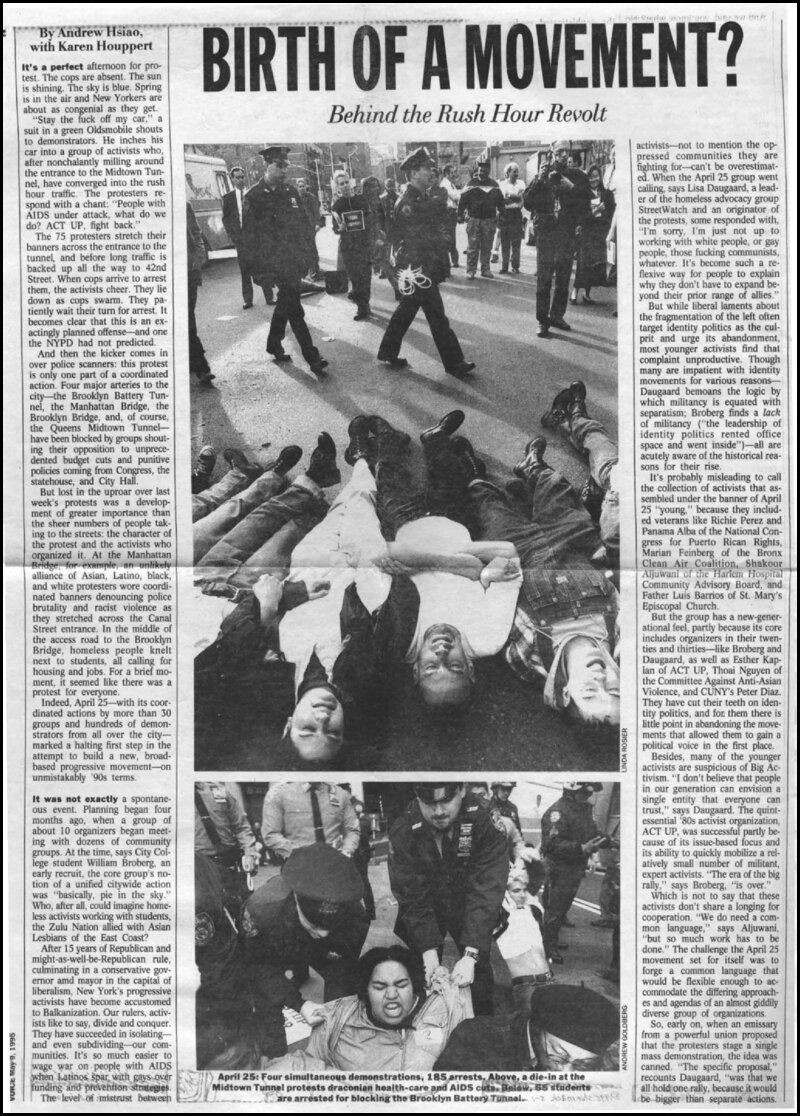
The 75 protesters stretch their
banners across the entrance to the
tunnel, and before long traffic is
backed up all the way to 42nd
Street. When cops arrive to arrest
them, the activists cheer. They lie
down as cops swarm. They pa-
tiently wait their turn for arrest. It
becomes clear that this is an ex-
actingly planned offense—and one
the NYPD had not predicted.
And then the kicker comes in
over police scanners: this protest
is only one part of a coordinated
action. Four major arteries to the
city—the Brooklyn Battery Tun-
nel, the Manhattan Bridge, the
Brooklyn Bridge, and, of course,
the Queens Midtown Tunnel—
have been blocked by groups shout-
ing their opposition to unprece-
dented budget cuts and punitive
policies coming from Congress, the
statehouse, and City Hall.
But lost in the uproar over last
week’s protests was a develop-
ment of greater importance than
the sheer numbers of people tak-
ing to the streets: the character of
alliance of Asian, Latino, black,
and white protesters wore coordi-
nated banners denouncing police
brutality and racist violence as
they stretched across the Canal
Street entrance. In the middle of
the access road to the Brooklyn
Bridge, homeless people knelt
next to students, all calling for
housing and jobs. For a brief mo-
ment, it seemed like there was a
protest for everyone.
Indeed, April 25—with its coor-
dinated actions by more than 30
groups and hundreds of demon-
strators from all over the city—
marked a halting first step in the
attempt to build a new, broad-
based progressive movement—on
unmistakably ‘90s terms.
It was not exactly a spontane-
ous event. Planning began four
months ago, when a group of
about 10 organizers began meet-
ing with dozens of community
groups. At the time, says City Col-
lege student William Broberg, an
early recruit, the core group's no-
tion of a unified citywide action
was “basically, pie in the sky.”
Who, after all, could imagine home-
less activists working with students,
the Zulu Nation allied with Asian
Lesbians of the East Coast?
After 15 years of Republican and
might-as-well-be-Republican rule,
culminating in a conservative gov-
ernor amd mayor in the capital of
liberalism, New York's progressive
activists have become accustomed
to Balkanization. Our rulers, activ-
ists like to say, divide and conquer.
They have succeeded in isolating—
and even subdividing—our com-
munities. It's so much easier to
wage war on-people with AIDS
when: Latinos Spar, with gays.over
funding’ and prevention strategies.
The level. 6f mistrust between
the protest and the activists who
ron it. At the Manhattan
sees eed
IRTH OF A MOV
Behind the Rush Hour Revolt
aa
:
iS 4 ) Aprit 2S: Four simultaneous demonstrations, 185 arrests,
Midtown Tunnel protests draconian health-care and AIDS c:
!” ‘are arrested for blocking the Brooklyn Battery Tunnel.
UNDA ROSIER
ANDREW GOLDBERG
EMENT?
activists—not to mention the op-
pressed communities they are
fighting for—can’t be overestimat-
ed, When the April 25 group went
calling, says Lisa Daugaard, a lead-
er of the homeless advocacy group
StreetWatch and an originator of
the protests, some responded with,
“I'm sorry, I’m just not up to
working with white people, or gay
people, those fucking communists,
whatever. It’s become such a re-
flexive way for people to explain
why they don’t have to expand be-
yond their prior range of allies.”
But while liberal laments about
the fragmentation of the left often
target identity politics as the cul-
prit and urge its abandonment,
most younger activists find that
complaint unproductive. Though
many are impatient with identity
movements for various reasons—
Daugaard bemoans the logic by
which militancy is equated with
separatism; Broberg finds a lack
of militancy (“the leadership of
identity politics rented office
space and went inside’”)—all are
acutely aware of the historical rea-
sons for their rise.
It’s probably misleading to call
the collection of activists that as-
sembled under the banner of April
25 “young,” because they includ-
ed veterans like Richie Perez and
Panama Alba of the National Con-
gress for Puerto Rican Rights,
Marian Feinberg of the Bronx
Clean Air Coalition, Shakoor
Community Advisory Board, and
Father Luis Barrios of St..Maty's
Episcopal Church.
But the group has a new-gener-
ational feel, partly because its core
includes organizers in their twen-
ties and thirties—like Broberg and
Daugaard, as well as Esther Kap-
lan of ACT UP, Thoai Nguyen of
the Committee Against Anti-Asian
Violence, and CUNY’s Peter Diaz.
They have cut their teeth on iden-
tity politics, and for them there is
little point in abandoning the move-
ments that allowed them to gain a
political voice in the first place.
Besides, many of the younger
activists are suspicious of Big Ac-
tivism. “I don't believe that people
in our generation can envision a
single entity that everyone can
trust,” says Daugaard. The quint-
essential '80s activist organization,
ACT UP, was successful partly be-
cause of its issue-based focus and
its ability to quickly mobilize a rel-
atively small number of militant,
expert activists. “The era of the big
rally,” says Broberg, “is over.”
Which is not to say that these
activists don’t share a longing for
cooperation. “We do need a com-
mon language,” says Aljuwani,
“but so much work has to be
done.” The challenge the April 25
movement set for itself was to
forge a common language that
would be flexible enough to ac-
commodate the differing approach-
es and agendas of an almost giddily
diverse group of organizations.
So, early on, when an emissary
from a powerful union proposed
that the protesters stage a single
mass demonstration, the idea was
canned. “The specific proposal,”
recounts Daugaard, “was that we
all hold:one rally, because it would
be bigger than separate actions.
Aljuwant of the Harlem Hospital
And we said, you know what? No
one wants to come to one rally
because they feel that they won't
be heard, they won't have control,
their people will be washed out in
the numerical splendor of the big
union or whoever is going to be
the dominant thing there.” (As it
turned out, the unions staged
their own march on April 4, to
much less fanfare than the April
25 demos.)
Ultimately, the activists settled
on a strategy of coordinated, si-
multaneous protests. An internal
memo circulated early on in the
project articulates the theory be-
hind the actions: “The bridge plan
might succeed only because it
does not require us to work as
one, to resolve our contradictions
and suspicions, in order to pull it
off. Ironically, once it is achieved,
a logistical and symbolic success
may be a compelling illustration
to all involved... of the benefits
of coordination and alliance, But
we cannot wish that comprehen-
sion and resolution into being—
we must achieve it tactically,
through demonstration of the
power of working together.”
The bridge event was, says Kap-
lan, “the perfect balance of unity
and autonomy.” Several months
of intense discussions and inter-
minable meetings ensued. Groups
dropped in; groups dropped out.
“It was a learning experience for
us,” says Perez. ‘Older activists
like myself had a different per-
spective; we grew up with suc-
cessful multiracial movements.” If
nothing else, the veterans could
communicate their optimism.
“Some of the younger Latinos, for
example, didn’t know any Asians.
Some did, of course, but had almost
no experience working together.”
And older activists learned from
younger: “The use of technology,
the sophisticated. media opera-
tions—we didn’t have that.” ACT
UP, as we all know, does.
In the end, novel strategies and
workable structures are necessary
but insufficient. Any strategy in-
volving civil disobedience depends
on one thing, as Aljuwani says:
“people who are willing to do a
frightening thing—put their body
on the line.” And the April 25
organizers nurtured this, at the
very least: 185 people from virtu-
ally every corner of the city, who
were willing to risk injury, arrest,
and jail time to throw down an
ethical challenge; who endured
the curses of angry New Yorkers
seemingly more concerned about a
delay in their commute than the
destruction of lives being commit-
ted in their names; who suffered
unusually harsh treatment from a
vengeful city police force.
But in doing so, they may have
kick-started a movement that has
never been more fervently longed
for nor more necessary than now.
It certainly has begun for those
who spent the night in jail. As
Perez says, “There's no greater
bonding site than the Tombs.”
Or as William Broberg puts it,
“T’'m a student, but since I've been
a homeless organizer, | was going
to help get the meetings off the
ground for that group. And having
been an ACT UP activist for a
long time, I would’ve been just as
comfortable working with them.
So there were three places where I
felt totally comfortable getting ar-
rested. Then in jail I realized that
a lot of people had a similar dilem-
ma, and I hope the next time we
do something even more people
have that dilemma, and then the
time after that it won't matter
which action we do. And it's
down that road that we hope
THE SHAPE OF THINGS TO COME
we've sent politics in this city.”
Sure, people make history, but
not under conditions of their own
choosing, right? Are the condi-
tions ripe for a broad-based moye-
ment? Has the historical moment
arrived? As if practicing the dia-
lectic or proffering zen koans, the
April 25 activists turn the ques-
tion on its head: if you can’t swim,
you don’t want to leap into the
ocean—but there's only one way to
learn. “The only way we'll get to
the point where we can trust each
other enough to work together is
to work together,” suggests Perez.
“Tt can only be done by deeds,
reflection, then more deeds.” &
13
vuIcE May'9, 1995
“By Andrew Héiao, ~~
with Karen Houppert
It’s a perfect afternoon for pro-
test. The cops are absent. The sun
is shining. The sky is blue. Spring
is in the air and New Yorkers are
about as congenial as they get.
“Stay the fuck off my car,” a
suit in a green Oldsmobile shouts
to demonstrators. He inches his
car into a group of activists who,
after nonchalantly milling around
the entrance to the Midtown Tun-
nel, have converged into the rush
hour traffic: The protesters re-
spond with a chant: “People with
AIDS under attack, what do we
do? ACT UP, fight back.”
The 75 protesters stretch their
banners across the entrance to the
tunnel, and before long traffic is
backed up all the way to 42nd
Street. When cops arrive to arrest
them, the activists cheer. They lie
down as cops swarm. They pa-
tiently wait their turn for arrest. It
becomes clear that this is an ex-
actingly planned offense—and one
the NYPD had not predicted.
And then the kicker comes in
over police scanners: this protest
is only one part of a coordinated
action. Four major arteries to the
city—the Brooklyn Battery Tun-
nel, the Manhattan Bridge, the
Brooklyn Bridge, and, of course,
the Queens Midtown Tunnel—
have been blocked by groups shout-
ing their opposition to unprece-
dented budget cuts and punitive
policies coming from Congress, the
statehouse, and City Hall.
But lost in the uproar over last
week’s protests was a develop-
ment of greater importance than
the sheer numbers of people tak-
ing to the streets: the character of
alliance of Asian, Latino, black,
and white protesters wore coordi-
nated banners denouncing police
brutality and racist violence as
they stretched across the Canal
Street entrance. In the middle of
the access road to the Brooklyn
Bridge, homeless people knelt
next to students, all calling for
housing and jobs. For a brief mo-
ment, it seemed like there was a
protest for everyone.
Indeed, April 25—with its coor-
dinated actions by more than 30
groups and hundreds of demon-
strators from all over the city—
marked a halting first step in the
attempt to build a new, broad-
based progressive movement—on
unmistakably ‘90s terms.
It was not exactly a spontane-
ous event. Planning began four
months ago, when a group of
about 10 organizers began meet-
ing with dozens of community
groups. At the time, says City Col-
lege student William Broberg, an
early recruit, the core group's no-
tion of a unified citywide action
was “basically, pie in the sky.”
Who, after all, could imagine home-
less activists working with students,
the Zulu Nation allied with Asian
Lesbians of the East Coast?
After 15 years of Republican and
might-as-well-be-Republican rule,
culminating in a conservative gov-
ernor amd mayor in the capital of
liberalism, New York's progressive
activists have become accustomed
to Balkanization. Our rulers, activ-
ists like to say, divide and conquer.
They have succeeded in isolating—
and even subdividing—our com-
munities. It's so much easier to
wage war on-people with AIDS
when: Latinos Spar, with gays.over
funding’ and prevention strategies.
The level. 6f mistrust between
the protest and the activists who
ron it. At the Manhattan
sees eed
IRTH OF A MOV
Behind the Rush Hour Revolt
aa
:
iS 4 ) Aprit 2S: Four simultaneous demonstrations, 185 arrests,
Midtown Tunnel protests draconian health-care and AIDS c:
!” ‘are arrested for blocking the Brooklyn Battery Tunnel.
UNDA ROSIER
ANDREW GOLDBERG
EMENT?
activists—not to mention the op-
pressed communities they are
fighting for—can’t be overestimat-
ed, When the April 25 group went
calling, says Lisa Daugaard, a lead-
er of the homeless advocacy group
StreetWatch and an originator of
the protests, some responded with,
“I'm sorry, I’m just not up to
working with white people, or gay
people, those fucking communists,
whatever. It’s become such a re-
flexive way for people to explain
why they don’t have to expand be-
yond their prior range of allies.”
But while liberal laments about
the fragmentation of the left often
target identity politics as the cul-
prit and urge its abandonment,
most younger activists find that
complaint unproductive. Though
many are impatient with identity
movements for various reasons—
Daugaard bemoans the logic by
which militancy is equated with
separatism; Broberg finds a lack
of militancy (“the leadership of
identity politics rented office
space and went inside’”)—all are
acutely aware of the historical rea-
sons for their rise.
It’s probably misleading to call
the collection of activists that as-
sembled under the banner of April
25 “young,” because they includ-
ed veterans like Richie Perez and
Panama Alba of the National Con-
gress for Puerto Rican Rights,
Marian Feinberg of the Bronx
Clean Air Coalition, Shakoor
Community Advisory Board, and
Father Luis Barrios of St..Maty's
Episcopal Church.
But the group has a new-gener-
ational feel, partly because its core
includes organizers in their twen-
ties and thirties—like Broberg and
Daugaard, as well as Esther Kap-
lan of ACT UP, Thoai Nguyen of
the Committee Against Anti-Asian
Violence, and CUNY’s Peter Diaz.
They have cut their teeth on iden-
tity politics, and for them there is
little point in abandoning the move-
ments that allowed them to gain a
political voice in the first place.
Besides, many of the younger
activists are suspicious of Big Ac-
tivism. “I don't believe that people
in our generation can envision a
single entity that everyone can
trust,” says Daugaard. The quint-
essential '80s activist organization,
ACT UP, was successful partly be-
cause of its issue-based focus and
its ability to quickly mobilize a rel-
atively small number of militant,
expert activists. “The era of the big
rally,” says Broberg, “is over.”
Which is not to say that these
activists don’t share a longing for
cooperation. “We do need a com-
mon language,” says Aljuwani,
“but so much work has to be
done.” The challenge the April 25
movement set for itself was to
forge a common language that
would be flexible enough to ac-
commodate the differing approach-
es and agendas of an almost giddily
diverse group of organizations.
So, early on, when an emissary
from a powerful union proposed
that the protesters stage a single
mass demonstration, the idea was
canned. “The specific proposal,”
recounts Daugaard, “was that we
all hold:one rally, because it would
be bigger than separate actions.
Aljuwant of the Harlem Hospital
And we said, you know what? No
one wants to come to one rally
because they feel that they won't
be heard, they won't have control,
their people will be washed out in
the numerical splendor of the big
union or whoever is going to be
the dominant thing there.” (As it
turned out, the unions staged
their own march on April 4, to
much less fanfare than the April
25 demos.)
Ultimately, the activists settled
on a strategy of coordinated, si-
multaneous protests. An internal
memo circulated early on in the
project articulates the theory be-
hind the actions: “The bridge plan
might succeed only because it
does not require us to work as
one, to resolve our contradictions
and suspicions, in order to pull it
off. Ironically, once it is achieved,
a logistical and symbolic success
may be a compelling illustration
to all involved... of the benefits
of coordination and alliance, But
we cannot wish that comprehen-
sion and resolution into being—
we must achieve it tactically,
through demonstration of the
power of working together.”
The bridge event was, says Kap-
lan, “the perfect balance of unity
and autonomy.” Several months
of intense discussions and inter-
minable meetings ensued. Groups
dropped in; groups dropped out.
“It was a learning experience for
us,” says Perez. ‘Older activists
like myself had a different per-
spective; we grew up with suc-
cessful multiracial movements.” If
nothing else, the veterans could
communicate their optimism.
“Some of the younger Latinos, for
example, didn’t know any Asians.
Some did, of course, but had almost
no experience working together.”
And older activists learned from
younger: “The use of technology,
the sophisticated. media opera-
tions—we didn’t have that.” ACT
UP, as we all know, does.
In the end, novel strategies and
workable structures are necessary
but insufficient. Any strategy in-
volving civil disobedience depends
on one thing, as Aljuwani says:
“people who are willing to do a
frightening thing—put their body
on the line.” And the April 25
organizers nurtured this, at the
very least: 185 people from virtu-
ally every corner of the city, who
were willing to risk injury, arrest,
and jail time to throw down an
ethical challenge; who endured
the curses of angry New Yorkers
seemingly more concerned about a
delay in their commute than the
destruction of lives being commit-
ted in their names; who suffered
unusually harsh treatment from a
vengeful city police force.
But in doing so, they may have
kick-started a movement that has
never been more fervently longed
for nor more necessary than now.
It certainly has begun for those
who spent the night in jail. As
Perez says, “There's no greater
bonding site than the Tombs.”
Or as William Broberg puts it,
“T’'m a student, but since I've been
a homeless organizer, | was going
to help get the meetings off the
ground for that group. And having
been an ACT UP activist for a
long time, I would’ve been just as
comfortable working with them.
So there were three places where I
felt totally comfortable getting ar-
rested. Then in jail I realized that
a lot of people had a similar dilem-
ma, and I hope the next time we
do something even more people
have that dilemma, and then the
time after that it won't matter
which action we do. And it's
down that road that we hope
THE SHAPE OF THINGS TO COME
we've sent politics in this city.”
Sure, people make history, but
not under conditions of their own
choosing, right? Are the condi-
tions ripe for a broad-based moye-
ment? Has the historical moment
arrived? As if practicing the dia-
lectic or proffering zen koans, the
April 25 activists turn the ques-
tion on its head: if you can’t swim,
you don’t want to leap into the
ocean—but there's only one way to
learn. “The only way we'll get to
the point where we can trust each
other enough to work together is
to work together,” suggests Perez.
“Tt can only be done by deeds,
reflection, then more deeds.” &
13
Title
"Birth of a Movement"
Description
This Village Voice article covers the coalition effort that pulled off four simultaneous civil disobedience actions on April 25, 1995, stopping traffic at major bridges and tunnels to fight city budget cuts. Puerto Rican, black and Asian groups against police brutality; AIDS activists; CUNY students; and homeless people demanding housing united to build this historic protest.
Contributor
Subways, Suzy
Creator
Hsiao, Andrew
Houppert, Karen
Date
May 9, 1995
Language
English
Publisher
The Village Voice
Rights
Copyrighted
Source
Subways, Suzy
Original Format
Article / Essay
Hsiao, Andrew, and Houppert, Karen. Letter. “‘Birth of a Movement’.”, CUNY DIGITAL HISTORY ARCHIVE, accessed September 5, 2026, https://stephenz.tailc22a4b.ts.net/s/cdha/item/257