De Hostos Echo, November - December, 1975
Item
SPECIAL EDITION
Hostos Community College
NOV. DEC. 1975
Bh cant march
O
save Hostos
By Edwin Rivera — Editor of ECHO
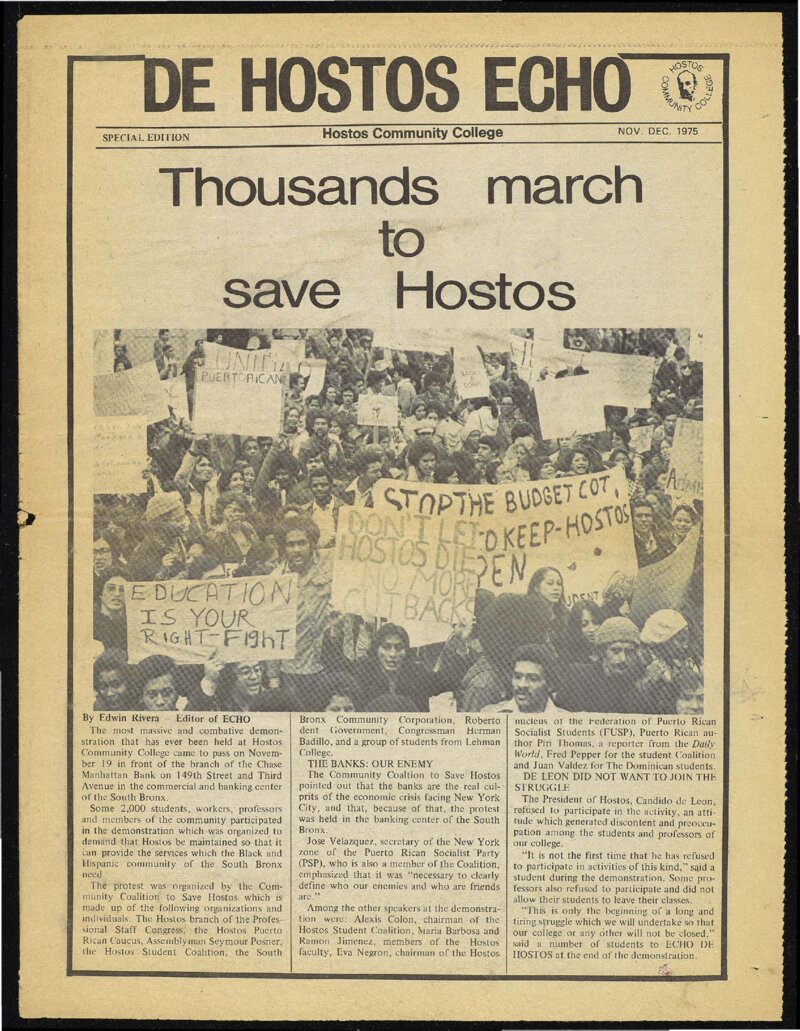
The most massive and combative demon-
stration that has ever been held at Hostos
Community. College came to pass on Novem-
ber 19 in front of the branch of the Chase
Manhattan Bank on 149th Street and Third
Avenue in the commercial and banking center
of the South Bronx.
Some 2,000 students, workers, professors
and members of the community participated
in the demonstration which was organized to
demand that Hostos be maintained so that it,
can provide the services which the Black and
Hispanic community of the South Bronx
need.
The protest was organized by the Com-
munity Coalition to Save Hostos which is
made up of the following organizations and
individuals: The Hostos branch of the Profes-
sional Staff Congress, the Hostos Puerto
Rican Caucus, Assemblyman Seymour Posner,
the Hostos Student Coalition, the South
a STOP THE guns
‘os
% ARI
Bronx Community Corporation, Roberto
dent Government, Congressman Herman
Badillo, and a group of students from Lehman
College.
THE BANKS: OUR ENEMY
The Community Coaltion to Save Hostos
pointed out that the banks are the real cul--
prits of the economic crisis facing New York
City, and that, because of that, the protest _
was held in the banking center of the South
Bronx. :
Jose Velazquez, secretary of the New York
zone of the Puerto Rican Socialist “Party
(PSP), who is also a member of the Coalition,
emphasized that it was “necessary to clearly
define who our enemies and who are friends
are.”
Among the other speakers at the demonstra-
tion were: Alexis Colon, chairman of the
Hostos Student Coalition, Maria Barbosa and
Ramon Jimenez, members of the —Hostos
faculty, Eva Negron, chairman of the Hostos
nucleus of the Federation of Puerto Rican
Socialist Students (FUSP), Puerto Rican au-
thor Piri Thomas, a reporter from the Daily
World, Fred Pepper for the student Coalition
and Juan Valdez for The Dominican students.
DE LEON DID NOT: WANT TO JOIN THE
STRUGGLE
The President of Hostos, Candido de Leon,
refused to participate in the activity, an atti-.
tude which generated discontent and preoccu-
pation among the students and professors of
our college.
“It is not the first time that he has refused
to participate in activities of this kind,” said a
student during the demonstration. Some pro-
fessors also refused to participate and did not
allow their students to leave their classes. |
“This is only the beginning of a long and
tiring struggle which we will undertake so that
our college or any other will not be closed,”
said a number of students to ECHO DE
HOSTOS at the end of the demonstration.
Upstairs
Upstairs; a student journal
which was created by the English
department. It is headed by Pro.
Shirley, Lim, faculty advisor and
Louis Figueroa, student editor.
Upstairs consists of creative
writings by the Hostos student.
Genesis is a publication put
together by the Hostos Organiza-
tion of Writers (H.O.W.). It is
under the faculty advisement of
Pro. Albert Villanueva and edited
by James Webster. This is a
brand new publication consisting
of everything, from a poem to an
essay. It even has a comic strip.
We need your help in the form
of poetry, short stories, essays,
plays, fairy tales, compositions,
and even photographs. Anything
you wish to submit, bring it to
either Louis Figueroa for Up-
stairs or James Webster~ for
Genesis. The faculty advisors will
also be available for consultation.
Students
| Activities
%
On Friday evening, December
5, 1975, at 8:00 P.M., Eugene
Reynolds will present a poetry
reading workshop at the Combo
Room Coffee House.
Mr. Reynolds, a former mem-
ber of the Negro Ensemble Ac-
tors Workshop, New Federal
Theater Workshop and the Na-
tional Black Theater is an actor
as well as a writer. His most re-
cent acting role was in the off-
Broadway play, “Five On The
Blackhand’ Side.’ He has done
poetry readings at the Harlem
Day Festival, The Bedford Hills
Women Correctional Facility,
Green Haven Penal International
Communication Association as
well as on Alma John’s weekly
WWRL radio program.
Writing credits include a two-
act play, “You, Me and Matu-
rity”, a screen play, “The
Family”, and a book of poetry
Amalgamation—A New Presenta-
tion in Poetry.
Mr. Reynolds will answer ques-
| tions and discuss writing styles as
well as read poetry. All members
of the Hostos College Commu-
nity are invited to share the
evening of conversation and fel-
lowship.
NOTARIO Rudolph Berenger
HOSTOS
COLLEGE
Toda Clase de Servicios
Salon 118
Why not?
On November 4, 1975, an
election was held for the ratifica-
_ tion of the proposal. The reason
_ for the students decision were:
1. The N.C. was drafted
by the administration and a
handful of students. No
public assembly was held
for opinions relating to the
Hostos constitution.
2. Administration on in-
volvement with students
activities.
3. The new proposal was
based on other colleges con-
stitution which are not fit
for Hostos.
4. The N.C. was drafted
and written in english only.
5. The Student Senate
was to be appointed by the
Executive Board .(no elec-
tions for representation).
6. The administration had
veto power over student
activities.
7. The Hostos clubs were
denied the power to criti-
cize the Student Go-
vernment.
8. Hostos clubs threa-
tened. Only students with
academic standings can par-
ticipate with its activities.
9. No overall representa-
tion for students with poor
- academic standing.
To sum it all up the New Con-
stitution was unconstitutional.
The final outcome of the elec-
tions: APPROVED 178 __ DIS-
APPROVED 365
ECO
DE HOSTOS
LOSTOS
DIRECTOR
Sz
Edwin Rivera :
8
NITY (©)
Asistente Director
Roberto Lugo
Redaccion -- José L. Colon Marta Muniz
Eva Negrdn Juan Sanchez Noemi
Vega Lucy Matos
Hostos Community College
Grand Concourse and 149 St.
Bronx, N.Y. 10451
ECO
needs your help
DE HOSTOS ECHO NOV. DEC. 1975
i Right on!
We should congratulate our-
selves for the work and style the
Hostos students showed during’
| the Student Government
election!
Some students were cam-
paigning for prestige, others for
-the sake of power, others out of
the pleasure, and some were
ready to turn our college to some
outsiders. This election was a
teach-in for the student body
who took their time to vote. I
am sure the Hostos Students’
Coalition intends to do the
Labour the past Dogmatic Stu-
dent Government failed to do.
The Coalition is grateful of the
WISE VOTE.
As students, we learned the
process of a democratic election.
The Coalition didn’t have to ugly
the walls, or hallways with sense-
less propaganda. The Hostos Coa-
lition worked, and intends to do
the best for the student’s interest
and well being, but the Coalition
needs the support of a united-
student body. Their support in
conciousness is most needed, so
that the Coalition can regain the
rights of the students, at least as
human beings!
Support the HOSTOS COALI-
TION so we can keep you up to
date ... for we have a long jour-
ney ahead of us. ....
How to succeed
at Hostos
by Professor Jerry Meyer
Many-perhaps most-students
entering Hostos arrive after being
out of school for many years or
arrive straight from.a high school
which does little to prepare any-
one for college. Here we will list
some pointers which are almost
guaranteed to get you out of
Hostos within two years pre-
“pared to succeed in any four year
college in the city.
1. Never miss a class.
Probably more than any
other one thing, class at-
tendance will determine
success or failure in college.
During class the subject
matter is outlined, ana-
lyzed, discussed. Assign-
ments are reviewed, new
assignments are explained.
2. Actively participate in
class. Sitting and listening
are not enough. Take notes.
Ask questions about any-
thing in the assignments
that is not clear to you. Do
not hesitate to ask your
teacher questions if some-
thing in the lesson is not
perfectly clear to you.
There is really no way a
teacher can guess what
exactly might not be clear.
Note, that if you have a
question the chances are a
hundred to one that others
are troubled about the same
point. Make sure that the
teacher clearly explains to
you any material that
he/she marked incorrectly
on an exam or paper.
3. Do your assignments
before class. If you consis-
tently complete the assign-
ments .before class, you will
be able to-ask questions
about the assignments at
the time when the material
is being taught. More im-
portantly, the class work
should be much clearer and
as a result more interesting.
Underline the most impor-
tant passages in your texts
(on the average 20 percent
should be underlined).
Look up those. words in a
dictionary which are not
perfectly clear.
4. Take advantage of your
teachers’ office hours. No
two people have exactly the
same problems, interests, or
needs. Most students, at
least some time during the
semester, should have a con-
ference with their teacher.
The greater the problems,
interests, or needs, the more
frequently you should see
your teacher individually.
5. Counselors and libra-
rians can help, often enor-
mously: utilize this re-
source.
6.. Make sure you are
taking the right course.
Spend at least as much time
choosing what courses you
need to satisfy the require-
ments for your degree and
need to achieve your career
goal as you would to pick
out a pair of shoes.
7. Do not take too many
credits. Realistically assess
how much time you have to
devote to school. The rule
of thumb is that a college
course requires two to three
hours of outside work for
every hour of class. If you
take 18 credits that means
you need 36 to 54 hours of
time for studying, preparing
papers, etc. If you take too
many credits, you may
wind ‘up blowing the whole
thing or just getting by
without learning very much.
8. Discover how you
learn. Everyone is not the’
same. Some people study
best by staying up late.
Others accomplish more by
getting up early. Find your
way. In general, however, it
is better to do at least some
studying every day, and not
study any one particular
subject for much more than
one hour.
Community.
Colleges :
EDITORIAL ae
What can we expect?
The development of more and larger community col-
leges in New York City came as a result of both the
needs of the economic structure our better trained .
workers and the mass struggles of many Third World
people in the mid and late sixties. Four of the exist-
ing community colleges were opened then. This cor-
responded to a time in which the complexities of
capitalist production was requiring a larger pool of
workers that were skilled. Fulfilling the man and
woman power needs of public and private employers
was the guiding purpose of most curricula developed _
at these institutions. The emphasis on. “vocational
education” was the result of this need.
The key factor in the rapid development of so many
of these community colleges was the militant mass
_ struggles ‘of the sixties. Without this there would have
| been more community colleges or an enlargement of
_ the existing ones but no where as many. The militant
struggles for open admission led to the CUNY system
having to open its doors to all, therefore forcing it to
change hierarchial structure. The community colleges
will become the “second hand” institutions (“high
schools with ashtrays”) in order that they produce
the “sub-professionals” that will be needed by public
and private employers. They will work to better to
train the militant sons and daughters of the late six-
ties in the work ethic and will try to obtain the re-
wards of patience and good citizenship. They will also
serve to prove to all that “everyone has the oppor-
tunity to higher education.” The built shortcoming of
these institutions are all well known to us, but in
spite of these tremendous barriers some of our people
have been able’ to utilize this education to obtain a
better job orto go on to four year institutions. The
current crisis of capitalism and in particular of New
York City threatens to (in the long run) eliminate
i=
most of these institutions. Why? The reasons are very,
very clear.
First of all the needs of New York City public and
private employers for “subprofessionals” has been
met, in fact unemployment among two and four year
graduates appears to be at an all time high. Having
unemployed intellectuals on the streets has many
times presented a problem to the ruling groups. These
people do not blame themselves for not having a job,
they see themselves as having the skills but being de-
. nied jobs by the System. Within capitalism it is best
to have a_compjetely unskilled labor reserve army,
rather than a skilled one. The latter present a greater
threat to the power structure in the society. Aside
from this, employers no longer see community col-
leges as a “good investment” for the City. The em-
ployers now see these schools as producing unneeded
workers who in the future may be “troublemakers”.
The second reason why these institutions are threa-
tened with elimination (as is Open Admissions) is
simply because the mass organization and militancy
of many Third World groups no longer exists today.
The analysts of the ruling classes see no threat to
their power if these actions are taken. The cutbacks,
all across the board have been very exorbitant, as if
guided by a conviction that the masses will do no-
thing. To a certain degree community ‘colleges and
open admissions were a concession to a massive
people’s struggle; this struggle and the type of organi-
zation we had before, do not exist at this time so the
concessions are being taken back.
Most of the plans proposed to the BHE will eliminate
directly ‘or indirectly most community colleges.
Those that call for tuition will lead to most students
who attend community colleges being “shut out”
completely. Working students who attempt to attend
will be unable to get financial aid, while at the same
time unable to pay tuition. Full time students, with
little financial means, who are being made promises
of financial aid can realistically only expect their tui-
tion to be paid. The financial aid they presently ob-
tain for living expenses will-go to tuition and they
will be without money to survive, therefore forced
out of school.
The Kibbee proposal will eliminate most of the stu-
dent population of the community colleges. Only
those who come directly from high school will be
entitled to open admissions. There will only be 6,000
slots for those who do not come directly from high
school and these will be filled on a competitive basis.
Many Latin’ students from the working class will be, —
in fact, denied college education. Using Hostos as an
example, we can clearly see that most of the popula-
tion that Hostos serves presently would be disfran-
chised of a free university education. Most students
from Hostos do not come directly from high school
(as many as 90% or more). Most -students from
Hostos have not excelled in high school for they have
been victims of the public high school system of this
City. Few among them would get some of the 6,000
slots open for those who do not directly come from
high school. We can estimate, with confidence, that at
least eighty percent of the current Hostos student
population would not be there if those were the re-
quirements for getting in.
We can therefore see that most community colleges
are in trouble and the cutbacks that are coming are _
only the beginning. Any strategy that we develop
must be based on a complete understanding of the
relationship educational institutions in this country
have to the economic system.
Forecast
for the
Antilles
De Hostos
Eugenio Maria de Hostos, whose home was
Puerto Rico, the Caribbean and Latin America-
through his vast, literary work and his
participation in the struggle for the indepen-
dence and progress of the peoples of this part of
the Western hemisphere- succeeded in combin-
ing in his personality, to the highest extent
possible, the traits of these three regions.
Having his roots in the Antilles, De Hostos
was able to identify himself with the cause of
the Cuban Revolution, espousing it as his own,
But what moves us most about De Hostos is
this long-range vision of the future of the
Antilles within the geographical complex of
Latin America and the role which attributed to
Cuba within this, based on both _ historical
reality and on his dream for the future, as is the
case with all true leaders of the people.
For De Hostos, the archipelago of the
Antilles had a historic mission, closely
resembling that of Greece in classical antiquity.
In‘his essay, ‘‘Cuba and_Puerto Rico’, after a
geographic description of the Antilles, we have
the following lyrical account: ‘‘In this sea of the
Antilles, the Caribbean Sea or the sea of
Columbus, whose name is associated with the
most glorious moment in modern history, two
prouee of islands, which in ages to come shall
ecome the Greece of the new continent, offer
their paradise, the wreath of their words, the
bouquet of their vales, the enchantment of their
views and the delights of their climate’’.
His thesis is developed in another article,
“The Problem of Cuba’. Just one hundred
years ago, De Hostos gave a clear outline of
what a free Cuba could represent, although of
course, within the social and political schema
which he was able to envisage at that time. But,
in its fundamental aspects, the outline
corresponded to what was to be the historical
significance of the Cuban Revolution. At the
end of the article he wrote: If Cuba were to pains
takingly carry out just one fraction of the task
entrused to her, in the future the whole world
will stop to marvel at not only the works of man
but also the miracle of nature in this and the
other lands discovered by Columbus between
the two great continental masses of the New
World.”’. > ioe :
And De Hostos added; ‘‘In the pored prior
to the cosmopolitan civilization we know, there
was a society established on an insignificantly
small peninsula and on a few small surrounding
islands which altogether had fewer inhabitants
that the tiniest of the Antilles. Of all ancient
societies, this, the Hellinic society, was the only
one which reconciled human reason with
humankind, as it progressed throughout
history. And this society owed everything, even
its intellectual genius, to its geographic
situation.
“From then on, the only societies in the
modern world which have occupied a geographic
location which is not only similar but superior
to that of Greece are those taking shape in Cuba
and throughout the Antilles.
“Reflect on what has been made, how the
world has changed: compare aspects of life in
Hellenic society with those in the future society
of the Antilles and then imagine the ideal that
can and should be brought about.
“Never has a society had a greater, more
stimulating, more beneficial spiritual future on
the horizon’. :
The above is just a sample of the foresight of
this illustrious Puerto Rican: Eugenio Maria De
Hostos, a man of the Antilles and of Latin
America.
DE HOSTOS ECHO NOV. DEC. 1975 PAGE 3
In light of the preoccupation of the student
body, we decided to interview the new presi- J
| dent of th Student Government Organization.
Following is the interview:
EOC: In view of the all the work that the
$tudent coalition did during the election cam-
paign, how do you view the support that the
student body gave you?
ALEXIS: Well, undoubtedly I think that the
support that the student body gave the coali-
tion has been demonstrated on various occas-
sions, be it in the electoral victories of all our
candidates for the student government or in
the massive mobilization being carried out by
| the coalition. And we hope that that same
support will be converted into a strong barrier
that nobody will be able to topple.
ECO: In terms of the misuse of funds that in
general has taken place in some organizations
and of course in the administration, what do
you in the coalition hope to achieve so that
the individuals who are responsible for this
are known to the public?
ALEXIS: Although we still haven’t discussed
this matter in the student government, one of
the proposals which I-hope to present and
which I am sure they will accept, is that we
conduct an investigation of the robberies that
the administration has made in terms of the
organizations and clubs recognized by the stu-
dent government. We will open an exhaustive
investigation on how they have used the bud-
gets that have been assigned to them.
ECO: President Colon, I don’t know if you
have taken notice of the comments and pre-#
Alexis Colon
occupations of the student body when they
say that nobody can enter the lounge because-
of the mess that exists there. How do you
plan on attacking that problem?
ALEXIS: We will most definitely attack the
problem, but we also have to recognize the
atmosphere of frustration and deprivation
that engulfs the lounge. But all that is part of
the frustrations and deviations that are in-
herent in many sectors of the student body
when it is not consulted or when it is isolated
from all social activity. We will do the oppo-
| site, or, in other words, we will'do everything
possible to integrate the student body and
make it identify with our daily work.
ECO: In relation to the fact that there are
organizations in the college that, since their
founding, have done fabulous work with the
‘students, like FUSP and PUL, those organiza-
tions do not have their offices. Do you think
there is any possibility that they might get
offices? ;
ALEXIS: As best we can we will try to siia.c
student government offices with these organi-
zations, taking in mind of course that we will
provide them with offices when we can. They
truly deserve them. é
ECO: What do you plan to do in relation to
s the crisis that is facing the college?
ALEXIS: Our student government states that
the so called “‘crisis’’ that is facing the college
is only a reflection of the crisis that is facing
the city of New York. This crisis affects us
more because we are the only bilingual college
in the entire city and because its student body
and teachers are Third World people. This cri-
sis comes to a head in the desire of the Board
of Higher Education to eliminate our college
We state that it is necessary that everybody,
teachers, workers, and students, mobilize to
turn back these plans and crisis that they
want to hit us with. If we organize properly
no crisis or anything else can affect us. That’s
the solution to all the problems of the student
body. Solution to the crisis? Unity and
struggle!
ECO: We appreciate your hospitality to have
answered our questions, and we hope that
your work in the student government be re-
cognized by all the students. ;
ALEXIS: I hope so, thanks.
TITUS WALKER
At one time black student
unions stood as a vanguard in the
movement of black people in this
country. If you remember,
S.N.C.C. (student
coordinating committee) that
spearheaded the civil rights
movement for voters registration
across the country. You will see
that we are now finding ourselves
walking blindly in the shadows
of our own greatness. The black
student unions are under attack:
so we see our situation today as a
state of emergency (But way)?
HISTORICAL BACKGROUND:
The 13th amendment so called
freed the blackman in America
and in 1865 after the civil war,
the government created programs
to blend the blackman into the
main steam of American society,
during this period black congress-
man and officials were voted to
various political post (This
period is known as_ re-
construction).
Then in the 1870’s_ black
people were set back again, be-
non-violent ©
cause white southerners hated
and feared any type of positive
movement by black people into
American society, and because
they were determined to keep
| blacks as menial laborers. An-
drew Johnson (Who was the only
president next to Nixon to be
almost impeached). Who became
president after the assassination
of Abraham Lincoln was not
sympathetic to the cause of
black civil rights and permitted
the harrassment and lynching of
blacks, by his policy of no policy
and not enforcing civil rights
laws in this country.
(Now doesn’t this story sound
familiar)?
In 1865 we were making great
strides and then in the 1870’s set
back.
NOTES:
In 1960’s we were making
great strides and then in the
1970's set back.
So yesterday is just like today,
just like then is just like now.
The plantation has just been
past down from father to son.
So today, we as students, the
future of tommorrow are being
DE HOSTOS ECHO NOV. DEC. 1975 PAGE 4
again
proposal to end open admission
as it stands today in the city uni-
versity.
This is our rubutal statement
to the Kibbee proposal.
We see the Kibbee proposal as
a direct attack on BLACKS, HIS-
PANICS, POUR WHITE’S, THE
YOUNG THE OLD STUDENTS
AS WELL AS FACULTY IN
THE CITY UNIVERSITY. The
Kibbee proposal is a racist plan
to systematically exterminate
people of color out of the city
university. We see the proposal as
a format to deny our children a
college education in America.
THE KIBBEE PROPOSAL
1) His proposal reduces
the admissions of general
equivalence diploma holder
and also graduation of ear-
lier years who never had an
opportunity to go to college.
Will now have a rougher
time getting into a college.
2) His proposal states that
their will be 3 terms instead
of two, which means an in-
crease in the admission fees.
3) His proposal states a
20% cut in faculty (last
hired are always the first
fired). This means a 20%
cut of black, hispanic, and
young professors. His pro-
posal gives all remaining
professors increases in
salary. :
4) His proposal states con-
solidation which means
destroying centralize edu-
cation at the college level.
Closing institutions such as
Hostos, Meger Evers, Kings-
borough -Community
College.
5) His proposal also states
a 2 year moratorium on
new, masters programs,
which is an attack on.
blacks, hispanic’s and young
students, from receiving
their masters degree and be-
coming professors (it hurts
the job market).
6) -Consolidation of
Health Science programs
which eliminates health
science programs at small
community. institutions
such as at Hostos and other
Community College’s.
CUNY students, workers fight back
By Ignacio Pérez
NEW YORK— City University of New York
(CUNY) students, non-academic staff and faculty
are militantly fighting back layoffs, shut-downs,
termination of special programs and plans to end
open admissions and free tuition and to merge
CUNY to the State University of New York
(SUNY)
The CUNY community. has organized coalitions
that are mobilizing thousands to demonstrations,
rallies and other militant actions in an effort to
present a united front in their struggle to defend
the quality of education and the right to a higher
education. ;
DEMONSTRATION
Thousands showed up for a demonstration
Coalition to Save Hostos— arrived amidst cheers
to more than double the mass of demonstrators at
the time.
Raméon J iménez, Hostos faculty member, urged
the people to “prepare for a very, very long
struggle’’ and to beware of efforts ‘‘to divide us as
to colleges, programs’ ’ and along other lines.
Jiménez stated “we have declared war on those
who want to destroy education’, followed by
applause and cheers.
Chanting * ‘They say cutback, we say fight,
back”, the demonstrators remained firm in their
This group wanted to enter the BH&i..puilding
while most demonstrators wete apparently
against it. 3
GENERAL
mE STRIKE
CITY
WORKERS!
ei
an independent group of students, faculty and
staff, organized a massive show of strength and
unity last November 20 at Wall and Broad
aoe This district was chosen for the activity
© “point to those who are responsible for this
crisis: the banks and finance capital’’, Rivera told
CLARIDAD. The FUSP participates actively in
the CUFA coalition.
Under the main slogan, “Make the banks pay”,
CUFA also sponsored a demonstration on
November 26 at the Chase Manhattan Plaza,
Liberty and Nassau Streets.
Rivera, in an interview, said that ‘'these actions
constantly being organized and carried out
outside the ‘Board of Higher Education (BHE
central office last Monday to oppose a plan callin,
. for a 20 per cent reduction in faculty and studen
body and other plans geared to deal with th
massive cut-backs in budget. This plan wa
introduced to the BHE by Robert J. Kibbee,
Chancellor of CUNY.
Initially called by the University Studen
Senate (USS) and the Professional Staff Congress
(PSC), the demonstration grew from a small cor
of a few hundred in the early afternoon to al
gigantic, angry mass as contingents from
different colleges arrived by the busloads.
The impressive Hostos: Community College
Contingent— organized by the Communit:
be discussed by delegates
“PARTIAL VICTORY”
Arturo Rivera, president of the Federation of
Socialist Puerto Rican University Students
(FUSP) and one of the featured speakers at the
activity, claimed the mobilization resulted in a
“partial victory”, since it managed to cancel
discussion on the Kibbee plan. This is the third
time discussion has been cancelled.
Rivera called on all supporters to return to the
BHE offices next Monday, December 1, to hold a
similar demonstration. At. 4 P.M. students,
faculty and sympathizers will again try to
discourage discussion of the Kibbee plan.
WALL STREET ACTION
The CUNY United for Action (CUFA) coalition,
rep-
That is why the closing session of
throughout the city are seteing the base for a
general class boycott in the CUNY system”.
The socialist student leader said the time is,ripe
for the creation of a/Steering Committee in the
city to prepare this general class boycott.
Rivera concluded by saying that students will
not accept the merger of the CUNY system to the
SUNY system, and they will fight in every way to
avoid it.
ALL out to
San Juan
PSP Congress
In all of this context, the members
of the Puerto Rican Socialist Party
begin their deliberations this week in
what is the Party’s Second National
Congress. -
A political program, new set of
organizational by-laws, and various
resolutions on issues of the day will
resenting the entire membership.
Indeed, the Congress process has
been a model of democracy of fullest
participation, of the kind of decision
making which a society needs to
soive its problems. It is in such sharp
contrast to. the top to bottom
economic manipulations which are
making people's lives impossible in
Puerto Rico and in this country.
the Congress, on December 7 is such
an historic event. There the decis-
ions, democratically arrived at bk
the Party membership, will be
presented to the Puerto Rican
people. There; in San Juan, -the
alternative to the misery that we live
under capitalism will be put forward
and explained.
on
December |
DE HOSTOS ECHO NOV. DEC. 1975 PAGE
THE Puerto Rican Massess
Pedro Albizu
lay down/ face in the mud
shot through the head
shot in the back
shot in the chest
shot in the heart
Albizu :
revolutionary/ warrior / nationalist / revolutionary
came speeding/flying down the street
tears in his eyes
shouting/screaming/yelling/hollering
“No, Pedro, don’t die.. PLEASE DON’T DIE. WE NEED you
‘Now.Z
“Pedro, vorcane die now. .not now. Please don’t Die.”
Chino, el barbero left Jésé hanging with 1/2 haircut
came racing out/ heart broken
“No, Pedro, don’t leave us jot now! |
Wilfredo, el bodegero closed his sho}
Joaquim, Miguel and Mario. . . all stopped selling La Bolita
Dona Maria, left her spiritos ~ 7
they all shouted/screamed/yelled/hollered
“Please, Pedro, don’t die’,
All the Salsa records stopped’, automatically
Musicians of all kirids
Palmieri/ Colon/ cheo/ Puentes ;
Thé Latin Hustle stood still. . . as all the Latin Dancers
in flashes of emergency rhythms
rushed to Pedro i
they all shouted/ sereampd/ yelled/ hollered
In Rhythm;
“Please, Pedro, don’t die”
The Homicides stopped fighting with the Su
Hijacked a subway “a
to where Pedro lay dead. ne
Papi stopped selling Piraghias <3
Maria, grabbed her two piifias, and started run
understood). A ee
The Fountain Crowd" a
left Central Park/ran so fast their ~
highs couldn't catch up 2%
ran so fast their Pig
super-coolness was left behind. . .
THe housewife sisters... Pilar... Concha.
stopped cooking/cleaning/sewin:
Ee
all of them. .. they all =
shouted/screamed/yelled/hollered
“Please Pedro, don’t die”
“ Boricuas on the Island
jumped in the ocean
started swimming to the street where Pedro lay. . .
swam so quick they shook the C.1.A., F.B.I., C.I.C.
The Boricua workers
flooded from the subways
and Instinctively ran to Pedro
i Hundreds
7 Uousands :
z_Tens of Thousands Garment Workers/ Restaurant workers/ Facto!
Z workers
x shouted/screamed/yelled/hollered
: “PLEASE PEDRO, DON’T DIE, NOT NOW”
Millions of Boricuas/ all kinds of Boricuas UNited their voices/
tears/ pain/ hopes:/. . . strength
Pedro Albizu
slowly tumed his twisted bod
looked around =
lifted himself up
and left Death in the gutter. ...
Death, having been defeated. .
.. by the PUERTO RICAN MASSES
By Ramon Jiménez
DE HOSTOS ECHO NOV. DEC. 1975 PAGE 6
LITERATURE SECTION
Editor: José L. Colon-Santiago
Hostos Community College
NOV. DEC. 1975
Bh cant march
O
save Hostos
By Edwin Rivera — Editor of ECHO
The most massive and combative demon-
stration that has ever been held at Hostos
Community. College came to pass on Novem-
ber 19 in front of the branch of the Chase
Manhattan Bank on 149th Street and Third
Avenue in the commercial and banking center
of the South Bronx.
Some 2,000 students, workers, professors
and members of the community participated
in the demonstration which was organized to
demand that Hostos be maintained so that it,
can provide the services which the Black and
Hispanic community of the South Bronx
need.
The protest was organized by the Com-
munity Coalition to Save Hostos which is
made up of the following organizations and
individuals: The Hostos branch of the Profes-
sional Staff Congress, the Hostos Puerto
Rican Caucus, Assemblyman Seymour Posner,
the Hostos Student Coalition, the South
a STOP THE guns
‘os
% ARI
Bronx Community Corporation, Roberto
dent Government, Congressman Herman
Badillo, and a group of students from Lehman
College.
THE BANKS: OUR ENEMY
The Community Coaltion to Save Hostos
pointed out that the banks are the real cul--
prits of the economic crisis facing New York
City, and that, because of that, the protest _
was held in the banking center of the South
Bronx. :
Jose Velazquez, secretary of the New York
zone of the Puerto Rican Socialist “Party
(PSP), who is also a member of the Coalition,
emphasized that it was “necessary to clearly
define who our enemies and who are friends
are.”
Among the other speakers at the demonstra-
tion were: Alexis Colon, chairman of the
Hostos Student Coalition, Maria Barbosa and
Ramon Jimenez, members of the —Hostos
faculty, Eva Negron, chairman of the Hostos
nucleus of the Federation of Puerto Rican
Socialist Students (FUSP), Puerto Rican au-
thor Piri Thomas, a reporter from the Daily
World, Fred Pepper for the student Coalition
and Juan Valdez for The Dominican students.
DE LEON DID NOT: WANT TO JOIN THE
STRUGGLE
The President of Hostos, Candido de Leon,
refused to participate in the activity, an atti-.
tude which generated discontent and preoccu-
pation among the students and professors of
our college.
“It is not the first time that he has refused
to participate in activities of this kind,” said a
student during the demonstration. Some pro-
fessors also refused to participate and did not
allow their students to leave their classes. |
“This is only the beginning of a long and
tiring struggle which we will undertake so that
our college or any other will not be closed,”
said a number of students to ECHO DE
HOSTOS at the end of the demonstration.
Upstairs
Upstairs; a student journal
which was created by the English
department. It is headed by Pro.
Shirley, Lim, faculty advisor and
Louis Figueroa, student editor.
Upstairs consists of creative
writings by the Hostos student.
Genesis is a publication put
together by the Hostos Organiza-
tion of Writers (H.O.W.). It is
under the faculty advisement of
Pro. Albert Villanueva and edited
by James Webster. This is a
brand new publication consisting
of everything, from a poem to an
essay. It even has a comic strip.
We need your help in the form
of poetry, short stories, essays,
plays, fairy tales, compositions,
and even photographs. Anything
you wish to submit, bring it to
either Louis Figueroa for Up-
stairs or James Webster~ for
Genesis. The faculty advisors will
also be available for consultation.
Students
| Activities
%
On Friday evening, December
5, 1975, at 8:00 P.M., Eugene
Reynolds will present a poetry
reading workshop at the Combo
Room Coffee House.
Mr. Reynolds, a former mem-
ber of the Negro Ensemble Ac-
tors Workshop, New Federal
Theater Workshop and the Na-
tional Black Theater is an actor
as well as a writer. His most re-
cent acting role was in the off-
Broadway play, “Five On The
Blackhand’ Side.’ He has done
poetry readings at the Harlem
Day Festival, The Bedford Hills
Women Correctional Facility,
Green Haven Penal International
Communication Association as
well as on Alma John’s weekly
WWRL radio program.
Writing credits include a two-
act play, “You, Me and Matu-
rity”, a screen play, “The
Family”, and a book of poetry
Amalgamation—A New Presenta-
tion in Poetry.
Mr. Reynolds will answer ques-
| tions and discuss writing styles as
well as read poetry. All members
of the Hostos College Commu-
nity are invited to share the
evening of conversation and fel-
lowship.
NOTARIO Rudolph Berenger
HOSTOS
COLLEGE
Toda Clase de Servicios
Salon 118
Why not?
On November 4, 1975, an
election was held for the ratifica-
_ tion of the proposal. The reason
_ for the students decision were:
1. The N.C. was drafted
by the administration and a
handful of students. No
public assembly was held
for opinions relating to the
Hostos constitution.
2. Administration on in-
volvement with students
activities.
3. The new proposal was
based on other colleges con-
stitution which are not fit
for Hostos.
4. The N.C. was drafted
and written in english only.
5. The Student Senate
was to be appointed by the
Executive Board .(no elec-
tions for representation).
6. The administration had
veto power over student
activities.
7. The Hostos clubs were
denied the power to criti-
cize the Student Go-
vernment.
8. Hostos clubs threa-
tened. Only students with
academic standings can par-
ticipate with its activities.
9. No overall representa-
tion for students with poor
- academic standing.
To sum it all up the New Con-
stitution was unconstitutional.
The final outcome of the elec-
tions: APPROVED 178 __ DIS-
APPROVED 365
ECO
DE HOSTOS
LOSTOS
DIRECTOR
Sz
Edwin Rivera :
8
NITY (©)
Asistente Director
Roberto Lugo
Redaccion -- José L. Colon Marta Muniz
Eva Negrdn Juan Sanchez Noemi
Vega Lucy Matos
Hostos Community College
Grand Concourse and 149 St.
Bronx, N.Y. 10451
ECO
needs your help
DE HOSTOS ECHO NOV. DEC. 1975
i Right on!
We should congratulate our-
selves for the work and style the
Hostos students showed during’
| the Student Government
election!
Some students were cam-
paigning for prestige, others for
-the sake of power, others out of
the pleasure, and some were
ready to turn our college to some
outsiders. This election was a
teach-in for the student body
who took their time to vote. I
am sure the Hostos Students’
Coalition intends to do the
Labour the past Dogmatic Stu-
dent Government failed to do.
The Coalition is grateful of the
WISE VOTE.
As students, we learned the
process of a democratic election.
The Coalition didn’t have to ugly
the walls, or hallways with sense-
less propaganda. The Hostos Coa-
lition worked, and intends to do
the best for the student’s interest
and well being, but the Coalition
needs the support of a united-
student body. Their support in
conciousness is most needed, so
that the Coalition can regain the
rights of the students, at least as
human beings!
Support the HOSTOS COALI-
TION so we can keep you up to
date ... for we have a long jour-
ney ahead of us. ....
How to succeed
at Hostos
by Professor Jerry Meyer
Many-perhaps most-students
entering Hostos arrive after being
out of school for many years or
arrive straight from.a high school
which does little to prepare any-
one for college. Here we will list
some pointers which are almost
guaranteed to get you out of
Hostos within two years pre-
“pared to succeed in any four year
college in the city.
1. Never miss a class.
Probably more than any
other one thing, class at-
tendance will determine
success or failure in college.
During class the subject
matter is outlined, ana-
lyzed, discussed. Assign-
ments are reviewed, new
assignments are explained.
2. Actively participate in
class. Sitting and listening
are not enough. Take notes.
Ask questions about any-
thing in the assignments
that is not clear to you. Do
not hesitate to ask your
teacher questions if some-
thing in the lesson is not
perfectly clear to you.
There is really no way a
teacher can guess what
exactly might not be clear.
Note, that if you have a
question the chances are a
hundred to one that others
are troubled about the same
point. Make sure that the
teacher clearly explains to
you any material that
he/she marked incorrectly
on an exam or paper.
3. Do your assignments
before class. If you consis-
tently complete the assign-
ments .before class, you will
be able to-ask questions
about the assignments at
the time when the material
is being taught. More im-
portantly, the class work
should be much clearer and
as a result more interesting.
Underline the most impor-
tant passages in your texts
(on the average 20 percent
should be underlined).
Look up those. words in a
dictionary which are not
perfectly clear.
4. Take advantage of your
teachers’ office hours. No
two people have exactly the
same problems, interests, or
needs. Most students, at
least some time during the
semester, should have a con-
ference with their teacher.
The greater the problems,
interests, or needs, the more
frequently you should see
your teacher individually.
5. Counselors and libra-
rians can help, often enor-
mously: utilize this re-
source.
6.. Make sure you are
taking the right course.
Spend at least as much time
choosing what courses you
need to satisfy the require-
ments for your degree and
need to achieve your career
goal as you would to pick
out a pair of shoes.
7. Do not take too many
credits. Realistically assess
how much time you have to
devote to school. The rule
of thumb is that a college
course requires two to three
hours of outside work for
every hour of class. If you
take 18 credits that means
you need 36 to 54 hours of
time for studying, preparing
papers, etc. If you take too
many credits, you may
wind ‘up blowing the whole
thing or just getting by
without learning very much.
8. Discover how you
learn. Everyone is not the’
same. Some people study
best by staying up late.
Others accomplish more by
getting up early. Find your
way. In general, however, it
is better to do at least some
studying every day, and not
study any one particular
subject for much more than
one hour.
Community.
Colleges :
EDITORIAL ae
What can we expect?
The development of more and larger community col-
leges in New York City came as a result of both the
needs of the economic structure our better trained .
workers and the mass struggles of many Third World
people in the mid and late sixties. Four of the exist-
ing community colleges were opened then. This cor-
responded to a time in which the complexities of
capitalist production was requiring a larger pool of
workers that were skilled. Fulfilling the man and
woman power needs of public and private employers
was the guiding purpose of most curricula developed _
at these institutions. The emphasis on. “vocational
education” was the result of this need.
The key factor in the rapid development of so many
of these community colleges was the militant mass
_ struggles ‘of the sixties. Without this there would have
| been more community colleges or an enlargement of
_ the existing ones but no where as many. The militant
struggles for open admission led to the CUNY system
having to open its doors to all, therefore forcing it to
change hierarchial structure. The community colleges
will become the “second hand” institutions (“high
schools with ashtrays”) in order that they produce
the “sub-professionals” that will be needed by public
and private employers. They will work to better to
train the militant sons and daughters of the late six-
ties in the work ethic and will try to obtain the re-
wards of patience and good citizenship. They will also
serve to prove to all that “everyone has the oppor-
tunity to higher education.” The built shortcoming of
these institutions are all well known to us, but in
spite of these tremendous barriers some of our people
have been able’ to utilize this education to obtain a
better job orto go on to four year institutions. The
current crisis of capitalism and in particular of New
York City threatens to (in the long run) eliminate
i=
most of these institutions. Why? The reasons are very,
very clear.
First of all the needs of New York City public and
private employers for “subprofessionals” has been
met, in fact unemployment among two and four year
graduates appears to be at an all time high. Having
unemployed intellectuals on the streets has many
times presented a problem to the ruling groups. These
people do not blame themselves for not having a job,
they see themselves as having the skills but being de-
. nied jobs by the System. Within capitalism it is best
to have a_compjetely unskilled labor reserve army,
rather than a skilled one. The latter present a greater
threat to the power structure in the society. Aside
from this, employers no longer see community col-
leges as a “good investment” for the City. The em-
ployers now see these schools as producing unneeded
workers who in the future may be “troublemakers”.
The second reason why these institutions are threa-
tened with elimination (as is Open Admissions) is
simply because the mass organization and militancy
of many Third World groups no longer exists today.
The analysts of the ruling classes see no threat to
their power if these actions are taken. The cutbacks,
all across the board have been very exorbitant, as if
guided by a conviction that the masses will do no-
thing. To a certain degree community ‘colleges and
open admissions were a concession to a massive
people’s struggle; this struggle and the type of organi-
zation we had before, do not exist at this time so the
concessions are being taken back.
Most of the plans proposed to the BHE will eliminate
directly ‘or indirectly most community colleges.
Those that call for tuition will lead to most students
who attend community colleges being “shut out”
completely. Working students who attempt to attend
will be unable to get financial aid, while at the same
time unable to pay tuition. Full time students, with
little financial means, who are being made promises
of financial aid can realistically only expect their tui-
tion to be paid. The financial aid they presently ob-
tain for living expenses will-go to tuition and they
will be without money to survive, therefore forced
out of school.
The Kibbee proposal will eliminate most of the stu-
dent population of the community colleges. Only
those who come directly from high school will be
entitled to open admissions. There will only be 6,000
slots for those who do not come directly from high
school and these will be filled on a competitive basis.
Many Latin’ students from the working class will be, —
in fact, denied college education. Using Hostos as an
example, we can clearly see that most of the popula-
tion that Hostos serves presently would be disfran-
chised of a free university education. Most students
from Hostos do not come directly from high school
(as many as 90% or more). Most -students from
Hostos have not excelled in high school for they have
been victims of the public high school system of this
City. Few among them would get some of the 6,000
slots open for those who do not directly come from
high school. We can estimate, with confidence, that at
least eighty percent of the current Hostos student
population would not be there if those were the re-
quirements for getting in.
We can therefore see that most community colleges
are in trouble and the cutbacks that are coming are _
only the beginning. Any strategy that we develop
must be based on a complete understanding of the
relationship educational institutions in this country
have to the economic system.
Forecast
for the
Antilles
De Hostos
Eugenio Maria de Hostos, whose home was
Puerto Rico, the Caribbean and Latin America-
through his vast, literary work and his
participation in the struggle for the indepen-
dence and progress of the peoples of this part of
the Western hemisphere- succeeded in combin-
ing in his personality, to the highest extent
possible, the traits of these three regions.
Having his roots in the Antilles, De Hostos
was able to identify himself with the cause of
the Cuban Revolution, espousing it as his own,
But what moves us most about De Hostos is
this long-range vision of the future of the
Antilles within the geographical complex of
Latin America and the role which attributed to
Cuba within this, based on both _ historical
reality and on his dream for the future, as is the
case with all true leaders of the people.
For De Hostos, the archipelago of the
Antilles had a historic mission, closely
resembling that of Greece in classical antiquity.
In‘his essay, ‘‘Cuba and_Puerto Rico’, after a
geographic description of the Antilles, we have
the following lyrical account: ‘‘In this sea of the
Antilles, the Caribbean Sea or the sea of
Columbus, whose name is associated with the
most glorious moment in modern history, two
prouee of islands, which in ages to come shall
ecome the Greece of the new continent, offer
their paradise, the wreath of their words, the
bouquet of their vales, the enchantment of their
views and the delights of their climate’’.
His thesis is developed in another article,
“The Problem of Cuba’. Just one hundred
years ago, De Hostos gave a clear outline of
what a free Cuba could represent, although of
course, within the social and political schema
which he was able to envisage at that time. But,
in its fundamental aspects, the outline
corresponded to what was to be the historical
significance of the Cuban Revolution. At the
end of the article he wrote: If Cuba were to pains
takingly carry out just one fraction of the task
entrused to her, in the future the whole world
will stop to marvel at not only the works of man
but also the miracle of nature in this and the
other lands discovered by Columbus between
the two great continental masses of the New
World.”’. > ioe :
And De Hostos added; ‘‘In the pored prior
to the cosmopolitan civilization we know, there
was a society established on an insignificantly
small peninsula and on a few small surrounding
islands which altogether had fewer inhabitants
that the tiniest of the Antilles. Of all ancient
societies, this, the Hellinic society, was the only
one which reconciled human reason with
humankind, as it progressed throughout
history. And this society owed everything, even
its intellectual genius, to its geographic
situation.
“From then on, the only societies in the
modern world which have occupied a geographic
location which is not only similar but superior
to that of Greece are those taking shape in Cuba
and throughout the Antilles.
“Reflect on what has been made, how the
world has changed: compare aspects of life in
Hellenic society with those in the future society
of the Antilles and then imagine the ideal that
can and should be brought about.
“Never has a society had a greater, more
stimulating, more beneficial spiritual future on
the horizon’. :
The above is just a sample of the foresight of
this illustrious Puerto Rican: Eugenio Maria De
Hostos, a man of the Antilles and of Latin
America.
DE HOSTOS ECHO NOV. DEC. 1975 PAGE 3
In light of the preoccupation of the student
body, we decided to interview the new presi- J
| dent of th Student Government Organization.
Following is the interview:
EOC: In view of the all the work that the
$tudent coalition did during the election cam-
paign, how do you view the support that the
student body gave you?
ALEXIS: Well, undoubtedly I think that the
support that the student body gave the coali-
tion has been demonstrated on various occas-
sions, be it in the electoral victories of all our
candidates for the student government or in
the massive mobilization being carried out by
| the coalition. And we hope that that same
support will be converted into a strong barrier
that nobody will be able to topple.
ECO: In terms of the misuse of funds that in
general has taken place in some organizations
and of course in the administration, what do
you in the coalition hope to achieve so that
the individuals who are responsible for this
are known to the public?
ALEXIS: Although we still haven’t discussed
this matter in the student government, one of
the proposals which I-hope to present and
which I am sure they will accept, is that we
conduct an investigation of the robberies that
the administration has made in terms of the
organizations and clubs recognized by the stu-
dent government. We will open an exhaustive
investigation on how they have used the bud-
gets that have been assigned to them.
ECO: President Colon, I don’t know if you
have taken notice of the comments and pre-#
Alexis Colon
occupations of the student body when they
say that nobody can enter the lounge because-
of the mess that exists there. How do you
plan on attacking that problem?
ALEXIS: We will most definitely attack the
problem, but we also have to recognize the
atmosphere of frustration and deprivation
that engulfs the lounge. But all that is part of
the frustrations and deviations that are in-
herent in many sectors of the student body
when it is not consulted or when it is isolated
from all social activity. We will do the oppo-
| site, or, in other words, we will'do everything
possible to integrate the student body and
make it identify with our daily work.
ECO: In relation to the fact that there are
organizations in the college that, since their
founding, have done fabulous work with the
‘students, like FUSP and PUL, those organiza-
tions do not have their offices. Do you think
there is any possibility that they might get
offices? ;
ALEXIS: As best we can we will try to siia.c
student government offices with these organi-
zations, taking in mind of course that we will
provide them with offices when we can. They
truly deserve them. é
ECO: What do you plan to do in relation to
s the crisis that is facing the college?
ALEXIS: Our student government states that
the so called “‘crisis’’ that is facing the college
is only a reflection of the crisis that is facing
the city of New York. This crisis affects us
more because we are the only bilingual college
in the entire city and because its student body
and teachers are Third World people. This cri-
sis comes to a head in the desire of the Board
of Higher Education to eliminate our college
We state that it is necessary that everybody,
teachers, workers, and students, mobilize to
turn back these plans and crisis that they
want to hit us with. If we organize properly
no crisis or anything else can affect us. That’s
the solution to all the problems of the student
body. Solution to the crisis? Unity and
struggle!
ECO: We appreciate your hospitality to have
answered our questions, and we hope that
your work in the student government be re-
cognized by all the students. ;
ALEXIS: I hope so, thanks.
TITUS WALKER
At one time black student
unions stood as a vanguard in the
movement of black people in this
country. If you remember,
S.N.C.C. (student
coordinating committee) that
spearheaded the civil rights
movement for voters registration
across the country. You will see
that we are now finding ourselves
walking blindly in the shadows
of our own greatness. The black
student unions are under attack:
so we see our situation today as a
state of emergency (But way)?
HISTORICAL BACKGROUND:
The 13th amendment so called
freed the blackman in America
and in 1865 after the civil war,
the government created programs
to blend the blackman into the
main steam of American society,
during this period black congress-
man and officials were voted to
various political post (This
period is known as_ re-
construction).
Then in the 1870’s_ black
people were set back again, be-
non-violent ©
cause white southerners hated
and feared any type of positive
movement by black people into
American society, and because
they were determined to keep
| blacks as menial laborers. An-
drew Johnson (Who was the only
president next to Nixon to be
almost impeached). Who became
president after the assassination
of Abraham Lincoln was not
sympathetic to the cause of
black civil rights and permitted
the harrassment and lynching of
blacks, by his policy of no policy
and not enforcing civil rights
laws in this country.
(Now doesn’t this story sound
familiar)?
In 1865 we were making great
strides and then in the 1870’s set
back.
NOTES:
In 1960’s we were making
great strides and then in the
1970's set back.
So yesterday is just like today,
just like then is just like now.
The plantation has just been
past down from father to son.
So today, we as students, the
future of tommorrow are being
DE HOSTOS ECHO NOV. DEC. 1975 PAGE 4
again
proposal to end open admission
as it stands today in the city uni-
versity.
This is our rubutal statement
to the Kibbee proposal.
We see the Kibbee proposal as
a direct attack on BLACKS, HIS-
PANICS, POUR WHITE’S, THE
YOUNG THE OLD STUDENTS
AS WELL AS FACULTY IN
THE CITY UNIVERSITY. The
Kibbee proposal is a racist plan
to systematically exterminate
people of color out of the city
university. We see the proposal as
a format to deny our children a
college education in America.
THE KIBBEE PROPOSAL
1) His proposal reduces
the admissions of general
equivalence diploma holder
and also graduation of ear-
lier years who never had an
opportunity to go to college.
Will now have a rougher
time getting into a college.
2) His proposal states that
their will be 3 terms instead
of two, which means an in-
crease in the admission fees.
3) His proposal states a
20% cut in faculty (last
hired are always the first
fired). This means a 20%
cut of black, hispanic, and
young professors. His pro-
posal gives all remaining
professors increases in
salary. :
4) His proposal states con-
solidation which means
destroying centralize edu-
cation at the college level.
Closing institutions such as
Hostos, Meger Evers, Kings-
borough -Community
College.
5) His proposal also states
a 2 year moratorium on
new, masters programs,
which is an attack on.
blacks, hispanic’s and young
students, from receiving
their masters degree and be-
coming professors (it hurts
the job market).
6) -Consolidation of
Health Science programs
which eliminates health
science programs at small
community. institutions
such as at Hostos and other
Community College’s.
CUNY students, workers fight back
By Ignacio Pérez
NEW YORK— City University of New York
(CUNY) students, non-academic staff and faculty
are militantly fighting back layoffs, shut-downs,
termination of special programs and plans to end
open admissions and free tuition and to merge
CUNY to the State University of New York
(SUNY)
The CUNY community. has organized coalitions
that are mobilizing thousands to demonstrations,
rallies and other militant actions in an effort to
present a united front in their struggle to defend
the quality of education and the right to a higher
education. ;
DEMONSTRATION
Thousands showed up for a demonstration
Coalition to Save Hostos— arrived amidst cheers
to more than double the mass of demonstrators at
the time.
Raméon J iménez, Hostos faculty member, urged
the people to “prepare for a very, very long
struggle’’ and to beware of efforts ‘‘to divide us as
to colleges, programs’ ’ and along other lines.
Jiménez stated “we have declared war on those
who want to destroy education’, followed by
applause and cheers.
Chanting * ‘They say cutback, we say fight,
back”, the demonstrators remained firm in their
This group wanted to enter the BH&i..puilding
while most demonstrators wete apparently
against it. 3
GENERAL
mE STRIKE
CITY
WORKERS!
ei
an independent group of students, faculty and
staff, organized a massive show of strength and
unity last November 20 at Wall and Broad
aoe This district was chosen for the activity
© “point to those who are responsible for this
crisis: the banks and finance capital’’, Rivera told
CLARIDAD. The FUSP participates actively in
the CUFA coalition.
Under the main slogan, “Make the banks pay”,
CUFA also sponsored a demonstration on
November 26 at the Chase Manhattan Plaza,
Liberty and Nassau Streets.
Rivera, in an interview, said that ‘'these actions
constantly being organized and carried out
outside the ‘Board of Higher Education (BHE
central office last Monday to oppose a plan callin,
. for a 20 per cent reduction in faculty and studen
body and other plans geared to deal with th
massive cut-backs in budget. This plan wa
introduced to the BHE by Robert J. Kibbee,
Chancellor of CUNY.
Initially called by the University Studen
Senate (USS) and the Professional Staff Congress
(PSC), the demonstration grew from a small cor
of a few hundred in the early afternoon to al
gigantic, angry mass as contingents from
different colleges arrived by the busloads.
The impressive Hostos: Community College
Contingent— organized by the Communit:
be discussed by delegates
“PARTIAL VICTORY”
Arturo Rivera, president of the Federation of
Socialist Puerto Rican University Students
(FUSP) and one of the featured speakers at the
activity, claimed the mobilization resulted in a
“partial victory”, since it managed to cancel
discussion on the Kibbee plan. This is the third
time discussion has been cancelled.
Rivera called on all supporters to return to the
BHE offices next Monday, December 1, to hold a
similar demonstration. At. 4 P.M. students,
faculty and sympathizers will again try to
discourage discussion of the Kibbee plan.
WALL STREET ACTION
The CUNY United for Action (CUFA) coalition,
rep-
That is why the closing session of
throughout the city are seteing the base for a
general class boycott in the CUNY system”.
The socialist student leader said the time is,ripe
for the creation of a/Steering Committee in the
city to prepare this general class boycott.
Rivera concluded by saying that students will
not accept the merger of the CUNY system to the
SUNY system, and they will fight in every way to
avoid it.
ALL out to
San Juan
PSP Congress
In all of this context, the members
of the Puerto Rican Socialist Party
begin their deliberations this week in
what is the Party’s Second National
Congress. -
A political program, new set of
organizational by-laws, and various
resolutions on issues of the day will
resenting the entire membership.
Indeed, the Congress process has
been a model of democracy of fullest
participation, of the kind of decision
making which a society needs to
soive its problems. It is in such sharp
contrast to. the top to bottom
economic manipulations which are
making people's lives impossible in
Puerto Rico and in this country.
the Congress, on December 7 is such
an historic event. There the decis-
ions, democratically arrived at bk
the Party membership, will be
presented to the Puerto Rican
people. There; in San Juan, -the
alternative to the misery that we live
under capitalism will be put forward
and explained.
on
December |
DE HOSTOS ECHO NOV. DEC. 1975 PAGE
THE Puerto Rican Massess
Pedro Albizu
lay down/ face in the mud
shot through the head
shot in the back
shot in the chest
shot in the heart
Albizu :
revolutionary/ warrior / nationalist / revolutionary
came speeding/flying down the street
tears in his eyes
shouting/screaming/yelling/hollering
“No, Pedro, don’t die.. PLEASE DON’T DIE. WE NEED you
‘Now.Z
“Pedro, vorcane die now. .not now. Please don’t Die.”
Chino, el barbero left Jésé hanging with 1/2 haircut
came racing out/ heart broken
“No, Pedro, don’t leave us jot now! |
Wilfredo, el bodegero closed his sho}
Joaquim, Miguel and Mario. . . all stopped selling La Bolita
Dona Maria, left her spiritos ~ 7
they all shouted/screamed/yelled/hollered
“Please, Pedro, don’t die’,
All the Salsa records stopped’, automatically
Musicians of all kirids
Palmieri/ Colon/ cheo/ Puentes ;
Thé Latin Hustle stood still. . . as all the Latin Dancers
in flashes of emergency rhythms
rushed to Pedro i
they all shouted/ sereampd/ yelled/ hollered
In Rhythm;
“Please, Pedro, don’t die”
The Homicides stopped fighting with the Su
Hijacked a subway “a
to where Pedro lay dead. ne
Papi stopped selling Piraghias <3
Maria, grabbed her two piifias, and started run
understood). A ee
The Fountain Crowd" a
left Central Park/ran so fast their ~
highs couldn't catch up 2%
ran so fast their Pig
super-coolness was left behind. . .
THe housewife sisters... Pilar... Concha.
stopped cooking/cleaning/sewin:
Ee
all of them. .. they all =
shouted/screamed/yelled/hollered
“Please Pedro, don’t die”
“ Boricuas on the Island
jumped in the ocean
started swimming to the street where Pedro lay. . .
swam so quick they shook the C.1.A., F.B.I., C.I.C.
The Boricua workers
flooded from the subways
and Instinctively ran to Pedro
i Hundreds
7 Uousands :
z_Tens of Thousands Garment Workers/ Restaurant workers/ Facto!
Z workers
x shouted/screamed/yelled/hollered
: “PLEASE PEDRO, DON’T DIE, NOT NOW”
Millions of Boricuas/ all kinds of Boricuas UNited their voices/
tears/ pain/ hopes:/. . . strength
Pedro Albizu
slowly tumed his twisted bod
looked around =
lifted himself up
and left Death in the gutter. ...
Death, having been defeated. .
.. by the PUERTO RICAN MASSES
By Ramon Jiménez
DE HOSTOS ECHO NOV. DEC. 1975 PAGE 6
LITERATURE SECTION
Editor: José L. Colon-Santiago
Title
De Hostos Echo, November - December, 1975
Description
De Hostos Echo is the Hostos Community College bilingual student newspaper. This November/December 1975 issue features stories on mass demonstrations to save the school from closure in order to deal with budget cuts. Stories also include tips for student success at the school, student election news, and editorials contextualizing the struggles happening at Hostos within a broader set of issues for CUNY community colleges.
In 1975, in response to the New York City fiscal crisis, Hostos Community College was slated to merge with Bronx Community College in order to dramatically cut spending. It was this threat that led to the second iteration of organizing to save Hostos. Determined to preserve Hostos for the South Bronx as a place for students to pursue a bilingual higher education, students, faculty, and community groups joined forces to keep Hostos open for the community.
In 1975, in response to the New York City fiscal crisis, Hostos Community College was slated to merge with Bronx Community College in order to dramatically cut spending. It was this threat that led to the second iteration of organizing to save Hostos. Determined to preserve Hostos for the South Bronx as a place for students to pursue a bilingual higher education, students, faculty, and community groups joined forces to keep Hostos open for the community.
Contributor
Meyer, Gerald
Creator
De Hostos Echo
Date
November 1975
Language
English
Spanish
Publisher
De Hostos Echo
Rights
Obtained from Contributor - Copyright Unknown
Source
Hostos Community College Archives
Original Format
Newspaper / Magazine / Journal
De Hostos Echo. Letter. “De Hostos Echo, November - December, 1975.”, CUNY DIGITAL HISTORY ARCHIVE, accessed September 5, 2026, https://stephenz.tailc22a4b.ts.net/s/cdha/item/643