"The Past and Future of Women's Studies" - Conference Talk
Item
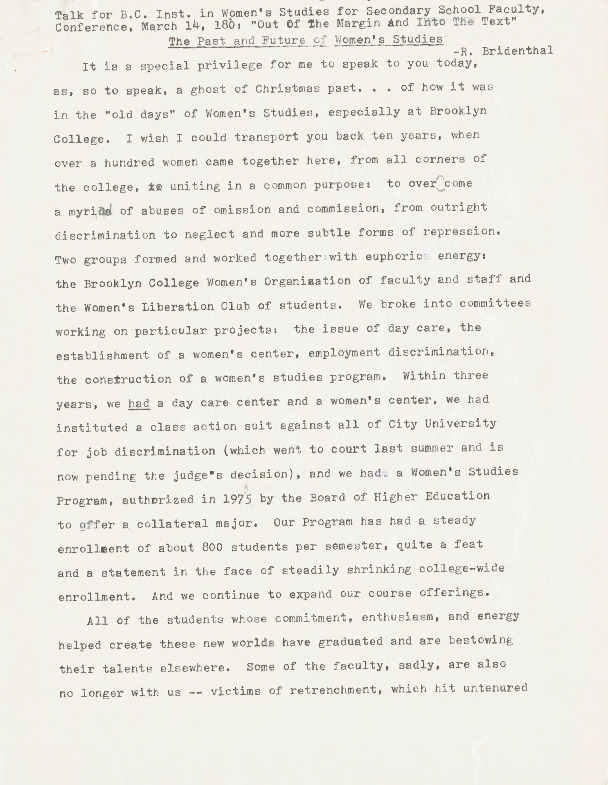
Talk for B.C. Inst. in Women's Studies for Secondary School Faculty,
Conference, March 14, 180: "Out Of The Margin And Into The Text”
The Past and Future of Women's Studies
It is a special privilege for me to speak to you Certo a
as, so to speak, a ghost of Christmas past. . . of how it was
in the "old days" of Women's Studies, especially at Brooklyn
College. I wish I could transport you back ten years, when
over a hundred women came together here, from all corners of
the college, &® uniting in a common purpose: to over come
a myriad of abuses of omission and commission, from outright
discrimination to neglect and more subtle forms of repression.
Two groups formed and worked together: with euphoric» energy:
the Brooklyn College Women's Organiaation of faculty and staff and
the Women's Liberation Club of students. We broke into committees
working on particular projects: the issue of day care, the
establishment of a women's center, employment discrimination,
the construction of a women's studies program. Within three
years, we had a day care center and a women's center, we had
instituted a class action suit against all of City University
for job discrimination (which went to court last summer and is
now pending the judge*s decision), and we had. a Women's Studies
Program, authprized in 1975 by the Board of Higher Education
to offer a collateral major. Our Program has had a steady
enrollment of about 800 students per semester, quite a feat
and a statement in the face of steadily shrinking college-wide
enrollment. And we continue to expand our course offerings.
All of the students whose commitment, enthusiasm, and energy
helped create these new worlds have graduated and are bestowing
their talents elsewhere. Some of the faculty, sadly, are also
no longer with us -- victims of retrenchment, which hit untenured
younger faculty, where women predominate, hardest; they became
case examples of the very problem they were trying to solve.
But many of us remain, and we have made Brooklyn College the
flagship of women's studies in this city.
Please excuse this parochial excursion. I could not contain
my pride. And I did want to convey to you something of the
strength and love and creativity that came out of the early
women's movement and flowed so generously into women's studies.
‘It was a national phenomenon. Now there are about 150 courses
in women's studies in about 20 institutions in New York City
alone, according to a slightly incomplete Guide to Women's Studies
Courses in New York City published by the New York City Commission
on the Status of Women (hold it up), and there are over 406
programs nation-wide. The most recent addition is Princeton
University, where the faculty virtually unanimously endorsed
its adoption. Graduate programs are also blossoming: the newest
ones being Ph.D. degrees in women's history at New York University
and the University of Wisconsin. City University's Graduate
Center has an expanding women's studies program in several
disciplines. In the high schools, too, interest is growing,
as your presence here attests. John Dewey High School was an
early pioneer, and has a newsletter, Fireworks, which would do
any college proud. Elsewhere, with less institutional support,
courageous individual teachers introduced new courses in women's
stufdes. There have been two summer institutes for secondary
school faculty in women's history, one at Sarah Lawrence and
one at Stanford University. The Brooklyn College Institute
pioneers in integrating women's studies in general into
thehigh school curriculum. It is an idea whose time has come.
We know that women's studies is here to stay from many other
signs as well. There is a burgeoning literature coming off
the pressess books, scholarly journals, newspapers, popular
works. We now have our own professional association: the
the University of Conn. in
National Women's Studies Association meeting at/Skexxxxx&annx
on the subject of Racism and Women.
in May /. Individual disciplines women's caucuses have grown
to be virtual associations on themselves, such as sociology's
Sex Roles in Society and history's Bertshire Conference in
Women's History to be held in Vassar this June. The conferences
they hold establish a wonderful Womanspace for us to grow in:
nurturant, buoyant, and creative. In the arts, we have also
mdde our marks museums, concert halls, and theaters have opened
their doors to women's creativity. No medium can ignore us;
at worst, it can try to co-opt our message, as when advertising
promotes a "newwoman® who is really the ‘old’ woman in drag.
No matter. The point has been made and everyone has heard it.
Our early struggles merely to be heard are over.
Does’ that mean our battle is over? You know as well as I
that it has just begun. When we study the subject of women,
we must note some sad facts. For every new anchorwoman on
television, shexg millions of women suffer a wage gap that continues
to widen, and it is worse for women of color,who remain at the
botBom of the income pyramid. Day care has made very little
progress, though women's employment is increasing. Our needs
with respect to reproduction are more severely challenged
than ever, with even contraception being questioned now.
The very civil rights of lesbians are not assured.
Globally, the problem is even worse: Asian women work seven
days a week for 50¢ a day, sewing garments or assembling
electronic equipment for companies who have sought this "more
favorable bufgness climate" abroad, leaving thousands of women
unemployed domestically and recreating sweatshop conditions here
for them and for illegal aliens who had fled just that greater
exploitation abroad. It looks like a vicious circle.
But what has that to do with women's studies? you might ask.
Aren't we getting into politics.now?
ves, Mamen And it does have to do with women's studies.
Not only because those are among the facts we must notice when
we study the subjett, but also because women's studies was born
out of the women's movement and continues to draw its vitality
from ite Those who have cut the placenta have become bloodless
and irrelevant. The future of women's studies, like its past,
is with the women's movement in general and implies its political
maturation. And therein also lies the responsibility of women's
studies.
#& The role of the intellectual is large and varied:
we must be resource people, providing information and offering
anlyses. We should not mistake ourselves *&z°feaders and strategists,
but neither should we efface ourselves. We are part of a collective
enterprise. As such, we have much to offer and much to receive.
I have learned at least as much from endless meetings and actions
as I have learned from my library research. Practice has
informed theory and vice versae Now, when I do my research
on German women's organizations before Hitler, I know what
they are talking about in terms of structure, tasks, strategy,
power relations within and without, and so on. Women's Studies
are richer Af the studier (and teacher) has first hand experience
of women in action.
And what do we have to offer? What is our future, in terms
of our responsibility?
Our major offering is demystification: an end to myth.
We must tell the truth and explode stereotype and illusion.
For example, anthropology (Pat Lander's field), debunks our
ethnocentric mythology, by unfolding alternatives and allowing
glimpses into possible origins. History (my field) debunks
presentism, lifts the veil of social amnesia, by mx revelging
the process of change within our own culture, which is by no means
one of unilinear progress, especially not for women. Psychology
most directly challenges the androcentric myth, which has
assumed the male experience to be standard and has defined
the female as deviant. At bottom, all these myths have been
androcentric, making men's experience the text, and women's
marginal or a footnote.
But the task of women's studies is not merely to insert
women here and there, digging up forgotten names and inserting
them into the text. That would be merely compensatory.
Our task is larger: we must redefine and rewrite much of the
text, so that women's experience is organically integrated,
making the text more true to its claim for universality.
Most of the texts are still in error, to put it politely,
in claiming to speak of the general human condition,
since they have not yet adjusted for the difference made
by woman's condition, By fulfilling this task, we raise
consciousness -- the true meaning of educating -- and we multiply
the forces for change.
Our second major offering is that of context: an arniysis
of the larger social forces that impinge upon us. Context has
created us the way we are -- our time and place, our race and
social class, our economic and political system. We, in turn,
re-create that context as historical actors. But we serve
ourselves best when we do it with full awareness of that mutual
interaction. Freedom is the recognition of necessity, and
power comes from an accurate assessment of forces. That does
not mean that our reach should be no® further than our grasp;
thealtimate goal Me not merely to understand reality and to stay
within its limits, but to change it.
So the future of Women's Studies is a broad horizon.
We are still pioneers. We still have the same purpose that
Lucy Stone , the American feminist, expressed in 1855 --
a full century and a quarter ago:
"In education, in marriage, in religion, in everything,
disappointment is the lot of woman. It shall be the
business of my life to deepen this disappointment in every
woman's heart until she bows down to it no longer."
And I would adds until she has her birthright of self-respect,
freedom, and joy.
Conference, March 14, 180: "Out Of The Margin And Into The Text”
The Past and Future of Women's Studies
It is a special privilege for me to speak to you Certo a
as, so to speak, a ghost of Christmas past. . . of how it was
in the "old days" of Women's Studies, especially at Brooklyn
College. I wish I could transport you back ten years, when
over a hundred women came together here, from all corners of
the college, &® uniting in a common purpose: to over come
a myriad of abuses of omission and commission, from outright
discrimination to neglect and more subtle forms of repression.
Two groups formed and worked together: with euphoric» energy:
the Brooklyn College Women's Organiaation of faculty and staff and
the Women's Liberation Club of students. We broke into committees
working on particular projects: the issue of day care, the
establishment of a women's center, employment discrimination,
the construction of a women's studies program. Within three
years, we had a day care center and a women's center, we had
instituted a class action suit against all of City University
for job discrimination (which went to court last summer and is
now pending the judge*s decision), and we had. a Women's Studies
Program, authprized in 1975 by the Board of Higher Education
to offer a collateral major. Our Program has had a steady
enrollment of about 800 students per semester, quite a feat
and a statement in the face of steadily shrinking college-wide
enrollment. And we continue to expand our course offerings.
All of the students whose commitment, enthusiasm, and energy
helped create these new worlds have graduated and are bestowing
their talents elsewhere. Some of the faculty, sadly, are also
no longer with us -- victims of retrenchment, which hit untenured
younger faculty, where women predominate, hardest; they became
case examples of the very problem they were trying to solve.
But many of us remain, and we have made Brooklyn College the
flagship of women's studies in this city.
Please excuse this parochial excursion. I could not contain
my pride. And I did want to convey to you something of the
strength and love and creativity that came out of the early
women's movement and flowed so generously into women's studies.
‘It was a national phenomenon. Now there are about 150 courses
in women's studies in about 20 institutions in New York City
alone, according to a slightly incomplete Guide to Women's Studies
Courses in New York City published by the New York City Commission
on the Status of Women (hold it up), and there are over 406
programs nation-wide. The most recent addition is Princeton
University, where the faculty virtually unanimously endorsed
its adoption. Graduate programs are also blossoming: the newest
ones being Ph.D. degrees in women's history at New York University
and the University of Wisconsin. City University's Graduate
Center has an expanding women's studies program in several
disciplines. In the high schools, too, interest is growing,
as your presence here attests. John Dewey High School was an
early pioneer, and has a newsletter, Fireworks, which would do
any college proud. Elsewhere, with less institutional support,
courageous individual teachers introduced new courses in women's
stufdes. There have been two summer institutes for secondary
school faculty in women's history, one at Sarah Lawrence and
one at Stanford University. The Brooklyn College Institute
pioneers in integrating women's studies in general into
thehigh school curriculum. It is an idea whose time has come.
We know that women's studies is here to stay from many other
signs as well. There is a burgeoning literature coming off
the pressess books, scholarly journals, newspapers, popular
works. We now have our own professional association: the
the University of Conn. in
National Women's Studies Association meeting at/Skexxxxx&annx
on the subject of Racism and Women.
in May /. Individual disciplines women's caucuses have grown
to be virtual associations on themselves, such as sociology's
Sex Roles in Society and history's Bertshire Conference in
Women's History to be held in Vassar this June. The conferences
they hold establish a wonderful Womanspace for us to grow in:
nurturant, buoyant, and creative. In the arts, we have also
mdde our marks museums, concert halls, and theaters have opened
their doors to women's creativity. No medium can ignore us;
at worst, it can try to co-opt our message, as when advertising
promotes a "newwoman® who is really the ‘old’ woman in drag.
No matter. The point has been made and everyone has heard it.
Our early struggles merely to be heard are over.
Does’ that mean our battle is over? You know as well as I
that it has just begun. When we study the subject of women,
we must note some sad facts. For every new anchorwoman on
television, shexg millions of women suffer a wage gap that continues
to widen, and it is worse for women of color,who remain at the
botBom of the income pyramid. Day care has made very little
progress, though women's employment is increasing. Our needs
with respect to reproduction are more severely challenged
than ever, with even contraception being questioned now.
The very civil rights of lesbians are not assured.
Globally, the problem is even worse: Asian women work seven
days a week for 50¢ a day, sewing garments or assembling
electronic equipment for companies who have sought this "more
favorable bufgness climate" abroad, leaving thousands of women
unemployed domestically and recreating sweatshop conditions here
for them and for illegal aliens who had fled just that greater
exploitation abroad. It looks like a vicious circle.
But what has that to do with women's studies? you might ask.
Aren't we getting into politics.now?
ves, Mamen And it does have to do with women's studies.
Not only because those are among the facts we must notice when
we study the subjett, but also because women's studies was born
out of the women's movement and continues to draw its vitality
from ite Those who have cut the placenta have become bloodless
and irrelevant. The future of women's studies, like its past,
is with the women's movement in general and implies its political
maturation. And therein also lies the responsibility of women's
studies.
#& The role of the intellectual is large and varied:
we must be resource people, providing information and offering
anlyses. We should not mistake ourselves *&z°feaders and strategists,
but neither should we efface ourselves. We are part of a collective
enterprise. As such, we have much to offer and much to receive.
I have learned at least as much from endless meetings and actions
as I have learned from my library research. Practice has
informed theory and vice versae Now, when I do my research
on German women's organizations before Hitler, I know what
they are talking about in terms of structure, tasks, strategy,
power relations within and without, and so on. Women's Studies
are richer Af the studier (and teacher) has first hand experience
of women in action.
And what do we have to offer? What is our future, in terms
of our responsibility?
Our major offering is demystification: an end to myth.
We must tell the truth and explode stereotype and illusion.
For example, anthropology (Pat Lander's field), debunks our
ethnocentric mythology, by unfolding alternatives and allowing
glimpses into possible origins. History (my field) debunks
presentism, lifts the veil of social amnesia, by mx revelging
the process of change within our own culture, which is by no means
one of unilinear progress, especially not for women. Psychology
most directly challenges the androcentric myth, which has
assumed the male experience to be standard and has defined
the female as deviant. At bottom, all these myths have been
androcentric, making men's experience the text, and women's
marginal or a footnote.
But the task of women's studies is not merely to insert
women here and there, digging up forgotten names and inserting
them into the text. That would be merely compensatory.
Our task is larger: we must redefine and rewrite much of the
text, so that women's experience is organically integrated,
making the text more true to its claim for universality.
Most of the texts are still in error, to put it politely,
in claiming to speak of the general human condition,
since they have not yet adjusted for the difference made
by woman's condition, By fulfilling this task, we raise
consciousness -- the true meaning of educating -- and we multiply
the forces for change.
Our second major offering is that of context: an arniysis
of the larger social forces that impinge upon us. Context has
created us the way we are -- our time and place, our race and
social class, our economic and political system. We, in turn,
re-create that context as historical actors. But we serve
ourselves best when we do it with full awareness of that mutual
interaction. Freedom is the recognition of necessity, and
power comes from an accurate assessment of forces. That does
not mean that our reach should be no® further than our grasp;
thealtimate goal Me not merely to understand reality and to stay
within its limits, but to change it.
So the future of Women's Studies is a broad horizon.
We are still pioneers. We still have the same purpose that
Lucy Stone , the American feminist, expressed in 1855 --
a full century and a quarter ago:
"In education, in marriage, in religion, in everything,
disappointment is the lot of woman. It shall be the
business of my life to deepen this disappointment in every
woman's heart until she bows down to it no longer."
And I would adds until she has her birthright of self-respect,
freedom, and joy.
Title
"The Past and Future of Women's Studies" - Conference Talk
Description
Women's Studies Program co-founder historian Renate Bridenthal gave this talk for the Brooklyn College Institute in Women's Studies for Secondary School Faculty conference in 1980. Bridenthal recounts the formation of the Brooklyn College Women's Organization of faculty and staff, and the student-run Women's Liberation Club. Such groups formed to address day care, employment discrimination, the establishment of a women's center, and the construction of the program. At the time of the presentation, the program had approximately 800 students per semester. She calls on the field to continue to question patriarchal norms, be inclusive of women in scholarship, and provide context and analysis for structural inequalities facing students and workers today.
Creator
Bridenthal, Renate
Date
March 14, 1980
Language
English
Rights
Obtained from Contributor - Copyright Unknown
Source
Brooklyn College Library, Archives and Special Collections
Original Format
Report / Paper / Proposal
Bridenthal, Renate. Letter. “‘The Past and Future of Women’s Studies’ - Conference Talk.”, CUNY DIGITAL HISTORY ARCHIVE, accessed September 5, 2026, https://stephenz.tailc22a4b.ts.net/s/cdha/item/652