Infusion: "CUNY's War on CUNY," October 1998
Item
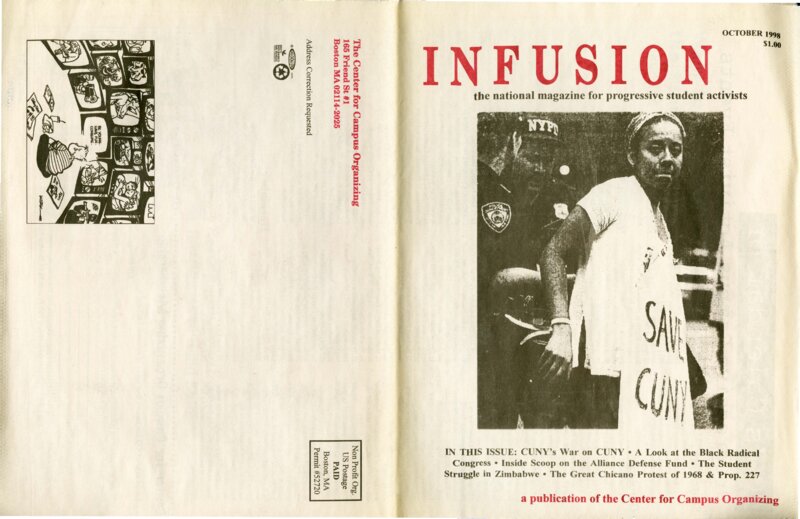
OCTOBER 199g
— > toe $1,
Vee mee gh "
acme [| | a g S 7 i
* fate 5
@e gi
i ° =] i
ae. {
g SR . , ‘ pel
3 S the national magazine for progressive student activists
re) hod
Rs to
8
& a
Suizesig sndureg 10; 103090 9G],
re
EB
IN THIS ISSUE: CUNY’s War on CUNY « A Look at the Black Radical
Congress ¢ Inside Scoop on the Alliance Defense Fund « The Student
Struggle in Zimbabwe * The Great Chicano Protest of 1968 & Prop. 227
~~
‘4
5
o8ejisog SN.
‘SIO 101g UON
sae]
ow
3g
4
+6
tt B
nn
N
~—
NX
S
i a publication of the Center for Campus Organizing
OCTOBER 1998
INFUSION
the national magazine for progressive student activists
Ne ew York: = View From Below
BY GRASSHOPPER
Ifyou’ re not from New York City, you must have heard a lot
about how nice it’s become. That the crime levels have been
declining, that the local economy is doing very well, with
the city boasting of billion dollar surpluses and windfalls
from the booming stock exchange. This is in comparison to
the notorious image of New York City as a nitty gritty crime
ridden wild west frontier town. The national media has
been very supportive of the particular individual that has
“~~been_credited for this “achievement,” NYC’s very own
Mayor, Rudolph Giuliani* —
Giuliani, a former federal prosecutor, mae history in
NYC in his own way by leading a several thousand police
rally turned police riot on the steps of City Hall before he
became mayor. Then Mayor, David Dinkins (the city’s first
Black mayor) had made some overtures to develop a fully
functioning and autonomous Civilian Complaint Review
Board. Giuliani tapped into an obviously angry police force
and took advantage of this conservative backlash from
NYPD, by leading this rally. Off duty cops that day were
heard calling the Mayor Dinkins a “washroom attendant”
who had no business running governmental affairs. Black
council members at City Hall that day were verbally
harassed and racially insulted by off duty officers who were
also getting drunk in public while their on duty fellow
officers watched on. Giuliani came out of
this riot smelling like a rose.
Giuliani was able to tap into a racially
polarized city by exploiting the worst
aspects of suppressed racist tendencies in
the white middle and working class
against neighboring Black communities.
If you are old enough to remember, you
may have heard of Howard Beach,
Bensonhurst, and Crown Heights. NYC
neighborhoods that propelled incidents of
racial violence so rank and odious, it made
international headlines. Rather than
being a peace maker, Giuliani cam-
paigned on a Nixonian “law and order”
platform which appealed greatly to a
white voter constituency that was fearful
and distrustful of Blacks.
Needless to say, Giuliani won the
elections by swaying enough liberal
turncoats to his position. He initiated what
he termed a “Quality of Life” campaign. He strongly argued
that what New York City needed was an absolute clamp
down on all those things that made life unbearable. Sounds
good? Okay, so that means we’re going to raise working
people’s wages, fight racism, raise the minimum wage,
improve the education system, promote and aid higher
education students, fight domestic violence, fight racist
police brutality, create more jobs, aid poor and
impoverished people, fight greedy corporations, eliminate
sweatshop labor— am I coming across here? But from the
beginning, Giuliani masterfully exploits the frustrations of
predominately white commuters by cracking down on
“squeegee men.” That’s right, squeegee men, the scourge
of civilized society who try to make a living by wiping the
windshields of passing motorists. While liberals whined
about civil liberties, Giuliani won his first victory
unchallenged, allowing NYPD to remove or arrest
squeegee men. He then logically moved against the
homeless and panhandlers. It didn’t seem to bother the
conscience of hardened New Yorkers one bit.
What was particular about this mayor was not just his
skillful rhetorical style, but his tightly controlled press
conferences. This tactic also forewarned other journalists
and toed marginal journalists into line. Pretty soon,
continued on page 6
Making Sense of Student Activism in 1998
Welcome back to campus and welcome to our first issue of
the 1998-1999 school year! We hope you like our new look.
Since our last issue in April a lot has happened. We’d like
to update you on a few activities at the Center for Campus
Organizing (CCO).
+ We moved from Cambridge to Boston a few months ago.
Somehow we managed to get a place that is cheaper and
bigger than our previous space, and that is above ground
with a few windows! Please note our new contact
information.
* We’d like to thank some excellent former CCO staff
members who contributed mightily to the student
movement. Sonya Huber, our former Jnfusion editor and
Campus Alternative Journalism Director for almost two
years, was hired as the Associate Publisher for Jn These
Times. Marti Garza, our former Organizing Director is now
the Campaign Organizer at United for a Fair Economy.
And Mark Piotrowski, our all-purpose organizer and
consultant, has recently relocated to Chicago and is doing
tech-support work.
* CCO is happy to welcome Nikki Morse, a May 1998
graduate of the University of Massachusetts, as our new
Development Director. She was one of CCO’s first interns
in 1995 after having been active in the Day of Action
Against the Contract on America, and she has been active
since then on the Board of Advisors and on the Board of
Directors. Dean Fujimoto is our new Interim Campus
Alternative Journalism Director. Dean is originally from
Los Angeles and is a junior at Antioch College studying
English and creative writing. Preethi Fernando has also
joined us this semester. Preethi is a graduate student in
Ethnomusicology at Tufts University in Boston, and is our
new Organizing Intern.
* Working Assets Long Distance has selected CCO as one
of the social change organizations that will receive a
portion of their 1998 donor pool. If you are a Working
Assets customer, please select CCO as one of your choices
when you vote! If you are not a Working Assets customer,
please consider switching.
Students Active Around the Globe
Students are active all around the world: in Burma,
students are supporting the democratically elected Aung
Sang Sui Kyi and the National League for Democracy; in
Peru, students are demanding an end to military
continued on page 11
Linking
History:
The Great
Chicano Protest
of 1968 &
Proposition 227
BY CARLOS MUNOZ, JR
Thirty years ago, on March 3, 1968, more than a thousand
Mexican American students walked out of Abraham
Lincoln High School and marched through the streets of
East Los Angeles, California. In the days that followed,
they were joined by several thousand more students who
walked out of five other predominantly Mexican American
high schools. By the end of the week, more than 10,000 had
joined the strike which lasted approximately ten days and
disrupted the nation’s largest public school system.
The major purpose of the student strike was to protest
the conditions of inequality which Mexican Americans had
been forced to endure since they were colonized after the
end of the U.S. Mexico War of 1846-48.
Three months after the student strike, the Los Angeles
white power structure, with the help of the FBI’s Counter
Intelligence Program (COIN-TELPRO), arrested thirteen
Chicano college student leaders and community activists
who helped to organize the high school strike. Indicted for
conspiracy to “willfully disturb the peace and quiet” of the
City of Los Angeles, each faced 66 years in prison if
convicted. These activists were members of the United
Mexican American Students (UMAS), the Brown Berets,
and other community organizations.
Approximately two years later, a California Appellate
Court cleared the activists, ruling that they were innocent
of the conspiracy charges by virtue ofthe First Amendment.
As one of those thirteen activists, this ruling freed me to
participate in more battles such as the unsuccessful fight
against Proposition 227, which may eliminate bilingual
education in California.
Significance of the Strike
The strike was the first mass protest against racism ever
staged by Mexican Americans in the Unites States. Carried
out in the non-violent protest tradition of the Southern civil
rights movement, the strike’s historical significance
paralleled the 1960 black student sit-ins in Greensboro,
N.C. The Los Angeles strike signaled the beginnings of a
powerful Chicano student movement throughout the
Southwestern United States.
The strike marked the entry of Mexican Americans
into the turbulent history of the 1960s. The student
movement generated by the strike was crucial to the
emerging Mexican American civil rights struggles and
helped shape the Chicano Power Movement in the late
1960s and early 1970s.
Those struggles opened doors for equal opportunity in
higher education and created Chicano Studies programs in
colleges throughout the country. From these emerged the
first generation of Mexican American scholars, writers,
poets, artists, filmmakers, actors, lawyers, medical doctors,
health care and social workers, and teachers. Bilingual
education, too, was a product of these fights for Latino
equality.
Despite these gains, Latino educational inequality still
persists. Latino students in public schools continue to
experience the same tracking system which I went through
back in the late 1950s. According to the U.S. Census
Bureau, 30 percent of Latino youth drop out of high
school—compared to 8 percent of white students and 12
percent of blacks. And most Latino students who are
fortunate enough to graduate from high school are ill-
equipped academically or don’t meet college entrance
requirements. For example, Latinos are the least qualified
continued on page 11
yn
War ow CUNY
The Fight to Preserve Open Admissions Against Attacks by the Board of Trustees Involves
Nothing Less Than Blocking Educational Apartheid
BY Ros WALLACE
In late May, the Board of Trustees of the City University of New York (CUNY) ended
CUNY’s 29-year-old policy of Open Admissions by aborting remediation classes at
CUNY’s senior colleges. In August, a State Supreme Court judge blocked the change in
policy.
As started in 1970, the Open Admissions policy allows any New York City high school
student who obtains a diploma a spot at CUNY. Those students who can not handle the
college material are placed in remedial courses until they can. The point of the policy was
to allow access to a college education to students that were traditionally provided
substandard high school educations by the public school system.
Open Admissions was implemented after Black and Latino students at City College
started successful protests against the exclusionary nature of the CUNY system which, in
1969, was comprised primarily of white students.
Following implementation of Open Admissions, a veritable revolution in education
swept New York City. By 1976, the majority of CUNY students were of color. By the early
1990s, 63 percent of CUNY undergraduates were non-white, 54 percent Black or Latino.
One barrier in the racial apartheid of New York education had been smashed.
In May, the Board of Trustees began to implement the apartheid once again. The Board
voted to block from entering CUNY’s four-year senior colleges any student who could not
pass proficiency tests in math, reading, and writing. The Board planned to implement the
new policy at CUNY campuses starting in September 1999. The Board, comprised
primarily of Mayor Giuliani and Governor Pataki appointees, oversees CUNY -wide policy.
The new policy would effectively end remediation classes at the senior colleges. As of
now under Open Admissions, students who could not pass any one of the tests could still
attend the colleges, take remediation courses, and retake the exams when ready, albeit
within a certain set time. The remediation courses were therefore a linchpin of Open
Admissions.
The Board’s decision turned the three assessment tests into entrance exams, You can’t
pass the tests? You can’t enter CUNY’s senior colleges. No other public university in the
country uses such entrance exams. The tests act then as another barrier for New York’s poor
and working class. The senior colleges have been shown by studies by Lehman College’s
David Lavin to be gateways to higher education and professional jobs for a generation of
students of color. The Board’s vote to end remediation officially returned apartheid and
class war to CUNY.
Apartheid Again
Anne Paolucci, the chair of the Board of Trustees, told reporters after the vote, in revealing
language, “We are cleaning out the four-year colleges and putting remediation where it
belongs,” at the already devastated two-year community colleges.
The end of remediation at the senior colleges will effectively “clean out” tens of
thousands of poor, principally Black, Latino, Asian, and immigrant students.
According to CUNY’s own study, five colleges, including City College, would lose half
their entering students under the Board’s new policy. City College has already lost over
3,000 students, many in good academic standing, over the past three years. The losses at
City College can be attributed to budget cuts, tuition hikes, and City College-specific
departmental closures. In 1995, Yolanda Moses, City College’s president, closed, among
several other departments, four ethnic studies departments and an entire School of Nursing.
The CUNY report declared under the new Board policy, minority students will be the
worst hit. The report stated 55 percent of Latino, 51 percent of Asian, and 46 percent of
Black students who would have been allowed entrance under present admissions criteria
will be barred from entering the senior colleges. Whites too
will be blocked, with 38 percent kept from entering by the
new policy. In total, 12,000 students—46 percent of
1999’s entering class—will be barred if the policy is
successfully implemented.
The CUNY report seconded projections by Lehman
College professor Lavin who has for years tracked the
positive effects Open Admissions has had and
continues to have on CUNY students and New York
City. Lavin and colleagues reported that of the 8,000
regular students who entered the senior colleges in Fall
1997, 5,000 would have been excluded under the new
policy. That included 2/3 of the entering Black, Latino,
and Asian students, and half of the white freshman.
Clearly, if this policy is implemented it would represent
one of the worst defeats New York City’s working class will have
suffered this half-century.
The Board of Trustees was provided the CUNY report a
week before it voted in the new policy. And Lavin’s study had
been available for months. So Board :
members, many of them bankers and Be»
government hacks, were quite aware what 3
impact their decision would have on
the schools and their students.
4 Inrusion % Ocroser 1998
Indeed, before the vote, the Board met for an hour with CUNY lawyers to discuss tl
likelihood that lawsuits would be leveled at the university system on the grounds the ne
policy racially discriminated.
Mayor Giuliani, who has continually hammered CUNY with threats an
recriminations, called the Board’s vote “courageous.” He declared, “[The Board’s] vot
sends a powerful message that CUNY is starting the important process of restoring it
reputation as one of the great public institutions of higher learning in this country.”
Under the new policy, many students brilliant at political science or physics, fo
example, but not versed in the material any one of the entrance exams would test, would b
barred entrance to the senior colleges. Imagine a newly immigrated Einstein barred fron
City College because he flunked the reading entrance exam.
A Legal Battle Won
On August 10th, State Supreme Court Judge Elliot Wilk issued an injunction against th
Board’s decision to end remediation at CUNY’s senior colleges. The decision stems from <
suit brought against the Board for violating state Open Meetings Laws when it voted agains!
remediation in May. The suit was brought by Professor William Crain of City College’:
psychology department, and David Suker, a City College graduate student.
Furthermore, on May 26th the Board ejected what few public audience members the
room could hold. Inside the meeting, six audience members were arrested, “including those
watching and listening peacefully,” as Justice Wilk’s ruling put it. Among those arrested
were a Franciscan nun and Assemblyman Ed Sullivan (D-Manhattan), the chairman of New
York State Assembly’s Education Committee. Outside the building, 20 demonstrators
protesting the decision were arrested.
The Board, never elected by their CUNY constituency, would not permit such violation
of Board “democracy,” as Chair Paolucci called making fundamental decisions on the future
of CUNY behind closed doors! *
“This is a huge victory for the forces of democracy in this city,” said Crain of Jud;
Wilk’s decision. “Hopefully, it will force the CUNY Board to sons thn
meetings policies, as well as the destructive decision to eliminate 1 ial education for
thousands of students who need it.”
Anthony Coles, a senior Giuliani advisor, called the ruling “ludicrous.” The Giuliani
administration has lost just about every lawsuit filed against the City for violating Open
Meetings and Freedom of Information laws.
Coles’ comments, and later Giuliani’s personal attacks, apparently so pissed off Wilk
that in late August he denied what CUNY had automatically received from other state
judges in the past: a stay of the injunction while CUNY appealed. That means the Board’s
decision is currently blocked and the campuses must refrain from making any moves to
dismantle remediation programs.
The Board’s decision is also being contested on another front. Earlier this summer,
former City College administrator and current faculty Board of Trustee representative
Bernie Sohmer requested New York State’s Board of Regents to review the decision to end
remediation. The Regents oversee education state-wide, including CUNY’s master plan, a
document describing the structure of CUNY and the principles by which the university is to
be run.
Sohmer charged that because ending remediation fundamentally changes admission
standards and the very structure and mission of CUNY, the Regents would have to review
the decision. A key question the Regents are looking into is whether sufficient access tc
CUNY would be maintained if remediation were ended at the senior colleges. From
CUNY’s own report and Professor Lavin’s work, access under the new policy would be
denied.
That so worries the Board of Trustees that, in their usual style, the Trustees have
launched a war against the Regents, bitterly questioning the Regents’ authority to review th
Trustees’ decision. That in turn pissed off the Board of Regents which is less open t
political pressure from Giuliani and Pataki.
But to Clinch Victory...
Ultimately, the decision to end remediation will have to be blocked by CUNY students
Legal and bureaucratic finagling won’t get the job done. Political power is the only reasor
why this absurd decision to end remediation is being pursued. So it is political power, th
kind that is exercised in protest out in the streets, that will in turn counteract these racist
classist attacks. After all, political protest was how Open Admissions and remediation wer:
won in the first place. Moreover, City College student protest and organizing in 1989, 1991
1995-1998 helped block budget cuts, tuition hikes, arming of security guards, and th
swindle of a new ID card-CUNYCard.
CUNY students need to exercise political power by organizing against the CUNY
administration. Only those most affected have the interest, and the power, to defend a1
Open Admissions policy that permits New York City’s working class and Black, Latino
Asian, and immigrant peoples the right to earn a college degree. Otherwise
CUNY administrators, whatever race they may be, will willfully sen
CUNY back in time—to educational apartheid—if it would further thei
own careers.
Isn’t that right, President Moses? e
Summer of Spying and Drama at
It was June Ist, the day before last spring’s commencement,
and four days after the CUNY Board of Trustees voted to
end all remedial courses at four year colleges at a
tumultuous meeting where 24 people were arrested.
On that day, a City College of New York (CCNY)
employee approached a CCNY student who he knew to be
an activist. He told him that what appeared to be a smoke
detector in front of NAC room 3/201 really wasn’t a smoke
detector at all. He said that the “smoke detector” actually
was a surveillance camera. The CCNY employee said he
had seen the surveillance equipment—a receiving device, a
TV monitor and VCR recording the image in front of the
“smoke detector” in the room next door to 3/201.
The student, David Suker, gained access to the room
where the employee had told him the recording equipment
was. Upon entering, a long, bizarre summer started at
CCNY.
Why NAC 3/201?
NAC 3/201 has been the center of student activism
on campus since it was taken over by student
activists during a student strike in 1989. The room
was renamed the “Shakur-Morales Community
and Student Center,’ in honor of two
revolutionary leaders who had gone to CCNY in
the 1960s, and it was dedicated to student
activism and building links between students
and the Harlem and Washington Heights
communities.
It is the home of the Pre-University
Program, a grassroots student-run program to
prepare high school students for college. The Pre-
University Program brings more than 200 high school
students to CCNY every Saturday. It is organized and
staffed entirely by volunteers, and it is free for the students.
Going Public
After Suker saw the surveillance equipment, he and two
_ other students—Ydanis Rodriguez and Brad Sigal—
_ videotaped footage of the surveillance camera and
equipment, and called student-rights attorney Ron
McGuire, who immediately came to campus with a reporter
from the Amsterdam News. The equipment was examined
and it became clear they had uncovered an organized
surveillance operation.
Attorney Ron McGuire filed a lawsuit against City
College on behalf of the three students two days later,
alleging that their constitutional rights to free assembly had
been violated. They did not, however, know who exactly at
CCNY was running the surveillance operation. The
equipment was anonymously given to Mr. McGuire for
safekeeping, who immediately brought it before the judge.
At that point the CCNY Security Department, seeing that
they had been “caught in the act,” acknowledged that the
equipment was theirs.
The students held a press conference on the steps of
City Hall to break the story to the public. That night, the
story broke on all the television news programs (it was the
lead news story right after one of the Chicago Bulls playoff
games), and over the next week it hit almost all of the New
York newspapers including the New York Times, El Diario,
and the Daily News.
Moses Busted
CCNY President Yolanda Moses didn’t seem to know how
to respond. If she knew about the surveillance, then she
authorized spying on students organizing peaceful and legal
activities. If she didn’t know about it, then she was out of
touch with possibly illegal spy operations going on under
her reign. So the CCNY administration made up a far-
fetched tale to explain their political spying.
The June Sth Daily News reported that, “Officials at the
Harlem campus said the camera was a routine security
measure to stop thieves from swiping computers.” CCNY
Security Director Timothy Hubbard stated, “This was just a
standard surveillance device we use to determine
criminality. It’s a standard practice we have employed over
the years to combat crime.” It is certainly unsettling if it is
“standard” for CCNY security to spy on students with
hidden cameras. But even that explanation, unsettling as it
was, did not give the whole story.
Many on campus questioned Hubbard and Moses’s
story. The New York Times reported on June 17th that,
“Gary Benenson, a Mechanical Engineering professor at
City College and chairman of its faculty union chapter, said
security officials were correct in saying that there were
burglary problems on campus—he has lost six computers in
his lab in the last two years, he said. But, he added, the
security office had done little to prevent thefts, and he had
been told to install his own alarms.”
The Real Reason for the Surveillance
Reality finally caught up with Security Director Hubbard.
When he was subpoenaed by McGuire and the students, he
was forced to submit an affidavit explaining his reasons for
the spying operation. In his affidavit, dated June 10, 1998,
he still tried to maintain that the main reason for the
surveillance was to prevent computer theft. But the truth
squeaked out at the end of his affidavit.
Directly contradicting all the administration’s denials
of political spying, he said there were also two other reasons,
both political. In Hubbard’s June 10 affidavit, he states:
“Finally, the third reason for placing the camera outside
room 3/201 was in response to a report of a possible student
P non-student take over of all or portions of NAC,
including room 3/201. [I was informed]
that a group of students (or non-students)
might be planning to attempt to take over
the building sometime around
commencement, on June 2, 1998 ... [so]
we decided that the security staff would
keep an eye out for unauthorized persons on
the premises, including in and around 3/
201.”
This stunning admission directly
contradicts every other statement made by
President Moses and university spokespeople.
For example, Moses stated in a “Presidential
Communiqué” dated June 22, 1998, “I wish to
assure the College community that [the use of
surveillance directed toward students or other
persons based upon their political views] has never and will
never occur at CCNY.” In her affidavit to the court dated
June 23, 1998, Moses repeats the same theme, saying, “City
College has not conducted and will not conduct any
surveillance against any of the plaintiffs or any other
students or visitors to City College...”
Hubbard says one of the reasons for the surveillance was
to monitor for a political protest or building takeover at
commencement, while Moses says City College has never
and will never engage in political spying. Since their
affidavits contradict each other, it appears that either
Hubbard or Moses is lying under oath.
we
SA"
Moses Retaliates
Stung by the bad publicity, President Moses lashed out
in retaliation at the students who had discovered the
secret camera. On June 18th, President Moses took the
highly unusual step of declaring last spring’s
Graduate Student Council (GSC) elections “null and
void,” while also changing the locks on all GSC
offices to keep out both the outgoing and the
incoming student governments. These actions
effectively shut down the graduate student
government.
CCNY administrators locked the editors of
the CCNY Messenger graduate student newspaper
out of their office as well, asserting that the CCNY
Messenger was actually just a newsletter of the GSC, and
therefore it would be shut down along with the GSC. This
was convenient for Moses, since one of the plaintiffs, Brad
Sigal, was also editor of the CCNY Messenger, which had
consistently criticized the Moses administration’s inaction
in defense of open admissions.
Why Moses Did It
President Moses resorted to these anti-democratic measures
because she didn’t like the slate who won the GSC election,
which included Rodriguez, Sigal, and Suker. The election
was swept by the “New Millennium” slate, who won ten of
the 11 council seats. The slate included many prominent
activists in the struggle to save remediation and open
admissions at CUNY. Moses had been wishy-washy on the
issue all year, and CCNY students had confronted her
numerous times to try to get her to take a stand against
Mayor Giuliani and the CUNY Board of Trustees. Moses
was fearful of an activist student government that would
demand accountability and political backbone in this
tumultuous time at CUNY.
These articles appeared in the September 1998 issue of “The Messenger,”
The Student Election Review Committee (SERC),
which coordinates and certifies student elections, had
already certified the GSC election as free and fair.
Normally, this would be the end of the story. But President
Moses twisted a rule allowing college presidents to review
SERC decisions, declaring that the election was not
certified until she said so.
President Moses accused the CCNY Messenger
graduate student newspaper of “biasing” the election,
saying that it was biased toward the New Millennium slate.
Even though it did not endorse any candidates, Moses
asserted its supposedly slanted coverage constituted a subtle
endorsement. Therefore, she said in a twist of logic, the
CCNY Messenger constituted campaign literature, and
therefore the cost of producing it (which she said cost
$1,400 even though receipts show it cost less than $400) put
the New Millennium slate over their spending limit.
Most student newspapers at CUNY overtly endorse
candidates every year. This is normal and acceptable
journalism. The New York Times, the Daily News, the Post,
etc., also endorse candidates in elections. Elections are not
canceled because a newspaper endorses candidates. This
past spring, student newspapers at College of Staten Island,
Hunter College, and Brooklyn College all endorsed
candidates, including candidates that were on the staff of
the endorsing newspaper.
The inconvenient fact for President Moses is that there
is nothing illegal, wrong, or even unethical about a
newspaper endorsing candidates (which the CCNY
Messenger didn’t even do!), even if it is an endorsement of
a slate that includes members of a paper’s own staff. The
public can determine the bias of a newspaper on their own;
it is not the role of a college president to determine for
students that a newspaper is biased and then shut that paper
down and cancel an election.
Challenging Moses’s Actions
The legal process grinds along at a snail’s pace, and if the
courts find President Moses’s actions illegal, it will
probably be after the goal she desired—damaging student
activism at CCNY—has already been accomplished. The
legal challenge is important, but student activists’ are
focusing more on putting mass pressure on President
Moses.
The CCNY Coalition to Defend Open Admissions is
demanding that President Moses recognize last spring’s
legitimate GSC election and re-open the CCNY Messenger
graduate student newspaper. While this has not yet
happened, the campaign has generated
a huge showing of solidarity from
students and faculty across the country.
More than 50 graduate student
governments and graduate student
unions signed an open letter to President
Moses written by Bryan Hannegan, the
President of the National Association of
Graduate-Professional Students (NAGPS).
Hundreds of individual students around the
country have also sent protest letters to
Moses.
NAGPS President Hannegan’s letter to
Moses expressed “strong opposition to your
recent actions against the City College of New
York’s Graduate Student Council.” Hannegan’s
letter declares that Moses’s actions “set a precedent which
threatens the rights of students at any college or university
in the United States, and these actions show blatant
disregard for the fundamental principles of a free society:
freedom of speech and association.”
As students are speaking out around the U.S., students
at City College and other CUNY schools must also speak
out more vocally if Moses is to feel the pressure. Until
CUNY students’ bring their collective weight to bear,
President Moses will continue to run roughshod over
democracy. This will make it that much easier for Giuliani
and the Board of Trustees to implement their insidious plan
for educational apartheid at CUNY.
Students are strongly encouraged to contact
President Moses and :et her know that you oppose her
actions in shutting down the Graduate Student Council
and the CCNY Messenger. President Moses can be
contacted at 212.650.7285, fax: 212.650.7680, or
ytm@crow.admin.ccny.cuny.edu.
an independent student newspaper published
by CCNY students—not be confused with the “CCNY Messenger” which is the official graduate student newspaper at
CCNY that has been shut down. In the absence of the CCNY Messenger, some students at CCNY have created this new,
independent publication, “The Messenger,” to carry the news that students wouldn’t otherwise be getting.
Ocroper 1998 % Inrusion 5
UNC Student Attends Black Radical Congress
BY CAROL BEN Davies
The month of June was a great time to be in Chicago, IL. I
and thousands of other people set out on planes, trains, and
buses headed to the Windy City for a historic event.
Surprisingly, it wasn’t to celebrate the Bulls 6th World
Championship title. Close to 2,000 activists, scholars,
organizers, and artists converged on the campus of the
University of Illinois for the first Black Radical Congress
(BRC). The term radical may have deterred some
individuals from attending, but it was an event I did not
want to miss.
Two years went into planning the BRC whose theme
was “Setting A Black Liberation Agenda for the 21st
Century.” The call was made by five individuals: Barbara
Ransby, Manning Marable, Leith Mulling, Abdul
Alkalimat and Bill Fletcher Jr, in response to the void in
African-American leadership as well as the digression of 30
years of programs used to uplift minorities.
The recent attacks on Affirmative Action, services to
the poor and homeless, subsidized housing, as well as the
increase of unemployment rates, welfare reform, and the
various issues surrounding the criminal justice system were
just a few of the critical issues the founders of the BRC saw
that stirred the initial efforts. They established a National
Continuations Committee with 200 representatives from
Boston, Philadelphia, Washington, D.C. Atlanta, Seattle,
Raleigh-Durham, and Chicago etc.
This Committee gained the support of Angela Davis,
Comel West, Amiri and Amina Baraka, Sonia Sanchez,
Charlene Mitchell, Kathleen Cleaver, Robin D.G. Kelley, and
many others. Information about the BRC was made through
the internet, e-mail, radio interviews, and word of mouth.
I first heard about the BRC through the University of
North Carolina-Chapel Hill (UNC-CH) Black Student
Movement listserv. I then met the Local Organizing
Committee members for Raleigh-Durham, Ajamu and
Rukiya Dillahunt, and I joined them in planning for our trip
to Chicago by selling raffle tickets and organizing
transportation. The long trip to Chicago was offset by the
great people I traveled with, individuals who were equally
excited about what we would experience.
We were all embraced with brotherly and sisterly love
as we made our way into the Chicago Circle Center on
University of Illinois-Chicago’s campus. An Inter-
generational Dialogue on Culture, History, and Politics
occurred at the Opening Plenary. Activists of the 1960s,
Angela Davis and Kathleen Cleaver, were interviewed by
youth activists of the 1990s in hope to learn from each other.
It was unlike any learning experience I had in my UNC-
CH courses. Not only did it serve as a history lesson for
younger participants, (I got a first hand account of
COINTELPRO—an FBI program established to break
down the Black Panther Party), but it allowed the older
generation a chance to look on the next generation of
radicals with pride and encouragement. Oftentimes my
generation (late 1970s) is criticized for not being as active as
our parents’ generation, but the youth present showed that
we are as committed to improving the lives of blacks and other
The BRC consisted of many different caucuses—Black
Feminist, BRC Youth, Lesbian-Gay, Trade and Union, and
others—over its three-day course. As a former leader of the
UNC-CH Black Student Movement, I participated in the
BRC Youth Caucus. It was a great opportunity to hear so
to their communities.
In a workshop session titled “Youth and Student
Organizing: Supporting Those Who Have the Courage to
Run Against the Storm: The Next Generation,” we
discussed the attacks on youth as gang bangers and
promiscuous teens, as well the results of recent cuts of
minority programs and scholarships on college campuses.
We worked to establish ways to link together and combat the
issues. In this session, as well as in the BRC Youth
Caucuses, the minds of intelligent, active, yet stubborn
individuals clashed.
The concept that so many people were trying to get
together to solve age old problems became very problematic.
Many of us decided not to attend many of the break sessions
or the BRC Cultural Event featuring Sonia Sanchez, t
instead stay up until 3:00 AM to have our reportbacks fron
our sessions. We argued and disagreed on ideologies an
basic procedure.
When finally we broke off into regions of East, West
Midwest, and South we began to accomplish many things
Each region came up with critical issues facing thei
communities. Some of the issues included political apathy
failing criminal justice system, police brutality, welfan
reform, liquor and cocaine addictions among several others
The issue of southern Black and Latino farmers was :
pressing one that didn’t show up on the list of other regions.
Since the BRC, the BRC Youth Caucus has composed
a listserv, I receive on the average five to ten messages each
day about the efforts of participants and the continued quest
for solutions to these many issues. We realize that our
problems will not go away if we are not willing to fight for
what we believe is right, and that merely having
conversations and daily chats will not alleviate our
problems.
There is quite a long road to take in the education of
many of our communities. When we left the BRC youth
caucuses we vowed to stay abreast of the issues facing the
African-American community and to fight to end racism
and inequality in America. I hope to do my part by creating
awareness about the expansion of the prisons—the
punishment industry. The BRC was an event that will occur
again in the future. Next year I hope to attend again but this
time with more knowledge about what radicalism is—
“getting to the root.”
Carol Ben Davies is a UNC-Chapel Hill student working
with the Black Cultural Center and Black Ink, published by
UNC’s Black Student Movement.
This article originally appeared in the North Carolina
alternative newspaper, The Prism, which can be reached at
919.968.3154 or prism@sunsite.unc.edu.
New York City’s “Quality of Life”
continued from page I
everyone seemed to agree on the story angle being put out by the mayor’s press conferences.
Nobody seemed to have any questions anymore. Then in line with his national counterparts, he
initiated attacks on New York’s welfare system and social safety nets by scapegoating and
perpetuating the myth of the Black Welfare Queen. Those welfare recipients who have been
forced into the Work Experience Programs now find themselves locked into slave wage menial
jobs that offer no real skills or social mobility and often end up replacing fired union workers.
His Quality of Life campaign targets another vulnerable group: Black and Latino youth.
In New York City and nearby vicinities, no less than 115 had been killed by the police since
January 1994, Giuliani’s first year in office. In 1994 alone, 31 people were shot on the streets
and 23 died in custody. On average, cops shoot and kill someone on the average of one
person every ten days. The cases clearly indicate the abuse of power and use of excessive
force by NYPD officers. In 1996, Amnesty International issued a report on “Police Brutality
and excessive force in the New York City Police Department.” The report made
comparisons between the NYPD and the death squads of dictatorial regimes around the
world which are infamous for torture and murder.
The skyrocketing rates of police brutality and abuse of power by officers is alarming.
The overwhelming number of victims have been Black and Latino. All people of color,
however, are also affected as well as a small number of white people. Many of those killed
often receive scant attention in the media. What media attention these killings have received
has been dismissive of the case, and used to justify shooting the victim. This went hand in
hand with an intensification of the criminalization and repression of young people of color.
Pretty soon all types of shootings were making headlines. One Black youth was shot for
holding a silver candy bar mistaken by cops as a gun. Another was shot for holding a key
chain mistaken for a gun. Numerous young teenagers and youth were shot for holding water
guns or toy guns. No person of conscience can forget the death of Nicholas Heywood Junior,
a 13-year-old youth shot to death by a cop while playing with a toy gun. Then there was
Xong Xin Huang, a 16-year-old Chinese student shot to death by a cop while playing with
atoy gun. Anthony Baez, a young married Latino man who was strangled to death by NYPD
officer Frances Livoti. Officer Livoti assaulted Anthony and his brother when their football
accidently hit Livoti’s squad car. And so the quality of life rolled on.
But it was becoming clear that the question was painfully becoming whose “Quality of
Life” were we talking about? Giuliani’s second term in office, which began this year, kicked
off by using the City University of New York as a punching bag. He supports the nationwide
and statewide cuts to public higher education, but in particular to the CUNY system, a
predominately working class, immigrant, and majority people of color institution. Decrying
the so-called “poor standard” of education in the CUNY system, Giuliani unleashed attacks
on CUNY’s Open Admissions policies. In a particular dark episode, College security forces
called the SAFE team heightened their political surveillance of CUNY activists by installing a
hidden camera in a smoke detector near a student center at City College up in Harlem.
By this time Cab drivers were targeted, as were school teachers, food vendors, street
artists, new vendors, community gardens, tenants, and various city agencies. People of all
persuasions began to smell the coffee. The mayor was able to hold onto his base of support
insofar as his attacks were directed toward particular communities of color. His tactical use
of dividing and conquering communities of color worked hand in hand with consolidating
6 Inrusion % October 1998
a strong base of white conservatives and winning over vacillating liberals.
His most recent media crusade was directed toward the Million Youth March (MYM)
which was recently held in Harlem. The MYM which was turning out to be a rather obscure
event, was given an incredible amount of promotion by the mayor in his attacks of the
march. Labeling one of the controversial event organizers, Khallid Muhammad a Black
Hitler and the event a hate march, Giuliani succeeded in creating an incredibly hostile
confrontation at what was a rather peaceful and unified and multi-racial rally. One of the
most horrifying actions by the NYPD was the attack of the stage by riot cops, and the use of
police helicopters at tenement building levels in what was essentially a paramilitary
operation directed toward a minority population. During this police raid, a white legal aid
recalled watching in shock as a police officer chocked a young black girl by the throat and
only released the girl after the legal aid pleaded with him to release her.
While a large part of the mayor's tactics in carrying forth policies hinges around
racializing serious social issues, it is important for students to remember that there is an
underlying economic aspect to these attacks. For us to reduce these attacks as being purely
racist would be foolish. What is important to understand is that the mayor, all throughout
his attacks, has been a strong proponent of neo-liberal economic policies. He is an ally of
some of the most powerful business and multi-national corporations in the world. He favors
the interests of privatization and the elimination of small time businesses to make way for
larger corporate conglomerates.
The results are Nike Towns, Disney Shops, Warner Shops, Barnes and Nobles, K-
Marts—the list goes on. The painfully obvious effect is an increasing in rents, which forces
gentrification of low-income people of color and working class neighborhoods. It decreases
the level of self-sufficient small business owners. It advocates for the privatization of public
institutions like schools, hospitals, and various service organizations—even prisons.
Masses of unionized workers would be laid off in order to increase profitability instead of
upholding social well being. We are essentially talking about the absolute takeover of every
dominant structural institution of our lives by multi-national corporations. Mayor Giuliani
is attempting to turn himself into a national figure with all the right media spin doctors at
his side. Unfortunately, through the uncritical prism of the corporate media, we’ll be lucky
if we even catch a glimpse of the real devastation that is being wrought in the city.
All throughout these various attacks, progressive and radical students have organized
and mobilized in defense of Open Admissions, have rallied against police brutality, fought
against sweatshops, strived for the self-determination of people of color, stood in solidarity
with teachers and cab drivers. Still, there is more to be done. We in NYC have lost our share
of battles. We have been dealt serious blows, but the most important lesson learned by the
young is that we have not lost the war. The past few years have taught us to persevere, to be
serious and committed, to be principled in our struggles while struggling to maintain
operational unity, to try to build our own organizations and most importantly to never forget
our humanity and capacity for love. We fight for the “equality of life” for all. We salute all
the other students across this nation who have done the same and will continue the struggle
for what we know in our hearts to be right and true.
Grasshopper is a member of the Student Liberation Action Movement.
“They say that George
Pataki (the governor of New
York) hopes to run again in
the fall. With the budget
he’s proposing, we will
barely read at all.” The
cadence rang out across
West Capitol Park as a
group of students marched,
dressed in the caps and
2 gowns of college graduates,
| attracting the attention of
reporters and capitol staffers.
Student protests are hardly
front-page news in Albany, certainly not with a governor who seems hell-bent on
dismantling the state university system. But this protest was slightly different, because in
addition to protesting cuts in education funding, these students came to protest the
governor’s prison expansion policies.
The protest is a sign that activists and policy analysts have begun to discover the dirty
little secret state politicians have kept hidden for several years. Across the nation, state
governments are stealing funds from higher education in order to pay for a massive and
unnecessary program of prison expansion. 5
In 1997, the Justice Policy Institute (JPI) released From Classrooms to Cellblocks, a
national study of trends in state and federal spending on education and incarceration. The
results are disturbing. In 1995, for example, total state spending on prison construction
increased by $926 million to $2.6 billion, while spending on university construction fell by
$954 million to $2.5 billion. In states such as California, which has built 21 prisons and only
one university since 1984, the pattern is even more pronounced. General expenditures
mirror those in construction. Since 1987, total spending on prisons has increased by more
than 30 percent, while higher education has been cut by 18 percent.
The impact of this trend on students has been tremendous. As budgets are slashed and
the number of people seeking post secondary education grows, state schools are forced to
reduce services and raise tuition—making a college degree inaccessible to many qualified
applicants. In New York, the Student Association of the State University (SASU) estimates
that tens of thousands of students may have been pushed out of school by large tuition and
fee hikes at the beginning of the Pataki administration. In California, according to the JPI
study, 450,000 students will be heading toward public higher education and most likely be
unable to attend because of lack of space or tuition fees.”
Those who remain in school do so under difficult conditions, working long hours,
taking on large debt, and spending an average of five and a half years (as a result of limited
HOW EDUCATIONAL FUNDS ARE
SIPHONED INTO JAILS
BY KEVIN PRANIS
course availability) to complete a four-year degree.
Students are not the only people who suffer from fiscal appropriations that place jails
before schools. Dependence on incarceration to deter poverty-driven crime has turned urban
communities into war zones, transforming a prison sentence into a standard rite of passage
for one out of three Latino and African-American men. Targeting of minority communities
by law enforcement feeds racist media images and denies more than a million people of
color the right to vote (as a result of felony convictions).
Students are taking the lead in organizing against prison expansion. In 1996, students
from the Democratic Socialists of America came together with former prisoners from the
Harlem-based Community Justice Center to form the Prison Moratorium Project (PMP).
The mission of PMP is to educate the public about the causes and consequences of prison
expansion and to build a coalition of students and community activists to challenge the
growing prison-industrial complex.
Since 1996, PMP has developed programs to educate, train, and organize students and
youth to oppose prison expansion and defend access to education. While PMP has been
active from Virginia to California, much of our energy has gone to the development of a
model organizing program in New York.
In 1997, students from New York University, Columbia University, and State
University of New York (SUNY) campuses at Binghamton and Geneseo organized a series
of educational events, including a rally, gameshow, concert, and forums to raise awareness
about Pataki’s proposal to spend $800 million on new prisons. In 1998, PMP began to work
closely with a statewide coalition of criminal justice organizations pushing for reform of the
state’s drug laws that force judges to sentence drug offenders to extremely long prison terms
and leave kingpin drug traffickers with a plea-bargain advantage over sellers on the street.
With the assistance of the Student Association of the State University, PMP activists
organized forums at college campuses around New York City and the state, putting together
two guerilla theater actions at the state capitol. The campaign culminated in a letter, signed
by student government representatives from nine SUNY campuses, calling on Pataki to
repeal the Rockefeller Drug Laws and restore funding to SUNY. Thanks in part to these
efforts, the coalition succeeded in convincing the student assembly to pass modest
Rockefeller reform provisions, which unfortunately failed to pass in the Senate.
Join the movement toward long-lasting, sustainable remedies for social problems
through education, and let lawmakers and educators alike know that augmenting prison
funds is a short-term fix at best. For more information about PMP and activities taking place
at campuses nationwide, contact Kevin Pranis at 212.727.8610 ext. 23 or at
kpranis@dsausa.org.
Kevin Pranis was the Youth Section Organizer for the Democratic Socialists of America,
and is currently on staff at PMP.
(Student Liberation Action Movement)
To find out more about the struggle to fight educational apartheid within
the City University of New York or New York City, contact 212.462.9106,
cunyslam@hotmail.com, or www.geocities.com/CapitolHill/lobby/6353.
OcroperR 1998 % INFUSION 7
— > toe $1,
Vee mee gh "
acme [| | a g S 7 i
* fate 5
@e gi
i ° =] i
ae. {
g SR . , ‘ pel
3 S the national magazine for progressive student activists
re) hod
Rs to
8
& a
Suizesig sndureg 10; 103090 9G],
re
EB
IN THIS ISSUE: CUNY’s War on CUNY « A Look at the Black Radical
Congress ¢ Inside Scoop on the Alliance Defense Fund « The Student
Struggle in Zimbabwe * The Great Chicano Protest of 1968 & Prop. 227
~~
‘4
5
o8ejisog SN.
‘SIO 101g UON
sae]
ow
3g
4
+6
tt B
nn
N
~—
NX
S
i a publication of the Center for Campus Organizing
OCTOBER 1998
INFUSION
the national magazine for progressive student activists
Ne ew York: = View From Below
BY GRASSHOPPER
Ifyou’ re not from New York City, you must have heard a lot
about how nice it’s become. That the crime levels have been
declining, that the local economy is doing very well, with
the city boasting of billion dollar surpluses and windfalls
from the booming stock exchange. This is in comparison to
the notorious image of New York City as a nitty gritty crime
ridden wild west frontier town. The national media has
been very supportive of the particular individual that has
“~~been_credited for this “achievement,” NYC’s very own
Mayor, Rudolph Giuliani* —
Giuliani, a former federal prosecutor, mae history in
NYC in his own way by leading a several thousand police
rally turned police riot on the steps of City Hall before he
became mayor. Then Mayor, David Dinkins (the city’s first
Black mayor) had made some overtures to develop a fully
functioning and autonomous Civilian Complaint Review
Board. Giuliani tapped into an obviously angry police force
and took advantage of this conservative backlash from
NYPD, by leading this rally. Off duty cops that day were
heard calling the Mayor Dinkins a “washroom attendant”
who had no business running governmental affairs. Black
council members at City Hall that day were verbally
harassed and racially insulted by off duty officers who were
also getting drunk in public while their on duty fellow
officers watched on. Giuliani came out of
this riot smelling like a rose.
Giuliani was able to tap into a racially
polarized city by exploiting the worst
aspects of suppressed racist tendencies in
the white middle and working class
against neighboring Black communities.
If you are old enough to remember, you
may have heard of Howard Beach,
Bensonhurst, and Crown Heights. NYC
neighborhoods that propelled incidents of
racial violence so rank and odious, it made
international headlines. Rather than
being a peace maker, Giuliani cam-
paigned on a Nixonian “law and order”
platform which appealed greatly to a
white voter constituency that was fearful
and distrustful of Blacks.
Needless to say, Giuliani won the
elections by swaying enough liberal
turncoats to his position. He initiated what
he termed a “Quality of Life” campaign. He strongly argued
that what New York City needed was an absolute clamp
down on all those things that made life unbearable. Sounds
good? Okay, so that means we’re going to raise working
people’s wages, fight racism, raise the minimum wage,
improve the education system, promote and aid higher
education students, fight domestic violence, fight racist
police brutality, create more jobs, aid poor and
impoverished people, fight greedy corporations, eliminate
sweatshop labor— am I coming across here? But from the
beginning, Giuliani masterfully exploits the frustrations of
predominately white commuters by cracking down on
“squeegee men.” That’s right, squeegee men, the scourge
of civilized society who try to make a living by wiping the
windshields of passing motorists. While liberals whined
about civil liberties, Giuliani won his first victory
unchallenged, allowing NYPD to remove or arrest
squeegee men. He then logically moved against the
homeless and panhandlers. It didn’t seem to bother the
conscience of hardened New Yorkers one bit.
What was particular about this mayor was not just his
skillful rhetorical style, but his tightly controlled press
conferences. This tactic also forewarned other journalists
and toed marginal journalists into line. Pretty soon,
continued on page 6
Making Sense of Student Activism in 1998
Welcome back to campus and welcome to our first issue of
the 1998-1999 school year! We hope you like our new look.
Since our last issue in April a lot has happened. We’d like
to update you on a few activities at the Center for Campus
Organizing (CCO).
+ We moved from Cambridge to Boston a few months ago.
Somehow we managed to get a place that is cheaper and
bigger than our previous space, and that is above ground
with a few windows! Please note our new contact
information.
* We’d like to thank some excellent former CCO staff
members who contributed mightily to the student
movement. Sonya Huber, our former Jnfusion editor and
Campus Alternative Journalism Director for almost two
years, was hired as the Associate Publisher for Jn These
Times. Marti Garza, our former Organizing Director is now
the Campaign Organizer at United for a Fair Economy.
And Mark Piotrowski, our all-purpose organizer and
consultant, has recently relocated to Chicago and is doing
tech-support work.
* CCO is happy to welcome Nikki Morse, a May 1998
graduate of the University of Massachusetts, as our new
Development Director. She was one of CCO’s first interns
in 1995 after having been active in the Day of Action
Against the Contract on America, and she has been active
since then on the Board of Advisors and on the Board of
Directors. Dean Fujimoto is our new Interim Campus
Alternative Journalism Director. Dean is originally from
Los Angeles and is a junior at Antioch College studying
English and creative writing. Preethi Fernando has also
joined us this semester. Preethi is a graduate student in
Ethnomusicology at Tufts University in Boston, and is our
new Organizing Intern.
* Working Assets Long Distance has selected CCO as one
of the social change organizations that will receive a
portion of their 1998 donor pool. If you are a Working
Assets customer, please select CCO as one of your choices
when you vote! If you are not a Working Assets customer,
please consider switching.
Students Active Around the Globe
Students are active all around the world: in Burma,
students are supporting the democratically elected Aung
Sang Sui Kyi and the National League for Democracy; in
Peru, students are demanding an end to military
continued on page 11
Linking
History:
The Great
Chicano Protest
of 1968 &
Proposition 227
BY CARLOS MUNOZ, JR
Thirty years ago, on March 3, 1968, more than a thousand
Mexican American students walked out of Abraham
Lincoln High School and marched through the streets of
East Los Angeles, California. In the days that followed,
they were joined by several thousand more students who
walked out of five other predominantly Mexican American
high schools. By the end of the week, more than 10,000 had
joined the strike which lasted approximately ten days and
disrupted the nation’s largest public school system.
The major purpose of the student strike was to protest
the conditions of inequality which Mexican Americans had
been forced to endure since they were colonized after the
end of the U.S. Mexico War of 1846-48.
Three months after the student strike, the Los Angeles
white power structure, with the help of the FBI’s Counter
Intelligence Program (COIN-TELPRO), arrested thirteen
Chicano college student leaders and community activists
who helped to organize the high school strike. Indicted for
conspiracy to “willfully disturb the peace and quiet” of the
City of Los Angeles, each faced 66 years in prison if
convicted. These activists were members of the United
Mexican American Students (UMAS), the Brown Berets,
and other community organizations.
Approximately two years later, a California Appellate
Court cleared the activists, ruling that they were innocent
of the conspiracy charges by virtue ofthe First Amendment.
As one of those thirteen activists, this ruling freed me to
participate in more battles such as the unsuccessful fight
against Proposition 227, which may eliminate bilingual
education in California.
Significance of the Strike
The strike was the first mass protest against racism ever
staged by Mexican Americans in the Unites States. Carried
out in the non-violent protest tradition of the Southern civil
rights movement, the strike’s historical significance
paralleled the 1960 black student sit-ins in Greensboro,
N.C. The Los Angeles strike signaled the beginnings of a
powerful Chicano student movement throughout the
Southwestern United States.
The strike marked the entry of Mexican Americans
into the turbulent history of the 1960s. The student
movement generated by the strike was crucial to the
emerging Mexican American civil rights struggles and
helped shape the Chicano Power Movement in the late
1960s and early 1970s.
Those struggles opened doors for equal opportunity in
higher education and created Chicano Studies programs in
colleges throughout the country. From these emerged the
first generation of Mexican American scholars, writers,
poets, artists, filmmakers, actors, lawyers, medical doctors,
health care and social workers, and teachers. Bilingual
education, too, was a product of these fights for Latino
equality.
Despite these gains, Latino educational inequality still
persists. Latino students in public schools continue to
experience the same tracking system which I went through
back in the late 1950s. According to the U.S. Census
Bureau, 30 percent of Latino youth drop out of high
school—compared to 8 percent of white students and 12
percent of blacks. And most Latino students who are
fortunate enough to graduate from high school are ill-
equipped academically or don’t meet college entrance
requirements. For example, Latinos are the least qualified
continued on page 11
yn
War ow CUNY
The Fight to Preserve Open Admissions Against Attacks by the Board of Trustees Involves
Nothing Less Than Blocking Educational Apartheid
BY Ros WALLACE
In late May, the Board of Trustees of the City University of New York (CUNY) ended
CUNY’s 29-year-old policy of Open Admissions by aborting remediation classes at
CUNY’s senior colleges. In August, a State Supreme Court judge blocked the change in
policy.
As started in 1970, the Open Admissions policy allows any New York City high school
student who obtains a diploma a spot at CUNY. Those students who can not handle the
college material are placed in remedial courses until they can. The point of the policy was
to allow access to a college education to students that were traditionally provided
substandard high school educations by the public school system.
Open Admissions was implemented after Black and Latino students at City College
started successful protests against the exclusionary nature of the CUNY system which, in
1969, was comprised primarily of white students.
Following implementation of Open Admissions, a veritable revolution in education
swept New York City. By 1976, the majority of CUNY students were of color. By the early
1990s, 63 percent of CUNY undergraduates were non-white, 54 percent Black or Latino.
One barrier in the racial apartheid of New York education had been smashed.
In May, the Board of Trustees began to implement the apartheid once again. The Board
voted to block from entering CUNY’s four-year senior colleges any student who could not
pass proficiency tests in math, reading, and writing. The Board planned to implement the
new policy at CUNY campuses starting in September 1999. The Board, comprised
primarily of Mayor Giuliani and Governor Pataki appointees, oversees CUNY -wide policy.
The new policy would effectively end remediation classes at the senior colleges. As of
now under Open Admissions, students who could not pass any one of the tests could still
attend the colleges, take remediation courses, and retake the exams when ready, albeit
within a certain set time. The remediation courses were therefore a linchpin of Open
Admissions.
The Board’s decision turned the three assessment tests into entrance exams, You can’t
pass the tests? You can’t enter CUNY’s senior colleges. No other public university in the
country uses such entrance exams. The tests act then as another barrier for New York’s poor
and working class. The senior colleges have been shown by studies by Lehman College’s
David Lavin to be gateways to higher education and professional jobs for a generation of
students of color. The Board’s vote to end remediation officially returned apartheid and
class war to CUNY.
Apartheid Again
Anne Paolucci, the chair of the Board of Trustees, told reporters after the vote, in revealing
language, “We are cleaning out the four-year colleges and putting remediation where it
belongs,” at the already devastated two-year community colleges.
The end of remediation at the senior colleges will effectively “clean out” tens of
thousands of poor, principally Black, Latino, Asian, and immigrant students.
According to CUNY’s own study, five colleges, including City College, would lose half
their entering students under the Board’s new policy. City College has already lost over
3,000 students, many in good academic standing, over the past three years. The losses at
City College can be attributed to budget cuts, tuition hikes, and City College-specific
departmental closures. In 1995, Yolanda Moses, City College’s president, closed, among
several other departments, four ethnic studies departments and an entire School of Nursing.
The CUNY report declared under the new Board policy, minority students will be the
worst hit. The report stated 55 percent of Latino, 51 percent of Asian, and 46 percent of
Black students who would have been allowed entrance under present admissions criteria
will be barred from entering the senior colleges. Whites too
will be blocked, with 38 percent kept from entering by the
new policy. In total, 12,000 students—46 percent of
1999’s entering class—will be barred if the policy is
successfully implemented.
The CUNY report seconded projections by Lehman
College professor Lavin who has for years tracked the
positive effects Open Admissions has had and
continues to have on CUNY students and New York
City. Lavin and colleagues reported that of the 8,000
regular students who entered the senior colleges in Fall
1997, 5,000 would have been excluded under the new
policy. That included 2/3 of the entering Black, Latino,
and Asian students, and half of the white freshman.
Clearly, if this policy is implemented it would represent
one of the worst defeats New York City’s working class will have
suffered this half-century.
The Board of Trustees was provided the CUNY report a
week before it voted in the new policy. And Lavin’s study had
been available for months. So Board :
members, many of them bankers and Be»
government hacks, were quite aware what 3
impact their decision would have on
the schools and their students.
4 Inrusion % Ocroser 1998
Indeed, before the vote, the Board met for an hour with CUNY lawyers to discuss tl
likelihood that lawsuits would be leveled at the university system on the grounds the ne
policy racially discriminated.
Mayor Giuliani, who has continually hammered CUNY with threats an
recriminations, called the Board’s vote “courageous.” He declared, “[The Board’s] vot
sends a powerful message that CUNY is starting the important process of restoring it
reputation as one of the great public institutions of higher learning in this country.”
Under the new policy, many students brilliant at political science or physics, fo
example, but not versed in the material any one of the entrance exams would test, would b
barred entrance to the senior colleges. Imagine a newly immigrated Einstein barred fron
City College because he flunked the reading entrance exam.
A Legal Battle Won
On August 10th, State Supreme Court Judge Elliot Wilk issued an injunction against th
Board’s decision to end remediation at CUNY’s senior colleges. The decision stems from <
suit brought against the Board for violating state Open Meetings Laws when it voted agains!
remediation in May. The suit was brought by Professor William Crain of City College’:
psychology department, and David Suker, a City College graduate student.
Furthermore, on May 26th the Board ejected what few public audience members the
room could hold. Inside the meeting, six audience members were arrested, “including those
watching and listening peacefully,” as Justice Wilk’s ruling put it. Among those arrested
were a Franciscan nun and Assemblyman Ed Sullivan (D-Manhattan), the chairman of New
York State Assembly’s Education Committee. Outside the building, 20 demonstrators
protesting the decision were arrested.
The Board, never elected by their CUNY constituency, would not permit such violation
of Board “democracy,” as Chair Paolucci called making fundamental decisions on the future
of CUNY behind closed doors! *
“This is a huge victory for the forces of democracy in this city,” said Crain of Jud;
Wilk’s decision. “Hopefully, it will force the CUNY Board to sons thn
meetings policies, as well as the destructive decision to eliminate 1 ial education for
thousands of students who need it.”
Anthony Coles, a senior Giuliani advisor, called the ruling “ludicrous.” The Giuliani
administration has lost just about every lawsuit filed against the City for violating Open
Meetings and Freedom of Information laws.
Coles’ comments, and later Giuliani’s personal attacks, apparently so pissed off Wilk
that in late August he denied what CUNY had automatically received from other state
judges in the past: a stay of the injunction while CUNY appealed. That means the Board’s
decision is currently blocked and the campuses must refrain from making any moves to
dismantle remediation programs.
The Board’s decision is also being contested on another front. Earlier this summer,
former City College administrator and current faculty Board of Trustee representative
Bernie Sohmer requested New York State’s Board of Regents to review the decision to end
remediation. The Regents oversee education state-wide, including CUNY’s master plan, a
document describing the structure of CUNY and the principles by which the university is to
be run.
Sohmer charged that because ending remediation fundamentally changes admission
standards and the very structure and mission of CUNY, the Regents would have to review
the decision. A key question the Regents are looking into is whether sufficient access tc
CUNY would be maintained if remediation were ended at the senior colleges. From
CUNY’s own report and Professor Lavin’s work, access under the new policy would be
denied.
That so worries the Board of Trustees that, in their usual style, the Trustees have
launched a war against the Regents, bitterly questioning the Regents’ authority to review th
Trustees’ decision. That in turn pissed off the Board of Regents which is less open t
political pressure from Giuliani and Pataki.
But to Clinch Victory...
Ultimately, the decision to end remediation will have to be blocked by CUNY students
Legal and bureaucratic finagling won’t get the job done. Political power is the only reasor
why this absurd decision to end remediation is being pursued. So it is political power, th
kind that is exercised in protest out in the streets, that will in turn counteract these racist
classist attacks. After all, political protest was how Open Admissions and remediation wer:
won in the first place. Moreover, City College student protest and organizing in 1989, 1991
1995-1998 helped block budget cuts, tuition hikes, arming of security guards, and th
swindle of a new ID card-CUNYCard.
CUNY students need to exercise political power by organizing against the CUNY
administration. Only those most affected have the interest, and the power, to defend a1
Open Admissions policy that permits New York City’s working class and Black, Latino
Asian, and immigrant peoples the right to earn a college degree. Otherwise
CUNY administrators, whatever race they may be, will willfully sen
CUNY back in time—to educational apartheid—if it would further thei
own careers.
Isn’t that right, President Moses? e
Summer of Spying and Drama at
It was June Ist, the day before last spring’s commencement,
and four days after the CUNY Board of Trustees voted to
end all remedial courses at four year colleges at a
tumultuous meeting where 24 people were arrested.
On that day, a City College of New York (CCNY)
employee approached a CCNY student who he knew to be
an activist. He told him that what appeared to be a smoke
detector in front of NAC room 3/201 really wasn’t a smoke
detector at all. He said that the “smoke detector” actually
was a surveillance camera. The CCNY employee said he
had seen the surveillance equipment—a receiving device, a
TV monitor and VCR recording the image in front of the
“smoke detector” in the room next door to 3/201.
The student, David Suker, gained access to the room
where the employee had told him the recording equipment
was. Upon entering, a long, bizarre summer started at
CCNY.
Why NAC 3/201?
NAC 3/201 has been the center of student activism
on campus since it was taken over by student
activists during a student strike in 1989. The room
was renamed the “Shakur-Morales Community
and Student Center,’ in honor of two
revolutionary leaders who had gone to CCNY in
the 1960s, and it was dedicated to student
activism and building links between students
and the Harlem and Washington Heights
communities.
It is the home of the Pre-University
Program, a grassroots student-run program to
prepare high school students for college. The Pre-
University Program brings more than 200 high school
students to CCNY every Saturday. It is organized and
staffed entirely by volunteers, and it is free for the students.
Going Public
After Suker saw the surveillance equipment, he and two
_ other students—Ydanis Rodriguez and Brad Sigal—
_ videotaped footage of the surveillance camera and
equipment, and called student-rights attorney Ron
McGuire, who immediately came to campus with a reporter
from the Amsterdam News. The equipment was examined
and it became clear they had uncovered an organized
surveillance operation.
Attorney Ron McGuire filed a lawsuit against City
College on behalf of the three students two days later,
alleging that their constitutional rights to free assembly had
been violated. They did not, however, know who exactly at
CCNY was running the surveillance operation. The
equipment was anonymously given to Mr. McGuire for
safekeeping, who immediately brought it before the judge.
At that point the CCNY Security Department, seeing that
they had been “caught in the act,” acknowledged that the
equipment was theirs.
The students held a press conference on the steps of
City Hall to break the story to the public. That night, the
story broke on all the television news programs (it was the
lead news story right after one of the Chicago Bulls playoff
games), and over the next week it hit almost all of the New
York newspapers including the New York Times, El Diario,
and the Daily News.
Moses Busted
CCNY President Yolanda Moses didn’t seem to know how
to respond. If she knew about the surveillance, then she
authorized spying on students organizing peaceful and legal
activities. If she didn’t know about it, then she was out of
touch with possibly illegal spy operations going on under
her reign. So the CCNY administration made up a far-
fetched tale to explain their political spying.
The June Sth Daily News reported that, “Officials at the
Harlem campus said the camera was a routine security
measure to stop thieves from swiping computers.” CCNY
Security Director Timothy Hubbard stated, “This was just a
standard surveillance device we use to determine
criminality. It’s a standard practice we have employed over
the years to combat crime.” It is certainly unsettling if it is
“standard” for CCNY security to spy on students with
hidden cameras. But even that explanation, unsettling as it
was, did not give the whole story.
Many on campus questioned Hubbard and Moses’s
story. The New York Times reported on June 17th that,
“Gary Benenson, a Mechanical Engineering professor at
City College and chairman of its faculty union chapter, said
security officials were correct in saying that there were
burglary problems on campus—he has lost six computers in
his lab in the last two years, he said. But, he added, the
security office had done little to prevent thefts, and he had
been told to install his own alarms.”
The Real Reason for the Surveillance
Reality finally caught up with Security Director Hubbard.
When he was subpoenaed by McGuire and the students, he
was forced to submit an affidavit explaining his reasons for
the spying operation. In his affidavit, dated June 10, 1998,
he still tried to maintain that the main reason for the
surveillance was to prevent computer theft. But the truth
squeaked out at the end of his affidavit.
Directly contradicting all the administration’s denials
of political spying, he said there were also two other reasons,
both political. In Hubbard’s June 10 affidavit, he states:
“Finally, the third reason for placing the camera outside
room 3/201 was in response to a report of a possible student
P non-student take over of all or portions of NAC,
including room 3/201. [I was informed]
that a group of students (or non-students)
might be planning to attempt to take over
the building sometime around
commencement, on June 2, 1998 ... [so]
we decided that the security staff would
keep an eye out for unauthorized persons on
the premises, including in and around 3/
201.”
This stunning admission directly
contradicts every other statement made by
President Moses and university spokespeople.
For example, Moses stated in a “Presidential
Communiqué” dated June 22, 1998, “I wish to
assure the College community that [the use of
surveillance directed toward students or other
persons based upon their political views] has never and will
never occur at CCNY.” In her affidavit to the court dated
June 23, 1998, Moses repeats the same theme, saying, “City
College has not conducted and will not conduct any
surveillance against any of the plaintiffs or any other
students or visitors to City College...”
Hubbard says one of the reasons for the surveillance was
to monitor for a political protest or building takeover at
commencement, while Moses says City College has never
and will never engage in political spying. Since their
affidavits contradict each other, it appears that either
Hubbard or Moses is lying under oath.
we
SA"
Moses Retaliates
Stung by the bad publicity, President Moses lashed out
in retaliation at the students who had discovered the
secret camera. On June 18th, President Moses took the
highly unusual step of declaring last spring’s
Graduate Student Council (GSC) elections “null and
void,” while also changing the locks on all GSC
offices to keep out both the outgoing and the
incoming student governments. These actions
effectively shut down the graduate student
government.
CCNY administrators locked the editors of
the CCNY Messenger graduate student newspaper
out of their office as well, asserting that the CCNY
Messenger was actually just a newsletter of the GSC, and
therefore it would be shut down along with the GSC. This
was convenient for Moses, since one of the plaintiffs, Brad
Sigal, was also editor of the CCNY Messenger, which had
consistently criticized the Moses administration’s inaction
in defense of open admissions.
Why Moses Did It
President Moses resorted to these anti-democratic measures
because she didn’t like the slate who won the GSC election,
which included Rodriguez, Sigal, and Suker. The election
was swept by the “New Millennium” slate, who won ten of
the 11 council seats. The slate included many prominent
activists in the struggle to save remediation and open
admissions at CUNY. Moses had been wishy-washy on the
issue all year, and CCNY students had confronted her
numerous times to try to get her to take a stand against
Mayor Giuliani and the CUNY Board of Trustees. Moses
was fearful of an activist student government that would
demand accountability and political backbone in this
tumultuous time at CUNY.
These articles appeared in the September 1998 issue of “The Messenger,”
The Student Election Review Committee (SERC),
which coordinates and certifies student elections, had
already certified the GSC election as free and fair.
Normally, this would be the end of the story. But President
Moses twisted a rule allowing college presidents to review
SERC decisions, declaring that the election was not
certified until she said so.
President Moses accused the CCNY Messenger
graduate student newspaper of “biasing” the election,
saying that it was biased toward the New Millennium slate.
Even though it did not endorse any candidates, Moses
asserted its supposedly slanted coverage constituted a subtle
endorsement. Therefore, she said in a twist of logic, the
CCNY Messenger constituted campaign literature, and
therefore the cost of producing it (which she said cost
$1,400 even though receipts show it cost less than $400) put
the New Millennium slate over their spending limit.
Most student newspapers at CUNY overtly endorse
candidates every year. This is normal and acceptable
journalism. The New York Times, the Daily News, the Post,
etc., also endorse candidates in elections. Elections are not
canceled because a newspaper endorses candidates. This
past spring, student newspapers at College of Staten Island,
Hunter College, and Brooklyn College all endorsed
candidates, including candidates that were on the staff of
the endorsing newspaper.
The inconvenient fact for President Moses is that there
is nothing illegal, wrong, or even unethical about a
newspaper endorsing candidates (which the CCNY
Messenger didn’t even do!), even if it is an endorsement of
a slate that includes members of a paper’s own staff. The
public can determine the bias of a newspaper on their own;
it is not the role of a college president to determine for
students that a newspaper is biased and then shut that paper
down and cancel an election.
Challenging Moses’s Actions
The legal process grinds along at a snail’s pace, and if the
courts find President Moses’s actions illegal, it will
probably be after the goal she desired—damaging student
activism at CCNY—has already been accomplished. The
legal challenge is important, but student activists’ are
focusing more on putting mass pressure on President
Moses.
The CCNY Coalition to Defend Open Admissions is
demanding that President Moses recognize last spring’s
legitimate GSC election and re-open the CCNY Messenger
graduate student newspaper. While this has not yet
happened, the campaign has generated
a huge showing of solidarity from
students and faculty across the country.
More than 50 graduate student
governments and graduate student
unions signed an open letter to President
Moses written by Bryan Hannegan, the
President of the National Association of
Graduate-Professional Students (NAGPS).
Hundreds of individual students around the
country have also sent protest letters to
Moses.
NAGPS President Hannegan’s letter to
Moses expressed “strong opposition to your
recent actions against the City College of New
York’s Graduate Student Council.” Hannegan’s
letter declares that Moses’s actions “set a precedent which
threatens the rights of students at any college or university
in the United States, and these actions show blatant
disregard for the fundamental principles of a free society:
freedom of speech and association.”
As students are speaking out around the U.S., students
at City College and other CUNY schools must also speak
out more vocally if Moses is to feel the pressure. Until
CUNY students’ bring their collective weight to bear,
President Moses will continue to run roughshod over
democracy. This will make it that much easier for Giuliani
and the Board of Trustees to implement their insidious plan
for educational apartheid at CUNY.
Students are strongly encouraged to contact
President Moses and :et her know that you oppose her
actions in shutting down the Graduate Student Council
and the CCNY Messenger. President Moses can be
contacted at 212.650.7285, fax: 212.650.7680, or
ytm@crow.admin.ccny.cuny.edu.
an independent student newspaper published
by CCNY students—not be confused with the “CCNY Messenger” which is the official graduate student newspaper at
CCNY that has been shut down. In the absence of the CCNY Messenger, some students at CCNY have created this new,
independent publication, “The Messenger,” to carry the news that students wouldn’t otherwise be getting.
Ocroper 1998 % Inrusion 5
UNC Student Attends Black Radical Congress
BY CAROL BEN Davies
The month of June was a great time to be in Chicago, IL. I
and thousands of other people set out on planes, trains, and
buses headed to the Windy City for a historic event.
Surprisingly, it wasn’t to celebrate the Bulls 6th World
Championship title. Close to 2,000 activists, scholars,
organizers, and artists converged on the campus of the
University of Illinois for the first Black Radical Congress
(BRC). The term radical may have deterred some
individuals from attending, but it was an event I did not
want to miss.
Two years went into planning the BRC whose theme
was “Setting A Black Liberation Agenda for the 21st
Century.” The call was made by five individuals: Barbara
Ransby, Manning Marable, Leith Mulling, Abdul
Alkalimat and Bill Fletcher Jr, in response to the void in
African-American leadership as well as the digression of 30
years of programs used to uplift minorities.
The recent attacks on Affirmative Action, services to
the poor and homeless, subsidized housing, as well as the
increase of unemployment rates, welfare reform, and the
various issues surrounding the criminal justice system were
just a few of the critical issues the founders of the BRC saw
that stirred the initial efforts. They established a National
Continuations Committee with 200 representatives from
Boston, Philadelphia, Washington, D.C. Atlanta, Seattle,
Raleigh-Durham, and Chicago etc.
This Committee gained the support of Angela Davis,
Comel West, Amiri and Amina Baraka, Sonia Sanchez,
Charlene Mitchell, Kathleen Cleaver, Robin D.G. Kelley, and
many others. Information about the BRC was made through
the internet, e-mail, radio interviews, and word of mouth.
I first heard about the BRC through the University of
North Carolina-Chapel Hill (UNC-CH) Black Student
Movement listserv. I then met the Local Organizing
Committee members for Raleigh-Durham, Ajamu and
Rukiya Dillahunt, and I joined them in planning for our trip
to Chicago by selling raffle tickets and organizing
transportation. The long trip to Chicago was offset by the
great people I traveled with, individuals who were equally
excited about what we would experience.
We were all embraced with brotherly and sisterly love
as we made our way into the Chicago Circle Center on
University of Illinois-Chicago’s campus. An Inter-
generational Dialogue on Culture, History, and Politics
occurred at the Opening Plenary. Activists of the 1960s,
Angela Davis and Kathleen Cleaver, were interviewed by
youth activists of the 1990s in hope to learn from each other.
It was unlike any learning experience I had in my UNC-
CH courses. Not only did it serve as a history lesson for
younger participants, (I got a first hand account of
COINTELPRO—an FBI program established to break
down the Black Panther Party), but it allowed the older
generation a chance to look on the next generation of
radicals with pride and encouragement. Oftentimes my
generation (late 1970s) is criticized for not being as active as
our parents’ generation, but the youth present showed that
we are as committed to improving the lives of blacks and other
The BRC consisted of many different caucuses—Black
Feminist, BRC Youth, Lesbian-Gay, Trade and Union, and
others—over its three-day course. As a former leader of the
UNC-CH Black Student Movement, I participated in the
BRC Youth Caucus. It was a great opportunity to hear so
to their communities.
In a workshop session titled “Youth and Student
Organizing: Supporting Those Who Have the Courage to
Run Against the Storm: The Next Generation,” we
discussed the attacks on youth as gang bangers and
promiscuous teens, as well the results of recent cuts of
minority programs and scholarships on college campuses.
We worked to establish ways to link together and combat the
issues. In this session, as well as in the BRC Youth
Caucuses, the minds of intelligent, active, yet stubborn
individuals clashed.
The concept that so many people were trying to get
together to solve age old problems became very problematic.
Many of us decided not to attend many of the break sessions
or the BRC Cultural Event featuring Sonia Sanchez, t
instead stay up until 3:00 AM to have our reportbacks fron
our sessions. We argued and disagreed on ideologies an
basic procedure.
When finally we broke off into regions of East, West
Midwest, and South we began to accomplish many things
Each region came up with critical issues facing thei
communities. Some of the issues included political apathy
failing criminal justice system, police brutality, welfan
reform, liquor and cocaine addictions among several others
The issue of southern Black and Latino farmers was :
pressing one that didn’t show up on the list of other regions.
Since the BRC, the BRC Youth Caucus has composed
a listserv, I receive on the average five to ten messages each
day about the efforts of participants and the continued quest
for solutions to these many issues. We realize that our
problems will not go away if we are not willing to fight for
what we believe is right, and that merely having
conversations and daily chats will not alleviate our
problems.
There is quite a long road to take in the education of
many of our communities. When we left the BRC youth
caucuses we vowed to stay abreast of the issues facing the
African-American community and to fight to end racism
and inequality in America. I hope to do my part by creating
awareness about the expansion of the prisons—the
punishment industry. The BRC was an event that will occur
again in the future. Next year I hope to attend again but this
time with more knowledge about what radicalism is—
“getting to the root.”
Carol Ben Davies is a UNC-Chapel Hill student working
with the Black Cultural Center and Black Ink, published by
UNC’s Black Student Movement.
This article originally appeared in the North Carolina
alternative newspaper, The Prism, which can be reached at
919.968.3154 or prism@sunsite.unc.edu.
New York City’s “Quality of Life”
continued from page I
everyone seemed to agree on the story angle being put out by the mayor’s press conferences.
Nobody seemed to have any questions anymore. Then in line with his national counterparts, he
initiated attacks on New York’s welfare system and social safety nets by scapegoating and
perpetuating the myth of the Black Welfare Queen. Those welfare recipients who have been
forced into the Work Experience Programs now find themselves locked into slave wage menial
jobs that offer no real skills or social mobility and often end up replacing fired union workers.
His Quality of Life campaign targets another vulnerable group: Black and Latino youth.
In New York City and nearby vicinities, no less than 115 had been killed by the police since
January 1994, Giuliani’s first year in office. In 1994 alone, 31 people were shot on the streets
and 23 died in custody. On average, cops shoot and kill someone on the average of one
person every ten days. The cases clearly indicate the abuse of power and use of excessive
force by NYPD officers. In 1996, Amnesty International issued a report on “Police Brutality
and excessive force in the New York City Police Department.” The report made
comparisons between the NYPD and the death squads of dictatorial regimes around the
world which are infamous for torture and murder.
The skyrocketing rates of police brutality and abuse of power by officers is alarming.
The overwhelming number of victims have been Black and Latino. All people of color,
however, are also affected as well as a small number of white people. Many of those killed
often receive scant attention in the media. What media attention these killings have received
has been dismissive of the case, and used to justify shooting the victim. This went hand in
hand with an intensification of the criminalization and repression of young people of color.
Pretty soon all types of shootings were making headlines. One Black youth was shot for
holding a silver candy bar mistaken by cops as a gun. Another was shot for holding a key
chain mistaken for a gun. Numerous young teenagers and youth were shot for holding water
guns or toy guns. No person of conscience can forget the death of Nicholas Heywood Junior,
a 13-year-old youth shot to death by a cop while playing with a toy gun. Then there was
Xong Xin Huang, a 16-year-old Chinese student shot to death by a cop while playing with
atoy gun. Anthony Baez, a young married Latino man who was strangled to death by NYPD
officer Frances Livoti. Officer Livoti assaulted Anthony and his brother when their football
accidently hit Livoti’s squad car. And so the quality of life rolled on.
But it was becoming clear that the question was painfully becoming whose “Quality of
Life” were we talking about? Giuliani’s second term in office, which began this year, kicked
off by using the City University of New York as a punching bag. He supports the nationwide
and statewide cuts to public higher education, but in particular to the CUNY system, a
predominately working class, immigrant, and majority people of color institution. Decrying
the so-called “poor standard” of education in the CUNY system, Giuliani unleashed attacks
on CUNY’s Open Admissions policies. In a particular dark episode, College security forces
called the SAFE team heightened their political surveillance of CUNY activists by installing a
hidden camera in a smoke detector near a student center at City College up in Harlem.
By this time Cab drivers were targeted, as were school teachers, food vendors, street
artists, new vendors, community gardens, tenants, and various city agencies. People of all
persuasions began to smell the coffee. The mayor was able to hold onto his base of support
insofar as his attacks were directed toward particular communities of color. His tactical use
of dividing and conquering communities of color worked hand in hand with consolidating
6 Inrusion % October 1998
a strong base of white conservatives and winning over vacillating liberals.
His most recent media crusade was directed toward the Million Youth March (MYM)
which was recently held in Harlem. The MYM which was turning out to be a rather obscure
event, was given an incredible amount of promotion by the mayor in his attacks of the
march. Labeling one of the controversial event organizers, Khallid Muhammad a Black
Hitler and the event a hate march, Giuliani succeeded in creating an incredibly hostile
confrontation at what was a rather peaceful and unified and multi-racial rally. One of the
most horrifying actions by the NYPD was the attack of the stage by riot cops, and the use of
police helicopters at tenement building levels in what was essentially a paramilitary
operation directed toward a minority population. During this police raid, a white legal aid
recalled watching in shock as a police officer chocked a young black girl by the throat and
only released the girl after the legal aid pleaded with him to release her.
While a large part of the mayor's tactics in carrying forth policies hinges around
racializing serious social issues, it is important for students to remember that there is an
underlying economic aspect to these attacks. For us to reduce these attacks as being purely
racist would be foolish. What is important to understand is that the mayor, all throughout
his attacks, has been a strong proponent of neo-liberal economic policies. He is an ally of
some of the most powerful business and multi-national corporations in the world. He favors
the interests of privatization and the elimination of small time businesses to make way for
larger corporate conglomerates.
The results are Nike Towns, Disney Shops, Warner Shops, Barnes and Nobles, K-
Marts—the list goes on. The painfully obvious effect is an increasing in rents, which forces
gentrification of low-income people of color and working class neighborhoods. It decreases
the level of self-sufficient small business owners. It advocates for the privatization of public
institutions like schools, hospitals, and various service organizations—even prisons.
Masses of unionized workers would be laid off in order to increase profitability instead of
upholding social well being. We are essentially talking about the absolute takeover of every
dominant structural institution of our lives by multi-national corporations. Mayor Giuliani
is attempting to turn himself into a national figure with all the right media spin doctors at
his side. Unfortunately, through the uncritical prism of the corporate media, we’ll be lucky
if we even catch a glimpse of the real devastation that is being wrought in the city.
All throughout these various attacks, progressive and radical students have organized
and mobilized in defense of Open Admissions, have rallied against police brutality, fought
against sweatshops, strived for the self-determination of people of color, stood in solidarity
with teachers and cab drivers. Still, there is more to be done. We in NYC have lost our share
of battles. We have been dealt serious blows, but the most important lesson learned by the
young is that we have not lost the war. The past few years have taught us to persevere, to be
serious and committed, to be principled in our struggles while struggling to maintain
operational unity, to try to build our own organizations and most importantly to never forget
our humanity and capacity for love. We fight for the “equality of life” for all. We salute all
the other students across this nation who have done the same and will continue the struggle
for what we know in our hearts to be right and true.
Grasshopper is a member of the Student Liberation Action Movement.
“They say that George
Pataki (the governor of New
York) hopes to run again in
the fall. With the budget
he’s proposing, we will
barely read at all.” The
cadence rang out across
West Capitol Park as a
group of students marched,
dressed in the caps and
2 gowns of college graduates,
| attracting the attention of
reporters and capitol staffers.
Student protests are hardly
front-page news in Albany, certainly not with a governor who seems hell-bent on
dismantling the state university system. But this protest was slightly different, because in
addition to protesting cuts in education funding, these students came to protest the
governor’s prison expansion policies.
The protest is a sign that activists and policy analysts have begun to discover the dirty
little secret state politicians have kept hidden for several years. Across the nation, state
governments are stealing funds from higher education in order to pay for a massive and
unnecessary program of prison expansion. 5
In 1997, the Justice Policy Institute (JPI) released From Classrooms to Cellblocks, a
national study of trends in state and federal spending on education and incarceration. The
results are disturbing. In 1995, for example, total state spending on prison construction
increased by $926 million to $2.6 billion, while spending on university construction fell by
$954 million to $2.5 billion. In states such as California, which has built 21 prisons and only
one university since 1984, the pattern is even more pronounced. General expenditures
mirror those in construction. Since 1987, total spending on prisons has increased by more
than 30 percent, while higher education has been cut by 18 percent.
The impact of this trend on students has been tremendous. As budgets are slashed and
the number of people seeking post secondary education grows, state schools are forced to
reduce services and raise tuition—making a college degree inaccessible to many qualified
applicants. In New York, the Student Association of the State University (SASU) estimates
that tens of thousands of students may have been pushed out of school by large tuition and
fee hikes at the beginning of the Pataki administration. In California, according to the JPI
study, 450,000 students will be heading toward public higher education and most likely be
unable to attend because of lack of space or tuition fees.”
Those who remain in school do so under difficult conditions, working long hours,
taking on large debt, and spending an average of five and a half years (as a result of limited
HOW EDUCATIONAL FUNDS ARE
SIPHONED INTO JAILS
BY KEVIN PRANIS
course availability) to complete a four-year degree.
Students are not the only people who suffer from fiscal appropriations that place jails
before schools. Dependence on incarceration to deter poverty-driven crime has turned urban
communities into war zones, transforming a prison sentence into a standard rite of passage
for one out of three Latino and African-American men. Targeting of minority communities
by law enforcement feeds racist media images and denies more than a million people of
color the right to vote (as a result of felony convictions).
Students are taking the lead in organizing against prison expansion. In 1996, students
from the Democratic Socialists of America came together with former prisoners from the
Harlem-based Community Justice Center to form the Prison Moratorium Project (PMP).
The mission of PMP is to educate the public about the causes and consequences of prison
expansion and to build a coalition of students and community activists to challenge the
growing prison-industrial complex.
Since 1996, PMP has developed programs to educate, train, and organize students and
youth to oppose prison expansion and defend access to education. While PMP has been
active from Virginia to California, much of our energy has gone to the development of a
model organizing program in New York.
In 1997, students from New York University, Columbia University, and State
University of New York (SUNY) campuses at Binghamton and Geneseo organized a series
of educational events, including a rally, gameshow, concert, and forums to raise awareness
about Pataki’s proposal to spend $800 million on new prisons. In 1998, PMP began to work
closely with a statewide coalition of criminal justice organizations pushing for reform of the
state’s drug laws that force judges to sentence drug offenders to extremely long prison terms
and leave kingpin drug traffickers with a plea-bargain advantage over sellers on the street.
With the assistance of the Student Association of the State University, PMP activists
organized forums at college campuses around New York City and the state, putting together
two guerilla theater actions at the state capitol. The campaign culminated in a letter, signed
by student government representatives from nine SUNY campuses, calling on Pataki to
repeal the Rockefeller Drug Laws and restore funding to SUNY. Thanks in part to these
efforts, the coalition succeeded in convincing the student assembly to pass modest
Rockefeller reform provisions, which unfortunately failed to pass in the Senate.
Join the movement toward long-lasting, sustainable remedies for social problems
through education, and let lawmakers and educators alike know that augmenting prison
funds is a short-term fix at best. For more information about PMP and activities taking place
at campuses nationwide, contact Kevin Pranis at 212.727.8610 ext. 23 or at
kpranis@dsausa.org.
Kevin Pranis was the Youth Section Organizer for the Democratic Socialists of America,
and is currently on staff at PMP.
(Student Liberation Action Movement)
To find out more about the struggle to fight educational apartheid within
the City University of New York or New York City, contact 212.462.9106,
cunyslam@hotmail.com, or www.geocities.com/CapitolHill/lobby/6353.
OcroperR 1998 % INFUSION 7
Title
Infusion: "CUNY's War on CUNY," October 1998
Description
In this October 1998 edition of Infusion, the circumstances surrounding CUNY’s recent ending of Open Admissions are given national attention. The publication, created by The Center for Campus Organizing, an outlet for “progressive student activists,” considers the larger implications of the demise of open enrollment, likening the measure to the introduction of “apartheid.” Another article covers the surveillance of a CCNY student activist.In May 1998, CUNY's Board of Trustees had voted to end the decades-long practice of Open Admissions throughout the university system. The vote, encouraged by Mayor Rudolph Giuliani, was met with strong resistance from many in and outside of CUNY.
Contributor
Subways, Suzy
Creator
Wallace, Rob
Date
October 1998
Language
English
Publisher
The Center for Campus Organizing
Rights
Copyrighted
Source
Subways, Suzy
Original Format
Newspaper / Magazine / Journal
Wallace, Rob. Letter. “Infusion: ‘CUNY’s War on CUNY,’ October 1998.”, CUNY DIGITAL HISTORY ARCHIVE, accessed September 5, 2026, https://stephenz.tailc22a4b.ts.net/s/cdha/item/69