"Winter Soldiers - The Story of a Conspiracy Against the Schools"
Item
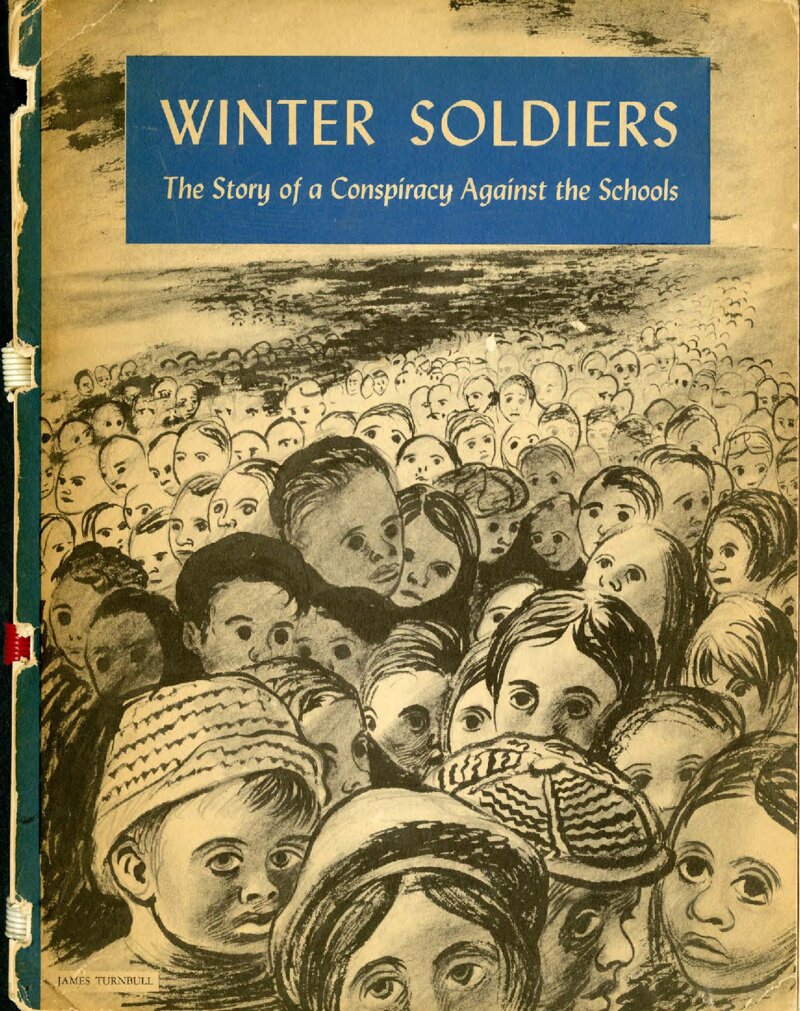
WINTER SOLDIERS
The Story of a C onsptracy Agaist the Schools
TEXT BY LOUIS LERMAN FOREWORD BY FRANZ BOAS
“These are the times that try men’s souls. The summer soldier and
the sunshine patriot will in this crisis shrink from the service of his
country. But he who stands it now deserves the love and thanks of
men and women.” —THOMAS PAINE, Common Sense
RAPHAEL SOYER
TO THOSE WHO HAVE GIVEN FREELY of their talents to make this book, we
give thanks. Our gratitude is offered to soldiers on a common front, who fight along-
side us with brush, pen and palette. Our battle is theirs.
To the United American Artists Workshop Group, for their cooperation and
guidance,
to the artists: Julian Brazelton, Bennet Buck, Ernest Crichlow, Aaron Douglas,
William Dove, James Egleson, Philip Evergood, Hugo Gellert, Harry Gottlieb,
William Gropper, Marston Hamlin, Ernest Hopf, Joe Jones, Mervin Jules, Rockwell
Kent, Louis Lozowick, Hugh Miller, Elizabeth Olds, Anton Refregier, Philip Reis-
man, Hulda Robbins, Raphael Soyer, William Steig, Harry Sternberg, James Turnbull,
Sylvia Wald, Gilbert Wilson, Art Young,
to Louis Lerman, one of the suspended staff members, who wrote the text,
to Lewis Balamuth, another of the suspended teachers, who conceived the project
and worked tirelessly to make it a reality—
we are indebted.
The final verdict in the fight for free education which we are waging, and our
measure of success with this book, we leave to you, the people, to whom we dedicate it.
Bella V. Dodd
COMMITTEE FOR DEFENSE OF PUBLIC EDUCATION
A Committee of the Teachers’ Union and the
College Teachers Union of New York City
AARON DOUGLAS
Foreword by Franz Boas
THE SAFETY of our country must be based on a serene confidence in the good sense
of our people. Our confidence must be based on the belief in the ability of our citizens
to form clear judgments regarding the problems of our time. Hence the necessity for
an education that teaches the young to think and to form opinions not swayed by
the catchwords of the day, that enables them to resist the clamor of the press, the
radio and the movie. Such education is possible only if the teacher himself is free to
think, if he is not prevented from presenting facts impartially.
The attacks upon our schools emanating from Chambers of Commerce, Economic
Councils and Legislatures are intended to curtail schooling and to indoctrinate the
young with the idea that all is well and that every attempt to adjust the old ways to
new needs is subversive and will lead to disaster. They are opposed to fundamental
needs of our times, to the education of the masses to independent thinking, to clearing
away of prejudices and to a tolerant understanding of the needs and aspirations of
the various groups constituting our society.
The well being of our country is based on the freedom of the school and on the
freedom of the teacher, upon his ability to give impartial information and upon his
ability to develop not only this knowledge but also the character of his pupils. The
more he is restricted by bureaucratic requirements, the more he is under surveillance
by irresponsible outsiders, the less efficient will he be as a true educator.
New York schools are suffering at present grievously under the attacks made
upon them by a Committee of the Legislature. The utterances of the Chairman and
the reports of his activities, if true, indicate that his ideals conform to those of the
Association of Manufacturers, the Chamber of Commerce of New York, and the
Economic Council and are opposed to the freedom of the school.
“Winter Soldiers” brings home the needs and achievements of the school. The
illustrations of school life and of school ideals will open the eyes of many, more
effectively than the written word alone can do.
Racial intolerance is held up to ridicule in the symbol of Max Yergan. The
complete disregard of race among children uncontaminated by conventional race
prejudice is brought before our eyes. The efforts of the “Signpost” and its backers
to close our city colleges and their reflection of the views of the Christian Front and
other agencies that foment race antagonism are disclosed. These are subjects to which
the Rapp-Coudert Committee has been wilfully blind. The overcrowded class rooms
and the urge of the masses to obtain educational facilities find significant expression.
May “Winter Soldiers” gain victory over the enemies of education.
June 17, 1941
GILBERT WILSON
Winter Soldzers
LET ME TELL YOU the story of a strange thing that is happening to America. I tell
you the story in pictures so that even you children, who cannot read the honey poison
speeches of the destroyers of your schools; so that you men and women who work
in the shops and the factories, the offices and farms, and perhaps have no time for
the luxury of reading, may read as you run your lathe, as you wash dishes in the
kitchen, as you sell groceries over the counter, as you march on the picket line, as you
speak for democracy, as you lend your eager tongue for the right of a man to a job—so
that you may know what is happening in America—America, the free and the beautiful.
Here is the story of fascism goosestepping through the quiet halls of your children’s
schools and colleges—an ugly, threatening story. Here is also a story of soldiers
fighting for the great traditions of learning, soldiers without uniforms, the winter
soldiers of education.
Suppose I told you, Mr. Jones and Mrs. Smith and Mr. Giovanni and Mrs.
Abramson, suppose I told you that in New York City, where Mayor LaGuardia’s radio
station tells us every day that “seven and one-half million people live in peace and
enjoy the blessings of democracy” .. .
that teachers are shadowed by plainclothesmen . . .
that students are third-degreed at secret hearings . . .
that union membership lists are seized . . .
that 34 teachers are fired from a college because they speak for civil rights and
security .. .
that a teacher is thrown into jail on a trumped up charge of perjury... .
You would say, wouldn’t you, “Stop trying to scare us, mister. This isn’t Germany,
this is a free country. We have trial by jury, don’t we? And isn’t a man innocent until
he’s proven guilty? And nobody has to testify against himself. And doesn’t a man
have right of counsel? Why, it says so in the Constitution. And say, what do you
mean by telling us that union membership lists are seized? Don’t you know that unions
are legal? The law says so. Why, everybody knows that!”
All right, all right, Mr. Jones and Mrs. Smith and so on, just wait a minute and
Pll tell you what's been happening.
ERNEST CRICHLOW
WE'LL HAVE TO GO BACK a while to get the full picture.
You're a mechanic, Mr. Jones—a union man. You know how long it took the
workers in your trade to get the 8 hour day? And how many strikes and lockouts and
arrests for ‘‘conspiracy” and “criminal syndicalism” and “littering the sidewalk”
and finks and frameups and injunctions and heartaches add up to the 8 hour day?
The same thing with free schools. Forty-four years after labor, parents and civic
gtoups began the fight, free common schools became the law in New York State.
“Education of the sons of the poor was feared as a breeder of discontent among the
lowly.” It was only after long years of effort and petition by the Workingmen’s
Association and other forward looking groups and individuals of like mind, that a
poor man’s college—the Free Academy—became a reality in 1847. The Free Academy
is now the City College.
So that you have the mechanics and the rest of the workers in the New York of
that day to thank for the city colleges of to-day, Mr. Jones, and for the New York
City elementary and high schools.
Pretty much the same kind of fight for free schools as for the 8 hour day. And
pretty much the same kind of people fought against both, the big property owners
and the big employers of labor. And pretty much the same kind of red baiting and
witch hunting to confuse the real issues. And the same persecution. Pretty much
everything is the same—except that the enemies of labor and the schools are stronger
to-day.
But then, so are the people.
i See
HARRY STERNBERG
WHO ARE THESE MEN and whom do they represent, and what forces are behind
them, and how come they sit in the state legislature and make laws for you and me?
Let’s see.
There is Merwin K. Hart, enemy number one of democracy and education, presi-
dent of the New York State Economic Council. Secretary Ickes three times publicly
called him fascist. In the Congressional Record for January 22, 1940, Representative
Hook describes Mr. Hart’s connection with Father Coughlin, with Fritz Kuhn, with
Allen Zoll, with other notorious anti-Semites. -
On February 22, 1939, there was a hearing on the budget of the State of New
York. Hart and his followers in the New York State Economic Council came to Albany
to force through a cut of 33 million dollars in the schools. Their slogan—‘‘Axe the
Tax.” One thousand union teachers came to Albany too. Their slogan— “Don’t Use the
Axe on the Child.” When the teachers said that the American way—the way of democ-
racy—means free instruction in the schools, Mr. Hart shouted: “Subversive!”
The teachers took the case for education to the people, through the radio, leaflets,
meetings; made the people aware of the threat to the schools. The legislators were told
off by their constituents. The budget was restored.
But the two sides lined up very clearly after this fight. On the one side stood the
Teachers Unions as the first rank fighters for the schools. On the other side, Merwin
K. Hart and the groups associated with him.
f
ff
ANTON REFREGIER
LET’S GET SOME MORE FACTS.
On December 4, 1940, a group called the Taxpayers Federation met in New
York. There were only forty people at this meeting, but these forty were representa-
tives of big money: The New York Central Railroad, Greenwich Savings Bank and
assorted “friends” of education. You were not at that meeting, nor I, nor the repre-
sentatives of the real 714 million taxpayers in New York City, nor the parents of the
children in the schools, nor the teachers. And here is the reason we weren't.
Their aims:
“Make pupils pay for textbooks and supplies.”
“Teach nothing but essentials.”
“Make parents and not the public-school system support child education.”
“Stop free college education.”
These forty came to the conclusion that “the solution of the problem of reducing
the cost of education . . . has been frustrated by the Teachers Unions . . .”
Not so many of them, are there? Not nearly as many as we are. But these are
only the front men. Behind them stands Money—and Reaction—and Politics. That’s
why they are dangerous.
Let’s name some names:
Milo F. McDonald, head of the American Education Association and editor of
the “Educational Signpost.”
Francis S. Mosely, head of the Teachers Alliance.
In May, 1940, Mrs. Joanna M. Lindloff, member of the Board of Education,
accused both these organizations of “spreading intolerance and anti-Semitism”. Both
groups reflect the point of view of Father Coughlin and the Christian Front in the
world of education.
Milo F. McDonald wants the substitution of scholarships for a system of city
colleges in order to “reduce the cost of education in this city by making it unnecessary
to maintain public colleges.”
Will you trade the schools for a handout?
You want to remember these names, Mr. Jones. They’re your enemies and the
enemies of your children.
JULIAN BRAZELTON
ORDWAY TEAD and District Attorney Dewey didn’t answer the people, but the
teachers did. They said:
For centuries wise men and brave men and patient men have searched for the
truths by which men ought to live.
For centuries men have fought for the right to know. That is the great tradition.
That search we propose to continue.
That tradition we mean to maintain.
This zs America, Mr. Jones and Mrs. Smith and Mr. Giovanni and Mrs. Abramson,
and by your grace, by the grace of the people, we pledge to keep it America.
That is the meaning of this story—which is not yet ended.
Lire AND LIGERTY FREEDOM OF WORSHIP
FREE BALLOT FREE PUBLIC SCHOOLS NO fF
FRAR SPEECH AND ASSEMBLY
RACIAL EQUALITY
GURY AQmey Vee Sem RIGHTS OFYMINORITIES
ie”! CONSZONU TION | 4 :
ee Pa me f
Se aa pe
“,
°
¥y
Arner -COVUDERT COM
VC. BOARD OF HIGHER EDUCATIO;
5 f
i a ,
v
a y it
eae
Mig
Me
STATESMEN
(S0-CALLED)
it, Ar Berk oy Fretotar urbe FEL Aone ART YOUNG
Are you indeed for Liberty?
Are you a man who would assume a place to teach here, or lead here, or be a poet here?
The place is august—the terms obdurate.
Who would assume to teach here, may well prepare himself, body and mind,
Who are you, indeed, who would talk or sing in America?
Have you studied out My Land, its idioms and men?
Have you learned the physiology, phrenology, politics, geography, pride, freedom,
friendship, of my land? its substratums and objects?
Have you considered the organic compact of the first day of the fwst year of the inde-
pendence of The States, signed by the Commissioners, ratified by the States and
read by Washington at the head of the army?
Have you possessed yourself of the Federal Constitution?
Do you acknowledge Liberty with audible and absolute acknowledgement, and set
Slavery at nought for life and death?
Are you of the whole people?
Walt W hitman
BENNET BUCK
TO SMASH THE SCHOOLS, they had to smash the Teachers Unions. This they set
about to do.
They had learned the technique. They had learned that if you shout “Red” long
enough and loud enough you might get people to believe it, especially if the radio
and newspapers join the chase, especially if you accuse and don’t give those accused
a chance to throw the lie back in your face.
Hitler had done it, and had enslaved a whole people. Mussolini, Franco, Pétain
had followed the same successful formula. Under the pretext of fighting communism,
fascism had destroyed the trade unions, the liberal and progressive movement, all
anti-fascist thought and sentiment.
And similarly, under the pretext of fighting subversion in the schools, the real
subverters, the budget cutters, the haters of labor, called their trigger men to work.
“Boys,” they said, “send out the word for the gang. Collect your false witnesses, your
slanderers. We got a job to do. There’s big money in it, the whole school budget. Get
after the union. The boys up in Albany,” they said, “will look after the legal end
of things.”
The boys up in Albany, the boys in the State Legislature, did the job. A legis-
lative committee to investigate the schools.
Some people said, “Why, there’s the report of the Gulick Committee, isn’t there
—found need for an increase of approximately 38 million in state educational services
—worked five years to survey the needs of the schools. What’s this new Committee for?”
That's the point. Mr. Rapp, chairman of the new committee to investigate . . .
found evidence for a cut of 12 million in state aid to education before he even began
his survey.
“That's the kind of committee we need—a committee to investigate . . .”
“What?”
“Why, subversive and un-American elements of course.”
“And what are the subversive elements?”
“Why, the Reds of course.”
“And who are the Reds?”
“That's an easy one. The Teachers Unions.”
WILLIAM STEIG
THE TEACHERS UNION:
In times of great emergency, men must restate their fundamental principles that
they may serve as guides to intelligent action. We, therefore, pledge our devotion
and energetic efforts in behalf of the following credo...
We believe that America, more than ever before, needs an expanding system of
free public education, in keeping with the resources and democratic traditions of the
richest nation on earth. The children of America must learn through experience the
full meaning of the democratic way of life.
We believe that full educational, vocational and cultural opportunities must be
afforded to all children without discrimination because of color, creed, or social status.
We believe that teachers must have complete academic freedom to search for and
to teach the truth, if they are to develop enlightened youth able to cope with democ-
tacy’s problems.
We believe that teachers are citizens. They must be guaranteed the same full
freedom of private belief and public action guaranteed by our Constitution and Bill
of Rights to all citizens.
We believe that we can make American democracy strong only by making
America’s children stronger. America cannot afford to deny to any of its. children
adequate nutrition, proper medical care and healthful homes.
We believe that it is our duty to frustrate any attempts which seek to lower the
living standards of the American people, to curb their liberties or to threaten their peace.
This credo we can realize through the united efforts of all men who believe in
education for democracy.
Education is Democracy’s first line of defense.
MERWIN K. HART: “... if you find any organization containing the word ‘democ-
racy’ it is probably directly or indirectly affiliated with the Communist Party.”
JAMES EGLESON and GILBERT WILSON
WITH ALL DUE POMP and formality the Rapp-Coudert Joint Legislative Com-
mittee was “hereby created and empowered to investigate, review and study” the
needs of the schools. The legislature appointed as vice-chairman of the committee
Senator Frederic R. Coudert, Jr. of the law firm of Coudert and Coudert, one time
attorneys for the Russian Czar, now a defender of the fascist anti-Semitic regime of
Vichy, the same firm which had engaged the services of Boris Brasol, the Boris Brasol
who introduced the anti-Semitic forgeries, the Protocols of Zion, and sold them to
Henry Ford for use in the Dearborn Independent.
Here—the Legislature told the people of the state—here is the gentleman who will
investigate un-American activities in the schools.
And so the conspiracy began to take shape, drawing into its web all the anti-
democratic forces in New York State—the Merwin K. Harts, the Milo McDonalds,
the Christian Fronters, the Coughlinites, all these—and the impostors and “willing
witnesses’ that are the camp followers of this army with fascist banners.
PHILIP EVERGOOD
ONLY ONE MAN in the State Legislature—Assemblyman Eugene Zimmer—voted
into office by the American Labor Party and the trade union movement in Troy—
raised his voice against the appropriation for the Committee. Assemblyman Zimmer,
himself a worker and a trade unionist, knew that the aim and function of the
Committee was to attack and destroy the Teachers Union, and thus to establish legal
precedent for the destruction of the rest of the trade union movement of the State.
Assemblyman Zimmer called upon the people of the State and upon the trade
union movement to act on the threatening danger, to protest any attempt to transform
the investigation into a witch hunt.
Leaders of the Republican and Democratic Parties in Albany pledged that the
‘ Committee would not be merely a “witch hunting, hedge jumping expedition”, but
would be an “honest, sane and comprehensive”’ study.
Honest people were skeptical. People who knew the history of the last thirty
years were disturbed.
And they had reason to be.
MARSTON HAMLIN
WHAT'S DIFFERENT is—the WAR!
Under cover of the hysteria which they spread like a black and threatening pall
all over the country, those men who want to destroy the schools are doing their work.
Fascism in America wants to burn the books: the books that say free speech
and civil rights and the right to organize and the right to free worship and the right
to believe in the Constitution and the 14th Amendment and all the other rights that
we've been taught the word America means.
They want to make sure that in the world they are out to make, your child will
learn history as they want it learned, that teachers will teach what they want taught,
and the only books read will be written by their hired men.
That’s the program, borrowed lock, stock and barrel—from Hitler. But the
language is different. They don’t call it fascism and destruction. They call it defend-
ing the schools from “subversive elements.”
That’s something to be concerned about, isn’t it, Mr. Jones?
ELIZABETH OLDS
YOU DIDN’T NEED A LONG MEMORY to think back to 1917 and what hap-
pened in the years after the first World War. You remembered the Palmer raids and
the attacks on the foreign born. You remembered the Lusk Committee, model of
Rapp-Coudert, created to train for loyalty through fear and intimidation. You remem-
bered that with the same high-flung phrases they closed in on everything decent
and progressive.
Robert Morss Lovett writes of those days, ‘Nowhere was the suppression of
freedom of mind, of truth, so energetic, so vindictive as in the schools. Instances
crowd upon the mind. I remember attending the trial of a teacher before a com-
mittee of the New York School Board, the point being whether his reasons for not
entering with his class upon a discussion of the Soviet government concealed a latent
sympathy with that form of social organization. The pupils were ranged in two groups,
Jews and Gentiles, and were summoned in turn to give their testimony—they had
previously been educated in the important functions of modern American society,
espionage and mass action. Another occasion is commemorated by the New York
Evening Post, the teacher being on trial for disloyalty and the chief count in his
indictment that he desired an early peace, and his accuser, one Dr. John Tildsley
(a superintendent of schools) ....
“ “Are you interested in having this man discharged?’
“I am,’ said Dr. Tildsley.
““Do you know of any act that would condemn him as a teacher?’
“ ‘Yes,’ said Dr. Tildsley, ‘he favored an early peace.’
“ “Don’t you want an early, victorious peace?’
“ “Why ask me a question like that?’
“Because I want to show you how unfair you have been to this teacher.’
“But Mr. Mufson wanted an early peace without victory,’ said Dr. Tildsley.
““He didn’t say that, did he? He did not say an early peace without victory?’
““No.’
“Then you don’t want an early peace, do you?’
““No.’
“You want a prolongation of all this world misery?’
““To a certain extent, yes,’ said Dr. Tildsley.”
The history of those days is a black page in the books. But a page to be read well
and clearly, because it’s happening again.
: TO
COURTS, VAILS
hi AND EXILE.
tr Foun
ART YOUNG
SENATOR COUDERT BEGAN by demanding that the Teachers Union turn over
its record books and membership lists. The activities of the Union were a matter of
public record. The Union, however, submitted its minute books for eight years back
to the Committee.
President Charles J. Hendley was instructed by the membership of his Union to
refuse to yield the lists.
Some people said, “Why doesn’t the Union release its membership lists? If it
has nothing to hide... .”
To the people who asked that question, the Union said; “You'll find the answer
in the LaFollette investigation of labor spying and blacklisting in industry.”
“But that’s in steel and coal and shoe—that might be true for factory workers,
but these are teachers, and they are employed by the state. Who ever heard of black-
listing in the schools?”
The Union said “. . . There is an unsavory history of withholding employment
from Union members by blacklisting. The fact of membership in the Union is repeat-
edly misused by those principals and supervisors who are unsympathetic to the
Union’s aims. The lists can be of no conceivable use to any agency desiring to pros-
ecute a ‘subversive hunt’. They can serve only a hunt for union members.”
Senator Coudert protested that he had no intention of publishing the Union
membership lists. But on the day the lists were ordered to be delivered to Senator
Coudert’s office, Hearst press photographers were present to photograph the lists for
publication. It wasn’t the Union that had asked them to come.
The case was argued before the Court of Appeals.
Counsel for the Teachers Union: ‘The lists are irrelevant to purposes of the
inquiry; their surrender would be a breach of faith to its membership and a danger-
ous precedent in denial of fundamental rights of trade unions.”
The Court delivered its decision: The membership lists must be delivered to the
Rapp-Coudert Committee or Mr. Hendley goes to jail—there to remain until the lists
are produced.
The Herald Tribune said: “. . . the obvious principle behind the Court of Appeals
decision applies to all unions or other associations publicly sanctioned and permitted
to function, and that is the principle that their records of whatever sort shall be open
to official inspection. Short of suppression, the community can have no other adequate
check on their activities.”
Did you say that unions are legal, Mr. Jones?
V DEgleson
JAMES EGLESON
STAR CHAMBER HEARINGS!
Senator Coudert begins his investigation of the needs of the schools!
A student is summoned to a private hearing. He faces a member of the Legisla-
ture, two of the committee’s lawyers, a stenographer. He asks whether he can have
his father present. The answer is no.
He is questioned about his private affairs, about his work, about his attitude
toward labor unions, about his political views. He is told he is lying, reminded that
his future is at stake. Off the record, he is told, “You know what this means, this is
perjury.”
He is questioned about his teachers and their activities on the campus.
“Do you know Professor So and So?”
“Is he a Communist?”
“Did you ever hear anybody say he is a Communist?”
“Has he ever said anything in class that would make you think he is a Communist?”
“Have you ever heard him talk about Communism with anyone?”
* * *
The Committee searches for the truth!
A college teacher is subpoenaed for the private hearings. He is offered “friendly
advice” by the investigator. Off the record he is asked to “confess”, to “play along”
with the Committee instead of being guided by a “mistaken loyalty” to the Teachers
Union. He is told his future is at stake. He is asked “Are you ready to go to jail for
the Communist Party?”
If the witness says he is not interested in off the record discussions on subjects
about which he knows nothing, the attitude changes.
The inquisition begins.
He is refused the right to have his counsel present. He is refused a copy of his
own testimony. He is asked:
“What newspapers do you read? What magazines do you subscribe to?”
“Are you a Communist?”
“Which of your friends are Communists?”
“Have you heard it said that any of your acquaintances are Communists?”
“Have you ever discussed Communism with anyone?”
“Is Professor X a Communist? Y? Z?”
“Have you heard any rumor at the college about any colleagues of yours who
are Communists?”
“Isn't it true that the Union is dominated by Communists?”
MERVIN JULES
MEN CALLED into star-chamber hearing to testify not about what they know but
about what they surmise, what they think, what they may have heard.
“Were you at a meeting for Spain?”
“Name others who were at that meeting.”
“The meeting is vague in your memory. Well, then, tell us whom you vaguely
saw at that meeting.”
Vagueness becomes evidence, rumor becomes fact, gossip becomes verity. A glo-
rious chance for working off old grudges and hates, for slander, for defamation of
character, for anonymous and evil whisperings.
The Committee found its “‘witnesses’—the fakers and phonies, the labor spies and
stool-pigeons, the fearful and the yellow-bellied.
These offered “testimony”.
HUGH MILLER
AS THE WITNESSES RECITED their glib, well-rehearsed stories the press went
on a drunken spree. Headlines crawled across the front pages, wiped the war news
off. The “respectable” Times, the “liberal” Post, the rest of the “free” press, all joined
in a sickening orgy of red-baiting, rivaled only later by their lynch editorials on the
New York City bus strikers.
And all that had happened was that an impostor had declared that 50 of the
most respected members of the faculties of the City College and Brooklyn College
had been members of the Communist party. No evidence offered—no documents. No
opportunity for these 50 to throw the lie back in his face. No opportunity to cross-
examine his testimony.
Sufficient that they have been accused. The newspaper presses ground out their
stories, and as the presses turned, the careers of 50 men and women that had been
built on years of scholarship, research, teaching, service to the community, crumbled
between the rollers.
In 1692, before the Salem witch court, a defendant spoke:
“T will not plead,” he said. “If I deny, I am condemned already in courts where
ghosts appear as witnesses and swear men’s lives away. If I confess, then I confess a
lie, to buy a life which is not life, but death in life.”
WILLIAM DOVE
THE TRIAL of the 50 was held in the headlines of a hostile press—the press adjudged
them guilty.
Weeks after the news was cold they were given the right they had demanded—
to appear at a public hearing and give the lie to the accusations that had been levelled
against them.
With dignity they presented their record of scholarship and research. With pride
they offered the unsolicited testimony of colleagues and students. With courage they
challenged the Rapp-Coudert Committee and its evil work.
“You dare not say that you are endeavoring to effect my dismissal from City
College because I oppose your program of retrenchment and war, your program of
fascism.”
Another flung back the charge of conspiratorial activity in the face of the Com-
mittee. “It was openly and not in conspiratorial fashion that we won tenure and
democracy and academic freedom at the public colleges of the city, and it is in the
same way, openly and publicly, that we shall retain them.”
A third: “It is my belief, gentlemen, that if I loved my country and my people
less, if [had kept my beliefs to myself, if I had not exercised my duty as an American
citizen to keep my country democratic and at peace, that my name would never have
come up in your investigation.”
The times need more men who will speak like that. There are too many tired
fighters—men who once put up a fight, or say they did. “Now it’s 1941,” they tell you,
“times are tough, it’s wise to lie low, wait till the storm blows over.”
The only time freedom needs defending is when it’s under attack. Voices must
be loud and courageous today to be heard above the storm.
HARRY GOTTLIEB
THE STUDENTS ANSWERED THAT-—4000 of them from City College who
walked out of classes on April 23rd, on strike for the reinstatement of academic free-
dom and their suspended teachers. Many thousands from other colleges.
There was a tradition at City College. Academic freedom was no hollow slogan.
In the memory of four generations of students the word had meant dismissal of
students, confiscation of student papers and magazines, suppression of student clubs.
For 15 years the three R’s—Robinson, Reaction and Retrenchment, rode high and
mighty through the college halls. It was only in 1938 that an outraged public and
student opinion forced the dismissal of President Robinson.
The class of 1926 remembered when every issue of the student newspaper appeared
with one news column draped in black, the legend reading: “The Campus may make
no further reference in its columns to a certain course at the college’—forbidden to
discuss the Military Science Department.
Students remembered when a college publication was suppressed because it refused
to accept a faculty adviser who was “‘to reject editorial comment that is directed against
any administrative officer”.
The class of 1932 remembered the first time police ever appeared on the college
grounds—to break up a student meeting protesting the dismissal of Oakley Johnson.
The meeting was dispersed and 10 students arrested and suspended.
The class of 1933 remembered the day when President Robinson invited a group
of Italian fascist student emissaries to a reception in the Great Hall. When the students
organized a meeting in protest, 21 were expelled and the Student Council suspended.
Indeed, academic freedom at City College has never been an abstraction. It has
been something to believe in, something to fight for. In those books that the National
Association of Manufacturers and the Rapp-Couderts have been trying to censor and
to suppress, the students read the words of Wendell Phillips and found them good.
“No matter whose the lips that would speak, they must be free and ungagged.
The community which does not protect the humblest and most hated member in the
free utterance of his opinion, no matter how false or hateful, is only a gang of slaves.
If there is anything in the university that can’t stand discussion, let it crack.”
LOUIS LOZOWICK
THE SUSPENDED TEACHERS were asked to speak at the student rally. The stu-
dents wanted to know if there was “anything in the university that can’t stand
discussion.”
But the truth was “subversive”. Acting-President Wright forbade the teachers
who had been suspended from addressing the student body, forbade the students
from listening.
Now, once again, the ghost of President Robinson stalked the halls of City
College. Once again academic repression—students threatened with dismissal—rooms
locked to prevent student meetings. Once again police and detectives patrol the
campus. A host of new regulations conjured up—red-tape and administrative hocus-
pocus, cut to 1941 style, and designed to the fascist pattern. False fire alarms rung to
break up a meeting—a stude:it beaten up for distributing a leaflet—and through all
this the canting hypocrisy of the administration singing hosannas to an academic free-
dom it had destroyed.
The new university in America, Mr. Jones?
A teacher forbidden to speak at a meeting of his own colleagues!
Forced to silence, he addressed himself by letter:
“I regret that we are deprived, by administrative fiat, of an opportunity to dis-
cuss our common problems. It is of lesser importance that the ban is an affront to me;
it is of greater moment that the ban is a slur upon you. Those who decreed it operate,
it seems to me, upon the premise that you are incapable of hearing me without being
bereft of reason and judgment, thus they insult your intelligence and deprecate your
maturity. The administration also seems to question your moral standards in having
invited me; in so doing it is haughty but not wise. The ban also flouts your traditional
feeling that a man is innocent until proven guilty; thereby it subverts American
judicial ideals. Finally, the ban invades your rights of free association and independ-
ent judgment; it therefore strikes at your integrity as a citizen, at your opportunity
to pursue the social good after your own fashion. It seeks to disorganize and weaken
your effective struggle for increased educational budgets adequate to the demand for
free higher education and for academic freedom. To these insults and incursions I
am confident you will find the way to make fitting response.”
ERNEST HOPF
THERE WAS A DAY in the summer of 1927 when together with a silent crowd of
other students I stood at the flagpole on the City College campus waiting for the grim
news from Boston. And as we waited, the air tense, threatening, somebody in the
crowd said, “They killed them . . . they killed Sacco and Vanzetti ... Jesus, they killed
Sacco and Vanzetti. . .” And he kept repeating it over and over, like a prayer,
“Jesus...” And as we walked home from the meeting, all we could think of to say
was, “What's the idea, what did they do it for, what’s the idea?”
There was something of the same thing in the air when the news came that Morris
U. Schappes was in the Tombs, indicted on a perjury charge and facing a twenty-year
sentence. Students stood around the flagpole, unbelieving, incredulous, hoping it
couldn’t be true in America. Word kept buzzing around the campus, angry buzzing.
“What's the idea? What’s the big idea?”
It’s a long time since that summer day in 1927. This time the students didn’t
ask, “What did they do it for?” They knew what they did it for.
They knew why Morris Schappes was in jail, why he had been arrested by five
detectives, why he had been indicted for perjury with a penalty of 20 years in jail
and $20,000 fine hung over his head, why he had been locked in the Tombs.
Morris U. Schappes had preached “subversive doctrines”. Like Sacco and Van-
zetti, like Tom Mooney, like Joe Hill, like a thousand others whose names the workers
of America reverence, he had fought for the people’s needs, he had spoken out for
democracy. He had said: “I believe in political, racial and social equality for Jews,
immigrants, Catholics and for that specially oppressed people, the Negro people. I
wish to help liberate the cultural energies and productive capacities of the common
people from the crippling restrictions placed upon them by big business. I desire to
see my students freed from the economic handicaps and the insecurity that is making
them aimless in their studies and uncertain of the future that their education cannot
help them chart or plan. I want for the American people and for myself, peace, security,
culture and happiness.”
That’s the credo of a man, Mr. Jones, an American.
But Americans have been imprisoned for less, for reading the Constitution of
the United States at a strike meeting.
HUGO GELLERT
DR. MAX YERGAN had also spoken out. Max Yergan, scholar, enemy of oppres-
sion, leader of the Negro people.
For the 90 years of the existence of the city colleges, in this city where 300,000
Negroes live, there had been no Negro instructor on the faculties. In 1937, after a
long campaign by the student Frederick Douglass Society, endorsed by the Teachers
Union, the first class in Negro History and Culture was opened and the first Negro
instructor appointed, Dr. Yergan.
The aim of the course which Dr. Yergan gave is described in the college bulletin:
“To disclose the culture of the Negro people and its place in world culture; to study
those forces which account for the present status of the Negro population in America,
to expose and correct the misrepresentation of the past of the Negro population in
America; and to discuss how Negroes may continue their contributions to cultural
progress and strengthening of democracy in America.”
A witness at the Rapp-Coudert Committee gave testimony, said that the course in
Negro History was liberal and progressive. To the Rapp-Coudert Committee that
could mean only one thing—the course was subversive. Dr. Yergan was thereupon
informed by the college authorities that he would not be asked to return to lecture
because it was “the policy of the department to change the personnel of these special
lectureships from time to time, in order that the students may get the benefit of dif-
ferent personalities.”
HUGO GELLERT
ASK THEM, Mr. Jones, they'll tell you.
Dr. Yergan wasn’t fired because he hated Jim Crow and the persecution of his
people.
He wasn’t fired because for twenty years he had lived and studied among the
exploited peoples of Africa and told his students that slavety and peonage hadn't
yet been abolished.
He wasn’t fired because he was President of the National Negro Congress, a
member of the College Teachers Union, and an uncompromising fighter for human
rights.
He wasn’t fired because he said that the Negroes in America have known the
lynch rope of fascism for 320 years.
JOE JONES
DR. YERGAN SAID, “I was dismissed because I was unwise enough to interest
myself in community affairs. 1 was unwise enough to concern myself with the condi-
tions under which children are being educated.”
Dr. Yergan had asked questions and had demanded answers.
Why does tuberculosis take such terrible toll of Negro school children in Harlem?
Why is the price for sunlight and fresh air so high that Negro babies must die
in the diseased and vermin-ridden tenements of Harlem?
Why are the schools in Harlem zoned so that Negro children are Jim-Crowed?
Why must Negro children be schooled in fire-traps?
Why, in this richest city in the richest country in the world, must our children
be hungry because there is too much to eat?
They didn’t answer these questions.
With the 6,000 other teacher-union members, Dr. Yergan had asked: Why is it
that 90% of all school children have bad teeth? And that 9 out of every 10 high school
pupils have some ailment and need remedial care which they can’t get? And that out
of every 100 school children who die between the ages of 10 and 14, 25 die of heart
disease? And that only 2 out of every 100 children who need glasses and can’t afford
them, can obtain glasses through public aid?
The Union said, “There are sick, under-nourished, rickety children in the schools.
They don’t have to be—for 81 cents a year for a child.” 81 cents a year for enough
nurses and doctors and dentists to grow healthy children. That’s cheap enough, isn’t
it? Cheaper than 60 billions for guns and tanks and battleships.
Would you call that subversive, Mr. Jones?
SYLVIA WALD
THE UNION SAID, children in crowded classes can’t learn.
620,000 children in New York sit in over-crowded classes. Children sit two in a
seat, find places on the window-sills or in the aisles, while 4,800 qualified teachers
have been waiting for years to be appointed.
Maybe your child is Tom K., high school student, who tells us, “In one of my
classes we have all the seats taken. The double rows where three of us sit made me
suffer because I had to sit on the crack between the seats. When my next period came
I was too cramped to sit in my seat. It was in this class that I got my lowest mark, 20%.”
Or maybe your child is Joan M. in 5A. “Teacher is always running around help-
ing us, but she doesn’t seem to have much time for each of us and I need her help
in arithmetic.”
Or Ruth W. in 9-B, who says, “I’m afraid to get up to speak. If I had a chance
to know the other pupils I wouldn’t be so bashful. I wish the classes were smaller.”
Things you ought to know about the schools your child learns in, Mr. Jones.
About the fire-traps, some of them. About the school toilets, some of them dark, dirty,
traps for disease. About the lunch-room your child might be eating in, crowded and
unsanitary.
Maybe you haven't heard about all of this before. But that’s not because the
Teachers Union hasn’t tried to tell you.
HULDA ROBBINS
THE COMMITTEE for the Defense of Public Education, a joint Committee of the
Teachers Unions in New York City, paid for radio time over WMCA to tell you
about these things, to let you know what the needs of the schools are. But the Rapp-
Coudert Committee didn’t want you to know. They forced the radio station to cancel
the contract.
The teachers tried to tell you about these things. They were suspended from
their jobs.
The Union tried to get word to you. The Rapp-Coudert Committee seized its
membership list and attacked its members as subversive.
What do you think of all this, Mr. Jones and Mrs. Smith and Mr. Giovanni and
Mrs. Abramson?
Do you think it’s something that concerns you?
Do you think it’s worth thinking about?
Speaking about?
Fighting about?
If you do, it’s time to speak up.
PHILIP REISMAN
THE STUDENTS DID.
Refused to stay in the classes that the suspended teachers had taught. Held mass
meetings, picket lines. Joined in delegations to President Wright and the Board of
Higher Education. Asked them, “Gentlemen, what do you propose to make of the
College we love? What do you propose to do with the teachers we honor? Has servil-
ity become the hallmark of a good teacher? Has unquestioning obedience to authority
—right or wrong—become the standard for academic distinction? Has it become a
crime to think honestly? Is it “verboten” to search for facts?
Is it your wish also to burn the books, and with them the men who live by
these books?
For what had happened in the colleges gave grim warning of the future. Teachers
beginning to water down their teaching. Censorship through fear—a fact here and
there omitted, a conclusion here and there not drawn, certain books quietly dropped
from reading lists, courses of study altered so they would not lead to dangerous
thinking.
And bigotry on the loose. For the first time in the history of education in New
York, teachers at a city college asked to declare their religious affiliation!
Clerical fascism and the auto-da-fé?
Is this the college you design?
Not for us, the students said.
SYLVIA WALD
LABOR SPOKE UP, spoke up loud and clear.
Labor had learned something in the hundred and thirty years since the shoe-
makers of Philadelphia were tried for “criminal conspiracy to raise their wages.”
Learned it with clubs and bullets and tear gas. Learned it from the coal and iron
police, the militia, the ‘Citizens’ Committees,” the Vigilantes. Haymarket, the Ludlow
Massacre, Memorial Day in Chicago, 1937, bear eloquent and bloody witness. Labor
had learned that rights must be won not once, but a hundred times over. That an
injury to one is an injury to all. And Labor rallied to the support of the teachers and
of their unions.
Seven hundred and seventy educators throughout the country, including ten
college presidents and a hundred ministers, protested to the Board of Higher Edu-
cation, adopted a “Statement of Principles on the Rights of Teachers.”
Theodore Dreiser, Richard Wright and a hundred others called upon “writers,
free men, men of good will to support the teachers at City College waging the fight
for democracy and education.”
And thousands of citizens flooded Ordway Tead and District Attorney Dewey
with post-cards, letters, and telegrams. “What's this you people are trying to do?”
they said. “This is America.”
WILLIAM GROPPER
TIME WAS when the members of the Board of Higher Education were the trustees
of more than the municipal colleges. Time was when they were the trustees of academic
freedom. Time was when the Nation in its honor roll included a citation for ‘‘the
Board of Higher Education under the chairmanship of Ordway Tead for introducing
academic democracy into the colleges of New York City.”
When the Dies Committee heard witnesses attack Brooklyn College, Mr. Tead
said: “Allegations of Communist activity in our city colleges are not news, nor is the
fact of such activity unknown to our board. Insofar as the activities of our students
are concerned . . . no one would propose any direct interference with the free
expression of their personal opinion on any matters. If there are Communists on the
faculty of Brooklyn College, that too, in the first instance is a matter of their personal
and private conviction. The political views of the members of our faculties are nat-
urally diverse and are not a matter which we inquire into in the first instance. Our
concern is with the scholarship and integrity of our faculties... . Indeed, differences
of opinion and attitude among faculty members are a wholesome sign of vitality, and
as this is reflected in the teaching, it supplies students with a useful cross-section of
the divergence of views in the community at large.”
New times—changed men. Ordway Tead now supports a resolution to remove "Ziatucohan for Demooracy
from the college staffs all those who advocate “subversive doctrines.” That vague and
sweeping term which has been used so often to mask assaults upon the Bill of Rights,
was left undefined.
Democracy 2 Fatioaher
(Cockwn Kaud 19
But the definition was not long in forthcoming. Acting-President Wright of the
City College told a delegation of union teachers that he was out to get rid not only
of the Communists but of those “who act like Communists” and “those who are called
Communists”.
A resolution new in the history of academic life, shameful and unprecedented.
A yellow sign hung over the arched doors of the colleges: “Closed to intellectual
thought and free inquiry. No dissenters need apply.”
Thirty-three of the teachers named in the Rapp-Coudert hearings were suspended
from their positions at the City College and at Brooklyn College.
The New York Sun headlined the resolution as a “purge”.
Are we ready for purges in America?
ROCKWELL KENT
Title
"Winter Soldiers - The Story of a Conspiracy Against the Schools"
Description
Published in 1941 by the Committee for Defense of Public Education, a joint committee of the Teachers Union and the College Teachers Union, Winter Soldiers tells the story of the Rapp-Coudert hearings and New York State's efforts to rid its public schools and colleges of "subversive influences" and persons, particularly those with communist ties. Sympathetic to the dozens of City College teachers that had been suspended or fired because of the hearings, Winter Soldiers features of a mix of story and artwork. It was created to raise money for the legal defense fund for the Rapp-Coudert victims. The text was written by Louis Lerman, one of CCNY's suspended faculty, and the drawings and graphics were contributed by some of the era's highest regarded activist artists such as Aaron Douglas, Elizabeth Olds, Louis Lozowick, Art Young, and Hugo Gellert. Many of the artists were supported under the Works Progress Administration (WPA), the government-funded Federal Art Project that hired hundreds of artists. The Project was part of President Franklin D. Roosevelt's New Deal during the Great Depression.
Contributor
Smith, Carol
Creator
Committee for Defense of Public Education
Date
1941
Language
English
Publisher
Committee for Defense of Public Education
Rights
Obtained from Contributor - Copyright Unknown
Source
Smith, Carol
Original Format
Book (excerpt)
Committee for Defense of Public Education. Letter. 1940. “‘Winter Soldiers - The Story of a Conspiracy Against the Schools’”, 1940, CUNY DIGITAL HISTORY ARCHIVE, accessed September 5, 2026, https://stephenz.tailc22a4b.ts.net/s/cdha/item/771