"Tough Times Ahead for Women"
Item
wee te ee ee Ae ae ee ee ee ee a ee ee ee ee ee ee ee ee a a ee ae
UNIVERSITY
‘Tough times’ ahead for women
“The women’s movement is being
misrepresented and used against itself,”
according to Brooklyn College history
professor Renate Bridenthal.
Speaking before the CUNY Feminist
Network Conference at the Graduate
Center Nov. 12, she warned that this is
one of several factors that threaten to
slow its progress.
A whole generation of young women
is in danger of reacting against the false
image of the movement being put forth
by the media, said Prof. Bridenthal. That
image presents as the feminist goal, the
superwoman who can do everything —
job, marriage, childraising — with re-
lative ease.
“The women’s movement as I saw it
never said that,” protested Prof. Briden-
thal, who was a founder of the CUNY
Women’s Coalition. “We have been
saying that we need such things as day
care so that a woman can realize her
goals. Not that she should kill herself
under existing conditions without a good
infrastructure for support.”
Prof. Bridenthal also fears the effect’
of the current economic slump on the
women’s movement.
“There’s not too much out there and
there’s an awful lot of competition for
it,’ she said, referring to the bleak
employment picture. “People are apt to
say, as they did in the Depression, that
women have taken men’s jobs.”
“Then they ask who is taking care of
the children, the aged, and the ill —
whom the government says it can no
longer assist.”
These pressures have created a
backlash that depicts the movement as
something undesirable and _ anti-social,
Prof. Bridenthal told her audience. “It’s
as if we were to blame for all the ills the
recession has dumped on us and it’s very
frightening.”
She sees a real threat that the burden
of caring for those whom the government
has abandoned will fall on women, forc-
ing them back into an_ existence
circumscribed by the home.
Women are also being blamed for
destroying the family, says Prof. Briden-
thal. But it is necessary to ask what is
meant by family, she cautions. “Those
who make this charge don’t see the
woman as an equal member with a life
of her own and needs of her own. I
sometimes think that ‘family’ is a code
word for a woman in the home.”
A specialist on Weimar Germany, she
finds certain parallels in this country
today that disturb her: a depressed
economy, the drying up of aid to the
needy, the desire for a strong person to
solve seemingly insoluble problems, at-
tempts to curtail women’s reproductive
rights, and what she calls “the bombast
about family life.” She notes also the
devaluing of humanistic education and,
with it, women’s studies.
Nevertheless, women’s studies, though
still battling for recognition in some
quarters, have made significant progress,
she feels. In her own field she points to
the inclusion of feminist contributions in
history texts by even some of the most
tradition-bound members of the pro- -
fession. :
The whole notion of looking into the
gender experience is transforming
scholarship, she says. A case in point:
researchers in compiling data now realize
that developments in social policy affect
men and women differently, and their
findings have begun to take this dif-
ference into account.
Both she and those attending the
feminist conference last semester stressed
the importance of networking at CUNY
and elsewhere. A series of workshop
sessions considered strategies and
specific courses of action for various
disciplines.
In spite of what she sees as “‘some very
tough times ahead’’ for the women’s
movement, Prof. Bridenthal is optimistic,
because, as she says, “The demands are
there and will continue to be voiced.”
For Renate Bridenthal, feminism is a
coming-to-consciousness, an ongoing
process that is both individual and social,
and something that has constantly to be
reworked and rethought.
Her own awakening was not the result
of any single event that shook her into
awareness, she reports. Instead, it was a
gradual realization that she wasn’t quite
being treated as an equal, the way she
thought a man might be treated.
Until then she was what she calls a
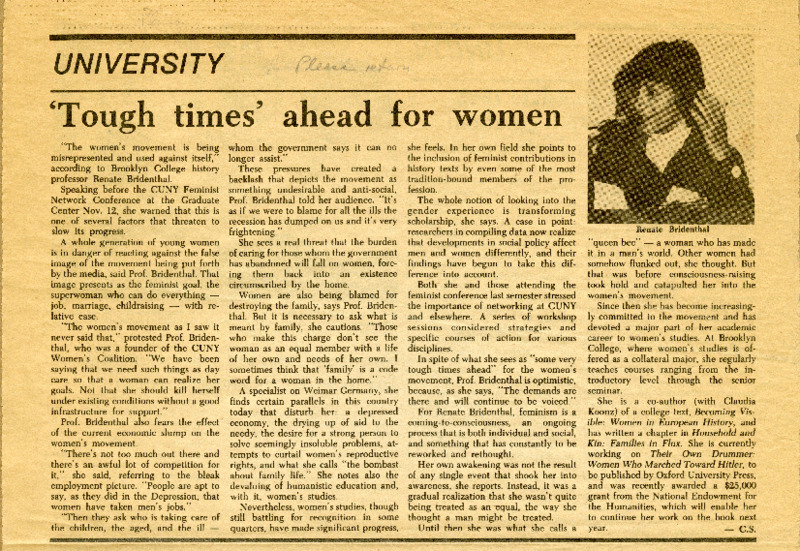
Renate Bridenthal
“queen bee’ — a woman who has made
it in a man’s world. Other women had
somehow flunked out, she thought. But
that- was before consciousness-raising
took hold and catapulted her into the
women’s movement.
Since then she has become increasing-
ly committed to the movement and has
devoted a major part of her academic
career to women’s studies. At Brooklyn
College, where women’s studies is of-
fered as a collateral major, she regularly
teaches courses ranging from the in-
troductory level through the senior
seminar.
She is a co-author (with Claudia
Koonz) of a college text, Becoming Vis-
ible: Women in European History, and
has written a chapter in Household and
Kin: Families in Flux. She is currently
working on Their Own Drummer:
Women Who Marched Toward Hitler, to
be published by Oxford University Press,
and was recently awarded a $25,000
grant from the National Endowment for
the Humanities, which will enable her
to continue her work on the book next
year. — CS.
Pees
UNIVERSITY
‘Tough times’ ahead for women
“The women’s movement is being
misrepresented and used against itself,”
according to Brooklyn College history
professor Renate Bridenthal.
Speaking before the CUNY Feminist
Network Conference at the Graduate
Center Nov. 12, she warned that this is
one of several factors that threaten to
slow its progress.
A whole generation of young women
is in danger of reacting against the false
image of the movement being put forth
by the media, said Prof. Bridenthal. That
image presents as the feminist goal, the
superwoman who can do everything —
job, marriage, childraising — with re-
lative ease.
“The women’s movement as I saw it
never said that,” protested Prof. Briden-
thal, who was a founder of the CUNY
Women’s Coalition. “We have been
saying that we need such things as day
care so that a woman can realize her
goals. Not that she should kill herself
under existing conditions without a good
infrastructure for support.”
Prof. Bridenthal also fears the effect’
of the current economic slump on the
women’s movement.
“There’s not too much out there and
there’s an awful lot of competition for
it,’ she said, referring to the bleak
employment picture. “People are apt to
say, as they did in the Depression, that
women have taken men’s jobs.”
“Then they ask who is taking care of
the children, the aged, and the ill —
whom the government says it can no
longer assist.”
These pressures have created a
backlash that depicts the movement as
something undesirable and _ anti-social,
Prof. Bridenthal told her audience. “It’s
as if we were to blame for all the ills the
recession has dumped on us and it’s very
frightening.”
She sees a real threat that the burden
of caring for those whom the government
has abandoned will fall on women, forc-
ing them back into an_ existence
circumscribed by the home.
Women are also being blamed for
destroying the family, says Prof. Briden-
thal. But it is necessary to ask what is
meant by family, she cautions. “Those
who make this charge don’t see the
woman as an equal member with a life
of her own and needs of her own. I
sometimes think that ‘family’ is a code
word for a woman in the home.”
A specialist on Weimar Germany, she
finds certain parallels in this country
today that disturb her: a depressed
economy, the drying up of aid to the
needy, the desire for a strong person to
solve seemingly insoluble problems, at-
tempts to curtail women’s reproductive
rights, and what she calls “the bombast
about family life.” She notes also the
devaluing of humanistic education and,
with it, women’s studies.
Nevertheless, women’s studies, though
still battling for recognition in some
quarters, have made significant progress,
she feels. In her own field she points to
the inclusion of feminist contributions in
history texts by even some of the most
tradition-bound members of the pro- -
fession. :
The whole notion of looking into the
gender experience is transforming
scholarship, she says. A case in point:
researchers in compiling data now realize
that developments in social policy affect
men and women differently, and their
findings have begun to take this dif-
ference into account.
Both she and those attending the
feminist conference last semester stressed
the importance of networking at CUNY
and elsewhere. A series of workshop
sessions considered strategies and
specific courses of action for various
disciplines.
In spite of what she sees as “‘some very
tough times ahead’’ for the women’s
movement, Prof. Bridenthal is optimistic,
because, as she says, “The demands are
there and will continue to be voiced.”
For Renate Bridenthal, feminism is a
coming-to-consciousness, an ongoing
process that is both individual and social,
and something that has constantly to be
reworked and rethought.
Her own awakening was not the result
of any single event that shook her into
awareness, she reports. Instead, it was a
gradual realization that she wasn’t quite
being treated as an equal, the way she
thought a man might be treated.
Until then she was what she calls a
Renate Bridenthal
“queen bee’ — a woman who has made
it in a man’s world. Other women had
somehow flunked out, she thought. But
that- was before consciousness-raising
took hold and catapulted her into the
women’s movement.
Since then she has become increasing-
ly committed to the movement and has
devoted a major part of her academic
career to women’s studies. At Brooklyn
College, where women’s studies is of-
fered as a collateral major, she regularly
teaches courses ranging from the in-
troductory level through the senior
seminar.
She is a co-author (with Claudia
Koonz) of a college text, Becoming Vis-
ible: Women in European History, and
has written a chapter in Household and
Kin: Families in Flux. She is currently
working on Their Own Drummer:
Women Who Marched Toward Hitler, to
be published by Oxford University Press,
and was recently awarded a $25,000
grant from the National Endowment for
the Humanities, which will enable her
to continue her work on the book next
year. — CS.
Pees
Title
"Tough Times Ahead for Women"
Description
Brooklyn College Women's Studies Program co-founder and professor of history, Renate Bridenthal, is featured in this Clarion article, which is the PSC-CUNY faculty union publication. The Clarion covered a speech Bridenthal gave at the CUNY Feminist Network Conference at the Graduate Center, in which she spoke about the cultural backlash against the feminist movement and predicted that women would experience disproportionate effects of the economic downturn in the early 1980s. However, Bridenthal is sure to note victories and strides made within feminist scholarship, such as the Women's Studies Program at Brooklyn College.
Contributor
Bridenthal, Renate
Creator
The Clarion
Date
January 1983
Language
English
Publisher
The Clarion
Rights
Obtained from Contributor - Copyright Unknown
Source
Brooklyn College Library, Archives and Special Collections
Original Format
Article / Essay
The Clarion. Letter. “‘Tough Times Ahead for Women’.”, CUNY DIGITAL HISTORY ARCHIVE, accessed September 5, 2026, https://stephenz.tailc22a4b.ts.net/s/cdha/item/885