Responses to the Nine Points
Item
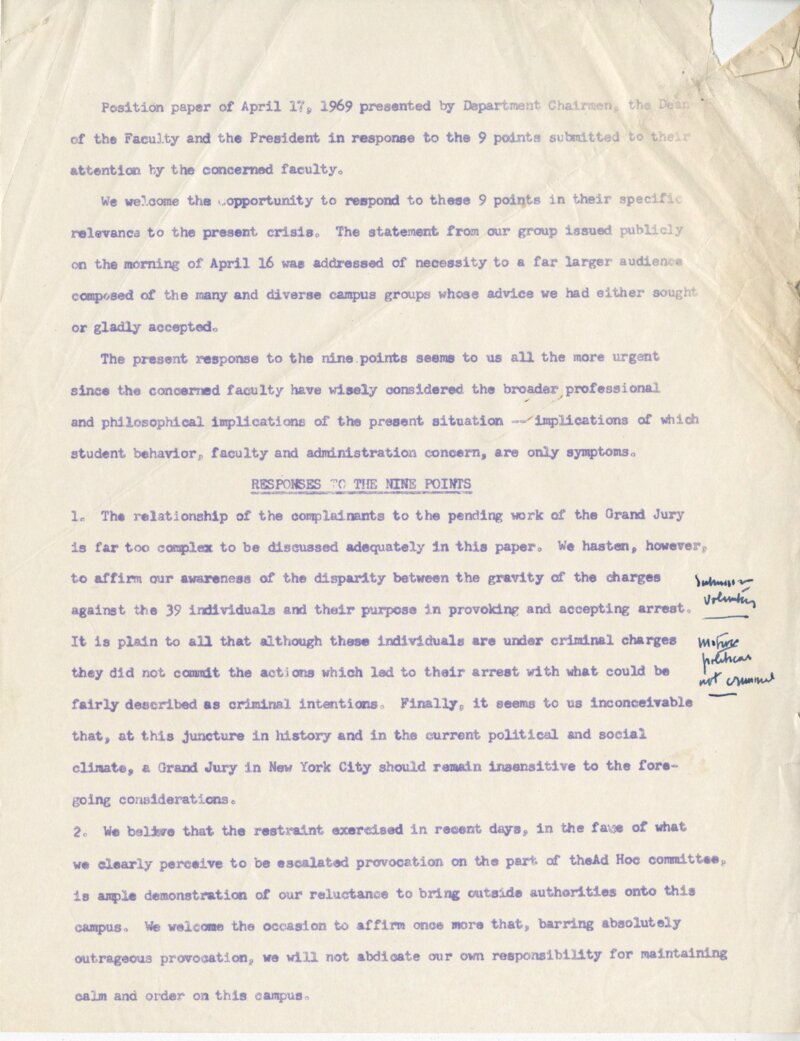
of the Faculty and the President in response to the 9 points submitted h: ort
they did not omnes the actions which led to their arrest with what could be i J | : eg
| that, at this juncture in history and in the current political and social
| Position paper of April i7, 1969 presented by Dipartnekt Chatreet, the, ”
attention hy the concerned faculty. hs
We welcome the opportunity to respond to these 9 points in their specific 4
relevance to the present crisis. The statement from our group ‘neued publicly
on the ‘pagina of April 16 was addressed of necessity to a far larger audience
compesed of the many and diverse campus groups whose advice we had either staght’
or gladly accepted.
The present response to the nine points seems to us all the more urgent —
since the concerned faculty have wisely considered the broader professional }
and philesophical impli. cations of the present situation eal implications of which |
student behavior, » faculty and administration concern, are only ssuptonss
1. The relationship of the complainants to the pending work of the Grand Jury : | | 4
is far too complex to be discussed adequately in this paper. We hasten » however, |
to affirm our awareness of the disparity between the gravity of the charges See aii s i
against the 39 individuals and their purpose in provoking and accepting arrest.
ie e
It is plain to all that although these individuals are under criminal charges wily
fairly described as criminal intentions. Finally, it seems to us inconceivable
climate, a Grand Jury in New York City should remain insensitive to the fore. fs
going considerations.
2. We belive that the restraint exercised in recent days, in the fave of what
we clearly perceive to be escalated provocation on the pari. of theAd Hise committee ,
is ample demonstration of our reluctance to bring outside authorities onto this
Campus. We welcome the occasion to affirm once more that, barring absolutely
outrageous provocation, we will not abdicate our own responsibility for maintaining
calm and order on this. campus.
age | }
3. The first part of this position having already received positive response —
in our statement of April 16, we will say here only that the referendum concern- : -
ing recruitment on campus promised by President McMurray will be held
en e¢.Umc¢ehUC~™ I fa RR ea se
4
i. The case of Professor Henry Lesnick is highly complex. Here again an
effort must be made to distinguish motive and intention from behavior. In this
instance, it could be argued convineingly that the bylaw invoked in charging
Professor Lesnick with unprofessional conduct may no longer be consonant with
prevalent professional mores, In view of a felt disparity between the
strictest interpretation of the bylaw concerned ani a flexible view of the
individual's freedom with respect to involvement in dissent to open
controversial social causes, this group would recommend to the President
that tieteslie Lasnick be restored to his former status. |
5. By a happy coincidence, a Special Committee established last December
by the University Senate has reviewed the bylaws of the Board of Higher
Education and has made recommendations for major changes in the snimtuhods
for faculty voting rights and tenure. These recormendations include
1) extending faculty voting rights to all appointees on tenure~bearing
lines, 2) the enfranchisement for internal departmental purposes of third-
year and later reappointees on non-tenure bearing lines, 3) the option of
departnental enfranchisenent for all other full-time appointees including
visiting and adjunct professors. A document suggesting liberalization,
within the existing bylaws,of current departmental P & B procedures is
new under consideration by the Couneil of the Deans. It is expected that
the College P & B committee will receive these recommendations for its | :
eonsideration in the near future.
With respect to specific opposition to the Max-Kahn report, our | 4
statement of April 16 recegnizes the difficulties raised by the regulations |
that have been inferred from that report. The peint raised here will
co Jes
naturally come under serious consideration in the course of the open hearings
that have been preposed for the purpose of examining in detail the entire |
| Max-Kahn memorandum.
6, 7.6, These three points must be viewed in their relation to the report
by the Ad Hoc Faculty Student committee on College Governance, Although this
report does not consider specifically the P & B system at either the depart-
mental or the college level, it does place a nitiihe upon any eventual student- |
faculty academic senate to give these matters high priorities among its
projected business. The same can be said with respect to improved grievance
machinery which camot come about without eventual adjustment in the present
bylaws.
9- In view of the slowness of appeal machinery and given the time of year, we
recognize the grave difficulties that Dr. Delaney might have in procuring a
Suitable position for a coming academic year in the event that her final |
appeal were rejected, We therefore reconmend to the P & B committee of the
English Department that in view of these ecnsiderations it undertake to see
whether or not. Dr. Delaney could not be offered a one-year terminal appointe
ment for 1969-70,
deg unk s¥orimy Ate
Sa 0° Retin
they did not omnes the actions which led to their arrest with what could be i J | : eg
| that, at this juncture in history and in the current political and social
| Position paper of April i7, 1969 presented by Dipartnekt Chatreet, the, ”
attention hy the concerned faculty. hs
We welcome the opportunity to respond to these 9 points in their specific 4
relevance to the present crisis. The statement from our group ‘neued publicly
on the ‘pagina of April 16 was addressed of necessity to a far larger audience
compesed of the many and diverse campus groups whose advice we had either staght’
or gladly accepted.
The present response to the nine points seems to us all the more urgent —
since the concerned faculty have wisely considered the broader professional }
and philesophical impli. cations of the present situation eal implications of which |
student behavior, » faculty and administration concern, are only ssuptonss
1. The relationship of the complainants to the pending work of the Grand Jury : | | 4
is far too complex to be discussed adequately in this paper. We hasten » however, |
to affirm our awareness of the disparity between the gravity of the charges See aii s i
against the 39 individuals and their purpose in provoking and accepting arrest.
ie e
It is plain to all that although these individuals are under criminal charges wily
fairly described as criminal intentions. Finally, it seems to us inconceivable
climate, a Grand Jury in New York City should remain insensitive to the fore. fs
going considerations.
2. We belive that the restraint exercised in recent days, in the fave of what
we clearly perceive to be escalated provocation on the pari. of theAd Hise committee ,
is ample demonstration of our reluctance to bring outside authorities onto this
Campus. We welcome the occasion to affirm once more that, barring absolutely
outrageous provocation, we will not abdicate our own responsibility for maintaining
calm and order on this. campus.
age | }
3. The first part of this position having already received positive response —
in our statement of April 16, we will say here only that the referendum concern- : -
ing recruitment on campus promised by President McMurray will be held
en e¢.Umc¢ehUC~™ I fa RR ea se
4
i. The case of Professor Henry Lesnick is highly complex. Here again an
effort must be made to distinguish motive and intention from behavior. In this
instance, it could be argued convineingly that the bylaw invoked in charging
Professor Lesnick with unprofessional conduct may no longer be consonant with
prevalent professional mores, In view of a felt disparity between the
strictest interpretation of the bylaw concerned ani a flexible view of the
individual's freedom with respect to involvement in dissent to open
controversial social causes, this group would recommend to the President
that tieteslie Lasnick be restored to his former status. |
5. By a happy coincidence, a Special Committee established last December
by the University Senate has reviewed the bylaws of the Board of Higher
Education and has made recommendations for major changes in the snimtuhods
for faculty voting rights and tenure. These recormendations include
1) extending faculty voting rights to all appointees on tenure~bearing
lines, 2) the enfranchisement for internal departmental purposes of third-
year and later reappointees on non-tenure bearing lines, 3) the option of
departnental enfranchisenent for all other full-time appointees including
visiting and adjunct professors. A document suggesting liberalization,
within the existing bylaws,of current departmental P & B procedures is
new under consideration by the Couneil of the Deans. It is expected that
the College P & B committee will receive these recommendations for its | :
eonsideration in the near future.
With respect to specific opposition to the Max-Kahn report, our | 4
statement of April 16 recegnizes the difficulties raised by the regulations |
that have been inferred from that report. The peint raised here will
co Jes
naturally come under serious consideration in the course of the open hearings
that have been preposed for the purpose of examining in detail the entire |
| Max-Kahn memorandum.
6, 7.6, These three points must be viewed in their relation to the report
by the Ad Hoc Faculty Student committee on College Governance, Although this
report does not consider specifically the P & B system at either the depart-
mental or the college level, it does place a nitiihe upon any eventual student- |
faculty academic senate to give these matters high priorities among its
projected business. The same can be said with respect to improved grievance
machinery which camot come about without eventual adjustment in the present
bylaws.
9- In view of the slowness of appeal machinery and given the time of year, we
recognize the grave difficulties that Dr. Delaney might have in procuring a
Suitable position for a coming academic year in the event that her final |
appeal were rejected, We therefore reconmend to the P & B committee of the
English Department that in view of these ecnsiderations it undertake to see
whether or not. Dr. Delaney could not be offered a one-year terminal appointe
ment for 1969-70,
deg unk s¥orimy Ate
Sa 0° Retin
Title
Responses to the Nine Points
Description
This position paper was presented by Queens College's Department Chairmen, the Dean of Faculty and the President in response to the concerns shared by a group of "Concerned Faculty" on April 13. The document provides a response to each of the nine points brought up by the faculty concerned with the college's handling of ongoing student demonstrations in March/April 1969.
Creator
Queens College (New York, N.Y.)-Administration
Date
April 17, 1969
Language
English
Publisher
Queens College Department of Special Collections and Archives (New York, N.Y.)
Relation
6022
Rights
Obtained from Contributor - Copyright Unknown
Original Format
Notes / Minutes
Queens College (New York, N.Y.)-Administration. Letter. “Responses to the Nine Points”. 6022, CUNY DIGITAL HISTORY ARCHIVE, accessed September 5, 2026, https://stephenz.tailc22a4b.ts.net/s/cdha/item/971