Items
801–825 of 1046
Advanced search
-
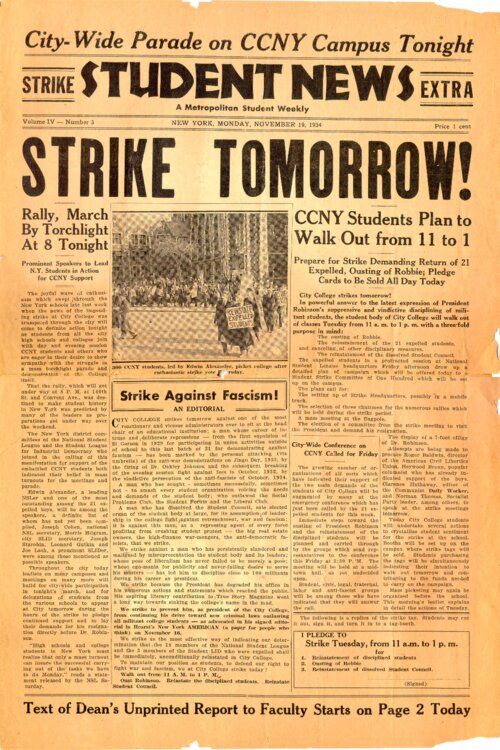 "Strike Tomorrow!" The headline for this edition of Student News announces City College students' strike set for November 20, 1934. The strike was demanded the reinstatement of twenty-one expelled students as well as the removal of City College (CCNY) President Frederick B. Robinson. The twenty-one were expelled following an anti-fascist rally on October 9th.As one article on this front page excerpt notes, the rally began at 11am. It lasted approximately two hours, attracting a crowd upwards of 1,500 students. By event's end, three students were reported to have been arrested during a clash with police and a two-headed effigy of CCNY President Robinson and Italian Prime Minister Benito Mussolini was burned.Student News was published weekly by the National Student League, a Communist-led collective of high school and college students based in New York City.
 -
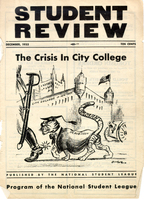 "The Crisis in City College" On this cover of the December 1933 edition of the National Student League's Student Review, CCNY President Robinson is depicted in full academic regalia as a cat, following in step behind a German military officer. Robinson's tail, meanwhile, is wagged by Tammany Hall, New York’s corrupt Democratic political machine. During his time at City College, Robinson drew extraordinary criticism from the left, particularly because of his repeated attempts to stifle free expression on campus. In May 1933, Robinson issued suspensions to a number of students, clubs, and campus publications following an anti-war/anti-ROTC rally in which he was alleged to have struck multiple students with his umbrella prior to his calling for police presence on campus.
 -
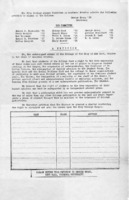 Alumni Petition for Free Expression on Campus This June 1933 petition was created by the City College Alumni Committee on Academic Freedom in protest of the college's treatment of students following a May 29th rally. The student-organized anti-war/anti-ROTC rally met resistance from the college administration who called upon the police to "disperse student" activity. In the petition, the Alumni Committee criticizes this police presence and bemoans the suspension of students, suppression of clubs and campus publications, as well as other college efforts to limit free expression on campus.
 -
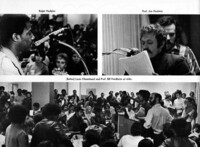 Three 1970 photographs of BMCC mass meeting Printed in Prism, the BMCC 1971 yearbook, these photographs are part of a series that documents the student takeover of one of the BMCC buildings in May 1970. Faculty members Bill Friedheim and Jim Perlstein are shown speaking in support of student demands and about the larger anti-war movement. Student leader Ralph Hudgins (top left) was one of the student leaders speaking in support of a strike to shut down the school.
 -
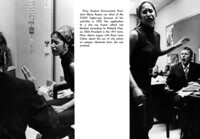 BMCC Student Government President Maria Ramos Arguing with Dean Leon Cohen BMCC student government president Maria Ramos "ran afoul of the higher-ups because of her activities in 1970." Printed in Prism, the BMCC 1971 yearbook, this photograph was one in a series that documents the student takeover of one of the BMCC buildings in May 1970. Ramos was arrested moments after this photograph was taken.
 -
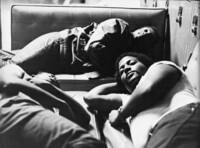 Students Sleeping Overnight at BMCC During 1970 Protest Printed in Prism, the BMCC 1971 yearbook, this photograph was one in a series that documents the student takeover of one of the BMCC buildings in May 1970. On May 6-7 over 30 students slept in the "A" building. As reported in Prism, the takeover lasted for several days.
 -
 Teaching at John Jay College in its Early Years: An Oral History Interview with William Walker This 1988 interview with Professor William S. Walker was conducted by Professor Jerry Markowitz in preparation for Educating for Justice, a history of John Jay College. Walker, a professor of sociology and criminology, was among the original faculty at John Jay from its opening in 1965 until his retirement in 1979. Prior to his time at the college, Walker taught at other CUNY schools including Brooklyn College and Queens College, and was involved in the city’s earlier efforts to educate its police force throughout the 1950s. Though Walker largely focuses on his experience with John Jay’s students, he also describes the early years of the college and its original faculty. As an African American professor, Walker offers a unique perspective, having educated a mainly white police force during the turbulent 1960s. In the interview, he reflects on this experience with several stories, including one about of the assassination of Martin Luther King and another about inviting inviting Louis Farrahkan to his class of primarily police officers. Despite the challenges, he concludes that it was a “privilege” to educate the officers. As Open Admissions in the 1970s led to a growing number of minority students attending John Jay College, Walker offers his observations on the interactions between the police students and the larger student body on campus. He comments on the challenges of the implementation of Open Admissions and the efforts he made to mentor and emplasize education to African American students who were interested and involved in the black power movement.
 -
 "Maybe I had a little something to do with making this all possible" - An Oral History Interview with Mayor Robert F. Wagner on the Creation of John Jay College In this October 5, 1988 interview, Robert F. Wagner, Jr., New York’s mayor from 1954 to 1965, speaks with Professor Jerry Markowitz in preparation for Educating for Justice, a history of John Jay College. Wagner recounts New York’s early efforts to meet the rising demand for higher education opportunities for the city’s police force throughout the 1950s and 1960s. These efforts proved insufficient and, as Wagner describes, it required the collective action of law enforcement leaders, city officials, and CUNY to ultimately create a dedicated school named the College of Police Science. Though the interview centers on John Jay College, Wagner also reflects on the founding of CUNY in 1960, its initial vision, funding issues, and his relationship with several college presidents. As Wagner discusses, his commitment to CUNY did not end with his mayorship as he went on to serve on multiple committees created to protect the interests of the city's university.
 -
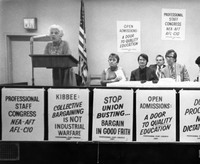 PSC Contract Rally The Professional Staff Congress (PSC) struggled to win its first contract from CUNY in 1972 and 1973. It called on support from others in the labor movement to help put pressure on the CUNY administration. At this meeting, President Belle Zeller of the PSC is speaking. In the first row behind her, at right, is Albert Shanker, United Federation of Teachers president, and to his right is Thomas Hobart, New York State United Teachers president. At the rear of the photo is Arnold Cantor, the Executive Director of the PSC.
 -
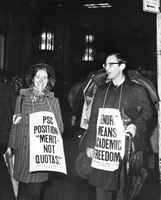 Tenure Quota Rally Carrying a sign that reads "Tenure Means Academic Freedom," Irwin Polishook, Vice President of the Professional Staff Congress (PSC), is joined by Carol Brandon, a union leader from the Borough of Manhattan Community College, at a rally against tenure quotas at CUNY. Rallies were one tactic in the PSCs’ opposition to the 50% tenure quota for academic departments in CUNY. Proposed by Chancellor Robert Kibbee in 1973, the policy was instituted by the Board of Higher Education (BHE) on October 29, 1973. The PSC also asked the faculty and staff to shun Chancellor Kibbee and reached out to the general public through ads and public relations pieces. The union placed newspaper advertisements warning prospective faculty about the tenure quotas, and reached out to politicians at the state and city levels. This campaign was a success, and on April 22, 1974 the BHE rescinded the tenure quotas.
 -
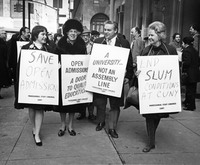 Picketing at Baruch College The Professional Staff Congress (PSC) picketed in favor of Open Admissions, among other things, in front of Baruch College in February 1973. Their efforts to save Open Admissions from budget cuts presaged the struggles that would come with fiscal crisis of the mid 1970s. While Open Admissions added many new students to CUNY after 1970, both New York State and New York City sought to cut funding for CUNY in the subsequent years. The PSC argued that this would degrade education for all students. Belle Zeller, PSC president, is second from the left, with Arnold Cantor, PSC’s Executive Director, to her right.
 -
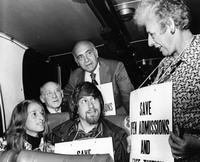 Bus Ride to Albany Rally Belle Zeller, Professional Staff Congress (PSC) president, can be seen at the right with Israel Kugler, the union's deputy president standing at the back. The photo was taken on a bus trip to Albany to rally in support of Open Admissions. The PSC opposed cuts to the program's funding and also favored CUNY's continuation of free tuition. While Open Admissions would survive the decade, free tuition would come to an end in 1976 during New York City's fiscal crisis. From its earliest years, the PSC was a strong force in Albany, thanks not only to the persistence of its lobbyists but also because of support received from the newly merged New York State United Teachers, a group representing educators throughout New York State.
 -
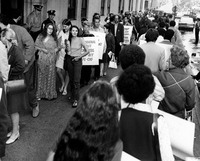 Rally Demanding Progress in Contract Negotiations This photograph captures a rally held by the Professional Staff Congress during their deadlock with CUNY administration over the terms of a new contract in 1973. As negotiations stalled, the PSC held a number of rallies demanding that CUNY administration bargain in good faith. This particular rally was held in front of the CUNY headquarters on East 80th Street in New York City. The woman holding the sign, in the center of the photograph, is Evelyn Lerner, a union leader from the New York City College of Technology. Directly in front of her is Lilia Melani, a leader at Brooklyn College, and in the late 1970s and early 1980s, the leader in the legal case that won pay equity, including retroactive payments, for the female faculty and staff at CUNY.
 -
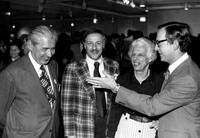 Lobby Efforts in Albany, NY Belle Zeller, Professional Staff Congress (PSC) president, was a frequent visitor to the New York legislators, first on behalf of the Legislative Conference, and then, after the merger, for the PSC. Here, in 1973, she is joined by State Senator John Markey, at the left, State Senator Kenneth LaValle to Markey’s left, and Irwin Polishook, the First Vice President of the PSC.
 -
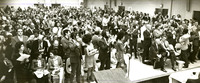 Audience at First PSC Contract Rally This October 1972 mass meeting at the Marc Ballroom at Union Square, New York came at a time when the Professional Staff Congress (PSC) was deadlocked with CUNY administration during negotiations for the union's first contract following its creation in April of that year. Don Davidson, a union leader from LaGuardia Community College, is the second figure in the first row, just left of the center aisle. The union held a number of rallies and took two strike authorization votes. Ultimately, an agreement was reached between CUNY and the PSC in July 1973.
 -
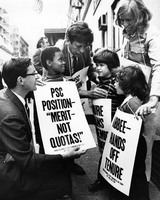 PSC Rally with Children This photograph was used by the Professional Staff Congress (PSC) as part of its campaign against a 50% tenure quota policy for academic departments that had been announced by Chancellor Robert Kibbee, and then approved by the Board of Higher Education (BHE) on October 29, 1973. The PSC strongly fought against the policy and this photograph was part of its outreach to the general public. First Vice President of the PSC, Irwin Polishook, is on the left. Jerry Meyer, a union leader from Hostos Community College is in the background. The campaign was a success, and, on April 22, 1974, the BHE rescinded the tenure quota policy.
 -
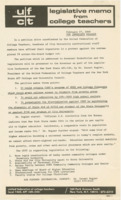 UFCT Legislative Memo: Petition Against State Budget Cuts This memo was issued to the members of the United Federation of College Teachers (UFCT) on behalf of union president Israel Kugler. It announces a petition drive against proposed budget cuts at CUNY. The document illustrates that even in times of relative calm, funding for CUNY was targeted by the New York State legislature and Governor Rockefeller. Among the petition demands was an equal funding formula to eliminate the disparity in financial support provided by the state to the State University of New York (SUNY) and the City University of New York. Although New York State did agree to full funding for CUNY's four-year colleges beginning in 1979, equal funding for SUNY and CUNY did not materialize.
 -
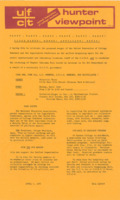 UFCT Hunter Viewpoint: "Close Ranks! Merge! Affiliate! Revel!" This flier was issued by the chair of the Hunter College Chapter of the United Federation of College Teachers, Bill Leicht. It calls on the members to vote in favor of the proposed merger with rival union, the Legislative Conference. the flier also celebrates the rehiring of Leicht after he won a grievance. Ultimately, substantial majorities of each union voted in favor of the merger. The new union, the Professional Staff Congress/CUNY (PSC), came into existence on April 14, 1972.
 -
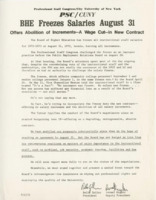 "BHE Freezes Salaries August 31" In this memorandum to CUNY faculty and staff, the Professional Staff Congress (PSC) attacks the tactics of the Board of Higher Education as the parties sought to negotiate the first contract following the merger of the Legislative Conference (LC) and the United Federation of College Teachers (UFCT) in April 1972. One major issue during negotiations was the annual increments in salary received by faculty and staff. CUNY had unsuccessfully sought to eliminate the incremental wage increases during the negotiations of the initial contracts with the LC and the UFCT in 1969. It revived the demand in the negotiations of 1972-1973, and as a tactic toward that objective froze all increments. The PSC protested that their action was in violation of the existing contracts. Ultimately a contract was agreed to in July 1973, and increments remained in force.
 -
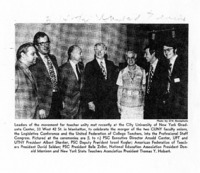 Labor Leaders at the Celebration of Merger This photograph was taken at the CUNY Graduate Center on 42nd St at a celebration of the merger of CUNY's two professional unions, the Legislative Conference and the United Federation of College Teachers, into the Professional Staff Congress (PSC). Pictured from left to right are: "PSC Executive Director Arnold Cantor; UFT and UTNY President Albert Shanker; PSC Deputy President Israel Kugler; AFT President David Selden; PSC President Belle Zeller, NEA President Donald Morrison; and New York State Teachers Association President Thomas Y. Hobart." The presence of Shanker, Hobart and the presidents of the national labor organizations illustrates the pressures that were placed upon CUNY's formerly competing labor unions to merge.
 -
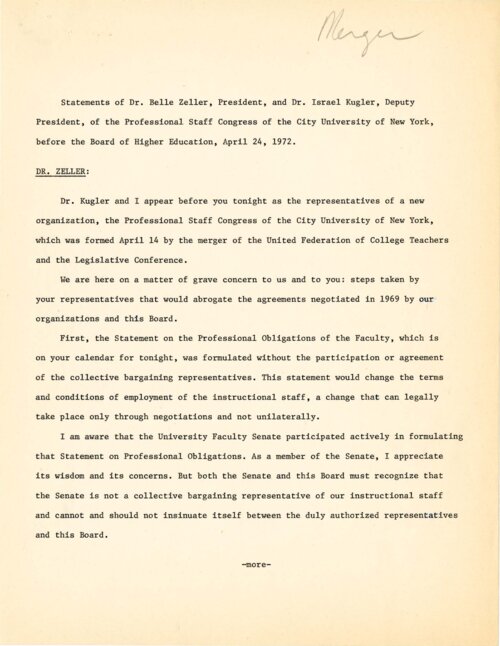 Statements of Belle Zeller and Israel Kugler before the Board of Higher Education These statements were prepared shortly after the Legislative Conference, led by Belle Zeller, and the United Federation of College Teachers, led by Israel Kugler, merged to form the Professional Staff Congress (PSC) in April 1972. This marked the first appearance by Zeller and Kugler in front of the Board of Higher Education as representatives of the PSC. Zeller focused on CUNY's recently developed "Statement on Professional Obligations for Faculty," as well as newly instituted student evaluations of faculty. Both, she charged, were developed without consultation of faculty and therefore violated existing contracts negotiated in 1969. Kugler, deputy president of the PSC, focused on CUNY’s refusal to bargain with the new union and their insistence on a division into three separate bargaining units for full-time, part-time, and non-classroom staff. CUNY's initial opposition to the PSC led to hostility between the two parties as well as strike votes by members of the union. Despite the insistence of CUNY administration, the PSC would come to serve as the single bargaining representative for all faculty and staff at CUNY and their first contract was negotiated in July 1973.
 -
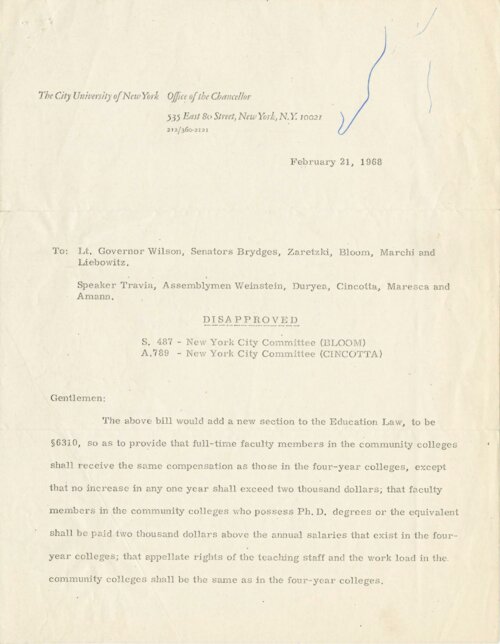 Chancellor Bowker to NYS Politicians Opposing Community College Faculty Advancement In this letter to New York State politicians, CUNY Chancellor Albert Bowker opposes a bill in the New York State Legislature that would have changed full time faculty salaries in the community colleges to be equal to that of faculty in the senior (four-year) colleges; provided a higher salary for full time community college faculty who had the doctorate or its equivalent as compared to those who did not; and equalized the workload between full time community college and senior college faculty. Bowker outlines his reasons for opposing all three provisions. The bill did not become law, but a single salary schedule became a basic element of the first collective bargaining contracts in 1969. The other two provisions of the bill did not materialize.
801–825 of 1046