Items
851–875 of 1046
Advanced search
-
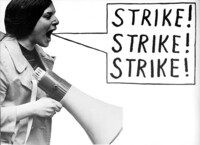 Strike! graphic from BMCC 1971 Yearbook Printed in the BMCC 1971 yearbook, Prism, this photograph was used in the "Strike!" section and was taken during the student takeover of the college in May 1970.
 -
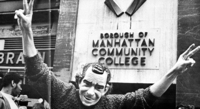 Student wearing Nixon Mask Printed in the BMCC 1971 yearbook, Prism, this photograph shows a BMCC student wearing a plastic President Nixon mask in front of BMCC's "B-bldg" at the height of the 1970's protests. Students demands included an end to student fees and a day care center for thier families as well as national issues related to the war in Vietnam.
 -
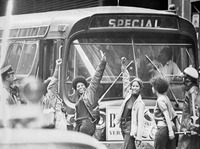 Arrest Bus - 1970 BMCC Student Strike This photograph features Maria Ramos, the Student Government President in front of the the arrest bus. The students were demanding an end to increases in tuition fees, and a day care center for children of students. Maria Ramos also confronted Dean Leon Cohen about the use of city police on campus shortly before her arrest.
 -
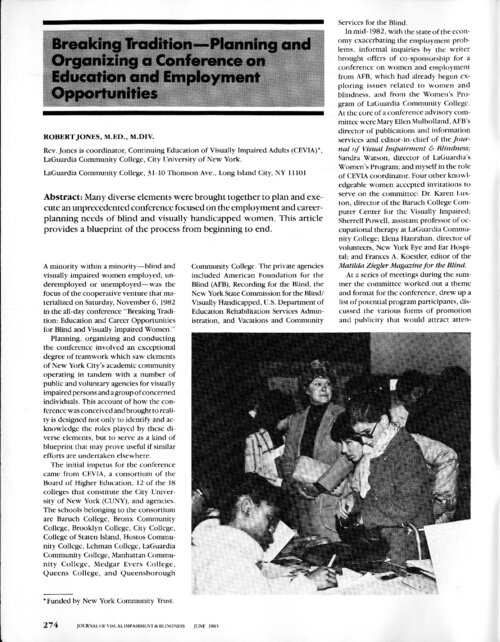 "Breaking Tradition — Planning and Organizing a Conference on Education and Employment Opportunities" In this article from the Journal of Visual Impairment & Blindness, Robert Jones, a professor at LaGuardia Community College, examines a number of the considerations that are involved in designing and holding a conference aimed at addressing the employment needs of women with visual impairments. In doing so, Jones presents a case study that describes the planning and realization of a November 6, 1982 conference that was put together with the cooperation of different organizations and CUNY colleges. Leading the efforts from within CUNY were LaGuardia's representatives on the planning committee. The college 's commitment to meeting the needs of underserved student populations quickly became a defining characteristic of LaGuardia's Continuing Education division in its early years.
 -
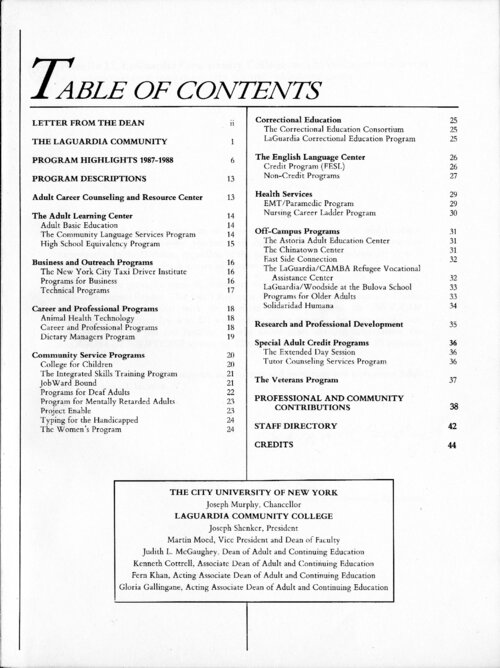 LaGuardia's Community Service Programs, 1987-88 This selection from the 1987-8 catalog of LaGuardia Community College's Continuing Education division highlights the college's commitment to serving the western Queens community. The diverse array of programs cater to local children, young adults, homeless, and those with disabilities, among others. Of particular note is the school's programming for Deaf adults and youth, an initiative that began in 1974.
 -
 "On the 20th Anniversary of the Program for Deaf Adults" This is the text of a presentation given by Fern Khan, former director of LaGuardia Community College's community service programs, on November 8, 1996. Delivered in commemoration of the twentieth anniversary of the college's Programs for Deaf Adults, Khan's speech recalls the formative years of the program, including initial hirings, outreach efforts, and funding initiatives. Remarking fondly on the collaboration between "college leadership, staff, the Deaf community, and supporters," Khan's presentation is equally a reflection of her own experiences with the program. Prior to leaving LaGuardia in 1989, Khan played a large role in shaping the college's community outreach efforts within its Continuing Education division. The college's commitment to educating the Deaf began in the early 1970s and was just one of several of the division's initiatives.
 -
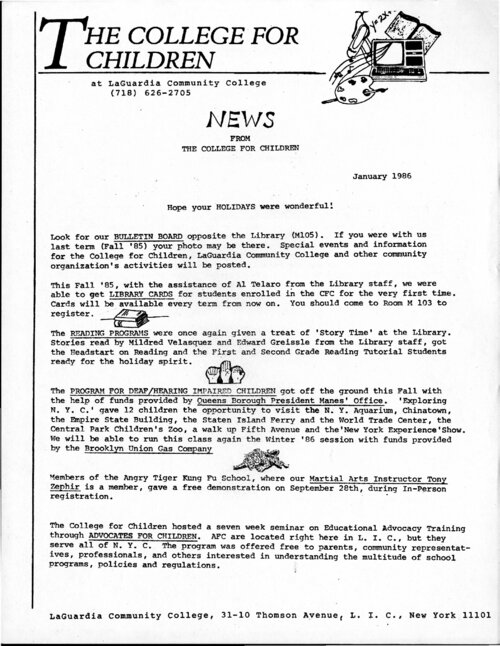 News from The College For Children, January 1986 This January 1986 newsletter from "The College for Children" at LaGuardia Community College provides a brief look into the college's unique program designed for the youth in western Queens. The newsletter includes mention of several course offerings within the program, enrollment figures, and brief summaries of recent events. The College for Children was created by LaGuardia CC in the early 1980s to serve children aged 4-14 in the surrounding community with emphasis given to underserved populations such as homeless, and Deaf youth. The program was contained within LaGuardia's Continuing Education division and represented just one of the many community-focused efforts at the school.
 -
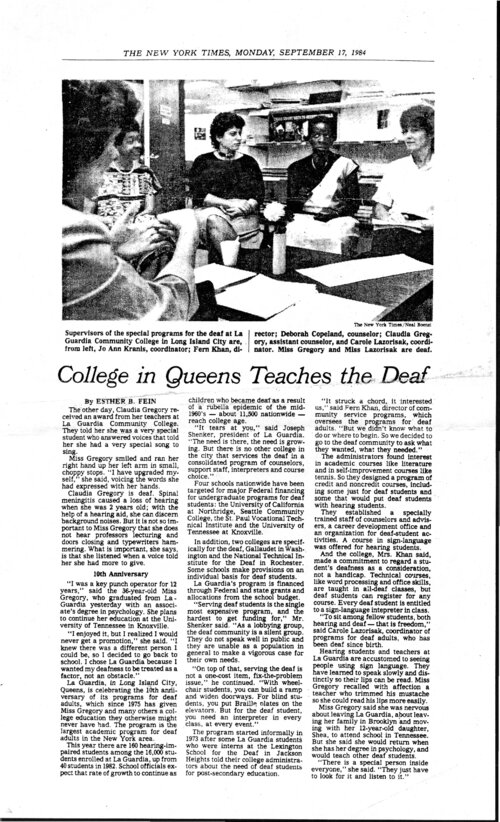 "College in Queens Teaches the Deaf" This New York Times article from September 1984 highlights the efforts of LaGuardia Community College to provide educational opportunities to Deaf students. Written on the 10th anniversary of the creation of the Programs for Deaf Adults department at LGCC, the article includes statements from LaGuardia students, faculty, and administration. LaGuardia's formal commitment to Deaf education began in 1974 and became a noteworthy component of the school's Continuing Education division.
 -
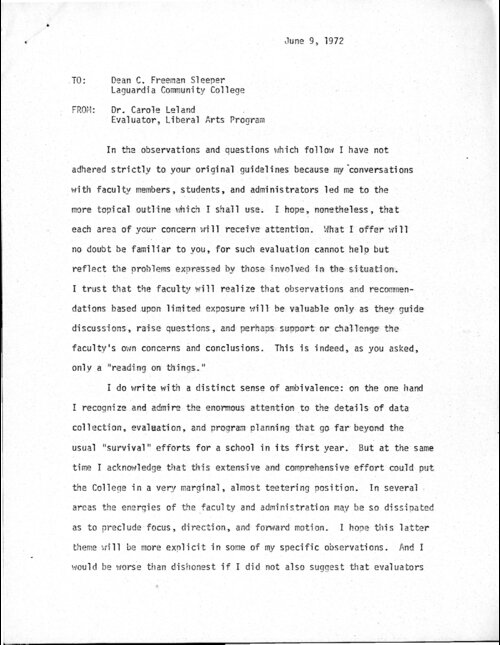 LaGuardia's Liberal Arts Program Evaluation, 1972 Written at the close of LaGuardia Community College's first academic year, this assessment of the college provides a sobering account of the difficulties present at the school in its infancy. The report, written by Dr. Carole Leland, examines various aspects of the college (e.g. atmosphere, curriculum, teaching methodology, evaluation) and bases its findings on observations and interviews conducted on campus.
 -
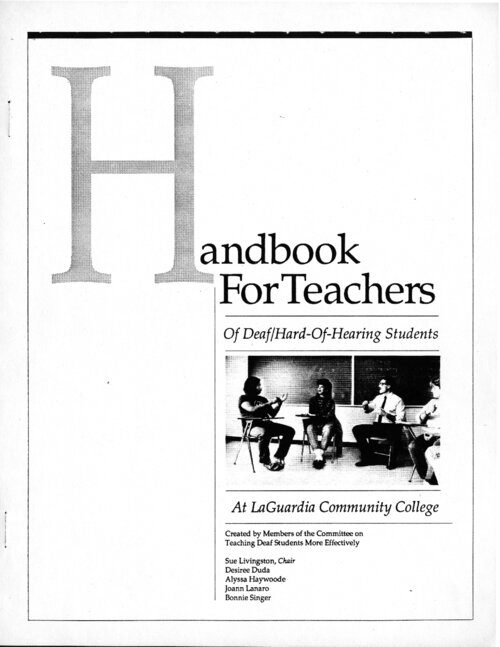 Handbook for Teachers of Deaf/Hard-Of-Hearing Students This is a handbook that was created for use by professors at LaGuardia Community College who had "a deaf or hard-of-hearing student in his/her class." The guidebook seeks to educate its readers on the realities of life with a hearing disability while shattering some existing myths. The authors include FAQs regarding "special considerations" for Deaf students including focus on the frequent need for in-class interpreters. The book also includes tips on classroom layout, communication techniques, and ways in which to engage Deaf students within existing teaching styles. LaGuardia Community College's commitment to education for the deaf can be traced to the early 1970s, and represented just one of the school's many efforts to provide opportunities for underserved populations within its Continuing Education division.
 -
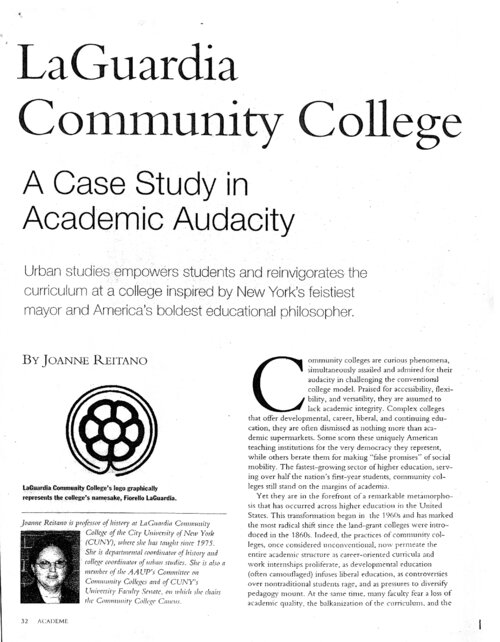 "A Case Study in Academic Audacity" Framing this 2002 case study of LaGuardia Community College around the larger conversation of community colleges nationwide, in this article, LaGuardia Professor Joanne Reitano explores the influence of Fiorello LaGuardia, former mayor of New York, and John Dewey, educational philosopher, on the creation of the college and the development of the mission and ethos of the school. The article also examines the college's unique urban studies requirement for its students. Reitano readily acknowledges the challenges faced by the school, though she offers a optimistic outlook for its future.
 -
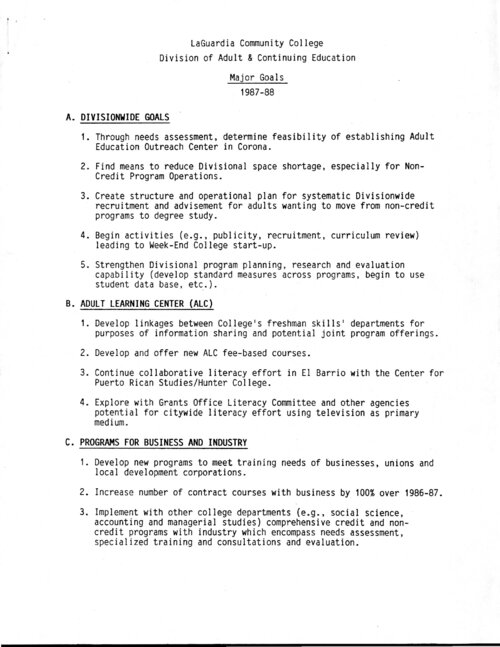 "Major Goals, 1987-88" This 1987-8 report lists the "major goals" of LaGuardia Community College's Division of Adult & Continuing Education. Outlining each of the components within the division, the report highlights the many initiatives of the college, particularly emphasizing the diverse students served via the school's continuing education programs. From its earliest years, LaGuardia committed itself to offering educational opportunities to underserved populations in western Queens.
 -
 "Open Admissions and LaGuardia Community College" This June 1972 report provides an outside assessment of LaGuardia Community College at the close of its first academic year. The document, which focuses on various aspects of Open Admissions at the college, examines both the observed successes and failings of campus programs, students, faculty, and administration. Created from observations and interviews with individuals on campus, the report is often critical of the fledgling college. Commissioned by the college's dean Freeman Sleeper, the report was created by Abraham Habenstreit, an assistant dean at Staten Island Community College.
 -
 "Post-Secondary Education and the Non-Traditional Deaf Student" This is the text of a May 1988 presentation prepared by Desiree Duda, academic coordinator of Programs for Deaf Adults at LaGuardia Community College, for the Conference on Post Secondary Education for Hearing Impaired Students. The presentation considers three types of "non-traditional" deaf students: ESL (English as a Second Language) students without educational experience in the U.S., those who entered the education system late, and those unprepared to work with others of "diverse backgrounds." Duda speaks of LaGuardia Community College's experience teaching each group, citing the college's different approaches and offering her own observations about effective teaching. The college's commitment to educating deaf students began in 1974 and became a noteworthy component of its Continuing Education division.
 -
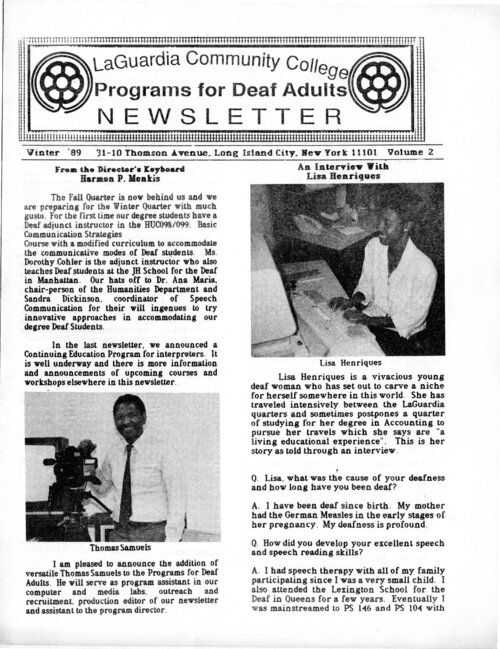 Program for Deaf Adults Newsletter, Winter 1989 This newsletter from Winter 1989 provides a glimpse into LaGuardia Community College's Programs for Deaf Adults department. The newsletter includes interviews with students and faculty, announcements of course offerings, and other news from within the department. The college's commitment to education for the deaf began in 1974 and became a noteworthy component of its Continuing Education division.
 -
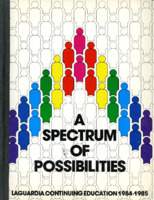 Community Service Programs, 1984-85 This selection from the 1984-5 catalog of LaGuardia Community College's Continuing Education division highlights several of the college's offerings for the western Queens community. Of particular note is the school's programming for Deaf adults and youth, an initiative that began in 1974. Other programs described cater to students with other forms of disabilities, underserved children, women returning to school, and military veterans.
 -
 Oral History Interview with Provost Basil Wilson for a History of John Jay College of Criminal Justice This 1999 videotaped interview with Basil Wilson, provost and senior vice president of academic affairs at John Jay College of Criminal Justice, was conducted by Professor Jerry Markowitz for Educating for Justice, a history of John Jay College. Appointed provost in June 1990 during an “extremely turbulent” period in the college’s history, Jamaican-born Basil Wilson reflects on the student activism of the time as well as the efforts he led to quell the “fury” on campus. Attributing the concerns largely to the unmet needs of a changing student population, Wilson discusses the importance of diversity both in student and faculty bodies, the effects of shifting admissions standards, and the importance of “consensus” between students, faculty, and administration. Wilson also considers the college’s growing national reputation, its “stepchild” status within CUNY, curriculum choices, and its creation in 1994 of an experimental program in Gurabo, Puerto Rico. Towards interview’s end, Wilson provides an assessment of the college and his aims for the institution’s development in the following decade. He ends with, "They [CUNY] really thnk you can build greatness on a pittance. You can't."
 -
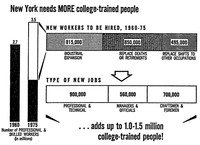 "New York needs MORE college-trained people" (from Heald Commission Report) This image from the Heald Commission Report shows the projected need for skilled and college -educated workers in its argument for additional colleges. Upon his election as governor in 1959, Nelson Rockefeller established a committee to examine the expected increase in demand for higher education in New York in the coming decades. The committee, chaired by Henry Heald, issued this report calling for an expansion of the SUNY system as well as public aid to private colleges, increased student scholarships, and an end to the tuition-free policy in New York City's municipal colleges.
 -
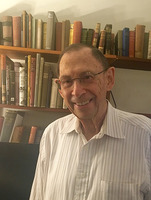 Oral History Interview with Irwin Yellowitz This oral history interview was conducted by Bill Friedheim on November 5, 2014 at the offices of the Professional Staff Congress (PSC). Irwin Yellowitz discusses his experience as a professor of history at City College of New York, events surrounding the merger of the Legislative Conference and the United Federation of College Teachers into what became the Professional Staff Congress in 1972, and his tenure as treasurer in the early years of the PSC.
 -
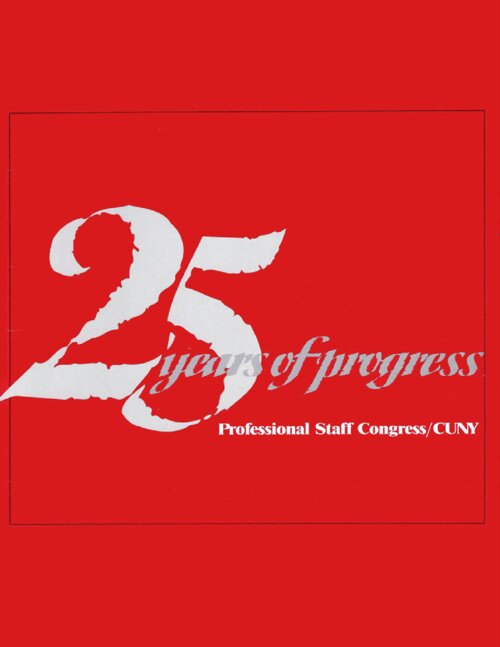 25 Years of Progress: Professional Staff Congress/CUNY In celebration of their 25th anniversary, the Professional Staff Congress/CUNY (PSC) published this collection of articles written by Irwin Yellowitz, "professor emeritus of history at City College and a former PSC treasurer." The articles and photographs trace faculty union efforts at CUNY. Beginning with the Legislative Conference and the United Federation of College Teachers, the book details their merging in 1972 to create the PSC, and follows the difficulties and successes of the group over the course of its first 25 years.
 -
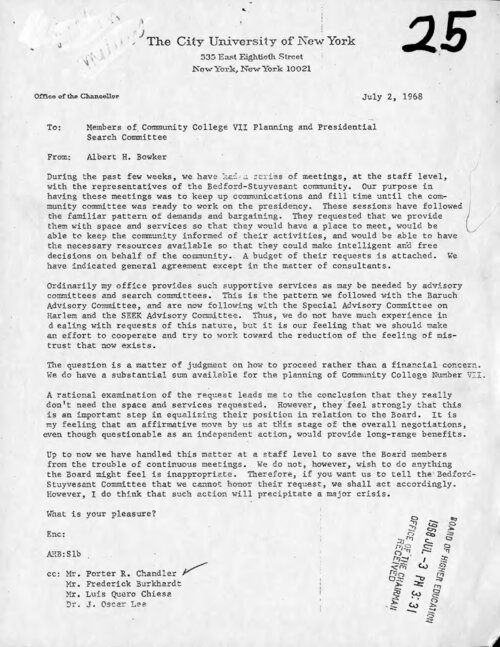 Letter from Chancellor Bowker to Members of Community College 7 Planning and Presidential Search Committee This letter from Chancellor Bowker to members of Community College 7 Planning and Presidential Search Committee came in response to a series of requests made by the Bedford-Stuyvesant Coalition in prior weeks. Those requests, expressed in a June 18, 1968 telegram from Al Vann, called for the furnishing of funds and space for use by the community's representatives on the Presidential Selection Committee. In this letter, Bowker suggests cooperating with the Coalition in fulfilling their demands in effort to reduce "the feeling of mistrust that now exists" between the community and CUNY. Bowker, however, is hesitant to proceed without the input of others and ultimately announces that he will defer to the consensus opinion of the Board of Higher Education. Funding for the neighborhood's representatives had been the source of much contention in the preceding weeks, and was an issue that would not be settled for another month. Over the course of Medgar Evers College's creation, CUNY officials and Bedford-Stuyvesant community members often clashed, and this particular dispute is just one example of the several that arose from the community's efforts to exert influence over their college's development.
 -
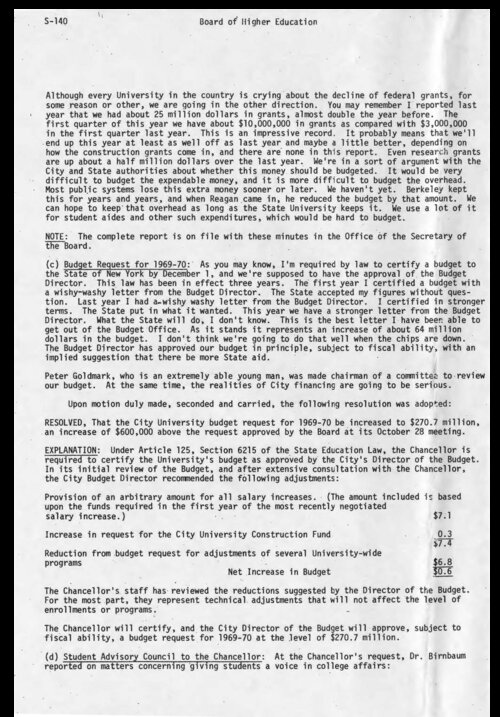 Minutes of the Board of Higher Education - November 25, 1968 These minutes of proceedings from the November 25, 1968 meeting of the Board of Higher Education record the establishment of new admissions criteria for CUNY four-year institutions as well as university-wide budget requests for the following year. The document details CUNY's resolve to expand the availability of their educational resources to graduating high school students in the city. To this end, the university agreed to initiate a study of five disadvantaged public high schools in effort to determine how CUNY could better serve their students. Moreover, all graduates from these schools with at least 70% averages would be admitted to a CUNY school. Additional decisions are made to guarantee admittance to all NYC students graduating in the top 100 of their high school classes. These efforts for increased educational access serve as precursors to CUNY's Open Admissions policy that would be introduced in subsequent years.
 -
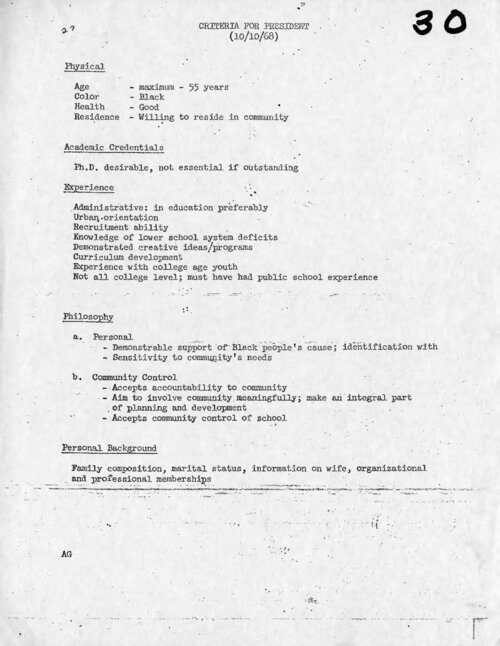 Community's Criteria for the President of Community College No. 7 Created by the Bedford-Stuyvesant community, this paper outlines their criteria for the president of Community College No. 7 (later named Medgar Evers College). Including experience, physical appearance, philosophy and personal background, among the factors to be considered are an individual who "accepts community control of the school." The Bedford-Stuyvesant community's participation in the presidential selection process was a hard-won victory for neighborhood leaders following months of struggle with CUNY administration over their role in the college's development.
 -
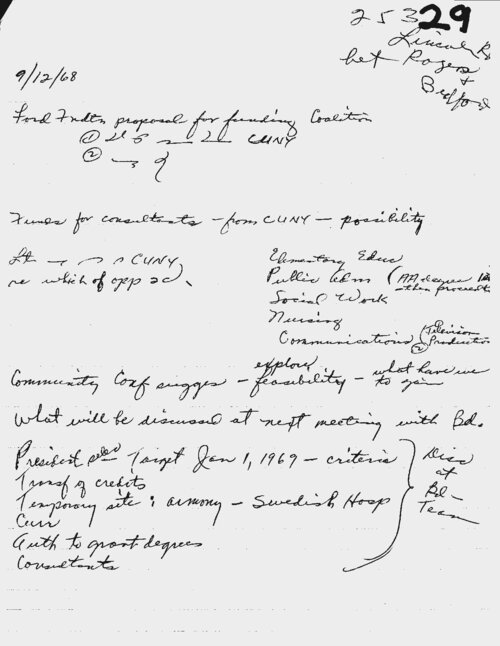 Handwritten Notes from a September 12, 1968 Meeting These handwritten notes are from a September 12, 1968 meeting of CUNY officials concerning the creation of Medgar Evers College. The notes suggest that the criteria for presidential candidates be established and that a selection be made by January 1, 1969. Also included is a number of potential academic departments for the new school, as well as a list of topics to cover in the next meeting with the Board of Higher Education.
 -
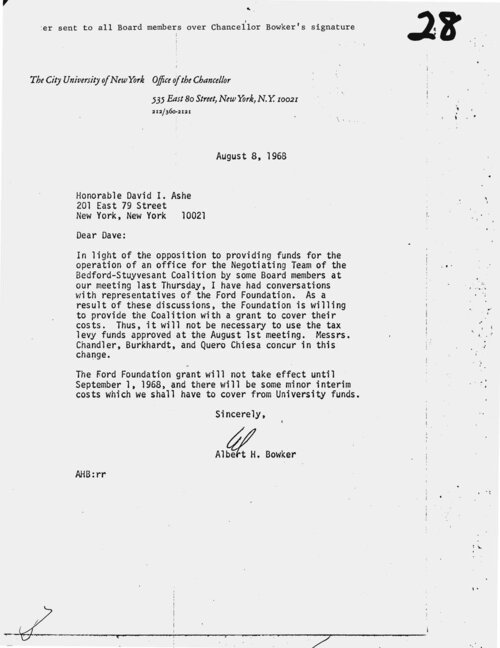 Letter from CUNY Chancellor Albert Bowker to all Board Members: Funding for the Coalition's Representatives In this letter sent to all Board of Higher Education members, CUNY Chancellor Albert Bowker announces that funds for the Bedford-Stuyvesant Coalition's representatives on the Presidential Search Committee had been obtained from the Ford Foundation. Funding for the neighborhood's representatives had been the source of much contention in the preceding months with community leader Al Vann threatening "action" in a June 18th telegram should the university not supply its promised funding and space. The community's presence on the committee was an achievement in itself and followed months of efforts from neighborhood organizations and individuals. Over the course of Medgar Evers College's creation, CUNY officials and Bedford-Stuyvesant community members often clashed, and this particular dispute is just one example of the several that arose from the community's efforts to exert influence over their college's development.
851–875 of 1046