Items
876–900 of 1046
Advanced search
-
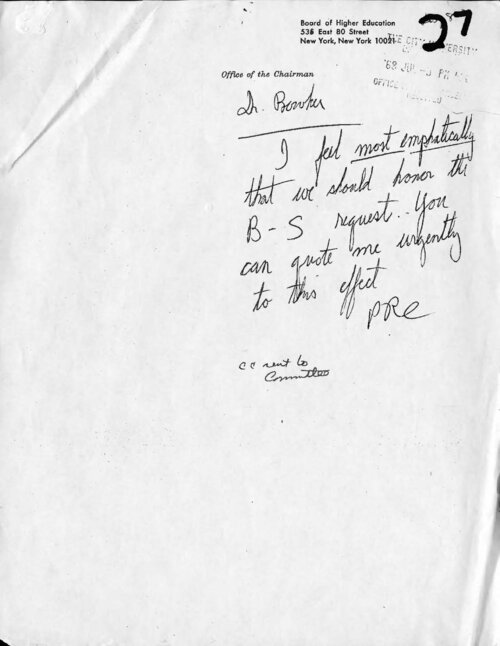 Handwritten Inter-office Memo from Porter R. Chandler to Chancellor Albert Bowker This handwritten memo from Porter R. Chandler, Chairman of the Board of Higher Education, "most emphatically" suggests that Albert Bowker, Chancellor of CUNY, accede to the requests of the Bedford-Stuyvesant Coalition leaders. Those requests, expressed in a June 18th telegram from Al Vann, called for the furnishing of funds and space for use by the community's representatives on the Presidential Selection Committee. Over the course of Medgar Evers College's creation, CUNY officials and Bedford-Stuyvesant community members repeatedly clashed, and this particular dispute is just one such example of the several that arose from the community's efforts to exert influence over their college's development.
 -
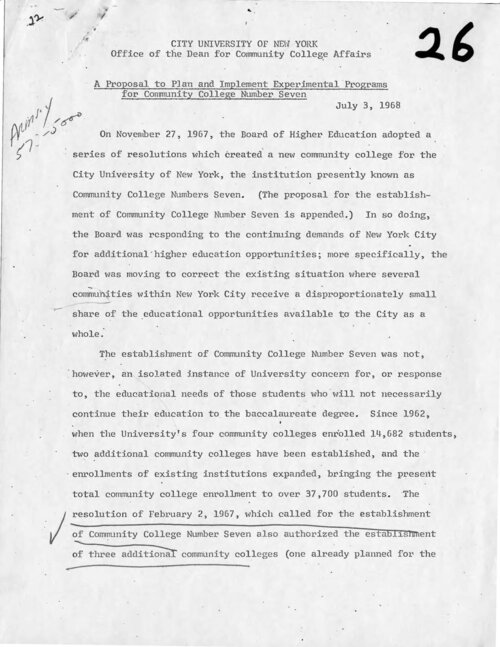 Proposal to Plan and Implement Departmental Programs for Community College No. 7 This document describes previous authorizations regarding the creation of Community College No. 7 (Medgar Evers College) and three additional community colleges. It goes on to detail one of the more unique features of the college: a community advisory committee located within the Bedford-Stuyvesant neighborhood. It also describes a proposed new admission policy that would introduce "wholly new admission standards [that] do not penalize students for poor choices or performance in high school."
 -
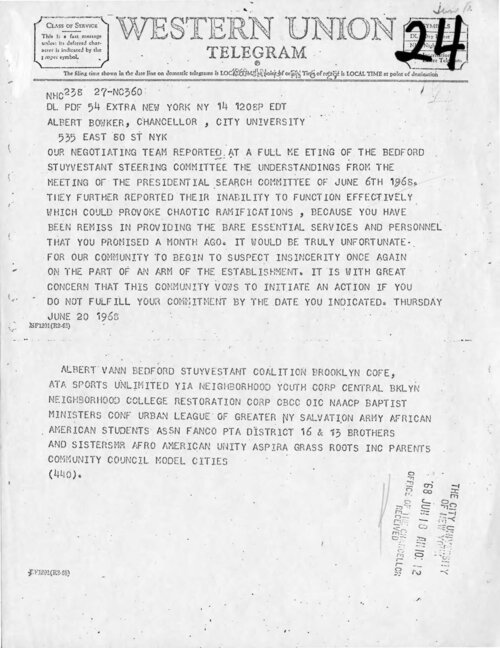 Telegram from Al Vann: Promising Action if Services and Personnel are Withdrawn This telegram was sent from Al Vann to CUNY Chancellor Albert Bowker. Vann, Chairman of the Steering Committee of the Bedford-Stuyvesant Coalition. Vann writes the message on behalf of the Coalition's member organizations in an effort to challenge the university to deliver on its promise of space and financial support for the community's representatives on the Presidential Search Committee. Failing this, Vann warns of organized community "action." The community's presence on the committee was an achievement in itself and followed months of efforts from neighborhood organizations and individuals. Over the course of Medgar Evers College's creation, CUNY officials and Bedford-Stuyvesant community members often clashed, and this particular dispute is just one example of the several that arose from the community's efforts to exert influence over their college's development.
 -
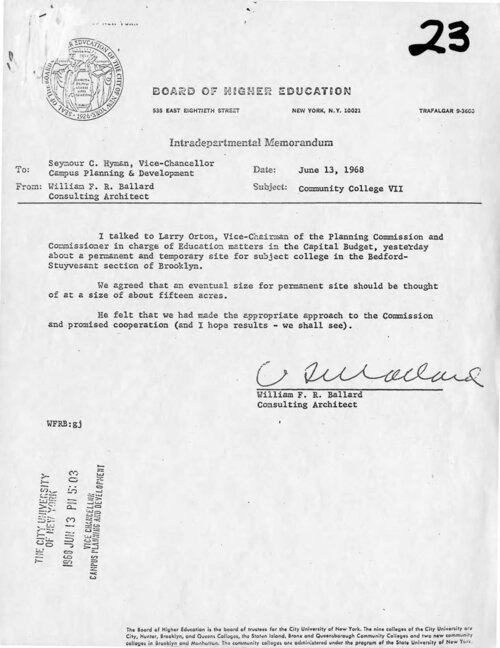 Memo from William Ballard: Space This is an interdepartmental memo from William Ballard, Consulting Architect, to Seymour Hyman, Vice Chancellor for Campus Planning & Development, concerning the size and location of a site for the new college (Medgar Evers College) in Bedford-Stuyvesant, Brooklyn.
 -
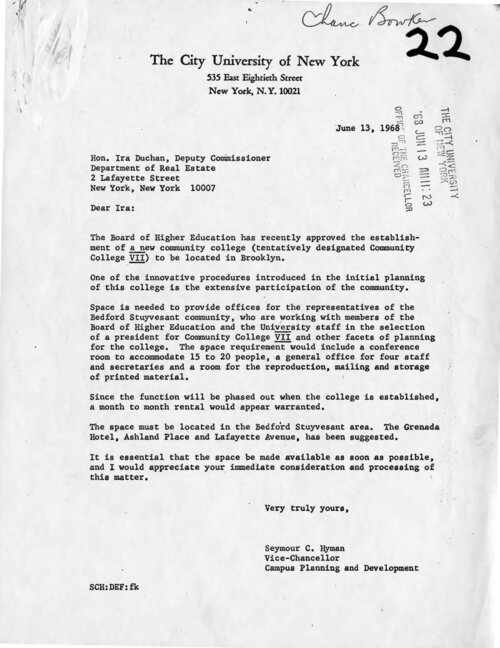 Letter from Seymour Hyman: Campus Planning Letter from Seymour Hyman, Vice Chancellor of Campus Planning & Development, to Ira Duncan, Deputy Commissioner of the Department of Real Estate, requesting temporary space in the Bedford Stuyvesant Community for the members to confer and develop plans for the new college (Medgar Evers College) and to meet with the community-at-large.
 -
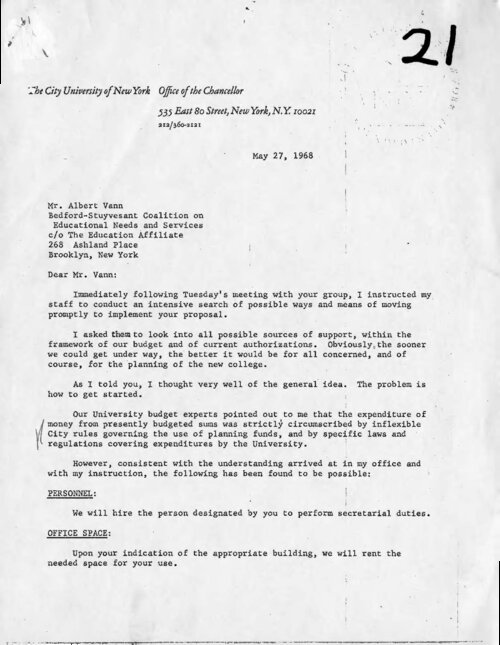 Letter from Chancellor Albert Bowker to Al Vann: Space and Personnel Letter from Chancellor Albert Bowker to Al Vann, Chairman of Bedford-Stuyvesant Steering Committee, outlining the ways in which the University can meet the request of the Bedford-Stuyvesant Coalition for space and personnel.
 -
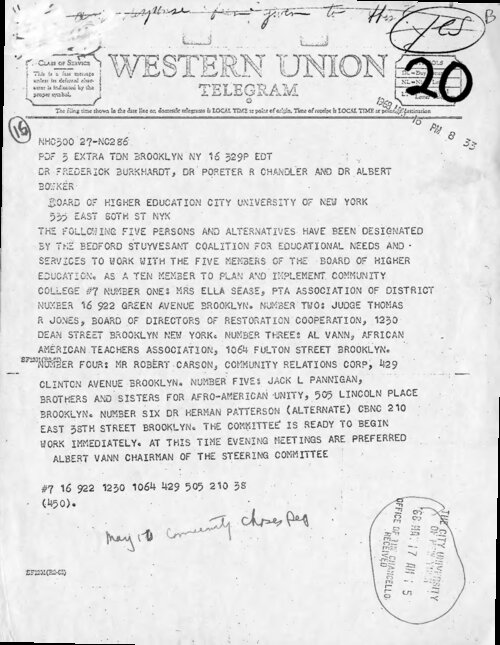 Telegram from Al Vann to CUNY Officials In this telegram from Al Vann, chairman of the Steering Committee of the Bedford-Stuyvesant Coalition, to Porter R. Chandler, Frederick Burkhardt, and Chancellor Albert Bowker, Vann lists the community's five selected representatives that will sit alongside five members from the Board of Higher Education on a presidential search committee. The responsibility of the committee had recently expanded to include not just the selection of a college president, but all matters related to the development and opening of the school. The community's placement on the committee was a hard-won victory for Bedford-Stuyvesant leaders following a protracted struggle with CUNY officials over the role of the neighborhood in the college's creation.
 -
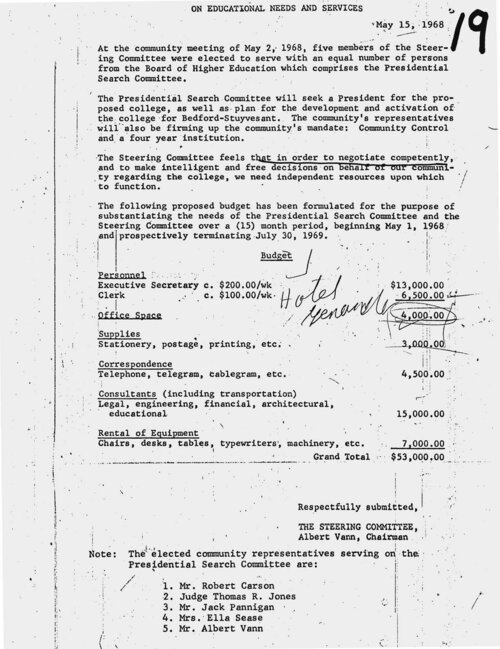 Memo from Al Vann: On Educational Needs and Services –The Bedford-Stuyvesant Coalition This unaddressed memo is from Al Vann, Chairman of Steering Committee, and appears to be directed towards Frederick Burkhardt, Chairman of the Committee to Seek a President for Community College Seven (Medgar Evers College). Vann requests funds to support the work of the Steering Committee and its work on the Presidential Search Committee. The group of five community-appointed representatives plan to set up space in Bedford-Stuyvesant to carry out their work that includes "firming up the community's mandate: Community Control and a four year institution." It was only because of the community's insistence that the college would open as a four-year institution instead of a two-year school as initially proposed.
 -
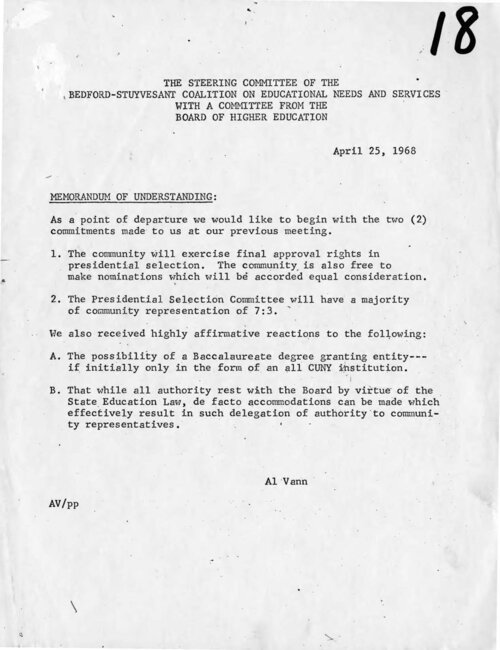 Memorandum of Understanding from Al Vann In this memorandum of understanding between the Bedford-Stuyvesant Coalition and a committee from the Board of Higher Education (likely the Presidential Search Committee), Al Vann, the chairman of the Coalition's steering committee, acknowledges two major promises made to his group. These include: "the community's final approval rights" in selecting a college president, and the community's majority representation on the Presidential Search Committee. The memo also includes other requests from Vann's organization.
 -
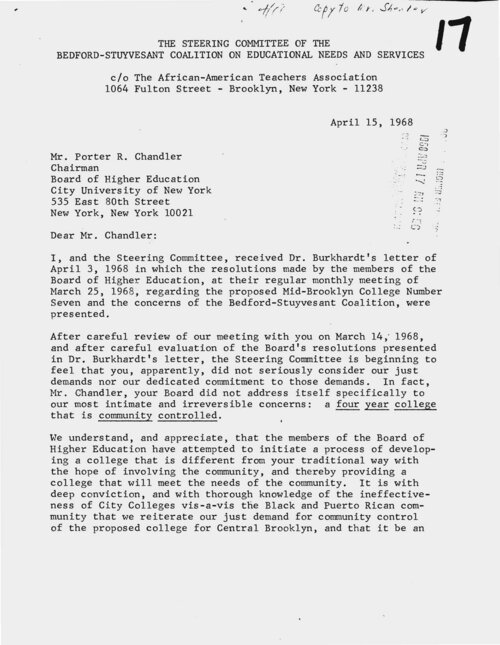 Letter from Al Vann to Mr. Chandler: New College Must be Four Year College In this letter from Al Vann, Chairman of the Steering Committee of the Bedford-Stuyvesant Coalition, Vann forcefully reasserts his organization's demand that the new college be both a 4-year institution and community controlled. Addressed to Porter R. Chandler, Chairman of the Board of Higher Education, Vann accuses the Board of not taking seriously his community's demands. The letter was sent just 11 days after the assassination of Martin Luther King, Jr., a fact referred to by Vann towards the letter's end.
 -
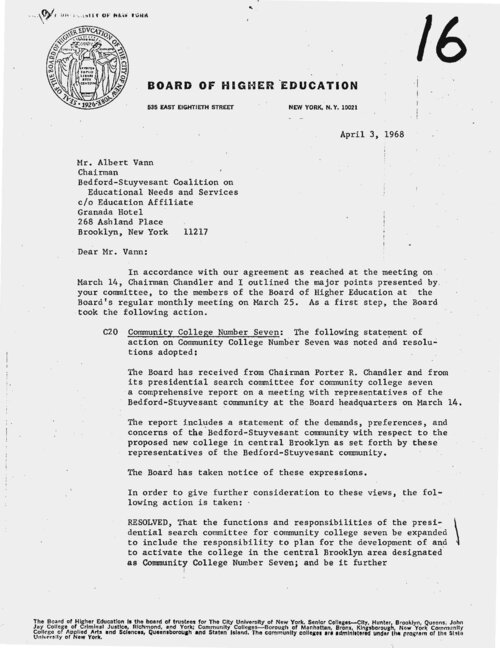 Letter from Frederick H. Burkhardt to Al Vann This is a letter from Frederick H. Burkhardt, chairman of the Committee to Seek Presidents for Community Colleges Seven and Eight, to Al Vann, chairman of the Steering Committee of the Bedford-Stuyvesant Coalition. In it, Burkhardt informs Vann that the functions of his search committee will be expanded to include decisions relating to the planning and activation of the college. As its name suggests, the "Committee to Seek Presidents..." was initially tasked only with the responsibility of selecting a president for the college. With its increased responsibility, the committee was expanded to include five members from the Bedford-Stuyvesant community in addition to the five existing representatives from the Board of Higher Education. The community's placement on the committee was a hard-won success for Bedford-Stuyvesant leaders in what was a protracted struggle with CUNY administration over the role of the community in the college's creation.
 -
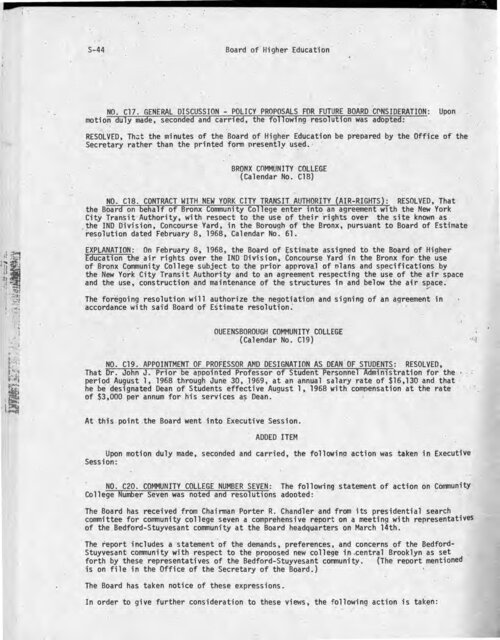 Minutes of Proceedings, Board of Higher Education Meeting - March 25, 1968 As seen in these minutes of the March 25, 1968 meeting, the Board of Higher Education to expanded the responsibility of their presidential search committee for Community College No. Seven to include all matters related to the development and activation of the college. To further help these efforts, the Board declares that five members of the Bedford-Stuyvesant community will serve alongside five members of the Board during the planning and decision making process.
 -
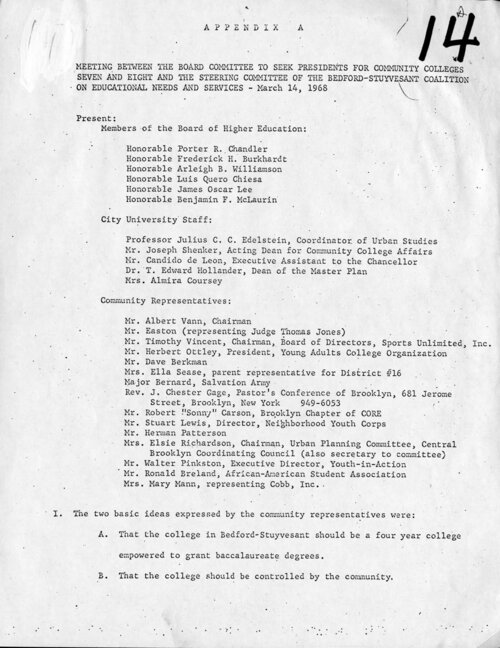 Appendix A: Meeting between The Board Committee to Seek Presidents and the Bedford-Stuyvesant Coalition Appendix A consists of a list of all those present at a March 14, 1968 meeting between the Board Committee to Seek Presidents for Community Colleges Seven and Eight and the Bedford-Stuyvesant Coalition Steering Committee. It also outlines the "two basic ideas" brought forward by community representatives. These are: the belief that the proposed school should be a four year college and that it should be controlled by the community. A definition of what is meant by "community control" is provided.
 -
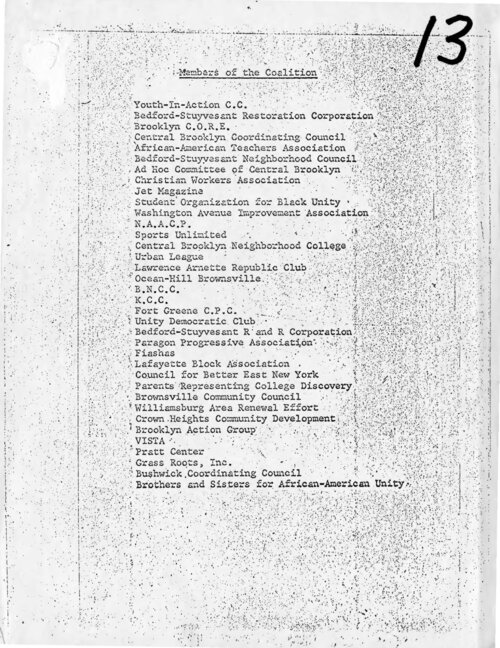 List of Members of the Bedford-Stuyvesant Coalition A list of organizations that comprised the "Bedford Stuyvesant Coalition on Education Needs and Services."
 -
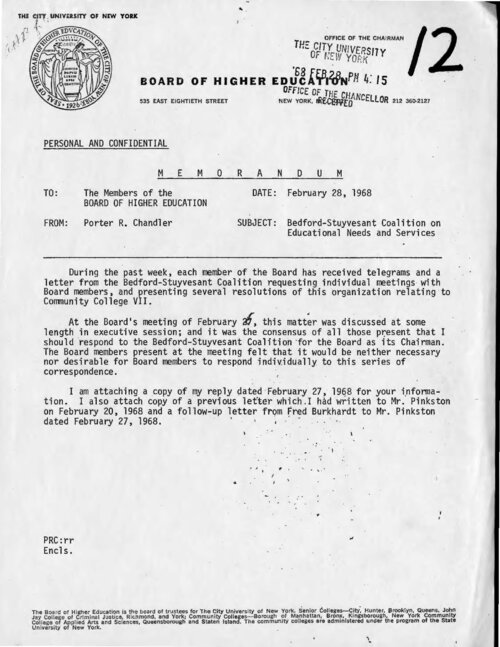 Memo from Porter R. Chandler: Refrain from Individual Meetings with the Bedford Stuyvesant Coalition This message from Porter R. Chandler to members of the Board of Higher Education states that although each member of the Board has received requests from the Bedford-Stuyvesant Coalition for individual meetings, the members should disregard the invitations in favor of a unified response from Chandler, the Board chairman.
 -
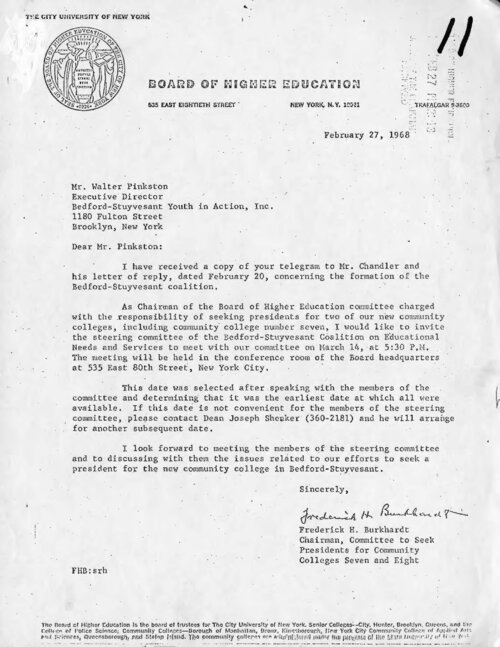 Letter from Frederick Burkhardt: Seeking President for Community College Seven and Eight In this letter from Frederick Burkhardt, Chairman of the Committee to Seek Presidents for Community Colleges Seven and Eight, to Walter Pinkston, executive chairman of Bedford-Stuyvesant Youth in Action, Burkhardt suggests a meeting on March 14th between his group and the steering committee of the Bedford Stuyvesant Coalition, which Pinkston represents. The community leader had previously demanded a formal meeting with the university. Though not evident in this letter, tensions between CUNY officials and the Bedford-Stuyvesant community would remain high throughout the development of Medgar Evers College.
 -
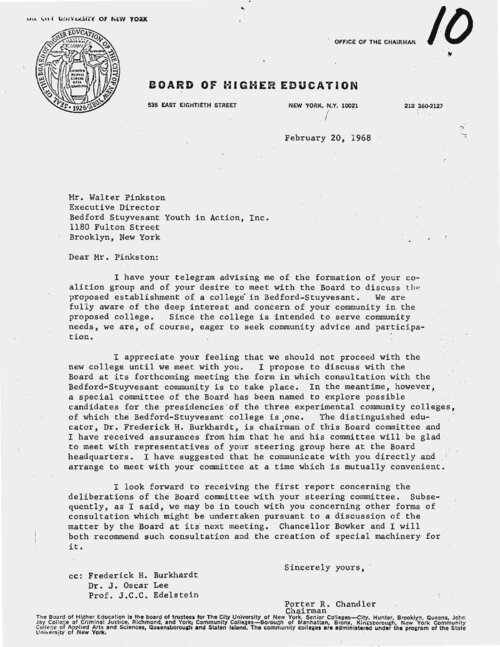 Letter from Porter R. Chandler to Walter Pinkston In this letter from Porter R. Chandler, Chairman of the Board of Higher Education, to Walter Pinkston, Executive Director of Bedford Stuyvesant Youth in Action, Chandler informs the community leader that he will confer with the Board on the ways in which consultation with the Bedford-Stuyvesant community is to take place. The letter follows a telegram from Pinkston demanding a halt to all planning until a meeting could be arranged with the newly formed Bedford-Stuyvesant Coalition. The Coalition was tasked with representing community interests during the formation of Medgar Evers College, a role that would sometimes lead to contention with CUNY officials.
 -
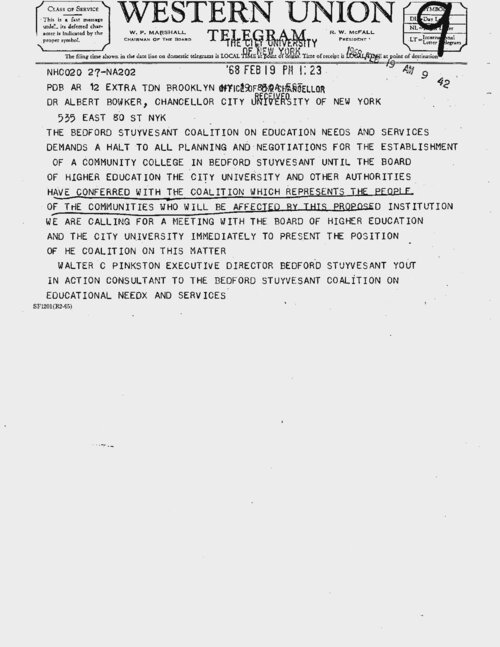 Telegram from Walter Pinkston to CUNY Chancellor Bowker Writing on behalf of the Bedford Stuyvesant Coalition on Education Needs and Services, Walter Pinkston demands that Chancellor Albert Bowker halt all planning of the new college until the Board of Higher Education and CUNY have conferred with the Coalition, which Pinkston writes, now represents the community "affected by [the] proposed institution." The Coalition, which comprised a collective of neighborhood organizations, would serve as the community's voice throughout the sometimes contentious negotiations with CUNY during the development of Medgar Evers College.
 -
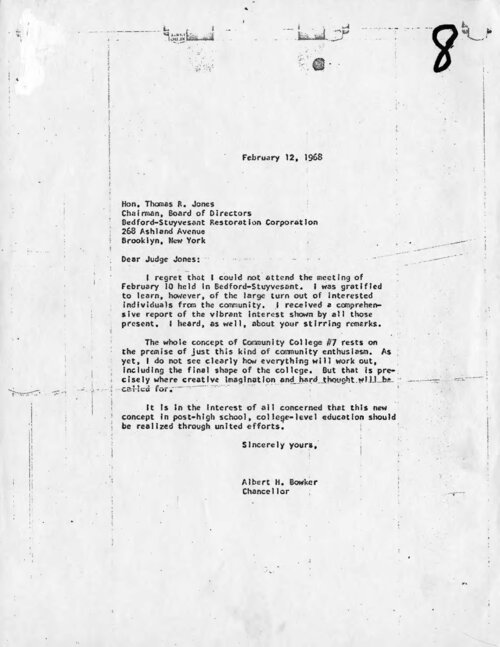 Letter from CUNY Chancellor Albert Bowker to Hon. Thomas R. Jones This is the third letter sent on February 12, 1968 from Chancellor Albert Bowker in regards to his absence at the February 10 meeting of community leaders and members at Decatur JHS. Addressed to Hon. Thomas R. Jones, chairman of the Bedford-Stuyvesant Restoration Committee, this letter informs Jones that he has received a comprehensive report from his staff and further reiterates Bowker's commitment to "unified efforts" for Community College No. 7's creation. Bowker had been previously invited to the meeting by community leader, Walter Pinkston, who had called for greater community involvement in the formation of Medgar Evers College.
 -
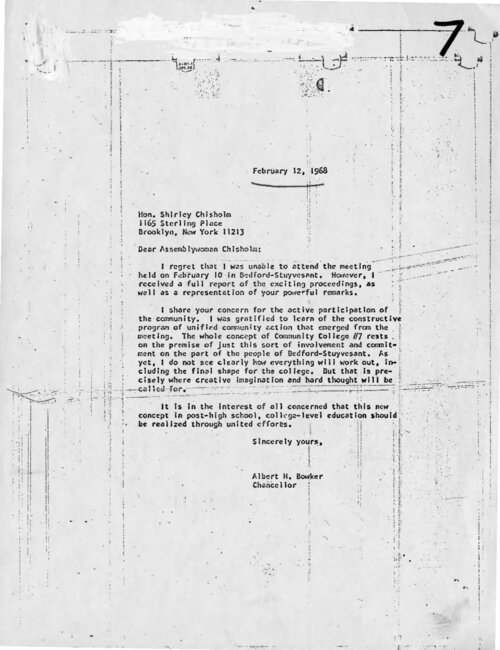 Letter from CUNY Chancellor Albert Bowker to Hon. Shirley Chisholm This is the second letter sent on February 12, 1968 from CUNY Chancellor Albert Bowker. This letter, addressed to Assemblywoman Shirley Chisholm, informs her that though he regrets not having attended the February 10th meeting at Decatur JHS, he has received a comprehensive report from his staff and is committed to community involvement in the creation of the new college. Bowker had been earlier invited to the meeting at the urgent request of Walter Pinkston, a community leader, who felt it necessary for the community to voice their concerns and desires for the proposed college.
 -
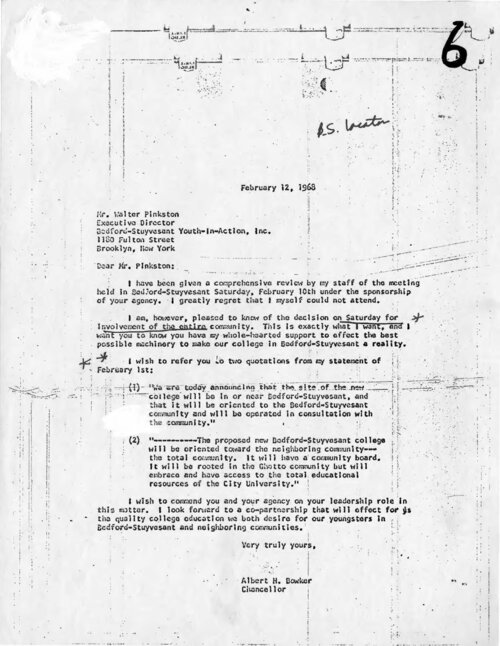 Letter from CUNY Chancellor Albert Bowker: Stating Commitment to Community Involvement This is the first of three letters sent on February 12, 1968 from Chancellor Albert Bowker in regards to his absence from a community meeting in Bedford Stuyvesant on February 10. In this letter to Walter Pinkston, executive director of Bedford Stuyvesant Youth in Action, the chancellor informs the chairman of Bedford-Stuyvesant Youth in Action that he has received a comprehensive report of the meeting from his staff and that he is committed to "the involvement of the entire community" in the creation of CUNY's new college. Bowker's presence at the meeting had earlier been urgently requested by Pinkston who felt that the community for whom the college was intended was being purposefully excluded from the planning process. Despite Bowker's assurances, tensions between CUNY officials and the Bedford-Stuyvesant community would remain constant throughout Medgar Evers College's development.
 -
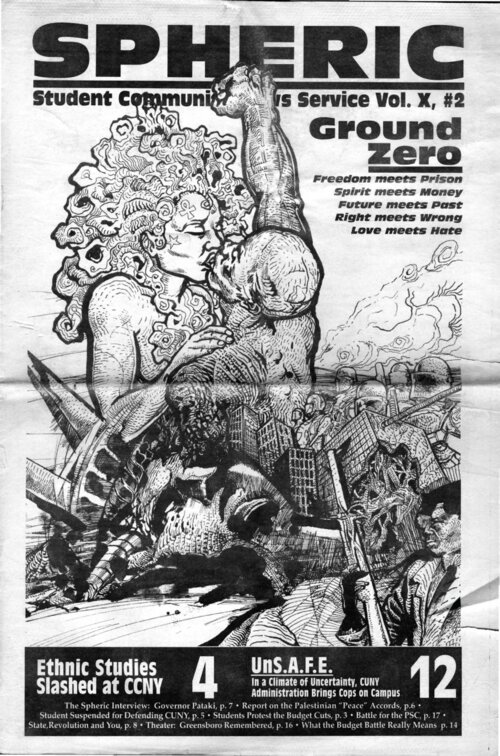 Spheric: Ground Zero This issue of Spheric, a Hunter College newspaper produced by activists from the CUNY Coalition, covers efforts organized by the Students Liberation Action Movement (SLAM!) to protest New York Governor George Pataki's plan to decrease state funding to CUNY. Additional articles cover such topics as: a CCNY student's lengthy suspension, the increased security presence on campuses, and a student's history of CUNY.
 -
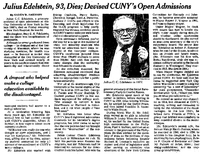 "Julius Edelstein, 93, Dies; Devised CUNY's Open Admissions" This New York Times obituary describes the career of former Vice-Chancellor Julius C. C. Edelstein, one of the primary architects of the open admissions policy at CUNY.
876–900 of 1046