Items
901–925 of 1046
Advanced search
-
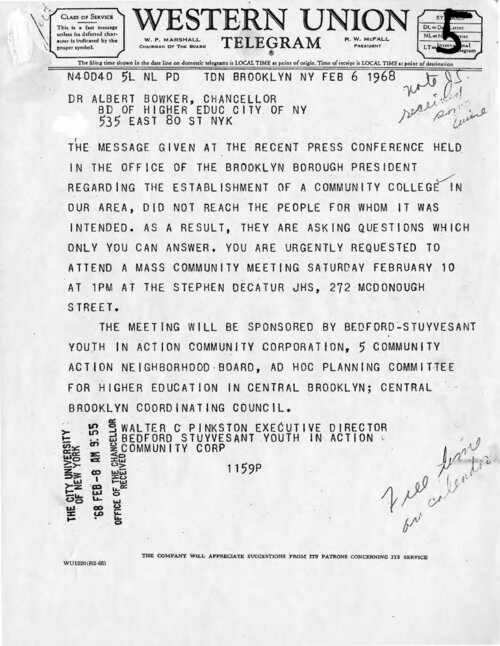 Telegram from Walter Pinkston to Chancellor Bowker: Lack of Community Involvement In this telegram sent to Chancellor Albert Bowker on February 6, 1968, Walter Pinkston, executive director of Bedford Stuyvesant Youth in Action, decries the recent announcement of Community College No. 7 because the message was delivered without any consideration given to the community. Pinkston "urgently request[s]" that the chancellor attend a meeting that Saturday, February 10, at Decatur JHS to meet with and hear the concerns of a variety of community groups in the neighborhood. Though the chancellor would not attend the meeting, Bowker would shortly reaffirm his commitment to community involvement. Throughout the development of Medgar Evers College, the Bedford-Stuyvesant community would maintain an active, if sometimes contentious, role in the creation of the institution.
 -
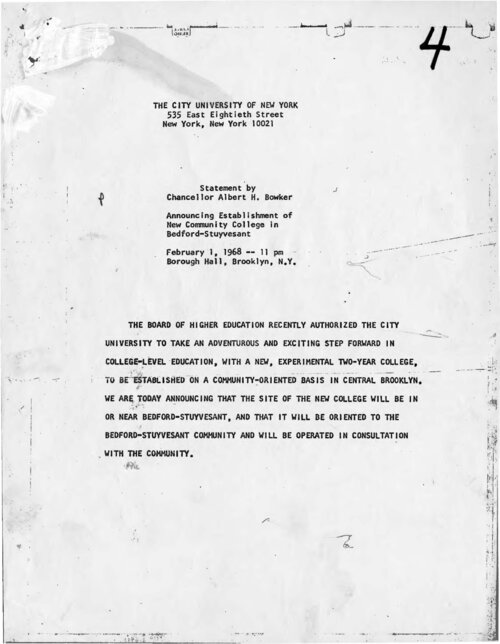 Statement by Chancellor Albert H. Bowker Announcing the Establishment of a New Community College In this statement by CUNY Chancellor Albert H. Bowker on February 1, 1968 in Brooklyn Borough Hall, Bowker announces the establishment of a new, experimental community college in Bedford Stuyvesant, Brooklyn. His announcement presents CUNY's hopes for the new institution as well as the large role that the community is expected to play in the college's creation and success. Bedford-Stuyvesant community leader, Walter Pinkston, would quickly take exception to the chancellor's announcement however, declaring that the decision to place a "community-oriented" college in the neighborhood was made without any consultation with the community itself. The community's push for participatory role in the new college's creation would persist through the planning and development of Community College No. 7 (later named Medgar Evers College).
 -
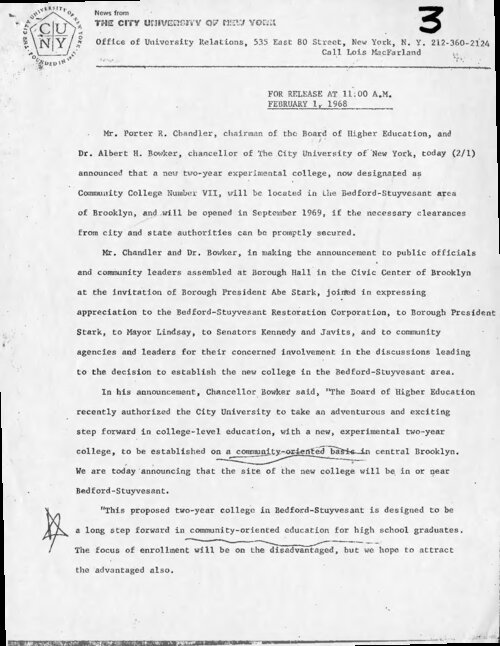 Press Release – A New Experimental College In this press release, The City University of New York's Office of University Relations announces the creation of a new, experimental, two-year college to be "established on a community-oriented basis in central Brooklyn." The press release coincided with a formal announcement made by CUNY officials at the office of the Brooklyn Borough President on February 1, 1968. The news of CUNY's plan would quickly reach the ears of Bedford-Stuyvesant community leaders, such as Walter Pinkston and Al Vann, who felt the university had not had any early consultation with the very community it had planned to center the new college around. The desire for a participatory role in the college's creation would persist throughout the college's formative years and, ultimately, it would define the development of Community College No. 7 (later named Medgar Evers College).
 -
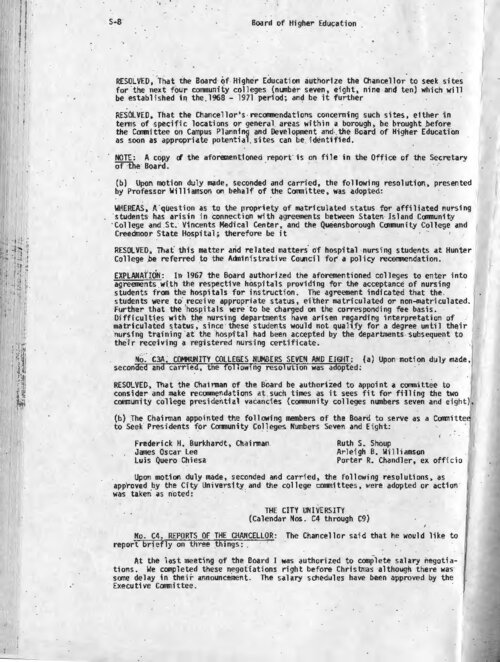 Minutes of Proceedings: Establishing Community College Number Seven In these minutes of proceedings from a January 22, 1968 meeting of the Board of Higher Education, the Board resolves to create the "Committee to Seek Presidents for Community Colleges Seven and Eight." The committee is first tasked with filling the presidential vacancy at Community College Number Seven, though its function would later be expanded during the college's development process. The meeting also calls for an amendment to the "1964 Master Plan for the City University of New York" to include the goals for the proposed college. These objectives include the new college's proposed common first semester, community-orientation, and admission procedures. Also mentioned are estimated operating budgets and facility requirements.
 -
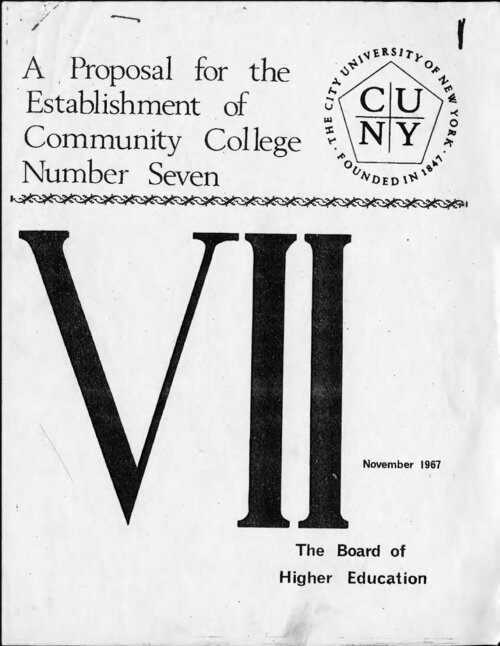 A Proposal for the Establishment of Community College Number Seven This proposal for the founding of Community College Number Seven (later named Medgar Evers College) was put forward by the Board of Higher Education in November 1967. In this excerpt (pages 11-15), the Board establishes their desire to place a new two-year college in or near a low-income community, a first for CUNY, where it will give greater emphasis to "the problems of disadvantaged youth." Consequently, it is stated, the proposed institution will be tasked to experiment with new programs designed to meet the unique needs of the community that it serves. The proposal also discusses the implementation of a common first semester, plans for location and facilities, aims for community involvement, and admissions goals.
 -
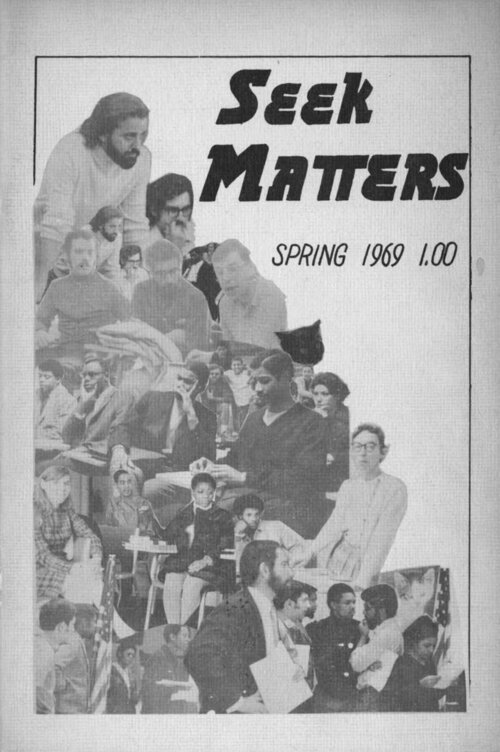 SEEK Matters, Spring 1969 SEEK Matters, a bilingual literary magazine produced by the SEEK University Center in 1969 published student essays, poems and illustrations that reflected their experiences. Short for "Search for Education, Elevation, and Knowledge," SEEK was established in 1966 as a CUNY-wide program to assist disadvantaged students who might otherwise lack the opportunity to study at a four-year college.
 -
 The Mayor's Advisory Task Force Report: The City University of New York: An Institution Adrift The Mayor's Advisory Task Force on the City University of New York issued its report, The City University of New York: An Institution Adrift, to Mayor Rudolph W. Giuliani on June 7, 1999. Over the course of their investigation, they reported that they examined CUNY's budgeting, funding and financial management. They reviewed the university's governance processes as well as its Open Admissions policies and remedial education programs. They examined the relationship between the public schools and the need for remedial education at CUNY. Lastly, they reported on ways in which third parties could provide remedial education to CUNY students.
 -
 Oral History Interview with Bill Friedheim and Jim Perlstein of Borough of Manhattan Community College This oral history interview with retired Borough of Manhattan Community College professors Bill Friedheim and Jim Perlstein was conducted at the CUNY Graduate Center on June 1, 2015. Friedheim and Perlstein were intimately involved in many of the radical struggles that occurred at BMCC and across the university during the 1960s and 70s. Topics covered in this interview include the origins of BMCC, its student body and facilities, connections with broader social movements, student organizations, faculty unionization, the 1971 student strike, and many others.
 -
 "...The importance of going on and getting education for police" - An Oral History Interview with Mayor John Lindsay Mayor Lindsay is interviewed in his Manhattan office on October 26, 1988 by Professor Jerry Markowitz for Educating for Justice, a history of John Jay College. Lindsay discusses the importance of accessible higher education, and educating police officers. He also maintains that higher education is a fundamental right and that it is an effective way to address strained relations between the police and local communities. He also thoughtfully considers the contentious issues surrounding Open Admissions and race relations in the city.
 -
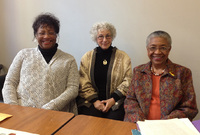 Oral History Interview with Joan Greenbaum, Fern Khan, and Sandy Watson of LaGuardia Community College Oral history interview with Sandy Watson, Joan Greenbaum, and Fern Khan of LaGuardia Community College. The interview was conducted on January 22, 2015 at the CUNY Graduate Center by Steve Brier and Andrea Ades Vásquez. The subjects discuss the founding of the college, its mission, and the array of innovative programs developed by a young faculty. Under a progressive administration, they were given free rein to build a college that would listen to, and serve, its surrounding community. Their adult and continuing education programs served a broad range of needs and many non-traditional learners.
 -
 Oral History Interview with Members of The Newt Davidson Collective Audio and transcription of oral history interview with Nanette Funk, Jerry Markowitz, Bill Tabb, and Mike Wallace, four of the original members of The Newt Davidson Collective.
 -
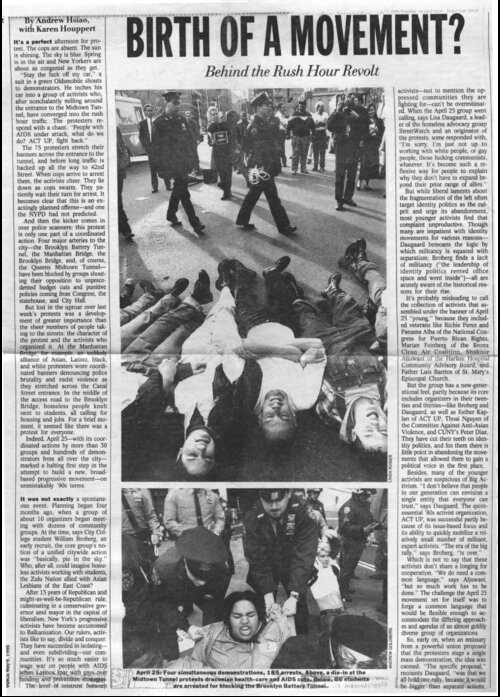 "Birth of a Movement" This Village Voice article covers the coalition effort that pulled off four simultaneous civil disobedience actions on April 25, 1995, stopping traffic at major bridges and tunnels to fight city budget cuts. Puerto Rican, black and Asian groups against police brutality; AIDS activists; CUNY students; and homeless people demanding housing united to build this historic protest.
 -
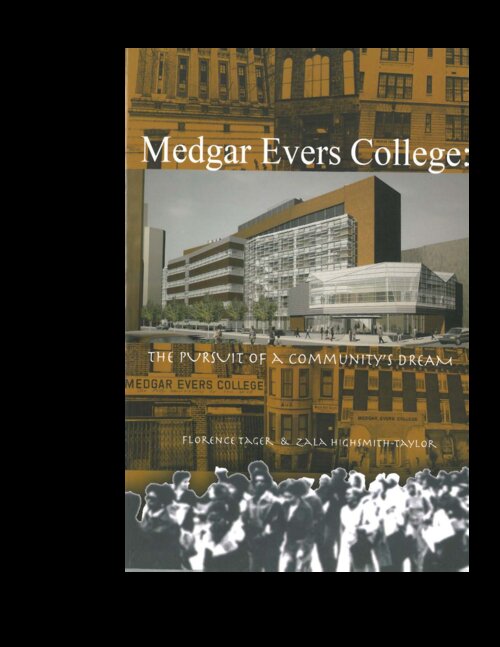 Medgar Evers College - The Pursuit of a Community's Dream In this short book, Medgar Evers College: The Pursuit of a Community's Dream, CUNY retired professors Florence Tager and Zala Highsmith-Taylor tell the story of the founding of the college. As an institution born largely out of 1960s community struggle, the book surveys the climate within New York City and CUNY that led to the confrontation between the Bedford-Stuyvesant community and the university at the time of the college's creation. In addition to the book's well-cited account of the institution's origins, it also includes photographs of faculty, staff, student life, community environment, and campus facilities (pages 35-49). The 122 page book is divided into three parts:1. Acts of Courage: A Community Challenges a University 2. Breaking Ground in the Racial Divide of New York City 3. Medgar Evers College is BornMuch of research for the book was culled from primary sources found in the Bowker Files of the CUNY archives, Louise Glover's private collection and interviews with community residents and politicians. A selected number of these files comprise "The Founding of Medgar Evers College" collection here at the CUNY Digital History Archive.
 -
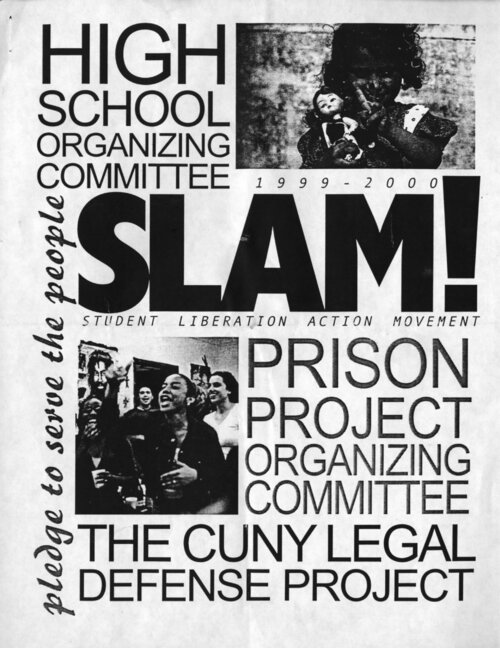 SLAM! Programs Brochure This 5-page brochure includes a brief overview of SLAM's history up to the 1999-2000 school year, SLAM!'s 10-point program, and details on three campaigns SLAM! was organizing that year: the High School Organizing Committee, which worked with high school students to demand the return of remedial classes at CUNY's senior colleges; the Prison Project, which mobilized youth to protest prison expansion and defend political prisoners; and the CUNY Legal Defense Project, which supported litigation by attorneys for CUNY students' civil liberties and rights and the defense of arrested activists. This brochure encourages people to get involved with these programs/campaigns.
 -
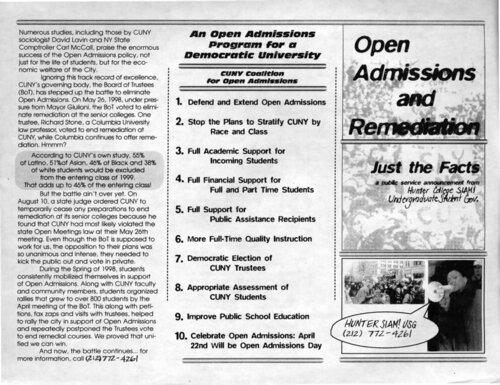 Open Admissions Fact Sheet This trifold pamphlet created by SLAM! debunks myths about remedial classes at CUNY's senior colleges and puts forward arguments for keeping CUNY's open admissions program. It educated students about the history and importance of open admissions at the time that the policy was being reversed by the Board of Trustees and SLAM! was fighting to preserve it.
 -
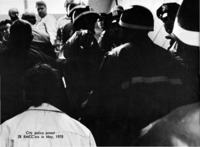 STRIKE!, Prism, 1971 Prism was the Borough of Manhattan Community College's annual yearbook. This 35 page chapter from the 1971 edition details the student strike that, in May 1970, temporarily shut down the college and resulted in 58 arrests. Filled with photos, drawings, poetry, and essays, it vividly portrays the politicized atmosphere of the college. Faculty members, including Jim Perlstein, Bill Friedheim, and Naomi Woronov, supported the students who shut down the school and even slept overnight, in the occupied buildings. Student leaders, including Louis Chessimard and Maria Ramos, had long lists of demands. Along with the "'regular demands' (withdraw all troops from Southeast Asia, free all political prisoners, cut all ties with the United States' 'war machine,' which seem to top everyone's list nowadays,...," their local demands included a call for a campus day care center and their opposition to tuition fee increases. Interesting and representative of the overall political climate, this story was not supressed or diminished but, instead, it received this thorough coverage in the school's yearbook shortly after having taken place.
 -
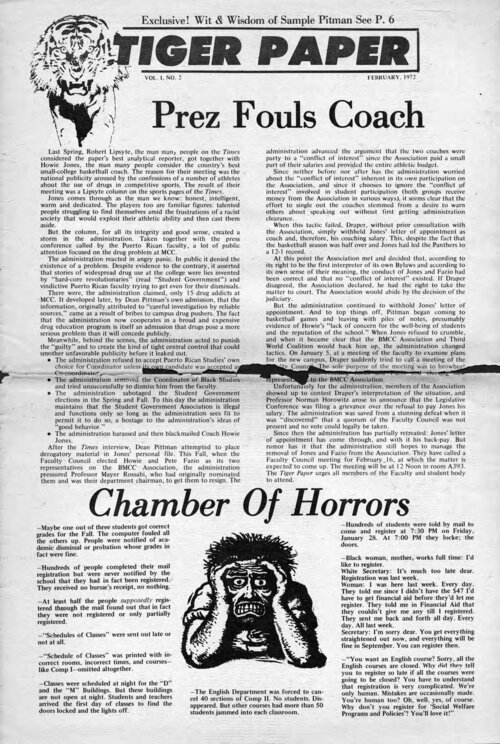 Tiger Paper, February 1972 This issue of the Tiger Paper contains humorous takedowns of the college administration, a call for free subways, a critique of the state of nursing education, and an extended interview with radical poet Sonia Sanchez.The Tiger Paper, which billed itself as "Manhattan Community College's only underground newspaper," was published between 1971 and 1974 by a group of radical faculty members at BMCC. The paper, whose name was a play on the quip of Mao Tse-tung that "U.S. imperialism is a paper tiger," addressed struggles both internal and external to the college while emphasizing the connections between them.
 -
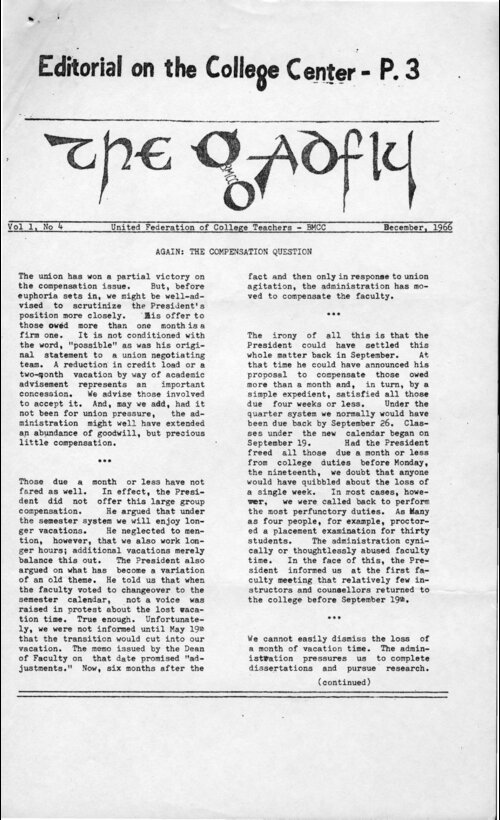 The Gadfly, December 1966 This edition of The Gadfly covers such topics as faculty compensation, "woefully inadequate" campus facilities, and BMCC's upcoming accreditation process. It also contains poetry, film reviews, and humorous pieces by faculty.The Gadfly was the newsletter of the BMCC chapter of the United Federation of College Teachers (UFCT). The UFCT and the Legislative Conference were the two main organizations that advocated for the concerns of CUNY faculty prior to their merging in 1972 to form the Professional Staff Congress (PSC).
 -
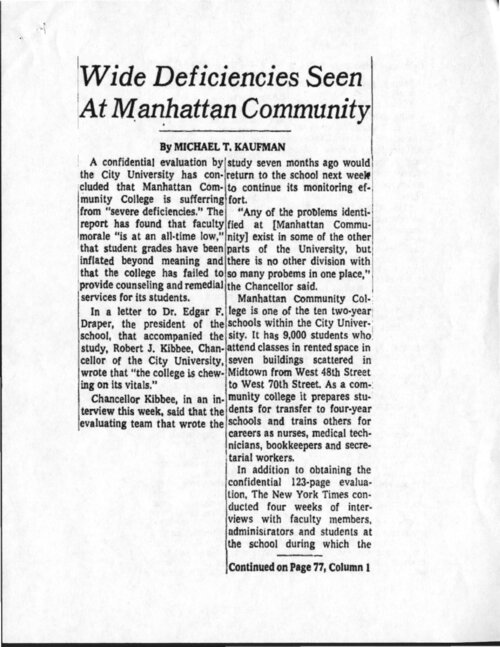 "Wide Deficiencies Seen at Manhattan Community" In May 1974 the New York Times published an investigation of alleged mismanagement at Borough of Manhattan Community College. The article was based on a confidential report compiled on the instructions of Chancellor Robert Kibbee. On the basis of the leaked report, the Times alleged that BMCC suffered from low faculty morale, consistent grade inflation, and a failure to implement the remedial education programs that became urgent following the establishment of open admissions in 1971. Radical students and faculty at BMCC, while accepting criticisms of the administration, hit back at what they felt were implied criticisms of the student body itself. The editors of Tiger Paper, a radical paper published by faculty at the college, led their May 1974 issue with an attack on this "smear job."
 -
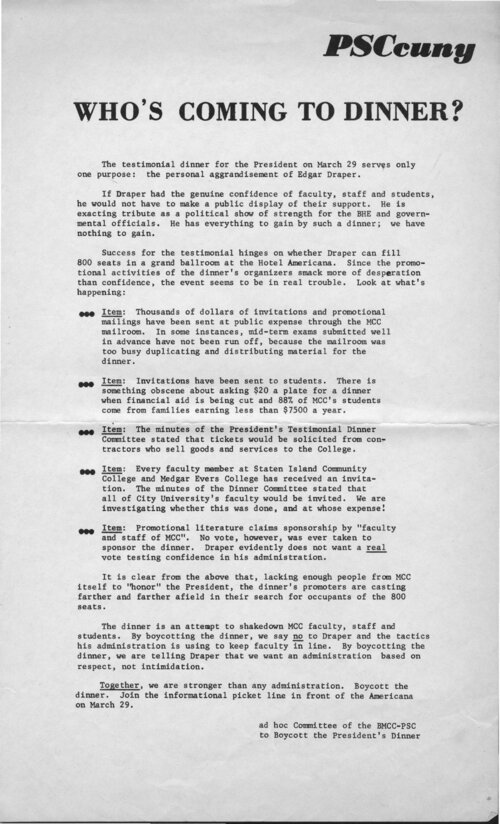 Who's Coming to Dinner? This leaflet, published by an ad hoc committee of Professional Staff Congress members at Borough of Manhattan Community College (BMCC), criticizes the plan of then-BMCC President Edgar Draper to stage a testimonial dinner to himself at the Americana hotel, an operation the committee describes as a "shakedown." The committee urged faculty to boycott and picket the event.
 -
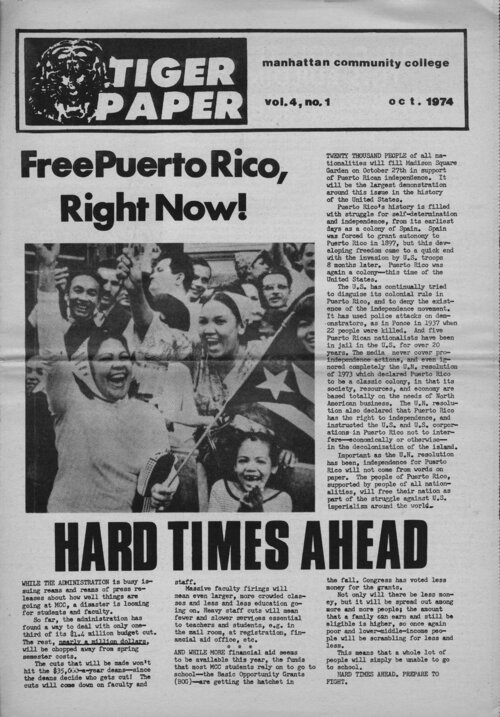 Tiger Paper, October 1974 This copy of the Tiger Paper advocates self-determination for Puerto Rico, criticizes the poor condition of facilities at BMCC, and encourages readers to remember "the spirit of Attica."The Tiger Paper, which billed itself as "Manhattan Community College's only underground newspaper," was published between 1971 and 1974 by a group of radical faculty members at BMCC. The paper, whose name was a play on the quip of Mao Tse-tung that "U.S. imperialism is a paper tiger," addressed struggles both internal and external to the college while emphasizing the connections between them.
901–925 of 1046