Occupy CUNY Curriculum Session Samples
Item
Occupy CUNY Curriculum Session Samples
1. What are the themes you want your students to address?
Examples:
Who are the 99%
Participatory Decision-Making
Modes of Civic Engagement, Civil Disobedience, etc.
Debt/Tuition Increases
Privatization
Please add your own, too!
NAA PWNE
2. What materials will you use to help guide students’ exploration of the theme?
workers- students - unemployed
DAY o: ACTION
walk out! strike!
quit! occupy!
| - lpm Speak-out/Rally outside GC }
- 2pm leave to meet Student
Corivergence at Union Square
~ -3pm Student Convergence at US!
; Pthen march to Foley Square
- 5pm Join up with Organized
Pia or fi F joint action
3. “There comes a time when the operation of the machine becomes so odious, makes you so sick at
heart, that you can't take part, you can't even passively take part, and you've got to put your bodies
upon the gears and upon the wheels, upon all the apparatus, and you've got to make it stop. And
you've got to indicate to the people who run it, the people who own it, that unless you're free the
machine will be prevented from working at all.” -Mario Savio (Leader of the Free Speech Movement,
Berkeley, CA, 1964)
3. What questions will help guide your exploration of the materials in connection with the
theme? (to think about what is going on “beneath the surface” of CUNY...)
Suggested questions:
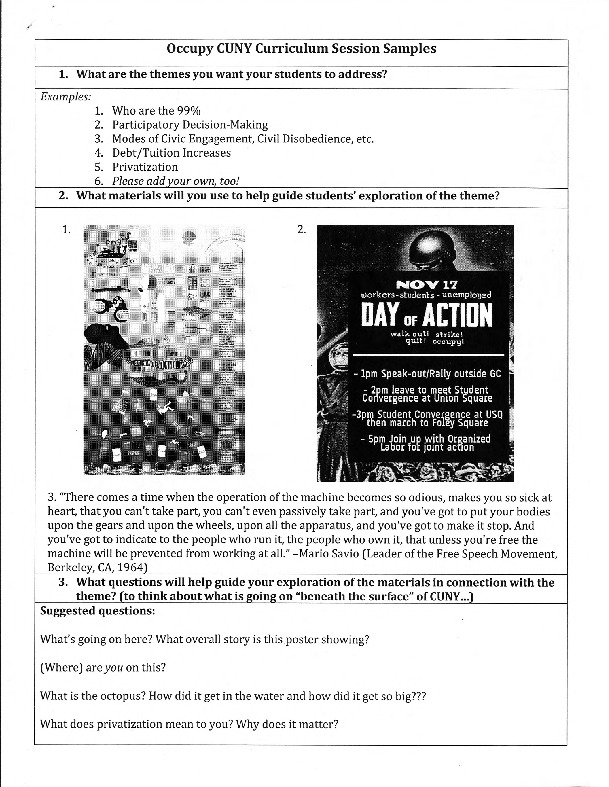
What’s going on here? What overall story is this poster showing?
(Where) are you on this?
What is the octopus? How did it get in the water and how did it get so big???
What does privatization mean to you? Why does it matter?
What does this poster say about neoliberalism? What the hell is that?
How are capitalism, privatization, and neoliberalism affecting public education? What else do these
things affect? Do we see this in other places?
Who is drowning? Why?
What is sinking? Why? So what?
Who/what is disposable?
Who is making money here? Who is benefiting in other ways? Who is not? What are the differences
between these folks?
Who is in the boat (upper left corner)? What decisions do they make? How did they get there?
What’s up with all this shit floating around the boat? (corporate logos as pollution)
What is growing up the right side of the poster (CUNY struggles/occupations as seaweed)? Where is it
growing from?
Which people have occupied public spaces in the past, and why? What else have people done in the
past to fight for their university/other common spaces?
What is the relationship between the 1969 CCNY struggle and 1975 tuition implementation? What
else was going on at this time (think in terms of social movements...economic/political changes
worldwide)? What was the result? Why?
Why are there gaps in the timeline of CUNY struggles?
How are adjunct and student struggles related? How have students and workers allied in the past?
How/why is it important that we work together now?
What do racism, sexism, heterosexism, ableism, classism, nationalism, colonialism, etc. have to do with
the defunding of public education?
What does it mean for all these people to be collecting together at the bottom?! (What can we do
together down here???)
How is the CUNY crisis producing its own “gravediggers”? How is being on the bottom generative?
What is the potential of coming together?
What is on the seabed?
How can we fight this Octopus? How would you sink the boat?
What is happening to the students being squished out the top, and kind of floating in the middle? Do
you identify with any of their insecurities?
Why are the prison and military on here? Handcuffs? Corporations? What do you think the connection
is to public ed?
Did you know we didn’t always have turnstiles and security at CUNY? Why do you think it’s changed?
What do you think the implications of this are?
What is missing from this poster? What would you add???
Visioning/Strategizing... What is the future of CUNY, and public education, in general? How can
we have an impact and shape our own future? What do you want to see changed? How can we
do this together?
4. What will be the final product of students’ work that will help you see how they are
interpreting the questions, materials, and themes, and that they can build upon in future
sessions?
Examples:
1. Students can write a paragraph/page connecting one or more of the themes from the
poster to a theme or question that has been addressed in your class.
2. Students can create a poster that connects one or more of the themes from the poster to
a struggle from their own life, that visually or textually explains an action that could be
taken to alleviate or address the struggle.
3. Students write a letter, poem, song, rap, etc. that connects one or more of the themes
from the class to a theme that has been addressed in your class or to a struggle in their
own life.
5. How will you be sure that students are not just making sense of the questions, materials,
and themes abstractly, but also connected to their lives and experiences, and in a way
that they can act on their new understandings?
Examples:
1. After students create their product analyzing the themes and materials, they can have a
conversation discussing what they created and how it reflects their own lives,
experiences, and struggles.
2. After students create their product analyzing the themes and materials, they can create
a plan of action for whether/how they would like to be involved in the day/week of
student action.
3. After students create their product analyzing the themes and materials, they can discuss
how the class they are currently in is helping them to address questions and themes that
have arisen.
4. After students create their product analyzing the themes and materials, they can discuss
how they would like to address the material for their course in a way that helps them to
address questions and themes that have arisen during these activities/conversations.
6. What is the timeline of this session?
Example:
5 minutes:
Introduce the events of the week, your reasons for doing this activity, and what the activity will
consist of. Present one or more themes that you would like your students to address, and ask for
questions, comments, concerns, etc. from the class
10 minutes:
Present materials (poster, flier, quote, etc.) with guiding questions and have students respond to one
or more questions using the materials you have presented (individually, in partners, or in groups of
3).
15 minutes:
Present activity for students to write or create something using the materials and questions you have
provided.
10 minutes:
Have students who are interested present their work and engage the class in a conversation to
connect that work to their own experiences and feelings about what is going on in their lives, in your
class, in CUNY, in NYC, in the U.S. and in the world right now.
7. What materials do you need for this session?
Example Materials:
1. Copies of the poster/flier/quote/etc. for each student
2. Flash drive with a copy of the poster/flier/quote/etc. to put up on a projector
3. Blank paper for students to design their own posters
4. Markers, colored pencils, etc. for students to design their own posters
5. List of themes and/or questions to pass out to students so they can choose one
6. Specific theme or question to write on the board for all students to respond to
8. How does this session fit into a broader set of sessions (unit)?
Example:
This is where you can demonstrate the connection between your course and this material so that you
can justify it to any administrator or other faculty who challenge your use of class time for this
purpose. It is also an opportunity to authentically weave these questions, and themes into the rest of
the material from your course.
1. What are the themes you want your students to address?
Examples:
Who are the 99%
Participatory Decision-Making
Modes of Civic Engagement, Civil Disobedience, etc.
Debt/Tuition Increases
Privatization
Please add your own, too!
NAA PWNE
2. What materials will you use to help guide students’ exploration of the theme?
workers- students - unemployed
DAY o: ACTION
walk out! strike!
quit! occupy!
| - lpm Speak-out/Rally outside GC }
- 2pm leave to meet Student
Corivergence at Union Square
~ -3pm Student Convergence at US!
; Pthen march to Foley Square
- 5pm Join up with Organized
Pia or fi F joint action
3. “There comes a time when the operation of the machine becomes so odious, makes you so sick at
heart, that you can't take part, you can't even passively take part, and you've got to put your bodies
upon the gears and upon the wheels, upon all the apparatus, and you've got to make it stop. And
you've got to indicate to the people who run it, the people who own it, that unless you're free the
machine will be prevented from working at all.” -Mario Savio (Leader of the Free Speech Movement,
Berkeley, CA, 1964)
3. What questions will help guide your exploration of the materials in connection with the
theme? (to think about what is going on “beneath the surface” of CUNY...)
Suggested questions:
What’s going on here? What overall story is this poster showing?
(Where) are you on this?
What is the octopus? How did it get in the water and how did it get so big???
What does privatization mean to you? Why does it matter?
What does this poster say about neoliberalism? What the hell is that?
How are capitalism, privatization, and neoliberalism affecting public education? What else do these
things affect? Do we see this in other places?
Who is drowning? Why?
What is sinking? Why? So what?
Who/what is disposable?
Who is making money here? Who is benefiting in other ways? Who is not? What are the differences
between these folks?
Who is in the boat (upper left corner)? What decisions do they make? How did they get there?
What’s up with all this shit floating around the boat? (corporate logos as pollution)
What is growing up the right side of the poster (CUNY struggles/occupations as seaweed)? Where is it
growing from?
Which people have occupied public spaces in the past, and why? What else have people done in the
past to fight for their university/other common spaces?
What is the relationship between the 1969 CCNY struggle and 1975 tuition implementation? What
else was going on at this time (think in terms of social movements...economic/political changes
worldwide)? What was the result? Why?
Why are there gaps in the timeline of CUNY struggles?
How are adjunct and student struggles related? How have students and workers allied in the past?
How/why is it important that we work together now?
What do racism, sexism, heterosexism, ableism, classism, nationalism, colonialism, etc. have to do with
the defunding of public education?
What does it mean for all these people to be collecting together at the bottom?! (What can we do
together down here???)
How is the CUNY crisis producing its own “gravediggers”? How is being on the bottom generative?
What is the potential of coming together?
What is on the seabed?
How can we fight this Octopus? How would you sink the boat?
What is happening to the students being squished out the top, and kind of floating in the middle? Do
you identify with any of their insecurities?
Why are the prison and military on here? Handcuffs? Corporations? What do you think the connection
is to public ed?
Did you know we didn’t always have turnstiles and security at CUNY? Why do you think it’s changed?
What do you think the implications of this are?
What is missing from this poster? What would you add???
Visioning/Strategizing... What is the future of CUNY, and public education, in general? How can
we have an impact and shape our own future? What do you want to see changed? How can we
do this together?
4. What will be the final product of students’ work that will help you see how they are
interpreting the questions, materials, and themes, and that they can build upon in future
sessions?
Examples:
1. Students can write a paragraph/page connecting one or more of the themes from the
poster to a theme or question that has been addressed in your class.
2. Students can create a poster that connects one or more of the themes from the poster to
a struggle from their own life, that visually or textually explains an action that could be
taken to alleviate or address the struggle.
3. Students write a letter, poem, song, rap, etc. that connects one or more of the themes
from the class to a theme that has been addressed in your class or to a struggle in their
own life.
5. How will you be sure that students are not just making sense of the questions, materials,
and themes abstractly, but also connected to their lives and experiences, and in a way
that they can act on their new understandings?
Examples:
1. After students create their product analyzing the themes and materials, they can have a
conversation discussing what they created and how it reflects their own lives,
experiences, and struggles.
2. After students create their product analyzing the themes and materials, they can create
a plan of action for whether/how they would like to be involved in the day/week of
student action.
3. After students create their product analyzing the themes and materials, they can discuss
how the class they are currently in is helping them to address questions and themes that
have arisen.
4. After students create their product analyzing the themes and materials, they can discuss
how they would like to address the material for their course in a way that helps them to
address questions and themes that have arisen during these activities/conversations.
6. What is the timeline of this session?
Example:
5 minutes:
Introduce the events of the week, your reasons for doing this activity, and what the activity will
consist of. Present one or more themes that you would like your students to address, and ask for
questions, comments, concerns, etc. from the class
10 minutes:
Present materials (poster, flier, quote, etc.) with guiding questions and have students respond to one
or more questions using the materials you have presented (individually, in partners, or in groups of
3).
15 minutes:
Present activity for students to write or create something using the materials and questions you have
provided.
10 minutes:
Have students who are interested present their work and engage the class in a conversation to
connect that work to their own experiences and feelings about what is going on in their lives, in your
class, in CUNY, in NYC, in the U.S. and in the world right now.
7. What materials do you need for this session?
Example Materials:
1. Copies of the poster/flier/quote/etc. for each student
2. Flash drive with a copy of the poster/flier/quote/etc. to put up on a projector
3. Blank paper for students to design their own posters
4. Markers, colored pencils, etc. for students to design their own posters
5. List of themes and/or questions to pass out to students so they can choose one
6. Specific theme or question to write on the board for all students to respond to
8. How does this session fit into a broader set of sessions (unit)?
Example:
This is where you can demonstrate the connection between your course and this material so that you
can justify it to any administrator or other faculty who challenge your use of class time for this
purpose. It is also an opportunity to authentically weave these questions, and themes into the rest of
the material from your course.
Title
Occupy CUNY Curriculum Session Samples
Description
Curriculum made for CUNY classrooms in conjunction with the "Occupy the Octopi" poster (made for an October 21, 2011, Occupy CUNY teach-in at Washington Square Park) and a flyer for the November 17, 2011, OWS Student Strike, both created by the Graduate Center General Assembly.
Contributor
Reed, Conor Tomás
Creator
Graduate Center General Assembly
Date
November 2011 (Circa)
Language
English
Publisher
Graduate Center General Assembly
Relation
7502
6472
6362
6342
20092
Rights
Creative Commons AttributionNonCommercialShareAlike
Source
Reed, Conor Tomas
Original Format
Curricular Material
Graduate Center General Assembly. Letter. “Occupy CUNY Curriculum Session Samples”. 7502, CUNY DIGITAL HISTORY ARCHIVE, accessed September 5, 2026, https://stephenz.tailc22a4b.ts.net/s/cdha/item/1005