Newton Hall Statement
Item
«i
Benes SOOT RS Ae ase
aoe : Powe
. THE CITY COLLEGE.
. : oF .
JHE CITY UNIVERSITY OF NEW YORK
“NEW YORK, N. ¥. 10033
Hvey P, Newton Hall for Political Action
-, BROTHERS AND SISTERS:
re
_- “Son“Avril 22, 1969, the Black and Puerto Rican Community took con-
trol of City College. For over six months, their repeated attempts
to implement the demands of their five point program failed. ‘he
administration's obstinacy and pigheadedness demanded a response.
‘the seizure of South Campus was the response of the Black and Puerto
Rican students to the institutional racism manifested by the Ad-
ministration, . a , : .
° The basis of the Black and Puerto Rican demands is the concept that
_the people must exercise control over their environibent. When they
‘arrive’at City College, Black and Puerto. Rican Studmts become immed-
fately aware that everything, from the entrance requirements to the
orientation programs to the curriculum, is geared to the needs of the
power structure under which the Blacks and Puerto Ricais are exploited.
(ne day after the seizure of South Campus, a group of white stu-
dents supporting the Black and Puerto Rican demands entered Klapper
Hall and have remained there since: We have renamed the building
Huey P, Newton Hall for Political Action. The consciousness that is
evolving here, thriving on continual political discourse will long
survive our occupation of Newton Hall. ;
We are here because the resolution of this crisis will affect every
. gtudent in the university. The future of cur education anc cur lives
cand this society is being determined to a great extent by what is hap-
pening at, Harlem University and NewtoniHell and the other Harlem Un-
iversitiés and Newton Halis across the country. We, as white students,
can either be a part of the solution or a part of the problem. At
Huey “P. Newton Hall of Political Action we are attempting to become
a part of the solution.
The unequivocal acceptmce of the Community's demands is a necessity =
for the future we seek for ourselves. We have occupied this building —
-becauge we want to show that our brothers and sisters of the University
of Harlem are not alone in their committment to see this struggle
through to the ends This solidarity is exemplified by the public pledge
of the Black and Puerto Rican Student Commumity to break off negoti~
ations with the administration if the police are called on campus, and
by our pledge to maintain the occupation until the demands are met.
N
. Our solidarity with the Black and Puerto Rican students arises
not from sympathy but from a realization that we, too, are oppres-
sed; that though the form of the oppression may differ, the face of
the oppressor is the same.
Black and Puerto Rican people are among the most oppressed mem-~
bers of this society. They must struggle daily with a system that
attempts to deprive them of their manhood, their livlihood and even
their Lives. :
If-Black people are field niggers, then white people are house
niggets in asplantation economy. We are the overseers of a society
that: spills our blood needlessly in wars against the colored peo-
ples of the World. This society consolidates the positions of cor-
porate interests so consumed with greed that they can only blindly
seek to expand their influence throughout the world.
We are victims of a gorporate society that reduces man to an
interchangeable part for an assembly line economy; a society that
veduces education to vocational training; a society that has fallen
out of touch with the pressing needs of the oppressed peoples of
this country and the world.
Equality is a meaningless phrase when racism has been institu-
tionalized through imperialism abroad and class stratification at
home.
Do not help the system fake reality, honesty and so-called
justice, That fakery’is the only force holding off the system's
secret fear, the fear and reality of knowing that they are unfit
to exist; expose fakery and help the truth destroy them. ‘Your con-
sent is their ONLY grasp on life.
The administration can't respond adequately to the needs of ei-
ther the urban comminity or of its students. The actions of the
Black and Puerto Rican Student Community have made all that clear.
They have resolved to achieve their ends despite obstacles created
by white racist institutions. WE ask you to join us as we have
joined with them,
. There will be a general meeting to discuss the strike and the
implementation of the Five Demands at Newton Hall, 135th Street and
Convent Avenue, on Monday, May 5, at 12 noon.
COME!!
POWER TO THE PEOPLES!
THE FIVE DEMANDS
1, A Separate School of Black and Puerto Rican Studies
Raclen is a barrier which separates people. Racism is hate fed
by {ignorance and misunderstanding. It is the responsibility of
education to eliminate this ignorance and enable people to wnder-
stead one another. Recism is also fed by the destruction of a
poopie who are denied access to their own history and culture.
it ig the responsibility of education to provide the knowledge
frew which dignity and self-respect can grow. An education which
omits Black and Puerto Rican studies fails in this task.
The vaigue needs cf these studies requires the establishment of
a sehcol with status comprable to that of the school of engineer-
ing. These needs cannot be met by merely a program or department,
for to study.a culture, rather than just history or literature,
requires a mobility which even inter-disciplinary programs cannot
provide and which inter-departmental politics would fundamentally
obstruct, The structure of such a school would make it responsible
to the students whose Lives are wrapped up with these studies in-
tead of a bureaucratic morass of white faculty cammiitees unable
to understand the needs of Third World people.
Cali for a “separate” school is not a demand for segregation; it
is a demand for control of a relevant education. The school would
be open to all students, as the need for education lies with all of
them. In the ghetto commmities, it is the key to dignity. In the
white commmities, it is the key to understanding. -
2, A Separate Orientation Program for Black and Puerto Rican
. Students
The Freshman Orientation program (FO) has been condemmed by the
entire college including the deans.
For ali students, its value is dubious. I: is particularly mean-
ingless for Black and Puerto Rican students, ‘They have grown up in
the unique world of the modern urban ghetto. They have beea ex-
cluded frem American society, The problems they must deal with can-
not be fully understood by white students. The white upperclassmen
whe staff FO have agreed that they cannot address themselves to the
special problems of a people ostracized from cur society.
Black upperclassmen, on the other hand, have faced rhe ‘same pro-
blem: which black freshmen have yet to exverience. For the good of
the fresimaen, as well as the college comaumity, they should be per-
mitted to run their own orientation pregram. The administration
must £ulfill its responsibilities and accord the Black and Puerto
Rican orientation program the same status and funding as the current
program-~elevating it from the extra-curricular level to become es-
tablished College policy,
3. A Voice for SEEK Students in the Setting of Guidelines for
the SEEK program, including the Hiring and Firing of Person-
nel
‘Education, ideally, should not only be centered around the pro-
cess of the students's efforts to "learn" a collection of facts,
but also his right to decide on the relevance and direction of that
process ag weil as the personnel with whom to implement it.
Since education should be geared to the needs of the student, ir-
respective of whether his goals are vocational or academic, he must
have control over his curriculum, to insure that his education is
serving HIS needs, and not those of any other individual or struct-
ure, Studant control is eapecially important in the SEEK program,
which is presently under the authority of a white college admini-
stration, which cannot truely understand and meet the needs of Black
students. The student also deserves to have some voice over budge-
tary matters, since the budget determines the implementation of the
very guidelines and priorities which the student himself helps es-
tablish. Further, the student must have a voice in deciding which
personnel should be hired or fired since he alone is in the position
cf constantly observing whether or not a faculty member is an ef-
fective teacher.
It should be clear that this applies not only to the SEEK program
but to all divisions of the College. Each department, each school,
from English to Engineering, must be responsible to the students of
that department. i.
4, That the Racial Composition of All Entering Classes Reflect
the Black and Puerto Rican Population of All New York City's
High Schools
We are a college which has traditionally led in opening the doors
to educational oppertunity for those peoples whose opportunities
were otherwise limited. The most complete extension of this trad-
ition and the most effective way of meeting the needs of the people
of New York now is through a policy of open admissions, for with such
a policy higher education would be available to all students who
desire it regardless of ethnic grouping. Education for ali people
is a right.
The present procedure of selecting students on the criteria of
examinations and grades is both arbitrary and discriminatory. It
‘is discriminatory in that it is clearly certain ethnic groups which
suffer by the standards due to inferior education in ghetto schools.
(While 52% of the high school population of the city is either Black
or Puerto Rican the figure is only 15% at the college even with the
predominantly Black SEEK program included.) And examinations and
grades are an arbitrary rather than qualitative measure of a student's
ability. They force a student to be more concerned with competition
than with education, more concerned with doing well than with learn-
ing well.
y
There tg a growing body of evidence that these criteria are net
even accurate means of predicting success in college. Students who
would not normally have been accepted have come to college wider
such programs as SEEK and have performed much better than high school
averages indicated. In view of this evidence, as weli as at aware~
ness of the basic justice of this approach, universites across the
country are adopting policies of open admissions.
Open Admissions to the City University.is the ultimate goal. The
‘Black and Ruerto Rican Community has fully endorsed our statement
of this goai as a corallary to their demand, But these groups can-
not wait until the university grows to accomodate the influx of stu-
.dents who would come under open admissions. The fair treatment which
has been denied them cannot be postponed any longer.
So it mugt be assured that the burden of any possible enrallment
cut not be boprne by these people alone. A fair ethnic balanes which
will automaticaily maintain itself under open admissions must be es-
tablished next year whatever the size of the class.
5. That Black and Puerto Rican History and the Spanish Language
be Required of All Education Majors
The one-year requirement of Spanish for education majors recently
approved by the College's Department of Elementary Education is in-
sufficient. One year of study is rarely enough to afford a working
jmowlLedge of a language. The only realistic requirement is one of
proficiency.
The School of Education at City College exists to provide teachers
for the New York public school system. A student preparing to teach
in thig urban environment mist have Imowledge and skills immediately
relevant to the students. Black and Puerto Rican stucents comprise
the majority in New York City's public schools.
Without the ability to talk to the student in his own language or
to communicate the history and culture of his people, the teacher be-
comes at best an alien in the classroom and perhaps even an obstacle
to Learning.
Benes SOOT RS Ae ase
aoe : Powe
. THE CITY COLLEGE.
. : oF .
JHE CITY UNIVERSITY OF NEW YORK
“NEW YORK, N. ¥. 10033
Hvey P, Newton Hall for Political Action
-, BROTHERS AND SISTERS:
re
_- “Son“Avril 22, 1969, the Black and Puerto Rican Community took con-
trol of City College. For over six months, their repeated attempts
to implement the demands of their five point program failed. ‘he
administration's obstinacy and pigheadedness demanded a response.
‘the seizure of South Campus was the response of the Black and Puerto
Rican students to the institutional racism manifested by the Ad-
ministration, . a , : .
° The basis of the Black and Puerto Rican demands is the concept that
_the people must exercise control over their environibent. When they
‘arrive’at City College, Black and Puerto. Rican Studmts become immed-
fately aware that everything, from the entrance requirements to the
orientation programs to the curriculum, is geared to the needs of the
power structure under which the Blacks and Puerto Ricais are exploited.
(ne day after the seizure of South Campus, a group of white stu-
dents supporting the Black and Puerto Rican demands entered Klapper
Hall and have remained there since: We have renamed the building
Huey P, Newton Hall for Political Action. The consciousness that is
evolving here, thriving on continual political discourse will long
survive our occupation of Newton Hall. ;
We are here because the resolution of this crisis will affect every
. gtudent in the university. The future of cur education anc cur lives
cand this society is being determined to a great extent by what is hap-
pening at, Harlem University and NewtoniHell and the other Harlem Un-
iversitiés and Newton Halis across the country. We, as white students,
can either be a part of the solution or a part of the problem. At
Huey “P. Newton Hall of Political Action we are attempting to become
a part of the solution.
The unequivocal acceptmce of the Community's demands is a necessity =
for the future we seek for ourselves. We have occupied this building —
-becauge we want to show that our brothers and sisters of the University
of Harlem are not alone in their committment to see this struggle
through to the ends This solidarity is exemplified by the public pledge
of the Black and Puerto Rican Student Commumity to break off negoti~
ations with the administration if the police are called on campus, and
by our pledge to maintain the occupation until the demands are met.
N
. Our solidarity with the Black and Puerto Rican students arises
not from sympathy but from a realization that we, too, are oppres-
sed; that though the form of the oppression may differ, the face of
the oppressor is the same.
Black and Puerto Rican people are among the most oppressed mem-~
bers of this society. They must struggle daily with a system that
attempts to deprive them of their manhood, their livlihood and even
their Lives. :
If-Black people are field niggers, then white people are house
niggets in asplantation economy. We are the overseers of a society
that: spills our blood needlessly in wars against the colored peo-
ples of the World. This society consolidates the positions of cor-
porate interests so consumed with greed that they can only blindly
seek to expand their influence throughout the world.
We are victims of a gorporate society that reduces man to an
interchangeable part for an assembly line economy; a society that
veduces education to vocational training; a society that has fallen
out of touch with the pressing needs of the oppressed peoples of
this country and the world.
Equality is a meaningless phrase when racism has been institu-
tionalized through imperialism abroad and class stratification at
home.
Do not help the system fake reality, honesty and so-called
justice, That fakery’is the only force holding off the system's
secret fear, the fear and reality of knowing that they are unfit
to exist; expose fakery and help the truth destroy them. ‘Your con-
sent is their ONLY grasp on life.
The administration can't respond adequately to the needs of ei-
ther the urban comminity or of its students. The actions of the
Black and Puerto Rican Student Community have made all that clear.
They have resolved to achieve their ends despite obstacles created
by white racist institutions. WE ask you to join us as we have
joined with them,
. There will be a general meeting to discuss the strike and the
implementation of the Five Demands at Newton Hall, 135th Street and
Convent Avenue, on Monday, May 5, at 12 noon.
COME!!
POWER TO THE PEOPLES!
THE FIVE DEMANDS
1, A Separate School of Black and Puerto Rican Studies
Raclen is a barrier which separates people. Racism is hate fed
by {ignorance and misunderstanding. It is the responsibility of
education to eliminate this ignorance and enable people to wnder-
stead one another. Recism is also fed by the destruction of a
poopie who are denied access to their own history and culture.
it ig the responsibility of education to provide the knowledge
frew which dignity and self-respect can grow. An education which
omits Black and Puerto Rican studies fails in this task.
The vaigue needs cf these studies requires the establishment of
a sehcol with status comprable to that of the school of engineer-
ing. These needs cannot be met by merely a program or department,
for to study.a culture, rather than just history or literature,
requires a mobility which even inter-disciplinary programs cannot
provide and which inter-departmental politics would fundamentally
obstruct, The structure of such a school would make it responsible
to the students whose Lives are wrapped up with these studies in-
tead of a bureaucratic morass of white faculty cammiitees unable
to understand the needs of Third World people.
Cali for a “separate” school is not a demand for segregation; it
is a demand for control of a relevant education. The school would
be open to all students, as the need for education lies with all of
them. In the ghetto commmities, it is the key to dignity. In the
white commmities, it is the key to understanding. -
2, A Separate Orientation Program for Black and Puerto Rican
. Students
The Freshman Orientation program (FO) has been condemmed by the
entire college including the deans.
For ali students, its value is dubious. I: is particularly mean-
ingless for Black and Puerto Rican students, ‘They have grown up in
the unique world of the modern urban ghetto. They have beea ex-
cluded frem American society, The problems they must deal with can-
not be fully understood by white students. The white upperclassmen
whe staff FO have agreed that they cannot address themselves to the
special problems of a people ostracized from cur society.
Black upperclassmen, on the other hand, have faced rhe ‘same pro-
blem: which black freshmen have yet to exverience. For the good of
the fresimaen, as well as the college comaumity, they should be per-
mitted to run their own orientation pregram. The administration
must £ulfill its responsibilities and accord the Black and Puerto
Rican orientation program the same status and funding as the current
program-~elevating it from the extra-curricular level to become es-
tablished College policy,
3. A Voice for SEEK Students in the Setting of Guidelines for
the SEEK program, including the Hiring and Firing of Person-
nel
‘Education, ideally, should not only be centered around the pro-
cess of the students's efforts to "learn" a collection of facts,
but also his right to decide on the relevance and direction of that
process ag weil as the personnel with whom to implement it.
Since education should be geared to the needs of the student, ir-
respective of whether his goals are vocational or academic, he must
have control over his curriculum, to insure that his education is
serving HIS needs, and not those of any other individual or struct-
ure, Studant control is eapecially important in the SEEK program,
which is presently under the authority of a white college admini-
stration, which cannot truely understand and meet the needs of Black
students. The student also deserves to have some voice over budge-
tary matters, since the budget determines the implementation of the
very guidelines and priorities which the student himself helps es-
tablish. Further, the student must have a voice in deciding which
personnel should be hired or fired since he alone is in the position
cf constantly observing whether or not a faculty member is an ef-
fective teacher.
It should be clear that this applies not only to the SEEK program
but to all divisions of the College. Each department, each school,
from English to Engineering, must be responsible to the students of
that department. i.
4, That the Racial Composition of All Entering Classes Reflect
the Black and Puerto Rican Population of All New York City's
High Schools
We are a college which has traditionally led in opening the doors
to educational oppertunity for those peoples whose opportunities
were otherwise limited. The most complete extension of this trad-
ition and the most effective way of meeting the needs of the people
of New York now is through a policy of open admissions, for with such
a policy higher education would be available to all students who
desire it regardless of ethnic grouping. Education for ali people
is a right.
The present procedure of selecting students on the criteria of
examinations and grades is both arbitrary and discriminatory. It
‘is discriminatory in that it is clearly certain ethnic groups which
suffer by the standards due to inferior education in ghetto schools.
(While 52% of the high school population of the city is either Black
or Puerto Rican the figure is only 15% at the college even with the
predominantly Black SEEK program included.) And examinations and
grades are an arbitrary rather than qualitative measure of a student's
ability. They force a student to be more concerned with competition
than with education, more concerned with doing well than with learn-
ing well.
y
There tg a growing body of evidence that these criteria are net
even accurate means of predicting success in college. Students who
would not normally have been accepted have come to college wider
such programs as SEEK and have performed much better than high school
averages indicated. In view of this evidence, as weli as at aware~
ness of the basic justice of this approach, universites across the
country are adopting policies of open admissions.
Open Admissions to the City University.is the ultimate goal. The
‘Black and Ruerto Rican Community has fully endorsed our statement
of this goai as a corallary to their demand, But these groups can-
not wait until the university grows to accomodate the influx of stu-
.dents who would come under open admissions. The fair treatment which
has been denied them cannot be postponed any longer.
So it mugt be assured that the burden of any possible enrallment
cut not be boprne by these people alone. A fair ethnic balanes which
will automaticaily maintain itself under open admissions must be es-
tablished next year whatever the size of the class.
5. That Black and Puerto Rican History and the Spanish Language
be Required of All Education Majors
The one-year requirement of Spanish for education majors recently
approved by the College's Department of Elementary Education is in-
sufficient. One year of study is rarely enough to afford a working
jmowlLedge of a language. The only realistic requirement is one of
proficiency.
The School of Education at City College exists to provide teachers
for the New York public school system. A student preparing to teach
in thig urban environment mist have Imowledge and skills immediately
relevant to the students. Black and Puerto Rican stucents comprise
the majority in New York City's public schools.
Without the ability to talk to the student in his own language or
to communicate the history and culture of his people, the teacher be-
comes at best an alien in the classroom and perhaps even an obstacle
to Learning.
Title
Newton Hall Statement
Description
“We as white students, can either be a part of the solution or a part of the problem. At Huey P. Newton Hall of Political Action we are attempting to become a part of the solution.”
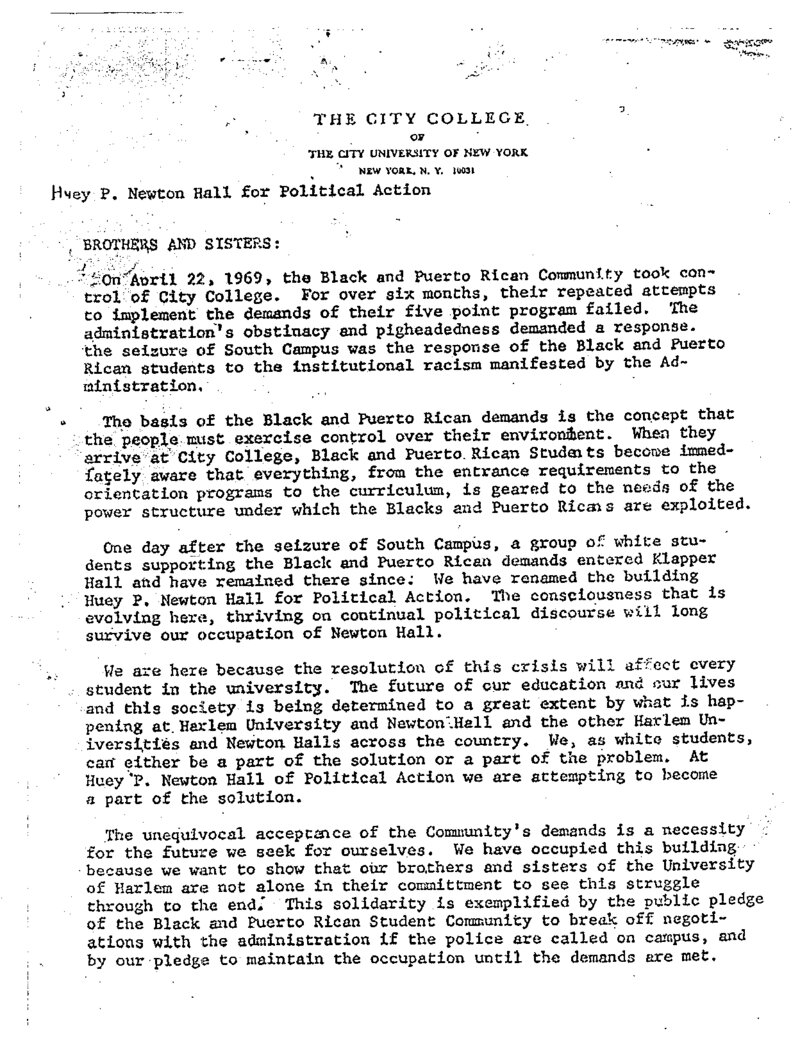
In solidarity with black and Puerto Rican students, a group of white students occupied City College's Klapper Hall at 135 Street and Convent Avenue and renamed it "Huey P. Newton Hall for Political Action," after the co-founder of the Black Panther Party.
This statement was written from within “Newton Hall” by occupying students and calls for the administration’s “unequivocal acceptance” of the Five Demands. It argues that white students should join them in supporting the strike. The announcement of a meeting and an analysis of the Five Demands, which pertains to the need for greater diversity and representation on campus is included in the statement.
Violence between pro-strike and anti-strike students and the police eventually led to the resignation of CCNY president Buell Gallagher on May 12th. Nevertheless, the protestors' persistence forced the administration to negotiate and make some agreements related to the students demands. This series of events was one of several that helped to pave the way for the policy of Open Admissions that began in fall 1970.
In solidarity with black and Puerto Rican students, a group of white students occupied City College's Klapper Hall at 135 Street and Convent Avenue and renamed it "Huey P. Newton Hall for Political Action," after the co-founder of the Black Panther Party.
This statement was written from within “Newton Hall” by occupying students and calls for the administration’s “unequivocal acceptance” of the Five Demands. It argues that white students should join them in supporting the strike. The announcement of a meeting and an analysis of the Five Demands, which pertains to the need for greater diversity and representation on campus is included in the statement.
Violence between pro-strike and anti-strike students and the police eventually led to the resignation of CCNY president Buell Gallagher on May 12th. Nevertheless, the protestors' persistence forced the administration to negotiate and make some agreements related to the students demands. This series of events was one of several that helped to pave the way for the policy of Open Admissions that began in fall 1970.
Creator
Unknown
Date
1969
Language
English
Relation
6962
6952
6932
6922
Rights
Obtained from Contributor - Copyright Unknown
Source
McGuire, Ron
Original Format
Report / Paper / Proposal
Unknown. Letter. 1968. “Newton Hall Statement”. 6962, 1968, CUNY DIGITAL HISTORY ARCHIVE, accessed September 5, 2026, https://stephenz.tailc22a4b.ts.net/s/cdha/item/1100