A New Role for Psychology: Working with Disadvantaged Persons in a College Setting
Item
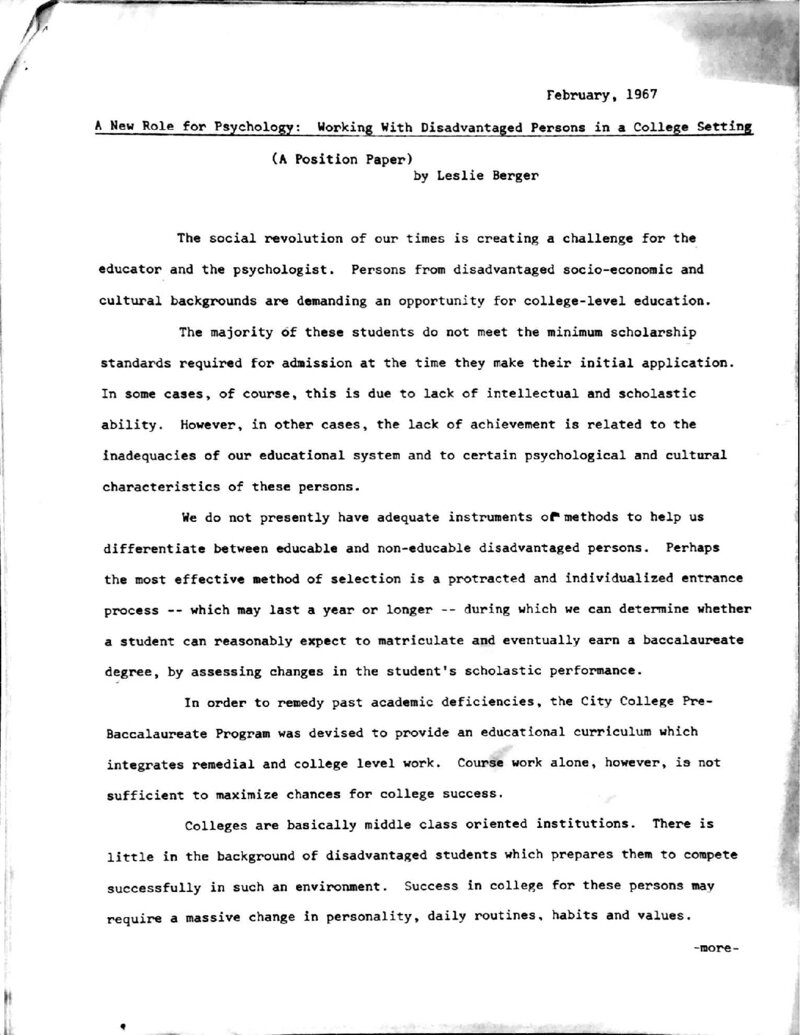
February, 1967
A New Role for Psychology: Working With Disadvantaged Persons in a College Setting
(A Position Paper)
by Leslie Berger
The social revolution of our times is creating a challenge for the
educator and the psychologist. Persons from disadvantaged socio-economic and
cultural backgrounds are demanding an opportunity for college-level education.
The majority of these students do not meet the minimum scholarship
standards required for admission at the time they make their initial application.
In some cases, of course, this is due to lack of intellectual and scholastic
ability. However, in other cases, the lack of achievement is related to the
inadequacies of our educational system and to certain psychological and cultural
characteristics of these persons.
We do not presently have adequate instruments of methods to help us
differentiate between educable and non-educable disadvantaged persons. Perhaps
the most effective method of selection is a protracted and individualized entrance
process -- which may last a year or longer -- during which we can determine whether
a student can reasonably expect to matriculate and eventually earn a baccalaureate
degree, by assessing changes in the student's scholastic performance.
In order to remedy past academic deficiencies, the City College Pre-
Baccalaureate Program was devised to provide an educational curriculum which
integrates remedial and college level work. Course work alone, however, is not
sufficient to maximize chances for college success.
Colleges are basically middle class oriented institutions. There is
little in the background of disadvantaged students which prepares them to compete
successfully in such an environment. Success in college for these persons may
require a massive change in personality, daily routines, habits and values.
~more-
How can psychologists contribute to the higher education of disadvantaged
persons? Four interrelated areas of functions appear to be relevant:
1. Assessment of educability
2. Facilitation of ego development
3. Psychotherapy
4. Assisting the faculty
Assessment of Educability
Good high school grades are usually indicative of intellectual ability,
appropriate motivation for academic success, adequate study skills, and a supportive
environment. Low grades in high school, however, can be caused by any or all of
these variables being deficient. If we assume that, with the exception of intel-
ligence, the other dimensions are potentially changeable, we begin to appreciate
the exceedingly complex task we face in determining educability in a culturally
disadvantaged person. We must also realize that a disadvantaged student can be
harmed not only by being discouraged from obtaining college-level education,
but also through inappropriate encouragement which results in failure.
Assessment of educability in this context becomes a continuous process
in which the student and the psychologist closely collaborate. The psychologist
must provide not only support and encouragement, but he must also continuously
assist with reality testing. He must communicate a feeling of acceptance and respect
for the person, regardless of his level of academic achievement. He must be familiar
with the academic curriculum and the educational process. He must be knowledgeable
about occupational alternatives;and when sufficient evidence becomes available in-
dicating that a student is not educable on the college level, the psychologist
must help him to utilize the college experience constructively in finding an
alternate vocational objective.
Facilitation of Ego-Development
It would be erroneous to classify all disadvantaged students as a
homogeneous group. There are many families of sufficient strength to combat
—— ee eee a a aan
-3- (
the effects of slum dwelling; and the children of these families reflect the strength
of their homes in school performance and adjustment to life. The majority of dis-
advantaged students, however, come from homes with a high incidence of social and
family pathology. They frequently come from broken homes due to separation and
desertion -- homes with unstable identification figures and unstable community ties.
By the time they enter college, many disadvantaged students have developed negative
self-images. Although they aspire to high prestige occupations, few realistically
expect to achieve such goals. They are not personally acquainted with anyone who
has achieved success; so while they may overtly express confidence, they are con-
vinced that "people like me don't have a chance to be successful in life." They
cannot anticipate the attainment of long-range goals, and they lack the ability
to postpone gratification of immediate needs in order to achieve remote and per-
haps abstract goals. They don't feel that they can control their own destiny, and
they therefore abandon responsibility for themselves.
A minority group member who wishes to become socially mobile through
educational achievement is faced with the prospect of rejection by his peer group
as his behavior deviates from theirs; and he does not have any security that he
will be accepted by the group toward which he aspires. Disadvantaged youngsters
are apt to view all authority, including college staff, with suspicion and some-
times outward hostility.
A person's adjustment to situational events is a learned response. Under
favorable conditions, a person achieves increasing autonomy from his instinctual
drives and his environment as he develops. In a well-developed person, there is
an appropriate balance between autonomy from forces within and autonomy from the
environment. As the individual develops ego autonomy, he becomes aware of his ,
ability to control his own behavior and his environment. He is a person who can
adapt himself to new situations relatively easily.
-more-
-4-
Persons growing up in a deprived environment frequently fail to develop
sufficient ego autonomy. Their ability to respond to new situations adaptively
is impaired. Consequently, students from disadvantaged backgrounds cannot easily
acclimate themselves to the college environment.
How can psychologists help these students, who are not "asking" for hip
and whose difficulties in living are not based on unconscious conflicts, but who
are insufficiently adaptive to the college situation? How can they develop a
“helping relation" to establish a feeling of trust and to relieve hostility,
suspicion, apathy and other feelings which may detract from the student's
ability to profit from college instruction? How can psychologists help these persons
to identify appropriate goals, to develop appropriate self-images and find socially
useful roles to play as adults? How can they help these students to establish
realistic levels of aspiration? How can they help them to expand their environment
and orient themselves to the larger environment and build some sense of general
trust in it?
As a first step, the psychologist must find a way to become involved
intimately in the life of the student. Ego development must take place in an
emotional context. It is the emotional rather than the intellectual attitudes
which are the raw material of this process. Ego development inevitably involves
relationships between people. The psychologist cannot wait for the student to
initiate this relationship. It is important, however, that this strategy not
be experienced as one of attempting to socialize students or of encouraging them
to accept roles presented by the majority world.
In the Pre-Baccalaureate Program, the role of the psychologist is structured
to facilitate interaction with students in order to facilitate the initiation of
a relationship. The psychologist is a central figure. He informs the student of
his acceptance into the program. He then works out with the student a course
schedule. They prepare a budget and a request for a weekly stipend , where such
aid is required (which is in most cases). The psychologist plays an active and
TS
aS
continuous role in the student's life. Through this role he substitutes for
the father figure, who frequently has no adequate role in the student's life or
who is entirely absent.
One must realize, however, that the assumption of this role can also be
frightening to the student.
one must be careful about overdependence. The student is seen weekly. By demon-
strating interest and readiness to help, one begins to provide a basis for trust.
As the psychologist remains a person who is predictable and non-punitive, trust
can be increased, and later transferred from the psychologist to other people
in the outside environment of the student. During this phase, the student is
confronted with how he is different from the other students in terms of academic
preparation. The psychologist makes clear to the student that what has occurred
is not the result of inferiority, worthlessness or inability. They begin to
explore together ways of overcoming the academic deficiencies and they prepare
a plan of action. This helps the student to reality test and encourages him by
introducing the concept that his present state will pass. He is also helped to
recognize his potential ability. The student must discover his limits through
competitive action in this supportive environment.
As the student becomes aware of his academic ability, he gains con-
fidence in himself. His previous unwillingness to commit himself to any action
which would have definite ending in either success or failure decreases. The
psychologist's job at this point is to open up possibilities for the student by
giving him information and helping him to interpret what he knows about the world
around him. He also assists the student in recognizing how his choices are a
reflection of how he feels about himself. The behavior requirements for a success-
ful career in college must be made explicit. Under such conditions, the system
can be accepted or rejected. Consequences of accepting or rejecting them can
be further considered. This facilitates the students' recognition of the fact
that they do have control over their future and can change their environment. As
While a dependent relationship at this stage is useful,
Students form clear and realistic goals, they begin to perceive some significance
for themselves in what they are asked to learn. Through positive experiences in
the learning situation, motivation increases.
The strategy is to assist the student's reality test in a supportive
environment through experiences of success. It starts out with a substantially
dependent relationship. As ego development and ego autonomy increases, the
individual begins to form more realistic goals and adapts more effectively to
the college environment. A by-product of this process is a development of
social skills, an increased ability to get along with others and a more effective
handling of internal and interpersonal conflicts. During this process, the student
and the psychologist must work through the dependent relationship. We work in a
framework where the student is ultimately free and responsible to make choices
in regard to the kind of person he wants to be. We must be aware, however, that
in this situation, the psychologist's values and personality structure offer a
model for identification on which to build his own personality.
Psychotherapy
This writer chose to discuss "Facilitation of Ego Development" and
"Psychotherapy" separately. Admittedly, however, this is a somewhat artificial
division, since there are essential similarities between the two categories, and
they are perhaps a continuum of one another. In working with any single person,
the psychologist may have to engage in both activities at any one time or at
different times. The differentiation, however, is expected to facilitate con-
ceptualization of the problems.
The term psychotherapy is restricted here to situations where the following
conditions exist:
1. Presence of anxiety
2. Awareness of some "problem" of "conflict"
3. Willingness to change something about themselves
4, The problem is of intra-psychic nature and the process of change
EEE
=?
ia concerned primarily with the irrational and unconscious,
There are very few disadvantaged atudents who initially meet the above
criteria and who initiate a contact for paychotherapy, During the "facilitation
of ego development", however, a more clearly paychotherapeutic relationahip may
develop. In our experience, about ten percent of thoxe we work with actually end
up in paychotherapy. Paychotherapy with there persona ia in general aimilar to
conventional psychotherapy, with aome important exceptions.
In psychotherapy, the therapiat must meet the individual on hie own
level, no matter who they are. In our work with disadvantaged persona, it
cannot be too strongly emphasized that there is a prime necesaity to fully
understand the cultural background. In the absence of such understanding, dif-
ferences in linguistic styles can become a deterrent to communication and under-
standing between psychologist and student. It is helpful to explicitly enlist
the aid of the patient at the very outset to help us in understanding him. It
must be kept in mind that a person from the lower socio-economic class is less
Likely to think in terms of abstractions and more likely to think in terms of
concrete things.
The common denominator of all therapies of whatever theoretical per-
suasion is the establishment of an object relationship, Patients in their
fantasies want their therapist to be their "father". The therapist in conventional
therapy does not permit the relationship to have reality for " patient. With
patients from disadvantaged backgrounds, their wishes have to be granted in the
early phase. The therapist becomes "mother" and "father" inasmuch as we must deal
with the realities of the patient's life, his daily events. We must keep in mind
the fact that frequently it is not the patient's perception of reality that is
distorted, but the reality itself. The therapist must intrude into the life of
the patient and participate in his decision-making. We must also realize that even
when the perception of a disadvantaged person is apparently distorted from our
vantage point and has all the signs of projection, it may not be an individual but
-B-
a cultural distortion, and as such appears real in its social context. Thus,
it is quite resistant to reality testing and change. A frequent response
from these students is "You don't understand me and my people". At that
point, it is perhaps best not to push it any further, in order to avoid
separation. An appropriate response may simply be, "I hope you will help
me to better understand you.’
It is important to be aware of and in touch with our tendencies
to feel guilty and embarrassed about the abuse and deprivation these students
and their families have been subjected to. Without this awareness on the part
of the therapist, the student may defeat his therapy through the use of his
"deprivation", and get by without doing the required therapeutic work. It
is also important that the psychologist not react to the student's hostility
by exasperation or withdrawal, but by continued interest. Though lateness
or absenteeism from sessions are important factors in therapy, we must
keep in mind that the meaning of such actions to these persons is not quite
the same as it is to middle class persons. So while such behavior would still
have to be dealt with in therapy, a greater degree of flexibility and very
clear, explicit limits are indicated.
There are many cases where the difficulties of an individual from
a deprived background represent reactions to his environment, i.e., the person
or persons with whom he is required to interact closely, like his family. The
individual's growth toward health is obstructed, yet he himself cannot take
the initiative and dissolve the pathology-producing relationship because it
satisfies important needs; and he is reluctant to forego these satisfactions
for the risk of starting anew. The efforts in these cases have to be directed
toward an exploration of the needs which are being gratified in the present
environment, and toward an analysis of the anxieties concerning the projected
change in life setting. Frequently the student is able to gain understanding
into the reasons for his remaining in his unhealthy milieu and becomes able
to effect a move on his ow initiative,or he may become more effective in
dealing with his current environment.
Assisting the Faculty
The role of the psychologist in the Pre-Baccalaureate Program
includes a close working relationship with the classroom teachers. We are
trying to individualize instruction as much as possible. Helping the teacher
to understand his students is invaluable, especially since teaching dis-
advantaged persons so often depends on the interpersonal ingredient between
the student and his teacher.
As in therapy, students subject their instructors to considerable
testing, to which the instructors often tend to react with considerable
hostility. Some teachers feel guilt toward the disadvantaged student; and
instead of teaching them, thev want to "take care of them". To love them,
however, is not enough. In fact, this kind of attitude is often a cover for
prejudice, resentment and lack of trust in the ability of these students
to achieve success on the college level. At times teachers who started out
with great enthusiasm become resentful, apathetic and ready to diagnose their
students as uneducable when the students fail to respond "sufficiently". Teach-
ing in the Pre-Baccalaureate Program is not a high prestige position in the
academic departments; and this further contributes to the insecurities of
the teacher.
The psychologist cannot and does not engage the instructor in
psychotherapy. The focus remains on the individual student. The psychologist
acts as an agent of reality testine by asking questions and exploring
alternatives in working with the student. He supports the teacher by ex-
pressing his appreciation for the difficult role the teacher must play. He
offers his understanding of the student, which may facilitate teaching him.
The psychologist may also encourage and assist the instructor in an ex-
perimental approach to teaching.
References
.
L.
l. Berger, Lestie, “The Pre-Baccalaureate Program at The City College™,
Alumnus Magazine, [S6@jeat-s. 1-4 lob
2. Caudill, Harry M.? Night fomes to the Cunbertang Biography of a
es ate Boston, Little, Brown & Co., ea
3. Clarke, racoote,. Dark Ghetto, New Yorky Harper and Row, 1965.
4. Deutsch, horttn., “Some Psycho-Social Aspects of Learning in the Dis-
advantaged”, Mental Health and Educational Achievement, Englewood Cliffs,
N.J.: Prentice Hall, Inc., 1964.
S. Frost, Joe L., "School Environment and Disadvantaged Children", Collected
Papers of the Inter-Institutional Seminar in Child Development, Dearborn,
Michigan: The Edison Institute, June, 1965.
My:
6. Harrington, Mrehaed, The Other America: Foverty in the United States,
New Yorks The Macmillan Co., 1962. _
N::
7. Hentoff, Nag, Our Children Are Dying, New Yorkg The Viking Press, 1966.
@) ’
8. Lewis, Ceraz:, The Children of Sanchez, New Yorks Random House, Inc., 1961.
9. Padilla, Elena, Up From Puerto Rico, New Yor: Columbia University Press, 19:
F.3
10. Riesman, Prank, Alternative Strategies for the Education of the Disad-
vantaged, ar Brunswick , Met Putgers University Press, OSsehar, 1963.
.
ll. Sexton, Detwieie, Spanish Harlem, New Yorr7 Harper and Row, 1965.
12. Youth in the Ghetto, New Yorks Harlem Youth Opportunities Unlimited, Inc.,
1964.
G eu Ee 4 : (Tey Mefle
: FE) fteceg
Aa (466
6
A New Role for Psychology: Working With Disadvantaged Persons in a College Setting
(A Position Paper)
by Leslie Berger
The social revolution of our times is creating a challenge for the
educator and the psychologist. Persons from disadvantaged socio-economic and
cultural backgrounds are demanding an opportunity for college-level education.
The majority of these students do not meet the minimum scholarship
standards required for admission at the time they make their initial application.
In some cases, of course, this is due to lack of intellectual and scholastic
ability. However, in other cases, the lack of achievement is related to the
inadequacies of our educational system and to certain psychological and cultural
characteristics of these persons.
We do not presently have adequate instruments of methods to help us
differentiate between educable and non-educable disadvantaged persons. Perhaps
the most effective method of selection is a protracted and individualized entrance
process -- which may last a year or longer -- during which we can determine whether
a student can reasonably expect to matriculate and eventually earn a baccalaureate
degree, by assessing changes in the student's scholastic performance.
In order to remedy past academic deficiencies, the City College Pre-
Baccalaureate Program was devised to provide an educational curriculum which
integrates remedial and college level work. Course work alone, however, is not
sufficient to maximize chances for college success.
Colleges are basically middle class oriented institutions. There is
little in the background of disadvantaged students which prepares them to compete
successfully in such an environment. Success in college for these persons may
require a massive change in personality, daily routines, habits and values.
~more-
How can psychologists contribute to the higher education of disadvantaged
persons? Four interrelated areas of functions appear to be relevant:
1. Assessment of educability
2. Facilitation of ego development
3. Psychotherapy
4. Assisting the faculty
Assessment of Educability
Good high school grades are usually indicative of intellectual ability,
appropriate motivation for academic success, adequate study skills, and a supportive
environment. Low grades in high school, however, can be caused by any or all of
these variables being deficient. If we assume that, with the exception of intel-
ligence, the other dimensions are potentially changeable, we begin to appreciate
the exceedingly complex task we face in determining educability in a culturally
disadvantaged person. We must also realize that a disadvantaged student can be
harmed not only by being discouraged from obtaining college-level education,
but also through inappropriate encouragement which results in failure.
Assessment of educability in this context becomes a continuous process
in which the student and the psychologist closely collaborate. The psychologist
must provide not only support and encouragement, but he must also continuously
assist with reality testing. He must communicate a feeling of acceptance and respect
for the person, regardless of his level of academic achievement. He must be familiar
with the academic curriculum and the educational process. He must be knowledgeable
about occupational alternatives;and when sufficient evidence becomes available in-
dicating that a student is not educable on the college level, the psychologist
must help him to utilize the college experience constructively in finding an
alternate vocational objective.
Facilitation of Ego-Development
It would be erroneous to classify all disadvantaged students as a
homogeneous group. There are many families of sufficient strength to combat
—— ee eee a a aan
-3- (
the effects of slum dwelling; and the children of these families reflect the strength
of their homes in school performance and adjustment to life. The majority of dis-
advantaged students, however, come from homes with a high incidence of social and
family pathology. They frequently come from broken homes due to separation and
desertion -- homes with unstable identification figures and unstable community ties.
By the time they enter college, many disadvantaged students have developed negative
self-images. Although they aspire to high prestige occupations, few realistically
expect to achieve such goals. They are not personally acquainted with anyone who
has achieved success; so while they may overtly express confidence, they are con-
vinced that "people like me don't have a chance to be successful in life." They
cannot anticipate the attainment of long-range goals, and they lack the ability
to postpone gratification of immediate needs in order to achieve remote and per-
haps abstract goals. They don't feel that they can control their own destiny, and
they therefore abandon responsibility for themselves.
A minority group member who wishes to become socially mobile through
educational achievement is faced with the prospect of rejection by his peer group
as his behavior deviates from theirs; and he does not have any security that he
will be accepted by the group toward which he aspires. Disadvantaged youngsters
are apt to view all authority, including college staff, with suspicion and some-
times outward hostility.
A person's adjustment to situational events is a learned response. Under
favorable conditions, a person achieves increasing autonomy from his instinctual
drives and his environment as he develops. In a well-developed person, there is
an appropriate balance between autonomy from forces within and autonomy from the
environment. As the individual develops ego autonomy, he becomes aware of his ,
ability to control his own behavior and his environment. He is a person who can
adapt himself to new situations relatively easily.
-more-
-4-
Persons growing up in a deprived environment frequently fail to develop
sufficient ego autonomy. Their ability to respond to new situations adaptively
is impaired. Consequently, students from disadvantaged backgrounds cannot easily
acclimate themselves to the college environment.
How can psychologists help these students, who are not "asking" for hip
and whose difficulties in living are not based on unconscious conflicts, but who
are insufficiently adaptive to the college situation? How can they develop a
“helping relation" to establish a feeling of trust and to relieve hostility,
suspicion, apathy and other feelings which may detract from the student's
ability to profit from college instruction? How can psychologists help these persons
to identify appropriate goals, to develop appropriate self-images and find socially
useful roles to play as adults? How can they help these students to establish
realistic levels of aspiration? How can they help them to expand their environment
and orient themselves to the larger environment and build some sense of general
trust in it?
As a first step, the psychologist must find a way to become involved
intimately in the life of the student. Ego development must take place in an
emotional context. It is the emotional rather than the intellectual attitudes
which are the raw material of this process. Ego development inevitably involves
relationships between people. The psychologist cannot wait for the student to
initiate this relationship. It is important, however, that this strategy not
be experienced as one of attempting to socialize students or of encouraging them
to accept roles presented by the majority world.
In the Pre-Baccalaureate Program, the role of the psychologist is structured
to facilitate interaction with students in order to facilitate the initiation of
a relationship. The psychologist is a central figure. He informs the student of
his acceptance into the program. He then works out with the student a course
schedule. They prepare a budget and a request for a weekly stipend , where such
aid is required (which is in most cases). The psychologist plays an active and
TS
aS
continuous role in the student's life. Through this role he substitutes for
the father figure, who frequently has no adequate role in the student's life or
who is entirely absent.
One must realize, however, that the assumption of this role can also be
frightening to the student.
one must be careful about overdependence. The student is seen weekly. By demon-
strating interest and readiness to help, one begins to provide a basis for trust.
As the psychologist remains a person who is predictable and non-punitive, trust
can be increased, and later transferred from the psychologist to other people
in the outside environment of the student. During this phase, the student is
confronted with how he is different from the other students in terms of academic
preparation. The psychologist makes clear to the student that what has occurred
is not the result of inferiority, worthlessness or inability. They begin to
explore together ways of overcoming the academic deficiencies and they prepare
a plan of action. This helps the student to reality test and encourages him by
introducing the concept that his present state will pass. He is also helped to
recognize his potential ability. The student must discover his limits through
competitive action in this supportive environment.
As the student becomes aware of his academic ability, he gains con-
fidence in himself. His previous unwillingness to commit himself to any action
which would have definite ending in either success or failure decreases. The
psychologist's job at this point is to open up possibilities for the student by
giving him information and helping him to interpret what he knows about the world
around him. He also assists the student in recognizing how his choices are a
reflection of how he feels about himself. The behavior requirements for a success-
ful career in college must be made explicit. Under such conditions, the system
can be accepted or rejected. Consequences of accepting or rejecting them can
be further considered. This facilitates the students' recognition of the fact
that they do have control over their future and can change their environment. As
While a dependent relationship at this stage is useful,
Students form clear and realistic goals, they begin to perceive some significance
for themselves in what they are asked to learn. Through positive experiences in
the learning situation, motivation increases.
The strategy is to assist the student's reality test in a supportive
environment through experiences of success. It starts out with a substantially
dependent relationship. As ego development and ego autonomy increases, the
individual begins to form more realistic goals and adapts more effectively to
the college environment. A by-product of this process is a development of
social skills, an increased ability to get along with others and a more effective
handling of internal and interpersonal conflicts. During this process, the student
and the psychologist must work through the dependent relationship. We work in a
framework where the student is ultimately free and responsible to make choices
in regard to the kind of person he wants to be. We must be aware, however, that
in this situation, the psychologist's values and personality structure offer a
model for identification on which to build his own personality.
Psychotherapy
This writer chose to discuss "Facilitation of Ego Development" and
"Psychotherapy" separately. Admittedly, however, this is a somewhat artificial
division, since there are essential similarities between the two categories, and
they are perhaps a continuum of one another. In working with any single person,
the psychologist may have to engage in both activities at any one time or at
different times. The differentiation, however, is expected to facilitate con-
ceptualization of the problems.
The term psychotherapy is restricted here to situations where the following
conditions exist:
1. Presence of anxiety
2. Awareness of some "problem" of "conflict"
3. Willingness to change something about themselves
4, The problem is of intra-psychic nature and the process of change
EEE
=?
ia concerned primarily with the irrational and unconscious,
There are very few disadvantaged atudents who initially meet the above
criteria and who initiate a contact for paychotherapy, During the "facilitation
of ego development", however, a more clearly paychotherapeutic relationahip may
develop. In our experience, about ten percent of thoxe we work with actually end
up in paychotherapy. Paychotherapy with there persona ia in general aimilar to
conventional psychotherapy, with aome important exceptions.
In psychotherapy, the therapiat must meet the individual on hie own
level, no matter who they are. In our work with disadvantaged persona, it
cannot be too strongly emphasized that there is a prime necesaity to fully
understand the cultural background. In the absence of such understanding, dif-
ferences in linguistic styles can become a deterrent to communication and under-
standing between psychologist and student. It is helpful to explicitly enlist
the aid of the patient at the very outset to help us in understanding him. It
must be kept in mind that a person from the lower socio-economic class is less
Likely to think in terms of abstractions and more likely to think in terms of
concrete things.
The common denominator of all therapies of whatever theoretical per-
suasion is the establishment of an object relationship, Patients in their
fantasies want their therapist to be their "father". The therapist in conventional
therapy does not permit the relationship to have reality for " patient. With
patients from disadvantaged backgrounds, their wishes have to be granted in the
early phase. The therapist becomes "mother" and "father" inasmuch as we must deal
with the realities of the patient's life, his daily events. We must keep in mind
the fact that frequently it is not the patient's perception of reality that is
distorted, but the reality itself. The therapist must intrude into the life of
the patient and participate in his decision-making. We must also realize that even
when the perception of a disadvantaged person is apparently distorted from our
vantage point and has all the signs of projection, it may not be an individual but
-B-
a cultural distortion, and as such appears real in its social context. Thus,
it is quite resistant to reality testing and change. A frequent response
from these students is "You don't understand me and my people". At that
point, it is perhaps best not to push it any further, in order to avoid
separation. An appropriate response may simply be, "I hope you will help
me to better understand you.’
It is important to be aware of and in touch with our tendencies
to feel guilty and embarrassed about the abuse and deprivation these students
and their families have been subjected to. Without this awareness on the part
of the therapist, the student may defeat his therapy through the use of his
"deprivation", and get by without doing the required therapeutic work. It
is also important that the psychologist not react to the student's hostility
by exasperation or withdrawal, but by continued interest. Though lateness
or absenteeism from sessions are important factors in therapy, we must
keep in mind that the meaning of such actions to these persons is not quite
the same as it is to middle class persons. So while such behavior would still
have to be dealt with in therapy, a greater degree of flexibility and very
clear, explicit limits are indicated.
There are many cases where the difficulties of an individual from
a deprived background represent reactions to his environment, i.e., the person
or persons with whom he is required to interact closely, like his family. The
individual's growth toward health is obstructed, yet he himself cannot take
the initiative and dissolve the pathology-producing relationship because it
satisfies important needs; and he is reluctant to forego these satisfactions
for the risk of starting anew. The efforts in these cases have to be directed
toward an exploration of the needs which are being gratified in the present
environment, and toward an analysis of the anxieties concerning the projected
change in life setting. Frequently the student is able to gain understanding
into the reasons for his remaining in his unhealthy milieu and becomes able
to effect a move on his ow initiative,or he may become more effective in
dealing with his current environment.
Assisting the Faculty
The role of the psychologist in the Pre-Baccalaureate Program
includes a close working relationship with the classroom teachers. We are
trying to individualize instruction as much as possible. Helping the teacher
to understand his students is invaluable, especially since teaching dis-
advantaged persons so often depends on the interpersonal ingredient between
the student and his teacher.
As in therapy, students subject their instructors to considerable
testing, to which the instructors often tend to react with considerable
hostility. Some teachers feel guilt toward the disadvantaged student; and
instead of teaching them, thev want to "take care of them". To love them,
however, is not enough. In fact, this kind of attitude is often a cover for
prejudice, resentment and lack of trust in the ability of these students
to achieve success on the college level. At times teachers who started out
with great enthusiasm become resentful, apathetic and ready to diagnose their
students as uneducable when the students fail to respond "sufficiently". Teach-
ing in the Pre-Baccalaureate Program is not a high prestige position in the
academic departments; and this further contributes to the insecurities of
the teacher.
The psychologist cannot and does not engage the instructor in
psychotherapy. The focus remains on the individual student. The psychologist
acts as an agent of reality testine by asking questions and exploring
alternatives in working with the student. He supports the teacher by ex-
pressing his appreciation for the difficult role the teacher must play. He
offers his understanding of the student, which may facilitate teaching him.
The psychologist may also encourage and assist the instructor in an ex-
perimental approach to teaching.
References
.
L.
l. Berger, Lestie, “The Pre-Baccalaureate Program at The City College™,
Alumnus Magazine, [S6@jeat-s. 1-4 lob
2. Caudill, Harry M.? Night fomes to the Cunbertang Biography of a
es ate Boston, Little, Brown & Co., ea
3. Clarke, racoote,. Dark Ghetto, New Yorky Harper and Row, 1965.
4. Deutsch, horttn., “Some Psycho-Social Aspects of Learning in the Dis-
advantaged”, Mental Health and Educational Achievement, Englewood Cliffs,
N.J.: Prentice Hall, Inc., 1964.
S. Frost, Joe L., "School Environment and Disadvantaged Children", Collected
Papers of the Inter-Institutional Seminar in Child Development, Dearborn,
Michigan: The Edison Institute, June, 1965.
My:
6. Harrington, Mrehaed, The Other America: Foverty in the United States,
New Yorks The Macmillan Co., 1962. _
N::
7. Hentoff, Nag, Our Children Are Dying, New Yorkg The Viking Press, 1966.
@) ’
8. Lewis, Ceraz:, The Children of Sanchez, New Yorks Random House, Inc., 1961.
9. Padilla, Elena, Up From Puerto Rico, New Yor: Columbia University Press, 19:
F.3
10. Riesman, Prank, Alternative Strategies for the Education of the Disad-
vantaged, ar Brunswick , Met Putgers University Press, OSsehar, 1963.
.
ll. Sexton, Detwieie, Spanish Harlem, New Yorr7 Harper and Row, 1965.
12. Youth in the Ghetto, New Yorks Harlem Youth Opportunities Unlimited, Inc.,
1964.
G eu Ee 4 : (Tey Mefle
: FE) fteceg
Aa (466
6
Title
A New Role for Psychology: Working with Disadvantaged Persons in a College Setting
Description
In this 10-page "position paper," Berger describes and offers a theoretical rationale for the central role of psychological counselors within SEEK. A handwritten note adds an additional source on page 10. Short for "Search for Education, Elevation, and Knowledge," SEEK was established in 1966 as a CUNY-wide program to assist disadvantaged students who might otherwise lack the opportunity to study at a four-year college. Berger was the program's initial director.
Contributor
Molloy, Sean
Creator
Berger, Leslie
Date
October 15, 1968
Language
English
Rights
Obtained from Contributor - Copyright Unknown
Source
Berger Family Archives
Original Format
Report / Paper / Proposal
Berger, Leslie. Letter. “A New Role for Psychology: Working With Disadvantaged Persons in a College Setting.”, CUNY DIGITAL HISTORY ARCHIVE, accessed September 5, 2026, https://stephenz.tailc22a4b.ts.net/s/cdha/item/1108