Final Report for Susan Harwood Training Grant
Item
December 20, 2000
FINAL REPORT
SUSAN HARWOOD TRAINING GRANT
(Hunter College and UPIU/PACE, Oct. 1997 — Sept. 2000)
On September 30, 2000 Hunter College and the Paper, Allied-Industrial, Chemical and
Energy Workers International Union (PACE) completed a highly successful three-year
Train-The-Trainer and Leadership Ergonomics Training Program, with support from the
U.S. Department of Labor through a grant from the Susan Harwood Training Program.
Under this program, Hunter College and PACE (formerly the United Paperworkers
International Union (UPIU) before its 1998 merger to form PACE) have trained over 600
union workers, union leaders and managers in recognizing, evaluating and controlling
ergonomic hazards in the papermaking and paper processing industry and related
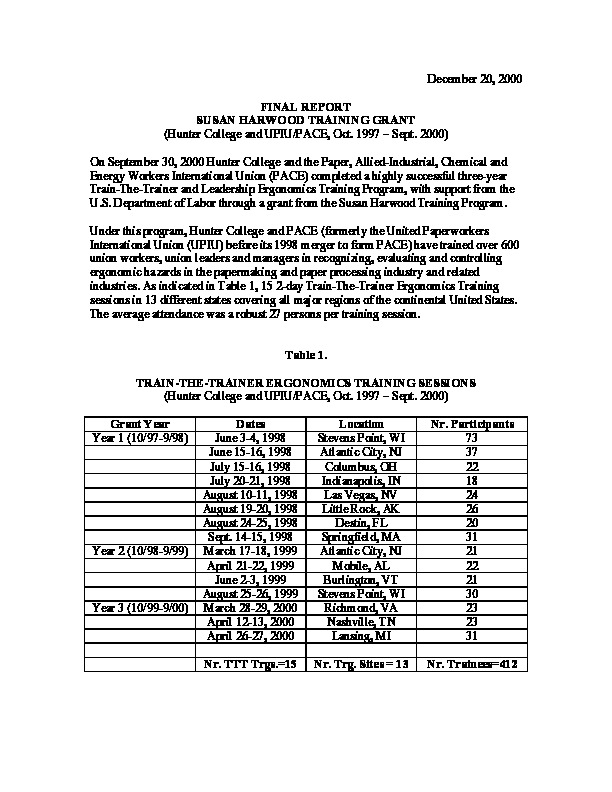
industries. As indicated in Table 1, 15 2-day Train-The-Trainer Ergonomics Training
sessions in 13 different states covering all major regions of the continental United States.
The average attendance was a robust 27 persons per training session.
Table 1.
TRAIN-THE-TRAINER ERGONOMICS TRAINING SESSIONS
(Hunter College and UPIU/PACE, Oct. 1997 — Sept. 2000)
Grant Year Dates Location Nr. Participants
Year | (10/97-9/98) June 3-4, 1998 Stevens Point, WI 73
June 15-16, 1998 Atlantic City, NJ 37
July 15-16, 1998 Columbus, OH 22
July 20-21, 1998 Indianapolis, IN 18
August 10-11, 1998 Las Vegas, NV 24
August 19-20, 1998 Little Rock, AK 26
August 24-25, 1998 Destin, FL 20
Sept. 14-15, 1998 Springfield, MA 31
Year 2 (10/98-9/99) | March 17-18, 1999 Atlantic City, NJ 21
April 21-22, 1999 Mobile, AL 22
June 2-3, 1999 Burlington, VT 21
August 25-26, 1999 Stevens Point, WI 30
Year 3 (10/99-9/00) | March 28-29, 2000 Richmond, VA 23
April 12-13, 2000 Nashville, TN 23
April 26-27, 2000 Lansing, MI 31
Nr. TTT Trgs.=15_| Nr. Trg. Sites =13 | Nr. Trainees=412
In addition, starting in Grant Year 2 (1998-1999), a series of four highly popular 16-hour
Leadership Ergonomics Training sessions were conducted to provide union leaders with
knowledge about ergonomics hazards and their controls so that they could better
understand these problems and thus help provide the necessary support and leadership to
their members. Over 200 persons were trained in these four sessions, which were held in
Cincinnati, Milwaukee and Nashville (avg. attendance 53 persons per session). (Table 2)
Because of the popularity of these sessions, and the unique opportunity for leadership
training that they provided, two of the sessions were allowed to be highly oversubscribed,
at the union's request -- 73 and 88 persons in Nashville and Milwaukee, respectively.
Both sessions were the last ones that grant year, and thus each was a final (or possibly
final) ergonomics leadership training opportunity.
Table 2.
ERGONOMICS LEADERSHIP TRAINING SESSIONS
(Hunter College and UPIU/PACE, Oct. 1997 — Sept. 2000)
Grant Year Dates Location Nr. Participants
Year 2 (10/98-9/99) June 16-17, 1999 Cincinnati, OH 18
Sept. 22-23, 1999 Milwaukee, WI 88
Year 3 (10/99-9/00) May 17-18, 2000 Milwaukee, WI 37
June 21-22, 2000 Nashville, TN 73
Nr. Trainees=216
Nr. Ldrshp.Trgs=4 | Nr. Trg. Sites =3
TRAINING MATERIALS/CURRICULUM
An essential feature of this program was the development of an ergonomics hazard
awareness curriculum and training materials, which were reviewed and approved by
OSHA and distributed to every participant in the train-the-trainer classes. The three-hour
awareness course was piloted during Grant Year | (1997-1998) both for the health and
safety committee at a paper plant in Franklin, Virginia and before a group of shop
stewards of locals in New York City. Revisions in the curriculum and training materials
were made based on focus groups, site visits, and these pilot ergonomics hazard
awareness sessions.
-2-
From then on during the program, every train-the-trainer participant received a manual to
assist in conducting a three-hour ergonomics awareness course at his/her plant, which
consisted of:
An awareness course agenda
An awareness course script
A set of 30 overhead transparencies for use in the awareness course
A list of additional resources on ergonomics
Master copies of awareness course sign-in sheets and evaluation forms
A master copy of a trainer log and self-evaluation form
In addition, each train-the-trainer participant received:
e Acopy of the videotape that was developed to assist in teaching the awareness
course. The videotape contains footage of a paper industry job with
ergonomics hazards that was used to help trainees recognize risk factors and
develop solutions. Title pages and credits were added to produce a more
polished product.
e A master copy of the ergonomics handbook developed for use in the train-the-
trainer course (see below) so that trainers could make copies of all or parts of
it for awareness course participants.
The core training material developed by Hunter College and the union for the train-the-
trainer program was a 61page Ergonomic Packet consisting of:
e A booklet, entitled “Working Without Pain: A Paperworker’s Guide to
Improving Jobs,” which uses examples from the paper industry to illustrate
ergonomics principles.
e Nine factsheets on issues such as preventing back injuries, evaluating and
improving hand tools, convincing management to participate in ergonomics
activities and protecting workers’ rights.
e A list of ergonomics-related websites and other ergonomics resources
The materials for the train-the-trainer course also included classroom exercises and other
handouts to reinforce the basics of ergonomics and adult education. However, although
the trainers left the course well prepared to teach the awareness course, it was recognized
that many would want additional information as they planned and implemented their
ergonomics training activities. The materials on additional resources, such as lists of
ergonomics web sites, were developed to allow them to do so. All materials for the two-
day train-the-trainer course were also reviewed and approved by OSHA.
During Grant Year 2 (1998-1999), a supplementary handout entitled Frequently Asked
Questions(FAQs) was developed and approved by OSHA. The handout was designed to
help fill in information gaps in the materials and resources distributed in earlier train-the-
trainer sessions. It was then mailed out to all previous Year 1 and Year 2 train-the-trainer
3-
participants, and incorporated into the ergonomics packets distributed to all later train-the-
trainer and leadership-training participants. Further minor modifications of the ergonomics
information packets were made during grant Year 3, including updating the list of website
and other ergonomics resources. Also during Grant Year 3, as result of the union merger
creating the new international union PACE, all of the cover pages and text of the training
materials was modified to reflect this change.
Thus as a result of the ergonomics training sessions conducted under the Susan Harwood
Program, over 600 copies each of “Working Without Pain,” sets of 30 training
transparencies, training videotapes, FAQs and set of ergonomics factsheets were
distributed nationally to members of the PACE International Union. These plus the
knowledge the participants gained from the training courses represents a major long-term
resource for this union and the paper industry as those involved try to identify, evaluate
and control workplace ergonomics hazards.
In addition to the above materials distributed, during Grant Year 3 copies of the
ergonomics informational packets were sent out to the over 700 paper local presidents
within the PACE union. Each of these packets contained a copy of the Working Without
Pain booklet and nine factsheets on ergonomics. These were intended as resource packets
for union officers, particularly those who were not able to attend one of the training
courses. The packet was designed to increase awareness among union leaders and help
them to support local ergonomics activities.
TRAINING COURSE EVALUATIONS
A. TRAIN THE TRAINER COURSES
Participant Evaluation: Throughout the three-year program period, the 16-hour train-the-
trainer courses were highly successful in terms of participant satisfaction.
During Grant Year 1 (1997-1998), for the eight train-the-trainer classes combined, 96% of
all evaluation questionnaire respondents found the course useful or very useful. Ninety-
two percent of the respondents found the course interesting or very interesting. Ninety-five
percent of the respondents reported that the train-the-trainer program met their needs and
introduced new materials. At three of the eight sites, 100% of respondents rated the course
as good or very good in all aspects. (The most common course strengths identified were:
instructors, basic information on ergonomics, chance to share ideas between plants and to
practice teaching and opportunity to attend joint labor-management course. As for course
weaknesses, participants wanted more time (longer course), more technical information on
ergonomics, and more information and discussion on organizational impediments to
change (such as how to get management support for an ergonomics
program/improvements, implications of job changes such as rotation and automation)
These comments were reviewed by project staff, and modifications made in so far as
possible.
-4.
During Grant Year 2 (1998-1999), for the four train-the-trainer courses combined, 98%
of all evaluation questionnaire respondents found the course useful or very useful.
Ninety-four percent of the respondents found the course interesting or very interesting.
Ninety-nine percent of the respondents reported that the train-the-trainer program met
their needs, and 97% said they were introduced to new materials.
During Grant Year 3 (1999-2000), for the three train-the-trainer courses combined, 100%
of all respondents (88% participation rate) found the course useful or very useful. Also all
(100%) found the course interesting or very interesting. Ninety-eight and one-half percent
of the respondents reported that the train-the-trainer program met their needs, and the
same percentage said they were introduced to new materials.
Table 3.
SUMMARY OF PARTICIPANT COURSE EVALUATIONS
TRAIN THE TRAINER TRAINING COURSES
(Hunter College and UPIU/PACE, Oct. 1997 — Sept. 2000)
Grant Year Pct. Useful or | Pct. Interesting or Pet. Pct. Intded to
Very Useful Very Interesting | Met Needs | New Materials
1. 1997-1998 96% 92% 95% 95%
2. 1998-1999 98% 94% 99% 97%
3. 1999-2000 100% 100% 98.5% 98.5%
Overall Pct.:* 97.2% 94.0% 96.6% 96.1%
* Overall percentages weighted by numbers of course participants during each grant year.
The above results, and also the consistency of improvements in participant ratings over
the course of the three-year program, were especially satisfying to the Hunter and PACE
trainers and program staff. For a training population this large and this varied, from all
parts of the continental U.S., these overall percentages are notably large.
Precourse/Postcourse Testing Results: For each train-the-trainer course, the Hunter and
PACE staff evaluated how well we achieved our learning objectives for the train-the-
trainer course by administering a ten-question test at the beginning and the end of each
two-day session to assess changes in knowledge attributable to the course. During grant
Year 1, 65 percent of the 241 participants filled out both the pre- and post-course
questionnaires. This percentage increased during the course of the three-year program. By
Grant Year 3, 88 percent filled out both questionnaires. The results demonstrate that this
training project raised participants’ awareness and understanding of ergonomics issues to a
higher level.
During Grant Year 1 (1997-1998), following the trainings, the average score for all groups
was 90%, an average increase of 12 percentage points from the pre-test results.
The increase in knowledge was most marked for a subset of five questions for which the
initial test scores were consistently lower than the others. (The average participant
answered only 66% of these questions correctly in the pre-test). Post-test scores for these
questions went up an average of 19 percentage points. Improvement was most significant
for the six training sessions with the lowest initial scores (less than 70% of the five
questions answered correctly), with increases for this subset of trainees between 19 and
27 points.
During Grant Year 2 (1998-1999), the average score of all four of the sessions prior to
the training was 80%. Following the two-day training, the average score was 94% -- an
increase of 14 percentage points from the pre-test. The most significant improvement
came from the question related to the use of back belts. Prior to the training, many
participants believed that back belts and other personal protective equipment were
effective ways to prevent overuse injuries (51%). By the end of the training, 97% of the
participants understood that back belts and other such devices have not been shown to
prevent overuse injuries, an improvement of 48%. Significant improvement was also seen
in the question related to surgery for carpal tunnel syndrome. Forty-two percent of the
participants thought that after a successful surgery for carpal tunnel syndrome, workers
could safely return to their regular jobs. However, after the training 87% of the
participants recognized that a hazardous job may have to be modified to ensure that
workers can safely return to work following surgery.
During Grant Year 3 (1999-2000), the pre-course average score of 83 percent, rose to a
post-course average score of 97 percent, an increase of 14 percentage points. These
results are presented in the Table below:
Table 4.
SUMMARY OF PRECOURSE-POSTCOURSE TEST SCORES
TRAIN-THE-TRAINER COURSES
(Hunter College and UPIU/PACE, Oct. 1997 — Sept. 2000)
Grant Year Test Score Test Score Percentage Point
(Pre-Course) (Post-Course) Increase
1. 1997-1998 78% 90% +12%
2. 1998-1999 80% 94% +14%
3. 1999-2000 83% 97% +14%
Overall Pct.:* 79.4% 92.2% +12.8%
* Overall percentages weighted by numbers of course participants during each grant year.
The above summary scores indicate that throughout this three-year training program
participants consistently improved their test performances as result of this training, as
indicated especially by the results in the average percentage-point increases in scores
(right-hand column). In addition, the post-course test scores rose consistently over the
three years, but it should be noted that the pre-test scores did also — perhaps a tribute to
the broader educational efforts of the union, as well as the renewed interest by union
members in ergonomics as a result of this training program. Thus for example the
national union newspaper ran a number of articles about the program, which both
educated members and promoted participation in this training effort.
B. LEADERSHIP TRAINING COURSES
Participant Evaluation: The 16-hour leadership training courses, initiated in Grant Year
2, were highly successful in terms of participant satisfaction.
During Grant Year 2 (1998-1999), the first leadership training course was offered in
Cincinnati, Ohio on June 16-17, 1999 to 18 participants from seven unionized plants. The
course was very well received -- all participants (100%) thought the course was useful or
very useful; met their needs; introduced new materials; and was interesting or very
interesting. The second leadership course, conducted on September 22-23, 1999 in
Milwaukee, Wisconsin, was highly over-subscribed, with 88 participants from 32 different
plants. It was also well received, but not surprisingly was not as well received as the first
leadership training. Specifically 81% of the respondents thought the course was useful or
very useful; 85% felt the course met their needs; 90% were introduced to new materials;
and 77 % thought the course was interesting or very interesting. We attribute these less
highly positive ratings to the large class size. (Prior to the class, when registration was
increasing to numbers beyond our expectations, we struggled with the decision of whether
to limit class size or to maximize the number of participants we would reach. The union
strongly urged us to accommodate anyone interested in attending. Given the limited
number of worker training opportunities, especially ones where the costs to the union and
its locals are partially subsidized, we agreed to do so. However, as we expected, many
found that the large class size detracted from their learning experience. Also several plants
in the Milwaukee area already had sophisticated ergonomics programs in place, and hence
they needed more advanced ergonomics training than was offered.)
During Grant Year 3 (1999-2000), a total of 100 persons attended the two leadership
training courses, of whom 83 filled out the evaluation forms (83% participation rate).
Again the last training course was over-subscribed, with 73 persons in the Nashville
course. Ninety percent of the participants in both courses thought the course was useful
or very useful, 89% felt the course met their needs, 98% were introduced to new
materials, and 88% thought the course was interesting or very interesting. The results of
the participant evaluations of the leadership training courses by grant year are presented
in the Table below:
Table 5.
SUMMARY OF PARTICIPANT COURSE EVALUATIONS
LEADERSHIP TRAINING COURSES
(Hunter College and UPIU/PACE, Oct. 1997 — Sept. 2000)
Grant Year Pct. Useful or | Pct. Interesting or Pet. Pct. Intded to
Very Useful Very Interesting | Met Needs | New Materials
2. 1998-1999 100% 100% 100% 100%
3. 1999-2000 90% 88% 89% 98%
Overall Pct.:* 94.9% 93.9% 94.4% 99.0%
* Overall percentages weighted by numbers of course participants during each grant year.
-7-
Overall these evaluation results were satisfying, and are quite comparable to the results
from the train-the-trainer courses (see Table above). It should also be noted that
evaluations of these trainings by representatives of the U. S. Department of Labor/OSHA
were also quite positive. Thus in a letter to Program Director Dr. David Kotelchuck, dated
July 7, 2000, Linda Forsyth, ARA/TECFAP in the Region II OSHA Office, reported that
OSHA representative Paul Todd of the Nashville Area Office was “extremely positive”
about the Nashville Leadership Training course.
Precourse/Postcourse Testing Results: As in the train-the-trainer courses, pre- and post-
course tests were administered during all leadership training courses to assess whether our
learning objectives had been met. However the questions were slightly different in the
leadership trainings (and more appropriate for union leaders), so the results from the two
types of trainings are not precisely comparable. The results for the leadership trainings
demonstrate that here too the training program raised participants’ awareness and
understanding of ergonomics issues to a higher level.
During Grant Year 2, the pre- and post-course results showed an average increase of 12
percentage points for the smaller Cincinnati class and of 11 percentage points in the
larger Milwaukee class. Thus in terms of participant progress as measured by test scores
(rather than subjective criteria), the two courses demonstrated comparable results. Again,
for certain questions, the percent increase was quite impressive — 30 percent for the back
belt question and 44 percent for the question on whether you need a doctor’s diagnosis to
trigger the OSHA 200 Log reporting requirements. In the pre-test, 54% of the participants
in the leadership trainings thought a doctors’ diagnosis was needed for an overuse injury
to be recordable. After the course, 92% of the participants understood that a doctor’s
diagnosis was not necessary, that other criteria may be met to trigger the OSHA
recording requirements for overuse injuries.
During Grant Year 3, the Milwaukee leadership training course showed an average
increase of 11 percentage points for the pre- post-course differences, and the more largely
subscribed Nashville course a larger 13 percent increase. Thus for this grant year, the
weighted average percentage point increase in test scores was 12.3 percent.
Overall the weighted average percentage point increase in pre-/ post-course tests for the
leadership trainings was 11.8 percentage points, with 11.2 in Grant Year 2 and 12.3 in
Grant Year 3. This is comparable to the 12.8 percentage point gains registered by the
train-the-trainer participants in a slightly different test. The results in both cases are
positive and gratifying, and help confirm the value of such ergonomics training.
FOLLOWUP TRAINING
About two months after each train-the-trainer course. each participant received a letter
reminding them to send in their trainer log forms and sign-in sheets when their awareness
trainings were completed. They were also reminded that Hunter College and the PACE
-8-
Health and Safety Department are available for technical and program support. About
four months after each training, each participant was called by the PACE Program
Coordinator to find out whether their trainings had been conducted and to report on
ergonomic changes which had been made in their plant as result of activities following up
on the course. A telephone script and tracking form were developed to assist the Program
Coordinator in her/his efforts.
Based on these reports, we have confirmed the following numbers of persons given
awareness training at the local level by participants in this program:
Table 6.
NUMBERS OF AWARENESS TRAINEES
TAUGHT BY ERGONOMICS PROGRAM PARTICIPANTS
Grant Year Numbers Trained (Confirmed)
1, 1997 - 1998 2494
2. 1998 — 1999 1956
3. 1999 — 2000 1568
Total: 6018
The awareness trainings reported in the above Table are from 56 different plants in the
paper industry throughout the U.S. We believe that many more such trainings have taken
place as a result of this program, but these have occurred after the six-month follow-up
telephone calling period. Those that were reported informally to union officials are
included in the above Table, but we believe many more have been missed due to limited
communication or lack of communication about these due to the press of other urgent
union activities, for example contract negotiations, grievances, activities around possible
plant closings, etc.
The above results reveal a positive multiplier effect of our train-the-trainer and leadership
trainings. Thus while we have reported over 600 persons trained in our train-the-trainer
and leadership training courses, these 600 persons have already taught a confirmed 6,000
persons more in their local and regional areas — a multiplier factor of 10. We consider it
quite possible that this number could in fact be twice as large, and that the true multiplier
may be more like 20 or 25.
Another goal of this program, in addition to encouraging and supporting the presentation
of ergonomics awareness trainings at the local level, is to encourage positive change in
the workplace in the paper and related industries. This too has been accomplished as a
result of this program. Below are some examples of the workplace changes effected:
= The formation of joint labor management ergonomics task forces (reported at
many plants)
= Purchase of new lift tables
= Changing the heights of machines during operations
= Purchase of new equipment to assist in moving heavy rolls of paper (so-called
“roll-kickers”).
-9.
During the past year the following have been reported, with the companies involved:
= Ata Norton plant, after an ergonomic job analysis was conducted, a number of
employee chairs were changed from rigid, non-adjustable to adjustable ones with
arm rests.
= Ata Weyerhauser plant, all course participants were solicited to give their ideas
about specific ergonomic improvements which should/need to be made at the
plant, and many of these are now in the process of being implemented.
= Attendees from CK Witco reported that several workspaces were redesigned to
reduce strain and twisting, and plans are being made to automate parts of some
jobs.
= At Glad Manufacturing, automatic palletizing has been installed to eliminate hand
shrink-wrapping.
= At Champion, plant workers have asked the plant management to change the way
that the company handles injuries, so that they "look at the job instead of the
worker."
= At the Smurfit-Stone plant, all employees were given ergonomics training, and
job rotation and mechanical lifting aids were introduced.
= At SAPPI, the company has developed a set of its own slides for ergonomics
training, and plans to re-engineer several jobs.
= At Pacon Corp., an ergonomics committee has been formed, and problem areas
have been identified.
= At Pekin Paperboard the company with union cooperation has given out surveys
to employees, and will base action on the results.
At the same time it must be admitted that many impediments to progress in this area still
exist. Some companies have not agreed to participate in ergonomics trainings or related
activities due to plant closings and downsizing, resulting in some cases in the elimination
of safety committees, and changes in management with new management not supporting
the ergonomics training program. However in these situations the union has its own
independent resources and now expertise in conducting awareness trainings.
ACHIEVING PROGRAM GOALS
The Hunter/PACE ergonomics training program has successfully accomplished its
training goals during the past three years. Specifically the program has successfully
offered and completed 19 train-the-trainer and ergonomics leadership-training courses
over this three-year period. (Tables 1 and 2) This represents 90 percent of the 21 training
courses it originally proposed to carry out — two courses (in Salt Lake City and
Louisville) were cancelled due to low enrollment during 1999. This largely resulted from
the 1999 merger of the UPIU and OCAW International Unions to form the PACE
International Union. The merger convention and other related activities strained local
budgets and limited additional activities locals could support during that year.
Most importantly, in term of participation in the ergonomics courses offered, this
program achieved 94 percent of its goal of participants trained — training a total of 628
-10-
persons out of our three-year goal of 665 persons trained. (Tables | and 2) The results by
year and type of training course are presented below:
Table 7.
ATTENDANCE AT ERGONOMICS TRAINING COURSES
(Hunter College and UPIU/PACE, Oct. 1997 — Sept. 2000)
Grant Year Nr. Trained Numerical Goals Pct. Of Goal
Achieved
TTT Courses:*
Year 1 (1997-1998) 241 280 86%
Year 2 (1998-1999) 94 140 67%
Year 3 (1999-2000) 71 105 73%
Subtotals: (412) (525) (78%)
Leadership Courses:
Year 2 (1998-1999) 106 70 151%
Year 3 (1999-2000) 110 70 157%
Subtotals: (216) (140) (154%)
Totals: 628 665 94%
* TTT Courses = Train-The-Trainer courses
As noted in Table 7, we achieved only 78 percent of our attendance goals in the train-the-
trainer courses, but these were compensated for, so to speak, by exceeding our goals for
the leadership courses (154%).
We published all of the training materials we had proposed, plus made revisions in our
packets and fact sheets to keep them up to date. Also the FAQs publication was decided
on to respond to worker/trainer needs.
Finally our goal for reaching union members and managers with local and regional
ergonomics awareness training was to reach 7,456 persons over the three-year program
period. We achieved confirmed training of 6,018 persons, 81 percent of our awareness
training goal. Since we believe that many more persons, perhaps twice as many, received
such awareness training as a result of program efforts we believe our awareness training
goals were more than amply achieved.
-l1-
FINAL REPORT
SUSAN HARWOOD TRAINING GRANT
(Hunter College and UPIU/PACE, Oct. 1997 — Sept. 2000)
On September 30, 2000 Hunter College and the Paper, Allied-Industrial, Chemical and
Energy Workers International Union (PACE) completed a highly successful three-year
Train-The-Trainer and Leadership Ergonomics Training Program, with support from the
U.S. Department of Labor through a grant from the Susan Harwood Training Program.
Under this program, Hunter College and PACE (formerly the United Paperworkers
International Union (UPIU) before its 1998 merger to form PACE) have trained over 600
union workers, union leaders and managers in recognizing, evaluating and controlling
ergonomic hazards in the papermaking and paper processing industry and related
industries. As indicated in Table 1, 15 2-day Train-The-Trainer Ergonomics Training
sessions in 13 different states covering all major regions of the continental United States.
The average attendance was a robust 27 persons per training session.
Table 1.
TRAIN-THE-TRAINER ERGONOMICS TRAINING SESSIONS
(Hunter College and UPIU/PACE, Oct. 1997 — Sept. 2000)
Grant Year Dates Location Nr. Participants
Year | (10/97-9/98) June 3-4, 1998 Stevens Point, WI 73
June 15-16, 1998 Atlantic City, NJ 37
July 15-16, 1998 Columbus, OH 22
July 20-21, 1998 Indianapolis, IN 18
August 10-11, 1998 Las Vegas, NV 24
August 19-20, 1998 Little Rock, AK 26
August 24-25, 1998 Destin, FL 20
Sept. 14-15, 1998 Springfield, MA 31
Year 2 (10/98-9/99) | March 17-18, 1999 Atlantic City, NJ 21
April 21-22, 1999 Mobile, AL 22
June 2-3, 1999 Burlington, VT 21
August 25-26, 1999 Stevens Point, WI 30
Year 3 (10/99-9/00) | March 28-29, 2000 Richmond, VA 23
April 12-13, 2000 Nashville, TN 23
April 26-27, 2000 Lansing, MI 31
Nr. TTT Trgs.=15_| Nr. Trg. Sites =13 | Nr. Trainees=412
In addition, starting in Grant Year 2 (1998-1999), a series of four highly popular 16-hour
Leadership Ergonomics Training sessions were conducted to provide union leaders with
knowledge about ergonomics hazards and their controls so that they could better
understand these problems and thus help provide the necessary support and leadership to
their members. Over 200 persons were trained in these four sessions, which were held in
Cincinnati, Milwaukee and Nashville (avg. attendance 53 persons per session). (Table 2)
Because of the popularity of these sessions, and the unique opportunity for leadership
training that they provided, two of the sessions were allowed to be highly oversubscribed,
at the union's request -- 73 and 88 persons in Nashville and Milwaukee, respectively.
Both sessions were the last ones that grant year, and thus each was a final (or possibly
final) ergonomics leadership training opportunity.
Table 2.
ERGONOMICS LEADERSHIP TRAINING SESSIONS
(Hunter College and UPIU/PACE, Oct. 1997 — Sept. 2000)
Grant Year Dates Location Nr. Participants
Year 2 (10/98-9/99) June 16-17, 1999 Cincinnati, OH 18
Sept. 22-23, 1999 Milwaukee, WI 88
Year 3 (10/99-9/00) May 17-18, 2000 Milwaukee, WI 37
June 21-22, 2000 Nashville, TN 73
Nr. Trainees=216
Nr. Ldrshp.Trgs=4 | Nr. Trg. Sites =3
TRAINING MATERIALS/CURRICULUM
An essential feature of this program was the development of an ergonomics hazard
awareness curriculum and training materials, which were reviewed and approved by
OSHA and distributed to every participant in the train-the-trainer classes. The three-hour
awareness course was piloted during Grant Year | (1997-1998) both for the health and
safety committee at a paper plant in Franklin, Virginia and before a group of shop
stewards of locals in New York City. Revisions in the curriculum and training materials
were made based on focus groups, site visits, and these pilot ergonomics hazard
awareness sessions.
-2-
From then on during the program, every train-the-trainer participant received a manual to
assist in conducting a three-hour ergonomics awareness course at his/her plant, which
consisted of:
An awareness course agenda
An awareness course script
A set of 30 overhead transparencies for use in the awareness course
A list of additional resources on ergonomics
Master copies of awareness course sign-in sheets and evaluation forms
A master copy of a trainer log and self-evaluation form
In addition, each train-the-trainer participant received:
e Acopy of the videotape that was developed to assist in teaching the awareness
course. The videotape contains footage of a paper industry job with
ergonomics hazards that was used to help trainees recognize risk factors and
develop solutions. Title pages and credits were added to produce a more
polished product.
e A master copy of the ergonomics handbook developed for use in the train-the-
trainer course (see below) so that trainers could make copies of all or parts of
it for awareness course participants.
The core training material developed by Hunter College and the union for the train-the-
trainer program was a 61page Ergonomic Packet consisting of:
e A booklet, entitled “Working Without Pain: A Paperworker’s Guide to
Improving Jobs,” which uses examples from the paper industry to illustrate
ergonomics principles.
e Nine factsheets on issues such as preventing back injuries, evaluating and
improving hand tools, convincing management to participate in ergonomics
activities and protecting workers’ rights.
e A list of ergonomics-related websites and other ergonomics resources
The materials for the train-the-trainer course also included classroom exercises and other
handouts to reinforce the basics of ergonomics and adult education. However, although
the trainers left the course well prepared to teach the awareness course, it was recognized
that many would want additional information as they planned and implemented their
ergonomics training activities. The materials on additional resources, such as lists of
ergonomics web sites, were developed to allow them to do so. All materials for the two-
day train-the-trainer course were also reviewed and approved by OSHA.
During Grant Year 2 (1998-1999), a supplementary handout entitled Frequently Asked
Questions(FAQs) was developed and approved by OSHA. The handout was designed to
help fill in information gaps in the materials and resources distributed in earlier train-the-
trainer sessions. It was then mailed out to all previous Year 1 and Year 2 train-the-trainer
3-
participants, and incorporated into the ergonomics packets distributed to all later train-the-
trainer and leadership-training participants. Further minor modifications of the ergonomics
information packets were made during grant Year 3, including updating the list of website
and other ergonomics resources. Also during Grant Year 3, as result of the union merger
creating the new international union PACE, all of the cover pages and text of the training
materials was modified to reflect this change.
Thus as a result of the ergonomics training sessions conducted under the Susan Harwood
Program, over 600 copies each of “Working Without Pain,” sets of 30 training
transparencies, training videotapes, FAQs and set of ergonomics factsheets were
distributed nationally to members of the PACE International Union. These plus the
knowledge the participants gained from the training courses represents a major long-term
resource for this union and the paper industry as those involved try to identify, evaluate
and control workplace ergonomics hazards.
In addition to the above materials distributed, during Grant Year 3 copies of the
ergonomics informational packets were sent out to the over 700 paper local presidents
within the PACE union. Each of these packets contained a copy of the Working Without
Pain booklet and nine factsheets on ergonomics. These were intended as resource packets
for union officers, particularly those who were not able to attend one of the training
courses. The packet was designed to increase awareness among union leaders and help
them to support local ergonomics activities.
TRAINING COURSE EVALUATIONS
A. TRAIN THE TRAINER COURSES
Participant Evaluation: Throughout the three-year program period, the 16-hour train-the-
trainer courses were highly successful in terms of participant satisfaction.
During Grant Year 1 (1997-1998), for the eight train-the-trainer classes combined, 96% of
all evaluation questionnaire respondents found the course useful or very useful. Ninety-
two percent of the respondents found the course interesting or very interesting. Ninety-five
percent of the respondents reported that the train-the-trainer program met their needs and
introduced new materials. At three of the eight sites, 100% of respondents rated the course
as good or very good in all aspects. (The most common course strengths identified were:
instructors, basic information on ergonomics, chance to share ideas between plants and to
practice teaching and opportunity to attend joint labor-management course. As for course
weaknesses, participants wanted more time (longer course), more technical information on
ergonomics, and more information and discussion on organizational impediments to
change (such as how to get management support for an ergonomics
program/improvements, implications of job changes such as rotation and automation)
These comments were reviewed by project staff, and modifications made in so far as
possible.
-4.
During Grant Year 2 (1998-1999), for the four train-the-trainer courses combined, 98%
of all evaluation questionnaire respondents found the course useful or very useful.
Ninety-four percent of the respondents found the course interesting or very interesting.
Ninety-nine percent of the respondents reported that the train-the-trainer program met
their needs, and 97% said they were introduced to new materials.
During Grant Year 3 (1999-2000), for the three train-the-trainer courses combined, 100%
of all respondents (88% participation rate) found the course useful or very useful. Also all
(100%) found the course interesting or very interesting. Ninety-eight and one-half percent
of the respondents reported that the train-the-trainer program met their needs, and the
same percentage said they were introduced to new materials.
Table 3.
SUMMARY OF PARTICIPANT COURSE EVALUATIONS
TRAIN THE TRAINER TRAINING COURSES
(Hunter College and UPIU/PACE, Oct. 1997 — Sept. 2000)
Grant Year Pct. Useful or | Pct. Interesting or Pet. Pct. Intded to
Very Useful Very Interesting | Met Needs | New Materials
1. 1997-1998 96% 92% 95% 95%
2. 1998-1999 98% 94% 99% 97%
3. 1999-2000 100% 100% 98.5% 98.5%
Overall Pct.:* 97.2% 94.0% 96.6% 96.1%
* Overall percentages weighted by numbers of course participants during each grant year.
The above results, and also the consistency of improvements in participant ratings over
the course of the three-year program, were especially satisfying to the Hunter and PACE
trainers and program staff. For a training population this large and this varied, from all
parts of the continental U.S., these overall percentages are notably large.
Precourse/Postcourse Testing Results: For each train-the-trainer course, the Hunter and
PACE staff evaluated how well we achieved our learning objectives for the train-the-
trainer course by administering a ten-question test at the beginning and the end of each
two-day session to assess changes in knowledge attributable to the course. During grant
Year 1, 65 percent of the 241 participants filled out both the pre- and post-course
questionnaires. This percentage increased during the course of the three-year program. By
Grant Year 3, 88 percent filled out both questionnaires. The results demonstrate that this
training project raised participants’ awareness and understanding of ergonomics issues to a
higher level.
During Grant Year 1 (1997-1998), following the trainings, the average score for all groups
was 90%, an average increase of 12 percentage points from the pre-test results.
The increase in knowledge was most marked for a subset of five questions for which the
initial test scores were consistently lower than the others. (The average participant
answered only 66% of these questions correctly in the pre-test). Post-test scores for these
questions went up an average of 19 percentage points. Improvement was most significant
for the six training sessions with the lowest initial scores (less than 70% of the five
questions answered correctly), with increases for this subset of trainees between 19 and
27 points.
During Grant Year 2 (1998-1999), the average score of all four of the sessions prior to
the training was 80%. Following the two-day training, the average score was 94% -- an
increase of 14 percentage points from the pre-test. The most significant improvement
came from the question related to the use of back belts. Prior to the training, many
participants believed that back belts and other personal protective equipment were
effective ways to prevent overuse injuries (51%). By the end of the training, 97% of the
participants understood that back belts and other such devices have not been shown to
prevent overuse injuries, an improvement of 48%. Significant improvement was also seen
in the question related to surgery for carpal tunnel syndrome. Forty-two percent of the
participants thought that after a successful surgery for carpal tunnel syndrome, workers
could safely return to their regular jobs. However, after the training 87% of the
participants recognized that a hazardous job may have to be modified to ensure that
workers can safely return to work following surgery.
During Grant Year 3 (1999-2000), the pre-course average score of 83 percent, rose to a
post-course average score of 97 percent, an increase of 14 percentage points. These
results are presented in the Table below:
Table 4.
SUMMARY OF PRECOURSE-POSTCOURSE TEST SCORES
TRAIN-THE-TRAINER COURSES
(Hunter College and UPIU/PACE, Oct. 1997 — Sept. 2000)
Grant Year Test Score Test Score Percentage Point
(Pre-Course) (Post-Course) Increase
1. 1997-1998 78% 90% +12%
2. 1998-1999 80% 94% +14%
3. 1999-2000 83% 97% +14%
Overall Pct.:* 79.4% 92.2% +12.8%
* Overall percentages weighted by numbers of course participants during each grant year.
The above summary scores indicate that throughout this three-year training program
participants consistently improved their test performances as result of this training, as
indicated especially by the results in the average percentage-point increases in scores
(right-hand column). In addition, the post-course test scores rose consistently over the
three years, but it should be noted that the pre-test scores did also — perhaps a tribute to
the broader educational efforts of the union, as well as the renewed interest by union
members in ergonomics as a result of this training program. Thus for example the
national union newspaper ran a number of articles about the program, which both
educated members and promoted participation in this training effort.
B. LEADERSHIP TRAINING COURSES
Participant Evaluation: The 16-hour leadership training courses, initiated in Grant Year
2, were highly successful in terms of participant satisfaction.
During Grant Year 2 (1998-1999), the first leadership training course was offered in
Cincinnati, Ohio on June 16-17, 1999 to 18 participants from seven unionized plants. The
course was very well received -- all participants (100%) thought the course was useful or
very useful; met their needs; introduced new materials; and was interesting or very
interesting. The second leadership course, conducted on September 22-23, 1999 in
Milwaukee, Wisconsin, was highly over-subscribed, with 88 participants from 32 different
plants. It was also well received, but not surprisingly was not as well received as the first
leadership training. Specifically 81% of the respondents thought the course was useful or
very useful; 85% felt the course met their needs; 90% were introduced to new materials;
and 77 % thought the course was interesting or very interesting. We attribute these less
highly positive ratings to the large class size. (Prior to the class, when registration was
increasing to numbers beyond our expectations, we struggled with the decision of whether
to limit class size or to maximize the number of participants we would reach. The union
strongly urged us to accommodate anyone interested in attending. Given the limited
number of worker training opportunities, especially ones where the costs to the union and
its locals are partially subsidized, we agreed to do so. However, as we expected, many
found that the large class size detracted from their learning experience. Also several plants
in the Milwaukee area already had sophisticated ergonomics programs in place, and hence
they needed more advanced ergonomics training than was offered.)
During Grant Year 3 (1999-2000), a total of 100 persons attended the two leadership
training courses, of whom 83 filled out the evaluation forms (83% participation rate).
Again the last training course was over-subscribed, with 73 persons in the Nashville
course. Ninety percent of the participants in both courses thought the course was useful
or very useful, 89% felt the course met their needs, 98% were introduced to new
materials, and 88% thought the course was interesting or very interesting. The results of
the participant evaluations of the leadership training courses by grant year are presented
in the Table below:
Table 5.
SUMMARY OF PARTICIPANT COURSE EVALUATIONS
LEADERSHIP TRAINING COURSES
(Hunter College and UPIU/PACE, Oct. 1997 — Sept. 2000)
Grant Year Pct. Useful or | Pct. Interesting or Pet. Pct. Intded to
Very Useful Very Interesting | Met Needs | New Materials
2. 1998-1999 100% 100% 100% 100%
3. 1999-2000 90% 88% 89% 98%
Overall Pct.:* 94.9% 93.9% 94.4% 99.0%
* Overall percentages weighted by numbers of course participants during each grant year.
-7-
Overall these evaluation results were satisfying, and are quite comparable to the results
from the train-the-trainer courses (see Table above). It should also be noted that
evaluations of these trainings by representatives of the U. S. Department of Labor/OSHA
were also quite positive. Thus in a letter to Program Director Dr. David Kotelchuck, dated
July 7, 2000, Linda Forsyth, ARA/TECFAP in the Region II OSHA Office, reported that
OSHA representative Paul Todd of the Nashville Area Office was “extremely positive”
about the Nashville Leadership Training course.
Precourse/Postcourse Testing Results: As in the train-the-trainer courses, pre- and post-
course tests were administered during all leadership training courses to assess whether our
learning objectives had been met. However the questions were slightly different in the
leadership trainings (and more appropriate for union leaders), so the results from the two
types of trainings are not precisely comparable. The results for the leadership trainings
demonstrate that here too the training program raised participants’ awareness and
understanding of ergonomics issues to a higher level.
During Grant Year 2, the pre- and post-course results showed an average increase of 12
percentage points for the smaller Cincinnati class and of 11 percentage points in the
larger Milwaukee class. Thus in terms of participant progress as measured by test scores
(rather than subjective criteria), the two courses demonstrated comparable results. Again,
for certain questions, the percent increase was quite impressive — 30 percent for the back
belt question and 44 percent for the question on whether you need a doctor’s diagnosis to
trigger the OSHA 200 Log reporting requirements. In the pre-test, 54% of the participants
in the leadership trainings thought a doctors’ diagnosis was needed for an overuse injury
to be recordable. After the course, 92% of the participants understood that a doctor’s
diagnosis was not necessary, that other criteria may be met to trigger the OSHA
recording requirements for overuse injuries.
During Grant Year 3, the Milwaukee leadership training course showed an average
increase of 11 percentage points for the pre- post-course differences, and the more largely
subscribed Nashville course a larger 13 percent increase. Thus for this grant year, the
weighted average percentage point increase in test scores was 12.3 percent.
Overall the weighted average percentage point increase in pre-/ post-course tests for the
leadership trainings was 11.8 percentage points, with 11.2 in Grant Year 2 and 12.3 in
Grant Year 3. This is comparable to the 12.8 percentage point gains registered by the
train-the-trainer participants in a slightly different test. The results in both cases are
positive and gratifying, and help confirm the value of such ergonomics training.
FOLLOWUP TRAINING
About two months after each train-the-trainer course. each participant received a letter
reminding them to send in their trainer log forms and sign-in sheets when their awareness
trainings were completed. They were also reminded that Hunter College and the PACE
-8-
Health and Safety Department are available for technical and program support. About
four months after each training, each participant was called by the PACE Program
Coordinator to find out whether their trainings had been conducted and to report on
ergonomic changes which had been made in their plant as result of activities following up
on the course. A telephone script and tracking form were developed to assist the Program
Coordinator in her/his efforts.
Based on these reports, we have confirmed the following numbers of persons given
awareness training at the local level by participants in this program:
Table 6.
NUMBERS OF AWARENESS TRAINEES
TAUGHT BY ERGONOMICS PROGRAM PARTICIPANTS
Grant Year Numbers Trained (Confirmed)
1, 1997 - 1998 2494
2. 1998 — 1999 1956
3. 1999 — 2000 1568
Total: 6018
The awareness trainings reported in the above Table are from 56 different plants in the
paper industry throughout the U.S. We believe that many more such trainings have taken
place as a result of this program, but these have occurred after the six-month follow-up
telephone calling period. Those that were reported informally to union officials are
included in the above Table, but we believe many more have been missed due to limited
communication or lack of communication about these due to the press of other urgent
union activities, for example contract negotiations, grievances, activities around possible
plant closings, etc.
The above results reveal a positive multiplier effect of our train-the-trainer and leadership
trainings. Thus while we have reported over 600 persons trained in our train-the-trainer
and leadership training courses, these 600 persons have already taught a confirmed 6,000
persons more in their local and regional areas — a multiplier factor of 10. We consider it
quite possible that this number could in fact be twice as large, and that the true multiplier
may be more like 20 or 25.
Another goal of this program, in addition to encouraging and supporting the presentation
of ergonomics awareness trainings at the local level, is to encourage positive change in
the workplace in the paper and related industries. This too has been accomplished as a
result of this program. Below are some examples of the workplace changes effected:
= The formation of joint labor management ergonomics task forces (reported at
many plants)
= Purchase of new lift tables
= Changing the heights of machines during operations
= Purchase of new equipment to assist in moving heavy rolls of paper (so-called
“roll-kickers”).
-9.
During the past year the following have been reported, with the companies involved:
= Ata Norton plant, after an ergonomic job analysis was conducted, a number of
employee chairs were changed from rigid, non-adjustable to adjustable ones with
arm rests.
= Ata Weyerhauser plant, all course participants were solicited to give their ideas
about specific ergonomic improvements which should/need to be made at the
plant, and many of these are now in the process of being implemented.
= Attendees from CK Witco reported that several workspaces were redesigned to
reduce strain and twisting, and plans are being made to automate parts of some
jobs.
= At Glad Manufacturing, automatic palletizing has been installed to eliminate hand
shrink-wrapping.
= At Champion, plant workers have asked the plant management to change the way
that the company handles injuries, so that they "look at the job instead of the
worker."
= At the Smurfit-Stone plant, all employees were given ergonomics training, and
job rotation and mechanical lifting aids were introduced.
= At SAPPI, the company has developed a set of its own slides for ergonomics
training, and plans to re-engineer several jobs.
= At Pacon Corp., an ergonomics committee has been formed, and problem areas
have been identified.
= At Pekin Paperboard the company with union cooperation has given out surveys
to employees, and will base action on the results.
At the same time it must be admitted that many impediments to progress in this area still
exist. Some companies have not agreed to participate in ergonomics trainings or related
activities due to plant closings and downsizing, resulting in some cases in the elimination
of safety committees, and changes in management with new management not supporting
the ergonomics training program. However in these situations the union has its own
independent resources and now expertise in conducting awareness trainings.
ACHIEVING PROGRAM GOALS
The Hunter/PACE ergonomics training program has successfully accomplished its
training goals during the past three years. Specifically the program has successfully
offered and completed 19 train-the-trainer and ergonomics leadership-training courses
over this three-year period. (Tables 1 and 2) This represents 90 percent of the 21 training
courses it originally proposed to carry out — two courses (in Salt Lake City and
Louisville) were cancelled due to low enrollment during 1999. This largely resulted from
the 1999 merger of the UPIU and OCAW International Unions to form the PACE
International Union. The merger convention and other related activities strained local
budgets and limited additional activities locals could support during that year.
Most importantly, in term of participation in the ergonomics courses offered, this
program achieved 94 percent of its goal of participants trained — training a total of 628
-10-
persons out of our three-year goal of 665 persons trained. (Tables | and 2) The results by
year and type of training course are presented below:
Table 7.
ATTENDANCE AT ERGONOMICS TRAINING COURSES
(Hunter College and UPIU/PACE, Oct. 1997 — Sept. 2000)
Grant Year Nr. Trained Numerical Goals Pct. Of Goal
Achieved
TTT Courses:*
Year 1 (1997-1998) 241 280 86%
Year 2 (1998-1999) 94 140 67%
Year 3 (1999-2000) 71 105 73%
Subtotals: (412) (525) (78%)
Leadership Courses:
Year 2 (1998-1999) 106 70 151%
Year 3 (1999-2000) 110 70 157%
Subtotals: (216) (140) (154%)
Totals: 628 665 94%
* TTT Courses = Train-The-Trainer courses
As noted in Table 7, we achieved only 78 percent of our attendance goals in the train-the-
trainer courses, but these were compensated for, so to speak, by exceeding our goals for
the leadership courses (154%).
We published all of the training materials we had proposed, plus made revisions in our
packets and fact sheets to keep them up to date. Also the FAQs publication was decided
on to respond to worker/trainer needs.
Finally our goal for reaching union members and managers with local and regional
ergonomics awareness training was to reach 7,456 persons over the three-year program
period. We achieved confirmed training of 6,018 persons, 81 percent of our awareness
training goal. Since we believe that many more persons, perhaps twice as many, received
such awareness training as a result of program efforts we believe our awareness training
goals were more than amply achieved.
-l1-
Title
Final Report for Susan Harwood Training Grant
Description
This report, produced by Hunter College's Center for Occupational and Environmental Health and the Paper, Allied-Industrial, Chemical and Energy Workers International Union (PACE), was created at the conclusion of their three-year, Susan Harwood Training Grant (10/1997 - 9/2000). The grant funded a "Train-the-Trainer and Leadership Ergonomics Program" and allowed the Center and union to train over 600 workers across 13 states on ergonomic issues in the "papermaking and processing industry." Those trained by the Center went on to train 6000 additional workers during the same three year period. The report includes training materials used, course and participant evaluations, and discussion of project goals and effects.
Formally established in 1990 by CUNY's Board of Trustees, the Hunter College Center for Occupational and Environmental Health was founded with the mission "to promote community and workplace health" across the New York metropolitan area. Working with community groups, unions, governmental agencies, private employers, and educational institutions, the Center educated hundreds of thousands over the course of its history.
Formally established in 1990 by CUNY's Board of Trustees, the Hunter College Center for Occupational and Environmental Health was founded with the mission "to promote community and workplace health" across the New York metropolitan area. Working with community groups, unions, governmental agencies, private employers, and educational institutions, the Center educated hundreds of thousands over the course of its history.
Contributor
Kotelchuck, David
Creator
Center for Occupational and Environmental Health at Hunter College
Date
December 20, 2000
Language
English
Rights
Creative Commons CDHA
Source
Center for Environmental and Occupational Health at Hunter College
Original Format
Report / Paper / Proposal
Center for Occupational and Environmental Health at Hunter College. Letter. “Final Report for Susan Harwood Training Grant.”, CUNY DIGITAL HISTORY ARCHIVE, accessed September 5, 2026, https://stephenz.tailc22a4b.ts.net/s/cdha/item/1182