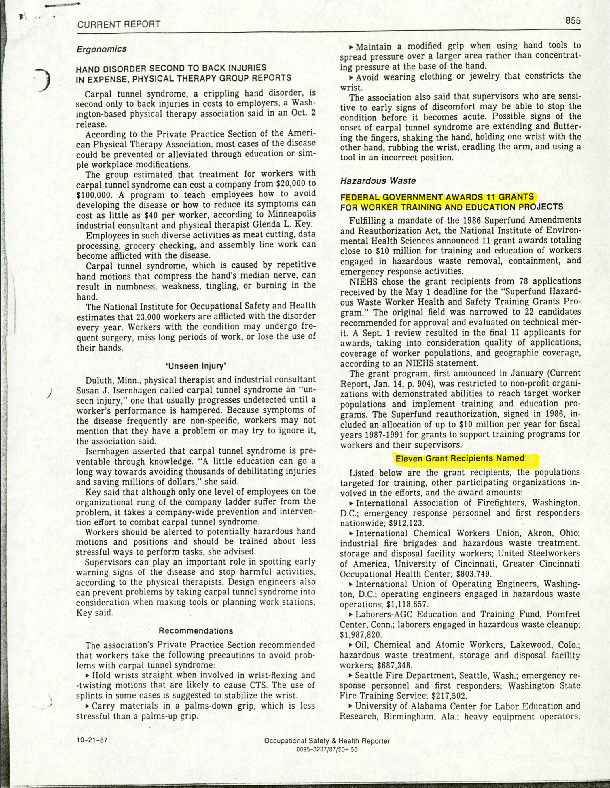
"Federal Government Awards 11 Grants for Worker Training and Education Projects"
Item
eames
ad
CURRENT REPORT
855
me
Ergonomics
HAND DISORDER SECOND TO BACK INJURIES
IN EXPENSE, PHYSICAL THERAPY GROUP REPORTS
Carpal tunnel syndrome, a crippling hand disorder, is
second only to back injuries in costs to employers, a Wash-
ington-based physical therapy association said in an Oct. 2
release.
According to the Private Practice Section of the Ameri-
can Physical Therapy Association, most cases of the disease
could be prevented or alleviated through education or sim-
ple workplace modifications.
The group estimated that treatment for workers with
carpal tunnel syndrome can cost a company from $20,000 to
$100,000. A program to teach employees how to avoid
developing the disease or how to reduce its symptoms can
cost as little as $40 per worker, according to Minneapolis
industrial consultant and physical therapist Glenda L. Key.
Employees in such diverse activities as meat cutting, data
processing, grocery checking, and assembly line work can
become afflicted with the disease.
Carpal tunnel syndrome, which is caused by repetitive
hand motions that compress the hand’s median nerve, can
result in numbness, weakness, tingling, or burning in the
hand.
The National Institute for Occupational Safety and Health
estimates that 23,000 workers are afflicted with the disorder
every year. Workers with the condition may undergo fre-
quent surgery, miss long periods of work, or lose the use of
their hands.
‘Unseen Injury’
Duluth, Minn., physical therapist and industrial consultant
Susan J. Isernhagen called carpal tunnel syndrome an “un-
seen injury,” one that usually progresses undetected until a
worker’s performance is hampered. Because symptoms of
the disease frequently are non-specific, workers may not
mention that they have a problem or may try to ignore it,
the association said.
Isernhagen asserted that carpal tunnel syndrome is pre-
ventable through knowledge. “A little education can go a
long way towards avoiding thousands of debilitating injuries
and saving millions of dollars,” she said.
Key said that although only one level of employees on the
organizational rung of the company ladder suffer from the
problem, it takes a company-wide prevention and interven-
tion effort to combat carpal tunnel syndrome.
Workers should be alerted to potentially hazardous hand
motions and positions and should be trained about less
stressful ways to perform tasks, she advised.
Supervisors can play an important role in spotting early
warning signs of the disease and stop harmful activities,
according to the physical therapists. Design engineers also
can prevent problems by taking carpal tunnel syndrome into
consideration when making tools or planning work stations,
Key said.
Recommendations
The association's Private Practice Section recommended
that workers take the following precautions to avoid prob-
lems with carpal tunnel syndrome:
> Hold wrists straight when involved in wrist-flexing and
-twisting motions that are likely to cause CTS. The use of
splints in some cases is suggested to stabilize the wrist.
> Carry materials in a palms-down grip, which is less
stressful than a palms-up grip.
> Maintain a modified grip when using hand tools to
spread pressure over a larger area rather than concentrat-
ing pressure at the base of the hand.
>» Avoid wearing clothing or jewelry that constricts the
wrist.
The association also said that supervisors who are sensi-
tive to early signs of discomfort may be able to stop the
condition before it becomes acute. Possible signs of the
onset of carpal tunnel syndrome are extending and flutter-
ing the fingers, shaking the hand, holding one wrist with the
other hand, rubbing the wrist, cradling the arm, and using a
tool in an incorrect position.
Hazardous Waste
FOR WORKER TRAINING AND EDUCATION PROJECTS
Fulfilling a mandate of the 1986 Superfund Amendments
and Reauthorization Act, the National Institute of Environ-
mental Health Sciences announced 11 grant awards totaling
close to $10 million for training and education of workers
engaged in hazardous waste removal, containment, and
emergency response activities.
NIEHS chose the grant recipients from 78 applications
received by the May 1 deadline for the “Superfund Hazard-
ous Waste Worker Health and Safety Training Grants Pro-
gram.” The original field was narrowed to 22 candidates
recommended for approval and evaluated on technical mer-
it. A Sept. 1 review resulted in the final 11 applicants for
awards, taking into consideration quality of applications,
coverage of worker populations, and geographic coverage,
according to an NIEHS statement.
The grant program, first announced in January (Current
Report, Jan. 14, p. 904), was restricted to non-profit organi-
zations with demonstrated abilities to reach target worker
populations and implement training and education pro-
grams. The Superfund reauthorization, signed in 1986, in-
cluded an allocation of up to $10 million per year for fiscal
years 1987-1991 for grants to support training programs for
workers and their supervisors.
Listed below are the grant recipients, a populations
targeted for training, other participating organizations in-
volved in the efforts, and the award amounts:
» International Association of Firefighters, Washington,
D.C.; emergency response personnel and first responders
nationwide; $912,123.
> International Chemical Workers Union, Akron, Ohio;
industrial fire brigades and hazardous waste treatment,
storage and disposal facility workers; United Steelworkers
of America, University of Cincinnati, Greater Cincinnati
Occupational Health Center; $803,749.
>» International Union of Operating Engineers, Washing-
ton, D.C.; operating engineers engaged in hazardous waste
operations; $1,118,657.
» Laborers-AGC Education and Training Fund, Pomfret
Center, Conn.; laborers engaged in hazardous waste cleanup;
$1,987,820.
» Oil, Chemical and Atomic Workers, Lakewood, Colo.;
hazardous waste treatment, storage and disposal facility
workers; $687,348.
» Seattle Fire Department, Seattle, Wash.; emergency re-
sponse personnel and first responders; Washington State
Fire Training Service; $217,502.
>» University of Alabama Center for Labor Education and
Research, Birmingham, Ala.; heavy equipment operators,
10-21-87 Occupational Safety & Health Reporter
0085-3237/87/$0+.50
OCCUPATIONAL SAFETY & HEALTH REPORTER
laborers, waste transportation workers, and governmental
personnel involved with hazardous waste sites; Deep South
Educational Resource Center; $406,006.
> University of California Institute of Industrial Relations,
Los Angeles, Calif; Superfund site workers, state/county
emergency response personnel, waste transportation person-
nel, and waste site assessment personnel; University of
California at Berkeley Labor Occupational Health Program,
university extension programs at UCLA, Davis and Irvine
campuses, University of Southern California Continuing
Education Program, Los Angeles Committee on Occupation-
al Safety and Health; $803,935.
> University of Cincinnati, Cincinnati, Ohio; waste dump
site workers and supervisors, treatment, storage and dispos-
al workers, emergency response personnel, and waste trans-
porters; Southeast Michigan Coalition on Occupational Safe-
ty and Health, Greater Cincinnati Occupational Health
Center, universities of Illinois, Kentucky, Michigan, Wiscon-
sin, Murray State, Michigan State, and Purdue; $1,527,038.
> University of Lowell Research Foundation, Lowell,
Mass.; waste site cleanup workers, emergency response
personnel, treatment, storage and disposal facility workers,
and waste transporters; Boston University School of Public
Health, Harvard Educational Resource Center, Tufts Uni-
versity Center for Environmental Management, Yale Uni-
versity Occupational Medicine Program, Massachusetts Co-
alition for Occupational Safety and Health, Maine Labor
Group for Health, Connecticut Committee for Occupational
Safety and Health, Rhode Island Committee for Occupation-
al Safety and Health; $765,300.
> University of Medicine and Dentistry of New Jersey,
Piscataway, N.J.; waste cleanup site workers and supervi-
sors, site assessment personnel, waste treatment, storage
and disposal facility workers, and waste transporters, New
Jersey Department of Labor, Hunter College School of
Health Sciences, Empire State College, State University of
New York, New York Committee for Occupational Health
and Safety, American Red Cross, Oil, Chemical and Atomic
Workers Union Local 8-149; $713,382.
Variances
OSHA ANNOUNCES DATE, LOCATION FOR HEARING
ON INTERSTATE LEAD MEDICAL REMOVAL REQUEST
A hearing on Interstate Lead Co.’s request for an exten-
sion of its temporary variance from provisions of the Occu-
pational Safety and Health Administration’s lead standard
will be held Dec. 1 in Birmingham, Ala., according to an Oct.
20 announcement from the agency (52 FR 38976).
The hearing is set to begin at 9:30 a.m. in the Birmingham
Room at the Southeastern Program Service Center, 2001
12th Ave. North, Birmingham, Ala. 35285.
Presiding at the hearing will be Quentin P. McColgin,
Office of Administrative Law Judges, Heritage Plaza, Suite
530, 111 Veterans Memorial Blvd., Metairie, La. 70005.
Interstate Lead Co., a secondary lead smelter and refiner,
requested in August that OSHA extend a temporary vari-
ance allowing the company to abide by less stringent phase-
ins of medical removal triggers (Current Report, Aug. 19, p.
487).
Under the lead standard at 29 CFR 1910.1025(k) employ-
ers are required to remove from work any employee whose
blood tests average at or above 50 micrograms of lead per
100 grams of blood. Employees removed from work under
this section must remain in temporary medical removal
until their blood lead levels have returned to or below the
medical removal trigger of 40 ng/100g.
10-21-87
Previous Requests Denied
Previous requests for temporary variances from that
section of the standard had been granted by the agency, but
in October 1985 OSHA declined to grant further relief to the
lead industry employers from removal and return triggers.
Following additional requests from two secondary smelters
in August, the agency agreed to accept, comments and to
hold public hearings on the issue.
Requests to participate in the hearing must be filed in
duplicate with James J. Concannon, director, Office of Vari-
ance Determination, Room N-3653, OSHA, U.S. Department
of Labor, 200 Constitution Ave. N.W., Washington, D.C.
20210; and Nahum Litt, chief administrative law judge, U.S.
Department of Labor, Vanguard Building, Suite 700, 1111
20th St. N.W., Washington, D.C. 20036.
Litigation
RAYMARK FILES SUITS IN 12 STATES
ALLEGING SETTLEMENT BASED ON FRAUD
Suits filed by Raymark Industries Inc. in 12 states seeking
to rescind a $15 million settlement with tire workers alleg-
edly suffering from asbestos-related diseases lack factual
foundation and represent an attempt by the company to put
plaintiffs in the tire workers litigation project in a defensive
posture, a California attorney coordinating the project told
BNA Oct. 8.
Raymark Industries Inc. v. Stemple, filed in late Sep-
tember under the federal Racketeering, Influence, and Cor-
rupt Organizations Act, sought recovery of a $15 million
settlement Raymark paid to 5,000 tire workers based on the
firm's allegations that medical examinations conducted un-
der the direction of plaintiffs’ counsels were fraudulent
(Current Report, Aug. 5, p. 408).
Raymark alleged that two California attorneys, three
medical doctors, and others conspired to obtain money from
the company by filing “phony or inadequate” medical diag-
noses. The diagnoses showed that tire workers examined
were suffering from asbestos-related disease. Settlements
amounting to $42 million, involving another 15,000 workers
represented by other attorneys, are unaffected by the suits.
The attorneys and the doctors allegedly organized a con-
sortium of lawyers to “utilize the false and misleading
medical documentation ... and thereafter to submit or
threaten to litigate false or frivolous claims on behalf of
said tire workers,” according to the suits.
Raymark would not comment on the litigation.
Suits Called ‘Inaccurate and Groundless’
“TI consider these lawsuits to be factually inaccurate and
groundless,” Gordon A. Stemple, of Stemple & Boyajian in
Century City, Calif., told BNA. “This is primarily an effort
by Raymark and others to divert time and resources away
from identifying victims [of asbestos exposure] and to put
attorneys and plaintiffs in a defensive posture in 12 different
states. Obviously, they’ve already had some success.”
Stemple said the company is attempting through the suits
to thwart medical screening of tire workers that the litiga-
tion project has been conducting throughout the United
States because the project is revealing “a lot of sick people”
with potential claims against the company.
Calling the lawsuits a “foolish and bold move” by a
company that has indicated it may file for protection from
its creditors under the federal bankruptcy code, Stemple
said the factual allegations in the suits involve issues about
which reasonable minds can disagree or which are untrue.
Copyright © 1987 by The Bureau of National Affairs, Inc.
0095-3237/87/$0+.50
ad
CURRENT REPORT
855
me
Ergonomics
HAND DISORDER SECOND TO BACK INJURIES
IN EXPENSE, PHYSICAL THERAPY GROUP REPORTS
Carpal tunnel syndrome, a crippling hand disorder, is
second only to back injuries in costs to employers, a Wash-
ington-based physical therapy association said in an Oct. 2
release.
According to the Private Practice Section of the Ameri-
can Physical Therapy Association, most cases of the disease
could be prevented or alleviated through education or sim-
ple workplace modifications.
The group estimated that treatment for workers with
carpal tunnel syndrome can cost a company from $20,000 to
$100,000. A program to teach employees how to avoid
developing the disease or how to reduce its symptoms can
cost as little as $40 per worker, according to Minneapolis
industrial consultant and physical therapist Glenda L. Key.
Employees in such diverse activities as meat cutting, data
processing, grocery checking, and assembly line work can
become afflicted with the disease.
Carpal tunnel syndrome, which is caused by repetitive
hand motions that compress the hand’s median nerve, can
result in numbness, weakness, tingling, or burning in the
hand.
The National Institute for Occupational Safety and Health
estimates that 23,000 workers are afflicted with the disorder
every year. Workers with the condition may undergo fre-
quent surgery, miss long periods of work, or lose the use of
their hands.
‘Unseen Injury’
Duluth, Minn., physical therapist and industrial consultant
Susan J. Isernhagen called carpal tunnel syndrome an “un-
seen injury,” one that usually progresses undetected until a
worker’s performance is hampered. Because symptoms of
the disease frequently are non-specific, workers may not
mention that they have a problem or may try to ignore it,
the association said.
Isernhagen asserted that carpal tunnel syndrome is pre-
ventable through knowledge. “A little education can go a
long way towards avoiding thousands of debilitating injuries
and saving millions of dollars,” she said.
Key said that although only one level of employees on the
organizational rung of the company ladder suffer from the
problem, it takes a company-wide prevention and interven-
tion effort to combat carpal tunnel syndrome.
Workers should be alerted to potentially hazardous hand
motions and positions and should be trained about less
stressful ways to perform tasks, she advised.
Supervisors can play an important role in spotting early
warning signs of the disease and stop harmful activities,
according to the physical therapists. Design engineers also
can prevent problems by taking carpal tunnel syndrome into
consideration when making tools or planning work stations,
Key said.
Recommendations
The association's Private Practice Section recommended
that workers take the following precautions to avoid prob-
lems with carpal tunnel syndrome:
> Hold wrists straight when involved in wrist-flexing and
-twisting motions that are likely to cause CTS. The use of
splints in some cases is suggested to stabilize the wrist.
> Carry materials in a palms-down grip, which is less
stressful than a palms-up grip.
> Maintain a modified grip when using hand tools to
spread pressure over a larger area rather than concentrat-
ing pressure at the base of the hand.
>» Avoid wearing clothing or jewelry that constricts the
wrist.
The association also said that supervisors who are sensi-
tive to early signs of discomfort may be able to stop the
condition before it becomes acute. Possible signs of the
onset of carpal tunnel syndrome are extending and flutter-
ing the fingers, shaking the hand, holding one wrist with the
other hand, rubbing the wrist, cradling the arm, and using a
tool in an incorrect position.
Hazardous Waste
FOR WORKER TRAINING AND EDUCATION PROJECTS
Fulfilling a mandate of the 1986 Superfund Amendments
and Reauthorization Act, the National Institute of Environ-
mental Health Sciences announced 11 grant awards totaling
close to $10 million for training and education of workers
engaged in hazardous waste removal, containment, and
emergency response activities.
NIEHS chose the grant recipients from 78 applications
received by the May 1 deadline for the “Superfund Hazard-
ous Waste Worker Health and Safety Training Grants Pro-
gram.” The original field was narrowed to 22 candidates
recommended for approval and evaluated on technical mer-
it. A Sept. 1 review resulted in the final 11 applicants for
awards, taking into consideration quality of applications,
coverage of worker populations, and geographic coverage,
according to an NIEHS statement.
The grant program, first announced in January (Current
Report, Jan. 14, p. 904), was restricted to non-profit organi-
zations with demonstrated abilities to reach target worker
populations and implement training and education pro-
grams. The Superfund reauthorization, signed in 1986, in-
cluded an allocation of up to $10 million per year for fiscal
years 1987-1991 for grants to support training programs for
workers and their supervisors.
Listed below are the grant recipients, a populations
targeted for training, other participating organizations in-
volved in the efforts, and the award amounts:
» International Association of Firefighters, Washington,
D.C.; emergency response personnel and first responders
nationwide; $912,123.
> International Chemical Workers Union, Akron, Ohio;
industrial fire brigades and hazardous waste treatment,
storage and disposal facility workers; United Steelworkers
of America, University of Cincinnati, Greater Cincinnati
Occupational Health Center; $803,749.
>» International Union of Operating Engineers, Washing-
ton, D.C.; operating engineers engaged in hazardous waste
operations; $1,118,657.
» Laborers-AGC Education and Training Fund, Pomfret
Center, Conn.; laborers engaged in hazardous waste cleanup;
$1,987,820.
» Oil, Chemical and Atomic Workers, Lakewood, Colo.;
hazardous waste treatment, storage and disposal facility
workers; $687,348.
» Seattle Fire Department, Seattle, Wash.; emergency re-
sponse personnel and first responders; Washington State
Fire Training Service; $217,502.
>» University of Alabama Center for Labor Education and
Research, Birmingham, Ala.; heavy equipment operators,
10-21-87 Occupational Safety & Health Reporter
0085-3237/87/$0+.50
OCCUPATIONAL SAFETY & HEALTH REPORTER
laborers, waste transportation workers, and governmental
personnel involved with hazardous waste sites; Deep South
Educational Resource Center; $406,006.
> University of California Institute of Industrial Relations,
Los Angeles, Calif; Superfund site workers, state/county
emergency response personnel, waste transportation person-
nel, and waste site assessment personnel; University of
California at Berkeley Labor Occupational Health Program,
university extension programs at UCLA, Davis and Irvine
campuses, University of Southern California Continuing
Education Program, Los Angeles Committee on Occupation-
al Safety and Health; $803,935.
> University of Cincinnati, Cincinnati, Ohio; waste dump
site workers and supervisors, treatment, storage and dispos-
al workers, emergency response personnel, and waste trans-
porters; Southeast Michigan Coalition on Occupational Safe-
ty and Health, Greater Cincinnati Occupational Health
Center, universities of Illinois, Kentucky, Michigan, Wiscon-
sin, Murray State, Michigan State, and Purdue; $1,527,038.
> University of Lowell Research Foundation, Lowell,
Mass.; waste site cleanup workers, emergency response
personnel, treatment, storage and disposal facility workers,
and waste transporters; Boston University School of Public
Health, Harvard Educational Resource Center, Tufts Uni-
versity Center for Environmental Management, Yale Uni-
versity Occupational Medicine Program, Massachusetts Co-
alition for Occupational Safety and Health, Maine Labor
Group for Health, Connecticut Committee for Occupational
Safety and Health, Rhode Island Committee for Occupation-
al Safety and Health; $765,300.
> University of Medicine and Dentistry of New Jersey,
Piscataway, N.J.; waste cleanup site workers and supervi-
sors, site assessment personnel, waste treatment, storage
and disposal facility workers, and waste transporters, New
Jersey Department of Labor, Hunter College School of
Health Sciences, Empire State College, State University of
New York, New York Committee for Occupational Health
and Safety, American Red Cross, Oil, Chemical and Atomic
Workers Union Local 8-149; $713,382.
Variances
OSHA ANNOUNCES DATE, LOCATION FOR HEARING
ON INTERSTATE LEAD MEDICAL REMOVAL REQUEST
A hearing on Interstate Lead Co.’s request for an exten-
sion of its temporary variance from provisions of the Occu-
pational Safety and Health Administration’s lead standard
will be held Dec. 1 in Birmingham, Ala., according to an Oct.
20 announcement from the agency (52 FR 38976).
The hearing is set to begin at 9:30 a.m. in the Birmingham
Room at the Southeastern Program Service Center, 2001
12th Ave. North, Birmingham, Ala. 35285.
Presiding at the hearing will be Quentin P. McColgin,
Office of Administrative Law Judges, Heritage Plaza, Suite
530, 111 Veterans Memorial Blvd., Metairie, La. 70005.
Interstate Lead Co., a secondary lead smelter and refiner,
requested in August that OSHA extend a temporary vari-
ance allowing the company to abide by less stringent phase-
ins of medical removal triggers (Current Report, Aug. 19, p.
487).
Under the lead standard at 29 CFR 1910.1025(k) employ-
ers are required to remove from work any employee whose
blood tests average at or above 50 micrograms of lead per
100 grams of blood. Employees removed from work under
this section must remain in temporary medical removal
until their blood lead levels have returned to or below the
medical removal trigger of 40 ng/100g.
10-21-87
Previous Requests Denied
Previous requests for temporary variances from that
section of the standard had been granted by the agency, but
in October 1985 OSHA declined to grant further relief to the
lead industry employers from removal and return triggers.
Following additional requests from two secondary smelters
in August, the agency agreed to accept, comments and to
hold public hearings on the issue.
Requests to participate in the hearing must be filed in
duplicate with James J. Concannon, director, Office of Vari-
ance Determination, Room N-3653, OSHA, U.S. Department
of Labor, 200 Constitution Ave. N.W., Washington, D.C.
20210; and Nahum Litt, chief administrative law judge, U.S.
Department of Labor, Vanguard Building, Suite 700, 1111
20th St. N.W., Washington, D.C. 20036.
Litigation
RAYMARK FILES SUITS IN 12 STATES
ALLEGING SETTLEMENT BASED ON FRAUD
Suits filed by Raymark Industries Inc. in 12 states seeking
to rescind a $15 million settlement with tire workers alleg-
edly suffering from asbestos-related diseases lack factual
foundation and represent an attempt by the company to put
plaintiffs in the tire workers litigation project in a defensive
posture, a California attorney coordinating the project told
BNA Oct. 8.
Raymark Industries Inc. v. Stemple, filed in late Sep-
tember under the federal Racketeering, Influence, and Cor-
rupt Organizations Act, sought recovery of a $15 million
settlement Raymark paid to 5,000 tire workers based on the
firm's allegations that medical examinations conducted un-
der the direction of plaintiffs’ counsels were fraudulent
(Current Report, Aug. 5, p. 408).
Raymark alleged that two California attorneys, three
medical doctors, and others conspired to obtain money from
the company by filing “phony or inadequate” medical diag-
noses. The diagnoses showed that tire workers examined
were suffering from asbestos-related disease. Settlements
amounting to $42 million, involving another 15,000 workers
represented by other attorneys, are unaffected by the suits.
The attorneys and the doctors allegedly organized a con-
sortium of lawyers to “utilize the false and misleading
medical documentation ... and thereafter to submit or
threaten to litigate false or frivolous claims on behalf of
said tire workers,” according to the suits.
Raymark would not comment on the litigation.
Suits Called ‘Inaccurate and Groundless’
“TI consider these lawsuits to be factually inaccurate and
groundless,” Gordon A. Stemple, of Stemple & Boyajian in
Century City, Calif., told BNA. “This is primarily an effort
by Raymark and others to divert time and resources away
from identifying victims [of asbestos exposure] and to put
attorneys and plaintiffs in a defensive posture in 12 different
states. Obviously, they’ve already had some success.”
Stemple said the company is attempting through the suits
to thwart medical screening of tire workers that the litiga-
tion project has been conducting throughout the United
States because the project is revealing “a lot of sick people”
with potential claims against the company.
Calling the lawsuits a “foolish and bold move” by a
company that has indicated it may file for protection from
its creditors under the federal bankruptcy code, Stemple
said the factual allegations in the suits involve issues about
which reasonable minds can disagree or which are untrue.
Copyright © 1987 by The Bureau of National Affairs, Inc.
0095-3237/87/$0+.50
Title
"Federal Government Awards 11 Grants for Worker Training and Education Projects"
Description
This article from the Occupational Health & Safety Reporter announces a number of grants awarded by the National Institute for Environmental Health Sciences in 1987. Included among these was one grant for a consortium based out of Rutgers that focused on hazardous waste worker training and education. The New York affiliate of this group was a nascent collective out of Hunter College that would shortly become the college's Center for Occupational and Environmental Health (COEH).
Officially founded in 1990, the COEH spent decades dedicating itself to promoting community and workplace health throughout the New York area. It offered courses on topics ranging from asthma to ergonomics for unions, neighborhood groups, public employees, and others.
Officially founded in 1990, the COEH spent decades dedicating itself to promoting community and workplace health throughout the New York area. It offered courses on topics ranging from asthma to ergonomics for unions, neighborhood groups, public employees, and others.
Contributor
Kotelchuck, David
Creator
Occupational Safety and Health Reporter
Date
1987
Rights
Creative Commons CDHA
Source
Center for Environmental and Occupational Health at Hunter College
Original Format
Article / Essay
Occupational Safety and Health Reporter. Letter. 1986. “‘Federal Government Awards 11 Grants for Worker Training and Education Projects’”, 1986, CUNY DIGITAL HISTORY ARCHIVE, accessed September 5, 2026, https://stephenz.tailc22a4b.ts.net/s/cdha/item/1202