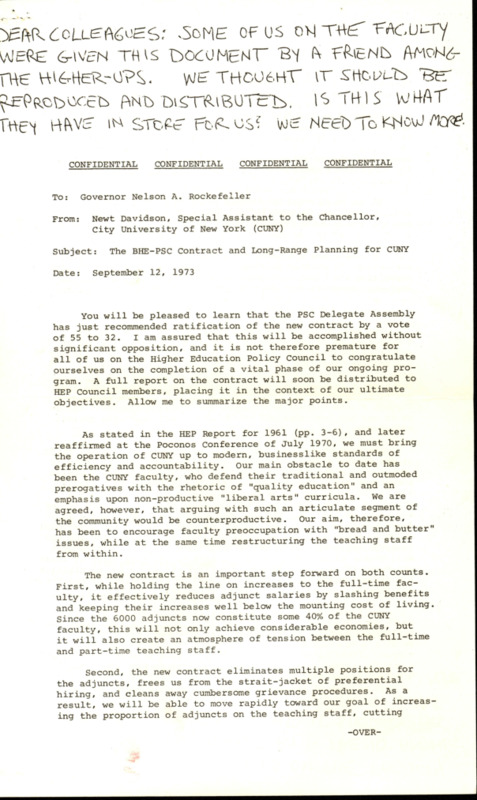
Newt Davidson Parody: Memo to Gov. Rockefeller on CUNY Planning
Item
“ .
——a Oe
YERR COLLEACGLES: SOME OF US ON THE FACULTY
WERE GIVEN THIS DOCUMENT BY & FRENDS AMONG
TRE HIGHERSUPS. WE THOU6HT (IT SHOLLD BE
REPRODUCED AND DISTRIBUTES, IS THIS WHAT
THEY HAVE IN STORE FoR USS We NEED To KNOW MO:
CONFIDENTIAL CONFIDENTIAL CONFIDENTIAL CONFIDENTIAL
To: Governor Nelson A. Rockefeller
From: Newt Davidson, Special Assistant to the Chancellor,
City University of New York (CUNY)
Subject: The BHE-PSC Contract and Long-Range Planning for CUNY
Date: September 12, 1973
You will be pleased to learn that the PSC Delegate Assembly
has just recommended ratification of the new contract by a vote
of 55 to 32. I am assured that this will be accomplished without
significant opposition, and it is not therefore premature for
all of us on the Higher Education Policy Council to congratulate
ourselves on the completion of a vital phase of our ongoing pro-
gram. A full report on the contract will soon be distributed to
HEP Council members, placing it in the context of our ultimate
objectives. Allow me to summarize the major points.
As stated in the HEP Report for 1961 (pp. 3-6), and later
reaffirmed at the Poconos Conference of July 1970, we must bring
the operation of CUNY up to modern, businesslike standards of
efficiency and accountability. Our main obstacle to date has
been the CUNY faculty, who defend their traditional and outmoded
prerogatives with the rhetoric of "quality education" and an
emphasis upon non-productive "liberal arts" curricula. We are
agreed, however, that arguing with such an articulate segment of
the community would be counterproductive. Our aim, therefore,
has been to encourage faculty preoccupation with "bread and butter"
issues, while at the same time restructuring the teaching staff
from within.
The new contract is an important step forward on both counts.
First, while holding the line on increases to the full-time fac-
ulty, it effectively reduces adjunct salaries by slashing benefits
and keeping their increases well below the mounting cost of living.
Since the 6000 adjuncts now constitute some 40% of the CUNY
faculty, this will not only achieve considerable economies, but
it will also create an atmosphere of tension between the full-time
and part-time teaching staff.
Second, the new contract eliminates multiple positions for
the adjuncts, frees us from the strait-jacket of preferential
hiring, and cleans away cumbersome grievance procedures. As a
result, we will be able to move rapidly toward our goal of increas-
ing the proportion of adjuncts on the teaching staff, cutting
-OVER-
sharply back on the middle ranks of full-time faculty, and
phasing out many of the currently excessive number of senior
faculty. Ultimately, as outlined in the HEP Report for 1968
("Labor and Management in Higher Education"), we hope to create
a teaching force for CUNY composed largely of adjuncts and
therefore inexpensive, expendable, and flexible enough to
meet the changing needs of the city economy. PSC consent to
the "zipper clause" in the new contract opens the way for
removal of the myriad traditional and customary rights (such as
the election of departmental chairmen) that impede efficient
management.
As the number and entrenched power of the full-time
faculty diminish, we will be in a position to discard the
archaic tenure system itself, which is both costly and a cont-
inuing barrier to the removal of faculty deadwood.
It also seems advisable to reiterate the need for student
evaluations of faculty performance, since the inevitable faculty
opposition will further discredit them with their students and
increase pressures for modernization of the entire CUNY system.
The next phase of our HEP Council program is a complete
transformation of the instructional process through the use of
educational technology. The 1972 Master Plan for CUNY calls for
the massive expansion of the CUMBIN (City University Mutual
Benefit Instructional Network) project, established in 1967,
and already in operation at the Graduate Center as well as five
senior colleges (City, Queens, Brooklyn, Hunter, and Lehman).
Through closed-circuit television, the CUMBIN system will enable
us to use our instructional staffs at all colleges with optimal
efficiency.
One pole of the new system will be a small but eminent staff
at the Graduate Center. These scholars will be able to transmit
lectures, via the CUMBIN microwave relay, to all twenty campuses
simultaneously. At one or more terminal points on each campus,
500 to 700 students may be conveniently assembled to view the
broadcast. Thus, one top-flight American historian at the Center
who costs us, say, $35,000 per year will be able to replace at
least twenty full-time faculty in the same field at the individual
colleges whose combined salaries now cost us between $300,000 and
$400,000 per year. In time, we anticipate that this arrangement
will enable us to operate with a full-time teaching force at least
one-twentieth its present size, while at the same time maintaining
the highest academic standards through the elimination of mediocrity
and incompetence in the individual colleges.
The second pole of the system will be a flexible teaching
force consisting of rotating teams of adjuncts who will supervise
recitation sections of 100-200 students at the CUMBIN terminal
points, thus assuring effective student-teacher contact on each
campus. There is no reason to fear a decline in academic standards
since the adjuncts will include in their ranks many who formerly
occupied higher positions on the faculty. Then, too, recent HEP
Council surveys of the labor market confirm that--even at the
one
projected, minimal salary scale--we will be able to attract the
best A.B.D.'s and new Ph.D.'s from area universities far into the
foreseeable future.
Needless to say, the centralization of the learning process
via CUMBIN will allow us to monitor more effectively the content
of the instructional program, to remove the influence of cranks
and subversives upon the student population, and, finally, to
impress more effectively upon our young people those values
and habits of mind needed for success in our highly-organized
contemporary society. Mr. Freund's office will for the moment
be financed quietly out of the special Chancellor's fund in
order to avoid arousing the opposition of faculty traditionalists.
Although the new contract thus brings us closer to the day
when the CUNY faculty can be utilized flexibly, in accordance
with modern cost-effectiveness standards, our ability to respond
quickly and affirmatively to changes in the city's economic
picture will depend upon an equally flexible approach to the
size and training of the student body. Our business and industrial
leaders have long understood that the traditional liberal arts
curriculum, which turns out young men and women poorly prepared
for and often critical of the tasks demanded of them by a free
society and economy, is an inappropriate as well as counter-
productive drain upon public resources. New York City in particu-
lar is dependent upon its reserves of skilled and semi-skilled
white collar workers, not upon poets and historians. Thus, as
outlined in the very first HEP Report (1948), our game-plan must
include the following:
a) We must gradually de-emphasize so-called "liberal arts"
instructional programs, which merely encourage our young people
to aspire to unreasonable and unrealizeable career-options.
As the Cottrell Report (1950) emphasized, it is “unquestionable
that there must always be 'drawers of water and hewers of wood'.
---It is a mistake to assume that all who take some form of
higher education should expect a professional or highly tech-
nical position. This is an Old World, leisure-class tradition.
It has no real basis in our American democratic way of life."
b) We must channel students into those instructional programs
geared to the training of bank clerks, hospital and laboratory
technicians, secretaries, key-punch operators, draftsmen, and
the many other less glamorous occupations so vital to the
business community.
c) We must assure that the overall instructional process instills
in our city's youth a healthy respect toward the work for which
they are being prepared, the correct attitudes to do it proper-
ly, and a suitable sense of gratitude for those who have given
them the opportunity to lead useful lives.
d) We must make greater efforts to reach the disadvantaged
Black and Puerto Rican youth of our community, who, through
CUNY, can be trained for work in the city's offices and
industries commensurate with their abilities, be made more
aware of the requirements for cooperative citizenship, and
be prepared to become responsible leaders of their communities
upon their return. Frankly, our failure to move fast enough
on this front contributed much to the atmosphere of racial
extremism in the 1960's. Since then, however, we have stepped
up the expansion of community colleges into disadvantaged
neighborhoods, launched the Open Admissions program far ahead
-OVER-
of schedule, and expanded our plans for direct-action programs,
of which the Cool in Summer program is a case in point. These
measures, thanks to the generous cooperation of law-enforcement
and welfare officials, have already done much to stem the tide
of racial discontent.
e) We must achieve a higher capability for expanding or con-
tracting the size of our student body in response to inputs
from the economic sector, without also interfering with our
objectives as outlined in points (c) and (d) above. We remain
committed to the Keppel Commission's recommendation that this
goal can be most effectively attained through the simultaneous
abolition of free tuition and the creation of a massive scholar-
incentive program. The number of these scholarships would be
increased as the economy expands, and diminished as the economy
declines. The work-study monies, geared to the white, lower-
income students, would be similarly increased and diminished.
At present, the need for retrenchment is paramount. (As the
Keppel Commission noted: "The State's projected supply of college-
educated citizens appears to exceed the economy's projected
demand for those who complete the baccalaureate degree and for
many graduate degrees as well. The demand appears to be greater
for students at the two-year, technical and occupational level.")
Even now, we are abolishing the costly SEEK program and slashing
work-study programs.
£) We must not lose sight of the important role that our rental
and construction programs can play in advancing our overall ob-
jectives. The allocation of contracts can, in itself, do much
to engage the support of influential union, business, and real-
estate industry leaders who might otherwise remain indifferent
or even hostile to our program. Furthermore, the massive influx
of rental and construction money into disadvantaged neighborhoods
can revive sagging real-estate values, pump new life into small
businesses, strengthen the middle-income groups whose presence
is so vital to community stability, and, in general, brighten the
darkening environment in which so many of our city's youth acquire
undesireable values and habits.
g) Finally, we must acknowledge that in the past, decisions
affecting higher education in the State have not always been
reached in a sufficiently orderly and prudent manner. Ad hoc
solutions to specific problems have been made without adequate
regard to an overall pattern of development. These relation-
ships need to be revised for the sake of the students, post-
secondary education, and the State. Now, with passage of our
Omnibus Higher Education Act, we have moved closer to the day
when all post-secondary education, public and private, can be
centrally coordinated and supervised by the Office of the Governor.
With ratification of the new BHE-PSC contract, we will achieve
an important preliminary streamlining of governance, planning,
and coordination at the local level, eliminating wasteful dupli-
cation.
In so far as it has contributed to weakening, distracting, and
dividing the faculty, the new contract has significantly reduced
the likelihood that there will be any foot-dragging within CUNY
itself as our modernization program advances. It is essential,
however, that we avoid potentially unfavorable media commentary
by adhering to our low-profile policy, and all HEP Council members
have received copies of the attached memo, instructing them to
refrain from public discussion of the contract and/or long-range
planning for CUNY.
——a Oe
YERR COLLEACGLES: SOME OF US ON THE FACULTY
WERE GIVEN THIS DOCUMENT BY & FRENDS AMONG
TRE HIGHERSUPS. WE THOU6HT (IT SHOLLD BE
REPRODUCED AND DISTRIBUTES, IS THIS WHAT
THEY HAVE IN STORE FoR USS We NEED To KNOW MO:
CONFIDENTIAL CONFIDENTIAL CONFIDENTIAL CONFIDENTIAL
To: Governor Nelson A. Rockefeller
From: Newt Davidson, Special Assistant to the Chancellor,
City University of New York (CUNY)
Subject: The BHE-PSC Contract and Long-Range Planning for CUNY
Date: September 12, 1973
You will be pleased to learn that the PSC Delegate Assembly
has just recommended ratification of the new contract by a vote
of 55 to 32. I am assured that this will be accomplished without
significant opposition, and it is not therefore premature for
all of us on the Higher Education Policy Council to congratulate
ourselves on the completion of a vital phase of our ongoing pro-
gram. A full report on the contract will soon be distributed to
HEP Council members, placing it in the context of our ultimate
objectives. Allow me to summarize the major points.
As stated in the HEP Report for 1961 (pp. 3-6), and later
reaffirmed at the Poconos Conference of July 1970, we must bring
the operation of CUNY up to modern, businesslike standards of
efficiency and accountability. Our main obstacle to date has
been the CUNY faculty, who defend their traditional and outmoded
prerogatives with the rhetoric of "quality education" and an
emphasis upon non-productive "liberal arts" curricula. We are
agreed, however, that arguing with such an articulate segment of
the community would be counterproductive. Our aim, therefore,
has been to encourage faculty preoccupation with "bread and butter"
issues, while at the same time restructuring the teaching staff
from within.
The new contract is an important step forward on both counts.
First, while holding the line on increases to the full-time fac-
ulty, it effectively reduces adjunct salaries by slashing benefits
and keeping their increases well below the mounting cost of living.
Since the 6000 adjuncts now constitute some 40% of the CUNY
faculty, this will not only achieve considerable economies, but
it will also create an atmosphere of tension between the full-time
and part-time teaching staff.
Second, the new contract eliminates multiple positions for
the adjuncts, frees us from the strait-jacket of preferential
hiring, and cleans away cumbersome grievance procedures. As a
result, we will be able to move rapidly toward our goal of increas-
ing the proportion of adjuncts on the teaching staff, cutting
-OVER-
sharply back on the middle ranks of full-time faculty, and
phasing out many of the currently excessive number of senior
faculty. Ultimately, as outlined in the HEP Report for 1968
("Labor and Management in Higher Education"), we hope to create
a teaching force for CUNY composed largely of adjuncts and
therefore inexpensive, expendable, and flexible enough to
meet the changing needs of the city economy. PSC consent to
the "zipper clause" in the new contract opens the way for
removal of the myriad traditional and customary rights (such as
the election of departmental chairmen) that impede efficient
management.
As the number and entrenched power of the full-time
faculty diminish, we will be in a position to discard the
archaic tenure system itself, which is both costly and a cont-
inuing barrier to the removal of faculty deadwood.
It also seems advisable to reiterate the need for student
evaluations of faculty performance, since the inevitable faculty
opposition will further discredit them with their students and
increase pressures for modernization of the entire CUNY system.
The next phase of our HEP Council program is a complete
transformation of the instructional process through the use of
educational technology. The 1972 Master Plan for CUNY calls for
the massive expansion of the CUMBIN (City University Mutual
Benefit Instructional Network) project, established in 1967,
and already in operation at the Graduate Center as well as five
senior colleges (City, Queens, Brooklyn, Hunter, and Lehman).
Through closed-circuit television, the CUMBIN system will enable
us to use our instructional staffs at all colleges with optimal
efficiency.
One pole of the new system will be a small but eminent staff
at the Graduate Center. These scholars will be able to transmit
lectures, via the CUMBIN microwave relay, to all twenty campuses
simultaneously. At one or more terminal points on each campus,
500 to 700 students may be conveniently assembled to view the
broadcast. Thus, one top-flight American historian at the Center
who costs us, say, $35,000 per year will be able to replace at
least twenty full-time faculty in the same field at the individual
colleges whose combined salaries now cost us between $300,000 and
$400,000 per year. In time, we anticipate that this arrangement
will enable us to operate with a full-time teaching force at least
one-twentieth its present size, while at the same time maintaining
the highest academic standards through the elimination of mediocrity
and incompetence in the individual colleges.
The second pole of the system will be a flexible teaching
force consisting of rotating teams of adjuncts who will supervise
recitation sections of 100-200 students at the CUMBIN terminal
points, thus assuring effective student-teacher contact on each
campus. There is no reason to fear a decline in academic standards
since the adjuncts will include in their ranks many who formerly
occupied higher positions on the faculty. Then, too, recent HEP
Council surveys of the labor market confirm that--even at the
one
projected, minimal salary scale--we will be able to attract the
best A.B.D.'s and new Ph.D.'s from area universities far into the
foreseeable future.
Needless to say, the centralization of the learning process
via CUMBIN will allow us to monitor more effectively the content
of the instructional program, to remove the influence of cranks
and subversives upon the student population, and, finally, to
impress more effectively upon our young people those values
and habits of mind needed for success in our highly-organized
contemporary society. Mr. Freund's office will for the moment
be financed quietly out of the special Chancellor's fund in
order to avoid arousing the opposition of faculty traditionalists.
Although the new contract thus brings us closer to the day
when the CUNY faculty can be utilized flexibly, in accordance
with modern cost-effectiveness standards, our ability to respond
quickly and affirmatively to changes in the city's economic
picture will depend upon an equally flexible approach to the
size and training of the student body. Our business and industrial
leaders have long understood that the traditional liberal arts
curriculum, which turns out young men and women poorly prepared
for and often critical of the tasks demanded of them by a free
society and economy, is an inappropriate as well as counter-
productive drain upon public resources. New York City in particu-
lar is dependent upon its reserves of skilled and semi-skilled
white collar workers, not upon poets and historians. Thus, as
outlined in the very first HEP Report (1948), our game-plan must
include the following:
a) We must gradually de-emphasize so-called "liberal arts"
instructional programs, which merely encourage our young people
to aspire to unreasonable and unrealizeable career-options.
As the Cottrell Report (1950) emphasized, it is “unquestionable
that there must always be 'drawers of water and hewers of wood'.
---It is a mistake to assume that all who take some form of
higher education should expect a professional or highly tech-
nical position. This is an Old World, leisure-class tradition.
It has no real basis in our American democratic way of life."
b) We must channel students into those instructional programs
geared to the training of bank clerks, hospital and laboratory
technicians, secretaries, key-punch operators, draftsmen, and
the many other less glamorous occupations so vital to the
business community.
c) We must assure that the overall instructional process instills
in our city's youth a healthy respect toward the work for which
they are being prepared, the correct attitudes to do it proper-
ly, and a suitable sense of gratitude for those who have given
them the opportunity to lead useful lives.
d) We must make greater efforts to reach the disadvantaged
Black and Puerto Rican youth of our community, who, through
CUNY, can be trained for work in the city's offices and
industries commensurate with their abilities, be made more
aware of the requirements for cooperative citizenship, and
be prepared to become responsible leaders of their communities
upon their return. Frankly, our failure to move fast enough
on this front contributed much to the atmosphere of racial
extremism in the 1960's. Since then, however, we have stepped
up the expansion of community colleges into disadvantaged
neighborhoods, launched the Open Admissions program far ahead
-OVER-
of schedule, and expanded our plans for direct-action programs,
of which the Cool in Summer program is a case in point. These
measures, thanks to the generous cooperation of law-enforcement
and welfare officials, have already done much to stem the tide
of racial discontent.
e) We must achieve a higher capability for expanding or con-
tracting the size of our student body in response to inputs
from the economic sector, without also interfering with our
objectives as outlined in points (c) and (d) above. We remain
committed to the Keppel Commission's recommendation that this
goal can be most effectively attained through the simultaneous
abolition of free tuition and the creation of a massive scholar-
incentive program. The number of these scholarships would be
increased as the economy expands, and diminished as the economy
declines. The work-study monies, geared to the white, lower-
income students, would be similarly increased and diminished.
At present, the need for retrenchment is paramount. (As the
Keppel Commission noted: "The State's projected supply of college-
educated citizens appears to exceed the economy's projected
demand for those who complete the baccalaureate degree and for
many graduate degrees as well. The demand appears to be greater
for students at the two-year, technical and occupational level.")
Even now, we are abolishing the costly SEEK program and slashing
work-study programs.
£) We must not lose sight of the important role that our rental
and construction programs can play in advancing our overall ob-
jectives. The allocation of contracts can, in itself, do much
to engage the support of influential union, business, and real-
estate industry leaders who might otherwise remain indifferent
or even hostile to our program. Furthermore, the massive influx
of rental and construction money into disadvantaged neighborhoods
can revive sagging real-estate values, pump new life into small
businesses, strengthen the middle-income groups whose presence
is so vital to community stability, and, in general, brighten the
darkening environment in which so many of our city's youth acquire
undesireable values and habits.
g) Finally, we must acknowledge that in the past, decisions
affecting higher education in the State have not always been
reached in a sufficiently orderly and prudent manner. Ad hoc
solutions to specific problems have been made without adequate
regard to an overall pattern of development. These relation-
ships need to be revised for the sake of the students, post-
secondary education, and the State. Now, with passage of our
Omnibus Higher Education Act, we have moved closer to the day
when all post-secondary education, public and private, can be
centrally coordinated and supervised by the Office of the Governor.
With ratification of the new BHE-PSC contract, we will achieve
an important preliminary streamlining of governance, planning,
and coordination at the local level, eliminating wasteful dupli-
cation.
In so far as it has contributed to weakening, distracting, and
dividing the faculty, the new contract has significantly reduced
the likelihood that there will be any foot-dragging within CUNY
itself as our modernization program advances. It is essential,
however, that we avoid potentially unfavorable media commentary
by adhering to our low-profile policy, and all HEP Council members
have received copies of the attached memo, instructing them to
refrain from public discussion of the contract and/or long-range
planning for CUNY.
Title
Newt Davidson Parody: Memo to Gov. Rockefeller on CUNY Planning
Description
This recently discovered (August 2017) document from the papers of historian Judith Stein, is the only extant example of what preceded the Crisis at CUNY brochure. As explained in the interview done with four members of the Newt Davidson Collective, a series of lengthy pamphlets were written anonymously and distributed across the university. They mocked the university administration for the direction it was taking, accusing them of corporatizing the university, automating teaching, and relying on adjunct labor, among other things. Crisis at CUNY and the documents that parodied CUNY administrators grew out of the research of the Newt Davidson Collective, an ad hoc group of faculty from several campuses who sought to understand reasons for this new climate of austerity in the 1970s. Their search for answers took them deep into the complex bureacracy of the City University and its links with other key institutions. The booklet and pamphlets produced by the Newt Davidson Collective would go on to circulate among CUNY faculty members and others.
Creator
Newt Davidson Collective
Date
September 12, 1973
Language
English
Rights
Creative Commons AttributionNonCommercialShareAlike
Source
CCNY Archives & Special Collections
Original Format
Pamphlet / Petition
Newt Davidson Collective. Letter. “Newt Davidson Parody: Memo to Gov. Rockefeller on CUNY Planning.”, CUNY DIGITAL HISTORY ARCHIVE, accessed September 5, 2026, https://stephenz.tailc22a4b.ts.net/s/cdha/item/1277