After Marriage Conference Program
Item
Dear After Marriage Community:
Angela Jones and Michael Yarbrough, Conference Organizers
Two Junes, a year apart, frame the mission of
this conference. In June 2015, the U.S. Supreme
Court ruled that this country’s constitution for-
bids the exclusion of same-sex couples from le-
gally recognized marriage. Arriving after a hard
and often painful fight, the ruling seemed to
many to mark a new kind of inclusion. Rainbows
wrapped many of our public spaces, from profile
pics to the White House, In triumphant celebra-
tion.
One year later, in June 2016, a massacre on
Latin night at Pulse nightclub in Orlando shocked
the nation and the world. Many felt the shock of
disbelief. But many LGBTQ people, especially
Latinx and LGBTQ people of color, felt the shock
of recognition at a familiar violence that mar-
riage did little to address.
Many activists and scholars have long em-
phasized the wide range of issues beyond mar-
riage affecting LGBTQ people and those we love.
From policing and mass incarceration to poverty
to employment to housing to education to immi-
gration and deportation to health care to families
living outside the marital model, the list of unfin-
ished work Is long. At the same time, the arrival
of same-sex marriage rights has changed the
legal, political, organizational, financial, cultural,
ideological, sexual, and familial terrain where we
do that work.
As activists, scholars, artists, students,
service providers, and community members,
we each have important contributions to make
as we move forward. We thank each of you for
joining us here to renew the call for a broader
agenda for LGBTQ justice. We especially thank
the over 175 presenters sharing your experienc-
es and expertise, and our tireless colleagues on
the organizing committee and CLAGS and CUNY
staff who have made this conference a reality.
Opinions about marriage itself will undoubtedly
vary among those gathered here this weekend,
but we all share a vision of LGBTQ justice that is
#morethanmarriage.
Celebrating its 25th anniversary this year,
CLAGS has built a legacy rooted in our home at
CUNY, New York City’s public university system.
The goal of the conference organizing commit-
tee has been to make this conference a space
that centers those often marginalized by main-
stream LGBTQ politics in a collaborative discus-
sion among activists, academics, and community
members. We believe the most transformation-
al path forward will be grounded in the needs,
knowledge, and power of those whose dally lives
under intersecting systems of oppression yield
the sharpest understandings of those systems.
In that spirit, we see the #AfterMarriage mo-
ment as an opportunity to reorient the direction
of LGBTQ thought and action. Thank you again
for joining us here to seize that opportunity. We
are excited to see what happens!
In solidarity and gratitude. Ml
Lat
aad lr
Dear CLAGS Family:
Kevin Nadal, Ph.D., Executive Director, CLAGS: The Center for LGBTQ Studies
|am so honored and excited to welcome you all to
the After Marriage Conference. It is so humbling
to know that hundreds of you - LGBTQ communi-
ty members, scholars, and students — have gath-
ered from all over the US and abroad to discuss’
the future of LGBTQ politics and scholarship. It
is an honor that this meeting is being sponsored
by CLAGS: The Center for LGBTQ Studies, during
our 25th anniversary at the The Graduate Cen-
ter, CUNY. CLAGS is the oldest university-based
LGBTQ research center in the US; and for over
25 years, we have aimed to nurture cutting-edge
scholarship on issues of concern to LGBTQ
communities. Thus, it is fitting that CLAGS is
sponsoring this conference because it not only
represents the types of critical discussions and
analyses that we have promoted since our in-
ception, but it also encourages future research,
scholarship, projects, and programs to improve
the lives of queer and trans people. | am also de-
lighted that we are gathering at John Jay College
of Criminal Justice - CUNY, where | am currently
an Associate Professor in Psychology. Because
John Jay College’s mission is to educate ‘fierce
advocates for justice’, | cannot think of a better
place for us to conceptualize, learn about, dis-
cuss, and argue the most pressing concerns for
queer and trans people. It is my hope that what
we learn from this conference will allow us to
be more effective and self-reflective educators,
scholars, and advocates.
Over the next two days, we will examine the
state of our LGBTQ communities, particularly af-
ter the historic Supreme Court decision in 2015
that allowed same-sex marriages to be legally
recognized across the US. We will be showcas-
ing exemplary scholars and community leaders
(both academics and non-academics] in hopes
of introducing different perspectives and ideas.
We will also have plenty of opportunities for net-
working and socializing, which we hope will re-
sult in future collaborations and potentially long-
term meaningful relationships.
| encourage all of you to take advantage of
what these next two days have to offer. Often, we
are the only LGBTQ people in our departments,
organizations, or academic programs, and we of-
ten are the spokespeople for all LGBTQ people. |
hope that you will enjoy the fact that you are with
hundreds of people who represent the true diver-
sity of our LGBTQ communities. | invite you to get
to know each other, learn from each other, vali-
date each other, and even challenge each other.
It is through learning different perspectives that
we become more understanding and unified; it is
in connecting with each other and our passions
that we become more activated to fight for social
justice.
Finally, | want to express my unending grat-
itude to Dr. Michael Yarbrough, for envisioning
this conference two years ago, and to Dr. Angela
Jones, for taking on the role of conference co-or-
ganizer. It is so gratifying to have seen how an
idea turned into a vision and then into a reality.
| have been truly impressed by the high caliber
of every aspect of the conference, and | am so
grateful to Michael, Angela, and their committee
for their vigorous work, passion, and commit-
ment to this event.
| look forward to meeting all of you, and |
hope you continue to support CLAGS in the fu-
ture.
Maraming salamat (many thanks]. ll
Schedule At-a-Glance
October 1
8.00am-9.00am
9.00am-11.00am
11.15am-1.00pm
1.00pm-2.30pm
2.30pm-4.15pm
4.15pm-4.45pm
4.45pm-6.30pm
6.30pm-8.30pm
October 2
8.00am-9.00am
9.00am-10.45am
11.00am-12.45pm
12.45pm-2.15pm
Registration and Light Breakfast and Coffee... eee ee eeeseeeeseeeeeeeeeeeees Exhibition Hall
Opening Plenary: LGBTQ Politics Aer Marriages ii. 8 cc psec csesteceneecncvedeceentunsdeies L263
Sessions
Lunch on your own
Sessions
Cette Rea i ei eaves Exhibition Hall
Sessions
COMPEreRCe RECEBLION. 22.5 Ae kee ee i EEL respec ewet Student Dining Hall
Registration and Light Breakfast and Coffee......... ees eeeeeteeeseeseeceecetesseeeees Exhibition Hall
Sessions
Sessions
Lunch on your own
2.15pm-4.00pm Sessions
4:00pm=4-30pm:,-Cotiee Break sake cara ie ee re ee ee Exhibition Hall
4.30pm-6.30pm Closing Plenary: LGBTQ Scholarship After Marriage...........c:cceseseesssessenseseeeseeeneeeeenees L.63
Exhibitors, Organizations, and Artists
Publishers Organizations There will also be a co-op infor-
Harrington Park Press LGBT Network mation table featuring flyers and
University of Wisconsin Press Pride for Youth information on events, organiza-
SUNY Press Trans Justice Funding Project tions, and books of interest.
ABC-CLIO
Palgrave Macmillan Artists
Haymarket Books AwQward Talent
Princeton University Press Trans Aesthetics in the Marriage
University of Texas Press Equality Utopia: A Micro-
NYU Press Manifesto
University of Illinois
Duke University Press
University of Michig
an
Conference Logistics
For lunch, there are many restaurants nearby serving a range of cuisines, especially on 10th
Avenue. There are also food trucks where you can get something to go. Weather permitting, you
may choose to bring a lunch to the beautiful outdoor space called the Jay Walk, on the 2nd floor.
See the map in this program for directions.
The exhibit hall will be open throughout the conference in the Hound Square on the 1st floor,
right at the top of the stairs coming from the lobby level.
Also throughout the conference, room 1.67 on the 1st floor will be open to anyone looking for a
Space to decompress or rest in a quieter environment.
If the conference wifi password does not work for you, please feel free to try the alternate net-
work called cuny, using password cunycuny.
We were in the process of organizing all-gender bathrooms for the conference as the program
went to press. Please listen for announcements for more information. Pursuant to directives by
the NYC Commission on Human Rights, everyone has the right under the NYC Human Rights
Law to use any bathroom consistent with their gender identity, no questions asked.
Connect
Network: clags
Want to tweet?
Use hashtag #aftermarriage
°?))
Password: aftermarriage
to join the conversation!
ull Schedule — nisin
October 1
8.00am-9.00am Registration and Light Breakfast and Coffee Exhibition Hall
9.00am-11.00am Opening Plenary: Room L.63
LGBTQ POLITICS AFTER MARRIAGE
Moderator: Steven Thrasher, The Guardian (U.S.) and New York University
Gabriel Foster, Trans Justice Funding Project
Paulina Helm-Hernandez, Southerners on New Ground (SONG)
Robyn Ochs, editor of Bi Women Quarterly and other publications, activist, and educator
Urvashi Vaid, attorney, activist leader, and author
11.15am-1.00pm DEADLY DENIAL: A PANEL DISCUSSION ON THE UNACKNOWLEDGED Room L.63
EPIDEMIC OF QUEER POVERTY
Joseph Nicholas DeFilippis, Seattle University
Amber Hollibaugh, artist, activist, public intellectual, and community organizer
Cara Page, Audre Lorde Project
Paulina Helm-Hernandez, Southerners on New Ground (SONG)
QUEER COMMUNITIES AFTER MARRIAGE Room 1.77
Clare Forstie: “Making Community Change: Rural Queer Kinship and its Normative Limits in
the Post-Marriage Era.”
Theo Greene: “Street Corner Citizenship: Gay Neighborhoods, Vicarious Citizenship, and the
Self-Enfranchisement of LGBT Youth.”
William Potter: “Havens of Reflexivity in a Heteronormative World? Retreats as Spaces to
Contemplate Alternative LGBT Futures.”
Greggor Mattson: “Lesbian Bars, Gay Places, Queer Futures?”
HEALTHCARE, PSYCHOLOGY, AND WELL-BEING Room 1.75
Johnathan Smilges: “The Virtuous Struggler: The Price for Purity in Reparative Therapy”
Elizabeth Kukura: “Changing the Culture of Health Care: Applying Lessons from Maternity
Care Advocacy to Improve Trans Health Care”
Emily Allen Paine: “You're Supposed to be Cared For’: Queer and Trans Experiences of Health
Care in the Age of Equality”
Pete Carney: “PrEP—HIV Prevention and Beyond”
2.30pm-4.15pm
POLICING SEX
Trevor Hoppe: “Punishing Sex: Sex Offenders and the Missing Punitive Turn in Sexuality
Studies”
Scott DeOrio: “Child Sexual Abuse Laws and the Criminalization of Teen Sex”
4
Maurice Tracey: ““The Blood Will Never Lose Its Power”: HIV Criminalization, Blackness, and
the Continued Construction of Homonormative Whiteness” (full abstract uploaded soon)
Russell K. Robinson: “The New Homophobia”
LIBERATION NOT DEPORTATION #NOT1MORE / BEHIND BARS
WITHOUT CITIZENSHIP
Jorge Gutierrez, Jerssay Arredondo, and Jennicet Gutiérrez: “Liberation Not Deportation
#not1more”
Jesus Barrios: “Behind Bars Without Citizenship: Immigration Detention and Queer Public
Health in the Deportation Era”
CONFRONTING THE STATE: POWER, ACTIVISM, AND THE SELF
Caner Hazar: “LGBT Activism in the Context of Political Islam: Sociopolitical Opportunities and
Constraints Facing the LGBT Activism in Turkey”
Chriss Sneed: “GAly)TEKEEPING IDENTITY & CLAIMS TO JUSTICE: Mainstream Discourse on
‘Gay’ Marriage and “Don’t Ask, Don't Tell” (2003-2015) & The Boundaries of Community within
LGBTQ Political Organizing”
Cristina Khan: Negotiations of Identity and Embodiment through Language”
BEFORE, AFTER AND BEYOND MARRIAGE - PERSPECTIVES FROM
SOUTHERN EUROPE |: QUEERING COUPLEDOM
Gracia Trujillo: “Marriage? On Radical Genealogies, Queer and Feminist Protests and Austerity
Times in Spain”
Mara Pieri: “Diving into the Unknown. Partnering and Migration Choices in Narratives from
Italy”
Ana Cristina Santos: “Queer Non-Monogamy Hits the Legal (Marriage] Fan: Relational
Citizenship in Portugal”
Pablo Perez Navarro: “Beyond Inclusion: Non-Monogamies Before the Law”
Luciana Moreira Silva: “Living Lesbian Relationships in Madrid: Do they Really Care About
Us?”
QUEER YOUTH AND HOMELESSNESS
Brandon Andrew Robinson, University of Texas
Bridget Hughes, Hetrick-Martin Institute
Kevin Lotz, Trinity Place Shelter
Joey Lopez, Ali Forney Center
KATHERINE FRANKE’S WEDLOCKED: THE PERILS OF MARRIAGE EQUALITY
Katherine Franke, Columbia Law School, discusses her recent book, Wedlocked: The Perils of
Marriage Equality (NYU Press, 2015} with David L. Eng, University of Pennsylvania. Copies of the
book will be available for sale and signing after the session.
Room 1.73
Room 1.76
Room 1.71
Room 1.69
Room L.63
Room 1.76
RELIGION, CONFLICT, AND SAME-SEX MARRIAGE Room 1.75
Susan Gluck Mezey: “After Obergefell: The Conflict Between Religious Freedom and LGBTQ
Rights in the United States”
Kate Henley Averett: “Religious Freedom, Parents’ Rights, and Counter-Mobilization After
Marriage’” a
Michelle Wolff: “Won and Done?: Black Lesbians & Trans Men Decolonizing the Future of
Same-Sex Marriage & Public Religion in South Africa”
Michael Boucai: “Disestablishing Marriage”
QUEERING PEDAGOGY Room 1.73
Charles Upchurch: “Undoing and the Future of LGBTQ Scholarship and Politics”
Erica J. Friedman: “Misgendering in Bathrooms: Cisgenderism in a Post-Federalized Same-
Gender Marriage America”
Kendall Gerdes: “Rhetorical Trauma: Trigger Warnings & Sensitive Students”
PILLOWTALK—POST GAY MARRIAGE POLITICS Room Moot Court (6th FL.)
Performance-based conversation led by Stephanie Hsu (Pace University], featuring the
participation of Beto O’Byrne, Bryan Glover (Founder, Harlem9], and the lead artists of
PILLOWTALK—Raja Feather Kelley, Daniel K. Isaac, and Kyoung H. Park
WRITING OUR PAST WITH A FUTURE IN SIGHT: ON WRITING QUEER BROWN
VOICES FOR QUEERS OF COLOR Room 1.77
This interactive session with Letitia “Leti” Gomez and Salvador Vidal-Ortiz will help attendees
understand the potential of collaborations between community activists and academics in
developing research projects with specific aims. Participants are encouraged to come with an
idea for a project.
CENTERING INTERSECTIONAL POLITICS: QUEER MIGRATION ACTIVISMS
“AFTER MARRIAGE” Room 1.71
In this session, academics and activists will take part in a roundtable conversation with Jara
M. Carrington (University of New Mexico], Claudia Cojocaru (Rutgers University School
of Criminal Justice], Jamila Hammami (Queer Detainee Empowerment Project], Siobhan
McGuirk (anthropologist and founding member, LGBT Freedom and Asylum Network], and
Riya Ortiz (Damayan Migrant Workers Association] to address the question: How might we
ticulate a more critical, intersectional vision of queer migration politics “after marriage?”
BEFORE, AFTER AND BEYOND MARRIAGE - PERSPECTIVES FROM
SOUTHERN EUROPE II: BIOGRAPHICAL NARRATIVES, COLLECTIVE STRUGGLES
AND HISTORICAL ACCOUNTS Room 1.69
Marina Franchi and Giulia Selmi: “Queer Kinship Before Marriage: Narratives, Strategies and
Struggles of LGBT Parents in Italy’
José Ignacio Pichardo Galan: “At the End of the Rainbow: Ten Years After the Legalization of
Same-Sex Marriage in Spain”
Ana Lucia Santos: “Can the Lesbian Couple Speak? Reshaping Homonormativity Through
Intimate Lesbian Biographies in Portugal”
Tatiana Motterle: “Before Marriage: Lesbian and Bisexual Women Reclaiming Relational
Visibility in Italy”
Marie Digoix: “After the Laws: Is the Nordic Model Still a Reference? The Case of Iceland” (full
abstract)
4.15pm-4.45pm
4.45pm-6.30pm
6.30pm-8.30pm
COFFEE BREAK Exhibiton Hall
AFTER PULSE Room L.63
In this roundtable discussion we will discuss will reflect on issues raised by the Pulse
shootings of June 2016. Moderator: Angela Jones (Farmingdale State College] and featuring
Jennicet Gutiérrez (Familia: Trans Queer Liberation Movement), Paulina Helm-Hernandez
{Southerners on New Ground, SONG}, Greggor Mattson (Oberlin College], Terry Roethlein
(Gays Against Guns], Steven Thrasher {The Guardian U.S. & NYU}, and Salvador Vidal-Ortiz
(American University).
QUEER YOUTH AND EDUCATION Room 1.77
Tamara Alexander: “SB 48 FAIR Education Act: Boom or Bust”
Ryan Thoreson: “Beyond RFRA: Rethinking LGBT Children’s Rights and Parents Rights in
Schools”
Nina Mauceri and Lisa Stulberg: “Young Adult LGBTQ Literature: Beyond Marriage, Beyond
Normal”
Adam William John Davies and Cameron Greensmith: “Queer Liberalism and Exclusionary
Politics: Gay-Straight Alliances and Homonormativity”
Mark Stern: “(White) Weddings, Charterled) Schools, and the (Bio]Politics of Love & ‘Equality’”
MEANING, FRAMING, AND EMOTION IN LGBTQ AND ANTI-LGBTQ POLITICS Room 1.75
Kristie Bailey: “Human Rights Campaign: A Study in Democratic Agency”
Mary Bernstein, Nancy Naples, and Brenna Harvey: “Marriage, The Final Frontier? Same-Sex
Marriage and the Future of the Lesbian and Gay Movement”
Doug Cloud: “Strategies for Concealing and Revealing Animus in Public Arguments about
LGBTQ People: Lessons from the SSM Debate and ‘Bathroom Bill’ Discourse”
Logan Casey: “Love Wins, Sex Doesn't: The Role of Disgust in Public Opinion and LGBTQ
Politics”
SCHOLARSHIP AFTER MARRIAGE: NEW METHODS AND INVISIBLE POPULATIONS
IN SEXUALITY AND GENDER RESEARCH Room 1.71
Andrew J. Young: “Who Can Tell Our Story? The Lambda Literary Awards and the Development
of a Transgender Literature”
Colin Hammar: “Effects of Workplace Discrimination and Nondiscrimination Policies”
Regina Ford: “Understanding Sexual Health Awareness among African American Older Adults”
QUEER(ING) MARRIAGE AND FAMILY IN CHINA AND TAIWAN Room 1.69
Shuzhen Huang: “Queering Marriage: The Practice of Xinghun in Contemporary Mainland
China”
Elisabeth Lund Engebretsen: “Chinese PFLAG Narratives: Family Relations, Moral Values, and
Identity Politics in Popo Fan's Mama Rainbow and Pink Dads”
Jingshu Zhu: “'l’m Gay, and | Won't Marry A Straight Person’: Critical Reflection on the
Campaign Against Mixed-Orientation Marriage in China”
Amy Brainer: “Queer Parenting in Taiwan”
Aiwan Liao: “A Cross-Strait (“STRAIGHT”) Future?”
CONFERENCE RECEPTION Student Dining Hall
October 2
8.00am-9.00am
9.00am-10.45am
Light Breakfast and Coffee Exhibition Hall
THE “BEYOND MARRIAGE” STATEMENT: REFLECTIONS 10 YEARS LATER Room L.63
Ten years after the statement Beyond Same-Sex Marriage: A New Strategic Vision For All Our Families
and Relationships, some of the original authors of the Beyond Marriage statement will gather together
for the first time to wrestle with its legacy, and publicly debrief what happened then, what lessons can
be learned now, and what the implications are for the future in a post-marriage world. Panel discussion
features Joseph DeFilippis, Lisa Duggan, Amber Hollibaugh, Ignacio Rivera, Katherine Acey, Kendall
Thomas, Terry Boggis, and Nancy Polikoff.
QUEER SEX WORKERS Room 1.76
Moderator: Angela Jones, Farmingdale State College
Sienna Baskin, consultant and former Managing Director of Sex Workers Project, Urban Justice Center
Kate D’Adamo, National Policy Advocate of Sex Workers Project, Urban Justice Center
Samantha Majic, John Jay College of Criminal Justice
Jarad Ringer, Harm Reduction Coalition
TRANSNATIONAL ISSUES IN LGBTQ POLITICS Room 1.76
John C. Hawley: “Beyond the Pink Picket Fence: Are Gays and Lesbians Still Queer, and What are the
Ethical Demands of their (Inter]National Politics Now?”
Raha Iranian Feminist Collective: “After Marriage, Redefining Freedom in the Crosshairs of Empire and
Dictatorship”
Kay Lalor: “Lasting Partnerships or Fragile Connections? LGBTQ Politics, Diplomacy, and International
Law"
Matthew Waites: “Genocide in Global Queer Politics and Scholarship”
Jamie J. Hagen: “Securing the Queer Refugee: Comparing Asylum Policies in the United States and
United Kingdom”
BIRTH, LIFE, AND DEATH IN LGBTQ FAMILIES Room 1.73
These papers consider issues related to the life course and everyday life of LGBTQ families, using both
social science and legal approaches. Collectively, the papers explore the material dynamics of LGBTQ
family lives in an evolving legal context.
Michael Boucai: “Is Assisted Procreation an LGBT Right?”
Vicki Schultz and Michael Yarbrough: “Will Marriage Make Same-Sex Couples Less Egalitarian? A
Cautionary Tale”
Bethany M. Coston: “No One Really Cares’: Detection and Prevention of LGBTQ + Intimate Partner
Violence”
Liz Montegary: “The Financialization of LGBT Family Life; or The Perversion of Queer Economic Justice”
Michelle Martin-Baron: “Re-framing Marriage Equality as Death Equality”
POLY FAMILIES, CULTURAL REPRESENTATION, AND THE LAW Room 1.71
Stina Soderling: “Next, Plural Marriage?”
Lital Pascar: “From Homonormativity to Polynormativity: Online Popular Discourses about Polyamory”
David Leitch: “(Re]I magining Plural Marriage”
REIMAGINING QUEER COLLECTIVITIES AND KINSHIP OUTSIDE MARRIAGE Room 1.69
Abbey S. Willis: “Benign Sexual Variation: Intimacies, Family, and Queering Sexual Citizenship”
Timothy M. Griffiths: “Cruising Ethiopia: Worldmaking, Antinormativity, and Other Aesthetic Strategies in
the Work of Pauline E. Hopkins”
Lavelle Porter: “Black Queer Future: Reading Samuel Delany's Through the Valley of the Nest of
Spiders”
11.00am-12.45pm
WHAT'S ACTUALLY HAPPENING AFTER MARRIAGE? ORGANIZED LGBTQ POLITICS Room 1.77
Hugo Bouvard: “French LGBT Politics After Marriage”
Melissa M. Gonzalez: “Queer Ambivalence: Argentina After Marriage”
Julie Moreau: “Queer Citizenship: Understanding Lesbian Activism After Marriage Equality in
Argentina and South Africa”
Abigail A. Sewell and Yasmiyn Irizarry: “Righting Race: Trends in the Tolerance of Sexual
Minorities Pre- and Post-DOMA”
TRANS AESTHETICS IN THE MARRIAGE EQUALITY UTOPIA: A MICRO-MANIFESTO Room 1.75
This is an informal roundtable composed of a cross section of transgender artists and writers
engaged in cultural production unique to their experience, featuring Al “Ghostcat” Rosenberg,
Jax Jackson, Hudson Krakowski, Buzz Slutzky, Trace Petersen, Dane Figueroa Edidi, Krey,
Morgan Sea, Cece Suazo, and McCorkle T. Diamond [who is also session organizer).
FORMS OF EXCLUSION IN MARRIAGE LAW Room 1.75
The presentations in this session each demonstrate the presumptions about marriage
relationships that underlie marriage law and marriage litigation in different contexts.
Nick Mulé: “The Debate that Wasn't: Implications of Same-Sex Marriage on the Canadian
LGBTQ Movement”
Melanie Heath: “From Marriage Equality to Polygamy? The Homonormative Family and
Canadian Law”
Jennifer Gaboury: “The Right to Form a Family: Using Human Rights Principles to Move
Beyond Civil Marriage”
THE LIMITS OF “SEXUAL ORIENTATION” Room 1.73
In different ways, each of these presentations examines the limits of “sexual orientation” as a
concept for understanding queer lives and achieving justice for them.
Brittany Dernberger: “#lovewins, but Many Lose: Increased Exclusion and Discrimination in
the Wake of Marriage Equality”
Luke A. Boso: “Beyond Group-Based Animus: Individualized Antigay Discrimination”
Jody Ahlm: “Born-This-Way Gays and Neoliberal Logics of Race”
BUILDING MOVEMENTS: NEW FORMS OF COALITION AND SOLIDARITY Room 1.71
Erin Adam: “Queering Rights? Power and Inequality in the Formation of Intersectional
Coalitions Around Statewide Rights Episodes”
Heather McKee Hurwitz: “‘Pro-Fabulous, Anti-Capitalist’: Strategies for Future Queer Politics
Gleaned from the Occupy Wall Street Movement”
Joseph Nicholas DeFilippis: “A New Queer Liberation Movement”
WHERE DO WE GO FROM HERE? A ROUNDTABLE DISCUSSION ON Room L.63
FUTURE FRONTS IN THE BATTLES FOR FAMILY DIVERSITY
How do we build a movement that fights for equal rights for single people, or people in
polyamorous relationships, or anyone else outside the “charmed circle” of couple-hood
{to borrow a concept from Gayle Rubin}? In this session, Andy Izenson (Diana Adams Law
& Mediation, PLLC), Martha Ertman [University of Maryland Carey Law School], Ricci
Levy (Woodhull Freedom Foundation), James Lopata (Boston Spirit magazine), Hugh Ryan
(journalist), The Scarborough 11 [intentional family fighting legal attacks in Hartford, CT), and
Sarah Wright (Unmarried Equality) will stage a roundtable discussion of actual, practical steps
that can be taken to move the discussion forward on this issue.
2.15pm-4.00pm
QUEER POLITICS OF LIFE AND DEATH Room 1.76
Debanuj DasGupta: “Toward Queer Libertarianism”
Nicholas Flores: “The Racial Politics of PreP”
Pooja Gehi: “National Security and Transgender Detention”
Jaime Grant: “Mapping Desire/Mapping New Spaces for Sexual Liberation”
Jennicet Gutiérrez: “Familia: Trans Queer Liberation Movement”
QUEER WORLD LAS VEGAS: FEMINIST FRIENDSHIPS AS RESISTANCE Room 1.69
This roundtable is focused on the importance of queer friendships, grounded in the shared experience
of living in Las Vegas, through auto-biographical remembering. Featuring Desirée Duncan, Crystal
Jackson, and Diana Thu-Thao Rhodes.
WHEN MARRIAGE WAS A DRAG: “TRICIA’S WEDDING” AFTER EDIE WINDSOR Room 1.66
This session with Vincent A. Lankewish examines the nationally televised wedding of Tricia Nixon and
Edward Cox on June 12, 1971, a historic event that served as the springboard for a witty, trenchant
critique of marriage by the drag group The Cockettes in their satirical film, Tricia's Wedding. Juxtaposing
clips from the Richard Nixon Foundation’s online footage of the Nixon-Cox nuptials with a screening of
the film, Lankewish considers the implications of those nuptials mock re-enactment in the latter—a
re-enactment that eventually devolves into a wild sex party after Eartha Kitt [played by a young Sylvester)
pours LSD into the punch, leading wedding guests Mamie Eisenhower, Jackie Onassis, Rose Kennedy,
and Lady Bird Johnson to abandon all social decorum—for contemporary queer politics.
WHAT'S ACTUALLY HAPPENING AFTER MARRIAGE? EVERYDAY LGBTQ POLITICS Room 1.77
Alexander Maine: “Same-Sex Marriage and the Homonormative Legal Identity: Empirical Reflections
from the United Kingdom”
Abigail Ocobock: “Suppressing and Softening Critique: The Impact of Legal Marriage on LGBTQ
Communities”
Jess Lee: “Black and LGBT: Identity Salience and Perception of Salience of Same-Sex Marriage”
Royal Gene Cravens, Ill: “Visibility & Inequality: Same-Sex Marriage & Reports of Anti-LGBT
Discrimination”
Shelby Chestnut: “Anti-Violence Project”
LGBTQ MOVEMENT INFRASTRUCTURE AFTER MARRIAGE Room L.63
The marriage debate in the U.S. occupied center stage in mainstream LGBTQ politics for over a decade,
becoming synonymous with “gay rights” for much of the general public. Last year’s Supreme Court
decision thus has implications for the finances, operations, structure, and mission of all the diverse
organizations and groups in this country that do LGBTQ-related work. In this panel, activists and
scholars share their different perspectives on these shifts.
Moderator: Mary Bernstein, University of Connecticut
Ben Francisco Maulbeck, President, Funders for LGBTQ Issues
Pauline Park, Chair, NYAGRA; and Board Chair, Queens Pride House
Myrl Beam, Virginia Commonwealth University: “The Queer Remainder: The Marriage Machine After
Marriage”
David Kilmnick, CEO, LGBT Network
WHAT'S ACTUALLY HAPPENING AFTER MARRIAGE? LGBTQ COUPLES AND FAMILIES — Room 1.77
Rachel Epstein: “After Marriage, Family Conflict”
Jessica Kean: “Alongside Marriage: De Facto Law in Australia”
Lwando Scott: “A State of Doubleness - Ten years of Same-Sex Marriage in South Africa”
Kristen Shrewsbury: “Exploring the Implications of Marriage Equality on Creating Cultural Connections
in a Socially and Politically Conservative Region of Virginia”
4.00pm-4.30pm
4.30pm-6.30pm
LITIGATION AND LGBTQ POLITICS Room 1.75
Jason Pierceson: “Litigating Transgender and Intersex Rights”
Alex Kulick: “Narrative Counter-Mobilization in U.S. Same-Sex Marriage Struggle: Anchors
and Influence in Obergefell v Hodges” i
Hayley Gorenberg, Lambda Legal
CONSTRUCTING AND TRANSCENDING HOMONORMATIVITY Room 1.73
Dawn Onishenko and Julie Erbland: “An Equal Marriage Retrospect: A Story in ‘Two Voices”
Alison R. Moss: “Compulsory Marriage and Queer Existence”
Courtenay W. Daum: “The Transgender Movement's Contestation of Sex: Overcoming Forces of
Governmentality and Moving Towards a Transgender Politics of Rights”
QUEER BODIES IN INTER/TRANSNATIONAL CONTEXTS Room 1.71
Lily Sanchez Ruiz: “Sexual Minority or Maricon [na]: The Case of Queer Communities in Chile,
Brazil and Peru”
Renatta Fordyce: “Guyana and the United States Pre and Post Marriage Equality: The Kitty-
Kattah Gaits Towards and Against the Anti-Man Aesthetic”
Christopher Rivera: “Queer Pedagogies in Inter/Transnational Contexts”
RURAL QUEERS IN THE BIG CITY: REFLECTIONS ON PLACE AND
RECENT LGBTQ ACTIVISM Room 1.69
Katherine Schweighofer: “Potty Politics: Spatializing Trans Restroom Debates”
Jae Basiliere: “Reactions and Redirected Efforts: Non-Metropolitan Drag Activism in the Wake
of Marriage Equality”
Carly Thomsen: “Rural Queer Scholarship and Activism: The Question of Ethics”
LONGTERM: LOVE, DURATION, CHANGE Room 1.76
Among other things, the queer critique of the marriage equality movement and the dismissal of
gay marriage as a homonormative aspiration obscures the longstanding and highly productive
relation that exists between homosexuality and the couple form. This panel taps into that
tradition by bringing together three scholars who are interested in the notion of enduring
relationships, with all the ambivalence that phrase can muster.
Scott Herring: “Little Lives: Queer Friendship after Obergefell’”
Heather Love: “To Last and To Burn: Maggie Nelson's Queer Marriage Plot”
Lee Wallace: “The Queer Shunning of Marriage”
COFFEE BREAK Exhibiton Hall
Closing Plenary: Room L.63
LGBTQ SCHOLARSHIP AFTER MARRIAGE
Moderator: Simone Kolysh, The Graduate Center, CUNY
Karma Chavez, University of Texas
Lisa Duggan, New York University
David L. Eng, University of Pennsylvania
Mignon Moore, Barnard College
stef shuster, Appalachian State University
‘aware
128
Damar
at
wm a 1a 1125
105
1109
1108,
1.108
Elevators
199
L - The Lobby Hor (connecting New Building and Haaren Hall)
Maps
~
4
f
a ~
ve
ca
oe
re
a
ie te
x wes
% 1
¢
4
‘
Breakout Rooms
New Building Floor 2
The After Marriage Team
CONFERENCE ORGANIZING COMMITTEE
Angela Jones (Co-Organizer)
Michael Yarbrough (Co-Organizer]
Joseph Nicholas DeFilippis
Stephanie Hsu
Bianca Laureano
Andrew Spieldenner
Kalle Westerling
Nicole Vitrit, Program Assistant
SPONSORS
Kevin Bogart and
Gabe Rodriguez
Jean Carmalt
Grace Cho
Rafael de la Dehesa
Sean Ewert
SPECIAL THANKS
Jane Bowers
Jean Carmalt
Anthony Carpi
James Cauthen
Win Chesson
Roddrick Colvin
Jamie Cruz Velazquez
Cheryl D’Antonio
VOLUNTEERS
Lwando Scott
Cristina Khan
Samantha Ng
Michael Marbella
Kathleena Girling
Nathalie Velasco
Christine Rivera
Angelica Rivera
Loyana Webb
Vicky Metayer
Clare Forstie
Trevor Hoppe
Stephanie Hsu
Jeff Kosbie
Bianca Laureano
Cliff Morehead
Rafael de la Dehesa
Peter Dodenhoff
Katherine Franke
Katie Gentile
Jessica Greenfield
Crystal Jackson
Imara Jones
Joseph Landau
Michael Pereira
Gina Capone
Eva Rodriguez
Erin Rose Collins
Madeline Heilbronner
Josie Silbaugh
Moira Pérez
Mark Schulte
Bridget Woods
Perry Danese
CLAGS STAFF
Jasmina Sinanovic
Yana Calou
Noam Parness
April Sizemore-Barber
Timothy Stewart-Winter
Ashley Sullivan
Christopher Thomas
Rhonda Cork Thomas
Michael Yarbrough
Andrew Lane
Joseph Laub
Samantha Majic
Maxwell Mak
Kevin Nadal
John Newsome
Pauline Park
Mashika Patterson
Sabino Vargas
Michael Hourahan
Aida Garcia
Holly Wang
Alexandra Ehrreich
Aissata Kouyate
Claire Lynch
Sherley Olophene
Jon Vasquez
Ellen Frances Sullivan
Mark Rivera
Jessica Robles-
Morales
Gabe Rodriguez
Rama Sudhakar
Nathan Schaefer
Dan Stageman
Steven Thrasher
Vanessa Henry
Sergio Osoria
Stephan Yambay
JeJae Daniels
Reshma Jaigobin
Jasmine Coley
Miles Shalaby
Diana Chacon
Sam Dauer
Reshma Jaigobin
Gender Studies Program,
John Jay College
Women’s Center for Gender
Justice, John Jay College
Johanna Whitton
Ona Winet
Kai Wright
Liza Yukins
D Belinsky
Anthony Frousios
Julie Rico
Elizabeth Cuesto
Christopher Morabito
Ella Merriweather
...and more!
CREDITS
Program and Conference Design by Kalle Westerling.
Additional graphics by Laura Devries.
Wireframe by Alfredo Hernandez from the Noun Project.
After the recent U.S. Supreme Court ruling, rainbow
memes and #lovewins hashtags flooded the internet.
But we also began to hear more about what activists
and academics have been saying for decades—that
LGBTQ politics is about #morethanmarriage.
The marriage equality campaign has been criticized for |
making invisible all of the many pressing issues that
impact diverse LGBTQ-identified individuals. Since the
_ ruling, donations to some LGBTQ organizations have
declined, and longstanding organizations have shut
down.
This conference convenes an urgently needed discus-
sion about this turning point. We will debate the way for-
ward through plenary roundtable conversations among
both established and rising figures in LGBTQ politics
and scholarship, and through dozens of academic pan-
els, roundtables, workshops, and other breakout ses- _
sions put together from responses to our open call.
PROGRAM ADDENDUM
Please note the following changes to the printed program:
Saturday 9-11
Sat 4:45-6:30
Sun 9-10:45
Opening Plenary on LGBTQ Politics
Hari Ziyad, storyteller and editor-in-chief of RaceBaitR has
joined this panel.
The session “Who are the Stewards of the AIDS Archive?”
was inadvertently left out of the printed program
In this public conversation, “Who are the Stewards of the AIDS
Archive,” Alexandra Juhasz (Brooklyn College) and
Theodore Kerr (writer and organizer) explore the
dominance of white gay men as the main subjects and makers
of AIDS-related culture that gets made and circulated about the
ongoing epidemic. Examples include: Dallas Buyers Club, How
to Survive A Plague, A Normal Heart. This conversation will be
less of a call-out and more of a proactive investigation: how do
we move forward, look back, and make sense of what we are
seeing in current representations of HIV/AIDS? How do
representations make some histories and current realities
more visible, while making other less visible?
This session will take place in room 1.76
Sienna Baskin has unfortunately had to cancel her appearance
on the Queer Sex Workers panel.
The Transnational Issues in LGBTQ Politics session will be
held in room 1.66.
Title
After Marriage Conference Program
Description
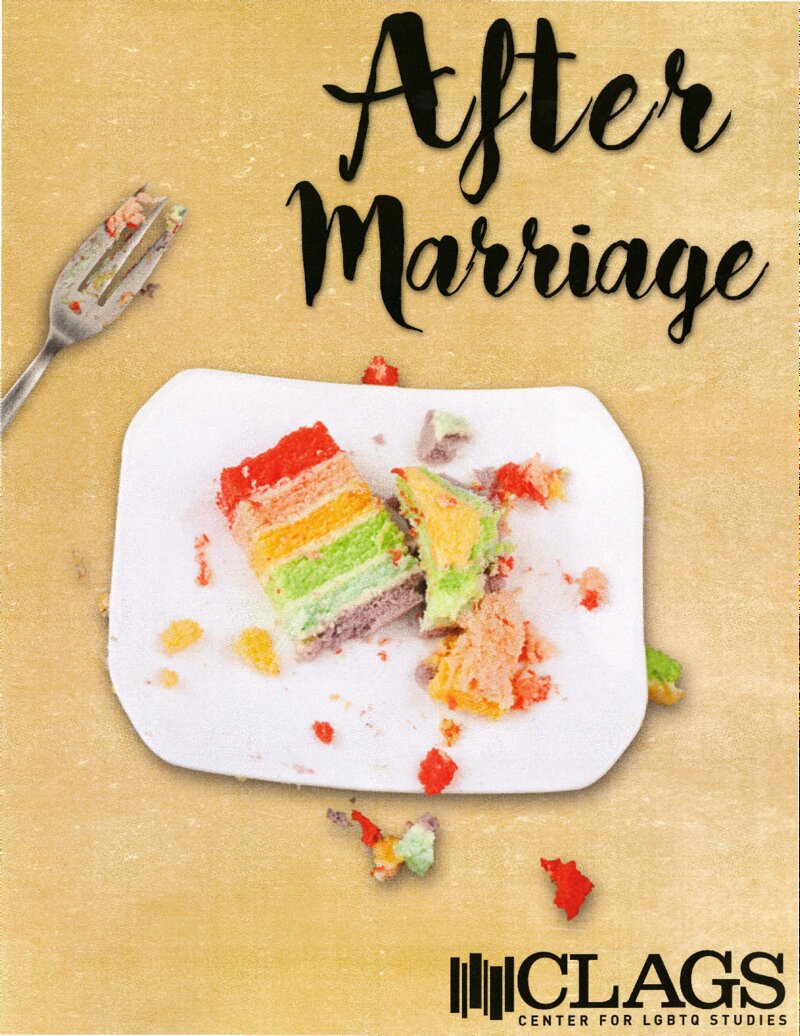
This program was given to those in attendance of CLAGS’ After Marriage conference, held at John Jay College of Criminal Justice on October 1 and 2, 2016. When the United States Supreme Court ruled on June 26, 2015, that same-sex marriage would become Federal law, it raised the question of what the future of queer studies would look like. In June of the following year, 49 people were killed in a mass shooting at Pulse, a gay nightclub in Orlando, Florida. These and many other events were at the heart of CLAGS’ conference. The conference brought together many notable queer scholars, such as Lisa Duggan and Heather Love. Topics of discussion included: “Queer Politics of Life and Death,” “Forms of Exclusion in Marriage Law,” “Policing Sex,” and “Queer Youth and Homelessness.”
Although formally instituted at the CUNY Graduate Center in 1991, CLAGS: The Center for LGBTQ Studies was first conceived 5 years earlier by Martin, Duberman, one of the first historians to embrace the, then infantile, field of Queer Studies. Duberman sensed the need for a formal center devoted to queer research. As the first university-based center for LGBTQ research, CLAGS continues to demonstrate its dedication to advancing Queer Studies, by hosting public events showcasing queer research and sponsoring fellowships to support queer scholars. Among its many notable contributions, CLAGS annually puts on at least one major conference and holds the Kessler Award Lecture every fall to celebrate a queer scholar who has made a notable contribution to the field of queer studies.
Although formally instituted at the CUNY Graduate Center in 1991, CLAGS: The Center for LGBTQ Studies was first conceived 5 years earlier by Martin, Duberman, one of the first historians to embrace the, then infantile, field of Queer Studies. Duberman sensed the need for a formal center devoted to queer research. As the first university-based center for LGBTQ research, CLAGS continues to demonstrate its dedication to advancing Queer Studies, by hosting public events showcasing queer research and sponsoring fellowships to support queer scholars. Among its many notable contributions, CLAGS annually puts on at least one major conference and holds the Kessler Award Lecture every fall to celebrate a queer scholar who has made a notable contribution to the field of queer studies.
Contributor
CLAGS
Creator
CLAGS
Date
2016 (Circa)
Language
English
Rights
Copyrighted
Source
CLAGS Archive
Original Format
Pamphlet / Petition
CLAGS. Letter. 2016. “After Marriage Conference Program”, 2016, CUNY DIGITAL HISTORY ARCHIVE, accessed September 5, 2026, https://stephenz.tailc22a4b.ts.net/s/cdha/item/1313