Spheric: "Birth of an Internation," Vol. X: #1, 1995
Item
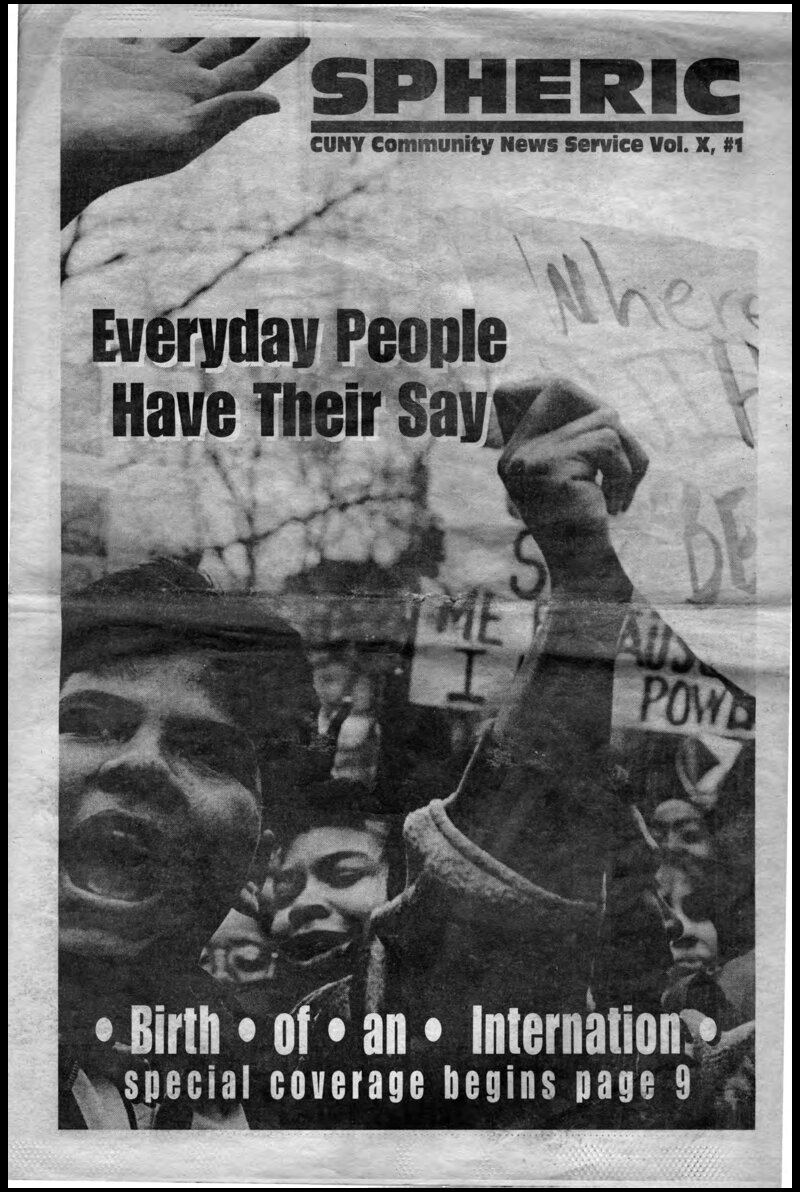
. 4 — =
CUNY Community News Service Vol. X, #
SPHERIC Birth of an Internation
OPH
Spheric Sta
PonyBoy Editor: Jed Brandt
ButterFLYgirl Copy Editor:
Joselyn Mirabal
Original Man Financial Manager:
Adam Perez
SubComandante: Ramiro Campos
La SadGirl Latin Linguistic:
Sandra Barros
Chief: Asif Ullah
Brooklyn Hit Squad:
Sattara Lenz and William Kopp
Conceptual Legal Counsel:
Ron McGuire
Contributors:
Ersellia Ferron, NYU -- photography;
Carl, Fordham; Alex Vitale, CUNY Grad;
Christopher Day, Hunter; Rebekah, Hunter; Jorge
Matos, Hunter; Suheir Hammad, woman-about-
town; the Revolutionary Worker; Epiphany Praxis,
New York; Neesha Anduze, Hunter; Fred “I’m Not
On Acid” Zabinski, Hunter escapee
Special Thanks to.....
Governor George Pataki for introducing the Spheric
staff, Thomas Hunter Hall (you know why), Joselyn’s
hair, All the trainride poets dropping stanzas on the
tracks -- we wit’ you in spirit, Fred for nice office and
laying out the entire fucking paper, the Student Power
Movement, Ilsa for acting like we’re actually compe-
tent, all the divinities dropping epiphany by the office,
Dean “Michael” Escott and Fish -- for all that hair!, The
Resource Center — for all that coffee, Nilda for all that,
the Hunter Envoy for all the “zany” antics, Hunter Stu-
dent Government for the revival of gladatorial combat:
Nilba “Michelle” Gonzalez v. Derron “That’s Not
Funny” O’Connor, Tanya -- you know why baby, and
all our families who we still love, Carl, Neesha, Flip (for
inspiration), the Jaguar (whoever s/he is) for personify-
ing our struggle, the ruling class for creating their own
gravediggers, Karl Marx (oh shit, we're going there)
- and: Touissant L’Ouverture and the Black Jacobins, Ché,
the Committee for Public Safety, the Attica Brothers, the
Hermanas Mirabal, Sandanistas, Zapatistas, Senderis-
tas, Ho Chi Minh, Lolita Lebron, the Young Lords Party,
the Black Panther Party, Toni Morrison, X, Mao Tse-
tung and Bruce Lee, Miles Davis and Geronimo, Marley
and Lenin, and most of all, before anything else -- Jesus
Christ for forgetting to save us.
Spheric is funded entirely by the
International Flouridation Conspiracy through
the Media Board of Hunter College.
Support CUNY media!
695 Park Avenue, Room 207TH New York City 10021
(212) 772-4279
Volume X, Number 1: Birth of an Internation
¢What is Spheric?
Coming out of all the troubles of last year, several of us at Hunter
and Brooklyn Colleges have gotten together to try and find OUR voice
as CUNY students.
Times are rough and looking ahead, they're getting rougher.
Every night the Governer and President get on TV to tell us how all
their decisions are the will of the people. But, you know, that doesn’t
seem the case. I didn’t see any one out in the streets demanding larger
class sizes and increased tuition. Only a bunch of landlords and
financiers in political fundraisers complaining about taxes. We
decided to start getting ourselves organized.
More than just reacting to attacks on our school, we see that the
big decisions affecting our lives are made by groups hostile to us. We
are hoping that through these pages we can discuss our dreams for a
world where we have overcome the lack of power in our communites.
We need submissions from everyone, no matter how well we
think we write, or what kind of politics we have. SPHERIC aims to be
a community paper for all of CUNY’s community colleges and senior
colleges. Not having a line of communication and information was a
teal weakness for the student movement in the Spring of 1995. Let us
begin here, All Power to the People!
The ACT ofthe Paper
§ More than the Fac ofthe Paper
ometimes people seek their freedom outside of people, their jus-
tice outside of the everyday, or their love in the distillation of
passed down poems before finding the sweet hand of a lover.
Some people fight for the idea before the actuality. In school we are
taught about history as if it
stopped happening and language
is trapped by static prophets in
dictionary prisons.
Sometimes our lives
demand more than this life has
presented us with and we begin to
move. When we are trying to
move through a newspaper, the
truth is no longer enough. The
newspaper becomes another part
of the flood, a current in the
stream that looks at itself and tries
to figure where it is going. We
begin to try and guide ourselves
in a Movement to change life.
What is true and holy to
one kind of person is blasphemy
to another. The freedom of New
York is a terror to Wall St. In try-
ing to build a newspaper for the
people, we must accept that the
daily truths we see and know are
lies to the men of power. But
police don’t beat people in USA
Today, they get to work right
down the street. This should not
slow us down for a moment.
Whether in print or in life, there is
an impetus to action in the lining
up of sides.
The New York Times and
its near infinite little brothers pre-
tend to speak for all of us. They
say they are objective, balanced
and only presenting the news fit
to print. But who does their news
fit? And if we can ask who their
news fits, we can ask who we are
and what news fits us. They are
the pretenders to objectivity and
the partisans of capital. We must
be our own partisans and have no
shame.
Movement newspapers
area tool, not the product. The act
of the paper is more than the fact
of the paper. Movement papers
reproduce the same relationships
as establishment papers unless
they consciously build unity of
thought and being in our commu-
nities. A particular unity based on
self-awareness and self-direction
for self-emancipation. The real
point of the major media is adver-
tising. The real point of people's
papers is revolution.
The major media has
three ways of operating to retard
the process we are attempting:
non-critical appearance, final
truth, and a dialectic of domina-
tion.
Non-critical appearance
is the pretense of speaking on
behalf of truth outside of the
turn to last page
Birth of an Internation
SPHERIC
i by jed
e look of surprise that
always gets me. Eyes bugged
out, hand over the mouth, a
quickly escaping “oh my”.
White shock in the face of
black reality never ceases to
amaze, In the aftermath of the Rod-
ney King verdict, Black folks tear it up
in Los Angeles and white folks are
confused and afraid. A predominate-
ly black jury acquits OJ Simpson of *
murder after learning that the inves-
tigative officer who found the most
damning evidence called blacks nig-
gers and lied about it.
The jury didn’t hear him brag-
ging of beating black people until
their faces “turned to mush” or plant-
ing evidence or thinking genocide
was a decent solution to the “black
problem”. The jury only knew what
life was like for black men in Los
Angeles when it came to the police.
White people, in general, saw a
black man “playing the race card”
and getting away with murder.
White people really didn’t get the OJ
Simpson’s trial was about a lot more
than Simpson being a murderer. It’s
really like blacks and whites are liv-
ing in two different worlds. But we're
not.
Black people hear white com-
mentators on television, see white
politicians making policy for the
black community, are trained in Euro-
pean history and in general know
quite a lot about white people.
They know white people don’t
get beaten by their neighborhood
cops for sport. They know white kids
PONYEANT
take drugs to “experiment” and black
kids do it cause “they have bad par-
ents”. They know white people get
every benefit of affirmative action in
that they own the companies they
work for, or their uncle does, or their
uncle’s friend; Black people didn’t
seem surprised that Fuhrman was a
racist. The black people on the Simp-
son jury said they knew he was lying
before they even heard the tapes.
And here's the real fact: So did every
white person watching.
It is impossible to live in Ameri-
ca and not know. But just like a
smoker who knows every drag kills
them, white people are living in a
dream world where their own chick-
ens will never come home to roost.
See, most white people don’t
think they are racist. They don’t say
nigger, don’t even think it. They go to
Grandpa, karma
dictates that | hang you
from that tree.
This theory assumes that whites
in general have created these pro-
grams,which they-Haven’t. Potterful
groups in this country created those
programs to mollify the black libera-
tion movement which was shaking
the foundation’ of America through-
out the 1960's. They created a small
black middle-class while the cities rot-
ted and jobs evaporated.
What was never attempted was
to meet the black demand for self-
determination. The white power
structure just gave enough carrots to
compliment the sticks then viciously
putting down the leaders and organi-
zations of the black movement.
It was not whites in general
doing any of this. It was owners of
companies and police, political par-
ties and liberal think tanks. Most
white folks simply came to under-
So long as the debate over race is a matter of how
When | was your
age, we used to
own them people.
Art by John Thompson Words by Jed and Fred.
They think not me because they
don’t have the personal power to
cause oppression writ large or usually
the desire. Regardless of their wishes
or actual power, white people tend to
benefit from racism.
It is exactly the identification
with “whiteness” that has kept the
targetting the source of their own
immiseration, their own bosses and
landlords. Those who do not have
power have a common cause in free-
ing our lives from being bought and
sold,
Just to remember human biolo-
gy: Race is alie. There is only one
human race with many distinct cul-
tures. We call European-Americans
white and African-Americans black.
The European-American nation in
America has been founded and con-
white people should treat black people, we are still
not ending racism in America.
school with and work by black people
and get along well enough. They are
outraged to some degree by out and
out brutality against blacks, such as
the acquittal of the cops who beat
Rodney King. They know about slav-
ery and Jim Crow. They know Martin
Luther King and Malcolm.X were
shot down. But, they reason, this is
1995.
Prompted by stilted debates in
the media, white people hear word of
all the programs like affirmative
action and desegregation, welfare and
the rise of a black middle-class and
think that white benevolence has run
amuck. From official statements,
even Jesse Helms and Bill Clinton,
politicians whose bread and butter is
racist, talk of how they help blacks.
The logic we are given is that
whites in general have tried to uplift
blacks at their own expense and it
hasn’t worked.
stand some small part of how racist
America was.
They adjusted their behavior to
not be offensive. They passively sup-
ported both the suppression of the
radical groups such as the Black Pan-
thers and the Young Lords, and the
social programs which were being
born, such as Affirmative Action and
Head Start.
White people, identifying as
“white”, confused the content of their
own participation. Though they had
privilege, they as individuals did not
and do not have power. Yet as white
people, they benefit economically,
legally and generally from white
supremacy.
White people, who don’t neces-
sarily wish black people harm, feel
slighted by black anger. Every time a
black speaker talks about “the white
man”, each white person says “not
me”.
tinues to prosper off of non-European
labor.
But most whites don’t own the
companies or make social policy.
They work for companies and are
subject to the laws others write. Most
white people don’t have power in
America. They have white-skin privi-
lege. Both white people and black
people have been hesitant to say this.
In this void, a psychology of race has
come to dominate white discussion.
Racism is not about how white
people feel, it’s about how we all
actually live — it’s about power.
White people in general contin-
ue to view race as a problem of per-
ception and “fear”. This psychologi-
cal view of race acts as if no one
benefits from the social construction
of race. It assumes that if white peo-
ple don’t actively hate black people
(in public), if they use the right words
and vote for the right politicians, then
black equality should follow suit.
Unless, of course, black people really
More than just feeling these
things, whites are conditioned to
think them. So are blacks for that
matter. We (I mean all of us) are told
so often about all the good things
whites have done for blacks, that the
news of TV becomes more real than
what's happening right down the
street.
Over and over we are shown
cultural images of successful black
people such as a black reporter cover-
ing some civil rights convention or
even a “general” news story, a sitcom
with comfortable unangry blacks and
even condemnation from government
officials of the stupider faces of
racism.
But for all the talk of forced
bussing, our schools are as segregated
as thirty years ago. For all the talk of
affirmative action, black people per
capita have 1/20th of the property
whites do. For all the talk of commu-
nity policing, brutality numbers climb
year after year. For all the talk of a
color-blind society, Harlem is black
and Westchester County is white and
you must be blind to color not to see
that.
So long as the debate over race is
a matter of how white people should
treat black people, we are still not
ending racism in America.
The question is not whether
white supremacy will be nice or bru-
tal. It is when will black people own
and control their own means of suste-
nance. Redistributing power was
never on the white supremacist agen-
da. Now that even playing nice is
considered a waste of time by the
white power structure, everyday
white people need to try and deal
with the basic realities of black Amer-
ica and aid in the struggle for black
self-determination. It is only in the
freedom of all people on their own
terms that we can even begin to speak
of love.
—E
agina 4
Nacimiento de un Internaci6én
;Cuba
por Sandra Barros
ctubre 22, 1995 encontro a la
communidad de Harlem
recibiendo con brasos
abiertos al presidente de
‘Cuba, Fidel Castro. Mientras
que los otros dignatarios que se
encontraban en Nueva York para el
50 aniversario de las Naciones
Unidas celebravan entre ellos mis-
mos, Fidel revivio su famosa estadia
en Harlem, cuando en 1960, visito por
primera vez a los Estados Unidos. En
esa ocasiOn se dieron la mano Mal-
colm X y Fidel Castro, uniendo sim-
bolicamente la revolucién de Cuba y
la lucha de los Afro -Americanos en
los Estados Unidos .
La noche del 22 las personas que
se unieron en el Abyssinian Baptist
Church vinieron bajo ese mismo
espiritu. Una mescla diversa de
activistas puertoriqueiios, domini-
canos y afro-americanos asistieron.
Entre ellas estuvieron figuras como
Angela Davis, Nydia Velasquez , Sam
Anderson y organisaciones estudi-
antiles como Malcolm X Grassroots
Movement y Student Power Move-
ment (la nueva generacién de activis-
tas). Vinieron todos a demostrar su
apollo y solidaridad con “Cuba rev-
olucionaria” y a denunciar el bloqueo
econémiico que tiene hasta el cuello al
pueblo cubano.
Ver a Castro , “el barbudo,” fue
para mi una experiencia llena de iro-
nia y contradicciones. Una de las pre-
guntas que mas resonaba en mi
mente era:
{Cuél es la légica que propugna
al gobierno Estaudinense a ser mucho
mas recalcitrante un embargo
econénimo que no ha tenido otro
resultado mas que ser atin mas miser-
able la situacién del pueblo cubano?
Los E.E.U.U. pinta una imagen de
Castro como un dictador fanatico que
impede la democracia y reprime al
pueblo cubano. La realidad, como
dijo Castro mismo esa noche, es que
la revoluci6n ha tenido innumerables
realizaciones sociales: se eliminaron
siertos niveles de pobresa; se redujo
el nivel de mortalidad en nacimientos
a 10 por cada 1000; el promedio de
» by Joselyn Mirabal
his world is filled with
so many injustices that
they speak to us about
a heaven which we
don’t want to form a part of.
erto Ricans, politicians and other
ic leaders,
Among those who attended
ere 70's radical Angela Davis, Rep.
lydia A. Velasquez, Rep. Jose Serra-
no, and others. His visit marks the
th anniversary of his historic visit
to Harlem in October 1960 where !
shook hands with Malcolm X. Tie
©
Dre:
vida subio a 76 afios ; y se levantaron
los niveles de alfabetismo al 96%
entre la poblacién adulta. Estas son
estadisticas positivas para un pais del
“3er mundo” que ha sido aislado y
rechasado por un conjunto de las
potencias mas grandes del mundo.
Estos logros de Cuba hacen mas
obvio la inefectividad del sistema
capitalista de résolver las necesidades
de las minorias. La nacién mas rica y
poderosa del mundo no puede garan-
tisar las necesidades mas basicas a su
pueblo. Aqui existe la disparidad
econémica mas grande entre los pais-
es “industriales.” Politica como la
proposicién 187 en California y el
Articulo 95 en Nueva York ejemplifi-
can la ideologia racista que permea
los hechos del gobierno. En estos
esfuersos anti-emigrante del partido
Republicano propone reducir sub-
stancialmente el “welfare,” la ayuda
médica y el acceso a la educaci6n, no
unicamente a los indocumentados,
sino a aquéllos que no sean ciu-
dadanos de los E.B.U.U.
Pero esperen, esperen! Como les
dije, hay que analizar la situacién en
Cuba desde varias perspectivas.
Mientras oia el discurso de Castro esa
noche, estuve pensando que aunque
ay que reconocer las realizaciones
que a logrado Cuba, no se puede
cometer el error de idealizar la
situacién en Cuba o de convertir a
Castro en un idolo monolitico,
“Que viva Castro, que viva”
decian dos jovenes sentados frente de
mi - sus ojos encendidos de pasidn.
Yo entendi lo que sentian. En los
E.E.U.U. (como en el mundo) nos
encontramos una ves mas en una _
epoca en cual,la injusticia social,
econémica y politica ha aumentado
sus fuerzas contra la humanidad,
{Donde estan nuestros revolucionar-
ios? Lolita Lebron? Malcolm X? Cas-
tro y Cuba suelen ser uno de los tini-
cos vestigios de la vieja isquierda -
una vislumbre de lo que puede ofre-
cer el socialismo, la revolucion viva -
eso representan Fidel y su pais para
muchas personas.
Pero la obligacién de ellos que
sigen en la lucha, ellos que todavia
event was sponsored by the Africans
in the American Committee to wel-
come Fidel Castro.
The crowd applauded Castro's
statements about Cuba's numerous
contributions to the world (specifical-
ly in Southern Africa) and called for
an end to the US embargo against
Cuba which he Says prevents his peo-
ple from recei medical,
economic and nutritional aid. “A
blockade is a noiseless atom bomb
which kills people,” said Castro.
class Cubans are against the
ones but others oppose Castro's
© oa groups protested out-
side during his speech. Some held up
signs which read “Cuba Yes, Castro
No,” Inside the church people
showed their full support, chanting
"Viva Cuba revolutionario.” Castro
responded to the crowd by saying,
“you are part of the group who were
creen en la posibilidad de tener un
mundo verdaderamente libre y
democratico. . . . Su obligacién es
analizar de manera critica las con-
tradicciones de la situacién en Cuba.
Las comunidades mas vulnera-
bles en los E-E.U.U., sean Washington
Heights, El South Bronx o Liberty
City en Miami entienden la urgencia
de obtener las necesidades materi-
ales. Adquirir vivienda decente, ayu-
Castro Speaks in Harlem
never deceived, and for that I will be
eternally grateful.”
Castro says he’s not against
human rights. According to him,
thousands of Cuban doctors and
teachers (majority female) have vol-
unteered their efforts to Africa, North
America, and Latin America. He
added that only Cubans fought
alongside Angolans for 15 years
shedding their fighting forces
sponsored by the South Africa
Apartheid regime. (He failed to men-
tion that Cuban troops also backed a
brutal military dictatorship in
Ethiopia at Soviet behest. — ed.)
- According to Castro, the United
Nations does not mention these con-
tributions; it’s as if the United
Nations accomplished the fall of
apartheid through talking, because
not one Cuban name is mentioned.
People write history, but they forget
reality.
da médica y educacién son el objetivo
principal en estas comunidades. Pero
estos factores representan solamente
parte de lo que requiere la justicia
social: La libertad politica, la expre-
sidn libre de ideas, tiene que existir al
la par de las necesidades materiales
porque “ambas” son derechos basicos
del ser humano.
Sabemos que en los E.E.U.U.
existe la represin politica; sea el caso
Returning to the issue of the|
blockade, Castro said 2,000 Cuba
have shed their blood in Cuba’s fight}
against colonialism. “Others have not
changed in their opposition, so will}
not change. Weare in the right.” _
Castro’s humor about religion
here because I am the devil” He went
on to say, “I’m not sure if] migh
cause damage to any political activity,
surrounded by so many political
leaders is sometimes insupportable.
wing fascists who are working)
against the economy of Cuba.
de Mumia Abu Jamal o los pri-
sioneros politicos puertoriquefios.
{Pero que de Cuba? En su discurso en
Harlem, Castro dio a entender que en
Cuba no existen tales injusticias.
jCasi me caigo de la silla al oir
estas insinuaciones! Aunque el
numero de prisioneros politicos en
Cuba a variado, actualmente existen
presos. El fotégrafo de Frances Pierre
Golendort, quien estuvo preso por 38
meses en 1970, presenté evidencia
que aproximaba 20,000 prisioneros de
consciencia - gentes que expresan su
desacuerdo con la politica y entonces,
en las palabras de Castro, representan
una amenasa a la seguridad nacional.
Otras figuras célculan numeros entre
80 y 200,000, depende la epoca desde
la revolucién. En los ‘80's, Gentos de
prisioneros fueron liberados, sin
embargo, “Amnestia Internacio:
ha presentado evidencia sobre el abu-
so de los “plantados:” ellos que
mantienen aislados en celdas oscuras
por semanas.
Desde el ‘91, el ministerio del
interior Cubano ha organizado y
autorizado lo que llaman “brigadas
de respuesta inmediata” que hostigan
alos opositores del sistema, incluyen-
do activistas humanitarios. El punto
no es que régimen de Castro sea fun-
damentalmente represivo - no
depende de eso:
La gran mayoria del pueblo apoya a
Castro. Pero aun, eso se debe en parte
a las formas sutiles de represién que
existen en Cuba.
Birth of an Internation
SPHERIC
_ WhyBlack Students Owe Their Time and Energies
by Carl
or many of us, college
will give us an opportu-
nity to raise our living
standards and will be
the launching pad to
new careers. Black college students
like other college students, have
worked diligently to succeed in the
academic world.
However, many of us have for-
gotten about the hard work that our
elders have put in to give us access to
higher education. Many of us believe
that our high school averages and
SAT scores are the only reasons why
we have gotten into these institutions.
We must remember that only 25 to 30
years ago these schools would not
even consider letting Black people in.
Let's keep it real, do you really think
that you are any smarter than your
parents or grandparents who were
denied opportunities at higher educa-
tion in vast numbers? Do you really
believe that white institutions woke
up one day with some new found
moral courage and said “Okay, it’s
time we gave a few of them a
chance?” | don’t think so, but many of
us are miseducated enough in these
places to walk around here. thinking
that we earned our way in with good
grades.
We have no concept of the fact
that our people have put their lives on
the line for this society to change the
little that it has, Power concedes
nothing without struggle, but how
many of us today continue on with
that struggle, and how many of us are
just trying to fill the few slots that
have been allotted for us in the job
market?
Many of the freedom fighters
involved in the social movements of
the 60’s and 70's are still languishing
in amerikkkan prisons, but we don’t
know about them because we are too
busy trying to get that good job to
stop and find out. Mumia Abu-Jamal
existen en Cuba.
La Union de Escritores
Cubanos (UNEAC) se encarga de
promover obras literarias que
apoyan el gobierno y censuran 0
suprimen opiniones divergentes y
temas que no sean culturalmente
] apropiados. El escritor Nicolas
} Guillén es el poeta oficial de Cuba
| debido a su trato de temas erdticos y
afro-cubanos. Ambos temas son
“muy acceptados.” En los ‘80's,
autores que denunciaban el sexismo,
el racismo o la homofobia fueron
censurados. Muchos que se oponian
al régimen se vieron obligados a
huir.
Otro ejemplo de represién
social es el trato dado a las victimas
del SIDA. Por la asociacién de la
enfermedad con la homosexualidad,
los enfermos son aislados, victimas
de su “preferencia sexual.”
En este momento, entiendo
porque senti tanta inquietud al ver a
Fidel. El pan y el agua “no son sufi-
cientes.” La libertad de expresién
tiene que ser protejida y estimulada.
La democracia que yo imagino
requiere que se oigan las voces del
pueblo entero. Que las voces sean
is one of those freedom fighters.
Mumia is a former black Panther
Party member and an award winning
journalist from Philidelphia. Mumia
was well known in Philadelphia for
his critical reporting on police bru-
tality and government misdeeds. He
has been fighting for the human
rights of Africans in amerikkka since
he was a teen-ager and now Mumia is
diversas, controversiales 0 conflic-
tivas, pues, es la obligacién del gob-
ierno encontrar la manera en que
todas las opiniones den luz al tipo de
sociedad que habra de existir. No
existe democracia si unas cuantas
personas desarollan ideas y “con-
vencen” a los demas. La sociedad
tiene que ser construida desde abajo
para arriba. Sea el sistema que sea,
tiene que acceptar la diversidad y
proveer materiales basicos.
Analizar y entender las con-
tradicciones que han caracterizado al
sistema cubano tiene que ocurnir a la
misma vez que estemos ofreciendo
respeto a este pueblo que tantose lo
merece. Cuba debe ensefiarnos que
el Imperialismo no es invencible y
que “si” es posible proveer las nece-
cidades basicas al pueblo. La revolu-
cién debe servir , no como un
ejemplo idealizado, sino debe repre-
sentar un experimento que no ha lle-
gado a su fin - un experimento del
cual nosotros, las nuevas genera-
ciones, podamos sacar lo que nos
sirva para construir “nuestro” futuro
tratando de evitar los mismos
errores, Para ellos que buscan los
heroes de la isquierda, deben saber
que la revolucién no pertenece al
“lider,” sino a la humanidad - queda
fighting for his own life.
In 1982 Mumia ywas falsely con-
victed for the killing of a police
officer. The circumstances sur-
rounding the incident and subse-
quent trial led to Mumia being rail-
roaded into jail and sentenced to
death. On the night of December 9,
1981, Mumia was moonlighting as a
cab driver when he saw his brother
Billy being beaten by a cop. Mumia
was shot in the stomach as he was
rushing to help his brother. The cop
was found dead at the scene. Wit-
nesses said another man shot the cop
and ran off. However, when other
police came on the scene, and noticed
that Mumia was the person shot and
lying next to a dead cop, he was
immediately arrested and beaten.
Even though Mumia needed imme-
diate medical attention, he was bru-
talized by cops before and after being
taken to the hospital.
At the trial Mumia was denied
the right to represent himself or have
counsel of his choice. Mumia’s incom-
petent court appointed defense
attorney was allotted only $150 for
the complete pre-trial investigation.
This made it evident that he was
fighting a losing battle. In a city
which is 40% black, only 2 blacks
were chosen for the jury, one of whom
was replaced by a white. Eleven
potential black jurors were struck
down. The presiding judge, Albert
Sabo is a lifetime member of the Fra-
ternal Order of Police and has sen-
tenced more people to death (31) than
any other judge in the country (29 or
them people of color). He refused to
let in evidence obtained under the
Freedom of Information Act from the
files of the FBI that proved Mumia
had been a target of harassment since
he was a teenager.
The District Attorney did not
®& 79S ERIC OROUKEH
PReon
make ballistics evidence available to
the defense. Officer Faulkner had
been shot and killed with a 44 caliber
hand gun, but Mumia had a licensed
.38, and there was no powder residue
on Mumia’s palm. At Mumia’s sen-
tencing the evidence presented
included Mumia's being a member of
the Black Panther Party and that he
had used the term “Power to the
People.” Also the D.A. brought in
0 Save the Life of Mumia Abu-Jamal
“evidence” that Mumia quoted Mao,
saying that “political power grows
out of the barrel of a gun.” All of this
was supposed to suggest that Mumia
had been wanting to kill a cop since
he was a teenager.
Now after Mumia has been on
death row 13 years, the Governor of
Pennsylvania has signed Mumia’s
death warrant. Mumia was scheduled
to be executed August 17th on
Marcus Garvey’s birthday. However,
the powerful outpouring of public
support has led to his getting a stay of
execution. Subsequently Mumia’s
appeal for a new trial has been turned
down and must now proceed to the
Pennsylvania Supreme Court.
Mumia has been sentenced to
death not because he killed a cop but
because Mumia is an uncompro-
mising freedom figher in the struggle
for justice for African people in
amerikkka. As noted before, like so
many activists’of the 60's, Mumia has
been under surveillance by the FBI
since he was a teenager in the Panther
Party. Mumia, Dr. King, Malcolm X,
Huey Newton, Stokely Charmichael,
and Fannie Lou Hammer were
watched not because they were guilty
of any crime, but for daring to speak
up against police brutality, racism,
government corruption and chal-
lenging the merit of a society that
puts profits in front of humanity.
We must get involved to save the
life of Mumia. If Mumia is killed then
that makes it easier for one of us to be
next when we decide to stand up and
struggle for our human rights.
No — Mike Tyson was not a
political prisoner but Dhruba Bin
Wahad and Angela Davis were... .
No — Tupac Shakur is not a political
prisoner but Geronimo Pratt and
Mumia Abu-Jamal are. Ask yourself
why the former names are much more
familiar to you than the latter, and
what we can do to change that. All
Power to the People.
DEAL
SPHERIC
TO KIDS?
Distributors needed all across
CUNY & the tri-state area.
Give us a call.
(212) 772-4279
The paper’s free,
we pay accordingly.
age 6
SPHERIC
Birth of an Internation
The Mark
Fuhrman Quota
te trial of OJ Simpson, went
beyond the gruesome mur-
ders of two people. The tri-
al, and especially the ver-
dict, centered around the
racist role of the police, commonly
known as da pigs , in our society.
The main reason that OJ was acquit-
ted was because of Mark Fuhrman.
The jury said the verdict was about
Mark Fuhrman, and about all the
Mark Fuhrmans in all the police
department in amerika.
Mark Fuhrman is not the excep-
tion, but the rule in every police
department across the country. I'm
not saying that every cop is a Mark
Fuhrman, but that there are enough
Mark Fuhrmans and Stacey Koons in
every police force across the country
to get the job done, to fulfill the role
the police have to play.
The question of these Mark
Fuhrmans is the question of the role
of police in our society. To answer
this question, the question inside of
this question must first be answered:
what are the police? According to
Merriam-Webster it's: the depart-
ment of government that keeps pub-
lic order and safety, enforces the law,
and detects and prosecutes law-
breakers...also, the military person-
nel detailed to perform this function.
An anthropological definition is: an
armed force standing over and above
society whose function is to act as an
occupying army (notice that they
have military ranks) at the behest of
the haves to keep the have-nots in
their place. Many radicals assert
that the police serve as the chief
instruments for the ruling class to
perpetuate their domination over
society.
Huey Newton and Bobby Seale
called them “pigs” because of the
disgusting and de-humanizing acts
they commit day in and day out such
as random beatings, handcuffings
human beings as though they were
animals, and then caging them.
Interestingly enough, the lexical
definition of “the police” does reveal
the military aspect. In reality, “police
departments” are a relatively new
social institution. Our ancient
hunter-gatherer ancestors had no
need for the “police,” and neither do
present hunter-gathering societies.
Looking back through history, the
institution of “army” developed in
response to the emergence of “king-
doms,” which developed as com-
merce increased between stable, sur-
plus producing agricultural societies.
Taking the ancient East African
kingdom of Axum as a case in point,
the kingdom grew when merchants
in the hills of present day Ethiopia
needed protection from roaming
bandits, as they brought their com-
modities to market. Allegiance was
given to the warrior who could com-
mand enough men to act as body-
guards for the merchants, and estab-
lish a relative peace in the area. In
fact, when trade across the Red Sea
began to fall prey to bandits a few
centuries later, the king of Axum sent
an army to “police” Arabia, serving
as an occupying army for the Axu-
mite merchants.
However, the police as known
today, has had its “birth” in the past
few centuries. As the wealth of mod-
sec
Ss
I’m not saying
that every cop
is a Mark
Fuhrman, but
that there are
enough Mark
Fuhrmans and
Stacey Koons
in every police
force across
the country to
get the job
done.
ern industrial societies became con-
centrated in the hands of fewer and
fewer, police departments were
established in order to maintain the
status quo.
In the southern US states of the
early nineteenth century, the “over-
seers” were established for this very
reason. Slave revolts were much
more common than is commonly
known, and the role of the overseers
were not only to maintain the status
quo, but to harass and brutalize the
enslaved Africans at will. They
served as the chief instruments of the
slavocracy in their domination over
the very people who produced the
wealth of their plantations.
As this example demonstrates,
when a people are robbed of their
wealth, or have no means to even
provide for their own subsistence, an
armed force is needed to suppress
the violent impulses that are created
from their de-humanization which
comes primarily from the unequal
distribution of wealth (hunger,
poverty), and their social conditions
(e.g., chattel-slavery. wage-slavery)
and lack of political power (subject to
laws written by the ruling class).
Today, police operations across
the country are still disproportion-
ately aimed at the people of African
descent. The fundamental reasons
remain the same, but a deeper analy-
sis is required.
At the beginning of the 1980's a
restructuring of the distribution of
wealth began. From the early, 1980's
up until the present, about one mil-
lion jobs were permanently lost (i.e.,
although new jobs were, and are still
being created, about one million
workers were permanently dis-
placed), while at the same time, the
number of people in prison rose by
about one million (coincidence?).
At the same time, a “war on
drugs” began. This highly milita-
rized police campaign against the
drug problem was primarily targeted
against the variant form of cocaine
known as “crack”, While the federal
and local governments insisted that
crack was the greatest threat to the
“quality of life” of the US, powder
cocaine was very rarely targeted.
Looking at the racist role of the
police in history, it becomes clear that
crack was targeted becuase it is the
drug of choice of poor Black and
Latino addicts and dealers.
Cocaine, however, is the drug
of choice of the affluent white folk
across the country. To further dispro-
portionate the situation, a mere 5
grams of crack cocaine possession
would heap upon a defendant the
same sentence that 500 grams of
cocaine possession would. The
likelihood of ever finding a per-
son with 500 grams of powder
cocaine in the ghetto, does not
compare with the 5 grams of
crack.
Is the concept of the police
framing Latinos and Black folk for
crimes they have not committed an
absurdity? Consider this: in Bronx
county, 90% of criminal cases heard
by juries in which a Black man’s
word is held against a white officer's
word are dismissed. But even with-
out siting this little known fact, if you
think that such a fact is an absurdity,
then you are probably white, have
had a comfortable life, and/or have
never had not even the most remote
experience with the “criminal jus-
tice” system in amerikkka. Police
frame-ups are a fact of life for many
young Blacks, Latinos, and poor
white folk across amerika. It is part
of the police's job.
I, SubComandante Ramiro,
assert that the police are a malignant
institution, that our “criminal jus-
tice” system is predicated on frante-
ups and lies, and that the majority of
these attacks are mitigated against
poor people who do not have the
resources to obtain competent, or at
least willing counsel for them (as did
O)).
However, a lot of ®
people scoff at these accusa- “9
tions and insist that the police
play a beneficial role in our ©
society. They claim that police §
fight crime and drug dealers on
our streets, and are there to pro-
tect and serve. However, these
Birth of an Internation SPHERIC page 7
HANGING SONG
epiphany praxis
by
his was the song of hot coals left on
the tongue
smoking in the hours before dawn
in a room without windows
he sang his people
as birds te
brooklyn
ng heavy on a tree
mocking birds in a
over the black tar rooftops of
and could be lovers smiling
as the
This glowing cheek and wind
pass
caught hair
I hold before gallows
and the coarse hemp of rope
in a country called my home
I feel the sun forever more
as mine
vibrating lullaby humming of new
mothers with
smoking incense on sunday
mornings up
into the heights of cathedral rafters
Loose the fire!
the hope of thousands
in union aloft
reaches pigeons roosting in the
rafters
and they gurgle,
giggles the poet with a hot coal
blackening his teeth
bring mine down on mau-mau
I leave my eyes on displa
for my children if they will have
them
if they will eat them like bibles
they will stand upright before the
sun
warmed on the beaches before the
iambic tide
roud and alive
in the company of a daylit moon
The Furhman Quota, cont'd
individuals are ignorant of many
things, of what the police do every
time they go out on the beat.
A case in point is the current
investigations of as many. 10,000
arrests in one precinct alone in north-
ern Philadelphia on the possibility of
frame-ups and wrongful charges
pressed against individuals by the
Pigs. They OJ verdict may be seen by
many as a vindication of their inno-
cence.
Ask any Puerto Rican from
Bushwick, who was celebrating Puer-
to Rican Day 1995 about the police.
Ask any black man who drives a nice
car in Bed-Stuy, Brownsville or
Uptown, or for that matter, any
young Black kid who rides a moun-
tain bike in a white neighborhood,
who the police serve. Ask any white
West Virginia coal miner, who has
been beaten up by strike-breaking
police who the police serve, or the
multi-racial strikers in Detroit who
are routinely attacked by the police
who they really serve.
The police are more than a mili-
Omens collect
the institutions and paperwork
the ghosts of lorca and che and
coltrane
wings
of puck cena and the willfully
mad
mad poet women in asylums
mad poet men in prisons
haikus snow through all the
bellvues
textures of lead and callused satin
haunt Attica
all these hung poets singing
within the sun
singeing the skin
singing the skin
and the turning of leaves
tary institutions or the personnel of an
occupying army in place that serve to
perpetuate the system we live under.
To give some credit to the young
women and men who join the US
armed forces, the differences between
police officers and regular military
personnel must be addressed. The
majority of Armed Forces personnel
enlist because they need a job, need
the GI Bill, or to get the high-tech
training that will supposedly give
them a competitive edge in the job
market.
Police officers, however, are a
different matter. Police work is a
career choice. They choose to become
pigs, not necessarily because they
believe that they will be doing some
good for society. Even if they “want
to help the community”, the despica-
ble things that police work involves
usually turns a rookie’s idealism sour.
Many times, rookie mentality is
shaped by the veterans of the force,
many of which joined out of racist
sentiment, or have become racist
through many years of racist police
work. So, when someone joins the
police force, they are quickly thrust
into the job of patrolling and control-
ling communities that they are not
from, much like occupying armies,
and are quickly made into pigs, by
veterans, or the very experience of
having to deal authoritarianly with
people who have been driven to
break laws written by rich people.
For example, white cops who
commute from Long Island or
Westchester County to NYC, will
have no qualms in being brutal and
piggish with the Blacks, Latinos, and
poor white folk of NYC, because they
are not from the community. The
NYPD are following the diabolical
example of the Roman Empire who
recruited soldiers from one part of the
empire to subjugate and control new-
ly conquered peoples.
Many of you may find this col-
umn offensive, and hard to believe.
Many people believe that the police
are socially necessary in order to con-
trol the criminal elements of our soci-
ety, and for the protection of the pop-
ulace at large. But, wouldn’t it be
much better to solve the problems in
our society that produces these crimi-
nal elements, to counter those social
relations that de-humanize our peo-
ple and divide human beings into
classes? Crime is a symptom of the
problem. We've all heard this song
before, but it is still yet to be done,
It is the system itself that is the
real criminal, and it is the system that
produces the poverty and despera-
tion that is prevalent in the ghettos,
barrios, and other parts of our society.
In this web of deception and misery,
the police are the paramilitary institu-
tion gutting society, in order to main-
tainthestatusquo. And in the
unflushed toilet bowl which is the
police force of every city in our coun-
try, the Mark Fuhrmans of every
police force are sure to maintain the
police departments on track.
A 19th century German philoso-
pher once said, “Being determines
consciousness”, and the very role that
police officers have to fulfill makes
them pigs. Every morning, they have
to decide whether or not they have to
go to work that day, knowing well the
crimes they have to commit against
the communities they work in, and
they consistently decide to continue
being PIGS.
What's in store for the future?
Cops are already on are campuses
and moving into our high schools.
The prison industry is now the fastest
growing industry in amerika, and in
two years, the estimated prison popu-
lation in amerika will surpass the esti-
mated enrollment of college stu-
dents...
“The Man” Wrecked My Game
by Topaz
moved - if any of you care.
Ino longer live on Avenue
D. I'm moving up in the
world. I now live in
Brooklyn. Yeah, yeah,
whatever. I know you think
that nobody ever goes there willingly
- usually people try to move from
Brooklyn, to Manhattan. But that is all
just part of my charming rebellious
nature. And it’s great. mete
need to use the subway. I think
transit people know my schedule,
and decide to fix the tracks at the
times I need to use the train. And now
I'll get to pay a buck fifty for that
pleasure. I live with ten cats, and two
roommates. To protect the innocent (I
like these guys), I’m not telling you
their real names. “Chris” and “Mary”
(ah - the joys of being an advice
columnist, and seeing so many stupid
all- American names in quotes! " are a
far cry from Morningstar and Kiki
(remember them ? I threw Kiki's dog
into a closet for a week.) They are my
closest friends, and that makes it so
much easier for me to yell at them.
Everywhere I step, there’s a cat. Our
neighborhood isn’t used to multi-col-
ored hair and body’ piercings, but we
provide them with visual entertain-
ment. Street cats flock tous like we
are feline messiahs or something: So
we keep bringing more and more in.
If'sgetting really out of hand. Any-
body want a cat? Anyway, I’m doing
this advice thing again. You know
what to do, I’m waiting. Please give
my life meaning. Give me something
more than cats and fare hikes. Please,
(Shit - now I’m begging again!)
Ask Topaz
Spheric
DEAR TOPAZ,
I’m going to be as blunt as possi-
ble. | am a twenty-five year old nor-
mal woman with an unnormal prob-
lem. I can’t stop masturbating. I don’t
do it in public - yet- but lately I've had
to literally fight the urge to do so.
Every time I’m alone, and there’s no
one around (they could be in the next
room, however) I am at it. Especi
when I go to bed. I can’t fall asleep
without doing it. And it’s not like I
don’t get sex, because I do, But even
when I’m in bed with a man, I want to
push him away during foreplay and
do it myself. I just do it the best but I
feel like a pervert. | thought only men
had this problem. What do you think
about this?
Itchy Fingers
Dear Itchy,
Yo - you better stop. That shit
could put fur on your palms. You
could go blind. And crippled. And
when you die- you'll go straight to
hell. Yes, that’s the guilt you carry
around every time you go meddling
around down there. Maybe you are a
bit excessive, but there are probably
people with your “problem” who
youldn’t ever admit it, in case they
vant to run for congress, or future
dictator or something. Yeah, wacking
off might be considered a “guy”
thing. But you aren't hurting anyone -
staining sheets, perhaps, but causing
no fatal harm. It's just another regular
habit that no one has to know pi
It’s definitely not as gross as picking
your nose, and if you're careful, you
have a much less risk of getting
caught. Of course you want to push a
guy away and do it yourself. So do I.
So do a lot of ladies. Half the time,
men have no clue- they just play
around with you to figure out where
to stick their thingie. You aren’t a per-
vert, unless you fantasize about small
children, or aardvarks, or Giuliani in
a bikini (that could get any women
hot.) It’s no sin to be horny, girlfriend.
DEAR TOPAZ,
Tam a Sophomore a Hunter Col-
lege, majoring in philosophy. Last
spring, I went to the CUNY budget
cut rally and met a really cute chick.
We totally hit it off. We walked
together, chanted together, and she
held my hand when we tried to make
this barricade. Even when it didn’t
work she kept holding my hand. At
this point I was all set to make my
move, when all of sudden this fuck-
ing pig grabbed me. I tried to fight
him off, but he got me in some choke
hold headlock, and threw me in this
goddamn paddy wagon with three of
my other buddies. What the fuck? I
swear, I was doing nothing - maybe
yelling a bit, but nothing criminal.
Don’t these asshole cops have more
dangerous people to gather up? Man,
I fucking hate them.
T never saw that chick
again. I never had a chance to get her
number before those goddam moth-
erfuckers whisked me away like 1 was
some serial granny sodomist or some-
thing like that, So I have two ques-
tions. One: How can I find that girl?
Two: Why are cops such fucking
dicks?
Down with bacon
Dear Bacon,
All those in favor of cops, a
show of hands, please. Anyone? Any-
one? No, really - not all cops are bad.
I'm sure there are some nice ones out
there. It’s just that all the nice cops
don’t bug us for no reason - only the
power-crazed pigs bother us with
bullshit. So of course, we never do get
to see the nice ones, for the very rea-
son that nice cops only arrest the bad
guys. I'll spare everyone the bad
donut jokes, and give our lovely
NYPD blues some due credit. When
they are needed, they do their job.
The trouble is, they seem to be around
a lot more when they aren’t needed
than when they are. If you were an
average Joe with a badge, a gun, and
a flashlight, would you rather deal
with a psychotic, machete wielding
madman on dust (there are so many
of those around, I know), or a stupid
little college student pissed off about
his tuition? You'd go for the easier
one, right? (Actually, come to think of
it, which is the easier one?) Yeah, cops
suck, and so does life. And nothings’
going to change. Our tuition will keep
going up for fewer classes and zero
programs. Tokens will someday in the
future cost about $3,000, and there'll
be one train working for the entire
city. And what can we do about it?
Nada, Zip. Diddly squat.
As for the babe, she could be in
any CUNY school, or just a concerned
citizen. You may run into her again.
You may not. You can blame the dick-
head cops for destroying a potential
soulmate. All could tell you is bomb
your nearest precinct for revenge.
You'll even put the nice ones out of
their misery. Tell ‘em Topaz sent you.
No, wait - on second thought, don’t
mention me at all.
DEAR TOPAZ,
I’m kind of shy at parties.
What's the best way to act, and to
break the ice in social settings?
Wall flower
DEAR FLOWER,
I know a lot of people might tell
you to be yourself. Have some com-
mon sense. Be honest with yourself- if
you are a total dork, then obviously
you aren't going to want to act the
way you normally do. Don’t be
extreme and try to disguise yourself
by Fred Zabinski
Lamsitting in the dark on
up the nerve to piss in
the water. For the past fif-
teen-minstes Of se T have
been telling myself the obvious: that
practically no one will see me and
that there is no reason to care if any-
one does. And for these past fifteen
minutes or so I have been unable to
stand and do it, amazed and morti-
tion.
T have just come from having
sex in a video booth store on
Christopher Street. It was pretty sat-
isfying, but upon leaving the store I
didn’t feel like getting on the sub-
way and going home right away. I
felt that old deep discontentment
with life and my mind was racing,
noisily chasing jumbled thoughts.
The pier would be a good place
to meditate a litfle, I thought; quiet
sounds and water rippling was what
Ineeded most right then. And, I
thought, I could piss in the water
before the long trip home. I had no
This is ridiculous, I tell myself,
it's not like I haven't done this
before. It’s obvious that nobody
would even care. This is Greenwich
Village, forchrissakes, the fucking
West Side pier. I’ve had sex here.
Everybody has sex here. On my way
over to the most secluded spot I
could find, I passed a man standing
with his shirt off and pants down,
showing another guy his erect cock.
Sitting behind the fence, more
than half the pier’s length from the
shore, I hear the muted sounds of
people laughing, talking, playing
house music. y, someone
passes by, but never clase enough to
“So I have two questions. One:
How can I find that girl? Two:
Why are cops such fucking dicks?”
fied by this sudden irrational inhibi-
(Remember Jan Brady's curly black
wig?) But don’t talk so much. Don’t
try to pretend to everyone you are
way cooler than you are - people see
right through that shit. And to tell
you the truth, there are people whose
dogs are probably way cooler than
you. But don’t let that get to you. Peo-
ple will talk to you if you give them
free drugs. That's always a sure thing.
And they might call you after the par-
ty to “hang out” if you're really gen-
erous. (And hey, if you get arrested
don’t expect them to have your back).
Don’t talk too much. Be mysteri-
ous. Pretend to listen to everyone -
the person who seems to listen the
most is the real life of the party. A
nameless being with no personality is
what's desired at get-togethers these
days. It makes all the others actually
seem intelligent and interesting.
Don’t be unsocial and weird. Don’t be
overly talkative, or too engaging. Try
H udson Bladder Blues
discern me. Yet, | feel completely
exposed.
Trying to reason. with myself,.1
observe how dark it is; there are no
lights on the pier, and the moon is”
barely visible behind,clouds and
smog. Reflections from the shore
provide the only light. would prob-
ably not be able to tell if one of the
vague silhouettes standing in light
were peeing right now. And yet
there may as well be a spotlight on
Quiet sounds
and water
rippling was
what I needed
most right
then. And, I
thought, I
could piss in
the water.
me for the way | feel.
This is not like me at all. 1am
usually happiest when violating
some law or social taboo. This is
something even the cops would
ignore. Pissing into the Hudson? Big
deal. :
I think of all the times I've bro-
ken the law, how half the motivation
was the thrill of risking getting
caught. Most of them involved
ing weed in one place or anoth-
er. Is anewfound cowardice the
of quitting?
Well, I guess I'll have to wait till
T get home. Let me at least try to
calm my mind and Zen out for a
minute. It's why I came here.
Ripples beat against each other,
to find a happy medium between lik-
able and dull. You'll be referred to as
“ what's-his name,” but eventually
somebody will remember your name
and dig your number up from a gum
wrapper in their junk drawer some
place.
Also - never get too drunk where
you can’t make it to the bathroom in
time to puke. No one appreciates
vomit, no matter how cool you are.
Puking on someone's carpet will defi-
nitely get you blacklisted (or
whitelisted-assistant ed.) from any
other party until your mid to late thir-
ties. Trust me, my child, they never
forget. Good luck. And remember - if
you see me at a party, don’t say hi. I
don’t know you.
Thanks for all your queries, folks. If
you send me letters, you will see
them answered -I promise you. Or
you'll get your money back. I'm only
doing my best. Come on- give me a
chance. I’m good, I tell you. Really
good. Advice is my calling, next to
crossing the Hudson River wearing
nothing but a Batman cape. Now,
which do you think would help our
student community more?
the surface shivers in confusion,
frenzied as the jabbering in my head.
J puld like to dp there aes, 7
“over me earlier this ier r had
just quit smoking weed, and I doubt-
ed that I would ever really be happy.
My own existence disgusted me,
keeping me up all night. I couldn't
stand to have the lights.on and see
my room or myself. But the darkness
was scary, too, with the sound of
myself whimpering softly. I felt the
suicidal urge as if it were some alien
thing, a man waiting just beside me
with a knife. Sheer will power kept
me going through those ten days,
and the darkness passed. While life
may be less than joyous, until
tonight I have at least felt like a sin-
gle, unified person.
Itis useless to ignore the pain in
my bladder or this conflict inside
myself, There is no hope of finding
peace here if I don’t make my body
comfortable and assure myself J am
not a coward. It’s either piss now or
leave.
If Lleave without doing this I'm
going to hate myself. It will haunt
me that I surrendered to irrational
fear, that the will power I take such
pride in could not even get me
through something so silly. My men-
tal health is at stake.
1 force myself to stand. I walk to
the very edge, unzip, pull out my
cock and let it go. The urine joins the
river and is quickly swallowed by
the deeper current. Intense relief
overcomes me; I am amazed at how
Jong it keeps flowing out.
When it is over I zip up and
slowly take my seat again, without
looking behind me. It is quiet here.
Snot drips into my mouth. Sit-
ting, I spit into the water, hard and
loud.
£
Fs
On the cool midday of March 23rd, 1995, a 16-
year-old Puerto Rican girl from Spanish Harlem
squeezed her way through thousands of protesters,
past the weak stage security and with unself-
conscious courage approached the Ais manager
demanding to speak. She explained that she had
stayed up half the night writing a speech and no one
would hold her back. Chaos was already ruling the
stage as every guy with five friends demanded his
turn on the mike. Politicians including Al Sharpton
and Borough President Ruth Messinger were turned
away from the stage, yet this young woman took her
turn. She told the story of her life, her family comin:
to New York, her schooling and hopes. She aske
why people so obviously hostile to her and her
family were even able to make decisions that so
pore, effected them. She spoke in Spanish and
glish and declared she would never be quiet. The
crowd roared in response. How was it that the
largest student protest New York has seen since the
60’s was more interested in the words of a young
e Birth ¢ of ¢ ane Internation
woman from Harlem, than the practiced speeches of
liberal government officials? How was it that people
came out on the 23rd to speak for themselves?
To understand what happened and to figure
out which way to go in our struggle for education
and self-determination, we need to study the many
lessons and different stories from Spring “95. Spheric
has collected stories from a variety of viewpoints in
an attempt to present the full breath of opinion. By
printing an article, Spheric is in no way endorsing
the opinions of the writer, we are only trying to give
a complete picture.
We hope this collection serves as a springboard
rather than an ending. The struggle which we all
unleashed is about more than just classrooms and
books, it was about we the people standing on our
own feet for once. And while we didn’t stop the
budget ax, we have learned much about power in
America, the power of people united, and that our
future really rests only in our own hands.
_— -
age 10,
SPHERIC
Birth of an Internation
INTERNATION
Half a Year
After the March
by Asif Ullah
nder the blanket of com-
mon hope and purpose
of adolescence, seniors,
students, professors,
and lists of other stabbed by the dag-
gers of elitist persecution, flooded the
streets of City Hall on March 23rd, in
a.cry for justice. Half a year later the
voices of students then linger on
many of the same minds now, except
this time their slogans are followed by
question marks.
“It's as if March 23rd never hap-
pened”, a grieved Neesha Anduze.
“Pataki or Giuliani don’t have to go to
school, work, ride the subway, and
pay bills under a salary that is barely
above minimum wage.”
Neesha, a senior at Hunter Col-
lege and a retail employee, is one of
the thousands devastated by the
increase in tuition and cutbacks on
financial aid. Although her grand-
mother finances the school bill, this
year Neesha was forced to scrape up
over a quarter of it as a direct result of
runaway tuition inflation. “They
don’t know what it’s like to be black,
working class, or poor and try and
make it out here,” she said referring
to the Governor and Mayor. “It’s just
not fair.”
Much of the school staff didn’t
think it was fair either. Since March
23rd, faculty and classes have been
reduced by almost 25%. Invaluable
programs have been eliminated.
Among the departments shut down
or reduced considerably are the nurs-
ing school at City College, remedial
classes at most of the CUNY’s 18 col-
leges, music, theater, and environ-
mental health departments at Kings-
borough Community College,
communications, media studies at
Hunter College and Lehman College,
which dedicated a $45 million gym-
nasium, was forced to resign their
physical education major. “These are
rough times,” said Hunter Sociology
Professor Carter during a teach-in on
March 15th'to a'sea of theering stu-
dents. Another professor from the
Sociology Dept., said the termination
of faculty is “in addition to the 17%
already laid off over the past four
years.” The teach-in was held to
build consciousness as well as
momentum for the City Hall March
that followed the week after.
According to a New York Times
article, “not since tuition was first
imposed during the fiscal crisis of the
1970's has the City University faced
such deep cuts.”
The deep wounds left by the
budget stabs are certainly unbound-
ed, for they hit primary, secondary
and extra-curricular education, as
well as CUNY. Less money would be
spent on rehabilitating school build-
ings and textbooks from the 1960's
willgetlife-extensions even as enroll-
ment flourishes. Meanwhile, Board
of Ed officials maintain that the $750
million cut would not significantly
effect classrooms.
Beyond the world of education,
everything else directly pertains or
somehow interlinks. $750 million cut
from Welfare and Medicaid pay-
ments. $58 million cut from the MTA
which means stricter guidelines for
the 350 thousand student recipients of
free train passes another token fair
hike by 20%.
“Tt’s just like Vietnam all over
again,” said Andre White, a homeless
veteran of the controversial war in the
sixties and an attendance of the
March 23rd City Hall protest. “It’s
like they don’t realize that there are
men dying out there until too many
have died,” he said painfully staring
off into space as if reliving the war. “
Well they’re doing the same thing
again. They're killing us and don’t
realize it, and if they do they sure as
hell don’t care.”
Many feel the ” they” have won.
“T went to the march and although I
don't regret it, I don’t think I'd do it
again if there’s another one,” said an
angry Alisa Ali, a junior at City Col-
lege in reference to the march. Alisa,
who was considering entering the
discontinued Nursing program at
City, has now settled for English writ-
ing. “There's no use in fighting
them.”
Still there are many who are less
pessimistic on the outcome of the
march. “I think March 23rd was a
start”, said Ivan, a History major at
This time their
slogans are
followed by
question
marks.
Hunter. He is critical of the system,
and felt optimistic of the demonstra-
tions significance. “The march was
very effective, although they
wouldn’t let us know that,” he said.
“Finding myself in a crowd of 20,000
who all came together for a common
purpose only reinforced my views
and made me stronger.
Ivan and many like him, feel the
march was the reason why tuition
was raised 25% instead of 50%. “We
scared them,” Ivan said smiling.
never submit to the man
always submit to spheric
letters epoems ¢ articles ¢ cartoons ephotos ¢ rants ¢ dreams ¢ journal
S © more cartoons
695 park avenue © room 207 thomas hunter hall « nyc, ny 10021 © 212-772-4279
Birth of an Internation SPHERIC ; page
OPEN POEM TO THOSE WHO RATHER-WE NOT READ...OR BREATHE
Fascism is in fashion
but we be style
dressed in sweat danced off Taino and
Arawak bodies
we children of children exiled from
homelands
descendants of immigrants denied jobs
and toilets
carry continents in our eyes
survivors of the Middle Passage
we stand
and demand recognition of our humanity
Starving for education
we feed on the love of our people
we flowers
the bloom on Amsterdam Ave
though pissed on by rich pink dogs
through concrete cracks
We passion kiss in the backs of police vans
recite poetry in prison cells
stained walls in blood tracing brutality
know the willow she weeps for
we her jazzy tears tasting of the strange fuit
of southern trees ;
Fascism is in imperial fashion &
but we be style
our tongues (long slashed-to-keep silence) While evil is wearing itself down with
wear blood jewels badges guns contracts .laws..cash ___
our heads sport civilizations and rouges its thin lips with human juice
our hips are velvet wrapped in music strained off billy clubs
and you can see the earth running and tightens its power tie around necks
right under our skin that just won’t bend
we see the price tag hanging out
In a state of police the cost is our death
cops act as pigs treat men as dogs and we refuse to pay
mothers as whores
the bold youth of a nation hungry and cold We be political prisoners walking around
an entire nation of youth semi-free
behind bars grown old our very breath is a threat
the mace and blood did not blind we to those who rather we not read
witness and demand a return to humanity and think andanalyze and watchout and
fight back
We braid resistance through our hair and be human beings the way we need to be
pierce justice through our ears
tattoo freedom onto our breasts We wear warrior marks well
The bluesy souls of brown eyed girls Fashion is passing
clash with the blackened blood on the pale style be everlasting
hands of governments of war we
cops who think they’re bluer than they are
black Suheir Hammad
mercenaries sent ona mission tosetback = 42195
our strength power love
Dedicated to those who realize our empowerment is
We be eternal style through education.
SPHERIC
Birth of an Internation
In My Blood
eesemeexeeee by Lenina Nadal
y family never gave up on
freedom. In the 1950's,
while young girls wore
poodle skirts and house-
wives wore high heels on
television, my grandmother was
learning powerful English words to
curse out members of the Board of
Education. She scolded them with
passion hoping the school would
finally listen to the needs of Latino
parents in her community. My grand-
father worked in a restaurant cooking
We were tied
to one another
by a quiet
love, one that
touches all
who undertake
the risk to
fight for
freedom.
meals for the rich and well-dressed.
He would long to come home and
reminisce about his youth as a war-
rior for Puerto Rican Independence.
He tickled: his lips playing patriotic
songs on his harmonica.
When I was a child, over-
whelmed by throngs of people at the
Puerto Rican Day parade, I held my
country’s flag tightly in my fist as my
father balanced me on his shoulders.
Theld strongly to the dreams which
were fought for by my family. When-
ever I resisted authority, | touched on
this spirit which rushed through me
and filled me with strength. But,
marching through the rain last April,
the spirit which guided me was my
by J. Kim
f what I have learned, or
absorbed from one of my
black mentors, this one
anecdote stands out.
His past recollections of his
youth, 15 years old, growing up in
black working class Detroit.
It is the 60's, and he describes to
me of the fire in his heart raging and
coursing through his veins. The East
Wind prevails. The flames of com-
munist revolution are sweeping all
thoughts and actions.
“I swore”, he'd say, holding out
his arm, extended open palm dis-
playing five fingers, “that there
would be revolution in five years.”
He is now a man in his forties,
ever so defiant, ever so brave, and
with all the years of struggle behind
lution in those five years from his fif-
teenth year of birth, as a revolution-
ary.
Much has changed, but much
more remains the same. Revolution,
uprising, rebellion, defiance saturates
own,
It was a simple thought, “why
should we have to pay more for edu-
cation? Shouldn’t we be able to
explore our world for free?” that led
the students at various CUNY univer-
sities to rebel. For this question we
were made to feel intimidated, as if
our questions were unreasonable.
When some students decided to
starve themselves for the sake of edu-
cation ,the students were told that we
did not have the right to protest in
school and that we would be arrested.
We were gathered in a commons area
of the college and were resentful to
the authorities. We walked out of the
college with conviction followed by
the guards who breathed upon us
heavily, asking us to move, It was
midnight and it had started to rain.
When we reached the streets, we hud-
dled close in puddles of water mixed
with gasoline on the sidewalk. I let
the rain pour on me, soaking my hair
and my long blue dress. I longed to be
naked for my clothes were heavy and
constricting.
We were tied to one another by. a
quiet love, one that touches all who
undertake the risk to fight for free-
dom. I watched the students. Some
were kissing new loves, others shoot-
ing up their fists and chanting. Oth-
ers were sliding on the wet concrete
giggling at a dance move they creat-
ed. There were children dressed
sntigly in their raincoats, standing by
the side of their moms. Others were
peeking at me and hiding behind
their parents’ legs. These were the
moments when time stood still, when
I realized the eternal nature of strug-
gle. These streets had a history of
soaking up the energy of the many
Who stood up in the past and those
who would rise in the future.
As we marched through Harlem
at midnight, people watched us from
Who could
forget when
the imperialist
red, white and
blue flags were
lowered to be
rightfully
replaced with
our colors?!
to free itself from its bonds.
285
Amidst the flurry of winter
winds and unfinished papers from
the fall semester, select bureaucratic
administrators from CUNY began to
initiate their first steps of resistance,
setting up the first SEEK student con-
the windows of their iments,
some faised fee in solidarity.
Cars drove by and’honked as we
chanted “fight, fight, fight, education
is our right!”. For all the grunts, all
the angry drivers locked hopelessly in
their cars who sneered at us, there
ferences. It was apparent that the
GOP fascist “revolution” was threat-
ening to engulf them as well.
Only weeks before, the students
of Rutgers University stole the
national spotlight, having a sit-down
protest during a national conference
basketball game. The first salvos
have been exchanged.
I was attending a private art
school at the time, of which the
majority of students were middle
class and/or Asian. They did not, as
a totality, sense the urgency of the sit-
uation, the overlooming threat to us
all.
Perhaps it was the division of
private and public spheres, though
all students were to be affected by the
cuts on federal grants. Perhaps it was
the greater promise or illusion of the
American dream. For most Asians,
acceptance in the status quo, as well
as the white supremacist culture they
embraced, was enough to immobilize
them into complacency. -
The majority of my work was
done with City University students at
Baruch. One of my comrades in arms
called me to his aid. As ever, you
were.also Signs of appreciation, a
smile, a salute:
We marched because we believed in
the power of presence and the power
of the human glare. We did not need
weapons, ‘we burned our enemies
The Flurries of Winter, the Furies of Spring
the air, fills every fiber of being. It is
an uneasy tension that too has an
unknown, neglected, but upon hav-
ing borne too much insult must real-
must go to where the struggle is, if a
long-term goal of organizing in a spe-
cific set locality appears to be non-
pragmatic to accomplish the task at
hand. A better strategic approach is
indeed to include all aspects of strug-
gle, only if, your resources are not
Quite recently I had excommu-
nicated myself from a Marxist-Lenin-
ist party of which I was a member for
about five years. contrary to popular
belief of the autocratic party struc-
ture, it was their unbearable white-
ness of being which actually rein-
forced my resolve to quit. It was as
easy as it was hard. Though | found
myself an orphan of sorts, the strug-
gle remained. (Without which there
would be no so-called parties of any
sort.)
For the first time I ventured
beyond the city boundaries, visiting
state colleges in Long Island, trying
‘to establish ties, forge links. On the
homefront we were engaged in strug-
gle - leafleting, holding forums, con-
solidating a political cadre of sorts.
The Student Power Movement was
conceived at Baruch as a result, we
were unifying our points of resis-
with strong, youthful eyes.
I rode the subway home that
night, filled with the same dreams for
freedom of people who stay hoping ,
who have fought, sung and died.
tance. Prior to that however, the
CUNY Coalition as it was known,
began to meet on a regular basis.
A conglomeration of different
views peppered these meeting lead-
ing to structural challenges, puzzle-
like in form — puzzles that would
ultimately be solved to some degree
on the field of practical activity. 1
honestly have very little to gripe
about the CUNY Coalition. It’s faults
were to be expected.
3/16/95.
“Pataki! Pataki! Pataki’s on fire!
He don’t need no water, let the moth-
erfucker burn! BURN MOTHER-
FUCKER, BURN!” The Black and
Latino Caucus/USS rally was a
tremendous outpouring of student
defiance. The chants thundered
throughout the path to Wall Street.
Thousands jammed the street in
protest, but unfortunately, it was
tightly regulated by political appa-
tatchniks, as it always seems to be. .
Their presence, as usual, guar-
anteed that the masses would be
offered as a sacrificial lamb to the
bastard sons of capital.
March 23rd. 1995
[net page
Birth of an Internation SPHERIC page 13
Ademonstration FPR i rte ey lhisisnotalove song
Kate McCarthy Joselyn Mirabal
Vast and deep - an ocean tl Al tl if Ki i There is a man
of people rushed into the I want to meet
trap like a crashing wave tl i]
They gathered for a cause | Mie | i |
but ended up digging |
Just to have
their own grave.
for one day
in a room with a view of
A whirling chaos that
drowned the outcries of
times square
tie naked to the bedpost
the demonstrators.
I’d stand there
smiling to myself
waiting until his dick got
hard
to then cut it off
and see the sheets fill with
red
against his pale white skin
I'd take pictures
&
mail them to college students
Driven by anger and
frustration - an
unpredictable current had
formed.
A cause pulled back to the
SEAS: : all around New York
Let a drift for people’s Then I'd leave him bleeding
personal scenes. & crying
singin
A seawall of billy clubs “T hate you, es 4 cking dick
and mace. Pataki you’re a
This time, had they lost motherfucking
‘ie races moneygrabbing, politician,
white shit”
The temperamental sea of But halfway down the stairs
people were forced to The naire I'd stop and turn around
retreat. because
a * h
As they slowly walked of this flower ZS ae 2 eats See
‘ ‘ eing suffering.
away - bittersweet smiles So I’d go back to the room
never showed their iS {0 Hioom and put a bullet through his
head
defeat.
Who can forget the magnitude?
Fire in the lungs of every man,
woman, and child who came down to
claim our right, our might, our collec-
tive self-determination! Over 20,000
strong in one place with one will.
Black, Latino, Asian and White
proudly repeating “Black Power!”
Afrocentricity in the context of a
multi-racial /multi-ethnic uprising
seized the day! The echo still res-
nates in my mind. Who could forget
when the imperialist red, white and
blue flags were lowered to be right-
fully replaced with our colors?! Flack
of African liberation, of the Domini-
can Republic, and the ole’ stars and
bars replaced with Anarchist Black!
The following disarray (the part
that made the front page of every
newspaper in New York and then
some) never really bothered me,
though our tactical defeat at the
hands of NYPD goons became the
source of bitter disputes for all fol-
lowing gathering to come. But no
force on Earth, volcano eruption or
tsunami tide can drown out the
echoes of the students on the 23rd of
March.
No, That was not the end. It
was followed up.with further acts of
defiance. The City College hunger
strikers that on one night led toa
nen march through the streets of
Harlem - April 26th (read it and
weep!) - the Silver Palace demonstra-
tion (workers and students in China-
town fighting for a livable wage in
restaurants) where about a dozen stu-
dents finally got a chance to say “fuck
Pataki, Fuck Pataki, FUCK Pataki!”
right to his face.
Somebody I met in the course of
the struggle told me that we may be
the first “post-modern” activists of
our kind. I’m still entertaining that
thought. We fought hard and we'll
even fight harder in the future. We
have to, there is little recourse left but
defeat, and victory is ever a brighter
alternative to defeat.
SPHERIC
Birth of an Internation
by Alex S. Vitale, CUNY Grad
oon after New York Governor George
Pataki joined the nationwide assault on
education by proposing 25 percent
reductions in state support to both the
State University of New York (SUNY)
and the City University of New York (CUNY),
an ad hoc coalition of student activists from a
number CUNY campuses began meeting to
organize a militant, multi-issue response.
Unlike in past years, when student organizing
had focused on the administrators of the CUNY
system, the newly formed-formed CUNY Coali-
tion chose as its target the new Governor, the
State Legislature and the downtown business
interests that they felt were ultimately behind
the austerity measures. This analysis, combined
with an open and democratic organizational
structure, created the framework for a mass
mobilization of CUNY and high school students
fed up with the barrage of cutbacks, and the
politicians’ rhetoric of hate. Unfortunately,
however, students were not able to build on
their successes, and organizing efforts degener-
ated into sectarian debates over revolutionary
strategies which left many alienated and demo-
bilized. A closer examination of the tactical
decisions made by organizers may help us to
better prepare future responses to the continu-
a Se Sa
Student reaction to
the day was mixed.
Many students
were alienated by
the militant
rhetoric of the
speakers and the
sense of poor
organization.
ing tide of global austerity.
The first challenge that faced the Coalition
was how to deal with the official CUNY-wide
student government, the University Student
Senate (USS), which was aligned with progres-
sive state and local legislators. The USS’s goal
was to preserve CUNY programs through inten-
sive lobbying within the Democratic Party,
backed up by carefully orchestrated mobiliza-
tions that they would control politically. The
two groups came into immediate conflict as each
began to plan demonstrations in March. The
USS,. working with the Black and Puerto Rican
Caucus of the State Legislature, called for a
march to Wall Street for the 16th. The CUNY
Coalition called another march to Wall Street on
the 23rd. A battle ensued over which event
would be more prominent and which group
would come to represent the legitimate center of
the struggle.
The USS decided to work with established
student leaders at the campuses; their political
positions were determined by a centralized
leadership. In contrast, the CUNY Coalition cre-
afed ad hoc committees that were open to every-
one. On some campuses, these committees were
closely tied to student governments or major
student organizations and on others they were
not. As a result, the Coalition’s organizing was
high on energy, and inclusive of diverse people
and ideas, but often low on resources. Both
groups were more racially divers than most stu-
dent coalitions but neither was as diverse as the
overall CUNY student population. The issue of
racial composition did come up on individual
campuses, but it was not a point of difference
between the USS and the CUNY Coalition.
COALITION GAINS MOMENTUM
As march drew on, it became clear that stu-
dent support was galvanized around the coali-
tion. The USS was having limited success out-
side of a few campuses where it had strong
student government support. The major Senior
Colleges (City College, Hunter, Brooklyn, and
Queens) were all working with the Coalition.
Progressive faculty, organized as the Coalition of
Concerned Faculty, were also supporting the
more open and radical politics of the CUNY
Coalition.
On the 16th, the USS had its event. Some
5,000 students, most from six campuses with
strong student government support, as well as
March 23, 1995 - Students gather to storm Wall Street.
SE by Jed Brandt, Hunter College
n the months since we fought to stop
the cuts, a lot of discussion has gone
on trying to figure out what happened
and which way to go. From cultural
nationalist critiques, to distorted liberal
moanings, to the truly bizarre “general strike”
rhetoric which haunts every public meeting,
each group has tried to put their own spin on
the student movement.
No, we didn’t stop the budget cuts and,
no, we didn’t start the revolution. We did,
however, unleash ourselves and thousands of
everyday people to stand on our own feet.
Never in my life have I seen such passion, such
some labor and community groups, marched
from the Borough of Manhattan Community
College to a large parking lot at the World Trade
Center where the Governor has an office. In
advance negotiations with the police they had
not been able to get permission to march to Wall
Street as advertised and were instead forced to
follow a route of only six blocks that was lined
by police barricades. And as the march came to
a stop, the police initially prevented people from
leaving the rally. This caused a minor panic and
a major sense of disempowerment. When exits
were finally opened up. people streamed out. A
greatly diminished crowd remained to hear the
speeches from legislators and student govern-
ment leaders, which were often indistinguish-
able.
From the start, the CUNY Coalition’s strat-
egy was more militant and less bureaucratic.
Over the course of many heated meetings the
go to page 15
aspirations talked about in public and such
genuine grass-roots activity come to fruition.
For good or bad, we're all still here.
Instead of pointing fingers and crying over
spilt milk, I’ll try here to list the major points I
think characterized our movement to help us
all find the way forward in these turbulent
times.
THE PROBLEMS
Any gathering of students talking about
the CUNY Coalition has a list of what went
wrong and who did what. Some of this discus-
sion is helpful. Often it is not and is based on
partial experience, petty opinion and political
agenda. Most of the griping starts with the
“failure” of March 23rd.
Weeks of discussion in the CUNY Coali-
tion led up to a definite picture of our central
day of action. The march would not target the
YouSay You Wanta Retin... Yes, We Do
Republican Party by itself, rather it woul
make a critique of capitalism and head for Wal
Street. Hardly an arbitrary decision, we collec
tively saw that the Republican Party was act
ing on imperatives from the economic restruc
turing of capitalism. I know that’sa mouthful
but neo-liberal economics is taking a toll al
around the world — and Wall Street is wher
the men of power buy and sell this world wi
live in.
We decided that we would not allow
politicians from the Democratic Party to speal
from the stage. Only students, union represen
tatives arid teachers would get to address th
crowd.
We decided that we would not get a per
mit. The slogan for the march was “Studen
Strike Against the Cuts! Shut the City Down!’
Having a ritual parade where we begged th
state government not to do bad things to u!
was just not going to happen.
Based on the last round of student activi
ty in ‘89-'91, we saw that once a critical mass o
students was formed, we could go pretty muct
wherever we wanted. This did not turn out t
be true,
Once 20,000 students gathered in th
No, we didn’t stop
the budget cuts and
no, we didn’t start
the revolution. We
did, however,
unleash ourselves™~
and thousands of
everyday people to
stand on our own
feet.
plaza of City Hall, the tactical team for the
March (Anthony Lyles, Bronx Community Col-
lege; Joan Parkin, ISO - Grad Center; Adoni:
Rozon - teacher; Alex Vitale, Grad Center; anc
Jed, Hunter) attempted to negotiate our wa}
out of the barricades. We had decided not tc
speak with the police up until the morning o
the 23rd, since we really wanted to shut the
city down and not just wander around chanti.
ng.
Getting a permit required a scriptec
march route, which would have sapped ou
whole point. This decision was reached after
six weeks of fierce argumentation and the tacti
cal team was carrying out the directives they
had been given by near unanimous votes.
The police decided not to let us leave anc
we as a group tried anyway. We failed. Ow
organization was not sufficient for the thou:
sands of high schools students who came from
wildcat walk-outs and CUNY students not ir
contingents.
Many left angry and confused. Some had
not been aware of the radical direct actior
intentions of the march, most were and had
come excited with the possibility. If we had
succeeded in breaking through the barricades,
then this political discussion would be moot.
However, even though people had gen-
uine feelings of failure, let's remember that il
was not until a demonstration outside the con-
trol of the Democratic Party occurred that talk
of compromise began. The budget cuts were
only a third of what had been predicted. The
go to page 15
Birth of an Internation
SPHERIC
April 25, 1995 -- Students blockade Holland Tunnel
Coalition voted several times that the goal of
the March 23 event was to “shut the City
down.” In practice, this meant drawing 5-
10,000 students to City Hall and marching
through the financial district, causing maxi-
mum disruption of business as usual. By not
scripting the day, the Coalition hoped to give
participants the sense that they had a role in
shaping the event as it occurred. It was hoped
that this level of empowerment, like the open
organizational style would create momentum
to build a sustainable student movement that
could take on the budget cuts and a wide vari-
ety of political issues.
On the 23rd, some 7,000-10,000 high
school students, up to 1,000 university faculty,
7,000-10,000 university students and over
1,0000 union and community members turned
out. These numbers far exceeded organizers’
expectations and caused major logistical and
crowd-control problems, especially for those
managing the stage.
OLICEOUT INFORCE™
TheNYPD also turned out in force. Dur-
ing the final days before the event, the police
had requested meetings with organizers and
had offered a march permit to the World Trade
Center. Student leaders had decided not to
meet with the police, instead planning to force
them into negotiations during the event, or to
start the March through sheer numbers as in
1989 and 1991, the two most recent CUNY
Mobilizations. In response, the NYPD
assigned more than 2,000 officers to the rally.
The police indicated to organizers that
they were going to use whatever force they
needed to prevent a march. A police provoca-
tion was clearly in the works. In spite of this
threat, organizers attempted to start a march by
moving people quickly into the street through
one of the few pedestrian openings in the barri-
cades. Many students were also prepared to
push through the police lines, despite assur-
ances from organizers that this was not the
intended strategy. Several scuffles broke out -
all initiated by the police - and dozens were
arrested. At one point, as the march turned
and headed toward the southern end of the
park, the tactical committee, which ostensibly
was leading the march, got split up and had to
scurry to regain control. After several con-
frontations with police and a great deal of
chaotic discussion, groups of students began to
pull out and reconvene at a campus nearby.
Student reaction to the day was mixed.
No one expected such a big turnout. But many
students were alienated by the militant rhetoric
of the speakers and the sense of poor organiza-
tion. Though at the event there had been wide-
spread support for attempting a march, some
were also opposed to a confrontational strate-
gy. It became clear that the structure of the
coalition was open and dynamic but lacked
sufficient accountability to ensure that the out-
look of the CUNY-wide organizing group ade-
quately represented the views of students on
the various campuses. The coalition attempted
to solve this problem through a representative
system but it was not implemented until early
April, after the group had lots its momentum
and some of its legitimacy.
One of the best aspects of the action, how-
ever, was its ability to connect issues, CUNY
students are from New York City; what affects
the community affects them. If schools, trans-
portation and public hospitals are hurt, then
students are hurt. Many students work in the
public sector, and they face a tuition increase
and a loss of employment at the same time.
This overlap gave organizers a sense that there
‘was a real possibility of a multi-issue, student-
led movement to oppose the entire program of
government restructuring.
The studen
speakers made
threats against the
police, and-tried to
motivate the crowd
through extremist,
and at times,
offensive language.
The next day, Rev. Al Sharpton and Den-
nis Rivera, president of 1199, the public health
care workers’ union, called the Coalition and
suggested another City-Hall-to-Wall-Street
march under a unified community-student-
labor banner. They had both been present
March 23rd and were appalled by the police
tactics. They proposed a joint event for April
4th, the anniversary of Dr. Martin Luther
King’s assassination.
Students voted overwhelmingly to sup-
port the new coalition, but not without voicing
turn to page 16
papers anounced the news in the following
days.
The second major problem I see was that
we could not hold together the city-wide coali-
tion after the spring. The reasons for this are
many. We are coming from a variety of different
communities and we have radically diverse
philosophies. Times of crisis gel us in opposi-
tion to government policy, but in terms of what
we want, there is not a clear vision which unites
us at this time.
The list of people I’ve heard blamed for the
disintegration of the CUNY Coalition include:
radicals, liberals, anarchists, Maoists, “white
people”, black nationalists, professional leftists,
trotskyites, police infiltrators, the Grad Center,
and on and on. Rather than finding one particu-
lar cause, it seems that without a unifying vision
of the world we hope to attain, we cannot keep
unity beyond these moments of crisis. Unfortu-
nately, little work has been done to try and find
our unity and much has happened to cement
our differences.
No matter how much bad blood is spilled,
events will again force us together. Let’s try to
keep politics in command and know what we
want, clearly argue for it, respect differences
and achieve the highest level of unity we can.
Our enemies have done a damn good job of uni-
fying, let us keep this discussion alive.
Thirdly and perhaps most importantly, the
issue of “representation” has been floating
around. This has been put forward in the fol-
lowing ways: the coalition was run by white
liberals /radicals who endangered people of col-
or by pushing militancy, that even with one-per-
son/one-vote - whole groups did not take an
active part in those discussions so they didn’t
even get the chance to vote, that small and
_aggressive trotskyite organizations were able to
talk at length about things no one wanted to
hear without a popular base to justify it, that
meetings were dominated by “powerful person-
alities” and not the positions they raised, that
meetings were packed by various factions, that
the placement of meetings at the CUNY Grad
Center gave too much influence to graduate stu-
dents who tended to be white and middle-class,
and that a standing leadership body was not
elected.
These various criticisms boil down to two
essential issues: democracy within the CUNY
Coalition and its representation as a body of
CUNY students as a whole.
No group can represent everyone. People
form different collectives to do particular things.
People form groups to use different tactics. The
CUNY Coalition was formed to be a grass-roots
body to really reach out on the campuses rather
than take directions from USS and the state
Democratic Party (e.g. Denis Rivera, Ruth
Messinger and Al Sharpton). Did it represent
every CUNY student? Obviously not, but those
|
students who supported the call came out, and
bodily supported the objectives raised by the
Coalition. If they did not support them, they
would not have come. Maybe some were igno-
rant of the permit issue, but the flier calling to
strike and shut the city down seemed pretty
explicit to me.
The idea that internally there was some
secret cabal pulling strings and manipulating
votes is absurd. Yes, there were factions. These
factions did not break down, however, along
racial or school lines internal to the Coalition.
The radical direct action faction included poor,
working-class and even middle-class students.
The liberal “lobbying” faction included same.
The direct action faction won the discus-
sions, based on the strength of the arguments
and the actual popular will on the campuses.
No other explanation fits the actuality.
I've seen years of liberals sapping the cre-
ative power of popular movements under the
banner of “inclusion”. But I want more than a
rally. I want a world where the decisions which
affect our communities, schools and workplaces
are made by us and not some jackass in Albany
or Wall Street. And I’m not alone in feeling this.
That was the sentiment that broadly made
March 23rd proceed with its radical vision, and
no backtracking can deny it.
Were some people “alienated” by the radi-
calism of March 23rd? Yes, but I think that had
more to do with not really shutting the city
down. Some didn’t want that to happen in the
first place, but they had NYPIRG, the Democrat-
ic Party, and the USS to represent them. Those
groups were multi-racial and multi-class in
composition also, but the vision and politics
Self-reliance is
knowing we have no
saviors. No miracle
politician or half-
baked demagogue is
going to open the
treasure chest of
America and rain
old chains on our
eads.
they carried out seem about as tired as Bill Clin-
ton’s fat mug. It’s not just rhetoric to demand
“all power to the people”, it’s what the struggle
is all about.
SO YOU LIKE
THE CUNY COALITION?
Nothing's perfect, but the student mobi-
lization last spring changed my life. Never
before had I seen such fine people rise up on
their own terms, with their own demands and
stand strong in the face of the government. Peo-
ple were beaten, spied on, harassed, maced,
degraded in the media and abandoned by the
liberals in Albany... And we kept coming. The
power of the people is a beautiful thing.
What good was the CUNY Coalition? It
brought the people out without begging. It said
that we ourselves, the poor and working-class
people of New York would set our own terms.
It said that it’s not just some suburban clown
named Pataki we have to blame, it’s a society
that buys and sells human life like steel or pork
bellies.
Before I get all romantic on ya'll, it’s three
central points of orientation I want to remember
and keep with us: self-reliance, systematic cri-
tique and Mass Line.
scoot to page 16
— St—“‘SO
page 16 SPHERIC Birth of an Internation
withering attacks against the union leadership
Many students especially those from
hard-left sectarian groups, including the Revo-
lutionary Communist Party (RCP) and the Rev-
olutionary Workers’ League (RWL) as well as
anarchist groups like Love and Rage, attacked
the union officials as reformist bureaucrats and
lauded the radical potential of rank-and-file
workers. They saw April 4as a chance to build
a rank-and-file movement that might result in
city-wide strikes; union leaders, on the other
hand, saw it as a more limited opportunity to
capitalize on momentum within labor and stu-
dent groups to stop the Republican attacks on
services, One exception to the narrow sectari-
anism was the International Socialist Organiza-
tion (ISO), which advocated strong links to
labor and a representative organizational struc-
ture.
Students, labor leaders from 1199 and Dis-
trict Council 37, and a representative of Rev.
Sharpton formed an organizing committee.
The Coalition selected students who strongly
opposed the union leaders because it was
believed that they would be the best negotia-
tors of an uncompromising political position.
The committee agreed to three demands: no
budget cuts, no tax cuts and an end to corpo-
rate welfare, It was also agreed the event
would be non-violent in the spirit of Dr. King.
Most students felt that the very act of a
joint march to Wall St. represented a huge vic-
tory, but some wanted to push things further.
During the final organizing, students contin-
ued to denounce the unions. And at the last
meeting, several proposals were put forward”
for civil disobedience actions and resistance to
crowd. While
ple of preventing any
police intervention.
Turnout for the event was relatively small,
about 5,000, made up equally of unionists and
students. The marshaling was well integrated
and, despite a brief rainstorm, things moved
smoothly. However, several of the student
speakers used the opportunity of addressing
rank and file workers to espouse the possibili-
ties of shutting the city down through united
action. They made threats against the police
and tried to motivate the crowd through
extremist and, in some cases, offensive lan-
guage.
In response, Dennis Rivera addressed the
crowd and stated that if such rhetoric contin-
ued he would pull his members out of the
march. Boos rang out, but primarily from stu-
dents. Rather than inspiring the rank-and-fil-
ers, the students alienated most of them. for
better or worse, most municipal workers are
not politicized beyond immediate workplace
concerns. And there is no compelling reason
why they should look to students for political
leadership. Students have low standing social-
ly, few resources, no proven track record and
limited political experience. Revolutionary
thetoric will not make up for these things.
During the final rally on Wall Street, a
group of students prevented the police from
establishing a crowd control barrier to keep a
cross street open to pedestrians. It appeared
that they might be arrested. This enraged the
union organizers who were already stinging
from the inflammatory speeches. fortunately,
the crowd was dispersing fast enough that the
police deciced that the barriers were no longer
necessary.
as a result of the speeches and the street
action, ties between the CUNY Coalition and
local unions were seriously damaged. The pos-
sibility of any future joint actions was gone.
- teform is not going to be built on rhetoric.
Some of the student speakers later admitted
that they had been swept up by the moment
and regretted their tone. None of the students
had communicated a clear message of why the
CUNY system was under assault and what it
would take to defend it. Instead they were
more concerned with projecting a revolution-
ary vision which they thought would inspire
people to look beyond the immediate crises.
It is important to think beyond immediate
circumstances in planning political activities. It
is also important, however, to understand
where, politically, your potential constituency
is. The repeated decisions by the Coalition to
favor a revolution-building strategy over a sta-
ble and effective student campaign against the
cuts left most students and student activists sit-
ting on the sidelines. There is not support in
the current climate for revolutionary rhetoric.
People are willing to engage in a certain degree
of political activity, even militant activity, but
only if they believe it will have short-term
meaningful consequences. Any attempt to
build a long term student movement must
operate with this understanding. It is by doing
a good job on a clearly defined issue that stu-
dents will gain the respect of their peers and
make a more broad-based movement possible.
The CUNY Coalition should have found
better ways to sustain coalitions with orga-
nized labor. This doesn’t mean giving in to
reformist Democratic politics. Ways can be
found both to push a radical agenda and to
find common ground. It was clear that the
union leaders were willing to accommodate the
see a great deal. And students represent
important political constituengy for both a
Sie struggle against the cuts and
ratic Party. By working with the
sawatilel Wave been enhiancéd: and the unions
might have been will to provide resources that
would have been of great help to the Coalition.
The fiscal problems of the public sector
cannot be solved by voting for the Democrats,
but at the same time a movement for economic
Political mobilization are built on a vision
of change and the possibility of real successes
along the way, The CUNY Coalition, while
maintaining an inclusive, non-hierarchical
structure and radical politics, became dominat-
ed by a desire to create a revolutionary student
movement out of thin air. As long as this form
of sectarian naiveté is the dominant force in the
CUNY Coalition, a stable base of student sup-
port will no be forthcoming.
. Scream, dude, scream! Yes, Spheric is running low on pictures.
Jed, from page 15
Self-reliance is knowing we have no sav-
iors. No miracle politician or half-baked dema-
gogue is going to open the treasure chest of
America and rain gold chains on our heads. The
CUNY Coalition explicitly, right from the get-
go, refused to take direction from official leader-
ship. We were non-partisan in that the Democ-
ratic Party was understood to be part of the
problem; that the union bureaucracy did not
represent the rank-and-file workers we so des-
perately wanted to unite with, and that only the
voices of students and everyday people would
speak for us.
This orientation is both essential for orga-
nizing around particular issues like our schools
and the budget cuts, and for creating the possi-
bilities of redistributing power in New York and
America. If we continue in the tradition of
“speaking truth to power”, we never address
the fact that we don’t ha¥e that power. The
CUNY Coalition attempted to reach unity with
broader forces, such as the unions, without com-
promising our orientation to our communities.
Unfortunately, people like Denis Rivera
can’t handle democracy. The reason he wanted
to unite with us, was that the popular move-
ment had escaped the control of the official
Democratic Party leadership of which he is a
part. When we speak, as a movement, on our
own terms — these official demagogues lose
their reason to exist. We've seen the fruit of two
decades of their bankrupt liberal leadership.
This is not sectarian, this is a fact of power and
the CUNY Coalition attempted to address it
e workin ents
an we realize even our smallest dreams. If this
is“unrealistic’ and “adventurist”, then we
might as well not even bother. But, if we are
going to bother, let's do more than irritate the
police, let’s build clear organization united
around egalitarian vision and the determination
to carry itout.
Systematic critique was going after Wall
Street and not the Republicans. Maybe it was
Pataki who made the proposals to cut CUNY.
But by only attacking the Republicans, we play
into the hands of the Democrats. I’m not going
to hearken back to the glory days of Dinkins,”
Cuomo and company, -Five years ago we tore it
up because they were cutting CUNY. Support
for the Democrats is a mile wide and an inch
deep. This lesser of two evils bullshit has now
{People to the Power or Power to the People?
come to an end. Let's not kill our movement by
delivering it into the hands of snakes.
Wall Street is the center of the empire.
Whole nations are traded on their boards, peo-
ple’s lives ruined for a penny a share. That is
the process that destroys CUNY, those are the
people who make the money from the work we
do. If we know this to be true, and most of us
do, let's stop fucking around about it and do
what logic necessitates: Take back what is ours!
The CUNY Coalition, while formally
founded because of the budget cuts, understood
these truths and acted accordingly. America is
not a democracy. The bourgeoisie owns New
York and our futures. It trades them for profit.
We will point our finger at the source and not
apologize. This second point is essential and
must be maintained strongly and centrally in
our movement, whatever particular forms it
takes.
Mass Line is understanding that we have
been given no special right to tell people what to
do. That our ideologies and personal ambitions
are secondary to the material conditions of our
people's lives. That we must go out in our com-
munities, listen to people's concerns and hopes
and try to make them into a plan of action. If we
do this well, the people will move.
This movement will be of a profoundly dif-
ferent character than the cattle-drive marches on
Washington DC or Albany. Mass Line is about
unleashing the conscious activity of all the peo-
ple, breaking down the leader/follower trap,
and our taking the desires of people for their
own world and giving it form. We are organiz-
Albany, a the anit were there as props for
the lobbying inside. We were just a backdrop
until several hundred students tried to storm
the State Building. Just then, the people them-
selves took action on their own terms, not wait-
ing for someone else to do our work. The liber-
als who don’t trust people are just a flipside of
the trotskyite jabberheads who don’t listen to
people, both think something else —a politician
or a political formula — will save us. And,
again, we have no saviors.
Mass Line is trying to build forums for
broad participation, while not sublimating real
political direction to mythical unity. Whatever
our particular political stripe, we must listen to
people in our communities and find what we
believe to be the highest common aspiration
and then put that into practice. That is radically
democratic and effective.
This part of the CUNY Coalition (minus
the jabberheads) worked a real human miracle.
We, regular students, brought out more people
on a higher level of unity than the Democratic
Party, USS, NYPIRG, the MORE Coalition, the
official union bureaucracy — and all with mini-
mal money or resources. We cannot forget that
“the people” are us. We, the people, can never
be defeated once we stand up clearly on our
own feet.
For all the difficulties we had last year, it
changed many of our lives. Many of us are now
dedicated to changing the whole set-up in
America. Some of us are in particular groups,
many of us are not. But let’s never forget the
power we saw unleashed, the joy of people’s
faces in our unity and the hopes that have yet to
die out. Let's criticize the problems and fix
them. Let's clarify the strengths and incorpo-
rate them. Let’s keep up the dialogue and keep
up down the long march to freedom. All Power
to the People!
Birth of an Internation
SPHERIC
age 17
“by Chris Day, Hunter
he movement against the
budget cuts last spring was a
significant development for
all people who hate this
system and want to live in
a freer and better world. There have
been many argument about particular
aspects of the struggle.
What follows is an account of the
course of major actions in the street, in
other words those moments when
thousands of ordinary people became
actors in struggles that affect their
lives.
1 also attempt to analyze the
complex dynamics between different
forces within the movement and how
they contributed to its successes and
failures,
OPENING MOVES
On February 27, 8,000 students,
mainly from the State University of
New York (SUNY) and the City Uni-
versity of New York (CUNY),
attended a rally organized by the New
York Public Interest Research Group
tol in Albany against dramatic pro-
posed cuts in the state budget for
higher education. The NYPIRG rally
was organized to coincide with a day
of student lobbying of state legisla-
tors.
Many of the students gathered in
Albany were in no mood to beg politi-
cians for what they consider a basic
right. Growing impatient with an end-
less array of speakers emphasizing the
importance of registering to vote and
writing to our legislators, groups of
students organized an impromptu
march that managed to capture the
whole crowd. After marching
up and down a long mall the students
started to march past the state capitol
building which was guarded by no
more than a dozen cops on horseback.
Students waving the flag of the
Dominican Republic were the first up
the stairs of the capitol building. For a
moment the crowd hesitated and then
proceeded up the stairs to the doors of
the capitol.
The NYPIRG organizers pan-
icked and pleaded with the crowd to
return to the rally site. It was too late.
Several hundred students poured into
the lobby of the capitol building
chanting, among other things, "Revo-
lution ! Revolution!” before the
NYPIRG organizers, working with the
cops, managed to secure the doors
and prevent the rest of the students
from getting in. The rest of the crowd
then marched several blocks to the
administrative headquarters of SUNY
where the -police were better pre-
pared. After several unsuccessful
attempts the crowd managed to push
through the police and get into the
SUNY building, where they remained
for about twenty minutes.
The demonstration obtained
only local Albany coverage in the cap-
italist media. While the students were
not prepared to transform these spon-
taneous actions into effective occupa-
tions, their insurgent spirit was an
indicator that the movement against
the budget cuts was going to be mili-
tant. This pattern- was to repeat itself
several times, with the rank and file of
the student movement breaking
through the boundaries established by
their self-appointed leaders.
TURNING UP THE HEAT
Several days later on March 1,
20,000 hospital workers organized by
their union, 1199 marched from the
Empire State Building to Belvue Hos-
pital in opposition to proposed cuts in
Medicaid and hospital funding. Over
the next several weeks the movement
began to.turn up the heat.
When recently- elected Governor
George Pataki came to speak in a New
York City hotel his path was blocked
by AIDS activists and students. On
March 15, speak-outs were organized
by faculty at many CUNY schools. At
Hunter a CUNY college, a speak-out
turned into a confrontation with the
police after theater students in a mock
funeral procession were followed by
about 100 students into the street
where they were attacked without
warning by the police. Eight students
were brutally arrested.
On March 16, about,3,000 stu-
dents organized by the CUNY Univer-
sity Student Senate (USS) marched
from the Borough of Manhattan Com-
munity College (BMCC) to the World
Trade Center.
STUDENT STRIKE ROCKS
NEW YORK
On March 23, 30,000 students
turned out for a demonstration orga-
nized by the CUNY Coalition Against
the Cuts with the explicit aim to “Shut
the City Down.” Only about 20,000
were able to get to the rally area
around City Hall. The rest were pre-
vented from getting to the rally by the
police and clogged the streets sur-
rounding the rally.
The crowd included thousands
of the 14,000 High School students
who walked out of classes that day.
When the students at City Hall
attempted to get through the police
barricades and into the street in order
to march on Wall Street they were met
with horses, mace and billy-clubs.
Seventy-five students were arrested
and many more were maced or other-
wise injured. Reporters and photogra-
phers were also caught up in the
police riot.
Eventually the repeated attacks
by the police broke down the determi-
nation of the crowd, which gradually
dispersed. Several thousand students
regrouped at BMCC nearby and sev-
eral hundred organized a march to 1
Police Plaza, police headquarters,
where the people arrested earlier were
being held.
Later that evening Police Com-
missioner Bratton attempted to speak
at a previously scheduled event at
Deer ee
Hunter College. Students disrupted
the event by shouting Bratton down
with accusations about police brutal-
ity atthedemonstration. After
one of the students was thrown out of
the room a crowd of students gathered
outside and chanted-loudly through-
out the event. As Bratton left he was
pursued by an angry crowd of stu-
dents chanting "Cops Off Campus!
Run Bratton Run!" The news black-
out on the movement against the bud-
get was finally broken. The March 23
demonstrations got front page cover-
age in every English and Spanish lan-
guage daily in New York in addition
to extensive national and international
coverage.
THE EMPIRE STRIKES BACK
The March 23 demonstration
seriously shook the power structure
by announcing the existence of an
autonomous working-class student
movement outside the control of any
of the traditional "progressive" forces
of New York City politics.
The CUNY Coalition refused to
let any politicians speak from the
stage. Ruth Messinger, the liberal
Democratic Manhattan Borough Presi-
dent, was told to get off the stage. The
response to the March 23 demonstra-
tion was immediate. The “left-wing”
of the Democratic Party represented
by the Rev. Al Sharpton and 1199 Pres-
ident (and vice- president of the New
York State Democratic Party) Denis
Rivera, called for a march from City
Hall to Wall Street on April 4.
Just as March 23 demonstrated
the power of the people to take mat-
ters into their own hands the April 4
demonstration showed the determina-
tion of the system to bring any such
expression of our power back under
control. The April 4 demonstration
had.many lessons to offer the new stu-
dent movement. Rivera and Sharpton
promised the CUNY Coalition that
they would be "equal partners" in
organizing the demonstration. They
were everything but.
About 5,000 people, mainly stu-
dents, turned out for the demonstra-
tion. 1199 did not mobilize its own
membership in anything like the sig-
nificant numbers they turned out for
March 1. 1199 overrode the CUNY
Coalition on several important issues
from who would get to speak to how
the marshals would respond to police
provocations.
At one point after several stu-
dents had made uncompromisingly
radical speeches, Denis Rivera took
the microphone and threatened not to -
participate in the march if there were
any more “provocative speeches." The
crowd, including many 1199 mem-
bers, booed Rivera. Al Sharpton had
to intercede to save his and Rivera's
political fortunes.
In an expert piece of dema-
goguery, Sharpton played the fire-
brand, riling the crowd up with chants
of "No Justice, No Peace,” and then
turned around and announced that
any "provocateurs” would be “handed
over to the police." Those who were
familiar with Sharpton's past as an FBI
informant didn't doubt his willingness
to collaborate with the cops.
April 4 cost the movement some
momentum but it also taught some
important lessons about alliances with
“progressive” Democrats. After April
4 the momentum returned to the indi-
vidual campuses.
At SUNY Binghamton, Governor
Pataki’s car was stoned by students as
he attempted to visit his daughter
who was participating in an event on
campus. On April 11 about 20 stu-
dents at the City College of New York
(CCNY) in Harlem initiated a hunger
strike in a 24-hour access building on
campus. That night CCNY president
Yolanda Moses called in the police to
arrest the hunger strikers and their
supporters when they refused to
vacate the building at 11 p.m.
In 1969 CCNY was the site of an
occupation that led to open admis-
sions at CUNY. Since then there has
been a tradition of not bringing the
cops on campus. Moses’ decision to
use mass arrests against a hunger
strike outraged not only other CUNY
students but also community activists
in Harlem and Washington Heights.
Only minor charges were
brought against the 47 arrestees, but
they were held in police custody
overnight and the hunger strikers
were denied any fluids in a blatant
effort to break their resolve. The next
morning the hunger strikers returned
to CCNY, and by early evening they
had been joined by several hundred
supporters from the community, from
other CUNY schools, and from
Columbia and other private schools.
That evgning a decision was made to
avoid arrests and to leave the building
when ordered to. The crowd then
marched in the rain for several hours
in a spirited demonstration through
Harlem. Answering an offer of sanctu-
ary from Columbia students the
crowd attempted to gain access to
Columbia but were blocked at the
main gate by police. The crowd then
rushed a smaller gate and about half
age 18
SPHERIC
Birth of an Internation
Still Loving, Still Raging
Chris Day, cont.
the people got in before the cops were
able to close the gates and arrest three
students. After a brief occupation of
the lobby of a library the crowd
decided to disperse.
The next evening Gov. Pataki
April 4 cost the movement some
One of the main battles within
the anti- budget cut movement has
been over where the budget cuts are
coming from. Liberal groups ranging
from NYPIRG to 1199 have empha-
sized the mean-spiritedness of the
cuts and have focused their attacks on
the Republican politicians in Albany.
geet
momentum but it also taught
some important lessons about
alliances with “progressive”
Democrats.
ventured into New York City, attempt-
ing to speak on Staten Island. He was
met by an angry crowd of transit
workers, school bus drivers threaten-
ing to strike, and students who suc-
cessfully shouted him down.
BUDGET OF THE DAMNED
Until 1969, when open admis-
sions was won CUNY was almost all
white and tuition was free. By 1976
CUNY was predominantly Black,
Latino and Asian, and for the first
time tuition fees were charged. Since
then there has been an almost unre-
lenting attack on CUNY. Each budget
proposal is accompanied by a vicious
campaign to demonize CUNY stu-
dents as undeserving of higher educa-
tion.
Patakis budget proposal is in
effect an effort to destroy CUNY as a
serious university offering a broad lib-
__ eral education to working-class youth.
One of the astounding things about
Pataki’s budget, however, is that it is
visiting similar cuts on the more white
and middle class upstate SUNY
schools. Because of inequalities in
how CUNY and SUNY are funded,
and because of the relatively more
privileged position of SUNY students,
SUNY will be able to absorb the cuts
more easily than CUNY. But the cuts
created a broad working- and middle-
class alliance against the cuts that put
Pataki on the political defensive.
«OR DOES IT EXPLODE
For the majority of CUNY stu-
dents, going to college is an enormous
struggle. Few CUNY students can
count on significant financial support
from their parents. The vast majority
of CUNY students hold down at least
one job. Many have children or other
family members to take care of. Many
are the first in their families to ever
attend college.
For these students, for their fami-
lies, and for their communities, a
CUNY education represents their
deepest hopes and aspirations. The
proposed budget cuts are a direct
assault on these dreams and aspira-
tions. For every one of the 200,000 stu-
dents in CUNY there are at least ten
more people watching to see what will
happen. Every CUNY student forced
out of school by these budget cuts rep-
resents younger sisters and brothers
or friends on the block who will give
up hope and numb their despair with
drugs. The budget cuts are quite sim-
ply a matter of life and death for the
Over and over one hears from
these quarters the refrain that the
politicians don't know what the cuts
will do to the people who will be
affected by them and that the purpose
of the movement is.to let them know.
In contrast to this, the CUNY
Coalition Against the Cuts took a
somewhat more explicitly anti-capital-
ist position that the cuts are part of the
general process of capitalist restruc-
turing taking place around the world
and that the real power behind the
budget cuts is on Wall Street, not in
Albany, But even in the CUNY Coali-
tion there is a lack of clarity. ~
Frequently, activists argue that
the budget cuts in higher education-
will be bad for New York's economy
because CUNY produces so many
ple of color that the system can not
deliver on.
From the point of view of the
rich, CUNY costs a lott of money and
is contributing vital materials to
future social explosions. The budget
cuts are, in effect, a form of long-term
riot control.
WE DON'T NEED
NO STINKING PERMITS
. The anti-budget cut movement
was very broad and there were enor-
mous contradictions between the vari-
ous forces it has brought together. Per-
haps the sharpest contradiction has
arisen between the "left- wing” of the
Democratic Party as represented by
1199 and the more autonomous
CUNY Coalition.
While 1199 has a membership of
tens of thousands of working class
people who will be directly affected
by the cuts, the leadership of the
union is in the hands of people who
will be affected in a very different
way, the cuts will undermine their
claim to institutionalized power.
By contrast, the CUNY Coalition,
in spite of many failings, was honestly
led by students who were not directly
concerned with future political
careers. The March 23 demonstration
was more than an attack on the bud-
get cuts. It was a challenge to the abil-
ity of the Democrats to keep opposi-
tion to the budget cuts within the
bounds of protest as usual.
The Democrats and the rest of
people who are trained to'work in institutionalized progressivism (the
high-paying skilled professions, as if
the ruling class has just made a big
blunder in calculating the effects of
the budget.
In fact the budget cuts are per-
fectly rational from the point of view
of the rich. In the new global economy
the high-paying jobs that support the
US's large middle class are being
greatly reduced. At a time when the
pool of high-paying jobs traditionally
reserved for the white middle class is
shrinking CUNY is producing thou-
sands of Black, Latino, and Asian
competitors for those jobs. This under-
The NYPIRG
organizers
panicked and
pleaded with the
crowd to return
to the rally site.
It was too late.
Several hundred
students poured
into the lobby of
the capitol
building
chanting
“Revolution!
Revolution!”
mines the ability of the system to
maintain a stable base of support in
the white middle class. It is also pro-
ducing raised expectations among an
enormous layer of well-educated peo-
unions, churches, etc.) are in deep
trouble. hav.
, ort among white
workers to theeright. Their one
remaining claim to viability is their
ability to rein in the unruly elements
of the more despised sections of soci-
ety. It is clear that on the whole the
system is choosing to rely more heav-
ily on repression (cops and prisons)
than on the strategy of co-optation
represented by the progressive
Democrats. Demonstrations
like the one on March 23 only rein-
force the idea that the ungainly
bureaucracies of institutionalized pro-
gressivism are as ineffective and irrel-
evant as they are expensive.
The hastily organized April 4
demonstration was nothing more than
a cynical attempt by politicians and
bureaucrats to get in front of a mass
movement and then to bring it back
under control. The failure of March 23
was our failure to break through
police lines and march on Wall Street.
The CUNY Coalition had delib-
erately decided not to get a permit for
such a march in order to avoid work-
ing with the police in blunting the
power of our own demonstration.
Denis Rivera and Al Sharpton sought
to capitalize on this failure by organiz-
ing a permitted march from City Hall
to Wall Street. They succeeded in mov-
ing 5,000 people from point A to point
B, but in so doing they sacrificed what
made March 23, even in its failure, an
expression of our power, the willing-
ness of 30,000 people to show up toa
demonstration with the explicit inten-
tion of shutting the city down to
defeat the cuts.
THE CUNY COALITION
The CUNY Coalition was for-
mally initiated at the start of the
Spring semester by the president of
student government at Bronx Com-
munity College, but most of the initial
work to build the coalition appeared
to be carried out by the International
Socialist Organization (ISO), a Trot-
skyist group, working with the stu-
dent government at the CUNY Gradu-
ate Center.
While the ISO has large chapters
at a number of private colleges in New
York, the only CUNY campus where
they have a significant presence is the
CUNY Graduate Center. Initially
CUNY Coalition meetings were sup-
posed to rotate from school to school,
but because of the superior facilities
offered by the Graduate Center the
meetings became fixed there.
Both the ISO and the Graduate
Center are considerably whiter in
composition than the rest of CUNY.
CUNY Coalition meetings had a
majority of white students while the
movements on the various campuses
are overwhelmingly made up of peo-
ple of color.
In addition to the ISO and the
Graduate Center a number of other
tiny Trotskyist groups representing
almost no significant base on the cam-
puses decided to make CUNY Coali-
tion meetings a forum for airing their
various party lines at great length. The
net effect of all this was an atmosphere
of distrust and poor communications
between the largely white leadership
of the Coalition and its largely Black,
Latino and Asian bases on’'the cam-
puses. This played itself out on March
23.
March 23 was the largest demon-
stration by youth of color in New York
history. While the call for the demon-
stration emphasized our intention to
shut the city down, the Trotskyists
packed the commitee which deter-
mined the speakers list and inflicted
an interminable program of speakers,
including every vaguely progressive
union bureaucrat any of them had
ever met, on a crowd eager to get into
the streets.
Security for the demonstration
was organized independently by each
school with a coordinating apparatus
that never actually worked with the
consequence that there was no effec-
tive stage security and everybody
with a buddy over 175 pounds could
get on the stage and demand a turn on
the microphone and many did.
After almost two hours of music,
speeches and visible chaos on stage,
the announcement was made that we
were going to march to Wall Street.
The problem, of course was that there
were several thousand cops gathered
and ready to stop us. The bigger prob-
lem was that there wasn’t coordina-
tion within the crowd to break
through police lines.
While some of the failure of coor-
dination can be blamed on technical
problems, the real failure was politi-
cal. The lines of trust and communica-
tion between campuses had not been
built up to the point that they could
overcome the predictable technical
the day after March 23 when students.
a - ~
he budget cuts are, in effect, a
form of long-term riot control.
and logistical screw-ups. In spite of
these weaknesses March 23 also
demonstrated the incredible power
represented by the CUNY Coalition in
the fighting spirit displayed by the
thousands of youth who turned out to
do whatever was necessary to shut the
city down.
While the CUNY Coalition failed
to organize an effective action to actu-
ally shut down the financial center of
the world, it must be credited with
making that potentiality clear to the
students of CUNY and to the world.
THE BIRTH OF A MOVEMENT
For the past several years we
have witnessed the almost complete
disintegration of any sort of radical
oppositional politics in the US. The
movement against the budget cuts in
New York is a significant reversal of
this trend. Also, events like the Los
Angeles rebellion have demonstrated
the existence of broad and deep con-
tempt for the existing order and.a will-
ingness to take to the streets to chal-
lenge it
While it is still in its earliest and
most vulnerable stages, we are right
now witnessing the birth of a new
movement The anti-budget cut move-
ment was not a tired re-run of all the
failed last stands of the old left of the
“80s. It successfully mobilized thou-
sands of people who have never par-
ticipated in any sort of politics before
and their vitality is palpable.
This spirit was expressed clearly
at Hunter College gathered to sum up
the demonstration and to talk about
where they wanted to go. While the
toom was filled with pacifists, mili-
tants, democratic socialists, anarchists,
communists, nationalists, Christians,
Muslims, Jews and independent radi-
cals, there was a profound feeling of
unity. When it was suggested that
everybody take a minute to say what
it was that they stood for and wanted
the group to stand for that unity was
made clear. Although our commit-
ment to defeating the cuts and defend-
ing CUNY had brought us together
not.one person mentioned either. All
but two people spoke specifically of
revolution. One Palestinian student
said simply "I believe in love” and was
met with loud applause.
In that moment it was apparent
that the CUNY budget cuts unleashed
something much more powerful than
another protest movement. It had
unleashed the profound feelings of
love and solidarity that are the corner-
stone of any truly revolutionary
movement.
This is a rewritten version of an article
that appeared in Love and Rage, the
newspaper of the Love and Rage Rev-
olutionary Anarchist Federation. For
further information on Love and Rage
contact:
Love and Rage
P.O. Box 853
Stuyvesant Station
New York, NY, 10009
Birth of an Internation
Las
SPHERIC
last page
Off With Our Heads!
® by Asif Ullah
iow that: many people, espe-
cially Marxists, have Nos-
tradamus-fortune-telling
abilities, but I still can’t
believe the proposed tuition
hikes went through.
I thought that tuition hikes
and budget cuts only happened in
Queen of Hearts Nightmareland,
where a white Jabba the Hut woman
with a crown walked around swing-
ing a yardstick and commanding her
deck to be: “OFF WITH THEIR
HEADS!”.
I found out that my head
was no exception to Nazi-Queen of
Hearts rhetoric when I received my
bill for fall semesters tuition -
$1665.00, and no financial aid, which
meant a glaceric devastation to my
lint rich pockets. It is a sum that has
dictated my life since day one of the
semester. Now in day 50, 60 or
another something, my cloths tran-
scend the rule of bagginess and Dis-
cover Card has rewarded an addi-
tional $500 to my limit, most of which
has been withdrawn for transporta-
tion,
All this financial exhaus-
tion has left me running to the perma-
nent Visa/Mastercard fisherman who
strung me by the abdomen without
the help of free t-shirt bait. “Sign me
up”, I said. “For everything.” The
salesman, who couldn't be more than
30 and was dressed like one of us (col-
ege student), smiled whole- spears
“Come back with friends,
shouted.
The word “friend” rung in
my ear for days afterward. Everytime
someone used it, I glared at them sus-
piciously. Maybe it was his repetition
of the word friend. Did he mean for
me to bring back more of my friends,
so we could all be friends. Or, just to
give him a chance to exchange a
handshake of meaningless prizes for
valueless plastic money? Whatever
his use for it, the word was perma-
nently devalued. I grew as weary of
The F/AC
writer’s place in human relations.
Journalism clothes itself in a
shroud of objectivity as if it were
above the human relations it cov-
ers. By choosing which particular
facts to cover, newspapers decide
what is important. Their criticism
of the world exists in the choosing
and ordering of events. Their pre-
tense of non-criticism trains us to
take the news at face value with
every word as final.
Finality is one of the
great lies of this, and every, epoch.
Those who have power like to act
as if their arrangement of power
in the world is the natural and
final culmination of previous his-
tory. Newspapers tend to contin-
ually downplay the motion of the
world. Change only happens
after the fact. Motion is only
alluded to. Every fact reported,
debate recorded or interview con-
ducted is taken as a fact out of the
people as I did of my naiveté. Pocket
holes have left me more keen to the
game of dollars and sense.
In the world of tuition
inflation, wage deflation, schools are
ghastly and bodegas crowded with
college-aged males who gulp down
just about the only affordable pain
reliever on the market. Women learn
the trade of educational celibacy and
capitalism of youth to climb the white
male penis ladder of the corporate
world, Young mothers push strollers
up and down the block as if searching
for fathers, but not knowing where to
look or even where to go.
In the world of pay more
for less, I’m not sure I know where to
go either. Classes resemble the vol-
ume in the 6 train during the evening
rush hour and more professors speak
English as a second language or one
only understood to themselves. The
worst thing about this world is that it
is real,
When I attended the City
a /
Tit
Hall demonstration on March 23rd to
protest the proposed budget cuts on
the entire board of education, includ-
ing city and state universities, along
with 20,000+ elementary, high school,
and college students, I knew we were
fighting some Lex Luther and his
crew. I also knew that it was a class,
race, and education battle, but little
else. This evil in my eyes was bigger
than every last one of us. In fact it
was so great that it wasn’t real, just an
it. So all the speeches, marching, and
world. Their facts are treated as if
eternal and simply rearranged
according to different particulari-
ties.
Non-critical appearance
combined with a framework of
finality lay the foundations for a
dialectic of domination. The
media is the teacher who knows
and we are the students who are
ignorant. The media taken as one
facet in the larger system of domi-
nation means that even our means
of thinking become conditioned
by their framing. If they are non-
biased, then what they say is true
for all. If the world and its many
“facts” never really change, then
the way of the world is “true”.
But since they do take sides and
the world is a cauldron of flux,
they really only present a picture
and a commentary on the world
which tries to keep it as is for
those who benefit. This is how
media acts as one of the pillars of
power. This is why we create our
own.
If the paper’s first prior-
ity is to the bettering of people’s
lives concretely and not to some
abstract principle, the reality of
the world must be ruthlessly dug
into. Everything must be put in
perspective and the paper's own
perspective needs to be put in per-
spective. And on and on...
This back and forth
process between the paper and the
world means continual openness
to transformation. Opposite the
static world of facts traditionally
shown, the paper discussed here
is changing just as much as New
York City or Russia.
SPHERIC’s views and
goals should be as open to change
as the world it envisions. Poems,
journalism and images will con-
tinually unfold in the world and
mixed with inspired action
willchange it. The paper should
be ever open to anew color.
This relation of openness
and change creates a radically dif-
ferent dialectic than one of domi-
nation. It is a dialectic of revolu-
tion. From the people, to the
people, from the people — though
never so neat beyond the page, is
a dynamic to strive for. Trying to
clarify who we are actively leads
to changes we cannot even envi-
sion.
Roads untravelled lead
to cities unknown. This is
SPHERIC’s whole point. There
are no lecturers, or jailers of verse
— only prophets and dreamers,
writers and readers, trying to
make sense of it all. This dialectic
is the act of the paper.
The same way two
lovers are more than just two peo-
ple together. Something higher is
made. That something is the flow
of revolution.
slogans were just acts of student soli-
darity. Kids came together to say
HO!, but not What?. Or rather, they
were there to say What?, but really
said HO!, as they were clueless to
what if really was and just what it can
do.
Well it did it. It, of course,
was Pataki and Giuliani but not just
them. It got their appointed staff of
trustees at the Board to tell the par-
ents and students that a $750 million
cut would mean just a difference of a
subtraction of a class period for high
school students, and an addition of a
class lecture for professors. This, and
a little cut of a quarter of professors
and guidance counselors, 100% cuts
of after school programs for teens,
library hours for college students and
a billion other things. But no, these
are minor alterations and wouldn't
change a thing. Maybe it may change
Giuliani's salary by an increase of
$35,000. Besides, according to Mr.
Giuliani, who evidently makes light
of the issue, a tuition hike may be a
good thing as it may encourage stu-
dents to work harder. We all owe Mr.
Pataki and Mr. Giuliani a very HOT
thank you.
ne e day this girl loved
this man so much that
she married him.
They were the best
couple. They
wanted to always be
together. They had no money,
she felt there was still something
she had that meant more and that
was her husband. When they
lived ina shelter they held on to
each other and worked together
to try to make their lives better.
When there was little food to go
around they would make sure
the other had enough to eat even
if one of them had to do without.
When they finally got on their
feet again they held on tighter for
they knew they were all they had
to depend on. When jobs were
unfair and paid them very little
they still went on while holding
on to each other. One day her
husband went to sleep after com-
ing home from a long day from
work and never woke up. She
pleaded with him to wake but he
didn’t. She cried over him like
she lost part of herself in him.
She felt the extreme sense of loss.
She thought about the support he
gave her and she knew without
him she would have never sur-
vived. Their union is what kept
them together all those long hard
years. She realized this and with
sad tears she decided to join her
beloved husband where they can
truly be happy without the
demands of society that says you
need money in order to be happy.
This is the true love story of a
poor couple.
;
Because woman's work is never done and _is.underpaid or
unpaid or boring or repetitious and we're the first to get the
sack and what we look like is more important than what we do
and if we get raped it’s our fault and if we get bashed we must
have provoked it and if we raise our voices we're nagging
bitches and if we enjoy sex we’re nymphos and if we don’t
we're frigid and if we love women it’s because we can’t get a
“real” man and if we ask our doctor too many questions we're}.
neurotic and/or pushy and if we expect community care for
children we're selfish and if we stand up for our rights we're
ageressive and “unfeminine” and if we don’t we're typical
weak females and if we want to get married we're out to trap a
man and if we don’t we're unnatural and because we still can’t
get an adequate safe contraceptive but men can walk on the
moon and if we can’t cope or don’t want a pregnancy we're
made to feel guilty about abortion and... for lots and lots of
other reasons we are part of the women’s liberation movement.
SO STEP THE FUCK BACK AND
SHOW SOME RESPECT
CUNY Community News Service Vol. X, #
SPHERIC Birth of an Internation
OPH
Spheric Sta
PonyBoy Editor: Jed Brandt
ButterFLYgirl Copy Editor:
Joselyn Mirabal
Original Man Financial Manager:
Adam Perez
SubComandante: Ramiro Campos
La SadGirl Latin Linguistic:
Sandra Barros
Chief: Asif Ullah
Brooklyn Hit Squad:
Sattara Lenz and William Kopp
Conceptual Legal Counsel:
Ron McGuire
Contributors:
Ersellia Ferron, NYU -- photography;
Carl, Fordham; Alex Vitale, CUNY Grad;
Christopher Day, Hunter; Rebekah, Hunter; Jorge
Matos, Hunter; Suheir Hammad, woman-about-
town; the Revolutionary Worker; Epiphany Praxis,
New York; Neesha Anduze, Hunter; Fred “I’m Not
On Acid” Zabinski, Hunter escapee
Special Thanks to.....
Governor George Pataki for introducing the Spheric
staff, Thomas Hunter Hall (you know why), Joselyn’s
hair, All the trainride poets dropping stanzas on the
tracks -- we wit’ you in spirit, Fred for nice office and
laying out the entire fucking paper, the Student Power
Movement, Ilsa for acting like we’re actually compe-
tent, all the divinities dropping epiphany by the office,
Dean “Michael” Escott and Fish -- for all that hair!, The
Resource Center — for all that coffee, Nilda for all that,
the Hunter Envoy for all the “zany” antics, Hunter Stu-
dent Government for the revival of gladatorial combat:
Nilba “Michelle” Gonzalez v. Derron “That’s Not
Funny” O’Connor, Tanya -- you know why baby, and
all our families who we still love, Carl, Neesha, Flip (for
inspiration), the Jaguar (whoever s/he is) for personify-
ing our struggle, the ruling class for creating their own
gravediggers, Karl Marx (oh shit, we're going there)
- and: Touissant L’Ouverture and the Black Jacobins, Ché,
the Committee for Public Safety, the Attica Brothers, the
Hermanas Mirabal, Sandanistas, Zapatistas, Senderis-
tas, Ho Chi Minh, Lolita Lebron, the Young Lords Party,
the Black Panther Party, Toni Morrison, X, Mao Tse-
tung and Bruce Lee, Miles Davis and Geronimo, Marley
and Lenin, and most of all, before anything else -- Jesus
Christ for forgetting to save us.
Spheric is funded entirely by the
International Flouridation Conspiracy through
the Media Board of Hunter College.
Support CUNY media!
695 Park Avenue, Room 207TH New York City 10021
(212) 772-4279
Volume X, Number 1: Birth of an Internation
¢What is Spheric?
Coming out of all the troubles of last year, several of us at Hunter
and Brooklyn Colleges have gotten together to try and find OUR voice
as CUNY students.
Times are rough and looking ahead, they're getting rougher.
Every night the Governer and President get on TV to tell us how all
their decisions are the will of the people. But, you know, that doesn’t
seem the case. I didn’t see any one out in the streets demanding larger
class sizes and increased tuition. Only a bunch of landlords and
financiers in political fundraisers complaining about taxes. We
decided to start getting ourselves organized.
More than just reacting to attacks on our school, we see that the
big decisions affecting our lives are made by groups hostile to us. We
are hoping that through these pages we can discuss our dreams for a
world where we have overcome the lack of power in our communites.
We need submissions from everyone, no matter how well we
think we write, or what kind of politics we have. SPHERIC aims to be
a community paper for all of CUNY’s community colleges and senior
colleges. Not having a line of communication and information was a
teal weakness for the student movement in the Spring of 1995. Let us
begin here, All Power to the People!
The ACT ofthe Paper
§ More than the Fac ofthe Paper
ometimes people seek their freedom outside of people, their jus-
tice outside of the everyday, or their love in the distillation of
passed down poems before finding the sweet hand of a lover.
Some people fight for the idea before the actuality. In school we are
taught about history as if it
stopped happening and language
is trapped by static prophets in
dictionary prisons.
Sometimes our lives
demand more than this life has
presented us with and we begin to
move. When we are trying to
move through a newspaper, the
truth is no longer enough. The
newspaper becomes another part
of the flood, a current in the
stream that looks at itself and tries
to figure where it is going. We
begin to try and guide ourselves
in a Movement to change life.
What is true and holy to
one kind of person is blasphemy
to another. The freedom of New
York is a terror to Wall St. In try-
ing to build a newspaper for the
people, we must accept that the
daily truths we see and know are
lies to the men of power. But
police don’t beat people in USA
Today, they get to work right
down the street. This should not
slow us down for a moment.
Whether in print or in life, there is
an impetus to action in the lining
up of sides.
The New York Times and
its near infinite little brothers pre-
tend to speak for all of us. They
say they are objective, balanced
and only presenting the news fit
to print. But who does their news
fit? And if we can ask who their
news fits, we can ask who we are
and what news fits us. They are
the pretenders to objectivity and
the partisans of capital. We must
be our own partisans and have no
shame.
Movement newspapers
area tool, not the product. The act
of the paper is more than the fact
of the paper. Movement papers
reproduce the same relationships
as establishment papers unless
they consciously build unity of
thought and being in our commu-
nities. A particular unity based on
self-awareness and self-direction
for self-emancipation. The real
point of the major media is adver-
tising. The real point of people's
papers is revolution.
The major media has
three ways of operating to retard
the process we are attempting:
non-critical appearance, final
truth, and a dialectic of domina-
tion.
Non-critical appearance
is the pretense of speaking on
behalf of truth outside of the
turn to last page
Birth of an Internation
SPHERIC
i by jed
e look of surprise that
always gets me. Eyes bugged
out, hand over the mouth, a
quickly escaping “oh my”.
White shock in the face of
black reality never ceases to
amaze, In the aftermath of the Rod-
ney King verdict, Black folks tear it up
in Los Angeles and white folks are
confused and afraid. A predominate-
ly black jury acquits OJ Simpson of *
murder after learning that the inves-
tigative officer who found the most
damning evidence called blacks nig-
gers and lied about it.
The jury didn’t hear him brag-
ging of beating black people until
their faces “turned to mush” or plant-
ing evidence or thinking genocide
was a decent solution to the “black
problem”. The jury only knew what
life was like for black men in Los
Angeles when it came to the police.
White people, in general, saw a
black man “playing the race card”
and getting away with murder.
White people really didn’t get the OJ
Simpson’s trial was about a lot more
than Simpson being a murderer. It’s
really like blacks and whites are liv-
ing in two different worlds. But we're
not.
Black people hear white com-
mentators on television, see white
politicians making policy for the
black community, are trained in Euro-
pean history and in general know
quite a lot about white people.
They know white people don’t
get beaten by their neighborhood
cops for sport. They know white kids
PONYEANT
take drugs to “experiment” and black
kids do it cause “they have bad par-
ents”. They know white people get
every benefit of affirmative action in
that they own the companies they
work for, or their uncle does, or their
uncle’s friend; Black people didn’t
seem surprised that Fuhrman was a
racist. The black people on the Simp-
son jury said they knew he was lying
before they even heard the tapes.
And here's the real fact: So did every
white person watching.
It is impossible to live in Ameri-
ca and not know. But just like a
smoker who knows every drag kills
them, white people are living in a
dream world where their own chick-
ens will never come home to roost.
See, most white people don’t
think they are racist. They don’t say
nigger, don’t even think it. They go to
Grandpa, karma
dictates that | hang you
from that tree.
This theory assumes that whites
in general have created these pro-
grams,which they-Haven’t. Potterful
groups in this country created those
programs to mollify the black libera-
tion movement which was shaking
the foundation’ of America through-
out the 1960's. They created a small
black middle-class while the cities rot-
ted and jobs evaporated.
What was never attempted was
to meet the black demand for self-
determination. The white power
structure just gave enough carrots to
compliment the sticks then viciously
putting down the leaders and organi-
zations of the black movement.
It was not whites in general
doing any of this. It was owners of
companies and police, political par-
ties and liberal think tanks. Most
white folks simply came to under-
So long as the debate over race is a matter of how
When | was your
age, we used to
own them people.
Art by John Thompson Words by Jed and Fred.
They think not me because they
don’t have the personal power to
cause oppression writ large or usually
the desire. Regardless of their wishes
or actual power, white people tend to
benefit from racism.
It is exactly the identification
with “whiteness” that has kept the
targetting the source of their own
immiseration, their own bosses and
landlords. Those who do not have
power have a common cause in free-
ing our lives from being bought and
sold,
Just to remember human biolo-
gy: Race is alie. There is only one
human race with many distinct cul-
tures. We call European-Americans
white and African-Americans black.
The European-American nation in
America has been founded and con-
white people should treat black people, we are still
not ending racism in America.
school with and work by black people
and get along well enough. They are
outraged to some degree by out and
out brutality against blacks, such as
the acquittal of the cops who beat
Rodney King. They know about slav-
ery and Jim Crow. They know Martin
Luther King and Malcolm.X were
shot down. But, they reason, this is
1995.
Prompted by stilted debates in
the media, white people hear word of
all the programs like affirmative
action and desegregation, welfare and
the rise of a black middle-class and
think that white benevolence has run
amuck. From official statements,
even Jesse Helms and Bill Clinton,
politicians whose bread and butter is
racist, talk of how they help blacks.
The logic we are given is that
whites in general have tried to uplift
blacks at their own expense and it
hasn’t worked.
stand some small part of how racist
America was.
They adjusted their behavior to
not be offensive. They passively sup-
ported both the suppression of the
radical groups such as the Black Pan-
thers and the Young Lords, and the
social programs which were being
born, such as Affirmative Action and
Head Start.
White people, identifying as
“white”, confused the content of their
own participation. Though they had
privilege, they as individuals did not
and do not have power. Yet as white
people, they benefit economically,
legally and generally from white
supremacy.
White people, who don’t neces-
sarily wish black people harm, feel
slighted by black anger. Every time a
black speaker talks about “the white
man”, each white person says “not
me”.
tinues to prosper off of non-European
labor.
But most whites don’t own the
companies or make social policy.
They work for companies and are
subject to the laws others write. Most
white people don’t have power in
America. They have white-skin privi-
lege. Both white people and black
people have been hesitant to say this.
In this void, a psychology of race has
come to dominate white discussion.
Racism is not about how white
people feel, it’s about how we all
actually live — it’s about power.
White people in general contin-
ue to view race as a problem of per-
ception and “fear”. This psychologi-
cal view of race acts as if no one
benefits from the social construction
of race. It assumes that if white peo-
ple don’t actively hate black people
(in public), if they use the right words
and vote for the right politicians, then
black equality should follow suit.
Unless, of course, black people really
More than just feeling these
things, whites are conditioned to
think them. So are blacks for that
matter. We (I mean all of us) are told
so often about all the good things
whites have done for blacks, that the
news of TV becomes more real than
what's happening right down the
street.
Over and over we are shown
cultural images of successful black
people such as a black reporter cover-
ing some civil rights convention or
even a “general” news story, a sitcom
with comfortable unangry blacks and
even condemnation from government
officials of the stupider faces of
racism.
But for all the talk of forced
bussing, our schools are as segregated
as thirty years ago. For all the talk of
affirmative action, black people per
capita have 1/20th of the property
whites do. For all the talk of commu-
nity policing, brutality numbers climb
year after year. For all the talk of a
color-blind society, Harlem is black
and Westchester County is white and
you must be blind to color not to see
that.
So long as the debate over race is
a matter of how white people should
treat black people, we are still not
ending racism in America.
The question is not whether
white supremacy will be nice or bru-
tal. It is when will black people own
and control their own means of suste-
nance. Redistributing power was
never on the white supremacist agen-
da. Now that even playing nice is
considered a waste of time by the
white power structure, everyday
white people need to try and deal
with the basic realities of black Amer-
ica and aid in the struggle for black
self-determination. It is only in the
freedom of all people on their own
terms that we can even begin to speak
of love.
—E
agina 4
Nacimiento de un Internaci6én
;Cuba
por Sandra Barros
ctubre 22, 1995 encontro a la
communidad de Harlem
recibiendo con brasos
abiertos al presidente de
‘Cuba, Fidel Castro. Mientras
que los otros dignatarios que se
encontraban en Nueva York para el
50 aniversario de las Naciones
Unidas celebravan entre ellos mis-
mos, Fidel revivio su famosa estadia
en Harlem, cuando en 1960, visito por
primera vez a los Estados Unidos. En
esa ocasiOn se dieron la mano Mal-
colm X y Fidel Castro, uniendo sim-
bolicamente la revolucién de Cuba y
la lucha de los Afro -Americanos en
los Estados Unidos .
La noche del 22 las personas que
se unieron en el Abyssinian Baptist
Church vinieron bajo ese mismo
espiritu. Una mescla diversa de
activistas puertoriqueiios, domini-
canos y afro-americanos asistieron.
Entre ellas estuvieron figuras como
Angela Davis, Nydia Velasquez , Sam
Anderson y organisaciones estudi-
antiles como Malcolm X Grassroots
Movement y Student Power Move-
ment (la nueva generacién de activis-
tas). Vinieron todos a demostrar su
apollo y solidaridad con “Cuba rev-
olucionaria” y a denunciar el bloqueo
econémiico que tiene hasta el cuello al
pueblo cubano.
Ver a Castro , “el barbudo,” fue
para mi una experiencia llena de iro-
nia y contradicciones. Una de las pre-
guntas que mas resonaba en mi
mente era:
{Cuél es la légica que propugna
al gobierno Estaudinense a ser mucho
mas recalcitrante un embargo
econénimo que no ha tenido otro
resultado mas que ser atin mas miser-
able la situacién del pueblo cubano?
Los E.E.U.U. pinta una imagen de
Castro como un dictador fanatico que
impede la democracia y reprime al
pueblo cubano. La realidad, como
dijo Castro mismo esa noche, es que
la revoluci6n ha tenido innumerables
realizaciones sociales: se eliminaron
siertos niveles de pobresa; se redujo
el nivel de mortalidad en nacimientos
a 10 por cada 1000; el promedio de
» by Joselyn Mirabal
his world is filled with
so many injustices that
they speak to us about
a heaven which we
don’t want to form a part of.
erto Ricans, politicians and other
ic leaders,
Among those who attended
ere 70's radical Angela Davis, Rep.
lydia A. Velasquez, Rep. Jose Serra-
no, and others. His visit marks the
th anniversary of his historic visit
to Harlem in October 1960 where !
shook hands with Malcolm X. Tie
©
Dre:
vida subio a 76 afios ; y se levantaron
los niveles de alfabetismo al 96%
entre la poblacién adulta. Estas son
estadisticas positivas para un pais del
“3er mundo” que ha sido aislado y
rechasado por un conjunto de las
potencias mas grandes del mundo.
Estos logros de Cuba hacen mas
obvio la inefectividad del sistema
capitalista de résolver las necesidades
de las minorias. La nacién mas rica y
poderosa del mundo no puede garan-
tisar las necesidades mas basicas a su
pueblo. Aqui existe la disparidad
econémica mas grande entre los pais-
es “industriales.” Politica como la
proposicién 187 en California y el
Articulo 95 en Nueva York ejemplifi-
can la ideologia racista que permea
los hechos del gobierno. En estos
esfuersos anti-emigrante del partido
Republicano propone reducir sub-
stancialmente el “welfare,” la ayuda
médica y el acceso a la educaci6n, no
unicamente a los indocumentados,
sino a aquéllos que no sean ciu-
dadanos de los E.B.U.U.
Pero esperen, esperen! Como les
dije, hay que analizar la situacién en
Cuba desde varias perspectivas.
Mientras oia el discurso de Castro esa
noche, estuve pensando que aunque
ay que reconocer las realizaciones
que a logrado Cuba, no se puede
cometer el error de idealizar la
situacién en Cuba o de convertir a
Castro en un idolo monolitico,
“Que viva Castro, que viva”
decian dos jovenes sentados frente de
mi - sus ojos encendidos de pasidn.
Yo entendi lo que sentian. En los
E.E.U.U. (como en el mundo) nos
encontramos una ves mas en una _
epoca en cual,la injusticia social,
econémica y politica ha aumentado
sus fuerzas contra la humanidad,
{Donde estan nuestros revolucionar-
ios? Lolita Lebron? Malcolm X? Cas-
tro y Cuba suelen ser uno de los tini-
cos vestigios de la vieja isquierda -
una vislumbre de lo que puede ofre-
cer el socialismo, la revolucion viva -
eso representan Fidel y su pais para
muchas personas.
Pero la obligacién de ellos que
sigen en la lucha, ellos que todavia
event was sponsored by the Africans
in the American Committee to wel-
come Fidel Castro.
The crowd applauded Castro's
statements about Cuba's numerous
contributions to the world (specifical-
ly in Southern Africa) and called for
an end to the US embargo against
Cuba which he Says prevents his peo-
ple from recei medical,
economic and nutritional aid. “A
blockade is a noiseless atom bomb
which kills people,” said Castro.
class Cubans are against the
ones but others oppose Castro's
© oa groups protested out-
side during his speech. Some held up
signs which read “Cuba Yes, Castro
No,” Inside the church people
showed their full support, chanting
"Viva Cuba revolutionario.” Castro
responded to the crowd by saying,
“you are part of the group who were
creen en la posibilidad de tener un
mundo verdaderamente libre y
democratico. . . . Su obligacién es
analizar de manera critica las con-
tradicciones de la situacién en Cuba.
Las comunidades mas vulnera-
bles en los E-E.U.U., sean Washington
Heights, El South Bronx o Liberty
City en Miami entienden la urgencia
de obtener las necesidades materi-
ales. Adquirir vivienda decente, ayu-
Castro Speaks in Harlem
never deceived, and for that I will be
eternally grateful.”
Castro says he’s not against
human rights. According to him,
thousands of Cuban doctors and
teachers (majority female) have vol-
unteered their efforts to Africa, North
America, and Latin America. He
added that only Cubans fought
alongside Angolans for 15 years
shedding their fighting forces
sponsored by the South Africa
Apartheid regime. (He failed to men-
tion that Cuban troops also backed a
brutal military dictatorship in
Ethiopia at Soviet behest. — ed.)
- According to Castro, the United
Nations does not mention these con-
tributions; it’s as if the United
Nations accomplished the fall of
apartheid through talking, because
not one Cuban name is mentioned.
People write history, but they forget
reality.
da médica y educacién son el objetivo
principal en estas comunidades. Pero
estos factores representan solamente
parte de lo que requiere la justicia
social: La libertad politica, la expre-
sidn libre de ideas, tiene que existir al
la par de las necesidades materiales
porque “ambas” son derechos basicos
del ser humano.
Sabemos que en los E.E.U.U.
existe la represin politica; sea el caso
Returning to the issue of the|
blockade, Castro said 2,000 Cuba
have shed their blood in Cuba’s fight}
against colonialism. “Others have not
changed in their opposition, so will}
not change. Weare in the right.” _
Castro’s humor about religion
here because I am the devil” He went
on to say, “I’m not sure if] migh
cause damage to any political activity,
surrounded by so many political
leaders is sometimes insupportable.
wing fascists who are working)
against the economy of Cuba.
de Mumia Abu Jamal o los pri-
sioneros politicos puertoriquefios.
{Pero que de Cuba? En su discurso en
Harlem, Castro dio a entender que en
Cuba no existen tales injusticias.
jCasi me caigo de la silla al oir
estas insinuaciones! Aunque el
numero de prisioneros politicos en
Cuba a variado, actualmente existen
presos. El fotégrafo de Frances Pierre
Golendort, quien estuvo preso por 38
meses en 1970, presenté evidencia
que aproximaba 20,000 prisioneros de
consciencia - gentes que expresan su
desacuerdo con la politica y entonces,
en las palabras de Castro, representan
una amenasa a la seguridad nacional.
Otras figuras célculan numeros entre
80 y 200,000, depende la epoca desde
la revolucién. En los ‘80's, Gentos de
prisioneros fueron liberados, sin
embargo, “Amnestia Internacio:
ha presentado evidencia sobre el abu-
so de los “plantados:” ellos que
mantienen aislados en celdas oscuras
por semanas.
Desde el ‘91, el ministerio del
interior Cubano ha organizado y
autorizado lo que llaman “brigadas
de respuesta inmediata” que hostigan
alos opositores del sistema, incluyen-
do activistas humanitarios. El punto
no es que régimen de Castro sea fun-
damentalmente represivo - no
depende de eso:
La gran mayoria del pueblo apoya a
Castro. Pero aun, eso se debe en parte
a las formas sutiles de represién que
existen en Cuba.
Birth of an Internation
SPHERIC
_ WhyBlack Students Owe Their Time and Energies
by Carl
or many of us, college
will give us an opportu-
nity to raise our living
standards and will be
the launching pad to
new careers. Black college students
like other college students, have
worked diligently to succeed in the
academic world.
However, many of us have for-
gotten about the hard work that our
elders have put in to give us access to
higher education. Many of us believe
that our high school averages and
SAT scores are the only reasons why
we have gotten into these institutions.
We must remember that only 25 to 30
years ago these schools would not
even consider letting Black people in.
Let's keep it real, do you really think
that you are any smarter than your
parents or grandparents who were
denied opportunities at higher educa-
tion in vast numbers? Do you really
believe that white institutions woke
up one day with some new found
moral courage and said “Okay, it’s
time we gave a few of them a
chance?” | don’t think so, but many of
us are miseducated enough in these
places to walk around here. thinking
that we earned our way in with good
grades.
We have no concept of the fact
that our people have put their lives on
the line for this society to change the
little that it has, Power concedes
nothing without struggle, but how
many of us today continue on with
that struggle, and how many of us are
just trying to fill the few slots that
have been allotted for us in the job
market?
Many of the freedom fighters
involved in the social movements of
the 60’s and 70's are still languishing
in amerikkkan prisons, but we don’t
know about them because we are too
busy trying to get that good job to
stop and find out. Mumia Abu-Jamal
existen en Cuba.
La Union de Escritores
Cubanos (UNEAC) se encarga de
promover obras literarias que
apoyan el gobierno y censuran 0
suprimen opiniones divergentes y
temas que no sean culturalmente
] apropiados. El escritor Nicolas
} Guillén es el poeta oficial de Cuba
| debido a su trato de temas erdticos y
afro-cubanos. Ambos temas son
“muy acceptados.” En los ‘80's,
autores que denunciaban el sexismo,
el racismo o la homofobia fueron
censurados. Muchos que se oponian
al régimen se vieron obligados a
huir.
Otro ejemplo de represién
social es el trato dado a las victimas
del SIDA. Por la asociacién de la
enfermedad con la homosexualidad,
los enfermos son aislados, victimas
de su “preferencia sexual.”
En este momento, entiendo
porque senti tanta inquietud al ver a
Fidel. El pan y el agua “no son sufi-
cientes.” La libertad de expresién
tiene que ser protejida y estimulada.
La democracia que yo imagino
requiere que se oigan las voces del
pueblo entero. Que las voces sean
is one of those freedom fighters.
Mumia is a former black Panther
Party member and an award winning
journalist from Philidelphia. Mumia
was well known in Philadelphia for
his critical reporting on police bru-
tality and government misdeeds. He
has been fighting for the human
rights of Africans in amerikkka since
he was a teen-ager and now Mumia is
diversas, controversiales 0 conflic-
tivas, pues, es la obligacién del gob-
ierno encontrar la manera en que
todas las opiniones den luz al tipo de
sociedad que habra de existir. No
existe democracia si unas cuantas
personas desarollan ideas y “con-
vencen” a los demas. La sociedad
tiene que ser construida desde abajo
para arriba. Sea el sistema que sea,
tiene que acceptar la diversidad y
proveer materiales basicos.
Analizar y entender las con-
tradicciones que han caracterizado al
sistema cubano tiene que ocurnir a la
misma vez que estemos ofreciendo
respeto a este pueblo que tantose lo
merece. Cuba debe ensefiarnos que
el Imperialismo no es invencible y
que “si” es posible proveer las nece-
cidades basicas al pueblo. La revolu-
cién debe servir , no como un
ejemplo idealizado, sino debe repre-
sentar un experimento que no ha lle-
gado a su fin - un experimento del
cual nosotros, las nuevas genera-
ciones, podamos sacar lo que nos
sirva para construir “nuestro” futuro
tratando de evitar los mismos
errores, Para ellos que buscan los
heroes de la isquierda, deben saber
que la revolucién no pertenece al
“lider,” sino a la humanidad - queda
fighting for his own life.
In 1982 Mumia ywas falsely con-
victed for the killing of a police
officer. The circumstances sur-
rounding the incident and subse-
quent trial led to Mumia being rail-
roaded into jail and sentenced to
death. On the night of December 9,
1981, Mumia was moonlighting as a
cab driver when he saw his brother
Billy being beaten by a cop. Mumia
was shot in the stomach as he was
rushing to help his brother. The cop
was found dead at the scene. Wit-
nesses said another man shot the cop
and ran off. However, when other
police came on the scene, and noticed
that Mumia was the person shot and
lying next to a dead cop, he was
immediately arrested and beaten.
Even though Mumia needed imme-
diate medical attention, he was bru-
talized by cops before and after being
taken to the hospital.
At the trial Mumia was denied
the right to represent himself or have
counsel of his choice. Mumia’s incom-
petent court appointed defense
attorney was allotted only $150 for
the complete pre-trial investigation.
This made it evident that he was
fighting a losing battle. In a city
which is 40% black, only 2 blacks
were chosen for the jury, one of whom
was replaced by a white. Eleven
potential black jurors were struck
down. The presiding judge, Albert
Sabo is a lifetime member of the Fra-
ternal Order of Police and has sen-
tenced more people to death (31) than
any other judge in the country (29 or
them people of color). He refused to
let in evidence obtained under the
Freedom of Information Act from the
files of the FBI that proved Mumia
had been a target of harassment since
he was a teenager.
The District Attorney did not
®& 79S ERIC OROUKEH
PReon
make ballistics evidence available to
the defense. Officer Faulkner had
been shot and killed with a 44 caliber
hand gun, but Mumia had a licensed
.38, and there was no powder residue
on Mumia’s palm. At Mumia’s sen-
tencing the evidence presented
included Mumia's being a member of
the Black Panther Party and that he
had used the term “Power to the
People.” Also the D.A. brought in
0 Save the Life of Mumia Abu-Jamal
“evidence” that Mumia quoted Mao,
saying that “political power grows
out of the barrel of a gun.” All of this
was supposed to suggest that Mumia
had been wanting to kill a cop since
he was a teenager.
Now after Mumia has been on
death row 13 years, the Governor of
Pennsylvania has signed Mumia’s
death warrant. Mumia was scheduled
to be executed August 17th on
Marcus Garvey’s birthday. However,
the powerful outpouring of public
support has led to his getting a stay of
execution. Subsequently Mumia’s
appeal for a new trial has been turned
down and must now proceed to the
Pennsylvania Supreme Court.
Mumia has been sentenced to
death not because he killed a cop but
because Mumia is an uncompro-
mising freedom figher in the struggle
for justice for African people in
amerikkka. As noted before, like so
many activists’of the 60's, Mumia has
been under surveillance by the FBI
since he was a teenager in the Panther
Party. Mumia, Dr. King, Malcolm X,
Huey Newton, Stokely Charmichael,
and Fannie Lou Hammer were
watched not because they were guilty
of any crime, but for daring to speak
up against police brutality, racism,
government corruption and chal-
lenging the merit of a society that
puts profits in front of humanity.
We must get involved to save the
life of Mumia. If Mumia is killed then
that makes it easier for one of us to be
next when we decide to stand up and
struggle for our human rights.
No — Mike Tyson was not a
political prisoner but Dhruba Bin
Wahad and Angela Davis were... .
No — Tupac Shakur is not a political
prisoner but Geronimo Pratt and
Mumia Abu-Jamal are. Ask yourself
why the former names are much more
familiar to you than the latter, and
what we can do to change that. All
Power to the People.
DEAL
SPHERIC
TO KIDS?
Distributors needed all across
CUNY & the tri-state area.
Give us a call.
(212) 772-4279
The paper’s free,
we pay accordingly.
age 6
SPHERIC
Birth of an Internation
The Mark
Fuhrman Quota
te trial of OJ Simpson, went
beyond the gruesome mur-
ders of two people. The tri-
al, and especially the ver-
dict, centered around the
racist role of the police, commonly
known as da pigs , in our society.
The main reason that OJ was acquit-
ted was because of Mark Fuhrman.
The jury said the verdict was about
Mark Fuhrman, and about all the
Mark Fuhrmans in all the police
department in amerika.
Mark Fuhrman is not the excep-
tion, but the rule in every police
department across the country. I'm
not saying that every cop is a Mark
Fuhrman, but that there are enough
Mark Fuhrmans and Stacey Koons in
every police force across the country
to get the job done, to fulfill the role
the police have to play.
The question of these Mark
Fuhrmans is the question of the role
of police in our society. To answer
this question, the question inside of
this question must first be answered:
what are the police? According to
Merriam-Webster it's: the depart-
ment of government that keeps pub-
lic order and safety, enforces the law,
and detects and prosecutes law-
breakers...also, the military person-
nel detailed to perform this function.
An anthropological definition is: an
armed force standing over and above
society whose function is to act as an
occupying army (notice that they
have military ranks) at the behest of
the haves to keep the have-nots in
their place. Many radicals assert
that the police serve as the chief
instruments for the ruling class to
perpetuate their domination over
society.
Huey Newton and Bobby Seale
called them “pigs” because of the
disgusting and de-humanizing acts
they commit day in and day out such
as random beatings, handcuffings
human beings as though they were
animals, and then caging them.
Interestingly enough, the lexical
definition of “the police” does reveal
the military aspect. In reality, “police
departments” are a relatively new
social institution. Our ancient
hunter-gatherer ancestors had no
need for the “police,” and neither do
present hunter-gathering societies.
Looking back through history, the
institution of “army” developed in
response to the emergence of “king-
doms,” which developed as com-
merce increased between stable, sur-
plus producing agricultural societies.
Taking the ancient East African
kingdom of Axum as a case in point,
the kingdom grew when merchants
in the hills of present day Ethiopia
needed protection from roaming
bandits, as they brought their com-
modities to market. Allegiance was
given to the warrior who could com-
mand enough men to act as body-
guards for the merchants, and estab-
lish a relative peace in the area. In
fact, when trade across the Red Sea
began to fall prey to bandits a few
centuries later, the king of Axum sent
an army to “police” Arabia, serving
as an occupying army for the Axu-
mite merchants.
However, the police as known
today, has had its “birth” in the past
few centuries. As the wealth of mod-
sec
Ss
I’m not saying
that every cop
is a Mark
Fuhrman, but
that there are
enough Mark
Fuhrmans and
Stacey Koons
in every police
force across
the country to
get the job
done.
ern industrial societies became con-
centrated in the hands of fewer and
fewer, police departments were
established in order to maintain the
status quo.
In the southern US states of the
early nineteenth century, the “over-
seers” were established for this very
reason. Slave revolts were much
more common than is commonly
known, and the role of the overseers
were not only to maintain the status
quo, but to harass and brutalize the
enslaved Africans at will. They
served as the chief instruments of the
slavocracy in their domination over
the very people who produced the
wealth of their plantations.
As this example demonstrates,
when a people are robbed of their
wealth, or have no means to even
provide for their own subsistence, an
armed force is needed to suppress
the violent impulses that are created
from their de-humanization which
comes primarily from the unequal
distribution of wealth (hunger,
poverty), and their social conditions
(e.g., chattel-slavery. wage-slavery)
and lack of political power (subject to
laws written by the ruling class).
Today, police operations across
the country are still disproportion-
ately aimed at the people of African
descent. The fundamental reasons
remain the same, but a deeper analy-
sis is required.
At the beginning of the 1980's a
restructuring of the distribution of
wealth began. From the early, 1980's
up until the present, about one mil-
lion jobs were permanently lost (i.e.,
although new jobs were, and are still
being created, about one million
workers were permanently dis-
placed), while at the same time, the
number of people in prison rose by
about one million (coincidence?).
At the same time, a “war on
drugs” began. This highly milita-
rized police campaign against the
drug problem was primarily targeted
against the variant form of cocaine
known as “crack”, While the federal
and local governments insisted that
crack was the greatest threat to the
“quality of life” of the US, powder
cocaine was very rarely targeted.
Looking at the racist role of the
police in history, it becomes clear that
crack was targeted becuase it is the
drug of choice of poor Black and
Latino addicts and dealers.
Cocaine, however, is the drug
of choice of the affluent white folk
across the country. To further dispro-
portionate the situation, a mere 5
grams of crack cocaine possession
would heap upon a defendant the
same sentence that 500 grams of
cocaine possession would. The
likelihood of ever finding a per-
son with 500 grams of powder
cocaine in the ghetto, does not
compare with the 5 grams of
crack.
Is the concept of the police
framing Latinos and Black folk for
crimes they have not committed an
absurdity? Consider this: in Bronx
county, 90% of criminal cases heard
by juries in which a Black man’s
word is held against a white officer's
word are dismissed. But even with-
out siting this little known fact, if you
think that such a fact is an absurdity,
then you are probably white, have
had a comfortable life, and/or have
never had not even the most remote
experience with the “criminal jus-
tice” system in amerikkka. Police
frame-ups are a fact of life for many
young Blacks, Latinos, and poor
white folk across amerika. It is part
of the police's job.
I, SubComandante Ramiro,
assert that the police are a malignant
institution, that our “criminal jus-
tice” system is predicated on frante-
ups and lies, and that the majority of
these attacks are mitigated against
poor people who do not have the
resources to obtain competent, or at
least willing counsel for them (as did
O)).
However, a lot of ®
people scoff at these accusa- “9
tions and insist that the police
play a beneficial role in our ©
society. They claim that police §
fight crime and drug dealers on
our streets, and are there to pro-
tect and serve. However, these
Birth of an Internation SPHERIC page 7
HANGING SONG
epiphany praxis
by
his was the song of hot coals left on
the tongue
smoking in the hours before dawn
in a room without windows
he sang his people
as birds te
brooklyn
ng heavy on a tree
mocking birds in a
over the black tar rooftops of
and could be lovers smiling
as the
This glowing cheek and wind
pass
caught hair
I hold before gallows
and the coarse hemp of rope
in a country called my home
I feel the sun forever more
as mine
vibrating lullaby humming of new
mothers with
smoking incense on sunday
mornings up
into the heights of cathedral rafters
Loose the fire!
the hope of thousands
in union aloft
reaches pigeons roosting in the
rafters
and they gurgle,
giggles the poet with a hot coal
blackening his teeth
bring mine down on mau-mau
I leave my eyes on displa
for my children if they will have
them
if they will eat them like bibles
they will stand upright before the
sun
warmed on the beaches before the
iambic tide
roud and alive
in the company of a daylit moon
The Furhman Quota, cont'd
individuals are ignorant of many
things, of what the police do every
time they go out on the beat.
A case in point is the current
investigations of as many. 10,000
arrests in one precinct alone in north-
ern Philadelphia on the possibility of
frame-ups and wrongful charges
pressed against individuals by the
Pigs. They OJ verdict may be seen by
many as a vindication of their inno-
cence.
Ask any Puerto Rican from
Bushwick, who was celebrating Puer-
to Rican Day 1995 about the police.
Ask any black man who drives a nice
car in Bed-Stuy, Brownsville or
Uptown, or for that matter, any
young Black kid who rides a moun-
tain bike in a white neighborhood,
who the police serve. Ask any white
West Virginia coal miner, who has
been beaten up by strike-breaking
police who the police serve, or the
multi-racial strikers in Detroit who
are routinely attacked by the police
who they really serve.
The police are more than a mili-
Omens collect
the institutions and paperwork
the ghosts of lorca and che and
coltrane
wings
of puck cena and the willfully
mad
mad poet women in asylums
mad poet men in prisons
haikus snow through all the
bellvues
textures of lead and callused satin
haunt Attica
all these hung poets singing
within the sun
singeing the skin
singing the skin
and the turning of leaves
tary institutions or the personnel of an
occupying army in place that serve to
perpetuate the system we live under.
To give some credit to the young
women and men who join the US
armed forces, the differences between
police officers and regular military
personnel must be addressed. The
majority of Armed Forces personnel
enlist because they need a job, need
the GI Bill, or to get the high-tech
training that will supposedly give
them a competitive edge in the job
market.
Police officers, however, are a
different matter. Police work is a
career choice. They choose to become
pigs, not necessarily because they
believe that they will be doing some
good for society. Even if they “want
to help the community”, the despica-
ble things that police work involves
usually turns a rookie’s idealism sour.
Many times, rookie mentality is
shaped by the veterans of the force,
many of which joined out of racist
sentiment, or have become racist
through many years of racist police
work. So, when someone joins the
police force, they are quickly thrust
into the job of patrolling and control-
ling communities that they are not
from, much like occupying armies,
and are quickly made into pigs, by
veterans, or the very experience of
having to deal authoritarianly with
people who have been driven to
break laws written by rich people.
For example, white cops who
commute from Long Island or
Westchester County to NYC, will
have no qualms in being brutal and
piggish with the Blacks, Latinos, and
poor white folk of NYC, because they
are not from the community. The
NYPD are following the diabolical
example of the Roman Empire who
recruited soldiers from one part of the
empire to subjugate and control new-
ly conquered peoples.
Many of you may find this col-
umn offensive, and hard to believe.
Many people believe that the police
are socially necessary in order to con-
trol the criminal elements of our soci-
ety, and for the protection of the pop-
ulace at large. But, wouldn’t it be
much better to solve the problems in
our society that produces these crimi-
nal elements, to counter those social
relations that de-humanize our peo-
ple and divide human beings into
classes? Crime is a symptom of the
problem. We've all heard this song
before, but it is still yet to be done,
It is the system itself that is the
real criminal, and it is the system that
produces the poverty and despera-
tion that is prevalent in the ghettos,
barrios, and other parts of our society.
In this web of deception and misery,
the police are the paramilitary institu-
tion gutting society, in order to main-
tainthestatusquo. And in the
unflushed toilet bowl which is the
police force of every city in our coun-
try, the Mark Fuhrmans of every
police force are sure to maintain the
police departments on track.
A 19th century German philoso-
pher once said, “Being determines
consciousness”, and the very role that
police officers have to fulfill makes
them pigs. Every morning, they have
to decide whether or not they have to
go to work that day, knowing well the
crimes they have to commit against
the communities they work in, and
they consistently decide to continue
being PIGS.
What's in store for the future?
Cops are already on are campuses
and moving into our high schools.
The prison industry is now the fastest
growing industry in amerika, and in
two years, the estimated prison popu-
lation in amerika will surpass the esti-
mated enrollment of college stu-
dents...
“The Man” Wrecked My Game
by Topaz
moved - if any of you care.
Ino longer live on Avenue
D. I'm moving up in the
world. I now live in
Brooklyn. Yeah, yeah,
whatever. I know you think
that nobody ever goes there willingly
- usually people try to move from
Brooklyn, to Manhattan. But that is all
just part of my charming rebellious
nature. And it’s great. mete
need to use the subway. I think
transit people know my schedule,
and decide to fix the tracks at the
times I need to use the train. And now
I'll get to pay a buck fifty for that
pleasure. I live with ten cats, and two
roommates. To protect the innocent (I
like these guys), I’m not telling you
their real names. “Chris” and “Mary”
(ah - the joys of being an advice
columnist, and seeing so many stupid
all- American names in quotes! " are a
far cry from Morningstar and Kiki
(remember them ? I threw Kiki's dog
into a closet for a week.) They are my
closest friends, and that makes it so
much easier for me to yell at them.
Everywhere I step, there’s a cat. Our
neighborhood isn’t used to multi-col-
ored hair and body’ piercings, but we
provide them with visual entertain-
ment. Street cats flock tous like we
are feline messiahs or something: So
we keep bringing more and more in.
If'sgetting really out of hand. Any-
body want a cat? Anyway, I’m doing
this advice thing again. You know
what to do, I’m waiting. Please give
my life meaning. Give me something
more than cats and fare hikes. Please,
(Shit - now I’m begging again!)
Ask Topaz
Spheric
DEAR TOPAZ,
I’m going to be as blunt as possi-
ble. | am a twenty-five year old nor-
mal woman with an unnormal prob-
lem. I can’t stop masturbating. I don’t
do it in public - yet- but lately I've had
to literally fight the urge to do so.
Every time I’m alone, and there’s no
one around (they could be in the next
room, however) I am at it. Especi
when I go to bed. I can’t fall asleep
without doing it. And it’s not like I
don’t get sex, because I do, But even
when I’m in bed with a man, I want to
push him away during foreplay and
do it myself. I just do it the best but I
feel like a pervert. | thought only men
had this problem. What do you think
about this?
Itchy Fingers
Dear Itchy,
Yo - you better stop. That shit
could put fur on your palms. You
could go blind. And crippled. And
when you die- you'll go straight to
hell. Yes, that’s the guilt you carry
around every time you go meddling
around down there. Maybe you are a
bit excessive, but there are probably
people with your “problem” who
youldn’t ever admit it, in case they
vant to run for congress, or future
dictator or something. Yeah, wacking
off might be considered a “guy”
thing. But you aren't hurting anyone -
staining sheets, perhaps, but causing
no fatal harm. It's just another regular
habit that no one has to know pi
It’s definitely not as gross as picking
your nose, and if you're careful, you
have a much less risk of getting
caught. Of course you want to push a
guy away and do it yourself. So do I.
So do a lot of ladies. Half the time,
men have no clue- they just play
around with you to figure out where
to stick their thingie. You aren’t a per-
vert, unless you fantasize about small
children, or aardvarks, or Giuliani in
a bikini (that could get any women
hot.) It’s no sin to be horny, girlfriend.
DEAR TOPAZ,
Tam a Sophomore a Hunter Col-
lege, majoring in philosophy. Last
spring, I went to the CUNY budget
cut rally and met a really cute chick.
We totally hit it off. We walked
together, chanted together, and she
held my hand when we tried to make
this barricade. Even when it didn’t
work she kept holding my hand. At
this point I was all set to make my
move, when all of sudden this fuck-
ing pig grabbed me. I tried to fight
him off, but he got me in some choke
hold headlock, and threw me in this
goddamn paddy wagon with three of
my other buddies. What the fuck? I
swear, I was doing nothing - maybe
yelling a bit, but nothing criminal.
Don’t these asshole cops have more
dangerous people to gather up? Man,
I fucking hate them.
T never saw that chick
again. I never had a chance to get her
number before those goddam moth-
erfuckers whisked me away like 1 was
some serial granny sodomist or some-
thing like that, So I have two ques-
tions. One: How can I find that girl?
Two: Why are cops such fucking
dicks?
Down with bacon
Dear Bacon,
All those in favor of cops, a
show of hands, please. Anyone? Any-
one? No, really - not all cops are bad.
I'm sure there are some nice ones out
there. It’s just that all the nice cops
don’t bug us for no reason - only the
power-crazed pigs bother us with
bullshit. So of course, we never do get
to see the nice ones, for the very rea-
son that nice cops only arrest the bad
guys. I'll spare everyone the bad
donut jokes, and give our lovely
NYPD blues some due credit. When
they are needed, they do their job.
The trouble is, they seem to be around
a lot more when they aren’t needed
than when they are. If you were an
average Joe with a badge, a gun, and
a flashlight, would you rather deal
with a psychotic, machete wielding
madman on dust (there are so many
of those around, I know), or a stupid
little college student pissed off about
his tuition? You'd go for the easier
one, right? (Actually, come to think of
it, which is the easier one?) Yeah, cops
suck, and so does life. And nothings’
going to change. Our tuition will keep
going up for fewer classes and zero
programs. Tokens will someday in the
future cost about $3,000, and there'll
be one train working for the entire
city. And what can we do about it?
Nada, Zip. Diddly squat.
As for the babe, she could be in
any CUNY school, or just a concerned
citizen. You may run into her again.
You may not. You can blame the dick-
head cops for destroying a potential
soulmate. All could tell you is bomb
your nearest precinct for revenge.
You'll even put the nice ones out of
their misery. Tell ‘em Topaz sent you.
No, wait - on second thought, don’t
mention me at all.
DEAR TOPAZ,
I’m kind of shy at parties.
What's the best way to act, and to
break the ice in social settings?
Wall flower
DEAR FLOWER,
I know a lot of people might tell
you to be yourself. Have some com-
mon sense. Be honest with yourself- if
you are a total dork, then obviously
you aren't going to want to act the
way you normally do. Don’t be
extreme and try to disguise yourself
by Fred Zabinski
Lamsitting in the dark on
up the nerve to piss in
the water. For the past fif-
teen-minstes Of se T have
been telling myself the obvious: that
practically no one will see me and
that there is no reason to care if any-
one does. And for these past fifteen
minutes or so I have been unable to
stand and do it, amazed and morti-
tion.
T have just come from having
sex in a video booth store on
Christopher Street. It was pretty sat-
isfying, but upon leaving the store I
didn’t feel like getting on the sub-
way and going home right away. I
felt that old deep discontentment
with life and my mind was racing,
noisily chasing jumbled thoughts.
The pier would be a good place
to meditate a litfle, I thought; quiet
sounds and water rippling was what
Ineeded most right then. And, I
thought, I could piss in the water
before the long trip home. I had no
This is ridiculous, I tell myself,
it's not like I haven't done this
before. It’s obvious that nobody
would even care. This is Greenwich
Village, forchrissakes, the fucking
West Side pier. I’ve had sex here.
Everybody has sex here. On my way
over to the most secluded spot I
could find, I passed a man standing
with his shirt off and pants down,
showing another guy his erect cock.
Sitting behind the fence, more
than half the pier’s length from the
shore, I hear the muted sounds of
people laughing, talking, playing
house music. y, someone
passes by, but never clase enough to
“So I have two questions. One:
How can I find that girl? Two:
Why are cops such fucking dicks?”
fied by this sudden irrational inhibi-
(Remember Jan Brady's curly black
wig?) But don’t talk so much. Don’t
try to pretend to everyone you are
way cooler than you are - people see
right through that shit. And to tell
you the truth, there are people whose
dogs are probably way cooler than
you. But don’t let that get to you. Peo-
ple will talk to you if you give them
free drugs. That's always a sure thing.
And they might call you after the par-
ty to “hang out” if you're really gen-
erous. (And hey, if you get arrested
don’t expect them to have your back).
Don’t talk too much. Be mysteri-
ous. Pretend to listen to everyone -
the person who seems to listen the
most is the real life of the party. A
nameless being with no personality is
what's desired at get-togethers these
days. It makes all the others actually
seem intelligent and interesting.
Don’t be unsocial and weird. Don’t be
overly talkative, or too engaging. Try
H udson Bladder Blues
discern me. Yet, | feel completely
exposed.
Trying to reason. with myself,.1
observe how dark it is; there are no
lights on the pier, and the moon is”
barely visible behind,clouds and
smog. Reflections from the shore
provide the only light. would prob-
ably not be able to tell if one of the
vague silhouettes standing in light
were peeing right now. And yet
there may as well be a spotlight on
Quiet sounds
and water
rippling was
what I needed
most right
then. And, I
thought, I
could piss in
the water.
me for the way | feel.
This is not like me at all. 1am
usually happiest when violating
some law or social taboo. This is
something even the cops would
ignore. Pissing into the Hudson? Big
deal. :
I think of all the times I've bro-
ken the law, how half the motivation
was the thrill of risking getting
caught. Most of them involved
ing weed in one place or anoth-
er. Is anewfound cowardice the
of quitting?
Well, I guess I'll have to wait till
T get home. Let me at least try to
calm my mind and Zen out for a
minute. It's why I came here.
Ripples beat against each other,
to find a happy medium between lik-
able and dull. You'll be referred to as
“ what's-his name,” but eventually
somebody will remember your name
and dig your number up from a gum
wrapper in their junk drawer some
place.
Also - never get too drunk where
you can’t make it to the bathroom in
time to puke. No one appreciates
vomit, no matter how cool you are.
Puking on someone's carpet will defi-
nitely get you blacklisted (or
whitelisted-assistant ed.) from any
other party until your mid to late thir-
ties. Trust me, my child, they never
forget. Good luck. And remember - if
you see me at a party, don’t say hi. I
don’t know you.
Thanks for all your queries, folks. If
you send me letters, you will see
them answered -I promise you. Or
you'll get your money back. I'm only
doing my best. Come on- give me a
chance. I’m good, I tell you. Really
good. Advice is my calling, next to
crossing the Hudson River wearing
nothing but a Batman cape. Now,
which do you think would help our
student community more?
the surface shivers in confusion,
frenzied as the jabbering in my head.
J puld like to dp there aes, 7
“over me earlier this ier r had
just quit smoking weed, and I doubt-
ed that I would ever really be happy.
My own existence disgusted me,
keeping me up all night. I couldn't
stand to have the lights.on and see
my room or myself. But the darkness
was scary, too, with the sound of
myself whimpering softly. I felt the
suicidal urge as if it were some alien
thing, a man waiting just beside me
with a knife. Sheer will power kept
me going through those ten days,
and the darkness passed. While life
may be less than joyous, until
tonight I have at least felt like a sin-
gle, unified person.
Itis useless to ignore the pain in
my bladder or this conflict inside
myself, There is no hope of finding
peace here if I don’t make my body
comfortable and assure myself J am
not a coward. It’s either piss now or
leave.
If Lleave without doing this I'm
going to hate myself. It will haunt
me that I surrendered to irrational
fear, that the will power I take such
pride in could not even get me
through something so silly. My men-
tal health is at stake.
1 force myself to stand. I walk to
the very edge, unzip, pull out my
cock and let it go. The urine joins the
river and is quickly swallowed by
the deeper current. Intense relief
overcomes me; I am amazed at how
Jong it keeps flowing out.
When it is over I zip up and
slowly take my seat again, without
looking behind me. It is quiet here.
Snot drips into my mouth. Sit-
ting, I spit into the water, hard and
loud.
£
Fs
On the cool midday of March 23rd, 1995, a 16-
year-old Puerto Rican girl from Spanish Harlem
squeezed her way through thousands of protesters,
past the weak stage security and with unself-
conscious courage approached the Ais manager
demanding to speak. She explained that she had
stayed up half the night writing a speech and no one
would hold her back. Chaos was already ruling the
stage as every guy with five friends demanded his
turn on the mike. Politicians including Al Sharpton
and Borough President Ruth Messinger were turned
away from the stage, yet this young woman took her
turn. She told the story of her life, her family comin:
to New York, her schooling and hopes. She aske
why people so obviously hostile to her and her
family were even able to make decisions that so
pore, effected them. She spoke in Spanish and
glish and declared she would never be quiet. The
crowd roared in response. How was it that the
largest student protest New York has seen since the
60’s was more interested in the words of a young
e Birth ¢ of ¢ ane Internation
woman from Harlem, than the practiced speeches of
liberal government officials? How was it that people
came out on the 23rd to speak for themselves?
To understand what happened and to figure
out which way to go in our struggle for education
and self-determination, we need to study the many
lessons and different stories from Spring “95. Spheric
has collected stories from a variety of viewpoints in
an attempt to present the full breath of opinion. By
printing an article, Spheric is in no way endorsing
the opinions of the writer, we are only trying to give
a complete picture.
We hope this collection serves as a springboard
rather than an ending. The struggle which we all
unleashed is about more than just classrooms and
books, it was about we the people standing on our
own feet for once. And while we didn’t stop the
budget ax, we have learned much about power in
America, the power of people united, and that our
future really rests only in our own hands.
_— -
age 10,
SPHERIC
Birth of an Internation
INTERNATION
Half a Year
After the March
by Asif Ullah
nder the blanket of com-
mon hope and purpose
of adolescence, seniors,
students, professors,
and lists of other stabbed by the dag-
gers of elitist persecution, flooded the
streets of City Hall on March 23rd, in
a.cry for justice. Half a year later the
voices of students then linger on
many of the same minds now, except
this time their slogans are followed by
question marks.
“It's as if March 23rd never hap-
pened”, a grieved Neesha Anduze.
“Pataki or Giuliani don’t have to go to
school, work, ride the subway, and
pay bills under a salary that is barely
above minimum wage.”
Neesha, a senior at Hunter Col-
lege and a retail employee, is one of
the thousands devastated by the
increase in tuition and cutbacks on
financial aid. Although her grand-
mother finances the school bill, this
year Neesha was forced to scrape up
over a quarter of it as a direct result of
runaway tuition inflation. “They
don’t know what it’s like to be black,
working class, or poor and try and
make it out here,” she said referring
to the Governor and Mayor. “It’s just
not fair.”
Much of the school staff didn’t
think it was fair either. Since March
23rd, faculty and classes have been
reduced by almost 25%. Invaluable
programs have been eliminated.
Among the departments shut down
or reduced considerably are the nurs-
ing school at City College, remedial
classes at most of the CUNY’s 18 col-
leges, music, theater, and environ-
mental health departments at Kings-
borough Community College,
communications, media studies at
Hunter College and Lehman College,
which dedicated a $45 million gym-
nasium, was forced to resign their
physical education major. “These are
rough times,” said Hunter Sociology
Professor Carter during a teach-in on
March 15th'to a'sea of theering stu-
dents. Another professor from the
Sociology Dept., said the termination
of faculty is “in addition to the 17%
already laid off over the past four
years.” The teach-in was held to
build consciousness as well as
momentum for the City Hall March
that followed the week after.
According to a New York Times
article, “not since tuition was first
imposed during the fiscal crisis of the
1970's has the City University faced
such deep cuts.”
The deep wounds left by the
budget stabs are certainly unbound-
ed, for they hit primary, secondary
and extra-curricular education, as
well as CUNY. Less money would be
spent on rehabilitating school build-
ings and textbooks from the 1960's
willgetlife-extensions even as enroll-
ment flourishes. Meanwhile, Board
of Ed officials maintain that the $750
million cut would not significantly
effect classrooms.
Beyond the world of education,
everything else directly pertains or
somehow interlinks. $750 million cut
from Welfare and Medicaid pay-
ments. $58 million cut from the MTA
which means stricter guidelines for
the 350 thousand student recipients of
free train passes another token fair
hike by 20%.
“Tt’s just like Vietnam all over
again,” said Andre White, a homeless
veteran of the controversial war in the
sixties and an attendance of the
March 23rd City Hall protest. “It’s
like they don’t realize that there are
men dying out there until too many
have died,” he said painfully staring
off into space as if reliving the war. “
Well they’re doing the same thing
again. They're killing us and don’t
realize it, and if they do they sure as
hell don’t care.”
Many feel the ” they” have won.
“T went to the march and although I
don't regret it, I don’t think I'd do it
again if there’s another one,” said an
angry Alisa Ali, a junior at City Col-
lege in reference to the march. Alisa,
who was considering entering the
discontinued Nursing program at
City, has now settled for English writ-
ing. “There's no use in fighting
them.”
Still there are many who are less
pessimistic on the outcome of the
march. “I think March 23rd was a
start”, said Ivan, a History major at
This time their
slogans are
followed by
question
marks.
Hunter. He is critical of the system,
and felt optimistic of the demonstra-
tions significance. “The march was
very effective, although they
wouldn’t let us know that,” he said.
“Finding myself in a crowd of 20,000
who all came together for a common
purpose only reinforced my views
and made me stronger.
Ivan and many like him, feel the
march was the reason why tuition
was raised 25% instead of 50%. “We
scared them,” Ivan said smiling.
never submit to the man
always submit to spheric
letters epoems ¢ articles ¢ cartoons ephotos ¢ rants ¢ dreams ¢ journal
S © more cartoons
695 park avenue © room 207 thomas hunter hall « nyc, ny 10021 © 212-772-4279
Birth of an Internation SPHERIC ; page
OPEN POEM TO THOSE WHO RATHER-WE NOT READ...OR BREATHE
Fascism is in fashion
but we be style
dressed in sweat danced off Taino and
Arawak bodies
we children of children exiled from
homelands
descendants of immigrants denied jobs
and toilets
carry continents in our eyes
survivors of the Middle Passage
we stand
and demand recognition of our humanity
Starving for education
we feed on the love of our people
we flowers
the bloom on Amsterdam Ave
though pissed on by rich pink dogs
through concrete cracks
We passion kiss in the backs of police vans
recite poetry in prison cells
stained walls in blood tracing brutality
know the willow she weeps for
we her jazzy tears tasting of the strange fuit
of southern trees ;
Fascism is in imperial fashion &
but we be style
our tongues (long slashed-to-keep silence) While evil is wearing itself down with
wear blood jewels badges guns contracts .laws..cash ___
our heads sport civilizations and rouges its thin lips with human juice
our hips are velvet wrapped in music strained off billy clubs
and you can see the earth running and tightens its power tie around necks
right under our skin that just won’t bend
we see the price tag hanging out
In a state of police the cost is our death
cops act as pigs treat men as dogs and we refuse to pay
mothers as whores
the bold youth of a nation hungry and cold We be political prisoners walking around
an entire nation of youth semi-free
behind bars grown old our very breath is a threat
the mace and blood did not blind we to those who rather we not read
witness and demand a return to humanity and think andanalyze and watchout and
fight back
We braid resistance through our hair and be human beings the way we need to be
pierce justice through our ears
tattoo freedom onto our breasts We wear warrior marks well
The bluesy souls of brown eyed girls Fashion is passing
clash with the blackened blood on the pale style be everlasting
hands of governments of war we
cops who think they’re bluer than they are
black Suheir Hammad
mercenaries sent ona mission tosetback = 42195
our strength power love
Dedicated to those who realize our empowerment is
We be eternal style through education.
SPHERIC
Birth of an Internation
In My Blood
eesemeexeeee by Lenina Nadal
y family never gave up on
freedom. In the 1950's,
while young girls wore
poodle skirts and house-
wives wore high heels on
television, my grandmother was
learning powerful English words to
curse out members of the Board of
Education. She scolded them with
passion hoping the school would
finally listen to the needs of Latino
parents in her community. My grand-
father worked in a restaurant cooking
We were tied
to one another
by a quiet
love, one that
touches all
who undertake
the risk to
fight for
freedom.
meals for the rich and well-dressed.
He would long to come home and
reminisce about his youth as a war-
rior for Puerto Rican Independence.
He tickled: his lips playing patriotic
songs on his harmonica.
When I was a child, over-
whelmed by throngs of people at the
Puerto Rican Day parade, I held my
country’s flag tightly in my fist as my
father balanced me on his shoulders.
Theld strongly to the dreams which
were fought for by my family. When-
ever I resisted authority, | touched on
this spirit which rushed through me
and filled me with strength. But,
marching through the rain last April,
the spirit which guided me was my
by J. Kim
f what I have learned, or
absorbed from one of my
black mentors, this one
anecdote stands out.
His past recollections of his
youth, 15 years old, growing up in
black working class Detroit.
It is the 60's, and he describes to
me of the fire in his heart raging and
coursing through his veins. The East
Wind prevails. The flames of com-
munist revolution are sweeping all
thoughts and actions.
“I swore”, he'd say, holding out
his arm, extended open palm dis-
playing five fingers, “that there
would be revolution in five years.”
He is now a man in his forties,
ever so defiant, ever so brave, and
with all the years of struggle behind
lution in those five years from his fif-
teenth year of birth, as a revolution-
ary.
Much has changed, but much
more remains the same. Revolution,
uprising, rebellion, defiance saturates
own,
It was a simple thought, “why
should we have to pay more for edu-
cation? Shouldn’t we be able to
explore our world for free?” that led
the students at various CUNY univer-
sities to rebel. For this question we
were made to feel intimidated, as if
our questions were unreasonable.
When some students decided to
starve themselves for the sake of edu-
cation ,the students were told that we
did not have the right to protest in
school and that we would be arrested.
We were gathered in a commons area
of the college and were resentful to
the authorities. We walked out of the
college with conviction followed by
the guards who breathed upon us
heavily, asking us to move, It was
midnight and it had started to rain.
When we reached the streets, we hud-
dled close in puddles of water mixed
with gasoline on the sidewalk. I let
the rain pour on me, soaking my hair
and my long blue dress. I longed to be
naked for my clothes were heavy and
constricting.
We were tied to one another by. a
quiet love, one that touches all who
undertake the risk to fight for free-
dom. I watched the students. Some
were kissing new loves, others shoot-
ing up their fists and chanting. Oth-
ers were sliding on the wet concrete
giggling at a dance move they creat-
ed. There were children dressed
sntigly in their raincoats, standing by
the side of their moms. Others were
peeking at me and hiding behind
their parents’ legs. These were the
moments when time stood still, when
I realized the eternal nature of strug-
gle. These streets had a history of
soaking up the energy of the many
Who stood up in the past and those
who would rise in the future.
As we marched through Harlem
at midnight, people watched us from
Who could
forget when
the imperialist
red, white and
blue flags were
lowered to be
rightfully
replaced with
our colors?!
to free itself from its bonds.
285
Amidst the flurry of winter
winds and unfinished papers from
the fall semester, select bureaucratic
administrators from CUNY began to
initiate their first steps of resistance,
setting up the first SEEK student con-
the windows of their iments,
some faised fee in solidarity.
Cars drove by and’honked as we
chanted “fight, fight, fight, education
is our right!”. For all the grunts, all
the angry drivers locked hopelessly in
their cars who sneered at us, there
ferences. It was apparent that the
GOP fascist “revolution” was threat-
ening to engulf them as well.
Only weeks before, the students
of Rutgers University stole the
national spotlight, having a sit-down
protest during a national conference
basketball game. The first salvos
have been exchanged.
I was attending a private art
school at the time, of which the
majority of students were middle
class and/or Asian. They did not, as
a totality, sense the urgency of the sit-
uation, the overlooming threat to us
all.
Perhaps it was the division of
private and public spheres, though
all students were to be affected by the
cuts on federal grants. Perhaps it was
the greater promise or illusion of the
American dream. For most Asians,
acceptance in the status quo, as well
as the white supremacist culture they
embraced, was enough to immobilize
them into complacency. -
The majority of my work was
done with City University students at
Baruch. One of my comrades in arms
called me to his aid. As ever, you
were.also Signs of appreciation, a
smile, a salute:
We marched because we believed in
the power of presence and the power
of the human glare. We did not need
weapons, ‘we burned our enemies
The Flurries of Winter, the Furies of Spring
the air, fills every fiber of being. It is
an uneasy tension that too has an
unknown, neglected, but upon hav-
ing borne too much insult must real-
must go to where the struggle is, if a
long-term goal of organizing in a spe-
cific set locality appears to be non-
pragmatic to accomplish the task at
hand. A better strategic approach is
indeed to include all aspects of strug-
gle, only if, your resources are not
Quite recently I had excommu-
nicated myself from a Marxist-Lenin-
ist party of which I was a member for
about five years. contrary to popular
belief of the autocratic party struc-
ture, it was their unbearable white-
ness of being which actually rein-
forced my resolve to quit. It was as
easy as it was hard. Though | found
myself an orphan of sorts, the strug-
gle remained. (Without which there
would be no so-called parties of any
sort.)
For the first time I ventured
beyond the city boundaries, visiting
state colleges in Long Island, trying
‘to establish ties, forge links. On the
homefront we were engaged in strug-
gle - leafleting, holding forums, con-
solidating a political cadre of sorts.
The Student Power Movement was
conceived at Baruch as a result, we
were unifying our points of resis-
with strong, youthful eyes.
I rode the subway home that
night, filled with the same dreams for
freedom of people who stay hoping ,
who have fought, sung and died.
tance. Prior to that however, the
CUNY Coalition as it was known,
began to meet on a regular basis.
A conglomeration of different
views peppered these meeting lead-
ing to structural challenges, puzzle-
like in form — puzzles that would
ultimately be solved to some degree
on the field of practical activity. 1
honestly have very little to gripe
about the CUNY Coalition. It’s faults
were to be expected.
3/16/95.
“Pataki! Pataki! Pataki’s on fire!
He don’t need no water, let the moth-
erfucker burn! BURN MOTHER-
FUCKER, BURN!” The Black and
Latino Caucus/USS rally was a
tremendous outpouring of student
defiance. The chants thundered
throughout the path to Wall Street.
Thousands jammed the street in
protest, but unfortunately, it was
tightly regulated by political appa-
tatchniks, as it always seems to be. .
Their presence, as usual, guar-
anteed that the masses would be
offered as a sacrificial lamb to the
bastard sons of capital.
March 23rd. 1995
[net page
Birth of an Internation SPHERIC page 13
Ademonstration FPR i rte ey lhisisnotalove song
Kate McCarthy Joselyn Mirabal
Vast and deep - an ocean tl Al tl if Ki i There is a man
of people rushed into the I want to meet
trap like a crashing wave tl i]
They gathered for a cause | Mie | i |
but ended up digging |
Just to have
their own grave.
for one day
in a room with a view of
A whirling chaos that
drowned the outcries of
times square
tie naked to the bedpost
the demonstrators.
I’d stand there
smiling to myself
waiting until his dick got
hard
to then cut it off
and see the sheets fill with
red
against his pale white skin
I'd take pictures
&
mail them to college students
Driven by anger and
frustration - an
unpredictable current had
formed.
A cause pulled back to the
SEAS: : all around New York
Let a drift for people’s Then I'd leave him bleeding
personal scenes. & crying
singin
A seawall of billy clubs “T hate you, es 4 cking dick
and mace. Pataki you’re a
This time, had they lost motherfucking
‘ie races moneygrabbing, politician,
white shit”
The temperamental sea of But halfway down the stairs
people were forced to The naire I'd stop and turn around
retreat. because
a * h
As they slowly walked of this flower ZS ae 2 eats See
‘ ‘ eing suffering.
away - bittersweet smiles So I’d go back to the room
never showed their iS {0 Hioom and put a bullet through his
head
defeat.
Who can forget the magnitude?
Fire in the lungs of every man,
woman, and child who came down to
claim our right, our might, our collec-
tive self-determination! Over 20,000
strong in one place with one will.
Black, Latino, Asian and White
proudly repeating “Black Power!”
Afrocentricity in the context of a
multi-racial /multi-ethnic uprising
seized the day! The echo still res-
nates in my mind. Who could forget
when the imperialist red, white and
blue flags were lowered to be right-
fully replaced with our colors?! Flack
of African liberation, of the Domini-
can Republic, and the ole’ stars and
bars replaced with Anarchist Black!
The following disarray (the part
that made the front page of every
newspaper in New York and then
some) never really bothered me,
though our tactical defeat at the
hands of NYPD goons became the
source of bitter disputes for all fol-
lowing gathering to come. But no
force on Earth, volcano eruption or
tsunami tide can drown out the
echoes of the students on the 23rd of
March.
No, That was not the end. It
was followed up.with further acts of
defiance. The City College hunger
strikers that on one night led toa
nen march through the streets of
Harlem - April 26th (read it and
weep!) - the Silver Palace demonstra-
tion (workers and students in China-
town fighting for a livable wage in
restaurants) where about a dozen stu-
dents finally got a chance to say “fuck
Pataki, Fuck Pataki, FUCK Pataki!”
right to his face.
Somebody I met in the course of
the struggle told me that we may be
the first “post-modern” activists of
our kind. I’m still entertaining that
thought. We fought hard and we'll
even fight harder in the future. We
have to, there is little recourse left but
defeat, and victory is ever a brighter
alternative to defeat.
SPHERIC
Birth of an Internation
by Alex S. Vitale, CUNY Grad
oon after New York Governor George
Pataki joined the nationwide assault on
education by proposing 25 percent
reductions in state support to both the
State University of New York (SUNY)
and the City University of New York (CUNY),
an ad hoc coalition of student activists from a
number CUNY campuses began meeting to
organize a militant, multi-issue response.
Unlike in past years, when student organizing
had focused on the administrators of the CUNY
system, the newly formed-formed CUNY Coali-
tion chose as its target the new Governor, the
State Legislature and the downtown business
interests that they felt were ultimately behind
the austerity measures. This analysis, combined
with an open and democratic organizational
structure, created the framework for a mass
mobilization of CUNY and high school students
fed up with the barrage of cutbacks, and the
politicians’ rhetoric of hate. Unfortunately,
however, students were not able to build on
their successes, and organizing efforts degener-
ated into sectarian debates over revolutionary
strategies which left many alienated and demo-
bilized. A closer examination of the tactical
decisions made by organizers may help us to
better prepare future responses to the continu-
a Se Sa
Student reaction to
the day was mixed.
Many students
were alienated by
the militant
rhetoric of the
speakers and the
sense of poor
organization.
ing tide of global austerity.
The first challenge that faced the Coalition
was how to deal with the official CUNY-wide
student government, the University Student
Senate (USS), which was aligned with progres-
sive state and local legislators. The USS’s goal
was to preserve CUNY programs through inten-
sive lobbying within the Democratic Party,
backed up by carefully orchestrated mobiliza-
tions that they would control politically. The
two groups came into immediate conflict as each
began to plan demonstrations in March. The
USS,. working with the Black and Puerto Rican
Caucus of the State Legislature, called for a
march to Wall Street for the 16th. The CUNY
Coalition called another march to Wall Street on
the 23rd. A battle ensued over which event
would be more prominent and which group
would come to represent the legitimate center of
the struggle.
The USS decided to work with established
student leaders at the campuses; their political
positions were determined by a centralized
leadership. In contrast, the CUNY Coalition cre-
afed ad hoc committees that were open to every-
one. On some campuses, these committees were
closely tied to student governments or major
student organizations and on others they were
not. As a result, the Coalition’s organizing was
high on energy, and inclusive of diverse people
and ideas, but often low on resources. Both
groups were more racially divers than most stu-
dent coalitions but neither was as diverse as the
overall CUNY student population. The issue of
racial composition did come up on individual
campuses, but it was not a point of difference
between the USS and the CUNY Coalition.
COALITION GAINS MOMENTUM
As march drew on, it became clear that stu-
dent support was galvanized around the coali-
tion. The USS was having limited success out-
side of a few campuses where it had strong
student government support. The major Senior
Colleges (City College, Hunter, Brooklyn, and
Queens) were all working with the Coalition.
Progressive faculty, organized as the Coalition of
Concerned Faculty, were also supporting the
more open and radical politics of the CUNY
Coalition.
On the 16th, the USS had its event. Some
5,000 students, most from six campuses with
strong student government support, as well as
March 23, 1995 - Students gather to storm Wall Street.
SE by Jed Brandt, Hunter College
n the months since we fought to stop
the cuts, a lot of discussion has gone
on trying to figure out what happened
and which way to go. From cultural
nationalist critiques, to distorted liberal
moanings, to the truly bizarre “general strike”
rhetoric which haunts every public meeting,
each group has tried to put their own spin on
the student movement.
No, we didn’t stop the budget cuts and,
no, we didn’t start the revolution. We did,
however, unleash ourselves and thousands of
everyday people to stand on our own feet.
Never in my life have I seen such passion, such
some labor and community groups, marched
from the Borough of Manhattan Community
College to a large parking lot at the World Trade
Center where the Governor has an office. In
advance negotiations with the police they had
not been able to get permission to march to Wall
Street as advertised and were instead forced to
follow a route of only six blocks that was lined
by police barricades. And as the march came to
a stop, the police initially prevented people from
leaving the rally. This caused a minor panic and
a major sense of disempowerment. When exits
were finally opened up. people streamed out. A
greatly diminished crowd remained to hear the
speeches from legislators and student govern-
ment leaders, which were often indistinguish-
able.
From the start, the CUNY Coalition’s strat-
egy was more militant and less bureaucratic.
Over the course of many heated meetings the
go to page 15
aspirations talked about in public and such
genuine grass-roots activity come to fruition.
For good or bad, we're all still here.
Instead of pointing fingers and crying over
spilt milk, I’ll try here to list the major points I
think characterized our movement to help us
all find the way forward in these turbulent
times.
THE PROBLEMS
Any gathering of students talking about
the CUNY Coalition has a list of what went
wrong and who did what. Some of this discus-
sion is helpful. Often it is not and is based on
partial experience, petty opinion and political
agenda. Most of the griping starts with the
“failure” of March 23rd.
Weeks of discussion in the CUNY Coali-
tion led up to a definite picture of our central
day of action. The march would not target the
YouSay You Wanta Retin... Yes, We Do
Republican Party by itself, rather it woul
make a critique of capitalism and head for Wal
Street. Hardly an arbitrary decision, we collec
tively saw that the Republican Party was act
ing on imperatives from the economic restruc
turing of capitalism. I know that’sa mouthful
but neo-liberal economics is taking a toll al
around the world — and Wall Street is wher
the men of power buy and sell this world wi
live in.
We decided that we would not allow
politicians from the Democratic Party to speal
from the stage. Only students, union represen
tatives arid teachers would get to address th
crowd.
We decided that we would not get a per
mit. The slogan for the march was “Studen
Strike Against the Cuts! Shut the City Down!’
Having a ritual parade where we begged th
state government not to do bad things to u!
was just not going to happen.
Based on the last round of student activi
ty in ‘89-'91, we saw that once a critical mass o
students was formed, we could go pretty muct
wherever we wanted. This did not turn out t
be true,
Once 20,000 students gathered in th
No, we didn’t stop
the budget cuts and
no, we didn’t start
the revolution. We
did, however,
unleash ourselves™~
and thousands of
everyday people to
stand on our own
feet.
plaza of City Hall, the tactical team for the
March (Anthony Lyles, Bronx Community Col-
lege; Joan Parkin, ISO - Grad Center; Adoni:
Rozon - teacher; Alex Vitale, Grad Center; anc
Jed, Hunter) attempted to negotiate our wa}
out of the barricades. We had decided not tc
speak with the police up until the morning o
the 23rd, since we really wanted to shut the
city down and not just wander around chanti.
ng.
Getting a permit required a scriptec
march route, which would have sapped ou
whole point. This decision was reached after
six weeks of fierce argumentation and the tacti
cal team was carrying out the directives they
had been given by near unanimous votes.
The police decided not to let us leave anc
we as a group tried anyway. We failed. Ow
organization was not sufficient for the thou:
sands of high schools students who came from
wildcat walk-outs and CUNY students not ir
contingents.
Many left angry and confused. Some had
not been aware of the radical direct actior
intentions of the march, most were and had
come excited with the possibility. If we had
succeeded in breaking through the barricades,
then this political discussion would be moot.
However, even though people had gen-
uine feelings of failure, let's remember that il
was not until a demonstration outside the con-
trol of the Democratic Party occurred that talk
of compromise began. The budget cuts were
only a third of what had been predicted. The
go to page 15
Birth of an Internation
SPHERIC
April 25, 1995 -- Students blockade Holland Tunnel
Coalition voted several times that the goal of
the March 23 event was to “shut the City
down.” In practice, this meant drawing 5-
10,000 students to City Hall and marching
through the financial district, causing maxi-
mum disruption of business as usual. By not
scripting the day, the Coalition hoped to give
participants the sense that they had a role in
shaping the event as it occurred. It was hoped
that this level of empowerment, like the open
organizational style would create momentum
to build a sustainable student movement that
could take on the budget cuts and a wide vari-
ety of political issues.
On the 23rd, some 7,000-10,000 high
school students, up to 1,000 university faculty,
7,000-10,000 university students and over
1,0000 union and community members turned
out. These numbers far exceeded organizers’
expectations and caused major logistical and
crowd-control problems, especially for those
managing the stage.
OLICEOUT INFORCE™
TheNYPD also turned out in force. Dur-
ing the final days before the event, the police
had requested meetings with organizers and
had offered a march permit to the World Trade
Center. Student leaders had decided not to
meet with the police, instead planning to force
them into negotiations during the event, or to
start the March through sheer numbers as in
1989 and 1991, the two most recent CUNY
Mobilizations. In response, the NYPD
assigned more than 2,000 officers to the rally.
The police indicated to organizers that
they were going to use whatever force they
needed to prevent a march. A police provoca-
tion was clearly in the works. In spite of this
threat, organizers attempted to start a march by
moving people quickly into the street through
one of the few pedestrian openings in the barri-
cades. Many students were also prepared to
push through the police lines, despite assur-
ances from organizers that this was not the
intended strategy. Several scuffles broke out -
all initiated by the police - and dozens were
arrested. At one point, as the march turned
and headed toward the southern end of the
park, the tactical committee, which ostensibly
was leading the march, got split up and had to
scurry to regain control. After several con-
frontations with police and a great deal of
chaotic discussion, groups of students began to
pull out and reconvene at a campus nearby.
Student reaction to the day was mixed.
No one expected such a big turnout. But many
students were alienated by the militant rhetoric
of the speakers and the sense of poor organiza-
tion. Though at the event there had been wide-
spread support for attempting a march, some
were also opposed to a confrontational strate-
gy. It became clear that the structure of the
coalition was open and dynamic but lacked
sufficient accountability to ensure that the out-
look of the CUNY-wide organizing group ade-
quately represented the views of students on
the various campuses. The coalition attempted
to solve this problem through a representative
system but it was not implemented until early
April, after the group had lots its momentum
and some of its legitimacy.
One of the best aspects of the action, how-
ever, was its ability to connect issues, CUNY
students are from New York City; what affects
the community affects them. If schools, trans-
portation and public hospitals are hurt, then
students are hurt. Many students work in the
public sector, and they face a tuition increase
and a loss of employment at the same time.
This overlap gave organizers a sense that there
‘was a real possibility of a multi-issue, student-
led movement to oppose the entire program of
government restructuring.
The studen
speakers made
threats against the
police, and-tried to
motivate the crowd
through extremist,
and at times,
offensive language.
The next day, Rev. Al Sharpton and Den-
nis Rivera, president of 1199, the public health
care workers’ union, called the Coalition and
suggested another City-Hall-to-Wall-Street
march under a unified community-student-
labor banner. They had both been present
March 23rd and were appalled by the police
tactics. They proposed a joint event for April
4th, the anniversary of Dr. Martin Luther
King’s assassination.
Students voted overwhelmingly to sup-
port the new coalition, but not without voicing
turn to page 16
papers anounced the news in the following
days.
The second major problem I see was that
we could not hold together the city-wide coali-
tion after the spring. The reasons for this are
many. We are coming from a variety of different
communities and we have radically diverse
philosophies. Times of crisis gel us in opposi-
tion to government policy, but in terms of what
we want, there is not a clear vision which unites
us at this time.
The list of people I’ve heard blamed for the
disintegration of the CUNY Coalition include:
radicals, liberals, anarchists, Maoists, “white
people”, black nationalists, professional leftists,
trotskyites, police infiltrators, the Grad Center,
and on and on. Rather than finding one particu-
lar cause, it seems that without a unifying vision
of the world we hope to attain, we cannot keep
unity beyond these moments of crisis. Unfortu-
nately, little work has been done to try and find
our unity and much has happened to cement
our differences.
No matter how much bad blood is spilled,
events will again force us together. Let’s try to
keep politics in command and know what we
want, clearly argue for it, respect differences
and achieve the highest level of unity we can.
Our enemies have done a damn good job of uni-
fying, let us keep this discussion alive.
Thirdly and perhaps most importantly, the
issue of “representation” has been floating
around. This has been put forward in the fol-
lowing ways: the coalition was run by white
liberals /radicals who endangered people of col-
or by pushing militancy, that even with one-per-
son/one-vote - whole groups did not take an
active part in those discussions so they didn’t
even get the chance to vote, that small and
_aggressive trotskyite organizations were able to
talk at length about things no one wanted to
hear without a popular base to justify it, that
meetings were dominated by “powerful person-
alities” and not the positions they raised, that
meetings were packed by various factions, that
the placement of meetings at the CUNY Grad
Center gave too much influence to graduate stu-
dents who tended to be white and middle-class,
and that a standing leadership body was not
elected.
These various criticisms boil down to two
essential issues: democracy within the CUNY
Coalition and its representation as a body of
CUNY students as a whole.
No group can represent everyone. People
form different collectives to do particular things.
People form groups to use different tactics. The
CUNY Coalition was formed to be a grass-roots
body to really reach out on the campuses rather
than take directions from USS and the state
Democratic Party (e.g. Denis Rivera, Ruth
Messinger and Al Sharpton). Did it represent
every CUNY student? Obviously not, but those
|
students who supported the call came out, and
bodily supported the objectives raised by the
Coalition. If they did not support them, they
would not have come. Maybe some were igno-
rant of the permit issue, but the flier calling to
strike and shut the city down seemed pretty
explicit to me.
The idea that internally there was some
secret cabal pulling strings and manipulating
votes is absurd. Yes, there were factions. These
factions did not break down, however, along
racial or school lines internal to the Coalition.
The radical direct action faction included poor,
working-class and even middle-class students.
The liberal “lobbying” faction included same.
The direct action faction won the discus-
sions, based on the strength of the arguments
and the actual popular will on the campuses.
No other explanation fits the actuality.
I've seen years of liberals sapping the cre-
ative power of popular movements under the
banner of “inclusion”. But I want more than a
rally. I want a world where the decisions which
affect our communities, schools and workplaces
are made by us and not some jackass in Albany
or Wall Street. And I’m not alone in feeling this.
That was the sentiment that broadly made
March 23rd proceed with its radical vision, and
no backtracking can deny it.
Were some people “alienated” by the radi-
calism of March 23rd? Yes, but I think that had
more to do with not really shutting the city
down. Some didn’t want that to happen in the
first place, but they had NYPIRG, the Democrat-
ic Party, and the USS to represent them. Those
groups were multi-racial and multi-class in
composition also, but the vision and politics
Self-reliance is
knowing we have no
saviors. No miracle
politician or half-
baked demagogue is
going to open the
treasure chest of
America and rain
old chains on our
eads.
they carried out seem about as tired as Bill Clin-
ton’s fat mug. It’s not just rhetoric to demand
“all power to the people”, it’s what the struggle
is all about.
SO YOU LIKE
THE CUNY COALITION?
Nothing's perfect, but the student mobi-
lization last spring changed my life. Never
before had I seen such fine people rise up on
their own terms, with their own demands and
stand strong in the face of the government. Peo-
ple were beaten, spied on, harassed, maced,
degraded in the media and abandoned by the
liberals in Albany... And we kept coming. The
power of the people is a beautiful thing.
What good was the CUNY Coalition? It
brought the people out without begging. It said
that we ourselves, the poor and working-class
people of New York would set our own terms.
It said that it’s not just some suburban clown
named Pataki we have to blame, it’s a society
that buys and sells human life like steel or pork
bellies.
Before I get all romantic on ya'll, it’s three
central points of orientation I want to remember
and keep with us: self-reliance, systematic cri-
tique and Mass Line.
scoot to page 16
— St—“‘SO
page 16 SPHERIC Birth of an Internation
withering attacks against the union leadership
Many students especially those from
hard-left sectarian groups, including the Revo-
lutionary Communist Party (RCP) and the Rev-
olutionary Workers’ League (RWL) as well as
anarchist groups like Love and Rage, attacked
the union officials as reformist bureaucrats and
lauded the radical potential of rank-and-file
workers. They saw April 4as a chance to build
a rank-and-file movement that might result in
city-wide strikes; union leaders, on the other
hand, saw it as a more limited opportunity to
capitalize on momentum within labor and stu-
dent groups to stop the Republican attacks on
services, One exception to the narrow sectari-
anism was the International Socialist Organiza-
tion (ISO), which advocated strong links to
labor and a representative organizational struc-
ture.
Students, labor leaders from 1199 and Dis-
trict Council 37, and a representative of Rev.
Sharpton formed an organizing committee.
The Coalition selected students who strongly
opposed the union leaders because it was
believed that they would be the best negotia-
tors of an uncompromising political position.
The committee agreed to three demands: no
budget cuts, no tax cuts and an end to corpo-
rate welfare, It was also agreed the event
would be non-violent in the spirit of Dr. King.
Most students felt that the very act of a
joint march to Wall St. represented a huge vic-
tory, but some wanted to push things further.
During the final organizing, students contin-
ued to denounce the unions. And at the last
meeting, several proposals were put forward”
for civil disobedience actions and resistance to
crowd. While
ple of preventing any
police intervention.
Turnout for the event was relatively small,
about 5,000, made up equally of unionists and
students. The marshaling was well integrated
and, despite a brief rainstorm, things moved
smoothly. However, several of the student
speakers used the opportunity of addressing
rank and file workers to espouse the possibili-
ties of shutting the city down through united
action. They made threats against the police
and tried to motivate the crowd through
extremist and, in some cases, offensive lan-
guage.
In response, Dennis Rivera addressed the
crowd and stated that if such rhetoric contin-
ued he would pull his members out of the
march. Boos rang out, but primarily from stu-
dents. Rather than inspiring the rank-and-fil-
ers, the students alienated most of them. for
better or worse, most municipal workers are
not politicized beyond immediate workplace
concerns. And there is no compelling reason
why they should look to students for political
leadership. Students have low standing social-
ly, few resources, no proven track record and
limited political experience. Revolutionary
thetoric will not make up for these things.
During the final rally on Wall Street, a
group of students prevented the police from
establishing a crowd control barrier to keep a
cross street open to pedestrians. It appeared
that they might be arrested. This enraged the
union organizers who were already stinging
from the inflammatory speeches. fortunately,
the crowd was dispersing fast enough that the
police deciced that the barriers were no longer
necessary.
as a result of the speeches and the street
action, ties between the CUNY Coalition and
local unions were seriously damaged. The pos-
sibility of any future joint actions was gone.
- teform is not going to be built on rhetoric.
Some of the student speakers later admitted
that they had been swept up by the moment
and regretted their tone. None of the students
had communicated a clear message of why the
CUNY system was under assault and what it
would take to defend it. Instead they were
more concerned with projecting a revolution-
ary vision which they thought would inspire
people to look beyond the immediate crises.
It is important to think beyond immediate
circumstances in planning political activities. It
is also important, however, to understand
where, politically, your potential constituency
is. The repeated decisions by the Coalition to
favor a revolution-building strategy over a sta-
ble and effective student campaign against the
cuts left most students and student activists sit-
ting on the sidelines. There is not support in
the current climate for revolutionary rhetoric.
People are willing to engage in a certain degree
of political activity, even militant activity, but
only if they believe it will have short-term
meaningful consequences. Any attempt to
build a long term student movement must
operate with this understanding. It is by doing
a good job on a clearly defined issue that stu-
dents will gain the respect of their peers and
make a more broad-based movement possible.
The CUNY Coalition should have found
better ways to sustain coalitions with orga-
nized labor. This doesn’t mean giving in to
reformist Democratic politics. Ways can be
found both to push a radical agenda and to
find common ground. It was clear that the
union leaders were willing to accommodate the
see a great deal. And students represent
important political constituengy for both a
Sie struggle against the cuts and
ratic Party. By working with the
sawatilel Wave been enhiancéd: and the unions
might have been will to provide resources that
would have been of great help to the Coalition.
The fiscal problems of the public sector
cannot be solved by voting for the Democrats,
but at the same time a movement for economic
Political mobilization are built on a vision
of change and the possibility of real successes
along the way, The CUNY Coalition, while
maintaining an inclusive, non-hierarchical
structure and radical politics, became dominat-
ed by a desire to create a revolutionary student
movement out of thin air. As long as this form
of sectarian naiveté is the dominant force in the
CUNY Coalition, a stable base of student sup-
port will no be forthcoming.
. Scream, dude, scream! Yes, Spheric is running low on pictures.
Jed, from page 15
Self-reliance is knowing we have no sav-
iors. No miracle politician or half-baked dema-
gogue is going to open the treasure chest of
America and rain gold chains on our heads. The
CUNY Coalition explicitly, right from the get-
go, refused to take direction from official leader-
ship. We were non-partisan in that the Democ-
ratic Party was understood to be part of the
problem; that the union bureaucracy did not
represent the rank-and-file workers we so des-
perately wanted to unite with, and that only the
voices of students and everyday people would
speak for us.
This orientation is both essential for orga-
nizing around particular issues like our schools
and the budget cuts, and for creating the possi-
bilities of redistributing power in New York and
America. If we continue in the tradition of
“speaking truth to power”, we never address
the fact that we don’t ha¥e that power. The
CUNY Coalition attempted to reach unity with
broader forces, such as the unions, without com-
promising our orientation to our communities.
Unfortunately, people like Denis Rivera
can’t handle democracy. The reason he wanted
to unite with us, was that the popular move-
ment had escaped the control of the official
Democratic Party leadership of which he is a
part. When we speak, as a movement, on our
own terms — these official demagogues lose
their reason to exist. We've seen the fruit of two
decades of their bankrupt liberal leadership.
This is not sectarian, this is a fact of power and
the CUNY Coalition attempted to address it
e workin ents
an we realize even our smallest dreams. If this
is“unrealistic’ and “adventurist”, then we
might as well not even bother. But, if we are
going to bother, let's do more than irritate the
police, let’s build clear organization united
around egalitarian vision and the determination
to carry itout.
Systematic critique was going after Wall
Street and not the Republicans. Maybe it was
Pataki who made the proposals to cut CUNY.
But by only attacking the Republicans, we play
into the hands of the Democrats. I’m not going
to hearken back to the glory days of Dinkins,”
Cuomo and company, -Five years ago we tore it
up because they were cutting CUNY. Support
for the Democrats is a mile wide and an inch
deep. This lesser of two evils bullshit has now
{People to the Power or Power to the People?
come to an end. Let's not kill our movement by
delivering it into the hands of snakes.
Wall Street is the center of the empire.
Whole nations are traded on their boards, peo-
ple’s lives ruined for a penny a share. That is
the process that destroys CUNY, those are the
people who make the money from the work we
do. If we know this to be true, and most of us
do, let's stop fucking around about it and do
what logic necessitates: Take back what is ours!
The CUNY Coalition, while formally
founded because of the budget cuts, understood
these truths and acted accordingly. America is
not a democracy. The bourgeoisie owns New
York and our futures. It trades them for profit.
We will point our finger at the source and not
apologize. This second point is essential and
must be maintained strongly and centrally in
our movement, whatever particular forms it
takes.
Mass Line is understanding that we have
been given no special right to tell people what to
do. That our ideologies and personal ambitions
are secondary to the material conditions of our
people's lives. That we must go out in our com-
munities, listen to people's concerns and hopes
and try to make them into a plan of action. If we
do this well, the people will move.
This movement will be of a profoundly dif-
ferent character than the cattle-drive marches on
Washington DC or Albany. Mass Line is about
unleashing the conscious activity of all the peo-
ple, breaking down the leader/follower trap,
and our taking the desires of people for their
own world and giving it form. We are organiz-
Albany, a the anit were there as props for
the lobbying inside. We were just a backdrop
until several hundred students tried to storm
the State Building. Just then, the people them-
selves took action on their own terms, not wait-
ing for someone else to do our work. The liber-
als who don’t trust people are just a flipside of
the trotskyite jabberheads who don’t listen to
people, both think something else —a politician
or a political formula — will save us. And,
again, we have no saviors.
Mass Line is trying to build forums for
broad participation, while not sublimating real
political direction to mythical unity. Whatever
our particular political stripe, we must listen to
people in our communities and find what we
believe to be the highest common aspiration
and then put that into practice. That is radically
democratic and effective.
This part of the CUNY Coalition (minus
the jabberheads) worked a real human miracle.
We, regular students, brought out more people
on a higher level of unity than the Democratic
Party, USS, NYPIRG, the MORE Coalition, the
official union bureaucracy — and all with mini-
mal money or resources. We cannot forget that
“the people” are us. We, the people, can never
be defeated once we stand up clearly on our
own feet.
For all the difficulties we had last year, it
changed many of our lives. Many of us are now
dedicated to changing the whole set-up in
America. Some of us are in particular groups,
many of us are not. But let’s never forget the
power we saw unleashed, the joy of people’s
faces in our unity and the hopes that have yet to
die out. Let's criticize the problems and fix
them. Let's clarify the strengths and incorpo-
rate them. Let’s keep up the dialogue and keep
up down the long march to freedom. All Power
to the People!
Birth of an Internation
SPHERIC
age 17
“by Chris Day, Hunter
he movement against the
budget cuts last spring was a
significant development for
all people who hate this
system and want to live in
a freer and better world. There have
been many argument about particular
aspects of the struggle.
What follows is an account of the
course of major actions in the street, in
other words those moments when
thousands of ordinary people became
actors in struggles that affect their
lives.
1 also attempt to analyze the
complex dynamics between different
forces within the movement and how
they contributed to its successes and
failures,
OPENING MOVES
On February 27, 8,000 students,
mainly from the State University of
New York (SUNY) and the City Uni-
versity of New York (CUNY),
attended a rally organized by the New
York Public Interest Research Group
tol in Albany against dramatic pro-
posed cuts in the state budget for
higher education. The NYPIRG rally
was organized to coincide with a day
of student lobbying of state legisla-
tors.
Many of the students gathered in
Albany were in no mood to beg politi-
cians for what they consider a basic
right. Growing impatient with an end-
less array of speakers emphasizing the
importance of registering to vote and
writing to our legislators, groups of
students organized an impromptu
march that managed to capture the
whole crowd. After marching
up and down a long mall the students
started to march past the state capitol
building which was guarded by no
more than a dozen cops on horseback.
Students waving the flag of the
Dominican Republic were the first up
the stairs of the capitol building. For a
moment the crowd hesitated and then
proceeded up the stairs to the doors of
the capitol.
The NYPIRG organizers pan-
icked and pleaded with the crowd to
return to the rally site. It was too late.
Several hundred students poured into
the lobby of the capitol building
chanting, among other things, "Revo-
lution ! Revolution!” before the
NYPIRG organizers, working with the
cops, managed to secure the doors
and prevent the rest of the students
from getting in. The rest of the crowd
then marched several blocks to the
administrative headquarters of SUNY
where the -police were better pre-
pared. After several unsuccessful
attempts the crowd managed to push
through the police and get into the
SUNY building, where they remained
for about twenty minutes.
The demonstration obtained
only local Albany coverage in the cap-
italist media. While the students were
not prepared to transform these spon-
taneous actions into effective occupa-
tions, their insurgent spirit was an
indicator that the movement against
the budget cuts was going to be mili-
tant. This pattern- was to repeat itself
several times, with the rank and file of
the student movement breaking
through the boundaries established by
their self-appointed leaders.
TURNING UP THE HEAT
Several days later on March 1,
20,000 hospital workers organized by
their union, 1199 marched from the
Empire State Building to Belvue Hos-
pital in opposition to proposed cuts in
Medicaid and hospital funding. Over
the next several weeks the movement
began to.turn up the heat.
When recently- elected Governor
George Pataki came to speak in a New
York City hotel his path was blocked
by AIDS activists and students. On
March 15, speak-outs were organized
by faculty at many CUNY schools. At
Hunter a CUNY college, a speak-out
turned into a confrontation with the
police after theater students in a mock
funeral procession were followed by
about 100 students into the street
where they were attacked without
warning by the police. Eight students
were brutally arrested.
On March 16, about,3,000 stu-
dents organized by the CUNY Univer-
sity Student Senate (USS) marched
from the Borough of Manhattan Com-
munity College (BMCC) to the World
Trade Center.
STUDENT STRIKE ROCKS
NEW YORK
On March 23, 30,000 students
turned out for a demonstration orga-
nized by the CUNY Coalition Against
the Cuts with the explicit aim to “Shut
the City Down.” Only about 20,000
were able to get to the rally area
around City Hall. The rest were pre-
vented from getting to the rally by the
police and clogged the streets sur-
rounding the rally.
The crowd included thousands
of the 14,000 High School students
who walked out of classes that day.
When the students at City Hall
attempted to get through the police
barricades and into the street in order
to march on Wall Street they were met
with horses, mace and billy-clubs.
Seventy-five students were arrested
and many more were maced or other-
wise injured. Reporters and photogra-
phers were also caught up in the
police riot.
Eventually the repeated attacks
by the police broke down the determi-
nation of the crowd, which gradually
dispersed. Several thousand students
regrouped at BMCC nearby and sev-
eral hundred organized a march to 1
Police Plaza, police headquarters,
where the people arrested earlier were
being held.
Later that evening Police Com-
missioner Bratton attempted to speak
at a previously scheduled event at
Deer ee
Hunter College. Students disrupted
the event by shouting Bratton down
with accusations about police brutal-
ity atthedemonstration. After
one of the students was thrown out of
the room a crowd of students gathered
outside and chanted-loudly through-
out the event. As Bratton left he was
pursued by an angry crowd of stu-
dents chanting "Cops Off Campus!
Run Bratton Run!" The news black-
out on the movement against the bud-
get was finally broken. The March 23
demonstrations got front page cover-
age in every English and Spanish lan-
guage daily in New York in addition
to extensive national and international
coverage.
THE EMPIRE STRIKES BACK
The March 23 demonstration
seriously shook the power structure
by announcing the existence of an
autonomous working-class student
movement outside the control of any
of the traditional "progressive" forces
of New York City politics.
The CUNY Coalition refused to
let any politicians speak from the
stage. Ruth Messinger, the liberal
Democratic Manhattan Borough Presi-
dent, was told to get off the stage. The
response to the March 23 demonstra-
tion was immediate. The “left-wing”
of the Democratic Party represented
by the Rev. Al Sharpton and 1199 Pres-
ident (and vice- president of the New
York State Democratic Party) Denis
Rivera, called for a march from City
Hall to Wall Street on April 4.
Just as March 23 demonstrated
the power of the people to take mat-
ters into their own hands the April 4
demonstration showed the determina-
tion of the system to bring any such
expression of our power back under
control. The April 4 demonstration
had.many lessons to offer the new stu-
dent movement. Rivera and Sharpton
promised the CUNY Coalition that
they would be "equal partners" in
organizing the demonstration. They
were everything but.
About 5,000 people, mainly stu-
dents, turned out for the demonstra-
tion. 1199 did not mobilize its own
membership in anything like the sig-
nificant numbers they turned out for
March 1. 1199 overrode the CUNY
Coalition on several important issues
from who would get to speak to how
the marshals would respond to police
provocations.
At one point after several stu-
dents had made uncompromisingly
radical speeches, Denis Rivera took
the microphone and threatened not to -
participate in the march if there were
any more “provocative speeches." The
crowd, including many 1199 mem-
bers, booed Rivera. Al Sharpton had
to intercede to save his and Rivera's
political fortunes.
In an expert piece of dema-
goguery, Sharpton played the fire-
brand, riling the crowd up with chants
of "No Justice, No Peace,” and then
turned around and announced that
any "provocateurs” would be “handed
over to the police." Those who were
familiar with Sharpton's past as an FBI
informant didn't doubt his willingness
to collaborate with the cops.
April 4 cost the movement some
momentum but it also taught some
important lessons about alliances with
“progressive” Democrats. After April
4 the momentum returned to the indi-
vidual campuses.
At SUNY Binghamton, Governor
Pataki’s car was stoned by students as
he attempted to visit his daughter
who was participating in an event on
campus. On April 11 about 20 stu-
dents at the City College of New York
(CCNY) in Harlem initiated a hunger
strike in a 24-hour access building on
campus. That night CCNY president
Yolanda Moses called in the police to
arrest the hunger strikers and their
supporters when they refused to
vacate the building at 11 p.m.
In 1969 CCNY was the site of an
occupation that led to open admis-
sions at CUNY. Since then there has
been a tradition of not bringing the
cops on campus. Moses’ decision to
use mass arrests against a hunger
strike outraged not only other CUNY
students but also community activists
in Harlem and Washington Heights.
Only minor charges were
brought against the 47 arrestees, but
they were held in police custody
overnight and the hunger strikers
were denied any fluids in a blatant
effort to break their resolve. The next
morning the hunger strikers returned
to CCNY, and by early evening they
had been joined by several hundred
supporters from the community, from
other CUNY schools, and from
Columbia and other private schools.
That evgning a decision was made to
avoid arrests and to leave the building
when ordered to. The crowd then
marched in the rain for several hours
in a spirited demonstration through
Harlem. Answering an offer of sanctu-
ary from Columbia students the
crowd attempted to gain access to
Columbia but were blocked at the
main gate by police. The crowd then
rushed a smaller gate and about half
age 18
SPHERIC
Birth of an Internation
Still Loving, Still Raging
Chris Day, cont.
the people got in before the cops were
able to close the gates and arrest three
students. After a brief occupation of
the lobby of a library the crowd
decided to disperse.
The next evening Gov. Pataki
April 4 cost the movement some
One of the main battles within
the anti- budget cut movement has
been over where the budget cuts are
coming from. Liberal groups ranging
from NYPIRG to 1199 have empha-
sized the mean-spiritedness of the
cuts and have focused their attacks on
the Republican politicians in Albany.
geet
momentum but it also taught
some important lessons about
alliances with “progressive”
Democrats.
ventured into New York City, attempt-
ing to speak on Staten Island. He was
met by an angry crowd of transit
workers, school bus drivers threaten-
ing to strike, and students who suc-
cessfully shouted him down.
BUDGET OF THE DAMNED
Until 1969, when open admis-
sions was won CUNY was almost all
white and tuition was free. By 1976
CUNY was predominantly Black,
Latino and Asian, and for the first
time tuition fees were charged. Since
then there has been an almost unre-
lenting attack on CUNY. Each budget
proposal is accompanied by a vicious
campaign to demonize CUNY stu-
dents as undeserving of higher educa-
tion.
Patakis budget proposal is in
effect an effort to destroy CUNY as a
serious university offering a broad lib-
__ eral education to working-class youth.
One of the astounding things about
Pataki’s budget, however, is that it is
visiting similar cuts on the more white
and middle class upstate SUNY
schools. Because of inequalities in
how CUNY and SUNY are funded,
and because of the relatively more
privileged position of SUNY students,
SUNY will be able to absorb the cuts
more easily than CUNY. But the cuts
created a broad working- and middle-
class alliance against the cuts that put
Pataki on the political defensive.
«OR DOES IT EXPLODE
For the majority of CUNY stu-
dents, going to college is an enormous
struggle. Few CUNY students can
count on significant financial support
from their parents. The vast majority
of CUNY students hold down at least
one job. Many have children or other
family members to take care of. Many
are the first in their families to ever
attend college.
For these students, for their fami-
lies, and for their communities, a
CUNY education represents their
deepest hopes and aspirations. The
proposed budget cuts are a direct
assault on these dreams and aspira-
tions. For every one of the 200,000 stu-
dents in CUNY there are at least ten
more people watching to see what will
happen. Every CUNY student forced
out of school by these budget cuts rep-
resents younger sisters and brothers
or friends on the block who will give
up hope and numb their despair with
drugs. The budget cuts are quite sim-
ply a matter of life and death for the
Over and over one hears from
these quarters the refrain that the
politicians don't know what the cuts
will do to the people who will be
affected by them and that the purpose
of the movement is.to let them know.
In contrast to this, the CUNY
Coalition Against the Cuts took a
somewhat more explicitly anti-capital-
ist position that the cuts are part of the
general process of capitalist restruc-
turing taking place around the world
and that the real power behind the
budget cuts is on Wall Street, not in
Albany, But even in the CUNY Coali-
tion there is a lack of clarity. ~
Frequently, activists argue that
the budget cuts in higher education-
will be bad for New York's economy
because CUNY produces so many
ple of color that the system can not
deliver on.
From the point of view of the
rich, CUNY costs a lott of money and
is contributing vital materials to
future social explosions. The budget
cuts are, in effect, a form of long-term
riot control.
WE DON'T NEED
NO STINKING PERMITS
. The anti-budget cut movement
was very broad and there were enor-
mous contradictions between the vari-
ous forces it has brought together. Per-
haps the sharpest contradiction has
arisen between the "left- wing” of the
Democratic Party as represented by
1199 and the more autonomous
CUNY Coalition.
While 1199 has a membership of
tens of thousands of working class
people who will be directly affected
by the cuts, the leadership of the
union is in the hands of people who
will be affected in a very different
way, the cuts will undermine their
claim to institutionalized power.
By contrast, the CUNY Coalition,
in spite of many failings, was honestly
led by students who were not directly
concerned with future political
careers. The March 23 demonstration
was more than an attack on the bud-
get cuts. It was a challenge to the abil-
ity of the Democrats to keep opposi-
tion to the budget cuts within the
bounds of protest as usual.
The Democrats and the rest of
people who are trained to'work in institutionalized progressivism (the
high-paying skilled professions, as if
the ruling class has just made a big
blunder in calculating the effects of
the budget.
In fact the budget cuts are per-
fectly rational from the point of view
of the rich. In the new global economy
the high-paying jobs that support the
US's large middle class are being
greatly reduced. At a time when the
pool of high-paying jobs traditionally
reserved for the white middle class is
shrinking CUNY is producing thou-
sands of Black, Latino, and Asian
competitors for those jobs. This under-
The NYPIRG
organizers
panicked and
pleaded with the
crowd to return
to the rally site.
It was too late.
Several hundred
students poured
into the lobby of
the capitol
building
chanting
“Revolution!
Revolution!”
mines the ability of the system to
maintain a stable base of support in
the white middle class. It is also pro-
ducing raised expectations among an
enormous layer of well-educated peo-
unions, churches, etc.) are in deep
trouble. hav.
, ort among white
workers to theeright. Their one
remaining claim to viability is their
ability to rein in the unruly elements
of the more despised sections of soci-
ety. It is clear that on the whole the
system is choosing to rely more heav-
ily on repression (cops and prisons)
than on the strategy of co-optation
represented by the progressive
Democrats. Demonstrations
like the one on March 23 only rein-
force the idea that the ungainly
bureaucracies of institutionalized pro-
gressivism are as ineffective and irrel-
evant as they are expensive.
The hastily organized April 4
demonstration was nothing more than
a cynical attempt by politicians and
bureaucrats to get in front of a mass
movement and then to bring it back
under control. The failure of March 23
was our failure to break through
police lines and march on Wall Street.
The CUNY Coalition had delib-
erately decided not to get a permit for
such a march in order to avoid work-
ing with the police in blunting the
power of our own demonstration.
Denis Rivera and Al Sharpton sought
to capitalize on this failure by organiz-
ing a permitted march from City Hall
to Wall Street. They succeeded in mov-
ing 5,000 people from point A to point
B, but in so doing they sacrificed what
made March 23, even in its failure, an
expression of our power, the willing-
ness of 30,000 people to show up toa
demonstration with the explicit inten-
tion of shutting the city down to
defeat the cuts.
THE CUNY COALITION
The CUNY Coalition was for-
mally initiated at the start of the
Spring semester by the president of
student government at Bronx Com-
munity College, but most of the initial
work to build the coalition appeared
to be carried out by the International
Socialist Organization (ISO), a Trot-
skyist group, working with the stu-
dent government at the CUNY Gradu-
ate Center.
While the ISO has large chapters
at a number of private colleges in New
York, the only CUNY campus where
they have a significant presence is the
CUNY Graduate Center. Initially
CUNY Coalition meetings were sup-
posed to rotate from school to school,
but because of the superior facilities
offered by the Graduate Center the
meetings became fixed there.
Both the ISO and the Graduate
Center are considerably whiter in
composition than the rest of CUNY.
CUNY Coalition meetings had a
majority of white students while the
movements on the various campuses
are overwhelmingly made up of peo-
ple of color.
In addition to the ISO and the
Graduate Center a number of other
tiny Trotskyist groups representing
almost no significant base on the cam-
puses decided to make CUNY Coali-
tion meetings a forum for airing their
various party lines at great length. The
net effect of all this was an atmosphere
of distrust and poor communications
between the largely white leadership
of the Coalition and its largely Black,
Latino and Asian bases on’'the cam-
puses. This played itself out on March
23.
March 23 was the largest demon-
stration by youth of color in New York
history. While the call for the demon-
stration emphasized our intention to
shut the city down, the Trotskyists
packed the commitee which deter-
mined the speakers list and inflicted
an interminable program of speakers,
including every vaguely progressive
union bureaucrat any of them had
ever met, on a crowd eager to get into
the streets.
Security for the demonstration
was organized independently by each
school with a coordinating apparatus
that never actually worked with the
consequence that there was no effec-
tive stage security and everybody
with a buddy over 175 pounds could
get on the stage and demand a turn on
the microphone and many did.
After almost two hours of music,
speeches and visible chaos on stage,
the announcement was made that we
were going to march to Wall Street.
The problem, of course was that there
were several thousand cops gathered
and ready to stop us. The bigger prob-
lem was that there wasn’t coordina-
tion within the crowd to break
through police lines.
While some of the failure of coor-
dination can be blamed on technical
problems, the real failure was politi-
cal. The lines of trust and communica-
tion between campuses had not been
built up to the point that they could
overcome the predictable technical
the day after March 23 when students.
a - ~
he budget cuts are, in effect, a
form of long-term riot control.
and logistical screw-ups. In spite of
these weaknesses March 23 also
demonstrated the incredible power
represented by the CUNY Coalition in
the fighting spirit displayed by the
thousands of youth who turned out to
do whatever was necessary to shut the
city down.
While the CUNY Coalition failed
to organize an effective action to actu-
ally shut down the financial center of
the world, it must be credited with
making that potentiality clear to the
students of CUNY and to the world.
THE BIRTH OF A MOVEMENT
For the past several years we
have witnessed the almost complete
disintegration of any sort of radical
oppositional politics in the US. The
movement against the budget cuts in
New York is a significant reversal of
this trend. Also, events like the Los
Angeles rebellion have demonstrated
the existence of broad and deep con-
tempt for the existing order and.a will-
ingness to take to the streets to chal-
lenge it
While it is still in its earliest and
most vulnerable stages, we are right
now witnessing the birth of a new
movement The anti-budget cut move-
ment was not a tired re-run of all the
failed last stands of the old left of the
“80s. It successfully mobilized thou-
sands of people who have never par-
ticipated in any sort of politics before
and their vitality is palpable.
This spirit was expressed clearly
at Hunter College gathered to sum up
the demonstration and to talk about
where they wanted to go. While the
toom was filled with pacifists, mili-
tants, democratic socialists, anarchists,
communists, nationalists, Christians,
Muslims, Jews and independent radi-
cals, there was a profound feeling of
unity. When it was suggested that
everybody take a minute to say what
it was that they stood for and wanted
the group to stand for that unity was
made clear. Although our commit-
ment to defeating the cuts and defend-
ing CUNY had brought us together
not.one person mentioned either. All
but two people spoke specifically of
revolution. One Palestinian student
said simply "I believe in love” and was
met with loud applause.
In that moment it was apparent
that the CUNY budget cuts unleashed
something much more powerful than
another protest movement. It had
unleashed the profound feelings of
love and solidarity that are the corner-
stone of any truly revolutionary
movement.
This is a rewritten version of an article
that appeared in Love and Rage, the
newspaper of the Love and Rage Rev-
olutionary Anarchist Federation. For
further information on Love and Rage
contact:
Love and Rage
P.O. Box 853
Stuyvesant Station
New York, NY, 10009
Birth of an Internation
Las
SPHERIC
last page
Off With Our Heads!
® by Asif Ullah
iow that: many people, espe-
cially Marxists, have Nos-
tradamus-fortune-telling
abilities, but I still can’t
believe the proposed tuition
hikes went through.
I thought that tuition hikes
and budget cuts only happened in
Queen of Hearts Nightmareland,
where a white Jabba the Hut woman
with a crown walked around swing-
ing a yardstick and commanding her
deck to be: “OFF WITH THEIR
HEADS!”.
I found out that my head
was no exception to Nazi-Queen of
Hearts rhetoric when I received my
bill for fall semesters tuition -
$1665.00, and no financial aid, which
meant a glaceric devastation to my
lint rich pockets. It is a sum that has
dictated my life since day one of the
semester. Now in day 50, 60 or
another something, my cloths tran-
scend the rule of bagginess and Dis-
cover Card has rewarded an addi-
tional $500 to my limit, most of which
has been withdrawn for transporta-
tion,
All this financial exhaus-
tion has left me running to the perma-
nent Visa/Mastercard fisherman who
strung me by the abdomen without
the help of free t-shirt bait. “Sign me
up”, I said. “For everything.” The
salesman, who couldn't be more than
30 and was dressed like one of us (col-
ege student), smiled whole- spears
“Come back with friends,
shouted.
The word “friend” rung in
my ear for days afterward. Everytime
someone used it, I glared at them sus-
piciously. Maybe it was his repetition
of the word friend. Did he mean for
me to bring back more of my friends,
so we could all be friends. Or, just to
give him a chance to exchange a
handshake of meaningless prizes for
valueless plastic money? Whatever
his use for it, the word was perma-
nently devalued. I grew as weary of
The F/AC
writer’s place in human relations.
Journalism clothes itself in a
shroud of objectivity as if it were
above the human relations it cov-
ers. By choosing which particular
facts to cover, newspapers decide
what is important. Their criticism
of the world exists in the choosing
and ordering of events. Their pre-
tense of non-criticism trains us to
take the news at face value with
every word as final.
Finality is one of the
great lies of this, and every, epoch.
Those who have power like to act
as if their arrangement of power
in the world is the natural and
final culmination of previous his-
tory. Newspapers tend to contin-
ually downplay the motion of the
world. Change only happens
after the fact. Motion is only
alluded to. Every fact reported,
debate recorded or interview con-
ducted is taken as a fact out of the
people as I did of my naiveté. Pocket
holes have left me more keen to the
game of dollars and sense.
In the world of tuition
inflation, wage deflation, schools are
ghastly and bodegas crowded with
college-aged males who gulp down
just about the only affordable pain
reliever on the market. Women learn
the trade of educational celibacy and
capitalism of youth to climb the white
male penis ladder of the corporate
world, Young mothers push strollers
up and down the block as if searching
for fathers, but not knowing where to
look or even where to go.
In the world of pay more
for less, I’m not sure I know where to
go either. Classes resemble the vol-
ume in the 6 train during the evening
rush hour and more professors speak
English as a second language or one
only understood to themselves. The
worst thing about this world is that it
is real,
When I attended the City
a /
Tit
Hall demonstration on March 23rd to
protest the proposed budget cuts on
the entire board of education, includ-
ing city and state universities, along
with 20,000+ elementary, high school,
and college students, I knew we were
fighting some Lex Luther and his
crew. I also knew that it was a class,
race, and education battle, but little
else. This evil in my eyes was bigger
than every last one of us. In fact it
was so great that it wasn’t real, just an
it. So all the speeches, marching, and
world. Their facts are treated as if
eternal and simply rearranged
according to different particulari-
ties.
Non-critical appearance
combined with a framework of
finality lay the foundations for a
dialectic of domination. The
media is the teacher who knows
and we are the students who are
ignorant. The media taken as one
facet in the larger system of domi-
nation means that even our means
of thinking become conditioned
by their framing. If they are non-
biased, then what they say is true
for all. If the world and its many
“facts” never really change, then
the way of the world is “true”.
But since they do take sides and
the world is a cauldron of flux,
they really only present a picture
and a commentary on the world
which tries to keep it as is for
those who benefit. This is how
media acts as one of the pillars of
power. This is why we create our
own.
If the paper’s first prior-
ity is to the bettering of people’s
lives concretely and not to some
abstract principle, the reality of
the world must be ruthlessly dug
into. Everything must be put in
perspective and the paper's own
perspective needs to be put in per-
spective. And on and on...
This back and forth
process between the paper and the
world means continual openness
to transformation. Opposite the
static world of facts traditionally
shown, the paper discussed here
is changing just as much as New
York City or Russia.
SPHERIC’s views and
goals should be as open to change
as the world it envisions. Poems,
journalism and images will con-
tinually unfold in the world and
mixed with inspired action
willchange it. The paper should
be ever open to anew color.
This relation of openness
and change creates a radically dif-
ferent dialectic than one of domi-
nation. It is a dialectic of revolu-
tion. From the people, to the
people, from the people — though
never so neat beyond the page, is
a dynamic to strive for. Trying to
clarify who we are actively leads
to changes we cannot even envi-
sion.
Roads untravelled lead
to cities unknown. This is
SPHERIC’s whole point. There
are no lecturers, or jailers of verse
— only prophets and dreamers,
writers and readers, trying to
make sense of it all. This dialectic
is the act of the paper.
The same way two
lovers are more than just two peo-
ple together. Something higher is
made. That something is the flow
of revolution.
slogans were just acts of student soli-
darity. Kids came together to say
HO!, but not What?. Or rather, they
were there to say What?, but really
said HO!, as they were clueless to
what if really was and just what it can
do.
Well it did it. It, of course,
was Pataki and Giuliani but not just
them. It got their appointed staff of
trustees at the Board to tell the par-
ents and students that a $750 million
cut would mean just a difference of a
subtraction of a class period for high
school students, and an addition of a
class lecture for professors. This, and
a little cut of a quarter of professors
and guidance counselors, 100% cuts
of after school programs for teens,
library hours for college students and
a billion other things. But no, these
are minor alterations and wouldn't
change a thing. Maybe it may change
Giuliani's salary by an increase of
$35,000. Besides, according to Mr.
Giuliani, who evidently makes light
of the issue, a tuition hike may be a
good thing as it may encourage stu-
dents to work harder. We all owe Mr.
Pataki and Mr. Giuliani a very HOT
thank you.
ne e day this girl loved
this man so much that
she married him.
They were the best
couple. They
wanted to always be
together. They had no money,
she felt there was still something
she had that meant more and that
was her husband. When they
lived ina shelter they held on to
each other and worked together
to try to make their lives better.
When there was little food to go
around they would make sure
the other had enough to eat even
if one of them had to do without.
When they finally got on their
feet again they held on tighter for
they knew they were all they had
to depend on. When jobs were
unfair and paid them very little
they still went on while holding
on to each other. One day her
husband went to sleep after com-
ing home from a long day from
work and never woke up. She
pleaded with him to wake but he
didn’t. She cried over him like
she lost part of herself in him.
She felt the extreme sense of loss.
She thought about the support he
gave her and she knew without
him she would have never sur-
vived. Their union is what kept
them together all those long hard
years. She realized this and with
sad tears she decided to join her
beloved husband where they can
truly be happy without the
demands of society that says you
need money in order to be happy.
This is the true love story of a
poor couple.
;
Because woman's work is never done and _is.underpaid or
unpaid or boring or repetitious and we're the first to get the
sack and what we look like is more important than what we do
and if we get raped it’s our fault and if we get bashed we must
have provoked it and if we raise our voices we're nagging
bitches and if we enjoy sex we’re nymphos and if we don’t
we're frigid and if we love women it’s because we can’t get a
“real” man and if we ask our doctor too many questions we're}.
neurotic and/or pushy and if we expect community care for
children we're selfish and if we stand up for our rights we're
ageressive and “unfeminine” and if we don’t we're typical
weak females and if we want to get married we're out to trap a
man and if we don’t we're unnatural and because we still can’t
get an adequate safe contraceptive but men can walk on the
moon and if we can’t cope or don’t want a pregnancy we're
made to feel guilty about abortion and... for lots and lots of
other reasons we are part of the women’s liberation movement.
SO STEP THE FUCK BACK AND
SHOW SOME RESPECT
Title
Spheric: "Birth of an Internation," Vol. X: #1, 1995
Description
This issue of Spheric, a Hunter College newspaper produced by activists from the CUNY Coalition, covers the massive March 23, 1995 protest at City Hall that led to the reduction of Governor Pataki's budget cuts and tuition hike that year. Includes stunning original photos, analysis by participants with opposing viewpoints, and popular education to encourage students to explore issues of racial and gender injustice.
Contributor
Subways, Suzy
Creator
Spheric 1995 staff and contributors: Jed Brandt, Joselyn Mirabal, Adam Perez, Ramiro Campos, Sandra Barros, Asif Ullah, Lenina Nadal, John Kim, Sattara Lenz, William Kopp, Ron McGuire, Ersellia Ferron, Alex Vitale, Christopher Day, Jorge Matos, Suheir Hammad, Neesha Anduze, Fred Zabinski
Date
1995 (Circa)
Language
English
Publisher
Spheric newspaper, Hunter College
Rights
Copyrighted
Source
Subways, Suzy
Original Format
Newspaper / Magazine / Journal
Spheric 1995 staff and contributors: Jed Brandt, Joselyn Mirabal, Adam Perez, Ramiro Campos, Sandra Barros, Asif Ullah, Lenina Nadal, John Kim, Sattara Lenz, William Kopp, Ron McGuire, Ersellia Ferron, Alex Vitale, Christopher Day, Jorge Matos, Suheir Hammad, Neesha Anduze, Fred Zabinski. Letter. 1995. “Spheric: ‘Birth of an Internation,’ Vol. X: #1,&Nbsp;1995”, 1995, CUNY DIGITAL HISTORY ARCHIVE, accessed September 5, 2026, https://stephenz.tailc22a4b.ts.net/s/cdha/item/132