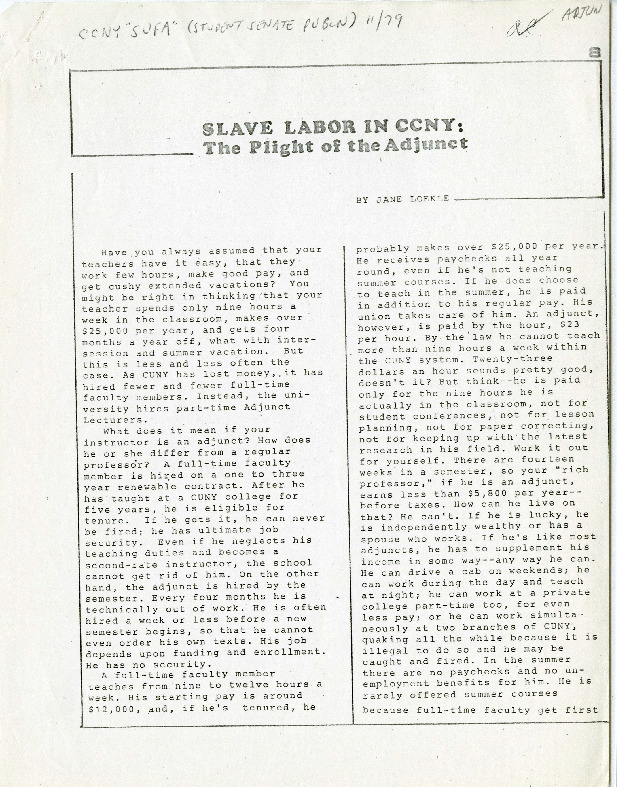
Slave Labor in CUNY: The Plight of the Adjunct
Item
CCR
Have you always assumed that your
teachers have it easy, that they
work few hours, make good pay, and
get cushy extended vacations? You
might be right in thinking ythat your
teacher spends only nine hours a
week in the classroom, makes over
$25,000 per year, and gets four
months a year off, what with inter-
session and summer vacation. But
this is less and less often the
case. As CUNY has lost money,,it has
hirea@ fewer and fewer full-time
faculty members. Instead, the uni-
versity hires part-time Adjunct
Lecturers. ,
What does it mean if your
instructor is an adjunct? How does
he or she differ from a regular
professor? A full-time faculty
member is hired on a one to three
year renewable contract. After he
has taught at a CUNY college for
five years, he is eligible for
tenure. If he gets it, he can never
be fired; he has ultimate job
security. Even if he neglects his
teaching duties and becomes a
second-rate instructor, the school
cannot get rid of him. On the other.
hand, the adjunct is hired by the
semester. Every four months he is
technically out of work. He is often
hired a week or less before a new
semester begins, so that he cannot
even order his own texts. His job
depends upon funding and enrollment.
He has no security.
A €ull-time faculty member
teaches from nine to twelve hours.a
week. His starting pay is around
S12. 0004) and, af ¢hews) cenuced, "he
yy “CUA” (Stet 7 SATE FU sew) es
SLAVE LABOR IN CCNY:
The Plight of the Adjunct
par
Ae
een
BY JANE LOEKLE
probably makes over $25,000 per year.
He receives paychecks all year
round, even if he's not teaching
summer courses. If he does choose
to teach in the summer, he is paid
in addition to his regular pay. His
union takes care of him. An adjunct,
however, is paid /by the nour, S25
per hour. By. the ‘law he cannot teach
_more than nine hours a week within
the CUNY system. Twenty-three
dollars an hour scunds pretty good,
doesn't it? But think--he is paid
only for the nine hours he is
actually in the classroom, not for
student conferences, not for lesson
planning, not for paper correcting,
not for keeping up with’ the latest
research in his field. Work it out
for yourself. There are fourteen
weeks in a semester, so your "rich
professor,” if he is an adjunct,
earns Less sthan.s5,800) per year. =
before taxes. How can he live on
that? He can't. If he is lucky, he
is independently wealthy or has a
spouse who works. If he's like most
adjuncts, he has to supplement his
income in some way--any way he can.
He can drive a cab on weekends; he
can work during the day and teach
at night; he can work at a private
college part-time too, for even
less pay; or he can work simulta-
neously at two branches of CUNY,
quaking all. the while because Leas
illegal to do so and he may be
caught and fired. In the summer
there are no paychecks ‘and’ noun
employment benefits for him. jHe’2s
rarely offered summer courses
because full-time faculty get first
dibs on this extra work and money.
In the summer, he has no time to
recuperate from having worked two
jobs all winter, he has no time to
do research, to write; he must work
or starve. If he has no savings and
he gets sick, he's in trouble; LOX
he cannot join the union, and he
has no benefits.
Well, you say, adjuncts may have
to work more hours for less pay,
but surely it's just a process of
trial by fire and only young, inex-
perienced teachers have to go
through this. It is true that some
adjuncts are beginners. However, Et
is also true that many have been
trapped in this position for a long
time, unable to find full-time em-
ployment., They hold doctorates, they
are dedicated teachers,- they are no
longer young. But, you may argue,
any educated, highly-trained person
who is willing to work under such
conditions must be crazy! I wouldn't
work for less than a quarter of what
someone else is paid to do the.same
job. I wouldn't work for a boss who
offered me no security and no
benefats of any sort.
Let's take a further look at this.
In the English department at CCNY,
as at any branch of CUNY, an adjunct
is almost always hired to teach
basic writing: English 1,2,and ans
As the student population of CUNY
has been changing over the last ten
years, and more and more incoming
students need to learn to write in
college, the full-time faculty
member also teaches these courses.
He has tenure and cannot be fired,
so he must earn his pay by teaching
these new, underprepared students.
But usually, he has been trained to
teach literature, not writing. Often
he resents having to teach writing,
finding) it either beneath him,
boring, defeating, or all three. He
considers the writing courses unre-
warding, he is bewildered by these
new students, and he wishes he could
teach only literature. This is
certainly not always the case, but
at? ‘tog often Pears, :
An adjunct generally teaches only
composition--two courses a semester
or maybe even four, if he is working
eventually get better, that he's
at more than one school. Usually,
especially if he is young, he has
done his graduate work in the
teaching of writing. He is trained
to teech writing, and he wants to
-do just that. He doesn't consider
it lowly; he knows it,'s a demanding
profession. He doesn't think of
basic writing students as dumb;
he simply acknowledges that they
are beginners.
The adjunct works hard. If he-is
-a good teacher, he has his students
write constantly, and he gives each
essay careful attention,. offering
fully developed comments, guidance
for the’ beginning writer. Tf he®
cares about his students, he allows
ample time for conferences with
them because he knows that indivi-
dual attention helps people to
learn. If he teaches two classes
of twenty students each and has
his students write ten papers a
semester, he will correct four
hundred papers in fourteen weeks.
If he requires his students to
revise all of their papers, double
that figure to get eight hundred.
hf (he eaches four courses at. iewo
different schools, double that
figure again; he has now got sixteen
hundred essays coming to him in
fourteen weeks!
The adjunct may well work forty
hours a week or more and be paid
for only nine of those hours. He
is either grossly overworked or
plagued by financial worries. As
there is never any guarantee that
he willbe) rehared , the (ts jin -con=
stant ‘fear’ for(his job. Hs, he erazy ?
Sometimes an adjunct starts out
dedicated and eager and burns out
within a few years. Overworked,
defeated, despairing, such an
adjunct will leave teaching and go
into a different field, one more §
secure and lucrative. Administra-
tions that allow this to happen
cheat the students, for dedicated
teachers trained in teaching the
skills that underprepared minority
students need to learn are scarce.
In other cases, the adjunct: does
not burn out. He holds on tenacious-
ly, telling himself that things will
bound to find full-time work if he
Gan just wait it outs He's got no
security, he makes only $5,000a year
after taxes; but he loves his stu-
dents, he loves teaching, and he
dreams that some day he may be able
to do the work he wants to do with-
out having constant worries. He
holds on even though he knows that-
his chances are slim, that for the
last five years the CUNY system has
been firing full-time non-tenured
faculty, not replacing retiring
faculty, and depending more and more
on the slave labor of adjuncts to
save money.
Why don't adjuncts organize to
demand union benefits and higher
. pay? A worker who has fifty others
waiting for his job is in’no posi-
tion to bargain. The solution will
not be reached easily. Ideally,
full-time faculty members would
teach literature, creative writing,
whatever they are trained to teach
and enjoy teaching. Ideally,
adjuncts would be paid an equitable
salary and offered some security.
Why do these inequities in the
system exist? I don't know. But I
do know that they will continue to
exist until adjuncts’ band together
and refuse to be slaves.
Jane Loekle
Adjunct Lecturer in
ESL at -CCNY
BOOK KEEPERS (4)
wanted
Part-time hours: From 8 am to ll am
MUST BE ABLE TO DO A TELLER's JOB
Calle (212)- 590-9339
free advertising
For a free advertising in S.U.F.A.,
Day Student Senate, Finley 331
690-81 75-76
send 2s ore sone tos Tonny 0. Romero
—
students
for
bilingual
education
BILINGUAL STUDENT: GET ORGANIZED
AND STRUGGLE FOR A BILINGUAL
EDUCATION. DEPARTMENT.
Who Are The Students For Bilingual
Education?
We, Students For Bilingual
Education, are an organization
established in this campus (CCNY)
with the objective to orientate,
educate and mobilize the bilingual
students around the problems that
afflict bilingual education in thas
college.
Our student organization ‘has been
struggling around the necessity of
creating at CCNY a Bilingual
Education Department in the School
of Education, that serves the needs
of our students. As part of the
struggle for the formation of the
Bilingual Department we have stru-
ggled to maintain open old lines,
to bring more professors, to expose
racist professors, to establish a
course of foundations of education
that responds to the needs of our
students. SBE has confronted the
administration in an active and
militant way in these struggles.
To canalize the courage of the
“students the top administrators ~
(Chandler), with the thelp of its
sequel from the School of Education,
called a Task Force supposedly to
Solve our problems. So far nothing
has changed: The number of professor
is still the same; the idea of a
Bilingual Office as) still in (the
air; the resources in the library
are inadequate; there is not a. ails
permanent secretary for the program,
there is a lack of new courses FOr
bilingual students in areas’ “such as:
ispeczal | education, vocational,, etc. }$
the program does not have full
Have you always assumed that your
teachers have it easy, that they
work few hours, make good pay, and
get cushy extended vacations? You
might be right in thinking ythat your
teacher spends only nine hours a
week in the classroom, makes over
$25,000 per year, and gets four
months a year off, what with inter-
session and summer vacation. But
this is less and less often the
case. As CUNY has lost money,,it has
hirea@ fewer and fewer full-time
faculty members. Instead, the uni-
versity hires part-time Adjunct
Lecturers. ,
What does it mean if your
instructor is an adjunct? How does
he or she differ from a regular
professor? A full-time faculty
member is hired on a one to three
year renewable contract. After he
has taught at a CUNY college for
five years, he is eligible for
tenure. If he gets it, he can never
be fired; he has ultimate job
security. Even if he neglects his
teaching duties and becomes a
second-rate instructor, the school
cannot get rid of him. On the other.
hand, the adjunct is hired by the
semester. Every four months he is
technically out of work. He is often
hired a week or less before a new
semester begins, so that he cannot
even order his own texts. His job
depends upon funding and enrollment.
He has no security.
A €ull-time faculty member
teaches from nine to twelve hours.a
week. His starting pay is around
S12. 0004) and, af ¢hews) cenuced, "he
yy “CUA” (Stet 7 SATE FU sew) es
SLAVE LABOR IN CCNY:
The Plight of the Adjunct
par
Ae
een
BY JANE LOEKLE
probably makes over $25,000 per year.
He receives paychecks all year
round, even if he's not teaching
summer courses. If he does choose
to teach in the summer, he is paid
in addition to his regular pay. His
union takes care of him. An adjunct,
however, is paid /by the nour, S25
per hour. By. the ‘law he cannot teach
_more than nine hours a week within
the CUNY system. Twenty-three
dollars an hour scunds pretty good,
doesn't it? But think--he is paid
only for the nine hours he is
actually in the classroom, not for
student conferences, not for lesson
planning, not for paper correcting,
not for keeping up with’ the latest
research in his field. Work it out
for yourself. There are fourteen
weeks in a semester, so your "rich
professor,” if he is an adjunct,
earns Less sthan.s5,800) per year. =
before taxes. How can he live on
that? He can't. If he is lucky, he
is independently wealthy or has a
spouse who works. If he's like most
adjuncts, he has to supplement his
income in some way--any way he can.
He can drive a cab on weekends; he
can work during the day and teach
at night; he can work at a private
college part-time too, for even
less pay; or he can work simulta-
neously at two branches of CUNY,
quaking all. the while because Leas
illegal to do so and he may be
caught and fired. In the summer
there are no paychecks ‘and’ noun
employment benefits for him. jHe’2s
rarely offered summer courses
because full-time faculty get first
dibs on this extra work and money.
In the summer, he has no time to
recuperate from having worked two
jobs all winter, he has no time to
do research, to write; he must work
or starve. If he has no savings and
he gets sick, he's in trouble; LOX
he cannot join the union, and he
has no benefits.
Well, you say, adjuncts may have
to work more hours for less pay,
but surely it's just a process of
trial by fire and only young, inex-
perienced teachers have to go
through this. It is true that some
adjuncts are beginners. However, Et
is also true that many have been
trapped in this position for a long
time, unable to find full-time em-
ployment., They hold doctorates, they
are dedicated teachers,- they are no
longer young. But, you may argue,
any educated, highly-trained person
who is willing to work under such
conditions must be crazy! I wouldn't
work for less than a quarter of what
someone else is paid to do the.same
job. I wouldn't work for a boss who
offered me no security and no
benefats of any sort.
Let's take a further look at this.
In the English department at CCNY,
as at any branch of CUNY, an adjunct
is almost always hired to teach
basic writing: English 1,2,and ans
As the student population of CUNY
has been changing over the last ten
years, and more and more incoming
students need to learn to write in
college, the full-time faculty
member also teaches these courses.
He has tenure and cannot be fired,
so he must earn his pay by teaching
these new, underprepared students.
But usually, he has been trained to
teach literature, not writing. Often
he resents having to teach writing,
finding) it either beneath him,
boring, defeating, or all three. He
considers the writing courses unre-
warding, he is bewildered by these
new students, and he wishes he could
teach only literature. This is
certainly not always the case, but
at? ‘tog often Pears, :
An adjunct generally teaches only
composition--two courses a semester
or maybe even four, if he is working
eventually get better, that he's
at more than one school. Usually,
especially if he is young, he has
done his graduate work in the
teaching of writing. He is trained
to teech writing, and he wants to
-do just that. He doesn't consider
it lowly; he knows it,'s a demanding
profession. He doesn't think of
basic writing students as dumb;
he simply acknowledges that they
are beginners.
The adjunct works hard. If he-is
-a good teacher, he has his students
write constantly, and he gives each
essay careful attention,. offering
fully developed comments, guidance
for the’ beginning writer. Tf he®
cares about his students, he allows
ample time for conferences with
them because he knows that indivi-
dual attention helps people to
learn. If he teaches two classes
of twenty students each and has
his students write ten papers a
semester, he will correct four
hundred papers in fourteen weeks.
If he requires his students to
revise all of their papers, double
that figure to get eight hundred.
hf (he eaches four courses at. iewo
different schools, double that
figure again; he has now got sixteen
hundred essays coming to him in
fourteen weeks!
The adjunct may well work forty
hours a week or more and be paid
for only nine of those hours. He
is either grossly overworked or
plagued by financial worries. As
there is never any guarantee that
he willbe) rehared , the (ts jin -con=
stant ‘fear’ for(his job. Hs, he erazy ?
Sometimes an adjunct starts out
dedicated and eager and burns out
within a few years. Overworked,
defeated, despairing, such an
adjunct will leave teaching and go
into a different field, one more §
secure and lucrative. Administra-
tions that allow this to happen
cheat the students, for dedicated
teachers trained in teaching the
skills that underprepared minority
students need to learn are scarce.
In other cases, the adjunct: does
not burn out. He holds on tenacious-
ly, telling himself that things will
bound to find full-time work if he
Gan just wait it outs He's got no
security, he makes only $5,000a year
after taxes; but he loves his stu-
dents, he loves teaching, and he
dreams that some day he may be able
to do the work he wants to do with-
out having constant worries. He
holds on even though he knows that-
his chances are slim, that for the
last five years the CUNY system has
been firing full-time non-tenured
faculty, not replacing retiring
faculty, and depending more and more
on the slave labor of adjuncts to
save money.
Why don't adjuncts organize to
demand union benefits and higher
. pay? A worker who has fifty others
waiting for his job is in’no posi-
tion to bargain. The solution will
not be reached easily. Ideally,
full-time faculty members would
teach literature, creative writing,
whatever they are trained to teach
and enjoy teaching. Ideally,
adjuncts would be paid an equitable
salary and offered some security.
Why do these inequities in the
system exist? I don't know. But I
do know that they will continue to
exist until adjuncts’ band together
and refuse to be slaves.
Jane Loekle
Adjunct Lecturer in
ESL at -CCNY
BOOK KEEPERS (4)
wanted
Part-time hours: From 8 am to ll am
MUST BE ABLE TO DO A TELLER's JOB
Calle (212)- 590-9339
free advertising
For a free advertising in S.U.F.A.,
Day Student Senate, Finley 331
690-81 75-76
send 2s ore sone tos Tonny 0. Romero
—
students
for
bilingual
education
BILINGUAL STUDENT: GET ORGANIZED
AND STRUGGLE FOR A BILINGUAL
EDUCATION. DEPARTMENT.
Who Are The Students For Bilingual
Education?
We, Students For Bilingual
Education, are an organization
established in this campus (CCNY)
with the objective to orientate,
educate and mobilize the bilingual
students around the problems that
afflict bilingual education in thas
college.
Our student organization ‘has been
struggling around the necessity of
creating at CCNY a Bilingual
Education Department in the School
of Education, that serves the needs
of our students. As part of the
struggle for the formation of the
Bilingual Department we have stru-
ggled to maintain open old lines,
to bring more professors, to expose
racist professors, to establish a
course of foundations of education
that responds to the needs of our
students. SBE has confronted the
administration in an active and
militant way in these struggles.
To canalize the courage of the
“students the top administrators ~
(Chandler), with the thelp of its
sequel from the School of Education,
called a Task Force supposedly to
Solve our problems. So far nothing
has changed: The number of professor
is still the same; the idea of a
Bilingual Office as) still in (the
air; the resources in the library
are inadequate; there is not a. ails
permanent secretary for the program,
there is a lack of new courses FOr
bilingual students in areas’ “such as:
ispeczal | education, vocational,, etc. }$
the program does not have full
Title
Slave Labor in CUNY: The Plight of the Adjunct
Description
"Slave Labor in CUNY: The Plight of the Adjunct," published in the City College of New York's (CCNY) Student Senate Publication in November 1979, attempted to dispel any misconceptions about adjunct faculty’s working conditions by highlighting the low pay and their precarious status. It called for adjunct faculty to "band together and refuse to be slaves."
Contributor
Professional Staff Congress
Creator
Loekle, Jane
Date
November 1979
Language
English
Publisher
S.U.F.A
Rights
Copyrighted
Source
The Tamiment Institute Library and Robert F. Wagner Labor Archives
Original Format
Article / Essay
Loekle, Jane. Letter. “Slave Labor in CUNY: The Plight of the Adjunct.”, CUNY DIGITAL HISTORY ARCHIVE, accessed September 5, 2026, https://stephenz.tailc22a4b.ts.net/s/cdha/item/1397