"Correcting Papers: The CUNY Protest You Didn't Hear About"
Item
b
COE
By EstherKaptan <n
& Alisa Solomon
Don’t believe everything you
read. The CUNY rally at City Hall
you read about in last week’s pa-
pers was a scene of mayhem creat-
ed by bottle-throwing students
who couldn’t spell. The Post told a
tale of “angry—and violent” stu-
dents who “broke through the
barricades”; the Times had stu-
dents initiating violence by
“knocking down one officer.” But
Voice reporters on the scene wit-
nessed a different story: brutal po-
lice who themselves were so out of
control that even a white-shirted
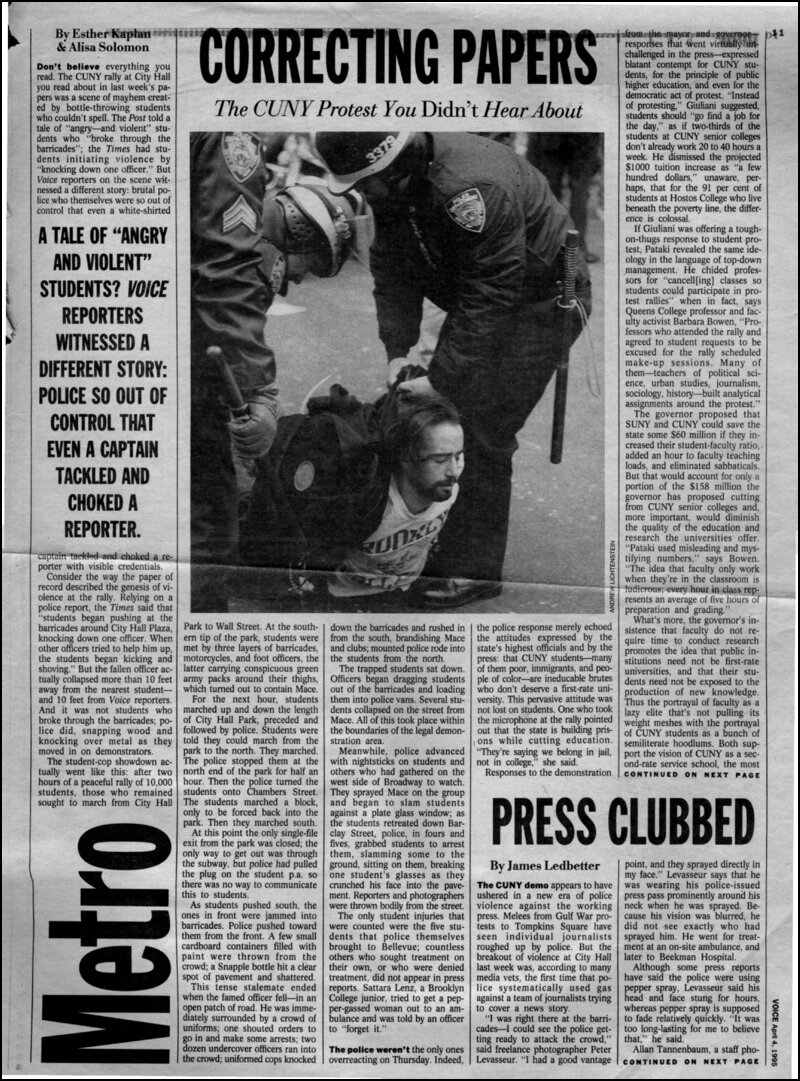
A TALE OF “ANGRY
AND VIOLENT”
STUDENTS? VOICE
REPORTERS
WITNESSED A
DIFFERENT STORY:
POLICE SO OUT OF
CONTROL THAT
EVEN A CAPTAIN
TACKLED AND
CHOKED A
REPORTER.
Captaiteekled-and. choked a_re-
porter with visible credentials.
Consider the way the paper of
record described the genesis of vi-
olence at the rally. Relying on a
police report, the Times said that
“students began pushing at the
barricades around City Hall Plaza,
knocking down one officer. When
other officers tried to help him up,
the students began kicking and
shoving.” But the fallen officer ac-
tually collapsed more than 10 feet
away from the nearest student—
and 10 feet from Voice reporters.
And it was not students who
broke through the barricades; po-
lice did, snapping wood and
knocking over metal as they
moved in on demonstrators.
The student-cop showdown ac-
tually went like this: after two
hours of a peaceful rally of 10,000
students, those who remained
sought to march from City Hall
Metro
TING PAPERS
The CUNY Protest You Didn’t Hear About
Park to Wall Street. At the south-
ern tip of the park, students were
met by three layers of barricades,
motorcycles, and foot officers, the
latter carrying conspicuous green
army packs around their thighs,
which turned out to contain Mace.
For the next hour, students
marched up and down the length
of City Hall Park, preceded and
followed by police. Students were
told they could march from the
park to the north. They marched.
The police stopped them at the
north end of the park for half an
hour. Then the police turned the
students onto Chambers Street.
The students marched a_ block,
only to be forced back into the
park. Then they marched south.
At this point the only single-file
exit from the park was closed; the
only way to get out was through
the subway, but police had pulled
the plug on the student p.a. so
there was no way to communicate
this to students.
As students pushed south, the
ones in front were jammed into
barricades. Police pushed toward
them from the front. A few small
cardboard containers filled with
paint were thrown from the
crowd; a Snapple bottle hit a clear
spot of pavement and shattered.
This tense stalemate ended
when the famed officer fell—in an
open patch of road. He was imme-
diately surrounded by a crowd of
uniforms; one shouted orders to
go in and make some arrests; two
dozen undercover officers ran into
the crowd; uniformed cops knocked
down the barricades and rushed in
from the south, brandishing Mace
and clubs; mounted police rode into
the students from the north.
The trapped students sat down.
Officers began dragging students
out of the barricades and loading
them into police vans. Several stu-
dents collapsed on the street from
Mace. All of this took place within
the boundaries of the legal demon-
stration area.
Meanwhile, police advanced
with nightsticks on students and
others who had gathered on the
west side of Broadway to watch.
They sprayed Mace on the group
and began to slam students
against a plate glass window; as
the students retreated down Bar-
clay Street, police, in fours and
fives, grabbed students to arrest
them, slamming some to the
ground, sitting on them, breaking
one student’s glasses as they
crunched his face into the pave-
ment. Reporters and photographers
were thrown bodily from the street.
The only student injuries that
were counted were the five stu-
dents that police themselves
brought to Bellevue; countless
others who sought treatment on
their own, or who were denied
treatment, did not appear in press
reports. Sattara Lenz, a Brooklyn
College junior, tried to get a pep-
per-gassed woman out to an am-
bulance and was told by an officer
to “forget it.”
The police weren’t the only ones
overreacting on Thursday. Indeed,
ANDREW LICHTENSTEIN
the police response merely echoed
the attitudes expressed by the
state’s highest officials and by the
press: that CUNY students—many
of them poor, immigrants, and peo-
ple of color—are ineducable brutes
who don’t deserve a first-rate uni-
versity. This pervasive attitude was
not lost on students. One who took
the microphone at the rally pointed
out that the state is building pris-
,ons while cutting education.
“They're saying we belong in jail,
not in college,” she said.
Responses to the demonstration
PRESS
By James Ledbetter
The CUNY demo appears to have
ushered in a new era of police
violence against the working
press. Melees from Gulf War pro-
tests to Tompkins Square have
seen individual journalists
roughed up by police. But the
breakout of violence at City Hall
last week was, according to many
media vets, the first time that po-
lice systematically used gas
against a team of journalists trying
to cover a news story.
“T was right there at the barri-
cades—I could see the police get-
ting ready to attack the crowd,”
said freelance photographer Peter
Levasseur. “I had a good vantage
ocene ve and yal
respo! at Avent ep) ts
challenged in the press—expressed
blatant contempt for CUNY stu-
dents, for the principle of public
higher education, and even for the
democratic act of protest. “Instead
of protesting,” Giuliani suggested,
students should “go find a job for
the day,” as if two-thirds of the
students at CUNY senior colleges
don’t already work 20 to 40 hours a
week. He dismissed the projected
$1000 tuition increase as “a few
hundred dollars,” unaware, per-
haps, that for the 91 per cent of
students at Hostos College who live
beneath the poverty line, the differ-
ence is colossal.
If Giuliani was offering a tough-
on-thugs response to student pro-
test, Pataki revealed the same ide-
ology in the language of top-down
management. He chided profes-
sors for “cancell{ing] classes so
students could participate in pro-
test rallies” when in fact, says
Queens College professor and fac-
ulty activist Barbara Bowen, ‘‘Pro-
fessors who attended the rally and
agreed to student requests to be
excused for the rally scheduled
make-up sessions. Many of
them—teachers of political sci-
ence, urban studies, journalism,
sociology, history—built analytical
assignments around the protest.”
The governor proposed that
SUNY and CUNY could save the
state some $60 million if they in-
creased their student-faculty ratio,
added an hour to faculty teaching
loads, and eliminated sabbaticals.
But that would account for only a
portion of the $158 million the
governor has proposed cutting
from CUNY senior colleges and,
more important, would diminish
the quality of the education and
research the universities offer.
“Pataki used misleading and mys-
tifying numbers,” says Bowen.
“The idea that faculty only work
when they're in the classroom is
ludicrous; every hour in class rep-
resents an average of five hours of
preparation and grading.”
What’s more, the governor's in-
sistence that faculty do not re-
quire time to conduct research
promotes the idea that public in-
stitutions need not be first-rate
universities, and that their stu-
dents need not be exposed to the
production of new knowledge.
Thus the portrayal of faculty as a
lazy elite that’s not pulling its
weight meshes with the portrayal
of CUNY students as a bunch of
semiliterate hoodlums. Both sup-
port the vision of CUNY as a sec-
ond-rate service school, the most
CONTINUED ON NEXT PAGE
LUBBED
point, and they sprayed directly in
my face.” Levasseur says that he
was wearing his police-issued
press pass prominently around his
neck when he was sprayed. Be-
cause his vision was blurred, he
did not see exactly who had
sprayed him. He went for treat-
ment at an on-site ambulance, and
later to Beekman Hospital.
Although some press reports
have said the police were using
pepper spray, Levasseur said his
head and face stung for hours,
whereas pepper spray is supposed
to fade relatively quickly. “It was
too long-lasting for me to believe
that,” he said.
Allan Tannenbaum, a staff pho-
CONTINUED ON NEXT PAGE
S66T ‘y Udy 310A
12
=i
SOLOMON
CONTINUED FROM LAST PAGE
poor and immigrant students have
any right to expect.
This assumption conveniently
renders irrelevant the fact that
New York ranks 47th in the U.S.
in state spending on public educa-
tion, and that Pataki’s proposed
25 per cent cut is much higher
than that sustained by any public
education system in the country—
facts that none of the dailies re-
ported last week.
Indeed, the media colluded in
the portrayal of CUNY as a waste
of taxpayer dollars. All the dai-
lies—and the mayor—made much
of student placards that had Giu-
liani’s name spelled wrong. (Curi-
VOICE April 4, 1995
ous that none of them pointed out
such errors a few years ago when
police officers rallied with mis-
spelled signs supporting Giuliani's
candidacy. And never mind that
the mayor probably couldn’t spell
most of the names on CUNY’s
rosters.) Selecting this placard,
journalists left out of the story the
abundance of creative and com-
pelling signs, such as one showing
Munch's screamer surrounded by
the legend, “No Art, No Culture.”
And how much easier it is to make
fun of a misspelled name than to
find someone to translate placards
that say “Educari ius est non
beneficium.”
Some went even further in de-
nying student capabilities by por-
traying student participation in
the rally as a duty enforced by
faculty. Despite many news re-
ports and Giuliani's remarks, the
faculty did not “lead” the pro-
test—though the march of 3000
professors dressed in caps and
gowns across Brooklyn Bridge
Pictures not taken: 30
was a powerful, dignified image of
resistance that did not make it
into any of the dailies. The rally
was the result of weeks of organiz-
ing by hundreds of CUNY stu-
dents. And for the vast majority
who came on Thursday—many
engaging in political protest for
the first time—the violent media
version of the day bore little re-
semblance to their experience. Hav-
ing left before the cops let loose,
they took part in an event that was
peaceful, effective, empowering.
Students described how in pre-
paring for the rally, kids who
wouldn’t sit together at lunch
would join in to make signs; how
during prerally marches from their
campuses to City Hall, people
honked horns in support and
waved from office buildings. The
rally was one of the most multira-
cial and multiethnic that the city
has seen—as diverse as CUNY it-
self. Indeed, characterizing the
march as faculty-led was Giuliani
and Pataki’s way of denying what
they don’t dare acknowledge: the
birth of a forceful, remarkably
grassroots student movement. @
14 East 41st Street -
more locations. more stuff. less money. special grand
midtown: 404 Sth avenue at 37th * herald square 50 w. 34th © 614 2nd ave. at 34th ¢ 541 lex at 50th e
380 madison at 46th * broadway & 49th * 502 park avenue at 59th « upper east side: 151 ©. 86th at lex «
* 349 e. 76th at second * upper west side: 61 w. 62nd at broadway © 248 w. 80th at
broadway * downtown: 30 cliff street * 151 reade at greenwich 125 7th ave. so. at sherdian square «
brooklyn: 110 boerum place * great neck: 15 barstow road « new Jersey: 8 cornwall ct, e. brunswick
1815 2nd at 94th
¢
WE MUST SE\.
"ALL IWVENTORY INTAS SOR
00% OFF
Grand Central Artists’ Materials, Inc.
New York
- 212-679 0023
45p.m
NewYorkSports’
00 faculty marched across the Brooklyn Bridge; for most, the rally was a peaceful success.
CUNY students will take part in a
national day of student actions
on March 29, and, on April 4, the
CUNY Coalition Against the
Cuts—in conjunction with heavy-
weights like Local 1199—will re-
turn to City Hall to reattempt the
march to Wall Street.
LETBETTER
CONTINUED FROM LAST PAGE
tographer for the Sygma agency,
says he was clubbed by a police
sergeant. Just as the violence be-
gan in earnest, Tannenbaum said,
he stepped up onto a Walk/Don’t
Walk signal pole to get a better
angle. He held the pole with his
left hand, and shot photos with
his right. According to Tannen-
baum, a police sergeant “came up
from behind three rows of cops
and clubbed my [left] hand, caus-
ing me to lose my grip.” His hand
was bloodied.
Tannenbaum, a professional pho-
tographer for more than 20 years,
said he sits on a police-sponsored
Block Watch committee in his pre-
cinct. “We have to be aggressive to
we're expanding
so our members don’t.
UBS
=
NYS
1-800-796-NYSC
~ ¥
do our jobs, but if I’m told to get
down or not to go somewhere, I'll
do it....1 don’t have any agenda
against the cops.” Nevertheless,
Tannenbaum said he plans to sue
the city to recoup his medical ex-
penses (after hospital treatment, his
thumb is in a splint). The only com-
parable experience Tannenbaum
has had professionally, he said, was
getting hit with a rock on the Gaza
Strip.
Ironically, staffers at the gener-
ally cop-friendly New York Post
and Daily News were also assault-
ed. News photog Misha Erwitt
was sprayed moments after photo-
graphing a mace-wielding cop,
though overall he thought the po-
lice were relatively restrained. In
all, the Voice has learned of eight
separate allegations that members
of the press—not all wearing cre-
dentials—were roughed up (in-
cluding Voice reporter Esther
Kaplan, whose notebook was
swatted out of her hands and
whose glasses were broken).
Why the rash of violence against
the media? Some of the roughed-
up photographers believe that the
ing rates expire 3/31.
Kok opEeLl!
7
Fine Je
YOUR DESTINATION FOR THE
LARGEST SELECTION & FINEST QUALITY
OF TRADITIONAL & CONTEMPORARY
NATIVE AMERICAN JEWELRY AND
HANDCRAFTED FETISHES
120 THOMPSON STREET
(between Prince & Spring)
212-925-4411
mind/body/spirit
at 212-475-3333, x 3030.
‘
police were preparing a massive
assault against the protestors, and
wanted to insure that there would
be no documentation. One pho-
tographer offers a different expla-
nation: “Since Rudy gutted DCPI
(the police public information of-
fice], there’s no buffer. Usually
there’d be a couple of recogniz-
able lieutenants out there to act as
liaison.”
Detective Martinez, who an-
swered the phone at the office of
the Deputy Commissioner for
Public Information, said he was at
the demonstration and saw no
such attacks against the press. He
added that there were DCPI per-
sonnel in the two designated areas
for members of the press; if some-
one wanders out of those pens,
“no one knows” what will hap-
pen. As of Monday, ‘We have no
reports of anyone from the work-
ing, credentialed press getting
clubbed or maced during the at-
tempt to bring the crowd under
control.” Except, he said after
questioning, the reports of such
attacks that ran in Friday's Post
and News. =
welry
COE
By EstherKaptan <n
& Alisa Solomon
Don’t believe everything you
read. The CUNY rally at City Hall
you read about in last week’s pa-
pers was a scene of mayhem creat-
ed by bottle-throwing students
who couldn’t spell. The Post told a
tale of “angry—and violent” stu-
dents who “broke through the
barricades”; the Times had stu-
dents initiating violence by
“knocking down one officer.” But
Voice reporters on the scene wit-
nessed a different story: brutal po-
lice who themselves were so out of
control that even a white-shirted
A TALE OF “ANGRY
AND VIOLENT”
STUDENTS? VOICE
REPORTERS
WITNESSED A
DIFFERENT STORY:
POLICE SO OUT OF
CONTROL THAT
EVEN A CAPTAIN
TACKLED AND
CHOKED A
REPORTER.
Captaiteekled-and. choked a_re-
porter with visible credentials.
Consider the way the paper of
record described the genesis of vi-
olence at the rally. Relying on a
police report, the Times said that
“students began pushing at the
barricades around City Hall Plaza,
knocking down one officer. When
other officers tried to help him up,
the students began kicking and
shoving.” But the fallen officer ac-
tually collapsed more than 10 feet
away from the nearest student—
and 10 feet from Voice reporters.
And it was not students who
broke through the barricades; po-
lice did, snapping wood and
knocking over metal as they
moved in on demonstrators.
The student-cop showdown ac-
tually went like this: after two
hours of a peaceful rally of 10,000
students, those who remained
sought to march from City Hall
Metro
TING PAPERS
The CUNY Protest You Didn’t Hear About
Park to Wall Street. At the south-
ern tip of the park, students were
met by three layers of barricades,
motorcycles, and foot officers, the
latter carrying conspicuous green
army packs around their thighs,
which turned out to contain Mace.
For the next hour, students
marched up and down the length
of City Hall Park, preceded and
followed by police. Students were
told they could march from the
park to the north. They marched.
The police stopped them at the
north end of the park for half an
hour. Then the police turned the
students onto Chambers Street.
The students marched a_ block,
only to be forced back into the
park. Then they marched south.
At this point the only single-file
exit from the park was closed; the
only way to get out was through
the subway, but police had pulled
the plug on the student p.a. so
there was no way to communicate
this to students.
As students pushed south, the
ones in front were jammed into
barricades. Police pushed toward
them from the front. A few small
cardboard containers filled with
paint were thrown from the
crowd; a Snapple bottle hit a clear
spot of pavement and shattered.
This tense stalemate ended
when the famed officer fell—in an
open patch of road. He was imme-
diately surrounded by a crowd of
uniforms; one shouted orders to
go in and make some arrests; two
dozen undercover officers ran into
the crowd; uniformed cops knocked
down the barricades and rushed in
from the south, brandishing Mace
and clubs; mounted police rode into
the students from the north.
The trapped students sat down.
Officers began dragging students
out of the barricades and loading
them into police vans. Several stu-
dents collapsed on the street from
Mace. All of this took place within
the boundaries of the legal demon-
stration area.
Meanwhile, police advanced
with nightsticks on students and
others who had gathered on the
west side of Broadway to watch.
They sprayed Mace on the group
and began to slam students
against a plate glass window; as
the students retreated down Bar-
clay Street, police, in fours and
fives, grabbed students to arrest
them, slamming some to the
ground, sitting on them, breaking
one student’s glasses as they
crunched his face into the pave-
ment. Reporters and photographers
were thrown bodily from the street.
The only student injuries that
were counted were the five stu-
dents that police themselves
brought to Bellevue; countless
others who sought treatment on
their own, or who were denied
treatment, did not appear in press
reports. Sattara Lenz, a Brooklyn
College junior, tried to get a pep-
per-gassed woman out to an am-
bulance and was told by an officer
to “forget it.”
The police weren’t the only ones
overreacting on Thursday. Indeed,
ANDREW LICHTENSTEIN
the police response merely echoed
the attitudes expressed by the
state’s highest officials and by the
press: that CUNY students—many
of them poor, immigrants, and peo-
ple of color—are ineducable brutes
who don’t deserve a first-rate uni-
versity. This pervasive attitude was
not lost on students. One who took
the microphone at the rally pointed
out that the state is building pris-
,ons while cutting education.
“They're saying we belong in jail,
not in college,” she said.
Responses to the demonstration
PRESS
By James Ledbetter
The CUNY demo appears to have
ushered in a new era of police
violence against the working
press. Melees from Gulf War pro-
tests to Tompkins Square have
seen individual journalists
roughed up by police. But the
breakout of violence at City Hall
last week was, according to many
media vets, the first time that po-
lice systematically used gas
against a team of journalists trying
to cover a news story.
“T was right there at the barri-
cades—I could see the police get-
ting ready to attack the crowd,”
said freelance photographer Peter
Levasseur. “I had a good vantage
ocene ve and yal
respo! at Avent ep) ts
challenged in the press—expressed
blatant contempt for CUNY stu-
dents, for the principle of public
higher education, and even for the
democratic act of protest. “Instead
of protesting,” Giuliani suggested,
students should “go find a job for
the day,” as if two-thirds of the
students at CUNY senior colleges
don’t already work 20 to 40 hours a
week. He dismissed the projected
$1000 tuition increase as “a few
hundred dollars,” unaware, per-
haps, that for the 91 per cent of
students at Hostos College who live
beneath the poverty line, the differ-
ence is colossal.
If Giuliani was offering a tough-
on-thugs response to student pro-
test, Pataki revealed the same ide-
ology in the language of top-down
management. He chided profes-
sors for “cancell{ing] classes so
students could participate in pro-
test rallies” when in fact, says
Queens College professor and fac-
ulty activist Barbara Bowen, ‘‘Pro-
fessors who attended the rally and
agreed to student requests to be
excused for the rally scheduled
make-up sessions. Many of
them—teachers of political sci-
ence, urban studies, journalism,
sociology, history—built analytical
assignments around the protest.”
The governor proposed that
SUNY and CUNY could save the
state some $60 million if they in-
creased their student-faculty ratio,
added an hour to faculty teaching
loads, and eliminated sabbaticals.
But that would account for only a
portion of the $158 million the
governor has proposed cutting
from CUNY senior colleges and,
more important, would diminish
the quality of the education and
research the universities offer.
“Pataki used misleading and mys-
tifying numbers,” says Bowen.
“The idea that faculty only work
when they're in the classroom is
ludicrous; every hour in class rep-
resents an average of five hours of
preparation and grading.”
What’s more, the governor's in-
sistence that faculty do not re-
quire time to conduct research
promotes the idea that public in-
stitutions need not be first-rate
universities, and that their stu-
dents need not be exposed to the
production of new knowledge.
Thus the portrayal of faculty as a
lazy elite that’s not pulling its
weight meshes with the portrayal
of CUNY students as a bunch of
semiliterate hoodlums. Both sup-
port the vision of CUNY as a sec-
ond-rate service school, the most
CONTINUED ON NEXT PAGE
LUBBED
point, and they sprayed directly in
my face.” Levasseur says that he
was wearing his police-issued
press pass prominently around his
neck when he was sprayed. Be-
cause his vision was blurred, he
did not see exactly who had
sprayed him. He went for treat-
ment at an on-site ambulance, and
later to Beekman Hospital.
Although some press reports
have said the police were using
pepper spray, Levasseur said his
head and face stung for hours,
whereas pepper spray is supposed
to fade relatively quickly. “It was
too long-lasting for me to believe
that,” he said.
Allan Tannenbaum, a staff pho-
CONTINUED ON NEXT PAGE
S66T ‘y Udy 310A
12
=i
SOLOMON
CONTINUED FROM LAST PAGE
poor and immigrant students have
any right to expect.
This assumption conveniently
renders irrelevant the fact that
New York ranks 47th in the U.S.
in state spending on public educa-
tion, and that Pataki’s proposed
25 per cent cut is much higher
than that sustained by any public
education system in the country—
facts that none of the dailies re-
ported last week.
Indeed, the media colluded in
the portrayal of CUNY as a waste
of taxpayer dollars. All the dai-
lies—and the mayor—made much
of student placards that had Giu-
liani’s name spelled wrong. (Curi-
VOICE April 4, 1995
ous that none of them pointed out
such errors a few years ago when
police officers rallied with mis-
spelled signs supporting Giuliani's
candidacy. And never mind that
the mayor probably couldn’t spell
most of the names on CUNY’s
rosters.) Selecting this placard,
journalists left out of the story the
abundance of creative and com-
pelling signs, such as one showing
Munch's screamer surrounded by
the legend, “No Art, No Culture.”
And how much easier it is to make
fun of a misspelled name than to
find someone to translate placards
that say “Educari ius est non
beneficium.”
Some went even further in de-
nying student capabilities by por-
traying student participation in
the rally as a duty enforced by
faculty. Despite many news re-
ports and Giuliani's remarks, the
faculty did not “lead” the pro-
test—though the march of 3000
professors dressed in caps and
gowns across Brooklyn Bridge
Pictures not taken: 30
was a powerful, dignified image of
resistance that did not make it
into any of the dailies. The rally
was the result of weeks of organiz-
ing by hundreds of CUNY stu-
dents. And for the vast majority
who came on Thursday—many
engaging in political protest for
the first time—the violent media
version of the day bore little re-
semblance to their experience. Hav-
ing left before the cops let loose,
they took part in an event that was
peaceful, effective, empowering.
Students described how in pre-
paring for the rally, kids who
wouldn’t sit together at lunch
would join in to make signs; how
during prerally marches from their
campuses to City Hall, people
honked horns in support and
waved from office buildings. The
rally was one of the most multira-
cial and multiethnic that the city
has seen—as diverse as CUNY it-
self. Indeed, characterizing the
march as faculty-led was Giuliani
and Pataki’s way of denying what
they don’t dare acknowledge: the
birth of a forceful, remarkably
grassroots student movement. @
14 East 41st Street -
more locations. more stuff. less money. special grand
midtown: 404 Sth avenue at 37th * herald square 50 w. 34th © 614 2nd ave. at 34th ¢ 541 lex at 50th e
380 madison at 46th * broadway & 49th * 502 park avenue at 59th « upper east side: 151 ©. 86th at lex «
* 349 e. 76th at second * upper west side: 61 w. 62nd at broadway © 248 w. 80th at
broadway * downtown: 30 cliff street * 151 reade at greenwich 125 7th ave. so. at sherdian square «
brooklyn: 110 boerum place * great neck: 15 barstow road « new Jersey: 8 cornwall ct, e. brunswick
1815 2nd at 94th
¢
WE MUST SE\.
"ALL IWVENTORY INTAS SOR
00% OFF
Grand Central Artists’ Materials, Inc.
New York
- 212-679 0023
45p.m
NewYorkSports’
00 faculty marched across the Brooklyn Bridge; for most, the rally was a peaceful success.
CUNY students will take part in a
national day of student actions
on March 29, and, on April 4, the
CUNY Coalition Against the
Cuts—in conjunction with heavy-
weights like Local 1199—will re-
turn to City Hall to reattempt the
march to Wall Street.
LETBETTER
CONTINUED FROM LAST PAGE
tographer for the Sygma agency,
says he was clubbed by a police
sergeant. Just as the violence be-
gan in earnest, Tannenbaum said,
he stepped up onto a Walk/Don’t
Walk signal pole to get a better
angle. He held the pole with his
left hand, and shot photos with
his right. According to Tannen-
baum, a police sergeant “came up
from behind three rows of cops
and clubbed my [left] hand, caus-
ing me to lose my grip.” His hand
was bloodied.
Tannenbaum, a professional pho-
tographer for more than 20 years,
said he sits on a police-sponsored
Block Watch committee in his pre-
cinct. “We have to be aggressive to
we're expanding
so our members don’t.
UBS
=
NYS
1-800-796-NYSC
~ ¥
do our jobs, but if I’m told to get
down or not to go somewhere, I'll
do it....1 don’t have any agenda
against the cops.” Nevertheless,
Tannenbaum said he plans to sue
the city to recoup his medical ex-
penses (after hospital treatment, his
thumb is in a splint). The only com-
parable experience Tannenbaum
has had professionally, he said, was
getting hit with a rock on the Gaza
Strip.
Ironically, staffers at the gener-
ally cop-friendly New York Post
and Daily News were also assault-
ed. News photog Misha Erwitt
was sprayed moments after photo-
graphing a mace-wielding cop,
though overall he thought the po-
lice were relatively restrained. In
all, the Voice has learned of eight
separate allegations that members
of the press—not all wearing cre-
dentials—were roughed up (in-
cluding Voice reporter Esther
Kaplan, whose notebook was
swatted out of her hands and
whose glasses were broken).
Why the rash of violence against
the media? Some of the roughed-
up photographers believe that the
ing rates expire 3/31.
Kok opEeLl!
7
Fine Je
YOUR DESTINATION FOR THE
LARGEST SELECTION & FINEST QUALITY
OF TRADITIONAL & CONTEMPORARY
NATIVE AMERICAN JEWELRY AND
HANDCRAFTED FETISHES
120 THOMPSON STREET
(between Prince & Spring)
212-925-4411
mind/body/spirit
at 212-475-3333, x 3030.
‘
police were preparing a massive
assault against the protestors, and
wanted to insure that there would
be no documentation. One pho-
tographer offers a different expla-
nation: “Since Rudy gutted DCPI
(the police public information of-
fice], there’s no buffer. Usually
there’d be a couple of recogniz-
able lieutenants out there to act as
liaison.”
Detective Martinez, who an-
swered the phone at the office of
the Deputy Commissioner for
Public Information, said he was at
the demonstration and saw no
such attacks against the press. He
added that there were DCPI per-
sonnel in the two designated areas
for members of the press; if some-
one wanders out of those pens,
“no one knows” what will hap-
pen. As of Monday, ‘We have no
reports of anyone from the work-
ing, credentialed press getting
clubbed or maced during the at-
tempt to bring the crowd under
control.” Except, he said after
questioning, the reports of such
attacks that ran in Friday's Post
and News. =
welry
Title
"Correcting Papers: The CUNY Protest You Didn't Hear About"
Description
Esther Kaplan and Alisa Solomon of The Village Voice critique other newspapers' reports of the March 23, 1995 CUNY Coalition protest: "A tale of 'angry and violent' students? Village Voice reporters witnessed a different story: police so out of control that even a captain tackled and choked a reporter."
Contributor
Subways, Suzy
Creator
The Village Voice
Date
April 4, 1995
Language
English
Publisher
The Village Voice
Rights
Copyrighted
Source
Subways, Suzy
Original Format
Article / Essay
The Village Voice. Letter. “‘Correcting Papers: The CUNY Protest You Didn’t Hear About’.”, CUNY DIGITAL HISTORY ARCHIVE, accessed September 5, 2026, https://stephenz.tailc22a4b.ts.net/s/cdha/item/139