The Trouble with Adjuncts: The Transients' Mentality
Item
he
Opinion
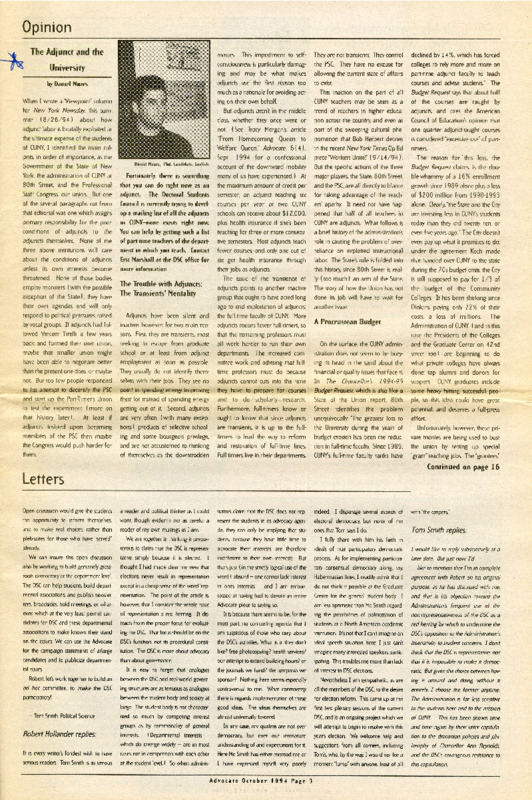
The Adjunct and the
University
by Daniel Mozes
When I wrote a Viewpoint” column
for New York Newsday, this sum-
(8/26/94) about how
adjunct labor is brutally exploited at
the ultimate expense of the students
of CUNY, I identified the main cul-
prits, in order of importance, as the
Government of the State of New
York, the administration of CUNY at
80th Street, and the Professional
Staff Congress, our union. But one
of the several paragraphs cut from
that editorial was one which assigns
mer
primary responsibility for the poor
the
adjuncts themselves. None of the
three above institutions will care
conditions of adjuncts to
about the conditions of adjuncts
unless its own interests become
threatened. None of those bodies
employ monsters (with the possible
exception of the State); they have
their own agendas and will only
respond to political pressures raised
by vocal groups. If adjuncts had fol-
lowed Vincent Tirelli a few years
back and formed their own union,
maybe that smaller union might
have been able to negotiate better
than the present one does, or maybe
not. But too few people responded
_ to his attempt to decertify the PSC.
_, and start up the PartTimer’s Union
to test the experiment (more on
that history later). At least if
adjuncts insisted upon becoming
members of the PSC then maybe
the Congress would push harder for
them.
Letters
Daniel Mozes, Phd. Candidate, English
Fortunately, there is something
that you can do right now as an
adjunct. The Doctoral Students
Council is currently trying to devel-
op a mailing list of all the adjuncts
in CUNY-none exists right now.
You can help by getting such a list
of part-time teachers of the depart-
ment in which you teach. Contact
Eric Marshall at the DSC office for
more information.
The Trouble with Adjuncts:
The Transients’ Mentality
Adjuncts have been silent and
inactive, however, for two main rea-
sons.. First, they are transients, most
seeking to escape from graduate
school or at least from adjunct
employment as soon as possible.
They usually do not identify them-
selves with their jobs. They see no
point in spending energy improving
their lot instead of spending energy
getting out of it. Second, adjuncts
are very often (with many excep-
tions) products of selective school-
ing and some bourgeois privilege,
and are not accustomed to thinking
of themselves-as the downtrodden
masses. This impediment to self-
consciousness is particularly damag-
ing and may be what makes
adjuncts use the first- reason too
much as a rationale for avoiding act-
ing on their own behalf.
But adjuncts arent in the middle
class, whether they once were or
not. (See Tracy Morgan's. article
“From Homecoming Queen to
Welfare Queen,” Advocate, 6(4).,
Sept. 1994 for a confessional
account of the downward mobility
many of us have experienced.) At
the maximum amount of credit per
semester, an adjunct teaching six
courses per year at two CUNY
schools can receive about $12,000,
plus health insurance if she’s been
teaching for three or more consecu-
tive semesters. Most adjuncts teach
fewer courses, and only one out of
six get health insurance through
their jobs as adjuncts.
The issue of the transience of
adjuncts points to another inactive
group that ought to have acted long
ago to end exploitation of adjuncts:
the full-time faculty of CUNY. More
adjuncts means fewer full-timers, so
that the remaining professors must
all work harder to run their own
departments. The increased com-
mittee work and advising that full-
time professors must do because
adjuncts cannot cuts into the time
_ they have to prepare for courses
and to do: scholarly ..research.
Furthermore, fulltimers know or
ought to know that since adjuncts
are transients, it is up to the full-
timers to lead the way to reform
and restoration of full-time lines.
Full-timers live in their departments.
They are not transients. They control
the PSC. They have no excuse for
allowing the current state of affairs
to exist.
This inaction on the part of all
CUNY teachers may be seen as a
trend of teachers in higher educa-
tion across the country, and even as
part of the sweeping cultural phe-
nomenon that Bob Herbert decries
in the recent New York Times Op-Ed
piece “Workers Unite!” (9/14/94).
But the specific actions of the three
major players, the State, 80th Street,
and the PSC, are all directly to blame
for taking advantage of the teach-
ers apathy. It need not have hap-
pened that half of all teachers in
CUNY are adjuncts. What follows is
a brief history of the administration's
role in causing the problem of over-
reliance on exploited instructional
labor. The State's role is folded into
this history, since 80th Street is real-
ly (too much) an arm of the State.
The story of how the Union has not
done its job will have to wait for
another issue.
A Procrustean Budget
On the surface, the CUNY admin-
istration does not seem to be bury-
ing its head in the sand about the
financial or quality issues that face it.
In The Chancellors 1994-95.
Budget Request, which is also like a —
State of the Union report, 80th
Street identifies the problem
unequivocally: ‘The greatest loss to
the University during the years of
budget erosion has been the reduc-
tion in full-time faculty. Since 1989,
CUNY’ full-time faculty ranks have
declined by 14%, which has forced
colleges to rely more and more on
parttime adjunct faculty to teach
courses and advise students.” The
Budget Request says that about half
of the courses are taught by
adjuncts, and cites the American
Council of Education's opinion that
one quarter adjunct-taught courses
is considered “excessive use” of part-
timers.
The reason for this loss, the
Budget Request claims, is the dou-
ble-whammy of a 16% enrollment
growth since 1989 alone plus a loss
of $200 million from 1990-1993
alone. Clearly, ‘the State and the City
are investing less in CUNY’s students
today than they did twenty, ten, or
even five years ago.” The City doesn't
even pay up what it promises to do;
under the agreement Koch made
that handed over CUNY to the state
during the 70s budget crisis, the City
is still supposed to pay for 1/3 of
the budget of the Community
Colleges. It has been shirking since
Dinkins, paying only 22% of their
costs, a loss of millions. The
Administration of CUNY, (and in this
case the Presidents of the Colleges
and the Graduate Center on 42nd
street too) are beginning to do
what private colleges have always
done: tap alumni and donors for
support. CUNY graduates include
‘some heavy hitting successful peo-
ple, so this idea could have great
potential, and deserves a full-press
effort.
Unfortunately, however, these pri-
vate monies are being used to bust
the union by setting up special
“grant” teaching jobs. The “grantees”
Continued on page 16
Open discussion would give the students
the opportunity to inform themselves,
and to make real choices, rather than
plebiscites for those who have “served”
already.
We can insure this open discussion
also by working to build genuinely grass-
roots democracy at the department level.
The DSC can help students build depart-
mental associations, and publish newslet-
ters, broadsides, hold meetings, or what-
ever, which at the very least permit can-
didates for DSC and these departmental
associations to make known their stand
on the issues. We can use the Advocate
for the campaign statements of atlarge
candidates and to publicize departmen-
tal issues.
Robert, let's work together to build an
ad hoc committee, to make the DSC
participatory!
— Tom Smith, Political Science
Robert Hollander replies:
It is every writer's fondest wish to have
serious readers. Tom Smith is as serious
a reader and political thinker as I could
want, though evidently not as careful a
reader of my own musings as I am.
We are together in thinking it prepos-
terous to claim that the DSC is represen-
tative simply because it is elected. I
thought I had made clear my view that
elections never result in representation
except in a cheap sense of the word ‘rep-
resentation. The point of the article is,
however, that I consider the whole issue
of representation a red herring. It dis-
tracts from the proper focus for evaluat-
ing the DSC. That focus should be on the
DSCs function, not its procedural consti-
tution. The DSC is more about advocacy
than about governance.
It is easy to forget that analogies
between the DSC and real-world govern-
ing structures are as tenuous as analogies
between the student body and society at
large. The student body is not character-
ized so much by competing interest
groups as by commonality of general
interests. (Departmental interests —
which do diverge widely — are in most
cases not in competition with each other
at the student level.) So when adminis-
trators claim that the DSC does not rep-
resent the students in its advocacy agen-
da, they can only be implying that stu-
dents, because they have little time to
advocate their interests, are therefore
indifferent to their own interests. But
that’s just (in the strictly logical use of the
word) absurd — one cannot lack interest
in ones interests — and I am embar-
rassed at having had to devote an entire
Advocate piece to saying so.
It is because there seems to be, for the
most part, no competing agenda that I
am suspicious of those who carp about
the DSCs activities. What is it they dont
like? free photocopying? health services?
our attempt to extend building hours? or
the journals we fund? the symposia we
sponsor? Nothing here seems especially
controversial to me. What controversy
there is regards implementation of these
good ideas. The ideas themselves are
almost universally favored.
In any case, my qualms are not over
democracy, but over our immature
understanding of and expectations for it.
Here Mr. Smith has either misread me or
I have expressed myself very poorly
indeed. I disparage several aspects of
electoral democracy, but none of the
ones that Tom says I do.
I fully share with him his faith in
ideals of true participatory democratic
process. As for implementing participa-
tory consensual democracy along, say,
Habermasian lines, I readily admit that I
do not think it possible at the Graduate
Center for the general student body. I
am less optimistic than Mr. Smith regard-
ing the possibilities of politicization of
students at a North American academic
institution. Its not that I cant imagine an
ideal speech situation here; I just cant
imagine many interested speakers partic-
ipating. This troubles me more than lack
of interest in DSC elections.
Nevertheless I am sympathetic, as are
all the members of the DSC, to the desire
for election reform. This came up at the
first two plenary sessions of the current
DSC, and is an ongoing project which we
will attempt to begin to resolve with this
year’s election. We welcome help and
suggestions from all corners, including
Tom's, who, by the way, I would not for a
moment “lump” with anyone, least of all
with “the carpers.”
Tom Smith replies:
I would like to reply substantively at a
later date. But just now, Id
like to mention that I'm in complete
agreement with Robert on his original
purpose, as he has discussed with me,
and that is his objection toward. the
Administration's frequent use of. the
non-representativeness of the DSC as a
red herring by which to undermine the
DSCs opposition to the Administration's
insensitivity to student concerns. I dont
think that the DSC is representative, nor
that it is impossible to make it democ-
ratic. But given the choice between hav-
ing it around and doing without it
entirely, I choose the former anytime.
The Administration is far less sensitive
to the students here and to the mission
of CUNY. This has been shown time
and time again by their utter capitula-
tion to the draconian policies and phi-
losophy of Chancellor Ann Reynolds,
and the DSCs courageous resistance to
this capitulation.
——————————————— Cer ——————— eee
Advocate October 1994 Page 3
Union Raises
Adjunct
Continued from 13
the question,” opted not to recognize
those with hands raised at the time.
and the matter was put to a vote.
Voice vote, that is. Despite the con-
stitutional requirement of a “two-
thirds majority... for the purpose of
determining a dues schedule for the
organization,” the vague result of a
voice vote was accepted in place of
the more exact counting of hands or
ballots. The motion had majority
support—not surprising considering
there are no part-timers on the
Delegate Assembly—but that it was a
full two-thirds majority was not
clear. When asked about the appro-
priateness of an informal voice vote
for such an important issue,
Polishook remarked that he favors
informality and that a show of
hands would take too much time
and would require an eligibility
check of all voters. Fortunately his
subtle ear can distinguish between
the eligible and ineligible in a voice
vote.
Support for the motion to increase
part-timer dues was substantial. But
I wonder how much input part-
timers had in the formulation of this
proposal. How many adjunct mem-
bers were surveyed for their opin-
ions? How many adjunct non-mem-
bers were polled? How did your
campus delegates vote on the issue?
Or your campus chair, for that mat-
ter? Perhaps you should ask:
Baruch: Harold Greenberg
~ Bronx CC: Howard Harris
Borough of Manhattan CC:
Percy Lambert
Brooklyn: Steve London
City: Bernard Sohmer
GSUC. Bill Kornblum
Hostos: Peter Castillo
Hunter: Sara Aronson
John Jay: Haig Bohigian
Kingsborough CC. David Keller
LaGuardia: John Hyland
Lehman: Eugene Bucchioni
Medgar Evers: Joyce Siler
New York Technical College:
Gerald Grayson
Queens: Martin Kaplan
Queens €C. Fred Greenbaum ;
Staten Island.: Mohamed Yousef
York: Richard Boris
Ask what is behind the PSCs
apparent disinclination to swell its
adjunct ranks. Ask why they do not
actively seek to enroll us in the
union. Ask why they place these
“nominal” obstacles in the way of
our joining? Ask why a union whose
bargaining power would be signifi-
cantly improved if its membership
increased to 15,000 or more would
assume such a_ lackadaisical
approach to attaining that increase.
Ask why a union that could do so
much to make your life better con-
sistently exhibits little interest in
doing so. And ask about the justifi-
cation of the devisive “If full-timers
do, then part-timers must” way of
thinking. Their dues were raised by
some small percent. Must ours be
raised by the same percent? Is there
not a bottom line—a salary floor—
below which such an argument
ought not to venture? Are full-
timers’ costs of living higher than
ours by that same percent?—for
then, indeed, such a position might
hold water.
Part of the blame for our union
problems lies with us, the adjuncts,
to be sure. Our absence at this spe-
cial meeting was unfortunate. The
insignificant adjunct presence in the
union is likewise a shame. Together
we can do something about it.
Apathy has been costly.
Thursday,
December 15
in the Student
Center
Basement
Mezzanine
6:00-10:00
Food, Drink,
Music,
and Dancing
Advocate October
¥* Adjuncts
Continued from 3
would really be contract consul-
tants whose benefits are at the
moment uncertain. The only way
for the new grant program to be
an improvement over what cur-
rently exists is for it to provide the
$16,000/ year salary that was
originally proposed for it. But that
salary level does not appear to be
in the current versions to the plan.
In any case, the Budget Request
leaves out the facts which would
show how the administration is a
major .cause of these problems.
The current administration's policy
has been to fund the CUNY cam-
puses on the basis of how many
students it has (or equivalents of
fulltime students). Thus each col-
lege, in order to get more funding,
actively recruits students. That pol-
icy is thus good for access, but bad
for the students, because the total
CUNY pie has been getting smaller.
Why encourage more students to
come to a school you know is get-
ting less money? One reason is to
use the students as pawns to put
pressure on Albany and City Hall.
So far, the only people to feel that
pressure have been the students
themselves.
What the Budget Request also
doesnt say is that the University
chooses how to deploy its. money.
The issue of downsizing the
University is complex, with ene-
mies of CUNY lining up to do just
that. But 80th street's chosen path
of exploitation clearly makes no
sense. It is conceivable for the
University, faced with vicious cuts
and swelling enrollments, to have
responded to the real crisis by turn-
ing students away and announcing
that CUNY’s mandate-to provide a
quality education for anyone with
a high-school diploma who shows
up—has become impossible to ful-
fill. That, along with a mobilized
student body, might have created
political pressure sufficient to
restore some of the cuts. Instead,
80th Street instituted two early
retirement programs, effective
freezes on hiring new assistant
professors, and mass adjunct hir-
ings, all of which solve the prob-
lem of providing quality education
by sweeping it under the rug. The
newest controversial plan by
Chancellor, referred to obliquely
in the Budget Request as each
campuss “opportunity to collabo-
rate with other CUNY colleges.”
calls for consolidation so that
departments with small numbers
of majors like, for example.
Philosophy, wouldnt be offered at
all at some schools. The plan has
been resoundingly rejected by
everyone other than the folks at
the 80th Street address. Both the
move to adjuncts and the consoli-
dation plan compromise CUNY
without really admitting that they
do so.
Organizing Effective Student
Lobbying
The CUNY central administra-
tion, headed by the embattled
Chancellor Ann Reynolds, makes a
request to the State Legislature
every year for more money.
(Reynolds is embattled partly
because of her income from out-
side of CUNY. This is a dramatic
but basically symbolic issue that
the press has spinelessly focussed
on, drawing attention away from
how the City and the State have
tried to abandon CUNY.) 80th
Street also lobbies the legislature—
a baroque but nowadays com-
monplace example of one gov-
ernment agency lobbying another.
The PSC also lobbies the legisla-
ture, but only through its larger
union affiliates. Those affiliates,
though very powerful, can only be
peripherally concerned with the
fate of its sub-group. They certain-
ly arent concerned with adjuncts
who form a part of the PSCs
responsibilities but who arent rep-
resented in its ranks.
The CUNY administration and
the Union say that they cooperate
to lobby together more effectively
for CUNY, but the above results
condemn their efforts. The issue,
perhaps, is lobbying strategy. To
get a better sense of the effective-
ness of the lobbying effort on
CUNY's behalf, I spoke with
Edward Sullivan, from Brooklyn
and Chair of the Higher Education
Committee in the State Assembly.
whom several sources identified
as CUNY’s best friend in the State
government. While respectful of
the power of the teachers’ unions
(Sullivan said of them, “they're on
my back all the time and rightly
so"), he openly derided the
administration's lobbying tech-
niques: Sullivan says that the stu-
dents should become a much big-
ger part of the lobbying—the
focus, in fact. “CUNY students have
numbers, but they aren't mobi-
lized. They could scare politicians,
but the administrators are sure
that the student organizations are
powerless. They [the administra-
tors) muck around with those
Twenty-five stu-
dents sitting in a legislator’s office
organizations.
are more powerful that the
Chancellor [of CUNY].”
I asked Sullivan for his opinion
regarding the reason why 80th
Street and the union do not use
the students and sometimes go
out of their way to avoid them.
Sullivan: “The students might
become obstreperous and
demand the change of some
department, but that's tough.” In
other words, if the CUNY adminis-
tration mobilized the student
leaders and got them to be a part
of a coordinated lobbying effort,
they might have to listen to those
student leaders’ ideas about how
1994 Page 16...
to improve education at CUNY. I
repeated to Sullivan something
that a union representative said to
me: the PSC used to takes busses
of students and teachers up to
Albany to lobby and protest, but,
he claims, they became violent
once and threw rocks. Sullivan:
“The students broke a door once
that might have cost $400. That's
not relevant. The students were
more dramatic, but it was not the
end of the world.” But it was the
end of student lobbying.
Without effective lobbying,
CUNY is an easy victim for the bud-
"get axe of the Republicans in the
State Senate and the Upstate and
Long Island legislators who hate
every dollar sent to the City.
Kenneth P. Lavalle, chair of the
Higher Ed Committee in the
Senate, has never opposed budget
cuts or tuition increases for CUNY.
Mario Cuomo played a Bill Clinton
for years by talking a good talk
but doing nothing effective. He
says he wants CUNY to be tuition-
free, (as it once was before
minorities and women started
enrolling in large numbers), but
he hasn't proposed such a thing to
the legislature.
Where Things Stand
Thus the picture emerges in the
background of the exploited
adjunct. The players are an indif-
ferent State and City, an adminis-
tration engaged in an ineffective
lobbying effort which uses. stu-
dents and teachers as pawns,
unorganized and dismantled stu-
dent organizations, an apathetic
and self-deceiving workforce, and
decisions, only
redressed, to sacrifice educational
quality in the name of the appear-
ance of education. The
Administrators of CUNY have had
their backs to the financial wall
for so long now that few of them
remember any other situation.
The State has increased their bud-
get for CUNY this year, but not
nearly enough to erase the cuts
that have been made over the last
ten years, not even considering the
now _ being
huge increases in enrollment.
Two CUNY professors of history,
Blanch W. Cook and Sandi E
Cooper (Cooper is also head of
the Faculty Senate) wrote in a
recent New York Times Op-Ed
piece, “The Trashing of CUNY”
(8/8/94), that conservative
journalists and others are attack-
ing CUNY with hostility and spuri-
ous arguments (see also the
responses in the Times,
8/15/94). That kind of
counter-attack is sorely needed by
CUNY, but so is an organizing
effort that involves as much of the
total CUNY population as possible.
Only a grass-roots effort will
impress anyone with the power to
fund CUNY and return the
University to a place where the
teachers are professors.
Opinion
The Adjunct and the
University
by Daniel Mozes
When I wrote a Viewpoint” column
for New York Newsday, this sum-
(8/26/94) about how
adjunct labor is brutally exploited at
the ultimate expense of the students
of CUNY, I identified the main cul-
prits, in order of importance, as the
Government of the State of New
York, the administration of CUNY at
80th Street, and the Professional
Staff Congress, our union. But one
of the several paragraphs cut from
that editorial was one which assigns
mer
primary responsibility for the poor
the
adjuncts themselves. None of the
three above institutions will care
conditions of adjuncts to
about the conditions of adjuncts
unless its own interests become
threatened. None of those bodies
employ monsters (with the possible
exception of the State); they have
their own agendas and will only
respond to political pressures raised
by vocal groups. If adjuncts had fol-
lowed Vincent Tirelli a few years
back and formed their own union,
maybe that smaller union might
have been able to negotiate better
than the present one does, or maybe
not. But too few people responded
_ to his attempt to decertify the PSC.
_, and start up the PartTimer’s Union
to test the experiment (more on
that history later). At least if
adjuncts insisted upon becoming
members of the PSC then maybe
the Congress would push harder for
them.
Letters
Daniel Mozes, Phd. Candidate, English
Fortunately, there is something
that you can do right now as an
adjunct. The Doctoral Students
Council is currently trying to devel-
op a mailing list of all the adjuncts
in CUNY-none exists right now.
You can help by getting such a list
of part-time teachers of the depart-
ment in which you teach. Contact
Eric Marshall at the DSC office for
more information.
The Trouble with Adjuncts:
The Transients’ Mentality
Adjuncts have been silent and
inactive, however, for two main rea-
sons.. First, they are transients, most
seeking to escape from graduate
school or at least from adjunct
employment as soon as possible.
They usually do not identify them-
selves with their jobs. They see no
point in spending energy improving
their lot instead of spending energy
getting out of it. Second, adjuncts
are very often (with many excep-
tions) products of selective school-
ing and some bourgeois privilege,
and are not accustomed to thinking
of themselves-as the downtrodden
masses. This impediment to self-
consciousness is particularly damag-
ing and may be what makes
adjuncts use the first- reason too
much as a rationale for avoiding act-
ing on their own behalf.
But adjuncts arent in the middle
class, whether they once were or
not. (See Tracy Morgan's. article
“From Homecoming Queen to
Welfare Queen,” Advocate, 6(4).,
Sept. 1994 for a confessional
account of the downward mobility
many of us have experienced.) At
the maximum amount of credit per
semester, an adjunct teaching six
courses per year at two CUNY
schools can receive about $12,000,
plus health insurance if she’s been
teaching for three or more consecu-
tive semesters. Most adjuncts teach
fewer courses, and only one out of
six get health insurance through
their jobs as adjuncts.
The issue of the transience of
adjuncts points to another inactive
group that ought to have acted long
ago to end exploitation of adjuncts:
the full-time faculty of CUNY. More
adjuncts means fewer full-timers, so
that the remaining professors must
all work harder to run their own
departments. The increased com-
mittee work and advising that full-
time professors must do because
adjuncts cannot cuts into the time
_ they have to prepare for courses
and to do: scholarly ..research.
Furthermore, fulltimers know or
ought to know that since adjuncts
are transients, it is up to the full-
timers to lead the way to reform
and restoration of full-time lines.
Full-timers live in their departments.
They are not transients. They control
the PSC. They have no excuse for
allowing the current state of affairs
to exist.
This inaction on the part of all
CUNY teachers may be seen as a
trend of teachers in higher educa-
tion across the country, and even as
part of the sweeping cultural phe-
nomenon that Bob Herbert decries
in the recent New York Times Op-Ed
piece “Workers Unite!” (9/14/94).
But the specific actions of the three
major players, the State, 80th Street,
and the PSC, are all directly to blame
for taking advantage of the teach-
ers apathy. It need not have hap-
pened that half of all teachers in
CUNY are adjuncts. What follows is
a brief history of the administration's
role in causing the problem of over-
reliance on exploited instructional
labor. The State's role is folded into
this history, since 80th Street is real-
ly (too much) an arm of the State.
The story of how the Union has not
done its job will have to wait for
another issue.
A Procrustean Budget
On the surface, the CUNY admin-
istration does not seem to be bury-
ing its head in the sand about the
financial or quality issues that face it.
In The Chancellors 1994-95.
Budget Request, which is also like a —
State of the Union report, 80th
Street identifies the problem
unequivocally: ‘The greatest loss to
the University during the years of
budget erosion has been the reduc-
tion in full-time faculty. Since 1989,
CUNY’ full-time faculty ranks have
declined by 14%, which has forced
colleges to rely more and more on
parttime adjunct faculty to teach
courses and advise students.” The
Budget Request says that about half
of the courses are taught by
adjuncts, and cites the American
Council of Education's opinion that
one quarter adjunct-taught courses
is considered “excessive use” of part-
timers.
The reason for this loss, the
Budget Request claims, is the dou-
ble-whammy of a 16% enrollment
growth since 1989 alone plus a loss
of $200 million from 1990-1993
alone. Clearly, ‘the State and the City
are investing less in CUNY’s students
today than they did twenty, ten, or
even five years ago.” The City doesn't
even pay up what it promises to do;
under the agreement Koch made
that handed over CUNY to the state
during the 70s budget crisis, the City
is still supposed to pay for 1/3 of
the budget of the Community
Colleges. It has been shirking since
Dinkins, paying only 22% of their
costs, a loss of millions. The
Administration of CUNY, (and in this
case the Presidents of the Colleges
and the Graduate Center on 42nd
street too) are beginning to do
what private colleges have always
done: tap alumni and donors for
support. CUNY graduates include
‘some heavy hitting successful peo-
ple, so this idea could have great
potential, and deserves a full-press
effort.
Unfortunately, however, these pri-
vate monies are being used to bust
the union by setting up special
“grant” teaching jobs. The “grantees”
Continued on page 16
Open discussion would give the students
the opportunity to inform themselves,
and to make real choices, rather than
plebiscites for those who have “served”
already.
We can insure this open discussion
also by working to build genuinely grass-
roots democracy at the department level.
The DSC can help students build depart-
mental associations, and publish newslet-
ters, broadsides, hold meetings, or what-
ever, which at the very least permit can-
didates for DSC and these departmental
associations to make known their stand
on the issues. We can use the Advocate
for the campaign statements of atlarge
candidates and to publicize departmen-
tal issues.
Robert, let's work together to build an
ad hoc committee, to make the DSC
participatory!
— Tom Smith, Political Science
Robert Hollander replies:
It is every writer's fondest wish to have
serious readers. Tom Smith is as serious
a reader and political thinker as I could
want, though evidently not as careful a
reader of my own musings as I am.
We are together in thinking it prepos-
terous to claim that the DSC is represen-
tative simply because it is elected. I
thought I had made clear my view that
elections never result in representation
except in a cheap sense of the word ‘rep-
resentation. The point of the article is,
however, that I consider the whole issue
of representation a red herring. It dis-
tracts from the proper focus for evaluat-
ing the DSC. That focus should be on the
DSCs function, not its procedural consti-
tution. The DSC is more about advocacy
than about governance.
It is easy to forget that analogies
between the DSC and real-world govern-
ing structures are as tenuous as analogies
between the student body and society at
large. The student body is not character-
ized so much by competing interest
groups as by commonality of general
interests. (Departmental interests —
which do diverge widely — are in most
cases not in competition with each other
at the student level.) So when adminis-
trators claim that the DSC does not rep-
resent the students in its advocacy agen-
da, they can only be implying that stu-
dents, because they have little time to
advocate their interests, are therefore
indifferent to their own interests. But
that’s just (in the strictly logical use of the
word) absurd — one cannot lack interest
in ones interests — and I am embar-
rassed at having had to devote an entire
Advocate piece to saying so.
It is because there seems to be, for the
most part, no competing agenda that I
am suspicious of those who carp about
the DSCs activities. What is it they dont
like? free photocopying? health services?
our attempt to extend building hours? or
the journals we fund? the symposia we
sponsor? Nothing here seems especially
controversial to me. What controversy
there is regards implementation of these
good ideas. The ideas themselves are
almost universally favored.
In any case, my qualms are not over
democracy, but over our immature
understanding of and expectations for it.
Here Mr. Smith has either misread me or
I have expressed myself very poorly
indeed. I disparage several aspects of
electoral democracy, but none of the
ones that Tom says I do.
I fully share with him his faith in
ideals of true participatory democratic
process. As for implementing participa-
tory consensual democracy along, say,
Habermasian lines, I readily admit that I
do not think it possible at the Graduate
Center for the general student body. I
am less optimistic than Mr. Smith regard-
ing the possibilities of politicization of
students at a North American academic
institution. Its not that I cant imagine an
ideal speech situation here; I just cant
imagine many interested speakers partic-
ipating. This troubles me more than lack
of interest in DSC elections.
Nevertheless I am sympathetic, as are
all the members of the DSC, to the desire
for election reform. This came up at the
first two plenary sessions of the current
DSC, and is an ongoing project which we
will attempt to begin to resolve with this
year’s election. We welcome help and
suggestions from all corners, including
Tom's, who, by the way, I would not for a
moment “lump” with anyone, least of all
with “the carpers.”
Tom Smith replies:
I would like to reply substantively at a
later date. But just now, Id
like to mention that I'm in complete
agreement with Robert on his original
purpose, as he has discussed with me,
and that is his objection toward. the
Administration's frequent use of. the
non-representativeness of the DSC as a
red herring by which to undermine the
DSCs opposition to the Administration's
insensitivity to student concerns. I dont
think that the DSC is representative, nor
that it is impossible to make it democ-
ratic. But given the choice between hav-
ing it around and doing without it
entirely, I choose the former anytime.
The Administration is far less sensitive
to the students here and to the mission
of CUNY. This has been shown time
and time again by their utter capitula-
tion to the draconian policies and phi-
losophy of Chancellor Ann Reynolds,
and the DSCs courageous resistance to
this capitulation.
——————————————— Cer ——————— eee
Advocate October 1994 Page 3
Union Raises
Adjunct
Continued from 13
the question,” opted not to recognize
those with hands raised at the time.
and the matter was put to a vote.
Voice vote, that is. Despite the con-
stitutional requirement of a “two-
thirds majority... for the purpose of
determining a dues schedule for the
organization,” the vague result of a
voice vote was accepted in place of
the more exact counting of hands or
ballots. The motion had majority
support—not surprising considering
there are no part-timers on the
Delegate Assembly—but that it was a
full two-thirds majority was not
clear. When asked about the appro-
priateness of an informal voice vote
for such an important issue,
Polishook remarked that he favors
informality and that a show of
hands would take too much time
and would require an eligibility
check of all voters. Fortunately his
subtle ear can distinguish between
the eligible and ineligible in a voice
vote.
Support for the motion to increase
part-timer dues was substantial. But
I wonder how much input part-
timers had in the formulation of this
proposal. How many adjunct mem-
bers were surveyed for their opin-
ions? How many adjunct non-mem-
bers were polled? How did your
campus delegates vote on the issue?
Or your campus chair, for that mat-
ter? Perhaps you should ask:
Baruch: Harold Greenberg
~ Bronx CC: Howard Harris
Borough of Manhattan CC:
Percy Lambert
Brooklyn: Steve London
City: Bernard Sohmer
GSUC. Bill Kornblum
Hostos: Peter Castillo
Hunter: Sara Aronson
John Jay: Haig Bohigian
Kingsborough CC. David Keller
LaGuardia: John Hyland
Lehman: Eugene Bucchioni
Medgar Evers: Joyce Siler
New York Technical College:
Gerald Grayson
Queens: Martin Kaplan
Queens €C. Fred Greenbaum ;
Staten Island.: Mohamed Yousef
York: Richard Boris
Ask what is behind the PSCs
apparent disinclination to swell its
adjunct ranks. Ask why they do not
actively seek to enroll us in the
union. Ask why they place these
“nominal” obstacles in the way of
our joining? Ask why a union whose
bargaining power would be signifi-
cantly improved if its membership
increased to 15,000 or more would
assume such a_ lackadaisical
approach to attaining that increase.
Ask why a union that could do so
much to make your life better con-
sistently exhibits little interest in
doing so. And ask about the justifi-
cation of the devisive “If full-timers
do, then part-timers must” way of
thinking. Their dues were raised by
some small percent. Must ours be
raised by the same percent? Is there
not a bottom line—a salary floor—
below which such an argument
ought not to venture? Are full-
timers’ costs of living higher than
ours by that same percent?—for
then, indeed, such a position might
hold water.
Part of the blame for our union
problems lies with us, the adjuncts,
to be sure. Our absence at this spe-
cial meeting was unfortunate. The
insignificant adjunct presence in the
union is likewise a shame. Together
we can do something about it.
Apathy has been costly.
Thursday,
December 15
in the Student
Center
Basement
Mezzanine
6:00-10:00
Food, Drink,
Music,
and Dancing
Advocate October
¥* Adjuncts
Continued from 3
would really be contract consul-
tants whose benefits are at the
moment uncertain. The only way
for the new grant program to be
an improvement over what cur-
rently exists is for it to provide the
$16,000/ year salary that was
originally proposed for it. But that
salary level does not appear to be
in the current versions to the plan.
In any case, the Budget Request
leaves out the facts which would
show how the administration is a
major .cause of these problems.
The current administration's policy
has been to fund the CUNY cam-
puses on the basis of how many
students it has (or equivalents of
fulltime students). Thus each col-
lege, in order to get more funding,
actively recruits students. That pol-
icy is thus good for access, but bad
for the students, because the total
CUNY pie has been getting smaller.
Why encourage more students to
come to a school you know is get-
ting less money? One reason is to
use the students as pawns to put
pressure on Albany and City Hall.
So far, the only people to feel that
pressure have been the students
themselves.
What the Budget Request also
doesnt say is that the University
chooses how to deploy its. money.
The issue of downsizing the
University is complex, with ene-
mies of CUNY lining up to do just
that. But 80th street's chosen path
of exploitation clearly makes no
sense. It is conceivable for the
University, faced with vicious cuts
and swelling enrollments, to have
responded to the real crisis by turn-
ing students away and announcing
that CUNY’s mandate-to provide a
quality education for anyone with
a high-school diploma who shows
up—has become impossible to ful-
fill. That, along with a mobilized
student body, might have created
political pressure sufficient to
restore some of the cuts. Instead,
80th Street instituted two early
retirement programs, effective
freezes on hiring new assistant
professors, and mass adjunct hir-
ings, all of which solve the prob-
lem of providing quality education
by sweeping it under the rug. The
newest controversial plan by
Chancellor, referred to obliquely
in the Budget Request as each
campuss “opportunity to collabo-
rate with other CUNY colleges.”
calls for consolidation so that
departments with small numbers
of majors like, for example.
Philosophy, wouldnt be offered at
all at some schools. The plan has
been resoundingly rejected by
everyone other than the folks at
the 80th Street address. Both the
move to adjuncts and the consoli-
dation plan compromise CUNY
without really admitting that they
do so.
Organizing Effective Student
Lobbying
The CUNY central administra-
tion, headed by the embattled
Chancellor Ann Reynolds, makes a
request to the State Legislature
every year for more money.
(Reynolds is embattled partly
because of her income from out-
side of CUNY. This is a dramatic
but basically symbolic issue that
the press has spinelessly focussed
on, drawing attention away from
how the City and the State have
tried to abandon CUNY.) 80th
Street also lobbies the legislature—
a baroque but nowadays com-
monplace example of one gov-
ernment agency lobbying another.
The PSC also lobbies the legisla-
ture, but only through its larger
union affiliates. Those affiliates,
though very powerful, can only be
peripherally concerned with the
fate of its sub-group. They certain-
ly arent concerned with adjuncts
who form a part of the PSCs
responsibilities but who arent rep-
resented in its ranks.
The CUNY administration and
the Union say that they cooperate
to lobby together more effectively
for CUNY, but the above results
condemn their efforts. The issue,
perhaps, is lobbying strategy. To
get a better sense of the effective-
ness of the lobbying effort on
CUNY's behalf, I spoke with
Edward Sullivan, from Brooklyn
and Chair of the Higher Education
Committee in the State Assembly.
whom several sources identified
as CUNY’s best friend in the State
government. While respectful of
the power of the teachers’ unions
(Sullivan said of them, “they're on
my back all the time and rightly
so"), he openly derided the
administration's lobbying tech-
niques: Sullivan says that the stu-
dents should become a much big-
ger part of the lobbying—the
focus, in fact. “CUNY students have
numbers, but they aren't mobi-
lized. They could scare politicians,
but the administrators are sure
that the student organizations are
powerless. They [the administra-
tors) muck around with those
Twenty-five stu-
dents sitting in a legislator’s office
organizations.
are more powerful that the
Chancellor [of CUNY].”
I asked Sullivan for his opinion
regarding the reason why 80th
Street and the union do not use
the students and sometimes go
out of their way to avoid them.
Sullivan: “The students might
become obstreperous and
demand the change of some
department, but that's tough.” In
other words, if the CUNY adminis-
tration mobilized the student
leaders and got them to be a part
of a coordinated lobbying effort,
they might have to listen to those
student leaders’ ideas about how
1994 Page 16...
to improve education at CUNY. I
repeated to Sullivan something
that a union representative said to
me: the PSC used to takes busses
of students and teachers up to
Albany to lobby and protest, but,
he claims, they became violent
once and threw rocks. Sullivan:
“The students broke a door once
that might have cost $400. That's
not relevant. The students were
more dramatic, but it was not the
end of the world.” But it was the
end of student lobbying.
Without effective lobbying,
CUNY is an easy victim for the bud-
"get axe of the Republicans in the
State Senate and the Upstate and
Long Island legislators who hate
every dollar sent to the City.
Kenneth P. Lavalle, chair of the
Higher Ed Committee in the
Senate, has never opposed budget
cuts or tuition increases for CUNY.
Mario Cuomo played a Bill Clinton
for years by talking a good talk
but doing nothing effective. He
says he wants CUNY to be tuition-
free, (as it once was before
minorities and women started
enrolling in large numbers), but
he hasn't proposed such a thing to
the legislature.
Where Things Stand
Thus the picture emerges in the
background of the exploited
adjunct. The players are an indif-
ferent State and City, an adminis-
tration engaged in an ineffective
lobbying effort which uses. stu-
dents and teachers as pawns,
unorganized and dismantled stu-
dent organizations, an apathetic
and self-deceiving workforce, and
decisions, only
redressed, to sacrifice educational
quality in the name of the appear-
ance of education. The
Administrators of CUNY have had
their backs to the financial wall
for so long now that few of them
remember any other situation.
The State has increased their bud-
get for CUNY this year, but not
nearly enough to erase the cuts
that have been made over the last
ten years, not even considering the
now _ being
huge increases in enrollment.
Two CUNY professors of history,
Blanch W. Cook and Sandi E
Cooper (Cooper is also head of
the Faculty Senate) wrote in a
recent New York Times Op-Ed
piece, “The Trashing of CUNY”
(8/8/94), that conservative
journalists and others are attack-
ing CUNY with hostility and spuri-
ous arguments (see also the
responses in the Times,
8/15/94). That kind of
counter-attack is sorely needed by
CUNY, but so is an organizing
effort that involves as much of the
total CUNY population as possible.
Only a grass-roots effort will
impress anyone with the power to
fund CUNY and return the
University to a place where the
teachers are professors.
Title
The Trouble with Adjuncts: The Transients' Mentality
Description
"The Trouble with Adjuncts: The Transients' Mentality", published in The Advocate in 1994 and written by Daniel Mozes, analyzed why adjuncts had traditionally been ineffective in advocating for their own rights. In addition to having lamented the lack of full-time faculty support and the manner in which CUNY disenfranchised contingent labor, Mozes expressed regret at adjuncts' unwillingness to get involved in grassroots struggles to improve their status.
The Advocate served as the newspaper for the students, staff, and faculty of the Graduate Center, CUNY.
The Advocate served as the newspaper for the students, staff, and faculty of the Graduate Center, CUNY.
Contributor
Professional Staff Congress
Creator
Mozes, Daniel
Date
October 1994
Language
English
Publisher
The Advocate
Rights
Obtained from Contributor - Copyright Unknown
Source
The Tamiment Institute Library and Robert F. Wagner Labor Archives
Original Format
Newspaper / Magazine / Journal
Mozes, Daniel. Letter. “The Trouble With Adjuncts: The Transients’ Mentality.”, CUNY DIGITAL HISTORY ARCHIVE, accessed July 8, 2026, https://stephenz.tailc22a4b.ts.net/s/cdha/item/1478