"Student Struggles"
Item
| LAUNCHING A PSC UNION DRIVE AT TE Gesu
THE ADVOCATE/MARCH 1996
BY ERIC MARSHALL
T IS NO LONGER news that the pro-
tracted national attack on higher,
education has
sunk so low as
to question even
the purpose,
validity, and (pardon
the expression) the
return-on-invest-
ment of post-sec-
ondary education.
Nor is it news that
the state and local
governments of New York have
proposed additional draconian budget
cuts for 1996-97 on top of the already
debilitating cuts of 1995-96. And again,
it is not news that among the hardest hit
by these cuts is the CUNY grad
student adjunct. What may
be news to some of you,
however—good news, it is
hoped-is that there is now
an activist organization at
the GSUC openly advocating
on behalf of this unorganized,
disenfranchised, shamefully
exploited segment of the
CUNY labor force.
In January, after a year and a
half of operation, The Adjunct
Organizing Project (AOP) of
the DSC -to be known. hereafter
as the CUNY Adjunct Project
(CAP)-hired longtime adjunct °
advocate Vinny Tirelli as Project
Director. Since its inception, this
organization has been compiling
an active database of CUNY
adjuncts in an effort to ascertain
who and where we are, and what
our professional lives are like—the
typical CUNY adjunct, for instance,
has been teaching in the system for
5.5 years, at 6 credits per semester,
has an average class size of 30 stu-
dents, and indicates only moderate -
degree of influence in determining
what classes s/he will teach.
More importantly, however, the CAP
Was created to disseminate relevent pro-
fessional information to the nearly 9000
adjuncts throughout the CUNY system.
For example, did you know that, cur-
rently full-time CUNY graduate students
who work ona __ part-time basis at any
City University unit are exempt from
coverage under the Social Security Act
and should not have Social Security Tax
withheld from their paychecks (1993-95
GSUC Bulletin, p.44)?
Unfortunately it is the case that few, if
any, payroll departments at the campus-
es check to see if an adjunct is a current
GSUC student, and therefore rarely, if
ever, do they offer this option, which
will save the typical adjunct $350-$750
per year. So go check.those old W2
forms. If you have had Social Security
Tax withheld from your CUNY adjunct
income, and would like to reclaim that
money, pick up and file the simple
1040X “Amended U.S. Individual
Income Tax Return” form (available at
Union: the
the
CAP office,
BM11). Included with your
request should be a copy of the relevant
W2 forms, and a letter from the
Registrar’s office stating that you were a
full-time student at the GSUC during the
year in question. The statute of limita-
tions for adjusting back tax returns is
three years.
Of course, our union, the Professional.
Staff Congress (PSC), should be inform-
ing us of rights and privileges such as
this. But they don’t. In fact, over the past
several years the present PSC leadership
(known as CUUC), has not only acqui-
esced to a’ great extent to governmental
budget cuts, and succumbed to pedagog-
ically indefensible edicts from 80th
Street, but has also made clear their dis-
interest in CUNY’s adjunct labor force,
Where the union maintains an agency
shop for full-timers (they; all must pay
either union dues and receive full mem-
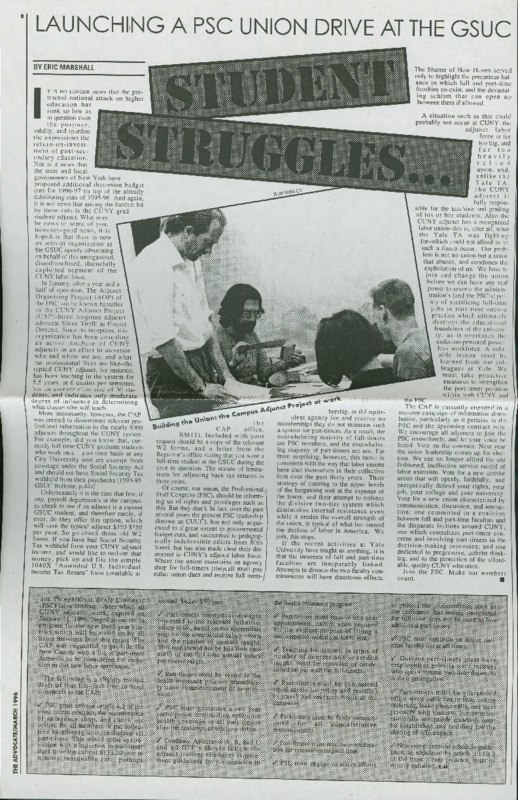
Building the
a ggork ots
bership, or thé equiy-
alent agency fee and receive no
membership) they do not maintain such
a system for part-timers. As a result, the
overwhelming majority of full-timers
are PSC members, and the overwhelm-
ing majority of part-timers are not. Far
from surprising, however, this tactic is
consistent with the way that labor unions
have shot themselves in their collective
foot over the past thirty years. Their
Strategy of catering to the upper levels
of the bargaining unit at the expense of
the lower, and their attempt to enforce
the divisive two-tier system which
diminishes internal resistance even
while it erodes the overall strength of
the union, is typical of what has caused
the decline of labor in America. We
Join, this stops.
If the recent activities at Yale
University have taught us anything, it is
that the interests of full and part-time
faculties are inseparably linked,
Attempts to divorce the two faculty con-
stituencies will have disastrous effects.
The Shame of New Haven served
only to highlight the precarious bal-
ance in which full and part-time
faculties co-exist, and the devastat-
ing schism that can open up
between them if allowed.
A situation such as this could
probably not occur at CUNY-the
adjunct labor
force is far
too big, and
far too
heavily
Rreulwikesd
upon, and,
unlike the
Yale TA,
the CUNY
adjunct is
fully respon-
sible for the teaching and grading
of his or her students. Also the
CUNY adjunct has a recognized
labor union-this is, after all, what
the Yale TA was fighting
for—-which could not afford to Ict
such a fiasco occur. Our prob-
lem is not no union but a union
that abuses, and condones the
exploitation of us. We have to
join and change the union
before we can have any real
power to reverse the adminis-
tration’s (and the PSC’s) pol-
icy of sacrificing full-time
Jobs to part-time ones—a
practice which ultimately
destroys the educational
foundation of the universi-
ty, as it overtaxes the
undercompensated power-
less workforce. A valu-
able lesson must be
learned from our col-
leagues at Yale. We
must take proactive
measures to strengthen
the part-timer position
within both CUNY and
the PSC.
The CAP is currently engaged in a
massive campaign of information distri-
bution, particularly as it pertains to the
PSC and the upcoming contract vote.
We encourage all adjuncts to join the
PSC immediately, and let your voice be
heard. Vote on the contract. Next year
the union leadership comes up for elec-
tion. We can no longer afford the old
fashioned, ineffective service model of
labor unionism. Vote for a new activist
union that will openly, faithfully, and
energetically defend your rights, your
‘job, your college and your university.
Vote for a new union characterized by
communication, discussion, and interac-
tion; one committed to a coalition
between full and part-time faculties and
the disparate factions around CUNY;
one which centralizes part-timer con-
cerns and involving part-timers in the
decision-making processes; and one
dedicated to progressive, activist think-
ing, and to the protection of the afford-
able, quality CUNY education.
Join the PSC. Make our numbers
count. a
THE ADVOCATE/MARCH 1996
BY ERIC MARSHALL
T IS NO LONGER news that the pro-
tracted national attack on higher,
education has
sunk so low as
to question even
the purpose,
validity, and (pardon
the expression) the
return-on-invest-
ment of post-sec-
ondary education.
Nor is it news that
the state and local
governments of New York have
proposed additional draconian budget
cuts for 1996-97 on top of the already
debilitating cuts of 1995-96. And again,
it is not news that among the hardest hit
by these cuts is the CUNY grad
student adjunct. What may
be news to some of you,
however—good news, it is
hoped-is that there is now
an activist organization at
the GSUC openly advocating
on behalf of this unorganized,
disenfranchised, shamefully
exploited segment of the
CUNY labor force.
In January, after a year and a
half of operation, The Adjunct
Organizing Project (AOP) of
the DSC -to be known. hereafter
as the CUNY Adjunct Project
(CAP)-hired longtime adjunct °
advocate Vinny Tirelli as Project
Director. Since its inception, this
organization has been compiling
an active database of CUNY
adjuncts in an effort to ascertain
who and where we are, and what
our professional lives are like—the
typical CUNY adjunct, for instance,
has been teaching in the system for
5.5 years, at 6 credits per semester,
has an average class size of 30 stu-
dents, and indicates only moderate -
degree of influence in determining
what classes s/he will teach.
More importantly, however, the CAP
Was created to disseminate relevent pro-
fessional information to the nearly 9000
adjuncts throughout the CUNY system.
For example, did you know that, cur-
rently full-time CUNY graduate students
who work ona __ part-time basis at any
City University unit are exempt from
coverage under the Social Security Act
and should not have Social Security Tax
withheld from their paychecks (1993-95
GSUC Bulletin, p.44)?
Unfortunately it is the case that few, if
any, payroll departments at the campus-
es check to see if an adjunct is a current
GSUC student, and therefore rarely, if
ever, do they offer this option, which
will save the typical adjunct $350-$750
per year. So go check.those old W2
forms. If you have had Social Security
Tax withheld from your CUNY adjunct
income, and would like to reclaim that
money, pick up and file the simple
1040X “Amended U.S. Individual
Income Tax Return” form (available at
Union: the
the
CAP office,
BM11). Included with your
request should be a copy of the relevant
W2 forms, and a letter from the
Registrar’s office stating that you were a
full-time student at the GSUC during the
year in question. The statute of limita-
tions for adjusting back tax returns is
three years.
Of course, our union, the Professional.
Staff Congress (PSC), should be inform-
ing us of rights and privileges such as
this. But they don’t. In fact, over the past
several years the present PSC leadership
(known as CUUC), has not only acqui-
esced to a’ great extent to governmental
budget cuts, and succumbed to pedagog-
ically indefensible edicts from 80th
Street, but has also made clear their dis-
interest in CUNY’s adjunct labor force,
Where the union maintains an agency
shop for full-timers (they; all must pay
either union dues and receive full mem-
Building the
a ggork ots
bership, or thé equiy-
alent agency fee and receive no
membership) they do not maintain such
a system for part-timers. As a result, the
overwhelming majority of full-timers
are PSC members, and the overwhelm-
ing majority of part-timers are not. Far
from surprising, however, this tactic is
consistent with the way that labor unions
have shot themselves in their collective
foot over the past thirty years. Their
Strategy of catering to the upper levels
of the bargaining unit at the expense of
the lower, and their attempt to enforce
the divisive two-tier system which
diminishes internal resistance even
while it erodes the overall strength of
the union, is typical of what has caused
the decline of labor in America. We
Join, this stops.
If the recent activities at Yale
University have taught us anything, it is
that the interests of full and part-time
faculties are inseparably linked,
Attempts to divorce the two faculty con-
stituencies will have disastrous effects.
The Shame of New Haven served
only to highlight the precarious bal-
ance in which full and part-time
faculties co-exist, and the devastat-
ing schism that can open up
between them if allowed.
A situation such as this could
probably not occur at CUNY-the
adjunct labor
force is far
too big, and
far too
heavily
Rreulwikesd
upon, and,
unlike the
Yale TA,
the CUNY
adjunct is
fully respon-
sible for the teaching and grading
of his or her students. Also the
CUNY adjunct has a recognized
labor union-this is, after all, what
the Yale TA was fighting
for—-which could not afford to Ict
such a fiasco occur. Our prob-
lem is not no union but a union
that abuses, and condones the
exploitation of us. We have to
join and change the union
before we can have any real
power to reverse the adminis-
tration’s (and the PSC’s) pol-
icy of sacrificing full-time
Jobs to part-time ones—a
practice which ultimately
destroys the educational
foundation of the universi-
ty, as it overtaxes the
undercompensated power-
less workforce. A valu-
able lesson must be
learned from our col-
leagues at Yale. We
must take proactive
measures to strengthen
the part-timer position
within both CUNY and
the PSC.
The CAP is currently engaged in a
massive campaign of information distri-
bution, particularly as it pertains to the
PSC and the upcoming contract vote.
We encourage all adjuncts to join the
PSC immediately, and let your voice be
heard. Vote on the contract. Next year
the union leadership comes up for elec-
tion. We can no longer afford the old
fashioned, ineffective service model of
labor unionism. Vote for a new activist
union that will openly, faithfully, and
energetically defend your rights, your
‘job, your college and your university.
Vote for a new union characterized by
communication, discussion, and interac-
tion; one committed to a coalition
between full and part-time faculties and
the disparate factions around CUNY;
one which centralizes part-timer con-
cerns and involving part-timers in the
decision-making processes; and one
dedicated to progressive, activist think-
ing, and to the protection of the afford-
able, quality CUNY education.
Join the PSC. Make our numbers
count. a
Title
"Student Struggles"
Description
Written by Eric Marshall and published in 1996 in The Advocate, this article explained the function of the CUNY Adjunct Project (CAP) as an aggregator of data about adjunct work at CUNY. Critical of the Professional Staff Congress's (PSC) role in fighting for adjunct rights, Marshall nevertheless advocated for adjuncts to join the Professional Staff Congress (PSC) in order to “make our numbers count”.
The Adjunct Project, founded in 1994, was an activity of the Doctoral Student Council (DSC). It was established to advocate on behalf of, disseminate information to, and educate the Graduate School and University Center (GSUC) student adjuncts on issues pertaining to their academic employment.
The Advocate was the newspaper for the students, staff, and faculty of the Graduate Center, CUNY.
The Adjunct Project, founded in 1994, was an activity of the Doctoral Student Council (DSC). It was established to advocate on behalf of, disseminate information to, and educate the Graduate School and University Center (GSUC) student adjuncts on issues pertaining to their academic employment.
The Advocate was the newspaper for the students, staff, and faculty of the Graduate Center, CUNY.
Contributor
Professional Staff Congress
Creator
Marshall, Eric
Date
March 1996
Language
English
Source
The Tamiment Institute Library and Robert F. Wagner Labor Archives
Original Format
Newspaper / Magazine / Journal
Marshall, Eric. Letter. 1996. “‘Student Struggles’”, 1996, CUNY DIGITAL HISTORY ARCHIVE, accessed September 5, 2026, https://stephenz.tailc22a4b.ts.net/s/cdha/item/1481