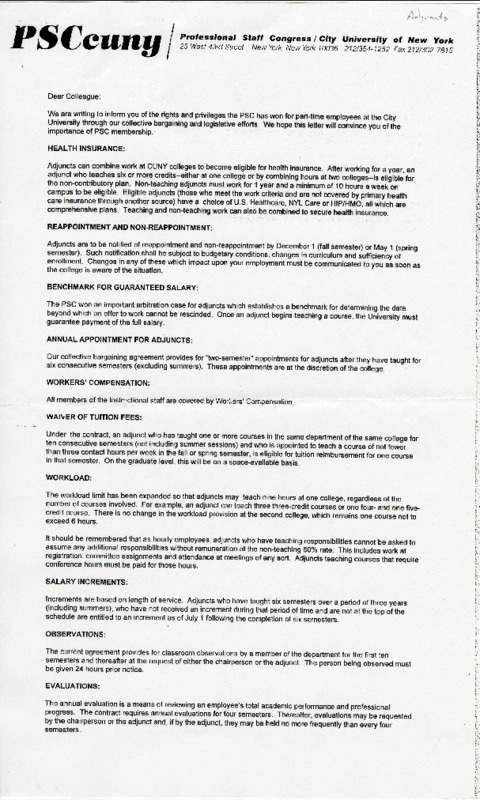
Memo: Recent negotiations on behalf of Adjuncts
Item
P | Professional Staff Congress / City University of New York
Cuny | 25 West 43rd Street New York, New York 10036 212/354-1252 Fax 212/302-7815
Dear Colleague:
We are writing to inform you of the rights and privileges the PSC has won for part-time employees at the City
University through our collective bargaining and legislative efforts. We hope this letter will convince you of the
importance of PSC membership.
HEALTH INSURANCE:
Adjuncts can combine work at CUNY colleges to become eligible for health insurance. After working for a year, an
adjunct who teaches six or more credits--either at one college or by combining hours at two colleges--is eligible for
the non-contributory plan. Non-teaching adjuncts must work for 1 year and a minimum of 10 hours a week on
campus to be eligible. Eligible adjuncts (those who meet the work criteria and are not covered by primary health
care insurance through another source) have a choice of U.S. Healthcare, NYL Care or HIP/HMO, all which are
comprehensive plans. Teaching and non-teaching work can also be combined to secure health insurance.
REAPPOINTMENT AND NON-REAPPOINTMENT:
Adjuncts are to be notified of reappointment and non-reappointment by December 1 (fall semester) or May 1 (spring
semester). Such notification shall be subject to budgetary conditions, changes in curriculum and sufficiency of
enrollment. Changes in any of these which impact upon your employment must be communicated to you as soon as
the college is aware of the situation.
BENCHMARK FOR GUARANTEED SALARY:
The PSC won an important arbitration case for adjuncts which establishes a benchmark for determining the date
beyond which an offer to work cannot be rescinded. Once an adjunct begins teaching a course, the University must
guarantee payment of the full salary.
ANNUAL APPOINTMENT FOR ADJUNCTS:
Our collective bargaining agreement provides for “two-semester” appointments for adjuncts after they have taught for
six consecutive semesters (excluding summers). These appointments are at the discretion of the college.
WORKERS’ COMPENSATION:
All members of the instr ‘ctional staff are covered by Workers’ Compensation.
WAIVER OF TUITION FEES:
Under the contract, an adjunct who has taught one or more courses in the same department of the same college for
ten consecutive semesters (not including summer sessions) and who is appointed to teach a course of not fewer
than three contact hours per week in the fall or spring semester, is eligible for tuition reimbursement for one course
in that semester. On the graduate level, this will be ona space-available basis.
WORKLOAD:
The workload limit has been expanded so that adjuncts may teach nine hours at one college, regardless of the
number of courses involved. For example, an adjunct can teach three three-credit courses or one four- and one five-
credit course. There is no change in the workload provision at the second college, which remains one course not to
exceed 6 hours.
It should be remembered that as hourly employees, adjuncts who have teaching responsibilities cannot be asked to
assume any additional responsibilities without remuneration at the non-teaching 60% rate. This includes work at
registration, committee assignments and attendance at meetings of any sort. Adjuncts teaching courses that require
conference hours must be paid for those hours.
SALARY INCREMENTS:
Increments are based on length of service. Adjuncts who have taught six semesters over a period of three years
(including summers), who have not received an increment during that period of time and are not at the top of the
schedule are entitled to an increment as of July 1 following the completion of six semesters.
OBSERVATIONS:
The current agreement provides for classroom observations by a member of the department for the first ten
semesters and thereafter at the request of either the chairperson or the adjunct. The person being observed must
be given 24 hours prior notice.
EVALUATIONS:
The annual evaluation is a means of reviewing an employee's total academic performance and professional
progress. The contract requires annual evaluations for four semesters. Thereafter, evaluations may be requested
by the chairperson or the adjunct and, if by the adjunct, they may be held no more frequently than every four
semesters.
PS ne od | De Bel
na fe ePOr IT- F
merges
Fd f Pek
FADS LIE BOY OD, FOE OI LID LLP GS
one
Pf) I:
dat pe)
RF
PERSONNEL FILES:
Observations and evaluations make up the bulk of your “personal” personnel file. Nothing should be placed in it
without your knowledge, signified by signing the document. You have the right to append to the document any
comments you wish to make. To be certain that you are aware of all the file’s contents, examine it periodically.
Faculty (including adjuncts) should examine and initial their “personal” personnel files at least once each year, and
preferably once each semester.
JURY DUTY:
Members of the bargaining unit who “are required to serve on a jury” are entitled to be paid their regular salary
during such absences provided that they give to the university any compensation they receive for jury duty.
PROMOTIONS:
Adjuncts are entitled to be considered for promotion on the basis of the same criteria that are applied to full-time
staff. t
RIGHT TO GRIEVE:
The PSC has insisted that adjuncts have full rights to the grievance and arbitration procedures of the collective
bargaining agreement. At first the university resisted extending full “citizenship” rights to adjuncts. Through the
PSC, adjuncts now can bring complaints and grievances to management, with the union’s backing.
TRAVEL FUNDS:
Adjuncts are eligible for travel allowances for attendance at professional meetings and conferences on the same
basis as full-time faculty.
LEAVES:
Adjuncts are entitled to miss one hour per semester for each hour they teach per week without loss of pay. The
reason for such absence may be either illness or personal emergency, and must be satisfactory to the chairperson.
PENSIONS:
Due to lobbying efforts Ey the Professional Staff Congress and its state affiliate, the New York State United
Teachers, ail employees iho have an option of joining a public retirement system must be notified in writing by their
employer of such right to join. All adjuncts not presently-contributing to or receiving a pension from a New York
State governmental institution are eligible to join the New York City Teachers’ Retirement System. Before making
the decision to join the pension system, we urge you to contact Ms. Clarissa Gilbert Weiss, director of pension and
welfare benefits for the Professional Staff Congress, at 212-354-1252 for further information. Information on the
pension system can also be obtained from the personnel office at your college.
TAX-DEFERRED ANNUITY:
As a result of PSC prodding, all adjuncts may now participate in a variety of Tax-Deferred Annuity programs
including TIAA/CREF. Please call the PSC office for further information about Tax-Deferred Annuities.
COBRA:
An adjunct who has established eligibility for health insurance loses it if in any two out of three academic years
he/she teaches fewer than six hours. In such a situation an adjunct may elect to maintain benefits by paying for
them him/herself. Under federal law (COBRA) he/she can continue to maintain benefits in this manner for up to 18
months.
The gains made by adjuncts in PSC contracts reflect continued efforts by the union to advance your interests. If you
are not yet a member of the Professional Staff Congress, we urge you to get an application form by calling our office.
Membership in your union will give you a voice in setting union policy and will help strengthen the representation of
adjuncts in university-wide affairs.
Sincerely yours,
Dann Dolby
Irwin H. Polishook
Vice President, Part-Time Personnel
Opeiu #153
10/96
CE SRE SENT SEY Ce
}
i
'
E
:
P
*
§
2
3
&
k
:
i
:
e
:
k
pS
é
‘
TOE pore yp 2) RIA
Cuny | 25 West 43rd Street New York, New York 10036 212/354-1252 Fax 212/302-7815
Dear Colleague:
We are writing to inform you of the rights and privileges the PSC has won for part-time employees at the City
University through our collective bargaining and legislative efforts. We hope this letter will convince you of the
importance of PSC membership.
HEALTH INSURANCE:
Adjuncts can combine work at CUNY colleges to become eligible for health insurance. After working for a year, an
adjunct who teaches six or more credits--either at one college or by combining hours at two colleges--is eligible for
the non-contributory plan. Non-teaching adjuncts must work for 1 year and a minimum of 10 hours a week on
campus to be eligible. Eligible adjuncts (those who meet the work criteria and are not covered by primary health
care insurance through another source) have a choice of U.S. Healthcare, NYL Care or HIP/HMO, all which are
comprehensive plans. Teaching and non-teaching work can also be combined to secure health insurance.
REAPPOINTMENT AND NON-REAPPOINTMENT:
Adjuncts are to be notified of reappointment and non-reappointment by December 1 (fall semester) or May 1 (spring
semester). Such notification shall be subject to budgetary conditions, changes in curriculum and sufficiency of
enrollment. Changes in any of these which impact upon your employment must be communicated to you as soon as
the college is aware of the situation.
BENCHMARK FOR GUARANTEED SALARY:
The PSC won an important arbitration case for adjuncts which establishes a benchmark for determining the date
beyond which an offer to work cannot be rescinded. Once an adjunct begins teaching a course, the University must
guarantee payment of the full salary.
ANNUAL APPOINTMENT FOR ADJUNCTS:
Our collective bargaining agreement provides for “two-semester” appointments for adjuncts after they have taught for
six consecutive semesters (excluding summers). These appointments are at the discretion of the college.
WORKERS’ COMPENSATION:
All members of the instr ‘ctional staff are covered by Workers’ Compensation.
WAIVER OF TUITION FEES:
Under the contract, an adjunct who has taught one or more courses in the same department of the same college for
ten consecutive semesters (not including summer sessions) and who is appointed to teach a course of not fewer
than three contact hours per week in the fall or spring semester, is eligible for tuition reimbursement for one course
in that semester. On the graduate level, this will be ona space-available basis.
WORKLOAD:
The workload limit has been expanded so that adjuncts may teach nine hours at one college, regardless of the
number of courses involved. For example, an adjunct can teach three three-credit courses or one four- and one five-
credit course. There is no change in the workload provision at the second college, which remains one course not to
exceed 6 hours.
It should be remembered that as hourly employees, adjuncts who have teaching responsibilities cannot be asked to
assume any additional responsibilities without remuneration at the non-teaching 60% rate. This includes work at
registration, committee assignments and attendance at meetings of any sort. Adjuncts teaching courses that require
conference hours must be paid for those hours.
SALARY INCREMENTS:
Increments are based on length of service. Adjuncts who have taught six semesters over a period of three years
(including summers), who have not received an increment during that period of time and are not at the top of the
schedule are entitled to an increment as of July 1 following the completion of six semesters.
OBSERVATIONS:
The current agreement provides for classroom observations by a member of the department for the first ten
semesters and thereafter at the request of either the chairperson or the adjunct. The person being observed must
be given 24 hours prior notice.
EVALUATIONS:
The annual evaluation is a means of reviewing an employee's total academic performance and professional
progress. The contract requires annual evaluations for four semesters. Thereafter, evaluations may be requested
by the chairperson or the adjunct and, if by the adjunct, they may be held no more frequently than every four
semesters.
PS ne od | De Bel
na fe ePOr IT- F
merges
Fd f Pek
FADS LIE BOY OD, FOE OI LID LLP GS
one
Pf) I:
dat pe)
RF
PERSONNEL FILES:
Observations and evaluations make up the bulk of your “personal” personnel file. Nothing should be placed in it
without your knowledge, signified by signing the document. You have the right to append to the document any
comments you wish to make. To be certain that you are aware of all the file’s contents, examine it periodically.
Faculty (including adjuncts) should examine and initial their “personal” personnel files at least once each year, and
preferably once each semester.
JURY DUTY:
Members of the bargaining unit who “are required to serve on a jury” are entitled to be paid their regular salary
during such absences provided that they give to the university any compensation they receive for jury duty.
PROMOTIONS:
Adjuncts are entitled to be considered for promotion on the basis of the same criteria that are applied to full-time
staff. t
RIGHT TO GRIEVE:
The PSC has insisted that adjuncts have full rights to the grievance and arbitration procedures of the collective
bargaining agreement. At first the university resisted extending full “citizenship” rights to adjuncts. Through the
PSC, adjuncts now can bring complaints and grievances to management, with the union’s backing.
TRAVEL FUNDS:
Adjuncts are eligible for travel allowances for attendance at professional meetings and conferences on the same
basis as full-time faculty.
LEAVES:
Adjuncts are entitled to miss one hour per semester for each hour they teach per week without loss of pay. The
reason for such absence may be either illness or personal emergency, and must be satisfactory to the chairperson.
PENSIONS:
Due to lobbying efforts Ey the Professional Staff Congress and its state affiliate, the New York State United
Teachers, ail employees iho have an option of joining a public retirement system must be notified in writing by their
employer of such right to join. All adjuncts not presently-contributing to or receiving a pension from a New York
State governmental institution are eligible to join the New York City Teachers’ Retirement System. Before making
the decision to join the pension system, we urge you to contact Ms. Clarissa Gilbert Weiss, director of pension and
welfare benefits for the Professional Staff Congress, at 212-354-1252 for further information. Information on the
pension system can also be obtained from the personnel office at your college.
TAX-DEFERRED ANNUITY:
As a result of PSC prodding, all adjuncts may now participate in a variety of Tax-Deferred Annuity programs
including TIAA/CREF. Please call the PSC office for further information about Tax-Deferred Annuities.
COBRA:
An adjunct who has established eligibility for health insurance loses it if in any two out of three academic years
he/she teaches fewer than six hours. In such a situation an adjunct may elect to maintain benefits by paying for
them him/herself. Under federal law (COBRA) he/she can continue to maintain benefits in this manner for up to 18
months.
The gains made by adjuncts in PSC contracts reflect continued efforts by the union to advance your interests. If you
are not yet a member of the Professional Staff Congress, we urge you to get an application form by calling our office.
Membership in your union will give you a voice in setting union policy and will help strengthen the representation of
adjuncts in university-wide affairs.
Sincerely yours,
Dann Dolby
Irwin H. Polishook
Vice President, Part-Time Personnel
Opeiu #153
10/96
CE SRE SENT SEY Ce
}
i
'
E
:
P
*
§
2
3
&
k
:
i
:
e
:
k
pS
é
‘
TOE pore yp 2) RIA
Title
Memo: Recent negotiations on behalf of Adjuncts
Description
This 1996 memo by the Professional Staff Congress (PSC) staff,enumerated the rights and privileges that adjuncts had gained in the most recent collective bargaining agreement and legislative efforts.
Contributor
Professional Staff Congress
Creator
Prager, Susan
Date
October 1996
Language
English
Rights
Obtained from Contributor - Copyright Unknown
Source
The Tamiment Institute Library and Robert F. Wagner Labor Archives
Original Format
Memorandum
Prager, Susan. Letter. “Memo: Recent Negotiations on Behalf of Adjuncts.”, CUNY DIGITAL HISTORY ARCHIVE, accessed September 5, 2026, https://stephenz.tailc22a4b.ts.net/s/cdha/item/1482