CUNY Adjunct Alert (February 1999)
Item
Ne
Bes
CUNY Adjunct Alert
Produced by CUNY Adjuncts Unite!
P.O. Box 1360, NYC 10163 212/780-2155 http://www.soc.qc.edu/adjunct :
Vol. 2, No. 5 February 1999
Boris...Not Good Enough
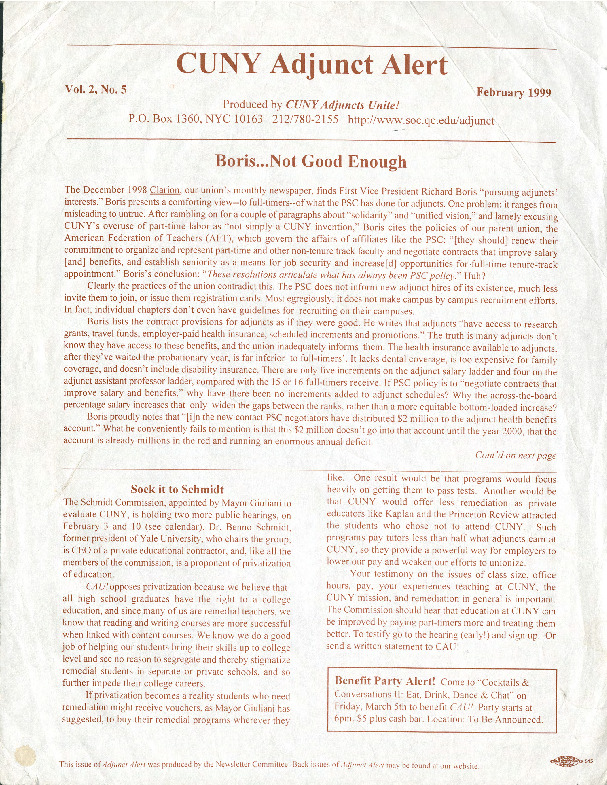
The December 1998 Clarion, our union’s monthly newspaper, finds First Vice President Richard Boris “pursuing adjuncts’
interests.” Boris presents a comforting view--to full-timers--of what the PSC has done for adjuncts. One problem: it ranges from
misleading to untrue. After rambling on for a couple of paragraphs about “solidarity” and “unified vision,” and lamely excusing Ne
CUNY’s overuse of part-time labor as “not simply a CUNY invention,” Boris cites the policies of our parent union, the — ;
American Federation of Teachers (AFT), which govern the affairs of affiliates like the PSC: “[they should] renew their
commitment to organize and represent part-time and other non-tenure track faculty and negotiate contracts that improve salary
[and] benefits, and establish seniority as a means for job security and increase[d] opportunities for -full-time tenure-track
appointment.” Boris’s conclusion: “These resolutions articulate what has always been PSC policy.” Huh?
Clearly the practices of the union contradict this. The PSC does not inform new adjunct hires of its existence, much less
invite them to join, or issue them registration cards. Most egregiously, it does not make campus by campus recruitment efforts.
In fact, individual chapters don’t even have guidelines for recruiting on their campuses.
Boris lists the contract provisions for adjuncts as if they were good. He writes that adjuncts “have access to research
grants, travel funds, employer-paid health insurance, scheduled increments and promotions.” The truth is many adjuncts don’t
know they have access to these benefits, and the union inadequately informs them. The health insurance available to adjuncts,
after they’ ve waited the probationary year, is far inferior to full-timers’. It lacks dental coverage, is too expensive for family
coverage, and doesn’t include disability insurance. There are only five increments on the adjunct salary ladder and four on the
adjunct assistant professor ladder, compared with the 15 or 16 full-timers receive. If PSC policy is to “negotiate contracts that
improve salary and benefits,” why have there been no increments added to adjunct schedules? Why the across-the-board
percentage salary increases that only widen the gaps between the ranks, rather than a more equitable bottom-loaded increase?
Boris proudly notes that “[iJn the new contact PSC negotiators have distributed $2 million to the adjunct health benefits
account.” What he conveniently fails to mention is that this $2 million doesn’t go into that account until the year 2000, that the
account is already millions in the red and running an enormous annual deficit.
Cont'd on next page
like. One result would be that programs would focus
heavily on getting them to pass tests. Another would be
that CUNY would offer less remediation as private
educators like Kaplan and the Princeton Review attracted
the students who chose not to attend CUNY. Such
programs pay tutors less than half what adjuncts earn at
CUNY, so they provide a powerful way for employers to
4 Sock it to Schmidt
The Schmidt Commission, appointed by Mayor Giuliani to
evaluate CUNY, is holding two more public hearings, on
February 3 and 10 (see calendar). Dr. Benno Schmidt,
former president of Yale University, who chairs the group,
is CEO of a private educational contractor, and, like all the
members of the commission, is a proponent of privatization
of education.
CAU! opposes privatization because we believe that
all high school graduates have the right to a college
education, and since many of us are remedial teachers, we
know that reading and writing courses are more successful
when linked with content courses. We know we do a good
Job of helping our students bring their skills up to college
level and see no reason to segregate and thereby stigmatize
remedial students in separate or private schools, and so
further impede their college careers.
If privatization becomes a reality students who need
remediation might receive vouchers, as Mayor Giuliani has
suggested, to buy their remedial programs wherever they
This issue of Adjunct Alert was produced by the Newsletter Committee. Back issues of Adjunct Alert may be found at our website.
lower our pay and weaken our efforts to unionize.
Your testimony on the issues of class size, office
hours, pay, your experiences teaching at CUNY, the
CUNY mission, and remediation in general is important.
The Commission should hear that education at CUNY can
be improved by paying part-timers more and treating them
better. To testify go to the hearing (early!) and sign up. Or
send a written statement to CAU!
Benefit Party Alert! Come to “Cocktails &
Conversations II: Eat, Drink, Dance & Chat” on
Friday, March Sth to benefit CAU! Party starts at
6pm. $5 plus cash bar. Location: To Be Announced.
Boris on Adjuncts cont’d
Boris touts adjuncts’ “access to limited leave, tuition
remission and pension plans,” and points out their “right to
due notice of appointment; they may be appointed annually
rather than by semester, and they receive full pay if a
course is canceled after teaching has begun.” Again, it’s
the conspicuously absent details regarding tuition
remission that matter. The $1 million set aside for “partial
tuition remission” in the new contract doesn’t become
available until the year 2000, in the final semester of the
contract, and it is not clear how that money will be
distributed. The existing tuition remission policy provides
for one course-worth per semester only after an adjunct has
been teaching in the same job title in the same department
of the same campus for ten consecutive semesters.
Considering the mobility (geographic and titular) of
CUNY’s part-time faculty, it’s hard to believe that more
than a token few are ever eligible for this benefit. Despite
exhaustive investigation, CAU! could find no adjuncts who
had received even a semester of paid leave. Adjuncts are
frequently hired and fired at the last minute (often later),
partly in to order to prevent management from having to
pay in full for a canceled class, and to prevent fired
adjuncts from collecting unemployment insurance. The
standard adjunct reappointment is contingent on enrollment
and funding, meaning that adjuncts get no promise that
they will even have the job offered them.
Boris writes that “[s]eniority measures have also been
introduced: part-timers need not be observed or evaluated
annually after a probationary period; and those with
remedial or ESL experience must be given priority access
to jobs if CUNY restructures their programs.” It is true that
observation isn’t required after ten consecutive semesters
in the same job title in the same department, but adjuncts
may be observed at the request of their chairs, and often
are, year after year. Moreover, these “seniority measures”
are in no way used as a “means for job security” or
“opportunities for full-time tenure-track appointment.”
Boris talks about the “firm commitment of PSC
negotiators to the interests of the part-timers.” Yet pay for
office hours disappeared from the table when management
quoted an inflated price for it. A serious fight might have
won a partial gain, perhaps using funds from those applied
to lump sum payments. Moreover, many of these
negotiators, including Boris, are among those who reject
enforcement of the contractual stipulation of agency fee for
adjuncts, effectively keeping the majority of the faculty
disenfranchised and under-represented.
Boris begins and ends his fictional pursuit of our
interests with the common justification of the raw deal
adjuncts get: it’s better than at most colleges. Of course,
this is management’s argument; when our own union uses
it, it is outrageous and divisive. Moreover, it fails to take
into consideration the unique realities of CUNY:
significantly higher cost of living than almost anywhere
else, distance between campuses, demographic makeup of
the adjunct pool, etc. Besides, other adjuncts, such as the
musicians at The New School, and teachers at Mass/Boston
have recently won significantly better contracts.
Adjuncts find it galling to have the PSC talk of the
need for solidarity when it suggests--in both word and
deed--that our needs are secondary to those of full-timers.
We're all for an inclusive union. That’s why CAU! is
recruiting adjuncts and campaigning for a referendum that
would bring larger numbers of adjuncts into the union.
While Boris thinks “[m]ore can never be enough to meet
all our demands,” we feel a larger union, strengthened by
the memberships of adjuncts, will have more bargaining
power in Albany, and increase the size of the pie the PSC
is able to bring back to share among its members.
“Academic values must predominate.” We agree. With our
large numbers of PhD’s, and our many years of teaching
experience, we add enormously to the education our
students get. If we didn’t have to spread ourselves so thin
we could raise even higher the value of a CUNY education.
Come to the Next Meeting of
CUNY Adjuncts Unite!
Friday, Jan. 8th @ 3pm
Room 400 25 W 43rd St
next Friday meetings: Feb. 5, Feb. 26, Mar. 26
™- Calendar of Upcoming Events
Feb 3. 2pm: Schmidt Commission Hearing (NYC Tech)
Feb 10 2pm: Schmidt Commission Hearing (Queens College)
Feb 16 4pm: Board of Trustees Hearing (535 E 80th St) %
Feb 18 7:15pm: PSC Delegate Assembly (GSUC Aud)
Feb 22 4:30pm: Board of Trustees Mtg (535 E 80th St)
Mar 1 Ipm: Referendum Press Conference (25 W 43rd St)
Mar 2 3pm: Faculty, Staff & Admin. Open Mtg (535 E 80th St)
Referendum Alert! Be sure to get all the signatures
you collected to CAU! by February 26! On Monday,
March 1 we will hold a press conference when we deliver
the petitions to the PSC. Until then, keep collecting!
CUNY Adjuncts Unite! Contacts
Baruch Jim Feast 718-449-0677
BMCC Shirley Rausher 212-721-0099
Bronx CC Ingrid Hughes 212-254-0635
Brooklyn Vinny Tirelli 212-642-2143
CCNY Rob Wallace 212-650-8179
CSI Harry Cason 212-838-1374
Hostos Anna Lopez 212-427-3874
Hunter Mark Halling 718-596-0654
Hunter Soc. Susanna Jones 718-243-0660
John Jay Michael Seitz ~ 212-229-9180
Kingsborough CC _ Jerry Karol 718-330-0916
La Guardia Costas Panayotakis 718-852-2069
Lehman Kyle Cuordileone 212-491-2653
Medgar Evers Eric Lehman 212-674-1767
NYC Tech. Wendy Scribner 212-982-0097
Queens x Eric Marshall 212-642-2143
Queensborough CC Howard Pflanzer 212-496-7452
York MikeVozick 212-874-7650
Bes
CUNY Adjunct Alert
Produced by CUNY Adjuncts Unite!
P.O. Box 1360, NYC 10163 212/780-2155 http://www.soc.qc.edu/adjunct :
Vol. 2, No. 5 February 1999
Boris...Not Good Enough
The December 1998 Clarion, our union’s monthly newspaper, finds First Vice President Richard Boris “pursuing adjuncts’
interests.” Boris presents a comforting view--to full-timers--of what the PSC has done for adjuncts. One problem: it ranges from
misleading to untrue. After rambling on for a couple of paragraphs about “solidarity” and “unified vision,” and lamely excusing Ne
CUNY’s overuse of part-time labor as “not simply a CUNY invention,” Boris cites the policies of our parent union, the — ;
American Federation of Teachers (AFT), which govern the affairs of affiliates like the PSC: “[they should] renew their
commitment to organize and represent part-time and other non-tenure track faculty and negotiate contracts that improve salary
[and] benefits, and establish seniority as a means for job security and increase[d] opportunities for -full-time tenure-track
appointment.” Boris’s conclusion: “These resolutions articulate what has always been PSC policy.” Huh?
Clearly the practices of the union contradict this. The PSC does not inform new adjunct hires of its existence, much less
invite them to join, or issue them registration cards. Most egregiously, it does not make campus by campus recruitment efforts.
In fact, individual chapters don’t even have guidelines for recruiting on their campuses.
Boris lists the contract provisions for adjuncts as if they were good. He writes that adjuncts “have access to research
grants, travel funds, employer-paid health insurance, scheduled increments and promotions.” The truth is many adjuncts don’t
know they have access to these benefits, and the union inadequately informs them. The health insurance available to adjuncts,
after they’ ve waited the probationary year, is far inferior to full-timers’. It lacks dental coverage, is too expensive for family
coverage, and doesn’t include disability insurance. There are only five increments on the adjunct salary ladder and four on the
adjunct assistant professor ladder, compared with the 15 or 16 full-timers receive. If PSC policy is to “negotiate contracts that
improve salary and benefits,” why have there been no increments added to adjunct schedules? Why the across-the-board
percentage salary increases that only widen the gaps between the ranks, rather than a more equitable bottom-loaded increase?
Boris proudly notes that “[iJn the new contact PSC negotiators have distributed $2 million to the adjunct health benefits
account.” What he conveniently fails to mention is that this $2 million doesn’t go into that account until the year 2000, that the
account is already millions in the red and running an enormous annual deficit.
Cont'd on next page
like. One result would be that programs would focus
heavily on getting them to pass tests. Another would be
that CUNY would offer less remediation as private
educators like Kaplan and the Princeton Review attracted
the students who chose not to attend CUNY. Such
programs pay tutors less than half what adjuncts earn at
CUNY, so they provide a powerful way for employers to
4 Sock it to Schmidt
The Schmidt Commission, appointed by Mayor Giuliani to
evaluate CUNY, is holding two more public hearings, on
February 3 and 10 (see calendar). Dr. Benno Schmidt,
former president of Yale University, who chairs the group,
is CEO of a private educational contractor, and, like all the
members of the commission, is a proponent of privatization
of education.
CAU! opposes privatization because we believe that
all high school graduates have the right to a college
education, and since many of us are remedial teachers, we
know that reading and writing courses are more successful
when linked with content courses. We know we do a good
Job of helping our students bring their skills up to college
level and see no reason to segregate and thereby stigmatize
remedial students in separate or private schools, and so
further impede their college careers.
If privatization becomes a reality students who need
remediation might receive vouchers, as Mayor Giuliani has
suggested, to buy their remedial programs wherever they
This issue of Adjunct Alert was produced by the Newsletter Committee. Back issues of Adjunct Alert may be found at our website.
lower our pay and weaken our efforts to unionize.
Your testimony on the issues of class size, office
hours, pay, your experiences teaching at CUNY, the
CUNY mission, and remediation in general is important.
The Commission should hear that education at CUNY can
be improved by paying part-timers more and treating them
better. To testify go to the hearing (early!) and sign up. Or
send a written statement to CAU!
Benefit Party Alert! Come to “Cocktails &
Conversations II: Eat, Drink, Dance & Chat” on
Friday, March Sth to benefit CAU! Party starts at
6pm. $5 plus cash bar. Location: To Be Announced.
Boris on Adjuncts cont’d
Boris touts adjuncts’ “access to limited leave, tuition
remission and pension plans,” and points out their “right to
due notice of appointment; they may be appointed annually
rather than by semester, and they receive full pay if a
course is canceled after teaching has begun.” Again, it’s
the conspicuously absent details regarding tuition
remission that matter. The $1 million set aside for “partial
tuition remission” in the new contract doesn’t become
available until the year 2000, in the final semester of the
contract, and it is not clear how that money will be
distributed. The existing tuition remission policy provides
for one course-worth per semester only after an adjunct has
been teaching in the same job title in the same department
of the same campus for ten consecutive semesters.
Considering the mobility (geographic and titular) of
CUNY’s part-time faculty, it’s hard to believe that more
than a token few are ever eligible for this benefit. Despite
exhaustive investigation, CAU! could find no adjuncts who
had received even a semester of paid leave. Adjuncts are
frequently hired and fired at the last minute (often later),
partly in to order to prevent management from having to
pay in full for a canceled class, and to prevent fired
adjuncts from collecting unemployment insurance. The
standard adjunct reappointment is contingent on enrollment
and funding, meaning that adjuncts get no promise that
they will even have the job offered them.
Boris writes that “[s]eniority measures have also been
introduced: part-timers need not be observed or evaluated
annually after a probationary period; and those with
remedial or ESL experience must be given priority access
to jobs if CUNY restructures their programs.” It is true that
observation isn’t required after ten consecutive semesters
in the same job title in the same department, but adjuncts
may be observed at the request of their chairs, and often
are, year after year. Moreover, these “seniority measures”
are in no way used as a “means for job security” or
“opportunities for full-time tenure-track appointment.”
Boris talks about the “firm commitment of PSC
negotiators to the interests of the part-timers.” Yet pay for
office hours disappeared from the table when management
quoted an inflated price for it. A serious fight might have
won a partial gain, perhaps using funds from those applied
to lump sum payments. Moreover, many of these
negotiators, including Boris, are among those who reject
enforcement of the contractual stipulation of agency fee for
adjuncts, effectively keeping the majority of the faculty
disenfranchised and under-represented.
Boris begins and ends his fictional pursuit of our
interests with the common justification of the raw deal
adjuncts get: it’s better than at most colleges. Of course,
this is management’s argument; when our own union uses
it, it is outrageous and divisive. Moreover, it fails to take
into consideration the unique realities of CUNY:
significantly higher cost of living than almost anywhere
else, distance between campuses, demographic makeup of
the adjunct pool, etc. Besides, other adjuncts, such as the
musicians at The New School, and teachers at Mass/Boston
have recently won significantly better contracts.
Adjuncts find it galling to have the PSC talk of the
need for solidarity when it suggests--in both word and
deed--that our needs are secondary to those of full-timers.
We're all for an inclusive union. That’s why CAU! is
recruiting adjuncts and campaigning for a referendum that
would bring larger numbers of adjuncts into the union.
While Boris thinks “[m]ore can never be enough to meet
all our demands,” we feel a larger union, strengthened by
the memberships of adjuncts, will have more bargaining
power in Albany, and increase the size of the pie the PSC
is able to bring back to share among its members.
“Academic values must predominate.” We agree. With our
large numbers of PhD’s, and our many years of teaching
experience, we add enormously to the education our
students get. If we didn’t have to spread ourselves so thin
we could raise even higher the value of a CUNY education.
Come to the Next Meeting of
CUNY Adjuncts Unite!
Friday, Jan. 8th @ 3pm
Room 400 25 W 43rd St
next Friday meetings: Feb. 5, Feb. 26, Mar. 26
™- Calendar of Upcoming Events
Feb 3. 2pm: Schmidt Commission Hearing (NYC Tech)
Feb 10 2pm: Schmidt Commission Hearing (Queens College)
Feb 16 4pm: Board of Trustees Hearing (535 E 80th St) %
Feb 18 7:15pm: PSC Delegate Assembly (GSUC Aud)
Feb 22 4:30pm: Board of Trustees Mtg (535 E 80th St)
Mar 1 Ipm: Referendum Press Conference (25 W 43rd St)
Mar 2 3pm: Faculty, Staff & Admin. Open Mtg (535 E 80th St)
Referendum Alert! Be sure to get all the signatures
you collected to CAU! by February 26! On Monday,
March 1 we will hold a press conference when we deliver
the petitions to the PSC. Until then, keep collecting!
CUNY Adjuncts Unite! Contacts
Baruch Jim Feast 718-449-0677
BMCC Shirley Rausher 212-721-0099
Bronx CC Ingrid Hughes 212-254-0635
Brooklyn Vinny Tirelli 212-642-2143
CCNY Rob Wallace 212-650-8179
CSI Harry Cason 212-838-1374
Hostos Anna Lopez 212-427-3874
Hunter Mark Halling 718-596-0654
Hunter Soc. Susanna Jones 718-243-0660
John Jay Michael Seitz ~ 212-229-9180
Kingsborough CC _ Jerry Karol 718-330-0916
La Guardia Costas Panayotakis 718-852-2069
Lehman Kyle Cuordileone 212-491-2653
Medgar Evers Eric Lehman 212-674-1767
NYC Tech. Wendy Scribner 212-982-0097
Queens x Eric Marshall 212-642-2143
Queensborough CC Howard Pflanzer 212-496-7452
York MikeVozick 212-874-7650
Title
CUNY Adjunct Alert (February 1999)
Description
This February 1998 CUNY Adjunct Alert newsletter responded to the Professional Staff Congress (PSC) Vice President Richard Boris's positions on adjunct labor at CUNY in relation to the recently ratified contract expressed in the December 1998 issue of The Clarion. Among other points of contention, it explained how adjunct health care coverage was inferior to insurance for full-timers and how there was a lack of available information on adjunct professional development opportunities. It also included an article criticizing the Schmidt Commission for its alleged stance on the privatization of remedial courses. CUNY Adjuncts Unite! (CAU), an independent coalition of CUNY part-timers founded in 1997, produced the CUNY Adjunct Alert newsletter. The Clarion is the newspaper of the PSC.
Contributor
Newfield, Marcia
Creator
CUNY Adjuncts Unite!
Date
February 1998
Language
English
Rights
Public Domain
Source
Newfield, Marcia
Original Format
Newspaper / Magazine / Journal
CUNY Adjuncts Unite!. Letter. “CUNY Adjunct Alert (February 1999).”, CUNY DIGITAL HISTORY ARCHIVE, accessed September 5, 2026, https://stephenz.tailc22a4b.ts.net/s/cdha/item/1488