Pathways to the Future: Annual Report, 1988-1989
Item
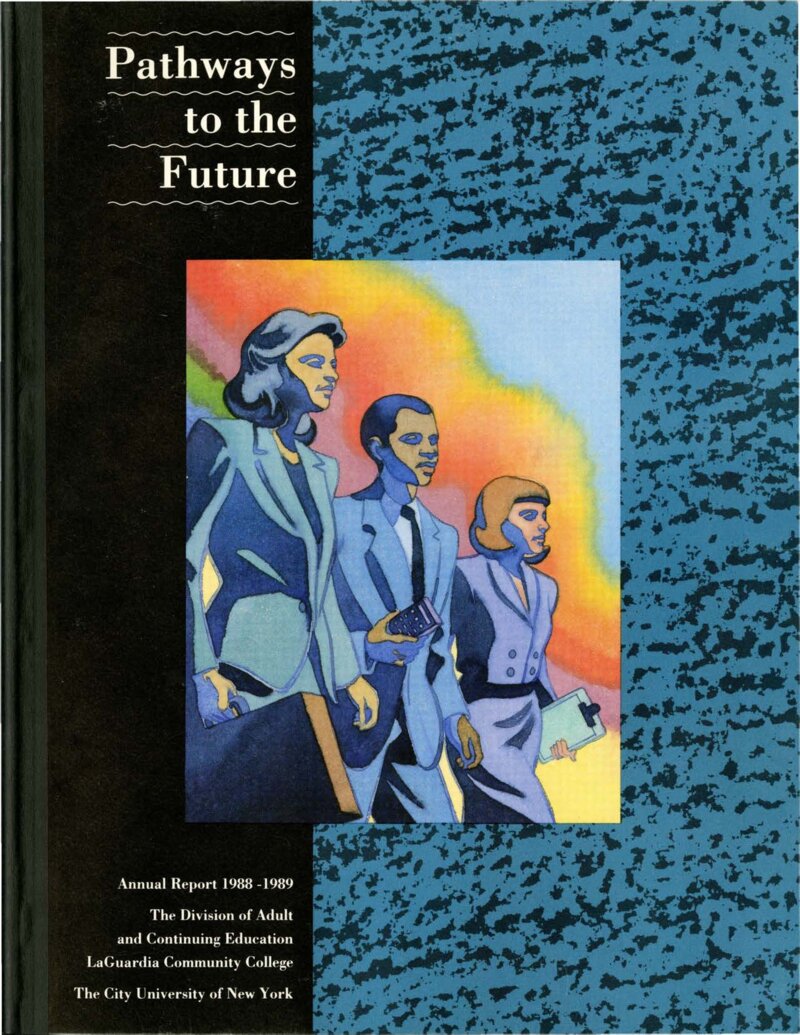
Pathways
to the
Future
Annual Report 1988 -1989
The Division of Adult
and Continuing Education
LaGuardia Community College
The City University of New York
Annual Report 1988-89
The Division of Adult And Continuing Education
Fiorello H. LaGuardia Community College
The City University of New York
31-10 Thomson Avenue Long Island City, New York 11101, U.S.A.
THE CITY UNIVERSITY OF NEW YORK
Joseph Murphy, Chancellor
FIORELLO H. LAGUARDIA COMMUNITY COLLEGE
Martin Moed, Acting President
Roy McLeod, Acting Dean of Faculty
DIVISION OF ADULT AND CONTINUING EDUCATION
Judith L. McGaughey, Dean
Kenneth Cottrell, Associate Dean
Fern Khan, Associate Dean
Gloria Gallingane, Senior Administrator
Robert Rosa, Senior Administrator
ABLE OF CONTENTS
ENROLLMENT STATISTICS: 1988-89 / iv
PATHWAYS TO THE FUTURE / 1
WHERE THE PROGRAMS MEET / 3
PROGRAM DESCRIPTIONS / 4
Adult Career Counseling and Resource Center / 4
The Adult Learning Center / 6
Adult Basic Education / 6
Off-Campus ESOL-BENL Programs / 6
Amnesty Program / 6
High School Equivalency Programs / 7
Business and Outreach Programs / 8
The New York City Taxi Driver Institute / 8
Programs for Business / 8
Technical Programs / 9
Career and Professional Programs / 10
Career and Professional Programs / 10
Animal Health Technology / 10
Dietary Managers Program / 11
College for Children / 12
Community Service Programs / 13
Project Enable / 13
Correctional Education Program / 13
Access Center for Vocational Education / 13
New Directions for Mature Adults / 14
Food Facts Nutrition Education Program / 15
The Integrated Skills Training Program / 15
Typing for the Handicapped / 16
Program for Mentally Disabled Adults / 16
The Correctional Education Consortium / 17
The English Language Center / 18
Freshman English as a Second Language / 18
Day Intensive Program / 18
The Afternoon Intensive English Program / 19
The Evening Intensive English Program / 19
Evening and Saturday Non-Intensive Program / 19
English for Special Purposes / 20
ESL for Home Care Attendants / 20
ESL for Electrical Workers / 20
Extended Day Session / 21
Health Services / 22
EMT/Paramedic Program / 22
Nursing Career Ladder Program / 23
Program for Deaf Adults / 24
Programs for Women and Youth / 25
Women's Program/Office Information Systems
Training Program / 25
Minority and Women's Entrepreneur Training
Program / 25
Programs for Dislocated Workers, Long Term
Unemployed, and Displaced Homemakers / 25
Jobward Bound / 26
Research and Professional Development / 27
The Veterans Program / 28
Off-Campus Programs / 29
The Astoria Adult Education Center / 29
The Chinatown Center / 29
East Side Connection / 2°
The LaGuardia/CAMBA Refugee Vocational
Assistance Center / 30
LaGuardia at the Bulova School/Woodside / 30
PROFESSIONAL AND COMMUNITY
CONTRIBUTIONS / 31
STAFF DIRECTORY / 36
THANK YOU / 39
CREDITS / 39
DIVISION OF ADULT AND CONTINUING EDUCATION
Enrollment in Programs, 1988-89
Access Center for Vocational Education
Adult Career Counseling
Adult Learning Center
Animal Health Technology
Astoria Adult Education Center
Career and Professional Programs
Chinatown Center
College for Children
Correctional Education Program
Dietary Managers Program
East Side Connection Program
EMT/Paramedic Program
English Language Center (non-credit only)
Food Facts Nutrition Education Program
Integrated Skills Training Program
Jobward Bound
LaGuardia/CAMBA Refugee Program
LaGuardia/Bulova-Woodside Programa
New Directions for Mature Adults
Nursing Career Ladder Program
Programs for Business
Programs for Deaf Adults
Programs for Mentally Disabled Adults
Programs for Women and Youth
(excluding Jobward Bound)
Project Enable
Taxi Institute
Typing for the Handicapped
Veterans Program
iv
GRAND TOTAL: 28,386
Bruway S TO THE FUTURE
The Division of Adult and Continuing Education draws
strength from the College’s deep commitment to develop
comprehensive programs and services to address the needs of
adult populations. Since the Division enrolled its first 2700
students in 1972 , the number of persons who have registered for
programs or courses of study has grown steadily, and in 1989
reached over 28,000.
The many “pathways to the future” which the past year’s
registrants have embarked on are described in the major section
of this annual report, the Program Descriptions. It is in these
programs that adult students define and refine their interests and
skills. Some students may discover a new pathway for them-
selves by taking a single word processing course while others
may be participants in a particular program—or programs—for
years. This is particularly true for those who, for example,
begin in the Adult Learning Center in a literacy course, steadily
make progress toward a high school equivalency diploma, a
better job, and some, eventually toa college degree program. In
fact, Continuing Education enrollment is often the first point of
entry for adults into the higher education mainstream. The
number of adults moving through such programs to degree
study at LaGuardia continues to grow with over 350 doing so
during 1988-89.
a
RZ
Honors and recognition to students in the Integrated Skills Vocational Training Program! From left to right, Phyllis Illges, counselor, and
students Arthur Emen, William Feliciano, Stephen Louey, and Steward Mitchell. Mr. Mitchell is a past graduate of the ISVT Program and now
successfully employed at Goldwater Memorial Hospital.
Characteristics of many of the programs that the Division
has developed and offered is that there have often been more
eager registrants for them than there has been capacity to accept.
Furthermore, in numerous instances, the programs have drawn
many individuals who have not met the program’s eligibility
requirements. However, the Division staff have remained
undaunted: through their dedication, enthusiasm, and sense of
advocacy for students, new funding sources have been identi-
fied, and grants written for programs that meet the needs of the
newly identified populations.
The Division of Adult and Continuing Education has also
continued to seck out and respond to identifiable and unmet
educational and career-related needs within the surrounding
communities. Its methodology has included an “Assessment of
Needs of Western Queens,” undertaken in 1980. The results of
this survey indicated that a major focus of the Division’s
programs should be on academic and career-oriented instruc-
tion and have led to our current emphasis on courses offering
academic development and skills training, as well as career
counseling. The need for children’s programs was also identi-
fied in this survey.
Working with Adults to Provide Programs for Them
A belief that is crucial to the Division’s methodology is that
adults can take a great deal of responsibility for their own
leaming. This approach is particularly evident in our guided
independent and individualized study classes, as well as in the
mature adults program in which older adults decide what
courses they would like to see developed and offered. Gener-
ally, inclusion of adults in an advisory capacity atearly program
phases, as well as their potential as students, faculty members,
or evaluators in later stages suggest the wide range of possible
involvement. Creating flexible learning environments while
maintaining academic integrity are major instructional and
administrative goals. Additionally, the Division remains sen-
sitive to emerging societal needs, unpredictable changes in the
labor market, funding sources and the political and social
climate, all of which have an impact on the kinds of programs
which are, or need to be developed.
Collaboration with the College and Community
The increasing numbers of collaborative programs between
the Division of Adult and Continuing Education and the other
college divisions have provided important opportunities for
creative and integrated program development. Program ex-
amples include the Nursing Career Ladder and the Dietary
Manager’s Programs offered through the Natural and Applied
Science Division, and Travel and Tourism courses at our
Astoria Center linked to the Accounting and Managerial Stud-
ies Department. Through Extended Day, credit courses from all
academic departments are offered during evenings and weck-
ends.
The ideas for these programs can be stimulated by Continu-
ing Education administrators, faculty and staff from other
Divisions of the college or members of the College’s many
external communities. The listing of director’s telephone
numbers in this report invites readers’ inquiries for further
information about particular programs, and directors welcome
ideas and suggestions for new ones, which frequently start with
a well-placed question.
Judith McGaughey
Dean
Karate is a popular course offering in the College for Children.
WHERE THE PROGRAMS MEET
BROOKLYN
JULY 1988 - JUNE 1989
3
D RESOUR
CE CENTER
A” ULT CAREER COUNSELING
AN.
Jane Schulman, Director
(718) 482-5355
Adult careercounseling isa process which enables individu-
als to assess their personal and work-related values, skills and
abilities, and encourages them to identify their goals together
with the necessary steps needed to fulfill their potential in the
world of work.
In the Adult Career Counseling and Resource Center
(ACCRC) career counseling services are available to adults
attending English-as-a-second-language, high school equiva-
lency, and adult basic education classes in the Division as well
as adults from the community at large.
‘ed nd careers: When Amy Pamphile retired as a supervisor ;
pain pclerenre ns for Mature Adults Program. Before she realized, she had earned
courses in psychology through the New Directioi r
childhood education. Now she is a teacher assistant in a day care c
for the LaGuardia Veterans GED Program. After he earned his credential there, he enr:
Central to the service is the seven-weck Career Counseling
Seminar in which participants explore their career interests,
identify their job-related abilities and values, and develop
decision-making skills. In the process, bee Aries ES
umes, improve their interviewing techniques, Inves-
oie caren pc tapi discuss employment and educational
opportunities.
A valuable companion service is the Career and Educational
Resource Center itself. Here students may explore occupational
and educational opportunities by using the extensive career
reference and other materials.
at the Department of Social Services, she started taking a few
an associate degree in
enter where she did her internships. As a veteran, John Carter qualified
colled in the gerontology program at LaGuardia. He
has nearly completed his degree, and upon graduation, plans to work at a senior center.
The Center’s staff also presents career information to the
community through lively panel discussions during the Career
Information Night Series, which is open to all interested stu-
dents from the Division or the community. Panels of experts in
fields such as computers, education, health, and travel and tour-
ism present information about employment opportunities, train-
ing and educational requirements, and methods of entering the
field.
In addition to our group seminars, the Center offers individ-
ual career counseling, resume preparation services, and job
interview workshops. These services focus on the individual
needs of our clients and individual consultation hours are
arranged at the client’s convenience.
AT&T/CUNY/ALLIANCE Adult Career Advisory Pro-
gram is a sixteen hour career decision-making program jointly
sponsored by the Alliance for Employee Growth and Develop-
ment and the City University of New York. Developed by
ACCRC at LaGuardia, the program provides AT&T employees
with the opportunity to reflect on their current career situation,
explore new career opportunities, and receive assistance with
career planning and decision making. The Center also provides
training for counselors from the various CUNY campuses
which participate in the program.
Career counseling services are provided to parents of chil-
dren participating in a pre-kindergarten experience as part of
the Mayor’s Parent Literacy Initiative. Through Project Giant
Step, the ACCRC conducts six-hour career development semi-
nars in schools and community agencies in all New York City
Boroughs.
Through Project TEACH (Teacher Education: A Carcer
Head-start), the staff identifies and recruits people into pre-
education programs at LaGuardia as part of an initiative to
increase teacher recruitment in the metropolitan area. ACCRC
provides students with career and academic support services,
coordinates services with the Teacher Opportunity Corps at the
Queens College School of Education, and works with the New
York City Board of Education to establish internships in the
school.
As a model center and part of a network of adult career
counseling centers throughout New York State, the staff of
LaGuardia’s ACCRC provides training workshops to counsel-
ors in adult and continuing education programs. The work-
shops enable counselors to become familiar with the New York
State Career Counseling Model.
A highlight of the spring quarter was a half-day Career
Opportunities Workshop which the ACCRC designed espe-
cially for women. “Going from Here to There: Women Chang-
ing Careers” brought successful women from such fields as
allied health, business and computers, and the building trades
industry to LaGuardia to share their broad experience and rich
personal accounts of career planning strategies and develop-
ment with the audience.
HE ADULT LEARNING
CENTER
Alexis D. Frazier, Director
Philip Akre, Assistant Director
(718) 482-5380
In 1988-89, the Adult Learning Center marked its fifteenth
year of operation. At the heart of the Center’s mission is a
commitment to literacy education directed toward adult popu-
lations. Campus-based and off-campus classes served the
needs of over 4,000 students in the areas of English as a second
language, amnesty citizenship classes, basic education in both
English and Spanish, math, and high school equivalency prepa-
ration.
Students bring rich educational and life experiences and a
diversity of cultural and linguistic backgrounds to the Center.
The objective is to endorse and incorporate these experiences
and build on them in ways that promote the achievement of the
student’s educational and career goals.
The Center’s staff utilizes the varied backgrounds and skills
of the students and teachers to develop a thematic curriculum
which fosters critical thinking and reading skills. Through
ongoing staff development activities, teachers are trained as
facilitators who build a student-centered, small group learning
process that encourages growth and achievement. Programs
and classes, both on and off-campus in 1988-89 included the
following:
ADULT BASIC EDUCATION
This year the Adult Learning Center celebrated ten years of
Adult Basic Education. Nearly 900 adults enrolled in the
program to strengthen reading, writing, and math skills they
need for personal and career development.
The program offers a complete range of day-time, evening,
and Saturday classes to the adult learner who can enter at any
one of four skill levels and continue through high school
equivalency preparation. Adult Basic Education at LaGuardia
continues its strong commitment to students at the beginning
level of reading skills.
This year two full-time instructors were added to the faculty.
Additionally, classes devoted solely to basic math skills were
offered. Students are also offered a variety of personal and
career counseling services through the Division’s Adult Career
Counseling and Resource Center.
OFF-CAMPUS ESOL/BENL
PROGRAMS
The Center provided instruction in English to speakers of
other languages (ESOL) in programs in Queens and Manhattan
for nearly 1000 adults who were enrolled in classes in their own
communities primarily during evening hours and on Saturdays.
The focus of instruction is development of listening, speaking,
reading, and writing skills in a curriculum that combines
English language proficiency with the development of skills
that are useful to students’ life situations.
The Corona Community Education Program is the largest
element of the ESOL programs, but classes are also held in
Flushing and Long Island City, Queens as well as in Manhat-
tan’s Chinatown. The Corona Program, housed in Our Lady of
Sorrows School, includes ESOL and Basic Education in the
Native Language.
Finally, new ESOL classes were begun in the past year in in-
dustrial workplaces and in correctional facilities. While based
on the model of community education in Corona, these classes
presented unique opportunities to develop instructional materi-
als and curriculum that fit the special needs of these popula-
tions.
THE AMNESTY PROGRAM
In a new project this year, the Adult Learning Center pro-
vided classes for students on campus and in Chinatown in the
Amnesty Citizenship Program. These classes were designed
for adults seeking permanent residency status in the U.S. who
need to demonstrate basic English skills and knowledge of
United States history and government.
Begun in January 1989, the program had served 800 partici-
pants by June. Of these, 540 received certificates of attendance
required to fulfill the educational requirements set by the U.S.
Immigration and Naturalization Service. Classes ranged from
beginning ESOL to advanced civics courses for fluent speakers
of English. The Center provided for counseling of students and
assisted instructors in the development of teaching materials
appropriate to the needs of students.
sa NI) ND
HIGH SCHOOL
EQUIVALENCY PROGRAMS
High School Equivalency Preparation Programs are another
essential component of the comprehensive of ferings of thes
Adult Learning Center. The CUNY GED Program at LaGuar-
dia, funded by the State Education Department through the City
University of New York, Prepares students for the GED (General
Intricacies of clock repair are a challenge to both professionals and hobbiests in the LdGamrdiithainn Se
7
Educational Development) examination ina free eveni
ing pro-
_ poet a students of all ages took classes in CUNY
at uardia this year. Of these, more th:
expected to earn their diplomas. ee
The Adult Learning Center also offers tuition-based high
school equivalency preparation classes in English and Spanish
in which 120 adults enrolled this year. A college admissions
counselor works exclusively with all GED students, helping
them to map their plans for coll
rl p lege and employment opportu-
“
chool Program.
USINESS AND OUTREACH
PROGRAMS
THE NEW YORK CITY TAXI
DRIVER INSTITUTE
Steve Brauch, Director
(718) 482-5335
Conducted jointly by the Federation Employment and Guid-
ance Service (FEGS) and LaGuardia Community College, the
New York City Taxi Driver Institute is dedicated to the educa-
tion of new taxi driver applicants in the metropolitan area. To
date, the program has served over 40,000 applicants.
The core curriculum, updated in 1988-89, covers the areas of
New York City geography, defensive driving, courtesy, and
New York City Taxi and Limousine Commission rules and
regulations. Emphasis is placed upon interactive role-playing,
especially in the driver-passenger relations components of the
course.
This year has been an active one for the New York City Taxi
Driver Institute; at the request of the New York City Taxi and
Limousine Commission, the Institute has:
e developed a one-to-one English screening examination to
measure applicants’ ability to speak as well as understand the
English language;
e revised and documented its curriculum, expanded the
areas of driver-passenger relations and geography;
e added new modes of testing on the final examination: oral
understanding and trip-routing questions requiring more thana
simple multiple-choice response;
e beguna formal process of certification by an independent
panel of educators and agency and industry personnel.
The New York City Taxi and Limousine Commission re-
cently announced sweeping changes in its training require-
ments which will affect the New York City Taxi Driver Insti-
tute. Among them are:
e expansion of the 20-hour curriculum to 40 hours;
e addition of a “refresher course” for experienced drivers;
e institution of an eight-hour instructional bus tour compo
nent to the geography section of the course.
The New York City Taxi Driver Institute at LaGuardia
Community College was invited by the Taxi Educators’ Con-
ference Committee to address its annual conference in Boston
in August 1989. The topic was the interactive English screen-
ing test for taxi driver-applicants, believed to be the first of its
kind in the country.
o
PROGRAMS FOR BUSINESS
Despene Gazianis-Stough, Director
(718) 482-5330
Programs for Business, a unique arm of the College’s Adult
and Continuing Education Division, reflects a commitment to
holistic training through collaborative relationship established
with corporations, small business, labor unions, local develop-
ment corporations and non-profit organizations. The pro-
gram’s uniqueness lies in the fact that the training is “custom-
tailored” for each specific industry, cost-effective, and offered
on a company’s premises.
The wide selection of courses spans six major areas: Man-
agement/Supervisory Skills, Computer Application Courses,
Communication/Language Skills (English-as-a-second-lan-
guage-specific-to-an-industry), Specialized Business Work-
shops, Technical Programs and Workshops for Small Business
Owners.
Initiated in 1979, Program’s for Business has served over
150 organizations and trained over 2000 employees. The
Program offers both fee-based (contract) courses and grant-
funded courses which are offered at no cost to the company.
The figures show contract program growth and the types of or-
ganizations served.
Organizations Served
24.14%
PR I10,
Industry Sector
Union HE Misc./Open
& Transportation @ Health CareHospitais
© Education @ Manutactunng
Local Dev. Agency Government
© HotevHospitality O Service
Contract Program’s Growth
Courses Provided
1983 1984 1985 1986 1987 1988 1989E
TECHNICAL AND GRANT
FUNDED PROGRAMS
Wilford Saunders, Coordinator
(718) 482-5358
Anoff-shoot of Programs for Business, Technical and Grant
Funded Programs provide training assistance to businesses and
industries in Long Island City.
Grant projects completed this year include:
WORKPLACE LITERACY
In October 1988 the New York State Education Department
increased funding to existing school-based literacy programs
through the Adult Literacy Education (ALE) grant, and Pro-
grams for Business submitted a proposal for Workplace Liter-
acy under this grant. The ALE funds were an “add-on” to the
Adult Basic Education grant administered by LaGuardia’s
Adult Learning Center. Over 600 hours of Workplace Literacy
classes were conducted for the Abe Munn Picture Frame Co.,
Tama Sportwear, Prints Charming, Tickle Me and the Korean
Manpower Development Corporation.
In the factory-based classes, the presence of teachers on the
factory floor had a subtle but important impact on the relation-
ship between student and teacher and probably helped the
students to “open up” more in class.
CROSS CULTURAL COMMUNICATIONS
WORKSHOP
Programs for Business offered a two-day intensive work-
shop in cross-cultural communication for managers and super-
visors in companies with a multi-cultural, multi-lingual
workforce. The premise of the training was that managers and
supervisory personnel need to be brought into the training loop
if the literacy initiative is to have the best chance of success.
Participating Companies included Abe Munn Picture Frames,
Dentsply Division of Cavitron Products, and the LaGuardia
Marriott Hotel.
QUEENS TOURISM SEMINARS
A series of four major seminars were conducted in coopera-
tion with the Queensborough President’s Office to inform
tourist-related businesses in Queens County on how to work
together to “package” themselves for the tourist audience. The
project also held four breakfast “card swaps” to encourage
networking between hotels, restaurants, tourist attractions and
representatives of the motor coach industry.
This was probably the most serious attempt to organize the
tourism industry in Queens since the 1964 World’s Fair and the
participants felt that the effort should be continued. Many
students in LaGuardia’s Travel and Tourism Program got
valuable exposure to the industry and several got job place-
ments in the bargain.
Continuing technical projects which Programs for Business
was involved in include:
AVIATION MAINTENANCE TECHNOLOGY
After two years of planning and collaboration with Aviation
High School, LaGuardia received approval for two associate
degree programs in Aviation Maintenance Technology/Airframe
and Aviation Maintenance Technology/Powerplant from New
York State and the programs were approved by the CUNY
Board of Trustees in May 1988. The proposed degree programs
prepare students for entry-level positions in the expanding field
of aircraft maintenance, and would also enable individuals
holding one license to obtain an A.A.S. degree while complet-
ing the requirements for the other license.
NEW IBM COMPUTER LABS
Conversion of the old Tandy Model IV computer lab to IBM/
PS2 Model 30/286 “AT” class machines was completed and
classes started in October 1988. Work began promptly on the
development of another PS/2 lab for the Astoria Center and
renovation and installation of the new equipment was com-
pleted in time to offer classes there during summer 1989.
AREER AND PROFESSIONAL
» PROGRAMS
Allen Cohen, Director
(718) 482-5125
Career and Professional Programs link the classroom to the
workplace by providing students with applicable work-related
skills. The program emphasizes “hands-on” experience for
students who are either new to a given field or who wish to learn
more about a field; therefore, courses often have a lab compo-
nent. To help students acquire first-hand knowledge, the
program employs professionals working in the field who come
to LaGuardia to share their experience and expertise.
Students may select courses from a variety of areas: account-
ing, real estate, office skills, word processing, microcomputing,
telecommunications, and health, for example. Course areas
that have expanded and have remained popular are:
1. The 160-hour certificate program in telecommunications
which is designed and taught by instructors who work full-time
in the field. Twelve 20-hour courses are offered in such areas
as Digital Networking, Data Communications I, Project
Management, and Equipment and Evaluation.
2. Advanced LOTUS 1-2-3, Advanced MS DOS, and An
Introduction to the MacIntosh Microcomputers, which provide
students with knowledge of up-to-date computer software and
give them hands-on experience.
3. The Real Estate Program, accredited by the Licensing
Office of the New York State Department State, prepares
students for jobs as real estate salespersons and brokers. In
1989, LaGuardia began to offer courses that real estate profes-
sionals are required to take to maintain their licenses.
4. 72-hour courses in Refrigeration, Electricity, Pneumatic
and Electric Controls are offered in conjunction with the
Metropolitan New York Chapter of the Refrigeration Service
Engineers Society (RSES). This year the program awarded
over 50 certificates to students who successfully completedthe
courses. In the fall 1988, the National Association of Power
Engineers began a new 200-hour qualifying course for licens-
ing in Refrigeration Machine Operation, in addition to its 72-
hour class in Steam Engineering.
5. Classes in word processing are offered on both the
dedicated Wang system and on other non-dedicated systems.
In spring 1989 an advanced Wang class specializing in legal
and medical documents was added to the curriculum. The
highdemand for word processing skills in the workplace has
made these classes continual favorites, in addition to the
offerings in Word Perfect 5.0.
In summer 1989, in association with Academics of Flight,
LaGuardia began a 36-hour Private Pilot Ground School course.
This course prepares students for the FAA written exam for
Private Pilots and is the first step one takes to become a pilot.
ANIMAL HEALTH
TECHNOLOGY
Kathleen Rider, Coordinator
(718) 482-5765
LaGuardia’s Animal Health Technology Program (AHT),
part of the Natural and Applied Science Department, provides
annual review sessions for graduates and technicians employed
in the animal science field. Graduates of the AHT program are
eligible to take the New York State Animal Health Technician
Licensing Examination and the Laboratory Animal Technician
certification examination, offered through the American Asso-
ciation for Laboratory Animal Science (AALAS). Established
in 1981, this program is the only program accredited by the
American Veterinary Medical Association in the metropolitan
area.
This year 38 students enrolled in review courses to prepare
for the written and practical portions of the New York State
Animal Health Technician Licensing Examination.
A 16-week course was also held to prepare employed tech-
nicians for the AALAS-sponsored Assistant Laboratory Ani-
mal Technicians and Laboratory Animal Technician certifica-
tion examinations, which are designed to upgrade the quality of
animal care personnel and provide uniform standards. Twenty
students completed the course and are eligible to take the
exams.
DIETARY MANAGERS
PROGRAM
Rosann Ippolito, Coordinator
(718) 482-5758
Offered jointly by the Department of Natural and Applied
Sciences and the Division of Adult and Continuing Education,
the Dietary Managers Program enables health care food service
employees to upgrade their job skills, often to the management
The Animal Health Technology Program prepares graduates and technicians employed in the animal science field for certification and
level. Students who complete the 135-hour, three-quarter
program meet the minimal educational requirements for the
position of Food Service Supervisor, set by the New York State
Department of Health.
Students who participate in the program come from diverse
vocational backgrounds: food service dietary aides, tray assem-
bly staff, cooks, and provisional supervisors. Students continu-
ally exhibit outstanding motivation and perseverance, as well as
ability to master a demanding curriculum. This year, 19
students completed the program.
' es
| —— eee
licensing examinations designed to upgrade the quality of animal care personnel and provide uniform standards.
C oLLEGe FOR CHILDREN
Laura MacDermeid, Coordinator
(718) 482-5323
If one equates learning with working, then it’s no exaggera-
tion to say that LaGuardia’s students begin work as early as age
3. The College for Children/Programs for Teens motto is “It’s
Never Too Early,” and in 1988-89, over 1500 children and
parents bore this out.
College for Children began in 1982 in response toa commu-
nity survey in which parents indicated that there was a great
need for children’s programs in the community. LaGuardia has
addressed this need by providing an opportunity for thousands
of young people, ages 3-16, to participate in a variety of classes.
Now more than 30 courses are offered each quarter in basic
skills improvement, the arts and humanities, and recreation.
Activities in the College for Children/Programs for Teens
also included putting on and attending performances and exhib-
its, and going on field trips. Representative activities in the
program this year were the following:
e@ A Dance Workshop which presented dance concerts at the
end of each quarter;
e Artstart and Exploring Art classes, which incorporated
field trips to the Institute for Contemporary Art/P.S. 1 Museum,
inaddition to exhibiting the young artists own work in the Youth
Arts Festival;
e Computer Discovery classes that visited the AT&T
Infoquest exhibit to study technology and “Playing to Win,” a
non-profit computer learning center in Manhattan.
College for Children also launched a pilot program this
year—the Weekday Summer Program—in which 23 children,
ages 7-11, attended classes in math and reading for six weeks in
July and August.
Parents were also part of the College for Children program.
Swimming classes offered parents and children an opportunity
to participate in pool activities together, and special workshops
for parents were presented this spring. Gateway Community
Restoration’s “Parent to Parent” program focused a session on
how to reduce the threat of drug abuse in their families and
neighborhoods through better communication with their chil-
dren. A Parent Effectiveness Workshop, led by a licensed
school counselor, gave parents insights into positive and pro-
ductive relationships with their children.
In 1988-89 two College for Children grant-funded programs
expanded, and a third project began in earnest. The Learning
Center at Jamaica, established in spring 1989 with funding from
the Kenworthy-Swift Foundation, provides homework help to
children who come to the New York City Parks Department’s
Homeless Youth Recreation site.
12
Learning Environments for Deaf Parents and Their Hearing
Children isa joint project of College for Children and Programs
for Deaf Adults, which brought together 22 families in fall 1988
and spring 1989 to attend Saturday workshops. Parents’ topics
included Effective Parenting and How to Help Your Child
Learn at Home. Simultaneously, the children, ages 3-6, partici-
pated in activities such as dancing, listening to music, painting,
and listening to stories. They also attended a LaGuardia Theatre
performance, which was sign language interpreted.
Finally, the College for Children/P.S. 171 Scholarship Pro-
gram started in winter 1989. Each quarter provision is to be
made for 20-22 children to attend the Saturday program on
scholarships. P.S. 171 is an elementary school in Astoria, and
the College for Children Scholarship is part of a larger college-
wide initiative to form a collaborative relationship with staff
and students there. The scholarships are funded by the Laura
Vogler Foundation and the Republic National Bank.
In the College for Children, training in music making skills starts at
@ young age.
OMMUNITY SERVICE
PROGRAMS
PROJECT ENABLE
Linda Johnson, Coordinator
(718) 482-5322
For single parents living in shelters with their dependent
children, for Hispanic adults on welfare with limited English
speaking ability, and for formerly homeless adults, Project
Enable provides free vocational training and academic reme-
diation in a variety of modes on and off-campus. In addition to
the technical and educational focus, the program emphasizes
supportive services such as child care referral, training benefits
referral, individual and group counseling, life skills and job
readiness workshops. Job counseling and placement are of-
fered to students in vocational as well as academic tracks, and
college counseling and placement services are also provided to
all.
Ineach Project Enable course, students are challenged to use
their vast experiences in the application of new knowledge and
skills that will result in self sufficiency from the welfare system.
Classes that are offered in the Office Technology component
include: typing, word processing concepts and applications,
secretarial office procedures, records and accounts, and career
and personal development. The High School Equivalency
Preparation (GED) course covers five subject areas plus writing
and math. The English-as-a-second-language (ESL) compo-
nent focuses on four communication modes (listening, speak-
ing, reading, writing), bilingual career and personal devclop-
ment workshops, and cultural awareness. Job placement and
college placement are available to all students.
Inthe last year Project Enable added ESL and family literacy
to its off-campus offerings in a Brooklyn shelter, and estab-
lished an office technology training satellite in a shelter in
Jamaica, Queens. There is also a new basic education class
starting in a mid-Manhattan shelter.
THE CORRECTIONAL
EDUCATION PROGRAM
Philippe Magloire, Program Coordinator
John Wesley, Assistant Coordinator
(718) 482-5333
Through funding provided by the New York City Depart-
ment of Corrections through the Correctional Education Con-
sortium, the LaGuardia Correctional Education Program pro-
vided Adult Learning Services to 4,025 inmates at three deten-
tion facilities: C-73 and North Facility on Rikers Island, and
Queens House of Detention (QHDM) in Kew Gardens. A full
range of educational services was provided at cach facility,
including English as a second language, adult basic education,
and high school equivalency test preparation, and at two facili-
ties, college preparation as well as “life skills” workshops. A
total of 354 students took the high school equivalency test,
which was offered in both English and Spanish. In addition, the
program initiated a C-73 vocational training program in Key-
boarding/Data Entry Skills, using 18 computers and two print-
ers donated by the College.
The major challenge in 1988-89 was the establishment of the
new Adult Learning Center at C-73, a newly reorganized
facility serving men, many of whom are anticipated as being on
Rikers for a longer detention period. This facility serves, in
addition to a gencral male population, a special drug rehabili-
tation unit. The program coordinator developed the Keyboard-
ing/Data Entry Training Program and spearheaded the Life
Skills Workshops there. At QHDM, the assistant coordinator
maintained the on-going program, worked very closely with the
Queensborough Public Library in further development of the
program computer lab and in their provision of a lending library
within the facility. At North Facility, although the budget was
quite limited, educational services for a full range of remedial
academic needs were provided within the framework of asingle
learning lab. Atall institutions, regular recognition ceremonies
were held and literacy magazines published.
THE ACCESS CENTER FOR
VOCATIONAL EDUCATION
Shirley Miller, Director
Arthur Leon, Outreach Counsclor
(718) 482-5129
The ACCESS Center, funded through the Carl Perkins Act,
works directly with inmates at Queensborough Correctional
Facility in Long Island City and at Lincoln Correctional Facility
in Manhattan, as well as recently released ex-offenders from
ustate institutions. The goal of the Access Center is to provide
career development workshops and referrals so that ex-offend-
ers can use educational and vocational training to assist them in
their transition to their home communities.
During the past year, the Access Center outreach counselor
provided direct services to 525 participants, encouraging them,
first, to identify career goals, and then helping to make out an
educational plan, a strategy which is especially important in
enabling ex-offenders to make a full commitment to an educa-
tional sequence.
The Access Center, in conjunction with the LaGuardia Adult
Career Counseling and Resource Center, provides means for
individuals to explore career options and career paths, and then
to follow-up with the appropriate referrals into accessible adult
basic education, English as a second language, high school
equivalency preparation and college credit programs. In the
past year, over forty men have entered the LaGuardia or other
college credit programs. As Queensborough Correctional
Facility is a work-release institution and located adjacent to
LaGuardia, it has been particularly easy for participants to
enroll in evening credit and non-credit courses on-campus.
The Access Center worked with the LaGuardia Adult Learn-
ing Center in providing an ESL class held within the facility.
Through this class, work-releases can gain the basic English
language skills they need both to survive and to hold jobs while
on work-release and later in their communities.
«€er'
;.
~~
Project Enable students express happiness over their accomplishments at this graduation social.
NEW DIRECTIONS FOR
MATURE ADULTS
Shirley Saulsbury, Coordinator
(718) 482-5304
In the past year New Directions for Mature Adults served
985 people through an expanded array of programs and serv-
ices—both on-campus and at senior centers throughout Queens,
This year the program expanded its low-cost campus courses,
focusing on major themes of wellness and today’s technology,
including Introduction to the Computer, Deliciously Healthy
Food, Patient Rights and New Medicare Entitlements, Fitness
Assessmentand Conditioning,and Aquanautics for Older Adults.
New Directions also continued its programming in four major
areas of interest to older adults:
e Best of Broadway, which this year provided low-cost
theatre tickets for over 400 participants;
@ special events on campus;
contract courses offered at Queens senior centers;
and the Phase I Scholars program, which works with older
adults in the LaGuardia credit program.
In 1988-89 New Directions special events included the
Health Festival, a health screening program reaching nearly
200 people and offered in conjunction with the New York
Hospital/Cornell Medical Center; support for the 4K for Fitness
walk, part of College 10K Race Day; and the annual College
Sampler, which offered a full day of over twenty high-interest
workshops taught by College faculty and staff.
Students in the Phase II Scholars credit program come to
LaGuardia with a variety of individual goals. Clearly many are
seeking the enrichment of the liberal arts after a lifetime of
work. Butothersare preparing for second careers, ranging from
accounting and business management to child development or
counseling older adults.
The New Directions program coordinator works directly
with community-based senior centers, both in coordination of
courses selected and purchased by centers to be given at the
centers, and in administration of courses provided through the
Institute of Study for Older Adults, funded through New York
City Technical College. To support these activities, New Di-
rections has developed both an information brochure about the
program, and the New Directions Quarterly a newsletter about
the accomplishments of program participant, topics of concern,
and upcoming activities.
FOOD FACTS NUTRITION
EDUCATION PROGRAM
Stephen Arrigo, Outreach Nutritionist
(718) 482-5130
Now in its fourth year of funding, the Food Facts IV Program
provides nutrition education workshops and counseling to three
especially at-risk populations: homeless families, pregnant
teens/adolescent parents, and older adults. The outreach coun-
selor has provided nutrition workshops for 96 homeless heads
of household, 276 pregnant teens/adolescent parents, and 124
low-income older adults, plus numerous individual nutrition
counseling sessions—all at community-based locations. The
close interface with these populations has been made possible
through networking with Project Enable; the New York City
Board of Education LYFE Program, which provides high-
school based education and day care program for teens; and the
New Directions for Mature Adults Program, which works
actively with senior centers and with the HRA/BPSS nutrition-
ist, Marian Reed.
This and other programs of this type seck to address the risk
facing one out of every four New Yorkers—23.2 percent—who
live in poverty and at high risk of nutritional deprivation. The
targeted outreach and nutrition education of the Food Facts IV
Program provides a means for these low-income individuals to
receive information about Federal feeding programs and the
guidelines to use their food dollars to best nutritional advantage.
INTEGRATED SKILLS
VOCATIONAL TRAINING
PROGRAM
Dolores Perin, Director
Phyllis Illges, Career Counselor
(718) 482-5326
With support from the U.S. Department of Education (Of-
fice of Special Education and Rehabilitative Services), LaGuar-
dia Community College has joined in collaboration with CASE/
IRDOE, the Federation Employment and Guidance Service
(FEGS), and the Federation of the Handicapped (FOH) to serve
learning disabled young adults.
Participants, who may be enrolled throughout the year on a
continuous basis, attend this program for six months to one
year. Two dayseach week, students attend classes at LaGuardia
which are directed toward the development of basic skills and
job-related social skills. Students also receive career counsel-
ing and work-study experience with job coaching. The remain-
ing three days a week, participants take vocational training
classes at either FEGS or FOH, in entry-level jobs, in uphol-
stery, furniture finishing, mailroom, reprographics, jewelry
manufacturing, building maintenance, custodial services, food
services and data entry. Both FEGS and FOH place students
who complete the program in competitive entry-level employ-
ment. Witha LaGuardia-based part-time staff including a basic
skills instructor and a tutor, the program serves up to 40
participants at a time.
TYPING FOR THE
HANDICAPPED
Shirley Miller, Director
(718) 482-5321
Jack Heller, Master Teacher
Mollie Polanski, Tutor and Outreach Specialist
(718) 341-2070
Since 1973, Typing for the Handicapped has been offered
collaboratively by the New York City Board of Education and
LaGuardia Community College. The program is designed to
serve the special group of young adults and adult students—
including the neurologically impaired, physically handicapped,
emotionally disturbed, cerebral palsied, and stroke impaired—
who find few educational opportunities open to them. The hard
of hearing are also served for beginning typing skills in prepa-
ration for entry to the Program for Deaf Adults.
Under the leadership of Jack Heller, a recognized leader in
education for the disabled, the program provides individualized
instruction in typing skills, math skills, and reading skills
through a special computer-aided instruction program. The
goal of the program is preparation of students for the work
force, and many graduates are successfully placed in jobs. In
1988-89 the program served 70 students.
PROGRAM FOR MENTALLY
DISABLED ADULTS
Shirley Miller, Director
(718) 482-5321
In collaboration with the Association for the Help of Re-
tarded Children (AHRC), the Program for Mentally Disabled
Adults offers a series of continuing education courses for
mentally retarded adults on Saturdays. Courses are arranged
thematically—American History, and the Psychology of Daily
Living, for example—and are designed to further the education
and independence of this student population. This year, stu-
dents took several field trips to Manhattan and listened to a
lecture by a guest speaker. The program, now in its fifth year,
enrolls approximately 10 students per session and continues to
receive praise from parents and students, as well as the educa-
tional community.
ORRECTIONAL EDUCATION
CONSORTIUM
Esther Rothman, Executive Director
(718) 786-4798
Since 1975, The Correctional Education Consortium has
been coordinating educational offerings within correctional
facilities in the New York metropolitan area. The Consortium,
at LaGuardia, oversees educational programs
offered by the Osborne Association, Inc., Long Island Univer-
sity, LaGuardia Community College, and Goodwill Industries.
The majority of the students in the program are detainees.
They are awaiting trial and have not been able to post bail,
sometimes as low as $50. The Consortium provides an impor-
tant educational experience and an opportunity to achieve
something of value during a difficult time. A number of
inmates, who have participated in the Consortium’s educa-
tional programs, have gone on to pursue college degrees.
Students may enroll in classes in basic literacy, English as a
second language, and preparation for both high school equiva-
lency and college entrance. Vocational classes in keyboarding
skills and data entry are also offered. Vocational assessment
services, counseling, aptitude testing, college referral, and post-
release counseling services are available as well.
The Consortium continues its publication of literary journals
written by inmates. This creative and vivid material is drawn
from these instructional programs, which focus primarily on the
communication arts.
HE ENGLISH LANGUAGE
CENTER
Gloria Gallingane, Director
(718) 482-5361
The English Language Center (TELC) is committed to
providing quality English instruction to non-English speaking
students for varying purposes, tailoring programs to meet their
individual needs. Courses are offered for both credit and non-
credit and on a full-time and part-time basis.
The Center’s administrators, faculty, and staff are concerned
about the quality of the students’ learning experience and
recognize that in teaching English to students, they are also
helping students gain access to American society and discover
a voice of their own in their second language.
FRESHMAN ENGLISH AS A
SECOND LANGUAGE (FESL)
Mimi Blaber, Coordinator
(718) 482-5379
Begun in September of 1974, the Freshman English-as-a-
Second-Language (FESL) program is the credit-bearing unit of
the English Language Center. Students in FESL are offered
instruction in oral skills, listening comprehension, reading, and
writing as preparation for further undergraduate studies at the
College. Approximately 2000 students took one or more of the
FESL courses during the 1988-89 academic year.
The FESL program includes four levels. The first and
second levels, ESL 096 and ESL 097, focus on the receptive
skills of listening and reading. The third level, ESL 098,
emphasizes the productive skills of speaking and writing. In
addition to ESL 098, ESR 098 (English for Selected Readers)
continues to be a popular course for students with high reading
levels, but who need to improve their oral and writing skills.
New to the FESL program in the fall 1989 quarter will be
ESW 099 which will replace ESL 099 as the highest Icvel of
ESL instruction. Taught experimentally during the 1988-89
academic year, ESW 099 showed dramatic results, with 50 to 66
percent of the students being able to skip a level in the English
Department’s sequence of writing courses. The curriculum for
this course emphasizes advanced structure and composition,
effective reading as well as continued oral/aural skills instruc-
tion.
Beginning in fall 1988, computers services in the FESL-lab
were expanded to include 25 new IBM computers. In addition
toa word processing function, the computers are equipped with
anetwork which provides self-paced and self-corrected reading
and grammar exercises. In order to reinforce and sharpen
language skills, students are encouraged to usc the lab during
the many drop-in hours available.
Also initiated in the language lab was an innovative ap-
proach to tutoring to promote autonomous learning. Part of the
language lab has been restructured, providing four language
stations for students to work on special areas of need: computer,
video, audio/oral, and grammar and writing. Working in close
cooperation with the instructor, students work at the stations to
improve troublesome areas, with lab tutors available to provide
assistance.
During the 1988-89 academic year, the FESL program
instituted challenging oral skills requirements for students at
the ESL 097 and ESL 098 levels. Moreover, anew method for
reading and grading all final compositions which emphasizes
content as well as grammatical structure was put into place.
In May, the FESL faculty, in conjunction with other mem-
bers of the English Language Center, sponsored the 7th annual
TELC conference, ESL: Politics and Professionalism. Ap-
proximately 100 participants attended, representing educators
throughout the NYC metropolitan arca.
DAY INTENSIVE PROGRAM
(DIP)
Suma Kurien, Coordinator
(718) 482-5363
Since 1974, the Day Intensive Program (DIP) has been
committed to providing English instruction on a full-time basis
to non-native students, many of whom are foreign nationals
planning toentercolleges inthe U.S. Students receive intensive
English instruction (20 hours per weck) in all areas of language
use: listening, speaking, reading, and writing.
In 1988-89, DIP enrolled 1185 students over the four
quarters, representing as many as 44 different countries. Stu-
dents typically enter the program in pursuit of academic of
professional goals. In arecent survey, 53 percent of the students
enrolled reported having some college-level instruction in their
native country.
Entering students are tested and then placed in one of the
seven levels, from beginning to advanced. Students in the ad-
vanced levels, however, are placed in listening/speaking and
reading/writing courses according to their proficiency in these
skill areas. Intermediate and advanced-level students can also
study elective courses for four hours a week. A sampling of
offerings includes: Introduction to American Culture, Public
Speaking, Study Skills for American Universities, Acting Work-
shop, and Introduction to Microcomputers.
Classes are kept small (16-20) in order to maximize the
amount of practice in English. Students who complete the sixth
level of the program and pass the English proficiency test can
enter LaGuardia Community College without taking the TOEFL
(Test of English as a Foreign Language), which is usually a
college entrance requirement for students born and educated
abroad.
In 1988-89, 72 students were admitted into LaGuardia
through this process of “direct admissions” from the Day
Intensive Program.
A major focus through-out 1988-89 was the strengthening of
the listening/speaking courses. Exit criteria for each level were
developed which describe the level of proficiency students
would need to attain in listening and speaking English at theend
of each course. A second version of the Listening/Speaking
Final Exam was also developed, and this is currently being tried
out in classes. The professional development workshop for
winter focused on incorporating “real-life” language into the
listening/speaking class. The presentation was videotaped and
made available for later viewing. Another major accomplish-
ment of the 1988-89 year was the computerization of the
administrative functions of the non-credit ESL program area,
including faculty appointments, registration, the creation of
rosters and class schedules.
THE AFTERNOON
INTENSIVE ENGLISH
PROGRAM (AIEP)
John Een, Coordinator
(718) 482-5374
The Afternoon Intensive English Program (AIEP) offers 10
hours of ESL instruction per week during afternoon hours. It
attracts a population of recently arrived immigrants who wish
to improve their English skills as a first step towards integrating
into U.S. society via work or further education.
Many AIEP students find day-time jobs after one or two
quarters of study and thus transfer to evening ESL classes.
Others who choose to pursue an academic route may transfer
into DIP for more concentrated college preparation. For both
of these populations, AIEP acts asa useful “way station,” where
language skills can be honed while plans for the future are being
laid.
During the past year, 400 students have taken part in
AIEP. Their four-day-a-week schedule includes two days of lis-
19
tening/speaking classes and two days of work on reading/
writing. There are six levels in all, from beginning to advanced.
Students in Level Six now have the possibility of taking an
examination which can provide direct admission into LaGuar-
dia’s credit programs.
THE EVENING INTENSIVE
ENGLISH PROGRAM (EIEP)
John Een, Coordinator
(718) 482-5374
The Evening Intensive Program (EIEP) draws a highly
motivated population of primarily young working people who—
beyond their various job and family responsibilitics—are will-
ing to devote four evenings a week to improving their English
language skills. The 10-hour-per-week program is structured
so that students alternate listening/speaking classes on Mon-
days and Wednesdays with reading/writing classes on Tuesday
and Thursdays.
With seven proficiency levels-subdivided into as many as 14
sections-being offered, it is possible for students to be placed
very precisely in each skill area. Lower levels emphasize work
on the English nceded for immediate survival in the U.S.
Intermediate classes focus on increased fluency while ad-
vanced levels provide opportunities for review as well as
further application and perfec'ion of skills. The new Level
Seven classes concentrate on p onunciation and accent correc-
tion.
EIEP has been growing rapidly. Enrol!ment during 1988-89
increased by 10 percent cach quarter, for a total of 857 students
registered.
THE PART-TIME PROGRAMS
EVENING NON-INTENSIVE PROGRAM (ENIP)
AND SATURDAY NON-INTENSIVE PROGRAM
(SNIP)
Victoria Badalamenti, Coordinator
(718) 482-5375
Approximately 2,200 students participated in the tuition-
based part-time ESL program this year. Designed to accommo-
a
date the person with daytime commitments, this program offers
evening and Saturday classes of 40 hours of instruction per
quarter.
Students are initially tested after registration and placed in
one of six levels. They receive practice in all skill areas
including speaking, listening, reading and writing. A number
of advanced courses such as Pronunciation and Speaking,
Grammar and Writing, English for the Business World and
Listening and Speaking through the Media are offered to
students who successfully complete Level Six. One very
popular course this year was Entry Into the Computer World, an
introduction to IBM and Macintosh computer terminology and
software. In cooperation with the Admissions Office and the
Adult Career Counseling and Resource Center (ACCRC),
college and career seminars were offered each quarter for
students intending to apply for admission to CUNY and/or
make career changes.
ENGLISH FOR SPECIAL PURPOSES: ESL FOR
HOMECARE ATTENDANTS
Victoria Badalamenti, Coordinator
(718) 482-5375
The English Language Center coordinates a grant-funded
English for Special Purposes course for homecare attendants.
Since its inception five years ago, the homecare program has
dramatically grown in number, with a total enrollment of 320
for 1988-89 as compared with 255 last year. Recruited from six
home service community agencies, the homecare attendants.
were involved in 38 hours of instruction each quarter to help
them gain more confidence in their ability to communicate and
perform on the job. As a result of several seven-week career
counseling seminars and individual health related workshops
provided by the ACCRC, several students have embarked on
careers in physical and occupational therapy, taken programs in
high school equivalency preparation, and been admitted to
LaGuardia Community College.
ENGLISH FOR SPECIAL PURPOSES: ESL FOR
ELECTRICAL WORKERS
John Een, Coordinator
(718) 482-5374
The newest of The English Language Center’s programs is
an ESL program for electrical industry workers which was
offered for the first time during the spring quarter. Planned and
executed through a contract in conjunction with the Education
and Culture Fund of the International Brotherhood of Electrical
Workers, Local 3, the classes were held at the union’s hall in
Flushing, Queens.
The pilot program this spring drew 100 workers and other
family members, who were able to choose Monday/Wednes-
day, Tuesday/Thursday, or Saturday classes. In all cases they
received four hours of instruction per week for 10 weeks.
The pilot consisted of only two levels (beginning and inter-
mediate), but a three-level curriculum is now being developed.
The beginning level will continue to emphasize survival-ori-
ented listening and speaking skills, while a high-beginning
level will introduce more work in reading and writing. The
intermediate level is being designed to provide specifically vo-
cational ESL.
E’xrenvep DAY SESSION
Robert Rosa, Director
(718) 482-5396
The Extended Day Session at LaGuardia recognizes that
demographic trends and economic necessities are changing the
profile of the traditional adult college student. Therefore, the
Extended Day Session offers programs on Fridays, Saturdays,
and weekday evenings, encouraging flexible course schedules
tailored to meet the needs of the older students with family and
professional commitments. At LaGuardia, 34 percent of the
total student population (approximately 3,000 students per
quarter) attends classes in the Extended Day Session.
Although their ages and backgrounds defy classification,
Extended Day students consistently report that they are drawn
to LaGuardia for several reasons: its central location, the
affordable tuition, the outstanding curriculum, the richness and
diversity of its student population, the flexible class scheduling,
the quarter system, and the College’s responsiveness to the
special needs of Extended Day students.
Students can follow a variety of programs and degree paths,
designing a flexible and individualized educational experience.
In 1988-89, Extended Day students enrolled in accounting, data
processing, business administration, and liberal arts courses, as
well as more technical areas, such as computer terminology,
and secretarial office technology. Friday night courses were
expanded, particularly in the areas of English and accounting.
The quarterly newsletter, LEDO (LaGuardia Extended Day
Organization) which began publication in 1986-87 as a joint
venture between Extended Day and Students Activities, has
effectively communicated information on financial aid, health,
library resources, student parking, and events and items of
particular interest to Extended Day students.
21
H.. EALTH SERVICES
EMT/PARAMEDIC PROGRAM
Christine Alvarez, Coordinator
(718) 482-5768
The Emergency Medical Technician (EMT) certificate
program at LaGuardia is designed to train individuals in basic
pre-hospital emergency care. Content areas in this non-credit
program include: resuscitation, oxygen therapy, patient assess-
ment, bleeding control, general medical and surgical emergen-
cies, obstetrical and pediatric emergencies, medical issues, and
various other related topics. New York State Certification is
based on satisfactory attendance, successful completion of
course exams, and passing of acertificationexam administered
by the New York State Department of Health, Emergency
Medical Services Program.
In addition, students learn many of the latest techniques in
critical trauma care, volunteer and professional ambulance
services. Students in the non-credit EMT Program are recruited
from the general population and may enroll in the course to
pursue promising career opportunities or as an avocation. A
pre-test and an interview are used to determine the selection of
40 students for each course cycle. Classes meet three nights a
week and one Saturday session. There are alternating sessions
on didactic and practical material and a clinical component.
Students are awarded the EMT-A certificate by the New York
State Department of Health which fulfills one of the eligibility
requirements for LaGuardia’s Paramedic Degree Program.
An EMT student learns to take a patient's vital signs.
22
In response to the mandate that EMTs be recertified every
three years, in 1988-89 the program initiated an eight-hour
EMT refresher course which fulfills the recertification require-
ments for New York State EMTs. New concepts of treatment
and related skills are introduced as they become accepted stan-
dards within the profession. Upon successful completion of the
course, students are eligible to sit for the New York State De-
partment of Health certification examination.
LaGuardia’s Program alsocontinued to offer 18-hour courses
on Critical Trauma Care at Flushing Hospital in cooperation
with the Regional Emergency Medical Services Council. Criti-
cal Trauma Care courses instruct certified EMTs in the latest
techniques, skills, and knowledge necessary to care for the
patient who is critically injured.
The College hosted a complete EMT Instructor Coordinator
Update and acomplete EMT Instructor Coordinator Workshop.
Both seminars, sponsored and conducted by the Emergency
Medical Services Division of the New York State Department
of Health, are designed to develop standardized and instructor
credentialing for all EMT instructors.
Finally, Cardiopulmonary Resuscitation (CPR) Instructor
course for health care professionals who wish to teach CPR
techniques and procedures was carried out, establishing LaGuar-
dia as a special provider of this service.
The 1988-89 enrollment in the EMT/Paramedic Program
increased to just over 240 students, 44 whom are in the degree
program.
NURSING CAREER LADDER
PROGRAM
Beth Lord, Coordinator
(718) 482-5357
The Nursing Career Ladder Program offers employees of the
municipal hospitals of the Health and Hospitals Corporation
system the opportunity to study for an Associate’s Degree in
Nursing. Paraprofessionals such as nurse’s aides, licensed
practical nurses, and technicians enroll in LaGuardia’s pre-
nursing sequence for part-time study until eligible to join the
Nursing Program.
The participants are then released from their jobs in order to
study full-time while retaining full-time paid employment
status. When they successfully complete the Nursing Program,
they return to their hospitals as graduate nurses and become
registered nurses when they pass the New York State Nursing
Boards. One hundred percent of our graduates who have taken
their exams have passed them.
The Nursing Career Ladder Program is funded by the U.S.
Department of Education Fund for the Improvement of Post-
Secondary Education and the U.S. Department of Health and
23
Human Services/Nursing Special Projects. It is jointly spon-
sored by the College of Staten Island, District Council 37, the
Service Employees International Union, and the Health and
Hospitals Corporation. It was initiated to help address the
shortage of professional nurses in New York City.
In spring 1989 a ceremony was held at the College of Staten
Island to honor all the graduates for their accomplishments.
Over 100 graduates attended and it was impressive to note that
many of them had become nursing supervisors and head nurses
at their hospitals. These women and men are clearly prepared
and eager to take on new and greater responsibilities as they
move further along their career paths.
One further highlight of this past year was the awarding of
a Worker Education Award to one of our graduates by the City
University. The conference was held in March at the Brooklyn
College Graduate Center for Worker Education in Manhattan.
ROGRAM FOR DEAF
ADULTS
Paul Menkis, Director
(718) 482-5308
Referred to by The New York Times as “the most comprehen-
sive educational program for deaf persons in metropolitan New
York City,” Program for Deaf Adults (PDA), offers specialized
support services and vocational/career training for deaf/hard-
of-hearing students enrolled in the College in either degree or
non-degree programs. The program provides: academic and
personal development programs, such as Academic Studies for
Deaf Adults, designed to help improve the academic skills of
students not ready to enroll in degree programs; specialized
training programs in typing and word processing; American
Sign Language teacher training; support services, which in-
clude interpreters and notetakers for students enrolled in degree
programs; and, if necessary, tutorial assistant and counseling
services to deaf and hard-of-hearing students at any stage of
their studies.
A major component in this unit is the non-credit Academic
Studies for Deaf Adults (ASDA) program which provides non-
credit options to students at different levels: adult basic educa-
tion, high school/GED preparation, English as a second lan-
guage for foreign deaf persons, and college preparation which
includes counseling, orientation, and coursework designed to
prepare students to enterLaGuardia or other colleges. In addi-
tion, PDA offers non-credit courses in microcomputers and
driver education, Regents Competency Test preparation, spe-
cial needs, karate, Learning Environments for Deaf Parents
with Hearing Children, American Sign Language, and inter-
preting workshops. The driver education course is one of the
most successful in the country—with 91 percent of the students
passing the written driver's license test. A large number of
students have continued from this ASDA into degree programs
at LaGuardia. A total of 622 students were served in both the
degree and non-degree programs this year.
The aim of the training programs is to provide students with
specific job-related skills in office skills and word processing.
Students in the word processing program, for example, enroll in
a six-month course, which focuses on keyboarding skills, word
processing, increased vocabulary skills development, and ca-
reer preparation. The program is funded through the Carl D.
Perkins Act by the New York State Education Department.
PDA provides an extensive support system for deaf/hard-of-
hearing students enrolled in degree programs. Interpreters,
counseling services, and, if necessary, tutorial assistance are
available. Additional support mechanisms include tutors in The
Writing Center who are able to sign and notetakers who sit in
with deaf students in their classes. Telecommunications De-
vices for the Deaf (TDDs) were purchased, which allow deaf
students to communicate by phone to the non-deaf. TDDs were
installed in the Library, Public Relations Office and other key
locations, as well as the offices of any program in which deaf
adults participate. LaGuardia is also increasing the number of
closed caption decoders.
The curriculum has changed to encourage the formation of
a positive self-image for deaf students and an increased aware-
ness of the deaf culture. As part of this effort, close-captioned
T.V. programming on deafness-related issues from the Silent
Network in Califomia is copied and made available to students.
Programs for Deaf Adults has also hired deaf instructors who
help students develop a sense that they, too, can succeed.
Students are encouraged to join the Deaf Students Club at the
College, as well as other state-wide athletic and advocacy
organizations.
A program which prepares deaf students for the Regents
Competency Test was started this year partly in response to
changes in the test format which includes a writing component
as well as a more rigorous section in the social sciences.
Programs for Deaf Adults is working with College for
Children to offer an educational program for deaf parents and
their hearing children aged 3 to 6.
Anew Special Needs Program is offered to adults who were
deafened late in life and to foreign born deaf students. The
program teaches American Sign Language to these students,
which will enable them to succeed in the deaf and hearing
world.
ROGRAMS FOR WOMEN
AND YOUTH
Sandra Watson, Director
Claudia Baldonedo, Women’s Program Coordinator
(718) 482-5351
WOMEN’S PROGRAM!
OFFICE INFORMATION
SYSTEMS TRAINING
PROGRAM
The Women’s Program provides mature students returning
to school with a support system of counseling, specialized
workshops, and training in specific job skills. This one-year
certificate program offers mature students a sense of commu-
nity and added confidence which helps them in the transition
into the working world.
The central component of the Women’s Program is the
Office Information Systems Training Program which prepares
students for work in corporations by training them to use
electronic and computerized office equipment.
In 1988-89, 30 students attended classes two nights a week
to obtain training in specific office skills including word proc-
essing, data base use, and electronic accounting practice on
microcomputers. Students typically range in age from 24 to 65
years. Fifty percent are single heads of households.
Some graduates have obtained excellent positions in major
private corporations, while others have been promoted by their
employers because of their advanced word processing and
computer application skills. A number of students in the
Women’s Program apply regularly to the College for admission
to degree program, and as of June 1989, 10 students have
graduated from the credit program at LaGuardia.
MINORITY AND WOMEN’S
ENTREPRENEUR TRAINING
PROGRAM
The Minority and Women’s Entrepreneur Training Program
began in October 1988 and served approximately 25 small
business owners. The program provided instruction in all
phases of owning, operating and expandinga business. Through
classroom instruction, workshops, seminars and individual
business assessment and mentoring, participants were prepared
to operate a business or enhance their current business success-
fully.
25
The unique mentor compon: nt of the Entrepreneur Program
matched successful business owners of executives from a wide
range of businesses and corporations in the community with
students in the program on a one-to-one basis. This match
provided the student with an opportunity to exchange ideas,
business concepts and strategies with the mentor.
A mentor network reception attended by 100 business lead-
ers, students and faculty members from within the division and
the college was sponsored by the program.
In addition, over 125 current and potential business owners
attended aconference in April 1989 sponsored by the program.
The conference, “Money—How and Where to Get It,” identi-
fied sources of financing. Based on the results of a survey
conducted at the conference, two non-credit courses, Owning
and Operating a Small Business, were developed and offered.
In spring 1989, in cooperation with the National Coalition
for Women’s Enterprise, the program developed and began
conducting a training needs assessmentof Urban Market Women.
A conference is planned in fall 1989 whose aim is to organize
women vendors in an empowering trade association.
PROGRAMS FOR
DISLOCATED WORKERS,
LONG TERM UNEMPLOYED,
AND DISPLACED
HOMEMAKERS
In response to the growing number of workers who have
been terminated or laid off from employment, the Women’s
Program developed a retraining effort. The program provided
dislocated workers, long term unemployed, and displaced home-
makers comprehensive training utilizing a curriculum devel-
oped over the past seven years within the Office Information
Systems Training Program. Specific training was offered in
microcomputer applications.
In addition, a support system of group and individual coun-
seling, Life Skills and Career Development workshops gave
students a sense of confidence that enabled them to begin the
process of re-entry into the job market.
A crucial area of the program was its job placement compo-
nent. Eighty-five percent of the students were placed in
unsubsidized jobs that offered opportunities for growth.
JOBWARD BOUND
Sandra Watson, Director
(718) 482-5351
The Jobward Bound program is designees to motivate young
people, aged 17 to 21, to develop and utilize marketable job
skills and to achieve a realistic level of academic competency.
Jobward Bound targets young men and women living in
neighborhoods in Queens and western Brooklyn who did not
finish high school or obtain a General Education Diploma.
There are no minimum math requirements, but a seventh grade
reading level is mandatory.
Students participate in a five-month program consisting of
ten weeks of concentrated classroom training followed by nine
weeks of part-time internship. The paid internship is supple-
mented by additional academic and college preparatory activi-
ties. There are four components to the program:
e Academic skills training geared towards the level of the
students: adult basic education, high school equivalency,or
college preparation;
e Career development activities that include resume writing
and interview techniques;
e Cultural awareness seminars designed to outline the
students’relationship to local and global events;
e Job skills training in areas predicted tohave high employ-
ment in the 1990's: data processing, clerical skills,and food
services operations.
Classroom vocational training is followed by on-the-job
training during a 9-week paid internship. Job placement serv-
ices are available at the end of the program.
Wayne Hilliard, a student from the Jobward Bound Program
distributes mail at the Veterans Center.
ESEARCH AND PROFES-
SIONAL DEVELOPMENT
Alice H. Osman, Director
(718) 482- 5334
The Research and Professional Development unit addresses
the special needs of a greatly diversified faculty and staff of the
Division of Adult and Continuing Education. Areas of interest
are identified and appropriate activities are planned by a Divi-
sional Committee, this year consisting of Rashida Aziz, Steve
Brauch, Martha Cummings, Gil Gerena, Linda Johnson, Suma
Kurien, Bruce Kurzius, Sue Livingston, and Roslyn Orgel.
The past year has been one of reflection and study about
common training needs which might be effectively met by
incorporating appropriate video tapes into training sequences,
and the committee spent several weeks reviewing video tapes
for their potential usefulness. In the process, some committe
members became enthusiastic about the possibility of creating
its own Divisional series, which may constitute part of the
agenda for next year’s work.
Finally, responding to a survey of staff training interests
which had been carried out earlier, the committee initiated
Spanish-language instruction for both faculty and support staff,
who feel the growing need to communicate bilingually with the
Division’s significant Spanish-speaking student body. Both a
beginners class and an intermediate conversation class met
throughout the summer months, and plans have been made to
continue through fall 1989.
Staff teaching staff. Francis Torres, teacher from the Adult Learning Center conducts a conversation class in Spanish for Division staff
interested in improving their language skills.
Tre VETERAN'S PROGRAM
Samuel E. Farrell, II, Director
Bruce Kurzius, Assistant Director
(718) 482-5386
The Veterans Program, established in 1972, is the oldest
Federally-funded program at the College. Through a U.S.
Department of Educations Veterans Upward Bound grant, the
program offers free non-credit academic courses, computer ori-
entation, and vocational counseling to prepare veterans for the
high school equivalency test, college, and vocational schools.
The staff helps veterans explore careers and jobs of interest
before matching career and job choices with the appropriate
schools. Every effort is made to schedule classes around the
vets’ job hours.
The Program serves a diverse group of veterans. Their ages
range from 20 to 65, their academic proficiency from basic
"+
education to college, and their goals from high school diplomas
to graduate degrees. In the past year, a new veteran population,
the homeless veteran, has been served in the nearby Borden
Avenue Veterans Residence (BAVR) which opened in early
1988. As a free service the LaGuardia Vets Program has been
conducting weekly academic and vocational testing of the
BAVR veterans. Over the last six months, 123 veterans have
been tested and, since the summer of 1988, eight Veterans
Program graduates from BAVR have enrolled in the College.
The new homeless veteran population, in fact, has sensitized
the program to the importance of meeting the vets more imme-
diate and short term needs.
In 1988-89 the Veterans Program moved closer to incorpo-
rating computers into regularly scheduled computer courses,
and also for maintaining data on students’ progress and admin-
istrative activities for monitoring, evaluative, and statistical
purposes.
2 stems empty
After completing the program in the Veterans Center, these students will be prepared to enter college or to take a better job.
Orr -CAMPUS PROGRAMS
THE ASTORIA ADULT
EDUCATION CENTER
Elizabeth Lara, Acting Coordinator
(718) 482-5353
The Astoria Adult Education Center was established eight
years ago in response to a documented need within the predomi-
nantly Greek community in Astoria for non-credit courses. In
the intervening years, the Center has become a recognized edu-
cational, recreational, and professional preparation resource in
Astoria which has changed as the Astoria community has
become more ethnically and economically diverse.
In the past year the Center offered a wide variety of courses
in career development, including Bookkeeping I/II, Small
Business Management, and Fundamentals of the Import/Ex-
port Business. Many students already in the workforce but
wishing to upgrade their existing skills or change careers
registered in our real estate or travel and tourism courses.
Students who successfully completed the real estate courses
obtained or renewed their licenses as salespersons or brokers.
Travel and tourism students received certificates upon complet-
ing each course. English-as-a-second-language and foreign
language courses continued to be popular. The Center also
served the younger population of Astoria by offering them
reading and math tutorials.
A 12-station computer lab equipped with IBM PS/2s, Model
30/286, went into operation in summer 1989. Courses offered
included Introduction to the PC, Lotus 1-2-3, WordPerfect
Word Processing, and DataBase III.
The Astoria Center, in collaboration with the Steinway
Mental Health and Family Development Center, was selected
to assist in coordinating the Steinway Multilingual Outreach
Project. The objective of the project is to inform the community
about the services available for the prevention and treatment of
missing children and child abuse cases, and includes work-
shops, radio programs, publications, and a video series, in
Greek, Spanish and English.
THE CHINATOWN CENTER
Maragaret Chin, Coordinator
(212) 431-3720
Like the Statue of Liberty, the Chinatown Center in Manhat-
tan is for the new Chinese immigrants a symbol of educational
opportunity. The overall mission of the program continues to
be the provision of classes and support to enable members of the
Chinese community to learn English and to begin a college
career. Courses in adult basic education and ESL (English as a
second language) for home health assistants are offered in ad-
dition to the basic credit program, which prepares Chinatown
students to make the transition to the main LaGuardia campus.
The typical Chinatown student is a Chinese immigrant who
speaks little or no English and who works long hours in a local
factory or restaurant. Participants at the Chinatown Center
range in age from their early 20s to their 60s or more. Regard-
less of their age, students demonstrate a deep commitment to
study, sometimes carrying a heavy schedule of classes in
Chinatown through the week and attending a Saturday course
on the main campus as well.
Counseling and administration take place at the Center’s
offices at 259 Canal Street and classes are held at Murray
Bergtraum High School on Pearl Street. Both sites are easily
accessible to students who live and work nearby. An orienta-
tion to credit and non-credit study options is available in the
student’s own language.
In 1988-89, the Chinatown Center continued to offer bilin-
gual and introductory courses in social science, algebra and
communications and a complete English-as-a-second-language
sequence. Working with LaGuardia’s Adult Learning Center
and Asian Americans for Equality, free English/Civics classes
were provided to over 200 people in the Amnesty Program.
Two new adult basic education/ESL classes were started in
Flushing, Queens with the Chinese Parents Association and the
Chinese Cultural Service Center.
EAST SIDE CONNECTION
Alice H. Osman, Coordinator
(718) 482-5334
On evenings and Saturday mornings, Room 104 at the
CUNY Central Office at 535 East 80th Street in Manhattan
witnesses a quiet transformation from a very formal board room
into a lively exercise center through the program known as the
East Side Connection. In the past year, 435 persons were
enrolled in courses targeted especially for local residents and
staff of the CUNY Central Office. Some 2700 persons have
been served since the program’s inception in summer 1983.
First time registrants in the now six-year-old fitness program
always express amazement at the extraordinary opportunity
provided in their own neighborhood to participate in the high
quality exercise classes offered: three levels of high intensity/
low impact aerobics, stretch/tone/alignment workouts, and
gentle-but-intense-fitness-after-50 sessions. Hatha Yoga I and
a multi-level Hatha Yoga workshop continue to be in demand.
There are other classes at the East Side Connection, too. A
new stress management course ran each quarter this year
together with courses in cardiopulmonary resuscitation and
personal financial management. Sailing the Sound, a unique
course consisting of a lecture and a three-hour sail off of City
Island,is taught by the New York Sailing School.
LAGUARDIA/CAMBA
REFUGEE VOCATIONAL
ASSISTANCE PROGRAM
Bruce Kurzius, Coordinator
(718) 482-5124
The LaGuardia/CAMBA program conducts English classes
for refugees at the Church Avenue Merchants Betterment
Association site on Church Avenue in North Flatbush, Brooklyn.
Sixty percent of the refugees during the last year were Haitian,
30 percent were Latin American (primarily Central American),
and 10 percent were from other nations.
Over 80 percent of the students in the program are either
unemployed or employed at entry level jobs. The ESP (English
—
Students execute their own designs while learning the basics of
jewelry craft in the LaGuardia/Bulova School Program.
for specific purposes) classes are oriented to helping the partici-
pants learn about the work world while learning English, thus
providing them with the opportunities to upgrade their employ-
ment. When students’ English skills reach the intermediate
level, they can take a Job Readiness Training course. Finally,
LaGuardia/CAMBA offers high school equivalency instruc-
tion to those participants who have completed the ESP se-
quence. During the last year, 450 students were enrolled in
LaGuardia/CAMBA classes.
During the next year, LaGuardia/CAMBA will be offering
vocational training in health and food service training fields
along with ESP and high school equivalency instruction.
LAGUARDIA AT THE
BULOVA SCHOOL/
WOODSIDE
Alice H. Osman, Coordinator
(718) 482-5334
In keeping with the history of the Joseph Bulova School,
which opened after World War II as a training center in clock
and watch repair for handicapped veterans, the LaGuardia/
Bulova program offers courses in clock repair and jewelry craft,
in addition to recreation courses which utilize the outstanding
gym and pool facilities.
The program at 40-24 62nd Street in Woodside has remained
steady since its inception four years ago, and although time and
space is limited at this thriving facility, an unused pool period
was identified appropriate for a new course offered jointly by
the New Directions for Mature Adults program: Aquanautics
for Older Adults, in which 14 enthusiastic participants enrolled
in the spring quarter. Other recreation courses, particularly
aerobics, tennis, yoga, and swimming, are very popular with
local residents, The more specialized clock repair and jewelry
classes attract participants from other parts of the city as well.
Overall, the program enrolls about 120 students each quarter.
ROFESSIONAL AND COM-
MUNITY CONTRIBUTIONS
The faculty and staff of the Division of Adult and Continu-
ing Education serve on numerous committees in both the
Division and the College, and, in addition, participate in a
wide variety of professional and community organizations.
The section below contains representative entries reflecting
primarily their involvement in the latter.
ADULT CAREER COUNSELING AND
RESOURCE CENTER
Enrique Garcia
Member, New York Mental Health Counselors Associa-
tion; and Association of Hispanic Mental Health Profes-
sionals
Participant, American Association of Counseling and
Development Annual Conference, Boston, Massachu-
setts, March 1989
Director and Panelist (Spanish), “Orientation for Latin
Americans in the USA,” TV Con Barral Show, New
York City, March 1989
Trainer/Presenter, Career Development for Program/Fam-
ily Assistants, Project Giant Step, New York City, De-
cember 1989 and February 1989
Presenter, “Cultural Awareness in Counseling ESL Stu-
dents,” Workshop, Batavia, New York, March 1989
Trainer/Presenter, Career Advisory Program sponsored by
CUNY, Alliance, and AT&T, New York City, April
1989
Beth Lord
Trainer/Presenter, “Adult Career Counseling for Literacy
Students,” New York State Adult Career Counseling
Training Workshop for Regional Trainers, Albany, New
York, November 1988
Presenter, “Cultural Awareness Techniques” and “Work
ing with Literacy Students Using the New York State
Adult Career Counseling Model,” Regional Training
Workshop, LaGuardia Community College, April 1989
Presenter, “Orientation to Career Counseling,” Worker
Experience Program for Public Assistance Recipients,
Human Resources Administration, Office of Employ
ment Services, New York City, June 1989
Jane Schulman
Presenter, “Responding to Career Development Needs of
Adult Learners,” Continuing Education Association of
New York Annual Conference, Saratoga, New York,
October 1988
Presenter, “Adult Career Counseling Center Model,” New
York State Education Department, In Service Training
for Albany, New York, December 1988
Presenter, “Career Counseling for Adults: The New York
State Group Model,” Association for Counseling and
Development National Conference, Boston, Massachu-
setts, March 1989
Workshop Leader, Student Leadership Conference, Stu-
dent Activities, LaGuardia Community College, Ker-
honkson, New York, April 1989
Panelist and Workshop Leader, “The Impact of Career
Counseling on Adult and Continuing Education Pro-
grams,” CUNY Adult Career Counseling Annual Con-
ference, Bronx, New York, May 1989
Trainer, New York State Adult Career Counseling Project,
Port Washington, New York, 1988-1989
THE ADULT LEARNING CENTER
Philip J. Akre
Presenter, “The United States and the Arab World: One
View From Two Sides,” Peace Corps and Smithsonian
Institution/ Symposium on Peace Corps in Arab Coun-
tries, Washington, D.C., September 1988
Author, “Do We Learn? The Peace Corps Experience and
Viewing U.S.-Arab Relations,” i
ics, The Peace Corps, Washington, D.C.,
1989
Co-Director, Governor’s School of New Jersey/Inaugural
Teacher Enrichment Project, Monmouth College and
Princeton University, New Jersey, July and November
1988
Author, “Industrialization in Algeria: The State and the
Role of U.S. Capital,” State and Development, edited by
Cal Clarke and Jonathan Lemko, Leiden and New York:
E.J. Brill, 1988. The identical article also appeared in
Journal of Developing Societies, vol.4, no. 1 (Summer
1988)
Consultant, Member, Board of Advisors for International
Studies Program, Felician College, Lodi, New Jersey,
Spring 1988
Author, “A Job for the Peace Corps” (featured letter),
International Herald Tribune, March 9, 1989
Alexis Frazier
Presenter, “LaGuardia’s Adult Literacy and GED Program
Offerings/Options,” CUNY Admissions Services Annual
Meeting, November 1988
Member, Board of Directors, Literacy Assistance Center,
New York City
Gilberto Gerena
Panelist, “Educational Opportunities in the U.S. for His-
panic Immigrants,” Time Square Studio’s TV Con
Barral Show, New York City, March 1989
Participant, CUNY Managers Retreat, City University of
New York, Walker Valley, New York, February 1989
Panelist, “The Politics of Citizenship,” Seventh Annual
ESL Conference, LaGuardia Community College, May
1989
BUSINESS AND OUTREACH PROGRAMS
Michael Bartlett
Presenter, “A Performance Based Evaluation Model,”
Conference of the Continuing Education Association of
New York, New York City, May 1989
Steve Brauch
Presenter, “Interactive Assessment of Active English
Skills of Taxi Driver Applicants,” Third Annual Confer-
ence of the International Association of Taxi Educators,
Boston, Massachusetts, August 1989
Member, Transportation Committee, Long Island City
Business Development Corporation
Presenter/Panelist, “Testing and Assessment Challenges in
a Non-Traditional Training Program,” Annual Confer-
ence of the Continuing Education Association of New
York, New York City, May 1989
Despene Gazianis-Stough
Presenter, “Assessment and Evaluation Mechanisms
within a Multi-dimensional Program,” Annual Confer-
ence of the Continuing Education Association of New
York, New York City, May 1989
Member, Business and Industry Training Committee,
Long Island City Business Development Corporation;
and the American Association of Training Directors
Member, Comell Alumni Association of Fairfield County
and Chair, Program Committee
CAREER AND PROFESSIONAL PROGRAMS
Allen Cohen
Presenter, “Dreams,” One-Day College Sampler, LaGuar-
dia Community College, June 1989
Participant, CUNY Adult and Continuing Education Con-
ference, New York City, November 1988
COMMUNITY SERVICE PROGRAMS
Katherine Deal
Member, National and Metro Registry of Interpreters for
the Deaf, Chair, Fund Raising Committee; Continental
Unitarian Universalist Young Adult Network, Newslet-
ter Committee Member
Reader for the Blind, “Intouch Networks” Radio, (weekly
reader of the Wall Street Journal and the New York
Times); also i Library of Congress,
September1988 - February 1989
Presenter/Facilitator, “Youth Conference on Disarma-
ment,” Unitarian Universalist United Nations Office,
Conference at U.N., New York City, November 1988
Participant/Delegate/Facilitator, Anytown Conference,
National Conference of Christians and Jews, Boston,
Massachusetts, August 1988 and 1989
32
Pamela I. Dinkins
Member, Board of Directors, New York State Advisory
Board of the Northeastern University Interpreter Educa-
tion Project
Desiree Duda
Member, Academic Alliance in Literacy and Language
Development in Deaf Studies; 1989 NYS TESOL
Conference Paper Selection Committee; American
Deafness and Rehabilitation Association (ADARA) and
Member, Hospitality Committee
Participant, “The Habilitation and Rehabilitation of Hear-
ing Impaired Adolescents,” Conference organized by the
University of Arkansas/ADARA/Gallaudet University,
Little Rock, Arkansas, October 1988
Participant, “At The Crossroads: a Celebration of Diver-
sity,"ADARA Conference, New York City, May 1989
Participant, “Image and Self-Projection for Women,” Ca-
reer Track Conference, New Jersey, February 1989
Linda Johnson
Presenter, “Training the Homeless - An Urban Model,”
Conference On Homelessness, Virginia Beach, Virginia,
October 1988
Consultant, Department of Cultural Affairs, New York
Hall of Science, Workshops Project for Homeless
Children, Queens, New York, February - June 1989
Guest Lecturer, “Problems of Employing the Homeless in
a Changing Economy,” Human Services Department for
a course on Homelessness at LaGuardia, July 1989
Barbara Litke
Presenter/Facilitator, Alumni Special Project Workshop, A
Conference at LaGuardia, June 1989
Juror, UNICEF's Children’s Art Contest, “I Draw My
Dream House,” sponsored by Japan and UNICEF,
August 1989
Participant, Conference on Art and Music by the Home-
less, The New York Society For Ethical Culture and the
New York Coalition for the Homeless, New York City,
April 1989
Participant, Small Group Faculty Art Exhibition, LaGuar-
dia December 1988
Sue Livingston
Presenter, “The Reading Comprehension Strategies of
Three Deaf College Students,” International Reading
Association Annual Meeting, New Orleans, Louisiana,
May 1989
Member, Teachers of English to Speakers of other
Languages; International Reading Association; and New
York City Metro Registry of Interpreters for the Deaf
Author, “Revision Strategies of Deaf Student Writers,”
American Annals of the Deaf, March 1989
Author, “The Role of Interpreters,” New York City Metro
RID Newsletter, May 1989
eeeeeeeeeeeeSSSFSSSSSSSSSSSSSSSSFSSeeeee
Laura MacDermeid
Consultant, New York Hall of Science, Museum Programs
for Homeless Children, Corona, New York, January -
June 1989
Member, Community Board #2 Youth Arts Festival Advi-
sory Committee
Participant, Annual Conference of the Long Island Studies
Institute, Hofstra University, Hempstead, New York,
June 1989
Paul Menkis
Facilitator/Panelist, “Cross Cross Cultural Communication
Among The Deaf” (a series of workshops), Lexington
School for the Deaf, Jackson Heights, New York,
November, December 1988 and January 1989
Board Member, Sign Instructors Guidance Network and
Chair, American Sign Language Teacher Preparation
Committee; Member, Association for Educational
Interest Group: Deaf
Participant, National Conference on Adults with Special
Learning Needs, Washington, D.C., August 1988
Workshop Presenter, “Attitudinal Barriers to Communica-
tion in Deafness,” Bank Street College of Education,
New York City, April 1989
Shirley Miller
Presenter, “Educational Linkages Between Two Urban
Correctional Facilities and a NYC Community College,”
Correctional Education Association Annual Meeting,
Atlantic City, New Jersey, June 1989
Member, State Association for Gerontological Educators,
Social Policy Committee; Advisory Commission for the
Institute of Study for Older Adults
Dorothy Pakula
Guest Speaker, “Teaching Deaf Adults,” Service Course
for Hearing and Deaf Professionals, Deaf Studies -
Exploring the Deaf World at JHS 45, New York City,
June 1989
Participant, Deaf Way Conference, Gallaudet University,
Washington, D.C., July 1989
Shirley J. Saulsbury
Member, New York State Association of Gerontological
Educators; and VISIONS/Services for the Blind and
Visually Impaired
Participant, NYSAGE Conference, NY State Association
of Gerontological Educators, Ellenville, New York,
October 1988
— Conference on Aging, New York City, March
Participant, Creative Aging Conference, New York City
Technical College, April 1989
33
Bonnie Singer
Guest Speaker, “Sign Language Interpreters in the U.S.
Court System” (a presentation to trial judges), Queens
Independent Living Center, March 1989
Member and President, New York City Metro Registry of
Interpreters for the Deaf; and Member, Conference of
Interpreter Trainers
Participant, First Annual CUNY Women’s Leadership
Project Conference, Bronx, New York, April 1989
Participant, Twenty-fifth Biannual National Registry of
Interpreters for the Deaf Convention, El Paso, Texas,
August 1989
Participant, Conference of Interpreter Trainers, Traverse
City, Michigan, July 1989
CORRECTIONAL EDUCATION
Philippe Magloire
Member, American Correctional Association; and Correc-
tional Education Association
Participant, Correctional Education Association Region I
Conference, Atlantic City, New Jersey, June 1989
Translator (Spanish), A Newsletter
for Homeless Families Living in New York City Hotels/
Shelters, June 1988-June 1989
THE ENGLISH LANGUAGE CENTER
Acronyms which appear frequently throughout this section:
ESL = English as a second language
ESOL = English to speakers of other languages
NYS TESOL = New York State Teachers to Speakers of
Other
Languages
TESOL = Teachers of English to Speakers of Other Lan-
guages
TESL = Teaching English as a second language
Victoria Badalamenti
Workshop Presenter, “Oral Language Activities for the
ESL Classroom” and “Reading & Writing Activities for
the ESL Classroom,” Board of Education, New York
City, February 1989
Workshop Presenter, “Stand Up and Deliver: Oral Lan-
guage Activities for ESL Students,” Department of Con
tinuing Education/Kingsborough Community College,
Brooklyn, New York, April 1989
Presenter, “Considering the Teacher as a Whole Person,”
7th Annual ESL Conference, “ESL: Politics & Peda-
gogy,” LaGuardia, May 1989
Consultant/Writer, “ESL Notes for Kindergarten to Second
Grade: A Math Book,” McClanahan & Co., New York
City, June 1989
Mimi Blaber
Presenter, Workshop: “On Becoming a Profession,” M.A.
Program in TESL, Teachers College, Columbia Univer-
sity
Second Vice President, NYS TESOL
Co-author, “Report on TESOL Employment Concerns
Survey,” TESOL Newsletter, June 1989
Nancy Erber-Cadet
Member, NYS TESOL and Chair, Higher Education
Special Interest Group; CUNY Women’s Leadership
Project and Editorial Committee (WLP Bulletin);
National Women’s Studies Association
Panelist, “What's Left? Alternatives for Radical Teach-
ers,” NYS TESOL Annual Conference, Tarrytown, New
York, November 1988
Participant, “Women in America: Race, Class and Ethnic-
ity,” Georgetown University Women’s Studio Program,
Washington, D.C., April 1989
Author, “Writing a Life: Colette and New Feminist Biog-
taphy,” Phoebe: An Interdisciplinary Journal of Feminist
Studies, February, 1989
Author, “Marginalia: Women in the Academic Work
Force,” vol. 4 no. 1, Spring 1989
Co-author, “Towards a Society of the Future: The World
as a DMZ,” Front 3, November 1988
John Andrew Een
Presenter, “Integrating the Non-Literate Student into the
ESL Classroom,” Annual TESOL Convention, San
Antonio, Texas, March 1989
Participant, Applied Linguistics Conference, NYC Applied
Linguistics Interest Section of NYS TESOL, New York
City, February 1989
Panelist, “Native Language Literacy,” Literacy Assistance
Center, New York City, May 1989
Presenter, “A Faculty Profile: The Teacher as a Whole
Person Too,” 7th Annual ESL Conference, LaGuardia,
May 1989
Presenter, “A Model of ESL Instruction that Takes into
Consideration the Needs of Non-Literate Learners,” Lit-
eracy: Who Cares? A Conference sponsored by NYS
TESOL et al., New York City, June 1989
Gloria Gallingane
Co-presenter, “The Future of the Earth: An ESOL Con-
cern,” NYS TESOL Annual Conference, Tarrytown,
New York, November 1988
Consultant, ESL Program Evaluation, Bunker Hill Com-
munity College, Boston, Massachusetts, April 1989
Participant, NYS TESOL Conference, Tarrytown, New
York, November 1988
Participant, TESOL Annual Convention, San Antonio,
Texas, March 1989
Jack Gantzer
Presenter, “From Theory to Practice in the L2 Reading
Classroom,” TESOL Annual Convention, San Antonio,
Texas, March 1989
Member, CUNY Instructional Resource Center, Advisory
Board, College English: NYS TESOL, Co-chair,
Publications Committee; CUNY ESL Council, Member
Conference Committee 1989-90)
Co-author, “Student Autonomy and Group Reliance i in an
ESL Reading/Writing Course,”
CUNY Instructional
Resource Center, Fall 1988
Author, “An Interview with Joanne Devine, Patricia
Carrell, and David Eskey,” Editors of Research in
Newsletter, October 1988
Author, “Teachers as Unwitting Learners: What ESL
Reading Textbooks Convince Us Reading Is,” Teachers
Council, Winter 1989
Author, “Language Proficiency Test: English,” United
Nations Organization, January 1989
Suma Kurien
Panelist, “Cross-Cultural Issues in the Classroom,” Metro-
politan College Health Association Annual Meeting,
New York City, March 1989
Presenter, “Team Building,” Continuing Education Asso-
ciation of New York Conference, New York City,
October 1988
Recipient, Trainee Award: “The Leaders Project,” Na-
tional Institute for Leadership Development, 1989
EXTENDED DAY SESSIONS
Bob Rosa
Recipient, Outstanding Leadership/Dedication to Profes-
sion Award, New Jersey College Personnel Association
Member, Board of Directors, Asbury Park 10K Classic,
Asbury Park, New Jersey, and Chair, Vendors’ Expo
Committee
Participant, Marketing Higher Education to Adults,
College Board Conference, Orlando, Florida, March
1989
PROGRAMS FOR WOMEN AND YOUTH
Claudia Baldonedo
Presenter, “Office Technology—Where Is It Headed?”
Office Technology/Business Educators of SUNY/
CUNY Annual Meeting, Long Island, New York, Octo-
ber 1988
8 “‘( (a(‘( BBLuLGLlhRWGUE LC ————MML_—i
Member, American Society for Training and Develop-
ment; National Business Educators Association;
National Education Association; National Organization
of Business Educators; and Lion’s Rock Black
Women’s Network
Sandra M. Watson
Presenter, “Women as Healers,” Ad Hoc Committee for
Cultural Awareness Week, New York City Technical
College, April 1989
Guest Speaker, “Women in African Society,” Women’s
Center, Medgar Evers College, March 1989
Member, Not-By-Bread Alone, and Chair, Board of Direc-
-tors; Lion’s Rock Black Women’s Network of CUNY,
and Ad Hoc Committee on By-laws and Constitution
Participant, “Youth-At-Risk,” Conference of Youth Pro-
fessionals Organization, New Orleans, Louisiana, March
1989
RESEARCH AND PROFESSIONAL DEVELOPMENT
Alice H. Osman
Presenter, “Recreation and Leisure Courses in Continuing
Education,” CUNY Adult, Continuing and Community
Education Faculty and Administrators Conference, New
York City, November 1988
Member, TESOL, TESOL Newsletter Advisory Board,
Study Group for a New TESOL Periodical and TESOL
Rule and Resolutions Committee
Participant, Invitational Conference, Council on the
Continuing Education Unit, Washington, D.C., June
1989
THE VETERANS’ PROGRAM
Bruce Kurzius
Member, Community Board #2 Veterans Advisory Com-
mittee, and Chair, Education, Training and Employment
Judith L, Goodman
Member, Modern Language Association; and New York
State Teachers of English to Speakers of Other Lan-
guages
Participant, Conference on Education and Technology,
New York City Association of Computer Educators,
New York City, October 1988
Author, “The Volunteer Path to Success,” Careers and the
Handicapped, Fall 1988
OFF-CAMPUS PROGRAMS
Margaret Chin
Presenter, Workshop “College and Community Services,”
The 2nd Annual Asian Bilingual Career Day, New York
City, May 1989
35
Presenter, Workshop “Financial Aids,” 1989 Chinese-
American College Fair, New York City, April 1989
Presenter, Workshop “Career in Education,” Seward Park
High School College Fair, New York City, May 1989
Member, Community Board No. 1, Manhattan, and Asian
Americans for Equality
Participant, Association of Asian American Studies, 6th
Annual Conference, Hunter College, New York City,
June 1989
Elizabeth H. Lara
Presenter, “Using USA Today to Teach English as a
Second Language,” a professional development work-
shop for the English Language Center, LaGuardia,
September 1988
Member, Applied Linguistics SIG of New York State
Teachers of English to Speakers of Other Languages
Participant, “Beyond ESL,” a conference at the Borough
of Manhattan Community College, New York City,
February 1989
Adjunct Representative, CUNY ESL Council, June 1989 -
May 1990
THE DEAN’S OFFICE
Kenneth J. Cottrell
Moderator of Panel, “Evaluation of Continuing Educa-
tion,” Continuing Education Association of New York
(CEA/NY), Region I Meeting, Fashion Institute of
Technology, New York City, May 1989
Judith McGaughey
Presenter, “Adult and Continuing Education: Our Own
Economic Development Enterprise,” American Associa-
tion for Adult and Continuing Education Annual Confer-
ence, Tulsa, Oklahoma, November 1988
Evaluator, Governor’s Challenge Grant, Union County
College, New Jersey, May 1989
S TAFF DIRECTORY
LAGUARDIA COMMUNITY COLLEGE
Martin Moed, Acting President
Roy McLeod, Acting Dean of Faculty
DIVISION OF ADULT AND
CONTINUINGEDUCATION
Judith L. McGaughey, Dean
Kenneth Cottrell, Associate Dean
Fern Khan, Associate Dean
Gloria Gallingane, Senior Administrator
Robert Rosa, Senior Administrator
OFFICE OF THE DEAN OF CONTINUING
EDUCATION
Shirley Saulsbury, Coordinator of Administrative Resources
Connie Chui, Fiscal and Personnel Assistant
Jean Whalley, Assistant to the Dean
Shirley Wright, Administrative Assistant
Tim Caldwell, Computer Lab Technician
Carrie Lazarus, Secretary
Eddy Smith, Secretary
Enza Lavanco, Secretary
Dana Hamilton, Secretary
ADMINISTRATIVE SERVICES AND PROGRAM
OPERATIONS
John Garcia, Director
Deborah Strachan-Periche, Coordinator of Registration and
Records
Bruce Kurzius, Coordinator of Managerial Systems
Stella Schilling, College Assistant
Jackie Koppel-Guillon, College Assistant
Krystyna Wisniewska, College Assistant
Dionila Keany, College Assistant
COLLEGE FOR CHILDREN
Laura MacDermeid, Coordinator
Laura Sheptuk, Program Assistant
Darlene Sanders-McRae, Assistant Coordinator, Summer
Programs
ADULT CAREER COUNSELING AND
RESOURCE CENTER
Jane Schulman, Director
Enrique Garcia, Assistant Director
Beth Lord, Outreach Coordinator
Phyllis Sivin, Counselor
Arthur Leon, Career Information Specialist
Diana Vila, Career Information Specialist
Judi Flamenbaum, Senior Administrative Assistant
Carolgene Grenade, Secretary
THE ADULT LEARNING CENTER
Alexis Frazier, Director
Philip Akre, Assistant Director
Angelo Giannone, Intake and Placement Assistant
Andrew Wainer, Basic Education Coordinator
Gilberto G. Gerena, Native Literacy/ESOL Coordinator
Francis Torres, Assistant Coordinator/Counselor
Elizabeth Gieske, Instructor
Louis DeFeo, Instructor
Ken Fuchs, Counselor, GED
Neil Waldman, Coordinator, CUNY/GED
Rafael Caraballo, Data Entry Technician
Maria Pena, Part-time Counselor
Ana Roldan, Assistant Teacher
Evelyn Bermudez, Secretary
Gloria Lluen, Secretary
Lillette Wilson, Secretary
BUSINESS AND OUTREACH PROGRAMS
Despene Gazianis-Stough, Director
Michael C. Bartlett, Assistant to the Director
Susan C. Blandi, Coordinator of Conferences and Seminars
Wilford Saunders, Technical Programs Coordinator
Joan Mandleur, Sec:
Eugenia Vega Guadalupe, Secretary (P/T)
Celeste Senneur, Secretary (P/T)
THE NEW YORK CITY TAXI DRIVERS
INSTITUTE
Steve Brauch, Director
Jon-Paul Reimold, Administrative Assistant
Loretta Pagona, College Assistant
Mary Ann Phelan, College Assistant
UU EEE ENE
CAREER AND PROFESSIONAL PROGRAMS
Allen Cohen, Director .
Eugene Petrik, College Assistant
Lillette Wilson, College Assistant
ANIMAL HEALTH TECHNOLOGY
Kathy Rider, Coordinator
DIETARY MANAGERS PROGRAM
Rosann Ippolito, Director
COMMUNITY SERVICE PROGRAMS
Shirley Miller, Director
Maria Fernandez, Secretary
PROJECT ENABLE
Linda Johnson, Coordinator
Alec Earle, Job Developer
Shirley M. Smith, Counselor
Susanne Alexander, ESL Specialist
Barbara Litke, Office Technology Specialist
Robert Tyler, Academic Specialist
Olive Williams, ESL Teacher
Sananeisha Aziz, Off-site Coordinator
Stephen Singer, Off-site Coordinator
Norma Martinez, Secretary
CORRECTIONAL EDUCATION PROGRAM
Philippe Magloire, Program Coordinator
John Wesley, Assistant Coordinator
Maria Fernandez, Secretary
ACCESS CENTER FOR CORRECTIONAL
EDUCATION
Shirley Miller, Director
Arthur Leon, Outreach Counselor
NEW DIRECTIONS FOR MATURE ADULTS
Shirley Miller, Administrator
Shirley Saulsbury, Coordinator
Carrie Lazarus, Secretary
FOOD FACTS NUTRITION EDUCATION
PROGRAM
Stephen Arrigo, Community Nutritionist
THE INTEGRATED SKILLS TRAINING
PROGRAM
Dolores Perin, Director
Phyllis Iliges, Career Counselor
Susan Dougherty, Basic Skills Instructor (P/T)
Nicholla Alexander, Basic Skills Tutor (P/T)
TYPING FOR THE HANDICAPPED
Shirley Miller, Director
Jack Heller, Master Teacher (P/T)
Molly Polanski, Lab Assistant (P/T)
Rose Provdiwy, Lab Assistant (P/T)
PROGRAM FOR MENTALLY DISABLED
ADULTS
Shirley Miller, Director
Debby Bennett, Recreation Supervisor
THE CORRECTIONAL EDUCATION
CONSORTIUM
Esther Rothman, Executive Director
Matthew Scarcella, Coordinator
Benjamin Myrick, Counselor
Fanny Fishenden, Administrative Assistant
THE ENGLISH LANGUAGE CENTER
Gloria Gallingane, Director
Suma Kurien, Assistant Director, Coordinator, DIP
Mimi Blaber, FESL Coordinator
Victoria Badalamenti, Coordinator, Non-intensive ESL
Program
John Een, Coordinator, AIEP, EIEP
Donald R. H. Byrd, Professor (on leave of absence)
Rashida Aziz, Lecturer
Paul Arcario, Instructor
Gail Cueto, Instructor
Martha C. Cummings, Assistant Professor
Nancy Erber, Assistant Professor
Judith Gex, Lecturer
Jack Gantzer, Instructor
Nancy Gross, Lecturer
Richard Henry, Lecturer
Jim Lydon, Lecturer
Jane Seldon, Instructor
Carolyn Sterling-Deer, Lecturer
Roslyn Orgel, College Lab Technician
Lilik Ratnasari Gondopriono, Master Tutor
Grace Martinez, Foreign Student Advisor (to June 1989)
Dorothy Catterson, Foreign Student Advisor (P/T)
Bernice Cohn, Secretary
Janeth Pinto, Secretary
Lorraine Bria, Secretary (P/T)
THE EXTENDED DAY SESSION
Robert Rosa, Director
Mary Ann Phelan, Secretary
HEALTH SERVICES:
EMT/PARAMEDIC PROGRAM
John Clappin, Director (to December 1988)
Christine Alvarez, Coordinator
NURSING CAREER LADDER PROGRAM
Beth Lord, Coordinator
PROGRAMS FOR DEAF ADULTS
H. Paul Menkis, Director
Desiree Duda, Assistant Director/Academic Coordinator
Dorothy Pakula, Assistant to Academic Coordinator
Thomas Samuels, Assistant to the Director
Sue Livingston, Assistant Professor, Basic Academic Skills
Bonnie Singer, Coordinator, Interpreter Services
Pamela Dinkins, Senior Academic Counselor
Claudia Gregory, Career Education Counselor
Kathryn Deal, Staff Interpreter
Eva Osuji, Secretary
PROGRAMS FOR WOMEN AND YOUTH
Sandra Watson, Director
Claudia Baldonedo, Coordinator, Women’s Program
Lillian Thomas, Administrative Assistant
Ruth DeJesus, Secretary
Janice Kydd, Assistant Director, Jobward Bound Program
Evelyn Pagnani, Fiscal Manager
Ilene Haspel, Counselor
Audrey Atkinson, Job Developer
Wilfred Martin, Laboratory Technician
Charlette Brown, Secretary
38
RESEARCH AND PROFESSIONAL
DEVELOPMENT
Alice H. Osman, Senior Faculty Associate
Katherine Foley, Secretary
THE VETERANS PROGRAM
Samuel E. Farrell II, Director
Bruce Kurzius, Assistant Director
Judith Goodman, Academic Coordinator
Ed German, Counselor
Lynette McDonald, Secretary
OFF-CAMPUS PROGRAMS
THE ASTORIA ADULT EDUCATION CENTER
Elizabeth Lara, Acting Coordinator
Stanley Sacks, Coordinator (to May 1989)
Amanda Kougianis, Administrative Assistant
Korina Thanasis, Secretary (to May 1989)
THE CHINATOWN CENTER AND
SOLIDARIDAD HUMANA
John Garcia, Director, Extension Programs
Margaret Chin, Coordinator
Stacy Shau, College Assistant
EAST SIDE CONNECTION
Alice H. Osman, Coordinator
Katherine Foley, Secretary
LAGUARDIA/CAMBA REFUGEE
VOCATIONAL ASSISTANCE PROGRAM
Bruce Kurzius, Coordinator
LAGUARDIA/WOODSIDE AT THE BULOVA
SCHOOL
Alice H. Osman, Coordinator
Katherine Foley, Secretary
Tank YOU
The Division of Adult and Continuing Education could not
have succeeded in 1988-89 to the measure that it did without
a variety of support from both private and public sources.
We extend our warmest thanks to the following:
Apelco Electric, Inc.
Automatique New York, Inc.
Avalon Florists, Astoria
Murray Bergtraum High School
The Joseph Bulova School
Cambria Heights Merchants Association
CASE, CUNY Graduate Center
Chemical Bank
Chinese Cultural Service Center, Flushing
Chinese Parents Association, Flushing
Church Avenue Merchants Block Association
City University, Office of Academic Affairs, Adult &
Continuing Education , and Central Office Operations
Edna McConnell Clark Foundation
Coach Leatherware
Demetriou & Demetriou Esquires
Dentsply Equipment Division
District Council 37
Flushing Hospital Medical Center
Fund for the Improvement of Post-Secondary Education
Gallo Wine
Girl Scouts of the United States of America
International Brotherhood of Electrical Workers, Local 3
International Design Center of New York
Job Training Partnership Act
Korean Manpower Development Corporation
Kenworthy-Swift Foundation
Lincoln Savings Bank
Long Island Rail Road
LaGuardia Incentive Grant
LaGuardia Learning Environments for Deaf Parents/
Children
Mainco
Marriott Marquis
Mary Immaculate Hospital
Metropolitan Hospital Center
Abe Munn Picture Frames
Arlene Nathanson
National Association of Power Engineers
National Westminster Bank
New York City Basic Education/Municipal Assistance
Corporation
New York City Board of Education
New York City Community Development Agency
New York City Department of Correction
New York City Mayor’s Office
New York City Regional Education Center for Economic
Development
New York City Taxi and Limousine Commission
New York Hospital-Cornell Medical Center
39
New York Medical Society
New York State Department of Health
New York State Education Department
Non-Traditional Employment
108th Precinct Industrial Community Council
Our Lady of Sorrows School
Professional Staff Congress - CUNY
Peerless Instrument Company
Quuens Chamber of Commerce
Quality House of Graphics
Queensborough Public Library Ravenswod Community
Center
Refrigeration Service Engineers Society
Republic National Bank
St. Rita's Roman Catholic Church
St. Vincent’s Hospital and Medical Center
Saxon Paper Company
Sheraton Park Avenue Hotel
Sock Shop International, Inc.
Solidaridad Humana
Teamsters Union Local 814
Tennisport, Inc.
United States Department of Education
United States Department of Justice
Valletis Pastry Shop
Laura Vogler Foundation
—
CREDITS
Alice H. Osman, Writer and Editor
Vincenza Lavanco, Word Processing Assistant
Martin Carrichner, Cover Design
Gamet Henderson, Cover Art
Randy Fader-Smith, Photographer
Bill Freeland, Page Mechanicals
John McKie, Photographer
Susanne Alexander, Project Enable Photo
Michael Accordino, Printing
to the
Future
Annual Report 1988 -1989
The Division of Adult
and Continuing Education
LaGuardia Community College
The City University of New York
Annual Report 1988-89
The Division of Adult And Continuing Education
Fiorello H. LaGuardia Community College
The City University of New York
31-10 Thomson Avenue Long Island City, New York 11101, U.S.A.
THE CITY UNIVERSITY OF NEW YORK
Joseph Murphy, Chancellor
FIORELLO H. LAGUARDIA COMMUNITY COLLEGE
Martin Moed, Acting President
Roy McLeod, Acting Dean of Faculty
DIVISION OF ADULT AND CONTINUING EDUCATION
Judith L. McGaughey, Dean
Kenneth Cottrell, Associate Dean
Fern Khan, Associate Dean
Gloria Gallingane, Senior Administrator
Robert Rosa, Senior Administrator
ABLE OF CONTENTS
ENROLLMENT STATISTICS: 1988-89 / iv
PATHWAYS TO THE FUTURE / 1
WHERE THE PROGRAMS MEET / 3
PROGRAM DESCRIPTIONS / 4
Adult Career Counseling and Resource Center / 4
The Adult Learning Center / 6
Adult Basic Education / 6
Off-Campus ESOL-BENL Programs / 6
Amnesty Program / 6
High School Equivalency Programs / 7
Business and Outreach Programs / 8
The New York City Taxi Driver Institute / 8
Programs for Business / 8
Technical Programs / 9
Career and Professional Programs / 10
Career and Professional Programs / 10
Animal Health Technology / 10
Dietary Managers Program / 11
College for Children / 12
Community Service Programs / 13
Project Enable / 13
Correctional Education Program / 13
Access Center for Vocational Education / 13
New Directions for Mature Adults / 14
Food Facts Nutrition Education Program / 15
The Integrated Skills Training Program / 15
Typing for the Handicapped / 16
Program for Mentally Disabled Adults / 16
The Correctional Education Consortium / 17
The English Language Center / 18
Freshman English as a Second Language / 18
Day Intensive Program / 18
The Afternoon Intensive English Program / 19
The Evening Intensive English Program / 19
Evening and Saturday Non-Intensive Program / 19
English for Special Purposes / 20
ESL for Home Care Attendants / 20
ESL for Electrical Workers / 20
Extended Day Session / 21
Health Services / 22
EMT/Paramedic Program / 22
Nursing Career Ladder Program / 23
Program for Deaf Adults / 24
Programs for Women and Youth / 25
Women's Program/Office Information Systems
Training Program / 25
Minority and Women's Entrepreneur Training
Program / 25
Programs for Dislocated Workers, Long Term
Unemployed, and Displaced Homemakers / 25
Jobward Bound / 26
Research and Professional Development / 27
The Veterans Program / 28
Off-Campus Programs / 29
The Astoria Adult Education Center / 29
The Chinatown Center / 29
East Side Connection / 2°
The LaGuardia/CAMBA Refugee Vocational
Assistance Center / 30
LaGuardia at the Bulova School/Woodside / 30
PROFESSIONAL AND COMMUNITY
CONTRIBUTIONS / 31
STAFF DIRECTORY / 36
THANK YOU / 39
CREDITS / 39
DIVISION OF ADULT AND CONTINUING EDUCATION
Enrollment in Programs, 1988-89
Access Center for Vocational Education
Adult Career Counseling
Adult Learning Center
Animal Health Technology
Astoria Adult Education Center
Career and Professional Programs
Chinatown Center
College for Children
Correctional Education Program
Dietary Managers Program
East Side Connection Program
EMT/Paramedic Program
English Language Center (non-credit only)
Food Facts Nutrition Education Program
Integrated Skills Training Program
Jobward Bound
LaGuardia/CAMBA Refugee Program
LaGuardia/Bulova-Woodside Programa
New Directions for Mature Adults
Nursing Career Ladder Program
Programs for Business
Programs for Deaf Adults
Programs for Mentally Disabled Adults
Programs for Women and Youth
(excluding Jobward Bound)
Project Enable
Taxi Institute
Typing for the Handicapped
Veterans Program
iv
GRAND TOTAL: 28,386
Bruway S TO THE FUTURE
The Division of Adult and Continuing Education draws
strength from the College’s deep commitment to develop
comprehensive programs and services to address the needs of
adult populations. Since the Division enrolled its first 2700
students in 1972 , the number of persons who have registered for
programs or courses of study has grown steadily, and in 1989
reached over 28,000.
The many “pathways to the future” which the past year’s
registrants have embarked on are described in the major section
of this annual report, the Program Descriptions. It is in these
programs that adult students define and refine their interests and
skills. Some students may discover a new pathway for them-
selves by taking a single word processing course while others
may be participants in a particular program—or programs—for
years. This is particularly true for those who, for example,
begin in the Adult Learning Center in a literacy course, steadily
make progress toward a high school equivalency diploma, a
better job, and some, eventually toa college degree program. In
fact, Continuing Education enrollment is often the first point of
entry for adults into the higher education mainstream. The
number of adults moving through such programs to degree
study at LaGuardia continues to grow with over 350 doing so
during 1988-89.
a
RZ
Honors and recognition to students in the Integrated Skills Vocational Training Program! From left to right, Phyllis Illges, counselor, and
students Arthur Emen, William Feliciano, Stephen Louey, and Steward Mitchell. Mr. Mitchell is a past graduate of the ISVT Program and now
successfully employed at Goldwater Memorial Hospital.
Characteristics of many of the programs that the Division
has developed and offered is that there have often been more
eager registrants for them than there has been capacity to accept.
Furthermore, in numerous instances, the programs have drawn
many individuals who have not met the program’s eligibility
requirements. However, the Division staff have remained
undaunted: through their dedication, enthusiasm, and sense of
advocacy for students, new funding sources have been identi-
fied, and grants written for programs that meet the needs of the
newly identified populations.
The Division of Adult and Continuing Education has also
continued to seck out and respond to identifiable and unmet
educational and career-related needs within the surrounding
communities. Its methodology has included an “Assessment of
Needs of Western Queens,” undertaken in 1980. The results of
this survey indicated that a major focus of the Division’s
programs should be on academic and career-oriented instruc-
tion and have led to our current emphasis on courses offering
academic development and skills training, as well as career
counseling. The need for children’s programs was also identi-
fied in this survey.
Working with Adults to Provide Programs for Them
A belief that is crucial to the Division’s methodology is that
adults can take a great deal of responsibility for their own
leaming. This approach is particularly evident in our guided
independent and individualized study classes, as well as in the
mature adults program in which older adults decide what
courses they would like to see developed and offered. Gener-
ally, inclusion of adults in an advisory capacity atearly program
phases, as well as their potential as students, faculty members,
or evaluators in later stages suggest the wide range of possible
involvement. Creating flexible learning environments while
maintaining academic integrity are major instructional and
administrative goals. Additionally, the Division remains sen-
sitive to emerging societal needs, unpredictable changes in the
labor market, funding sources and the political and social
climate, all of which have an impact on the kinds of programs
which are, or need to be developed.
Collaboration with the College and Community
The increasing numbers of collaborative programs between
the Division of Adult and Continuing Education and the other
college divisions have provided important opportunities for
creative and integrated program development. Program ex-
amples include the Nursing Career Ladder and the Dietary
Manager’s Programs offered through the Natural and Applied
Science Division, and Travel and Tourism courses at our
Astoria Center linked to the Accounting and Managerial Stud-
ies Department. Through Extended Day, credit courses from all
academic departments are offered during evenings and weck-
ends.
The ideas for these programs can be stimulated by Continu-
ing Education administrators, faculty and staff from other
Divisions of the college or members of the College’s many
external communities. The listing of director’s telephone
numbers in this report invites readers’ inquiries for further
information about particular programs, and directors welcome
ideas and suggestions for new ones, which frequently start with
a well-placed question.
Judith McGaughey
Dean
Karate is a popular course offering in the College for Children.
WHERE THE PROGRAMS MEET
BROOKLYN
JULY 1988 - JUNE 1989
3
D RESOUR
CE CENTER
A” ULT CAREER COUNSELING
AN.
Jane Schulman, Director
(718) 482-5355
Adult careercounseling isa process which enables individu-
als to assess their personal and work-related values, skills and
abilities, and encourages them to identify their goals together
with the necessary steps needed to fulfill their potential in the
world of work.
In the Adult Career Counseling and Resource Center
(ACCRC) career counseling services are available to adults
attending English-as-a-second-language, high school equiva-
lency, and adult basic education classes in the Division as well
as adults from the community at large.
‘ed nd careers: When Amy Pamphile retired as a supervisor ;
pain pclerenre ns for Mature Adults Program. Before she realized, she had earned
courses in psychology through the New Directioi r
childhood education. Now she is a teacher assistant in a day care c
for the LaGuardia Veterans GED Program. After he earned his credential there, he enr:
Central to the service is the seven-weck Career Counseling
Seminar in which participants explore their career interests,
identify their job-related abilities and values, and develop
decision-making skills. In the process, bee Aries ES
umes, improve their interviewing techniques, Inves-
oie caren pc tapi discuss employment and educational
opportunities.
A valuable companion service is the Career and Educational
Resource Center itself. Here students may explore occupational
and educational opportunities by using the extensive career
reference and other materials.
at the Department of Social Services, she started taking a few
an associate degree in
enter where she did her internships. As a veteran, John Carter qualified
colled in the gerontology program at LaGuardia. He
has nearly completed his degree, and upon graduation, plans to work at a senior center.
The Center’s staff also presents career information to the
community through lively panel discussions during the Career
Information Night Series, which is open to all interested stu-
dents from the Division or the community. Panels of experts in
fields such as computers, education, health, and travel and tour-
ism present information about employment opportunities, train-
ing and educational requirements, and methods of entering the
field.
In addition to our group seminars, the Center offers individ-
ual career counseling, resume preparation services, and job
interview workshops. These services focus on the individual
needs of our clients and individual consultation hours are
arranged at the client’s convenience.
AT&T/CUNY/ALLIANCE Adult Career Advisory Pro-
gram is a sixteen hour career decision-making program jointly
sponsored by the Alliance for Employee Growth and Develop-
ment and the City University of New York. Developed by
ACCRC at LaGuardia, the program provides AT&T employees
with the opportunity to reflect on their current career situation,
explore new career opportunities, and receive assistance with
career planning and decision making. The Center also provides
training for counselors from the various CUNY campuses
which participate in the program.
Career counseling services are provided to parents of chil-
dren participating in a pre-kindergarten experience as part of
the Mayor’s Parent Literacy Initiative. Through Project Giant
Step, the ACCRC conducts six-hour career development semi-
nars in schools and community agencies in all New York City
Boroughs.
Through Project TEACH (Teacher Education: A Carcer
Head-start), the staff identifies and recruits people into pre-
education programs at LaGuardia as part of an initiative to
increase teacher recruitment in the metropolitan area. ACCRC
provides students with career and academic support services,
coordinates services with the Teacher Opportunity Corps at the
Queens College School of Education, and works with the New
York City Board of Education to establish internships in the
school.
As a model center and part of a network of adult career
counseling centers throughout New York State, the staff of
LaGuardia’s ACCRC provides training workshops to counsel-
ors in adult and continuing education programs. The work-
shops enable counselors to become familiar with the New York
State Career Counseling Model.
A highlight of the spring quarter was a half-day Career
Opportunities Workshop which the ACCRC designed espe-
cially for women. “Going from Here to There: Women Chang-
ing Careers” brought successful women from such fields as
allied health, business and computers, and the building trades
industry to LaGuardia to share their broad experience and rich
personal accounts of career planning strategies and develop-
ment with the audience.
HE ADULT LEARNING
CENTER
Alexis D. Frazier, Director
Philip Akre, Assistant Director
(718) 482-5380
In 1988-89, the Adult Learning Center marked its fifteenth
year of operation. At the heart of the Center’s mission is a
commitment to literacy education directed toward adult popu-
lations. Campus-based and off-campus classes served the
needs of over 4,000 students in the areas of English as a second
language, amnesty citizenship classes, basic education in both
English and Spanish, math, and high school equivalency prepa-
ration.
Students bring rich educational and life experiences and a
diversity of cultural and linguistic backgrounds to the Center.
The objective is to endorse and incorporate these experiences
and build on them in ways that promote the achievement of the
student’s educational and career goals.
The Center’s staff utilizes the varied backgrounds and skills
of the students and teachers to develop a thematic curriculum
which fosters critical thinking and reading skills. Through
ongoing staff development activities, teachers are trained as
facilitators who build a student-centered, small group learning
process that encourages growth and achievement. Programs
and classes, both on and off-campus in 1988-89 included the
following:
ADULT BASIC EDUCATION
This year the Adult Learning Center celebrated ten years of
Adult Basic Education. Nearly 900 adults enrolled in the
program to strengthen reading, writing, and math skills they
need for personal and career development.
The program offers a complete range of day-time, evening,
and Saturday classes to the adult learner who can enter at any
one of four skill levels and continue through high school
equivalency preparation. Adult Basic Education at LaGuardia
continues its strong commitment to students at the beginning
level of reading skills.
This year two full-time instructors were added to the faculty.
Additionally, classes devoted solely to basic math skills were
offered. Students are also offered a variety of personal and
career counseling services through the Division’s Adult Career
Counseling and Resource Center.
OFF-CAMPUS ESOL/BENL
PROGRAMS
The Center provided instruction in English to speakers of
other languages (ESOL) in programs in Queens and Manhattan
for nearly 1000 adults who were enrolled in classes in their own
communities primarily during evening hours and on Saturdays.
The focus of instruction is development of listening, speaking,
reading, and writing skills in a curriculum that combines
English language proficiency with the development of skills
that are useful to students’ life situations.
The Corona Community Education Program is the largest
element of the ESOL programs, but classes are also held in
Flushing and Long Island City, Queens as well as in Manhat-
tan’s Chinatown. The Corona Program, housed in Our Lady of
Sorrows School, includes ESOL and Basic Education in the
Native Language.
Finally, new ESOL classes were begun in the past year in in-
dustrial workplaces and in correctional facilities. While based
on the model of community education in Corona, these classes
presented unique opportunities to develop instructional materi-
als and curriculum that fit the special needs of these popula-
tions.
THE AMNESTY PROGRAM
In a new project this year, the Adult Learning Center pro-
vided classes for students on campus and in Chinatown in the
Amnesty Citizenship Program. These classes were designed
for adults seeking permanent residency status in the U.S. who
need to demonstrate basic English skills and knowledge of
United States history and government.
Begun in January 1989, the program had served 800 partici-
pants by June. Of these, 540 received certificates of attendance
required to fulfill the educational requirements set by the U.S.
Immigration and Naturalization Service. Classes ranged from
beginning ESOL to advanced civics courses for fluent speakers
of English. The Center provided for counseling of students and
assisted instructors in the development of teaching materials
appropriate to the needs of students.
sa NI) ND
HIGH SCHOOL
EQUIVALENCY PROGRAMS
High School Equivalency Preparation Programs are another
essential component of the comprehensive of ferings of thes
Adult Learning Center. The CUNY GED Program at LaGuar-
dia, funded by the State Education Department through the City
University of New York, Prepares students for the GED (General
Intricacies of clock repair are a challenge to both professionals and hobbiests in the LdGamrdiithainn Se
7
Educational Development) examination ina free eveni
ing pro-
_ poet a students of all ages took classes in CUNY
at uardia this year. Of these, more th:
expected to earn their diplomas. ee
The Adult Learning Center also offers tuition-based high
school equivalency preparation classes in English and Spanish
in which 120 adults enrolled this year. A college admissions
counselor works exclusively with all GED students, helping
them to map their plans for coll
rl p lege and employment opportu-
“
chool Program.
USINESS AND OUTREACH
PROGRAMS
THE NEW YORK CITY TAXI
DRIVER INSTITUTE
Steve Brauch, Director
(718) 482-5335
Conducted jointly by the Federation Employment and Guid-
ance Service (FEGS) and LaGuardia Community College, the
New York City Taxi Driver Institute is dedicated to the educa-
tion of new taxi driver applicants in the metropolitan area. To
date, the program has served over 40,000 applicants.
The core curriculum, updated in 1988-89, covers the areas of
New York City geography, defensive driving, courtesy, and
New York City Taxi and Limousine Commission rules and
regulations. Emphasis is placed upon interactive role-playing,
especially in the driver-passenger relations components of the
course.
This year has been an active one for the New York City Taxi
Driver Institute; at the request of the New York City Taxi and
Limousine Commission, the Institute has:
e developed a one-to-one English screening examination to
measure applicants’ ability to speak as well as understand the
English language;
e revised and documented its curriculum, expanded the
areas of driver-passenger relations and geography;
e added new modes of testing on the final examination: oral
understanding and trip-routing questions requiring more thana
simple multiple-choice response;
e beguna formal process of certification by an independent
panel of educators and agency and industry personnel.
The New York City Taxi and Limousine Commission re-
cently announced sweeping changes in its training require-
ments which will affect the New York City Taxi Driver Insti-
tute. Among them are:
e expansion of the 20-hour curriculum to 40 hours;
e addition of a “refresher course” for experienced drivers;
e institution of an eight-hour instructional bus tour compo
nent to the geography section of the course.
The New York City Taxi Driver Institute at LaGuardia
Community College was invited by the Taxi Educators’ Con-
ference Committee to address its annual conference in Boston
in August 1989. The topic was the interactive English screen-
ing test for taxi driver-applicants, believed to be the first of its
kind in the country.
o
PROGRAMS FOR BUSINESS
Despene Gazianis-Stough, Director
(718) 482-5330
Programs for Business, a unique arm of the College’s Adult
and Continuing Education Division, reflects a commitment to
holistic training through collaborative relationship established
with corporations, small business, labor unions, local develop-
ment corporations and non-profit organizations. The pro-
gram’s uniqueness lies in the fact that the training is “custom-
tailored” for each specific industry, cost-effective, and offered
on a company’s premises.
The wide selection of courses spans six major areas: Man-
agement/Supervisory Skills, Computer Application Courses,
Communication/Language Skills (English-as-a-second-lan-
guage-specific-to-an-industry), Specialized Business Work-
shops, Technical Programs and Workshops for Small Business
Owners.
Initiated in 1979, Program’s for Business has served over
150 organizations and trained over 2000 employees. The
Program offers both fee-based (contract) courses and grant-
funded courses which are offered at no cost to the company.
The figures show contract program growth and the types of or-
ganizations served.
Organizations Served
24.14%
PR I10,
Industry Sector
Union HE Misc./Open
& Transportation @ Health CareHospitais
© Education @ Manutactunng
Local Dev. Agency Government
© HotevHospitality O Service
Contract Program’s Growth
Courses Provided
1983 1984 1985 1986 1987 1988 1989E
TECHNICAL AND GRANT
FUNDED PROGRAMS
Wilford Saunders, Coordinator
(718) 482-5358
Anoff-shoot of Programs for Business, Technical and Grant
Funded Programs provide training assistance to businesses and
industries in Long Island City.
Grant projects completed this year include:
WORKPLACE LITERACY
In October 1988 the New York State Education Department
increased funding to existing school-based literacy programs
through the Adult Literacy Education (ALE) grant, and Pro-
grams for Business submitted a proposal for Workplace Liter-
acy under this grant. The ALE funds were an “add-on” to the
Adult Basic Education grant administered by LaGuardia’s
Adult Learning Center. Over 600 hours of Workplace Literacy
classes were conducted for the Abe Munn Picture Frame Co.,
Tama Sportwear, Prints Charming, Tickle Me and the Korean
Manpower Development Corporation.
In the factory-based classes, the presence of teachers on the
factory floor had a subtle but important impact on the relation-
ship between student and teacher and probably helped the
students to “open up” more in class.
CROSS CULTURAL COMMUNICATIONS
WORKSHOP
Programs for Business offered a two-day intensive work-
shop in cross-cultural communication for managers and super-
visors in companies with a multi-cultural, multi-lingual
workforce. The premise of the training was that managers and
supervisory personnel need to be brought into the training loop
if the literacy initiative is to have the best chance of success.
Participating Companies included Abe Munn Picture Frames,
Dentsply Division of Cavitron Products, and the LaGuardia
Marriott Hotel.
QUEENS TOURISM SEMINARS
A series of four major seminars were conducted in coopera-
tion with the Queensborough President’s Office to inform
tourist-related businesses in Queens County on how to work
together to “package” themselves for the tourist audience. The
project also held four breakfast “card swaps” to encourage
networking between hotels, restaurants, tourist attractions and
representatives of the motor coach industry.
This was probably the most serious attempt to organize the
tourism industry in Queens since the 1964 World’s Fair and the
participants felt that the effort should be continued. Many
students in LaGuardia’s Travel and Tourism Program got
valuable exposure to the industry and several got job place-
ments in the bargain.
Continuing technical projects which Programs for Business
was involved in include:
AVIATION MAINTENANCE TECHNOLOGY
After two years of planning and collaboration with Aviation
High School, LaGuardia received approval for two associate
degree programs in Aviation Maintenance Technology/Airframe
and Aviation Maintenance Technology/Powerplant from New
York State and the programs were approved by the CUNY
Board of Trustees in May 1988. The proposed degree programs
prepare students for entry-level positions in the expanding field
of aircraft maintenance, and would also enable individuals
holding one license to obtain an A.A.S. degree while complet-
ing the requirements for the other license.
NEW IBM COMPUTER LABS
Conversion of the old Tandy Model IV computer lab to IBM/
PS2 Model 30/286 “AT” class machines was completed and
classes started in October 1988. Work began promptly on the
development of another PS/2 lab for the Astoria Center and
renovation and installation of the new equipment was com-
pleted in time to offer classes there during summer 1989.
AREER AND PROFESSIONAL
» PROGRAMS
Allen Cohen, Director
(718) 482-5125
Career and Professional Programs link the classroom to the
workplace by providing students with applicable work-related
skills. The program emphasizes “hands-on” experience for
students who are either new to a given field or who wish to learn
more about a field; therefore, courses often have a lab compo-
nent. To help students acquire first-hand knowledge, the
program employs professionals working in the field who come
to LaGuardia to share their experience and expertise.
Students may select courses from a variety of areas: account-
ing, real estate, office skills, word processing, microcomputing,
telecommunications, and health, for example. Course areas
that have expanded and have remained popular are:
1. The 160-hour certificate program in telecommunications
which is designed and taught by instructors who work full-time
in the field. Twelve 20-hour courses are offered in such areas
as Digital Networking, Data Communications I, Project
Management, and Equipment and Evaluation.
2. Advanced LOTUS 1-2-3, Advanced MS DOS, and An
Introduction to the MacIntosh Microcomputers, which provide
students with knowledge of up-to-date computer software and
give them hands-on experience.
3. The Real Estate Program, accredited by the Licensing
Office of the New York State Department State, prepares
students for jobs as real estate salespersons and brokers. In
1989, LaGuardia began to offer courses that real estate profes-
sionals are required to take to maintain their licenses.
4. 72-hour courses in Refrigeration, Electricity, Pneumatic
and Electric Controls are offered in conjunction with the
Metropolitan New York Chapter of the Refrigeration Service
Engineers Society (RSES). This year the program awarded
over 50 certificates to students who successfully completedthe
courses. In the fall 1988, the National Association of Power
Engineers began a new 200-hour qualifying course for licens-
ing in Refrigeration Machine Operation, in addition to its 72-
hour class in Steam Engineering.
5. Classes in word processing are offered on both the
dedicated Wang system and on other non-dedicated systems.
In spring 1989 an advanced Wang class specializing in legal
and medical documents was added to the curriculum. The
highdemand for word processing skills in the workplace has
made these classes continual favorites, in addition to the
offerings in Word Perfect 5.0.
In summer 1989, in association with Academics of Flight,
LaGuardia began a 36-hour Private Pilot Ground School course.
This course prepares students for the FAA written exam for
Private Pilots and is the first step one takes to become a pilot.
ANIMAL HEALTH
TECHNOLOGY
Kathleen Rider, Coordinator
(718) 482-5765
LaGuardia’s Animal Health Technology Program (AHT),
part of the Natural and Applied Science Department, provides
annual review sessions for graduates and technicians employed
in the animal science field. Graduates of the AHT program are
eligible to take the New York State Animal Health Technician
Licensing Examination and the Laboratory Animal Technician
certification examination, offered through the American Asso-
ciation for Laboratory Animal Science (AALAS). Established
in 1981, this program is the only program accredited by the
American Veterinary Medical Association in the metropolitan
area.
This year 38 students enrolled in review courses to prepare
for the written and practical portions of the New York State
Animal Health Technician Licensing Examination.
A 16-week course was also held to prepare employed tech-
nicians for the AALAS-sponsored Assistant Laboratory Ani-
mal Technicians and Laboratory Animal Technician certifica-
tion examinations, which are designed to upgrade the quality of
animal care personnel and provide uniform standards. Twenty
students completed the course and are eligible to take the
exams.
DIETARY MANAGERS
PROGRAM
Rosann Ippolito, Coordinator
(718) 482-5758
Offered jointly by the Department of Natural and Applied
Sciences and the Division of Adult and Continuing Education,
the Dietary Managers Program enables health care food service
employees to upgrade their job skills, often to the management
The Animal Health Technology Program prepares graduates and technicians employed in the animal science field for certification and
level. Students who complete the 135-hour, three-quarter
program meet the minimal educational requirements for the
position of Food Service Supervisor, set by the New York State
Department of Health.
Students who participate in the program come from diverse
vocational backgrounds: food service dietary aides, tray assem-
bly staff, cooks, and provisional supervisors. Students continu-
ally exhibit outstanding motivation and perseverance, as well as
ability to master a demanding curriculum. This year, 19
students completed the program.
' es
| —— eee
licensing examinations designed to upgrade the quality of animal care personnel and provide uniform standards.
C oLLEGe FOR CHILDREN
Laura MacDermeid, Coordinator
(718) 482-5323
If one equates learning with working, then it’s no exaggera-
tion to say that LaGuardia’s students begin work as early as age
3. The College for Children/Programs for Teens motto is “It’s
Never Too Early,” and in 1988-89, over 1500 children and
parents bore this out.
College for Children began in 1982 in response toa commu-
nity survey in which parents indicated that there was a great
need for children’s programs in the community. LaGuardia has
addressed this need by providing an opportunity for thousands
of young people, ages 3-16, to participate in a variety of classes.
Now more than 30 courses are offered each quarter in basic
skills improvement, the arts and humanities, and recreation.
Activities in the College for Children/Programs for Teens
also included putting on and attending performances and exhib-
its, and going on field trips. Representative activities in the
program this year were the following:
e@ A Dance Workshop which presented dance concerts at the
end of each quarter;
e Artstart and Exploring Art classes, which incorporated
field trips to the Institute for Contemporary Art/P.S. 1 Museum,
inaddition to exhibiting the young artists own work in the Youth
Arts Festival;
e Computer Discovery classes that visited the AT&T
Infoquest exhibit to study technology and “Playing to Win,” a
non-profit computer learning center in Manhattan.
College for Children also launched a pilot program this
year—the Weekday Summer Program—in which 23 children,
ages 7-11, attended classes in math and reading for six weeks in
July and August.
Parents were also part of the College for Children program.
Swimming classes offered parents and children an opportunity
to participate in pool activities together, and special workshops
for parents were presented this spring. Gateway Community
Restoration’s “Parent to Parent” program focused a session on
how to reduce the threat of drug abuse in their families and
neighborhoods through better communication with their chil-
dren. A Parent Effectiveness Workshop, led by a licensed
school counselor, gave parents insights into positive and pro-
ductive relationships with their children.
In 1988-89 two College for Children grant-funded programs
expanded, and a third project began in earnest. The Learning
Center at Jamaica, established in spring 1989 with funding from
the Kenworthy-Swift Foundation, provides homework help to
children who come to the New York City Parks Department’s
Homeless Youth Recreation site.
12
Learning Environments for Deaf Parents and Their Hearing
Children isa joint project of College for Children and Programs
for Deaf Adults, which brought together 22 families in fall 1988
and spring 1989 to attend Saturday workshops. Parents’ topics
included Effective Parenting and How to Help Your Child
Learn at Home. Simultaneously, the children, ages 3-6, partici-
pated in activities such as dancing, listening to music, painting,
and listening to stories. They also attended a LaGuardia Theatre
performance, which was sign language interpreted.
Finally, the College for Children/P.S. 171 Scholarship Pro-
gram started in winter 1989. Each quarter provision is to be
made for 20-22 children to attend the Saturday program on
scholarships. P.S. 171 is an elementary school in Astoria, and
the College for Children Scholarship is part of a larger college-
wide initiative to form a collaborative relationship with staff
and students there. The scholarships are funded by the Laura
Vogler Foundation and the Republic National Bank.
In the College for Children, training in music making skills starts at
@ young age.
OMMUNITY SERVICE
PROGRAMS
PROJECT ENABLE
Linda Johnson, Coordinator
(718) 482-5322
For single parents living in shelters with their dependent
children, for Hispanic adults on welfare with limited English
speaking ability, and for formerly homeless adults, Project
Enable provides free vocational training and academic reme-
diation in a variety of modes on and off-campus. In addition to
the technical and educational focus, the program emphasizes
supportive services such as child care referral, training benefits
referral, individual and group counseling, life skills and job
readiness workshops. Job counseling and placement are of-
fered to students in vocational as well as academic tracks, and
college counseling and placement services are also provided to
all.
Ineach Project Enable course, students are challenged to use
their vast experiences in the application of new knowledge and
skills that will result in self sufficiency from the welfare system.
Classes that are offered in the Office Technology component
include: typing, word processing concepts and applications,
secretarial office procedures, records and accounts, and career
and personal development. The High School Equivalency
Preparation (GED) course covers five subject areas plus writing
and math. The English-as-a-second-language (ESL) compo-
nent focuses on four communication modes (listening, speak-
ing, reading, writing), bilingual career and personal devclop-
ment workshops, and cultural awareness. Job placement and
college placement are available to all students.
Inthe last year Project Enable added ESL and family literacy
to its off-campus offerings in a Brooklyn shelter, and estab-
lished an office technology training satellite in a shelter in
Jamaica, Queens. There is also a new basic education class
starting in a mid-Manhattan shelter.
THE CORRECTIONAL
EDUCATION PROGRAM
Philippe Magloire, Program Coordinator
John Wesley, Assistant Coordinator
(718) 482-5333
Through funding provided by the New York City Depart-
ment of Corrections through the Correctional Education Con-
sortium, the LaGuardia Correctional Education Program pro-
vided Adult Learning Services to 4,025 inmates at three deten-
tion facilities: C-73 and North Facility on Rikers Island, and
Queens House of Detention (QHDM) in Kew Gardens. A full
range of educational services was provided at cach facility,
including English as a second language, adult basic education,
and high school equivalency test preparation, and at two facili-
ties, college preparation as well as “life skills” workshops. A
total of 354 students took the high school equivalency test,
which was offered in both English and Spanish. In addition, the
program initiated a C-73 vocational training program in Key-
boarding/Data Entry Skills, using 18 computers and two print-
ers donated by the College.
The major challenge in 1988-89 was the establishment of the
new Adult Learning Center at C-73, a newly reorganized
facility serving men, many of whom are anticipated as being on
Rikers for a longer detention period. This facility serves, in
addition to a gencral male population, a special drug rehabili-
tation unit. The program coordinator developed the Keyboard-
ing/Data Entry Training Program and spearheaded the Life
Skills Workshops there. At QHDM, the assistant coordinator
maintained the on-going program, worked very closely with the
Queensborough Public Library in further development of the
program computer lab and in their provision of a lending library
within the facility. At North Facility, although the budget was
quite limited, educational services for a full range of remedial
academic needs were provided within the framework of asingle
learning lab. Atall institutions, regular recognition ceremonies
were held and literacy magazines published.
THE ACCESS CENTER FOR
VOCATIONAL EDUCATION
Shirley Miller, Director
Arthur Leon, Outreach Counsclor
(718) 482-5129
The ACCESS Center, funded through the Carl Perkins Act,
works directly with inmates at Queensborough Correctional
Facility in Long Island City and at Lincoln Correctional Facility
in Manhattan, as well as recently released ex-offenders from
ustate institutions. The goal of the Access Center is to provide
career development workshops and referrals so that ex-offend-
ers can use educational and vocational training to assist them in
their transition to their home communities.
During the past year, the Access Center outreach counselor
provided direct services to 525 participants, encouraging them,
first, to identify career goals, and then helping to make out an
educational plan, a strategy which is especially important in
enabling ex-offenders to make a full commitment to an educa-
tional sequence.
The Access Center, in conjunction with the LaGuardia Adult
Career Counseling and Resource Center, provides means for
individuals to explore career options and career paths, and then
to follow-up with the appropriate referrals into accessible adult
basic education, English as a second language, high school
equivalency preparation and college credit programs. In the
past year, over forty men have entered the LaGuardia or other
college credit programs. As Queensborough Correctional
Facility is a work-release institution and located adjacent to
LaGuardia, it has been particularly easy for participants to
enroll in evening credit and non-credit courses on-campus.
The Access Center worked with the LaGuardia Adult Learn-
ing Center in providing an ESL class held within the facility.
Through this class, work-releases can gain the basic English
language skills they need both to survive and to hold jobs while
on work-release and later in their communities.
«€er'
;.
~~
Project Enable students express happiness over their accomplishments at this graduation social.
NEW DIRECTIONS FOR
MATURE ADULTS
Shirley Saulsbury, Coordinator
(718) 482-5304
In the past year New Directions for Mature Adults served
985 people through an expanded array of programs and serv-
ices—both on-campus and at senior centers throughout Queens,
This year the program expanded its low-cost campus courses,
focusing on major themes of wellness and today’s technology,
including Introduction to the Computer, Deliciously Healthy
Food, Patient Rights and New Medicare Entitlements, Fitness
Assessmentand Conditioning,and Aquanautics for Older Adults.
New Directions also continued its programming in four major
areas of interest to older adults:
e Best of Broadway, which this year provided low-cost
theatre tickets for over 400 participants;
@ special events on campus;
contract courses offered at Queens senior centers;
and the Phase I Scholars program, which works with older
adults in the LaGuardia credit program.
In 1988-89 New Directions special events included the
Health Festival, a health screening program reaching nearly
200 people and offered in conjunction with the New York
Hospital/Cornell Medical Center; support for the 4K for Fitness
walk, part of College 10K Race Day; and the annual College
Sampler, which offered a full day of over twenty high-interest
workshops taught by College faculty and staff.
Students in the Phase II Scholars credit program come to
LaGuardia with a variety of individual goals. Clearly many are
seeking the enrichment of the liberal arts after a lifetime of
work. Butothersare preparing for second careers, ranging from
accounting and business management to child development or
counseling older adults.
The New Directions program coordinator works directly
with community-based senior centers, both in coordination of
courses selected and purchased by centers to be given at the
centers, and in administration of courses provided through the
Institute of Study for Older Adults, funded through New York
City Technical College. To support these activities, New Di-
rections has developed both an information brochure about the
program, and the New Directions Quarterly a newsletter about
the accomplishments of program participant, topics of concern,
and upcoming activities.
FOOD FACTS NUTRITION
EDUCATION PROGRAM
Stephen Arrigo, Outreach Nutritionist
(718) 482-5130
Now in its fourth year of funding, the Food Facts IV Program
provides nutrition education workshops and counseling to three
especially at-risk populations: homeless families, pregnant
teens/adolescent parents, and older adults. The outreach coun-
selor has provided nutrition workshops for 96 homeless heads
of household, 276 pregnant teens/adolescent parents, and 124
low-income older adults, plus numerous individual nutrition
counseling sessions—all at community-based locations. The
close interface with these populations has been made possible
through networking with Project Enable; the New York City
Board of Education LYFE Program, which provides high-
school based education and day care program for teens; and the
New Directions for Mature Adults Program, which works
actively with senior centers and with the HRA/BPSS nutrition-
ist, Marian Reed.
This and other programs of this type seck to address the risk
facing one out of every four New Yorkers—23.2 percent—who
live in poverty and at high risk of nutritional deprivation. The
targeted outreach and nutrition education of the Food Facts IV
Program provides a means for these low-income individuals to
receive information about Federal feeding programs and the
guidelines to use their food dollars to best nutritional advantage.
INTEGRATED SKILLS
VOCATIONAL TRAINING
PROGRAM
Dolores Perin, Director
Phyllis Illges, Career Counselor
(718) 482-5326
With support from the U.S. Department of Education (Of-
fice of Special Education and Rehabilitative Services), LaGuar-
dia Community College has joined in collaboration with CASE/
IRDOE, the Federation Employment and Guidance Service
(FEGS), and the Federation of the Handicapped (FOH) to serve
learning disabled young adults.
Participants, who may be enrolled throughout the year on a
continuous basis, attend this program for six months to one
year. Two dayseach week, students attend classes at LaGuardia
which are directed toward the development of basic skills and
job-related social skills. Students also receive career counsel-
ing and work-study experience with job coaching. The remain-
ing three days a week, participants take vocational training
classes at either FEGS or FOH, in entry-level jobs, in uphol-
stery, furniture finishing, mailroom, reprographics, jewelry
manufacturing, building maintenance, custodial services, food
services and data entry. Both FEGS and FOH place students
who complete the program in competitive entry-level employ-
ment. Witha LaGuardia-based part-time staff including a basic
skills instructor and a tutor, the program serves up to 40
participants at a time.
TYPING FOR THE
HANDICAPPED
Shirley Miller, Director
(718) 482-5321
Jack Heller, Master Teacher
Mollie Polanski, Tutor and Outreach Specialist
(718) 341-2070
Since 1973, Typing for the Handicapped has been offered
collaboratively by the New York City Board of Education and
LaGuardia Community College. The program is designed to
serve the special group of young adults and adult students—
including the neurologically impaired, physically handicapped,
emotionally disturbed, cerebral palsied, and stroke impaired—
who find few educational opportunities open to them. The hard
of hearing are also served for beginning typing skills in prepa-
ration for entry to the Program for Deaf Adults.
Under the leadership of Jack Heller, a recognized leader in
education for the disabled, the program provides individualized
instruction in typing skills, math skills, and reading skills
through a special computer-aided instruction program. The
goal of the program is preparation of students for the work
force, and many graduates are successfully placed in jobs. In
1988-89 the program served 70 students.
PROGRAM FOR MENTALLY
DISABLED ADULTS
Shirley Miller, Director
(718) 482-5321
In collaboration with the Association for the Help of Re-
tarded Children (AHRC), the Program for Mentally Disabled
Adults offers a series of continuing education courses for
mentally retarded adults on Saturdays. Courses are arranged
thematically—American History, and the Psychology of Daily
Living, for example—and are designed to further the education
and independence of this student population. This year, stu-
dents took several field trips to Manhattan and listened to a
lecture by a guest speaker. The program, now in its fifth year,
enrolls approximately 10 students per session and continues to
receive praise from parents and students, as well as the educa-
tional community.
ORRECTIONAL EDUCATION
CONSORTIUM
Esther Rothman, Executive Director
(718) 786-4798
Since 1975, The Correctional Education Consortium has
been coordinating educational offerings within correctional
facilities in the New York metropolitan area. The Consortium,
at LaGuardia, oversees educational programs
offered by the Osborne Association, Inc., Long Island Univer-
sity, LaGuardia Community College, and Goodwill Industries.
The majority of the students in the program are detainees.
They are awaiting trial and have not been able to post bail,
sometimes as low as $50. The Consortium provides an impor-
tant educational experience and an opportunity to achieve
something of value during a difficult time. A number of
inmates, who have participated in the Consortium’s educa-
tional programs, have gone on to pursue college degrees.
Students may enroll in classes in basic literacy, English as a
second language, and preparation for both high school equiva-
lency and college entrance. Vocational classes in keyboarding
skills and data entry are also offered. Vocational assessment
services, counseling, aptitude testing, college referral, and post-
release counseling services are available as well.
The Consortium continues its publication of literary journals
written by inmates. This creative and vivid material is drawn
from these instructional programs, which focus primarily on the
communication arts.
HE ENGLISH LANGUAGE
CENTER
Gloria Gallingane, Director
(718) 482-5361
The English Language Center (TELC) is committed to
providing quality English instruction to non-English speaking
students for varying purposes, tailoring programs to meet their
individual needs. Courses are offered for both credit and non-
credit and on a full-time and part-time basis.
The Center’s administrators, faculty, and staff are concerned
about the quality of the students’ learning experience and
recognize that in teaching English to students, they are also
helping students gain access to American society and discover
a voice of their own in their second language.
FRESHMAN ENGLISH AS A
SECOND LANGUAGE (FESL)
Mimi Blaber, Coordinator
(718) 482-5379
Begun in September of 1974, the Freshman English-as-a-
Second-Language (FESL) program is the credit-bearing unit of
the English Language Center. Students in FESL are offered
instruction in oral skills, listening comprehension, reading, and
writing as preparation for further undergraduate studies at the
College. Approximately 2000 students took one or more of the
FESL courses during the 1988-89 academic year.
The FESL program includes four levels. The first and
second levels, ESL 096 and ESL 097, focus on the receptive
skills of listening and reading. The third level, ESL 098,
emphasizes the productive skills of speaking and writing. In
addition to ESL 098, ESR 098 (English for Selected Readers)
continues to be a popular course for students with high reading
levels, but who need to improve their oral and writing skills.
New to the FESL program in the fall 1989 quarter will be
ESW 099 which will replace ESL 099 as the highest Icvel of
ESL instruction. Taught experimentally during the 1988-89
academic year, ESW 099 showed dramatic results, with 50 to 66
percent of the students being able to skip a level in the English
Department’s sequence of writing courses. The curriculum for
this course emphasizes advanced structure and composition,
effective reading as well as continued oral/aural skills instruc-
tion.
Beginning in fall 1988, computers services in the FESL-lab
were expanded to include 25 new IBM computers. In addition
toa word processing function, the computers are equipped with
anetwork which provides self-paced and self-corrected reading
and grammar exercises. In order to reinforce and sharpen
language skills, students are encouraged to usc the lab during
the many drop-in hours available.
Also initiated in the language lab was an innovative ap-
proach to tutoring to promote autonomous learning. Part of the
language lab has been restructured, providing four language
stations for students to work on special areas of need: computer,
video, audio/oral, and grammar and writing. Working in close
cooperation with the instructor, students work at the stations to
improve troublesome areas, with lab tutors available to provide
assistance.
During the 1988-89 academic year, the FESL program
instituted challenging oral skills requirements for students at
the ESL 097 and ESL 098 levels. Moreover, anew method for
reading and grading all final compositions which emphasizes
content as well as grammatical structure was put into place.
In May, the FESL faculty, in conjunction with other mem-
bers of the English Language Center, sponsored the 7th annual
TELC conference, ESL: Politics and Professionalism. Ap-
proximately 100 participants attended, representing educators
throughout the NYC metropolitan arca.
DAY INTENSIVE PROGRAM
(DIP)
Suma Kurien, Coordinator
(718) 482-5363
Since 1974, the Day Intensive Program (DIP) has been
committed to providing English instruction on a full-time basis
to non-native students, many of whom are foreign nationals
planning toentercolleges inthe U.S. Students receive intensive
English instruction (20 hours per weck) in all areas of language
use: listening, speaking, reading, and writing.
In 1988-89, DIP enrolled 1185 students over the four
quarters, representing as many as 44 different countries. Stu-
dents typically enter the program in pursuit of academic of
professional goals. In arecent survey, 53 percent of the students
enrolled reported having some college-level instruction in their
native country.
Entering students are tested and then placed in one of the
seven levels, from beginning to advanced. Students in the ad-
vanced levels, however, are placed in listening/speaking and
reading/writing courses according to their proficiency in these
skill areas. Intermediate and advanced-level students can also
study elective courses for four hours a week. A sampling of
offerings includes: Introduction to American Culture, Public
Speaking, Study Skills for American Universities, Acting Work-
shop, and Introduction to Microcomputers.
Classes are kept small (16-20) in order to maximize the
amount of practice in English. Students who complete the sixth
level of the program and pass the English proficiency test can
enter LaGuardia Community College without taking the TOEFL
(Test of English as a Foreign Language), which is usually a
college entrance requirement for students born and educated
abroad.
In 1988-89, 72 students were admitted into LaGuardia
through this process of “direct admissions” from the Day
Intensive Program.
A major focus through-out 1988-89 was the strengthening of
the listening/speaking courses. Exit criteria for each level were
developed which describe the level of proficiency students
would need to attain in listening and speaking English at theend
of each course. A second version of the Listening/Speaking
Final Exam was also developed, and this is currently being tried
out in classes. The professional development workshop for
winter focused on incorporating “real-life” language into the
listening/speaking class. The presentation was videotaped and
made available for later viewing. Another major accomplish-
ment of the 1988-89 year was the computerization of the
administrative functions of the non-credit ESL program area,
including faculty appointments, registration, the creation of
rosters and class schedules.
THE AFTERNOON
INTENSIVE ENGLISH
PROGRAM (AIEP)
John Een, Coordinator
(718) 482-5374
The Afternoon Intensive English Program (AIEP) offers 10
hours of ESL instruction per week during afternoon hours. It
attracts a population of recently arrived immigrants who wish
to improve their English skills as a first step towards integrating
into U.S. society via work or further education.
Many AIEP students find day-time jobs after one or two
quarters of study and thus transfer to evening ESL classes.
Others who choose to pursue an academic route may transfer
into DIP for more concentrated college preparation. For both
of these populations, AIEP acts asa useful “way station,” where
language skills can be honed while plans for the future are being
laid.
During the past year, 400 students have taken part in
AIEP. Their four-day-a-week schedule includes two days of lis-
19
tening/speaking classes and two days of work on reading/
writing. There are six levels in all, from beginning to advanced.
Students in Level Six now have the possibility of taking an
examination which can provide direct admission into LaGuar-
dia’s credit programs.
THE EVENING INTENSIVE
ENGLISH PROGRAM (EIEP)
John Een, Coordinator
(718) 482-5374
The Evening Intensive Program (EIEP) draws a highly
motivated population of primarily young working people who—
beyond their various job and family responsibilitics—are will-
ing to devote four evenings a week to improving their English
language skills. The 10-hour-per-week program is structured
so that students alternate listening/speaking classes on Mon-
days and Wednesdays with reading/writing classes on Tuesday
and Thursdays.
With seven proficiency levels-subdivided into as many as 14
sections-being offered, it is possible for students to be placed
very precisely in each skill area. Lower levels emphasize work
on the English nceded for immediate survival in the U.S.
Intermediate classes focus on increased fluency while ad-
vanced levels provide opportunities for review as well as
further application and perfec'ion of skills. The new Level
Seven classes concentrate on p onunciation and accent correc-
tion.
EIEP has been growing rapidly. Enrol!ment during 1988-89
increased by 10 percent cach quarter, for a total of 857 students
registered.
THE PART-TIME PROGRAMS
EVENING NON-INTENSIVE PROGRAM (ENIP)
AND SATURDAY NON-INTENSIVE PROGRAM
(SNIP)
Victoria Badalamenti, Coordinator
(718) 482-5375
Approximately 2,200 students participated in the tuition-
based part-time ESL program this year. Designed to accommo-
a
date the person with daytime commitments, this program offers
evening and Saturday classes of 40 hours of instruction per
quarter.
Students are initially tested after registration and placed in
one of six levels. They receive practice in all skill areas
including speaking, listening, reading and writing. A number
of advanced courses such as Pronunciation and Speaking,
Grammar and Writing, English for the Business World and
Listening and Speaking through the Media are offered to
students who successfully complete Level Six. One very
popular course this year was Entry Into the Computer World, an
introduction to IBM and Macintosh computer terminology and
software. In cooperation with the Admissions Office and the
Adult Career Counseling and Resource Center (ACCRC),
college and career seminars were offered each quarter for
students intending to apply for admission to CUNY and/or
make career changes.
ENGLISH FOR SPECIAL PURPOSES: ESL FOR
HOMECARE ATTENDANTS
Victoria Badalamenti, Coordinator
(718) 482-5375
The English Language Center coordinates a grant-funded
English for Special Purposes course for homecare attendants.
Since its inception five years ago, the homecare program has
dramatically grown in number, with a total enrollment of 320
for 1988-89 as compared with 255 last year. Recruited from six
home service community agencies, the homecare attendants.
were involved in 38 hours of instruction each quarter to help
them gain more confidence in their ability to communicate and
perform on the job. As a result of several seven-week career
counseling seminars and individual health related workshops
provided by the ACCRC, several students have embarked on
careers in physical and occupational therapy, taken programs in
high school equivalency preparation, and been admitted to
LaGuardia Community College.
ENGLISH FOR SPECIAL PURPOSES: ESL FOR
ELECTRICAL WORKERS
John Een, Coordinator
(718) 482-5374
The newest of The English Language Center’s programs is
an ESL program for electrical industry workers which was
offered for the first time during the spring quarter. Planned and
executed through a contract in conjunction with the Education
and Culture Fund of the International Brotherhood of Electrical
Workers, Local 3, the classes were held at the union’s hall in
Flushing, Queens.
The pilot program this spring drew 100 workers and other
family members, who were able to choose Monday/Wednes-
day, Tuesday/Thursday, or Saturday classes. In all cases they
received four hours of instruction per week for 10 weeks.
The pilot consisted of only two levels (beginning and inter-
mediate), but a three-level curriculum is now being developed.
The beginning level will continue to emphasize survival-ori-
ented listening and speaking skills, while a high-beginning
level will introduce more work in reading and writing. The
intermediate level is being designed to provide specifically vo-
cational ESL.
E’xrenvep DAY SESSION
Robert Rosa, Director
(718) 482-5396
The Extended Day Session at LaGuardia recognizes that
demographic trends and economic necessities are changing the
profile of the traditional adult college student. Therefore, the
Extended Day Session offers programs on Fridays, Saturdays,
and weekday evenings, encouraging flexible course schedules
tailored to meet the needs of the older students with family and
professional commitments. At LaGuardia, 34 percent of the
total student population (approximately 3,000 students per
quarter) attends classes in the Extended Day Session.
Although their ages and backgrounds defy classification,
Extended Day students consistently report that they are drawn
to LaGuardia for several reasons: its central location, the
affordable tuition, the outstanding curriculum, the richness and
diversity of its student population, the flexible class scheduling,
the quarter system, and the College’s responsiveness to the
special needs of Extended Day students.
Students can follow a variety of programs and degree paths,
designing a flexible and individualized educational experience.
In 1988-89, Extended Day students enrolled in accounting, data
processing, business administration, and liberal arts courses, as
well as more technical areas, such as computer terminology,
and secretarial office technology. Friday night courses were
expanded, particularly in the areas of English and accounting.
The quarterly newsletter, LEDO (LaGuardia Extended Day
Organization) which began publication in 1986-87 as a joint
venture between Extended Day and Students Activities, has
effectively communicated information on financial aid, health,
library resources, student parking, and events and items of
particular interest to Extended Day students.
21
H.. EALTH SERVICES
EMT/PARAMEDIC PROGRAM
Christine Alvarez, Coordinator
(718) 482-5768
The Emergency Medical Technician (EMT) certificate
program at LaGuardia is designed to train individuals in basic
pre-hospital emergency care. Content areas in this non-credit
program include: resuscitation, oxygen therapy, patient assess-
ment, bleeding control, general medical and surgical emergen-
cies, obstetrical and pediatric emergencies, medical issues, and
various other related topics. New York State Certification is
based on satisfactory attendance, successful completion of
course exams, and passing of acertificationexam administered
by the New York State Department of Health, Emergency
Medical Services Program.
In addition, students learn many of the latest techniques in
critical trauma care, volunteer and professional ambulance
services. Students in the non-credit EMT Program are recruited
from the general population and may enroll in the course to
pursue promising career opportunities or as an avocation. A
pre-test and an interview are used to determine the selection of
40 students for each course cycle. Classes meet three nights a
week and one Saturday session. There are alternating sessions
on didactic and practical material and a clinical component.
Students are awarded the EMT-A certificate by the New York
State Department of Health which fulfills one of the eligibility
requirements for LaGuardia’s Paramedic Degree Program.
An EMT student learns to take a patient's vital signs.
22
In response to the mandate that EMTs be recertified every
three years, in 1988-89 the program initiated an eight-hour
EMT refresher course which fulfills the recertification require-
ments for New York State EMTs. New concepts of treatment
and related skills are introduced as they become accepted stan-
dards within the profession. Upon successful completion of the
course, students are eligible to sit for the New York State De-
partment of Health certification examination.
LaGuardia’s Program alsocontinued to offer 18-hour courses
on Critical Trauma Care at Flushing Hospital in cooperation
with the Regional Emergency Medical Services Council. Criti-
cal Trauma Care courses instruct certified EMTs in the latest
techniques, skills, and knowledge necessary to care for the
patient who is critically injured.
The College hosted a complete EMT Instructor Coordinator
Update and acomplete EMT Instructor Coordinator Workshop.
Both seminars, sponsored and conducted by the Emergency
Medical Services Division of the New York State Department
of Health, are designed to develop standardized and instructor
credentialing for all EMT instructors.
Finally, Cardiopulmonary Resuscitation (CPR) Instructor
course for health care professionals who wish to teach CPR
techniques and procedures was carried out, establishing LaGuar-
dia as a special provider of this service.
The 1988-89 enrollment in the EMT/Paramedic Program
increased to just over 240 students, 44 whom are in the degree
program.
NURSING CAREER LADDER
PROGRAM
Beth Lord, Coordinator
(718) 482-5357
The Nursing Career Ladder Program offers employees of the
municipal hospitals of the Health and Hospitals Corporation
system the opportunity to study for an Associate’s Degree in
Nursing. Paraprofessionals such as nurse’s aides, licensed
practical nurses, and technicians enroll in LaGuardia’s pre-
nursing sequence for part-time study until eligible to join the
Nursing Program.
The participants are then released from their jobs in order to
study full-time while retaining full-time paid employment
status. When they successfully complete the Nursing Program,
they return to their hospitals as graduate nurses and become
registered nurses when they pass the New York State Nursing
Boards. One hundred percent of our graduates who have taken
their exams have passed them.
The Nursing Career Ladder Program is funded by the U.S.
Department of Education Fund for the Improvement of Post-
Secondary Education and the U.S. Department of Health and
23
Human Services/Nursing Special Projects. It is jointly spon-
sored by the College of Staten Island, District Council 37, the
Service Employees International Union, and the Health and
Hospitals Corporation. It was initiated to help address the
shortage of professional nurses in New York City.
In spring 1989 a ceremony was held at the College of Staten
Island to honor all the graduates for their accomplishments.
Over 100 graduates attended and it was impressive to note that
many of them had become nursing supervisors and head nurses
at their hospitals. These women and men are clearly prepared
and eager to take on new and greater responsibilities as they
move further along their career paths.
One further highlight of this past year was the awarding of
a Worker Education Award to one of our graduates by the City
University. The conference was held in March at the Brooklyn
College Graduate Center for Worker Education in Manhattan.
ROGRAM FOR DEAF
ADULTS
Paul Menkis, Director
(718) 482-5308
Referred to by The New York Times as “the most comprehen-
sive educational program for deaf persons in metropolitan New
York City,” Program for Deaf Adults (PDA), offers specialized
support services and vocational/career training for deaf/hard-
of-hearing students enrolled in the College in either degree or
non-degree programs. The program provides: academic and
personal development programs, such as Academic Studies for
Deaf Adults, designed to help improve the academic skills of
students not ready to enroll in degree programs; specialized
training programs in typing and word processing; American
Sign Language teacher training; support services, which in-
clude interpreters and notetakers for students enrolled in degree
programs; and, if necessary, tutorial assistant and counseling
services to deaf and hard-of-hearing students at any stage of
their studies.
A major component in this unit is the non-credit Academic
Studies for Deaf Adults (ASDA) program which provides non-
credit options to students at different levels: adult basic educa-
tion, high school/GED preparation, English as a second lan-
guage for foreign deaf persons, and college preparation which
includes counseling, orientation, and coursework designed to
prepare students to enterLaGuardia or other colleges. In addi-
tion, PDA offers non-credit courses in microcomputers and
driver education, Regents Competency Test preparation, spe-
cial needs, karate, Learning Environments for Deaf Parents
with Hearing Children, American Sign Language, and inter-
preting workshops. The driver education course is one of the
most successful in the country—with 91 percent of the students
passing the written driver's license test. A large number of
students have continued from this ASDA into degree programs
at LaGuardia. A total of 622 students were served in both the
degree and non-degree programs this year.
The aim of the training programs is to provide students with
specific job-related skills in office skills and word processing.
Students in the word processing program, for example, enroll in
a six-month course, which focuses on keyboarding skills, word
processing, increased vocabulary skills development, and ca-
reer preparation. The program is funded through the Carl D.
Perkins Act by the New York State Education Department.
PDA provides an extensive support system for deaf/hard-of-
hearing students enrolled in degree programs. Interpreters,
counseling services, and, if necessary, tutorial assistance are
available. Additional support mechanisms include tutors in The
Writing Center who are able to sign and notetakers who sit in
with deaf students in their classes. Telecommunications De-
vices for the Deaf (TDDs) were purchased, which allow deaf
students to communicate by phone to the non-deaf. TDDs were
installed in the Library, Public Relations Office and other key
locations, as well as the offices of any program in which deaf
adults participate. LaGuardia is also increasing the number of
closed caption decoders.
The curriculum has changed to encourage the formation of
a positive self-image for deaf students and an increased aware-
ness of the deaf culture. As part of this effort, close-captioned
T.V. programming on deafness-related issues from the Silent
Network in Califomia is copied and made available to students.
Programs for Deaf Adults has also hired deaf instructors who
help students develop a sense that they, too, can succeed.
Students are encouraged to join the Deaf Students Club at the
College, as well as other state-wide athletic and advocacy
organizations.
A program which prepares deaf students for the Regents
Competency Test was started this year partly in response to
changes in the test format which includes a writing component
as well as a more rigorous section in the social sciences.
Programs for Deaf Adults is working with College for
Children to offer an educational program for deaf parents and
their hearing children aged 3 to 6.
Anew Special Needs Program is offered to adults who were
deafened late in life and to foreign born deaf students. The
program teaches American Sign Language to these students,
which will enable them to succeed in the deaf and hearing
world.
ROGRAMS FOR WOMEN
AND YOUTH
Sandra Watson, Director
Claudia Baldonedo, Women’s Program Coordinator
(718) 482-5351
WOMEN’S PROGRAM!
OFFICE INFORMATION
SYSTEMS TRAINING
PROGRAM
The Women’s Program provides mature students returning
to school with a support system of counseling, specialized
workshops, and training in specific job skills. This one-year
certificate program offers mature students a sense of commu-
nity and added confidence which helps them in the transition
into the working world.
The central component of the Women’s Program is the
Office Information Systems Training Program which prepares
students for work in corporations by training them to use
electronic and computerized office equipment.
In 1988-89, 30 students attended classes two nights a week
to obtain training in specific office skills including word proc-
essing, data base use, and electronic accounting practice on
microcomputers. Students typically range in age from 24 to 65
years. Fifty percent are single heads of households.
Some graduates have obtained excellent positions in major
private corporations, while others have been promoted by their
employers because of their advanced word processing and
computer application skills. A number of students in the
Women’s Program apply regularly to the College for admission
to degree program, and as of June 1989, 10 students have
graduated from the credit program at LaGuardia.
MINORITY AND WOMEN’S
ENTREPRENEUR TRAINING
PROGRAM
The Minority and Women’s Entrepreneur Training Program
began in October 1988 and served approximately 25 small
business owners. The program provided instruction in all
phases of owning, operating and expandinga business. Through
classroom instruction, workshops, seminars and individual
business assessment and mentoring, participants were prepared
to operate a business or enhance their current business success-
fully.
25
The unique mentor compon: nt of the Entrepreneur Program
matched successful business owners of executives from a wide
range of businesses and corporations in the community with
students in the program on a one-to-one basis. This match
provided the student with an opportunity to exchange ideas,
business concepts and strategies with the mentor.
A mentor network reception attended by 100 business lead-
ers, students and faculty members from within the division and
the college was sponsored by the program.
In addition, over 125 current and potential business owners
attended aconference in April 1989 sponsored by the program.
The conference, “Money—How and Where to Get It,” identi-
fied sources of financing. Based on the results of a survey
conducted at the conference, two non-credit courses, Owning
and Operating a Small Business, were developed and offered.
In spring 1989, in cooperation with the National Coalition
for Women’s Enterprise, the program developed and began
conducting a training needs assessmentof Urban Market Women.
A conference is planned in fall 1989 whose aim is to organize
women vendors in an empowering trade association.
PROGRAMS FOR
DISLOCATED WORKERS,
LONG TERM UNEMPLOYED,
AND DISPLACED
HOMEMAKERS
In response to the growing number of workers who have
been terminated or laid off from employment, the Women’s
Program developed a retraining effort. The program provided
dislocated workers, long term unemployed, and displaced home-
makers comprehensive training utilizing a curriculum devel-
oped over the past seven years within the Office Information
Systems Training Program. Specific training was offered in
microcomputer applications.
In addition, a support system of group and individual coun-
seling, Life Skills and Career Development workshops gave
students a sense of confidence that enabled them to begin the
process of re-entry into the job market.
A crucial area of the program was its job placement compo-
nent. Eighty-five percent of the students were placed in
unsubsidized jobs that offered opportunities for growth.
JOBWARD BOUND
Sandra Watson, Director
(718) 482-5351
The Jobward Bound program is designees to motivate young
people, aged 17 to 21, to develop and utilize marketable job
skills and to achieve a realistic level of academic competency.
Jobward Bound targets young men and women living in
neighborhoods in Queens and western Brooklyn who did not
finish high school or obtain a General Education Diploma.
There are no minimum math requirements, but a seventh grade
reading level is mandatory.
Students participate in a five-month program consisting of
ten weeks of concentrated classroom training followed by nine
weeks of part-time internship. The paid internship is supple-
mented by additional academic and college preparatory activi-
ties. There are four components to the program:
e Academic skills training geared towards the level of the
students: adult basic education, high school equivalency,or
college preparation;
e Career development activities that include resume writing
and interview techniques;
e Cultural awareness seminars designed to outline the
students’relationship to local and global events;
e Job skills training in areas predicted tohave high employ-
ment in the 1990's: data processing, clerical skills,and food
services operations.
Classroom vocational training is followed by on-the-job
training during a 9-week paid internship. Job placement serv-
ices are available at the end of the program.
Wayne Hilliard, a student from the Jobward Bound Program
distributes mail at the Veterans Center.
ESEARCH AND PROFES-
SIONAL DEVELOPMENT
Alice H. Osman, Director
(718) 482- 5334
The Research and Professional Development unit addresses
the special needs of a greatly diversified faculty and staff of the
Division of Adult and Continuing Education. Areas of interest
are identified and appropriate activities are planned by a Divi-
sional Committee, this year consisting of Rashida Aziz, Steve
Brauch, Martha Cummings, Gil Gerena, Linda Johnson, Suma
Kurien, Bruce Kurzius, Sue Livingston, and Roslyn Orgel.
The past year has been one of reflection and study about
common training needs which might be effectively met by
incorporating appropriate video tapes into training sequences,
and the committee spent several weeks reviewing video tapes
for their potential usefulness. In the process, some committe
members became enthusiastic about the possibility of creating
its own Divisional series, which may constitute part of the
agenda for next year’s work.
Finally, responding to a survey of staff training interests
which had been carried out earlier, the committee initiated
Spanish-language instruction for both faculty and support staff,
who feel the growing need to communicate bilingually with the
Division’s significant Spanish-speaking student body. Both a
beginners class and an intermediate conversation class met
throughout the summer months, and plans have been made to
continue through fall 1989.
Staff teaching staff. Francis Torres, teacher from the Adult Learning Center conducts a conversation class in Spanish for Division staff
interested in improving their language skills.
Tre VETERAN'S PROGRAM
Samuel E. Farrell, II, Director
Bruce Kurzius, Assistant Director
(718) 482-5386
The Veterans Program, established in 1972, is the oldest
Federally-funded program at the College. Through a U.S.
Department of Educations Veterans Upward Bound grant, the
program offers free non-credit academic courses, computer ori-
entation, and vocational counseling to prepare veterans for the
high school equivalency test, college, and vocational schools.
The staff helps veterans explore careers and jobs of interest
before matching career and job choices with the appropriate
schools. Every effort is made to schedule classes around the
vets’ job hours.
The Program serves a diverse group of veterans. Their ages
range from 20 to 65, their academic proficiency from basic
"+
education to college, and their goals from high school diplomas
to graduate degrees. In the past year, a new veteran population,
the homeless veteran, has been served in the nearby Borden
Avenue Veterans Residence (BAVR) which opened in early
1988. As a free service the LaGuardia Vets Program has been
conducting weekly academic and vocational testing of the
BAVR veterans. Over the last six months, 123 veterans have
been tested and, since the summer of 1988, eight Veterans
Program graduates from BAVR have enrolled in the College.
The new homeless veteran population, in fact, has sensitized
the program to the importance of meeting the vets more imme-
diate and short term needs.
In 1988-89 the Veterans Program moved closer to incorpo-
rating computers into regularly scheduled computer courses,
and also for maintaining data on students’ progress and admin-
istrative activities for monitoring, evaluative, and statistical
purposes.
2 stems empty
After completing the program in the Veterans Center, these students will be prepared to enter college or to take a better job.
Orr -CAMPUS PROGRAMS
THE ASTORIA ADULT
EDUCATION CENTER
Elizabeth Lara, Acting Coordinator
(718) 482-5353
The Astoria Adult Education Center was established eight
years ago in response to a documented need within the predomi-
nantly Greek community in Astoria for non-credit courses. In
the intervening years, the Center has become a recognized edu-
cational, recreational, and professional preparation resource in
Astoria which has changed as the Astoria community has
become more ethnically and economically diverse.
In the past year the Center offered a wide variety of courses
in career development, including Bookkeeping I/II, Small
Business Management, and Fundamentals of the Import/Ex-
port Business. Many students already in the workforce but
wishing to upgrade their existing skills or change careers
registered in our real estate or travel and tourism courses.
Students who successfully completed the real estate courses
obtained or renewed their licenses as salespersons or brokers.
Travel and tourism students received certificates upon complet-
ing each course. English-as-a-second-language and foreign
language courses continued to be popular. The Center also
served the younger population of Astoria by offering them
reading and math tutorials.
A 12-station computer lab equipped with IBM PS/2s, Model
30/286, went into operation in summer 1989. Courses offered
included Introduction to the PC, Lotus 1-2-3, WordPerfect
Word Processing, and DataBase III.
The Astoria Center, in collaboration with the Steinway
Mental Health and Family Development Center, was selected
to assist in coordinating the Steinway Multilingual Outreach
Project. The objective of the project is to inform the community
about the services available for the prevention and treatment of
missing children and child abuse cases, and includes work-
shops, radio programs, publications, and a video series, in
Greek, Spanish and English.
THE CHINATOWN CENTER
Maragaret Chin, Coordinator
(212) 431-3720
Like the Statue of Liberty, the Chinatown Center in Manhat-
tan is for the new Chinese immigrants a symbol of educational
opportunity. The overall mission of the program continues to
be the provision of classes and support to enable members of the
Chinese community to learn English and to begin a college
career. Courses in adult basic education and ESL (English as a
second language) for home health assistants are offered in ad-
dition to the basic credit program, which prepares Chinatown
students to make the transition to the main LaGuardia campus.
The typical Chinatown student is a Chinese immigrant who
speaks little or no English and who works long hours in a local
factory or restaurant. Participants at the Chinatown Center
range in age from their early 20s to their 60s or more. Regard-
less of their age, students demonstrate a deep commitment to
study, sometimes carrying a heavy schedule of classes in
Chinatown through the week and attending a Saturday course
on the main campus as well.
Counseling and administration take place at the Center’s
offices at 259 Canal Street and classes are held at Murray
Bergtraum High School on Pearl Street. Both sites are easily
accessible to students who live and work nearby. An orienta-
tion to credit and non-credit study options is available in the
student’s own language.
In 1988-89, the Chinatown Center continued to offer bilin-
gual and introductory courses in social science, algebra and
communications and a complete English-as-a-second-language
sequence. Working with LaGuardia’s Adult Learning Center
and Asian Americans for Equality, free English/Civics classes
were provided to over 200 people in the Amnesty Program.
Two new adult basic education/ESL classes were started in
Flushing, Queens with the Chinese Parents Association and the
Chinese Cultural Service Center.
EAST SIDE CONNECTION
Alice H. Osman, Coordinator
(718) 482-5334
On evenings and Saturday mornings, Room 104 at the
CUNY Central Office at 535 East 80th Street in Manhattan
witnesses a quiet transformation from a very formal board room
into a lively exercise center through the program known as the
East Side Connection. In the past year, 435 persons were
enrolled in courses targeted especially for local residents and
staff of the CUNY Central Office. Some 2700 persons have
been served since the program’s inception in summer 1983.
First time registrants in the now six-year-old fitness program
always express amazement at the extraordinary opportunity
provided in their own neighborhood to participate in the high
quality exercise classes offered: three levels of high intensity/
low impact aerobics, stretch/tone/alignment workouts, and
gentle-but-intense-fitness-after-50 sessions. Hatha Yoga I and
a multi-level Hatha Yoga workshop continue to be in demand.
There are other classes at the East Side Connection, too. A
new stress management course ran each quarter this year
together with courses in cardiopulmonary resuscitation and
personal financial management. Sailing the Sound, a unique
course consisting of a lecture and a three-hour sail off of City
Island,is taught by the New York Sailing School.
LAGUARDIA/CAMBA
REFUGEE VOCATIONAL
ASSISTANCE PROGRAM
Bruce Kurzius, Coordinator
(718) 482-5124
The LaGuardia/CAMBA program conducts English classes
for refugees at the Church Avenue Merchants Betterment
Association site on Church Avenue in North Flatbush, Brooklyn.
Sixty percent of the refugees during the last year were Haitian,
30 percent were Latin American (primarily Central American),
and 10 percent were from other nations.
Over 80 percent of the students in the program are either
unemployed or employed at entry level jobs. The ESP (English
—
Students execute their own designs while learning the basics of
jewelry craft in the LaGuardia/Bulova School Program.
for specific purposes) classes are oriented to helping the partici-
pants learn about the work world while learning English, thus
providing them with the opportunities to upgrade their employ-
ment. When students’ English skills reach the intermediate
level, they can take a Job Readiness Training course. Finally,
LaGuardia/CAMBA offers high school equivalency instruc-
tion to those participants who have completed the ESP se-
quence. During the last year, 450 students were enrolled in
LaGuardia/CAMBA classes.
During the next year, LaGuardia/CAMBA will be offering
vocational training in health and food service training fields
along with ESP and high school equivalency instruction.
LAGUARDIA AT THE
BULOVA SCHOOL/
WOODSIDE
Alice H. Osman, Coordinator
(718) 482-5334
In keeping with the history of the Joseph Bulova School,
which opened after World War II as a training center in clock
and watch repair for handicapped veterans, the LaGuardia/
Bulova program offers courses in clock repair and jewelry craft,
in addition to recreation courses which utilize the outstanding
gym and pool facilities.
The program at 40-24 62nd Street in Woodside has remained
steady since its inception four years ago, and although time and
space is limited at this thriving facility, an unused pool period
was identified appropriate for a new course offered jointly by
the New Directions for Mature Adults program: Aquanautics
for Older Adults, in which 14 enthusiastic participants enrolled
in the spring quarter. Other recreation courses, particularly
aerobics, tennis, yoga, and swimming, are very popular with
local residents, The more specialized clock repair and jewelry
classes attract participants from other parts of the city as well.
Overall, the program enrolls about 120 students each quarter.
ROFESSIONAL AND COM-
MUNITY CONTRIBUTIONS
The faculty and staff of the Division of Adult and Continu-
ing Education serve on numerous committees in both the
Division and the College, and, in addition, participate in a
wide variety of professional and community organizations.
The section below contains representative entries reflecting
primarily their involvement in the latter.
ADULT CAREER COUNSELING AND
RESOURCE CENTER
Enrique Garcia
Member, New York Mental Health Counselors Associa-
tion; and Association of Hispanic Mental Health Profes-
sionals
Participant, American Association of Counseling and
Development Annual Conference, Boston, Massachu-
setts, March 1989
Director and Panelist (Spanish), “Orientation for Latin
Americans in the USA,” TV Con Barral Show, New
York City, March 1989
Trainer/Presenter, Career Development for Program/Fam-
ily Assistants, Project Giant Step, New York City, De-
cember 1989 and February 1989
Presenter, “Cultural Awareness in Counseling ESL Stu-
dents,” Workshop, Batavia, New York, March 1989
Trainer/Presenter, Career Advisory Program sponsored by
CUNY, Alliance, and AT&T, New York City, April
1989
Beth Lord
Trainer/Presenter, “Adult Career Counseling for Literacy
Students,” New York State Adult Career Counseling
Training Workshop for Regional Trainers, Albany, New
York, November 1988
Presenter, “Cultural Awareness Techniques” and “Work
ing with Literacy Students Using the New York State
Adult Career Counseling Model,” Regional Training
Workshop, LaGuardia Community College, April 1989
Presenter, “Orientation to Career Counseling,” Worker
Experience Program for Public Assistance Recipients,
Human Resources Administration, Office of Employ
ment Services, New York City, June 1989
Jane Schulman
Presenter, “Responding to Career Development Needs of
Adult Learners,” Continuing Education Association of
New York Annual Conference, Saratoga, New York,
October 1988
Presenter, “Adult Career Counseling Center Model,” New
York State Education Department, In Service Training
for Albany, New York, December 1988
Presenter, “Career Counseling for Adults: The New York
State Group Model,” Association for Counseling and
Development National Conference, Boston, Massachu-
setts, March 1989
Workshop Leader, Student Leadership Conference, Stu-
dent Activities, LaGuardia Community College, Ker-
honkson, New York, April 1989
Panelist and Workshop Leader, “The Impact of Career
Counseling on Adult and Continuing Education Pro-
grams,” CUNY Adult Career Counseling Annual Con-
ference, Bronx, New York, May 1989
Trainer, New York State Adult Career Counseling Project,
Port Washington, New York, 1988-1989
THE ADULT LEARNING CENTER
Philip J. Akre
Presenter, “The United States and the Arab World: One
View From Two Sides,” Peace Corps and Smithsonian
Institution/ Symposium on Peace Corps in Arab Coun-
tries, Washington, D.C., September 1988
Author, “Do We Learn? The Peace Corps Experience and
Viewing U.S.-Arab Relations,” i
ics, The Peace Corps, Washington, D.C.,
1989
Co-Director, Governor’s School of New Jersey/Inaugural
Teacher Enrichment Project, Monmouth College and
Princeton University, New Jersey, July and November
1988
Author, “Industrialization in Algeria: The State and the
Role of U.S. Capital,” State and Development, edited by
Cal Clarke and Jonathan Lemko, Leiden and New York:
E.J. Brill, 1988. The identical article also appeared in
Journal of Developing Societies, vol.4, no. 1 (Summer
1988)
Consultant, Member, Board of Advisors for International
Studies Program, Felician College, Lodi, New Jersey,
Spring 1988
Author, “A Job for the Peace Corps” (featured letter),
International Herald Tribune, March 9, 1989
Alexis Frazier
Presenter, “LaGuardia’s Adult Literacy and GED Program
Offerings/Options,” CUNY Admissions Services Annual
Meeting, November 1988
Member, Board of Directors, Literacy Assistance Center,
New York City
Gilberto Gerena
Panelist, “Educational Opportunities in the U.S. for His-
panic Immigrants,” Time Square Studio’s TV Con
Barral Show, New York City, March 1989
Participant, CUNY Managers Retreat, City University of
New York, Walker Valley, New York, February 1989
Panelist, “The Politics of Citizenship,” Seventh Annual
ESL Conference, LaGuardia Community College, May
1989
BUSINESS AND OUTREACH PROGRAMS
Michael Bartlett
Presenter, “A Performance Based Evaluation Model,”
Conference of the Continuing Education Association of
New York, New York City, May 1989
Steve Brauch
Presenter, “Interactive Assessment of Active English
Skills of Taxi Driver Applicants,” Third Annual Confer-
ence of the International Association of Taxi Educators,
Boston, Massachusetts, August 1989
Member, Transportation Committee, Long Island City
Business Development Corporation
Presenter/Panelist, “Testing and Assessment Challenges in
a Non-Traditional Training Program,” Annual Confer-
ence of the Continuing Education Association of New
York, New York City, May 1989
Despene Gazianis-Stough
Presenter, “Assessment and Evaluation Mechanisms
within a Multi-dimensional Program,” Annual Confer-
ence of the Continuing Education Association of New
York, New York City, May 1989
Member, Business and Industry Training Committee,
Long Island City Business Development Corporation;
and the American Association of Training Directors
Member, Comell Alumni Association of Fairfield County
and Chair, Program Committee
CAREER AND PROFESSIONAL PROGRAMS
Allen Cohen
Presenter, “Dreams,” One-Day College Sampler, LaGuar-
dia Community College, June 1989
Participant, CUNY Adult and Continuing Education Con-
ference, New York City, November 1988
COMMUNITY SERVICE PROGRAMS
Katherine Deal
Member, National and Metro Registry of Interpreters for
the Deaf, Chair, Fund Raising Committee; Continental
Unitarian Universalist Young Adult Network, Newslet-
ter Committee Member
Reader for the Blind, “Intouch Networks” Radio, (weekly
reader of the Wall Street Journal and the New York
Times); also i Library of Congress,
September1988 - February 1989
Presenter/Facilitator, “Youth Conference on Disarma-
ment,” Unitarian Universalist United Nations Office,
Conference at U.N., New York City, November 1988
Participant/Delegate/Facilitator, Anytown Conference,
National Conference of Christians and Jews, Boston,
Massachusetts, August 1988 and 1989
32
Pamela I. Dinkins
Member, Board of Directors, New York State Advisory
Board of the Northeastern University Interpreter Educa-
tion Project
Desiree Duda
Member, Academic Alliance in Literacy and Language
Development in Deaf Studies; 1989 NYS TESOL
Conference Paper Selection Committee; American
Deafness and Rehabilitation Association (ADARA) and
Member, Hospitality Committee
Participant, “The Habilitation and Rehabilitation of Hear-
ing Impaired Adolescents,” Conference organized by the
University of Arkansas/ADARA/Gallaudet University,
Little Rock, Arkansas, October 1988
Participant, “At The Crossroads: a Celebration of Diver-
sity,"ADARA Conference, New York City, May 1989
Participant, “Image and Self-Projection for Women,” Ca-
reer Track Conference, New Jersey, February 1989
Linda Johnson
Presenter, “Training the Homeless - An Urban Model,”
Conference On Homelessness, Virginia Beach, Virginia,
October 1988
Consultant, Department of Cultural Affairs, New York
Hall of Science, Workshops Project for Homeless
Children, Queens, New York, February - June 1989
Guest Lecturer, “Problems of Employing the Homeless in
a Changing Economy,” Human Services Department for
a course on Homelessness at LaGuardia, July 1989
Barbara Litke
Presenter/Facilitator, Alumni Special Project Workshop, A
Conference at LaGuardia, June 1989
Juror, UNICEF's Children’s Art Contest, “I Draw My
Dream House,” sponsored by Japan and UNICEF,
August 1989
Participant, Conference on Art and Music by the Home-
less, The New York Society For Ethical Culture and the
New York Coalition for the Homeless, New York City,
April 1989
Participant, Small Group Faculty Art Exhibition, LaGuar-
dia December 1988
Sue Livingston
Presenter, “The Reading Comprehension Strategies of
Three Deaf College Students,” International Reading
Association Annual Meeting, New Orleans, Louisiana,
May 1989
Member, Teachers of English to Speakers of other
Languages; International Reading Association; and New
York City Metro Registry of Interpreters for the Deaf
Author, “Revision Strategies of Deaf Student Writers,”
American Annals of the Deaf, March 1989
Author, “The Role of Interpreters,” New York City Metro
RID Newsletter, May 1989
eeeeeeeeeeeeSSSFSSSSSSSSSSSSSSSSFSSeeeee
Laura MacDermeid
Consultant, New York Hall of Science, Museum Programs
for Homeless Children, Corona, New York, January -
June 1989
Member, Community Board #2 Youth Arts Festival Advi-
sory Committee
Participant, Annual Conference of the Long Island Studies
Institute, Hofstra University, Hempstead, New York,
June 1989
Paul Menkis
Facilitator/Panelist, “Cross Cross Cultural Communication
Among The Deaf” (a series of workshops), Lexington
School for the Deaf, Jackson Heights, New York,
November, December 1988 and January 1989
Board Member, Sign Instructors Guidance Network and
Chair, American Sign Language Teacher Preparation
Committee; Member, Association for Educational
Interest Group: Deaf
Participant, National Conference on Adults with Special
Learning Needs, Washington, D.C., August 1988
Workshop Presenter, “Attitudinal Barriers to Communica-
tion in Deafness,” Bank Street College of Education,
New York City, April 1989
Shirley Miller
Presenter, “Educational Linkages Between Two Urban
Correctional Facilities and a NYC Community College,”
Correctional Education Association Annual Meeting,
Atlantic City, New Jersey, June 1989
Member, State Association for Gerontological Educators,
Social Policy Committee; Advisory Commission for the
Institute of Study for Older Adults
Dorothy Pakula
Guest Speaker, “Teaching Deaf Adults,” Service Course
for Hearing and Deaf Professionals, Deaf Studies -
Exploring the Deaf World at JHS 45, New York City,
June 1989
Participant, Deaf Way Conference, Gallaudet University,
Washington, D.C., July 1989
Shirley J. Saulsbury
Member, New York State Association of Gerontological
Educators; and VISIONS/Services for the Blind and
Visually Impaired
Participant, NYSAGE Conference, NY State Association
of Gerontological Educators, Ellenville, New York,
October 1988
— Conference on Aging, New York City, March
Participant, Creative Aging Conference, New York City
Technical College, April 1989
33
Bonnie Singer
Guest Speaker, “Sign Language Interpreters in the U.S.
Court System” (a presentation to trial judges), Queens
Independent Living Center, March 1989
Member and President, New York City Metro Registry of
Interpreters for the Deaf; and Member, Conference of
Interpreter Trainers
Participant, First Annual CUNY Women’s Leadership
Project Conference, Bronx, New York, April 1989
Participant, Twenty-fifth Biannual National Registry of
Interpreters for the Deaf Convention, El Paso, Texas,
August 1989
Participant, Conference of Interpreter Trainers, Traverse
City, Michigan, July 1989
CORRECTIONAL EDUCATION
Philippe Magloire
Member, American Correctional Association; and Correc-
tional Education Association
Participant, Correctional Education Association Region I
Conference, Atlantic City, New Jersey, June 1989
Translator (Spanish), A Newsletter
for Homeless Families Living in New York City Hotels/
Shelters, June 1988-June 1989
THE ENGLISH LANGUAGE CENTER
Acronyms which appear frequently throughout this section:
ESL = English as a second language
ESOL = English to speakers of other languages
NYS TESOL = New York State Teachers to Speakers of
Other
Languages
TESOL = Teachers of English to Speakers of Other Lan-
guages
TESL = Teaching English as a second language
Victoria Badalamenti
Workshop Presenter, “Oral Language Activities for the
ESL Classroom” and “Reading & Writing Activities for
the ESL Classroom,” Board of Education, New York
City, February 1989
Workshop Presenter, “Stand Up and Deliver: Oral Lan-
guage Activities for ESL Students,” Department of Con
tinuing Education/Kingsborough Community College,
Brooklyn, New York, April 1989
Presenter, “Considering the Teacher as a Whole Person,”
7th Annual ESL Conference, “ESL: Politics & Peda-
gogy,” LaGuardia, May 1989
Consultant/Writer, “ESL Notes for Kindergarten to Second
Grade: A Math Book,” McClanahan & Co., New York
City, June 1989
Mimi Blaber
Presenter, Workshop: “On Becoming a Profession,” M.A.
Program in TESL, Teachers College, Columbia Univer-
sity
Second Vice President, NYS TESOL
Co-author, “Report on TESOL Employment Concerns
Survey,” TESOL Newsletter, June 1989
Nancy Erber-Cadet
Member, NYS TESOL and Chair, Higher Education
Special Interest Group; CUNY Women’s Leadership
Project and Editorial Committee (WLP Bulletin);
National Women’s Studies Association
Panelist, “What's Left? Alternatives for Radical Teach-
ers,” NYS TESOL Annual Conference, Tarrytown, New
York, November 1988
Participant, “Women in America: Race, Class and Ethnic-
ity,” Georgetown University Women’s Studio Program,
Washington, D.C., April 1989
Author, “Writing a Life: Colette and New Feminist Biog-
taphy,” Phoebe: An Interdisciplinary Journal of Feminist
Studies, February, 1989
Author, “Marginalia: Women in the Academic Work
Force,” vol. 4 no. 1, Spring 1989
Co-author, “Towards a Society of the Future: The World
as a DMZ,” Front 3, November 1988
John Andrew Een
Presenter, “Integrating the Non-Literate Student into the
ESL Classroom,” Annual TESOL Convention, San
Antonio, Texas, March 1989
Participant, Applied Linguistics Conference, NYC Applied
Linguistics Interest Section of NYS TESOL, New York
City, February 1989
Panelist, “Native Language Literacy,” Literacy Assistance
Center, New York City, May 1989
Presenter, “A Faculty Profile: The Teacher as a Whole
Person Too,” 7th Annual ESL Conference, LaGuardia,
May 1989
Presenter, “A Model of ESL Instruction that Takes into
Consideration the Needs of Non-Literate Learners,” Lit-
eracy: Who Cares? A Conference sponsored by NYS
TESOL et al., New York City, June 1989
Gloria Gallingane
Co-presenter, “The Future of the Earth: An ESOL Con-
cern,” NYS TESOL Annual Conference, Tarrytown,
New York, November 1988
Consultant, ESL Program Evaluation, Bunker Hill Com-
munity College, Boston, Massachusetts, April 1989
Participant, NYS TESOL Conference, Tarrytown, New
York, November 1988
Participant, TESOL Annual Convention, San Antonio,
Texas, March 1989
Jack Gantzer
Presenter, “From Theory to Practice in the L2 Reading
Classroom,” TESOL Annual Convention, San Antonio,
Texas, March 1989
Member, CUNY Instructional Resource Center, Advisory
Board, College English: NYS TESOL, Co-chair,
Publications Committee; CUNY ESL Council, Member
Conference Committee 1989-90)
Co-author, “Student Autonomy and Group Reliance i in an
ESL Reading/Writing Course,”
CUNY Instructional
Resource Center, Fall 1988
Author, “An Interview with Joanne Devine, Patricia
Carrell, and David Eskey,” Editors of Research in
Newsletter, October 1988
Author, “Teachers as Unwitting Learners: What ESL
Reading Textbooks Convince Us Reading Is,” Teachers
Council, Winter 1989
Author, “Language Proficiency Test: English,” United
Nations Organization, January 1989
Suma Kurien
Panelist, “Cross-Cultural Issues in the Classroom,” Metro-
politan College Health Association Annual Meeting,
New York City, March 1989
Presenter, “Team Building,” Continuing Education Asso-
ciation of New York Conference, New York City,
October 1988
Recipient, Trainee Award: “The Leaders Project,” Na-
tional Institute for Leadership Development, 1989
EXTENDED DAY SESSIONS
Bob Rosa
Recipient, Outstanding Leadership/Dedication to Profes-
sion Award, New Jersey College Personnel Association
Member, Board of Directors, Asbury Park 10K Classic,
Asbury Park, New Jersey, and Chair, Vendors’ Expo
Committee
Participant, Marketing Higher Education to Adults,
College Board Conference, Orlando, Florida, March
1989
PROGRAMS FOR WOMEN AND YOUTH
Claudia Baldonedo
Presenter, “Office Technology—Where Is It Headed?”
Office Technology/Business Educators of SUNY/
CUNY Annual Meeting, Long Island, New York, Octo-
ber 1988
8 “‘( (a(‘( BBLuLGLlhRWGUE LC ————MML_—i
Member, American Society for Training and Develop-
ment; National Business Educators Association;
National Education Association; National Organization
of Business Educators; and Lion’s Rock Black
Women’s Network
Sandra M. Watson
Presenter, “Women as Healers,” Ad Hoc Committee for
Cultural Awareness Week, New York City Technical
College, April 1989
Guest Speaker, “Women in African Society,” Women’s
Center, Medgar Evers College, March 1989
Member, Not-By-Bread Alone, and Chair, Board of Direc-
-tors; Lion’s Rock Black Women’s Network of CUNY,
and Ad Hoc Committee on By-laws and Constitution
Participant, “Youth-At-Risk,” Conference of Youth Pro-
fessionals Organization, New Orleans, Louisiana, March
1989
RESEARCH AND PROFESSIONAL DEVELOPMENT
Alice H. Osman
Presenter, “Recreation and Leisure Courses in Continuing
Education,” CUNY Adult, Continuing and Community
Education Faculty and Administrators Conference, New
York City, November 1988
Member, TESOL, TESOL Newsletter Advisory Board,
Study Group for a New TESOL Periodical and TESOL
Rule and Resolutions Committee
Participant, Invitational Conference, Council on the
Continuing Education Unit, Washington, D.C., June
1989
THE VETERANS’ PROGRAM
Bruce Kurzius
Member, Community Board #2 Veterans Advisory Com-
mittee, and Chair, Education, Training and Employment
Judith L, Goodman
Member, Modern Language Association; and New York
State Teachers of English to Speakers of Other Lan-
guages
Participant, Conference on Education and Technology,
New York City Association of Computer Educators,
New York City, October 1988
Author, “The Volunteer Path to Success,” Careers and the
Handicapped, Fall 1988
OFF-CAMPUS PROGRAMS
Margaret Chin
Presenter, Workshop “College and Community Services,”
The 2nd Annual Asian Bilingual Career Day, New York
City, May 1989
35
Presenter, Workshop “Financial Aids,” 1989 Chinese-
American College Fair, New York City, April 1989
Presenter, Workshop “Career in Education,” Seward Park
High School College Fair, New York City, May 1989
Member, Community Board No. 1, Manhattan, and Asian
Americans for Equality
Participant, Association of Asian American Studies, 6th
Annual Conference, Hunter College, New York City,
June 1989
Elizabeth H. Lara
Presenter, “Using USA Today to Teach English as a
Second Language,” a professional development work-
shop for the English Language Center, LaGuardia,
September 1988
Member, Applied Linguistics SIG of New York State
Teachers of English to Speakers of Other Languages
Participant, “Beyond ESL,” a conference at the Borough
of Manhattan Community College, New York City,
February 1989
Adjunct Representative, CUNY ESL Council, June 1989 -
May 1990
THE DEAN’S OFFICE
Kenneth J. Cottrell
Moderator of Panel, “Evaluation of Continuing Educa-
tion,” Continuing Education Association of New York
(CEA/NY), Region I Meeting, Fashion Institute of
Technology, New York City, May 1989
Judith McGaughey
Presenter, “Adult and Continuing Education: Our Own
Economic Development Enterprise,” American Associa-
tion for Adult and Continuing Education Annual Confer-
ence, Tulsa, Oklahoma, November 1988
Evaluator, Governor’s Challenge Grant, Union County
College, New Jersey, May 1989
S TAFF DIRECTORY
LAGUARDIA COMMUNITY COLLEGE
Martin Moed, Acting President
Roy McLeod, Acting Dean of Faculty
DIVISION OF ADULT AND
CONTINUINGEDUCATION
Judith L. McGaughey, Dean
Kenneth Cottrell, Associate Dean
Fern Khan, Associate Dean
Gloria Gallingane, Senior Administrator
Robert Rosa, Senior Administrator
OFFICE OF THE DEAN OF CONTINUING
EDUCATION
Shirley Saulsbury, Coordinator of Administrative Resources
Connie Chui, Fiscal and Personnel Assistant
Jean Whalley, Assistant to the Dean
Shirley Wright, Administrative Assistant
Tim Caldwell, Computer Lab Technician
Carrie Lazarus, Secretary
Eddy Smith, Secretary
Enza Lavanco, Secretary
Dana Hamilton, Secretary
ADMINISTRATIVE SERVICES AND PROGRAM
OPERATIONS
John Garcia, Director
Deborah Strachan-Periche, Coordinator of Registration and
Records
Bruce Kurzius, Coordinator of Managerial Systems
Stella Schilling, College Assistant
Jackie Koppel-Guillon, College Assistant
Krystyna Wisniewska, College Assistant
Dionila Keany, College Assistant
COLLEGE FOR CHILDREN
Laura MacDermeid, Coordinator
Laura Sheptuk, Program Assistant
Darlene Sanders-McRae, Assistant Coordinator, Summer
Programs
ADULT CAREER COUNSELING AND
RESOURCE CENTER
Jane Schulman, Director
Enrique Garcia, Assistant Director
Beth Lord, Outreach Coordinator
Phyllis Sivin, Counselor
Arthur Leon, Career Information Specialist
Diana Vila, Career Information Specialist
Judi Flamenbaum, Senior Administrative Assistant
Carolgene Grenade, Secretary
THE ADULT LEARNING CENTER
Alexis Frazier, Director
Philip Akre, Assistant Director
Angelo Giannone, Intake and Placement Assistant
Andrew Wainer, Basic Education Coordinator
Gilberto G. Gerena, Native Literacy/ESOL Coordinator
Francis Torres, Assistant Coordinator/Counselor
Elizabeth Gieske, Instructor
Louis DeFeo, Instructor
Ken Fuchs, Counselor, GED
Neil Waldman, Coordinator, CUNY/GED
Rafael Caraballo, Data Entry Technician
Maria Pena, Part-time Counselor
Ana Roldan, Assistant Teacher
Evelyn Bermudez, Secretary
Gloria Lluen, Secretary
Lillette Wilson, Secretary
BUSINESS AND OUTREACH PROGRAMS
Despene Gazianis-Stough, Director
Michael C. Bartlett, Assistant to the Director
Susan C. Blandi, Coordinator of Conferences and Seminars
Wilford Saunders, Technical Programs Coordinator
Joan Mandleur, Sec:
Eugenia Vega Guadalupe, Secretary (P/T)
Celeste Senneur, Secretary (P/T)
THE NEW YORK CITY TAXI DRIVERS
INSTITUTE
Steve Brauch, Director
Jon-Paul Reimold, Administrative Assistant
Loretta Pagona, College Assistant
Mary Ann Phelan, College Assistant
UU EEE ENE
CAREER AND PROFESSIONAL PROGRAMS
Allen Cohen, Director .
Eugene Petrik, College Assistant
Lillette Wilson, College Assistant
ANIMAL HEALTH TECHNOLOGY
Kathy Rider, Coordinator
DIETARY MANAGERS PROGRAM
Rosann Ippolito, Director
COMMUNITY SERVICE PROGRAMS
Shirley Miller, Director
Maria Fernandez, Secretary
PROJECT ENABLE
Linda Johnson, Coordinator
Alec Earle, Job Developer
Shirley M. Smith, Counselor
Susanne Alexander, ESL Specialist
Barbara Litke, Office Technology Specialist
Robert Tyler, Academic Specialist
Olive Williams, ESL Teacher
Sananeisha Aziz, Off-site Coordinator
Stephen Singer, Off-site Coordinator
Norma Martinez, Secretary
CORRECTIONAL EDUCATION PROGRAM
Philippe Magloire, Program Coordinator
John Wesley, Assistant Coordinator
Maria Fernandez, Secretary
ACCESS CENTER FOR CORRECTIONAL
EDUCATION
Shirley Miller, Director
Arthur Leon, Outreach Counselor
NEW DIRECTIONS FOR MATURE ADULTS
Shirley Miller, Administrator
Shirley Saulsbury, Coordinator
Carrie Lazarus, Secretary
FOOD FACTS NUTRITION EDUCATION
PROGRAM
Stephen Arrigo, Community Nutritionist
THE INTEGRATED SKILLS TRAINING
PROGRAM
Dolores Perin, Director
Phyllis Iliges, Career Counselor
Susan Dougherty, Basic Skills Instructor (P/T)
Nicholla Alexander, Basic Skills Tutor (P/T)
TYPING FOR THE HANDICAPPED
Shirley Miller, Director
Jack Heller, Master Teacher (P/T)
Molly Polanski, Lab Assistant (P/T)
Rose Provdiwy, Lab Assistant (P/T)
PROGRAM FOR MENTALLY DISABLED
ADULTS
Shirley Miller, Director
Debby Bennett, Recreation Supervisor
THE CORRECTIONAL EDUCATION
CONSORTIUM
Esther Rothman, Executive Director
Matthew Scarcella, Coordinator
Benjamin Myrick, Counselor
Fanny Fishenden, Administrative Assistant
THE ENGLISH LANGUAGE CENTER
Gloria Gallingane, Director
Suma Kurien, Assistant Director, Coordinator, DIP
Mimi Blaber, FESL Coordinator
Victoria Badalamenti, Coordinator, Non-intensive ESL
Program
John Een, Coordinator, AIEP, EIEP
Donald R. H. Byrd, Professor (on leave of absence)
Rashida Aziz, Lecturer
Paul Arcario, Instructor
Gail Cueto, Instructor
Martha C. Cummings, Assistant Professor
Nancy Erber, Assistant Professor
Judith Gex, Lecturer
Jack Gantzer, Instructor
Nancy Gross, Lecturer
Richard Henry, Lecturer
Jim Lydon, Lecturer
Jane Seldon, Instructor
Carolyn Sterling-Deer, Lecturer
Roslyn Orgel, College Lab Technician
Lilik Ratnasari Gondopriono, Master Tutor
Grace Martinez, Foreign Student Advisor (to June 1989)
Dorothy Catterson, Foreign Student Advisor (P/T)
Bernice Cohn, Secretary
Janeth Pinto, Secretary
Lorraine Bria, Secretary (P/T)
THE EXTENDED DAY SESSION
Robert Rosa, Director
Mary Ann Phelan, Secretary
HEALTH SERVICES:
EMT/PARAMEDIC PROGRAM
John Clappin, Director (to December 1988)
Christine Alvarez, Coordinator
NURSING CAREER LADDER PROGRAM
Beth Lord, Coordinator
PROGRAMS FOR DEAF ADULTS
H. Paul Menkis, Director
Desiree Duda, Assistant Director/Academic Coordinator
Dorothy Pakula, Assistant to Academic Coordinator
Thomas Samuels, Assistant to the Director
Sue Livingston, Assistant Professor, Basic Academic Skills
Bonnie Singer, Coordinator, Interpreter Services
Pamela Dinkins, Senior Academic Counselor
Claudia Gregory, Career Education Counselor
Kathryn Deal, Staff Interpreter
Eva Osuji, Secretary
PROGRAMS FOR WOMEN AND YOUTH
Sandra Watson, Director
Claudia Baldonedo, Coordinator, Women’s Program
Lillian Thomas, Administrative Assistant
Ruth DeJesus, Secretary
Janice Kydd, Assistant Director, Jobward Bound Program
Evelyn Pagnani, Fiscal Manager
Ilene Haspel, Counselor
Audrey Atkinson, Job Developer
Wilfred Martin, Laboratory Technician
Charlette Brown, Secretary
38
RESEARCH AND PROFESSIONAL
DEVELOPMENT
Alice H. Osman, Senior Faculty Associate
Katherine Foley, Secretary
THE VETERANS PROGRAM
Samuel E. Farrell II, Director
Bruce Kurzius, Assistant Director
Judith Goodman, Academic Coordinator
Ed German, Counselor
Lynette McDonald, Secretary
OFF-CAMPUS PROGRAMS
THE ASTORIA ADULT EDUCATION CENTER
Elizabeth Lara, Acting Coordinator
Stanley Sacks, Coordinator (to May 1989)
Amanda Kougianis, Administrative Assistant
Korina Thanasis, Secretary (to May 1989)
THE CHINATOWN CENTER AND
SOLIDARIDAD HUMANA
John Garcia, Director, Extension Programs
Margaret Chin, Coordinator
Stacy Shau, College Assistant
EAST SIDE CONNECTION
Alice H. Osman, Coordinator
Katherine Foley, Secretary
LAGUARDIA/CAMBA REFUGEE
VOCATIONAL ASSISTANCE PROGRAM
Bruce Kurzius, Coordinator
LAGUARDIA/WOODSIDE AT THE BULOVA
SCHOOL
Alice H. Osman, Coordinator
Katherine Foley, Secretary
Tank YOU
The Division of Adult and Continuing Education could not
have succeeded in 1988-89 to the measure that it did without
a variety of support from both private and public sources.
We extend our warmest thanks to the following:
Apelco Electric, Inc.
Automatique New York, Inc.
Avalon Florists, Astoria
Murray Bergtraum High School
The Joseph Bulova School
Cambria Heights Merchants Association
CASE, CUNY Graduate Center
Chemical Bank
Chinese Cultural Service Center, Flushing
Chinese Parents Association, Flushing
Church Avenue Merchants Block Association
City University, Office of Academic Affairs, Adult &
Continuing Education , and Central Office Operations
Edna McConnell Clark Foundation
Coach Leatherware
Demetriou & Demetriou Esquires
Dentsply Equipment Division
District Council 37
Flushing Hospital Medical Center
Fund for the Improvement of Post-Secondary Education
Gallo Wine
Girl Scouts of the United States of America
International Brotherhood of Electrical Workers, Local 3
International Design Center of New York
Job Training Partnership Act
Korean Manpower Development Corporation
Kenworthy-Swift Foundation
Lincoln Savings Bank
Long Island Rail Road
LaGuardia Incentive Grant
LaGuardia Learning Environments for Deaf Parents/
Children
Mainco
Marriott Marquis
Mary Immaculate Hospital
Metropolitan Hospital Center
Abe Munn Picture Frames
Arlene Nathanson
National Association of Power Engineers
National Westminster Bank
New York City Basic Education/Municipal Assistance
Corporation
New York City Board of Education
New York City Community Development Agency
New York City Department of Correction
New York City Mayor’s Office
New York City Regional Education Center for Economic
Development
New York City Taxi and Limousine Commission
New York Hospital-Cornell Medical Center
39
New York Medical Society
New York State Department of Health
New York State Education Department
Non-Traditional Employment
108th Precinct Industrial Community Council
Our Lady of Sorrows School
Professional Staff Congress - CUNY
Peerless Instrument Company
Quuens Chamber of Commerce
Quality House of Graphics
Queensborough Public Library Ravenswod Community
Center
Refrigeration Service Engineers Society
Republic National Bank
St. Rita's Roman Catholic Church
St. Vincent’s Hospital and Medical Center
Saxon Paper Company
Sheraton Park Avenue Hotel
Sock Shop International, Inc.
Solidaridad Humana
Teamsters Union Local 814
Tennisport, Inc.
United States Department of Education
United States Department of Justice
Valletis Pastry Shop
Laura Vogler Foundation
—
CREDITS
Alice H. Osman, Writer and Editor
Vincenza Lavanco, Word Processing Assistant
Martin Carrichner, Cover Design
Gamet Henderson, Cover Art
Randy Fader-Smith, Photographer
Bill Freeland, Page Mechanicals
John McKie, Photographer
Susanne Alexander, Project Enable Photo
Michael Accordino, Printing
Title
Pathways to the Future: Annual Report, 1988-1989
Description
The Annual Report for 1988-89, prepared by the Division of Adult and Continuing Education, details the array of programs developed by LaGuardia Community College staff to expand the educational reach of the college and meet the needs of its surrounding communities. With this guiding imperative in mind, the Division designed programs intended to reach non-traditional learners, including working adults, the homeless, and those learning English for the first time.
Contributor
Khan, Fern
Creator
Division of Adult and Continuing Education
Date
1989
Language
English
Publisher
The Division of Adult and Continuing Education
LaGuardia Community College
Relation
1191
Rights
Public Domain
Original Format
Report / Paper / Proposal
Division of Adult and Continuing Education. Letter. 1988. “Pathways to the Future: Annual Report, 1988-1989”. 1191, 1988, CUNY DIGITAL HISTORY ARCHIVE, accessed September 5, 2026, https://stephenz.tailc22a4b.ts.net/s/cdha/item/149