Fact Finding "Brief"
Item
PS¢ Fper Finding
" Byre$” |
demand by psc calling for automatic promotion for Higher
Education Officers when they have reached the top step in
the ‘salary schedule in their classification. This demand
was necessitated by the fact that there is no P & B
| Committee which deals with promotional questions for Higher,
Education Officers although promotions are dealt with by :
| P & B Committees or other comparable procedures in the
other classifications comprising the instructional staff,
| G. SPECIAL GROUP PROBLEMS an |
i ‘
; Salaries for adjunct faculty (and multiple
positions fractional lines and other part-
time personnel) exclusive of Lecturers
i
: | (part-time).
a i
|
| There: are a substantial number of the faculty
| who are employed by the City University on a part-time
schedule. [In order to clarify the language for the Panel,
we have set forth the various types of part-time employees
currently utilized.
The adjunct staff member is one hired to perform |
{
| teaching functions in those instances after the department |
|
m4 | has staffed its courses with all of its full-time instruc-
Bt. i : ;
nl ; tional staff or where an adjunct is employed to teach all
or part of the teaching schedule of a full-time member
for a specific period of time, such as during the period
of sabbatical leave, maternity leave, or sick leave.
There are occasions where in special areas of business,
industry or the professions, an adjunct is engaged to teach
in order to bring his special knowledge and direct exper-
ience to the classroom.
A multiple position refers to additional work
performed by a regular full-time member of the instructional
staff on a carefully restricted or limited basis. For |
example, it is not unusual for a full-time member of the
staff at one college to teach in a multiple position
|" part-time at another.
‘A fractional line appointment refers to those
personnel who teach part of a te program against a ,
budget line assigned to the department and are paid a |
proportion of a full-time salary provided by that line. |
Theoretically, fractional lines were to be applied to
artists in residence, in fields of literature, music and |
art and architecture, or where an individual does not wish |
to teach fulltime but desires a continuing teaching |
_xrelationship with the college... ee i ee
|
= ee Pe yaa Se eran oo Casi canes Seat nai atone won Gabe lendyinems eal Ok arate ee Seances en ae eases cucneoh senate abe acer aay sl greener]
With the advent of open enrollment, the result has !
i been an abuse of all of the part-time faculty. A substan-
tial number of programs in the City University are largely
| taught by either adjunct faculty or faculty in multiple
positions. The requirements for teaching on an adjunct
| basis is the same as that of the full-time faculty.
Section 11.11 of the Bylaws of the Board provide that
persons assigned faculty titles as adjuncts "must have
those qualifications or professional achievement and
| training comparable to those of faculty members in the |
corresponding ranks." |
The fact is that adjuncts and those in multiple
}
semester, .for comparable time than the members of the full-|
i {
time faculty. In addition, they do not receive any of the
benefits of a full-time faculty. They have no vacation,
no leave, no welfare insurance and no pension rights.
Aside from violating a simple equitable principle
of equal pay for equal work, the University by turning to
adjuncts and to assignment of the teaching responsibility
inkmitiple positions has in fact downgraded faculty salaries
seaptae ie aoe ame SSeS emmaN aN Tusec cosets soeeemomens) sre team = ‘an wae oon SAS PO SS SS Taaeaine sw seseeea eee a prep ap ne
|
at the City University. There are instances where adjunctg
{
are teaching a course load and mve as many contact hours !
as full-time faculty. It is thus possible fora feoaceaent
to staff many more courses at the same cost by using adjuncts
and full-time people in multiple positions to meet course
requirements. ’ |
The PSC proposal therefore for all part-time |
work, including summer session, is the payment for this
work on a direct pro rata basis. If an adjunct is called
upon to teach one-third of the normal teaching load ‘of a
full professor and holds the title of adjunct professor,
he should receive one-third of a full professor's salary. |
The University will still benefit by not being required _ |
to pay vacations, holidays, welfare, pensions, aney but |
at least it will restrain the abuse of the adjunct faculty
which has come to be usual practice under the current
'
collective bargaining agreements.
The PSC proposal is not contrary to the policies |
of the Board of Higher Education. Indeed, as we have
i
already pointed out, the qualification for adjunct faculty!
is identical to that of the full-time faculty. In the 1966
14.
ee ee
3
- ee
oe
| Master Plan, Chapter 5, p. 47, there appears the following
| statement:
"Por the schools of General Studies and
evening and extension and summer sessions,
attention is being given to a proposal
looking toward rates of compensation per
course more closely adjusted to the salary
scales and incremental steps of annually
appointed faculty members than are the
present clock-hour rates, as well as toward
the creation of more annual positions. .-« -
A similar statement appears in proposals made by
|| the City College of New York Alumni Association in its
i
study of Open Admissions. There, in order to encourage
more effective use of summer session for remedial work, the
| Association recommends that it "must be staffed by quali-
fied staff, compensated on a parity basis with other
sessions of the University."
Moreover, the Fashion Te titutc of Technology, a
public community college in New York City, supported in
the same way as CUNY is by the City and State, currently
provides pro rata compensation for summer session teaching. |
" Byre$” |
demand by psc calling for automatic promotion for Higher
Education Officers when they have reached the top step in
the ‘salary schedule in their classification. This demand
was necessitated by the fact that there is no P & B
| Committee which deals with promotional questions for Higher,
Education Officers although promotions are dealt with by :
| P & B Committees or other comparable procedures in the
other classifications comprising the instructional staff,
| G. SPECIAL GROUP PROBLEMS an |
i ‘
; Salaries for adjunct faculty (and multiple
positions fractional lines and other part-
time personnel) exclusive of Lecturers
i
: | (part-time).
a i
|
| There: are a substantial number of the faculty
| who are employed by the City University on a part-time
schedule. [In order to clarify the language for the Panel,
we have set forth the various types of part-time employees
currently utilized.
The adjunct staff member is one hired to perform |
{
| teaching functions in those instances after the department |
|
m4 | has staffed its courses with all of its full-time instruc-
Bt. i : ;
nl ; tional staff or where an adjunct is employed to teach all
or part of the teaching schedule of a full-time member
for a specific period of time, such as during the period
of sabbatical leave, maternity leave, or sick leave.
There are occasions where in special areas of business,
industry or the professions, an adjunct is engaged to teach
in order to bring his special knowledge and direct exper-
ience to the classroom.
A multiple position refers to additional work
performed by a regular full-time member of the instructional
staff on a carefully restricted or limited basis. For |
example, it is not unusual for a full-time member of the
staff at one college to teach in a multiple position
|" part-time at another.
‘A fractional line appointment refers to those
personnel who teach part of a te program against a ,
budget line assigned to the department and are paid a |
proportion of a full-time salary provided by that line. |
Theoretically, fractional lines were to be applied to
artists in residence, in fields of literature, music and |
art and architecture, or where an individual does not wish |
to teach fulltime but desires a continuing teaching |
_xrelationship with the college... ee i ee
|
= ee Pe yaa Se eran oo Casi canes Seat nai atone won Gabe lendyinems eal Ok arate ee Seances en ae eases cucneoh senate abe acer aay sl greener]
With the advent of open enrollment, the result has !
i been an abuse of all of the part-time faculty. A substan-
tial number of programs in the City University are largely
| taught by either adjunct faculty or faculty in multiple
positions. The requirements for teaching on an adjunct
| basis is the same as that of the full-time faculty.
Section 11.11 of the Bylaws of the Board provide that
persons assigned faculty titles as adjuncts "must have
those qualifications or professional achievement and
| training comparable to those of faculty members in the |
corresponding ranks." |
The fact is that adjuncts and those in multiple
}
semester, .for comparable time than the members of the full-|
i {
time faculty. In addition, they do not receive any of the
benefits of a full-time faculty. They have no vacation,
no leave, no welfare insurance and no pension rights.
Aside from violating a simple equitable principle
of equal pay for equal work, the University by turning to
adjuncts and to assignment of the teaching responsibility
inkmitiple positions has in fact downgraded faculty salaries
seaptae ie aoe ame SSeS emmaN aN Tusec cosets soeeemomens) sre team = ‘an wae oon SAS PO SS SS Taaeaine sw seseeea eee a prep ap ne
|
at the City University. There are instances where adjunctg
{
are teaching a course load and mve as many contact hours !
as full-time faculty. It is thus possible fora feoaceaent
to staff many more courses at the same cost by using adjuncts
and full-time people in multiple positions to meet course
requirements. ’ |
The PSC proposal therefore for all part-time |
work, including summer session, is the payment for this
work on a direct pro rata basis. If an adjunct is called
upon to teach one-third of the normal teaching load ‘of a
full professor and holds the title of adjunct professor,
he should receive one-third of a full professor's salary. |
The University will still benefit by not being required _ |
to pay vacations, holidays, welfare, pensions, aney but |
at least it will restrain the abuse of the adjunct faculty
which has come to be usual practice under the current
'
collective bargaining agreements.
The PSC proposal is not contrary to the policies |
of the Board of Higher Education. Indeed, as we have
i
already pointed out, the qualification for adjunct faculty!
is identical to that of the full-time faculty. In the 1966
14.
ee ee
3
- ee
oe
| Master Plan, Chapter 5, p. 47, there appears the following
| statement:
"Por the schools of General Studies and
evening and extension and summer sessions,
attention is being given to a proposal
looking toward rates of compensation per
course more closely adjusted to the salary
scales and incremental steps of annually
appointed faculty members than are the
present clock-hour rates, as well as toward
the creation of more annual positions. .-« -
A similar statement appears in proposals made by
|| the City College of New York Alumni Association in its
i
study of Open Admissions. There, in order to encourage
more effective use of summer session for remedial work, the
| Association recommends that it "must be staffed by quali-
fied staff, compensated on a parity basis with other
sessions of the University."
Moreover, the Fashion Te titutc of Technology, a
public community college in New York City, supported in
the same way as CUNY is by the City and State, currently
provides pro rata compensation for summer session teaching. |
Title
Fact Finding "Brief"
Description
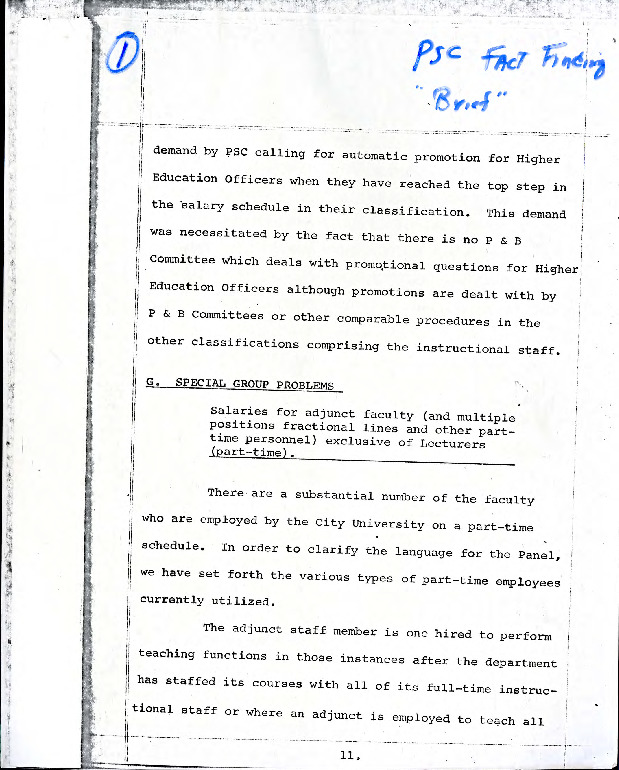
This excerpt from a Fact Finding "Brief" focused on CUNY's exploitative use of adjunct faculty following the advent in 1970 of open enrollment. Following a clarification of the types of part-time positions, the brief criticized low adjunct pay, large course loads, and unequal treatment when compared to full-time faculty. Included in the excerpt is the proposal that adjuncts' compensation be commensurate with what full-time equivalent faculty would make (e.g. 1/3 teaching load = 1/3 full professor's salary).
Contributor
Professional Staff Congress
Date
1973 (Circa)
Language
English
Rights
Public Domain
Source
The Tamiment Institute Library and Robert F. Wagner Labor Archives
“Fact Finding ‘Brief’”. Letter. 1973, 1973, CUNY DIGITAL HISTORY ARCHIVE, accessed September 5, 2026, https://stephenz.tailc22a4b.ts.net/s/cdha/item/1497