Three Pronged Alternative Approach to Pro-Rated Pay
Item
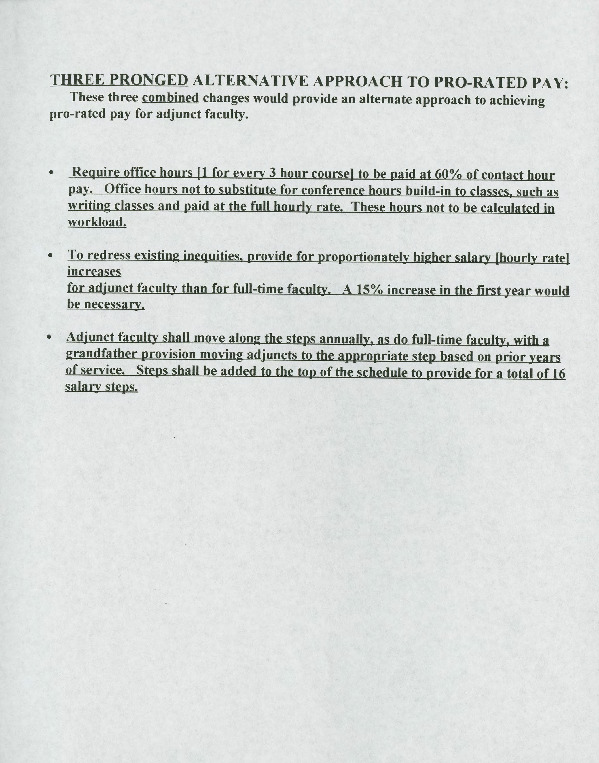
THREE PRONGED ALTERNATIVE APPROACH TO PRO-RATED PAY:
These three combined changes would provide an alternate approach to achieving
pro-rated pay for adjunct faculty.
e _Require office hours [1 for every 3 hour course] to be paid at 60% of contact hour
pay. Office hours not to substitute for conference hours build-in to classes, such as
writing classes and paid at the full hourly rate. These hours not to be calculated in
workload.
e Toredr xisting inequiti rovide for pr ionately higher sal hourly r
°
increases
for adjunct faculty than for full-time faculty. A 15% increase in the first year would
be necessar y.
e Adjunct faculty shall move along the steps annually, as do full-time faculty, with a
grandfather provision moving adjuncts to the appropriate step based on prior years
of service. Steps shall be added to the top of the schedule to provide for a total of 16
salary steps.
i ee ee
SG
ED SIMIES OF aMEINC Nt
mee tiwag | £ G B59699526¢ fe
WASHINGTON, D. c. :
oa oa Ge w
. SES 4
‘
Cte
ae a a a —_—
Pas bs UPERE AL. REESE BIAS ere f= cy)
} THE: UNITED ED STATES; ES OR AMERICA + ,
a Mi pale " ¢ 8596995266 Zz
— PAKS. Ti. .
ny So ME
THE RATIONALE AND CALCULATION OF PRO-RATED PAY
FOR ADJUNCT FACULTY
We are represented by the same union, employed by the same university, and teach the same
students. We expect the same pay for the same work. We believe this is a basic union principle.
Anything less is unjust and indefensible. ROUGHLY 30% OF OUR PAYCHECK IS MISSING!
The work and professional responsibilities involved in teaching a course at CUNY are no different
whether an adjunct or full-time faculty member teach the course. Adjunct faculty do exactly the same
work as full-time Lecturers or Assistant Professors at community colleges, except for their
administrative duties. Therefore, they should receive equal pay for equal work, i.e. pro-rated pay per
course taught.
This equivalence of teaching responsibility per course assumes that adjunct faculty provide office
hours to their students. We are including this responsibilitiy since it has been implicitly[if not
explicitly] expected by all concerned, our students, our departments, our profession and ourselves,
despite the fact that we are currently unpaid for these hours.
If, any only if, we receive full pro-rated pay, would we consider ourselves as having been paid for
office hours. We insist that office hours be contracturally part of teaching each course and be paid for.
PRO-RATED PAY, CONSERVATIVELY CALCULATED:
Adjunct Lecturers shall receive 1/10 of the annual sal f the full-time L rer for
each 3 credit [or 3 contact hour] course taught. Adjunct Assistant Prof hall
receive 1/10 the annual salary of full-time Assistant Professors.
Additionally, Adjunct faculty shall move along the steps annually, as do full-time
faculty, with a grandfather provision moving adjuncts to the appropriate step based on
prior years of service.
The basis of this calculation is that the responsiblities of the full-time Lecturer or Assistant
Professor at a community college [teaching to contract] is 27 credits per year, i.e. 9 [3 credit] courses
which include the provision of office hours/student consultation, - plus administrative duties.
Counting their administrative duties as equivalent to 1 [3 credit] course per year, they teach the
equivalent of - 30 credits per year, i.e. 10 [3 credit] courses annually.
AN EXAMPLE:
A adjunct lecturer newly hired in 95/96 shall be paid $2,745 per 3 credit course. Whereas, an adjunct lecturer who
began teaching 6 years prior shall be paid $3,634 per 3 credit course.
This is based on a full-time Lecturers annual pay of $27,454 if they were newly hired in 95/96, or $36,344, if they were in
their 6th year of teaching. An equivalent procedure would follow for adjunct Assistant Professors and full-time Assistant
Professors in community colleges.
Our paycheck is roughly 70% of what full-time faculty in the same rank earn for the
same work. We expect the missing 30% to appear in our paychecks next year!
THE PAY GAP MUST BE CLOSED!
This is not a pay raise. It is a pay adjustment.
ELABORATION AND COMPUTATION:
1. An hourly pay rate could be imputed from pro-rated course payment. For example, the newly
hired adjunct lecturer noted above would have an imputed hourly rate of $61 which would implicitly
include office hours.
The pay, $2,735 per 3 credit course. A 3 credit course involves 45 contact hours.
Take $2,735 divided by 45 = $61 per contact hour. A 4 credit course, would pay $3660, [$61 x 60
contact hours]. Likewise, a 2 credit course would pay $1,830. [$61 x 30 contact hours].
The same procedure would follow for an adjunct further along the schedule or in a different rank,
by merely taking the appropriate pay for the 3 credit course.
2. The pay gap varies with seniority, increasing with more years of service.
Below are some examples of this pay gap [for adjunct faculty teaching in 95/96}
An adjunct Lecturer in the 6th year of teaching at CUNY earns 64%
of what their full-time colleague is paid - for the same work.
An adjunct Assistant Professor in the 6th year of teaching at CUNY earns 65%
of what their full-time colleague is paid - for the same work.
A newly hired adjunct Lecturer earns 75%
of what their full-time colleague is paid - for the same work
A newly hired adjunct Assistant Professor earns 78%
of what their full-time colleague is paid - for the same work
3. For most adjunct faculty the pay gap varies roughly from 22% to 36% depending upon length of
service for most adjuncts. For those adjunct faculty teaching longer than 6 years, the gap is even
greater than 36%! The 30% gap is a very rough average.
4. Closing this gap would require a salary increase of 33% to 56% for the examples given.
These three combined changes would provide an alternate approach to achieving
pro-rated pay for adjunct faculty.
e _Require office hours [1 for every 3 hour course] to be paid at 60% of contact hour
pay. Office hours not to substitute for conference hours build-in to classes, such as
writing classes and paid at the full hourly rate. These hours not to be calculated in
workload.
e Toredr xisting inequiti rovide for pr ionately higher sal hourly r
°
increases
for adjunct faculty than for full-time faculty. A 15% increase in the first year would
be necessar y.
e Adjunct faculty shall move along the steps annually, as do full-time faculty, with a
grandfather provision moving adjuncts to the appropriate step based on prior years
of service. Steps shall be added to the top of the schedule to provide for a total of 16
salary steps.
i ee ee
SG
ED SIMIES OF aMEINC Nt
mee tiwag | £ G B59699526¢ fe
WASHINGTON, D. c. :
oa oa Ge w
. SES 4
‘
Cte
ae a a a —_—
Pas bs UPERE AL. REESE BIAS ere f= cy)
} THE: UNITED ED STATES; ES OR AMERICA + ,
a Mi pale " ¢ 8596995266 Zz
— PAKS. Ti. .
ny So ME
THE RATIONALE AND CALCULATION OF PRO-RATED PAY
FOR ADJUNCT FACULTY
We are represented by the same union, employed by the same university, and teach the same
students. We expect the same pay for the same work. We believe this is a basic union principle.
Anything less is unjust and indefensible. ROUGHLY 30% OF OUR PAYCHECK IS MISSING!
The work and professional responsibilities involved in teaching a course at CUNY are no different
whether an adjunct or full-time faculty member teach the course. Adjunct faculty do exactly the same
work as full-time Lecturers or Assistant Professors at community colleges, except for their
administrative duties. Therefore, they should receive equal pay for equal work, i.e. pro-rated pay per
course taught.
This equivalence of teaching responsibility per course assumes that adjunct faculty provide office
hours to their students. We are including this responsibilitiy since it has been implicitly[if not
explicitly] expected by all concerned, our students, our departments, our profession and ourselves,
despite the fact that we are currently unpaid for these hours.
If, any only if, we receive full pro-rated pay, would we consider ourselves as having been paid for
office hours. We insist that office hours be contracturally part of teaching each course and be paid for.
PRO-RATED PAY, CONSERVATIVELY CALCULATED:
Adjunct Lecturers shall receive 1/10 of the annual sal f the full-time L rer for
each 3 credit [or 3 contact hour] course taught. Adjunct Assistant Prof hall
receive 1/10 the annual salary of full-time Assistant Professors.
Additionally, Adjunct faculty shall move along the steps annually, as do full-time
faculty, with a grandfather provision moving adjuncts to the appropriate step based on
prior years of service.
The basis of this calculation is that the responsiblities of the full-time Lecturer or Assistant
Professor at a community college [teaching to contract] is 27 credits per year, i.e. 9 [3 credit] courses
which include the provision of office hours/student consultation, - plus administrative duties.
Counting their administrative duties as equivalent to 1 [3 credit] course per year, they teach the
equivalent of - 30 credits per year, i.e. 10 [3 credit] courses annually.
AN EXAMPLE:
A adjunct lecturer newly hired in 95/96 shall be paid $2,745 per 3 credit course. Whereas, an adjunct lecturer who
began teaching 6 years prior shall be paid $3,634 per 3 credit course.
This is based on a full-time Lecturers annual pay of $27,454 if they were newly hired in 95/96, or $36,344, if they were in
their 6th year of teaching. An equivalent procedure would follow for adjunct Assistant Professors and full-time Assistant
Professors in community colleges.
Our paycheck is roughly 70% of what full-time faculty in the same rank earn for the
same work. We expect the missing 30% to appear in our paychecks next year!
THE PAY GAP MUST BE CLOSED!
This is not a pay raise. It is a pay adjustment.
ELABORATION AND COMPUTATION:
1. An hourly pay rate could be imputed from pro-rated course payment. For example, the newly
hired adjunct lecturer noted above would have an imputed hourly rate of $61 which would implicitly
include office hours.
The pay, $2,735 per 3 credit course. A 3 credit course involves 45 contact hours.
Take $2,735 divided by 45 = $61 per contact hour. A 4 credit course, would pay $3660, [$61 x 60
contact hours]. Likewise, a 2 credit course would pay $1,830. [$61 x 30 contact hours].
The same procedure would follow for an adjunct further along the schedule or in a different rank,
by merely taking the appropriate pay for the 3 credit course.
2. The pay gap varies with seniority, increasing with more years of service.
Below are some examples of this pay gap [for adjunct faculty teaching in 95/96}
An adjunct Lecturer in the 6th year of teaching at CUNY earns 64%
of what their full-time colleague is paid - for the same work.
An adjunct Assistant Professor in the 6th year of teaching at CUNY earns 65%
of what their full-time colleague is paid - for the same work.
A newly hired adjunct Lecturer earns 75%
of what their full-time colleague is paid - for the same work
A newly hired adjunct Assistant Professor earns 78%
of what their full-time colleague is paid - for the same work
3. For most adjunct faculty the pay gap varies roughly from 22% to 36% depending upon length of
service for most adjuncts. For those adjunct faculty teaching longer than 6 years, the gap is even
greater than 36%! The 30% gap is a very rough average.
4. Closing this gap would require a salary increase of 33% to 56% for the examples given.
Title
Three Pronged Alternative Approach to Pro-Rated Pay
Description
This information sheet compiled in 1995 addressed the income disparity between adjuncts and full-time faculty and proposed a three-pronged approach to lessen the income disparity. The rationale and calculation of pro-rated pay for adjunct faculty were explained in a graphic representation of a dollar, visually illustrating the proportional difference in pay.
Contributor
Professional Staff Congress
Creator
Unknown
Date
- 1995
Language
English
Rights
Public Domain
Source
The Tamiment Institute Library and Robert F. Wagner Labor Archives
Original Format
Poster / Flier / Leaflet
Unknown. Letter. 2000. “Three Pronged Alternative Approach to Pro-Rated Pay”, 2000, CUNY DIGITAL HISTORY ARCHIVE, accessed September 5, 2026, https://stephenz.tailc22a4b.ts.net/s/cdha/item/1499