LOTUS: An Asian American Student Journal at Hunter College
Item
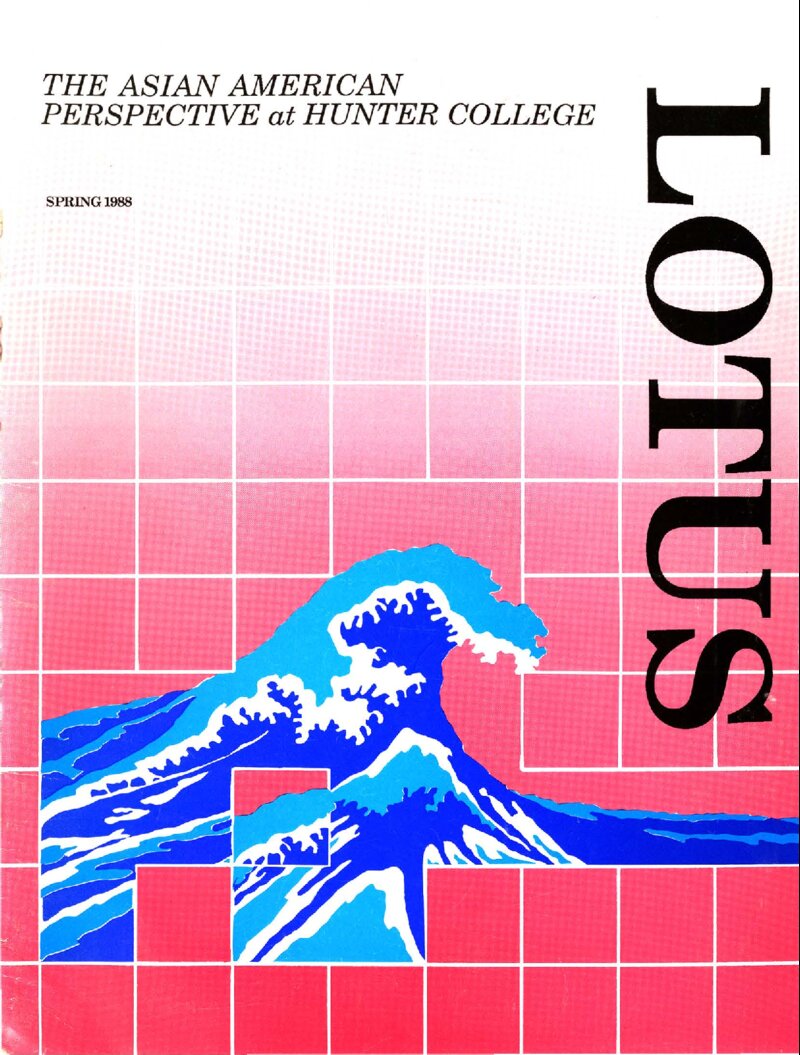
THE ASIAN AMERICAN
PERSPECTIVE at HUNTER COLLEGE
SPRING 1988
EDITORIAL
Welcome reader, to our first issue of LOTUS. You may be asking why we need to have a
school publication devoted to Asian/Asian-American perspectives. A college education
goes beyond the academic boundaries of the classroom. It extends to what is taught not
only by the faculty, but by the student body as well. What is learned at Hunter should,
therefore, be a reflection of the College’s diverse community. What this publication shall
endeavor to do is to educate non-Asians as to what if means to be Asian, and to raise the
consciousness of Asians in issues that are inherent to the Asian experience in America.
In the following pages, you will discover a broad spectrum of Asian perspectives. Experi-
ences of interned Japanese Americans, Chinese from Mainland China and Amerasian
children, although new to many of us, are representative of the true essence of Hunter
College’s Asian population. Throughout Asia, there is a long standing belief that out of the
muddiest of ponds springs forth the pure white lotus. The symbol of the lotus shall be our guide
in reminding us of our roots in Asia and our dedication to integrity.
Victor M. Lem
Senior Editor
Share your Asian-American experiences with the
Hunter community. Lotus invites your poetry, prose,
illustrations, photographs and impressions. Additions
to our staff are also welcome.
All submissions, questions and comments to:
LOTUS
Rm. 121HN
Box 211
695 Park Avenue
New York, NY 10021
EDITOR-IN-CHIEF
WOEI-MING NEW
SENIOR EDITORS
VICTOR M, LEM
MON DAI LEE
EDITORS
TSUH-YIN CHEN
KELLY NISHIMURA
STAFF
FREDERICK FU
ELEANOR HOM
PHOTOGRAPHIC TECHNICAL
ADVISOR
PETER D. LEM
TECHNICAL ADVISOR
PETER E. CHIN
COVER
YUI CHIU
SPECIAL THANKS TO:
JOANNE LOK HUNG SIU
PROF. WILLIAM PITT ROOT
WING KEUNG CHIU
YUI CHIU
DEAN MICHAEL ESCOTT
FIRST IMPRESSIONS INK.
ROCKWELL CHIN
MAY CHIN
LOTUS
THE ASIAN AMERICAN PERSPECTIVE AT HUNTER COLLEGE
SPRING 1988
CONTENTS
EXPRESSIONS
THE ALLEGORY OF THE BEANIE
WING KEUNG CHIU
ONE MULTICULTURAL MILKSHAKE
HSIAO CHIOU
LOST PEARL, LOST PROMISES
VICTOR LEM
LOVES AWRY
M. LEE
DESPAIR FROM DOVES’ EYES
WAH HON LEM
BAMBOO IN YELLOWSTONE
M. LEE
DISCUSSIONS
RE-THINKING BEAUTY ON NON-WHITE TERMS
KELLY NISHIMURA
TRACING THE REDRESS/REPARATIONS
MOVEMENT
LINDA ASATO
LIVING IN THE UNITED STATES AS A CHINESE
YOU-HUA XU
IMPRESSIONS
INTERRACIAL CHILDREN
ALICE N. NASH
ASIAN AMERICANS WORKING TOGETHER
MARGARET M, CHIN
HUNTER AT ECASU CONFERENCE
VICTOR LEM
LAST WORDS
15
20
13
12
17
21
EXPRESSIONS ;
THE ALLEGORY OF THE BEANIE
Wing Keung Chiu
When I was a boy growing up in Chinatown, there was a kid
named Wiley whom I hated intensely. The substance of my
hatred stemmed from his stealing my bright red beanie, which at
the time, was my pride and joy. For those of you who don’t know
what a beanie is, it’s sort of a baseball cap with propeller blades
protruding form the top.
I was playing basketball at the time, and I was wearing my
beanie while playing. 1 remember this fact expressly because, if
you’ve ever tried to play basketball while wearing a beanie,
you'd know that its not the easiest thing in the world to do—and
its not something you’d soon forget.
I was new in the neighborhood and the kids never really
accepted me until they saw that I could play basketball while
wearing my bright red beanie. This trick brought me great fame,
because frankly, it was acool sight to behold. Apparently, the kid
who stole my beanie thought so as well and became jealous. You
see, this kid used to stand on his head and make fish faces, and this
was cool also—but not as cool as playing basketball while
wearing a bright red beanie.
At first he tried to tell me that I looked foolish, but I would
have none of his lies. I was cool and knew it. When he saw that
I was undaunted, he became furious, and one day while I was
going in for a lay-up, he grabbed my beanie and in one tremen-
dous effort threw it over the fence.
I was crest-fallen.
“Why did you do that?!” I asked him in blind anger,
forgetting the vital fact that he was six inches taller than myself
and quite capable of kicking the shit out of me. When he began
to raise his fists, I quickly recovered my senses and did the most
logical thing that came to mind—I ran for my life.
I hid behind a hydrant for quite a long time waiting for him
to leave so that I could recover my beanie. It was a very long
afternoon.
When he finally did leave, I made my way to the playground
where I found to my surprise that the other kids were rallying
around me. Apparently Wiley had picked on the other kids as
well.
To this kid Jason, Wiley had played a mean trick by telling
the teacher that he had cheated on atest, the result of which Jason
was kept inside after school for four straight days. This other boy
named Blake told me how Wiley had taken his lunch for the past
few weeks and was still stealing lunch from him. They told me
that they were all pretty sick and tired of his abuse but could do
nothing about it because he was bigger than all of them, and he
was also the teacher’s pet. Since they had been in the neighbor-
hood longer, I asked them how I could deal with Wiley.
Jason suggested that I forget the whole thing and to just be
careful not to wear my beanie while playing basketball when he
was around. This didn’t make much sense to me because Wiley
always seemed to be around, and besides, I wanted to hurt him
good. Blake said that Jason’s idea was stupid and suggested all
these neat ways to embarrass Wiley and to make him fall down,
but after a while, the ideas all seemed too wild for me. I just
wanted to play basketball while wearing my beanie—nothing
more, nothing less.
I was going to thank them for their support before retrieving
my beanie, but by this time Blake and Jason had started arguing
with each other, so J left and picked up my bright red beanie.
When I returned to the playground the next day, Wiley was
there waiting for me. I had the beanie in my knapsack but was
afraid to take it out. I tried playing basketball without it, but it
didn’t feel the same. All the while, he was watching me, ready
to pounce on me if I took out my beanie.
This continued for a week until I just couldn’t take it any
more. One day, when I’d convinced myself that nothing else
mattered, I took out my beanie, put it on the top of my head and
started to play basketball—right in front of everyone’s eyes. All
of a sudden, Wiley came dashing toward me and snagged my
beanie. When he started to throw it over the fence, I grabbed his
arm and wouldn’t let go. “Stop it!” I yelled. “Just let me be!”
Wiley stopped, and looked at me. I stared back. Fora while
I didn’t hear a sound. I didn’t make a move. He started tugging
his arm forward, but I wouldn’t budge aninch. By this time the
teacher had arrived at the playground and asked us what was
going on. The other kids had told her that there was trouble in the
yard, and she saw that we were involved. She saw Wiley with my
beanie in his hand.
You couldn’t believe the temptation that rushed through my
mind at that moment. Here was the chance to get Wiley back
good! I looked at Wiley again, and for the life of me he seemed
tobe scared shitless. The other kids were yelling, “Tell her Chris!
Tell her what happened!” But you know what? I couldn’t do it.
“T dropped my beanie,” Itold the teacher. “Wiley was giving
it back to me.”
Blake nearly fainted. Jason started to smile, but I could see
they both didn’t understand.
After everyone had left the playground, Wiley came up tome
and just looked at me. “Why?” he asked.
“I told you,” I said, “I just want to play basketball while
wearing my beanie—nothing more, nothing less.”
LOTUS
INTERRACIAL CHILDREN
Alice N. Nash
One of the last strongholds of resistance to interracial mar-
riage is the plaintive cry, “It really doesn’t bother me, but what
about the children? That’s what I worry about.”
Notice that these people never seek out such children to
determine their feelings on the matter.
My fatheris atenth-generation New England American with
brown hair and greeneyes. My paternal cousins have red hair and
freckles. My mother is a second generation Japanese American
who went to Japan for the first time in her life last summer; she
grew up with Shirley Temple curls and Hostess Cupcakes and
Sunday School.
Race was never a big deal in my family. My brothers and I
were equally loved and spoiled by both sets of grandparents. I
asked my mother once if there had been any resistance when she
and my father decided to get married. (If they had lived in
Virginia at the time, their marriage and my birth would have been
illegal under state anti-miscigenation laws, which were not
struck down until 1967 in Loving vs Virginia. ) She replied that
both families placed a higher priority on having acommon set of
values. My paternal grandmother always introduced my mother
to people as “my daughter.”
It’s true that half-breeds like myself may be confused about
our identity, but doesn’t everyone go through that? We all have
to face the perils of the outside world at some point. Some of us
are fat; some of us are ugly; some of us have obnoxious person-
alities. Does someone who is half-Black really face more
obstacles that someone who is all Black in today’s society?
Who’s racially pure anyway? What really matters is how our
self-image is formed at an early age, and that goes directly back
to the family —parents, grandparents, aunts, uncles, and cousins.
I once knew an elderly Issei woman who was not allowed to
see her grandchildren because her blonde daughter-in-law didn’t
want the children exposed to someone who spoke broken Eng-
lish. I often wonder how those children feel about being half
Japanese. My maternal grandmother spoke broken English, but
she cooked us Japanese meals, and taught us Japanese words, and
gave us pride in our Japanese heritage. Her vocabulary expanded
as she kept up with all our activities; by the time she passed away
at the age of 85, she was able to make jokes in English.
My brother’s wife is half Haitian and half Chinese Ameri-
can. Both sides of her family accept her wholeheartedly, and she
thinks of herself as an American with an extra “plus.” When she
married my brother, the waiters thought the reception was for the
United Nations. ‘No I told them. It's just my family”’
Interracial children do experience some conflict and confu-
sion over their identities, but as with any children, the degree
LOTUS
varies with the circumstances and the individual personality. I
know a woman who is half-Japanese and half-Black. Her father,
a Black American GI, met and married her mother in Japan after
World WarlIl. Ostracized by the Japanese community, my friend
developed a hatred of anything Japanese. On coming to New
York at the age of five or six she was welcomed by her father’s
family. She thinks of herself as Black, but has never really
formed a positive identity. The last I heard of her, she was still
drifting from one job to the next, unable to find meaning in
anything. Does she have a problem because she is interracial per
se or because she is unable to integrate and accept her differ-
ences?
I suspect that those who object to mixed marriages on the
grounds of concern for the delicate psyches of potential off-
spring aren’t being honest with themselves. No one can predict
what the course of a child’s life will be. Some people choose not
to have children because they worry about what the world will be
like “when they grow up.” Some people have children and try to
make the world a better place to live in. The fact that I exist is
an expression of my parents’ belief that someday the barriers of
race, religion and social class will cease to exist.
It’s unfortunate that the families of a mixed couple may have
to deal with a certain amount of “embarrassment,” but if all those
involved can get past their own prejudices, any children that
come along will have as good a chance of growing up healthy and
happy as anyone—maybe more.
EXPRESSIONS
ONE MULTICULTURAL MILKSHAKE
Hsiao Chiou
When Hsiao first started school at Pepperdine University in
the fall of 1985, she decided it was time to put an end to what she
constantly referred to as a “milkshake of cultures.” It took her
massive amounts of courage to see the school psychologist. She
had never gone to one because her parents did not think there had
been anything wrong with their daughter and she did not have
enough money to see one on her own, Since the school began
offering free counseling services, she decided to take advantage
of the opportunity. Besides, her parents will never find out if she
doesn't tell them.
Hi! I’m Hsiao. Would you like to trade places with me? It’s
easy! Get a blender and add the following ingredients with milk:
10 lbs. of peeled fresh lychees from Taiwan
(make sure you remove the seeds that are inside)
7 spoonfuls of “café Brasil”
5 ripe Japanese strawberries
2 Sunkist oranges from Malibu
No, you don’t get diarrhea! The final product, if you let it sit for
eighteen years, is a Hsiao milkshake.
My first impression of him wasn’t much. I mean, he was not
mega-fine, but he wasn’t ugly either. He was in his thirties, kind
of tall, brown eyes, brown hair, tie and trousers. Very profes-
sional looking—even his way of looking at you. Married to
another psychologist. I was not as nervous as I thought I would
be. I just wanted him to help me. I wanted someone, anyone, to
understand and sympathize with me.
Once I was in his office, he asked me my name, and the
horrible, dreadful question (the last one you would expect from
a shrink),” And where are you from?”
“Outer Mongolia,” I should have said, but I guess I had to be
nice, “Japan,” I replied, which is also kind of accurate. At the
time, I kept telling myself that he wasn’t as bad as he sounded.
“That’s nice. What part of Japan?”
“We used to live in the suburbs of Tokyo, Recently though,
we moved to the heart of the city.” His office was always cold
even though it was hot that fall. Air-conditioned, I guess. The
room was small, orderly, and well-decorated, but everything was
in dull colors. It didn’t have a cozy atmosphere.
I told him I couldn’t decide on a major. I wasn’t sure I liked
Malibu. I had plans of transferring to another school, somewhere
less far from civilization with more people, buses, and cabs. San
Francisco sounded kind of nice, but my parents were opposed to
the idea. “Too much violence,” they said.
4
Another thing about my parents, they can’t take it that I have
serious conflicts over my identity. They probably feel guilty that
they haven’t provided for all my needs. In any case, they refuse
to talk about it by saying that I’m overly sensitive and that I will
outgrow it. Baloney.
“You mentioned last time we met that you feel like a foreigner
everywhere you go. Can you explain that further?”
“Do Ihave to?” This was only hurting me more. “I’m from
Japan, but I didn’t live there all my life. Isn’tit sad how I’ve never
lived in any one place for too long? I was bom in Taiwan, and my
parents decided to immigrate to Brazil when I was not quite three
years old. I wish could have been oldersoI could have prevented
us from moving. Maybe not. My dad is too stubbom. I grew up
with mostly Portuguese and some Taiwanese.”
“For first grade my mom enrolled me in a private girls’
catholic school run by old nuns. There was this one Sister—I used
to hate her guts—-who taught math and made kids go to the board
to do problems out loud. It was humiliating if you didn’t know
how to find the solutions or if you did something wrong. There
was no winning with her if you were not good in math”
“Sounds like you had a rough time with that Sister. Did you
stay in that school for long?”
“In sixth grade I transferred to anon-parochial, co-ed school.
It was a little better because, at least we didn’t have to pray four
times a day, but there was a lot of cheating on exams that went
unnoticed in that school. I was mainly shocked that everyone
there used such obscene language. Coming from a “nunnery” it
took me a while to get the perverted jokes. Once I leamed “the
ways of the kids,” I guess it became more fun. However, many
teachers had trouble getting my name right and couldn’t tell if I
was a boy or a girl by just reading it. That was it for Brazil. We
moved to Japan in December of 1981.”
“How did you find Japan?”
He must have gotten his Ph.D. studying how to ask dumb
questions. I couldn’t believe it. “I had just finished junior high
when we moved to a tiny house on the outskirts of Tokyo. I was
put in an American high school near our home. The school was
mainly for kids whose parents were in the army or working forthe
U.S. government. My dad had some influential friends working
there, soI was able to go to a “base school.” It was very confusing
at first. Everyone, except me, spoke American English. My mom
used to hire me tutors when we lived in Sao Paulo, but, I never
took them seriously. English seemed like such pain-in-the-
behind language. Again, there was a lot of profane language used
and somehow, dirty jokes in English sounded nastier.
“By my senior year I was getting used to the culture shock,
I had to make decisions about college in Japan vs. college in the
LOTUS
States. That was the first time I could really choose for myself. I
wished I was given an order, just like all the times we moved from
country to country. My parents did say they would feel better and
safer ifI stayed, but for once they didn’t impose their ideas on me.
I didn’t make a decision until July of 1985. So, what’s new,“ I
thought, I'll go to the States and make moving around a lifestyle
for me,”
“Gee, sounds like something you would read in a novel. It
must have been pretty hard for you to decide between the security
of your parents and a new life, in a new environment.”
No duh! Are all shrinks like this?
The counseling sessions lasted for almost three months. Dr.
Lowe could not understand nor could he help me deal with my
ethnicity. Maybe he just thought that it wasn’t as important or as
confusing as it was to me because he kept saying I was very
Americanized and that I definitely had no language barriers, as in
the case of many foreign students.
The popular idea that only first generation immigrants suffer
from culture shock is a myth. Even those who are bom in the
United States might experience some type of ponderance on their
ethnicity. Although they might consider themselves to be true
Americans by right of birth, others might not view them as such.
As the Asian American walks down the street, he is told to “go
back to China.” He is constantly asked where he is really from
because, since he is not white, he is surely not from Malibu or
Cape Cod, much less be American.
The Asian American is caught in the middle with the conflict
of clashing cultures. He has always considered the United States
his home and himself an “American”; yet, he is not treated as an
American because he is not born blonde with blue eyes.
Where are the counselors and psychologists when their help
is most needed? They are in their offices treating every patient
from their American point of view, without realizing that Amer-
ica is as diverse as every non-Caucasian patient that walks in for
help. This is what made me quit counseling sessions and further-
more, vow never to step into a shrink’s office again.
The general public does not understand nor does it accept
non-Caucasians as an integral part of America, and the burden of
educating the general public is on the minorities. However,
counselors and psychologists, who are professionally trained to
handle problems of the mind, should at least address problems
with adjustment or the search for one’s identity as real or serious
issues. If psychologists are to ever counsel their patients effec-
tively, they would have to learn to counsel from a truly “Ameri-
can” point of view, both Caucasian and non-Caucasian.
LOTUS
- EXPRESSIONS
LOST PEARL, LOST PROMISES
I go to the golden mountain,
Leaving my home, an island
Within a land so vast
Of happy valleys
And glorious peaks named for queens.
[leave my city, her lanterns
And dragon boat races in the harbor.
I leave a pearl for a mountain of gold.
Here is my new home, an island
Within a land so vast
Of housing projects
And gargantuan towers named for no one.
I’ve arrived in a city, with flashing lights
And yellow taxis racing through the streets.
I see no mountain, I see no gold.
I lie awake in my bed,
My island, within this foreign land
Squeezing my eyes shut, suppressing the noise of subways
And the stench of elevators.
I release, only when the sweet scents
And warmth of my forsaken pearl retums.
I float.
I weep.
Victor Lem
LOVES AWRY
Confusion
Lines of grey,
lines azure.
The soft pulsing
of your being
against mine.
Strangely familiar,
compelling emotion.
Have we met...
before?
Millennia
lives ago.
Why can love,
not love,
as it does?
M. Lee
LOTUS
RE-THINKING BEAUTY
ON NON-WHITE TERMS
Kelly Nishimura
There’s a story about a girl named Pecola Breedlove written
by Toni Morrison titled The Bluest Eye. Pecola is black, and she
is ugly, according to white-American standards of beauty. She’s
shy, sensitive and longs to be loved by her family and the rest of
the world. All her life Pecola has been alienated and ignored, the
victim of racism and a scapegoat for blacks humiliated by white
society.
Pecola believes, however, that her suffering would be re-
lieved if only she were beautiful-if only she had blue eyes. As
tragic as her life is, her longing for blue eyes is in itself very
painful, She will never have blue eyes, and as a child growing up
in the ’40s, she will never know that so much beauty lies in the
blackness she already possesses.
The awareness that “Black is beautiful” came in the sixties
and helped African-Americans appreciate their black skin and
features. However, white standards of beauty still dominate in
our society and sadly, in others as well.
The criteria we use to judge beauty is learned. We are
conditioned from day one to believe that “good looks” belong to
the blonde, blue-eyed and busty and the tall, dark and handsome.
We are taught this by the Barbie and Ken dolls we played with,
by Snow White and Cinderella, by Cheryl Tiegs, Don Johnson
and Rob Lowe, by Duran Duran and MTV. Advertisements,
television and the movies work on our subconscious and rein-
force these beauty standards in our conscious minds. Beauty is
a big business raking in mega bucks for the fashion and cosmetic
industries, Hollywood and plastic surgeons.
A friend of mine said her Japanese-American professor
teaching an American Studies class on Japanese-Americans said
Japanese-American girls go for white guys because they like the
white look; but did the professor go on to explain why that
preference exists? Did he make it clear that he was generalizing
and that it is not a pre-determined act that these girls are not
destined to behave this way from birth?
I resented the professor’s comment on a personal level
because not only is he miseducating his students, he’s hurting my
ego (something I hope to eliminate before I’m forty). Idon’t want
people to think that 7’m one of those white-boy loving girls. My
boyfriend is white and I like him despite the fact. I like him not
for his blue eyes and his six-foot bod but for , among other things,
his encouragement of my appreciation for my Asian culture, my
Asian looks and my Asian body.
It is important to understand that when non-whites admire
beauty, that admiration is based on white standards that have
been taught. Itis not human nature that causes us to find tall, blue-
eyed men and blonde, busty women particularly appealing.
Having grown up in America, I have been conditioned to
LOTUS
evaluate beauty using white standards, but I have also been
conditioned by the Asian/minority community in Hawaii where
I grew up. I can judge beauty using other standards in addition to
the white ones. I know that these “Hawaii” standards are learned
and not products of human nature because they are not used
elsewhere in America. They were cultivated in Hawaii and
remain unique to Hawaii.
A couple of hundred years ago, the Hawaiians saw beauty in
large, heavy-set women. Members of certain African tribes put
discs in their mouths to stretch their lips to create a beauty that
appeals to them. The Japanese used to think that exposing the
back of the neck was a turn-on. We may laugh at these standards
of beauty and sexual appeal, thinking they are funny and strange,
but someday people may laugh at America’s lust for big tits. (A
friend of mine said he can’t understand why people find large
breasts appealing; “sacks of fat” he calls them).
As Asian-Americans, we have to reject not only the white
standards of beauty but whites’ ideas of Asian beauty. We
shouldn’t merely throw out our white Barbie dolls and replace
them with the Japanese Barbies, which are molded by narrow,
white definitions of Asian women. We must learn to appreciate
our Asian faces and bodies, which come in many different shapes
and sizes, on our own terms.
Toni Morrison writes that physical beauty is “probably the
most destructive idea in the history of human thought.” Some-
day, in an ideal world, no standards for beauty will exist.
Awareness that standards of beauty are learned and not pre-
determined in the womb should inspire us to try to unlearn them
and more importantly not pass them on to future generations.
|
DISCUSSIONS
TRACING THE REDRESS/
REPARATIONS MOVEMENT
Linda Asato
Forty-five years ago, over 110,000 Japanese Americans on
the West Coast were rounded up and taken to remote concentra-
tion camps in the U.S. without any reason or proper warning,
except that it was a wartime military necessity, persons of
Japanese ancestry-from babies to grandmothers—were tagged
and labeled spies and saboteurs (although no evidence of this has
ever been proven).
Although the camps were supposed to protect the internees,
all Japanese Americans were treated as prisoners as they stood
beneath armed guard towers, with rifles pointed at them. For
nearly three years, the American government imprisoned the
Japanese Americans in camps surrounded by barbed wire,
resembling a nightmare of Nazi Germany.
There were hundreds of horror stories describing families
being torn apart, extreme living conditions, psychological pain,
humility, death, loneliness, and of course, billions of dollars of
economic loss. Equally horrifying were the post-war experiences
as people set out to rebuild their shattered lives, mostly from
scratch, in a virtually anti-Japanese climate. Many had their
property stolen and faced discrimination in housing and employ-
ment. While some were fortunate in that they were helped by post-
war inflation and labor shortages, others never regained mo-
mentum and stayed impoverished, dependent on their children.
In the 1960’s anew Asian American movement was devel-
oping that was inspired by the Black Civil Rights movement and
the black power movements. Many of these Asian Americans
were third generation Japanese Americans—children of the
internees that had come of age.
In Asian American Studies classes, won through the third
World student strikes of the 1960’s, students learned about the
camps as part of along history of racism against the Japanese and
Asian Americans. Tuming anger into action, the first student and
community pilgrimages into the camps took place in 1969. Since
then numerous pilgrimages have inspired thousands of Japanese
Americans to reclaim their identity and heritage.
The young Asian American movement demanded nothing
less than justice, equality and respect and the camps issue became
a rallying cry. This new generation of activism also had a deep
impact on the older generations.
Momentum for redress built throughout the 1970’s. In 1978,
the Japanese American Citizens League (JACL) passed a resolu-
tion calling for a $25,000 compensation for each internee. In
1979, the National Council for Japanese American Redress
(NCJAR), which is pursuing a class action redress suit, was
founded. In 1980, the National Council for Redress and Repara-
tions (NCRR) was formed, bringing together grass roots support,
students, churches and many other groups active in pilgrimages
8
and commemorations. The Committee to Reverse the Japanese
American Wartime Cases, which led the appeals of the Kore-
matsu and Yasui cases, also initiated at this time.
In 1980, Congress established a commission to investigate
the history of the camps. Insuring that the community’s voice be
heard then became the primary objective of the movement. In the
summer of 1981, public hearings were held all across the nation,
bringing together thousands of Japanese Americans to testify on
the conditions and the losses caused by the internment experi-
ence. After nearly 40 years of silence, Japanese Americans came
forward from all walks of life to openly speak about their camp
experiences.
Through being active in the movement, I learned a great deal
about the true history of Japanese and Asian Americans in this
country. I began to realize that my experiences as an Asian
American were inseparable from the history and struggles of my
community—Why did I feel guilty when December 7, “Pearl
Harbor Day” came every year? Why am I and other Asians
blamed for US unemployment and “Japan stealing jobs’? Why
has the history of Japanese Americans during WWII not been
told? The answers to these questions are related to our history and
tothe way ourcommunities have historically been treated. These
lessons taught me that I was not the only one who felt “guilty” or
who felt singled out, but that Asian Americans are still being
scape goated for society’s inequalities and are made to feel guilty
about our community’s accomplishments.
Learning about the realities Asians must face today has
taught me much about myself as an Asian woman. It has taught
me to root myself in the rich history and contributions of our
communities and to respect the struggles of the many generations
and nationalities of Asian people in the US. The struggle for
Redress and Reparations for Japanese Americans is an important
issue for all our communities. It means a struggle to ensure that
the true history of people of color is taught in our school systems;
it means that ignorance can no longer be used as an excuse for
racism or anti-Asian sentiment; it means that Asians and people
of color can stand with pride in our communities and our accom-
plishments.
Recently the Redress/Reparations movement has made sig-
nificant progress toward its goals. On September 17,1987, the
200th anniversary of the signing of the Constitution, the House
of Representatives passed H.R.442, the “Civil Liberties Act of
1987”, which recommends a public apology from the US
government to Japanese Americans for their incarceration during
WWIL. It also recommends that an educational fund be set up and
that compensation of $20,000 be made to each surviving in-
ternee. A similar resolution was passed by the Senate.
LOTUS
LOTUS
In this solemn hour we pledge our fullest
cooperation to you, Mr. President, and
to our country. There cannot be any question.
There must be no doubt. We, in our hearts, are
Americans-loyal to America.
We must prove that to all of you.
Telegram to President Roosevelt, Dec. 7, 1941,
from Japanese American Citizens League.
I'm for catching every Japanese in
America, Alaska, and Hawaii now and
putting them in concentration camps.
..-Damn them! Let’s get rid of them now!
Congressman John Rankin,
Congressional Record, Feb 19, 1942
The Japanese race is an enemy race...
Gen. John DeWitt, Commander,
Western Defense Command & 4th U.S. Army
10 LOTUS
We’ re charged with wanting to
get rid of the Japs for selfish
reasons. We might as well be
honest. We do. It’s a question of
whether the white man lives
on the Pacific Coast or the
brown men. They came into this
valley to work, and they stayed
to take over.
Austin Anson, Managing Secretary
Crower-Shipper Vegetable Association of
Central Califarnia, quoted in The
Saturday Evening Post, May 9, 1942.
LOTUS
NOW, THEREFORE, by virtue of the authority
vested in me as President of the United States,
and Commander-in-Chief of the Army and
Navy, I hereby authorize and direct Secretary
of War, and the Military Commanders
whom he may from time to time designate,
whenever he or any designated Commander
deems such action necessary or desirable, to
prescribe military areas in such places and of
such extent as he or the appropriate Military
Commander may determine, from which any
or all persons may be excluded, and with respect
to which, the right of any person to enter,
remain in, or leave shall be subject to whatever
restrictions the Secretary of War or the
appropriate Military Commander may impose in
his discretion...
FRANKLIN D. ROOSEVELT
The White House
February 19, 1942
All photos and quotes from Executive Order 9066,
The MIT Press, 1972.
11
*
IMPRESSIONS
ASIAN AMERICANS WORKING TOGETHER
Margaret M. Chin
There have been many changes in the Asian-American
student movement over the past ten years since ECASU was
founded, the most significant of which is the increasing number
of Asian-Americans that are going to college. It is no magical
coincidence that last year’s ECASU conference at Boston Uni-
versity attracted over 500 students.
The increase in the numbers of Asian-American students
attending institutions of higher learning came as the result of
much hard work. This is not easy for ECASU members to
understand, nor is the Civil Rights era of the ’60s or the anti-war
era of the ’70s. It was at that time that Third World students
demanded access to higher education, thus opening the doors for
Asian-Americans to go to college today.
When the first Asian student organizations (ASOs) devel-
oped, students brought to campuses an awareness of a people
striving for equality and justice. These ASOs put on educational
programs on our history, while their social and cultural programs
on our history, while their social and cultural programs brought
us together. They affirmed our sense of identity and our pride in
being Asian-American. Nowhere else on campus could people
leam about our collective history in America or even share our
feelings and connections to the larger society as Asian-Ameri-
cans,
With the increase in the number of Asian-Americans in
college, the ethnic composition of the student population
changed as well. Because of the liberal immigration laws of 1965
and because of the Vietnam War, many Asian groups, such as the
Vietnamese, Cambodians, Chinese, Koreans, East Indians, have
settled in America. Today about half of the Asian-American
students on the East Coast are American bom, and half are
immigrants.
So what does this mean to organizers of ASOs?
Historically, Chinese American students have dominated
ASOs. The first clubs to develop were Chinese student organiza-
tions that formed to address social and cultural issues. Here,
American and foreign-born Chinese could meet and share ideas
about their mutual heritage.
Today, these clubs continue to serve Chinese students by
linking students’ current lives to their cultural roots. Korean,
Japanese, Southeast Asian, East Indian, and Filipino clubs have
also been formed to serve the social and cultural needs of their
respective memberships.
In addition, there are Asian American student organizations
(AASOs) that seek to address the pan-Asian concerns: educa-
tional and political issues as well as social and cultural ones.
AASOs thus support the development of anti-racial harassment
policies and of Asian-American studies, besides sponsoring
12
cultural weeks and social events.
To be truly pan-Asian, however, AASOs need to attract
members from all Asian groups. This means publicizing the
events of the other organizations. It does not mean dropping
concems such as racial harassment and Asian-American studies;
rather, AASOs need to stress why it is important for all the Asian
groups to work together. Every organization should be seen as
another source of strength for the minority student movement.
With the press watching Asians as the “model minority,” we
especially need to keep on our toes.
At school as well as on the streets, no matter what nationality
you are, an Asian-American is an Asian-American. These issues
will affect all of us. Our common history links us together and
allows us to make a stand. This is the basis for us to work together
for a common goal.
Realistically, at any college, ASOs can come together to face
an issue or Support an event. But the only way this can happen is
if all of the groups recognize one another and support one
another’s activities.
Forexample, I know that many of the AASOs are dominated
by Chinese Americans. This is natural because Chinese Ameri-
cans make up about 50% of the Asian American student popula-
tion on the East Coast. But I think that as the AASOs start
supporting the ASOs and the issues that concern individual na-
tionalities, such as the development of bilingual classes and the
improvement of financial aid availability, we'll start to see more
student of those nationalities participating in the AASOs.
In turn, the different nationality clubs should support the
AASOs. When an AASO is working to fight campus racism, or
organizing to obtain Asian-American studies, we have to make
an effort to try to explain why it is important to support these
issues and to show how they affect everyone. For example,
racism is directed at any of us who look Asian, and that means all
of us, immigrant or fourth generation American.
We have tried for Third World unity, but it is very difficult.
The Model Minority Myth‘ is used to divide us, and as we Third
World people stand divided, we are not as strong as we could be.
Unity would strengthen our fight against financial aid cutbacks,
ourefforts to increase minority faculty and ourmoves to establish
more support systems to help minority students finish college.
Today, during these conservative times, we really need to
Stick together. If we do not communicate among ourselves and if
we donot gather all the organizations in mutual support, we leave
ourselves vulnerable for attack. Yes, it is hard to work together
but as we try harder, we grow stronger as we learn about each
other.
LOTUS
LIVING IN
THE UNITED STATES
AS A CHINESE
You-Hua Xu
In my opinion, most Americans are accustomed to seeing
Chinese since a large number of Asians from Taiwan and Hong
Kong live in this country. Much of what Americans lear about
the Chinese is acquired through their associations with the people
from Taiwan and Hong Kong. However, most Americans know
and understand litle about the Chinese from Mainland China.
I’m from Canton, a province in Southern China. I remember
the first day I attended an ESL class upon arriving in the United
States. It was at the California International University. The
teacher, a middle-aged woman, asked me what part of China I
was from. When I answered, she rolled her eyes around in
wonder and embarrassment because she had little knowledge
about Canton, or where it was located. Canton is one of the most
important provinces in China, comparable to places like New
York or San Francisco. In my native country, most people know
several big cities in the United States. It surprised me that she, as
an international university teacher, didn’t know Canton.
When I said that Americans don’t understand the Chinese
very much, I was not referring to the obvious language barrier.
Overcoming the Chinese/English language barrier is easy com-
pared with understanding the people of China. Many Americans
remain ignorant of the situations the Chinese had to face in
Mainland China.
In my reading class a few weeks ago, my teacher asked me,
with a pleasant smile on his face, “Can you tell us what the
Cultural Revolution in your country was about?”’ I felt like I had
been shot. His question was insensitive enough, but his amused
expression really hurt me. The Cultural Revolution was a heavy
page in the book of Chinese modem history, laden with blood and
tears. It started in 1966 and lasted till 1979. During these thirteen
years, the Chinese people fought crazily with each other. China’s
economy fell sharply and higher education was stopped com-
pletely ( some colleges were closed for ten years!).
A whole generation of young people wasted their youth in
blind fighting. Families were torn apart, many lives were lost,
and the whole country almost collapsed. It was one long
nightmare for the Chinese. When we woke up, we realized that
we had been lied to and misled. We gave up our youth, our blood,
and our lives to destroy, with our very own hands, the things that
we loved dearly.
Can you imagine what we must have felt? The entire
country’s spirit collapsed. A great number of people couldn’t
face the cruel reality of what they had done. Others have been
slowly rising from the depths of pain in the ten years that have
passed. We have tried to look back in cool review to examine the
LOTUS
DISCUSSIONS
Kp
.
x te
R ey
causes of the insanity that reigned over that period of Chinese
history. Through this retrospect, we have begun to change our
beliefs, in hopes of reforming the country. Today, the people of
China have improved living conditions and the country itself has
grown stronger.
Although these reforms came as an indirect result of the
Cultural Revolution, we cannot forget the tremendous price of
blood and tears that we have had to pay. That period of history
is like an old wound in Chinese hearts. Whenever you touch it,
the heart still feels pain. For some, the wounds would bleed
again, So how could I respond to my teacher’s smile? Ifsomeone
were to cheerfully ask an American woman whose son was killed
in the Vietnam War, “Can you tell us about the Vietnam War?”
how do you suppose she would react?
However, my reading teacher can’t be held completely
responsible for his insensitive question. Since modem China had
been closed from the rest of the world until President Nixon’s
visit in 1972, little is known about my native country. Inaddition,
although there has been more and more news reported out of
China to the United States, rarely are general backgrounds on
Chinese history included in the journalists’ reports.
Since many aspects of China and her history are unfamiliar
tothe American public, as Chinese living in the United States, we
should introduce our native country to Americans. We came to
this country not only to understand Americans, but to have
Americans understand us also. Through friendships based on
understanding, we can act as bridges connecting Westem and
Eastern cultural exchange and promote a better understanding
between our two countries.
In my opinion, most Americans are open-minded and would
like to understand us. The problem is that many Chinese are
reluctant to talk about themselves. In American schools, many
Chinese students are regarded as being good at math and involved
in some science programs. However, they are often quiet and
avoid many social activities. This is a very unbalanced situation.
Some Chinese complain that their teachers and classmates do not
understand them. If you don’t open yourselves up, how can other
people understand you? So, let’s put some weights on the other
side of the balance!
13
Photo by Winnie Lem ©1960
LOTUS
EXPRESSIONS
DESPAIR FROM DOVES’ EYES
Wah Hon Lem
“Yes, understand,” said my mother into the telephone. “Of
course, the children’s safety comes first,” she continued and
added, “You'll let us know then” and “Thank you.” She cradled
the receiver. For several moments afterwards, she stood there
with her hands resting on the telephone without saying a word.
Her eyes seemed to search the space in front of them, as they did
whenever she came across a word Mr. Siu had given her whose
meaning she had forgotten.
Mr. Siu came to our house twice a week to teach my mother
Japanese. He never objected to my sitting in as he taught. Several
months earlier, when the lessons first began, he said that I could
remain by my mother’s side through the lesson as long as I
promised not to interrupt or ask questions. I never did.
Sometimes though, when the material in the lessons grew
tedious, as a diversion I would try to mimic the intense look on
my mother’s face as she struggled with the material. I’d pay
particular attention to imitating the concentration in her eyes.
When she and Mr. Siu noticed, they’d laugh and my mother
would scold me lightly for disturbing their work. However, Mr.
Siu would always defend me by saying, “That’s quite all right.
I’m glad she is here to keep our lessons from becoming tiresome
or monotonous.” Mr. Siu had stopped coming two weeks ago.
“Momma?” I said softly. She didn’t respond. I tried again,
only louder this time. “Momma, what’s wrong?” She looked
startled when she heard me, as though she had forgotten anyone
else was in the room.
She tumed to me and replied sharply, “Oh, nothing’s wrong.
Nothing at all, Wai Fon.” Her eyes seemed to drift back to that
searching look again. After a moment, she said in her usual,
deliberate manner, “That was the school. You won’t have to
attend classes tomorrow.”
“Well, that’s good news,” I said with relief. I expected her
to reproach me, as she had in the past, for sounding so happy
about missing school. Only this time, she said nothing. She just
stared at me expressionlessly.
I fidgeted in my seat. “If I don’t have to go to school
tomorrow, and there’s nothing wrong, then that’s great
news...isn’t it?” I asked meekly. Still nothing. For one intermi-
nable moment, the room seemed thick with a blanket of silence.
My apprehension grew when I looked into her eyes again. Gone
from them was all the strength I’ve grown accustomed to seeing.
All that remained was despair.
“What could Momma be so disturbed over?” I asked myself.
I wished father would come home soon. I broke the silence.
“Momma, what-” Before I could go on, tears emerged from the
corners of her eyes.
I’d never seen my mother cry before. I used to wonder if she
LOTUS
had ever cried. She once told me that tears were the heart’s blood
and that her heart would never bleed while father and I were near.
After that, I could never imagine my mother with tears. I was too
bewildered to utter asound as she rushed over and hugged me. All
the confusion I had felt grew into concern.
She sobbed as she said, “Yes Wai Fon. there’s nothing to
worry about.” And she added, “It is good news.” She embraced
me tighter and suddenly, I was crying too.
We sat there holding each other, sobbing quietly on each
other’s shoulders until my mother slowly drew back. Patting the
tears from her cheeks with her palms, she stood up and kept her
back to me as she composed herself.
I was about to dry my eyes with the sleeves of my dress, but
decided instead to use the palms of my hands as mother did. I
didn’t think she would notice, but she had always reminded me
to treat my school uniforms with care and] didn’t wantto give her
more to be upset over.
I really couldn’t care less about the clothes they made us
wear for the winter session. They were always dull colored and
made of materials that made me itch. The only thing I liked about
the uniform was the school crest sewn over my breast pocket. It
was a red and gold patch with a white dove holding an olive
branch in the middle.
Mother had regained her composure and seated herself at
father’s desk. I watched as she opened the top drawer and
removed several sheets of paper and an abacus. I was still
bewildered over what had happened, but I resisted the urge to
press her with questions. I couldn’t bear to see her cry again. I
decided to accept her answer, that there was nothing wrong, at
least for now.
I got up from my father’s easy chair and walked across to
where my mother was seated. Sitting on the arm of her chair, I
rested against her shoulder as she worked. She was busy writing
down figures and making calculations with the abacus. It looked
like some sort of shopping list, only there was something odd
aboutit. She was ordering toomuch. Not only did she write down
the usual meats and vegetables, but she also included a large
assortment of rice and smoked food, things we already had plenty
of in our kitchen pantry.
I tumed my head so that my mother would not see the
perplexed look on my face. I focused my attention on the
opposite side of the room where the two Chinese, calligraphy
scrolls my father had painted were hung. Hanging between them
was a portrait of my grandfather. He passed away several years
prior to my birth before my father emigrated here, to Hong Kong,
from his native China. The painting was hung there as a
memorial.
15
My mother was still working on her list and figures. I could
hear the clicks the counters of the abacus made as she moved
them back and forth along the rows of the frame. I took a deep
breath and tried to clear the signs of worried frustration from my
face before turning around.
She had already reached the bottom of her list and was
looking at it carefully. When she was satisfied with her work, she
lifted the abacus by its frame, allowing all the wooden counters
to slide into place simultaneously with one final click.
With the list in hand, mother stood and walked out of the den
with me at her heels. She opened the hall closet and pulled out
a dark blue wrap.
“Are we going shopping now Momma?” I asked, trying to
sound causal. She looked at me apologetically.
“I’m sorry Wai Fon, but I would rather have you stay here
and wait for your father to come home.” She tugged nervously
at the ends of her wrap. Once again, her eyes met mine. She
reached down and gently touched my cheek with her palm.
“All right Momma,” I said softly, “I'll stay home.” She
smiled as she drew her hand away.
“Come on,” she said, “You can walk me out.” She reached
down again and took my hand as we walked to the front door. It
was only the mid-afternoon and yet the air that blew in as I opened
the door felt colder than usual.
“Probably only the sea air blowing inland,” I thought, since
our house overlooked the ocean. My mother tightened the wrap
around her and stepped through the door. She tumed around to
say good-bye when she noticed the dove emblem on my uniform.
Her eyes stared at it for a moment before she looked up at me.
“I’ll be back soon Wai Fon,” she said. I stood there and
watched as she descended our front steps. When she reached the
tall, green hedges, I closed the door and went upstairs. From my
bedroom window, I watched as she left the gate that led into the
main road. She turned, as she had done so many times in the past,
and looked up at me. I waved and she continued down the road.
I looked over the horizon at the ocean. The water didn’t
seem as blue asI was used to seeing it. Itlooked grey and ominous
as did the sky. There were hardly any boats moving across the sea
line. Only a long row of black birds could be seen flying in from
the horizon.
I drew the curtains and changed out of my uniform. It wasn’t
really late in the day, but I felt very tired already. I lay down in
bed and closed my eyes. All I could think about was the telephone
call from school and the despair in my mother’s eyes.
“What happened here today?” I asked myself. “Why was
Momma so upset? And what about that list?”
These questions lingered in my mind and entered my
dreams. My room dissolved around me and became an ocean of
grey. I sat alone in a boat searching for something long forgotten
from my memories. Every so often, I would encounter another
boat like mine, but filled with people I did not recognize. They
would ask me in Japanese, “Little girl, why are you out here?
Don’t you know that this is a sea of despair?” I understood what
they were saying to me, but I didn’t know how to answer them.
They would grow tired of asking and drift away.
This seemed to continue for hours. So devoid of hope was
16
I that I was ready to drown myself in that grey sea. Then came
alight in the distance. As it grew close, I recognized it. The light
became a beautiful] white dove with an olive branch cupped in its
mouth. All at once, I knew this was what I had been searching for.
But then the ocean grew rough and shook the boat and
thunder roared from the sky. This so frightened the dove that it
dropped the olive branch it had always held and flew away.
“Wait, please!“ I cried. “Don’t go!” I pleaded, but it just
flew deeper and deeper into the dark horizon leaving me behind.
The sound of thunder grew deafening and I began to cry.
I cried even as my father and mother came into my room and
tried to wake me from my nightmare.
“Wai Fon!” my father hollered.
“Wake up! We're here.” said my mother.
“Momma?” I asked, still half sobbing from the dream.
“That’s right Wai Fon. It’s Momma and Baba,” said my
father.
I woke me up completely. I was so happy to see my parents
that I hugged them both and cried, “I’m so glad that it was all just
a bad dream.” I held them close to me until suddenly, I realized
something was wrong. I pulled away quickly and looked into
their eyes. My heart sank. All I saw in them was despair.
“Baba...Momma!” I cried pleadingly.
My father hung his head down as he said, “I wish it was only
a bad dream.” Before I could ask anymore, I heard the distant
rumblings of the thunder from my dream. Mother began to cry.
I leapt from my bed and tore open the curtains of my window.
Outside, there were lights flashing and people running every-
where. Buildings in the distance were ablaze and planes roared
by. The war had reached Hong Kong.
LOTUS
Conterence
al Cornel
aS SSS See
+) ‘— —.—
es,
Hunter in Attendance at ECASU Spring 1988 Conference
The East Coast Asian Student Union (ECASU), founded in April 1978 in response to growing opposition
to Third World students and their programs, celebrated its tenth anniversary with a Spring Conference at Cornell
University, during the weekend of April 8-10, 1988. In the ten years since its inception, ECASU has become
a network of Asian Student Organizations from more than 40 college campuses in the MidAtlantic and New
England states. Hunter College, whose chapter of ECASU is the Asian/Pacific Students Alliance, was well
represented with over 80 student participants in attendance.
The ECASU conference was a huge success. Over the course of the weekend, the organizations’ achieve-
ments over its first decade were summarized and issues facing Asian Americans were examined by ECASU
alumni. From the welcoming remarks of Professor Lee C. Lee, of Comell’s Asian American Studies Program,
through the inspiring and insightful keynote addresses of speakers, Fred Houn and Linda Asato, to the various
consciousness raising workshops, the momentum behind student activism could be felt as it drove us through
the weekend’s activities. Of particular relevance was the film premiére of Christine Choy and Renee Tajima’s,
“Who Killed Vincent Chin,” a stark and revealing documentary, which examined one of the most atrocious acts
of racial injustice of our time. The film was followed by a festive, dance party that gave many of the conference
participants a chance to socialize and network with students from other schools. The weekend was concluded
with aclosing address by William Marutani and a regional meeting, which focused on the possibility of a national
link-up between ECASU and its West Coast counterpart, APSU (Asian/Pacific Islander Students Union).
What follows are some thoughts and impressions of some Hunter College students who attended the Spring
1988 conference.
It was a good experience to attend an Asian conference. Everyone gathered together like a family.
They spoke out for justice. All Asians must have equal rights with people of other colors. Itwas the first
time that I have ever seen Asian students rise up and rally together for a common cause, Now I believe that
no one can laugh or look down upon us.
Toan Pahn
LOTUS 17
EXPRESSIONS
We as Asians in America often find little encouragement in this country to celebrate Asian culture and
recognize our heritage. The consequences are ignorance about Asian tradition, denial of our Asian
identities (such as changing our names to Anglo ones and choosing to speak nothing but English), and
rejection of our Asian identities in exchange for White-American ones.
The work of Asian-American scholars, writers, artists, community activists and organizations has
encouraged interest in our Asian backgrounds and united Asians who share the desire to acknowledge and
uphold our experiences as Asian Americans. These role models serve as inspiration to Asian-American
youths and as an integral part of promoting and supporting the establishment of the Asian-American
identity.
The ECASU conference brought together people who have integrated Asian culture with their careers
in education, music and film, and others active in Asian affairs. Through conference activities and
workshops, students met these professionals and activists and learned what inspires them, how they work
and why they have been so successful.
Fred Houn, a musical artist, writer and ECASU founder, talked about his work which is greatly
influenced by his Asian roots. He has composed music for Asian-American theater, leads the Asian
American Arts Ensemble and also the Afro-Asian Music Ensemble. He has also published writings in many
Asian-American publications and has founded the Asian American Resource of Asian American.
Filmmakers Christen Choy and Renee Tajima presented their film “Who Killed Vincent Chin?” , a
documentary of the events that followed the murder of Vincent Chin by two white men in Detroit. The film,
contained interviews with Lily Chin, Vincent Chin's mother, who despite all her pain, spoke out against
the light, slap-on-the-wrist sentences given to the defendants.
The racism involved in Chin’ s attack and in the judicial neglect to adequately punish the defendants
is exposed through interviews with the defendants, a judge, witnesses and a woman heading a group
seeking justice for Chin.
At the showing, Choy and Tojima talked and answered questions about their experiences as Asian,
women filmmakers. They noted that being women was an advantage in filming some parts of “Vincent
Chin” because they were seenas non-threatening and were thus able to get some footage that men probably
couldn’ t have gotten.
It was invigorating to see fellow Asians—professionals and students—at the conference who are
concerned about Asian-American issues and are actively working for progress in areas such as education
and civil rights where Asians have suffered neglect and injustice.
Kelly Nishimura
I really should have brought along some more clothes. Itwas freezing up there. The Cornell campus
is nice, but it’d be nicer in Southern California. Despite the inclement weather, I still managed to enjoy
myself. The students were friendly and patient with giving directions. I enjoyed Fred Houn's speech the
most and found two points he raised particularly interesting. Primarily. it is important to institute
programs like Asian American Studies so as to dispel the “Model Minority Myth’. Secondly, although
Asian Americans may gain broader accessibility to many professions, they fall victim to the double
standard that, “although Asians are good, reliable workers, they do not make for good managerial
material” .
Choy and Tajima’ s film, “Who Killed Vincent Chin,” was superb and. in itself. worth the six hour bus
ride to Ithaca. However, because of the tragic circumstances which the film examined. most of us were not
really in the mood “to party” afterwards. I hope planning will be better at next year's conference. Yes.
I will attend the next one!
Victor Lem
18 LOTUS
When I boarded the bus to the ECASU conference at Cornell, I knew that I was going to hear Asians talk
about their experiences, but I really didn’t know what else to expect.
The first event I attended was a workshop on Asian American art and culture. Two Asian American artists,
Fred Houn and Robert Lee, spoke on their work and the realities facing Asian American artists. They were
eloquent in their speeches and cheerful in their discussions on the rewards of being artists with rich, ethnic
backgrounds.
It felt so good to be there and to hear positive things about expressing oneself as an Asian American. At one
point, Robert Lee said that if one does not express one’s feelings, then it is as if one’s experiences had never
existed. That statement struck me like a thunderbolt. Suddenly, I felt an urgent need to share the feelings that
have been locked up inside me. Suddenly, I felt that my experiences were worth talking about.
Through the rest of the weekend, I met with more and more Asian student activists, and I became even more
excited about my own identity as an Asian American. For me, the culminating point of the conference was
reached at the ECASU plenary session, where some students from the University of Connecticut gave us the
accounts of a racial incident they had experienced on campus.
According to the U. Conn students, they were on their way to a dance last semester, The three couples, who
were all Chinese, boarded a bus and sat down. En route to the party, one of the girls felt something hit the back
of her head. When she turned around, she discovered that some white football players, who were students at
U. Conn as well, were spitting at her and her companions. Their backs were already covered with spit. When
the Chinese students asked them to stop, the football players tried to provoke a fight with them, calling them
“oriental faggots” and singing “we all live ina yellow submarine” . The Chinese students, intimidated by the
football players, endured the harassment for the duration of the ride. When they arrived at the dance, the
football players continued tormenting them. The Chinese students requested help from the university officials
present at the party. However, they only advised them to ignore the racist remarks and avoid their tormenters.
This account of racial harassment at U.Conn, filled the room with intense emotions. Someone suggested that
we all sign a letter condemning the University of Connecticut for allowing such a despicable incident of racism
to occur without punishing the guilty parties. A roar of support followed this proposal, [twas a very emotional
moment for me. I had never experienced such a feeling of “closeness” to other Asians before. I felt like part
of the group, not a stranger or a freak. Tears came to my eyes when I realized that being Asian would never
mean the same to me again.
Before the ECASU conference, I had always felt somewhat isolated and ashamed of being an Asian American.
lam grateful to everyone there for teaching me to be proud of my ethnicity.
Tsuh- Yin Chen
LOTUS 19
=
EXPRESSIONS
BAMBOO IN YELLOWSTONE
The greys
The greys
Why no colors, only grey?
“and the idea was designed and conceived
by our colleagues in China,
but the final product will, indeed, be made in the USA.”
Some common westerm acr onyms:
PCH:
Poly-Chinese Humanoid
TACO:
Typed American of Chinese Origin
BEACH:
Breath-Emitting Asiatic of Chinese Origin
You don’t notice rainbows,
When you’re colorblind.
-M. Lee
20 LOTUS
LAST WORDS
Fred:
Everyone:
Voice from the end of the table:
Victor:
Mon Dai:
Tsuh:
Fred:
Ming:
Victor:
Mon Dai:
Tsuh:
Fred:
Everyone but Ming:
Any more suggestions?
How about just calling it The Asian Journal?
Borrriinng.
How about The Hunter Dragon?!
groans fill the room
Look, the name's gotta have some credibility.
I think it should symbolize our purpose.
How about El Progresso?
I think that's been done.
Come on guys, let's really think about it. This is
beginning to sound like an Isuzu commercial.
Squid!
Chicken!
Grasshopper!
III-marrrk,..
Aaahhh, I1I-marrrk,..
PERSPECTIVE at HUNTER COLLEGE
SPRING 1988
EDITORIAL
Welcome reader, to our first issue of LOTUS. You may be asking why we need to have a
school publication devoted to Asian/Asian-American perspectives. A college education
goes beyond the academic boundaries of the classroom. It extends to what is taught not
only by the faculty, but by the student body as well. What is learned at Hunter should,
therefore, be a reflection of the College’s diverse community. What this publication shall
endeavor to do is to educate non-Asians as to what if means to be Asian, and to raise the
consciousness of Asians in issues that are inherent to the Asian experience in America.
In the following pages, you will discover a broad spectrum of Asian perspectives. Experi-
ences of interned Japanese Americans, Chinese from Mainland China and Amerasian
children, although new to many of us, are representative of the true essence of Hunter
College’s Asian population. Throughout Asia, there is a long standing belief that out of the
muddiest of ponds springs forth the pure white lotus. The symbol of the lotus shall be our guide
in reminding us of our roots in Asia and our dedication to integrity.
Victor M. Lem
Senior Editor
Share your Asian-American experiences with the
Hunter community. Lotus invites your poetry, prose,
illustrations, photographs and impressions. Additions
to our staff are also welcome.
All submissions, questions and comments to:
LOTUS
Rm. 121HN
Box 211
695 Park Avenue
New York, NY 10021
EDITOR-IN-CHIEF
WOEI-MING NEW
SENIOR EDITORS
VICTOR M, LEM
MON DAI LEE
EDITORS
TSUH-YIN CHEN
KELLY NISHIMURA
STAFF
FREDERICK FU
ELEANOR HOM
PHOTOGRAPHIC TECHNICAL
ADVISOR
PETER D. LEM
TECHNICAL ADVISOR
PETER E. CHIN
COVER
YUI CHIU
SPECIAL THANKS TO:
JOANNE LOK HUNG SIU
PROF. WILLIAM PITT ROOT
WING KEUNG CHIU
YUI CHIU
DEAN MICHAEL ESCOTT
FIRST IMPRESSIONS INK.
ROCKWELL CHIN
MAY CHIN
LOTUS
THE ASIAN AMERICAN PERSPECTIVE AT HUNTER COLLEGE
SPRING 1988
CONTENTS
EXPRESSIONS
THE ALLEGORY OF THE BEANIE
WING KEUNG CHIU
ONE MULTICULTURAL MILKSHAKE
HSIAO CHIOU
LOST PEARL, LOST PROMISES
VICTOR LEM
LOVES AWRY
M. LEE
DESPAIR FROM DOVES’ EYES
WAH HON LEM
BAMBOO IN YELLOWSTONE
M. LEE
DISCUSSIONS
RE-THINKING BEAUTY ON NON-WHITE TERMS
KELLY NISHIMURA
TRACING THE REDRESS/REPARATIONS
MOVEMENT
LINDA ASATO
LIVING IN THE UNITED STATES AS A CHINESE
YOU-HUA XU
IMPRESSIONS
INTERRACIAL CHILDREN
ALICE N. NASH
ASIAN AMERICANS WORKING TOGETHER
MARGARET M, CHIN
HUNTER AT ECASU CONFERENCE
VICTOR LEM
LAST WORDS
15
20
13
12
17
21
EXPRESSIONS ;
THE ALLEGORY OF THE BEANIE
Wing Keung Chiu
When I was a boy growing up in Chinatown, there was a kid
named Wiley whom I hated intensely. The substance of my
hatred stemmed from his stealing my bright red beanie, which at
the time, was my pride and joy. For those of you who don’t know
what a beanie is, it’s sort of a baseball cap with propeller blades
protruding form the top.
I was playing basketball at the time, and I was wearing my
beanie while playing. 1 remember this fact expressly because, if
you’ve ever tried to play basketball while wearing a beanie,
you'd know that its not the easiest thing in the world to do—and
its not something you’d soon forget.
I was new in the neighborhood and the kids never really
accepted me until they saw that I could play basketball while
wearing my bright red beanie. This trick brought me great fame,
because frankly, it was acool sight to behold. Apparently, the kid
who stole my beanie thought so as well and became jealous. You
see, this kid used to stand on his head and make fish faces, and this
was cool also—but not as cool as playing basketball while
wearing a bright red beanie.
At first he tried to tell me that I looked foolish, but I would
have none of his lies. I was cool and knew it. When he saw that
I was undaunted, he became furious, and one day while I was
going in for a lay-up, he grabbed my beanie and in one tremen-
dous effort threw it over the fence.
I was crest-fallen.
“Why did you do that?!” I asked him in blind anger,
forgetting the vital fact that he was six inches taller than myself
and quite capable of kicking the shit out of me. When he began
to raise his fists, I quickly recovered my senses and did the most
logical thing that came to mind—I ran for my life.
I hid behind a hydrant for quite a long time waiting for him
to leave so that I could recover my beanie. It was a very long
afternoon.
When he finally did leave, I made my way to the playground
where I found to my surprise that the other kids were rallying
around me. Apparently Wiley had picked on the other kids as
well.
To this kid Jason, Wiley had played a mean trick by telling
the teacher that he had cheated on atest, the result of which Jason
was kept inside after school for four straight days. This other boy
named Blake told me how Wiley had taken his lunch for the past
few weeks and was still stealing lunch from him. They told me
that they were all pretty sick and tired of his abuse but could do
nothing about it because he was bigger than all of them, and he
was also the teacher’s pet. Since they had been in the neighbor-
hood longer, I asked them how I could deal with Wiley.
Jason suggested that I forget the whole thing and to just be
careful not to wear my beanie while playing basketball when he
was around. This didn’t make much sense to me because Wiley
always seemed to be around, and besides, I wanted to hurt him
good. Blake said that Jason’s idea was stupid and suggested all
these neat ways to embarrass Wiley and to make him fall down,
but after a while, the ideas all seemed too wild for me. I just
wanted to play basketball while wearing my beanie—nothing
more, nothing less.
I was going to thank them for their support before retrieving
my beanie, but by this time Blake and Jason had started arguing
with each other, so J left and picked up my bright red beanie.
When I returned to the playground the next day, Wiley was
there waiting for me. I had the beanie in my knapsack but was
afraid to take it out. I tried playing basketball without it, but it
didn’t feel the same. All the while, he was watching me, ready
to pounce on me if I took out my beanie.
This continued for a week until I just couldn’t take it any
more. One day, when I’d convinced myself that nothing else
mattered, I took out my beanie, put it on the top of my head and
started to play basketball—right in front of everyone’s eyes. All
of a sudden, Wiley came dashing toward me and snagged my
beanie. When he started to throw it over the fence, I grabbed his
arm and wouldn’t let go. “Stop it!” I yelled. “Just let me be!”
Wiley stopped, and looked at me. I stared back. Fora while
I didn’t hear a sound. I didn’t make a move. He started tugging
his arm forward, but I wouldn’t budge aninch. By this time the
teacher had arrived at the playground and asked us what was
going on. The other kids had told her that there was trouble in the
yard, and she saw that we were involved. She saw Wiley with my
beanie in his hand.
You couldn’t believe the temptation that rushed through my
mind at that moment. Here was the chance to get Wiley back
good! I looked at Wiley again, and for the life of me he seemed
tobe scared shitless. The other kids were yelling, “Tell her Chris!
Tell her what happened!” But you know what? I couldn’t do it.
“T dropped my beanie,” Itold the teacher. “Wiley was giving
it back to me.”
Blake nearly fainted. Jason started to smile, but I could see
they both didn’t understand.
After everyone had left the playground, Wiley came up tome
and just looked at me. “Why?” he asked.
“I told you,” I said, “I just want to play basketball while
wearing my beanie—nothing more, nothing less.”
LOTUS
INTERRACIAL CHILDREN
Alice N. Nash
One of the last strongholds of resistance to interracial mar-
riage is the plaintive cry, “It really doesn’t bother me, but what
about the children? That’s what I worry about.”
Notice that these people never seek out such children to
determine their feelings on the matter.
My fatheris atenth-generation New England American with
brown hair and greeneyes. My paternal cousins have red hair and
freckles. My mother is a second generation Japanese American
who went to Japan for the first time in her life last summer; she
grew up with Shirley Temple curls and Hostess Cupcakes and
Sunday School.
Race was never a big deal in my family. My brothers and I
were equally loved and spoiled by both sets of grandparents. I
asked my mother once if there had been any resistance when she
and my father decided to get married. (If they had lived in
Virginia at the time, their marriage and my birth would have been
illegal under state anti-miscigenation laws, which were not
struck down until 1967 in Loving vs Virginia. ) She replied that
both families placed a higher priority on having acommon set of
values. My paternal grandmother always introduced my mother
to people as “my daughter.”
It’s true that half-breeds like myself may be confused about
our identity, but doesn’t everyone go through that? We all have
to face the perils of the outside world at some point. Some of us
are fat; some of us are ugly; some of us have obnoxious person-
alities. Does someone who is half-Black really face more
obstacles that someone who is all Black in today’s society?
Who’s racially pure anyway? What really matters is how our
self-image is formed at an early age, and that goes directly back
to the family —parents, grandparents, aunts, uncles, and cousins.
I once knew an elderly Issei woman who was not allowed to
see her grandchildren because her blonde daughter-in-law didn’t
want the children exposed to someone who spoke broken Eng-
lish. I often wonder how those children feel about being half
Japanese. My maternal grandmother spoke broken English, but
she cooked us Japanese meals, and taught us Japanese words, and
gave us pride in our Japanese heritage. Her vocabulary expanded
as she kept up with all our activities; by the time she passed away
at the age of 85, she was able to make jokes in English.
My brother’s wife is half Haitian and half Chinese Ameri-
can. Both sides of her family accept her wholeheartedly, and she
thinks of herself as an American with an extra “plus.” When she
married my brother, the waiters thought the reception was for the
United Nations. ‘No I told them. It's just my family”’
Interracial children do experience some conflict and confu-
sion over their identities, but as with any children, the degree
LOTUS
varies with the circumstances and the individual personality. I
know a woman who is half-Japanese and half-Black. Her father,
a Black American GI, met and married her mother in Japan after
World WarlIl. Ostracized by the Japanese community, my friend
developed a hatred of anything Japanese. On coming to New
York at the age of five or six she was welcomed by her father’s
family. She thinks of herself as Black, but has never really
formed a positive identity. The last I heard of her, she was still
drifting from one job to the next, unable to find meaning in
anything. Does she have a problem because she is interracial per
se or because she is unable to integrate and accept her differ-
ences?
I suspect that those who object to mixed marriages on the
grounds of concern for the delicate psyches of potential off-
spring aren’t being honest with themselves. No one can predict
what the course of a child’s life will be. Some people choose not
to have children because they worry about what the world will be
like “when they grow up.” Some people have children and try to
make the world a better place to live in. The fact that I exist is
an expression of my parents’ belief that someday the barriers of
race, religion and social class will cease to exist.
It’s unfortunate that the families of a mixed couple may have
to deal with a certain amount of “embarrassment,” but if all those
involved can get past their own prejudices, any children that
come along will have as good a chance of growing up healthy and
happy as anyone—maybe more.
EXPRESSIONS
ONE MULTICULTURAL MILKSHAKE
Hsiao Chiou
When Hsiao first started school at Pepperdine University in
the fall of 1985, she decided it was time to put an end to what she
constantly referred to as a “milkshake of cultures.” It took her
massive amounts of courage to see the school psychologist. She
had never gone to one because her parents did not think there had
been anything wrong with their daughter and she did not have
enough money to see one on her own, Since the school began
offering free counseling services, she decided to take advantage
of the opportunity. Besides, her parents will never find out if she
doesn't tell them.
Hi! I’m Hsiao. Would you like to trade places with me? It’s
easy! Get a blender and add the following ingredients with milk:
10 lbs. of peeled fresh lychees from Taiwan
(make sure you remove the seeds that are inside)
7 spoonfuls of “café Brasil”
5 ripe Japanese strawberries
2 Sunkist oranges from Malibu
No, you don’t get diarrhea! The final product, if you let it sit for
eighteen years, is a Hsiao milkshake.
My first impression of him wasn’t much. I mean, he was not
mega-fine, but he wasn’t ugly either. He was in his thirties, kind
of tall, brown eyes, brown hair, tie and trousers. Very profes-
sional looking—even his way of looking at you. Married to
another psychologist. I was not as nervous as I thought I would
be. I just wanted him to help me. I wanted someone, anyone, to
understand and sympathize with me.
Once I was in his office, he asked me my name, and the
horrible, dreadful question (the last one you would expect from
a shrink),” And where are you from?”
“Outer Mongolia,” I should have said, but I guess I had to be
nice, “Japan,” I replied, which is also kind of accurate. At the
time, I kept telling myself that he wasn’t as bad as he sounded.
“That’s nice. What part of Japan?”
“We used to live in the suburbs of Tokyo, Recently though,
we moved to the heart of the city.” His office was always cold
even though it was hot that fall. Air-conditioned, I guess. The
room was small, orderly, and well-decorated, but everything was
in dull colors. It didn’t have a cozy atmosphere.
I told him I couldn’t decide on a major. I wasn’t sure I liked
Malibu. I had plans of transferring to another school, somewhere
less far from civilization with more people, buses, and cabs. San
Francisco sounded kind of nice, but my parents were opposed to
the idea. “Too much violence,” they said.
4
Another thing about my parents, they can’t take it that I have
serious conflicts over my identity. They probably feel guilty that
they haven’t provided for all my needs. In any case, they refuse
to talk about it by saying that I’m overly sensitive and that I will
outgrow it. Baloney.
“You mentioned last time we met that you feel like a foreigner
everywhere you go. Can you explain that further?”
“Do Ihave to?” This was only hurting me more. “I’m from
Japan, but I didn’t live there all my life. Isn’tit sad how I’ve never
lived in any one place for too long? I was bom in Taiwan, and my
parents decided to immigrate to Brazil when I was not quite three
years old. I wish could have been oldersoI could have prevented
us from moving. Maybe not. My dad is too stubbom. I grew up
with mostly Portuguese and some Taiwanese.”
“For first grade my mom enrolled me in a private girls’
catholic school run by old nuns. There was this one Sister—I used
to hate her guts—-who taught math and made kids go to the board
to do problems out loud. It was humiliating if you didn’t know
how to find the solutions or if you did something wrong. There
was no winning with her if you were not good in math”
“Sounds like you had a rough time with that Sister. Did you
stay in that school for long?”
“In sixth grade I transferred to anon-parochial, co-ed school.
It was a little better because, at least we didn’t have to pray four
times a day, but there was a lot of cheating on exams that went
unnoticed in that school. I was mainly shocked that everyone
there used such obscene language. Coming from a “nunnery” it
took me a while to get the perverted jokes. Once I leamed “the
ways of the kids,” I guess it became more fun. However, many
teachers had trouble getting my name right and couldn’t tell if I
was a boy or a girl by just reading it. That was it for Brazil. We
moved to Japan in December of 1981.”
“How did you find Japan?”
He must have gotten his Ph.D. studying how to ask dumb
questions. I couldn’t believe it. “I had just finished junior high
when we moved to a tiny house on the outskirts of Tokyo. I was
put in an American high school near our home. The school was
mainly for kids whose parents were in the army or working forthe
U.S. government. My dad had some influential friends working
there, soI was able to go to a “base school.” It was very confusing
at first. Everyone, except me, spoke American English. My mom
used to hire me tutors when we lived in Sao Paulo, but, I never
took them seriously. English seemed like such pain-in-the-
behind language. Again, there was a lot of profane language used
and somehow, dirty jokes in English sounded nastier.
“By my senior year I was getting used to the culture shock,
I had to make decisions about college in Japan vs. college in the
LOTUS
States. That was the first time I could really choose for myself. I
wished I was given an order, just like all the times we moved from
country to country. My parents did say they would feel better and
safer ifI stayed, but for once they didn’t impose their ideas on me.
I didn’t make a decision until July of 1985. So, what’s new,“ I
thought, I'll go to the States and make moving around a lifestyle
for me,”
“Gee, sounds like something you would read in a novel. It
must have been pretty hard for you to decide between the security
of your parents and a new life, in a new environment.”
No duh! Are all shrinks like this?
The counseling sessions lasted for almost three months. Dr.
Lowe could not understand nor could he help me deal with my
ethnicity. Maybe he just thought that it wasn’t as important or as
confusing as it was to me because he kept saying I was very
Americanized and that I definitely had no language barriers, as in
the case of many foreign students.
The popular idea that only first generation immigrants suffer
from culture shock is a myth. Even those who are bom in the
United States might experience some type of ponderance on their
ethnicity. Although they might consider themselves to be true
Americans by right of birth, others might not view them as such.
As the Asian American walks down the street, he is told to “go
back to China.” He is constantly asked where he is really from
because, since he is not white, he is surely not from Malibu or
Cape Cod, much less be American.
The Asian American is caught in the middle with the conflict
of clashing cultures. He has always considered the United States
his home and himself an “American”; yet, he is not treated as an
American because he is not born blonde with blue eyes.
Where are the counselors and psychologists when their help
is most needed? They are in their offices treating every patient
from their American point of view, without realizing that Amer-
ica is as diverse as every non-Caucasian patient that walks in for
help. This is what made me quit counseling sessions and further-
more, vow never to step into a shrink’s office again.
The general public does not understand nor does it accept
non-Caucasians as an integral part of America, and the burden of
educating the general public is on the minorities. However,
counselors and psychologists, who are professionally trained to
handle problems of the mind, should at least address problems
with adjustment or the search for one’s identity as real or serious
issues. If psychologists are to ever counsel their patients effec-
tively, they would have to learn to counsel from a truly “Ameri-
can” point of view, both Caucasian and non-Caucasian.
LOTUS
- EXPRESSIONS
LOST PEARL, LOST PROMISES
I go to the golden mountain,
Leaving my home, an island
Within a land so vast
Of happy valleys
And glorious peaks named for queens.
[leave my city, her lanterns
And dragon boat races in the harbor.
I leave a pearl for a mountain of gold.
Here is my new home, an island
Within a land so vast
Of housing projects
And gargantuan towers named for no one.
I’ve arrived in a city, with flashing lights
And yellow taxis racing through the streets.
I see no mountain, I see no gold.
I lie awake in my bed,
My island, within this foreign land
Squeezing my eyes shut, suppressing the noise of subways
And the stench of elevators.
I release, only when the sweet scents
And warmth of my forsaken pearl retums.
I float.
I weep.
Victor Lem
LOVES AWRY
Confusion
Lines of grey,
lines azure.
The soft pulsing
of your being
against mine.
Strangely familiar,
compelling emotion.
Have we met...
before?
Millennia
lives ago.
Why can love,
not love,
as it does?
M. Lee
LOTUS
RE-THINKING BEAUTY
ON NON-WHITE TERMS
Kelly Nishimura
There’s a story about a girl named Pecola Breedlove written
by Toni Morrison titled The Bluest Eye. Pecola is black, and she
is ugly, according to white-American standards of beauty. She’s
shy, sensitive and longs to be loved by her family and the rest of
the world. All her life Pecola has been alienated and ignored, the
victim of racism and a scapegoat for blacks humiliated by white
society.
Pecola believes, however, that her suffering would be re-
lieved if only she were beautiful-if only she had blue eyes. As
tragic as her life is, her longing for blue eyes is in itself very
painful, She will never have blue eyes, and as a child growing up
in the ’40s, she will never know that so much beauty lies in the
blackness she already possesses.
The awareness that “Black is beautiful” came in the sixties
and helped African-Americans appreciate their black skin and
features. However, white standards of beauty still dominate in
our society and sadly, in others as well.
The criteria we use to judge beauty is learned. We are
conditioned from day one to believe that “good looks” belong to
the blonde, blue-eyed and busty and the tall, dark and handsome.
We are taught this by the Barbie and Ken dolls we played with,
by Snow White and Cinderella, by Cheryl Tiegs, Don Johnson
and Rob Lowe, by Duran Duran and MTV. Advertisements,
television and the movies work on our subconscious and rein-
force these beauty standards in our conscious minds. Beauty is
a big business raking in mega bucks for the fashion and cosmetic
industries, Hollywood and plastic surgeons.
A friend of mine said her Japanese-American professor
teaching an American Studies class on Japanese-Americans said
Japanese-American girls go for white guys because they like the
white look; but did the professor go on to explain why that
preference exists? Did he make it clear that he was generalizing
and that it is not a pre-determined act that these girls are not
destined to behave this way from birth?
I resented the professor’s comment on a personal level
because not only is he miseducating his students, he’s hurting my
ego (something I hope to eliminate before I’m forty). Idon’t want
people to think that 7’m one of those white-boy loving girls. My
boyfriend is white and I like him despite the fact. I like him not
for his blue eyes and his six-foot bod but for , among other things,
his encouragement of my appreciation for my Asian culture, my
Asian looks and my Asian body.
It is important to understand that when non-whites admire
beauty, that admiration is based on white standards that have
been taught. Itis not human nature that causes us to find tall, blue-
eyed men and blonde, busty women particularly appealing.
Having grown up in America, I have been conditioned to
LOTUS
evaluate beauty using white standards, but I have also been
conditioned by the Asian/minority community in Hawaii where
I grew up. I can judge beauty using other standards in addition to
the white ones. I know that these “Hawaii” standards are learned
and not products of human nature because they are not used
elsewhere in America. They were cultivated in Hawaii and
remain unique to Hawaii.
A couple of hundred years ago, the Hawaiians saw beauty in
large, heavy-set women. Members of certain African tribes put
discs in their mouths to stretch their lips to create a beauty that
appeals to them. The Japanese used to think that exposing the
back of the neck was a turn-on. We may laugh at these standards
of beauty and sexual appeal, thinking they are funny and strange,
but someday people may laugh at America’s lust for big tits. (A
friend of mine said he can’t understand why people find large
breasts appealing; “sacks of fat” he calls them).
As Asian-Americans, we have to reject not only the white
standards of beauty but whites’ ideas of Asian beauty. We
shouldn’t merely throw out our white Barbie dolls and replace
them with the Japanese Barbies, which are molded by narrow,
white definitions of Asian women. We must learn to appreciate
our Asian faces and bodies, which come in many different shapes
and sizes, on our own terms.
Toni Morrison writes that physical beauty is “probably the
most destructive idea in the history of human thought.” Some-
day, in an ideal world, no standards for beauty will exist.
Awareness that standards of beauty are learned and not pre-
determined in the womb should inspire us to try to unlearn them
and more importantly not pass them on to future generations.
|
DISCUSSIONS
TRACING THE REDRESS/
REPARATIONS MOVEMENT
Linda Asato
Forty-five years ago, over 110,000 Japanese Americans on
the West Coast were rounded up and taken to remote concentra-
tion camps in the U.S. without any reason or proper warning,
except that it was a wartime military necessity, persons of
Japanese ancestry-from babies to grandmothers—were tagged
and labeled spies and saboteurs (although no evidence of this has
ever been proven).
Although the camps were supposed to protect the internees,
all Japanese Americans were treated as prisoners as they stood
beneath armed guard towers, with rifles pointed at them. For
nearly three years, the American government imprisoned the
Japanese Americans in camps surrounded by barbed wire,
resembling a nightmare of Nazi Germany.
There were hundreds of horror stories describing families
being torn apart, extreme living conditions, psychological pain,
humility, death, loneliness, and of course, billions of dollars of
economic loss. Equally horrifying were the post-war experiences
as people set out to rebuild their shattered lives, mostly from
scratch, in a virtually anti-Japanese climate. Many had their
property stolen and faced discrimination in housing and employ-
ment. While some were fortunate in that they were helped by post-
war inflation and labor shortages, others never regained mo-
mentum and stayed impoverished, dependent on their children.
In the 1960’s anew Asian American movement was devel-
oping that was inspired by the Black Civil Rights movement and
the black power movements. Many of these Asian Americans
were third generation Japanese Americans—children of the
internees that had come of age.
In Asian American Studies classes, won through the third
World student strikes of the 1960’s, students learned about the
camps as part of along history of racism against the Japanese and
Asian Americans. Tuming anger into action, the first student and
community pilgrimages into the camps took place in 1969. Since
then numerous pilgrimages have inspired thousands of Japanese
Americans to reclaim their identity and heritage.
The young Asian American movement demanded nothing
less than justice, equality and respect and the camps issue became
a rallying cry. This new generation of activism also had a deep
impact on the older generations.
Momentum for redress built throughout the 1970’s. In 1978,
the Japanese American Citizens League (JACL) passed a resolu-
tion calling for a $25,000 compensation for each internee. In
1979, the National Council for Japanese American Redress
(NCJAR), which is pursuing a class action redress suit, was
founded. In 1980, the National Council for Redress and Repara-
tions (NCRR) was formed, bringing together grass roots support,
students, churches and many other groups active in pilgrimages
8
and commemorations. The Committee to Reverse the Japanese
American Wartime Cases, which led the appeals of the Kore-
matsu and Yasui cases, also initiated at this time.
In 1980, Congress established a commission to investigate
the history of the camps. Insuring that the community’s voice be
heard then became the primary objective of the movement. In the
summer of 1981, public hearings were held all across the nation,
bringing together thousands of Japanese Americans to testify on
the conditions and the losses caused by the internment experi-
ence. After nearly 40 years of silence, Japanese Americans came
forward from all walks of life to openly speak about their camp
experiences.
Through being active in the movement, I learned a great deal
about the true history of Japanese and Asian Americans in this
country. I began to realize that my experiences as an Asian
American were inseparable from the history and struggles of my
community—Why did I feel guilty when December 7, “Pearl
Harbor Day” came every year? Why am I and other Asians
blamed for US unemployment and “Japan stealing jobs’? Why
has the history of Japanese Americans during WWII not been
told? The answers to these questions are related to our history and
tothe way ourcommunities have historically been treated. These
lessons taught me that I was not the only one who felt “guilty” or
who felt singled out, but that Asian Americans are still being
scape goated for society’s inequalities and are made to feel guilty
about our community’s accomplishments.
Learning about the realities Asians must face today has
taught me much about myself as an Asian woman. It has taught
me to root myself in the rich history and contributions of our
communities and to respect the struggles of the many generations
and nationalities of Asian people in the US. The struggle for
Redress and Reparations for Japanese Americans is an important
issue for all our communities. It means a struggle to ensure that
the true history of people of color is taught in our school systems;
it means that ignorance can no longer be used as an excuse for
racism or anti-Asian sentiment; it means that Asians and people
of color can stand with pride in our communities and our accom-
plishments.
Recently the Redress/Reparations movement has made sig-
nificant progress toward its goals. On September 17,1987, the
200th anniversary of the signing of the Constitution, the House
of Representatives passed H.R.442, the “Civil Liberties Act of
1987”, which recommends a public apology from the US
government to Japanese Americans for their incarceration during
WWIL. It also recommends that an educational fund be set up and
that compensation of $20,000 be made to each surviving in-
ternee. A similar resolution was passed by the Senate.
LOTUS
LOTUS
In this solemn hour we pledge our fullest
cooperation to you, Mr. President, and
to our country. There cannot be any question.
There must be no doubt. We, in our hearts, are
Americans-loyal to America.
We must prove that to all of you.
Telegram to President Roosevelt, Dec. 7, 1941,
from Japanese American Citizens League.
I'm for catching every Japanese in
America, Alaska, and Hawaii now and
putting them in concentration camps.
..-Damn them! Let’s get rid of them now!
Congressman John Rankin,
Congressional Record, Feb 19, 1942
The Japanese race is an enemy race...
Gen. John DeWitt, Commander,
Western Defense Command & 4th U.S. Army
10 LOTUS
We’ re charged with wanting to
get rid of the Japs for selfish
reasons. We might as well be
honest. We do. It’s a question of
whether the white man lives
on the Pacific Coast or the
brown men. They came into this
valley to work, and they stayed
to take over.
Austin Anson, Managing Secretary
Crower-Shipper Vegetable Association of
Central Califarnia, quoted in The
Saturday Evening Post, May 9, 1942.
LOTUS
NOW, THEREFORE, by virtue of the authority
vested in me as President of the United States,
and Commander-in-Chief of the Army and
Navy, I hereby authorize and direct Secretary
of War, and the Military Commanders
whom he may from time to time designate,
whenever he or any designated Commander
deems such action necessary or desirable, to
prescribe military areas in such places and of
such extent as he or the appropriate Military
Commander may determine, from which any
or all persons may be excluded, and with respect
to which, the right of any person to enter,
remain in, or leave shall be subject to whatever
restrictions the Secretary of War or the
appropriate Military Commander may impose in
his discretion...
FRANKLIN D. ROOSEVELT
The White House
February 19, 1942
All photos and quotes from Executive Order 9066,
The MIT Press, 1972.
11
*
IMPRESSIONS
ASIAN AMERICANS WORKING TOGETHER
Margaret M. Chin
There have been many changes in the Asian-American
student movement over the past ten years since ECASU was
founded, the most significant of which is the increasing number
of Asian-Americans that are going to college. It is no magical
coincidence that last year’s ECASU conference at Boston Uni-
versity attracted over 500 students.
The increase in the numbers of Asian-American students
attending institutions of higher learning came as the result of
much hard work. This is not easy for ECASU members to
understand, nor is the Civil Rights era of the ’60s or the anti-war
era of the ’70s. It was at that time that Third World students
demanded access to higher education, thus opening the doors for
Asian-Americans to go to college today.
When the first Asian student organizations (ASOs) devel-
oped, students brought to campuses an awareness of a people
striving for equality and justice. These ASOs put on educational
programs on our history, while their social and cultural programs
on our history, while their social and cultural programs brought
us together. They affirmed our sense of identity and our pride in
being Asian-American. Nowhere else on campus could people
leam about our collective history in America or even share our
feelings and connections to the larger society as Asian-Ameri-
cans,
With the increase in the number of Asian-Americans in
college, the ethnic composition of the student population
changed as well. Because of the liberal immigration laws of 1965
and because of the Vietnam War, many Asian groups, such as the
Vietnamese, Cambodians, Chinese, Koreans, East Indians, have
settled in America. Today about half of the Asian-American
students on the East Coast are American bom, and half are
immigrants.
So what does this mean to organizers of ASOs?
Historically, Chinese American students have dominated
ASOs. The first clubs to develop were Chinese student organiza-
tions that formed to address social and cultural issues. Here,
American and foreign-born Chinese could meet and share ideas
about their mutual heritage.
Today, these clubs continue to serve Chinese students by
linking students’ current lives to their cultural roots. Korean,
Japanese, Southeast Asian, East Indian, and Filipino clubs have
also been formed to serve the social and cultural needs of their
respective memberships.
In addition, there are Asian American student organizations
(AASOs) that seek to address the pan-Asian concerns: educa-
tional and political issues as well as social and cultural ones.
AASOs thus support the development of anti-racial harassment
policies and of Asian-American studies, besides sponsoring
12
cultural weeks and social events.
To be truly pan-Asian, however, AASOs need to attract
members from all Asian groups. This means publicizing the
events of the other organizations. It does not mean dropping
concems such as racial harassment and Asian-American studies;
rather, AASOs need to stress why it is important for all the Asian
groups to work together. Every organization should be seen as
another source of strength for the minority student movement.
With the press watching Asians as the “model minority,” we
especially need to keep on our toes.
At school as well as on the streets, no matter what nationality
you are, an Asian-American is an Asian-American. These issues
will affect all of us. Our common history links us together and
allows us to make a stand. This is the basis for us to work together
for a common goal.
Realistically, at any college, ASOs can come together to face
an issue or Support an event. But the only way this can happen is
if all of the groups recognize one another and support one
another’s activities.
Forexample, I know that many of the AASOs are dominated
by Chinese Americans. This is natural because Chinese Ameri-
cans make up about 50% of the Asian American student popula-
tion on the East Coast. But I think that as the AASOs start
supporting the ASOs and the issues that concern individual na-
tionalities, such as the development of bilingual classes and the
improvement of financial aid availability, we'll start to see more
student of those nationalities participating in the AASOs.
In turn, the different nationality clubs should support the
AASOs. When an AASO is working to fight campus racism, or
organizing to obtain Asian-American studies, we have to make
an effort to try to explain why it is important to support these
issues and to show how they affect everyone. For example,
racism is directed at any of us who look Asian, and that means all
of us, immigrant or fourth generation American.
We have tried for Third World unity, but it is very difficult.
The Model Minority Myth‘ is used to divide us, and as we Third
World people stand divided, we are not as strong as we could be.
Unity would strengthen our fight against financial aid cutbacks,
ourefforts to increase minority faculty and ourmoves to establish
more support systems to help minority students finish college.
Today, during these conservative times, we really need to
Stick together. If we do not communicate among ourselves and if
we donot gather all the organizations in mutual support, we leave
ourselves vulnerable for attack. Yes, it is hard to work together
but as we try harder, we grow stronger as we learn about each
other.
LOTUS
LIVING IN
THE UNITED STATES
AS A CHINESE
You-Hua Xu
In my opinion, most Americans are accustomed to seeing
Chinese since a large number of Asians from Taiwan and Hong
Kong live in this country. Much of what Americans lear about
the Chinese is acquired through their associations with the people
from Taiwan and Hong Kong. However, most Americans know
and understand litle about the Chinese from Mainland China.
I’m from Canton, a province in Southern China. I remember
the first day I attended an ESL class upon arriving in the United
States. It was at the California International University. The
teacher, a middle-aged woman, asked me what part of China I
was from. When I answered, she rolled her eyes around in
wonder and embarrassment because she had little knowledge
about Canton, or where it was located. Canton is one of the most
important provinces in China, comparable to places like New
York or San Francisco. In my native country, most people know
several big cities in the United States. It surprised me that she, as
an international university teacher, didn’t know Canton.
When I said that Americans don’t understand the Chinese
very much, I was not referring to the obvious language barrier.
Overcoming the Chinese/English language barrier is easy com-
pared with understanding the people of China. Many Americans
remain ignorant of the situations the Chinese had to face in
Mainland China.
In my reading class a few weeks ago, my teacher asked me,
with a pleasant smile on his face, “Can you tell us what the
Cultural Revolution in your country was about?”’ I felt like I had
been shot. His question was insensitive enough, but his amused
expression really hurt me. The Cultural Revolution was a heavy
page in the book of Chinese modem history, laden with blood and
tears. It started in 1966 and lasted till 1979. During these thirteen
years, the Chinese people fought crazily with each other. China’s
economy fell sharply and higher education was stopped com-
pletely ( some colleges were closed for ten years!).
A whole generation of young people wasted their youth in
blind fighting. Families were torn apart, many lives were lost,
and the whole country almost collapsed. It was one long
nightmare for the Chinese. When we woke up, we realized that
we had been lied to and misled. We gave up our youth, our blood,
and our lives to destroy, with our very own hands, the things that
we loved dearly.
Can you imagine what we must have felt? The entire
country’s spirit collapsed. A great number of people couldn’t
face the cruel reality of what they had done. Others have been
slowly rising from the depths of pain in the ten years that have
passed. We have tried to look back in cool review to examine the
LOTUS
DISCUSSIONS
Kp
.
x te
R ey
causes of the insanity that reigned over that period of Chinese
history. Through this retrospect, we have begun to change our
beliefs, in hopes of reforming the country. Today, the people of
China have improved living conditions and the country itself has
grown stronger.
Although these reforms came as an indirect result of the
Cultural Revolution, we cannot forget the tremendous price of
blood and tears that we have had to pay. That period of history
is like an old wound in Chinese hearts. Whenever you touch it,
the heart still feels pain. For some, the wounds would bleed
again, So how could I respond to my teacher’s smile? Ifsomeone
were to cheerfully ask an American woman whose son was killed
in the Vietnam War, “Can you tell us about the Vietnam War?”
how do you suppose she would react?
However, my reading teacher can’t be held completely
responsible for his insensitive question. Since modem China had
been closed from the rest of the world until President Nixon’s
visit in 1972, little is known about my native country. Inaddition,
although there has been more and more news reported out of
China to the United States, rarely are general backgrounds on
Chinese history included in the journalists’ reports.
Since many aspects of China and her history are unfamiliar
tothe American public, as Chinese living in the United States, we
should introduce our native country to Americans. We came to
this country not only to understand Americans, but to have
Americans understand us also. Through friendships based on
understanding, we can act as bridges connecting Westem and
Eastern cultural exchange and promote a better understanding
between our two countries.
In my opinion, most Americans are open-minded and would
like to understand us. The problem is that many Chinese are
reluctant to talk about themselves. In American schools, many
Chinese students are regarded as being good at math and involved
in some science programs. However, they are often quiet and
avoid many social activities. This is a very unbalanced situation.
Some Chinese complain that their teachers and classmates do not
understand them. If you don’t open yourselves up, how can other
people understand you? So, let’s put some weights on the other
side of the balance!
13
Photo by Winnie Lem ©1960
LOTUS
EXPRESSIONS
DESPAIR FROM DOVES’ EYES
Wah Hon Lem
“Yes, understand,” said my mother into the telephone. “Of
course, the children’s safety comes first,” she continued and
added, “You'll let us know then” and “Thank you.” She cradled
the receiver. For several moments afterwards, she stood there
with her hands resting on the telephone without saying a word.
Her eyes seemed to search the space in front of them, as they did
whenever she came across a word Mr. Siu had given her whose
meaning she had forgotten.
Mr. Siu came to our house twice a week to teach my mother
Japanese. He never objected to my sitting in as he taught. Several
months earlier, when the lessons first began, he said that I could
remain by my mother’s side through the lesson as long as I
promised not to interrupt or ask questions. I never did.
Sometimes though, when the material in the lessons grew
tedious, as a diversion I would try to mimic the intense look on
my mother’s face as she struggled with the material. I’d pay
particular attention to imitating the concentration in her eyes.
When she and Mr. Siu noticed, they’d laugh and my mother
would scold me lightly for disturbing their work. However, Mr.
Siu would always defend me by saying, “That’s quite all right.
I’m glad she is here to keep our lessons from becoming tiresome
or monotonous.” Mr. Siu had stopped coming two weeks ago.
“Momma?” I said softly. She didn’t respond. I tried again,
only louder this time. “Momma, what’s wrong?” She looked
startled when she heard me, as though she had forgotten anyone
else was in the room.
She tumed to me and replied sharply, “Oh, nothing’s wrong.
Nothing at all, Wai Fon.” Her eyes seemed to drift back to that
searching look again. After a moment, she said in her usual,
deliberate manner, “That was the school. You won’t have to
attend classes tomorrow.”
“Well, that’s good news,” I said with relief. I expected her
to reproach me, as she had in the past, for sounding so happy
about missing school. Only this time, she said nothing. She just
stared at me expressionlessly.
I fidgeted in my seat. “If I don’t have to go to school
tomorrow, and there’s nothing wrong, then that’s great
news...isn’t it?” I asked meekly. Still nothing. For one intermi-
nable moment, the room seemed thick with a blanket of silence.
My apprehension grew when I looked into her eyes again. Gone
from them was all the strength I’ve grown accustomed to seeing.
All that remained was despair.
“What could Momma be so disturbed over?” I asked myself.
I wished father would come home soon. I broke the silence.
“Momma, what-” Before I could go on, tears emerged from the
corners of her eyes.
I’d never seen my mother cry before. I used to wonder if she
LOTUS
had ever cried. She once told me that tears were the heart’s blood
and that her heart would never bleed while father and I were near.
After that, I could never imagine my mother with tears. I was too
bewildered to utter asound as she rushed over and hugged me. All
the confusion I had felt grew into concern.
She sobbed as she said, “Yes Wai Fon. there’s nothing to
worry about.” And she added, “It is good news.” She embraced
me tighter and suddenly, I was crying too.
We sat there holding each other, sobbing quietly on each
other’s shoulders until my mother slowly drew back. Patting the
tears from her cheeks with her palms, she stood up and kept her
back to me as she composed herself.
I was about to dry my eyes with the sleeves of my dress, but
decided instead to use the palms of my hands as mother did. I
didn’t think she would notice, but she had always reminded me
to treat my school uniforms with care and] didn’t wantto give her
more to be upset over.
I really couldn’t care less about the clothes they made us
wear for the winter session. They were always dull colored and
made of materials that made me itch. The only thing I liked about
the uniform was the school crest sewn over my breast pocket. It
was a red and gold patch with a white dove holding an olive
branch in the middle.
Mother had regained her composure and seated herself at
father’s desk. I watched as she opened the top drawer and
removed several sheets of paper and an abacus. I was still
bewildered over what had happened, but I resisted the urge to
press her with questions. I couldn’t bear to see her cry again. I
decided to accept her answer, that there was nothing wrong, at
least for now.
I got up from my father’s easy chair and walked across to
where my mother was seated. Sitting on the arm of her chair, I
rested against her shoulder as she worked. She was busy writing
down figures and making calculations with the abacus. It looked
like some sort of shopping list, only there was something odd
aboutit. She was ordering toomuch. Not only did she write down
the usual meats and vegetables, but she also included a large
assortment of rice and smoked food, things we already had plenty
of in our kitchen pantry.
I tumed my head so that my mother would not see the
perplexed look on my face. I focused my attention on the
opposite side of the room where the two Chinese, calligraphy
scrolls my father had painted were hung. Hanging between them
was a portrait of my grandfather. He passed away several years
prior to my birth before my father emigrated here, to Hong Kong,
from his native China. The painting was hung there as a
memorial.
15
My mother was still working on her list and figures. I could
hear the clicks the counters of the abacus made as she moved
them back and forth along the rows of the frame. I took a deep
breath and tried to clear the signs of worried frustration from my
face before turning around.
She had already reached the bottom of her list and was
looking at it carefully. When she was satisfied with her work, she
lifted the abacus by its frame, allowing all the wooden counters
to slide into place simultaneously with one final click.
With the list in hand, mother stood and walked out of the den
with me at her heels. She opened the hall closet and pulled out
a dark blue wrap.
“Are we going shopping now Momma?” I asked, trying to
sound causal. She looked at me apologetically.
“I’m sorry Wai Fon, but I would rather have you stay here
and wait for your father to come home.” She tugged nervously
at the ends of her wrap. Once again, her eyes met mine. She
reached down and gently touched my cheek with her palm.
“All right Momma,” I said softly, “I'll stay home.” She
smiled as she drew her hand away.
“Come on,” she said, “You can walk me out.” She reached
down again and took my hand as we walked to the front door. It
was only the mid-afternoon and yet the air that blew in as I opened
the door felt colder than usual.
“Probably only the sea air blowing inland,” I thought, since
our house overlooked the ocean. My mother tightened the wrap
around her and stepped through the door. She tumed around to
say good-bye when she noticed the dove emblem on my uniform.
Her eyes stared at it for a moment before she looked up at me.
“I’ll be back soon Wai Fon,” she said. I stood there and
watched as she descended our front steps. When she reached the
tall, green hedges, I closed the door and went upstairs. From my
bedroom window, I watched as she left the gate that led into the
main road. She turned, as she had done so many times in the past,
and looked up at me. I waved and she continued down the road.
I looked over the horizon at the ocean. The water didn’t
seem as blue asI was used to seeing it. Itlooked grey and ominous
as did the sky. There were hardly any boats moving across the sea
line. Only a long row of black birds could be seen flying in from
the horizon.
I drew the curtains and changed out of my uniform. It wasn’t
really late in the day, but I felt very tired already. I lay down in
bed and closed my eyes. All I could think about was the telephone
call from school and the despair in my mother’s eyes.
“What happened here today?” I asked myself. “Why was
Momma so upset? And what about that list?”
These questions lingered in my mind and entered my
dreams. My room dissolved around me and became an ocean of
grey. I sat alone in a boat searching for something long forgotten
from my memories. Every so often, I would encounter another
boat like mine, but filled with people I did not recognize. They
would ask me in Japanese, “Little girl, why are you out here?
Don’t you know that this is a sea of despair?” I understood what
they were saying to me, but I didn’t know how to answer them.
They would grow tired of asking and drift away.
This seemed to continue for hours. So devoid of hope was
16
I that I was ready to drown myself in that grey sea. Then came
alight in the distance. As it grew close, I recognized it. The light
became a beautiful] white dove with an olive branch cupped in its
mouth. All at once, I knew this was what I had been searching for.
But then the ocean grew rough and shook the boat and
thunder roared from the sky. This so frightened the dove that it
dropped the olive branch it had always held and flew away.
“Wait, please!“ I cried. “Don’t go!” I pleaded, but it just
flew deeper and deeper into the dark horizon leaving me behind.
The sound of thunder grew deafening and I began to cry.
I cried even as my father and mother came into my room and
tried to wake me from my nightmare.
“Wai Fon!” my father hollered.
“Wake up! We're here.” said my mother.
“Momma?” I asked, still half sobbing from the dream.
“That’s right Wai Fon. It’s Momma and Baba,” said my
father.
I woke me up completely. I was so happy to see my parents
that I hugged them both and cried, “I’m so glad that it was all just
a bad dream.” I held them close to me until suddenly, I realized
something was wrong. I pulled away quickly and looked into
their eyes. My heart sank. All I saw in them was despair.
“Baba...Momma!” I cried pleadingly.
My father hung his head down as he said, “I wish it was only
a bad dream.” Before I could ask anymore, I heard the distant
rumblings of the thunder from my dream. Mother began to cry.
I leapt from my bed and tore open the curtains of my window.
Outside, there were lights flashing and people running every-
where. Buildings in the distance were ablaze and planes roared
by. The war had reached Hong Kong.
LOTUS
Conterence
al Cornel
aS SSS See
+) ‘— —.—
es,
Hunter in Attendance at ECASU Spring 1988 Conference
The East Coast Asian Student Union (ECASU), founded in April 1978 in response to growing opposition
to Third World students and their programs, celebrated its tenth anniversary with a Spring Conference at Cornell
University, during the weekend of April 8-10, 1988. In the ten years since its inception, ECASU has become
a network of Asian Student Organizations from more than 40 college campuses in the MidAtlantic and New
England states. Hunter College, whose chapter of ECASU is the Asian/Pacific Students Alliance, was well
represented with over 80 student participants in attendance.
The ECASU conference was a huge success. Over the course of the weekend, the organizations’ achieve-
ments over its first decade were summarized and issues facing Asian Americans were examined by ECASU
alumni. From the welcoming remarks of Professor Lee C. Lee, of Comell’s Asian American Studies Program,
through the inspiring and insightful keynote addresses of speakers, Fred Houn and Linda Asato, to the various
consciousness raising workshops, the momentum behind student activism could be felt as it drove us through
the weekend’s activities. Of particular relevance was the film premiére of Christine Choy and Renee Tajima’s,
“Who Killed Vincent Chin,” a stark and revealing documentary, which examined one of the most atrocious acts
of racial injustice of our time. The film was followed by a festive, dance party that gave many of the conference
participants a chance to socialize and network with students from other schools. The weekend was concluded
with aclosing address by William Marutani and a regional meeting, which focused on the possibility of a national
link-up between ECASU and its West Coast counterpart, APSU (Asian/Pacific Islander Students Union).
What follows are some thoughts and impressions of some Hunter College students who attended the Spring
1988 conference.
It was a good experience to attend an Asian conference. Everyone gathered together like a family.
They spoke out for justice. All Asians must have equal rights with people of other colors. Itwas the first
time that I have ever seen Asian students rise up and rally together for a common cause, Now I believe that
no one can laugh or look down upon us.
Toan Pahn
LOTUS 17
EXPRESSIONS
We as Asians in America often find little encouragement in this country to celebrate Asian culture and
recognize our heritage. The consequences are ignorance about Asian tradition, denial of our Asian
identities (such as changing our names to Anglo ones and choosing to speak nothing but English), and
rejection of our Asian identities in exchange for White-American ones.
The work of Asian-American scholars, writers, artists, community activists and organizations has
encouraged interest in our Asian backgrounds and united Asians who share the desire to acknowledge and
uphold our experiences as Asian Americans. These role models serve as inspiration to Asian-American
youths and as an integral part of promoting and supporting the establishment of the Asian-American
identity.
The ECASU conference brought together people who have integrated Asian culture with their careers
in education, music and film, and others active in Asian affairs. Through conference activities and
workshops, students met these professionals and activists and learned what inspires them, how they work
and why they have been so successful.
Fred Houn, a musical artist, writer and ECASU founder, talked about his work which is greatly
influenced by his Asian roots. He has composed music for Asian-American theater, leads the Asian
American Arts Ensemble and also the Afro-Asian Music Ensemble. He has also published writings in many
Asian-American publications and has founded the Asian American Resource of Asian American.
Filmmakers Christen Choy and Renee Tajima presented their film “Who Killed Vincent Chin?” , a
documentary of the events that followed the murder of Vincent Chin by two white men in Detroit. The film,
contained interviews with Lily Chin, Vincent Chin's mother, who despite all her pain, spoke out against
the light, slap-on-the-wrist sentences given to the defendants.
The racism involved in Chin’ s attack and in the judicial neglect to adequately punish the defendants
is exposed through interviews with the defendants, a judge, witnesses and a woman heading a group
seeking justice for Chin.
At the showing, Choy and Tojima talked and answered questions about their experiences as Asian,
women filmmakers. They noted that being women was an advantage in filming some parts of “Vincent
Chin” because they were seenas non-threatening and were thus able to get some footage that men probably
couldn’ t have gotten.
It was invigorating to see fellow Asians—professionals and students—at the conference who are
concerned about Asian-American issues and are actively working for progress in areas such as education
and civil rights where Asians have suffered neglect and injustice.
Kelly Nishimura
I really should have brought along some more clothes. Itwas freezing up there. The Cornell campus
is nice, but it’d be nicer in Southern California. Despite the inclement weather, I still managed to enjoy
myself. The students were friendly and patient with giving directions. I enjoyed Fred Houn's speech the
most and found two points he raised particularly interesting. Primarily. it is important to institute
programs like Asian American Studies so as to dispel the “Model Minority Myth’. Secondly, although
Asian Americans may gain broader accessibility to many professions, they fall victim to the double
standard that, “although Asians are good, reliable workers, they do not make for good managerial
material” .
Choy and Tajima’ s film, “Who Killed Vincent Chin,” was superb and. in itself. worth the six hour bus
ride to Ithaca. However, because of the tragic circumstances which the film examined. most of us were not
really in the mood “to party” afterwards. I hope planning will be better at next year's conference. Yes.
I will attend the next one!
Victor Lem
18 LOTUS
When I boarded the bus to the ECASU conference at Cornell, I knew that I was going to hear Asians talk
about their experiences, but I really didn’t know what else to expect.
The first event I attended was a workshop on Asian American art and culture. Two Asian American artists,
Fred Houn and Robert Lee, spoke on their work and the realities facing Asian American artists. They were
eloquent in their speeches and cheerful in their discussions on the rewards of being artists with rich, ethnic
backgrounds.
It felt so good to be there and to hear positive things about expressing oneself as an Asian American. At one
point, Robert Lee said that if one does not express one’s feelings, then it is as if one’s experiences had never
existed. That statement struck me like a thunderbolt. Suddenly, I felt an urgent need to share the feelings that
have been locked up inside me. Suddenly, I felt that my experiences were worth talking about.
Through the rest of the weekend, I met with more and more Asian student activists, and I became even more
excited about my own identity as an Asian American. For me, the culminating point of the conference was
reached at the ECASU plenary session, where some students from the University of Connecticut gave us the
accounts of a racial incident they had experienced on campus.
According to the U. Conn students, they were on their way to a dance last semester, The three couples, who
were all Chinese, boarded a bus and sat down. En route to the party, one of the girls felt something hit the back
of her head. When she turned around, she discovered that some white football players, who were students at
U. Conn as well, were spitting at her and her companions. Their backs were already covered with spit. When
the Chinese students asked them to stop, the football players tried to provoke a fight with them, calling them
“oriental faggots” and singing “we all live ina yellow submarine” . The Chinese students, intimidated by the
football players, endured the harassment for the duration of the ride. When they arrived at the dance, the
football players continued tormenting them. The Chinese students requested help from the university officials
present at the party. However, they only advised them to ignore the racist remarks and avoid their tormenters.
This account of racial harassment at U.Conn, filled the room with intense emotions. Someone suggested that
we all sign a letter condemning the University of Connecticut for allowing such a despicable incident of racism
to occur without punishing the guilty parties. A roar of support followed this proposal, [twas a very emotional
moment for me. I had never experienced such a feeling of “closeness” to other Asians before. I felt like part
of the group, not a stranger or a freak. Tears came to my eyes when I realized that being Asian would never
mean the same to me again.
Before the ECASU conference, I had always felt somewhat isolated and ashamed of being an Asian American.
lam grateful to everyone there for teaching me to be proud of my ethnicity.
Tsuh- Yin Chen
LOTUS 19
=
EXPRESSIONS
BAMBOO IN YELLOWSTONE
The greys
The greys
Why no colors, only grey?
“and the idea was designed and conceived
by our colleagues in China,
but the final product will, indeed, be made in the USA.”
Some common westerm acr onyms:
PCH:
Poly-Chinese Humanoid
TACO:
Typed American of Chinese Origin
BEACH:
Breath-Emitting Asiatic of Chinese Origin
You don’t notice rainbows,
When you’re colorblind.
-M. Lee
20 LOTUS
LAST WORDS
Fred:
Everyone:
Voice from the end of the table:
Victor:
Mon Dai:
Tsuh:
Fred:
Ming:
Victor:
Mon Dai:
Tsuh:
Fred:
Everyone but Ming:
Any more suggestions?
How about just calling it The Asian Journal?
Borrriinng.
How about The Hunter Dragon?!
groans fill the room
Look, the name's gotta have some credibility.
I think it should symbolize our purpose.
How about El Progresso?
I think that's been done.
Come on guys, let's really think about it. This is
beginning to sound like an Isuzu commercial.
Squid!
Chicken!
Grasshopper!
III-marrrk,..
Aaahhh, I1I-marrrk,..
Title
LOTUS: An Asian American Student Journal at Hunter College
Description
This is the first issue of LOTUS, a student-run publication devoted to Asian/Asian American perspectives at Hunter College, which came out in the Spring of 1988. The issue includes fiction, non-fiction, poetry, photography, and reflections on the 1988 East Coast Asian American Student Union (ECAASU) conference at Cornell University by Hunter students. Topics span mixed-race politics, Asian American experiences of counseling and psychology, beauty standards, the redress/reparations movement for Japanese war crimes, pan-Asian social movements, and the murder of Vincent Chin. The journal is an example of the ways that Asian American students self-organized intellectual, artistic, and political community before an institutionalized program took hold.
The Hunter College Asian American Studies Program (AASP) was established in 1993. As the only academic program in Asian American studies in the CUNY system, the AASP offers a minor in Asian American Studies and other resources and programming. The AASP supports scholars, artists, and activists advancing scholarship in the fields of Asian American studies and critical ethnic studies and serves as a resource for New York City's Asian American communities. In 2006, the program was at risk of being cut due to a lack of funding. Students formed the Coalition for the Revitalization of Asian American Studies at Hunter (CRAASH) and saved the program within a year. CRAASH is now a student-run club that continues to advocate for the AASP.
The Hunter College Asian American Studies Program (AASP) was established in 1993. As the only academic program in Asian American studies in the CUNY system, the AASP offers a minor in Asian American Studies and other resources and programming. The AASP supports scholars, artists, and activists advancing scholarship in the fields of Asian American studies and critical ethnic studies and serves as a resource for New York City's Asian American communities. In 2006, the program was at risk of being cut due to a lack of funding. Students formed the Coalition for the Revitalization of Asian American Studies at Hunter (CRAASH) and saved the program within a year. CRAASH is now a student-run club that continues to advocate for the AASP.
Contributor
Hune, Shirley
Creator
LOTUS: The Asian American Perspective at Hunter College
Date
February 1988 - May 1988
Language
English
Publisher
LOTUS: The Asian American Perspective at Hunter College
Rights
Copyrighted
Original Format
Newspaper / Magazine / Journal
LOTUS: The Asian American Perspective at Hunter College. Letter. “LOTUS: An Asian American Student Journal at Hunter College.”, CUNY DIGITAL HISTORY ARCHIVE, accessed September 5, 2026, https://stephenz.tailc22a4b.ts.net/s/cdha/item/1577