The Center for the Study of Women and Sex Roles Newsletter: The Center for the Study of Women and Sex Roles Newsletter: Vol. 1, No. 3
Item
NEWSLETTER
The Center for the Study of Women and Sex Roles
ES
THE GRADUATE CENTER 33 WEST 42 STREET, NYC,10036 790-4435
VOL.1,NO.3 DECEMBER, 1979
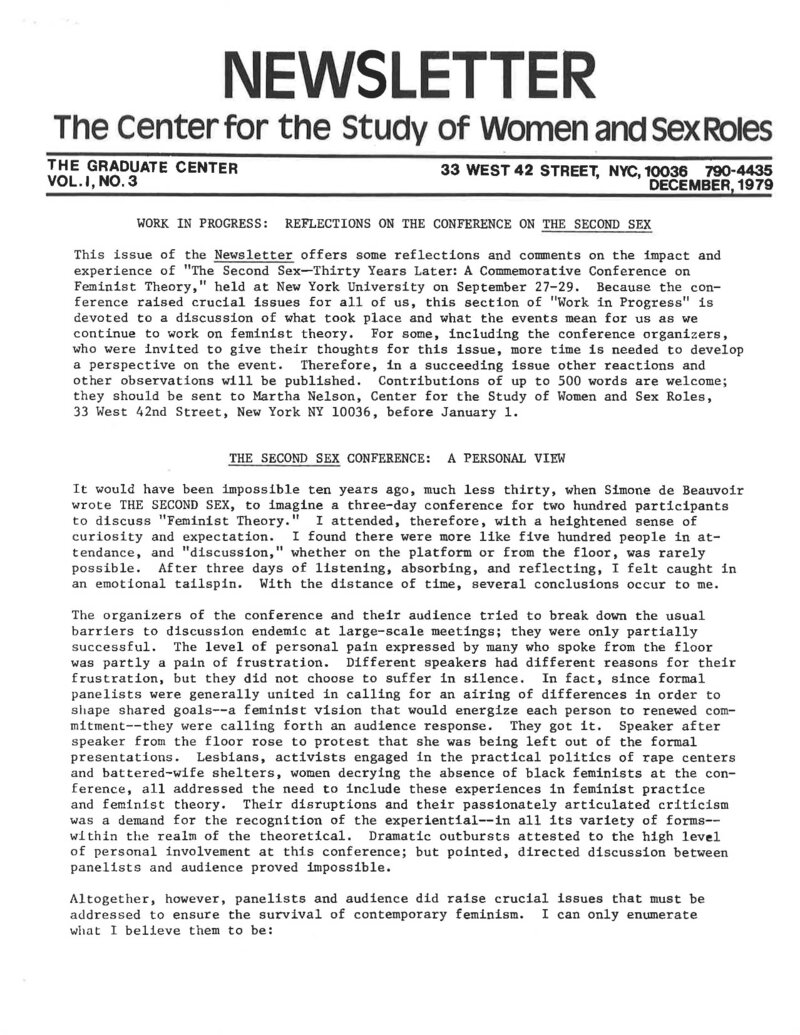
WORK IN PROGRESS: REFLECTIONS ON THE CONFERENCE ON THE SECOND SEX
This issue of the Newsletter offers some reflections and comments on the impact and
experience of "The Second Sex—Thirty Years Later: A Commemorative Conference on
Feminist Theory," held at New York University on September 27-29. Because the con-
ference raised crucial issues for all of us, this section of "Work in Progress" is
devoted to a discussion of what took place and what the events mean for us as we
continue to work on feminist theory. For some, including the conference organizers,
who were invited to give their thoughts for this issue, more time is needed to develop
a perspective on the event. Therefore, in a succeeding issue other reactions and
other observations will be published. Contributions of up to 500 words are welcome;
they should be sent to Martha Nelson, Center for the Study of Women and Sex Roles,
33 West 42nd Street, New York NY 10036, before January 1.
THE SECOND SEX CONFERENCE: A PERSONAL VIEW
It would have been impossible ten years ago, much less thirty, when Simone de Beauvoir
wrote THE SECOND SEX, to imagine a three-day conference for two hundred participants
to discuss "Feminist Theory." I attended, therefore, with a heightened sense of
curiosity and expectation. I found there were more like five hundred people in at-
tendance, and "discussion," whether on the platform or from the floor, was rarely
possible. After three days of listening, absorbing, and reflecting, I felt caught in
an emotional tailspin. With the distance of time, several conclusions occur to me.
The organizers of the conference and their audience tried to break down the usual
barriers to discussion endemic at large-scale meetings; they were only partially
successful. The level of personal pain expressed by many who spoke from the floor
was partly a pain of frustration. Different speakers had different reasons for their
frustration, but they did not choose to suffer in silence. In fact, since formal
panelists were generally united in calling for an airing of differences in order to
shape shared goals--a feminist vision that would energize each person to renewed com-
mitment--they were calling forth an audience response. They got it. Speaker after
speaker from the floor rose to protest that she was being left out of the formal
presentations. Lesbians, activists engaged in the practical politics of rape centers
and battered-wife shelters, women decrying the absence of black feminists at the con-
ference, all addressed the need to include these experiences in feminist practice
and feminist theory. Their disruptions and their passionately articulated criticism
was a demand for the recognition of the experiential--in all its variety of forms--
within the realm of the theoretical. Dramatic outbursts attested to the high level
of personal involvement at this conference; but pointed, directed discussion between
panelists and audience proved impossible.
Altogether, however, panelists and audience did raise crucial issues that must be
addressed to ensure the survival of contemporary feminism. I can only enumerate
what I believe them to be:
--How should particularist experience inform feminist theory?
--What are the origins of gender identity and do we really seek to break it down?
--How can we theorize significantly about feminist goals when we are forced to use
concepts and language that reflect male perceptions of reality?
--Can we ignore the physical body and erotic needs we take with us into the feminist
future?
--To what extent must the concept of "self" reflect significant others and social
scripts?
--How can we arrive at a shared feminist vision in which differences are celebrated
and not merely tolerated or actually condemned?
As the products of one social reality we must communicate with each other while con-
structing a new world. Our greatest danger is not that we shout each other down,
but that we stop shouting because each of us fails to understand what the other is
shouting about.
Dorothy 0. Helly
Hunter College, CUNY
The Second Sex Conference was the feminist event of the year. Seven hundred women,
representing diverse tendencies and concerns, gathered to identify and discuss the
central questions that preoccupy American and European feminists devoted to political
theory and action. In commemoration of Simone de Beauvoir's substantial theoretical
contribution, three days were set aside to present theoretical work on women's
definition and condition in society.
Most of the women I talked to approached the conference with an uneasy mixture of
expectation and apprehension. Because we have seen how many feminist demands have
been reduced to civil liberties/discrimination issues, we look to theory to provide
a vision for social action that cannot be so easily subsumed by the capitalist
patriarchy. Theory also provides a space for our desires to float free of the con--
straints of everyday worries. Frustrated in our actual struggle, making theory
helps us to design models which can explain the condition of women and the mechanisms
by which it is reproduced; then we can more clearly plan the changes that will need
to be made. By women, in society.
At the same time many women had a vague sensation of fear in approaching a conference
devoted to theory and wondered who the women were who were scheduled to speak. Were
they THE theoreticians of the Movement? If so, what relationship were we to have to
them. Making theory had always been presented to us as a male elite activity, and
few of us had labelled our thinking about our lives as women, theorizing. What if
we did not understand what was being said? What if it was too abstract? Did that
make us the "Masses"? Despite these hesitations, no one I knew wanted to be left
out of what appeared to be a crucial historical moment, the first feminist conference
in the United States devoted entirely to feminist thought and feminist thinkers.
Two months have passed since that conference and the women who attended are still
discussing if conferences are the most productive settings for talking theory. The
deep reactions of disillusion and anger that were provoked there push us to analyze
further what we expect from conferences, what happens to us when we attend them,
and how, in light of this, we can evaluate them and experiment with new forms of
public discourse.
The content of the Conference, the workshops and the panels were topically and
politically diverse. Conflict, produced and contained in the historical contradictions
women face daily, was a hallmark of the event. Some areas of continuing conflict
revolve around the following:
1) What is the nature of a feminist revolution?
2) What is the current and future relationship of feminists to Left groups?
3) Does feminism adequately challenge capitalism?
4) What is feminist political action?
5) Can feminism create a constituency of non-white women?
6) What do we expect theory to give us, do for us?
7) What issues are operating in the Lesbian/heterosexual divergence?
8) What are the sources of women's power?
9) Will the destruction of gender free women?
10) What is a woman?
In order to answer these pertinent questions and others that are central to the
task of creating unity among feminists and a consistency of feminist theory, we
must continue the discussion that was sparked by The Second Sex Conference and pro-
ceed in defining political priorities. The real utility of conferences and the
theories they offer will be demonstrated by our future political activity.
Paula Webster
Associate, CSWSR
IMPRESSIONS OF THE SECOND SEX CONFERENCE
International meetings are important to strengthen the political-theoretical dialogue
which we need to answer the problems facing the feminist movement all over the world.
At the Conference on The Second Sex, the first day's discussion seemed to me too
academic, but the second and third days became more interesting. In saying this, I
mean that the problematic concerning existentialist philosophy, the topic of discus-
sion the first day, is really one of style. I agreed with Michelle LeDoeff not only
in her position about The Second Sex, but also in her desire to jump quickly over
the question of existentialisn.
The sessions which were most important to me were "Developing Feminist Theory," run
by French feminists, and "Heterosexuality and Power." I agreed with the French
feminists of Questions Feministes that a materialistic interpretation of the contra-
diction between the sexes is necessary. As yet this position has many unclear points,
but I think it could produce significant developments in the future. The session on
Heterosexuality and Power was interesting in its focus on the criticism of the role
of mothers as the major agents of female victimization, even though not enough men-
tion was made of how this process also prepares women for the totally self-annuling
role of motherhood. I found the speeches of Linda Gordon, Charlotte Bunch and Kate
Young particularly strong.
I would also like to comment on the organization of the conference, particularly on
the. contradictions which blew up on the last day. The way in which the conference
was organized reflected the contradictions which emerged. I speak mainly about those
between whites and Blacks, but also between lesbians and straights, and between theo-
reticians and activists. The absence of Black feminists was a serious error, which
was probably avoidable. (As an aside, I still wonder why the feminist representation
from England and Italy was so poor; I wonder on what basis the representatives were
chosen.) Most of us expected the explosions before the last day, when these contra-
dictions, which are real, broke the sometimes fictitiously peaceful and abstract tone.
Exactly because such conflicts are old and difficult to solve, exactly because their
origins are social and historical rather than a difference in ideas, as Gerda Lerner
pointed out, I consider it impossible to deal with them either through reciprocal
accusations, or psychological mechanisms of agression and passivity or through
reciprocal vindications. In this regard, what shocked me most was the way in which
the division between Blacks and whites was faced. The responses to Black criticism
were either guilty applause or intolerance, with very few attempts to get to the
heart of the problem. Even though it is completely understandable to be weary of
these same old problems, still I believe that the only right thing to do is to face
them. To continue this debate in a political, useful way, it will be necessary to
Start exactly from the last day of the conference.
Mariagrazie Rossilli
Rome, Italy
JOB NOTICES
Interested in improving education in the humanities at the community college level?
An opportunity to work now with Professor Saul Touster on a small project in humanities
education could be the basis for further full-time employment. Post-doctoral scholar
in humanities with educational interests preferred. An application from someone
seeking mentorship under the Educational Research Opportunities Program, directed by
Dr. Deanna Chitayat, would be welcome. For information, write to Dr. Chitayat or Dr.
Touster at the Graduate Center.
The Illinois Humanities Council, an agency devoted to bringing the humanities to the
out-of-school adult public, seeks an Executive Director. The Director is responsible for
policy, supervising funds, directing staff and preparing proposals for funding. Send a
letter of interest, resume with salary history and letters of recommendation to Victoria
Ranney, Chair, Illinois Humanities Council, 67 East Madison, Chicago, Illinois, 60603.
UPDATE ON MAILING LIST
If you did not send in the notice of your current address, which appeared in last month's
Newsletter, please do so now. You may use the form we provided, or just write to us, but
if we do not receive some notice, you name will be dropped from the mailing list. It is
important to keep the list accurate and up-to-date, and we appreciate your help.
MAILING COSTS
Since we began to publish the Newsletter regularly, the mailing list has grown by
25%. We're delighted that we can reach so many people, but the cost of mailing to ad-
dresses outside the CUNY system is high. If you receive the Newsletter at a non-CUNY
address, please send $2.00 to defray postage costs. Thank you. With this assistance
we can continue to mail to all our readers.
Asian Women United and the Center for the Study of Women and Sex Roles will co-sponsor a
conference on Asian/Pacific Women's Educational Equity on March 14, 15, and 16, 1980. The
next planning meeting is December 12, in Room 1401, at 6:30. Call Angie Cruz, 790-4306 or
790-4435 for more information on planning or attending the conference.
Professor Moshe Shokeid, of Tel Aviv University, will speak on "Women's Position and
Ethnic Identity Among Arabs in an Israeli City" on Dec. 7 at 1 p.m. in Room 1437,
NOTES AND ANNOUNCEMENTS
A special issue of WOMEN'S STUDIES edited by a committee from the Center will examine
the question of how feminist theory and questions have challenged intellectual ‘tradi-
tions in general and the framework and traditions of specific disciplines. Topics
will include an exploration of the relationship between feminism as a political move-
Ment and scholarship as a non-feminist, "objective" intellectual enterprise. We
hope for articles that present new research or a fresh theoretical viewpoint. No
review articles will be considered. WOMEN'S STUDIES is an interdisciplinary journal
and therefore articles should have sufficient breadth to be of interest to readers
from all disciplines. Criteria for acceptance in addition to scholarly merit, will
be: 1) How centrally does the paper address the theme of the issue; 2) General sig-
nificance of the topic; 3) A balance of disciplines and points of view. Submissions
will be reviewed blind at every stage. The first reading will be done by the editorial
committee. Papers which may be appropriate for the issue will be sent out for review
to experts in the field. Authors of accepted articles will be asked to meet to dis-
cuss their work and the issue as a whole. Although we will make every effort to return
decisions as soon as possible, the process may take as long as four months.
Send three copies of the submission, typed double-spaced, to The Center for the Study
of Women and Sex Roles, Room 1400, The Graduate Center, 33 West 42nd Street, New York,
NY 10036. In order to insure blind review, the author's name should appear only on
a_ detachable cover sheet. The deadline for submission is: SEPTEMBER 1, 1980. Papers
should be 25-35 pages double-spaced, including notes. To assist us in the editorial
process, please send an abstract of your proposed submission by JUNE 1, 1980.
Graduate Students interested in a dissertation support group--a small, supportive
group to read each other's work, help each other through impasses, provide encourage-
ment and stimulation and keep each other going--call Laurie Phillips, 865-6879. The
group would meet weekly or biweekly. Laurie Phillips is working on a dissertation
that explores how heterosexual women who have identified as feminists for eight to
ten years understand the interplay of feminism and their primary relationships with men.
The Feminist Student Organization is a new group forming to meet the political and
academic needs of feminist doctoral students. An organizational meeting will be held
on Wednesday, December 12 in the 8th Floor Lounge at Noon. For information, call
Claire Riley, 258-8929. ,
In a future issue of the Newsletter, we will publish a list of special collections
and sources of material on women in and around New York City. We ask for suggestions
of especially good libraries, archives, special collections and resource centers to
add to this list. Please call or write the Center with your ideas.
The fifth Berkshire Conference on Women in History will be held at Vassar College on
June 16, 17 and 18, 1981. Panel proposals for the 1981 conference should be sent to
JoAnn McNamara, 500 West 1lth Street, New York, NY 10025 before March 15, 1980.
The proposal should include a title for the panel, names of participants and the
titles of the papers. A brief abstract of each paper and a brief vita of each par-
ticipant should accompany the proposal. Include a self-addressed postcard for
acknowledging receipt of proposals.
DECEMBER 1979
CENTER FOR THE STUDY OF WOMEN AND SEX ROLES
All events will take place in room 1400, unless otherwise noted.
Tuesday, December 4
Thursday, December 6
Thursday, December 6
Friday, December 7
Tuesday, December 11
Tuesday, December 11
Wednesday, December 12
Thursday, December 13
Friday, December 14
Friday, December 14
Friday, December 14
Tuesday, December 18
11:45-1:15 Tuesday Noon Lunch. All are welcome to this
weekly informal discussion and meeting in the 18th Floor
Dining Room.
3:00-5:00 Associates Meeting, Room 1401.
11:30 Film Showing: Babies and Banners. Women workers
and wives of workers in the Detroit auto industry talk about
their union activities in the thirties and their con-
tinuing struggle for women's rights in work. Third Floor
Studio.
2:00 Seminar on the Impact of Multinational Corpora-
tions on Women. New Members welcome. Room 1401. For
details call Ruby Rohrlich, 874-6884.
11:45-1:15 Tuesday Noon Lunch. 18th Floor Dining Roon.
5:00-6:30 Film premiere. A Man's Place produced by
Deanna Chitayat, looks at men who live or work in a setting
that requires them to expand their traditional male role.
3rd Floor studio.
Noon Meeting of the Feminist Students Organization,
a newly formed group of feminist doctoral students. 8th Floor
lounge. Contact Claire Riley, 258-8929 or leave message
in Center.
11:30 Film showing: Social Change and the American
Woman. The evolution of the American woman from 1900 to
the present. Third Floor Studio.
3:00 Feminist Methods of Inquiry will meet to
discuss The Mamie Papers, and explore the way in which per-
sonal memoir is both social history and literature. Room
1629. For more details call Trudy Berger, 539-8444.
3:00 Women and Health Seminar. Charlotte Muller,
economist at The Graduate Center, will talk about her work
on economic issues affecting. women and health. This will
be followed by wine and a discussion/brainstorming session
on issues relevant to the physical and mental health of
working women. Room 1712.
4:00-6:00 Conversation Hour. Natalie Sokoloff will speak
on "The Sociological Approach to Women and Work: a Marxist-
Feminist Critique." Room 1401.
11:45-1:15 Tuesday Noon Lunch. 18th Floor Dining Roon.
The Center for the Study of Women and Sex Roles
ES
THE GRADUATE CENTER 33 WEST 42 STREET, NYC,10036 790-4435
VOL.1,NO.3 DECEMBER, 1979
WORK IN PROGRESS: REFLECTIONS ON THE CONFERENCE ON THE SECOND SEX
This issue of the Newsletter offers some reflections and comments on the impact and
experience of "The Second Sex—Thirty Years Later: A Commemorative Conference on
Feminist Theory," held at New York University on September 27-29. Because the con-
ference raised crucial issues for all of us, this section of "Work in Progress" is
devoted to a discussion of what took place and what the events mean for us as we
continue to work on feminist theory. For some, including the conference organizers,
who were invited to give their thoughts for this issue, more time is needed to develop
a perspective on the event. Therefore, in a succeeding issue other reactions and
other observations will be published. Contributions of up to 500 words are welcome;
they should be sent to Martha Nelson, Center for the Study of Women and Sex Roles,
33 West 42nd Street, New York NY 10036, before January 1.
THE SECOND SEX CONFERENCE: A PERSONAL VIEW
It would have been impossible ten years ago, much less thirty, when Simone de Beauvoir
wrote THE SECOND SEX, to imagine a three-day conference for two hundred participants
to discuss "Feminist Theory." I attended, therefore, with a heightened sense of
curiosity and expectation. I found there were more like five hundred people in at-
tendance, and "discussion," whether on the platform or from the floor, was rarely
possible. After three days of listening, absorbing, and reflecting, I felt caught in
an emotional tailspin. With the distance of time, several conclusions occur to me.
The organizers of the conference and their audience tried to break down the usual
barriers to discussion endemic at large-scale meetings; they were only partially
successful. The level of personal pain expressed by many who spoke from the floor
was partly a pain of frustration. Different speakers had different reasons for their
frustration, but they did not choose to suffer in silence. In fact, since formal
panelists were generally united in calling for an airing of differences in order to
shape shared goals--a feminist vision that would energize each person to renewed com-
mitment--they were calling forth an audience response. They got it. Speaker after
speaker from the floor rose to protest that she was being left out of the formal
presentations. Lesbians, activists engaged in the practical politics of rape centers
and battered-wife shelters, women decrying the absence of black feminists at the con-
ference, all addressed the need to include these experiences in feminist practice
and feminist theory. Their disruptions and their passionately articulated criticism
was a demand for the recognition of the experiential--in all its variety of forms--
within the realm of the theoretical. Dramatic outbursts attested to the high level
of personal involvement at this conference; but pointed, directed discussion between
panelists and audience proved impossible.
Altogether, however, panelists and audience did raise crucial issues that must be
addressed to ensure the survival of contemporary feminism. I can only enumerate
what I believe them to be:
--How should particularist experience inform feminist theory?
--What are the origins of gender identity and do we really seek to break it down?
--How can we theorize significantly about feminist goals when we are forced to use
concepts and language that reflect male perceptions of reality?
--Can we ignore the physical body and erotic needs we take with us into the feminist
future?
--To what extent must the concept of "self" reflect significant others and social
scripts?
--How can we arrive at a shared feminist vision in which differences are celebrated
and not merely tolerated or actually condemned?
As the products of one social reality we must communicate with each other while con-
structing a new world. Our greatest danger is not that we shout each other down,
but that we stop shouting because each of us fails to understand what the other is
shouting about.
Dorothy 0. Helly
Hunter College, CUNY
The Second Sex Conference was the feminist event of the year. Seven hundred women,
representing diverse tendencies and concerns, gathered to identify and discuss the
central questions that preoccupy American and European feminists devoted to political
theory and action. In commemoration of Simone de Beauvoir's substantial theoretical
contribution, three days were set aside to present theoretical work on women's
definition and condition in society.
Most of the women I talked to approached the conference with an uneasy mixture of
expectation and apprehension. Because we have seen how many feminist demands have
been reduced to civil liberties/discrimination issues, we look to theory to provide
a vision for social action that cannot be so easily subsumed by the capitalist
patriarchy. Theory also provides a space for our desires to float free of the con--
straints of everyday worries. Frustrated in our actual struggle, making theory
helps us to design models which can explain the condition of women and the mechanisms
by which it is reproduced; then we can more clearly plan the changes that will need
to be made. By women, in society.
At the same time many women had a vague sensation of fear in approaching a conference
devoted to theory and wondered who the women were who were scheduled to speak. Were
they THE theoreticians of the Movement? If so, what relationship were we to have to
them. Making theory had always been presented to us as a male elite activity, and
few of us had labelled our thinking about our lives as women, theorizing. What if
we did not understand what was being said? What if it was too abstract? Did that
make us the "Masses"? Despite these hesitations, no one I knew wanted to be left
out of what appeared to be a crucial historical moment, the first feminist conference
in the United States devoted entirely to feminist thought and feminist thinkers.
Two months have passed since that conference and the women who attended are still
discussing if conferences are the most productive settings for talking theory. The
deep reactions of disillusion and anger that were provoked there push us to analyze
further what we expect from conferences, what happens to us when we attend them,
and how, in light of this, we can evaluate them and experiment with new forms of
public discourse.
The content of the Conference, the workshops and the panels were topically and
politically diverse. Conflict, produced and contained in the historical contradictions
women face daily, was a hallmark of the event. Some areas of continuing conflict
revolve around the following:
1) What is the nature of a feminist revolution?
2) What is the current and future relationship of feminists to Left groups?
3) Does feminism adequately challenge capitalism?
4) What is feminist political action?
5) Can feminism create a constituency of non-white women?
6) What do we expect theory to give us, do for us?
7) What issues are operating in the Lesbian/heterosexual divergence?
8) What are the sources of women's power?
9) Will the destruction of gender free women?
10) What is a woman?
In order to answer these pertinent questions and others that are central to the
task of creating unity among feminists and a consistency of feminist theory, we
must continue the discussion that was sparked by The Second Sex Conference and pro-
ceed in defining political priorities. The real utility of conferences and the
theories they offer will be demonstrated by our future political activity.
Paula Webster
Associate, CSWSR
IMPRESSIONS OF THE SECOND SEX CONFERENCE
International meetings are important to strengthen the political-theoretical dialogue
which we need to answer the problems facing the feminist movement all over the world.
At the Conference on The Second Sex, the first day's discussion seemed to me too
academic, but the second and third days became more interesting. In saying this, I
mean that the problematic concerning existentialist philosophy, the topic of discus-
sion the first day, is really one of style. I agreed with Michelle LeDoeff not only
in her position about The Second Sex, but also in her desire to jump quickly over
the question of existentialisn.
The sessions which were most important to me were "Developing Feminist Theory," run
by French feminists, and "Heterosexuality and Power." I agreed with the French
feminists of Questions Feministes that a materialistic interpretation of the contra-
diction between the sexes is necessary. As yet this position has many unclear points,
but I think it could produce significant developments in the future. The session on
Heterosexuality and Power was interesting in its focus on the criticism of the role
of mothers as the major agents of female victimization, even though not enough men-
tion was made of how this process also prepares women for the totally self-annuling
role of motherhood. I found the speeches of Linda Gordon, Charlotte Bunch and Kate
Young particularly strong.
I would also like to comment on the organization of the conference, particularly on
the. contradictions which blew up on the last day. The way in which the conference
was organized reflected the contradictions which emerged. I speak mainly about those
between whites and Blacks, but also between lesbians and straights, and between theo-
reticians and activists. The absence of Black feminists was a serious error, which
was probably avoidable. (As an aside, I still wonder why the feminist representation
from England and Italy was so poor; I wonder on what basis the representatives were
chosen.) Most of us expected the explosions before the last day, when these contra-
dictions, which are real, broke the sometimes fictitiously peaceful and abstract tone.
Exactly because such conflicts are old and difficult to solve, exactly because their
origins are social and historical rather than a difference in ideas, as Gerda Lerner
pointed out, I consider it impossible to deal with them either through reciprocal
accusations, or psychological mechanisms of agression and passivity or through
reciprocal vindications. In this regard, what shocked me most was the way in which
the division between Blacks and whites was faced. The responses to Black criticism
were either guilty applause or intolerance, with very few attempts to get to the
heart of the problem. Even though it is completely understandable to be weary of
these same old problems, still I believe that the only right thing to do is to face
them. To continue this debate in a political, useful way, it will be necessary to
Start exactly from the last day of the conference.
Mariagrazie Rossilli
Rome, Italy
JOB NOTICES
Interested in improving education in the humanities at the community college level?
An opportunity to work now with Professor Saul Touster on a small project in humanities
education could be the basis for further full-time employment. Post-doctoral scholar
in humanities with educational interests preferred. An application from someone
seeking mentorship under the Educational Research Opportunities Program, directed by
Dr. Deanna Chitayat, would be welcome. For information, write to Dr. Chitayat or Dr.
Touster at the Graduate Center.
The Illinois Humanities Council, an agency devoted to bringing the humanities to the
out-of-school adult public, seeks an Executive Director. The Director is responsible for
policy, supervising funds, directing staff and preparing proposals for funding. Send a
letter of interest, resume with salary history and letters of recommendation to Victoria
Ranney, Chair, Illinois Humanities Council, 67 East Madison, Chicago, Illinois, 60603.
UPDATE ON MAILING LIST
If you did not send in the notice of your current address, which appeared in last month's
Newsletter, please do so now. You may use the form we provided, or just write to us, but
if we do not receive some notice, you name will be dropped from the mailing list. It is
important to keep the list accurate and up-to-date, and we appreciate your help.
MAILING COSTS
Since we began to publish the Newsletter regularly, the mailing list has grown by
25%. We're delighted that we can reach so many people, but the cost of mailing to ad-
dresses outside the CUNY system is high. If you receive the Newsletter at a non-CUNY
address, please send $2.00 to defray postage costs. Thank you. With this assistance
we can continue to mail to all our readers.
Asian Women United and the Center for the Study of Women and Sex Roles will co-sponsor a
conference on Asian/Pacific Women's Educational Equity on March 14, 15, and 16, 1980. The
next planning meeting is December 12, in Room 1401, at 6:30. Call Angie Cruz, 790-4306 or
790-4435 for more information on planning or attending the conference.
Professor Moshe Shokeid, of Tel Aviv University, will speak on "Women's Position and
Ethnic Identity Among Arabs in an Israeli City" on Dec. 7 at 1 p.m. in Room 1437,
NOTES AND ANNOUNCEMENTS
A special issue of WOMEN'S STUDIES edited by a committee from the Center will examine
the question of how feminist theory and questions have challenged intellectual ‘tradi-
tions in general and the framework and traditions of specific disciplines. Topics
will include an exploration of the relationship between feminism as a political move-
Ment and scholarship as a non-feminist, "objective" intellectual enterprise. We
hope for articles that present new research or a fresh theoretical viewpoint. No
review articles will be considered. WOMEN'S STUDIES is an interdisciplinary journal
and therefore articles should have sufficient breadth to be of interest to readers
from all disciplines. Criteria for acceptance in addition to scholarly merit, will
be: 1) How centrally does the paper address the theme of the issue; 2) General sig-
nificance of the topic; 3) A balance of disciplines and points of view. Submissions
will be reviewed blind at every stage. The first reading will be done by the editorial
committee. Papers which may be appropriate for the issue will be sent out for review
to experts in the field. Authors of accepted articles will be asked to meet to dis-
cuss their work and the issue as a whole. Although we will make every effort to return
decisions as soon as possible, the process may take as long as four months.
Send three copies of the submission, typed double-spaced, to The Center for the Study
of Women and Sex Roles, Room 1400, The Graduate Center, 33 West 42nd Street, New York,
NY 10036. In order to insure blind review, the author's name should appear only on
a_ detachable cover sheet. The deadline for submission is: SEPTEMBER 1, 1980. Papers
should be 25-35 pages double-spaced, including notes. To assist us in the editorial
process, please send an abstract of your proposed submission by JUNE 1, 1980.
Graduate Students interested in a dissertation support group--a small, supportive
group to read each other's work, help each other through impasses, provide encourage-
ment and stimulation and keep each other going--call Laurie Phillips, 865-6879. The
group would meet weekly or biweekly. Laurie Phillips is working on a dissertation
that explores how heterosexual women who have identified as feminists for eight to
ten years understand the interplay of feminism and their primary relationships with men.
The Feminist Student Organization is a new group forming to meet the political and
academic needs of feminist doctoral students. An organizational meeting will be held
on Wednesday, December 12 in the 8th Floor Lounge at Noon. For information, call
Claire Riley, 258-8929. ,
In a future issue of the Newsletter, we will publish a list of special collections
and sources of material on women in and around New York City. We ask for suggestions
of especially good libraries, archives, special collections and resource centers to
add to this list. Please call or write the Center with your ideas.
The fifth Berkshire Conference on Women in History will be held at Vassar College on
June 16, 17 and 18, 1981. Panel proposals for the 1981 conference should be sent to
JoAnn McNamara, 500 West 1lth Street, New York, NY 10025 before March 15, 1980.
The proposal should include a title for the panel, names of participants and the
titles of the papers. A brief abstract of each paper and a brief vita of each par-
ticipant should accompany the proposal. Include a self-addressed postcard for
acknowledging receipt of proposals.
DECEMBER 1979
CENTER FOR THE STUDY OF WOMEN AND SEX ROLES
All events will take place in room 1400, unless otherwise noted.
Tuesday, December 4
Thursday, December 6
Thursday, December 6
Friday, December 7
Tuesday, December 11
Tuesday, December 11
Wednesday, December 12
Thursday, December 13
Friday, December 14
Friday, December 14
Friday, December 14
Tuesday, December 18
11:45-1:15 Tuesday Noon Lunch. All are welcome to this
weekly informal discussion and meeting in the 18th Floor
Dining Room.
3:00-5:00 Associates Meeting, Room 1401.
11:30 Film Showing: Babies and Banners. Women workers
and wives of workers in the Detroit auto industry talk about
their union activities in the thirties and their con-
tinuing struggle for women's rights in work. Third Floor
Studio.
2:00 Seminar on the Impact of Multinational Corpora-
tions on Women. New Members welcome. Room 1401. For
details call Ruby Rohrlich, 874-6884.
11:45-1:15 Tuesday Noon Lunch. 18th Floor Dining Roon.
5:00-6:30 Film premiere. A Man's Place produced by
Deanna Chitayat, looks at men who live or work in a setting
that requires them to expand their traditional male role.
3rd Floor studio.
Noon Meeting of the Feminist Students Organization,
a newly formed group of feminist doctoral students. 8th Floor
lounge. Contact Claire Riley, 258-8929 or leave message
in Center.
11:30 Film showing: Social Change and the American
Woman. The evolution of the American woman from 1900 to
the present. Third Floor Studio.
3:00 Feminist Methods of Inquiry will meet to
discuss The Mamie Papers, and explore the way in which per-
sonal memoir is both social history and literature. Room
1629. For more details call Trudy Berger, 539-8444.
3:00 Women and Health Seminar. Charlotte Muller,
economist at The Graduate Center, will talk about her work
on economic issues affecting. women and health. This will
be followed by wine and a discussion/brainstorming session
on issues relevant to the physical and mental health of
working women. Room 1712.
4:00-6:00 Conversation Hour. Natalie Sokoloff will speak
on "The Sociological Approach to Women and Work: a Marxist-
Feminist Critique." Room 1401.
11:45-1:15 Tuesday Noon Lunch. 18th Floor Dining Roon.
Title
The Center for the Study of Women and Sex Roles Newsletter: The Center for the Study of Women and Sex Roles Newsletter: Vol. 1, No. 3
Description
The Center for the Study of Women and Sex Roles – now the Center for the Study of Women and Society's (CSWS) – December 1979 Newsletter began with reflections on The Second Sex Conference, which commemorated the publication of Simone de Beauvoir's seminal book thirty years ago. The reflections focused on the event organizers, attendees, and participants' unaddressed question: what is feminism, and who gets to represent it? Following this discussion, the Newsletter called for submissions for the Women's Studies Journal, a peer-reviewed journal for the study of women across disciplines, focused on the relationship between feminist theory and academic tradition. The journal's interdisciplinary nature was underscored, inviting submissions to interest a wide range of readers.
Since 1977, the Center for the Study of Women and Society (CSWS), Graduate Center, City University of New York (CUNY) has promoted interdisciplinary feminist scholarship. The Center’s research agenda focuses on the intersectional study of gender, sexuality, race, ethnicity, class, and nation in societies worldwide. The Center co-sponsors the Women’s Studies Certificate Program and, most notably, hosts the only stand-alone Women’s and Gender Studies MA Program in New York City.
Contributor
Center for the Study of Women and Society
Creator
Center for the Study of Women and Society
Date
December 1979
Language
English
Publisher
Center for the Study of Women and Society
Rights
Copyrighted
Source
Center for the Study of Women and Society
Center for the Study of Women and Society. Letter. “The Center for the Study of Women and Sex Roles Newsletter: The Center for the Study of Women and Sex Roles Newsletter: Vol. 1, No. 3.”, CUNY DIGITAL HISTORY ARCHIVE, accessed September 5, 2026, https://stephenz.tailc22a4b.ts.net/s/cdha/item/1611