Minutes of the Board of Higher Education - November 25, 1968
Item
S-140 . Board of Higher Education
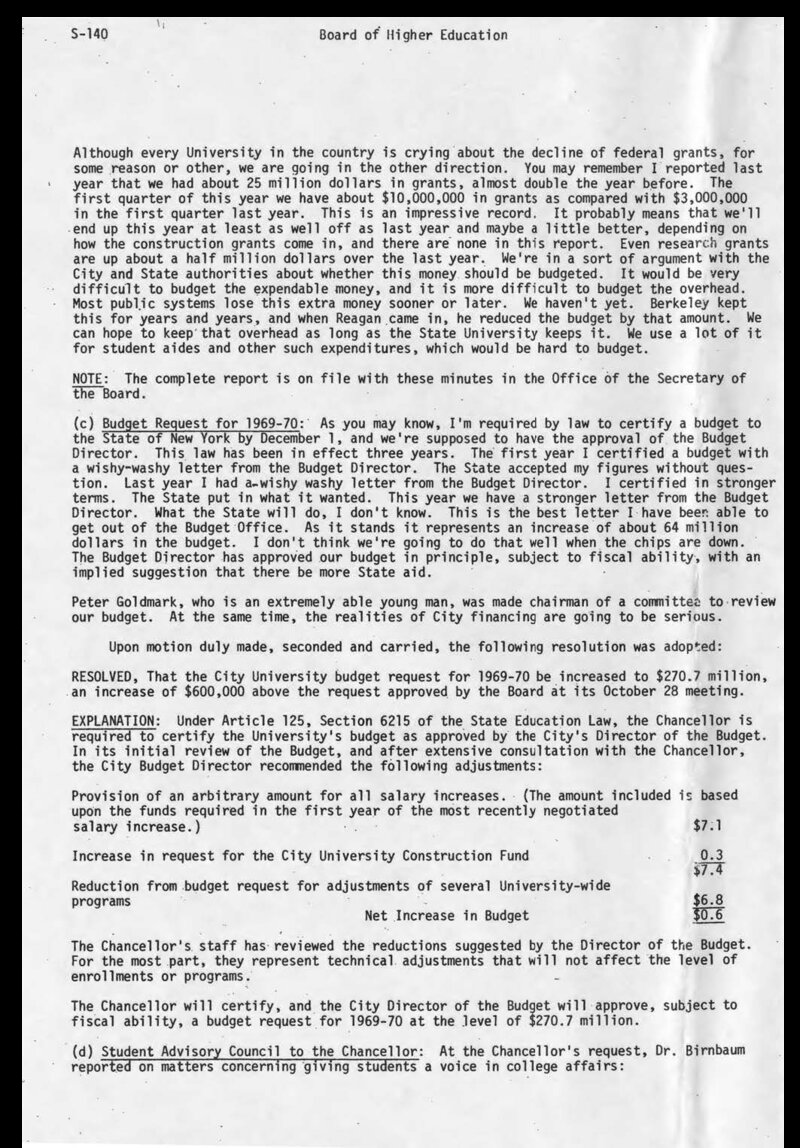
Although every University in the country is crying about the decline of federal grants, for
some reason or other, we are going in the other direction. You may remember I reported last
year that we had about 25 million dollars in grants, almost double the year before. The
first quarter of this year we have about $10,000,000 in grants as compared with $3,000,000
in the first quarter last year. This is an impressive record. It probably means that we'll
end up this year at least as well off as last year and maybe a little better, depending on
how the construction grants come in, and there are none in this report. Even research grants
are up about a half million dollars over the last year. We're in a sort of argument with the
City and State authorities about whether this money should be budgeted. It would be very
difficult to budget the expendable money, and it is more difficult to budget the overhead.
Most public systems lose this extra money sooner or later. We haven't yet. Berkeley kept
this for years and years, and when Reagan came in, he reduced the budget by that amount. We
can hope to keep’ that overhead as long as the State University keeps it. We use a lot of it
for student aides and other such expenditures, which would be hard to budget.
NOTE: The complete report is on file with these minutes in the Office of the Secretary of
the Board. ‘
(c) Budget Request for 1969-70: As you may know, I'm required by law to certify a budget to
the State of New York by December 1, and we're supposed to have the approval of the Budget
Director. This law has been in effect three years. The first year I certified a budget with
a wishy-washy letter from the Budget Director. The State accepted my figures without ques-
tion. Last year I had a-wishy washy letter from the Budget Director. I certified in stronger
terms. The State put in what it wanted. This year we have a stronger letter from the Budget
Director. What the State will do, I don't know. This is the best letter I-have been able to
get out of the Budget Office. As it stands it represents an increase of about 64 million
dollars in the budget. I don't think we're going to do that well when the chips are down.
The Budget Director has approved our budget in principle, subject to fiscal ability, with an
implied suggestion that there be more State aid. :
Peter Goldmark, who is an extremely able young man, was made chairman of a committee to-review
our budget. At the same time, the realities of City financing are going to be serious.
Upon motion duly made, seconded and carried, the following resolution was adopted:
RESOLVED, That the City University budget request for 1969-70 be increased to $270.7 million,
an increase of $600,000 above the request approved by the Board at its October 28 meeting.
EXPLANATION: Under Article 125, Section 6215 of the State Education Law, the Chancellor is
required to certify the University's budget as approved by the City's Director of the Budget.
In its initial review of the Budget, and after extensive consultation with the Chancellor,
the City Budget Director recommended the following adjustments:
Provision of an arbitrary amount for all salary increases. (The amount included is based
upon the funds required in the first year of the most recently negotiated
salary increase.) $7.1
Increase in request for the City University Construction Fund ot
dv.
Reduction from budget request for adjustments of several University-wide
programs ae
Net Increase in Budget 5
The Chancellor's staff has reviewed the reductions suggested by the Director of the Budget.
For the most part, they represent technical. adjustments that will not affect the level of
enrollments or programs. =
The Chancellor will certify, and the City Director of the Budget will approve, subject to
fiscal ability, a budget request for 1969-70 at the level of $270.7 million.
(d) Student Advisory Council to the Chancellor: At the Chancellor's request, Dr. Birnbaum
reported on matters concerning giving students a voice in college affairs:
Minutes of Proceedings, November 25, 1968 41
After a full day meeting of the Board held on June 21, 1968, and after considerable study,
the Board at its August 1, 1968 meeting adopted new admissions policies, the effects of which
would be to expand the enrollment of full-time students from minority groups from the present
12% so that in September, 1969 approximately 25% of the entering freshmen would be comprised
of minority students.
The following resolutions were approved by the Board:
RESOLVED, That the maximum use of relevant resources, capabilities and creative capacities
of the City University be mobilized and focused on . . .(expanding educational opportunities)
. . which must be given one of the highest priorities among all the undergraduate missions
of the City University; and be it further
RESOLVED, That the City University promptly initiate and establish new admissions practices
adjusted to this priority, and at the same time utilize its special resources to help the
public academic high schools of New York City better to prepare their graduates for college-
level work; and be it further
RESOLVED, That the Board hereby authorizes the following actions to take effect beginning in
the academic year 1969-70:
1. The University shall select initially at least five public high schools in New York City
from among those schools which exhibit the greatest degree of disadvantage as measured by
such factors as the proportion of students earning general diplomas, the percentage of
students reading below grade level, the attrition rate, the proportion of students residing
in officially designated poverty areas, and similar measures. The University shall study
the feasibility of bringing additional high schools into this program as rapidly as possible.
The University shall petition the New York City Board of Education and the Board of Regents
fof complete operational control of and jurisdiction over these schools and, if granted,
each of these high schools shall be associated with a unit or units of the City University.
All graduates of these high schools earning at least a 70% high school average shall be
admitted as matriculated students in the associated City University unit or units, and shall
receive such counseling, tutorial, remedial, financial and other support as may be necessary.
2. (a) Every graduate from a public academic high school not selected as an associate school
shall be admitted as a matriculant to a baccalaureate degree-granting institution of the
University if he is.one of the top 100 graduates of his school.
(b) Every graduate from a non-public academic high school shall be admitted as a matricu-
lant to a baccalaureate degree-granting institution of the University if he either is one of
the top 100 graduates of a school with at least 500 graduates, or in the top 20% of the
graduates of a school with less than 500 graduates; and be it further
RESOLVED, That these expanded opportunities shall be provided within the context of the
traditional academic excellence which has long characterized the University and its con-
stituent colleges; and be it further
RESOLVED, That the above programs be implemented in addition tc ~urrent enrollment plans and
projections for students admitted under regular procedures, SEEK, and College Discovery, so
that no student whose enrollment is presently contemplated under the City University Master
Plan shall be denied admission because of these new programs; and be it further
RESOLVED, That the Mayor, the Governor, the City Council, and the State Legislature be
petitioned to provide the adequate financial support which will permit the expansion of
educational opportunities under the programs approved in these resolutions; and be it further
RESOLVED, That the Board, mindful of the obligations which it has assumed through the adoption
of these new and innovative approaches to providing equality of educational opportunity, ask
the City and State government and its agencies, the University community, and community groups
for their assistance and support; and be it further
S-142 Board of Higher Education
RESOLVED, That the Chancellor report annually to the Board no later than its December meeting
and concurrently to the public, the progress which the University is making in achieving
racial integration towards the end that minority groups shall be represented in the units
of the University in the same proportion as they are represented among all high school grad-
uates of the City.
The Board of Higher Education has long recognized the existence in the City of a condition
of social crisis which has arisen from deep social inequities and resulted in massive
individual as well as group frustrations and intergroup tensions. Federal, State and City
governments have recognized also the existing social crisis and have declared the need for
commitment to programs of action.
In response to the need, the Board of Higher Education has taken as its compelling priority
the equalization, improvement and extension of educational opportunity to the disadvantaged.
Specifically, the intention is to provide as many New York City high school graduates, from
educationally, socially and economically deprived neighborhoods and homes, as possible with
an opportunity for post high school education.
While the City University now enrolls more Negro and Puerto Rican students than any other
institution of higher education in the nation and offers post high school education through
SEEK and College Discovery, two of the largest programs in the country providing counseling,
tutorial, remedial, financial and other supportive assistance to students, the Board con-
siders it crucially important to move faster and further in this area, accelerating, as well,
the constructive integration of the student bodies of the City University, itself an essential
step toward the creation of an integrated society.
This policy, together with existing Master Plan policies, would result in the following ad-
missions to the Senior Colleges in addition to regular student enrollment:
SEEK 2,000
Additional students who would be admitted as a result
of the "top 100" resolution 450
Additional students who would be admitted under the
"five high school" resolution 650
Special admissions to Senior Colleges 3,100
Regular admissions 1969-70 from High School (1968
Master Plan Table 2-3, page 21) 11,260
Total First Time Freshmen Admission 14,360
Percent that Special Admission is of Regular Admission 27.4%
Estimated Costs.
The University estimates that the consequences of these new policies (excluding SEEK already
in the Master Plan) would result in enrollment and cost increases beyond current projections
as follows. Estimated costs of the new programs are $3,000,000 in 1969, rising to $10,500,000
in 1975.*
*® Excludes cost increasés. The cost in 1975 is estimated at $14.8 million if the current rate
of salary increases continues through that year.
Minutes of Proceedings, November 25, 1968 $-143
City University of New York
Enrollment Implications of New Admission Policies
For the Years 1969-1975
Enrollment Increment
Cost of Increment
lumber o itiona ercent tha tional Students
Year Students to be are of Present CUNY Enrollment In Constant In Future
Enrolled Projections of Full-Time, Day Dollars Dollars
Session Matrics
1969 1,100 1.5% $ 3,000,000 $ 3,000,000
1970 2,000 2.4 5,000 ,000 5,500,000
1971 2,750 Sul 6,875,000 8,000,000
1972 3,400 3.6 8,500,000 10,300,000
1973 3,800 Set 9,500,000 12,100,000
1974 4,050 3.7 10,125,000 13,600,000
1975 4,200 3.6 10,500,000 14,800,000
NO. C4. BASEMENT COMPLETION PROJECT - STATEN ISLAND COMMUNITY COLLEGE: RESOLVED, That
the Board approve the final plans and specifications for basement completion at Staten Island
Community College as submitted by The Moore and Hutchins Partnership, Architect, pursuant to
Contract No. 205689 and cost estimate in the amount of $678,590 plus 5% contingency of
$34,710 for a total of $711,300, chargeable to Capital Project HN-121.
EXPLANATION: The Board has a design contract with The Moore and Hutchins Partnership for
the basement completion of Staten Island Community College. The proposed estimated cost of
$711,300 is compared to the estimated cost of $711,300 which was approved by the Bureau of
the Budget under Certificate CP-2121 on May 13, 1968.
Upon motion duly made, seconded and carried, the following resolutions as approved by
the Committee on the City University and the college committees were adopted or action was
taken as noted: (Calendar Nos. C5 through C16)
THE CITY UNIVERSITY
(Calendar Nos. C5 and C6)
NO. C5. REPORTS OF THE CHANCELLOR: The Chancellor presented the following report:
(a) Collective Bargaining: Probably the biggest event on our immediate agenda is the col-
lective bargaining election for the faculties on December 4 and 5. There was an article
about it in the paper on Sunday. I am not greeting the prospect of collective bargaining
with any great enthusiasm, but the situation is now that the election will be held according
to PERB regulations. As the Union and the Legislative Conference, who are the two contending
parties, are both deluging the faculty with propaganda, I have sent to the faculty and have
distributed tonight a pamphlet explaining collective bargaining and what it might mean in
the University. This pamphlet was intended to be a reasonably unbiased view of the subject,
and it was reviewed by most of the members of the Executive Committee before it was finally
sent out.
The Presidents report, and as far as I can see from my other sources, there seems to be a
great apathy on this subject on the campuses. There hasn't been a great deal of discussion
on action or meetings on the individual campuses, and it would seem to me that we run the
danger of having these important questions decided by a small section of the faculty. I
don't really know what will happen. I think there's a reasonably good chance that we'll
end up with a collective bargaining agent.
(b) First Quarter Report on Contracts and Grants (1968-69): I'd like to discuss with you
the first quarter's grant report. This is a report which you have in front of you and which
you get five times a year, one at the end of each quarter and one summarizing the year in
“comparison to other years.
Although every University in the country is crying about the decline of federal grants, for
some reason or other, we are going in the other direction. You may remember I reported last
year that we had about 25 million dollars in grants, almost double the year before. The
first quarter of this year we have about $10,000,000 in grants as compared with $3,000,000
in the first quarter last year. This is an impressive record. It probably means that we'll
end up this year at least as well off as last year and maybe a little better, depending on
how the construction grants come in, and there are none in this report. Even research grants
are up about a half million dollars over the last year. We're in a sort of argument with the
City and State authorities about whether this money should be budgeted. It would be very
difficult to budget the expendable money, and it is more difficult to budget the overhead.
Most public systems lose this extra money sooner or later. We haven't yet. Berkeley kept
this for years and years, and when Reagan came in, he reduced the budget by that amount. We
can hope to keep’ that overhead as long as the State University keeps it. We use a lot of it
for student aides and other such expenditures, which would be hard to budget.
NOTE: The complete report is on file with these minutes in the Office of the Secretary of
the Board. ‘
(c) Budget Request for 1969-70: As you may know, I'm required by law to certify a budget to
the State of New York by December 1, and we're supposed to have the approval of the Budget
Director. This law has been in effect three years. The first year I certified a budget with
a wishy-washy letter from the Budget Director. The State accepted my figures without ques-
tion. Last year I had a-wishy washy letter from the Budget Director. I certified in stronger
terms. The State put in what it wanted. This year we have a stronger letter from the Budget
Director. What the State will do, I don't know. This is the best letter I-have been able to
get out of the Budget Office. As it stands it represents an increase of about 64 million
dollars in the budget. I don't think we're going to do that well when the chips are down.
The Budget Director has approved our budget in principle, subject to fiscal ability, with an
implied suggestion that there be more State aid. :
Peter Goldmark, who is an extremely able young man, was made chairman of a committee to-review
our budget. At the same time, the realities of City financing are going to be serious.
Upon motion duly made, seconded and carried, the following resolution was adopted:
RESOLVED, That the City University budget request for 1969-70 be increased to $270.7 million,
an increase of $600,000 above the request approved by the Board at its October 28 meeting.
EXPLANATION: Under Article 125, Section 6215 of the State Education Law, the Chancellor is
required to certify the University's budget as approved by the City's Director of the Budget.
In its initial review of the Budget, and after extensive consultation with the Chancellor,
the City Budget Director recommended the following adjustments:
Provision of an arbitrary amount for all salary increases. (The amount included is based
upon the funds required in the first year of the most recently negotiated
salary increase.) $7.1
Increase in request for the City University Construction Fund ot
dv.
Reduction from budget request for adjustments of several University-wide
programs ae
Net Increase in Budget 5
The Chancellor's staff has reviewed the reductions suggested by the Director of the Budget.
For the most part, they represent technical. adjustments that will not affect the level of
enrollments or programs. =
The Chancellor will certify, and the City Director of the Budget will approve, subject to
fiscal ability, a budget request for 1969-70 at the level of $270.7 million.
(d) Student Advisory Council to the Chancellor: At the Chancellor's request, Dr. Birnbaum
reported on matters concerning giving students a voice in college affairs:
Minutes of Proceedings, November 25, 1968 41
After a full day meeting of the Board held on June 21, 1968, and after considerable study,
the Board at its August 1, 1968 meeting adopted new admissions policies, the effects of which
would be to expand the enrollment of full-time students from minority groups from the present
12% so that in September, 1969 approximately 25% of the entering freshmen would be comprised
of minority students.
The following resolutions were approved by the Board:
RESOLVED, That the maximum use of relevant resources, capabilities and creative capacities
of the City University be mobilized and focused on . . .(expanding educational opportunities)
. . which must be given one of the highest priorities among all the undergraduate missions
of the City University; and be it further
RESOLVED, That the City University promptly initiate and establish new admissions practices
adjusted to this priority, and at the same time utilize its special resources to help the
public academic high schools of New York City better to prepare their graduates for college-
level work; and be it further
RESOLVED, That the Board hereby authorizes the following actions to take effect beginning in
the academic year 1969-70:
1. The University shall select initially at least five public high schools in New York City
from among those schools which exhibit the greatest degree of disadvantage as measured by
such factors as the proportion of students earning general diplomas, the percentage of
students reading below grade level, the attrition rate, the proportion of students residing
in officially designated poverty areas, and similar measures. The University shall study
the feasibility of bringing additional high schools into this program as rapidly as possible.
The University shall petition the New York City Board of Education and the Board of Regents
fof complete operational control of and jurisdiction over these schools and, if granted,
each of these high schools shall be associated with a unit or units of the City University.
All graduates of these high schools earning at least a 70% high school average shall be
admitted as matriculated students in the associated City University unit or units, and shall
receive such counseling, tutorial, remedial, financial and other support as may be necessary.
2. (a) Every graduate from a public academic high school not selected as an associate school
shall be admitted as a matriculant to a baccalaureate degree-granting institution of the
University if he is.one of the top 100 graduates of his school.
(b) Every graduate from a non-public academic high school shall be admitted as a matricu-
lant to a baccalaureate degree-granting institution of the University if he either is one of
the top 100 graduates of a school with at least 500 graduates, or in the top 20% of the
graduates of a school with less than 500 graduates; and be it further
RESOLVED, That these expanded opportunities shall be provided within the context of the
traditional academic excellence which has long characterized the University and its con-
stituent colleges; and be it further
RESOLVED, That the above programs be implemented in addition tc ~urrent enrollment plans and
projections for students admitted under regular procedures, SEEK, and College Discovery, so
that no student whose enrollment is presently contemplated under the City University Master
Plan shall be denied admission because of these new programs; and be it further
RESOLVED, That the Mayor, the Governor, the City Council, and the State Legislature be
petitioned to provide the adequate financial support which will permit the expansion of
educational opportunities under the programs approved in these resolutions; and be it further
RESOLVED, That the Board, mindful of the obligations which it has assumed through the adoption
of these new and innovative approaches to providing equality of educational opportunity, ask
the City and State government and its agencies, the University community, and community groups
for their assistance and support; and be it further
S-142 Board of Higher Education
RESOLVED, That the Chancellor report annually to the Board no later than its December meeting
and concurrently to the public, the progress which the University is making in achieving
racial integration towards the end that minority groups shall be represented in the units
of the University in the same proportion as they are represented among all high school grad-
uates of the City.
The Board of Higher Education has long recognized the existence in the City of a condition
of social crisis which has arisen from deep social inequities and resulted in massive
individual as well as group frustrations and intergroup tensions. Federal, State and City
governments have recognized also the existing social crisis and have declared the need for
commitment to programs of action.
In response to the need, the Board of Higher Education has taken as its compelling priority
the equalization, improvement and extension of educational opportunity to the disadvantaged.
Specifically, the intention is to provide as many New York City high school graduates, from
educationally, socially and economically deprived neighborhoods and homes, as possible with
an opportunity for post high school education.
While the City University now enrolls more Negro and Puerto Rican students than any other
institution of higher education in the nation and offers post high school education through
SEEK and College Discovery, two of the largest programs in the country providing counseling,
tutorial, remedial, financial and other supportive assistance to students, the Board con-
siders it crucially important to move faster and further in this area, accelerating, as well,
the constructive integration of the student bodies of the City University, itself an essential
step toward the creation of an integrated society.
This policy, together with existing Master Plan policies, would result in the following ad-
missions to the Senior Colleges in addition to regular student enrollment:
SEEK 2,000
Additional students who would be admitted as a result
of the "top 100" resolution 450
Additional students who would be admitted under the
"five high school" resolution 650
Special admissions to Senior Colleges 3,100
Regular admissions 1969-70 from High School (1968
Master Plan Table 2-3, page 21) 11,260
Total First Time Freshmen Admission 14,360
Percent that Special Admission is of Regular Admission 27.4%
Estimated Costs.
The University estimates that the consequences of these new policies (excluding SEEK already
in the Master Plan) would result in enrollment and cost increases beyond current projections
as follows. Estimated costs of the new programs are $3,000,000 in 1969, rising to $10,500,000
in 1975.*
*® Excludes cost increasés. The cost in 1975 is estimated at $14.8 million if the current rate
of salary increases continues through that year.
Minutes of Proceedings, November 25, 1968 $-143
City University of New York
Enrollment Implications of New Admission Policies
For the Years 1969-1975
Enrollment Increment
Cost of Increment
lumber o itiona ercent tha tional Students
Year Students to be are of Present CUNY Enrollment In Constant In Future
Enrolled Projections of Full-Time, Day Dollars Dollars
Session Matrics
1969 1,100 1.5% $ 3,000,000 $ 3,000,000
1970 2,000 2.4 5,000 ,000 5,500,000
1971 2,750 Sul 6,875,000 8,000,000
1972 3,400 3.6 8,500,000 10,300,000
1973 3,800 Set 9,500,000 12,100,000
1974 4,050 3.7 10,125,000 13,600,000
1975 4,200 3.6 10,500,000 14,800,000
NO. C4. BASEMENT COMPLETION PROJECT - STATEN ISLAND COMMUNITY COLLEGE: RESOLVED, That
the Board approve the final plans and specifications for basement completion at Staten Island
Community College as submitted by The Moore and Hutchins Partnership, Architect, pursuant to
Contract No. 205689 and cost estimate in the amount of $678,590 plus 5% contingency of
$34,710 for a total of $711,300, chargeable to Capital Project HN-121.
EXPLANATION: The Board has a design contract with The Moore and Hutchins Partnership for
the basement completion of Staten Island Community College. The proposed estimated cost of
$711,300 is compared to the estimated cost of $711,300 which was approved by the Bureau of
the Budget under Certificate CP-2121 on May 13, 1968.
Upon motion duly made, seconded and carried, the following resolutions as approved by
the Committee on the City University and the college committees were adopted or action was
taken as noted: (Calendar Nos. C5 through C16)
THE CITY UNIVERSITY
(Calendar Nos. C5 and C6)
NO. C5. REPORTS OF THE CHANCELLOR: The Chancellor presented the following report:
(a) Collective Bargaining: Probably the biggest event on our immediate agenda is the col-
lective bargaining election for the faculties on December 4 and 5. There was an article
about it in the paper on Sunday. I am not greeting the prospect of collective bargaining
with any great enthusiasm, but the situation is now that the election will be held according
to PERB regulations. As the Union and the Legislative Conference, who are the two contending
parties, are both deluging the faculty with propaganda, I have sent to the faculty and have
distributed tonight a pamphlet explaining collective bargaining and what it might mean in
the University. This pamphlet was intended to be a reasonably unbiased view of the subject,
and it was reviewed by most of the members of the Executive Committee before it was finally
sent out.
The Presidents report, and as far as I can see from my other sources, there seems to be a
great apathy on this subject on the campuses. There hasn't been a great deal of discussion
on action or meetings on the individual campuses, and it would seem to me that we run the
danger of having these important questions decided by a small section of the faculty. I
don't really know what will happen. I think there's a reasonably good chance that we'll
end up with a collective bargaining agent.
(b) First Quarter Report on Contracts and Grants (1968-69): I'd like to discuss with you
the first quarter's grant report. This is a report which you have in front of you and which
you get five times a year, one at the end of each quarter and one summarizing the year in
“comparison to other years.
Title
Minutes of the Board of Higher Education - November 25, 1968
Description
These minutes of proceedings from the November 25, 1968 meeting of the Board of Higher Education record the establishment of new admissions criteria for CUNY four-year institutions as well as university-wide budget requests for the following year. The document details CUNY's resolve to expand the availability of their educational resources to graduating high school students in the city. To this end, the university agreed to initiate a study of five disadvantaged public high schools in effort to determine how CUNY could better serve their students. Moreover, all graduates from these schools with at least 70% averages would be admitted to a CUNY school. Additional decisions are made to guarantee admittance to all NYC students graduating in the top 100 of their high school classes. These efforts for increased educational access serve as precursors to CUNY's Open Admissions policy that would be introduced in subsequent years.
Contributor
Tager, Florence
Creator
Board of Higher Education
Date
November 25, 1968
Language
English
Rights
Obtained from Contributor - Copyright Unknown
Source
CUNY Central Archives
Board of Higher Education. Letter. “Minutes of the Board of Higher Education - November 25, 1968.”, CUNY DIGITAL HISTORY ARCHIVE, accessed September 5, 2026, https://stephenz.tailc22a4b.ts.net/s/cdha/item/355