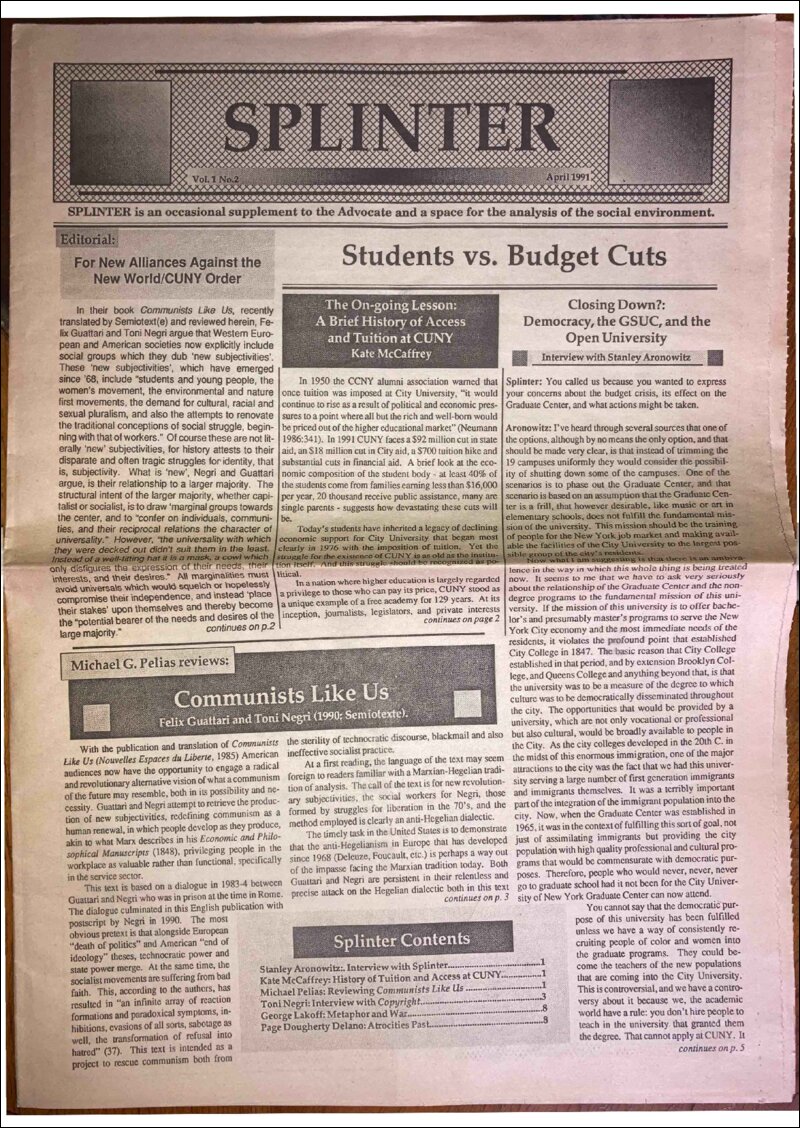
The Splinter
Item
PIII IIIS
KKK HK IOKIOK IK IOI IOI x ores
k SKK NN KH ee
ae seatatstatetatereteteteenteleiaeiaeeneieneenen NUMSUM NENNCRNENNRNS
SSK esos hatatgtate ntatatateta
POX OKO
HESS KRIS
| Weretete, a
i Peteretetetete oe, tere
BRK RKO
i atetetetetete! Oty,
SSSA
KKK SSS
OKO
ererererereteretere.
SSK
Mererererorete loca?
SOS SRS
TKK Rina
SSS
Wasesechsetetababete’,
erererereterere,
In their book Communists Like Us, recently
translated by Semiotext(e) and reviewed herein, Fe-
lix Guattari and Toni Negri argue that Western Euro-
pean and American societies now explicitly include
social groups which they dub ‘new subjectivities’.
These ‘new subjectivities’, which have emerged
since ’68, include “students and young people, the
women’s movement, the environmental and nature
first movements, the demand for cultural, racial and
sexual pluralism, and also the attempts to renovate
the traditional conceptions of social struggle, begin-
ning with that of workers.” Of course these are not lit-
erally ‘new’ subjectivities, for history attests to their
disparate and often tragic struggles for identity, that
is, subjectivity. What is ‘new’, Negri and Guattari
argue, is their relationship to a larger majority. The
Structural intent of the larger majority, whether capi-
talist or socialist, is to draw ‘marginal groups towards
the center, and to “confer on individuals, communi- | be.
ties, and their reciprocal relations the character of
_universality.". However,
suit the
only disfigures exoression of their needs,
interests, and their desires.” All marginalities
avoid universals which would squelch or hopelessly
compromise their independence, and
their stakes’ upon themselv y
the “potential bearer of the needs and desires of the
large majority.” continues on p.2
With the publication and translation of Communists
Like Us (Nouvelles Espaces du Liberte, 1985) American
audiences now have the opportunity to engage a radical
and revolutionary alternative vision of what acommunism
of the future may resemble, both in its possibility and ne-
cessity. Guattari and Negri attempt to retrieve the produc-
tion of new subjectivities, redefining communism as a
human renewal, in which people develop as they produce,
akin to what Marx describes in his Economic and Philo-
sophical Manuscripts (1848), privileging people in the
workplace as valuable rather than functional, specifically
in the service sector.
This text is based on a dialogue in 1983-4 between
Guattari and Negri who was in prison at the time inRome.
The dialogue culminated in this English publication with
postscript by Negri in 1990. The most
obvious pretext is that alongside European
“death of politics” and American “end of
ideology” theses, technocratic power and
state power merge. At the same time, the
socialist movements are suffering from bad
faith. This, according to the authors, has
resulted in “an infinite array of reaction
formations and paradoxical symptoms, in-
hibitions, evasions of all sorts, sabotage as
well, the transformation of refusal into
hatred” (37). This text is intended as a
project to rescue communism both from
“
“the universality with which | economic
must | litical.
Stanley Aronowitz:. Interview with Splimters...-s-ssmsessersseres
Kate McCaffrey: History of Tuition and Access at CUNY...
—AAAAK
22K? OOO
SOK
-@s
- The On-going Lesson: —_.
_A Brief History of Access
~ and Tuition at CUNY
Kate McCaffrey
In 1950 the CCNY alumni association warned that
once tuition was imposed at City University, “it would
continue to rise as a result of political and economic pres-
sures to a point where all but the rich and well-bom would
be priced out of the higher educational market” (Neumann
1986:341). In 1991 CUNY faces a $92 million cut in state
aid, an $18 million cut in City aid, a $700 tuition hike and
substantial cuts in financial aid. A brief look at the eco-
nomic composition of the student body - at least 40% of
the students come from families earning less than $16,000
per year, 20 thousand receive public assistance, many are
single parents - suggests how devastating these cuts will
Today’s students have inherited a legacy of declining
support for City University that most
{n anation where higher education is largely regarded
instead ‘place |a privilege to those who can pay its price, CUNY stood as
es and thereby become |a unique example of a free academy for 129 years. At its
legislators, and private interests
inception, journalists, r
continues on page 2
the sterility of technocratic discourse, blackmail and also
ineffective socialist practice.
Ata first reading, the language of the text may seem
foreign to readers familiar with a Marxian-Hegelian tradi-
tion of analysis. The call of the text is for new revolution-
ary subjectivities, the social workers for Negri, those
formed by struggles for liberation in the 70’s, and the
method employed is clearly an anti-Hegelian dialectic.
The timely task in the United States is to demonstrate
that the anti-Hegelianism in Europe that has developed
since 1968 (Deleuze, Foucault, etc.) is perhaps a way out
of the impasse facing the Marxian tradition today. Both
Guattari and Negri are persistent in their relentless and
precise attack on the Hegelian dialectic both in this text
continues on p. 3
___ Splinter Contents
Michael Pelias: Reviewing Communists Like US ---ssssvssseose
Toni Negri: Interview with Copyright...
George Lakoff: Metaphor and Wat........
Page Dougherty Delano: Atrocities Past..-sm-srsssecerens
Ce
Mn ergiateiaateiteteietets
OOO
SS
at,
SO OOo @ x
SSSI
SHRI
ewe eLetters |
sg LON ia “OSeeaee eee
SHI SISCKS
SIMS PI
SOR KK
< rerererereterets
. eretereteretetes
SSS 52050505 1
SR SKK
S585 0505]
Nb, Nesececececece,
ralecororotetoretetetotetets
SKE
OJ
QOOOOD
S568 0 QPL SOK SX
20>
Closing Down?:
Democracy, the GSUC, and the
Open University
i ig
Interview with Stanley Aronowitz
Splinter: You called us because you wanted to express
your concerns about the budget crisis, its effect on the
Graduate Center, and what actions might be taken.
Aronowitz: I’ve heard through several sources that one of
the options, although by no means the only option, and that
should be made very clear, is that instead of trimming the
19 campuses uniformly they would consider the possibil-
ity of shutting down some of the campuses. One of the
scenarios is to phase out the Graduate Center, and: that
scenario is based on an assumption that the Graduate Cen-
ter is a frill, that however desirable, like music or art in
fund
I
lence in the way in which this whole thing is being treated
now. It seems to me that we have to ask very seriously
about the relationship of the Graduate Center and the non-
degree programs to the fundamental mission of this uni-
versity. If the mission of this university is to offer bache-
lor’s and presumably master’s programs to serve the New
York City economy and the most immediate needs of the
residents, it violates the profound point that established
City College in 1847. The basic reason that City College
established in that period, and by extension Brooklyn Col-
lege, and Queens College and anything beyond that, is that
the university was to be a measure of the degree to which
culture was to be democratically disseminated throughout
the city. The opportunities that would be provided by a
university, which are not only vocational or professional
but also cultural, would be broadly available to people in
the City. As the city colleges developed in the 20th C. in
the midst of this enormous immigration, one of the major
attractions to the city was the fact that we had this univer-
sity serving a large number of first generation immigrants
and immigrants themselves. It was a terribly important
part of the integration of the immigrant population into the
city. Now, when the Graduate Center was established in
1965, it was in the context of fulfilling this sort of goal, not
just of assimilating immigrants but providing the city
population with high quality professional and cultural pro-
grams that would be commensurate with democratic pur-
poses. Therefore, people who would never, never, never
go to graduate school had it not been for the City Univer-
sity of New York Graduate Center can now attend.
: You cannot say that the democratic pur-
pose of this university has been fulfilled
unless we have a way of consistently re-
cruiting people of color and women into
the graduate programs. They could be-
come the teachers of the new populations
that are coming into the City University.
This is controversial, and we have a contro-
versy about it because we, the academic
world have a rule: you don’t hire people to
teach in the university that granted them
the degree. That cannot apply at CUNY, It
continues on p. 5
aseee ene:
bate
Smee ;
PLINTER fe
In the recent us, budget proposals which effectively
citizens of New York. | have already seen the coalescence of gut the quality of our education, and
"50s, three community colloges | the kind of collective politics described standardization tests which restore, de
© established: Suaten Island (1956), | by Guattari and Negri. Atleast in New facto, the racist and otherwise discrimi-
), and Queensborough (1958). | York City diverse groups such as ACT- natory entrance requirements which
however, these colleges together | UP, the African American Coalition, our minority and progressive predeces-
/ « ed 3% of the city’s high school | Students Against War, Transportation sors Iiterarily fought to dismantle in
graduates (Wechsler 1977:263). In 1950, | Allernatives, New Jewish Agenda, Mili- 1970. Within the next month it is very
City, Hunter, Brooklyn, and Queens Col- | tary Family Support Network, SANE- likely that the CUNY adminstration in
Jeges instituted a uniform provedure for | Freeze, Palestine Solidarity Commit- conjunction with the municipal and
processing applications and continued to | tee, and many more, sometimes sepa- state governments will use Ihe courts
ne entrance by 1959 it | rately and sometimes collectively op- and then the various security forces to
was set at 85% for all four colleges | posed the U.S.-led war against Iraq. ‘legally’ and violently suppress the stu-
_ (Women's City Club 1975:15). Between | Indeed, these ‘new subjectivilies' found dents defense of one the most crucial
| 1962 the municipal college sys- | a way to work collectively without com- democratic gains of the last 20 years.
tem whole experienced little growth | promising their respective cause to a We urge all of our readers, whether
pa to demand, Ai the 4-year sen- | universal. ACT-UP, for example, al- student, staff, faculty, or non-CUNY
ior colleges, total annual admissions in-| ways told us, "Health Care Not War- citizens, to support us — to oppose all
creased from 10,337 to 11,945 in 12 years, | fare”, while Transportation Alternatives _ tuition increases, budget cuts, and en-
number of bachelor’s degreecan- | urged, “Bikes No! Bombs”. And here at trance requirements, and instead call
for tax increases for corporations,
chsler 1977:262). Students Against the War consistently which must include Columbia Univer-
What seems to have been at the root of | stressed the disastrous economic im- sity and NYU, as well as the wealthiest
5% of our state. Democracy entails
more than an atrophied voting process,
cannot be enforced by our military
abroad or our police at home, and is
only realized in institutions such as
CUNY. S!
the first two years of the four year colleges. | the various campuses in opposition to
Since NY State created the SUNY system | tuition hikes which will make public
926 in 1948, there was a growing perception | education too expensive for many of
l isa that higher education was.a state, not a city | ——_—— AA
grew responsibility. City officials began to in- loudercalls for the administrative reorgani- mitment to and/or capabili i
¢ the population of tensify lobbying efforts to pressure Albany zation of the system, The Alumni Associa- New Yorkers’ denne hag om
m 6,276,000 to to. commit the same amount of resources to tion stepped forward once again, staunchly tion was a problem that intensified by the
growth CUNY as it was commiting to upstate col- defending the local autonomy of the mu- "60s. With the number of high school
amann leges (Neumann 1986:336). As if to nicipal college system, stressing that state graduates who would apply to college a
y ducation did not-necessitate state veritable “tidal wave' here growing
nn 1986:341). By 1961 a distiction made between “tree h is er edu =
D mn 1 ‘resolution was reached that validated the cation for the able,” and “free hig lu-
: in io 1 of tuition imminent, autonomy of the the city system, and re- cation for all" (Neumann 1986:348). But
r 1 Alumni Association forcefully lobbied named it the City University of New York. the notion that there were students more
college in for the passage of state aid bills that would Yet the same day that this bill was passed, capable of benefitting from higher educa-
é (Wechsler ‘compensate for the City’s diminished sup- another unrelated bill was passed in the tion than others, and that this ability would
n ‘it became port (Neumann 1986:338). State Legislature that repealed the tuition- be reflected in high school grades, was an
‘the univer- Thecontext in which the City beganto free mandate of the municipal colleges, and idea clearly at odds with the mandate of a
become pull away from its support for free higher substituted a tuition policy that would be at public university. It became increasingly
‘Until 1924 education appears significant On one the discretion of the Board of Higher Edu- apparent, moreover, that there were scrious
n were hand, the "40s and “50s were times of un- cation (Neumann 1986:346). Though stu- discrepencies between the ethnic composi-
precedented growth for higher education, dent fees had constituted a substantial part tion of the city and that of the university, In
and the level of resources required for ex- of CUNY’s budget since the Depression, the late 60's, African-American and Puerto
pansion were significant. On the other and part-timers, who were perhaps the least Rican-students led the fight for open admis-
hand, the "40s and "50s broughtonademo- affluent, paid for their classes, there now sions at CUNY. In an era of African-
graphic revolution in New York. Federal was the possibility of tition being im- American struggle for civil rights, cqual
of highway policy contributed to a white posed ona whole new scale. opportunity and social justice, students of
canis middle class shift from the urban centersto Open Admissions color called for the white citadel perched
tz suburbs Where they could buy their first The City University of New York's com- ona hilltop in Harlem to open its doors to
‘homes (Marshak 1982:4). Increasingly, Continues on nex! page
ed into the city replacing the whites.
‘ while NYC's population remained con-
wlyat_stant during the "50s approximately one
--Andrew Long, Michael Waldron
VSP OPAPP PAA PPO odo
MOO
xX) RRR KKK RE
Sewn wne e's ‘
‘The Graduate School and University Center Contributors
of the City University of New York
a 33 West 42nd Street
lew York, New York 10036 Stanley Aronowliz
Student Center 18 Page Delano
Telephone: 212-642-2852 George Lakoff
The SPLINTER Collective: Kate McCaffrey
Thomas Burgess Michael Pelias
Margaret Groarke Negri-Masumi-Jardine
‘Thomas Smith
Michael Waldron,
i ‘The opinions expressed in SPLINTER are those of the
Pishyut Individual contributors and in no way reflect the opinions of the
Doctoral Students’ Council, its officials or its represeritatives, . °”
noe hl
April 1991
..4 collective mobilization
Alice Jardine and Brian Massumi SEE Ry ieee
Translated by Brian Massumi,
Recorded July 24, 1986
[Editor's note: this interview original, journal
ly appeared in the j 1
Copyright (#1, 1987), We thank Brian Massumi for his ission
reprint the interview in Splinter! | : Ete ees
Alice Jardine: Reading New Spaces of Lib- mism of the will. Along with it comes an | and elsewhere (Anti-Oedipus, Marx Be-
erty [also known as Communists Like Us) aristocratic attitude and a definition of the yond Marx). As is well ova the He.
is what gave us the idea of talking with you. intellectual as one who is capable of volun- gelian dialectic is a progressive movement
Ne “Why? Because there isakind of disori- taristically pointing the way, asa Nietwzsch- | that is to say, it preserves, suppresses and
entation, even despair or cynicism, among can intellectual capable of breaking | lifts to a higher plane of synthesis that
radical thinkers today, especially in the through by force of will —a will that is not which it negates: wage {aber Ss cies It
United States, You and Guattari admit that organized as an ontological rationality or a | is from the standpoint of capital and that of
we are surrounded by despair, sadness, rationality weighed down by reality. the capitalist State which attempts to con-
boredom, monotony. ; To make matters Felix's and my optimism is in opposi-| tain and manipulate any kind of working
worse, the despair is individualized, and tion w all of that. Before defining the con- | class antagonism in which Guattari and
isolates people from one another, Even in tent of that optimism of reason, it is neces- | Negri make their intervention. They sub-
your own texts there are things I find terri- sary to say that there is something in indi- stitute the concept of antagonism for that of
bly depressing. Especially in your book viduals’ lives — respect, sharing ideas, the | contradiction and describe the dialectic as
with Guattari, in which you explain that possibility of contact, the possiibility of | relational rather than contradic! situ:
under what Guattari calls Worldwide Inte- building something together — that in | ated in the relations of pear a Le
grated Capitalism we are all subjugated philosophical terms is a constitutive force. | in the forces of production. Although the
because power is no longer localizable. 1 This constitutive force precedes every
find that attitude Central to the pessimism moment of profound illumination of real- | lated to capital, it is nev-
surrounding us, But the reason we arc here ity. That is the optimism of reason. Itisan | ertheless an : autono-
is that in Spite of all of that, we found opti- optimism that pertains to the construction | mous expression
mism in New Spaces of Liberty. In fact,1 of subjectivity as such — as opposed to a | against capital. From
have never read anything of yours in which pessimism of the will, in other words a | the perspective of the
that optimism doesn’t appear, at the begin- pessimism with respect to.action. Clearly, | working class, there is
ning, at the end, or throughout. This is true on the level of action we have suffered | no synthesis in its
even of your interviews. For example, in many, many defeats. We have lived i id
an interview throw, ¢ Be
orizauion allowing 4 an -
with the immense ethical project of peac creates a relation, a mecting of minds, a
That is an optimism I share at a certain possibility of communication, of construc-
Ievel. Could you explain in more detail tion, of the constitution of something new.
where this optimism comes from and As for the content, the optimism of reason | and Negri cnvisage a new group of revolu
where it leads, given the present stale of means that everything we did in all our | tionary subjecuvities in the antagonistic
things? I am particularly interested in the years of struggle — more than that: every- dialectic who may actually refuse work or
“optimism of reason, and pessimism ofthe thing that has characterized the twentieth transform work itself, giving us a new
will.” century — is irreversible, This irreversibil- revolutionary class composition. Two
ity is absolutely fundamental. What was lines of alliance are delineated in this new
Toni Negri: “Optimism of reason, pessi- the twentieth century? It's almost over! political program, molar antagonisms as
mism of the will” is directed polemically I studied the nineteenth century exten- | group struggles in the workplace against
against the traditional position of the Com- sively. People would say that, depending | exploitation, and molecular proliferations
munists of the Third International: “pessi- on the point of view, the nineteenth century | as isolated instances of struggle within col-
mism of reason, optimism of the will.” cither ended ten years before 1900 or four- | lectivities, transforming relationships be-
What does that mean? It means that from ten years after. Ten years before: 1890, | tween individuals and collectivities.
the point of view of relations of force real- about when the Socialist Party was being What does this new subjective con-
ity cannot be changed, that one cannot at- organized in Europe. Or fourteen years | sciousness engendered by the collective
tack it, but that one can commit oneself toa after: the outbreak of World War 1. You | work experience mean? Labor has been
cause in a totally voluntaristic way. The really can look at it that way, even from the de-territorialized, and the global blackmail
optimism of the will is will-power exer- viewpoint of cultural history, of a Kul- | that Integrated World Capital has induced
cised against the dictattcs of reason, I have turgeschichte of the nineteenth century. | makes it virtually impossible for people to
always considered this position blind, mys- Now, my impression is that, from the point | live without being threatened into thinking
tical, and unreasonable in the worst way. of view of exploited peoples, at least two | that there is no future or possibilities of a
Inherent in this conception is the idea that major phenomena have characterized the | future liberation for alternative modes of
ifreality can be changed at all itis only bya twentieth century: the October Revolution | expression, experience and practice. Work
small minority, by an entirely singlular in 1917, and the great process of decoloni- | and life are no longer separate, In a poctic
will. [have seen this pessimism of reason zation of the postwar years. From the capi- | Nourish, Negri and Guattari call for love
and optimism of the will in action in terror- talist point of view, it has been character- } and reason, re-articulating the communism
ism. All of the terrorists 1 have known ized by the construction of a world market, | of the future as nothing other than a call to
were people who thought that nothing and the nuclear overdetermination of that life, a collective mobilization for freedom
could be done. They were desperate. They market. This places us in a contradictory | that will inaugurate an entirely different
thought that only an individual act that situation, We can say that the new rela-
broke through the crust of reality could tions of force that the twentieth century has eat ; a
have a positive impact. I would say, fur- constructed are indestructible, and that the the capitalist state is overdetermining, in
ther, that this pessimism of reason and working class has irreversibly negated it- the sense that its power has reached meta-
optimism of the will is found to some ex- self by demanding wage rights, the right of physical proportions: it has the power to
tent in all of the catastrophic, chiliastic cur- reproduction, and the right ot wealth, Or, destroy the world. The universe. For the
rents of contemporary thought, This prac- we can point to the desire for revolution, first time in history human beigns have the
tico-matcrial inertia of the real presupposes the desire for transformation, a profound ability to do that, by means of nuclear
the exceptional moment, the Blitz of rea- urge to transformation, as something irre- power. Not only nuclear power, but also
gon, the Jetzt of the moment of rupture. 1 versible. People have changed, But the biological engineering and any number of
sec this as an internalization of Leninsim: a change in the situation of the capitalist state other things under development. Nuclear
thorough pessimism of reason and an opti- is equally irreversible. Itis undeniable that power is that power at its height. So, it is
working class antagonism.
By rejecting the more pious and com
working class is within and by necessity re- posed into a subversive and innovative
--people in the
workplace as
for freedom that will inau-
way of working together...
way of working together and “a singular
of individuals and groups emphatically not
reducible to each other™ (17),
In the sixth and tau dialogue of the
text, “Think and Live in Another Way,”
Guattari and Negri offer a five-point politi-
cal program. Introducing 3 new series of
definitive perspectives which imply the
fequirements of patience, courage, and in-
telligence, they sce a crystalization of new
Organizations in which the old slogans,
such as “let a thousand flowers bloom” are
Uansformed into an analytic key for grasp-
ing the social characteristics and dimen-
sions of productive labor and are recom-
presence. The five
movement's radical
separation i
and stale appariuses,
- peace movement as the beginnin,
promising Hegcl-like synthesis, Guatarri of the revolutionary program; and (5) G
nally creating capable organtzauions.
Although this series of dialogues is
dated, Negri and Gualtari in a prophetic
vein have anticipatcd the further extension
of Integrated World Capitalism into what is
now called the New World Order. In the
time of a generalized fecling of helpless-
ness and despair following the capitalisuc
states’ military display of its latest ad-
this text itself becomes a molecular prolif-
eration, at once refreshing and hopeful,
utopic in scope, providing new tools for
for subjectivity-in-process. The most re-
markable aspect of the dialogue between
these two thinkers is their tonal optimism
and their relenilcss critique of Integrated
World Capitalism and the subjection, sur-
veillance and servitude it promotes. One
can only be reminded of the words of
Marx, “The revolution is dead, Long live
the revolution.”
Michael G. Pelias is am instructor and tu-
tor in Philosophy at Long Island Univer-
sity. He is currently writing a book on
Nietzsche and Spinoza.
—
true that those in power have this enormous
tool of destruction. But is is also tue that
the unification of the world market means
that what was once the class struggle is
now an integration of struggles that reaches
right into the citadel of capital, the head-
quarters of comand; that the crisis in the
Argentine and Brazilian economies strikes
at the heart of capital, This contradiction is
continued on page &
tasks include (1) the |
tg
April 1991
CUNY college. Rather than only high
school averages, a combination of high
school average and class rank were used to
determine entrance into the university, For
example, a students with an average of 80
or better, and/or ranking in the top half of
Harvard,” and the “alma mater of Nobel needs of students of color: that a school of their graduating class, were guaranteed
Jaureates;” who were romantically ued to Black and Puerto Rican studies be estab- spots in a senior college (Lavin 1981219),
the notion of CUNY asa place where hard lished; that a separate orientation program The following Fall, the university admitted
working immigrants “were civilized” (see for Black and Puerto Rican students be es- a freshman class of 35,000 students, a 75%
‘Martin Mayer’s article in Commentary 2/ tablished; that students be given a voice in increase over the previous year (Lavin
73). Underlying these arguments about the administration of the SEEK program; 1981:19). The ethnic balance of the uni-
“maintaining standards” was a more that the entering class reflect the ratio of yersity changed dramatically; by 1971,
charged debate about the centrality of a Blacks and Puerto Ricans in the total enrollment of students of color rose to 24%
school system; and that classes in Spanish at senior colleges and 36% in community
The debate over open admissions at language, as well as Black and Puerto Ri- colleges, among the highest representation
City University stemmed from a concem can history he mandatory for education of students of color for any public univer-
that rapid growth and lowered standards majors (Ballard 1973:124). The tactics sity in the country (Gorelick 1980:28).
would lead to a “cheapened” degree. And were more extreme: chaining the gates to
in a cily where all believed that a degree South Campus at City College; occupying the massive expansion of public higher
from Brooklyn, City, Hunter, or Queens the office of the president and effectively education remained unclear, State support
College had heretofore facilitaied social. bringing about his resignation (Marshak for open admissions came from a governor
Yet the depth of the commitment to
o oe, reat mobility and provided some economic se- 1982:15). And there were those who found who in his re-clection campaign would
Jege and demanded that it meet the educa-
tthe group tional needs of the city’s population, Pro-
(Heller 1973211)
‘graduation rates from high should aim to“{maximizc] the educational
‘admitted (0) enirance,” rather than “ensure its own pres-
don west per (Rossmann
s 1975:2). At the core of the arguments for
American and sity, “Opening up a chance for the cx-
“edu- cluded many does not preclude meeting t=
> no right lo serve one group while effec-
but financed by the citizens, as much by
hose “who receive college training with-
tusition charge as by those who are
1973:129).
‘curity, a “cheap” degree rendered it too the demands threatening:
At the present moment the American
educational establishment is being
dent intent is not a changed but im-
proved system: it is the total destruc-
tion of the system itself, together with
the society which relies upon it.
look for the votes of those who supported
the open admissions plan (Wechsler
1977:287). Ata time of heightened racial
tensions in New York and in the nation,
ing was another issue. From the beginning,
there was considerable resistance from cer-
lain factions over the expansion of public
education. Former Columbia Dean Jac-
ques Barzun, who presided over a confer-
ence on open admissions in Washington,
DC, in 1971, predicted that “open admis-
| New York in the"S0s, grades. They argued that public education There were others who suggested that sions will be a minority privilege for which
what was really being demanded was that the entire country will be paying through
the university fulfill its mandate of service various forms of taxation” (Ballard
to the working class, that human needs not 1973:133). A 1970 article in Fortune
sd by corporate terms, but by the magazine commented oropen admissions
‘whole people,” in this case,
working class minorities (Gorelick
n 19812194). Furthermore, it was recognized
‘were unable to open admissions was the conviction that that it was not sufficient to slot students of
‘Critics elitism had no place in the public univer- color into places at 2-year colleges. Over
the years, the community colleges had be-
come the place where students with high
school averages of 75-85% had gone, with
significant obstacles preventing tiem from
| tively excluding another” (Rempson further transfer. Proponents of open ad-
es of 1973:37), Moreover, il was pointed out missions were careful to call for a plan that
f that public education was indeed not free, would not result in the “ghetto-ization” of
the community colleges (Ballard
Underlying CUNY’s bold venture are
the premises that a large number of
disadvantaged students have the native
ability to master college-level instruc-
lion, and that their initial handicaps in
reading and math can be overcome ina
fairly short time.... It is unsettling to
think what the CUNY policy might
lead to. Adopted universally, it would
bring about a huge jump in enroll-
ments. (Gorelick 1980:21)
A1975 study of CUNY’s open admis-
In response to political pressure, the sions policy concluded that it was unlikely
from it by high admission require- Board of Higher Education implemented that open admissions would be abandoned
an open admissions plan in the Fall of 1970 openly: “that would be politically impos-
that was 2 compromise between a variety sible - but it could be nibbled away or
of plans put forth by students, faculty, and starved to death” (Women's City Club
an ad hoc committes on admissions. Prior 1975:4).
to 1970 admission to any CUNY college Conclusion
was based on an applicant's high school
average or acombination of an applicant's Education voted to impose tuition at the
In June 1976 the Board of Higher
April 1991
A Brief History of Access and Tuition at CUNY
continued from page 4
New York City's financial woes. There is
evidence to suggest, however, that the im-
position of tuition at CUNY was not an
economic necessity, but one of many his-
toric attempts to withdraw financial sup-
port from public higher education in New
York City. In the '70s as in the "30s, critics
argued that the City could no longer afford
the university. Yct at its peak, financial
support for CUNY amounted to only 4% of
the City’s budget (Gorelick 1980:29). John
Sawhill, the president of NYU, chair of the
private college’s lobby group, and a mem-
ber of the State Emergency Financial Con-
trol Board was instrumental in pushing for
cutbacks at CUNY (Newsday 5/16/89:54).
Yet even when tuition was imposed, the
City called for more drastic budget cuts,
with the aim of severing all municipal sup-
port for the university (NYT 6/22/76:1).
Tuition fees never reached the university's
operating budget, but went to pay interest
on City construction bonds (Gorelick
CUNY, tuition was matched instead with
severe budget cuts. The community col-
leges had been scheduled to take on an
added importance with open admissions by
absorbing most of the system's students.
They now were forced to cut classes, staff,
and tenured faculty (NYT 7/27/76:21).
Brooklyn College, which served 30,000
students was forced to cut $18 million in
two years to bring its:
million (NYT 7/25/76:32)-
College was shifted from a 4-year to a 2-
year college. In three years CUNY was
forced to shrink its teaching staff by nearly
50% and its student body by 75,000 (New-
sday 5/16/89:54). African American and
Puerto Rican students showed the greatest
enrollment decline on all levels (Gorelick
1980:33).
Today CUNY faces some of the most
severe budget cuts and tuition hikes since
1976. At the same time, the CUNY ad-
ministration has announced a renewed con-
cem for “stiffer preparation for students’
and “higher educational standards” at
CUNY. A quick glance atthe history of the
university reveals that such concerns have
been most pronounced at times when there
was a desire to limit the student body.
In the Fall of 1990, for the first ume
since open admissions, City University
turned te between 3000-5000 qualified
References
“After Tuition,” NYT, 6/3/76, p36.
students, claiming inadequate space and
staff to cope with the level of applicants
(NYT 9/26/90:1). Ata time when its en-
rollment is the highest since 1976, insuf-
ficent financial support has brought on hir-
ing freezes, tuition hikes, and substantial
budget cuts. With increasing austerity is
the growing perception that the battle over
budget cuts is a power struggle whose piv-
otal issue is race (NYT 5/28/90:1).
In 1988 and 1989, student protestors
took over administrative offices. Roughly
10,000 took to the streets of New York
charging that now that more students of
color are able to take advantage of public
education, elected officials are abandoning
their historic mission to educate the work-
ing class. The City and State continue to
hide behind various budget crises to ration-
alize tuition hikes and budget cuts. Yet
over the past 15 years while the State
chopped away at CUNY it found millions
of dollars to subsidize private education in
CCNY alumni association issued a scath-
ing response to those who would attack
their alma mater:
Now when the government of the city
is profoundly disturbed by municipal
problems of the gravest nature, all the
the cloak of civic welfare their hatred
of races and creeds not their own, rise
up in ignorance and hypocrisy to call
the college a luxury, and by their bla-
tancy in troubled times, to disturb the
calm minds of those who desire to do
well. (Neumann 1986:119)
Ata time when the “children of the
poor” are again facing the imposition of
admissions requirements and tuition hikes
that will function to homogenize and bur-
den the student body, and at a time when
the university faces budget cuts that
threaten its diversity, its vitality, and ulti-
Page 5
Axonowilz Interview
from page 1.
cannot apply because in the first place we
have the opportunity. Even if we take it as
our mission to be held by and for the city as
well maintaining a national or international
reputation, we should be training increas-
ing numbers of people of color, women,
people from new immigrant background
and immigrant groups who will go back
into the university and become primary
faculty. Columbia and NYU and Stanford
and the University of Chicago and the Ivy
Leagues and the Universities of California
are not going to be the source of faculty.
We have to be the source for the faculty.
Its a mission that we haven't defined for
ourselves yet.
Splinter: Actually if they are afraid of
nepotism and inbreeding then what you
just said about the campuses of City Uni-
versity being dispersed among quite a
number of senior colleges actually speaks
for the fact that we could hire CUNY
But what I wanted to emphasize is that
the preservation of the Graduate Center has
to do with the continuation of the orienta-
tion of the university itself. If we see as our
mission not just bringing people and giving:
have no choice.
the ff
linctions between natura! science. social
sciences and the humanitics are largely
spurious. They are rooted in 18th C. con-
ceptions of knowledge and at best 19th C.
conceptions of knowledge. After all many
of the disciplines in the social sciences, and
in the humanitics are only a century old_
We used to have literature, philosophy and
theology and that was it. So that the new
disciplines in the humanities—compara-
tive literature and so on, they are very new.
They themselves were responsive to
changes. But 1 am speaking about broader
mately its existence, students would do | categorical transgressions. We have
well to remember the words and the | begin not simply to talk
struggles of their predecessors.
Kate McCaffrey is a graduate student in speak of
the Ph.D program in Anthropology.
“At City U., Ending of a 129-Year Policy,"NYT, 6/2/76, p.)-
the language of an
interdisciplinary approach, but to talk the
language of non-disciplinary. We have to
knowledge in relationship to the
new problematics that have been proposed
not only by French and German philoso-
but also within our own tradition by
people like John Dewey. These have not
The disciplines, based upon the dis-
Spay jel
ts |
rstand exactly
what you are talking about. But Iam pos-
ing this in the way through which historical
figures that made this university made the
colleges famous posed it These people
built the school as a way in which there
would be cultural critique and cultural dis~
semination. Part of this contract is not
of é : es 2 * eae 1980:30). the form of Bundy Aid. ates. simply know-how to create the technical
ai tremens Older ethnic groups ee ae soon aig ae = opening a doors of the City University There were increasing demands forthe In March of 1932 in the midst of the _ labor for New York business and New
x eo ‘echsler 197 a a, a! pages aoe as as WAS). DO! pepo’ way of avoiding state to match aid for tuition-paying CUNY Great Depression, acting Mayor of New | Aronowitz: Yes, this is what I just said. York public agencies but to provide a
“only” 82 Pea cos ere those who wanted eee aha ae “les Sexer oe ing es long-term students at the same Ievel to aid with tui- York, Joseph McKee, proposed closing | We could hire CUNY graduates. And we democratic vista the city asia whole, to pre-
85-87. - , (Granger ange cee ap ther eS beritinrs fee aad she ir ae ig nsurate with the undertak- tion-paying SUNY students. Yet at down the municipal college system. The | might violate the informal nepotism rule. vent the city from becoming basically de-
politicized and decitizenized if you wantto
zenship function, the power of this univer-
as
obligation to maintain this pl.
cultural center.
Splinter: So how might we advise the
chancellor who for instance thinks that if
would be innovative to take non traditional
students, people of color, women, snd sce
that they are trained in graduate saadics m
the traditional disciplines?
Aronowitz: All I have to say is, im answer
to that, I mean, what Ann Reynolds thinks
is innovative and what | think is innowative
may be two different things. I have letters
here on this very desk from people of the
Dominican Republic, of Venezuela and
Puerto Rico, people who have called me
many times from Lann Amenca, who want
to come here because we offer the pessibil-
ity of a multi-disciplinary spproach. And
in fact, there are non traditional students
SO enon? i sption from the South Bronx who have all the cre-
i nivel “ ow!
Gores Sher. yaloge the ea Flee re heady Radel erin 14 DAL poem’ is ndedinGermanand graduate school but want to come w
Gorelick, Sherry, “City College: the Rise and Fall of t ry, erica cational project is grou na . =
pp 21-35. Lester B, “A Report on the City University and its Proposed 1964 Master Liebe se eye be — CUN Sora re sds ae reputapon.
Crane the Deathof te American University, New Rochelle, Arlington ean ition, coneey pies ed a ae ——
i rok yn College; The First Half-Century, NY, Brooklyn Co i
Urn Dvd a Rig Vr Lio onin wee i You stared off by loosely de~ got to enier into a uaditional department
Lavin, David et al, Right Versus Privilege, NY, The Free . Ee VES Fare Splinter: You we
te Felicla “Minority Issues Lie Behind Protest Over Cutting of Budget at fs : abla w bia Saket beeecasie ante ait ical are “ =
ate Renewal i fulfill rg “
i : President, Washington, Uni university and the immigrant and poor 0 :
gator mse apenas : pated of the city. 1 think some ment and do this kind of ee!
people would say, well the contract, the cutting-edge work on your own lime.
terms of the contracts are that we are here that's a shame.
to provide the kind of know-how that will :
since these populations a means Splinter: If you were Se ET
through which to rise socially, economi- the kind of proposals that ec beard
Newsday, 5/16/] cally, whatever. That contract does nor about recently, Bow would you respond?
entail what the Graduate Center does, &
does not entail intellectual and political de-
velopments.
| high school average and aptitude test City University of New York, ending a 129
scores. Generally speaking, those students year policy of free higher education. Tui-
with averages of 85 or above had achance tion came at a ume of system wide shut-
to enroll in a senior college; those students down, ordered by the Chancellor after the
with averages of 75 or above were eligible collapse of legislative efforts to provide
to enroll in 2-year liberal arts programs emergency funds to meet the university's
of with the possibility of wansfer, those stu- year end bills. The imposition of tuition
h dents with averages of 70 or above could effectively abandoned the effort towards
in 2-year career programs. Those open admissions launched six years carlicr.
st with averages below 70 or those A student senate leader at the time de-
who had not taken an “academic” program nounced the resolution as a “complete sell-
h school, regardless of their class out" (NYT 6/2/76:34).
© ineligible for admission to any Most literature reflecting back to this
within CUNY (Rossmann period situates the imposition of tition in
0). Thus, under this policy, only the context of city-wide fiscal crisis (see
é of high school graduates were eligible Lavin 1981; NYT 6/2/16). Accordingly,
With the new the City University was seen as only onc of
all high school Many institutions inevitably affected by
toa continues on next page
L
Mars!
“More City Unversity
Neiman Florence ‘Access to Free Public
1973, pp.35-37,
‘An Analysis of the First Year
issions,” Urban Review 6.0),
City University of New York
1986.
Rempson, Joe C. “The Case for Open Adm ‘
Rossmann, Jack E. et al, eer a
Sa era eeuert *About Education: A Private Heist SUNY Bucks,”
tein, Jus
vali Harold S. The Qualified Student: A History of Selective College Ai
Wiley, 1977, facto, Budget Cuts, CUNY Tums Students Away,” NY
o 2
missions in America, NY, Jo! Interview comimmes om Pat
T,9/267%, p.
Weiss, Samue
April 1991
TN: Yes. That was when the working class, laboring
classes in general, came to be seen by capital as fundamen-
tal elements in the reproduction of the system. This is
something absolutely fundamental. It meant that wages
BM: In other words, power has become immanent to the were no longer an independent variable. They became a
of critical impor- social, and the points of confrontation have multiplied. dependent variable of economic growth. What drove the
¢. That is the opti- ‘Thus the possibility of resistance is everywhere. system was the wage variable, in other words the variable
: the existence of pertaining to the physical reproduction of the system, to
the reproduction of the most important commodity of all:
labor-power itself.
‘AJ: Then why is there a tendency to experience this com- 1929 represents the adoption of Keynesianism in virtu-
as monotony and boredom and the impossbility of ally every advanced capitalist country. It represents the
from the fact that action? Where does this sensation of monotony come setting of standard monetary values which was accom-
4 irreversible movements, from? If there are so many points of resistance and so plished on a global scale at Bretion Woods in the carly
ane 7 many ies, where does the inertia come from that 1940s. _ The postwar period saw the generalization o:
‘reach another crisis point? we feel so deeply in our bodies, in our daily life, in our Keynesianism throughout Europe, by means of the
y Marshall Plan. A new cconomic model was set in place:
stl Be saints, ‘This situ~ recovery and restructuring through the transplantation of
ae Le [TN: From the gap betweenthe two processes. Ontheone the American model to Europe. This was the rise of what
theend of the hand, there is a process of production of subjectivity, par- I call the “planning state.” The planning state lasted up to
Leninistin the ticularly in the domain of the state, and large-scale eco- the 1960s, when pressure from the working class pushed it
1. And the two nomic powers that have reached very high levels of ffi- beyond its limits, namely the orderly reproduction of the
f we can pinpoint ciency. On the other hand, there are processes constitutive system,
the 1950s, 1968 to be precise, of new subjectivitics that sometimes submit and some-
the normal state of af- times resist. It is aclassic gap. Our period resembles two BM: So the transition, the crisis, was provoked by resis-
new. It would be other periods. First, the end of the Renaissance and the tance. It wasn’t an internal result of the logic of capital-
nic evolution began first half of the seventeenth century, That period saw the ism.
‘that is when the defeat ofa revolutionary ideology coextensive with Italian
‘about became com- humanism; and, parallel to humanism, of certain currents TN: Absolutely not. But we shouldn't oversimplify,
interiorization became of then nascent protesiantism. Both were reduced, the first. Obviously, from a capitalist point of view, there is the
fact of the political his- to the new modem state, the second to the Reform Church. ever-present problem of permanent overproduction.
ig like it had already They are forms and contents of defeat. But beyond that Keynes, analyzing the New Deal, stated that it was impos-
‘of the bourgeoisie. | there was life, a vital movement that continued and took sible for an economy organized along the lines described
but I believe that on the most varied of forms. There were the libertines and in his theory to sustain itsclf without war, The reason is
‘can recognize, that they are the new sciences, which broke with one revolutionary overproduction: at a certain point things are produced that
ja certain development that politics and joined forces with another. The bourgeois cannot be sold. The production of war has the enormous
Fcrisis, Wecannotget out revolution came outof that. The other period is the Resto- advantage that things can continue to be produced and
ct, in other words that ration that followed the French Revolution and Napoleon- destroyed without having to pass through the market.
s sahon imemal ‘ctionary compared.to the Enlightenment. But it had its BN: Al of this relates to decoloniza in other words
ere phenomena of historical irreversibility that proletariat.
isa involved a break-up of ideologies and a splintering of sub-
every jective continuities, But they also included the possibility
nates there is of following lines that were already in motion and were
: . This isnot irreversible, and of king them further. On the other
disappeared, as the hand, 1968 was something that came too carly, and now
contradicitons are must find a form to settle into, The last ten years have
fialist conception. It been truly horrendous in some ways, It is often said that
‘infinite, that all that remains of our social and historical panorama are
ns. Thatis shadows, We are now beginning to see the shadows take
ischizophre- form, However, much remains to be done.
TN: Yes, the oppression of the decolonized proletariats is
especially important. Decolonization comes to be inter-
preted as a new quest for commodities on the part of the
decolonized nations, and for the moncy to buy them. For
example, after World War II the Arab countries make their
entry onto the world stage,
AN: And what an entry!
TN: The same thing happened with the Southeast Asian
countries, Two systems were in operation: the Keynesian
system within the advanced capitalist countries, and, inter-
nationally, another Keynesian system, that of Bretton
Woods (the pinning of the gold standard to the value of the
dollar, which was the basis ofmoncy exchanges betwen
capitalist countries). That all fell apart in 1971, when
Nixon declared the value of the dollar to be independent of
gold. ‘The capitalist countries had to learn to deal with the
uncertainti¢s of completely open exchange. That is what
inaugurates the crisis state, in other words a state that no
longer attempts to ensure orderly relations between the
laboring classes and capital, between wages and profits,
but instead secks to regulate shifling relations that have
not yet taken definite shape. The hope was that this would
be @ temporary situation, But it wasn't; it wasn'ta period
ora phase, It is the very definition of the turn of the cen-
tury; crisis as a normal, organic situation.
it bizarre BM: You said that 1968 was the wansition, It was the
u've gol transition to what you call the “crisis state.” What was the
Lwe're preceding suige of capital? What did that transition con-
ove you sist of? What brought it about?
ae
oad
TN: What 1 am about to say is in pant based on my own
fesearch, and in part on work done by the Italian move-
Ment asa whole, and also the French, 1929 is fundamental
‘the changes that the structures of the contem
BM: The planning state is characterized by a compromise,
by the working class's compromising itsclf. The Italian
Communist Party's campaign during the 1970s for a“‘His-
toric Compromise” with the Christian Democrats can be
‘Seen AS an attempt to regress to that Keynesian phase. The
Autonomia movement, on the other hand, was marked by
A total rejection of that compromise, a total rejection of the
existing organization of work. What exactly did this “re-
fusal of work” involve? What strategies were employed’?
oY aaa
April 1991
from previous page
TN: Before I can respond to the last question I have to
cover a lot of history. The transition from the planning
state to the crisis state also marks a transition in the struc-
ture of the subjects implicated in that process. Obviously,
as always, there is an initiative on the part of capital run-
ning through the various state forms. The Keynesian state
is also the Fordist state. Fordism is on the microscopic
level what Keynesianism is on the macroscopic level.
Fordism is a precise relation: the workers’ wages should
enable them to buy the automobiles they make. At the
same time, the Fordist state is a perfecting of Taylorism, in
other words of a form of work where skilled labor is re-
placed by the assembly line. The work required is com-
pletely unskilled . The working class is no longer hierar-
chically organized with the skilled workers of the large
factories on top. There had been a whole working class
ideology that went along with that and depended on the
workers possessing the production plan. That falls by the
wayside, becoming an archeological vestige. Today in
Italy southerners go north to be thrown onto the assembly
line to carry on that large-scale production. France has the
Arabs. Germany has the Turks. The United States has
everybody. They have lost the privilege the traditional
working class had of knowing about production, possess-
ing it.
BM: Everything becomes fragmented.
TN: And it’s work that anybody can learn in two hours.
BM: Now only the capitalist knows the plan, while at the
same time the worker has become a consumer,
TN: That's right.
BM; So the refusal of work is the rejection of this organi-
zation of work. ...
TN: Clearly.
a
‘TN: In short, of the role assigned to what we have called
the “mass worker.” The passage from skilled worker to
mass worker is contemporancous with the transition from
the traditional liberal-democratic state form to the plan-
ning state. The planning state is predicated upon the mass
worker, The mass worker is the flipside of the planning
state. And in their massification mass workers massify
desire, they massify their needs, That massified pressure
is what brings the planning state down.
BM: Soon the onc hand we have a refusal of that organi-
zation of work, That implies, for example, the sabotaging
of the industrial process — Italian workers practiced many
forms of sabotage through out the 1960s and 1970s, And
on the other hand, we have a rejection of the consumer
function: hence auto-reductions, whereby people unilater-
ally decided to pay less for goods and services than they
were asked to pay. The strategy was two-pronged.
TN: Precisely. There ws a two-pronged strategy — the
social side of which became increasingly more important.
In other words, the role of auto-reductions and grassroots
organization grew. Why? Because the breakdown of the
planning state, its transformation into the crisis state, is
accompanied by a restructuring of labor-power and of the
constitution of the working class itself. A struggle was
waged against the planning state, inside and outside of the
factory, People’s lives and reproduction outside the fac-
tory came to be seen from a wage perspective. People
came to understand that the processes of the accumulation
ofcapital pervaded all of society. Society had become a
factory — all of the mechanisms of the reproduction of
labor-power were not completely dominated by capital
and its state. Under these conditions, wages became social
wages, and all of society became the battleground, In
order to reconquer an individual territory, it was necessary
to attack the state, to contest capital; it was necesary to uy
to destroy everything in order to build one's freedom.
Auto-reductions played a role, but so did direct appropria-
tion. And not only direct appropriation, but also wide-
spread pressure on public spending, in other words on the
welfare system. Public spending came to be scen as a form
and to apply all of their abilities, intellectual and other
of salary. This idea was taken up by the women's move-
ment and by young people, by all those excluded from the
factory as a center of struggle. Without the women's
movement, Autonomia would never have gotten off the
ground in Italy or anywhere in Europe. Autonomia in Italy
began with demands for autonomy by the young, with at-
tacks against the city and regional governments. The de-
mand was made for a salary for the young and for students.
Government budgets became overburdened and there was
acrisis in public spending. Rember the budget crises of
the late 1970s in the big cities in the United States, in par-
ticular New York; these were characteristic of a certain
moment in the transition from the planning state to the
crisis state. What happens when this kind of pressure gets
to the point that it can no longer be sustained? According
to Marx, and 1 am in complete agreement with him on this
point, technological change occurs when struggles make it
impossible to maintain the old technologies. Strikes at-
tract new technology — strikes.in the literal sense, in other
words ruptures in the system, This is casily verified in
Germany and Italy. It is in the most depressed areas that
the work system falls apart, and it is there that it is first
replaced: examples are the automation of factories, and,
more importantly, the socialization of reproduction. It is
true that production has moved outside the large-scale
factory, and that the factory no longer exists as a center of
struggle. The situation has changed, and it was the
struggles that changed it. The new situation will be en-
tirely different.
BM: We have passed from the mass worker to the social
worker,
‘TN: We have passed to a form of the organization of work
that presupposes a social subject. The workers are still
mass workers, but their work-place is different. They are
no longer to be found in the factory: they are spread
throughout society in the most diverse forms. It is crucial
to understand that this is more than a change in location.
> pert eet DCs
wise, to that work. These new forms of work and the rela-
tions they imply are very abstract. We ure beginning to see
social segments where wealth is no longer simply the ab-
sorbtion of labor, where itis no longer simply what people
do, It is also, for example, the form of the family: for a
man who works at home, his relation with his wife is a part
of his wealth, as is his relation with his children, who may
contribute to the work. Wealth has become an overall
social organization, The phenomena we are beginning to
sce, like all phenomena of capitalistic change and transfor-
mation, are highly complex and highly ambiguous. On the
one hand, we have the break-up of the factory as we know
it. On the other hand, we have a socialization of produc-
tion, At the same time, the application of labor-power has
become increasingly abstract. In other words, the worker
becomes more and more mobile, both in space and in
terms of the work day. Above all, the worker's capacity to
work becomes increasingly intellectual, and as a result
increasingly adaptable and transformable, The labor-
power of social workers is not tied to a craft, as was the
case with the skilled worker; it does not hinge only their
physical mobility, as with the mass worker of the assembly
line. Their labor-power is general, abstract, as plastic as
the requirements of the machine in the age of the comput-
erization of production, However, the abstraction | am
talking about is at the same time a very special kind that
constitutes subjective qualitics, All social processes fold
back onto the worker, and it is through that folding back
that the worker comes to recognize him- or herself as a
subject, attaining a consciousness of his or her singularity.
So, we have four clements: the break-up of the factory, the
socialization of work, maximum abstraction of labor, and
an extreme subjectification of the sites, positions, and
wages involved. In other words, a powerful disunification
has taken place.
AJ; In this context, sabotage . . .
TN: Atthat point, sabotage becomes meaningless, At that
point, Sabotage played an important role. It has been the
worker's natural defense — especially the skilled
worker's, because the skilled worker has a greater possi-
‘The quality of the work itself has changed. Workers areno
bility of refusing to work. Think of that great undertaking
of sabotage, the French Resistance: the communist Resis-
tance was nun by skilled workers who knew, for example,
how to sabotage a railroad. Think of Basque terrorism. It
is terrorism as a craft — skilled work. They can use dyna-
mite as only miners know how. Sabotage is the form of
resistance proper to the skilled worker. The mass worker
also has the possibility of sabotaging. The incidence of
sabotage in the old-style factories is very high, and goes up
and down with the intensity of the struggle, The funda-
mental form of struggle for the mass worker was the wild-
cat strike, a sudden rupture that stopped production. They
would turn off the electricity and walk away. Or they
would go into the factory and kick out the scabs. Sabotage
was a recomposition of the masses. It was the sabotaging,
not of the product, but of work itself, Workers’ struggies
in the big factories of Detroit, Billancourt, or Turin are
struggles involving large masses, and what is sabotaged is
not the object produced but the process of production it-
self. In the large-scale factory, the work relation no longer
involves a real relation to the object. Object after identical
object passes before the worker. The object becomes
something hateful. It is not even worth sabotaging. What
must be sabotaged is the machine. The form of the
struggle is relative to the figure or subject waging it. What
kind of sabotage can the social worker practice? To an-
swer that question we would have to define what the social
worker is in more detail.
BM: That was my next question. It seems to me that what
makes this new state of affairs possible is automation and
the exportation of large-scale production to the Third
World. Both are ways of side-stepping the traditional
working class. At the same time, as the service sector
grows, anew kind of worker is being created. It is ruc that
they are no longer skilled workers, but neither are they
simply unskilled. They are often quite highly educated
and are capabic of doing a wide range of jobs.
communitarian aspects of the process, in olner wore
autonomization of collective social structures and their
absorption as such into central production. Capital no
longer exploits only individuals, but tries to absorb homo-
geneous groups, even entire communities, into the mode
of production. At Volvo and Fiat, for example, the bosses
have responded to the workers’ movement with a new
organization of work, in “production islands.” Work is
done in teams, with each tcam completing a complex se-
rics of tasks. Small communities are created, preventing
the growth of a mass movement. This method of produc-
tion is the rule in factorics where computer systems are
designed.
On a much larger scale, capital is attempting to absorb
whole socictics and cultures, Its methods of absorbtion,
however, do not necessarily bring revolutionary change,
as has been the case in the past: capital has learned to be
parasitical. It now has the ability to take in completely
archaic modes of organization of social work and to inte-
grate them into production with maximum efficiency.
Japan is a good example. The social mobilization of work
recuperaics as many levels of society as possbile, includ-
ing the most archaic social relations of production and
reproduction, This could be called the subsumption of
society by capitalist development. Brazil has every kind
of production imaginable, from the tribal production of the
Indians to computer technology so advanced that it com-
petes with the United States, It is a country that is medi-
ated to an extraordinary degree; even precapitalist forms
of cooperation have been integrated into the social mecha~
nism of production, [tis very important t emphasize this.
IL has to be scen as a system of communicating vessels.
The big question is what forms of organization and of
conscious subjectification are called for, Not knowing
that is what has brought on the crisis in the movement. A.
whole series of critical positions from the past have en-
tered consciousness, and, | am convinced, there is a con-
sciousness of the irreversibility of the movement. But I
don’t see any evidence yet of a general experimentation
toward a new form of organization. But once again, pessi-
mism is not in order, Bocause from a scientific point of
view, all of the clements are in place, The question is how
continued on page 10
April 1991
porary nations of the Middle East. To see Arabs mela
phorically as one big family is to suggest that oil wealth
should belong to all Arabs. To many Arabs, the national
boundaries drawn by colonial powers are illegitimate, vid;
lating the conception of Arabs as a single “brotherhood
and impoverishing millions. To those cel ages ee
eran fo Avie sek e
what is hidden when Kuwait is cast as an innocent victim. lions, the positive side of Saddam's invasion
‘The"legitimase eovernment” that wo sek to reinsallis an was that it challenged national borders and brought to the
oppressive monarchy. fore the divisions between rich and poor that result from
° e those lines in the sand. If there is to be peace in the region,
__ What is Victory?
these divisions must be addressed, say, by se ik
iry tale or a game, victory is well-defined. Arab countries make extensive investments in devclop-
fp Reedy 2 ales dt Neither is ment that will help poor Arabs. As long as ae gulf
Tale of the Just War may the case in the gulf crisis. History continues, and “victory” between rich and poor exists in the Arab world, a ra
sional ‘You just do notrea- makes sense only in terms of continuing history. The number of poor Arabs will continue to see one 0} i
J . 01 president's stated objectives are total Iraqi withdrawal and superstate aie ae ee e 2 ape
metaphor demands that Saddam be restoration Kuwaiti monarchy. But no one believes fundamentalism, as bein, : ya i
Uh oateectons plmeea yes ah there, since Saddam would still be in region will continue to be unstable. The external issue is
| 7 power with all of his forces intact. General Powell said in the weakness. The current national boundaries keep Arab
Senate testimony that if Saddam withdrew, the US nations squabbling among themselves and therefore weak
i would have to “strengthen the indigenous countries of the relative to Western nations. To unity advocates, what we
‘ region” to achieve a balance of power. Presumably that call “stability” means continued weakness. Weakness is a
his self-interest. At the means arming Assad, who is every bit as dangerous as major theme in the Arab world, and is often concepwal-
uJ ‘The nuclear weap- Saddam. Would arming another villain count as victory? If ized in sexual terms, even more than in the West. Ameri-
rational, he should we go to war, what will constitute “victory”? Suppose we can officials, in speaking of the “rape” of Kuwait, are con-
thousands of hy- conquer Iraq, wiping out its military capability. How ceptualizing a weak, defenseless country as female anda
estimated to have would Iraq be governed? No puppet government that we strong militarily powerful country as male. Similarly, itis
ble atomic bombs. It would set up could govern effectively since it would be hated by common for Arabs to conceptualize the colonization and
‘months and possibly five years the entire populace. Since Saddam has wiped out all oppo- subsequent domination of the Arab world by the West,
le, untested alomic bomb ona truck. sition, the only remaining effective government for the especially the US, as emasculation. An Arab proverb that
for even a few deliverable nu- country would be his Ba'ath party. Would it count as a is reported to be popular in Iraq these days is that “It is
‘years, The argument that he would victory if Saddam’s friends wound up in power? If not, better to be a cock for a day than achicken fora year.” The
nuclear arsenal and by Isracl’s as- what other choice is there? And if Iraq has no remaining message is clear: It is better to be male, that is, strong and
Hitler analogy also assumes that military force, how could it defend itself against Syriaand dominant for a short period of time than to be female, that
madman. The analogy presupposes Iran? It would certainly not bea “victory” forus ifeitherof is, weak and defenscless for a long time. Much of the sup-
‘which Hitler too was an irrational demon, them took over Iraq. If Syria did, then Assad’s Arab na- port for Saddam among Arabs is duc to the fact that he is
‘rational self- serving brutal politician. In the tionalism would become a threat. If Iran did, then Islamic seen as standing up to the US, even if only for a while, and
ch was 2 mistake and Hitler could have been fundamentalism would become even more powerful and that there is a dignity in this. If upholding dignity is an
had England entered the war then. Mili- threatening. lt would seem that the closest thing to a“‘vic- essential part of what defines Saddam's “rational self-
4 whether the myth istmuc. Be tory” for the US in case of war would be to drive the Iraqis interest”, it is vitally important for our government to
by does not hold. Whether or not out of Kuwait: destroy just enough of Iraq's military 10 know this, since he may be willing to go to war to “be a
‘Yen' Germany. lt has 17 million cave it capable of defending itself against Syria and Iran, cock for a day.” The US does not have anything like a
% a v of power, but let his Ba‘ath proper understanding of the issue of Arab dignity. Take
party n in control of a country just strong enough tothe question of whether Iraq will comé out of this with part
defend itself, but not strong enough to be a threat; and keep of the Rumailah oil fields and two islands giving it a port
‘he has done, from the price of oil at a reasonably low Jevel. The problems: It on the gulf. From Iraq’s point of view these are seen as
to using poison gas is not obvious that we could get Saddam out of power economic necessities if Iraq is to rebuild. President Bush
Kurds, to invading Ku- without wiping out most of Iraq's military capability. We has spoken of this as “rewarding aggression”, using the
forthering his own self-interest. would have invaded an Arab country, which would create §Third-World-Countries-As-Children metaphor, where the
‘ vast hatred for us throughout the Arab world, and would great powers are grown-ups who have the obligation to re-
no doubt result in decades of increased terrorism and lack ward or punish children so as to make them behave prop-
‘victim is innocent To the Iraquis, of cooperation by Arab states. We would, by defeating an erly. This is exactly the attitude that grates on Arabs who
ag bul an innocent ingenue. The war Arab nationalist state, strengthen Islamic fundamentalism. want to be treated with dignity. Instead of seeing Iraq as a
y bankrupted Iraq. Iraq saw itselfashav- Iraq would remain a cruel dictatorship run by cronies of sovercign nation that has taken military action for eco-
Panily for the benefit of Kuwait and Saddam. By reinstating the government of Kuwait, we nomic purposes, the president treats Iraq as if it were a
‘Shiite citizens supported Khomeini’s would inflame the hatred of the poor toward the rich child gone bad, who has become the neighborhood bully
‘Kuwait had agreed tohelp finance the throughout the Arab world, and thus increase instability. and should be properly disciplined by the grown-ups. The
the Kuwaitis insisted on repayment And the price of oil would go through the roof. Even the issue of the Rumailah oil fields and the two islands has
is had invested hundreds of billions closest thing to a victory doesn’t look very victorious. In alternatively been discussed in the media in terms of “sav-
Japan, but would not investin Iraq the debate over whether to go to war, very little time has ing face.” Saving face is a very different concept than
i the contrary, it began been spent clarifying what a victory would be. Andif“vic- upholding Arab dignity and insisting on being treated as
‘warfare against Iraq by over- tory” cannot be defined, neither can “worthwhile sacri- an equal, not an inferior.
d es down. In addition, fice.”
territory in the Ru- What is Hidden By Seeing the State as a Person?
from Iraqi territory, The Arab Viewpoint The State-as-Person metaphor highlights the
‘its cur- The metaphors used toconceptualize the gulf cri- ways in which states act as units, and hides the internal
faies. Subse- sis hide the most powerful political ideas in the Arab structure of the state. Class structure is hidden by this
‘ontrips world: Arab nationalism and Islamic fundamentalism. The metaphor, as is ethnic composition, religious rivalry, po-
fates, first seeks to form a racially-based all-Arab nation, the litical parties, the ecology, the influence of the military
ily were second, a theocratic all-Islamic state. Though bitterly op- and of corporations (especially multi- national corpora-
‘of men killed posed to one another, they share a great deal. Both arecon- tions). Consider “national interest.” It is in a person’s
had ceptualized in family terms, an Arab brotherhood and an interest to be healthy and strong. The State-as-Person
Ku- Islamic brotherhood. Both see brotherhoods as more le- metaphor translates this into a “national interest” of eco-
infla- gitimate than existing states. Both are at odds with the nomic health and military strength. But what is in the
‘good state-as-person metaphor, which sees currently existing “national interest” may or may not be in the interest of
Capital Slales as distinct entities with aright to exist in perpetuity. many ordinary citizens, groups, or institutions, who may
Also hidden by our metaphors is perhaps the most impor- become poorer as the GNP rises and weaker as the military
tant daily concer throughout the Arab world: Arab dig- gets stronger. The “national interest” is a metaphorical
Both political movements are seen as ways toachieve concept, and it is defined in America by politicians and
dignity through unity. The current national boundaries are policy makers. For the most part, they are influenced more
‘perceived as working against Arab dignity in two by the rich than by the poor, more by large corporations
one internal and one extemal. The internal issue is than by small business, and more by developers than eco-
s ee eae wen Poor logical activists. When President Bush argues that going to
rich Arabs as ch by accident, by where the war would “serve our vital national interests”, he is using a
{to draw the | created the contem- metaphor that hides exactly whose interests would be
April 1991 Fz = ae
These testimonies from the National Veterans
Inquiry (NVI) on U.S, War Crimes in Vietnam, held in
December 1970, were read into the Record by Congress-
man Ron Dellums. The NVI was organized by Tod Ensign
and Jeremy Rifkin of the Citizens Commission of Inquiry,
and was followed in Jan. 31-Feb, 2 1971 with the Winter
Soldier Investigations organized by Vietnam Veterans
Against The War in Detroit, when more veterans testified
about their role in war crimes, Encouraged by the horrific
revelations of the My Lai massacre, in which U.S. soldiers
raped and murdered over 500 Vietnamese in one after-
noon, many veterans sought to reveal their own actions,
The attempt in all of these hearings was to show not only
the magnitude of the horrors inflicted upon the Vietnam-
ese people, but to show that such activities were standard
operating procedure, and were condoned if not com-
manded by the highest levels of the military.
The excerpts presented here are only a few from
the many testimonics of men and women who participated
in and observed war crimes in Vietnam. There is much
that is unknown, and certainly even more that is forgotten
by the public. We are expected to forgive if not forget
completely, and now we are faced with a new war in which
the tonnage of bombs dropped and artillery used is unpar-
alleled in history. The extensive cover-ups, mystification,
and lies from the Vietnam war may begin to shrink in com-
parison to the U.S./"Allics” war against Iraq.
Mike McCusker, correspondent, Vietnam, 1966: I was
trained in Recon, which meant that I became a jumper, a
parachutist, scuba, and all the other John Wayne varieties.
In the two years that I was active I was what was called a
damn near everything...
My job was essentially to cover things up from
the press, to be the PR, and come off with the Marine
Corps looking like a shining knight on a white horse. If
anything was coming up that would embarrass the Marine
Corps, we were to take reporters someplace else and make
sure that they didn't know about it. The general trend was
Atrocities Past:
Excerpts from the Vietnam War Crimes Inquiry
Page Dougherty Delano
to allude in our stories to all Vietnamese as Communists,
not only dehumanizing them but indicting them as some-
thing that we were programmed to fear and abhor. Every
dead Victnamese was counted as Viet Cong, because they
would not be dead if they were not Viet Cong, whether
they were ninety years old or six months old. The body
count was any pool of blood, and I used to think that, per-
haps multiplied by seven. The villagers were destroyed or
forcibly removed to New Life. Hamlets - which is what
they were called - which were nothing more than concen-
tration camps with barbed wire and machine guns. The
huts were too close, there was hardly any food - which
forced beggars and whores of once-proud farmers...
Now, what's an atrocity? The killing down of
one man running in the field? Well, in other testimony,
whenever you naped [napalmed] a village, the villagers
were running from it, helicopters would shoot them down.
Under the general operating procedure ... anybody running
must be a Viet Cong or he wouldn't run from you. It was
not taken into account that he might be just scared to
death.... And so they were shot down in the field as they
were running through the paddies. No, these were the
general rule, whether it was the shooting down of one man
or whether two villages were hit.
Floor: You're absolving the CO (Commanding Officer) of
the battalion as just doing his duty under standing orders,
are you?
McCusker: I'm absolving him as, in essence, the same
way I'm absolving myself. That he was just as much a
victim of the rigid structure in which he was involved,
which especially his whole career was involved and so he
And I felt a great sense of powerlessness...
Kenneth Osborn, arca intelligence specialist, Vietnam,
1969: ....They had two hootches right there on that 3rd
Marine Amphibious Force compound which were devoted
to interrogation and they used the following modus oper-
andi: at one point I had described a certain individual of a
cedure... Lwon't describe. of
local village.- suburban village of Danang. They went out
and scarfed her up and brought her in and simply put her in
there, There were no facilities other than a wooden bench
which stood on, like a sawhorse.-.on which she could sit,
sleep do whatever she wanted to. There were no toilet
facilities. There was no food and no water. And the idea
was that she should stay there until she talked, when they
had weakened her. I was on the compound one day and the
~ a lieutenant said to me, | want to show you what we're
doing with so-and-so whom you - whom we got from your
feport there, Come on over next door and I'll show you
the process. And when we went over and they had set this
hootch up within the week. And they were quite proud of
the fact that they were just leaving the people there to
starve. I said, well, we'll just leave her there until she
talks. They did leave her there for about ten days until, fi-
nally, she was so weak that she couldn’t respond to any-
thing, and at that point, they just sent her back to her vil-
lage and called it a loss - got no information from her.
{A male prisoner was picked up], He was putin
the same hootch with the four cages, in another cage, and
he was forced to lay back on the floor with his hands. tied
behind his back. And they would insert a bamboo peg - a
wooden peg, I’m not sure if it was bamboo - a wooden peg,
a dowel with a sharpened end, into the semicircular canal
of the car, which would be forced into the head litle by
litte as he was interrogated. And eventually, did enter the
brain and killed the subject. They never got any viable in-
formation out of him - they called that a loss. But
case that was one thing that was a standard
into—the, I think, worst of the torture methods t
was the one of inserting the dowel into the ear.
Page Dougherty Delano is a doctoral student in the Eng-
lish Program. She teaches at Baruch College, and is coed-
iting an issue of Vietnam Generation on U_S. war crimes in
Vietnam, due in April, 1991.
Metaphors of War
from previous page
served and whose would not. For example, poor people,
especially blacks and Hispanics, are represented in the
military in disproportionately large numbers, and in a war
the lower classes and those ethnic groups will suffer pro-
portionally more casualties. Thus war is less in the interest
of ethnic minorities and the lower classes than the white
upper classes. Also hidden are the interests of the military
itself, which are served when war is justified. Hopes that,
after the cold war, the military might play a smaller role
have been dashed by the president’s decision to prepare
for war. He was advised, as he should be, by the national
security council, which consists primarily of military men.
War is so awful a prospect that one would not like to think
that military self-interest itself could help tilt the balance
to a decision for war. But in a democratic society, the
question must be asked, since the justifications for war
also justify continued military funding and an undimin-
ished national political role for the military.
Energy Policy
The State-as-Person metaphor defines health for
the state in economic terms, with our current understand-
ing of economic health taken as a given, including our
dependence on foreign oil, Many commentators have ar-
gued that a change in energy policy to make us less de-
pendent on foreign oil would be more rational than going
to war to preserve our supply of cheap oil from the gulf.
This argument may have a real force, but it has no meta-
phorical force when the definition of economic health is
taken as fixed. After all, you don’t deal with an attack on
your health by changing the definition of health. Meta-
phorical logic pushes a change in energy policy out of the
spotlight in the current crisis. I do not want to give the
impression thatall that is involved here is metaphor. Obvi-
ously there are powerful corporate interests lined up
against a fundamental restructuring of our national energy
policy. What is sad is that they have a very compelling
system of metaphorical thought on their side. If the debate
is framed in terms of an attack on our economic health, one
cannot argue for redefining what economic health is with-
out changing the grounds for the debate. And if the debate
is framed in terms of rescuing a victim, then changes in
energy policy seem utterly beside the point.
The “Costs” of War
Clausewitz's metaphor requires a calculation of
the “costs” and the “gains” of going to war. What, exactly,
goes into that calculation and what does not? Certainly
American casualties, loss of equipment, and dollars spent
on the operation count as costs. But Vietnam taught us that
there are social costs: trauma to families and communities,
disruption of lives, psychological effects on veterans,
long-term health problems, in addition to the cost of
spending our moncy on war instead of on vital social needs
at home. Also hidden are political costs: the enmity of
Arabs for many years, and the cost of increased terrorism.
And barely discussed is the moral cost that comes from
killing and maiming as a way to settle disputes. And there
is the moral cost of using a “cost” metaphor at all. When
we do so, we quantify the effects of war and thus hide from
Ourselves the qualitative reality of pain and death, But
those are costs to us. What is most ghoulish about the cost-
benefit calculation is that “costs” to the other side count as
“gains” for us. In Vietnam, the body counts of killed Viet
Cong were taken as evidence of what was being “gained”
in the war. Dead human beings went on the profit side of
our ledger. There is a lot of talk of American deaths as
“costs”, but Iraqi deaths aren't mentioned, The metaphors
of cost-benefit accounting and the fairy tale villain lead us
to devalue of the lives of Iragis, even when most of thase
actually killed will not be villains at all, but simply inno-
cent draftees or reservists or civilians.
America as Hero
The classic fairy tale defines what constitutes a
hero: it is a person who rescues an innocent victim and
who defeats and punishes a guilty and inherently evil Vil-
Jain, and who does so for moral rather than venal reasons.
If America starts a war, will it be functioning as a hero? Ik
will certainly not fit the profile very well. First, one of its
main goals will be to reinstate “the legitimate government
of Kuwait.” That means reinstating an absolute monarchy,
where women are not accorded anything resembling rea-
sonable rights, and where 80% of the people living in the
country are foreign workers who do the dirtiest jobs and
are not accorded the opportunity to become Citizens. This
is Not an innocent victim whose rescue makes us heroic.
Second, the actual human beings who will suffer from an
all-out attack will, for the most part, be innocent people
who did not take part in the atrocities in Kuwait Killing
and maiming a lot of innocent bystanders in the process of
nabbing a much smaller number of villains does not make
one much of a hero. Third, in the self- defense scenario,
where oil is at issue, America is acting in its self-interest.
But, in order to qualify as a legitimate hero in the rescue
scenario, it must be acting selflessly, Thus, there is a
contradiction between the self-interested hero of the solf-
defense scenario and the purely selMess hero of the rescue
continued on page }1
Bm SPLINTER
y, but the fact of their repression. An
eliminate those who have the now
April 1991
found, itis destroyed. It’s too dangerous. Itis smothered.
We don't know how to prevent that.
lieve is the project of all of human history — is to create
forms of compatibility between freedoms. Freedom is a
singularizing phenomenon, but it is also a phenomenon of
socialization. There has never been any incompatibility
between freedom and communism. Never.
AJ: That was another word I wanted to ask you about. In
the opening pages of The New Spaces of Liberty you de-
scribe how the word “communism” has been betrayed and
traordinarily important
BM: Butisn'tan anti-state Marxist an anarchist? Why do
you reject that label?
TN: Because I think anarchism is tied to a social organiza-
tion that no longer exists, in which there was a high degree
of solidarity between different sectors. It is true that anar-
chism provided great impetus toward a far-reaching con-
Lakoff: 5! os
War as Metaphor
from page 9
ly archaic power to disseminate amass scale. To- = k
classy, invuencefancons Tnoveningly on a micropoltical TN: It is te, as you say, tat desire is constitutive of
Jevel. This will also be truc of the passage from social subjectivity. But there is a danger in speaking 0} desire as
‘of work to the production of revolutionary subjectivity. It though it were indifferent to content. Desire is beret
cannot result from the actions of an intellectual, or of any something indifferent or undefined, Itis something deter-
individual. ‘There will be no more Lenins. What was minate. Desire is a machine, an aggregate of determinate
Lenin? Lenin was the’ ion of a separate work- moments. It is a principle of singularity and determina-
ing class function vis-a-vis the rest of society. The work- tion. Politically speaking, desire must be seen in relation
ing class was a minority. ‘Lenin was the idea that aminor- to the machine of state organization. State organization
scenario. Fourth, America may be a hero to the royal fami-
lies of Kuwait and Saudi Arabia. but it will not be a hero to
most Arabs. Most Arabs do not think in terms of our meta-
phors. A great many Arabs will see us'as.a kind of colonial
power using illegitimate force against an Arab brother. To
them, we will be villains, not heroes. America appears a3
classic hero only if you don’t look carefully at how the
metaphor is applied to the situation. It is here that the
State-as-Person metaphor functions in a way that hides
vital truths. The State-as-Person metaphor hides the inter-
nal structure of states and allows us to think of Kuwaitasa
unitary entity, the defenseless maiden tw be rescued in the
fairy tale. The metaphor hides the monarchical character
of Kuwait, and the way Kuwailis reat women and the vast
majority of the peaple who live in their country. The State-
as-Person metaphor also hides the internal structures of
Iraq, and thus hides the actual people who will mostly be
killed, maimed, or otherwise harmed in a war. The same
never entered historical and collective experience, To TN: AILI know is that we have to try as hard as we can. | metaphor also hides the internal structure of the US, and
speak of communism, certain conditions must be met, We need to base the struggle on individual rights, fully | therefore hides the fact that is the poor and minorities who
namely the socialization of work, desires, and possibilities exercised in an open democracy. There is always the dan- | will make the most sacrifices while not getting any signifi-
of freedom. The world today is ripe for communism, That ger of falling into mystification when the word democracy | cant benefit. And it hides the main ideas that drive Middle
might sound a bit rhetorical, but we use the word because is used. It is not a mystification as long as we are clear | Eastern politics.
generations of revolutionaries grew up on itand fought for about what questions have been left unanswered. We must
it, and it is they who have safeguarded our freedom. experiment — on reconstituting a new subjectivity, new Things to Do
forms of organization, and new forms of representation. War would create much more suffering than it
BM: Inan interview in L'Autre Journal you spoke ofthe Those are the three crucial problems. would alleviate, and should be renounced in this case on
oblivion revolutionary struggles have been consigned to, humanitarian grounds. There is no shortage of alicratives
and the need to revive a collective memory of them. Is that AJ: What recent French thinkers have influenced you? to war. Troops can be rotated out and brought to the
one of your motives for using the word communism? invasion of Saudi Aral
heaped with infamy. If that is the case, why call that fight ception of revolution, But anarchism has solidified into
for freedom communism? If the word has become so infa- something negative in revolutionary consciousness, In
mous, why use it? particular, the anarchists’ resistance to what the later
Sartre called “praxis process” was quite negative. Anar-
TN: Because it is full of history. Today, what is com- chism — perhaps this applies to Marxism as well — did
monly called communism is actually socialism, and some- not understand that capitalism could turn into fascism, into
times noteven that. The distinction between socialism and something truly monstrous. In order to fight fascism you
communism was fundamental for me and my generation. need higher forms of solidarity and organization. 1 like
Socialism meant when property was abolished and each anarchists. But see them/as people who throw themselves
received according to his or her merits. Communism re- at a powerful enemy armed with sticks and stones. Today
ferred to the final form of production, when the human we are not confronted by fascism, but by forms of democ-
community became a totality within which each received racy policed by the horrendous overdetermination of nu-
according to his or her needs and desires. The Soviet sys- clear power: the power to destroy the world used as black-
tem is still called communist, when it has nothing at all to mail to ensure order. We must organize all of social power
do with communism. This causes terrible confusion. against that. Anarchism is not equal to it.
Hatred is directed against the word. It is a sad situation.
Not only has communism been betrayed, so has socialism. AJ: Is it possible to do that democratically?
The utopianism of communism as a positive project has
transform society. Henceforth it will have to be endeavors to: desire in a relation of subordination and
ee ce taciaicn, rite ci Desires constitute new subjectivities
7 port ‘now is not so much the function of everywhere. Some are absorbed by the state and smoth-
of representation. There is ered, emptied of their vital substance. There are parame-
fon has ters we can use to define these constitutive desires. For
of political example the discourses on freedom that treat it as a mate-
parties tind organizations, and by the structure of the me- rial potential, a potential for being. Concepts of alicnation
dia. This can already be seen in the American film of the and exploitation follow from that. The discourse on desire
1920s and 1930s. Citizen Kane is an example. Demo- makes sense only if desire is placed in the real, concrete
, ‘cratic representation as it was traditionally conceived isno context of the muliplicity of powers and potentials form-
longer possible. ing the fabric of our experience.
tue.
nation- BM: Ifitever was. BM: You define freedom as a power to act, a potentiality,
work. ; rather than a static condition.
‘TN: Right. If itdid exist, itis now merely ridiculous. But
jonand we obviously can’ttalk about anew kind of representation AJ: Whatis the difference between freedom conceived in
by the until we know what the new organization will be. Inclas- this way and the freedom produced by the state and state
Monetary sical philosophical terms, the formal conditions for the media? What role does freedom have in your thinking?
‘the same We are confronted by a form of social work that is half TN; Freedom is the ontological enrichment of the subject.
abstract and half absolutely singularlized. It is It is the power to choose between possible paths. Maxi-
’ enormously difficult theoretically to make the conection mum freedom is having a maximum of possibilities. That
¢ Antegrated Capital- between abstraction and singularization, orto short-circuit it is a thoroughly communist conception of freedom. It
nh AS) Paves eal. singlasity is born of the contradiction Sogo ebadicagt et ee rere or a7 ;
u of the j Ppossibily have when in It- “
should be studied more. How is it erased, and how ts it cre 1 dilter | mento! if ca ACCrLin amo =
‘of market 10 roots. That is not at all what Iam talking about. We
nifics. In must create the territorriality within which the new sub-
n. Singu- jectivity will grow. How can we foster this process? That
Teaches its is the problem Deleuze and Guattari tackle in A Thousand
into an open antago- Plateaus. Their h is entirely consistent with my are controlled by corporations? What does a free market a ili A ‘ ri
ve en fier ey plied a aka a izing atte pire Ree shes a aaa ' Half of Sao Paolo, acity of fourteen million people, isof thought of French thinkers like Foucault, Deleuze, and | used, together with the threat of refusal by usandthe Sovi- 9 >=
r example, aes FicetatiodtGne est Bean aaniie. fue teesiee intee aed oe th ae Skt waka , Italian extraction. New York is heavily Italian. Itwas the Derrida really provides new tools to help understand the | ets to supply spare parts necded to keep hi-tech military
worker had ie seeatiy sar make Raeaerstdtan and. access fo Deiaal tie i Laie Gancspl of Liberty ‘ at of ee ay and the tg the country knotofcomplexity we have referred to, or whether it was a | weaponry functional. If there is a moral to come out of the
aa Scouser ; : we é ) at brought it on. rc ine. iti 5 : Hg
‘the new solu- organizational process, and new subjectivities will come advanced in the liberal constitution is in truth a concept of gaibasve abet aid jails aaa penn Se Mee et ead an Ca oe i i ce bas
to them. What is the body? That is the question. sla re and simple. Freedom is thit i ; : fait i i etipawsh tah oe sae
atiheoes. T ay Beate at 4 Ab fare ti pate we ear Bes si a, Then the northemers came, created a domestic market for TN: think itis both. Recent French philosophy is a con- | about alternatives to war. They should be taken seriously.
s oo hee elaethe i esi reactionary. Seed aati es sg Of individuals todo what their own products, and reduced the south to colonial tinuation of the post-Nietzschean project of German phi- | S!
er was autonomy. i ts s the body, ae lation between arias! they believe is right, and to fight to bring itabout. That is status. The people’s resistance was to flee, Ask an intel- losophy of the first half of the century: Husserl, Hei-
i oy sing Seed apc seaaataae ie aittee: sacrosant. lectual, someone like Martin Scorsese, what his memory degger, Wittgenstein. In keeping with the traditional inde- | George Lakoff is Professor of Linguistics at the University
es. _ ence between organization and the body? | really don’t AJ: So the word freedom still has meaning for you. ce ee eee pendence of French thought, that project was given a spe- | of California at Berkeley and is frequently “seen™ in the
panty * Se ae ¢ cifically French vocabulary that was often enriching, as | virtual reality of computer networks.
. es = : res f you think that the media plays an important role in was often liked to moral questions. Avove all, French phi-
eae pike youl ore saying ia that the TN: Yes, itis profoundly meaningful. Provided that itis this process of forgetting? losophy is philosophy in the bedroom; it is shilcaoplie fe
you are saying is new collective sub- connected to the thematics of desire and of singularization iali ree : ; .
700 in NewS ofLi eran bane: a nonspecialists. | belive that that is very important. These Nictzsche. Sartre's theones of hetcronomy, historical de-
peed discuss i oar stale He TN: Yes, now it does. Before, in Italy, itwas the schools. are also thinkers who experienced the crisis in Marxism. velopment, and the conversion of effects into causes was
F ra ic bes sentation. ne ‘hal a that it will con- BM: Fi vo lis'e comtinioes Sec Giesion test ba eaacinae ts ee Ane Pa ee in a what they haptic isarcpeti- the integration of that reading of philosophy into French
stitute itself on the level of the unconscious and desire, rather than a state that is reached or the practice of certain eRe = uuthemers tion of ninctcenth-century philosophy. Their responses to thought. T'think Sartre's book on Genet anticipates many
‘and that conscic willco fier? iighis cont bythe siti, “Are there tithes when ts employed in the factories of the north. Intellectual labor the crisis in Marxism were high! original. There ts Fou- later developments and is of enormous importance in the
rhe. Hs Ee bd ary to ally oneself with, for example, went into establishing the continuities, but it was too late, cault's structural response, which redefined resistance at history of Philosophy. Bachelard’s studies of epistemo-
: ihe Vosiat sie ei detend bourgeots) freedoms - é increasingly marginal levels. And there is Deleuze's apol- logical discontinuity followed, and were central to Fou-
irrational process. Itis a Ofconfron- against the kin epee BIURaey powers indes which Jou AJ: So you use the word communism to keep alive the ogy for singularization, which I find wonderful. Then cault and the philosophy of singularity.
n involvin; caoccis tarhiner ent “sens y if ed? y memory of that history, Is that also the reason you retain there is Derrida’s critique of the crisis in epistemology.
i ; th word Marxism even though you no longer believe inthe Marxism was present in the debate, in its Sartrean and AJ: So you think recent French philosophy has made fun-
Hare using a new model of desire that does not TN: Yes, if they are not interpreted simply as capitalist SE ee aaaaa ee ee eee
rat onal. freedoms, bot as ineversibie’ gains won ibeougiinevole E : demics; they were there in the bedroom.
tionary action, as collective & ibilities opening the ci TN: A lot of my friends have stopped using the words es TN: Yes. But at the same time it is only a beginning. We -
for a blossoming of individuals and groups. communism and Marxism, and | see their point. But : I like that image. must forge ahead. Perhaps the most im cf all
Marxism is still a very important technical tool of analysis. is A Thousand Plateaus. 1 is in many ways the culmina-
BM: Possibilities that the state was forced to codify’ i We need to remember that. We shouldn't throw .... TN: It’s not meant to be belittling. A tremendous amount tion of postwar philosophy. It is the definition of a plateau
spite of itself forced to codify in L of research was done, particularly if you think of Foucault, from which to launch a reconstruction, Historical disconti-
AJ: ... the baby out with the bath water. especially his work on historical discontinuity. fuity must be seen in a future perspective as well. That is lee
cousins at that?
AJ: It’s the same in the English-speaking world. Rupert
Murdoch owns everything.
TN: And what does freedom of the courts mean when they
TN: Exactly. Of course those freedoms can enter i
into
Seefetbetn at The project of communism — which I be-
on ; continued next page
reconstituted? What interactions take place between
memories, between stratifications of memories, and the
struggles that develop at various times? It is very impor-
tant to find a way of thinking about that. Some incredible
things have happened in Italy, Fully a third of the popula-
tion emigrated between 1890 and 1914, and not a trace of
it is left in official memory. It's unbelievable. Italians
populated the United Stats, Argentina, and later Australia.
TN: In particular, we shouldn't throw out Marx’s Marx-
ism along with the Sovict interpretation of it, which is
truly vile.’ The Marxism I know, Marx's Marxism, is ex~
dimension of totality and antagonism. That is very mucha
part of Spinoza, and it is worth retaining.
metaphysical | saving” for Saddam is beter than war: As part of a com-
promise, the Kuwaili monarchy can be sacrificed and clec-
tions held in Kuwait. The probicms of rich and poor Arabs
must be addressed, with pressures placed on the Kuwaitis
AJ: Do you think that the French philosophical corpus of | and others to invest significantly in development to help
the last twenty years offers, not a consensus, but a series of | poor Arabs. Balaace of power solutions within the region
should always be scen as moves toward reducing, not in-
creasing armaments; positive economic incentives can
responses to the problems we have been discussing? There
is a debate going on in the United States about whether the
AJ: Itchanges everything.
‘TN: The discourse of discontinuity was already present in
the optimism of reason we discussed at the beginning: it is
possible to make a leap.
IE NOTES — LOK APL IO
fe hes
EN iat 4 re Le
~t
Peay laa coe
fur ntal needs. These are needs that transcend any-
“thing else, and if you are cutting health, education or the
nvironment, you are going to make it much more difficult
the city to maintain itself.
i=
a
=
%
Splinter: Those are fundamental resources for the future.
_ Aronowitz: Exactly. So, when these’people, the Gover-
nor and the Mayor and the administrative agencies actu-
ally ask for budget cuts without protest and without con-
‘ceiving alternative fund-raising, I feel that they partici-
pate, they become part of the problem and not the solution.
Now, the problem is that one has to then convince this
chancellor. We don’t have a president at the Graduate
Center so we lack an articulate well trained spokesperson
ftoactually represent our interests. We are in a bind in that
respect. A lot of changes could take place between now
and the political appointment of the next president. We
have to convince the department chairs and the Graduate
Center administrators to be serious and maintain the cur-
rent budget City University should not be cut. We the
unions, the social welfare agencies including education
have made proposals for tax increases.
Change, creative change only takes place if not in the
context of friendship at the very least in the context of sta-
bility. I mean of economic stability. When you have eco-
nomic deprivation and all people are concerned about is
deprivation. And our Union, I mean the PSC, our chancel-
lor, and the best people in the system, can think of nothing
but job preservation. Now, I think job preservation is very
important. Especially my own. No, seriously, it’s not that
unimportant. But if all we talk about is job preservation, I
think we will miss the point of the university at the mo-
ment. Andithat’s why I wanted to talk to you. Everybody
is:sort of assuming, you know, my arse is not goint to be
caught, I’m gonna be safe, I’m tenured or whatever. |
The next thing will be proposals to increase the work
loads. There will probably be proposals such as cutting
down the number of deans, putting deans back in the class-
rooms, increasing the work load of some of the faculty.
When you increase the work loads of the faculty to three to
four courses, you then reduce scholarship. More egre-
giously from our prospective, you begin to bump adjuncts.
Because in addition to trying to cut down the number of
SPLINTER
students, which we’ve seen in the newspapers, budget cut-
ting will cut down the number of faculty, eventually. They
will try to cut down the number of adjuncts by making
faculty work longer in the classroom. Now, we were not
hired, although this might be considered rather controver-
sial, exclusively as full-time classroom teachers. One of
our responsibilities, is to be intellectually creative and
productive. How do you go to the classroom if you don’t
have the time not only to prepare the courses but actually
have time to write and do original research? Increasing the
work load in the classroom doesn’t give us a hell of a lot of
time for research.
Splinter: Yes, but isn’t that consistent with the type of
technocratic vision we have talked about?
Aronowitz: Of course, if you are not interested in the
broad areas of cultural development, if you are interested
in training, then you won’t be so concered with work
load.
Splinter: You know that Il am in agreement with what you
are saying, but I think the problem or the counter-argu-
ment will be that you haven’t explained the line between
cultural development, as you term it, and democracy. You
will have to demonstrate that people from the South Bronx
are allied with us against the technocrats and that there are
some democratic principles at stake here.
Aronowitz: You see, it is my experience that the Gradu-
ate Center is one of the few universities, certainly the only
university in New York that has a considerable minority
enrollment. We recruit community leaders to the Gradu-
ate Center. There’s a community organizer from
Bronxville in the Sociology program of the Graduate Cen-
ter. There is the head of the South Bronx based Puerto
Rican Immigration Project, a sociology graduate student.
There are people who have been active in the Lower East
Side, in housing activities, who are graduate students
doing studies of their own communities and their own ac-
tivities.
Splinter: But! think that multi-cultural education is inher-
ently linked to a democratic society because if you con-
ceive of a democratic
society as a sphere in
which exchange and
negotiation of differ-
ences between commu-
nities takes place, the
multi-cultural educa-
tion has to be the proving ground, the training ground for
that kind of dialogue and exchange.
Aronowitz: I think it’s misdirected to believe that what
we ought to be doing is recruiting people of color and
women to become ordinary mainstream professionals.
There are people who have said that to me that this posi-
tion is very arrogant. But I think the real opportunities,
I’m speaking simply on a vocational, on an occupational
basis, are in the exploration of new forms of knowledge,
new forms of community exchange, new kinds of educa-
tional curricula.
Splinter: There is another pragmatic reason when looked
at from the opposite point of view. The committee for
Cultural Studies did a survey of one year’s job listings
posted by the MLA, the year ending in the Spring of 1990.
It indicated that positions were fillable some 60% of the
time by graduates trained in what we call here at the
CUNY Graduate Center Cultural Studies. Which is to say
inter-disciplinary programs, programs in which one often
needed to teach Latino or Black or Asian or Women’s lit-
erature, rhetoric programs, programs that ran along the
dividing line between the humanities and the sciences.
Anybody who thinks that people studying in this merged
and joined way will not be employable is dead wrong.
Yet people might want you to point to something tan-
gible within CUNY. As far as the Graduate School is
concemed, what would you point to?
Aronowitz: There is nothing tangible. Let me just tell
you, in ’75 there was a proposal to terminate the Graduate
Center, it was floated in the legislamre and in the State
Education Department. Harold Proshansky had go up
there and lobby like hell to preserve, to'save the Graduate
School. We haven't got anybody yet. Lam trying:to talk
about this because we don’t have anybody. Who is going
to go to save the Graduate School to explain the reasons
that the Graduate School is valuable to the people of the
City and State of New York. That’s the issue that we have
to address. Now somebody will come along and say: “Oh,
Aronowitz is full of shit”, terrific. Then let Cuomo deny it.
KKK HK IOKIOK IK IOI IOI x ores
k SKK NN KH ee
ae seatatstatetatereteteteenteleiaeiaeeneieneenen NUMSUM NENNCRNENNRNS
SSK esos hatatgtate ntatatateta
POX OKO
HESS KRIS
| Weretete, a
i Peteretetetete oe, tere
BRK RKO
i atetetetetete! Oty,
SSSA
KKK SSS
OKO
ererererereteretere.
SSK
Mererererorete loca?
SOS SRS
TKK Rina
SSS
Wasesechsetetababete’,
erererereterere,
In their book Communists Like Us, recently
translated by Semiotext(e) and reviewed herein, Fe-
lix Guattari and Toni Negri argue that Western Euro-
pean and American societies now explicitly include
social groups which they dub ‘new subjectivities’.
These ‘new subjectivities’, which have emerged
since ’68, include “students and young people, the
women’s movement, the environmental and nature
first movements, the demand for cultural, racial and
sexual pluralism, and also the attempts to renovate
the traditional conceptions of social struggle, begin-
ning with that of workers.” Of course these are not lit-
erally ‘new’ subjectivities, for history attests to their
disparate and often tragic struggles for identity, that
is, subjectivity. What is ‘new’, Negri and Guattari
argue, is their relationship to a larger majority. The
Structural intent of the larger majority, whether capi-
talist or socialist, is to draw ‘marginal groups towards
the center, and to “confer on individuals, communi- | be.
ties, and their reciprocal relations the character of
_universality.". However,
suit the
only disfigures exoression of their needs,
interests, and their desires.” All marginalities
avoid universals which would squelch or hopelessly
compromise their independence, and
their stakes’ upon themselv y
the “potential bearer of the needs and desires of the
large majority.” continues on p.2
With the publication and translation of Communists
Like Us (Nouvelles Espaces du Liberte, 1985) American
audiences now have the opportunity to engage a radical
and revolutionary alternative vision of what acommunism
of the future may resemble, both in its possibility and ne-
cessity. Guattari and Negri attempt to retrieve the produc-
tion of new subjectivities, redefining communism as a
human renewal, in which people develop as they produce,
akin to what Marx describes in his Economic and Philo-
sophical Manuscripts (1848), privileging people in the
workplace as valuable rather than functional, specifically
in the service sector.
This text is based on a dialogue in 1983-4 between
Guattari and Negri who was in prison at the time inRome.
The dialogue culminated in this English publication with
postscript by Negri in 1990. The most
obvious pretext is that alongside European
“death of politics” and American “end of
ideology” theses, technocratic power and
state power merge. At the same time, the
socialist movements are suffering from bad
faith. This, according to the authors, has
resulted in “an infinite array of reaction
formations and paradoxical symptoms, in-
hibitions, evasions of all sorts, sabotage as
well, the transformation of refusal into
hatred” (37). This text is intended as a
project to rescue communism both from
“
“the universality with which | economic
must | litical.
Stanley Aronowitz:. Interview with Splimters...-s-ssmsessersseres
Kate McCaffrey: History of Tuition and Access at CUNY...
—AAAAK
22K? OOO
SOK
-@s
- The On-going Lesson: —_.
_A Brief History of Access
~ and Tuition at CUNY
Kate McCaffrey
In 1950 the CCNY alumni association warned that
once tuition was imposed at City University, “it would
continue to rise as a result of political and economic pres-
sures to a point where all but the rich and well-bom would
be priced out of the higher educational market” (Neumann
1986:341). In 1991 CUNY faces a $92 million cut in state
aid, an $18 million cut in City aid, a $700 tuition hike and
substantial cuts in financial aid. A brief look at the eco-
nomic composition of the student body - at least 40% of
the students come from families earning less than $16,000
per year, 20 thousand receive public assistance, many are
single parents - suggests how devastating these cuts will
Today’s students have inherited a legacy of declining
support for City University that most
{n anation where higher education is largely regarded
instead ‘place |a privilege to those who can pay its price, CUNY stood as
es and thereby become |a unique example of a free academy for 129 years. At its
legislators, and private interests
inception, journalists, r
continues on page 2
the sterility of technocratic discourse, blackmail and also
ineffective socialist practice.
Ata first reading, the language of the text may seem
foreign to readers familiar with a Marxian-Hegelian tradi-
tion of analysis. The call of the text is for new revolution-
ary subjectivities, the social workers for Negri, those
formed by struggles for liberation in the 70’s, and the
method employed is clearly an anti-Hegelian dialectic.
The timely task in the United States is to demonstrate
that the anti-Hegelianism in Europe that has developed
since 1968 (Deleuze, Foucault, etc.) is perhaps a way out
of the impasse facing the Marxian tradition today. Both
Guattari and Negri are persistent in their relentless and
precise attack on the Hegelian dialectic both in this text
continues on p. 3
___ Splinter Contents
Michael Pelias: Reviewing Communists Like US ---ssssvssseose
Toni Negri: Interview with Copyright...
George Lakoff: Metaphor and Wat........
Page Dougherty Delano: Atrocities Past..-sm-srsssecerens
Ce
Mn ergiateiaateiteteietets
OOO
SS
at,
SO OOo @ x
SSSI
SHRI
ewe eLetters |
sg LON ia “OSeeaee eee
SHI SISCKS
SIMS PI
SOR KK
< rerererereterets
. eretereteretetes
SSS 52050505 1
SR SKK
S585 0505]
Nb, Nesececececece,
ralecororotetoretetetotetets
SKE
OJ
QOOOOD
S568 0 QPL SOK SX
20>
Closing Down?:
Democracy, the GSUC, and the
Open University
i ig
Interview with Stanley Aronowitz
Splinter: You called us because you wanted to express
your concerns about the budget crisis, its effect on the
Graduate Center, and what actions might be taken.
Aronowitz: I’ve heard through several sources that one of
the options, although by no means the only option, and that
should be made very clear, is that instead of trimming the
19 campuses uniformly they would consider the possibil-
ity of shutting down some of the campuses. One of the
scenarios is to phase out the Graduate Center, and: that
scenario is based on an assumption that the Graduate Cen-
ter is a frill, that however desirable, like music or art in
fund
I
lence in the way in which this whole thing is being treated
now. It seems to me that we have to ask very seriously
about the relationship of the Graduate Center and the non-
degree programs to the fundamental mission of this uni-
versity. If the mission of this university is to offer bache-
lor’s and presumably master’s programs to serve the New
York City economy and the most immediate needs of the
residents, it violates the profound point that established
City College in 1847. The basic reason that City College
established in that period, and by extension Brooklyn Col-
lege, and Queens College and anything beyond that, is that
the university was to be a measure of the degree to which
culture was to be democratically disseminated throughout
the city. The opportunities that would be provided by a
university, which are not only vocational or professional
but also cultural, would be broadly available to people in
the City. As the city colleges developed in the 20th C. in
the midst of this enormous immigration, one of the major
attractions to the city was the fact that we had this univer-
sity serving a large number of first generation immigrants
and immigrants themselves. It was a terribly important
part of the integration of the immigrant population into the
city. Now, when the Graduate Center was established in
1965, it was in the context of fulfilling this sort of goal, not
just of assimilating immigrants but providing the city
population with high quality professional and cultural pro-
grams that would be commensurate with democratic pur-
poses. Therefore, people who would never, never, never
go to graduate school had it not been for the City Univer-
sity of New York Graduate Center can now attend.
: You cannot say that the democratic pur-
pose of this university has been fulfilled
unless we have a way of consistently re-
cruiting people of color and women into
the graduate programs. They could be-
come the teachers of the new populations
that are coming into the City University.
This is controversial, and we have a contro-
versy about it because we, the academic
world have a rule: you don’t hire people to
teach in the university that granted them
the degree. That cannot apply at CUNY, It
continues on p. 5
aseee ene:
bate
Smee ;
PLINTER fe
In the recent us, budget proposals which effectively
citizens of New York. | have already seen the coalescence of gut the quality of our education, and
"50s, three community colloges | the kind of collective politics described standardization tests which restore, de
© established: Suaten Island (1956), | by Guattari and Negri. Atleast in New facto, the racist and otherwise discrimi-
), and Queensborough (1958). | York City diverse groups such as ACT- natory entrance requirements which
however, these colleges together | UP, the African American Coalition, our minority and progressive predeces-
/ « ed 3% of the city’s high school | Students Against War, Transportation sors Iiterarily fought to dismantle in
graduates (Wechsler 1977:263). In 1950, | Allernatives, New Jewish Agenda, Mili- 1970. Within the next month it is very
City, Hunter, Brooklyn, and Queens Col- | tary Family Support Network, SANE- likely that the CUNY adminstration in
Jeges instituted a uniform provedure for | Freeze, Palestine Solidarity Commit- conjunction with the municipal and
processing applications and continued to | tee, and many more, sometimes sepa- state governments will use Ihe courts
ne entrance by 1959 it | rately and sometimes collectively op- and then the various security forces to
was set at 85% for all four colleges | posed the U.S.-led war against Iraq. ‘legally’ and violently suppress the stu-
_ (Women's City Club 1975:15). Between | Indeed, these ‘new subjectivilies' found dents defense of one the most crucial
| 1962 the municipal college sys- | a way to work collectively without com- democratic gains of the last 20 years.
tem whole experienced little growth | promising their respective cause to a We urge all of our readers, whether
pa to demand, Ai the 4-year sen- | universal. ACT-UP, for example, al- student, staff, faculty, or non-CUNY
ior colleges, total annual admissions in-| ways told us, "Health Care Not War- citizens, to support us — to oppose all
creased from 10,337 to 11,945 in 12 years, | fare”, while Transportation Alternatives _ tuition increases, budget cuts, and en-
number of bachelor’s degreecan- | urged, “Bikes No! Bombs”. And here at trance requirements, and instead call
for tax increases for corporations,
chsler 1977:262). Students Against the War consistently which must include Columbia Univer-
What seems to have been at the root of | stressed the disastrous economic im- sity and NYU, as well as the wealthiest
5% of our state. Democracy entails
more than an atrophied voting process,
cannot be enforced by our military
abroad or our police at home, and is
only realized in institutions such as
CUNY. S!
the first two years of the four year colleges. | the various campuses in opposition to
Since NY State created the SUNY system | tuition hikes which will make public
926 in 1948, there was a growing perception | education too expensive for many of
l isa that higher education was.a state, not a city | ——_—— AA
grew responsibility. City officials began to in- loudercalls for the administrative reorgani- mitment to and/or capabili i
¢ the population of tensify lobbying efforts to pressure Albany zation of the system, The Alumni Associa- New Yorkers’ denne hag om
m 6,276,000 to to. commit the same amount of resources to tion stepped forward once again, staunchly tion was a problem that intensified by the
growth CUNY as it was commiting to upstate col- defending the local autonomy of the mu- "60s. With the number of high school
amann leges (Neumann 1986:336). As if to nicipal college system, stressing that state graduates who would apply to college a
y ducation did not-necessitate state veritable “tidal wave' here growing
nn 1986:341). By 1961 a distiction made between “tree h is er edu =
D mn 1 ‘resolution was reached that validated the cation for the able,” and “free hig lu-
: in io 1 of tuition imminent, autonomy of the the city system, and re- cation for all" (Neumann 1986:348). But
r 1 Alumni Association forcefully lobbied named it the City University of New York. the notion that there were students more
college in for the passage of state aid bills that would Yet the same day that this bill was passed, capable of benefitting from higher educa-
é (Wechsler ‘compensate for the City’s diminished sup- another unrelated bill was passed in the tion than others, and that this ability would
n ‘it became port (Neumann 1986:338). State Legislature that repealed the tuition- be reflected in high school grades, was an
‘the univer- Thecontext in which the City beganto free mandate of the municipal colleges, and idea clearly at odds with the mandate of a
become pull away from its support for free higher substituted a tuition policy that would be at public university. It became increasingly
‘Until 1924 education appears significant On one the discretion of the Board of Higher Edu- apparent, moreover, that there were scrious
n were hand, the "40s and “50s were times of un- cation (Neumann 1986:346). Though stu- discrepencies between the ethnic composi-
precedented growth for higher education, dent fees had constituted a substantial part tion of the city and that of the university, In
and the level of resources required for ex- of CUNY’s budget since the Depression, the late 60's, African-American and Puerto
pansion were significant. On the other and part-timers, who were perhaps the least Rican-students led the fight for open admis-
hand, the "40s and "50s broughtonademo- affluent, paid for their classes, there now sions at CUNY. In an era of African-
graphic revolution in New York. Federal was the possibility of tition being im- American struggle for civil rights, cqual
of highway policy contributed to a white posed ona whole new scale. opportunity and social justice, students of
canis middle class shift from the urban centersto Open Admissions color called for the white citadel perched
tz suburbs Where they could buy their first The City University of New York's com- ona hilltop in Harlem to open its doors to
‘homes (Marshak 1982:4). Increasingly, Continues on nex! page
ed into the city replacing the whites.
‘ while NYC's population remained con-
wlyat_stant during the "50s approximately one
--Andrew Long, Michael Waldron
VSP OPAPP PAA PPO odo
MOO
xX) RRR KKK RE
Sewn wne e's ‘
‘The Graduate School and University Center Contributors
of the City University of New York
a 33 West 42nd Street
lew York, New York 10036 Stanley Aronowliz
Student Center 18 Page Delano
Telephone: 212-642-2852 George Lakoff
The SPLINTER Collective: Kate McCaffrey
Thomas Burgess Michael Pelias
Margaret Groarke Negri-Masumi-Jardine
‘Thomas Smith
Michael Waldron,
i ‘The opinions expressed in SPLINTER are those of the
Pishyut Individual contributors and in no way reflect the opinions of the
Doctoral Students’ Council, its officials or its represeritatives, . °”
noe hl
April 1991
..4 collective mobilization
Alice Jardine and Brian Massumi SEE Ry ieee
Translated by Brian Massumi,
Recorded July 24, 1986
[Editor's note: this interview original, journal
ly appeared in the j 1
Copyright (#1, 1987), We thank Brian Massumi for his ission
reprint the interview in Splinter! | : Ete ees
Alice Jardine: Reading New Spaces of Lib- mism of the will. Along with it comes an | and elsewhere (Anti-Oedipus, Marx Be-
erty [also known as Communists Like Us) aristocratic attitude and a definition of the yond Marx). As is well ova the He.
is what gave us the idea of talking with you. intellectual as one who is capable of volun- gelian dialectic is a progressive movement
Ne “Why? Because there isakind of disori- taristically pointing the way, asa Nietwzsch- | that is to say, it preserves, suppresses and
entation, even despair or cynicism, among can intellectual capable of breaking | lifts to a higher plane of synthesis that
radical thinkers today, especially in the through by force of will —a will that is not which it negates: wage {aber Ss cies It
United States, You and Guattari admit that organized as an ontological rationality or a | is from the standpoint of capital and that of
we are surrounded by despair, sadness, rationality weighed down by reality. the capitalist State which attempts to con-
boredom, monotony. ; To make matters Felix's and my optimism is in opposi-| tain and manipulate any kind of working
worse, the despair is individualized, and tion w all of that. Before defining the con- | class antagonism in which Guattari and
isolates people from one another, Even in tent of that optimism of reason, it is neces- | Negri make their intervention. They sub-
your own texts there are things I find terri- sary to say that there is something in indi- stitute the concept of antagonism for that of
bly depressing. Especially in your book viduals’ lives — respect, sharing ideas, the | contradiction and describe the dialectic as
with Guattari, in which you explain that possibility of contact, the possiibility of | relational rather than contradic! situ:
under what Guattari calls Worldwide Inte- building something together — that in | ated in the relations of pear a Le
grated Capitalism we are all subjugated philosophical terms is a constitutive force. | in the forces of production. Although the
because power is no longer localizable. 1 This constitutive force precedes every
find that attitude Central to the pessimism moment of profound illumination of real- | lated to capital, it is nev-
surrounding us, But the reason we arc here ity. That is the optimism of reason. Itisan | ertheless an : autono-
is that in Spite of all of that, we found opti- optimism that pertains to the construction | mous expression
mism in New Spaces of Liberty. In fact,1 of subjectivity as such — as opposed to a | against capital. From
have never read anything of yours in which pessimism of the will, in other words a | the perspective of the
that optimism doesn’t appear, at the begin- pessimism with respect to.action. Clearly, | working class, there is
ning, at the end, or throughout. This is true on the level of action we have suffered | no synthesis in its
even of your interviews. For example, in many, many defeats. We have lived i id
an interview throw, ¢ Be
orizauion allowing 4 an -
with the immense ethical project of peac creates a relation, a mecting of minds, a
That is an optimism I share at a certain possibility of communication, of construc-
Ievel. Could you explain in more detail tion, of the constitution of something new.
where this optimism comes from and As for the content, the optimism of reason | and Negri cnvisage a new group of revolu
where it leads, given the present stale of means that everything we did in all our | tionary subjecuvities in the antagonistic
things? I am particularly interested in the years of struggle — more than that: every- dialectic who may actually refuse work or
“optimism of reason, and pessimism ofthe thing that has characterized the twentieth transform work itself, giving us a new
will.” century — is irreversible, This irreversibil- revolutionary class composition. Two
ity is absolutely fundamental. What was lines of alliance are delineated in this new
Toni Negri: “Optimism of reason, pessi- the twentieth century? It's almost over! political program, molar antagonisms as
mism of the will” is directed polemically I studied the nineteenth century exten- | group struggles in the workplace against
against the traditional position of the Com- sively. People would say that, depending | exploitation, and molecular proliferations
munists of the Third International: “pessi- on the point of view, the nineteenth century | as isolated instances of struggle within col-
mism of reason, optimism of the will.” cither ended ten years before 1900 or four- | lectivities, transforming relationships be-
What does that mean? It means that from ten years after. Ten years before: 1890, | tween individuals and collectivities.
the point of view of relations of force real- about when the Socialist Party was being What does this new subjective con-
ity cannot be changed, that one cannot at- organized in Europe. Or fourteen years | sciousness engendered by the collective
tack it, but that one can commit oneself toa after: the outbreak of World War 1. You | work experience mean? Labor has been
cause in a totally voluntaristic way. The really can look at it that way, even from the de-territorialized, and the global blackmail
optimism of the will is will-power exer- viewpoint of cultural history, of a Kul- | that Integrated World Capital has induced
cised against the dictattcs of reason, I have turgeschichte of the nineteenth century. | makes it virtually impossible for people to
always considered this position blind, mys- Now, my impression is that, from the point | live without being threatened into thinking
tical, and unreasonable in the worst way. of view of exploited peoples, at least two | that there is no future or possibilities of a
Inherent in this conception is the idea that major phenomena have characterized the | future liberation for alternative modes of
ifreality can be changed at all itis only bya twentieth century: the October Revolution | expression, experience and practice. Work
small minority, by an entirely singlular in 1917, and the great process of decoloni- | and life are no longer separate, In a poctic
will. [have seen this pessimism of reason zation of the postwar years. From the capi- | Nourish, Negri and Guattari call for love
and optimism of the will in action in terror- talist point of view, it has been character- } and reason, re-articulating the communism
ism. All of the terrorists 1 have known ized by the construction of a world market, | of the future as nothing other than a call to
were people who thought that nothing and the nuclear overdetermination of that life, a collective mobilization for freedom
could be done. They were desperate. They market. This places us in a contradictory | that will inaugurate an entirely different
thought that only an individual act that situation, We can say that the new rela-
broke through the crust of reality could tions of force that the twentieth century has eat ; a
have a positive impact. I would say, fur- constructed are indestructible, and that the the capitalist state is overdetermining, in
ther, that this pessimism of reason and working class has irreversibly negated it- the sense that its power has reached meta-
optimism of the will is found to some ex- self by demanding wage rights, the right of physical proportions: it has the power to
tent in all of the catastrophic, chiliastic cur- reproduction, and the right ot wealth, Or, destroy the world. The universe. For the
rents of contemporary thought, This prac- we can point to the desire for revolution, first time in history human beigns have the
tico-matcrial inertia of the real presupposes the desire for transformation, a profound ability to do that, by means of nuclear
the exceptional moment, the Blitz of rea- urge to transformation, as something irre- power. Not only nuclear power, but also
gon, the Jetzt of the moment of rupture. 1 versible. People have changed, But the biological engineering and any number of
sec this as an internalization of Leninsim: a change in the situation of the capitalist state other things under development. Nuclear
thorough pessimism of reason and an opti- is equally irreversible. Itis undeniable that power is that power at its height. So, it is
working class antagonism.
By rejecting the more pious and com
working class is within and by necessity re- posed into a subversive and innovative
--people in the
workplace as
for freedom that will inau-
way of working together...
way of working together and “a singular
of individuals and groups emphatically not
reducible to each other™ (17),
In the sixth and tau dialogue of the
text, “Think and Live in Another Way,”
Guattari and Negri offer a five-point politi-
cal program. Introducing 3 new series of
definitive perspectives which imply the
fequirements of patience, courage, and in-
telligence, they sce a crystalization of new
Organizations in which the old slogans,
such as “let a thousand flowers bloom” are
Uansformed into an analytic key for grasp-
ing the social characteristics and dimen-
sions of productive labor and are recom-
presence. The five
movement's radical
separation i
and stale appariuses,
- peace movement as the beginnin,
promising Hegcl-like synthesis, Guatarri of the revolutionary program; and (5) G
nally creating capable organtzauions.
Although this series of dialogues is
dated, Negri and Gualtari in a prophetic
vein have anticipatcd the further extension
of Integrated World Capitalism into what is
now called the New World Order. In the
time of a generalized fecling of helpless-
ness and despair following the capitalisuc
states’ military display of its latest ad-
this text itself becomes a molecular prolif-
eration, at once refreshing and hopeful,
utopic in scope, providing new tools for
for subjectivity-in-process. The most re-
markable aspect of the dialogue between
these two thinkers is their tonal optimism
and their relenilcss critique of Integrated
World Capitalism and the subjection, sur-
veillance and servitude it promotes. One
can only be reminded of the words of
Marx, “The revolution is dead, Long live
the revolution.”
Michael G. Pelias is am instructor and tu-
tor in Philosophy at Long Island Univer-
sity. He is currently writing a book on
Nietzsche and Spinoza.
—
true that those in power have this enormous
tool of destruction. But is is also tue that
the unification of the world market means
that what was once the class struggle is
now an integration of struggles that reaches
right into the citadel of capital, the head-
quarters of comand; that the crisis in the
Argentine and Brazilian economies strikes
at the heart of capital, This contradiction is
continued on page &
tasks include (1) the |
tg
April 1991
CUNY college. Rather than only high
school averages, a combination of high
school average and class rank were used to
determine entrance into the university, For
example, a students with an average of 80
or better, and/or ranking in the top half of
Harvard,” and the “alma mater of Nobel needs of students of color: that a school of their graduating class, were guaranteed
Jaureates;” who were romantically ued to Black and Puerto Rican studies be estab- spots in a senior college (Lavin 1981219),
the notion of CUNY asa place where hard lished; that a separate orientation program The following Fall, the university admitted
working immigrants “were civilized” (see for Black and Puerto Rican students be es- a freshman class of 35,000 students, a 75%
‘Martin Mayer’s article in Commentary 2/ tablished; that students be given a voice in increase over the previous year (Lavin
73). Underlying these arguments about the administration of the SEEK program; 1981:19). The ethnic balance of the uni-
“maintaining standards” was a more that the entering class reflect the ratio of yersity changed dramatically; by 1971,
charged debate about the centrality of a Blacks and Puerto Ricans in the total enrollment of students of color rose to 24%
school system; and that classes in Spanish at senior colleges and 36% in community
The debate over open admissions at language, as well as Black and Puerto Ri- colleges, among the highest representation
City University stemmed from a concem can history he mandatory for education of students of color for any public univer-
that rapid growth and lowered standards majors (Ballard 1973:124). The tactics sity in the country (Gorelick 1980:28).
would lead to a “cheapened” degree. And were more extreme: chaining the gates to
in a cily where all believed that a degree South Campus at City College; occupying the massive expansion of public higher
from Brooklyn, City, Hunter, or Queens the office of the president and effectively education remained unclear, State support
College had heretofore facilitaied social. bringing about his resignation (Marshak for open admissions came from a governor
Yet the depth of the commitment to
o oe, reat mobility and provided some economic se- 1982:15). And there were those who found who in his re-clection campaign would
Jege and demanded that it meet the educa-
tthe group tional needs of the city’s population, Pro-
(Heller 1973211)
‘graduation rates from high should aim to“{maximizc] the educational
‘admitted (0) enirance,” rather than “ensure its own pres-
don west per (Rossmann
s 1975:2). At the core of the arguments for
American and sity, “Opening up a chance for the cx-
“edu- cluded many does not preclude meeting t=
> no right lo serve one group while effec-
but financed by the citizens, as much by
hose “who receive college training with-
tusition charge as by those who are
1973:129).
‘curity, a “cheap” degree rendered it too the demands threatening:
At the present moment the American
educational establishment is being
dent intent is not a changed but im-
proved system: it is the total destruc-
tion of the system itself, together with
the society which relies upon it.
look for the votes of those who supported
the open admissions plan (Wechsler
1977:287). Ata time of heightened racial
tensions in New York and in the nation,
ing was another issue. From the beginning,
there was considerable resistance from cer-
lain factions over the expansion of public
education. Former Columbia Dean Jac-
ques Barzun, who presided over a confer-
ence on open admissions in Washington,
DC, in 1971, predicted that “open admis-
| New York in the"S0s, grades. They argued that public education There were others who suggested that sions will be a minority privilege for which
what was really being demanded was that the entire country will be paying through
the university fulfill its mandate of service various forms of taxation” (Ballard
to the working class, that human needs not 1973:133). A 1970 article in Fortune
sd by corporate terms, but by the magazine commented oropen admissions
‘whole people,” in this case,
working class minorities (Gorelick
n 19812194). Furthermore, it was recognized
‘were unable to open admissions was the conviction that that it was not sufficient to slot students of
‘Critics elitism had no place in the public univer- color into places at 2-year colleges. Over
the years, the community colleges had be-
come the place where students with high
school averages of 75-85% had gone, with
significant obstacles preventing tiem from
| tively excluding another” (Rempson further transfer. Proponents of open ad-
es of 1973:37), Moreover, il was pointed out missions were careful to call for a plan that
f that public education was indeed not free, would not result in the “ghetto-ization” of
the community colleges (Ballard
Underlying CUNY’s bold venture are
the premises that a large number of
disadvantaged students have the native
ability to master college-level instruc-
lion, and that their initial handicaps in
reading and math can be overcome ina
fairly short time.... It is unsettling to
think what the CUNY policy might
lead to. Adopted universally, it would
bring about a huge jump in enroll-
ments. (Gorelick 1980:21)
A1975 study of CUNY’s open admis-
In response to political pressure, the sions policy concluded that it was unlikely
from it by high admission require- Board of Higher Education implemented that open admissions would be abandoned
an open admissions plan in the Fall of 1970 openly: “that would be politically impos-
that was 2 compromise between a variety sible - but it could be nibbled away or
of plans put forth by students, faculty, and starved to death” (Women's City Club
an ad hoc committes on admissions. Prior 1975:4).
to 1970 admission to any CUNY college Conclusion
was based on an applicant's high school
average or acombination of an applicant's Education voted to impose tuition at the
In June 1976 the Board of Higher
April 1991
A Brief History of Access and Tuition at CUNY
continued from page 4
New York City's financial woes. There is
evidence to suggest, however, that the im-
position of tuition at CUNY was not an
economic necessity, but one of many his-
toric attempts to withdraw financial sup-
port from public higher education in New
York City. In the '70s as in the "30s, critics
argued that the City could no longer afford
the university. Yct at its peak, financial
support for CUNY amounted to only 4% of
the City’s budget (Gorelick 1980:29). John
Sawhill, the president of NYU, chair of the
private college’s lobby group, and a mem-
ber of the State Emergency Financial Con-
trol Board was instrumental in pushing for
cutbacks at CUNY (Newsday 5/16/89:54).
Yet even when tuition was imposed, the
City called for more drastic budget cuts,
with the aim of severing all municipal sup-
port for the university (NYT 6/22/76:1).
Tuition fees never reached the university's
operating budget, but went to pay interest
on City construction bonds (Gorelick
CUNY, tuition was matched instead with
severe budget cuts. The community col-
leges had been scheduled to take on an
added importance with open admissions by
absorbing most of the system's students.
They now were forced to cut classes, staff,
and tenured faculty (NYT 7/27/76:21).
Brooklyn College, which served 30,000
students was forced to cut $18 million in
two years to bring its:
million (NYT 7/25/76:32)-
College was shifted from a 4-year to a 2-
year college. In three years CUNY was
forced to shrink its teaching staff by nearly
50% and its student body by 75,000 (New-
sday 5/16/89:54). African American and
Puerto Rican students showed the greatest
enrollment decline on all levels (Gorelick
1980:33).
Today CUNY faces some of the most
severe budget cuts and tuition hikes since
1976. At the same time, the CUNY ad-
ministration has announced a renewed con-
cem for “stiffer preparation for students’
and “higher educational standards” at
CUNY. A quick glance atthe history of the
university reveals that such concerns have
been most pronounced at times when there
was a desire to limit the student body.
In the Fall of 1990, for the first ume
since open admissions, City University
turned te between 3000-5000 qualified
References
“After Tuition,” NYT, 6/3/76, p36.
students, claiming inadequate space and
staff to cope with the level of applicants
(NYT 9/26/90:1). Ata time when its en-
rollment is the highest since 1976, insuf-
ficent financial support has brought on hir-
ing freezes, tuition hikes, and substantial
budget cuts. With increasing austerity is
the growing perception that the battle over
budget cuts is a power struggle whose piv-
otal issue is race (NYT 5/28/90:1).
In 1988 and 1989, student protestors
took over administrative offices. Roughly
10,000 took to the streets of New York
charging that now that more students of
color are able to take advantage of public
education, elected officials are abandoning
their historic mission to educate the work-
ing class. The City and State continue to
hide behind various budget crises to ration-
alize tuition hikes and budget cuts. Yet
over the past 15 years while the State
chopped away at CUNY it found millions
of dollars to subsidize private education in
CCNY alumni association issued a scath-
ing response to those who would attack
their alma mater:
Now when the government of the city
is profoundly disturbed by municipal
problems of the gravest nature, all the
the cloak of civic welfare their hatred
of races and creeds not their own, rise
up in ignorance and hypocrisy to call
the college a luxury, and by their bla-
tancy in troubled times, to disturb the
calm minds of those who desire to do
well. (Neumann 1986:119)
Ata time when the “children of the
poor” are again facing the imposition of
admissions requirements and tuition hikes
that will function to homogenize and bur-
den the student body, and at a time when
the university faces budget cuts that
threaten its diversity, its vitality, and ulti-
Page 5
Axonowilz Interview
from page 1.
cannot apply because in the first place we
have the opportunity. Even if we take it as
our mission to be held by and for the city as
well maintaining a national or international
reputation, we should be training increas-
ing numbers of people of color, women,
people from new immigrant background
and immigrant groups who will go back
into the university and become primary
faculty. Columbia and NYU and Stanford
and the University of Chicago and the Ivy
Leagues and the Universities of California
are not going to be the source of faculty.
We have to be the source for the faculty.
Its a mission that we haven't defined for
ourselves yet.
Splinter: Actually if they are afraid of
nepotism and inbreeding then what you
just said about the campuses of City Uni-
versity being dispersed among quite a
number of senior colleges actually speaks
for the fact that we could hire CUNY
But what I wanted to emphasize is that
the preservation of the Graduate Center has
to do with the continuation of the orienta-
tion of the university itself. If we see as our
mission not just bringing people and giving:
have no choice.
the ff
linctions between natura! science. social
sciences and the humanitics are largely
spurious. They are rooted in 18th C. con-
ceptions of knowledge and at best 19th C.
conceptions of knowledge. After all many
of the disciplines in the social sciences, and
in the humanitics are only a century old_
We used to have literature, philosophy and
theology and that was it. So that the new
disciplines in the humanities—compara-
tive literature and so on, they are very new.
They themselves were responsive to
changes. But 1 am speaking about broader
mately its existence, students would do | categorical transgressions. We have
well to remember the words and the | begin not simply to talk
struggles of their predecessors.
Kate McCaffrey is a graduate student in speak of
the Ph.D program in Anthropology.
“At City U., Ending of a 129-Year Policy,"NYT, 6/2/76, p.)-
the language of an
interdisciplinary approach, but to talk the
language of non-disciplinary. We have to
knowledge in relationship to the
new problematics that have been proposed
not only by French and German philoso-
but also within our own tradition by
people like John Dewey. These have not
The disciplines, based upon the dis-
Spay jel
ts |
rstand exactly
what you are talking about. But Iam pos-
ing this in the way through which historical
figures that made this university made the
colleges famous posed it These people
built the school as a way in which there
would be cultural critique and cultural dis~
semination. Part of this contract is not
of é : es 2 * eae 1980:30). the form of Bundy Aid. ates. simply know-how to create the technical
ai tremens Older ethnic groups ee ae soon aig ae = opening a doors of the City University There were increasing demands forthe In March of 1932 in the midst of the _ labor for New York business and New
x eo ‘echsler 197 a a, a! pages aoe as as WAS). DO! pepo’ way of avoiding state to match aid for tuition-paying CUNY Great Depression, acting Mayor of New | Aronowitz: Yes, this is what I just said. York public agencies but to provide a
“only” 82 Pea cos ere those who wanted eee aha ae “les Sexer oe ing es long-term students at the same Ievel to aid with tui- York, Joseph McKee, proposed closing | We could hire CUNY graduates. And we democratic vista the city asia whole, to pre-
85-87. - , (Granger ange cee ap ther eS beritinrs fee aad she ir ae ig nsurate with the undertak- tion-paying SUNY students. Yet at down the municipal college system. The | might violate the informal nepotism rule. vent the city from becoming basically de-
politicized and decitizenized if you wantto
zenship function, the power of this univer-
as
obligation to maintain this pl.
cultural center.
Splinter: So how might we advise the
chancellor who for instance thinks that if
would be innovative to take non traditional
students, people of color, women, snd sce
that they are trained in graduate saadics m
the traditional disciplines?
Aronowitz: All I have to say is, im answer
to that, I mean, what Ann Reynolds thinks
is innovative and what | think is innowative
may be two different things. I have letters
here on this very desk from people of the
Dominican Republic, of Venezuela and
Puerto Rico, people who have called me
many times from Lann Amenca, who want
to come here because we offer the pessibil-
ity of a multi-disciplinary spproach. And
in fact, there are non traditional students
SO enon? i sption from the South Bronx who have all the cre-
i nivel “ ow!
Gores Sher. yaloge the ea Flee re heady Radel erin 14 DAL poem’ is ndedinGermanand graduate school but want to come w
Gorelick, Sherry, “City College: the Rise and Fall of t ry, erica cational project is grou na . =
pp 21-35. Lester B, “A Report on the City University and its Proposed 1964 Master Liebe se eye be — CUN Sora re sds ae reputapon.
Crane the Deathof te American University, New Rochelle, Arlington ean ition, coneey pies ed a ae ——
i rok yn College; The First Half-Century, NY, Brooklyn Co i
Urn Dvd a Rig Vr Lio onin wee i You stared off by loosely de~ got to enier into a uaditional department
Lavin, David et al, Right Versus Privilege, NY, The Free . Ee VES Fare Splinter: You we
te Felicla “Minority Issues Lie Behind Protest Over Cutting of Budget at fs : abla w bia Saket beeecasie ante ait ical are “ =
ate Renewal i fulfill rg “
i : President, Washington, Uni university and the immigrant and poor 0 :
gator mse apenas : pated of the city. 1 think some ment and do this kind of ee!
people would say, well the contract, the cutting-edge work on your own lime.
terms of the contracts are that we are here that's a shame.
to provide the kind of know-how that will :
since these populations a means Splinter: If you were Se ET
through which to rise socially, economi- the kind of proposals that ec beard
Newsday, 5/16/] cally, whatever. That contract does nor about recently, Bow would you respond?
entail what the Graduate Center does, &
does not entail intellectual and political de-
velopments.
| high school average and aptitude test City University of New York, ending a 129
scores. Generally speaking, those students year policy of free higher education. Tui-
with averages of 85 or above had achance tion came at a ume of system wide shut-
to enroll in a senior college; those students down, ordered by the Chancellor after the
with averages of 75 or above were eligible collapse of legislative efforts to provide
to enroll in 2-year liberal arts programs emergency funds to meet the university's
of with the possibility of wansfer, those stu- year end bills. The imposition of tuition
h dents with averages of 70 or above could effectively abandoned the effort towards
in 2-year career programs. Those open admissions launched six years carlicr.
st with averages below 70 or those A student senate leader at the time de-
who had not taken an “academic” program nounced the resolution as a “complete sell-
h school, regardless of their class out" (NYT 6/2/76:34).
© ineligible for admission to any Most literature reflecting back to this
within CUNY (Rossmann period situates the imposition of tition in
0). Thus, under this policy, only the context of city-wide fiscal crisis (see
é of high school graduates were eligible Lavin 1981; NYT 6/2/16). Accordingly,
With the new the City University was seen as only onc of
all high school Many institutions inevitably affected by
toa continues on next page
L
Mars!
“More City Unversity
Neiman Florence ‘Access to Free Public
1973, pp.35-37,
‘An Analysis of the First Year
issions,” Urban Review 6.0),
City University of New York
1986.
Rempson, Joe C. “The Case for Open Adm ‘
Rossmann, Jack E. et al, eer a
Sa era eeuert *About Education: A Private Heist SUNY Bucks,”
tein, Jus
vali Harold S. The Qualified Student: A History of Selective College Ai
Wiley, 1977, facto, Budget Cuts, CUNY Tums Students Away,” NY
o 2
missions in America, NY, Jo! Interview comimmes om Pat
T,9/267%, p.
Weiss, Samue
April 1991
TN: Yes. That was when the working class, laboring
classes in general, came to be seen by capital as fundamen-
tal elements in the reproduction of the system. This is
something absolutely fundamental. It meant that wages
BM: In other words, power has become immanent to the were no longer an independent variable. They became a
of critical impor- social, and the points of confrontation have multiplied. dependent variable of economic growth. What drove the
¢. That is the opti- ‘Thus the possibility of resistance is everywhere. system was the wage variable, in other words the variable
: the existence of pertaining to the physical reproduction of the system, to
the reproduction of the most important commodity of all:
labor-power itself.
‘AJ: Then why is there a tendency to experience this com- 1929 represents the adoption of Keynesianism in virtu-
as monotony and boredom and the impossbility of ally every advanced capitalist country. It represents the
from the fact that action? Where does this sensation of monotony come setting of standard monetary values which was accom-
4 irreversible movements, from? If there are so many points of resistance and so plished on a global scale at Bretion Woods in the carly
ane 7 many ies, where does the inertia come from that 1940s. _ The postwar period saw the generalization o:
‘reach another crisis point? we feel so deeply in our bodies, in our daily life, in our Keynesianism throughout Europe, by means of the
y Marshall Plan. A new cconomic model was set in place:
stl Be saints, ‘This situ~ recovery and restructuring through the transplantation of
ae Le [TN: From the gap betweenthe two processes. Ontheone the American model to Europe. This was the rise of what
theend of the hand, there is a process of production of subjectivity, par- I call the “planning state.” The planning state lasted up to
Leninistin the ticularly in the domain of the state, and large-scale eco- the 1960s, when pressure from the working class pushed it
1. And the two nomic powers that have reached very high levels of ffi- beyond its limits, namely the orderly reproduction of the
f we can pinpoint ciency. On the other hand, there are processes constitutive system,
the 1950s, 1968 to be precise, of new subjectivitics that sometimes submit and some-
the normal state of af- times resist. It is aclassic gap. Our period resembles two BM: So the transition, the crisis, was provoked by resis-
new. It would be other periods. First, the end of the Renaissance and the tance. It wasn’t an internal result of the logic of capital-
nic evolution began first half of the seventeenth century, That period saw the ism.
‘that is when the defeat ofa revolutionary ideology coextensive with Italian
‘about became com- humanism; and, parallel to humanism, of certain currents TN: Absolutely not. But we shouldn't oversimplify,
interiorization became of then nascent protesiantism. Both were reduced, the first. Obviously, from a capitalist point of view, there is the
fact of the political his- to the new modem state, the second to the Reform Church. ever-present problem of permanent overproduction.
ig like it had already They are forms and contents of defeat. But beyond that Keynes, analyzing the New Deal, stated that it was impos-
‘of the bourgeoisie. | there was life, a vital movement that continued and took sible for an economy organized along the lines described
but I believe that on the most varied of forms. There were the libertines and in his theory to sustain itsclf without war, The reason is
‘can recognize, that they are the new sciences, which broke with one revolutionary overproduction: at a certain point things are produced that
ja certain development that politics and joined forces with another. The bourgeois cannot be sold. The production of war has the enormous
Fcrisis, Wecannotget out revolution came outof that. The other period is the Resto- advantage that things can continue to be produced and
ct, in other words that ration that followed the French Revolution and Napoleon- destroyed without having to pass through the market.
s sahon imemal ‘ctionary compared.to the Enlightenment. But it had its BN: Al of this relates to decoloniza in other words
ere phenomena of historical irreversibility that proletariat.
isa involved a break-up of ideologies and a splintering of sub-
every jective continuities, But they also included the possibility
nates there is of following lines that were already in motion and were
: . This isnot irreversible, and of king them further. On the other
disappeared, as the hand, 1968 was something that came too carly, and now
contradicitons are must find a form to settle into, The last ten years have
fialist conception. It been truly horrendous in some ways, It is often said that
‘infinite, that all that remains of our social and historical panorama are
ns. Thatis shadows, We are now beginning to see the shadows take
ischizophre- form, However, much remains to be done.
TN: Yes, the oppression of the decolonized proletariats is
especially important. Decolonization comes to be inter-
preted as a new quest for commodities on the part of the
decolonized nations, and for the moncy to buy them. For
example, after World War II the Arab countries make their
entry onto the world stage,
AN: And what an entry!
TN: The same thing happened with the Southeast Asian
countries, Two systems were in operation: the Keynesian
system within the advanced capitalist countries, and, inter-
nationally, another Keynesian system, that of Bretton
Woods (the pinning of the gold standard to the value of the
dollar, which was the basis ofmoncy exchanges betwen
capitalist countries). That all fell apart in 1971, when
Nixon declared the value of the dollar to be independent of
gold. ‘The capitalist countries had to learn to deal with the
uncertainti¢s of completely open exchange. That is what
inaugurates the crisis state, in other words a state that no
longer attempts to ensure orderly relations between the
laboring classes and capital, between wages and profits,
but instead secks to regulate shifling relations that have
not yet taken definite shape. The hope was that this would
be @ temporary situation, But it wasn't; it wasn'ta period
ora phase, It is the very definition of the turn of the cen-
tury; crisis as a normal, organic situation.
it bizarre BM: You said that 1968 was the wansition, It was the
u've gol transition to what you call the “crisis state.” What was the
Lwe're preceding suige of capital? What did that transition con-
ove you sist of? What brought it about?
ae
oad
TN: What 1 am about to say is in pant based on my own
fesearch, and in part on work done by the Italian move-
Ment asa whole, and also the French, 1929 is fundamental
‘the changes that the structures of the contem
BM: The planning state is characterized by a compromise,
by the working class's compromising itsclf. The Italian
Communist Party's campaign during the 1970s for a“‘His-
toric Compromise” with the Christian Democrats can be
‘Seen AS an attempt to regress to that Keynesian phase. The
Autonomia movement, on the other hand, was marked by
A total rejection of that compromise, a total rejection of the
existing organization of work. What exactly did this “re-
fusal of work” involve? What strategies were employed’?
oY aaa
April 1991
from previous page
TN: Before I can respond to the last question I have to
cover a lot of history. The transition from the planning
state to the crisis state also marks a transition in the struc-
ture of the subjects implicated in that process. Obviously,
as always, there is an initiative on the part of capital run-
ning through the various state forms. The Keynesian state
is also the Fordist state. Fordism is on the microscopic
level what Keynesianism is on the macroscopic level.
Fordism is a precise relation: the workers’ wages should
enable them to buy the automobiles they make. At the
same time, the Fordist state is a perfecting of Taylorism, in
other words of a form of work where skilled labor is re-
placed by the assembly line. The work required is com-
pletely unskilled . The working class is no longer hierar-
chically organized with the skilled workers of the large
factories on top. There had been a whole working class
ideology that went along with that and depended on the
workers possessing the production plan. That falls by the
wayside, becoming an archeological vestige. Today in
Italy southerners go north to be thrown onto the assembly
line to carry on that large-scale production. France has the
Arabs. Germany has the Turks. The United States has
everybody. They have lost the privilege the traditional
working class had of knowing about production, possess-
ing it.
BM: Everything becomes fragmented.
TN: And it’s work that anybody can learn in two hours.
BM: Now only the capitalist knows the plan, while at the
same time the worker has become a consumer,
TN: That's right.
BM; So the refusal of work is the rejection of this organi-
zation of work. ...
TN: Clearly.
a
‘TN: In short, of the role assigned to what we have called
the “mass worker.” The passage from skilled worker to
mass worker is contemporancous with the transition from
the traditional liberal-democratic state form to the plan-
ning state. The planning state is predicated upon the mass
worker, The mass worker is the flipside of the planning
state. And in their massification mass workers massify
desire, they massify their needs, That massified pressure
is what brings the planning state down.
BM: Soon the onc hand we have a refusal of that organi-
zation of work, That implies, for example, the sabotaging
of the industrial process — Italian workers practiced many
forms of sabotage through out the 1960s and 1970s, And
on the other hand, we have a rejection of the consumer
function: hence auto-reductions, whereby people unilater-
ally decided to pay less for goods and services than they
were asked to pay. The strategy was two-pronged.
TN: Precisely. There ws a two-pronged strategy — the
social side of which became increasingly more important.
In other words, the role of auto-reductions and grassroots
organization grew. Why? Because the breakdown of the
planning state, its transformation into the crisis state, is
accompanied by a restructuring of labor-power and of the
constitution of the working class itself. A struggle was
waged against the planning state, inside and outside of the
factory, People’s lives and reproduction outside the fac-
tory came to be seen from a wage perspective. People
came to understand that the processes of the accumulation
ofcapital pervaded all of society. Society had become a
factory — all of the mechanisms of the reproduction of
labor-power were not completely dominated by capital
and its state. Under these conditions, wages became social
wages, and all of society became the battleground, In
order to reconquer an individual territory, it was necessary
to attack the state, to contest capital; it was necesary to uy
to destroy everything in order to build one's freedom.
Auto-reductions played a role, but so did direct appropria-
tion. And not only direct appropriation, but also wide-
spread pressure on public spending, in other words on the
welfare system. Public spending came to be scen as a form
and to apply all of their abilities, intellectual and other
of salary. This idea was taken up by the women's move-
ment and by young people, by all those excluded from the
factory as a center of struggle. Without the women's
movement, Autonomia would never have gotten off the
ground in Italy or anywhere in Europe. Autonomia in Italy
began with demands for autonomy by the young, with at-
tacks against the city and regional governments. The de-
mand was made for a salary for the young and for students.
Government budgets became overburdened and there was
acrisis in public spending. Rember the budget crises of
the late 1970s in the big cities in the United States, in par-
ticular New York; these were characteristic of a certain
moment in the transition from the planning state to the
crisis state. What happens when this kind of pressure gets
to the point that it can no longer be sustained? According
to Marx, and 1 am in complete agreement with him on this
point, technological change occurs when struggles make it
impossible to maintain the old technologies. Strikes at-
tract new technology — strikes.in the literal sense, in other
words ruptures in the system, This is casily verified in
Germany and Italy. It is in the most depressed areas that
the work system falls apart, and it is there that it is first
replaced: examples are the automation of factories, and,
more importantly, the socialization of reproduction. It is
true that production has moved outside the large-scale
factory, and that the factory no longer exists as a center of
struggle. The situation has changed, and it was the
struggles that changed it. The new situation will be en-
tirely different.
BM: We have passed from the mass worker to the social
worker,
‘TN: We have passed to a form of the organization of work
that presupposes a social subject. The workers are still
mass workers, but their work-place is different. They are
no longer to be found in the factory: they are spread
throughout society in the most diverse forms. It is crucial
to understand that this is more than a change in location.
> pert eet DCs
wise, to that work. These new forms of work and the rela-
tions they imply are very abstract. We ure beginning to see
social segments where wealth is no longer simply the ab-
sorbtion of labor, where itis no longer simply what people
do, It is also, for example, the form of the family: for a
man who works at home, his relation with his wife is a part
of his wealth, as is his relation with his children, who may
contribute to the work. Wealth has become an overall
social organization, The phenomena we are beginning to
sce, like all phenomena of capitalistic change and transfor-
mation, are highly complex and highly ambiguous. On the
one hand, we have the break-up of the factory as we know
it. On the other hand, we have a socialization of produc-
tion, At the same time, the application of labor-power has
become increasingly abstract. In other words, the worker
becomes more and more mobile, both in space and in
terms of the work day. Above all, the worker's capacity to
work becomes increasingly intellectual, and as a result
increasingly adaptable and transformable, The labor-
power of social workers is not tied to a craft, as was the
case with the skilled worker; it does not hinge only their
physical mobility, as with the mass worker of the assembly
line. Their labor-power is general, abstract, as plastic as
the requirements of the machine in the age of the comput-
erization of production, However, the abstraction | am
talking about is at the same time a very special kind that
constitutes subjective qualitics, All social processes fold
back onto the worker, and it is through that folding back
that the worker comes to recognize him- or herself as a
subject, attaining a consciousness of his or her singularity.
So, we have four clements: the break-up of the factory, the
socialization of work, maximum abstraction of labor, and
an extreme subjectification of the sites, positions, and
wages involved. In other words, a powerful disunification
has taken place.
AJ; In this context, sabotage . . .
TN: Atthat point, sabotage becomes meaningless, At that
point, Sabotage played an important role. It has been the
worker's natural defense — especially the skilled
worker's, because the skilled worker has a greater possi-
‘The quality of the work itself has changed. Workers areno
bility of refusing to work. Think of that great undertaking
of sabotage, the French Resistance: the communist Resis-
tance was nun by skilled workers who knew, for example,
how to sabotage a railroad. Think of Basque terrorism. It
is terrorism as a craft — skilled work. They can use dyna-
mite as only miners know how. Sabotage is the form of
resistance proper to the skilled worker. The mass worker
also has the possibility of sabotaging. The incidence of
sabotage in the old-style factories is very high, and goes up
and down with the intensity of the struggle, The funda-
mental form of struggle for the mass worker was the wild-
cat strike, a sudden rupture that stopped production. They
would turn off the electricity and walk away. Or they
would go into the factory and kick out the scabs. Sabotage
was a recomposition of the masses. It was the sabotaging,
not of the product, but of work itself, Workers’ struggies
in the big factories of Detroit, Billancourt, or Turin are
struggles involving large masses, and what is sabotaged is
not the object produced but the process of production it-
self. In the large-scale factory, the work relation no longer
involves a real relation to the object. Object after identical
object passes before the worker. The object becomes
something hateful. It is not even worth sabotaging. What
must be sabotaged is the machine. The form of the
struggle is relative to the figure or subject waging it. What
kind of sabotage can the social worker practice? To an-
swer that question we would have to define what the social
worker is in more detail.
BM: That was my next question. It seems to me that what
makes this new state of affairs possible is automation and
the exportation of large-scale production to the Third
World. Both are ways of side-stepping the traditional
working class. At the same time, as the service sector
grows, anew kind of worker is being created. It is ruc that
they are no longer skilled workers, but neither are they
simply unskilled. They are often quite highly educated
and are capabic of doing a wide range of jobs.
communitarian aspects of the process, in olner wore
autonomization of collective social structures and their
absorption as such into central production. Capital no
longer exploits only individuals, but tries to absorb homo-
geneous groups, even entire communities, into the mode
of production. At Volvo and Fiat, for example, the bosses
have responded to the workers’ movement with a new
organization of work, in “production islands.” Work is
done in teams, with each tcam completing a complex se-
rics of tasks. Small communities are created, preventing
the growth of a mass movement. This method of produc-
tion is the rule in factorics where computer systems are
designed.
On a much larger scale, capital is attempting to absorb
whole socictics and cultures, Its methods of absorbtion,
however, do not necessarily bring revolutionary change,
as has been the case in the past: capital has learned to be
parasitical. It now has the ability to take in completely
archaic modes of organization of social work and to inte-
grate them into production with maximum efficiency.
Japan is a good example. The social mobilization of work
recuperaics as many levels of society as possbile, includ-
ing the most archaic social relations of production and
reproduction, This could be called the subsumption of
society by capitalist development. Brazil has every kind
of production imaginable, from the tribal production of the
Indians to computer technology so advanced that it com-
petes with the United States, It is a country that is medi-
ated to an extraordinary degree; even precapitalist forms
of cooperation have been integrated into the social mecha~
nism of production, [tis very important t emphasize this.
IL has to be scen as a system of communicating vessels.
The big question is what forms of organization and of
conscious subjectification are called for, Not knowing
that is what has brought on the crisis in the movement. A.
whole series of critical positions from the past have en-
tered consciousness, and, | am convinced, there is a con-
sciousness of the irreversibility of the movement. But I
don’t see any evidence yet of a general experimentation
toward a new form of organization. But once again, pessi-
mism is not in order, Bocause from a scientific point of
view, all of the clements are in place, The question is how
continued on page 10
April 1991
porary nations of the Middle East. To see Arabs mela
phorically as one big family is to suggest that oil wealth
should belong to all Arabs. To many Arabs, the national
boundaries drawn by colonial powers are illegitimate, vid;
lating the conception of Arabs as a single “brotherhood
and impoverishing millions. To those cel ages ee
eran fo Avie sek e
what is hidden when Kuwait is cast as an innocent victim. lions, the positive side of Saddam's invasion
‘The"legitimase eovernment” that wo sek to reinsallis an was that it challenged national borders and brought to the
oppressive monarchy. fore the divisions between rich and poor that result from
° e those lines in the sand. If there is to be peace in the region,
__ What is Victory?
these divisions must be addressed, say, by se ik
iry tale or a game, victory is well-defined. Arab countries make extensive investments in devclop-
fp Reedy 2 ales dt Neither is ment that will help poor Arabs. As long as ae gulf
Tale of the Just War may the case in the gulf crisis. History continues, and “victory” between rich and poor exists in the Arab world, a ra
sional ‘You just do notrea- makes sense only in terms of continuing history. The number of poor Arabs will continue to see one 0} i
J . 01 president's stated objectives are total Iraqi withdrawal and superstate aie ae ee e 2 ape
metaphor demands that Saddam be restoration Kuwaiti monarchy. But no one believes fundamentalism, as bein, : ya i
Uh oateectons plmeea yes ah there, since Saddam would still be in region will continue to be unstable. The external issue is
| 7 power with all of his forces intact. General Powell said in the weakness. The current national boundaries keep Arab
Senate testimony that if Saddam withdrew, the US nations squabbling among themselves and therefore weak
i would have to “strengthen the indigenous countries of the relative to Western nations. To unity advocates, what we
‘ region” to achieve a balance of power. Presumably that call “stability” means continued weakness. Weakness is a
his self-interest. At the means arming Assad, who is every bit as dangerous as major theme in the Arab world, and is often concepwal-
uJ ‘The nuclear weap- Saddam. Would arming another villain count as victory? If ized in sexual terms, even more than in the West. Ameri-
rational, he should we go to war, what will constitute “victory”? Suppose we can officials, in speaking of the “rape” of Kuwait, are con-
thousands of hy- conquer Iraq, wiping out its military capability. How ceptualizing a weak, defenseless country as female anda
estimated to have would Iraq be governed? No puppet government that we strong militarily powerful country as male. Similarly, itis
ble atomic bombs. It would set up could govern effectively since it would be hated by common for Arabs to conceptualize the colonization and
‘months and possibly five years the entire populace. Since Saddam has wiped out all oppo- subsequent domination of the Arab world by the West,
le, untested alomic bomb ona truck. sition, the only remaining effective government for the especially the US, as emasculation. An Arab proverb that
for even a few deliverable nu- country would be his Ba'ath party. Would it count as a is reported to be popular in Iraq these days is that “It is
‘years, The argument that he would victory if Saddam’s friends wound up in power? If not, better to be a cock for a day than achicken fora year.” The
nuclear arsenal and by Isracl’s as- what other choice is there? And if Iraq has no remaining message is clear: It is better to be male, that is, strong and
Hitler analogy also assumes that military force, how could it defend itself against Syriaand dominant for a short period of time than to be female, that
madman. The analogy presupposes Iran? It would certainly not bea “victory” forus ifeitherof is, weak and defenscless for a long time. Much of the sup-
‘which Hitler too was an irrational demon, them took over Iraq. If Syria did, then Assad’s Arab na- port for Saddam among Arabs is duc to the fact that he is
‘rational self- serving brutal politician. In the tionalism would become a threat. If Iran did, then Islamic seen as standing up to the US, even if only for a while, and
ch was 2 mistake and Hitler could have been fundamentalism would become even more powerful and that there is a dignity in this. If upholding dignity is an
had England entered the war then. Mili- threatening. lt would seem that the closest thing to a“‘vic- essential part of what defines Saddam's “rational self-
4 whether the myth istmuc. Be tory” for the US in case of war would be to drive the Iraqis interest”, it is vitally important for our government to
by does not hold. Whether or not out of Kuwait: destroy just enough of Iraq's military 10 know this, since he may be willing to go to war to “be a
‘Yen' Germany. lt has 17 million cave it capable of defending itself against Syria and Iran, cock for a day.” The US does not have anything like a
% a v of power, but let his Ba‘ath proper understanding of the issue of Arab dignity. Take
party n in control of a country just strong enough tothe question of whether Iraq will comé out of this with part
defend itself, but not strong enough to be a threat; and keep of the Rumailah oil fields and two islands giving it a port
‘he has done, from the price of oil at a reasonably low Jevel. The problems: It on the gulf. From Iraq’s point of view these are seen as
to using poison gas is not obvious that we could get Saddam out of power economic necessities if Iraq is to rebuild. President Bush
Kurds, to invading Ku- without wiping out most of Iraq's military capability. We has spoken of this as “rewarding aggression”, using the
forthering his own self-interest. would have invaded an Arab country, which would create §Third-World-Countries-As-Children metaphor, where the
‘ vast hatred for us throughout the Arab world, and would great powers are grown-ups who have the obligation to re-
no doubt result in decades of increased terrorism and lack ward or punish children so as to make them behave prop-
‘victim is innocent To the Iraquis, of cooperation by Arab states. We would, by defeating an erly. This is exactly the attitude that grates on Arabs who
ag bul an innocent ingenue. The war Arab nationalist state, strengthen Islamic fundamentalism. want to be treated with dignity. Instead of seeing Iraq as a
y bankrupted Iraq. Iraq saw itselfashav- Iraq would remain a cruel dictatorship run by cronies of sovercign nation that has taken military action for eco-
Panily for the benefit of Kuwait and Saddam. By reinstating the government of Kuwait, we nomic purposes, the president treats Iraq as if it were a
‘Shiite citizens supported Khomeini’s would inflame the hatred of the poor toward the rich child gone bad, who has become the neighborhood bully
‘Kuwait had agreed tohelp finance the throughout the Arab world, and thus increase instability. and should be properly disciplined by the grown-ups. The
the Kuwaitis insisted on repayment And the price of oil would go through the roof. Even the issue of the Rumailah oil fields and the two islands has
is had invested hundreds of billions closest thing to a victory doesn’t look very victorious. In alternatively been discussed in the media in terms of “sav-
Japan, but would not investin Iraq the debate over whether to go to war, very little time has ing face.” Saving face is a very different concept than
i the contrary, it began been spent clarifying what a victory would be. Andif“vic- upholding Arab dignity and insisting on being treated as
‘warfare against Iraq by over- tory” cannot be defined, neither can “worthwhile sacri- an equal, not an inferior.
d es down. In addition, fice.”
territory in the Ru- What is Hidden By Seeing the State as a Person?
from Iraqi territory, The Arab Viewpoint The State-as-Person metaphor highlights the
‘its cur- The metaphors used toconceptualize the gulf cri- ways in which states act as units, and hides the internal
faies. Subse- sis hide the most powerful political ideas in the Arab structure of the state. Class structure is hidden by this
‘ontrips world: Arab nationalism and Islamic fundamentalism. The metaphor, as is ethnic composition, religious rivalry, po-
fates, first seeks to form a racially-based all-Arab nation, the litical parties, the ecology, the influence of the military
ily were second, a theocratic all-Islamic state. Though bitterly op- and of corporations (especially multi- national corpora-
‘of men killed posed to one another, they share a great deal. Both arecon- tions). Consider “national interest.” It is in a person’s
had ceptualized in family terms, an Arab brotherhood and an interest to be healthy and strong. The State-as-Person
Ku- Islamic brotherhood. Both see brotherhoods as more le- metaphor translates this into a “national interest” of eco-
infla- gitimate than existing states. Both are at odds with the nomic health and military strength. But what is in the
‘good state-as-person metaphor, which sees currently existing “national interest” may or may not be in the interest of
Capital Slales as distinct entities with aright to exist in perpetuity. many ordinary citizens, groups, or institutions, who may
Also hidden by our metaphors is perhaps the most impor- become poorer as the GNP rises and weaker as the military
tant daily concer throughout the Arab world: Arab dig- gets stronger. The “national interest” is a metaphorical
Both political movements are seen as ways toachieve concept, and it is defined in America by politicians and
dignity through unity. The current national boundaries are policy makers. For the most part, they are influenced more
‘perceived as working against Arab dignity in two by the rich than by the poor, more by large corporations
one internal and one extemal. The internal issue is than by small business, and more by developers than eco-
s ee eae wen Poor logical activists. When President Bush argues that going to
rich Arabs as ch by accident, by where the war would “serve our vital national interests”, he is using a
{to draw the | created the contem- metaphor that hides exactly whose interests would be
April 1991 Fz = ae
These testimonies from the National Veterans
Inquiry (NVI) on U.S, War Crimes in Vietnam, held in
December 1970, were read into the Record by Congress-
man Ron Dellums. The NVI was organized by Tod Ensign
and Jeremy Rifkin of the Citizens Commission of Inquiry,
and was followed in Jan. 31-Feb, 2 1971 with the Winter
Soldier Investigations organized by Vietnam Veterans
Against The War in Detroit, when more veterans testified
about their role in war crimes, Encouraged by the horrific
revelations of the My Lai massacre, in which U.S. soldiers
raped and murdered over 500 Vietnamese in one after-
noon, many veterans sought to reveal their own actions,
The attempt in all of these hearings was to show not only
the magnitude of the horrors inflicted upon the Vietnam-
ese people, but to show that such activities were standard
operating procedure, and were condoned if not com-
manded by the highest levels of the military.
The excerpts presented here are only a few from
the many testimonics of men and women who participated
in and observed war crimes in Vietnam. There is much
that is unknown, and certainly even more that is forgotten
by the public. We are expected to forgive if not forget
completely, and now we are faced with a new war in which
the tonnage of bombs dropped and artillery used is unpar-
alleled in history. The extensive cover-ups, mystification,
and lies from the Vietnam war may begin to shrink in com-
parison to the U.S./"Allics” war against Iraq.
Mike McCusker, correspondent, Vietnam, 1966: I was
trained in Recon, which meant that I became a jumper, a
parachutist, scuba, and all the other John Wayne varieties.
In the two years that I was active I was what was called a
damn near everything...
My job was essentially to cover things up from
the press, to be the PR, and come off with the Marine
Corps looking like a shining knight on a white horse. If
anything was coming up that would embarrass the Marine
Corps, we were to take reporters someplace else and make
sure that they didn't know about it. The general trend was
Atrocities Past:
Excerpts from the Vietnam War Crimes Inquiry
Page Dougherty Delano
to allude in our stories to all Vietnamese as Communists,
not only dehumanizing them but indicting them as some-
thing that we were programmed to fear and abhor. Every
dead Victnamese was counted as Viet Cong, because they
would not be dead if they were not Viet Cong, whether
they were ninety years old or six months old. The body
count was any pool of blood, and I used to think that, per-
haps multiplied by seven. The villagers were destroyed or
forcibly removed to New Life. Hamlets - which is what
they were called - which were nothing more than concen-
tration camps with barbed wire and machine guns. The
huts were too close, there was hardly any food - which
forced beggars and whores of once-proud farmers...
Now, what's an atrocity? The killing down of
one man running in the field? Well, in other testimony,
whenever you naped [napalmed] a village, the villagers
were running from it, helicopters would shoot them down.
Under the general operating procedure ... anybody running
must be a Viet Cong or he wouldn't run from you. It was
not taken into account that he might be just scared to
death.... And so they were shot down in the field as they
were running through the paddies. No, these were the
general rule, whether it was the shooting down of one man
or whether two villages were hit.
Floor: You're absolving the CO (Commanding Officer) of
the battalion as just doing his duty under standing orders,
are you?
McCusker: I'm absolving him as, in essence, the same
way I'm absolving myself. That he was just as much a
victim of the rigid structure in which he was involved,
which especially his whole career was involved and so he
And I felt a great sense of powerlessness...
Kenneth Osborn, arca intelligence specialist, Vietnam,
1969: ....They had two hootches right there on that 3rd
Marine Amphibious Force compound which were devoted
to interrogation and they used the following modus oper-
andi: at one point I had described a certain individual of a
cedure... Lwon't describe. of
local village.- suburban village of Danang. They went out
and scarfed her up and brought her in and simply put her in
there, There were no facilities other than a wooden bench
which stood on, like a sawhorse.-.on which she could sit,
sleep do whatever she wanted to. There were no toilet
facilities. There was no food and no water. And the idea
was that she should stay there until she talked, when they
had weakened her. I was on the compound one day and the
~ a lieutenant said to me, | want to show you what we're
doing with so-and-so whom you - whom we got from your
feport there, Come on over next door and I'll show you
the process. And when we went over and they had set this
hootch up within the week. And they were quite proud of
the fact that they were just leaving the people there to
starve. I said, well, we'll just leave her there until she
talks. They did leave her there for about ten days until, fi-
nally, she was so weak that she couldn’t respond to any-
thing, and at that point, they just sent her back to her vil-
lage and called it a loss - got no information from her.
{A male prisoner was picked up], He was putin
the same hootch with the four cages, in another cage, and
he was forced to lay back on the floor with his hands. tied
behind his back. And they would insert a bamboo peg - a
wooden peg, I’m not sure if it was bamboo - a wooden peg,
a dowel with a sharpened end, into the semicircular canal
of the car, which would be forced into the head litle by
litte as he was interrogated. And eventually, did enter the
brain and killed the subject. They never got any viable in-
formation out of him - they called that a loss. But
case that was one thing that was a standard
into—the, I think, worst of the torture methods t
was the one of inserting the dowel into the ear.
Page Dougherty Delano is a doctoral student in the Eng-
lish Program. She teaches at Baruch College, and is coed-
iting an issue of Vietnam Generation on U_S. war crimes in
Vietnam, due in April, 1991.
Metaphors of War
from previous page
served and whose would not. For example, poor people,
especially blacks and Hispanics, are represented in the
military in disproportionately large numbers, and in a war
the lower classes and those ethnic groups will suffer pro-
portionally more casualties. Thus war is less in the interest
of ethnic minorities and the lower classes than the white
upper classes. Also hidden are the interests of the military
itself, which are served when war is justified. Hopes that,
after the cold war, the military might play a smaller role
have been dashed by the president’s decision to prepare
for war. He was advised, as he should be, by the national
security council, which consists primarily of military men.
War is so awful a prospect that one would not like to think
that military self-interest itself could help tilt the balance
to a decision for war. But in a democratic society, the
question must be asked, since the justifications for war
also justify continued military funding and an undimin-
ished national political role for the military.
Energy Policy
The State-as-Person metaphor defines health for
the state in economic terms, with our current understand-
ing of economic health taken as a given, including our
dependence on foreign oil, Many commentators have ar-
gued that a change in energy policy to make us less de-
pendent on foreign oil would be more rational than going
to war to preserve our supply of cheap oil from the gulf.
This argument may have a real force, but it has no meta-
phorical force when the definition of economic health is
taken as fixed. After all, you don’t deal with an attack on
your health by changing the definition of health. Meta-
phorical logic pushes a change in energy policy out of the
spotlight in the current crisis. I do not want to give the
impression thatall that is involved here is metaphor. Obvi-
ously there are powerful corporate interests lined up
against a fundamental restructuring of our national energy
policy. What is sad is that they have a very compelling
system of metaphorical thought on their side. If the debate
is framed in terms of an attack on our economic health, one
cannot argue for redefining what economic health is with-
out changing the grounds for the debate. And if the debate
is framed in terms of rescuing a victim, then changes in
energy policy seem utterly beside the point.
The “Costs” of War
Clausewitz's metaphor requires a calculation of
the “costs” and the “gains” of going to war. What, exactly,
goes into that calculation and what does not? Certainly
American casualties, loss of equipment, and dollars spent
on the operation count as costs. But Vietnam taught us that
there are social costs: trauma to families and communities,
disruption of lives, psychological effects on veterans,
long-term health problems, in addition to the cost of
spending our moncy on war instead of on vital social needs
at home. Also hidden are political costs: the enmity of
Arabs for many years, and the cost of increased terrorism.
And barely discussed is the moral cost that comes from
killing and maiming as a way to settle disputes. And there
is the moral cost of using a “cost” metaphor at all. When
we do so, we quantify the effects of war and thus hide from
Ourselves the qualitative reality of pain and death, But
those are costs to us. What is most ghoulish about the cost-
benefit calculation is that “costs” to the other side count as
“gains” for us. In Vietnam, the body counts of killed Viet
Cong were taken as evidence of what was being “gained”
in the war. Dead human beings went on the profit side of
our ledger. There is a lot of talk of American deaths as
“costs”, but Iraqi deaths aren't mentioned, The metaphors
of cost-benefit accounting and the fairy tale villain lead us
to devalue of the lives of Iragis, even when most of thase
actually killed will not be villains at all, but simply inno-
cent draftees or reservists or civilians.
America as Hero
The classic fairy tale defines what constitutes a
hero: it is a person who rescues an innocent victim and
who defeats and punishes a guilty and inherently evil Vil-
Jain, and who does so for moral rather than venal reasons.
If America starts a war, will it be functioning as a hero? Ik
will certainly not fit the profile very well. First, one of its
main goals will be to reinstate “the legitimate government
of Kuwait.” That means reinstating an absolute monarchy,
where women are not accorded anything resembling rea-
sonable rights, and where 80% of the people living in the
country are foreign workers who do the dirtiest jobs and
are not accorded the opportunity to become Citizens. This
is Not an innocent victim whose rescue makes us heroic.
Second, the actual human beings who will suffer from an
all-out attack will, for the most part, be innocent people
who did not take part in the atrocities in Kuwait Killing
and maiming a lot of innocent bystanders in the process of
nabbing a much smaller number of villains does not make
one much of a hero. Third, in the self- defense scenario,
where oil is at issue, America is acting in its self-interest.
But, in order to qualify as a legitimate hero in the rescue
scenario, it must be acting selflessly, Thus, there is a
contradiction between the self-interested hero of the solf-
defense scenario and the purely selMess hero of the rescue
continued on page }1
Bm SPLINTER
y, but the fact of their repression. An
eliminate those who have the now
April 1991
found, itis destroyed. It’s too dangerous. Itis smothered.
We don't know how to prevent that.
lieve is the project of all of human history — is to create
forms of compatibility between freedoms. Freedom is a
singularizing phenomenon, but it is also a phenomenon of
socialization. There has never been any incompatibility
between freedom and communism. Never.
AJ: That was another word I wanted to ask you about. In
the opening pages of The New Spaces of Liberty you de-
scribe how the word “communism” has been betrayed and
traordinarily important
BM: Butisn'tan anti-state Marxist an anarchist? Why do
you reject that label?
TN: Because I think anarchism is tied to a social organiza-
tion that no longer exists, in which there was a high degree
of solidarity between different sectors. It is true that anar-
chism provided great impetus toward a far-reaching con-
Lakoff: 5! os
War as Metaphor
from page 9
ly archaic power to disseminate amass scale. To- = k
classy, invuencefancons Tnoveningly on a micropoltical TN: It is te, as you say, tat desire is constitutive of
Jevel. This will also be truc of the passage from social subjectivity. But there is a danger in speaking 0} desire as
‘of work to the production of revolutionary subjectivity. It though it were indifferent to content. Desire is beret
cannot result from the actions of an intellectual, or of any something indifferent or undefined, Itis something deter-
individual. ‘There will be no more Lenins. What was minate. Desire is a machine, an aggregate of determinate
Lenin? Lenin was the’ ion of a separate work- moments. It is a principle of singularity and determina-
ing class function vis-a-vis the rest of society. The work- tion. Politically speaking, desire must be seen in relation
ing class was a minority. ‘Lenin was the idea that aminor- to the machine of state organization. State organization
scenario. Fourth, America may be a hero to the royal fami-
lies of Kuwait and Saudi Arabia. but it will not be a hero to
most Arabs. Most Arabs do not think in terms of our meta-
phors. A great many Arabs will see us'as.a kind of colonial
power using illegitimate force against an Arab brother. To
them, we will be villains, not heroes. America appears a3
classic hero only if you don’t look carefully at how the
metaphor is applied to the situation. It is here that the
State-as-Person metaphor functions in a way that hides
vital truths. The State-as-Person metaphor hides the inter-
nal structure of states and allows us to think of Kuwaitasa
unitary entity, the defenseless maiden tw be rescued in the
fairy tale. The metaphor hides the monarchical character
of Kuwait, and the way Kuwailis reat women and the vast
majority of the peaple who live in their country. The State-
as-Person metaphor also hides the internal structures of
Iraq, and thus hides the actual people who will mostly be
killed, maimed, or otherwise harmed in a war. The same
never entered historical and collective experience, To TN: AILI know is that we have to try as hard as we can. | metaphor also hides the internal structure of the US, and
speak of communism, certain conditions must be met, We need to base the struggle on individual rights, fully | therefore hides the fact that is the poor and minorities who
namely the socialization of work, desires, and possibilities exercised in an open democracy. There is always the dan- | will make the most sacrifices while not getting any signifi-
of freedom. The world today is ripe for communism, That ger of falling into mystification when the word democracy | cant benefit. And it hides the main ideas that drive Middle
might sound a bit rhetorical, but we use the word because is used. It is not a mystification as long as we are clear | Eastern politics.
generations of revolutionaries grew up on itand fought for about what questions have been left unanswered. We must
it, and it is they who have safeguarded our freedom. experiment — on reconstituting a new subjectivity, new Things to Do
forms of organization, and new forms of representation. War would create much more suffering than it
BM: Inan interview in L'Autre Journal you spoke ofthe Those are the three crucial problems. would alleviate, and should be renounced in this case on
oblivion revolutionary struggles have been consigned to, humanitarian grounds. There is no shortage of alicratives
and the need to revive a collective memory of them. Is that AJ: What recent French thinkers have influenced you? to war. Troops can be rotated out and brought to the
one of your motives for using the word communism? invasion of Saudi Aral
heaped with infamy. If that is the case, why call that fight ception of revolution, But anarchism has solidified into
for freedom communism? If the word has become so infa- something negative in revolutionary consciousness, In
mous, why use it? particular, the anarchists’ resistance to what the later
Sartre called “praxis process” was quite negative. Anar-
TN: Because it is full of history. Today, what is com- chism — perhaps this applies to Marxism as well — did
monly called communism is actually socialism, and some- not understand that capitalism could turn into fascism, into
times noteven that. The distinction between socialism and something truly monstrous. In order to fight fascism you
communism was fundamental for me and my generation. need higher forms of solidarity and organization. 1 like
Socialism meant when property was abolished and each anarchists. But see them/as people who throw themselves
received according to his or her merits. Communism re- at a powerful enemy armed with sticks and stones. Today
ferred to the final form of production, when the human we are not confronted by fascism, but by forms of democ-
community became a totality within which each received racy policed by the horrendous overdetermination of nu-
according to his or her needs and desires. The Soviet sys- clear power: the power to destroy the world used as black-
tem is still called communist, when it has nothing at all to mail to ensure order. We must organize all of social power
do with communism. This causes terrible confusion. against that. Anarchism is not equal to it.
Hatred is directed against the word. It is a sad situation.
Not only has communism been betrayed, so has socialism. AJ: Is it possible to do that democratically?
The utopianism of communism as a positive project has
transform society. Henceforth it will have to be endeavors to: desire in a relation of subordination and
ee ce taciaicn, rite ci Desires constitute new subjectivities
7 port ‘now is not so much the function of everywhere. Some are absorbed by the state and smoth-
of representation. There is ered, emptied of their vital substance. There are parame-
fon has ters we can use to define these constitutive desires. For
of political example the discourses on freedom that treat it as a mate-
parties tind organizations, and by the structure of the me- rial potential, a potential for being. Concepts of alicnation
dia. This can already be seen in the American film of the and exploitation follow from that. The discourse on desire
1920s and 1930s. Citizen Kane is an example. Demo- makes sense only if desire is placed in the real, concrete
, ‘cratic representation as it was traditionally conceived isno context of the muliplicity of powers and potentials form-
longer possible. ing the fabric of our experience.
tue.
nation- BM: Ifitever was. BM: You define freedom as a power to act, a potentiality,
work. ; rather than a static condition.
‘TN: Right. If itdid exist, itis now merely ridiculous. But
jonand we obviously can’ttalk about anew kind of representation AJ: Whatis the difference between freedom conceived in
by the until we know what the new organization will be. Inclas- this way and the freedom produced by the state and state
Monetary sical philosophical terms, the formal conditions for the media? What role does freedom have in your thinking?
‘the same We are confronted by a form of social work that is half TN; Freedom is the ontological enrichment of the subject.
abstract and half absolutely singularlized. It is It is the power to choose between possible paths. Maxi-
’ enormously difficult theoretically to make the conection mum freedom is having a maximum of possibilities. That
¢ Antegrated Capital- between abstraction and singularization, orto short-circuit it is a thoroughly communist conception of freedom. It
nh AS) Paves eal. singlasity is born of the contradiction Sogo ebadicagt et ee rere or a7 ;
u of the j Ppossibily have when in It- “
should be studied more. How is it erased, and how ts it cre 1 dilter | mento! if ca ACCrLin amo =
‘of market 10 roots. That is not at all what Iam talking about. We
nifics. In must create the territorriality within which the new sub-
n. Singu- jectivity will grow. How can we foster this process? That
Teaches its is the problem Deleuze and Guattari tackle in A Thousand
into an open antago- Plateaus. Their h is entirely consistent with my are controlled by corporations? What does a free market a ili A ‘ ri
ve en fier ey plied a aka a izing atte pire Ree shes a aaa ' Half of Sao Paolo, acity of fourteen million people, isof thought of French thinkers like Foucault, Deleuze, and | used, together with the threat of refusal by usandthe Sovi- 9 >=
r example, aes FicetatiodtGne est Bean aaniie. fue teesiee intee aed oe th ae Skt waka , Italian extraction. New York is heavily Italian. Itwas the Derrida really provides new tools to help understand the | ets to supply spare parts necded to keep hi-tech military
worker had ie seeatiy sar make Raeaerstdtan and. access fo Deiaal tie i Laie Gancspl of Liberty ‘ at of ee ay and the tg the country knotofcomplexity we have referred to, or whether it was a | weaponry functional. If there is a moral to come out of the
aa Scouser ; : we é ) at brought it on. rc ine. iti 5 : Hg
‘the new solu- organizational process, and new subjectivities will come advanced in the liberal constitution is in truth a concept of gaibasve abet aid jails aaa penn Se Mee et ead an Ca oe i i ce bas
to them. What is the body? That is the question. sla re and simple. Freedom is thit i ; : fait i i etipawsh tah oe sae
atiheoes. T ay Beate at 4 Ab fare ti pate we ear Bes si a, Then the northemers came, created a domestic market for TN: think itis both. Recent French philosophy is a con- | about alternatives to war. They should be taken seriously.
s oo hee elaethe i esi reactionary. Seed aati es sg Of individuals todo what their own products, and reduced the south to colonial tinuation of the post-Nietzschean project of German phi- | S!
er was autonomy. i ts s the body, ae lation between arias! they believe is right, and to fight to bring itabout. That is status. The people’s resistance was to flee, Ask an intel- losophy of the first half of the century: Husserl, Hei-
i oy sing Seed apc seaaataae ie aittee: sacrosant. lectual, someone like Martin Scorsese, what his memory degger, Wittgenstein. In keeping with the traditional inde- | George Lakoff is Professor of Linguistics at the University
es. _ ence between organization and the body? | really don’t AJ: So the word freedom still has meaning for you. ce ee eee pendence of French thought, that project was given a spe- | of California at Berkeley and is frequently “seen™ in the
panty * Se ae ¢ cifically French vocabulary that was often enriching, as | virtual reality of computer networks.
. es = : res f you think that the media plays an important role in was often liked to moral questions. Avove all, French phi-
eae pike youl ore saying ia that the TN: Yes, itis profoundly meaningful. Provided that itis this process of forgetting? losophy is philosophy in the bedroom; it is shilcaoplie fe
you are saying is new collective sub- connected to the thematics of desire and of singularization iali ree : ; .
700 in NewS ofLi eran bane: a nonspecialists. | belive that that is very important. These Nictzsche. Sartre's theones of hetcronomy, historical de-
peed discuss i oar stale He TN: Yes, now it does. Before, in Italy, itwas the schools. are also thinkers who experienced the crisis in Marxism. velopment, and the conversion of effects into causes was
F ra ic bes sentation. ne ‘hal a that it will con- BM: Fi vo lis'e comtinioes Sec Giesion test ba eaacinae ts ee Ane Pa ee in a what they haptic isarcpeti- the integration of that reading of philosophy into French
stitute itself on the level of the unconscious and desire, rather than a state that is reached or the practice of certain eRe = uuthemers tion of ninctcenth-century philosophy. Their responses to thought. T'think Sartre's book on Genet anticipates many
‘and that conscic willco fier? iighis cont bythe siti, “Are there tithes when ts employed in the factories of the north. Intellectual labor the crisis in Marxism were high! original. There ts Fou- later developments and is of enormous importance in the
rhe. Hs Ee bd ary to ally oneself with, for example, went into establishing the continuities, but it was too late, cault's structural response, which redefined resistance at history of Philosophy. Bachelard’s studies of epistemo-
: ihe Vosiat sie ei detend bourgeots) freedoms - é increasingly marginal levels. And there is Deleuze's apol- logical discontinuity followed, and were central to Fou-
irrational process. Itis a Ofconfron- against the kin epee BIURaey powers indes which Jou AJ: So you use the word communism to keep alive the ogy for singularization, which I find wonderful. Then cault and the philosophy of singularity.
n involvin; caoccis tarhiner ent “sens y if ed? y memory of that history, Is that also the reason you retain there is Derrida’s critique of the crisis in epistemology.
i ; th word Marxism even though you no longer believe inthe Marxism was present in the debate, in its Sartrean and AJ: So you think recent French philosophy has made fun-
Hare using a new model of desire that does not TN: Yes, if they are not interpreted simply as capitalist SE ee aaaaa ee ee eee
rat onal. freedoms, bot as ineversibie’ gains won ibeougiinevole E : demics; they were there in the bedroom.
tionary action, as collective & ibilities opening the ci TN: A lot of my friends have stopped using the words es TN: Yes. But at the same time it is only a beginning. We -
for a blossoming of individuals and groups. communism and Marxism, and | see their point. But : I like that image. must forge ahead. Perhaps the most im cf all
Marxism is still a very important technical tool of analysis. is A Thousand Plateaus. 1 is in many ways the culmina-
BM: Possibilities that the state was forced to codify’ i We need to remember that. We shouldn't throw .... TN: It’s not meant to be belittling. A tremendous amount tion of postwar philosophy. It is the definition of a plateau
spite of itself forced to codify in L of research was done, particularly if you think of Foucault, from which to launch a reconstruction, Historical disconti-
AJ: ... the baby out with the bath water. especially his work on historical discontinuity. fuity must be seen in a future perspective as well. That is lee
cousins at that?
AJ: It’s the same in the English-speaking world. Rupert
Murdoch owns everything.
TN: And what does freedom of the courts mean when they
TN: Exactly. Of course those freedoms can enter i
into
Seefetbetn at The project of communism — which I be-
on ; continued next page
reconstituted? What interactions take place between
memories, between stratifications of memories, and the
struggles that develop at various times? It is very impor-
tant to find a way of thinking about that. Some incredible
things have happened in Italy, Fully a third of the popula-
tion emigrated between 1890 and 1914, and not a trace of
it is left in official memory. It's unbelievable. Italians
populated the United Stats, Argentina, and later Australia.
TN: In particular, we shouldn't throw out Marx’s Marx-
ism along with the Sovict interpretation of it, which is
truly vile.’ The Marxism I know, Marx's Marxism, is ex~
dimension of totality and antagonism. That is very mucha
part of Spinoza, and it is worth retaining.
metaphysical | saving” for Saddam is beter than war: As part of a com-
promise, the Kuwaili monarchy can be sacrificed and clec-
tions held in Kuwait. The probicms of rich and poor Arabs
must be addressed, with pressures placed on the Kuwaitis
AJ: Do you think that the French philosophical corpus of | and others to invest significantly in development to help
the last twenty years offers, not a consensus, but a series of | poor Arabs. Balaace of power solutions within the region
should always be scen as moves toward reducing, not in-
creasing armaments; positive economic incentives can
responses to the problems we have been discussing? There
is a debate going on in the United States about whether the
AJ: Itchanges everything.
‘TN: The discourse of discontinuity was already present in
the optimism of reason we discussed at the beginning: it is
possible to make a leap.
IE NOTES — LOK APL IO
fe hes
EN iat 4 re Le
~t
Peay laa coe
fur ntal needs. These are needs that transcend any-
“thing else, and if you are cutting health, education or the
nvironment, you are going to make it much more difficult
the city to maintain itself.
i=
a
=
%
Splinter: Those are fundamental resources for the future.
_ Aronowitz: Exactly. So, when these’people, the Gover-
nor and the Mayor and the administrative agencies actu-
ally ask for budget cuts without protest and without con-
‘ceiving alternative fund-raising, I feel that they partici-
pate, they become part of the problem and not the solution.
Now, the problem is that one has to then convince this
chancellor. We don’t have a president at the Graduate
Center so we lack an articulate well trained spokesperson
ftoactually represent our interests. We are in a bind in that
respect. A lot of changes could take place between now
and the political appointment of the next president. We
have to convince the department chairs and the Graduate
Center administrators to be serious and maintain the cur-
rent budget City University should not be cut. We the
unions, the social welfare agencies including education
have made proposals for tax increases.
Change, creative change only takes place if not in the
context of friendship at the very least in the context of sta-
bility. I mean of economic stability. When you have eco-
nomic deprivation and all people are concerned about is
deprivation. And our Union, I mean the PSC, our chancel-
lor, and the best people in the system, can think of nothing
but job preservation. Now, I think job preservation is very
important. Especially my own. No, seriously, it’s not that
unimportant. But if all we talk about is job preservation, I
think we will miss the point of the university at the mo-
ment. Andithat’s why I wanted to talk to you. Everybody
is:sort of assuming, you know, my arse is not goint to be
caught, I’m gonna be safe, I’m tenured or whatever. |
The next thing will be proposals to increase the work
loads. There will probably be proposals such as cutting
down the number of deans, putting deans back in the class-
rooms, increasing the work load of some of the faculty.
When you increase the work loads of the faculty to three to
four courses, you then reduce scholarship. More egre-
giously from our prospective, you begin to bump adjuncts.
Because in addition to trying to cut down the number of
SPLINTER
students, which we’ve seen in the newspapers, budget cut-
ting will cut down the number of faculty, eventually. They
will try to cut down the number of adjuncts by making
faculty work longer in the classroom. Now, we were not
hired, although this might be considered rather controver-
sial, exclusively as full-time classroom teachers. One of
our responsibilities, is to be intellectually creative and
productive. How do you go to the classroom if you don’t
have the time not only to prepare the courses but actually
have time to write and do original research? Increasing the
work load in the classroom doesn’t give us a hell of a lot of
time for research.
Splinter: Yes, but isn’t that consistent with the type of
technocratic vision we have talked about?
Aronowitz: Of course, if you are not interested in the
broad areas of cultural development, if you are interested
in training, then you won’t be so concered with work
load.
Splinter: You know that Il am in agreement with what you
are saying, but I think the problem or the counter-argu-
ment will be that you haven’t explained the line between
cultural development, as you term it, and democracy. You
will have to demonstrate that people from the South Bronx
are allied with us against the technocrats and that there are
some democratic principles at stake here.
Aronowitz: You see, it is my experience that the Gradu-
ate Center is one of the few universities, certainly the only
university in New York that has a considerable minority
enrollment. We recruit community leaders to the Gradu-
ate Center. There’s a community organizer from
Bronxville in the Sociology program of the Graduate Cen-
ter. There is the head of the South Bronx based Puerto
Rican Immigration Project, a sociology graduate student.
There are people who have been active in the Lower East
Side, in housing activities, who are graduate students
doing studies of their own communities and their own ac-
tivities.
Splinter: But! think that multi-cultural education is inher-
ently linked to a democratic society because if you con-
ceive of a democratic
society as a sphere in
which exchange and
negotiation of differ-
ences between commu-
nities takes place, the
multi-cultural educa-
tion has to be the proving ground, the training ground for
that kind of dialogue and exchange.
Aronowitz: I think it’s misdirected to believe that what
we ought to be doing is recruiting people of color and
women to become ordinary mainstream professionals.
There are people who have said that to me that this posi-
tion is very arrogant. But I think the real opportunities,
I’m speaking simply on a vocational, on an occupational
basis, are in the exploration of new forms of knowledge,
new forms of community exchange, new kinds of educa-
tional curricula.
Splinter: There is another pragmatic reason when looked
at from the opposite point of view. The committee for
Cultural Studies did a survey of one year’s job listings
posted by the MLA, the year ending in the Spring of 1990.
It indicated that positions were fillable some 60% of the
time by graduates trained in what we call here at the
CUNY Graduate Center Cultural Studies. Which is to say
inter-disciplinary programs, programs in which one often
needed to teach Latino or Black or Asian or Women’s lit-
erature, rhetoric programs, programs that ran along the
dividing line between the humanities and the sciences.
Anybody who thinks that people studying in this merged
and joined way will not be employable is dead wrong.
Yet people might want you to point to something tan-
gible within CUNY. As far as the Graduate School is
concemed, what would you point to?
Aronowitz: There is nothing tangible. Let me just tell
you, in ’75 there was a proposal to terminate the Graduate
Center, it was floated in the legislamre and in the State
Education Department. Harold Proshansky had go up
there and lobby like hell to preserve, to'save the Graduate
School. We haven't got anybody yet. Lam trying:to talk
about this because we don’t have anybody. Who is going
to go to save the Graduate School to explain the reasons
that the Graduate School is valuable to the people of the
City and State of New York. That’s the issue that we have
to address. Now somebody will come along and say: “Oh,
Aronowitz is full of shit”, terrific. Then let Cuomo deny it.
Title
The Splinter
Description
The Splinter described itself as a supplement to The Advocate (the Graduate Center student newspaper) and a “space for the analysis of social environment.” Published in April 1991 Vol. 1 No. 2 of The Splinter featured editorials, book reviews, interviews, and analysis. Of particular interest was an article by Kate McCaffrey, “The On-going Lessons: A Brief History of Access and Tuition at CUNY,” and an interview with Stanley Aronowitz, “Closing Down?: Democracy, the GSUC, and the Open University”. Both the article and interview were concerned with holding CUNY accountable for its original mandate of offering free and open education to the citizens of New York. McCaffrey offered an analysis that demonstrated the historical connections between state and city funding, tuition imposition, unrealistic entrance requirements perpetuated as a method of maintaining income, and racial inequality. In light of the proposed state budget crisis of 1991, Aronowitz, a professor at the Graduate Center, had requested an interview to discuss the potential effect of cugts on the Graduate Center and what actions could and should be taken. He had heard several scenarios, one of which was to phase out the Graduate Center, which had been founded in 1964. Like McCaffrey, Aronowitz also based his arguments on the founding mission of CUNY (once known as the working-class Harvard), and argued that the social contract that CUNY had with the people of NYC was not a promise of upward mobility but rather the promise of equitable access to culture – one moored in a Deweyan belief in democratic education. He also emphasized the importance of preserving the Graduate Center as a place positioned to diversify the faculty across the CUNY system at large.
The 1991 CUNY strikes were part of the larger story of austerity measures imposed on New York City and the community efforts to resist those measures. On April 16th, students mainly from the Graduate Center Anthropology PhD program occupied the Graduate Center in solidarity with a broader undergraduate mobilization across CUNY against the threat of steep tuition hikes, massive budget cuts, and faculty layoffs. What began as a one-day strike turned into a ten-day take-over in which students and faculty practiced forms of participatory democracy, discussed the root causes of the austerity problems being faced, and debated actions for change. Students often drew on CUNY’s history as the premier urban, public institution of higher education in the United States to argue that education was a right and that the proposed measures threatened working-class New Yorkers' ability to receive an education.
Contributor
McCaffrey, Katherine
Creator
Aronowitz, Stanley
McCaffrey, Kate
Date
April 1991 (Circa)
Language
English
Rights
Copyrighted
Source
McCaffrey, Katherine
Original Format
Newspaper / Magazine / Journal / Catalogue
Aronowitz, Stanley, and McCaffrey, Kate. Letter. 1991. “The Splinter”, 1991, CUNY DIGITAL HISTORY ARCHIVE, accessed September 5, 2026, https://stephenz.tailc22a4b.ts.net/s/cdha/item/1709