Action, February 1969
Item
tJ
VOL. VI, NO. 4
actio
FEBRUARY, 1969
PUBLISHED
MONTHLY BY
THE UNITED
FEDERATION OF
COLLEGE TEACHERS
ELECTION ANALYSIS
UFCT emerges from election stronger than it entered it, showing
best in those areas where the University is expanding most rapidly
While the faculty of the City University was
unable to choose with any real decisiveness or
consistency the kind of union it desired to ne-
gotiate on its behalf, it voted, when presented
the choice in the initial representational elec-
tion at the City University on December 4-5,
by an overwhelming ratio of six to one for col-
lective bargaining, this despite the not-so-subtle
pamphleteering by Chancellor Albert Bowker
advising the contrary.
The election was the first of its kind at a
major American university. With the liberal-
ization of labor laws in New York state, partic-
ularly as they affect private universities, and
intensified activity by the American Federation
of Teachers (of which the UFCT is a memher)
in the California state colleges, the election at
the City University assumes national ‘signifi-
cance. More and more faculties at major uni-
versities will turn, as have many of their col-
leagues in Europe, to union organization as a
means by which they can assert prerogatives
which were traditionally theirs but which have
been diminished and undermined by the power
wielded by ubiquitous administrative bureauc-
racies and public and private agencies that lie
outside of the academic weal.
UFCT STRENGTHENED
While, upon a cursory analysis, the faculty
seemingly split its allegiance between the two
organizations contending for representation in
two bargaining units, a more detailed exami-
nation reveals that the UFCT emerged from
the election much stronger than it had entered
it.
The victory by the Legislative Conference in
unit one, comprised of faculty on tenure-gener-
ating lines, solidifies its position for the very
immediate future but makes it rather tenuous
over the long haul.
The UFCT defeated the Legislative Confer-
ence by almost 214-to-1 in unit two by win-
ning a majority at every single college of the
City University. In unit one, the Conference
did not command the majority in the original
election necessary for certification. Two weeks
later, in the runoff election between the two
organizations, the Conference lost 28 votes
while the UFCT gained 94, a net increase of
122. With 46.2 percent of the total votes cast
going to the UFCT, ‘the Conference’s mandate
to represent faculty with tenure-generating
titles is somewhat shaky.
The decision of the New York State Public
Employment Relations Board, which conducted
the election and the hearing preparatory to it,
to split the staff into two units was without
labor-law precedent. Had there been a single,
combined unit, as urged by both the UFCT
and the Board of Higher Education, the union
would have won by over 600 votes. The com-
bined tabulation of the two units gave the
UFCT 3,403 to the Conference’s 2,798.
-The UFCT’s potential constituency is ex-
panding while that of the Conference is con-
tracting. The Conference, entrenched, as it has
been in the City University for 31 years, quite
understandably showed strongly among older
faculty, particularly at the established senior
colleges. In another year and a half, when
the UFCT petitions to decertify the Conference
in unit one, retirement will remove some of
these voters from the rolls. Conversely, the
UFCT’s strength in unit one is precisely in
those areas where the University is expanding
most rapidly. The UFCT won at every single
community college by a total vote of over two-
to-one and, significantly, carried the two new-
est senior colleges, Richmond and York. With
more and more lecturers moving to tenure-
generating lines, the UFCT’s base of support
in unit one should increase, a trend that should
give the Conference little comfort, let alone
room to manipulate, considering it barely won
in what essentially was a hand-carved unit.
The UFCT’s executive board, upon analyz-
ing the election, took pride in the campaign
that the union waged, its thrust being on sub-
stantive issues and not innuendo and invective.
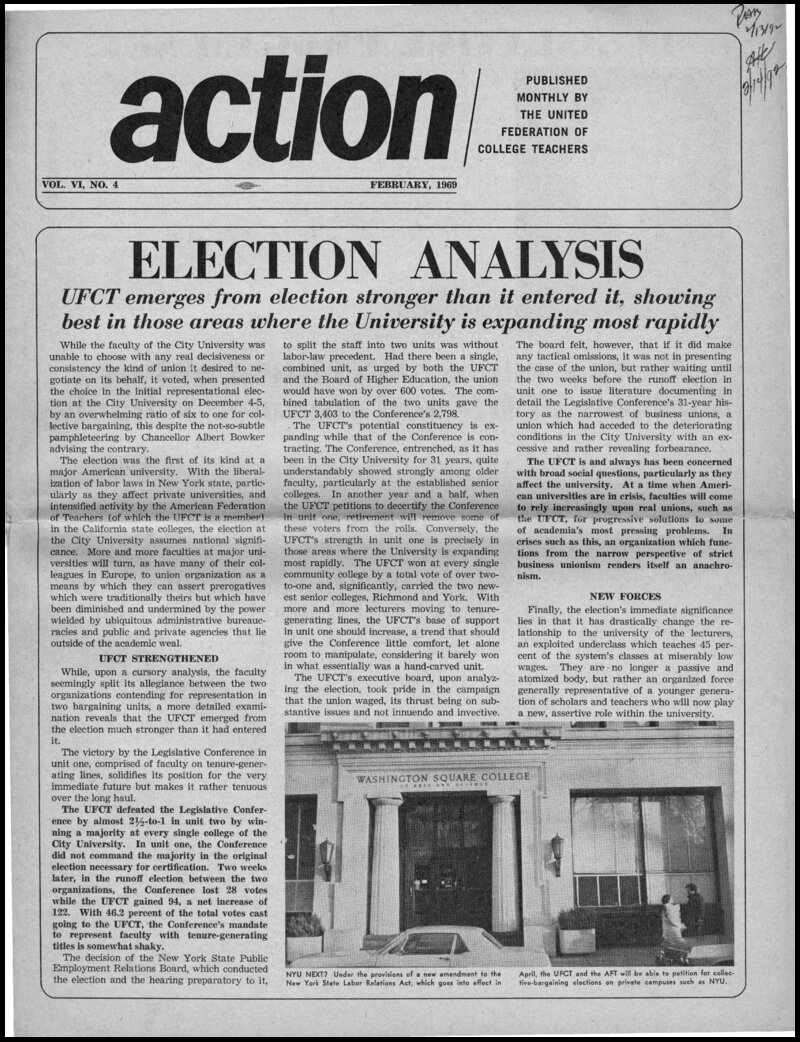
_ WASHINGTO!
NYU NEXT? Under the provisions of a new amendment to the
New York State Labor Relations Act, which goes into effect in
The board felt, however, that if it did make
any tactical omissions, it was not in presenting
the case of the union, but rather waiting until
the two weeks before the runoff election in
unit one to issue literature documenting in
detail the Legislative Conference’s 31-year his-
tory as the narrowest of business unions, a
union which had acceded to the deteriorating
conditions in the City University with an ex-
cessive and rather revealing forbearance.
The UFCT is and always has been concerned
with broad social questions, particularly as they
affect the university. At a time when Ameri-
can universities are in crisis, faculties will come
to rely increasingly upon real unions, such as
the UFCT, for progressive solutions to some
of academia’s most pressing problems. In
erises such as this, an organization which func-
tions from the narrow perspective of strict
business unionism renders itself an anachro-
nism.
NEW FORCES
Finally, the election’s immediate significance
lies in that it has drastically change the re-
lationship to the university of the lecturers,
an exploited underclass which teaches 45 per-
cent of the system’s classes at miserably low
wages. They are-no longer a passive and
atomized body, but rather an organized force
generally representative of a younger genera-
tion of scholars and teachers who will now play
a new, assertive role within the universit
April, the UFCT and the AFT will be able to petition for collec-
tive-bargaining elections on private campuses such as NYU.
Sidney Schwartz, the UFCT’s legislative repre-
sentative, testifying recently in Albany.
Professor Sidney Schwartz, the UFCT’s leg-
islative representative has announced that he,
together with the officers and staff of the union,
have prepared a comprehensive program for
consideration of the state assembly and senate
now meeting in Albany.
Among the legislation the UFCT is sponsoring are
bills calling for open personnel files at the City Uni-
versity, increased pension benefits, parity between
the senior and community colleges, and repeal of the
Feinberg Law. The UFCT is also calling for financial
aid per student from Albany at the City University
similar to that received by the state colleges.
A synopsis of bills sponsored by the UFCT follow:
1. Exemption of community colleges from the stat-
utory debt limit of the New York City capital budget.
2. Equal state aid per full-time student equivalent
to the City University as compared to the State Uni-
versity.
3. Increase of per capita in state aid to public high-
er education.
4, Eight percent increased take-home pay.
5. Revision of new tenure law for benefit of incum-
bent instructors.
6. Vacations for CUNY librarians.
7. Board of Education Medical-Examiners’ pay for
City University physicians.
8. Parity for community-college instructional staff.
9. Membership in N.Y.C. teachers retirement sys-
tem for CUNY lecturers.
10. Authorized leaves of absence for purposes of
study shall not constitute an interruption of proba-
tionary period for purposes of securing tenure (com-
panion bills for senior colleges and community col-
leges—similar to laws on maternity leaves).
OPEN PERSONNEL FILES
11. Personnel files shall be open for inspection by
individual members of CUNY instructional staff. All
evaluations for purposes of reappointment, tenure, and
promotion shall be in writing with a copy given to
staff member who shall have the right to file written
comments.
12. Repeal of Feinberg Law.
13. Twenty years’ retirement at half pay.
14. “Average” salary defined as last year’s salary.
15. Vesting after 10 years at age 55.
16. Cost-of-living index for retirees.
17. Increase retirement allowance for on-the-job
injury.
18. Reopen purchase of prior-service credit.
19. Tax-deferred annuity.
20. Pension credit for military service in World
War II and Korean War before entering teaching.
21. Permit librarians to purchase pension credits
for service in public libraries.
22. State aid to community colleges increased to
half of operating costs.
23. State aid to community colleges in New York
City increased to two-thirds of operating costs with
free tuition.
Dean’s report is critical of low
budgets of GS and summer sehools
In a rather revealing, if not damning, report issued
in December, the council of deans and directors of
schools of general studies, evening divisions, and sum-
mer sessions criticized with a surprising forthright-
ness the City University’s failure to fund properly the
programs for which they are responsible.
As a result of the University’s miserliness, expen-
ditures per student, as well as pay scales for faculty,
rank among the lowest in the country at the system’s
general studies and summer schools and its evening
divisions. é
ADVANTAGE TAKEN
The report noted the average 1968-9 expense per
full-time undergraduate student was $1,177.50 for
senior-college day session as compared with $353.40
per senior-college summer session, and $979.45 as com-
pared with $265.98 for the community colleges. The
deans and directors concluded that “some of the dif-
ference in expense is proper and understandable, re-
flecting among other things, the reduced nonteaching
demands for summer staff. The greatest part of the
difference, however, is attributable to the advantage
that has been taken of summer faculty, many of
whom, until very recently, had been compelled to
seek additional income rather than rest or engage in
scholarly pursuits.” [Emphasis added.]
The report dramatized the university’s exploitation
of its faculty by producing information which re-
vealed 81 percent of the nation’s public universities
with enrollment of 10,000 or over paid their full-time
summer faculty the same or a higher.rate per week
than they did during the regular academic year.
At the City University, the summer faculty is paid
at a substantially lower rate.
The report’s assessment of the University’s schools
of general studies and evening divisions is as equally
dismal.
Although 21 percent of the University’s full-time
students attend classes in the evening divisions or
schools of general studies (29.7 percent in the com-
munity colleges), expenditures per head are consider-
ably less than they are during the day. During the
present academic year, the senior colleges are ex-
pending $597.48 per full-time evening student, or just
about half of the full-time day allotment of $1,177.50.
The community-college cost of $405.83 per student in
the evening is 41 percent of the comparable day fig-
ure of $979.45.
“EXPLOITATION”
The report comments rather bluntly that “most of
the differénce is due to the exploitation of the general
studies staffs. [Emphasis added.] These teachers,
who have the greatest need for highly developed skills
and commitment in dealing with the less well prepared
segment of the general studies students striving to
overcome their educational handicap, should be the
most capable and highly paid members of our staffs.
Their salaries are not in keeping with their obliga-
tions and demonstrated accomplishments.”
Since 1962, evening and summer faculty have not
enjoyed raises comparable to those of the day faculty.
Across the board, from professor down to instructor,
2
the wages paid out per semester hour in the summer
and evening during the present academic year repre-
sent a lower percentage of a faculty’s full time day
salary than in 1962. Since 1962 the percentage at
most ranks has steadily gone down,
Considering that. evening and summer session
salaries are determined by a formula based on a per-
centage of a faculty member’s annual full-time salary,
the report’s revelations do not speak well for the uni-
versity.
Obviously, as the report only too thoroughly docu-
ments, the University will not be able to attract, let
alone retain, quality faculty in its evening and summer
programs if the present and horrendously low pay
scales continue to prevail.
Implicitly, the low pay scales smack of certain con-
descension by the university toward the students
whom these programs serve. Many of these students
are drawn from the lower classes. Evening and sum-
mer sessions usually make money for the University,
money at the expense of students who must pay for
every course they take and, of a cheap labor force, the
faculty. ‘
BRIGHTER PROSPECT
The prospects for improved conditions.in_ both th
evening and summer programs, now with the advent
of collective bargaining, have, quite fortunately,
brightened. At present, the UFCT is working on pro-
posals which will be presented to the board of higher
education at the negotiating table later this month.
UFCT FORMULATING DEMANDS
FOR OVER 6,000 LECTURERS
The UFCT is in the process of drawing up demands,
preparatory to collective-bargaining negotiations, on
behalf of over 6,000 lecturers at the City University.
The UFCT is trying to involve as many members
and lecturers as possible in the process of formulating
and negotiating these demands. After consultation
with the UFCT’s lecturers committee, the union’s
central office drew up a list of tentative demands as
a basis of discussion. A list of the demands was then
mailed to every lecturer in the City University to-
gether with a covering letter soliciting comment.
MASS MEETING
At a well-attended citywide meeting of lecturers
convened at. the Hotel George Washington on Satur-
day, January 11, over 100 participants debated the
merits of, and further refined, the original demands.
Within the next two weeks, the UFCT will call
meetings on every campus of the University to ex-
amine, and if necessary, revise still again the pro-
posals.
To further insure that its collective-bargaining de-
mands democratically reflect the interests of the mem-
bership, rather than decisions unilaterally arrived at
by a few atop the organization’s structure, the UFCT
has issued a call for volunteers for its negotiating
committee from the lecturers among its rank and file.
DEMOCRATIC RATIFICATION
Any agreement that comes out of bargaining will of
course be subject to ratification by the entire member-
ship of the UFCT within the City University.
The tentative demands cover six areas: salaries, job
security, workload, grievance procedure, welfare, fac-
ulty governance, and working conditions.
At present, the lecturers constitute, in the words of
Israel Kugler, the president of the UFCT, “an ex-
ploited underclass of the City University.” They teach
approximately 45 percent of the University’s classes
at miserably low wages and without tthe health, wel-
fare, and pension benefits enjoyed by their colleagues
on tenure-generating lines. Lecturers have not shared
equally in the last two pay increases at the University
and, in some cases, as recently documented by the
union, they are actually receiving less, rather than
more, pay than before.
“CHEAP LABOR”
Since the city system is sustained largely through
the “cheap labor” of lecturers, collective bargaining
for the group portends radical alterations in the very
structure of the university, alterations which may
ultimately improve the quality of the younger faculty
attracted to teach at the university as well as the
type of educational programs it provides to its stu-
dents.
For the first time, a group that was once fragment-
ed and unorganized will leave its impact upon the
university.
OFFICERS
ISRAEL KUGLER
President
STANLEY LEWIS
Vice-President,
4-Year Public College
PETER O'REILLY
Vice-President,
4-Year Private College
action
published monthly during
the academic year by the
UNITED FEDERATION OF
COLLEGE TEACHERS
Local 1460, American
Federation of Teachers,
AFL-CIO
260 Park Avenue, So.,
New York, N. Y. 10010 HENRY ESTERLY
Tel.: 673-6310-11 Vice-President,
a 2-Year Public College
j BO Oe BERNARD FLICKER
WILLIAM FRIEDHEIM Secretary
Signed articles and adver- _ ENWARD ALTERMAN
tisements do not neces- Tassos
sarily represent the view-
points or policies of the SIDNEY SCHWARTZ
UFCT. Legislative Representative
action
Rockefeller may cut university
budget by another 5 percent
At a “town meeting” convened in the audi-
torium of Bronx Community College on Friday,
Jan. 31, and presided over by Governor Nelson
Rockefeller, who was presenting his proposed
budget to the local public for appraisal, Dr.
Israel Kugler, president of the UFCT, expressed
his dismay at the prospect of a 5 percent cut-
back in the state’s contribution to the budget
of the City University.
AUSTERITY BUDGETS
Dr. Kugler seconded the testimony of Chan-
cellor Albert Bowker, who pointed out that the
cut would severely tax the University’s already
meager resources. The first casualty of a
budget cut would undoubtedly be the recently
instituted SEEK and College Discovery pro-
grams for ghetto youth; programs that are al-
ready operating on austerity budgets.
The budget submitted by the college presi-
dents of the City University has already been
trimmed by $16.4 million by the Chancellor.
His request has yet to go before the bureau of
the budget, the city council, the board of esti-
mate and Mayor John Lindsay, who, between
them, reduced last year’s budget by over $35
million, Over the past six budgetary periods,
a total of $95.6 million has been slashed from
successive budget requests.
EXTRAORDINARY STRAIN
It is in this context that a five percent re-
duction in state funds places an extraordinary
strain upon the University.
In his remarks, Dr. Kugler noted that New
York state ranked an embarrassing 25th in per
capita aid to higher education. The state
spends $26.72 per capita as compared to $33.70
of ninth ranked California, a state with com-
parable population and income.
If the $7 difference between the states was
added to New York’s budget for higher edu-
cation, it would increase by $119 million.
The problem is compounded for the City Uni-
versity by the discriminatory policies of the
state. It receives but 32.2 percent of the finan-
cial aid allotted for the State University, a sit-
uation the UFCT hopes to remedy as a result
of legislation it is introducing in the current
session of the state legislature.
DISCRIMINATION
The City University has a total enrollment
of 114,548 with budgeted expenses of $135.8
million with the state supplying $67.3 million.
By contrast, $257.6 million of the State Uni-
versity’s budget of $279.6 million is financed
by Albany.
DR. ISRAEL KUGLER, UFCT President
SAN FRANCISCO
At 3:30 a.m., a blue Dodge pulls up to
the corner of Holloway and 19th Ave._
on the far southwest side of San Fran-
cisco. Bundled against the damp, pene-
trating chill of northern California’s
rainy season, two professors—both hold-
ers of Ph.D.s—emerge. Taking picket
signs from two others who have been
there since midnight, they keep vigil
until dawn, Concurrently, similar scenes
are being enacted at five other nearby
locations under the eyes of cruising po-
lice cars.
This nocturnal changing of the
pickets has been a daily occurrence
since Jan. 6, when over 400 faculty
members began a strike against the ad-
ministration of San Francisco State
College. Actively supported by thou-
sands of students (many of whom are
running a parallel strike), by most Bay
Area labor unions inside and outside
the AFL-CIO, and by many church and
community groups, the pickets have
guarded all entrances to the campus 24
hours daily.
The strike is the longest teachers’
strike in California history, the largest
ever called by a four-year college
faculty in the U.S., and one of the
most significant ever for public 'em-
ployees in California and the nation.
Officially, it is being waged over lay-
off threats, heavy workloads, salaries,
and other pure and traditional trade-
union issues—in itself, a big step for
academicians to take.
But the strike is symptomatic of
more deep-seated concerns. It has be-
come the most visible aspect of a con-
frontation between the academic com-
munity’s view that SFSC’s traditional
role of an _ innovative, community-
oriented college must be preserved and
strengthened, and Gov. Ronald Reagan’s
superelitist perception of higher educa-
tion as a technological training ground
for the middle class.
REAGAN REJECTS MEDIATION
Reagan and his academic alter ego,
SFSC Acting President S. I, Hayakawa,
and the business-oriented board of
trustees, have solidly opposed the
strikers, even refusing to turn the out-
February, 1969
Prof. Art Bierman, chief negotiator for AFT ccal 1352, leads
his picketing colleagues in a cheer in front of San Francisco
standing issues over to mediation. In-
stead, they have used what AFT Presi-
dent David Selden calls a “tissue of
deceit” to mislead the press and public
about the strike. Their actions in calling
in San Francisco’s tactical police squad
to break up campus student meetings
have, more often than not, led to vio-
lence and arrests. And, the press has
focused much of its attention on Haya-
kawa (a good “copy” man because of
his popular book about semantics and
his posturing as a beleagured liberal),
thus often downplaying the union side.
Against these odds, it would seem un-
likely that the AFT could win the
strike. Yet class attendance is down to
13 percent, two-thirds of the faculty are
not teaching, and morale is high.
The faculty strikers are members of
two locals of the American Federation
of Teachers. Local 1352 has 410 mem-
bers among the 1,100 on the regular
teaching faculty; Local 1928 includes a
majority of the teaching assistants.
Library workers and clerical workers
are organizing unions and are support-
ing the strike. Under the leadership of
speech professor Dr. Gary Hawkins,
Local 1352’s president, the strikers have
won sanctions for their walkout from
the San Francisco AFL-CIO Central
Labor Council.
The parallel student strike is being
run by two campus organizations, the
Black Students Union (BSU) and the
local president.
Third World Liberation Front (TWLF),
which seek an autonomous black studies
program and 14 other demands. While
there is no formal tie between the two
strikes, faculty strikers have listed as
one of their demands the “resolution and
_ implementation” of BSU and TWLF
grievances. TWLF leader Roger Alvar-
ade has, in turn, described the AFT’s
conflict over collective bargaining as
“important to us because a lot of
minority people work for municipal and
state governments.”
Teachers, while recognizing the stu-
dent grievances as symptomatic of the
college troubles, say that they cannot
presume to negotiate the students’ de-
mands for them; the BSU and TWLF,
like most new-left groups, view the pro-
fessors with a jaundiced eye, and rhe-
toricize about the “establishment”
nature of unions.
A majority of faculty members had
seen the troubled horizon two years
ago and had voted for collective bar-
gaining in a campus electidn, but the
election résults had been disregarded
by the state trustees. Then, last spring
and this fall, AFT Local 1352 escalated
its campaign designed to thwart the
triumph of Reaganism. Seizing on the
issue of the unpopular high classload,
the union, in concert with other col-
lege AFT locals around the state, began
collecting signatures on a pledge to
teach no more than nine hours starting
0
State College. Third from the ‘left is Prof. Gary Hawkins,
in February. It accompanied this with
a membership drive (‘‘We’ve gone from
190 members at the start of the school
year to 410 currently,” said Local 1352
President Hawkins), with informational
picket lines, letterwriting campaigns,
and delegations to Sacramento.
TRUSTEES HARDEN LINE
The AFT’s battle drew only a hard-
ened reaction from the state trustees.
In mid-November, they announced that
any teacher who refused to teach the
scheduled 12 hours would be docked 25
percent of his salary. They accompanied
this with a notice that “lack of funds”
would necessitate the firing of 100 to
125 professors by February. And they
refused all AFT requests for bargaining
sessions,
STRIKE DATE SET
The AFT, as a last resort, set a
strike date for Dec, 16, vowing to close
down the campus until the board of
trustees agreed to bargain on the
layoffs, a grievance procedure, the
workload, and other economic and non-
economic demands.
Their resolve was strengthened when
representatives of the AFT discovered
in a meeting on Dec. 9 in San Francisco
that, instead of being “broke,” the state
college system actually had $3.5 million
in excess salary savings ready to turn
back to the California general fund at
the end of this fiscal year on June 81.
Books
BLACK MISEDUCATION
By BERNARD FLICKER
Henry Allan Bullock, A History of Negro Ed-
ucation in the South (from 1619 to the pres-
ent), (Harvard University Press, 1967).
The search for a usable past is a continuing
game in the history of racism in the United
States. Afro-Americans have contended that
until recently there has been a conscious plot
to exclude them from the history books used in
American schools. In those instances where
the contributions of Afro-Americans have been
recorded, there has been some question con-
cerning the validity of the accounts. The his-
torian has the power to select the phase of
history he deems important and then presents
us with a fait accompli of evidence to prove his
point. It is to the credit of Henry Bullock
that he has attempted to present all sides of
the past in his survey of Afro-American edu-
cation in the South. Due to the brevity of the
book, he also leaves us with the problem of
evaluating the true causes of the oppression of
the Afro-American through the manipulation
of the educational system in the United States.
The major contention presented by Bullock
is that “. . . the changes in American race
relations which we are now experiencing are
the result of a ‘sneak attack’ directed by the
larger purpose of human society against the
biases of individuals and through the force of
a segregated educational system that was never
created for such an end.” There is, of course,
an element of truth in this doctrine of historical
accident. Civil rights leaders in the South
have always noted that one of the most im-
portant leaders of the movement was Bull
Connor, appearing on television with his troop-
ers, dogs, fire hoses, and guns. The sight of
Afro-American youngsters being attacked by
the police during nonviolent marches probably
did more to help pass the civil rights legisla-
tion of the ’60s than anything else. The sad
reality of the protest movement may well be
the need for more “historical accident” and less
logic. :
“KEEP ’EM IN THEIR PLACE”
If education truly follows the culture, then
we have no trouble understanding the basic
premise of the education of the American Ne-
gro. A white society, controlling the educa-
tional system with the aid of oppressed mem-
bers of a caste society attempts to insure its
control by structuring a system guaranteed to
prevent social and economic mobility. A self-
perpetuating low-grade educational system for
Afro-Americans is designed not through acci-
dent but with specific intent. The American
Dream becomes the nightmarish slogan ‘‘keep
them in their place.” Thus, vocational educa-
tion is considered good enough for “niggers.”
Segregated schools based on “separate but
equal” are built to become “separate but un-
equal.” And while Negro literacy throughout
the nation lags behind white literacy, philan-
thropists, their consciences disturbed, donate
millions of dollars to segregated Southern Ne-
gro schools in an ironic attempt to further
education.
One can note progress in numbers of stu-
dents and teachers and schools. The statistics,
however, lie. They don’t tell us that society
was not prepared to allow Afro-Americans in
any significant numbers to move into economic
integration with whites. To this very day one
can find large numbers of Afro-Americans with
4
high school and college diplomas working for
the United States Post Office while their white
“equals” have risen to higher levels of almost
all other job categories. Statistics are also
meaningless in education unless one examines
the content of the curriculum. It has always
been a national scandal that Southern schools
—both black and white—have provided an in-
ferior education in almost every aspect of cur-
riculum. For decades a circular method of self-
destruction has provided Southern students
with bad schools, teachers, curriculum, and
school boards. One wonders if this is the great
benefit to be reaped from school decentraliza-
tion as now advocated in New York City.
HISTORICAL PARALLELS
At almost every step along the road from
Reconstruction to the protest movements of the
’60s, history provides us with interesting par-
allels. Curiously enough, Willie Lee Rose in
his study “Rehearsal For Reconstruction’ de-
velops some interesting insights into the edu-
cational dilemma of the present, although he
is ostensibly examining the first schools estab-
lished by Northern teachers for Southern Afro-
Americans in the 1860s. The Northern teach-
ers in their letters and diaries recounted that
there was a great zeal for learning among both
the younger students and their parents. Dis-
cipline problems were almost nonexistent. If
anything, students were much too docile. Yet,
most students walked for miles to attend
classes. The major problem confronting the
teachers was that the New England primers
used in classes were almost totally unrelated
to the cultural background of the students and
thus created difficulties in learning. One won-
ders how far we have come in history when we
still hear the same plea from teachers today—
give us materials related to the lives of our
students!
The early free public schools also proved that
there was no inferiority based ‘on race, since
Afro-American students were rated by the
teachers. as equal or superior to their former
white New England students. (Today army in-
telligence tests strip bare the mythology of ra-
cial superiority while revealing the inadequacy
of the school system. The usual pattern on the
army tests has been that Northern whites score
highest, then Northern Negroes, Southern
whites, and Southern Negroes. The United
States Office of Education has recently at-
tempted to gather information through na-
tional tests but has met opposition from local
education officials.)
“HANDS OFF”
Lenny Bruce always claimed that the prob-
lem with life is that we are always faced with
what is, while trying to seek what should be.
Bullock points out that the insincerity of our
motives in educating Afro-Americans has cre-
ated such a tension between the real and the
ideal: ‘Carrying the seeds of its own defeat, it
(Southern Negro education) merely served to
develop a further stage of intergroup conflict—
a stage in which the Negro American’s persist-
ing need for racial equality would be revived
and a new accommodation in American race
relations made necessary.” This is all quite
true but still leaves us with the practical and
inescapable question—where do we—in actual-
ity—go from here? Obviously we have abun-
dant evidence to conclude that the Afro-Ameri-
can was the victim of racism in all phases of
American life and that the schools were used to
place him into a neat bag labeled ‘“‘Hands Off!”
Even the President’s Commission on the riots
(of 1967) suggests that Americans have ap-
proached their race problem with an uncon-
scious duplicity: we nervously apologize for
oppressing our black population, unwittingly
admitting to our guilt, while on a more con-
scious level of behavior, we have conned our-
selves into believing that our system of segre-
gation cannot be compared with South African
apartheid.
There are no simple alternatives. After a
hundred years, patterns of segregation still per-
sist in our schogls. We might well be on the
edge of a second civil war, yet we cut poverty
funds and our education budget looks sickly in
comparison to the cost of running the war in
Vietnam. The federal government spends less
than $100 per child for education. Education
and poverty programs usually blossom just be-
fore or immediately after a riot. The Afro-
(Continued on Page 5)
action
Black Miseducation
(Continued from Page 4)
American ghettos are growing at a rate which
makes talk of integrating schools sound ludi-
crous—nonwhites represent 93 percent of pub-
lic school pupils in Washington, D.C., 54 per-
cent in Chicago, 53 percent in Cleveland, 52
percent in New York City, and 62 percent in
St. Louis. There has been a steady increase
in the number of segregated schools in the
United States, particularly in the Northern
cities, since the 1954 Brown vs. Board of Edu-
cation decision.
REALISM AS RACISM
It is discouraging to note that while there
has been little attempt to integrate Southern
schools since 1954, massive segregation has
been taking place in the North. Increased seg-
regation has resulted in a decline in the aca-
Academic Fat
demic position of our big-city high schools.
Segregation and quality education do not seem
to go together. The Coleman Report for the
U.S. Office of Education found that there were
improvements in the education of black stu-
dents in integrated schools, while there was no
change in the education of the white students.
Despite the Coleman study, the report of the
U.S. Civil Rights Commission, and the moral
pronouncements of white and black liberals
alike, the fact remains that there has been no
real attempt to stem the segregationist flow.
Thus, we find black militants demanding con-
trol of their schools while white liberals call for
massive doses of money to help upgrade black-
ghetto education. Realism seems to be the new
clarion call, whereas a century ago it was sim-
ply labeled racism. Cities abandon paired
schools, open enrollment policies, rezoning proj-
ects, educational parks and the like almost as
(Continued on Page 6)
THE CLIENT
UNIVERSITY
By JAMES PERLSTEIN
Theodore Roszak, ed., The Dissenting Acade-
my (Pantheon, 1967).
One jet-set scandal reads much like another
but the National Enquirer continues to sell:
_the immorality of our betters fascinates never-
endingly, particularly when they get away with
it. If our pretensions as academics make it un-
seemly for us to be caught with the Enquirer, —
we have compensating scandals among the
more accomplished of our own coterie, the
chronicles of which are readily available now-
adays. These scandals may be political rather
than sexual, but this detracts only minimally
from their appeal. What has the Enquirer
printed of late to top the offer of an elite chair
in humanities at a major university to a man
who, Noam Chomsky reminds us, felt it to be
his duty to persuade the world that an Ameri-
can-sponsored invasion of a nearby country
was nothing of the sort; a man who when asked
to explain the contradiction between his later
published account of the Bay of Pigs and his
statements to the press at the time, simply re-
marked that he had lied? Nothing beats a
scandal at once individual and institutional.
“A HARVEST OF WEEDS”
Chomsky’s reminder appears in a catalogue
of atrocities entitled The Dissenting Academy,
published a year ago by Knopf. Eleven scholars
noted for their involvement in discussions of
public policy and, not incidentally, for their
outspoken disenchantment with official policy
decisions, responded to the question: “Does the
business-as-usual of the American academic
community do more to assist in the production
of Vietnams than it does to examine, resist,
and correct policy that leads to such moral dis-
aster?” Their answers, although limited to
their respective fields in the social sciences and
humanities, depict an academic landscape
studded with moral obtuseness, evasion, oppor-
tunism and dishonesty. If, to quote one con-
tributor, the university ought to provide fertile
ground “for challenging the premises of the
present society, for appreciating what deserves
to be retained, and for developing a new en-
vironment worthy of the best in man,” then we
February, 1969
have reaped a harvest of weeds whose classifi-
cation is the real business of this book. But if
we are titillated by these tales of moral bank-
ruptcy, if our feelings of guilt are assuaged by
the certain knowledge that our sins have been
matched and surpassed by our colleagues, the
panorama is depressing nonetheless.
ACADEMIC AMORALITY
Tragically, the burden of evidence here and
elsewhere points to the conclusion that the uni-
versities, as institutions, are not, and never
have been, hospitable to social morality, criti-
cism, or change. As the writer quoted above is
quick to acknowledge, we cannot turn our eyes
from the present dreary prospect to envision
some past Eden: “The university has always
been caught up in the going system. Its inhabi-
tants have always had to struggle for intellec-
tual independence against those who have
viewed the schools as instruments for culture-
breaking the young and developing loyalty to
the social order.” And, one might add, as train-
ing grounds for whatever functionaries the
status quo requires. It would be hard indeed to
imagine the Philosophes as chairholders in
academe.
MAKING IT
And yet, institutions of higher learning can-
not be separated from the individuals who staff
them. If their prospects do not foster optimism,
it is in part because the professoreate benefits
from present arrangements. Theodore Roszak,
the editor of this collection, points out (with
respects to David Riesman) that academic life
declasses those who enter it, lifting them out |
of family, region, and ethnic background, only”
to reclass them on the higher levels of national
society, with all that this means in the way of
conformity to parochial loyalties. “The Ameri-
can middle class is a comfortable place in which
to find oneself, especially when one adds just
the right admixture of jet-set elegance for the
highly successful academic: research grants
with foreign travel, visiting lectureships, pres-
tigious conferences, and even perhaps invita-
tions to help out in Washington. It is a mar-
velous institution that can offer a young man
who may have started out with nothing but
brains such an opportunity to rise so high in
the Great Society.” And, as another contribu-
tor concludes, “whoever questions the legiti-
macy of a social order, or the assumptions by
which it is habitually justified, is a radical. And
radicalism can be uncomfortable and, often
enough, inconvenient for career purposes.”
DISMAL OUTLOOK;
The proliferation of malcontents and their
enhanced respectability (to which this volume
and its prestigious publisher bear witness) are»
not necessarily such cheering developments
They may signify only the vibrant health of
the Higher Learning; its ability to tolerate and
thereby to defuse dissent. Mounting opposition
to official policy is a good thing; it may even be,
as Roszak asserts, “the most hopeful event in
postwar American history,” but it certainly
does not justify the speculation that perhaps
“the universities are about to cease functioning
as the handmaidens of whatever political, mili-
tary, paramilitary, or economic elite happen to
be financing their operations.”
All of which figures as a warning. The UFCT
grew precisely because it appealed to cranks
and malcontents to disturbers of the status quo.
Its demands for justice and social responsibility
have naturally extended to include the outs
and underdogs of every calling: it has always
expected better of itself than mere business
unionism. But we have just emerged from a
momentous certification election, and now
come the contract negotiations. Recognition
and Sanctification. What then? Do we go the
way of all legitimatized flesh? If the Dissenting
Academy speaks to our condition, the cards
have been dealt, and the odds heavily favor the
House.
(James Perlstein is Assistant Professor of
history at Manhattan Community College.)
The need to cover the high cost of specialist care is
greater today than ever before.
Nevertheless, H.I.P. is still the only plan in this area
providing fully paid specialist services—in the office, hos-
pital and home..
WHAT H.1.P. DOES
H.I.P.’s Medical Groups provide care and consulta-
tions by qualified specialists in fourteen basic specialties
—in and out of the hospital.
There are no specialist charges... no limit on visits
... no deductibles ... no claim forms.
‘When needed in difficult cases, H.I.P. brings you the
services of specially qualified specialists and surgical
teams—also without cost to you!
AND THE OTHERS?
Compare H.I.P.’s broad coverage with the specialist
coverage given by the other plans available to City em-
ployee families.
We repeat...
¢|
YOU BE THE JUDGE!
Books: Black
Miseducation
(Continued from Page 5)
soon as they start. There is talk
about “pairing” the students of
white suburbia with those of the
black ghettos somewhere in be-
tween in a no-man’s land. There
isn’t much action.
Black kids are being murdered
in the schools of the United
States every single day and no
one seems to know how to stop
the slaughter. If the answer is
integrated schools, we are told
that we can’t have them. If the
answer is segregated schools, we
are told that they are insuffi-
cient but that we have to make
do.
There is obviously a need for
a revolutionary upheaval in
American education and little
likelihood of its ever happening.
There is something wrong with
American society today which
prevents “good” people from
really seeing. much further than
their own self-interest. The clas-
sic comment about poverty in
America was made during Pres-
ident Kennedy’s flight over Ap-
palachia when a reporter on the
trip peered out the window
through a martini haze and said
“Poverty looks pretty damn
good from 30,000 feet!” Poverty
and inadequate schools look
pretty good to an educational
establishment which views the
problems of the 20th Century
with all the preconceptions of
the 19th. Unfortunately, the
middle-brow civil service types
who administrate our schools
usually are too busy aspiring to
be superintendents to engage in
a serious rethinking of our an-
tiquated educational policies.
LEARN, BABY, LEARN
The curriculum of the schools
must be changed to meet the im-
mediate needs of black male stu-
dents. The dropout rate for
black male students in the
United States is a national dis-
grace. We must stop blaming
the school, the home, the teach-
er, the society, the student, and
anything else one can think of,
and start the task of a massive
reconstruction of our educa-
tional system. If we must live
with the reality of a segregated
system, we might well turn the
schools over to Afro-American
organizations, and try to help
them succeed where white so-
ciety has fallen short. Failing
that, though, we must try to
mandate schools integrating city
and suburb.
We have to make’some very
important decisions about the
course of American education in
the next few years. The only
trouble is that our students are
going to make those decisions
for us. They will be the teachers
and we will be the students as
we listen to either “burn, baby,
625 MADISON AVENUE, NEW YORK, N.Y.10022 (Professor Flicker teaches ed-
Pp HEALTH INSURANCE PLAN OF GREATER NEW YORK burn”. or “learn, baby, learn?”
ucation at Hunter.)
6 action
EMPIRE STATE FEDERATION OF TEACHERS
1969 EUROPEAN CHARTER
New York - Paris - New York $239
July 5 to August 25
7 Weeks European Tour
(including flight)
ALL UFCT MEMBERS AND
THEIR IMMEDIATE FAMILIES
ARE ELIGIBLE
DETAILS AVAILABLE FROM:
Prof. Morton Silverstein
Fashion Institute of Technology
227 West 27th Street
New York, N.Y. 10001
Tel.: 212-673-6310
Eve.: 201-385-7538
OFFICIAL
UFCT DISCOUN
Approved By Executive Board
NEW CARS— Official UFCT car purchase plan...exactly $100 above dealers actual cost!
@ CARPETING — Specially negotiated discount prices on almost all national brands.
@ STEREO AND HI-FI — Stereo consoles, stereo cabinets and stereo components including
amplifiers, preamplifiers, tuners, turntables, speakers and speaker systems and tape
recorders.
@ DIAMONDS — Uncontested value at lowest possible price!
@ PIANOS —Direct factory arrangement for special discount prices. Factory showroom
located in New York.
@ CAMERAS AND PHOTOGRAPHIC EQUIPMENT — Cameras and accessories, movie cam-
eras, still and movie projectors, editing, copying and developing equipment, lenses and
se ADDITIONAL SERVICES
@ MAJOR APPLIANCES — Televisions, air-conditioners, refrigerators, freezers, dishwash-
ers, washing machines, dryers, disposals, ranges, radios, humidifiers, dehumidifiers,
tape recorders and vacuum cleaners are available at slightly above wholesale.
@ FURNITURE — Complete lines of furniture at slightly above dealers actual cost.
@ CUSTOM DRAPERIES, UPHOLSTERY AND SLIP COVERS — Exclusive service group
only through United Buying Service. 13 locations throughout the metropolitan area.
@ FURS—A prominent fur manufacturer and supplier to major department stores is now
contracted to offer their products at discounts exclusive to United Buying Service. Furs
available include Mink, Beaver, Leopard, Muskrat, Broadtail, Alaskan Seal, Persian
Lamb and a variety of Fun Furs.
LUGGAGE — Products of all leading manufacturers at special discount prices.
1855 Broadway, New York, N.Y. 10023
United Buying Service Corporation § New York: (212) LT 1-9494, PL 7-0007
New Jersey: (201) 434-6788
: UES | The Greatest Buying Power in Greater New, York
February, 1969
UFCT financial statement
UNITED FEDERATION OF COLLEGE TEACHERS
LOCAL 1460, AMERICAN FEDERATION OF TEACHERS, AFL-CIO
STATEMENT OF FINANCIAL CONDITION, JULY 31, 1968
ASSETS
Cash Mi bank tile ncn eterna tnnnom “ merino 1,776.69
Petty cash as Rais LARS
Checkoff receivable...
Office equipment
Less accumulated dep!
TOTAL .... a TS oretownevene WN! His
LIABILITIES AND NET WORTH
LIABILITIES
Accounts payable ee mwnweveennen —- $ 21,953.52
Per capita payable ~~ 5,780.00
Loans payable—Amaigamated Bank ~ 21,000.00
Notes payable—equipment . 3 408.24
TOTAL LIABILITIES 350i a eS oe eS ae age
Net worth—(deficit) ee SPRL REI
TOTAL ee | Sion min Beene ata mete y one 1G oy
STATEMENT OF OPERATIONS AND NET WORTH
YEAR ENDED JULY 31, 1968
INCOME
DUES—
Checkoft Se per eee
Direct payment —_ SPROUL) POLISH ONE
Less checkoff charges ecm
NET DUES AVAILABLE __ dai ht Nast trae at ae
OTHER INCOME—
Subsidies—American Federation of Teachers, —
—Empire State Federation of Tea
Contributions from other Unions...
Contributions from members,
Reimbursement of prior year's expenses by National Citizens Commit-
fee to Defend Academic Freedom at St. John's University —
Advertising
Miscellaneous ACE ERIE,
TOTAL OTHER INCOME Recah arte 37,374.45
TOTAL INCOME ....... ets 88,163.13
Expenses—Schedule |. id annem 110,865.80
Excess of expenses over income 4 indie Salneda ta RTT oY 5)
Net worth (deficit)—August 1, 1967 0000 : IT (15,533.32)
Net worth (deficit) —July 31, 1968 ee nn snwnenee($_ 38,235.99)
( ) Indicates negative figure
_
GOLDEN ARROW in SUNAPEE, N.H.
A personal non-competitive approach to
children's camping, using the wilderness Buy furniture, fabric mattresses at
setting for creative living. A balanced 5% above cost. My card gives you
progyanstom fa ng ted lake and mis entre to al aca eAtt, sono)
an 0g ing-fe e ¥
animals. 4 wks, ced 6-13, Bruce &
Helen Charpentier, 35-54 ab St., Jackson
Hts., N.Y. HA 6-4
ELECTIONS
For Best ERVICE
For Tremendous AVINGS
On All Periods of
FURNITURE
We Invite the Members of UFCT and their
Families to visit our Showroom.
Credit terms arranged up to 3 years
at the LOWEST RATES in New York City.
ARTI R.
Purndliia (orpbany Cre
v y. 7 ®
Manufacturer's Distributors
Free Parking at: Sunrose Parking Lot, 24th St. cor. 6th Ave.
119 W. 24 St., New York City CHelsea 2-3354 - §
Hours: Daily 9:00 to 5:00, Thursday to 8:00 P.M., Saturday to 4:00 P.M.
@ OFFICIAL UFCT
@ MAJOR APPLIANCE
@ DISCOUNT OUTLET
MEMBERSHIP PRICES QUOTED ARE UNBEATABLE
* WASHERS. + DRYERS + REFRIGERATORS -
FREEZERS + RANGES + DISHWASHERS -
* TM. + STEREO + AIR CONDITIONERS -
° Featuring — All Famous Brand Names
PHONE ORDERS—I0 A.M. -6 P.M.
CALL WITH MAKE AND MODEL NUMBER
JAMAICA GAS & ELECTRIC
42-24 BELL BOULEVARD
BAYSIDE, N. Y. BA 9-2853 BA 9-2400
Open Daily Till 9 p.m.; Wed. & Sat. Till 6 p.m.
4
Letters
The View
from Dixie
Dear Sir:
I have been following the educational crisis in New
York City. Recently I have seen copies of UFCT
ACTION at the University of Florida library and it
has not reflected this crisis. You should endeavor to
inform your readers and, perhaps, this letter will help
you understand how another part of the country views
the problem.
The educational crisis in New York City has caught
the attention of the South. It is a ground upon which
conservative and liberal finally seem to agree.
UNREALISTIC DECISION
Southern schools were fundamentally disrupted in
1954 by a totally unrealistic Supreme Court decision.
Many years have passed and we have not been able to
solve the problem of educating our negroes [sic] un-
der the “new” rules.
Now the way has been found. New York City must
decentralize its schools and obey the facts of nature.
Our negroes [sic] must have their own schools so that
they can develop at their own pace. We must realize
that they have different needs and abilities. “Sepa-
rate but equal schools” in the same districts have
been declared illegal. “Separate but equal districts”
are the answer.
Since the northern pressure created our problem, it
is only just that the North should find solutions. We
applaud the political leadership of New York City and
condemn those leftists, intellectuals, and labor bosses
who would deny the right of the community to run
their schools.
VIC YEAGER
UFCT and UFT
Dear Sir:
Why did we lose Unit I and what can we do in order
to win the next CB election? From canvassing vir-
tually every faculty member, of my school, and from
speaking to others who did the same at other schools,
I feel that failure to denounce the UFT strike cost us
the election. Too many of the UFCT membership
wanted to avoid or table the UFT issue in order to
appeal to the greatest (lowest?) common denomina-
tor. Yes, I know that the UFCT has taken contro-
versial stands in the past while the LC has dodged
every social issue (and even some academic ones).
The City University is a training ground for the com-
munity of New York and we are affected by the issues
concerning this community. The Queens-SEEK con-
troversy confirms this. If the issues we consider are
so limited, it seems that all we may have to offer at
the next CB election is a slightly better business
agent. And the faculty who voted for the LC (in
many cases, irrationally, to spite the UFCT) because
of our silence or de facto approval of the UFT strike
will not be interested.
DE FACTO APPROVAL
Speaking of de facto approval, it seems that new
procedures must be established to authorize money
in support of other unions. Our president gave $100 to
the UFT. As an executive member of the local, I
certainly had no voice in this, let alone the member-
ship. I do not feel that there is any kind of teacher
solidarity which forces us to support every strike,
especially when this financial support implies political
support which may have cost us the CB election.
MIKE ROSENBAUM
Manhattan Community College
isn’t it
time
YOU took
some action?
Educating the
pre-qualified
Dear Sir:
The recent vote of a committee of the faculty sen-
ate of Brooklyn College to eliminate SEEK from its
campus is a symptom of a dangerous tendency among
CUNY faculty which, if not soon counteracted, will
lead us straight down the road to a disaster like that
of the UFT this year.
Although, in theory, the free-tuition public colleges
serve the working-class students of New York City,
in fact, it is painfully evident that they do not serve
the working-class Negro and Puerto Rican student.
For a great many reasons, Negro and Puerto Rican
working-class children in New York do not receive
the same quality education in public schools as white
middle-class children, and do not possess the requisite
grade average for admission to the public colleges.
At SEEK, we believe that many of these “unquali-
fied” students are really “pre-qualified.” That is, they
can be brought up to college-level performance by a
program of remedial and other kinds of help—while
they are in college.
In my classroom, this hypothesis is tested daily and
the results seem to support it. Over the next few
years, there will be more programs like SEEK, bring-
ing supposedly “unqualified” Negro and Puerto Rican
students into the city colleges. However, if the
teaching staff is hostile to these students, these pro-
grams are doomed to failure and the belief that Negro
and Puerto Rican. students cannot perform at college
level because they are Negro and Puerto Rican will
be reinforced. Furthermore, the hostility that al-
ready exists between public-school] teachers and poor,
minority-group communities in New York will be in-
tensified.
A NEW CHALLENGE
It is the task of the teachers’ union to do the job
of educating the teaching staff to the responsibilities
we have toward all.students in. New. York City, and
not only toward those with the high-school grade aver-
ages which admit them ‘to the city colleges. We can-
not leave this task to the Administration because it will
not and can not perform it. It is no skin off the back
of an administrator to devise a program for the ad-
mission of students with reading difficulties to the
college. The teachers are expected to know how to
resolve these problems by some magical process. The
demand for admission to the colleges, by Black and
Spanish groups, is legitimate. It provides a long
needed challenge to us as teachers. We must be pre-
pared to revise our courses—something which students
at all colleges have been demanding—and to think
about our role as teachers in a new way.
The union is the only organization of college teach-
ers equipped to meet this challenge and should do so
without delay. We might set up a conference early
in the spring to which SEEK teachers and students
are invited to prepare reports and discussions. This
would be especially relevant to the lecturers who
teach the majority of freshman courses where SEEK
and other “prequalified” students will have to be inte-
grated into a regular college program. Such a con-
ference should be open to all teachers and students
and a report of the conference sent to all faculty
members represented by the UFCT. We should be
thinking in terms of seminars and discussion groups
where teachers can learn from one another’s expe-
riences and where we can evaluate our present work
and make changes for the future.
1 want information [7]
| want to join @
Home Address
City and State.......
College...
Home Phone...
College Phone. icccncxcccmen- ne
Mail filled-out coupon (please print) to UFCT, 260 Park Avenue
South, N. Y. 10010.
ee
The location of the SEEK University Center in the
Alamac Hotel at Broadway and 7Ist St. underscores
the tenuous nature of the program, particularly now
that it is once again threatened by budget cuts in
Albany.
START NOW
In the fullest sense, the next few years will be an
experiment in integrated education at the public col-
leges. If we begin now, we will find»ourselves on the
side of the students in making demands on the-CUNY
administration. There need be no contradiction be-
tween the demands of our students for better and
more meaningful education for all, and the union’s
demand that teachers be guaranteed working condi-
tions which will make this task possible.
PRUDENCE POSNER
University Center, SEEK
(The UFCT’s executive board has asked the union’s
special committee on the University and the Commu-
nity to examine the problem and proposal presented
by Miss Posner—Ed.)
SEEK resolution
On Jan. 20, the Queens College chapter of the
UFCT held an open faculty meeting to discuss the
crisis revolving about the campus’ SEEK program.
Earlier in the month student activists and demonstra-
tors had asked for greater voice in the control of
the program and among other demands, insisted that
the director of the program be replaced. At the two
hour session, many viewpoints were presented.
At the meeting’s conclusion, the chapter’s executive
board met to analyze the different views and adopted
the following statement:
The Chapter’s executive board wishes the faculty to
realize its dedication to solving the problems of the
SEEK program.
1. The executive board reaffirms the UFCT support
of the SEEK program and will do everything possible
to see that it is strengthened and expanded. —
2. It believes that all who are involved in the SEEK
program (including students, faculty, administration,
as well as the general faculty of the college) should
participate in determining the future of the program.
3. The executive board reaffirms its belief in the
principle of due process for all individuals—teachers,
counsellors, administrators and students.
Upon the recommendation of the executive board,
President Israel Kugler sent the following telegram
to Porter R. Chandler, Chairman, board of higher
education and Albert H. Bowker, Chancellor, the City
University of New York:
“THE UFCT BELIEVES THAT THE COLLEC-
TIVE BARGAINING AGENT FOR THE QUEENS
COLLEGE SEEK STAFF MUST BE INVOLVED
IN THE’ DECISIONS LEADING TO THE- RESO-
LUTION OF THE DISPUTE SINCE THEY AFFECT
TERMS AND CONDITIONS OF EMPLOYMENT.
“WE REQUEST AN IMMEDIATE APPOINTMENT
TO DISCUSS IMPLEMENTATION.”
action
VOL. VI, NO. 4
actio
FEBRUARY, 1969
PUBLISHED
MONTHLY BY
THE UNITED
FEDERATION OF
COLLEGE TEACHERS
ELECTION ANALYSIS
UFCT emerges from election stronger than it entered it, showing
best in those areas where the University is expanding most rapidly
While the faculty of the City University was
unable to choose with any real decisiveness or
consistency the kind of union it desired to ne-
gotiate on its behalf, it voted, when presented
the choice in the initial representational elec-
tion at the City University on December 4-5,
by an overwhelming ratio of six to one for col-
lective bargaining, this despite the not-so-subtle
pamphleteering by Chancellor Albert Bowker
advising the contrary.
The election was the first of its kind at a
major American university. With the liberal-
ization of labor laws in New York state, partic-
ularly as they affect private universities, and
intensified activity by the American Federation
of Teachers (of which the UFCT is a memher)
in the California state colleges, the election at
the City University assumes national ‘signifi-
cance. More and more faculties at major uni-
versities will turn, as have many of their col-
leagues in Europe, to union organization as a
means by which they can assert prerogatives
which were traditionally theirs but which have
been diminished and undermined by the power
wielded by ubiquitous administrative bureauc-
racies and public and private agencies that lie
outside of the academic weal.
UFCT STRENGTHENED
While, upon a cursory analysis, the faculty
seemingly split its allegiance between the two
organizations contending for representation in
two bargaining units, a more detailed exami-
nation reveals that the UFCT emerged from
the election much stronger than it had entered
it.
The victory by the Legislative Conference in
unit one, comprised of faculty on tenure-gener-
ating lines, solidifies its position for the very
immediate future but makes it rather tenuous
over the long haul.
The UFCT defeated the Legislative Confer-
ence by almost 214-to-1 in unit two by win-
ning a majority at every single college of the
City University. In unit one, the Conference
did not command the majority in the original
election necessary for certification. Two weeks
later, in the runoff election between the two
organizations, the Conference lost 28 votes
while the UFCT gained 94, a net increase of
122. With 46.2 percent of the total votes cast
going to the UFCT, ‘the Conference’s mandate
to represent faculty with tenure-generating
titles is somewhat shaky.
The decision of the New York State Public
Employment Relations Board, which conducted
the election and the hearing preparatory to it,
to split the staff into two units was without
labor-law precedent. Had there been a single,
combined unit, as urged by both the UFCT
and the Board of Higher Education, the union
would have won by over 600 votes. The com-
bined tabulation of the two units gave the
UFCT 3,403 to the Conference’s 2,798.
-The UFCT’s potential constituency is ex-
panding while that of the Conference is con-
tracting. The Conference, entrenched, as it has
been in the City University for 31 years, quite
understandably showed strongly among older
faculty, particularly at the established senior
colleges. In another year and a half, when
the UFCT petitions to decertify the Conference
in unit one, retirement will remove some of
these voters from the rolls. Conversely, the
UFCT’s strength in unit one is precisely in
those areas where the University is expanding
most rapidly. The UFCT won at every single
community college by a total vote of over two-
to-one and, significantly, carried the two new-
est senior colleges, Richmond and York. With
more and more lecturers moving to tenure-
generating lines, the UFCT’s base of support
in unit one should increase, a trend that should
give the Conference little comfort, let alone
room to manipulate, considering it barely won
in what essentially was a hand-carved unit.
The UFCT’s executive board, upon analyz-
ing the election, took pride in the campaign
that the union waged, its thrust being on sub-
stantive issues and not innuendo and invective.
_ WASHINGTO!
NYU NEXT? Under the provisions of a new amendment to the
New York State Labor Relations Act, which goes into effect in
The board felt, however, that if it did make
any tactical omissions, it was not in presenting
the case of the union, but rather waiting until
the two weeks before the runoff election in
unit one to issue literature documenting in
detail the Legislative Conference’s 31-year his-
tory as the narrowest of business unions, a
union which had acceded to the deteriorating
conditions in the City University with an ex-
cessive and rather revealing forbearance.
The UFCT is and always has been concerned
with broad social questions, particularly as they
affect the university. At a time when Ameri-
can universities are in crisis, faculties will come
to rely increasingly upon real unions, such as
the UFCT, for progressive solutions to some
of academia’s most pressing problems. In
erises such as this, an organization which func-
tions from the narrow perspective of strict
business unionism renders itself an anachro-
nism.
NEW FORCES
Finally, the election’s immediate significance
lies in that it has drastically change the re-
lationship to the university of the lecturers,
an exploited underclass which teaches 45 per-
cent of the system’s classes at miserably low
wages. They are-no longer a passive and
atomized body, but rather an organized force
generally representative of a younger genera-
tion of scholars and teachers who will now play
a new, assertive role within the universit
April, the UFCT and the AFT will be able to petition for collec-
tive-bargaining elections on private campuses such as NYU.
Sidney Schwartz, the UFCT’s legislative repre-
sentative, testifying recently in Albany.
Professor Sidney Schwartz, the UFCT’s leg-
islative representative has announced that he,
together with the officers and staff of the union,
have prepared a comprehensive program for
consideration of the state assembly and senate
now meeting in Albany.
Among the legislation the UFCT is sponsoring are
bills calling for open personnel files at the City Uni-
versity, increased pension benefits, parity between
the senior and community colleges, and repeal of the
Feinberg Law. The UFCT is also calling for financial
aid per student from Albany at the City University
similar to that received by the state colleges.
A synopsis of bills sponsored by the UFCT follow:
1. Exemption of community colleges from the stat-
utory debt limit of the New York City capital budget.
2. Equal state aid per full-time student equivalent
to the City University as compared to the State Uni-
versity.
3. Increase of per capita in state aid to public high-
er education.
4, Eight percent increased take-home pay.
5. Revision of new tenure law for benefit of incum-
bent instructors.
6. Vacations for CUNY librarians.
7. Board of Education Medical-Examiners’ pay for
City University physicians.
8. Parity for community-college instructional staff.
9. Membership in N.Y.C. teachers retirement sys-
tem for CUNY lecturers.
10. Authorized leaves of absence for purposes of
study shall not constitute an interruption of proba-
tionary period for purposes of securing tenure (com-
panion bills for senior colleges and community col-
leges—similar to laws on maternity leaves).
OPEN PERSONNEL FILES
11. Personnel files shall be open for inspection by
individual members of CUNY instructional staff. All
evaluations for purposes of reappointment, tenure, and
promotion shall be in writing with a copy given to
staff member who shall have the right to file written
comments.
12. Repeal of Feinberg Law.
13. Twenty years’ retirement at half pay.
14. “Average” salary defined as last year’s salary.
15. Vesting after 10 years at age 55.
16. Cost-of-living index for retirees.
17. Increase retirement allowance for on-the-job
injury.
18. Reopen purchase of prior-service credit.
19. Tax-deferred annuity.
20. Pension credit for military service in World
War II and Korean War before entering teaching.
21. Permit librarians to purchase pension credits
for service in public libraries.
22. State aid to community colleges increased to
half of operating costs.
23. State aid to community colleges in New York
City increased to two-thirds of operating costs with
free tuition.
Dean’s report is critical of low
budgets of GS and summer sehools
In a rather revealing, if not damning, report issued
in December, the council of deans and directors of
schools of general studies, evening divisions, and sum-
mer sessions criticized with a surprising forthright-
ness the City University’s failure to fund properly the
programs for which they are responsible.
As a result of the University’s miserliness, expen-
ditures per student, as well as pay scales for faculty,
rank among the lowest in the country at the system’s
general studies and summer schools and its evening
divisions. é
ADVANTAGE TAKEN
The report noted the average 1968-9 expense per
full-time undergraduate student was $1,177.50 for
senior-college day session as compared with $353.40
per senior-college summer session, and $979.45 as com-
pared with $265.98 for the community colleges. The
deans and directors concluded that “some of the dif-
ference in expense is proper and understandable, re-
flecting among other things, the reduced nonteaching
demands for summer staff. The greatest part of the
difference, however, is attributable to the advantage
that has been taken of summer faculty, many of
whom, until very recently, had been compelled to
seek additional income rather than rest or engage in
scholarly pursuits.” [Emphasis added.]
The report dramatized the university’s exploitation
of its faculty by producing information which re-
vealed 81 percent of the nation’s public universities
with enrollment of 10,000 or over paid their full-time
summer faculty the same or a higher.rate per week
than they did during the regular academic year.
At the City University, the summer faculty is paid
at a substantially lower rate.
The report’s assessment of the University’s schools
of general studies and evening divisions is as equally
dismal.
Although 21 percent of the University’s full-time
students attend classes in the evening divisions or
schools of general studies (29.7 percent in the com-
munity colleges), expenditures per head are consider-
ably less than they are during the day. During the
present academic year, the senior colleges are ex-
pending $597.48 per full-time evening student, or just
about half of the full-time day allotment of $1,177.50.
The community-college cost of $405.83 per student in
the evening is 41 percent of the comparable day fig-
ure of $979.45.
“EXPLOITATION”
The report comments rather bluntly that “most of
the differénce is due to the exploitation of the general
studies staffs. [Emphasis added.] These teachers,
who have the greatest need for highly developed skills
and commitment in dealing with the less well prepared
segment of the general studies students striving to
overcome their educational handicap, should be the
most capable and highly paid members of our staffs.
Their salaries are not in keeping with their obliga-
tions and demonstrated accomplishments.”
Since 1962, evening and summer faculty have not
enjoyed raises comparable to those of the day faculty.
Across the board, from professor down to instructor,
2
the wages paid out per semester hour in the summer
and evening during the present academic year repre-
sent a lower percentage of a faculty’s full time day
salary than in 1962. Since 1962 the percentage at
most ranks has steadily gone down,
Considering that. evening and summer session
salaries are determined by a formula based on a per-
centage of a faculty member’s annual full-time salary,
the report’s revelations do not speak well for the uni-
versity.
Obviously, as the report only too thoroughly docu-
ments, the University will not be able to attract, let
alone retain, quality faculty in its evening and summer
programs if the present and horrendously low pay
scales continue to prevail.
Implicitly, the low pay scales smack of certain con-
descension by the university toward the students
whom these programs serve. Many of these students
are drawn from the lower classes. Evening and sum-
mer sessions usually make money for the University,
money at the expense of students who must pay for
every course they take and, of a cheap labor force, the
faculty. ‘
BRIGHTER PROSPECT
The prospects for improved conditions.in_ both th
evening and summer programs, now with the advent
of collective bargaining, have, quite fortunately,
brightened. At present, the UFCT is working on pro-
posals which will be presented to the board of higher
education at the negotiating table later this month.
UFCT FORMULATING DEMANDS
FOR OVER 6,000 LECTURERS
The UFCT is in the process of drawing up demands,
preparatory to collective-bargaining negotiations, on
behalf of over 6,000 lecturers at the City University.
The UFCT is trying to involve as many members
and lecturers as possible in the process of formulating
and negotiating these demands. After consultation
with the UFCT’s lecturers committee, the union’s
central office drew up a list of tentative demands as
a basis of discussion. A list of the demands was then
mailed to every lecturer in the City University to-
gether with a covering letter soliciting comment.
MASS MEETING
At a well-attended citywide meeting of lecturers
convened at. the Hotel George Washington on Satur-
day, January 11, over 100 participants debated the
merits of, and further refined, the original demands.
Within the next two weeks, the UFCT will call
meetings on every campus of the University to ex-
amine, and if necessary, revise still again the pro-
posals.
To further insure that its collective-bargaining de-
mands democratically reflect the interests of the mem-
bership, rather than decisions unilaterally arrived at
by a few atop the organization’s structure, the UFCT
has issued a call for volunteers for its negotiating
committee from the lecturers among its rank and file.
DEMOCRATIC RATIFICATION
Any agreement that comes out of bargaining will of
course be subject to ratification by the entire member-
ship of the UFCT within the City University.
The tentative demands cover six areas: salaries, job
security, workload, grievance procedure, welfare, fac-
ulty governance, and working conditions.
At present, the lecturers constitute, in the words of
Israel Kugler, the president of the UFCT, “an ex-
ploited underclass of the City University.” They teach
approximately 45 percent of the University’s classes
at miserably low wages and without tthe health, wel-
fare, and pension benefits enjoyed by their colleagues
on tenure-generating lines. Lecturers have not shared
equally in the last two pay increases at the University
and, in some cases, as recently documented by the
union, they are actually receiving less, rather than
more, pay than before.
“CHEAP LABOR”
Since the city system is sustained largely through
the “cheap labor” of lecturers, collective bargaining
for the group portends radical alterations in the very
structure of the university, alterations which may
ultimately improve the quality of the younger faculty
attracted to teach at the university as well as the
type of educational programs it provides to its stu-
dents.
For the first time, a group that was once fragment-
ed and unorganized will leave its impact upon the
university.
OFFICERS
ISRAEL KUGLER
President
STANLEY LEWIS
Vice-President,
4-Year Public College
PETER O'REILLY
Vice-President,
4-Year Private College
action
published monthly during
the academic year by the
UNITED FEDERATION OF
COLLEGE TEACHERS
Local 1460, American
Federation of Teachers,
AFL-CIO
260 Park Avenue, So.,
New York, N. Y. 10010 HENRY ESTERLY
Tel.: 673-6310-11 Vice-President,
a 2-Year Public College
j BO Oe BERNARD FLICKER
WILLIAM FRIEDHEIM Secretary
Signed articles and adver- _ ENWARD ALTERMAN
tisements do not neces- Tassos
sarily represent the view-
points or policies of the SIDNEY SCHWARTZ
UFCT. Legislative Representative
action
Rockefeller may cut university
budget by another 5 percent
At a “town meeting” convened in the audi-
torium of Bronx Community College on Friday,
Jan. 31, and presided over by Governor Nelson
Rockefeller, who was presenting his proposed
budget to the local public for appraisal, Dr.
Israel Kugler, president of the UFCT, expressed
his dismay at the prospect of a 5 percent cut-
back in the state’s contribution to the budget
of the City University.
AUSTERITY BUDGETS
Dr. Kugler seconded the testimony of Chan-
cellor Albert Bowker, who pointed out that the
cut would severely tax the University’s already
meager resources. The first casualty of a
budget cut would undoubtedly be the recently
instituted SEEK and College Discovery pro-
grams for ghetto youth; programs that are al-
ready operating on austerity budgets.
The budget submitted by the college presi-
dents of the City University has already been
trimmed by $16.4 million by the Chancellor.
His request has yet to go before the bureau of
the budget, the city council, the board of esti-
mate and Mayor John Lindsay, who, between
them, reduced last year’s budget by over $35
million, Over the past six budgetary periods,
a total of $95.6 million has been slashed from
successive budget requests.
EXTRAORDINARY STRAIN
It is in this context that a five percent re-
duction in state funds places an extraordinary
strain upon the University.
In his remarks, Dr. Kugler noted that New
York state ranked an embarrassing 25th in per
capita aid to higher education. The state
spends $26.72 per capita as compared to $33.70
of ninth ranked California, a state with com-
parable population and income.
If the $7 difference between the states was
added to New York’s budget for higher edu-
cation, it would increase by $119 million.
The problem is compounded for the City Uni-
versity by the discriminatory policies of the
state. It receives but 32.2 percent of the finan-
cial aid allotted for the State University, a sit-
uation the UFCT hopes to remedy as a result
of legislation it is introducing in the current
session of the state legislature.
DISCRIMINATION
The City University has a total enrollment
of 114,548 with budgeted expenses of $135.8
million with the state supplying $67.3 million.
By contrast, $257.6 million of the State Uni-
versity’s budget of $279.6 million is financed
by Albany.
DR. ISRAEL KUGLER, UFCT President
SAN FRANCISCO
At 3:30 a.m., a blue Dodge pulls up to
the corner of Holloway and 19th Ave._
on the far southwest side of San Fran-
cisco. Bundled against the damp, pene-
trating chill of northern California’s
rainy season, two professors—both hold-
ers of Ph.D.s—emerge. Taking picket
signs from two others who have been
there since midnight, they keep vigil
until dawn, Concurrently, similar scenes
are being enacted at five other nearby
locations under the eyes of cruising po-
lice cars.
This nocturnal changing of the
pickets has been a daily occurrence
since Jan. 6, when over 400 faculty
members began a strike against the ad-
ministration of San Francisco State
College. Actively supported by thou-
sands of students (many of whom are
running a parallel strike), by most Bay
Area labor unions inside and outside
the AFL-CIO, and by many church and
community groups, the pickets have
guarded all entrances to the campus 24
hours daily.
The strike is the longest teachers’
strike in California history, the largest
ever called by a four-year college
faculty in the U.S., and one of the
most significant ever for public 'em-
ployees in California and the nation.
Officially, it is being waged over lay-
off threats, heavy workloads, salaries,
and other pure and traditional trade-
union issues—in itself, a big step for
academicians to take.
But the strike is symptomatic of
more deep-seated concerns. It has be-
come the most visible aspect of a con-
frontation between the academic com-
munity’s view that SFSC’s traditional
role of an _ innovative, community-
oriented college must be preserved and
strengthened, and Gov. Ronald Reagan’s
superelitist perception of higher educa-
tion as a technological training ground
for the middle class.
REAGAN REJECTS MEDIATION
Reagan and his academic alter ego,
SFSC Acting President S. I, Hayakawa,
and the business-oriented board of
trustees, have solidly opposed the
strikers, even refusing to turn the out-
February, 1969
Prof. Art Bierman, chief negotiator for AFT ccal 1352, leads
his picketing colleagues in a cheer in front of San Francisco
standing issues over to mediation. In-
stead, they have used what AFT Presi-
dent David Selden calls a “tissue of
deceit” to mislead the press and public
about the strike. Their actions in calling
in San Francisco’s tactical police squad
to break up campus student meetings
have, more often than not, led to vio-
lence and arrests. And, the press has
focused much of its attention on Haya-
kawa (a good “copy” man because of
his popular book about semantics and
his posturing as a beleagured liberal),
thus often downplaying the union side.
Against these odds, it would seem un-
likely that the AFT could win the
strike. Yet class attendance is down to
13 percent, two-thirds of the faculty are
not teaching, and morale is high.
The faculty strikers are members of
two locals of the American Federation
of Teachers. Local 1352 has 410 mem-
bers among the 1,100 on the regular
teaching faculty; Local 1928 includes a
majority of the teaching assistants.
Library workers and clerical workers
are organizing unions and are support-
ing the strike. Under the leadership of
speech professor Dr. Gary Hawkins,
Local 1352’s president, the strikers have
won sanctions for their walkout from
the San Francisco AFL-CIO Central
Labor Council.
The parallel student strike is being
run by two campus organizations, the
Black Students Union (BSU) and the
local president.
Third World Liberation Front (TWLF),
which seek an autonomous black studies
program and 14 other demands. While
there is no formal tie between the two
strikes, faculty strikers have listed as
one of their demands the “resolution and
_ implementation” of BSU and TWLF
grievances. TWLF leader Roger Alvar-
ade has, in turn, described the AFT’s
conflict over collective bargaining as
“important to us because a lot of
minority people work for municipal and
state governments.”
Teachers, while recognizing the stu-
dent grievances as symptomatic of the
college troubles, say that they cannot
presume to negotiate the students’ de-
mands for them; the BSU and TWLF,
like most new-left groups, view the pro-
fessors with a jaundiced eye, and rhe-
toricize about the “establishment”
nature of unions.
A majority of faculty members had
seen the troubled horizon two years
ago and had voted for collective bar-
gaining in a campus electidn, but the
election résults had been disregarded
by the state trustees. Then, last spring
and this fall, AFT Local 1352 escalated
its campaign designed to thwart the
triumph of Reaganism. Seizing on the
issue of the unpopular high classload,
the union, in concert with other col-
lege AFT locals around the state, began
collecting signatures on a pledge to
teach no more than nine hours starting
0
State College. Third from the ‘left is Prof. Gary Hawkins,
in February. It accompanied this with
a membership drive (‘‘We’ve gone from
190 members at the start of the school
year to 410 currently,” said Local 1352
President Hawkins), with informational
picket lines, letterwriting campaigns,
and delegations to Sacramento.
TRUSTEES HARDEN LINE
The AFT’s battle drew only a hard-
ened reaction from the state trustees.
In mid-November, they announced that
any teacher who refused to teach the
scheduled 12 hours would be docked 25
percent of his salary. They accompanied
this with a notice that “lack of funds”
would necessitate the firing of 100 to
125 professors by February. And they
refused all AFT requests for bargaining
sessions,
STRIKE DATE SET
The AFT, as a last resort, set a
strike date for Dec, 16, vowing to close
down the campus until the board of
trustees agreed to bargain on the
layoffs, a grievance procedure, the
workload, and other economic and non-
economic demands.
Their resolve was strengthened when
representatives of the AFT discovered
in a meeting on Dec. 9 in San Francisco
that, instead of being “broke,” the state
college system actually had $3.5 million
in excess salary savings ready to turn
back to the California general fund at
the end of this fiscal year on June 81.
Books
BLACK MISEDUCATION
By BERNARD FLICKER
Henry Allan Bullock, A History of Negro Ed-
ucation in the South (from 1619 to the pres-
ent), (Harvard University Press, 1967).
The search for a usable past is a continuing
game in the history of racism in the United
States. Afro-Americans have contended that
until recently there has been a conscious plot
to exclude them from the history books used in
American schools. In those instances where
the contributions of Afro-Americans have been
recorded, there has been some question con-
cerning the validity of the accounts. The his-
torian has the power to select the phase of
history he deems important and then presents
us with a fait accompli of evidence to prove his
point. It is to the credit of Henry Bullock
that he has attempted to present all sides of
the past in his survey of Afro-American edu-
cation in the South. Due to the brevity of the
book, he also leaves us with the problem of
evaluating the true causes of the oppression of
the Afro-American through the manipulation
of the educational system in the United States.
The major contention presented by Bullock
is that “. . . the changes in American race
relations which we are now experiencing are
the result of a ‘sneak attack’ directed by the
larger purpose of human society against the
biases of individuals and through the force of
a segregated educational system that was never
created for such an end.” There is, of course,
an element of truth in this doctrine of historical
accident. Civil rights leaders in the South
have always noted that one of the most im-
portant leaders of the movement was Bull
Connor, appearing on television with his troop-
ers, dogs, fire hoses, and guns. The sight of
Afro-American youngsters being attacked by
the police during nonviolent marches probably
did more to help pass the civil rights legisla-
tion of the ’60s than anything else. The sad
reality of the protest movement may well be
the need for more “historical accident” and less
logic. :
“KEEP ’EM IN THEIR PLACE”
If education truly follows the culture, then
we have no trouble understanding the basic
premise of the education of the American Ne-
gro. A white society, controlling the educa-
tional system with the aid of oppressed mem-
bers of a caste society attempts to insure its
control by structuring a system guaranteed to
prevent social and economic mobility. A self-
perpetuating low-grade educational system for
Afro-Americans is designed not through acci-
dent but with specific intent. The American
Dream becomes the nightmarish slogan ‘‘keep
them in their place.” Thus, vocational educa-
tion is considered good enough for “niggers.”
Segregated schools based on “separate but
equal” are built to become “separate but un-
equal.” And while Negro literacy throughout
the nation lags behind white literacy, philan-
thropists, their consciences disturbed, donate
millions of dollars to segregated Southern Ne-
gro schools in an ironic attempt to further
education.
One can note progress in numbers of stu-
dents and teachers and schools. The statistics,
however, lie. They don’t tell us that society
was not prepared to allow Afro-Americans in
any significant numbers to move into economic
integration with whites. To this very day one
can find large numbers of Afro-Americans with
4
high school and college diplomas working for
the United States Post Office while their white
“equals” have risen to higher levels of almost
all other job categories. Statistics are also
meaningless in education unless one examines
the content of the curriculum. It has always
been a national scandal that Southern schools
—both black and white—have provided an in-
ferior education in almost every aspect of cur-
riculum. For decades a circular method of self-
destruction has provided Southern students
with bad schools, teachers, curriculum, and
school boards. One wonders if this is the great
benefit to be reaped from school decentraliza-
tion as now advocated in New York City.
HISTORICAL PARALLELS
At almost every step along the road from
Reconstruction to the protest movements of the
’60s, history provides us with interesting par-
allels. Curiously enough, Willie Lee Rose in
his study “Rehearsal For Reconstruction’ de-
velops some interesting insights into the edu-
cational dilemma of the present, although he
is ostensibly examining the first schools estab-
lished by Northern teachers for Southern Afro-
Americans in the 1860s. The Northern teach-
ers in their letters and diaries recounted that
there was a great zeal for learning among both
the younger students and their parents. Dis-
cipline problems were almost nonexistent. If
anything, students were much too docile. Yet,
most students walked for miles to attend
classes. The major problem confronting the
teachers was that the New England primers
used in classes were almost totally unrelated
to the cultural background of the students and
thus created difficulties in learning. One won-
ders how far we have come in history when we
still hear the same plea from teachers today—
give us materials related to the lives of our
students!
The early free public schools also proved that
there was no inferiority based ‘on race, since
Afro-American students were rated by the
teachers. as equal or superior to their former
white New England students. (Today army in-
telligence tests strip bare the mythology of ra-
cial superiority while revealing the inadequacy
of the school system. The usual pattern on the
army tests has been that Northern whites score
highest, then Northern Negroes, Southern
whites, and Southern Negroes. The United
States Office of Education has recently at-
tempted to gather information through na-
tional tests but has met opposition from local
education officials.)
“HANDS OFF”
Lenny Bruce always claimed that the prob-
lem with life is that we are always faced with
what is, while trying to seek what should be.
Bullock points out that the insincerity of our
motives in educating Afro-Americans has cre-
ated such a tension between the real and the
ideal: ‘Carrying the seeds of its own defeat, it
(Southern Negro education) merely served to
develop a further stage of intergroup conflict—
a stage in which the Negro American’s persist-
ing need for racial equality would be revived
and a new accommodation in American race
relations made necessary.” This is all quite
true but still leaves us with the practical and
inescapable question—where do we—in actual-
ity—go from here? Obviously we have abun-
dant evidence to conclude that the Afro-Ameri-
can was the victim of racism in all phases of
American life and that the schools were used to
place him into a neat bag labeled ‘“‘Hands Off!”
Even the President’s Commission on the riots
(of 1967) suggests that Americans have ap-
proached their race problem with an uncon-
scious duplicity: we nervously apologize for
oppressing our black population, unwittingly
admitting to our guilt, while on a more con-
scious level of behavior, we have conned our-
selves into believing that our system of segre-
gation cannot be compared with South African
apartheid.
There are no simple alternatives. After a
hundred years, patterns of segregation still per-
sist in our schogls. We might well be on the
edge of a second civil war, yet we cut poverty
funds and our education budget looks sickly in
comparison to the cost of running the war in
Vietnam. The federal government spends less
than $100 per child for education. Education
and poverty programs usually blossom just be-
fore or immediately after a riot. The Afro-
(Continued on Page 5)
action
Black Miseducation
(Continued from Page 4)
American ghettos are growing at a rate which
makes talk of integrating schools sound ludi-
crous—nonwhites represent 93 percent of pub-
lic school pupils in Washington, D.C., 54 per-
cent in Chicago, 53 percent in Cleveland, 52
percent in New York City, and 62 percent in
St. Louis. There has been a steady increase
in the number of segregated schools in the
United States, particularly in the Northern
cities, since the 1954 Brown vs. Board of Edu-
cation decision.
REALISM AS RACISM
It is discouraging to note that while there
has been little attempt to integrate Southern
schools since 1954, massive segregation has
been taking place in the North. Increased seg-
regation has resulted in a decline in the aca-
Academic Fat
demic position of our big-city high schools.
Segregation and quality education do not seem
to go together. The Coleman Report for the
U.S. Office of Education found that there were
improvements in the education of black stu-
dents in integrated schools, while there was no
change in the education of the white students.
Despite the Coleman study, the report of the
U.S. Civil Rights Commission, and the moral
pronouncements of white and black liberals
alike, the fact remains that there has been no
real attempt to stem the segregationist flow.
Thus, we find black militants demanding con-
trol of their schools while white liberals call for
massive doses of money to help upgrade black-
ghetto education. Realism seems to be the new
clarion call, whereas a century ago it was sim-
ply labeled racism. Cities abandon paired
schools, open enrollment policies, rezoning proj-
ects, educational parks and the like almost as
(Continued on Page 6)
THE CLIENT
UNIVERSITY
By JAMES PERLSTEIN
Theodore Roszak, ed., The Dissenting Acade-
my (Pantheon, 1967).
One jet-set scandal reads much like another
but the National Enquirer continues to sell:
_the immorality of our betters fascinates never-
endingly, particularly when they get away with
it. If our pretensions as academics make it un-
seemly for us to be caught with the Enquirer, —
we have compensating scandals among the
more accomplished of our own coterie, the
chronicles of which are readily available now-
adays. These scandals may be political rather
than sexual, but this detracts only minimally
from their appeal. What has the Enquirer
printed of late to top the offer of an elite chair
in humanities at a major university to a man
who, Noam Chomsky reminds us, felt it to be
his duty to persuade the world that an Ameri-
can-sponsored invasion of a nearby country
was nothing of the sort; a man who when asked
to explain the contradiction between his later
published account of the Bay of Pigs and his
statements to the press at the time, simply re-
marked that he had lied? Nothing beats a
scandal at once individual and institutional.
“A HARVEST OF WEEDS”
Chomsky’s reminder appears in a catalogue
of atrocities entitled The Dissenting Academy,
published a year ago by Knopf. Eleven scholars
noted for their involvement in discussions of
public policy and, not incidentally, for their
outspoken disenchantment with official policy
decisions, responded to the question: “Does the
business-as-usual of the American academic
community do more to assist in the production
of Vietnams than it does to examine, resist,
and correct policy that leads to such moral dis-
aster?” Their answers, although limited to
their respective fields in the social sciences and
humanities, depict an academic landscape
studded with moral obtuseness, evasion, oppor-
tunism and dishonesty. If, to quote one con-
tributor, the university ought to provide fertile
ground “for challenging the premises of the
present society, for appreciating what deserves
to be retained, and for developing a new en-
vironment worthy of the best in man,” then we
February, 1969
have reaped a harvest of weeds whose classifi-
cation is the real business of this book. But if
we are titillated by these tales of moral bank-
ruptcy, if our feelings of guilt are assuaged by
the certain knowledge that our sins have been
matched and surpassed by our colleagues, the
panorama is depressing nonetheless.
ACADEMIC AMORALITY
Tragically, the burden of evidence here and
elsewhere points to the conclusion that the uni-
versities, as institutions, are not, and never
have been, hospitable to social morality, criti-
cism, or change. As the writer quoted above is
quick to acknowledge, we cannot turn our eyes
from the present dreary prospect to envision
some past Eden: “The university has always
been caught up in the going system. Its inhabi-
tants have always had to struggle for intellec-
tual independence against those who have
viewed the schools as instruments for culture-
breaking the young and developing loyalty to
the social order.” And, one might add, as train-
ing grounds for whatever functionaries the
status quo requires. It would be hard indeed to
imagine the Philosophes as chairholders in
academe.
MAKING IT
And yet, institutions of higher learning can-
not be separated from the individuals who staff
them. If their prospects do not foster optimism,
it is in part because the professoreate benefits
from present arrangements. Theodore Roszak,
the editor of this collection, points out (with
respects to David Riesman) that academic life
declasses those who enter it, lifting them out |
of family, region, and ethnic background, only”
to reclass them on the higher levels of national
society, with all that this means in the way of
conformity to parochial loyalties. “The Ameri-
can middle class is a comfortable place in which
to find oneself, especially when one adds just
the right admixture of jet-set elegance for the
highly successful academic: research grants
with foreign travel, visiting lectureships, pres-
tigious conferences, and even perhaps invita-
tions to help out in Washington. It is a mar-
velous institution that can offer a young man
who may have started out with nothing but
brains such an opportunity to rise so high in
the Great Society.” And, as another contribu-
tor concludes, “whoever questions the legiti-
macy of a social order, or the assumptions by
which it is habitually justified, is a radical. And
radicalism can be uncomfortable and, often
enough, inconvenient for career purposes.”
DISMAL OUTLOOK;
The proliferation of malcontents and their
enhanced respectability (to which this volume
and its prestigious publisher bear witness) are»
not necessarily such cheering developments
They may signify only the vibrant health of
the Higher Learning; its ability to tolerate and
thereby to defuse dissent. Mounting opposition
to official policy is a good thing; it may even be,
as Roszak asserts, “the most hopeful event in
postwar American history,” but it certainly
does not justify the speculation that perhaps
“the universities are about to cease functioning
as the handmaidens of whatever political, mili-
tary, paramilitary, or economic elite happen to
be financing their operations.”
All of which figures as a warning. The UFCT
grew precisely because it appealed to cranks
and malcontents to disturbers of the status quo.
Its demands for justice and social responsibility
have naturally extended to include the outs
and underdogs of every calling: it has always
expected better of itself than mere business
unionism. But we have just emerged from a
momentous certification election, and now
come the contract negotiations. Recognition
and Sanctification. What then? Do we go the
way of all legitimatized flesh? If the Dissenting
Academy speaks to our condition, the cards
have been dealt, and the odds heavily favor the
House.
(James Perlstein is Assistant Professor of
history at Manhattan Community College.)
The need to cover the high cost of specialist care is
greater today than ever before.
Nevertheless, H.I.P. is still the only plan in this area
providing fully paid specialist services—in the office, hos-
pital and home..
WHAT H.1.P. DOES
H.I.P.’s Medical Groups provide care and consulta-
tions by qualified specialists in fourteen basic specialties
—in and out of the hospital.
There are no specialist charges... no limit on visits
... no deductibles ... no claim forms.
‘When needed in difficult cases, H.I.P. brings you the
services of specially qualified specialists and surgical
teams—also without cost to you!
AND THE OTHERS?
Compare H.I.P.’s broad coverage with the specialist
coverage given by the other plans available to City em-
ployee families.
We repeat...
¢|
YOU BE THE JUDGE!
Books: Black
Miseducation
(Continued from Page 5)
soon as they start. There is talk
about “pairing” the students of
white suburbia with those of the
black ghettos somewhere in be-
tween in a no-man’s land. There
isn’t much action.
Black kids are being murdered
in the schools of the United
States every single day and no
one seems to know how to stop
the slaughter. If the answer is
integrated schools, we are told
that we can’t have them. If the
answer is segregated schools, we
are told that they are insuffi-
cient but that we have to make
do.
There is obviously a need for
a revolutionary upheaval in
American education and little
likelihood of its ever happening.
There is something wrong with
American society today which
prevents “good” people from
really seeing. much further than
their own self-interest. The clas-
sic comment about poverty in
America was made during Pres-
ident Kennedy’s flight over Ap-
palachia when a reporter on the
trip peered out the window
through a martini haze and said
“Poverty looks pretty damn
good from 30,000 feet!” Poverty
and inadequate schools look
pretty good to an educational
establishment which views the
problems of the 20th Century
with all the preconceptions of
the 19th. Unfortunately, the
middle-brow civil service types
who administrate our schools
usually are too busy aspiring to
be superintendents to engage in
a serious rethinking of our an-
tiquated educational policies.
LEARN, BABY, LEARN
The curriculum of the schools
must be changed to meet the im-
mediate needs of black male stu-
dents. The dropout rate for
black male students in the
United States is a national dis-
grace. We must stop blaming
the school, the home, the teach-
er, the society, the student, and
anything else one can think of,
and start the task of a massive
reconstruction of our educa-
tional system. If we must live
with the reality of a segregated
system, we might well turn the
schools over to Afro-American
organizations, and try to help
them succeed where white so-
ciety has fallen short. Failing
that, though, we must try to
mandate schools integrating city
and suburb.
We have to make’some very
important decisions about the
course of American education in
the next few years. The only
trouble is that our students are
going to make those decisions
for us. They will be the teachers
and we will be the students as
we listen to either “burn, baby,
625 MADISON AVENUE, NEW YORK, N.Y.10022 (Professor Flicker teaches ed-
Pp HEALTH INSURANCE PLAN OF GREATER NEW YORK burn”. or “learn, baby, learn?”
ucation at Hunter.)
6 action
EMPIRE STATE FEDERATION OF TEACHERS
1969 EUROPEAN CHARTER
New York - Paris - New York $239
July 5 to August 25
7 Weeks European Tour
(including flight)
ALL UFCT MEMBERS AND
THEIR IMMEDIATE FAMILIES
ARE ELIGIBLE
DETAILS AVAILABLE FROM:
Prof. Morton Silverstein
Fashion Institute of Technology
227 West 27th Street
New York, N.Y. 10001
Tel.: 212-673-6310
Eve.: 201-385-7538
OFFICIAL
UFCT DISCOUN
Approved By Executive Board
NEW CARS— Official UFCT car purchase plan...exactly $100 above dealers actual cost!
@ CARPETING — Specially negotiated discount prices on almost all national brands.
@ STEREO AND HI-FI — Stereo consoles, stereo cabinets and stereo components including
amplifiers, preamplifiers, tuners, turntables, speakers and speaker systems and tape
recorders.
@ DIAMONDS — Uncontested value at lowest possible price!
@ PIANOS —Direct factory arrangement for special discount prices. Factory showroom
located in New York.
@ CAMERAS AND PHOTOGRAPHIC EQUIPMENT — Cameras and accessories, movie cam-
eras, still and movie projectors, editing, copying and developing equipment, lenses and
se ADDITIONAL SERVICES
@ MAJOR APPLIANCES — Televisions, air-conditioners, refrigerators, freezers, dishwash-
ers, washing machines, dryers, disposals, ranges, radios, humidifiers, dehumidifiers,
tape recorders and vacuum cleaners are available at slightly above wholesale.
@ FURNITURE — Complete lines of furniture at slightly above dealers actual cost.
@ CUSTOM DRAPERIES, UPHOLSTERY AND SLIP COVERS — Exclusive service group
only through United Buying Service. 13 locations throughout the metropolitan area.
@ FURS—A prominent fur manufacturer and supplier to major department stores is now
contracted to offer their products at discounts exclusive to United Buying Service. Furs
available include Mink, Beaver, Leopard, Muskrat, Broadtail, Alaskan Seal, Persian
Lamb and a variety of Fun Furs.
LUGGAGE — Products of all leading manufacturers at special discount prices.
1855 Broadway, New York, N.Y. 10023
United Buying Service Corporation § New York: (212) LT 1-9494, PL 7-0007
New Jersey: (201) 434-6788
: UES | The Greatest Buying Power in Greater New, York
February, 1969
UFCT financial statement
UNITED FEDERATION OF COLLEGE TEACHERS
LOCAL 1460, AMERICAN FEDERATION OF TEACHERS, AFL-CIO
STATEMENT OF FINANCIAL CONDITION, JULY 31, 1968
ASSETS
Cash Mi bank tile ncn eterna tnnnom “ merino 1,776.69
Petty cash as Rais LARS
Checkoff receivable...
Office equipment
Less accumulated dep!
TOTAL .... a TS oretownevene WN! His
LIABILITIES AND NET WORTH
LIABILITIES
Accounts payable ee mwnweveennen —- $ 21,953.52
Per capita payable ~~ 5,780.00
Loans payable—Amaigamated Bank ~ 21,000.00
Notes payable—equipment . 3 408.24
TOTAL LIABILITIES 350i a eS oe eS ae age
Net worth—(deficit) ee SPRL REI
TOTAL ee | Sion min Beene ata mete y one 1G oy
STATEMENT OF OPERATIONS AND NET WORTH
YEAR ENDED JULY 31, 1968
INCOME
DUES—
Checkoft Se per eee
Direct payment —_ SPROUL) POLISH ONE
Less checkoff charges ecm
NET DUES AVAILABLE __ dai ht Nast trae at ae
OTHER INCOME—
Subsidies—American Federation of Teachers, —
—Empire State Federation of Tea
Contributions from other Unions...
Contributions from members,
Reimbursement of prior year's expenses by National Citizens Commit-
fee to Defend Academic Freedom at St. John's University —
Advertising
Miscellaneous ACE ERIE,
TOTAL OTHER INCOME Recah arte 37,374.45
TOTAL INCOME ....... ets 88,163.13
Expenses—Schedule |. id annem 110,865.80
Excess of expenses over income 4 indie Salneda ta RTT oY 5)
Net worth (deficit)—August 1, 1967 0000 : IT (15,533.32)
Net worth (deficit) —July 31, 1968 ee nn snwnenee($_ 38,235.99)
( ) Indicates negative figure
_
GOLDEN ARROW in SUNAPEE, N.H.
A personal non-competitive approach to
children's camping, using the wilderness Buy furniture, fabric mattresses at
setting for creative living. A balanced 5% above cost. My card gives you
progyanstom fa ng ted lake and mis entre to al aca eAtt, sono)
an 0g ing-fe e ¥
animals. 4 wks, ced 6-13, Bruce &
Helen Charpentier, 35-54 ab St., Jackson
Hts., N.Y. HA 6-4
ELECTIONS
For Best ERVICE
For Tremendous AVINGS
On All Periods of
FURNITURE
We Invite the Members of UFCT and their
Families to visit our Showroom.
Credit terms arranged up to 3 years
at the LOWEST RATES in New York City.
ARTI R.
Purndliia (orpbany Cre
v y. 7 ®
Manufacturer's Distributors
Free Parking at: Sunrose Parking Lot, 24th St. cor. 6th Ave.
119 W. 24 St., New York City CHelsea 2-3354 - §
Hours: Daily 9:00 to 5:00, Thursday to 8:00 P.M., Saturday to 4:00 P.M.
@ OFFICIAL UFCT
@ MAJOR APPLIANCE
@ DISCOUNT OUTLET
MEMBERSHIP PRICES QUOTED ARE UNBEATABLE
* WASHERS. + DRYERS + REFRIGERATORS -
FREEZERS + RANGES + DISHWASHERS -
* TM. + STEREO + AIR CONDITIONERS -
° Featuring — All Famous Brand Names
PHONE ORDERS—I0 A.M. -6 P.M.
CALL WITH MAKE AND MODEL NUMBER
JAMAICA GAS & ELECTRIC
42-24 BELL BOULEVARD
BAYSIDE, N. Y. BA 9-2853 BA 9-2400
Open Daily Till 9 p.m.; Wed. & Sat. Till 6 p.m.
4
Letters
The View
from Dixie
Dear Sir:
I have been following the educational crisis in New
York City. Recently I have seen copies of UFCT
ACTION at the University of Florida library and it
has not reflected this crisis. You should endeavor to
inform your readers and, perhaps, this letter will help
you understand how another part of the country views
the problem.
The educational crisis in New York City has caught
the attention of the South. It is a ground upon which
conservative and liberal finally seem to agree.
UNREALISTIC DECISION
Southern schools were fundamentally disrupted in
1954 by a totally unrealistic Supreme Court decision.
Many years have passed and we have not been able to
solve the problem of educating our negroes [sic] un-
der the “new” rules.
Now the way has been found. New York City must
decentralize its schools and obey the facts of nature.
Our negroes [sic] must have their own schools so that
they can develop at their own pace. We must realize
that they have different needs and abilities. “Sepa-
rate but equal schools” in the same districts have
been declared illegal. “Separate but equal districts”
are the answer.
Since the northern pressure created our problem, it
is only just that the North should find solutions. We
applaud the political leadership of New York City and
condemn those leftists, intellectuals, and labor bosses
who would deny the right of the community to run
their schools.
VIC YEAGER
UFCT and UFT
Dear Sir:
Why did we lose Unit I and what can we do in order
to win the next CB election? From canvassing vir-
tually every faculty member, of my school, and from
speaking to others who did the same at other schools,
I feel that failure to denounce the UFT strike cost us
the election. Too many of the UFCT membership
wanted to avoid or table the UFT issue in order to
appeal to the greatest (lowest?) common denomina-
tor. Yes, I know that the UFCT has taken contro-
versial stands in the past while the LC has dodged
every social issue (and even some academic ones).
The City University is a training ground for the com-
munity of New York and we are affected by the issues
concerning this community. The Queens-SEEK con-
troversy confirms this. If the issues we consider are
so limited, it seems that all we may have to offer at
the next CB election is a slightly better business
agent. And the faculty who voted for the LC (in
many cases, irrationally, to spite the UFCT) because
of our silence or de facto approval of the UFT strike
will not be interested.
DE FACTO APPROVAL
Speaking of de facto approval, it seems that new
procedures must be established to authorize money
in support of other unions. Our president gave $100 to
the UFT. As an executive member of the local, I
certainly had no voice in this, let alone the member-
ship. I do not feel that there is any kind of teacher
solidarity which forces us to support every strike,
especially when this financial support implies political
support which may have cost us the CB election.
MIKE ROSENBAUM
Manhattan Community College
isn’t it
time
YOU took
some action?
Educating the
pre-qualified
Dear Sir:
The recent vote of a committee of the faculty sen-
ate of Brooklyn College to eliminate SEEK from its
campus is a symptom of a dangerous tendency among
CUNY faculty which, if not soon counteracted, will
lead us straight down the road to a disaster like that
of the UFT this year.
Although, in theory, the free-tuition public colleges
serve the working-class students of New York City,
in fact, it is painfully evident that they do not serve
the working-class Negro and Puerto Rican student.
For a great many reasons, Negro and Puerto Rican
working-class children in New York do not receive
the same quality education in public schools as white
middle-class children, and do not possess the requisite
grade average for admission to the public colleges.
At SEEK, we believe that many of these “unquali-
fied” students are really “pre-qualified.” That is, they
can be brought up to college-level performance by a
program of remedial and other kinds of help—while
they are in college.
In my classroom, this hypothesis is tested daily and
the results seem to support it. Over the next few
years, there will be more programs like SEEK, bring-
ing supposedly “unqualified” Negro and Puerto Rican
students into the city colleges. However, if the
teaching staff is hostile to these students, these pro-
grams are doomed to failure and the belief that Negro
and Puerto Rican. students cannot perform at college
level because they are Negro and Puerto Rican will
be reinforced. Furthermore, the hostility that al-
ready exists between public-school] teachers and poor,
minority-group communities in New York will be in-
tensified.
A NEW CHALLENGE
It is the task of the teachers’ union to do the job
of educating the teaching staff to the responsibilities
we have toward all.students in. New. York City, and
not only toward those with the high-school grade aver-
ages which admit them ‘to the city colleges. We can-
not leave this task to the Administration because it will
not and can not perform it. It is no skin off the back
of an administrator to devise a program for the ad-
mission of students with reading difficulties to the
college. The teachers are expected to know how to
resolve these problems by some magical process. The
demand for admission to the colleges, by Black and
Spanish groups, is legitimate. It provides a long
needed challenge to us as teachers. We must be pre-
pared to revise our courses—something which students
at all colleges have been demanding—and to think
about our role as teachers in a new way.
The union is the only organization of college teach-
ers equipped to meet this challenge and should do so
without delay. We might set up a conference early
in the spring to which SEEK teachers and students
are invited to prepare reports and discussions. This
would be especially relevant to the lecturers who
teach the majority of freshman courses where SEEK
and other “prequalified” students will have to be inte-
grated into a regular college program. Such a con-
ference should be open to all teachers and students
and a report of the conference sent to all faculty
members represented by the UFCT. We should be
thinking in terms of seminars and discussion groups
where teachers can learn from one another’s expe-
riences and where we can evaluate our present work
and make changes for the future.
1 want information [7]
| want to join @
Home Address
City and State.......
College...
Home Phone...
College Phone. icccncxcccmen- ne
Mail filled-out coupon (please print) to UFCT, 260 Park Avenue
South, N. Y. 10010.
ee
The location of the SEEK University Center in the
Alamac Hotel at Broadway and 7Ist St. underscores
the tenuous nature of the program, particularly now
that it is once again threatened by budget cuts in
Albany.
START NOW
In the fullest sense, the next few years will be an
experiment in integrated education at the public col-
leges. If we begin now, we will find»ourselves on the
side of the students in making demands on the-CUNY
administration. There need be no contradiction be-
tween the demands of our students for better and
more meaningful education for all, and the union’s
demand that teachers be guaranteed working condi-
tions which will make this task possible.
PRUDENCE POSNER
University Center, SEEK
(The UFCT’s executive board has asked the union’s
special committee on the University and the Commu-
nity to examine the problem and proposal presented
by Miss Posner—Ed.)
SEEK resolution
On Jan. 20, the Queens College chapter of the
UFCT held an open faculty meeting to discuss the
crisis revolving about the campus’ SEEK program.
Earlier in the month student activists and demonstra-
tors had asked for greater voice in the control of
the program and among other demands, insisted that
the director of the program be replaced. At the two
hour session, many viewpoints were presented.
At the meeting’s conclusion, the chapter’s executive
board met to analyze the different views and adopted
the following statement:
The Chapter’s executive board wishes the faculty to
realize its dedication to solving the problems of the
SEEK program.
1. The executive board reaffirms the UFCT support
of the SEEK program and will do everything possible
to see that it is strengthened and expanded. —
2. It believes that all who are involved in the SEEK
program (including students, faculty, administration,
as well as the general faculty of the college) should
participate in determining the future of the program.
3. The executive board reaffirms its belief in the
principle of due process for all individuals—teachers,
counsellors, administrators and students.
Upon the recommendation of the executive board,
President Israel Kugler sent the following telegram
to Porter R. Chandler, Chairman, board of higher
education and Albert H. Bowker, Chancellor, the City
University of New York:
“THE UFCT BELIEVES THAT THE COLLEC-
TIVE BARGAINING AGENT FOR THE QUEENS
COLLEGE SEEK STAFF MUST BE INVOLVED
IN THE’ DECISIONS LEADING TO THE- RESO-
LUTION OF THE DISPUTE SINCE THEY AFFECT
TERMS AND CONDITIONS OF EMPLOYMENT.
“WE REQUEST AN IMMEDIATE APPOINTMENT
TO DISCUSS IMPLEMENTATION.”
action
Title
Action, February 1969
Description
This edition of Action leads with the results of a recent CUNY-wide faculty vote regarding union representation. It also includes articles covering the UFCT's legislative efforts in Albany, ongoing threats to CUNY's budget, as well as book reviews and letters contributed by faculty from across the CUNY system.Action was the monthly newspaper of the United Federation of College Teachers (UFCT), one of the two main organizations that advocated for the concerns of CUNY employees before the formation in 1972 of the Professional Staff Congress, the union that has since represented CUNY faculty and professional staff. During this period, Action was edited by Bill Friedheim, an outspoken professor at Borough of Manhattan Community College and one of the subjects of our oral history interview on radicalism at BMCC.
Contributor
Friedheim, Bill
Creator
United Federation of College Teachers
Date
February 1969
Publisher
United Federation of College Teachers
Rights
Obtained from Contributor - Copyright Unknown
Source
Friedheim, Bill
Original Format
Newspaper / Magazine / Journal
United Federation of College Teachers. Letter. “Action, February 1969.”, CUNY DIGITAL HISTORY ARCHIVE, accessed September 5, 2026, https://stephenz.tailc22a4b.ts.net/s/cdha/item/163