Action, May-June 1969
Item
VOL. VL N07... a —~<“‘si‘“‘sSOCS”:~C*~C:iC AON, 1969 VI, NO. 7
REP
The institutions within which we function
can ultimately (but not necessarily) structure
our perception of reality to the point of blind-
ness. At its worst, institutional authority, ar-
bitrarily wielded, defines its own morality and
conventions, sanctioning its political manipula-
tions and even violence with a spurious respect-
ability and legitimacy.
DESPOTISM
The bylaws of the board of higher education
legitimize the despotism — sometimes benevo-
lent, too often tyrannical—of the college presi-
dents of the City University. Within their
fiefs, these beknighted administrators can ex-
ercise power that it total to the point of abso-
lute veto over virtually all departmental and
faculty decisions.
Dr. Kurt R. Schmeller, for one, the president
of Queensborough Community College, has
brought to the prerogatives of his office an al-
most demonic enthusiasm, the excesses of
which were documented in all of their grisly
horror in the last issue of action.
President Schmeller respected the judgment
of neither the English department nor the col-
-lege personnel. and budget committee when he
reversed their recommendations to reappoint
Dr. Donald Silberman, an assistant professor of
English, for the academic year 1969-70. John
Riedl, the dean of the faculty, admitted in a
moment of indiscretion that the administra-
tion’s opposition to the reappointment of Dr.
Silberman was as much a matter of politics as
it was budget. (The president had originally
maintained that Professor Silberman’s appoint-
ment was being held up because no lines were
available in the English department.) Dr. Sil-
berman is a professed communist.
INTIMIDATION
President Schmeller responded to a massive
and peaceful sit-in in support of Professor Sil-
berman which at one point involved over 1,000
students with the tactical police, court injunc-
tions, suspensions and the summary dismissal
of Dr. Silberman and two of his colleagues.
The sit-in on the fourth floor lobby of the ad-
ministration-library building obstructed neither
the activities nor movements of the administra-
tion and staff. Lest one has illusions about re-
straints that moderate presidential power, it
should be noted that Dr. Schmeller dismissed
the three faculty members without so much as
preferring a single charge against them.
CONTEMPT
Dr. Schmeller held the faculty in utter con-
tempt. When on April 26, it voted overwhelm-
ingly in favor of Dr, Silberman’s reappoint-
ment, the reinstatement of the three dismissed
faculty and the dropping of all court charges,
Dr. Schmeller, even though he participated in
the meeting, declared that its results were by
no means binding upon the administration.
When on May 2, with 10 percent of the instruc-
tional staff having legally petitioned for a meet-
ing, faculty members found their entrance
barred by security guards and locked doors,
they forced their way into the hall and voted
54 to 14 with six abstentions to call for the
resignation of President Schmeller. Again, on
Tuesday, May 6, Dr. Schmeller sought to sub-
vert a legally convened faculty meeting by the
simple expedient of locking the doors to the
hall.
action
MAY-JUNE, 1969
PUBLISHED
MONTHLY BY
THE UNITED
FEDERATION OF
COLLEGE TEACHERS
RESSION
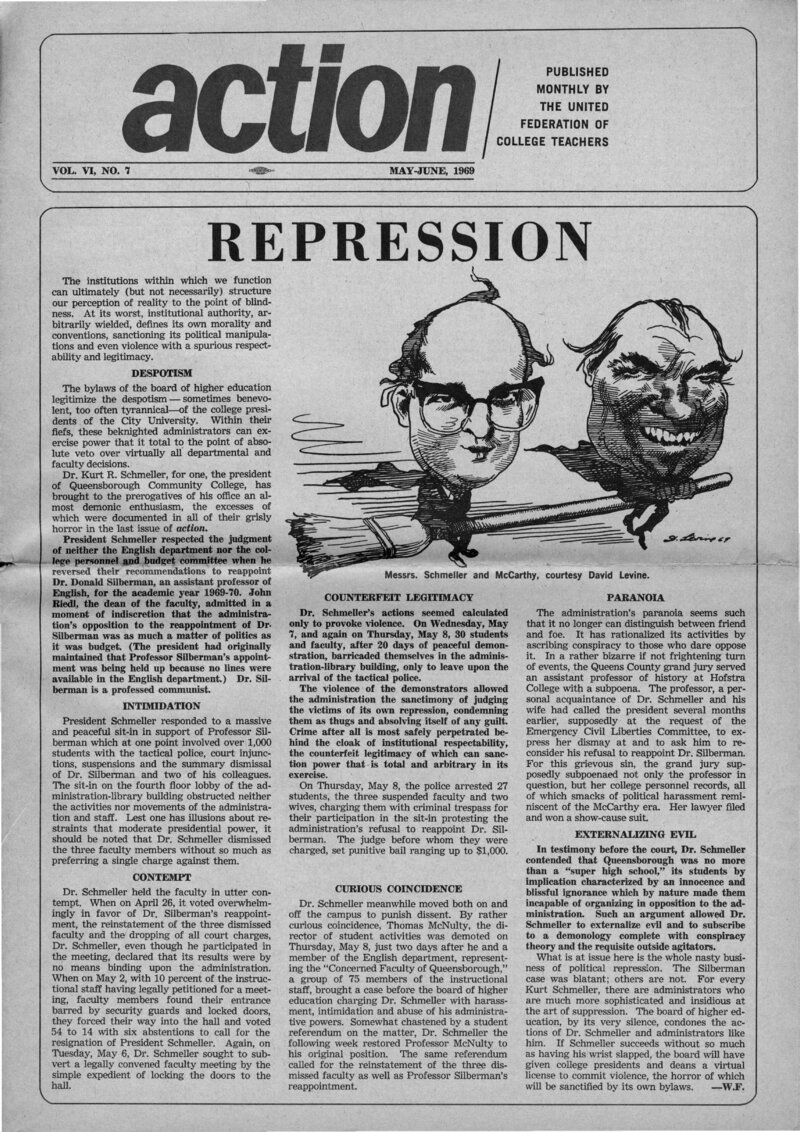
Messrs. Schmeller and McCarthy, courtesy David Levine.
COUNTERFEIT LEGITIMACY
Dr, Schmeller’s actions seemed calculated
only to provoke violence. On Wednesday, May
7, and again on Thursday, May 8, 30 students
and faculty, after 20 days of peaceful demon-
stration, barricaded themselves in the adminis-
tration-library building, only to leave upon the
arrival of the tactical police.
The violence of the demonstrators allowed
the administration the sanctimony of judging
the victims of its own repression, condemning
them as thugs and absolving itself of any guilt.
Crime after all is most safely perpetrated be-
hind the cloak of institutional respectability,
the counterfeit legitimacy of which can sanc-
tion power that-is total and arbitrary in its
exercise.
On Thursday, May 8, the police arrested 27
students, the three suspended faculty and two
wives, charging them with criminal trespass for
their participation in the sit-in protesting the
administration’s refusal to reappoint Dr. Sil-
berman. The judge before whom they were
charged, set punitive bail ranging up to $1,000.
CURIOUS COINCIDENCE
Dr. Schmeller meanwhile moved both on and
off the campus to punish dissent. By rather
curious coincidence, Thomas McNulty, the di-
rector of student activities was demoted on
Thursday, May 8, just two days after he and a
member of the English department, represent-
ing the “Concerned Faculty of Queensborough,”
a group of 75 members of the instructional
staff, brought a case before the board of higher
education charging Dr. Schmeller with harass-
ment, intimidation and abuse of his administra-
tive powers. Somewhat chastened by a student
referendum on the matter, Dr. Schmeller the
following week restored Professor McNulty to
his original position. The same referendum
called for the reinstatement of the three dis-
missed faculty as well as Professor Silberman’s
reappointment.
PARANOIA
The administration’s paranoia seems such
that it no longer can distinguish between friend
and foe. It has rationalized its activities by
ascribing conspiracy to those who dare oppose
it. In a rather bizarre if not frightening turn
of events, the Queens County grand jury served
an assistant professor of history at Hofstra
College with a subpoena. The professor, a per-
sonal acquaintance of Dr. Schmeller and his
wife had called the president several months
earlier, supposedly at the request of the
Emergency Civil Liberties Committee, to ex-
press her dismay at and to ask him to re-
consider his refusal to reappoint Dr. Silberman.
For this grievous sin, the grand jury sup-
posedly subpoenaed not only the professor in
question, but her college personnel records, all
of which smacks of political harassment remi-
niscent of the McCarthy era. Her lawyer filed
and won a show-cause suit.
EXTERNALIZING EVIL
In testimony before the court, Dr. Schmeller
contended that Queensborough was no more
than a “super high school,” its students by
implication characterized by an innocence and
blissful ignorance which by nature made them
incapable of organizing in opposition to the ad-
ministration. Such an argument allowed Dr.
Schmeller to externalize evil and to subscribe
to a demonology complete with conspiracy
theory and the requisite outside agitators.
What is at issue here is the whole nasty busi-
ness of political repression. The Silberman
case was blatant; others are not. For every
Kurt Schmeller, there are administrators who
are much more sophisticated and insidious at
the art of suppression. The board of higher ed-
ucation, by its very silence, condones the ac-
tions of Dr. Schmeller and administrators like
him. If Schmeller succeeds without so much
as having his wrist slapped, the board will have
given. college presidents and deans a virtual
license to commit violence, the horror of which
will be sanctified by its own bylaws. —W.F.
CUNY budget sliced
Dr. Albert Bowker, chancellor of the City
University, has beat a retreat on the budget.
After Mayor John Lindsay had pruned some
$70 million from the University’s budget, Bow-
ker testified with rather curious circumspec-
tion before the board of estimate on Monday,
May 5. He requested a meagre $6 million.
Bowker’s sudden forbearance in the face of
massive budgets cuts contrasts sharply with
the frenzied activity of the City University’s
public relations’ apparatus which for almost
three months had churned out a small fortune
in literature dramatizing the very real crisis
that austerity financing would create at
CUNY.
In testimony the same day, Dr. Irsael Kug-
ler, president of the UFCT pointed out that
the University was operating at 143 percent
of capacity, creating “an aggravated cumula-
tive need for staffing, space and support serv-
a
BOWKER
ices.” The University’s master plan has pro-
grammed such improvements, but unfortu-
nately, as Dr. Kugler suggested, that document
”
has been rendered bad fiction by $200 million
in budget cuts over the past seven years.
“This cannot go on,” Dr. Kugler said.
“There are taxing powers unutilized—auto
use for example. There is under-assessed real
estate valuation below the going market.
There are parcels of land, buildings and cor-
porate enterprises which are exempt from
City taxes. There is a tax rate for incomes
above $40,000 which is not graduated. ... May
I also suggest that you slash away at red tape
that prevents college buildings from being
constructed with the dispatch that is managed
by commercial buildings—some even with city
funds like Shea Stadium.”
OFFICERS
ISRAEL KUGLER
President
STANLEY LEWIS
Vice-President,
_ 4-Year Public College :
PETER O'REILLY
Vice-President,
4-Year Private College
_ HENRY ESTERLY
Vice-President,
2-Year Public College
BERNARD FLICKER
_ Secretary
EDWARD ALTERMAN
action
published monthly during
the academic year by the
_ UNITED FEDERATION OF
COLLEGE TEACHERS
Local 1460, American
Federation of Teachers,
AFL-CIO
260 Park Avenue, So.
New York, N.Y. 10010
Tel.: 673-6310.) tf
EDITOR
WILLIAM FRIEDHEIM
Signed nee and adver-
tisements not neces-
sarily represent the view- Treasurer
points or piee ee bya SIDNEY SCHWARTZ
UFCT. oe Legislative Representative
SPEECH FOR LEROI
In memory of my cousin Mickey Schwerner
by Armand Schwerner
(The following poem was originally written and
read at a benefit for LeRoi Jones’ defense fund in
1967. Professor Schwerner, a poet who teaches Eng-
lish at Staten Island Community College, feels the
poem can serve as an appropriate allegorical and per-
sonal statement on the sentiments and reactions
evoked by the current campus crises.)
common cause
common cause
come come come come
remission of sins is not in question
Jefferson is not in question
fear is in question 10:30 is in question hunger is in
question
come to the anxiety fair
common sauce reasons of soup and meat and terrible
anger and the noose of news
like the wolf’s jaw
tightening
friends laugh
in metal
in ropes
in distrust
to make common cause
with the time nothing is
enough or quite right, all activity forgets
The Agency Shop
A vote against [emphasis added] the Con-
ference means .. . dues of $60 a year, and
a possible “agency shop” in which an
amount of equal dues will be deducted from
your salary even if you choose not to be-
come a union member, and possible assess-
ments to finance outside organizing and
strike activity.
Page three, Legislative Conference
News, October-November 1968
cha-me’le-on (ka-mé’lé .Wn; ka -mél’yun), n.
[From L., fr. Gr. chamaileén, fr. chamai
on the ground, dwarf + ledn lion.] 1. Any
of a group of lizards remarkable for the
changes of color of the skin according to
the mood of the animal or surrounding con-
ditions. 2. A person who is fickle or incon-
stant.
Webster’s Collegiate Dictionary
Item—Upon questioning, representatives of
the Legislative Conference have confirmed
that their organization is negotiating for an
agency shop by which an amount equal to
its dues will be deducted from the salaries
of all faculty in unit one whether they be
LC members or not. The UFCT, represent-
ing 6,000 lecturers in unit two, is negotiat-
ing for neither an agency shop or exclusive
check-off. Neither during the campaign nor
the collective bargaining process itself, has
the UFCT advocated either position.
ends in the exercise of being, absolutes
leap into usefulness to comfort the grave-
diggers
The coolest is the most obsessed the ownership of souls
newly patented every month.
We live,
think of it, establishing
nourishment from solid
anger
that is left,
like the wolf toward mirages
and we stand
a little too straight.
Yes I live
in a dark time, belief in the poem
requires a major transplant every morning, I imagine
on my cheek, on my cornea, behind
my knee connective tissue hardening
in death, simple local answers
to the pressures in the body of the world,
come
belief, passion
come, come
sweet poem, or sour, or
broken is best;
to come sweetly
is evidence of the body letting up
on itself, falling into images.
But I know of men in an art
in an endless whip of fury, their angry certainty.
Whoever possessed by Justice selects Holy and Holier
and cries Artifact at flesh
forgets nothingness
and walks at the funeral of the whole human race.
If you took the road
through my cranial suture, through the dura matter,
what an allegorical fool you would find,
fat and weary
from too much time passing too fast, the right arm
paralyzed, and the left holding up the pennant holding
the pennant of poetry.
Mickey I think of you, I think you
into my body,
jelly tissue beginnings soft parts
in the loam of a dam between Philadelphia and
Meridian
I think about reasons for getting up mornings
and the commonness of tissue
and the violence of gravediggers and the violence
of my wish for an end
(Acknowledgements to Caterpillar magazine, and to
Black Sparrow press)
|
RESOLUTION ON CAMPUS TURMOIL PASSED —
The following resolution was passed by the UFCT executive
board on May 9:
_ The UFCT recognizes that the demonstrations and
confrontations on campuses of CUNY are often not only a
manifestation of deep and sometimes profoundly moral
discontent arising out of long-standing social injustices —
_ such as poverty, discrimination, and war, but also in many
instances a result of irresponsibility, unresponsiveness,
and insensitivity within the university structure itself. We
call upon all members of the academic community—stu-
dents, instructional staff, and administration—to continue
to seek appropriate solutions and institute necessary
change through peaceful, non-violent, and democratic
procedures. We not only condemn violent disruption that
threatens bodily harm and endangers life, but also vigor-
ously oppose vengeful reprisals against students, instruc-
tional staff, and administrators whether they occur from
within or without the academic community.
Violence, arson, serious damage to college buildings
and equipment profoundly threaten the very existence of
CUNY by exacerbating racial and ethnic hostility and cre-
ating that anti-intellectual backlash reflected in mindless
punitive legislation threatening academic freedom, dis-
advantaged students, and the Anan viability of the uni-
versity.
The maintenance of pada peace must be the es-
sential responsibility of the academic community. Trans-
gressions by students must be dealt with in accordance
with regard for their constitutional rights and due process
through democratically constituted bodies of faculty and
students. Faculty members charged with disruptive acts
must also be accorded due process by democratically con-
stituted bodies of the instructional staff.
' Should efforts to protect lives of students and facul-
ty, as well as academic property, unfortunately be beyond
the efforts of the colleges and the university, and the civil
authorities called upon, this should be done where pos-
sible only after decisions made by responsible bodies rep-
resenting students, faculty, and administration.
action
*“‘Any attempt to make sense of the present
situation on the nation’s campuses must
focus on the fundamental distinction
between disruption and violence. ”’
By IRWIN YELLOWITZ
Any attempt to make sense of the present situa-
tion on the nation’s campuses must focus upon the
fundamental distinction between disruption and vi-
olence, the reasons why disruptive tactics have been
employed so widely, and the response that the univer-
sity should make to the demands of the students.
A DISTINCTION
I believe that it is incorrect to label strikes, dem-
onstrations, and occupations of buildings as violence, if
there is no destruction of property or attacks upon
persons. The disruptive tactics used by students re-
semble the sit-ins and mass marches of the Southern
civil rights movement, which also broke laws and
regulations. The strikes by public school teachers,
welfare department caseworkers, sanitationmen, and
other groups of public employees, have violated the
law.
Many of those who condemn disruption by students
today vigorously supported Martin Luther King and
the other proponents of nonviolent disruption. Clearly,
many of the disturbances produced by students are
also nonviolent, and they flow from the same basic sit-
uation faced by civil rights leaders; powerlessness.
The student realizes that he has no effective voice
in most areas of academic life, that although he is the
reason for the university’s existence, his interests are
not automatically protected, and that he must have
the right to participate in decisions which vitally af-
fect his activities in the university. The issuance of
demands, and the disruption necessary to make the
faculty, administrators, and trustees seriously consider
the issues raised, seems to the student to be the only
way to secure a voice in the making of policy. Lack-
ing institutionalized forms of power and influence, the
students have improvised other methods. A faculty
that has a measure of power, but continuously com-
plains of its lack of influence over crucial decisions,
should be able to understand students who lack even
the modicum of authority that the faculty exercises.
DISRUPTION
Can the university put up with disruption, especially
by a minority of the student body? If one regards
disruption as a form of social pressure, and as an
occasion for reexamining established practices, the an-
swer is assuredly yes. Frivolous disruption is not
likely to occur véry often, and if it does, it will gain
little support and quickly collapse. An effective voice
for students in the governance of the university should
do much to eliminate disruption among moderate stu-
dents. The revolutionary students will then lose the
student power theme, and their influence will be based
on the appeal of their ideas.
Violence is another matter, which must be care-
fully distinguished from disruptive activity. Certainly
occupation of a building can lead to the destruction of
that building, and attempts to seal off a campus ulti-
mately can become a riot—but these unfortunate re-
sults are not an automatic development of disrup-
tion. When violence does occur, it must be re-
strained, and those guilty of illegal acts should be
punished according to law.
In America, violence has not led to a constructive
end: unlike disruption it has lacked the potential to
initiate change, and it usually destroyed the program
proposed by the violent groups. Although Americans
have accepted certain forms of personal violence, the
society has repressed political violence consistently,
and college students who believe that this will not be
the case in 1969 or 1970 are ignorant of American his-
tory as well as fundamental attitudes in contemporary
society.
If one believes that the social order itself is insti-
tutionalized violence, and that therefore other forms
of violence are justified, he must accept the position
of the revolutionary who argues for the destruction
of society by all means possible and clearly accepts
the risks of illegal activity. One can make a rational
case for violence as part of a revolution, but not for
violence as a legitimate tactic within an established in-
stitution. The revolutionist can claim justice, but not
legality; he can turn to violence as a tactic, but not
expect that society will sanction and pardon illegal
acts.
INFLUENCE
Clearly disruption is not the most desirable way for
students to participate in the governance of the uni-
versity. Students must have influence within the in-
stitution so that they need not disrupt it in order to
focus attention on their proposals. Until this funda-
mental change in structure is made, demands by dis-
ruptive students should be considered by whatever ad
hoc student-faculty bodies can be created. Nonnego-
tiable demands should be negotiated, and accepted
when they strengthen the university.
Professor Yellowitz teaches labor history at City
College.
A forum
on turmoil
Crisis has characterized many of the cam-
puses of not only the City University but
the whole nation over the past two months.
These crises have evoked many responses:
some sympathetic to the demands of stu-
dents, others not. These responses are not
necessarily open to glib categorization. The
five analyses found on the following three
pages, while representing a wide variety of
viewpoints, by no means reflect the total
range of opinion on the subject of campus
turmoil. The five faculty who graciously
consented to write up their reactions to what
has happened agreed to do so with the stipu-
lation that they were to respond to the is-
sues as they perceived them and with the
knowledge that the brevity of their essays—
necessitated by limitations of space—dictat-
ed that their comments be more suggestive
than substantive.
“the creation of democratic order through a powerful union of faculty
which can win the respect of the majority of the students.”
By ROBERT MARTINSON
In the Summer of 1961, I was imprisoned in Cell
Number Five of the maximum-security unit of the
Mississippi state penitentiary at Purchman as a free-
dom rider. In Cell Number Four was Stokely Car-
michael—then a young man—later to become head of
SNCC as it moved from integration and nonviolence
toward “black power,” racial exclusion, and violence.
In Cell Number ‘Six was James Farmer—then head
of CORE—now a Nixon appointee.
DEMOCRATIC LEFT
As a strong believer in democratic and politically
progressive trade unionism, and as a militant advo-
cate of full citizenship for the Negro people, I have
had to sharply separate myself from these two old cell-
mates. Carmichael’s “black militants” and Farmer’s
“black capitalism” are two sides of the same coin—
they both avoid the complex and protracted task of
politically organizing the mass of the black popula-
tion along with trade unions, the liberal community,
MAY-JUNE, 1969
the churches, and others into a democratic left which
could achieve political ascendance in this country.
The faculties of our universities will play an in-
creasingly important role in this process to the de-
gree that they are organized into a democratic, nation-
wide association—the UFCT—which both represents
their fundamental interests and provides decisive and
firm leadership during the present periods of student
unrest and societal “backlash.”
POWERLESSNESS
If “faculty power” is to become a reality, the UFCT
must take a firm stand against two related impulses—
to capitulate to violence (as at Cornell) and to refuse
to initiate change. Both impulses derive from pow-
erlessness vis-a-vis administrations and boards of re-
gents and from an understandable fear of political
interference with academic freedom either by student
extremists or by enraged legislators.
The UFCT must squarely face the problems of how
to maintain democratic order on the campuses. In the
long run, democratic order can be created only
through a strong majority coalition of faculty and
students intent on defending academic freedom and
the right to all legitimate means of dissent, including
strikes, demonstrations, and peaceful civil disobedience.
Such a coalition must take a firm stand against vi-
olent and confrontationist tactics aimed at the dis-
ruption of the educational process and the “Latiniza-
tion” of the American university.
DEMOCRATIC ORDER
To summarize, the UFCT must join Dr. Kenneth
Clark in denouncing the Antioch formula of hidden
segregationalism, it must cease “tail-ending” various
student groups, and it must be prepared to call upon
the civil authorities when necessary to defend the
integrity of the educational process. While orienting
the concerns of the great majority of faculty mem-
bers, the UFCT must continue to press for needed
educational reform. Our orientation should be: the
creation of democratic order through a powerful union
of faculty which can win the respect of the majority
of the students.
Professor Martinson teaches sociology at City
College.
~~
“the sizeable investment of the profession in present arrangements
renders suspect its claim to defend nothing but Beauty and Truth.”
By JAMES PERLSTEIN
In the spectrum of reactions to campus unrest, the
most common, at least within the professoreate, might
be rendered, “I understand and—not without sadness
—I condemn.” A reaction of this kind rests on an
assumption of superior wisdom: the student in revolt
fails to understand what he really wants, what he
really needs, what he really means. The faculty, on
the other hand, perceives with the dispassion born of
scholarly inquiry, and acts with the disinterest appro-
priate to those whose lives are dedicated to the Uni-
versity Ideal. Both notions die hard. Fulsome pro-
nouncements of faculty councils still pass as value-
free mediation, and reasoned student demands are
construed as modern dress reenactments of the Oedi-
pus myth.
A MATTER OF INTERESTS
With a deep bow to the complexities, wouldn’t it
clarify things to view the conflict on the campus as a
struggle in which both sides know quite well what
the stakes are, a struggle in which each is fully deter-
mined to defend its own interests? Isn’t it true that
the sizeable investment of the profession in present
arrangements renders suspect its claim to defend noth-
ing but Beauty and Truth? And isn’t it equally true
that the journeyman and apprentices, those not yet
totally caught up in the apparatus, possess at least
as much objectivity as the masters? Might it not be
worthwhile to concede that the student is his own
best interpreter; that he means what he says and not
something else? After all, if the educational system
works as well as its supporters claim, then one is
“The truth is that they
have no higher purpose
than to wield power,
power for its own sake.”’
By ANATOLE DOLGOFF
We are part of a society whose guts are laid bare by
a disgusting war and crumbling urban fabric. The
power of the military, the exploitation of the poor, the
racism, the distortion of human values by a complex
of state bureaucracy capitalism, and vulgar mass me-
dia, are transparent. Large and-influential segments of
the population have become disaffected, if not on all
of these issues, with at least enough of them to create
a massive climate of discontent. The churches, the
liberal press, key senators, civil rights groups, and, of
course, the young have all come out against the war
and in opposition to the draft. It is in this soil of
society’s evils and in this climate of tolerance to dis-
sent within liberal institutions that the student pro-
test movement has flourished. The alienation, needless
to say, is particularly widespread on the campuses.
HAMMER-LOCK
By skillfully exploiting this atmosphere, cliques of
“radical” students, their various apologists and camp
followers, have shown a powerful emotional hammer-
lock on their critics, a hold which must be broken if
one is rationally to assess their actions. These cliques,
not to be confused with the majority of student pro-
testors who may be with them on specific issues, seem
at present to have captured the student movement,
and, along with the black racists, have given it a to-
talitarian turn. Their grip is based on two false
assumptions: “
(1) That because of their youth and “sincerity,” the
students speak from a loftier moral plane, and
(2) That to criticize them is to identify them with
reaction.
The belief that these cliques have essentially noble
intentions stems partly from their well-publicized rhet-
oric, replete with catch phrases dear to the guilty
heart of the grizzled libertarian, and partly from the
perpetual flaunting of their youth as if a passport for
their demagoguery. Rhetoric is essential to all move-
ments. It is always couched in terms of strong emo-
tional appeal, often expressing the greatest hopes of
mankind. Stop in at random at any church and more
than likely you will hear true Judeo-Christian senti-
ments expressed in tones dripping sincerity, although
in a style different from that of the “radical” stu-
dents.
SELECTIVE INDIGNATION
However, more important than what one says is
what one does, and I find what most of these cliques
do to be reprehensible. Two hundred advocates of
“participatory democracy” can tie up (without consul-
tation) a campus used by thousands and if they are
booted out, set fire to the building. Their indignation
is selective at best. They can be rightfully indignant
about the Vietnam War, but remarkably silent on Bia-
fran slaughter, or Czechoslovakia. They can scream
political repression, but, at the same time, hang on
their wall the picture of a bearded man who locks
young people up for dressing like hippies, who has
spies on every block, and who tolerates no opposition
4
obliged to take seriously the protests of students
trained to think clearly. And if 20-year-olds are in-
capable of evaluating their situation then the system
has failed and their indictment stands in spite of them-
selves.
Perhaps the shoe fits the other foot. The universi-
ties possess their own copious talent for disingenuous-
ness and self-deception. Opposition to student demands
rests less on a principled faith in things as they are
than in an inchoate fear of things as they may become.
What if there is no longer a university Laius for a
student Oedipus to play to? What if the student body
becomes predominantly Black, Puerto Rican and work-
ing class? What if the ethnic composition of the fac-
ulty comes to reflect that of a new student body?
What if students share decisively in the design of cur-
* ricula, and in the hiring and firing of faculty? What
if, in short, the university is transformed?
OBSOLESCENCE
Some foresee the end of Western Civilization. But
most, at least dimly, perceive a more prosaic. yet more
intimidating problem: How does a white, upwardly
mobile, middle class faculty cope with a student body
whose power is growing and whose composition and
purposes no longer correspond to its own? The un-
certain answer generates most faculty resistance. To-
day’s university is imperfect but comfortable. The
university of the future will probably be just as im-
perfect in its own way and certainly less comfortable.
Trained to value Academe as it is and rewarded for
the valuing, the faculty finds its own position as cul-
(you can be damn sure not in the University of Ha-
vana!).
The rationalizations for their actions are by now
well known; false comparisons to depression sit-down
strikes; the “fact” that it gets “results” (what kind
is another matter); the inability to effect changes in
the university structure by other means, as if the
university were under some cosmic moral imperative
to accept their domination. The truth is that they
have no higher purpose than to wield power, power
for its own sake. And, like all power addicts, they
will do whatever is necessary to accomplish this aim
until stopped. As a case in point, take their rela-
tionship with their counterparts among the black
students. The black cliques make not even a pretense
at progressive or libertarian ideals. Their demands of
quotas, of separate facilities, of separate faculty, of
separate studies, all controlled by them, is racist and
reactionary. They broach no opposition from within
their own ranks and display all the attributes of a
totalitarian movement, color it black or white. They
have dealt a body blow to integration, a cause for
which better men than they have given their lives.
Yet, in a tawdry attempt to enhance their own image
tural courtier too embarrassing to confront. Devotion
to principle explains less at this moment than does
the faculty’s sudden intimation of its own obsolescence
along with the institution which shelters it. The prin-
ciples are discovered only after the threat is felt.
CANT AND FRAUD
If faculty and administration really desire to provide
the very best education, then their fears are mis-
placed. Students, with rare exceptions, are neither
stupid nor self-destructive. They too want the best.
They prize good teaching and good reading, and they
define “good” in ways surprisingly like their teachers.
The Humanist Tradition is not on its last legs; even
the. anarchists, so-called, operate within it.
What the students do insist upon is an end to cant
and an end to fraud whether in the universities or the
society at large. They no longer accept the argument
that in defining the Good Life the seniority principle
applies. If faculty and administration could rid them-
selves at last of their belief in a silent democracy
and a speaking aristocracy, then the university might
become a genuine community capable of facing larger
social issues with integrity.
There would no longer be any need nor any excuse
for “understanding condemnation.” The understand-
ing derives from the implicit justice of student de-
mands; the condemnation from their disruptiveness.
But disruption and its attendant violence grow from
the students’ sense of their powerlessness. When they
win their fair share of power the violence will pass.
Professor Perlstein teaches history at Manhattan
Community College.
Be oa ore Tie Fl
as the champion of the downtrodden, the white “radi-
cals” support them.
NO ALTERNATIVE
In short, the student movement as controlled by the
various campus cliques, far from offering an alterna-
tive to our society, mirrors its corruption, its hypoc-
risy, its authoritarianism. As such, the movement
must eventually lose its appeal to the great mass of
students, and even its active supporters. The climate
of tolerance essential to its growth will change. The
constant machinations, the glaring inconsistencies, the
lies, the arrogance, the boredom of it all, will even-
tually take their toll. This will not happen at once,
for the leadership is shrewd’ and knows how to manip-
ulate their eroding base of support. But, for well
deserved reasons, the movement, as it now stands, is
no longer a force for effecting social justice. It is not
worthy of the support of people seriously concerned
with liberty. One would hope that a new movement
will emerge that employs tactics consistent with its
aims.
Professor Dolgoff teaches physics at New York Com-
munity College.
action
‘And it has peace, and
campus... <
By EDWARD SAGARIN
Violence. How abhorrent! It is ugly, repulsive, sin-
ful, and, worse than that, someone can get hurt. And
surely it has no place on college campuses, which
exist as sanctified centers of pure learning, where ideas
are examined in a stratified atmosphere, uncontami-
nated by power struggles and—yes, by violence.
So let us, like professors and scholars and denizens
of this world of purity (and even like unionists who
have conveniently obliterated from memory much of
the history of American unionism), join the chorus of
denouncers. We must have peace on the campus (but
quick, correct the statement, or elaborate on it, so
that everyone knows we are talking about domestic
peace, not international peace). Let us have tran-
quility, because tranquility is good for the atmos-
phere of professors, and let us remember we are pro-
fessors, even if, as we embrace tranquility, we forget
that we are unionists, and then tomorrow, when we
support a strike, we can remember that we are union-
ists, while we forget that we are professors, because
then we will not be so enamored of tranquility, and
professors love of tranquility. The campus must be
tranquil, and that is why we must give it tranquil-
izers, and if we give it enough tranquilizers, it will be
the most tranquil place in town. No, not quite, but
almost, because there is another tranquil spot in the
city, a very tranquil spot, and it is called a cemetery.
And it has peace, and no violence, the cemetery, just
like a tranquil campus.
Yes, we must denounce violence, because violence is
very bad, especially when it gets violent. If only we
could have some nicely contained violence, gentlemanly
violence, reasonably rational violence, maybe even non-
violent violence, then professors could acquiesce. So
let us send the violence far away, far from the campus,
away, away to Vietnam for example, and let us be
very gentlemanly about our violence, like Dean Rusk,
who is a very nonviolent man, and who would never
condone the seizure of a campus building.
RESOLUTIONS
Let us pass resolutions against violence and the
destruction of people and property, or should we say
property and people, just to get our priorities straight?
So I propose that we adopt as the union line on this
burning issue (no ambiguity intended):
“We denounce the destruction of human lives on our
campus, deplore the half-dozen or more deaths of stu-
dents and the injury of many others resulting from
campus turmoil, while at the same time we denounce
the destruction of human lives (American, Vietnamese,
and other) being plotted on our campuses by an in-
ternational conspiracy that reaches across many con-
tinents.
“We denounce radical students who would interfere
with the rights of others to pursue their military train-
.ing through the ROTC on campus, while at the same
time we denounce military students who have joined
in a conspiracy to take peaceful and tranquil students
and send them to an early and violent death.
“We denounce blacks who would close a campus
%
Part of the picket line sponso!
The following motions were passed at an
emergency meeting of the UFCT’s executive
board convened on May 21 to discuss the crisis
at Queensborough Community College.
e That the UFCT attorney take the Silber-
man case as a grievance before the BHE.
© That the UFCT support the effort of the
Queensborough Concerned Faculty in its effort
to have the BHE discipline President Schmeller
for his flouting of faculty rights guaranteed by
the by-laws. Also that the UFCT mount. a
campaign including a picket line before the
BHE if there is no positive response from BHE
MAY-JUNE, 1969
red by the UFCT at Queensborough Community College on May 2.
no violence, the cemetery, just like a tranquil
and interfere with the rights of whites to go about
obtaining their education, while at the same time we
denounce whites who control the systematic misedu-
cation of the blacks and, in the name of unionism
(which has so often been synonymous with anti-black
racism in America), are interfering with the rights of
blacks to go about obtaining their education.
“We denounce students who are asking for separate
dormitories for blacks, while at the same time we rise
up to break down the illegal ghettos in our cities and
demand that fair housing laws be enforced (for we
are for law and order, and fair housing is a law).
SEPARATISM
“We denounce black students who would separate
into clubs where whites are not welcome, and call for
disbanding of such clubs, while at the same time we
insist on the disbanding of Hillel, Newman Clubs, and
Student Christian societies on the campuses.
“And, finally, what’s all this silly talk about am-
nesty? People who break the law should face the
music. There must be no amnesty for black students
ae
after June 1. Also, that if possible, the brief of
the concerned faculty be printed in the forth-
coming issue of Action.
e That if the BHE does not respond posi-
tively to the appeal of the Concerned Faculty,
the UFCT pass a motion of censure against
President Schmeller.
e That the UFCT establish a legal defense
fund and that an appeal for funds be sent to
both members and nonmembers.
e That the UFCT ask the AFT to set up a
nationwide commission to hear witnesses and
who keep whites out of a dormitory, or for white
landlords who keep black tenants out of their build-
ings. Integrate them in the jails, black and white to-
gether, and throw in the city officials who have toler-
ated crime by allowing these two types of activities
to flourish.
“There must be no amnesty for students who burn
a building, nor for soldiers, generals, and civilian offi-
cials who burn (or order the burning of) a village.
Arsonists all, they must be treated equally, even if we
integrate them in one great trial.
“Every student who breaks a law, any law, must be
tried in a court of law. Immediately tried, for he is
entitled to a quick trial. But, wait. Let us make
these the first trials after we have completed the
great trial (for there must be no amnesty) of those
who have violated the supreme law of this land, as
written in the Constitution, by ordering to be waged
an obviously illegal war. As soon as this latter trial
is completed, I call to account these lawbreaking stu-
dents.”
Professor Sagarin teaches sociology at City College.
UFCT moves against repression at OCC
to take testimony on the Queensborough situa-
tion.
e That the UFCT send a telegram to BHE
protesting the summary dismissals and request-
ing the BHE not to cooperate with repressive
investigations of faculty.
Contributions for the defense fund can be
sent to the United Federation of College Teach-
ers, 260 Park Avenue South, New York, N.Y.
10010.
Solidarity ?
(Continued from Page 8)
If the UFCT does emerge as a strong force for
truly radical change in these matters and others, then
what will be our relation to a unionism which in the
main has acted to preserve the power relationships
that have brought the country to its present state
of crisis? To what extent will past favors and future
ones, money and help given or to be given, or the
general imperative of union solidarity, commit the
UFCT to support—or even maintain discreet silence
about—such policy?
Will we be able to send money to groups like the
United Black Brothers of Ford Mahwah, who are
severely critical of their local? As for that lady fre-
quently referred to as our sister union, I say she is
no lady and no kin of mine. But the UFCT shares its
building with the UFT, and the very chairs we sit on
at Executive Board meetings bear those endearing
three letters on their backs. Trivial? Possibly. But
the UFCT’s autonomy from UFT influence must be
more than rhetorical, lest we, too, find ourselves be-
come the protectors of the anachronistic.
—Barbara Koenig,
STATEN ISLAND CC
5
JUDG
The need to cover the high cost of specialist care is
greater today than ever before.
Nevertheless, H.I.P. is still the only plan in this area
providing fully paid specs services—in the office, hos-
pital and home..
WHAT H.1.P. DOES
H.I.P.’s Medical Groups provide care and consulta-
tions by qualified specialists in fourteen basic specialties
—in and out of the hospital.
There are no specialist charges . . . no limit on visits
.. no deductibles... no claim forms.
When needed in difficult cases, H.I.P. brings you the
services of specially qualified specialists and surgical
teams—also without cost to you!
AND THE OTHERS?
Compare H.I.P.’s broad coverage with the specialist
coverage given by the other plans available to City em-
ployee families.
We repeat...
HEALTH INSURANCE PLAN OF GREATER NEW YORK
625 MADISON AVENUE, NEW YORK, N.Y.10022
Who runs our
universities?
WASHINGTON, D.C.
Who runs the nation’s colleges
and universities?
What kind of person serves on
the governing boards of the in-
stitutions of higher education in
the U.S.?
Two answers to these questions
were given by competent authori-
ties last month—one dealing with
San Francisco State College, spe-
cifically, and the other, a remark-
ably similar reply, dealing with
the national picture.
Lee McClatchey, president of
the academic senate at San Fran-
cisco State, was outlining possible
reasons for the student and
teacher strikes at SFS before a
House subcommittee here, when
he touched on the composition
of the board of trustees of the 18-
campus California State College
system.
“It's not too different from
most governing boards,” he said.
“There’s only one black man and
no Mexican-Americans among
the 20 members. Most of the
members represent legal and
business interests. Most are from
the upper-middle or wealthy
classes.” Members of the board,
he noted, are appointed by Gov-
ernor Reagan “strictly at his
whim” and serve 8-year terms.
Asked by Rep. Louis Stokes
(D.-Ohio) if it wouldn’t be help-
ful to have representatives of
other ethnic groups such as
blacks and Mexican-Americans on
the board because of Califor-
nia’s high population of these
minority groups, McClatchey
said, “Absolutely. We need more
of them in the student bodies
and faculties, too.”
Earlier, the Educational Test-
ing Service in Princeton, N.J.,
in cooperation with the Ameri-
ean Association for Higher Edu-
cation and the Association of
Governing Boards of Universi-
ties and Colleges, did a survey of
the makeup of governing boards
in the entire country.
Their conclusion, as reported
by the New York Times, was
that “The men who govern the
nation’s colleges and universities
are predominantly white, wealthy
Protestants whose politics lean
to conservative Republicanism.”
“They take a_ considerably
more limited view of academic
freedom than most faculty mem-
bers, and their background read-
ing on higher education is scanty.
Their views and attitudes, which
have been severely criticized by
students, can be expected to be
in growing conflict with those of
many faculty members.”
The Times reported that a
composite profile of board mem-
bers shows that fewer than 2
percent are black, and fewer than
4 percent Jewish. More than
half have annual incomes above
$30,000 and most come from
business executive posts, with
others frequently having back-
grounds in medicine, law and
education. Fifty-eight percent
identify themselves as Republi-
cans. Only 15 percent describe
their philosophies as “liberal.”
The trustees “generally favor a
hierarchical system in which de-
cisions are made at the top and
passed down,” the study con-
cluded, Substantial numbers of
the trustees felt that the admin-
istration should control content
of college newspapers and that it
was reasonable to require loyalty
oaths from faculty members.
The study—called “College and
University Trustees: Their Back-
grounds, Roles, and Educational
Attitudes”’—-was disturbed over
the fact that “trustees do not
read — indeed have generally
never even heard of—the more
relevant higher education books
and journals. Half of the busi-
ness executives on the board
moreover were found to agree
that ‘running a college is like
running a business.’”
action
FUND IS ESTABLISHED FOR STRIKING
HOSPITAL WORKERS IN CHARLESTON
CHARLESTON, S.C.
(The UFCT has established a
fund in support of the Charles-
ton, S.C., Hospital workers. Con-
tributions should be sent to the
UFCT, 260 Park Ave. South,
New York City 10010.)
American Federation of Teach-
ers President David Selden,
Washington, D.C., led a delega-
tion of teacher union members
joining the Charleston Hospital
workers’ support march here on
May 11.
The more than 7,000 marchers
were headed by the Rev. Ralph
David Abernathy of the South-
ern Christian Leadership Con-
ference, and among those also on
hand to show solidarity with the
hospital strikers were William
Kircher, AFL-CIO director of or-
ganization; Walter Reuther, pres-
ident of UAW; and five members
of Congress, including John Con-
yers (D-Mich.), winner of last
year’s AFT Stillman Award.
Four hundred workers at two
of the city’s six hospitals have
been on strike for more than two
months in an effort to secure
bargaining rights for their un-
ion, Local 1199B of the Retail,
Wholesale, and Department Store
Union. They walked out after the
two publicly supported hospitals,
South Carolina Medical College
Hospital and Charleston County
Hospital, fired 11 union leaders
and refused to agree to a bar-
gaining-agent election.
A rebirth of the powerful lIa-
bor-civil rights coalition has been
seen in the Charleston effort, as
recorders.
located in New York.
film.
ynireo
MAY-JUNE, 1969
sometimes dissident labor and
civil rights leaders have united
in support of the strikers. Last
month, 14 civil rights leaders re-
leased a joint statement asking
Gov. Robert E. McNair of South
Carolina and hospital officials to
recognize the union. It was the
first joint statement made by
leaders of such groups as CORE,
the Urban League, A. Philip Ran-
dolph Institute, NAACP, Negro
American Labor Council, Nation-
al Welfare Rights Organization,
Council of Negro Women, and
others, since the death of Dr.
Martin Luther King, Jr., more
than a year before.
“They’ve even jailed the prison
chaplain,” said Dave Prosten of
the striking hospital workers’ un-
ion here, when asked in late
April for a report on develop-
ments in this city. “There are
246 people in jail now,” Prosten
said, “and there’ll probably be
300 by the end of today.”
In addition to Father Thomas
Duffy of Charleston, chaplain of
the county jail, who was arrest-
ed, the jail then also held the
Rev. Ralph Abernathy, Atlanta,
Ga., head of the Southern Chris-
tian Leadership Conference, and
Leon Davis, New York City,
president of Local 1199 of the
Retail, Wholesale, and Depart-
ment Store Union. They have
since been released on bond.
SAME WORK, LOWER PAY
Service and maintenance work-
ers and practical nurses and or-
derlies at two of the city’s six
hospitals have been on strike
OFFICIAL
UFCT DISCOUNT
Approved By Executive Board
NEW CARS — Official UFCT car purchase plan...exactly $100 above dealers actual cost!
CARPETING — Specially negotiated discount prices on almost all national brands.
STEREO AND HI-FI — Stereo consoles, stereo cabinets and stereo components including
amplifiers, preamplifiers, tuners, turntables, speakers and speaker systems and tape
DIAMONDS — Uncontested value at lowest possible price!
PIANOS — Direct factory arrangement for special discount prices. Factory showroom
CAMERAS AND PHOTOGRAPHIC EQUIPMENT — Cameras and accessories, movie cam-
eras, still and movie projectors, editing, copying and developing equipment, lenses and
ADDITIONAL SERVICES
MAJOR APPLIANCES — Televisions, air-conditioners, refrigerators, freezers, dishwash-
ers, washing machines, dryers, disposals, ranges, radios, humidifiers, dehumidifiers,
tape recorders and vacuum cleaners are available at slightly above wholesale.
FURNITURE — Complete lines of furniture at slightly above dealers actual cost.
CUSTOM DRAPERIES, UPHOLSTERY AND SLIP COVERS — Exclusive service group
only through United Buying Service. 13 locations throughout the metropolitan area.
FURS — A prominent fur manufacturer and supplier to major department stores is now
contracted to offer their products at discounts exclusive to United Buying Service. Furs
available include Mink, Beaver, Leopard, Muskrat, Broadtail, Alaskan Seal, Persian
Lamb and a variety of Fun Furs.
LUGGAGE — Products of all leading manufacturers at special discount prices.
The Greatest Buying Power in Bcater New York
1855 Broadway, New York, N.Y. 10023
United Buying Service Corporation § New York: (212) LT 1-9494, PL7-0007
New Jersey: (201) 434-6788
since March 20, when 12 of their
colleagues were fired for union
activity. -Local 1199B of the
RWDSU—an offshoot of the
Drug and Hospital Employees
Union of New York City—has
been trying to secure union rec-
ognition for the mostly black
hospital workers, who have been
paid an average of $1.30 an hour,
and generally less than whites.
who do identical work.
The two struck institutions are
the 150-bed County Hospital, and
the 500-bed Medical College Hos-
pital, both publicly-supported.
Each has been trying to get along
with scabs, Prosten said, but in-
dications are that fewer than
half their beds are filled. “They
hire new people who work for a
few days, and then they come
over here,” Prosten reported
from strike headquarters.
One of the six hospitals, St.
Francis Xavier, has recognized
the union to the extent of agree-
ing to a representation election
for its workers.
COMPARED TO MEMPHIS
In the meantine, the 300 “will
stay in jail until this thing is set-
tled,” Prosten reported. Coretta
King, widow of Dr. Martin Lu-
ther King, Jr., spoke at an April
29 rally, and led a march in
Charleston the following day. She
had earlier issued a strong state-
ment, with 13 other black lead-
ers, urging Gov. Robert McNair
and hospital officials to recognize
the union. Among the other sign-
ers were Rep. John Conyers
(D.-Mich.); Rep. Shirley Chis-
holm (D.-N.Y.); Mayor Richard
Hatcher of Gary, Ind.; Mayor
Carl Stokes of Cleveland, Ohio;
AFL-CIO Vice-President <A.
Philip Randolph; NAACP Execu-
tive Secretary Roy Wilkins; and
Bayard Rustin, director of the
A. Philip Randolph Institute.
MEMPHIS
The statement noted that “We
cannot fail to recall that the
right of workers to be represent-
ed by a union is precisely the
same issue that led to tragedy in
Memphis last year.” It was while
he was aiding striking sanitation
workers in Memphis that Dr.
King was assassinated last April.
Labor and community support
for the strikers has been great,
Posten said. Black students be-
gan a formal boycott of the
schools on April 28, and many of
the city’s schoolchildren joined
in a mass march several days be-
fore, when an estimated 5,000
persons demonstrated in support
of the strikers. There are 1,000
members of the national guard
on duty in the city, but apart
from several beatings, no violence
has yet occurred.
Notice to
all readers
Neither the United Federation
of College Teachers nor action
can take responsibility for the ac-
curacy of thé advertisements or
the bonae fides of the advertisers
appearing in the publication.
While every reasonable precau-
tion is exercised in the screening
of these advertisements, readers
are advised to use the same de-
gree of prudence that they would
in responding to an advertise-
ment in any publication.
If any reader has a specific
complaint regarding service or
product of any advertiser appear-
ing in action, he is advised to
send his complaint, in writing, to
the advertiser, with a carbon
copy to action.
action, of course conforms to
the strict advertising canons and
ethics of the International Labor
Press Association, AFL-CIO, gov-
erning advertisements appear-
ing in the labor press.
Vacation for two—4 days, 3-nights—$5.00
Hotels in Miami Beach, Las Vegas, etc.
no meals
Inquire details of
N. SILVERMON
382 Central Park West
New York, N.Y. 10025
@ SPECIAL SAVINGS
strength and size. Deliverie
OFFICIAL UFCT OIL PROGRAM
Discounts made possible through UFCT
in New York metropolitan area.
HE SERVICE —oil burner service contracts tailor made for your needs.
Hi PERSONAL ATTENTION—Atter years
members we understand your need for personal attention.
Jay Manacher, Secretary-Treasurer.
CENTRAL PETROLEUM CORP.
NYC and WESTCHESTER
325 Exterior Street
Bronx, N. Y.
212-MO 9-4040
COLLECTIVE STRENGTH BRINGS YOU INDIVIDUAL BENEFITS
mai, |
service to UFCT
Please ask for
of
NASSAU and SUFFOLK
456 So. Franklin Street
Hempstead, L. I.
516-1V 3-9611
For Large
For Best
For Tremendous
ELECTIONS
ERVICE
AVINGS
On All Periods of
FURNITURE
We Invite the Members of UFCT and their
Families to visit our Showroom.
Credit terms arranged up to 3 years
at the LOWEST RATES in New York City.
foes 1 Ea Fe
Purnia (Pripany Cn
A ro 7 05 ie
Manufacturer's Distributors
Free Parking at: Sunrose Parking Lot, 24th St. cor. 6th Ave.
119 W. 24 St., New York City
CHelsea 2-3354 - 5
Hours: Daily 9:00 to 5:00, Thursday to 8:00 P.M., Saturday to 4:00 P.M.
@ OFFICIAL UFCT
@ MAJOR APPLIANCE
© DISCOUNT OUTLET
MEMBERSHIP PRICES QUOTED ARE UNBEATABLE
WASHERS -
¢ FREEZERS -
o TNe 0 STEREO
DRYERS -
RANGES) +
REFRIGERATORS -+
DISHWASHERS’) +
AIR CONDITIONERS +
® Featuring — All Famous Brand Names
SHOP FIRST — COME IN
WITH MAKE AND MODEL NUMBER
JAMAICA GAS & ELECTRIC
42-24 BELL BOULEVARD
BAYSIDE, N. Y. BA 9-2853 BA 9-2400
Open Daily Till 9 p.m.; Wed. & Sat. Till 6 p.m.
SPECIAL PRE-SEASON AIR CONDITIONING
SALE ON NOW
FEDDERS - GE -
PHILCO
- EMERSON - CHRYSLER
Trade union
solidarity
Dear Sir:
The UFCT has wisely taken action so that such a
gesture as the controversial gift of $100 to the UFT
on behalf of our local could not again be made with-
out the approval of the Executive Board. However, I
continue to be troubled by the whole question of trade-
union solidarity. I think that my conception of the
union movement in general and the role of the UFCT
in particular differs in certain specifics from more
conventionally held definitions of unionism. My con-
cern over the matter of trade-union solidarity has
prompted me to write this letter, a letter which I
hope will elicit responses and hopefully generate some
kind of debate over the issues it raises.
The present student generation is not alone in its
disenchantment with the conservatism of contempo-
rary trade unionism. Many of us too grew up not
when the unions were full of idealistic promise but in
the years when most unions had already abdicated
their social commitments. We have watched George
Meany and other leaders of the AFL-CIO back John-
son’s Vietnam policy and support other aggressive
forays of American power that were heinous to us.
An article in the May 3 New Republic adds a sinis-
ter new development to this closeness between union-
ism and U.S. policy by revealing various kinds of mas-
sive government financing, overt and covert, accepted
by the AFL-CIO for overseas labor activities. The
title of the article, “Agent Meany,” casts the union
leader in an even grimmer role than his former ones.
Further, we have seen the union movement, as it
consolidated its gains for its own workers, turn its
back on the poor and the black. I am uncomfortable
to find myself in agreement on this point with a recent
bitter editorial attack by the notoriously anti-union
New York Times. The work stoppage begun some
weeks ago at the Ford plant at Mahwah, N.J.—prin-
cipally by black and Puerto Rican workers—exposed
the failure of the UAW local to represent its black
workers, as other small, scattered breakaways by black
workers’ locals elsewhere recently have also done.
But, in addition to this failure of unionism to actively
fight for the black workers in its ranks, there is
the even more disturbing failure of unionism to re-
cruit and organize with any great energy those who
have been excluded by the rest of this rich and im-
mensely favored society.
And for many of us to whom the real issue of the
UFT-Ocean Hill-Brownsville conflict was the black
community’s aspiration for better schools, the pitiful
destruction of Ocean Hill-Brownsville and the general
betrayal of the black community by the new legis-
lation (undoubtedly made possible by the UFT’s col-
laboration with its “liberal” champion John Marchi)
seems another sorry indication of unionism standing
in opposition to the weak and needy when the chips
are really down, when real power is at stake and its
own privileges are jeopardized. In short, the unionism
of our experience, with all its great power and wealth,
stands as one of the mainstays of the status quo.
So, many of us who have been active in and loyal
to the UFCT because we believe in its goals and its
vision—and who feel our trust is already justified in
the excellent set of demands the union is making for
the lecturers, and the battle it is now waging to get
those demands realized—many of us so committed
to the UFCT find George Meany a most ugly bed-
fellow and Albert Shanker just as offensive. Simple
trade-union solidarity is not at all simple for us.
On the other hand, invoking non-problematic bread-
and-butter issues is all too simple.
The UFCT, to its great credit, has, all along, recog-
nized that its interests transcend, though they im-
portantly include, pure business unionism—and that
it must support larger social change as well as in-
creased office space. It should hardly need be said
that in a time when the whole country is being torn
apart—and especially since the schools and colleges
have become central battlegrounds and foci of every-
thing that has gone wrong or been neglected for gen-
erations in the society at large—it is obviously im-
possible to be apolitical anywhere, but especially in
education. The war touches our kids most closely, the
black and Puerto Rican students are asking entry of
us and questioning our admission policies in relation
to avenues of social mobility out of the ghetto; the
supposedly objective nature of what we choose to
teach and how we teach it is rightly being challenged,
etc., etc.
Trade unions that concerned themselves only with
improving wages and hours of their workers but kept
out or ignored—or even did not actively extend help
to—the poor and the blacks were not apolitical, but
were, rather, a force in perpetuating the oppression
of the oppressed.
isn’t it
time
YOU took
some action?
I want information []
Iwanttojoin [J
Wane ne
Home Address...
City and State. os
College... : mas :
Home Phone...
College Phone...
Dept...
Mail filled-out coupon “(please et to UFCT, 260 ee Avenue
South, N. Y. 10010. :
:
el ae eee ee eee en eee enone ned
This being the case, the crucial question is whether
we in the UFCT will hold more or less tightly to an
old order that has excluded so many and so much,
and is now being called into question with an ex-
tremity proportionate to the time problems have been
neglected and left to fester and grow. We are all de-
fined, it seems to me, not by what we say about mat-
ters remote from us (the blacks were right, we have
long ago discovered, in their contempt for Northern
Liberals) but what we do when we are asked to
share our own power, to open our own doors, to make
changes in our own little worlds that may mean we
have less and those without have more. This sharing
applies to the disenfranchised younger members of
faculties and departments, to students, and, in another
way, to black and third-world students.
(Continued on Page 5)
Birds in the wind
By LEONARD QUART
Soft bellies
Watch peacocks pirouetting
Placing them in gray cartons
To feel relief
In a rash of sensational headlines and
still pictures, solemn TV documentaries
and pretentious think pieces, the media
record and analyze youthful revolution-
aries, drug busts, folk rock, campus vio-
lence, and the generation gap. Every
politician, professor, and Kiwanis mem-
ber feels it necessary to develop pat ex-
planations for these both titillating and
threatening phenomena. Hypotheses are
projected by men on all ranges of the
political and professional spectrum,
neatly categorizing and explaining away
the rationale behind the anger, frustra-
tion, and rebellion of “the kids.” Inter-
pretations proliferate (some more sophis-
ticated than others): images of affluent
sons rebelling against fathers, commu-
nists subverting and agitating among
youth, nihilists destroying order and em-
bracing chaos, and heroic militants
struggling against establishment corrup-
tion for a more moral and socially just
America.
These elaborate fictions are evoked
and the public begins to feel relief. The
rebellious youth—their pot-making, pla-
card-carrying, flamboyantly dressed sons
and daughters—can now be placed in
boxes, a semblance of order peers through
the chaos, and if the world is still in
confusion, it can at least be more easily
understood. These facile formulae entice
me, too, for, since I teach these Oedipully
ridden rebels, I also seek categories by
which to grasp the whole disordered
scene. However, to my chagrin I dis-
cover that when these categories con-
front reality, they splinter into a thou-
sand contradictory insights and truths
and I am left with a series of images
without much of a hypothesis to control
them with.
This semester I plunged into the youth
scene by working at Richmond College
with a commune organized to study so-
cial change. The participants did not
live together but they took a bloc of
eredits communally, inhabiting the same
room and social universe. The history
of the commune demands a more exten-
sive piece to do it justice; however, there
were insights that I gained and images
that I can conjure up to superficially
convey the experience.
APOLITICAL?
I began working with the commune
under the illusion that the majority of
students would be involved in some form
of political. action. I was quickly
wrenched from this fantasy and discov-
ered that the few SDS members in the
group went unheeded in their political
analyses and rhetoric. Jargon like “rac-
ist imperialism” or calls for a Marxist
analysis of the budget cuts left most un-
touched or brought laughter in its wake.
It was true that the majority of stu-
dents in the commune were repelled by
American policies and felt anger and re-
sentment towards the political establish-
ment. However, radical political feel-
ings did not mean working actively on
programs for political and social change
or studying Marx, Mao, and Fanon. Al-
though the students were alienated from
American society, they were also disen-
gaged from the political struggle. Emis-
saries from the New Left came and
chastized them for their quietism, and
the commune students listened and
nodded sympathetically, but they did not
leave the next day to organize the fac-
tories, or make common cause with their
“black brothers.”
For most of the students the major
part of their energies was directed in-
ward. They constantly repeated the
litany that they could do little in the
outside world until they got their “heads
straight.” These products of non-afflu-
ent, authoritarian, lower-middle-class
homes sought in the commune aid and,
hopefully, some solutions for their con-
fusion, isolation, and sense of fragmen-
tation. One of the commune members
described the communal spirit as a
“weak and frightened bird” seeking
wholeness and unity—a “common wind.”
The most significant goals for these stu-
dents were personal ones, a sense of
ease with themselves, greater warmth
and.spontaneity, a feeling of group soli-
darity and relatedness. The commune
was a refuge from an educational sys-
tem which blotted out these aspirations
and operated according to impersonal
pressures and meaningless abstractions.
They wanted ideas to be felt—masks to
be dropped—compassion to be expressed
—a classroom and a college to become
an authentic community.
CULTURAL REVOLUTIONARIES
The students in the commune were en-
gaged in creating a cultural revolution.
The term seems bold and overblown, and
the students had not quite reached the
point of fully articulating the vision of
a new life or of creating a set of counter
institutions. This was not a group of
wild poets and bohemians but a number
of community-college graduates who had
begun to question the nature of their
personal and social experience. On a
visit to the school, Abbie Hoffman had
condemned them for remaining in col-
lege and operating within the social or-
der. It was true that they ‘went to col-
lege and vaguely thought of jobs after
graduation. Some still lived at home
and, coexisting with their feelings of
alienation, had numerous ties and loyal-
ties to the conventional world. Their
fragile egos still withered under criti-
cism and they continued to desire ap-
proval from those the Yippies would
have dismissed as the enemy. How-
ever, there were moments when they
demonstrated a self-righteousness wor-
thy of the Living Theater, condemning
and criticizing the establishment out of
a fount of moral purity. But they ac-
companied these feelings of self right-
eousness with a courage and fearlessness
which shamed their elders and trans-
cended their own insecurities. There
were luminous moments—where they
stood with great dignity affirming their
point of view in the face of all aca-
demic and political authority.
In an inchoate way they had ex-
pressed the alienation and despair that
most Americans feel and repress in
private moments of silence and un-
wanted revelation. They had begun to
question and partially reject such
American verities as status, security,
patriotism, electoral politics, and a life
where present gratification was deferred
and sacrificed to future success. They
were exploring new life styles and values
—from using drugs to participating in
encounter groups. These explorations
were often superficial and lacking in
continuity, for the students had difficulty
in following up on initial enthusiasms.
However, a choice had been made and
even if many of the commune students
entered the middle class, a small revolu-
tion had already occurred for most, and
their private and public worlds would
never be the same again.
In examining what I have written, I
realize I have also been guilty of flat-
tening out and categorizing what defies
clear definition. But I am hopeful that
my account captures more of the com-
plexity of a phenomena which eludes
simplification.
Leonard Quart teaches history at
Richmond College.
action
REP
The institutions within which we function
can ultimately (but not necessarily) structure
our perception of reality to the point of blind-
ness. At its worst, institutional authority, ar-
bitrarily wielded, defines its own morality and
conventions, sanctioning its political manipula-
tions and even violence with a spurious respect-
ability and legitimacy.
DESPOTISM
The bylaws of the board of higher education
legitimize the despotism — sometimes benevo-
lent, too often tyrannical—of the college presi-
dents of the City University. Within their
fiefs, these beknighted administrators can ex-
ercise power that it total to the point of abso-
lute veto over virtually all departmental and
faculty decisions.
Dr. Kurt R. Schmeller, for one, the president
of Queensborough Community College, has
brought to the prerogatives of his office an al-
most demonic enthusiasm, the excesses of
which were documented in all of their grisly
horror in the last issue of action.
President Schmeller respected the judgment
of neither the English department nor the col-
-lege personnel. and budget committee when he
reversed their recommendations to reappoint
Dr. Donald Silberman, an assistant professor of
English, for the academic year 1969-70. John
Riedl, the dean of the faculty, admitted in a
moment of indiscretion that the administra-
tion’s opposition to the reappointment of Dr.
Silberman was as much a matter of politics as
it was budget. (The president had originally
maintained that Professor Silberman’s appoint-
ment was being held up because no lines were
available in the English department.) Dr. Sil-
berman is a professed communist.
INTIMIDATION
President Schmeller responded to a massive
and peaceful sit-in in support of Professor Sil-
berman which at one point involved over 1,000
students with the tactical police, court injunc-
tions, suspensions and the summary dismissal
of Dr. Silberman and two of his colleagues.
The sit-in on the fourth floor lobby of the ad-
ministration-library building obstructed neither
the activities nor movements of the administra-
tion and staff. Lest one has illusions about re-
straints that moderate presidential power, it
should be noted that Dr. Schmeller dismissed
the three faculty members without so much as
preferring a single charge against them.
CONTEMPT
Dr. Schmeller held the faculty in utter con-
tempt. When on April 26, it voted overwhelm-
ingly in favor of Dr, Silberman’s reappoint-
ment, the reinstatement of the three dismissed
faculty and the dropping of all court charges,
Dr. Schmeller, even though he participated in
the meeting, declared that its results were by
no means binding upon the administration.
When on May 2, with 10 percent of the instruc-
tional staff having legally petitioned for a meet-
ing, faculty members found their entrance
barred by security guards and locked doors,
they forced their way into the hall and voted
54 to 14 with six abstentions to call for the
resignation of President Schmeller. Again, on
Tuesday, May 6, Dr. Schmeller sought to sub-
vert a legally convened faculty meeting by the
simple expedient of locking the doors to the
hall.
action
MAY-JUNE, 1969
PUBLISHED
MONTHLY BY
THE UNITED
FEDERATION OF
COLLEGE TEACHERS
RESSION
Messrs. Schmeller and McCarthy, courtesy David Levine.
COUNTERFEIT LEGITIMACY
Dr, Schmeller’s actions seemed calculated
only to provoke violence. On Wednesday, May
7, and again on Thursday, May 8, 30 students
and faculty, after 20 days of peaceful demon-
stration, barricaded themselves in the adminis-
tration-library building, only to leave upon the
arrival of the tactical police.
The violence of the demonstrators allowed
the administration the sanctimony of judging
the victims of its own repression, condemning
them as thugs and absolving itself of any guilt.
Crime after all is most safely perpetrated be-
hind the cloak of institutional respectability,
the counterfeit legitimacy of which can sanc-
tion power that-is total and arbitrary in its
exercise.
On Thursday, May 8, the police arrested 27
students, the three suspended faculty and two
wives, charging them with criminal trespass for
their participation in the sit-in protesting the
administration’s refusal to reappoint Dr. Sil-
berman. The judge before whom they were
charged, set punitive bail ranging up to $1,000.
CURIOUS COINCIDENCE
Dr. Schmeller meanwhile moved both on and
off the campus to punish dissent. By rather
curious coincidence, Thomas McNulty, the di-
rector of student activities was demoted on
Thursday, May 8, just two days after he and a
member of the English department, represent-
ing the “Concerned Faculty of Queensborough,”
a group of 75 members of the instructional
staff, brought a case before the board of higher
education charging Dr. Schmeller with harass-
ment, intimidation and abuse of his administra-
tive powers. Somewhat chastened by a student
referendum on the matter, Dr. Schmeller the
following week restored Professor McNulty to
his original position. The same referendum
called for the reinstatement of the three dis-
missed faculty as well as Professor Silberman’s
reappointment.
PARANOIA
The administration’s paranoia seems such
that it no longer can distinguish between friend
and foe. It has rationalized its activities by
ascribing conspiracy to those who dare oppose
it. In a rather bizarre if not frightening turn
of events, the Queens County grand jury served
an assistant professor of history at Hofstra
College with a subpoena. The professor, a per-
sonal acquaintance of Dr. Schmeller and his
wife had called the president several months
earlier, supposedly at the request of the
Emergency Civil Liberties Committee, to ex-
press her dismay at and to ask him to re-
consider his refusal to reappoint Dr. Silberman.
For this grievous sin, the grand jury sup-
posedly subpoenaed not only the professor in
question, but her college personnel records, all
of which smacks of political harassment remi-
niscent of the McCarthy era. Her lawyer filed
and won a show-cause suit.
EXTERNALIZING EVIL
In testimony before the court, Dr. Schmeller
contended that Queensborough was no more
than a “super high school,” its students by
implication characterized by an innocence and
blissful ignorance which by nature made them
incapable of organizing in opposition to the ad-
ministration. Such an argument allowed Dr.
Schmeller to externalize evil and to subscribe
to a demonology complete with conspiracy
theory and the requisite outside agitators.
What is at issue here is the whole nasty busi-
ness of political repression. The Silberman
case was blatant; others are not. For every
Kurt Schmeller, there are administrators who
are much more sophisticated and insidious at
the art of suppression. The board of higher ed-
ucation, by its very silence, condones the ac-
tions of Dr. Schmeller and administrators like
him. If Schmeller succeeds without so much
as having his wrist slapped, the board will have
given. college presidents and deans a virtual
license to commit violence, the horror of which
will be sanctified by its own bylaws. —W.F.
CUNY budget sliced
Dr. Albert Bowker, chancellor of the City
University, has beat a retreat on the budget.
After Mayor John Lindsay had pruned some
$70 million from the University’s budget, Bow-
ker testified with rather curious circumspec-
tion before the board of estimate on Monday,
May 5. He requested a meagre $6 million.
Bowker’s sudden forbearance in the face of
massive budgets cuts contrasts sharply with
the frenzied activity of the City University’s
public relations’ apparatus which for almost
three months had churned out a small fortune
in literature dramatizing the very real crisis
that austerity financing would create at
CUNY.
In testimony the same day, Dr. Irsael Kug-
ler, president of the UFCT pointed out that
the University was operating at 143 percent
of capacity, creating “an aggravated cumula-
tive need for staffing, space and support serv-
a
BOWKER
ices.” The University’s master plan has pro-
grammed such improvements, but unfortu-
nately, as Dr. Kugler suggested, that document
”
has been rendered bad fiction by $200 million
in budget cuts over the past seven years.
“This cannot go on,” Dr. Kugler said.
“There are taxing powers unutilized—auto
use for example. There is under-assessed real
estate valuation below the going market.
There are parcels of land, buildings and cor-
porate enterprises which are exempt from
City taxes. There is a tax rate for incomes
above $40,000 which is not graduated. ... May
I also suggest that you slash away at red tape
that prevents college buildings from being
constructed with the dispatch that is managed
by commercial buildings—some even with city
funds like Shea Stadium.”
OFFICERS
ISRAEL KUGLER
President
STANLEY LEWIS
Vice-President,
_ 4-Year Public College :
PETER O'REILLY
Vice-President,
4-Year Private College
_ HENRY ESTERLY
Vice-President,
2-Year Public College
BERNARD FLICKER
_ Secretary
EDWARD ALTERMAN
action
published monthly during
the academic year by the
_ UNITED FEDERATION OF
COLLEGE TEACHERS
Local 1460, American
Federation of Teachers,
AFL-CIO
260 Park Avenue, So.
New York, N.Y. 10010
Tel.: 673-6310.) tf
EDITOR
WILLIAM FRIEDHEIM
Signed nee and adver-
tisements not neces-
sarily represent the view- Treasurer
points or piee ee bya SIDNEY SCHWARTZ
UFCT. oe Legislative Representative
SPEECH FOR LEROI
In memory of my cousin Mickey Schwerner
by Armand Schwerner
(The following poem was originally written and
read at a benefit for LeRoi Jones’ defense fund in
1967. Professor Schwerner, a poet who teaches Eng-
lish at Staten Island Community College, feels the
poem can serve as an appropriate allegorical and per-
sonal statement on the sentiments and reactions
evoked by the current campus crises.)
common cause
common cause
come come come come
remission of sins is not in question
Jefferson is not in question
fear is in question 10:30 is in question hunger is in
question
come to the anxiety fair
common sauce reasons of soup and meat and terrible
anger and the noose of news
like the wolf’s jaw
tightening
friends laugh
in metal
in ropes
in distrust
to make common cause
with the time nothing is
enough or quite right, all activity forgets
The Agency Shop
A vote against [emphasis added] the Con-
ference means .. . dues of $60 a year, and
a possible “agency shop” in which an
amount of equal dues will be deducted from
your salary even if you choose not to be-
come a union member, and possible assess-
ments to finance outside organizing and
strike activity.
Page three, Legislative Conference
News, October-November 1968
cha-me’le-on (ka-mé’lé .Wn; ka -mél’yun), n.
[From L., fr. Gr. chamaileén, fr. chamai
on the ground, dwarf + ledn lion.] 1. Any
of a group of lizards remarkable for the
changes of color of the skin according to
the mood of the animal or surrounding con-
ditions. 2. A person who is fickle or incon-
stant.
Webster’s Collegiate Dictionary
Item—Upon questioning, representatives of
the Legislative Conference have confirmed
that their organization is negotiating for an
agency shop by which an amount equal to
its dues will be deducted from the salaries
of all faculty in unit one whether they be
LC members or not. The UFCT, represent-
ing 6,000 lecturers in unit two, is negotiat-
ing for neither an agency shop or exclusive
check-off. Neither during the campaign nor
the collective bargaining process itself, has
the UFCT advocated either position.
ends in the exercise of being, absolutes
leap into usefulness to comfort the grave-
diggers
The coolest is the most obsessed the ownership of souls
newly patented every month.
We live,
think of it, establishing
nourishment from solid
anger
that is left,
like the wolf toward mirages
and we stand
a little too straight.
Yes I live
in a dark time, belief in the poem
requires a major transplant every morning, I imagine
on my cheek, on my cornea, behind
my knee connective tissue hardening
in death, simple local answers
to the pressures in the body of the world,
come
belief, passion
come, come
sweet poem, or sour, or
broken is best;
to come sweetly
is evidence of the body letting up
on itself, falling into images.
But I know of men in an art
in an endless whip of fury, their angry certainty.
Whoever possessed by Justice selects Holy and Holier
and cries Artifact at flesh
forgets nothingness
and walks at the funeral of the whole human race.
If you took the road
through my cranial suture, through the dura matter,
what an allegorical fool you would find,
fat and weary
from too much time passing too fast, the right arm
paralyzed, and the left holding up the pennant holding
the pennant of poetry.
Mickey I think of you, I think you
into my body,
jelly tissue beginnings soft parts
in the loam of a dam between Philadelphia and
Meridian
I think about reasons for getting up mornings
and the commonness of tissue
and the violence of gravediggers and the violence
of my wish for an end
(Acknowledgements to Caterpillar magazine, and to
Black Sparrow press)
|
RESOLUTION ON CAMPUS TURMOIL PASSED —
The following resolution was passed by the UFCT executive
board on May 9:
_ The UFCT recognizes that the demonstrations and
confrontations on campuses of CUNY are often not only a
manifestation of deep and sometimes profoundly moral
discontent arising out of long-standing social injustices —
_ such as poverty, discrimination, and war, but also in many
instances a result of irresponsibility, unresponsiveness,
and insensitivity within the university structure itself. We
call upon all members of the academic community—stu-
dents, instructional staff, and administration—to continue
to seek appropriate solutions and institute necessary
change through peaceful, non-violent, and democratic
procedures. We not only condemn violent disruption that
threatens bodily harm and endangers life, but also vigor-
ously oppose vengeful reprisals against students, instruc-
tional staff, and administrators whether they occur from
within or without the academic community.
Violence, arson, serious damage to college buildings
and equipment profoundly threaten the very existence of
CUNY by exacerbating racial and ethnic hostility and cre-
ating that anti-intellectual backlash reflected in mindless
punitive legislation threatening academic freedom, dis-
advantaged students, and the Anan viability of the uni-
versity.
The maintenance of pada peace must be the es-
sential responsibility of the academic community. Trans-
gressions by students must be dealt with in accordance
with regard for their constitutional rights and due process
through democratically constituted bodies of faculty and
students. Faculty members charged with disruptive acts
must also be accorded due process by democratically con-
stituted bodies of the instructional staff.
' Should efforts to protect lives of students and facul-
ty, as well as academic property, unfortunately be beyond
the efforts of the colleges and the university, and the civil
authorities called upon, this should be done where pos-
sible only after decisions made by responsible bodies rep-
resenting students, faculty, and administration.
action
*“‘Any attempt to make sense of the present
situation on the nation’s campuses must
focus on the fundamental distinction
between disruption and violence. ”’
By IRWIN YELLOWITZ
Any attempt to make sense of the present situa-
tion on the nation’s campuses must focus upon the
fundamental distinction between disruption and vi-
olence, the reasons why disruptive tactics have been
employed so widely, and the response that the univer-
sity should make to the demands of the students.
A DISTINCTION
I believe that it is incorrect to label strikes, dem-
onstrations, and occupations of buildings as violence, if
there is no destruction of property or attacks upon
persons. The disruptive tactics used by students re-
semble the sit-ins and mass marches of the Southern
civil rights movement, which also broke laws and
regulations. The strikes by public school teachers,
welfare department caseworkers, sanitationmen, and
other groups of public employees, have violated the
law.
Many of those who condemn disruption by students
today vigorously supported Martin Luther King and
the other proponents of nonviolent disruption. Clearly,
many of the disturbances produced by students are
also nonviolent, and they flow from the same basic sit-
uation faced by civil rights leaders; powerlessness.
The student realizes that he has no effective voice
in most areas of academic life, that although he is the
reason for the university’s existence, his interests are
not automatically protected, and that he must have
the right to participate in decisions which vitally af-
fect his activities in the university. The issuance of
demands, and the disruption necessary to make the
faculty, administrators, and trustees seriously consider
the issues raised, seems to the student to be the only
way to secure a voice in the making of policy. Lack-
ing institutionalized forms of power and influence, the
students have improvised other methods. A faculty
that has a measure of power, but continuously com-
plains of its lack of influence over crucial decisions,
should be able to understand students who lack even
the modicum of authority that the faculty exercises.
DISRUPTION
Can the university put up with disruption, especially
by a minority of the student body? If one regards
disruption as a form of social pressure, and as an
occasion for reexamining established practices, the an-
swer is assuredly yes. Frivolous disruption is not
likely to occur véry often, and if it does, it will gain
little support and quickly collapse. An effective voice
for students in the governance of the university should
do much to eliminate disruption among moderate stu-
dents. The revolutionary students will then lose the
student power theme, and their influence will be based
on the appeal of their ideas.
Violence is another matter, which must be care-
fully distinguished from disruptive activity. Certainly
occupation of a building can lead to the destruction of
that building, and attempts to seal off a campus ulti-
mately can become a riot—but these unfortunate re-
sults are not an automatic development of disrup-
tion. When violence does occur, it must be re-
strained, and those guilty of illegal acts should be
punished according to law.
In America, violence has not led to a constructive
end: unlike disruption it has lacked the potential to
initiate change, and it usually destroyed the program
proposed by the violent groups. Although Americans
have accepted certain forms of personal violence, the
society has repressed political violence consistently,
and college students who believe that this will not be
the case in 1969 or 1970 are ignorant of American his-
tory as well as fundamental attitudes in contemporary
society.
If one believes that the social order itself is insti-
tutionalized violence, and that therefore other forms
of violence are justified, he must accept the position
of the revolutionary who argues for the destruction
of society by all means possible and clearly accepts
the risks of illegal activity. One can make a rational
case for violence as part of a revolution, but not for
violence as a legitimate tactic within an established in-
stitution. The revolutionist can claim justice, but not
legality; he can turn to violence as a tactic, but not
expect that society will sanction and pardon illegal
acts.
INFLUENCE
Clearly disruption is not the most desirable way for
students to participate in the governance of the uni-
versity. Students must have influence within the in-
stitution so that they need not disrupt it in order to
focus attention on their proposals. Until this funda-
mental change in structure is made, demands by dis-
ruptive students should be considered by whatever ad
hoc student-faculty bodies can be created. Nonnego-
tiable demands should be negotiated, and accepted
when they strengthen the university.
Professor Yellowitz teaches labor history at City
College.
A forum
on turmoil
Crisis has characterized many of the cam-
puses of not only the City University but
the whole nation over the past two months.
These crises have evoked many responses:
some sympathetic to the demands of stu-
dents, others not. These responses are not
necessarily open to glib categorization. The
five analyses found on the following three
pages, while representing a wide variety of
viewpoints, by no means reflect the total
range of opinion on the subject of campus
turmoil. The five faculty who graciously
consented to write up their reactions to what
has happened agreed to do so with the stipu-
lation that they were to respond to the is-
sues as they perceived them and with the
knowledge that the brevity of their essays—
necessitated by limitations of space—dictat-
ed that their comments be more suggestive
than substantive.
“the creation of democratic order through a powerful union of faculty
which can win the respect of the majority of the students.”
By ROBERT MARTINSON
In the Summer of 1961, I was imprisoned in Cell
Number Five of the maximum-security unit of the
Mississippi state penitentiary at Purchman as a free-
dom rider. In Cell Number Four was Stokely Car-
michael—then a young man—later to become head of
SNCC as it moved from integration and nonviolence
toward “black power,” racial exclusion, and violence.
In Cell Number ‘Six was James Farmer—then head
of CORE—now a Nixon appointee.
DEMOCRATIC LEFT
As a strong believer in democratic and politically
progressive trade unionism, and as a militant advo-
cate of full citizenship for the Negro people, I have
had to sharply separate myself from these two old cell-
mates. Carmichael’s “black militants” and Farmer’s
“black capitalism” are two sides of the same coin—
they both avoid the complex and protracted task of
politically organizing the mass of the black popula-
tion along with trade unions, the liberal community,
MAY-JUNE, 1969
the churches, and others into a democratic left which
could achieve political ascendance in this country.
The faculties of our universities will play an in-
creasingly important role in this process to the de-
gree that they are organized into a democratic, nation-
wide association—the UFCT—which both represents
their fundamental interests and provides decisive and
firm leadership during the present periods of student
unrest and societal “backlash.”
POWERLESSNESS
If “faculty power” is to become a reality, the UFCT
must take a firm stand against two related impulses—
to capitulate to violence (as at Cornell) and to refuse
to initiate change. Both impulses derive from pow-
erlessness vis-a-vis administrations and boards of re-
gents and from an understandable fear of political
interference with academic freedom either by student
extremists or by enraged legislators.
The UFCT must squarely face the problems of how
to maintain democratic order on the campuses. In the
long run, democratic order can be created only
through a strong majority coalition of faculty and
students intent on defending academic freedom and
the right to all legitimate means of dissent, including
strikes, demonstrations, and peaceful civil disobedience.
Such a coalition must take a firm stand against vi-
olent and confrontationist tactics aimed at the dis-
ruption of the educational process and the “Latiniza-
tion” of the American university.
DEMOCRATIC ORDER
To summarize, the UFCT must join Dr. Kenneth
Clark in denouncing the Antioch formula of hidden
segregationalism, it must cease “tail-ending” various
student groups, and it must be prepared to call upon
the civil authorities when necessary to defend the
integrity of the educational process. While orienting
the concerns of the great majority of faculty mem-
bers, the UFCT must continue to press for needed
educational reform. Our orientation should be: the
creation of democratic order through a powerful union
of faculty which can win the respect of the majority
of the students.
Professor Martinson teaches sociology at City
College.
~~
“the sizeable investment of the profession in present arrangements
renders suspect its claim to defend nothing but Beauty and Truth.”
By JAMES PERLSTEIN
In the spectrum of reactions to campus unrest, the
most common, at least within the professoreate, might
be rendered, “I understand and—not without sadness
—I condemn.” A reaction of this kind rests on an
assumption of superior wisdom: the student in revolt
fails to understand what he really wants, what he
really needs, what he really means. The faculty, on
the other hand, perceives with the dispassion born of
scholarly inquiry, and acts with the disinterest appro-
priate to those whose lives are dedicated to the Uni-
versity Ideal. Both notions die hard. Fulsome pro-
nouncements of faculty councils still pass as value-
free mediation, and reasoned student demands are
construed as modern dress reenactments of the Oedi-
pus myth.
A MATTER OF INTERESTS
With a deep bow to the complexities, wouldn’t it
clarify things to view the conflict on the campus as a
struggle in which both sides know quite well what
the stakes are, a struggle in which each is fully deter-
mined to defend its own interests? Isn’t it true that
the sizeable investment of the profession in present
arrangements renders suspect its claim to defend noth-
ing but Beauty and Truth? And isn’t it equally true
that the journeyman and apprentices, those not yet
totally caught up in the apparatus, possess at least
as much objectivity as the masters? Might it not be
worthwhile to concede that the student is his own
best interpreter; that he means what he says and not
something else? After all, if the educational system
works as well as its supporters claim, then one is
“The truth is that they
have no higher purpose
than to wield power,
power for its own sake.”’
By ANATOLE DOLGOFF
We are part of a society whose guts are laid bare by
a disgusting war and crumbling urban fabric. The
power of the military, the exploitation of the poor, the
racism, the distortion of human values by a complex
of state bureaucracy capitalism, and vulgar mass me-
dia, are transparent. Large and-influential segments of
the population have become disaffected, if not on all
of these issues, with at least enough of them to create
a massive climate of discontent. The churches, the
liberal press, key senators, civil rights groups, and, of
course, the young have all come out against the war
and in opposition to the draft. It is in this soil of
society’s evils and in this climate of tolerance to dis-
sent within liberal institutions that the student pro-
test movement has flourished. The alienation, needless
to say, is particularly widespread on the campuses.
HAMMER-LOCK
By skillfully exploiting this atmosphere, cliques of
“radical” students, their various apologists and camp
followers, have shown a powerful emotional hammer-
lock on their critics, a hold which must be broken if
one is rationally to assess their actions. These cliques,
not to be confused with the majority of student pro-
testors who may be with them on specific issues, seem
at present to have captured the student movement,
and, along with the black racists, have given it a to-
talitarian turn. Their grip is based on two false
assumptions: “
(1) That because of their youth and “sincerity,” the
students speak from a loftier moral plane, and
(2) That to criticize them is to identify them with
reaction.
The belief that these cliques have essentially noble
intentions stems partly from their well-publicized rhet-
oric, replete with catch phrases dear to the guilty
heart of the grizzled libertarian, and partly from the
perpetual flaunting of their youth as if a passport for
their demagoguery. Rhetoric is essential to all move-
ments. It is always couched in terms of strong emo-
tional appeal, often expressing the greatest hopes of
mankind. Stop in at random at any church and more
than likely you will hear true Judeo-Christian senti-
ments expressed in tones dripping sincerity, although
in a style different from that of the “radical” stu-
dents.
SELECTIVE INDIGNATION
However, more important than what one says is
what one does, and I find what most of these cliques
do to be reprehensible. Two hundred advocates of
“participatory democracy” can tie up (without consul-
tation) a campus used by thousands and if they are
booted out, set fire to the building. Their indignation
is selective at best. They can be rightfully indignant
about the Vietnam War, but remarkably silent on Bia-
fran slaughter, or Czechoslovakia. They can scream
political repression, but, at the same time, hang on
their wall the picture of a bearded man who locks
young people up for dressing like hippies, who has
spies on every block, and who tolerates no opposition
4
obliged to take seriously the protests of students
trained to think clearly. And if 20-year-olds are in-
capable of evaluating their situation then the system
has failed and their indictment stands in spite of them-
selves.
Perhaps the shoe fits the other foot. The universi-
ties possess their own copious talent for disingenuous-
ness and self-deception. Opposition to student demands
rests less on a principled faith in things as they are
than in an inchoate fear of things as they may become.
What if there is no longer a university Laius for a
student Oedipus to play to? What if the student body
becomes predominantly Black, Puerto Rican and work-
ing class? What if the ethnic composition of the fac-
ulty comes to reflect that of a new student body?
What if students share decisively in the design of cur-
* ricula, and in the hiring and firing of faculty? What
if, in short, the university is transformed?
OBSOLESCENCE
Some foresee the end of Western Civilization. But
most, at least dimly, perceive a more prosaic. yet more
intimidating problem: How does a white, upwardly
mobile, middle class faculty cope with a student body
whose power is growing and whose composition and
purposes no longer correspond to its own? The un-
certain answer generates most faculty resistance. To-
day’s university is imperfect but comfortable. The
university of the future will probably be just as im-
perfect in its own way and certainly less comfortable.
Trained to value Academe as it is and rewarded for
the valuing, the faculty finds its own position as cul-
(you can be damn sure not in the University of Ha-
vana!).
The rationalizations for their actions are by now
well known; false comparisons to depression sit-down
strikes; the “fact” that it gets “results” (what kind
is another matter); the inability to effect changes in
the university structure by other means, as if the
university were under some cosmic moral imperative
to accept their domination. The truth is that they
have no higher purpose than to wield power, power
for its own sake. And, like all power addicts, they
will do whatever is necessary to accomplish this aim
until stopped. As a case in point, take their rela-
tionship with their counterparts among the black
students. The black cliques make not even a pretense
at progressive or libertarian ideals. Their demands of
quotas, of separate facilities, of separate faculty, of
separate studies, all controlled by them, is racist and
reactionary. They broach no opposition from within
their own ranks and display all the attributes of a
totalitarian movement, color it black or white. They
have dealt a body blow to integration, a cause for
which better men than they have given their lives.
Yet, in a tawdry attempt to enhance their own image
tural courtier too embarrassing to confront. Devotion
to principle explains less at this moment than does
the faculty’s sudden intimation of its own obsolescence
along with the institution which shelters it. The prin-
ciples are discovered only after the threat is felt.
CANT AND FRAUD
If faculty and administration really desire to provide
the very best education, then their fears are mis-
placed. Students, with rare exceptions, are neither
stupid nor self-destructive. They too want the best.
They prize good teaching and good reading, and they
define “good” in ways surprisingly like their teachers.
The Humanist Tradition is not on its last legs; even
the. anarchists, so-called, operate within it.
What the students do insist upon is an end to cant
and an end to fraud whether in the universities or the
society at large. They no longer accept the argument
that in defining the Good Life the seniority principle
applies. If faculty and administration could rid them-
selves at last of their belief in a silent democracy
and a speaking aristocracy, then the university might
become a genuine community capable of facing larger
social issues with integrity.
There would no longer be any need nor any excuse
for “understanding condemnation.” The understand-
ing derives from the implicit justice of student de-
mands; the condemnation from their disruptiveness.
But disruption and its attendant violence grow from
the students’ sense of their powerlessness. When they
win their fair share of power the violence will pass.
Professor Perlstein teaches history at Manhattan
Community College.
Be oa ore Tie Fl
as the champion of the downtrodden, the white “radi-
cals” support them.
NO ALTERNATIVE
In short, the student movement as controlled by the
various campus cliques, far from offering an alterna-
tive to our society, mirrors its corruption, its hypoc-
risy, its authoritarianism. As such, the movement
must eventually lose its appeal to the great mass of
students, and even its active supporters. The climate
of tolerance essential to its growth will change. The
constant machinations, the glaring inconsistencies, the
lies, the arrogance, the boredom of it all, will even-
tually take their toll. This will not happen at once,
for the leadership is shrewd’ and knows how to manip-
ulate their eroding base of support. But, for well
deserved reasons, the movement, as it now stands, is
no longer a force for effecting social justice. It is not
worthy of the support of people seriously concerned
with liberty. One would hope that a new movement
will emerge that employs tactics consistent with its
aims.
Professor Dolgoff teaches physics at New York Com-
munity College.
action
‘And it has peace, and
campus... <
By EDWARD SAGARIN
Violence. How abhorrent! It is ugly, repulsive, sin-
ful, and, worse than that, someone can get hurt. And
surely it has no place on college campuses, which
exist as sanctified centers of pure learning, where ideas
are examined in a stratified atmosphere, uncontami-
nated by power struggles and—yes, by violence.
So let us, like professors and scholars and denizens
of this world of purity (and even like unionists who
have conveniently obliterated from memory much of
the history of American unionism), join the chorus of
denouncers. We must have peace on the campus (but
quick, correct the statement, or elaborate on it, so
that everyone knows we are talking about domestic
peace, not international peace). Let us have tran-
quility, because tranquility is good for the atmos-
phere of professors, and let us remember we are pro-
fessors, even if, as we embrace tranquility, we forget
that we are unionists, and then tomorrow, when we
support a strike, we can remember that we are union-
ists, while we forget that we are professors, because
then we will not be so enamored of tranquility, and
professors love of tranquility. The campus must be
tranquil, and that is why we must give it tranquil-
izers, and if we give it enough tranquilizers, it will be
the most tranquil place in town. No, not quite, but
almost, because there is another tranquil spot in the
city, a very tranquil spot, and it is called a cemetery.
And it has peace, and no violence, the cemetery, just
like a tranquil campus.
Yes, we must denounce violence, because violence is
very bad, especially when it gets violent. If only we
could have some nicely contained violence, gentlemanly
violence, reasonably rational violence, maybe even non-
violent violence, then professors could acquiesce. So
let us send the violence far away, far from the campus,
away, away to Vietnam for example, and let us be
very gentlemanly about our violence, like Dean Rusk,
who is a very nonviolent man, and who would never
condone the seizure of a campus building.
RESOLUTIONS
Let us pass resolutions against violence and the
destruction of people and property, or should we say
property and people, just to get our priorities straight?
So I propose that we adopt as the union line on this
burning issue (no ambiguity intended):
“We denounce the destruction of human lives on our
campus, deplore the half-dozen or more deaths of stu-
dents and the injury of many others resulting from
campus turmoil, while at the same time we denounce
the destruction of human lives (American, Vietnamese,
and other) being plotted on our campuses by an in-
ternational conspiracy that reaches across many con-
tinents.
“We denounce radical students who would interfere
with the rights of others to pursue their military train-
.ing through the ROTC on campus, while at the same
time we denounce military students who have joined
in a conspiracy to take peaceful and tranquil students
and send them to an early and violent death.
“We denounce blacks who would close a campus
%
Part of the picket line sponso!
The following motions were passed at an
emergency meeting of the UFCT’s executive
board convened on May 21 to discuss the crisis
at Queensborough Community College.
e That the UFCT attorney take the Silber-
man case as a grievance before the BHE.
© That the UFCT support the effort of the
Queensborough Concerned Faculty in its effort
to have the BHE discipline President Schmeller
for his flouting of faculty rights guaranteed by
the by-laws. Also that the UFCT mount. a
campaign including a picket line before the
BHE if there is no positive response from BHE
MAY-JUNE, 1969
red by the UFCT at Queensborough Community College on May 2.
no violence, the cemetery, just like a tranquil
and interfere with the rights of whites to go about
obtaining their education, while at the same time we
denounce whites who control the systematic misedu-
cation of the blacks and, in the name of unionism
(which has so often been synonymous with anti-black
racism in America), are interfering with the rights of
blacks to go about obtaining their education.
“We denounce students who are asking for separate
dormitories for blacks, while at the same time we rise
up to break down the illegal ghettos in our cities and
demand that fair housing laws be enforced (for we
are for law and order, and fair housing is a law).
SEPARATISM
“We denounce black students who would separate
into clubs where whites are not welcome, and call for
disbanding of such clubs, while at the same time we
insist on the disbanding of Hillel, Newman Clubs, and
Student Christian societies on the campuses.
“And, finally, what’s all this silly talk about am-
nesty? People who break the law should face the
music. There must be no amnesty for black students
ae
after June 1. Also, that if possible, the brief of
the concerned faculty be printed in the forth-
coming issue of Action.
e That if the BHE does not respond posi-
tively to the appeal of the Concerned Faculty,
the UFCT pass a motion of censure against
President Schmeller.
e That the UFCT establish a legal defense
fund and that an appeal for funds be sent to
both members and nonmembers.
e That the UFCT ask the AFT to set up a
nationwide commission to hear witnesses and
who keep whites out of a dormitory, or for white
landlords who keep black tenants out of their build-
ings. Integrate them in the jails, black and white to-
gether, and throw in the city officials who have toler-
ated crime by allowing these two types of activities
to flourish.
“There must be no amnesty for students who burn
a building, nor for soldiers, generals, and civilian offi-
cials who burn (or order the burning of) a village.
Arsonists all, they must be treated equally, even if we
integrate them in one great trial.
“Every student who breaks a law, any law, must be
tried in a court of law. Immediately tried, for he is
entitled to a quick trial. But, wait. Let us make
these the first trials after we have completed the
great trial (for there must be no amnesty) of those
who have violated the supreme law of this land, as
written in the Constitution, by ordering to be waged
an obviously illegal war. As soon as this latter trial
is completed, I call to account these lawbreaking stu-
dents.”
Professor Sagarin teaches sociology at City College.
UFCT moves against repression at OCC
to take testimony on the Queensborough situa-
tion.
e That the UFCT send a telegram to BHE
protesting the summary dismissals and request-
ing the BHE not to cooperate with repressive
investigations of faculty.
Contributions for the defense fund can be
sent to the United Federation of College Teach-
ers, 260 Park Avenue South, New York, N.Y.
10010.
Solidarity ?
(Continued from Page 8)
If the UFCT does emerge as a strong force for
truly radical change in these matters and others, then
what will be our relation to a unionism which in the
main has acted to preserve the power relationships
that have brought the country to its present state
of crisis? To what extent will past favors and future
ones, money and help given or to be given, or the
general imperative of union solidarity, commit the
UFCT to support—or even maintain discreet silence
about—such policy?
Will we be able to send money to groups like the
United Black Brothers of Ford Mahwah, who are
severely critical of their local? As for that lady fre-
quently referred to as our sister union, I say she is
no lady and no kin of mine. But the UFCT shares its
building with the UFT, and the very chairs we sit on
at Executive Board meetings bear those endearing
three letters on their backs. Trivial? Possibly. But
the UFCT’s autonomy from UFT influence must be
more than rhetorical, lest we, too, find ourselves be-
come the protectors of the anachronistic.
—Barbara Koenig,
STATEN ISLAND CC
5
JUDG
The need to cover the high cost of specialist care is
greater today than ever before.
Nevertheless, H.I.P. is still the only plan in this area
providing fully paid specs services—in the office, hos-
pital and home..
WHAT H.1.P. DOES
H.I.P.’s Medical Groups provide care and consulta-
tions by qualified specialists in fourteen basic specialties
—in and out of the hospital.
There are no specialist charges . . . no limit on visits
.. no deductibles... no claim forms.
When needed in difficult cases, H.I.P. brings you the
services of specially qualified specialists and surgical
teams—also without cost to you!
AND THE OTHERS?
Compare H.I.P.’s broad coverage with the specialist
coverage given by the other plans available to City em-
ployee families.
We repeat...
HEALTH INSURANCE PLAN OF GREATER NEW YORK
625 MADISON AVENUE, NEW YORK, N.Y.10022
Who runs our
universities?
WASHINGTON, D.C.
Who runs the nation’s colleges
and universities?
What kind of person serves on
the governing boards of the in-
stitutions of higher education in
the U.S.?
Two answers to these questions
were given by competent authori-
ties last month—one dealing with
San Francisco State College, spe-
cifically, and the other, a remark-
ably similar reply, dealing with
the national picture.
Lee McClatchey, president of
the academic senate at San Fran-
cisco State, was outlining possible
reasons for the student and
teacher strikes at SFS before a
House subcommittee here, when
he touched on the composition
of the board of trustees of the 18-
campus California State College
system.
“It's not too different from
most governing boards,” he said.
“There’s only one black man and
no Mexican-Americans among
the 20 members. Most of the
members represent legal and
business interests. Most are from
the upper-middle or wealthy
classes.” Members of the board,
he noted, are appointed by Gov-
ernor Reagan “strictly at his
whim” and serve 8-year terms.
Asked by Rep. Louis Stokes
(D.-Ohio) if it wouldn’t be help-
ful to have representatives of
other ethnic groups such as
blacks and Mexican-Americans on
the board because of Califor-
nia’s high population of these
minority groups, McClatchey
said, “Absolutely. We need more
of them in the student bodies
and faculties, too.”
Earlier, the Educational Test-
ing Service in Princeton, N.J.,
in cooperation with the Ameri-
ean Association for Higher Edu-
cation and the Association of
Governing Boards of Universi-
ties and Colleges, did a survey of
the makeup of governing boards
in the entire country.
Their conclusion, as reported
by the New York Times, was
that “The men who govern the
nation’s colleges and universities
are predominantly white, wealthy
Protestants whose politics lean
to conservative Republicanism.”
“They take a_ considerably
more limited view of academic
freedom than most faculty mem-
bers, and their background read-
ing on higher education is scanty.
Their views and attitudes, which
have been severely criticized by
students, can be expected to be
in growing conflict with those of
many faculty members.”
The Times reported that a
composite profile of board mem-
bers shows that fewer than 2
percent are black, and fewer than
4 percent Jewish. More than
half have annual incomes above
$30,000 and most come from
business executive posts, with
others frequently having back-
grounds in medicine, law and
education. Fifty-eight percent
identify themselves as Republi-
cans. Only 15 percent describe
their philosophies as “liberal.”
The trustees “generally favor a
hierarchical system in which de-
cisions are made at the top and
passed down,” the study con-
cluded, Substantial numbers of
the trustees felt that the admin-
istration should control content
of college newspapers and that it
was reasonable to require loyalty
oaths from faculty members.
The study—called “College and
University Trustees: Their Back-
grounds, Roles, and Educational
Attitudes”’—-was disturbed over
the fact that “trustees do not
read — indeed have generally
never even heard of—the more
relevant higher education books
and journals. Half of the busi-
ness executives on the board
moreover were found to agree
that ‘running a college is like
running a business.’”
action
FUND IS ESTABLISHED FOR STRIKING
HOSPITAL WORKERS IN CHARLESTON
CHARLESTON, S.C.
(The UFCT has established a
fund in support of the Charles-
ton, S.C., Hospital workers. Con-
tributions should be sent to the
UFCT, 260 Park Ave. South,
New York City 10010.)
American Federation of Teach-
ers President David Selden,
Washington, D.C., led a delega-
tion of teacher union members
joining the Charleston Hospital
workers’ support march here on
May 11.
The more than 7,000 marchers
were headed by the Rev. Ralph
David Abernathy of the South-
ern Christian Leadership Con-
ference, and among those also on
hand to show solidarity with the
hospital strikers were William
Kircher, AFL-CIO director of or-
ganization; Walter Reuther, pres-
ident of UAW; and five members
of Congress, including John Con-
yers (D-Mich.), winner of last
year’s AFT Stillman Award.
Four hundred workers at two
of the city’s six hospitals have
been on strike for more than two
months in an effort to secure
bargaining rights for their un-
ion, Local 1199B of the Retail,
Wholesale, and Department Store
Union. They walked out after the
two publicly supported hospitals,
South Carolina Medical College
Hospital and Charleston County
Hospital, fired 11 union leaders
and refused to agree to a bar-
gaining-agent election.
A rebirth of the powerful lIa-
bor-civil rights coalition has been
seen in the Charleston effort, as
recorders.
located in New York.
film.
ynireo
MAY-JUNE, 1969
sometimes dissident labor and
civil rights leaders have united
in support of the strikers. Last
month, 14 civil rights leaders re-
leased a joint statement asking
Gov. Robert E. McNair of South
Carolina and hospital officials to
recognize the union. It was the
first joint statement made by
leaders of such groups as CORE,
the Urban League, A. Philip Ran-
dolph Institute, NAACP, Negro
American Labor Council, Nation-
al Welfare Rights Organization,
Council of Negro Women, and
others, since the death of Dr.
Martin Luther King, Jr., more
than a year before.
“They’ve even jailed the prison
chaplain,” said Dave Prosten of
the striking hospital workers’ un-
ion here, when asked in late
April for a report on develop-
ments in this city. “There are
246 people in jail now,” Prosten
said, “and there’ll probably be
300 by the end of today.”
In addition to Father Thomas
Duffy of Charleston, chaplain of
the county jail, who was arrest-
ed, the jail then also held the
Rev. Ralph Abernathy, Atlanta,
Ga., head of the Southern Chris-
tian Leadership Conference, and
Leon Davis, New York City,
president of Local 1199 of the
Retail, Wholesale, and Depart-
ment Store Union. They have
since been released on bond.
SAME WORK, LOWER PAY
Service and maintenance work-
ers and practical nurses and or-
derlies at two of the city’s six
hospitals have been on strike
OFFICIAL
UFCT DISCOUNT
Approved By Executive Board
NEW CARS — Official UFCT car purchase plan...exactly $100 above dealers actual cost!
CARPETING — Specially negotiated discount prices on almost all national brands.
STEREO AND HI-FI — Stereo consoles, stereo cabinets and stereo components including
amplifiers, preamplifiers, tuners, turntables, speakers and speaker systems and tape
DIAMONDS — Uncontested value at lowest possible price!
PIANOS — Direct factory arrangement for special discount prices. Factory showroom
CAMERAS AND PHOTOGRAPHIC EQUIPMENT — Cameras and accessories, movie cam-
eras, still and movie projectors, editing, copying and developing equipment, lenses and
ADDITIONAL SERVICES
MAJOR APPLIANCES — Televisions, air-conditioners, refrigerators, freezers, dishwash-
ers, washing machines, dryers, disposals, ranges, radios, humidifiers, dehumidifiers,
tape recorders and vacuum cleaners are available at slightly above wholesale.
FURNITURE — Complete lines of furniture at slightly above dealers actual cost.
CUSTOM DRAPERIES, UPHOLSTERY AND SLIP COVERS — Exclusive service group
only through United Buying Service. 13 locations throughout the metropolitan area.
FURS — A prominent fur manufacturer and supplier to major department stores is now
contracted to offer their products at discounts exclusive to United Buying Service. Furs
available include Mink, Beaver, Leopard, Muskrat, Broadtail, Alaskan Seal, Persian
Lamb and a variety of Fun Furs.
LUGGAGE — Products of all leading manufacturers at special discount prices.
The Greatest Buying Power in Bcater New York
1855 Broadway, New York, N.Y. 10023
United Buying Service Corporation § New York: (212) LT 1-9494, PL7-0007
New Jersey: (201) 434-6788
since March 20, when 12 of their
colleagues were fired for union
activity. -Local 1199B of the
RWDSU—an offshoot of the
Drug and Hospital Employees
Union of New York City—has
been trying to secure union rec-
ognition for the mostly black
hospital workers, who have been
paid an average of $1.30 an hour,
and generally less than whites.
who do identical work.
The two struck institutions are
the 150-bed County Hospital, and
the 500-bed Medical College Hos-
pital, both publicly-supported.
Each has been trying to get along
with scabs, Prosten said, but in-
dications are that fewer than
half their beds are filled. “They
hire new people who work for a
few days, and then they come
over here,” Prosten reported
from strike headquarters.
One of the six hospitals, St.
Francis Xavier, has recognized
the union to the extent of agree-
ing to a representation election
for its workers.
COMPARED TO MEMPHIS
In the meantine, the 300 “will
stay in jail until this thing is set-
tled,” Prosten reported. Coretta
King, widow of Dr. Martin Lu-
ther King, Jr., spoke at an April
29 rally, and led a march in
Charleston the following day. She
had earlier issued a strong state-
ment, with 13 other black lead-
ers, urging Gov. Robert McNair
and hospital officials to recognize
the union. Among the other sign-
ers were Rep. John Conyers
(D.-Mich.); Rep. Shirley Chis-
holm (D.-N.Y.); Mayor Richard
Hatcher of Gary, Ind.; Mayor
Carl Stokes of Cleveland, Ohio;
AFL-CIO Vice-President <A.
Philip Randolph; NAACP Execu-
tive Secretary Roy Wilkins; and
Bayard Rustin, director of the
A. Philip Randolph Institute.
MEMPHIS
The statement noted that “We
cannot fail to recall that the
right of workers to be represent-
ed by a union is precisely the
same issue that led to tragedy in
Memphis last year.” It was while
he was aiding striking sanitation
workers in Memphis that Dr.
King was assassinated last April.
Labor and community support
for the strikers has been great,
Posten said. Black students be-
gan a formal boycott of the
schools on April 28, and many of
the city’s schoolchildren joined
in a mass march several days be-
fore, when an estimated 5,000
persons demonstrated in support
of the strikers. There are 1,000
members of the national guard
on duty in the city, but apart
from several beatings, no violence
has yet occurred.
Notice to
all readers
Neither the United Federation
of College Teachers nor action
can take responsibility for the ac-
curacy of thé advertisements or
the bonae fides of the advertisers
appearing in the publication.
While every reasonable precau-
tion is exercised in the screening
of these advertisements, readers
are advised to use the same de-
gree of prudence that they would
in responding to an advertise-
ment in any publication.
If any reader has a specific
complaint regarding service or
product of any advertiser appear-
ing in action, he is advised to
send his complaint, in writing, to
the advertiser, with a carbon
copy to action.
action, of course conforms to
the strict advertising canons and
ethics of the International Labor
Press Association, AFL-CIO, gov-
erning advertisements appear-
ing in the labor press.
Vacation for two—4 days, 3-nights—$5.00
Hotels in Miami Beach, Las Vegas, etc.
no meals
Inquire details of
N. SILVERMON
382 Central Park West
New York, N.Y. 10025
@ SPECIAL SAVINGS
strength and size. Deliverie
OFFICIAL UFCT OIL PROGRAM
Discounts made possible through UFCT
in New York metropolitan area.
HE SERVICE —oil burner service contracts tailor made for your needs.
Hi PERSONAL ATTENTION—Atter years
members we understand your need for personal attention.
Jay Manacher, Secretary-Treasurer.
CENTRAL PETROLEUM CORP.
NYC and WESTCHESTER
325 Exterior Street
Bronx, N. Y.
212-MO 9-4040
COLLECTIVE STRENGTH BRINGS YOU INDIVIDUAL BENEFITS
mai, |
service to UFCT
Please ask for
of
NASSAU and SUFFOLK
456 So. Franklin Street
Hempstead, L. I.
516-1V 3-9611
For Large
For Best
For Tremendous
ELECTIONS
ERVICE
AVINGS
On All Periods of
FURNITURE
We Invite the Members of UFCT and their
Families to visit our Showroom.
Credit terms arranged up to 3 years
at the LOWEST RATES in New York City.
foes 1 Ea Fe
Purnia (Pripany Cn
A ro 7 05 ie
Manufacturer's Distributors
Free Parking at: Sunrose Parking Lot, 24th St. cor. 6th Ave.
119 W. 24 St., New York City
CHelsea 2-3354 - 5
Hours: Daily 9:00 to 5:00, Thursday to 8:00 P.M., Saturday to 4:00 P.M.
@ OFFICIAL UFCT
@ MAJOR APPLIANCE
© DISCOUNT OUTLET
MEMBERSHIP PRICES QUOTED ARE UNBEATABLE
WASHERS -
¢ FREEZERS -
o TNe 0 STEREO
DRYERS -
RANGES) +
REFRIGERATORS -+
DISHWASHERS’) +
AIR CONDITIONERS +
® Featuring — All Famous Brand Names
SHOP FIRST — COME IN
WITH MAKE AND MODEL NUMBER
JAMAICA GAS & ELECTRIC
42-24 BELL BOULEVARD
BAYSIDE, N. Y. BA 9-2853 BA 9-2400
Open Daily Till 9 p.m.; Wed. & Sat. Till 6 p.m.
SPECIAL PRE-SEASON AIR CONDITIONING
SALE ON NOW
FEDDERS - GE -
PHILCO
- EMERSON - CHRYSLER
Trade union
solidarity
Dear Sir:
The UFCT has wisely taken action so that such a
gesture as the controversial gift of $100 to the UFT
on behalf of our local could not again be made with-
out the approval of the Executive Board. However, I
continue to be troubled by the whole question of trade-
union solidarity. I think that my conception of the
union movement in general and the role of the UFCT
in particular differs in certain specifics from more
conventionally held definitions of unionism. My con-
cern over the matter of trade-union solidarity has
prompted me to write this letter, a letter which I
hope will elicit responses and hopefully generate some
kind of debate over the issues it raises.
The present student generation is not alone in its
disenchantment with the conservatism of contempo-
rary trade unionism. Many of us too grew up not
when the unions were full of idealistic promise but in
the years when most unions had already abdicated
their social commitments. We have watched George
Meany and other leaders of the AFL-CIO back John-
son’s Vietnam policy and support other aggressive
forays of American power that were heinous to us.
An article in the May 3 New Republic adds a sinis-
ter new development to this closeness between union-
ism and U.S. policy by revealing various kinds of mas-
sive government financing, overt and covert, accepted
by the AFL-CIO for overseas labor activities. The
title of the article, “Agent Meany,” casts the union
leader in an even grimmer role than his former ones.
Further, we have seen the union movement, as it
consolidated its gains for its own workers, turn its
back on the poor and the black. I am uncomfortable
to find myself in agreement on this point with a recent
bitter editorial attack by the notoriously anti-union
New York Times. The work stoppage begun some
weeks ago at the Ford plant at Mahwah, N.J.—prin-
cipally by black and Puerto Rican workers—exposed
the failure of the UAW local to represent its black
workers, as other small, scattered breakaways by black
workers’ locals elsewhere recently have also done.
But, in addition to this failure of unionism to actively
fight for the black workers in its ranks, there is
the even more disturbing failure of unionism to re-
cruit and organize with any great energy those who
have been excluded by the rest of this rich and im-
mensely favored society.
And for many of us to whom the real issue of the
UFT-Ocean Hill-Brownsville conflict was the black
community’s aspiration for better schools, the pitiful
destruction of Ocean Hill-Brownsville and the general
betrayal of the black community by the new legis-
lation (undoubtedly made possible by the UFT’s col-
laboration with its “liberal” champion John Marchi)
seems another sorry indication of unionism standing
in opposition to the weak and needy when the chips
are really down, when real power is at stake and its
own privileges are jeopardized. In short, the unionism
of our experience, with all its great power and wealth,
stands as one of the mainstays of the status quo.
So, many of us who have been active in and loyal
to the UFCT because we believe in its goals and its
vision—and who feel our trust is already justified in
the excellent set of demands the union is making for
the lecturers, and the battle it is now waging to get
those demands realized—many of us so committed
to the UFCT find George Meany a most ugly bed-
fellow and Albert Shanker just as offensive. Simple
trade-union solidarity is not at all simple for us.
On the other hand, invoking non-problematic bread-
and-butter issues is all too simple.
The UFCT, to its great credit, has, all along, recog-
nized that its interests transcend, though they im-
portantly include, pure business unionism—and that
it must support larger social change as well as in-
creased office space. It should hardly need be said
that in a time when the whole country is being torn
apart—and especially since the schools and colleges
have become central battlegrounds and foci of every-
thing that has gone wrong or been neglected for gen-
erations in the society at large—it is obviously im-
possible to be apolitical anywhere, but especially in
education. The war touches our kids most closely, the
black and Puerto Rican students are asking entry of
us and questioning our admission policies in relation
to avenues of social mobility out of the ghetto; the
supposedly objective nature of what we choose to
teach and how we teach it is rightly being challenged,
etc., etc.
Trade unions that concerned themselves only with
improving wages and hours of their workers but kept
out or ignored—or even did not actively extend help
to—the poor and the blacks were not apolitical, but
were, rather, a force in perpetuating the oppression
of the oppressed.
isn’t it
time
YOU took
some action?
I want information []
Iwanttojoin [J
Wane ne
Home Address...
City and State. os
College... : mas :
Home Phone...
College Phone...
Dept...
Mail filled-out coupon “(please et to UFCT, 260 ee Avenue
South, N. Y. 10010. :
:
el ae eee ee eee en eee enone ned
This being the case, the crucial question is whether
we in the UFCT will hold more or less tightly to an
old order that has excluded so many and so much,
and is now being called into question with an ex-
tremity proportionate to the time problems have been
neglected and left to fester and grow. We are all de-
fined, it seems to me, not by what we say about mat-
ters remote from us (the blacks were right, we have
long ago discovered, in their contempt for Northern
Liberals) but what we do when we are asked to
share our own power, to open our own doors, to make
changes in our own little worlds that may mean we
have less and those without have more. This sharing
applies to the disenfranchised younger members of
faculties and departments, to students, and, in another
way, to black and third-world students.
(Continued on Page 5)
Birds in the wind
By LEONARD QUART
Soft bellies
Watch peacocks pirouetting
Placing them in gray cartons
To feel relief
In a rash of sensational headlines and
still pictures, solemn TV documentaries
and pretentious think pieces, the media
record and analyze youthful revolution-
aries, drug busts, folk rock, campus vio-
lence, and the generation gap. Every
politician, professor, and Kiwanis mem-
ber feels it necessary to develop pat ex-
planations for these both titillating and
threatening phenomena. Hypotheses are
projected by men on all ranges of the
political and professional spectrum,
neatly categorizing and explaining away
the rationale behind the anger, frustra-
tion, and rebellion of “the kids.” Inter-
pretations proliferate (some more sophis-
ticated than others): images of affluent
sons rebelling against fathers, commu-
nists subverting and agitating among
youth, nihilists destroying order and em-
bracing chaos, and heroic militants
struggling against establishment corrup-
tion for a more moral and socially just
America.
These elaborate fictions are evoked
and the public begins to feel relief. The
rebellious youth—their pot-making, pla-
card-carrying, flamboyantly dressed sons
and daughters—can now be placed in
boxes, a semblance of order peers through
the chaos, and if the world is still in
confusion, it can at least be more easily
understood. These facile formulae entice
me, too, for, since I teach these Oedipully
ridden rebels, I also seek categories by
which to grasp the whole disordered
scene. However, to my chagrin I dis-
cover that when these categories con-
front reality, they splinter into a thou-
sand contradictory insights and truths
and I am left with a series of images
without much of a hypothesis to control
them with.
This semester I plunged into the youth
scene by working at Richmond College
with a commune organized to study so-
cial change. The participants did not
live together but they took a bloc of
eredits communally, inhabiting the same
room and social universe. The history
of the commune demands a more exten-
sive piece to do it justice; however, there
were insights that I gained and images
that I can conjure up to superficially
convey the experience.
APOLITICAL?
I began working with the commune
under the illusion that the majority of
students would be involved in some form
of political. action. I was quickly
wrenched from this fantasy and discov-
ered that the few SDS members in the
group went unheeded in their political
analyses and rhetoric. Jargon like “rac-
ist imperialism” or calls for a Marxist
analysis of the budget cuts left most un-
touched or brought laughter in its wake.
It was true that the majority of stu-
dents in the commune were repelled by
American policies and felt anger and re-
sentment towards the political establish-
ment. However, radical political feel-
ings did not mean working actively on
programs for political and social change
or studying Marx, Mao, and Fanon. Al-
though the students were alienated from
American society, they were also disen-
gaged from the political struggle. Emis-
saries from the New Left came and
chastized them for their quietism, and
the commune students listened and
nodded sympathetically, but they did not
leave the next day to organize the fac-
tories, or make common cause with their
“black brothers.”
For most of the students the major
part of their energies was directed in-
ward. They constantly repeated the
litany that they could do little in the
outside world until they got their “heads
straight.” These products of non-afflu-
ent, authoritarian, lower-middle-class
homes sought in the commune aid and,
hopefully, some solutions for their con-
fusion, isolation, and sense of fragmen-
tation. One of the commune members
described the communal spirit as a
“weak and frightened bird” seeking
wholeness and unity—a “common wind.”
The most significant goals for these stu-
dents were personal ones, a sense of
ease with themselves, greater warmth
and.spontaneity, a feeling of group soli-
darity and relatedness. The commune
was a refuge from an educational sys-
tem which blotted out these aspirations
and operated according to impersonal
pressures and meaningless abstractions.
They wanted ideas to be felt—masks to
be dropped—compassion to be expressed
—a classroom and a college to become
an authentic community.
CULTURAL REVOLUTIONARIES
The students in the commune were en-
gaged in creating a cultural revolution.
The term seems bold and overblown, and
the students had not quite reached the
point of fully articulating the vision of
a new life or of creating a set of counter
institutions. This was not a group of
wild poets and bohemians but a number
of community-college graduates who had
begun to question the nature of their
personal and social experience. On a
visit to the school, Abbie Hoffman had
condemned them for remaining in col-
lege and operating within the social or-
der. It was true that they ‘went to col-
lege and vaguely thought of jobs after
graduation. Some still lived at home
and, coexisting with their feelings of
alienation, had numerous ties and loyal-
ties to the conventional world. Their
fragile egos still withered under criti-
cism and they continued to desire ap-
proval from those the Yippies would
have dismissed as the enemy. How-
ever, there were moments when they
demonstrated a self-righteousness wor-
thy of the Living Theater, condemning
and criticizing the establishment out of
a fount of moral purity. But they ac-
companied these feelings of self right-
eousness with a courage and fearlessness
which shamed their elders and trans-
cended their own insecurities. There
were luminous moments—where they
stood with great dignity affirming their
point of view in the face of all aca-
demic and political authority.
In an inchoate way they had ex-
pressed the alienation and despair that
most Americans feel and repress in
private moments of silence and un-
wanted revelation. They had begun to
question and partially reject such
American verities as status, security,
patriotism, electoral politics, and a life
where present gratification was deferred
and sacrificed to future success. They
were exploring new life styles and values
—from using drugs to participating in
encounter groups. These explorations
were often superficial and lacking in
continuity, for the students had difficulty
in following up on initial enthusiasms.
However, a choice had been made and
even if many of the commune students
entered the middle class, a small revolu-
tion had already occurred for most, and
their private and public worlds would
never be the same again.
In examining what I have written, I
realize I have also been guilty of flat-
tening out and categorizing what defies
clear definition. But I am hopeful that
my account captures more of the com-
plexity of a phenomena which eludes
simplification.
Leonard Quart teaches history at
Richmond College.
action
Title
Action, May-June 1969
Description
This issue of Action features a "forum" of five CUNY faculty reflecting on the "turmoil" present on college campuses across the nation. The professors' contributions reflect several perspectives on student protest efforts and the larger issues surrounding them.Action was the monthly newspaper of the United Federation of College Teachers, one of the two main organizations that advocated for the concerns of CUNY employees before the formation in 1972 of the Professional Staff Congress, the union that has since represented CUNY faculty and professional staff. During this period, Action was edited by Bill Friedheim, an outspoken professor at Borough of Manhattan Community College and one of the subjects of our oral history interview on radicalism at BMCC.
Contributor
Friedheim, Bill
Creator
United Federation of College Teachers
Date
May 1969 - June 1969
Language
English
Publisher
United Federation of College Teachers
Rights
Obtained from Contributor - Copyright Unknown
Source
Friedheim, Bill
Original Format
Newspaper / Magazine / Journal
United Federation of College Teachers. Letter. 1969. “Action, May-June 1969”, 1969, CUNY DIGITAL HISTORY ARCHIVE, accessed September 5, 2026, https://stephenz.tailc22a4b.ts.net/s/cdha/item/164