The Graduate Students' Union 1983-84: A position paper
Item
”)
f
i | we @
The Graduate Students’ Union 1983-84 (Ca V
A position paper sa
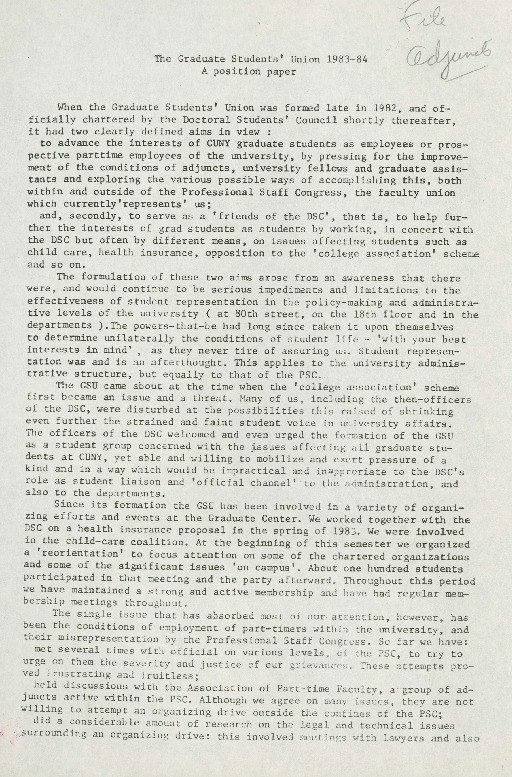
When the Graduate Students’ Union was formed late in 1982, and of-
ficially chartered by the Doctoral Students’ Council shortly thereafter,
it had two clearly defined aims in view :
to advance the interests of CUNY graduate students as employees or pros-—
pective parttime employees of the university, by pressing for the improve-
ment of the conditions of adjuncts, university fellows and graduate assis-—
tants and exploring the various possible ways of accomplishing this, both
within and outside of the Professional Staff Congress, the faculty union
which currently'represents' us;
and, secondly, to serve as a "friends of the DSC’, that is, to help fur-
ther the interests of grad students as students by working, in concert with
the DSC but often by different means, on issues affecting students such as
child care, health insurance, opposition to the ‘college association' scheme
and so on.
The formulation of these two aims arose from an awareness that there
were, and would continue to be serious impediments and limitations to the
effectiveness of student representation in the policy-making and administra-
tive levels of the university ( at 80th street, on the 18th floor and in the
departments ).The powers-that-be had long since taken it upon themselves
to determine unilaterally the conditions of student life - 'with your best
interests in mind', as they never tire of assuring us. Student represen-
tation was and is an afterthought. This applies to the university adminis-
trative structure, but equally to that of the PSC.
The GSU came about at the time when the ‘college association' scheme
first became an issue and a threat. Many of us, including the then-officers
of the DSC, were disturbed at the possibilities this raised of shrinking
even further the strained and faint student voice in university affairs.
The officers of the DSC welcomed and even urged the formation of the GSU
as a student group concerned with the issues affecting all graduate stu-
dents at CUNY, yet able and willing to mobilize and exert pressure of a
kind and in a way which would be impractical and inapproriate to the DSC's
role as student liaison and ‘official channet' to the administration, and
also to the departments.
Since its formation the GSU has been involved in a variety of organi-
zing efforts and events at the Graduate Center. We worked together with the
DSC on a health insurance proposal in the spring of 1983. We were involved
in the child-care coalition. At the beginning of this semester we organized
a ‘reorientation’ to focus attention on some of the chartered organizations
and some of the significant issues 'on campus'. About one hundred students
participated in that meeting and the party afterward. Throughout this period
we have maintained a strong and active membership and have had regular mem-
bership meetings throughout.
The single issue that has absorbed most of our attention, however, has
been the conditions of employment of part-timers within the university, and
their misrepresentation by the Professional Staff Congress. So far we have:
met several times with official on various levels jef*the PSC to treyto
urge on them the severity and justice of our grievances. These attempts pro-
ved frustrating and fruitless;
held discussions with the Association of Part-time Faculty, a group of ad-
juncts active within the PSC. Although we agree on many issues, they are not
willing to attempt an organizing drive outside the confines of the PSC;
did a considerable amount of research on the legal and technical issues
Surrounding an organizing drive: this involved meetings with lawyers and also
with union activists and officials;
we consulted with students who are completing the organization of a SUNY taal
uate Student Emloyees' Union and we are encouraged by their success,
We have concluded that graduate student and part-time employees will make pro-
gress only when they have openly established their separate community of interest,
the failure of the PSC to represent that interest, and the willingness of grad-
uate students and part-time instructional and research staff to guarantee that their
interest is represented. The most effective way of registering our exasperation is
through a decertification campaign. This means, essentially, that part-time research
and instructional staff put the PSC on notice that, unless we are taken seriously
and our needs are met, we will form our own union to represent us in collective bar-
gaining with the university. Such a decertification campaign will :
be a gauge of part-time. employees' sentiments and needs, as well as helping to
inform them of the legal issues and of the options available to them;
send a message to the union that their evasions and inaction have become into-
lerable;
begin to coalesce an organization of graduate students and part-time employees
on a university-wide scale, which is essential to any attempts at improving our con-
ditions;
accumulate a volume of organizing experience and necessary legal and organiza-
tional expertise;
prepare the basis for the creation of an independent union, if necessary.
A decertification campaign is never a happy affair - it is the rejection of an
established union and its policies, a declaration that a new beginning must be made.
The PSC enjoys a comfortable relationship with CUNY: but it is predicated on safe-
guarding the interests of full-time tenured faculties and retirees above all. The
PSC has made no effort to organize part-timers nor to bring them into the life of
the union. As things stand, the PSC can do without an organized adjunct and part-
time employees’ presence, and will resist representing part-time faculty's interest.
Meanwhile, the number of adjuncts and part-timers in CUNY keeps growing, in
keeping with a.national trend in higher education. The Board of Regents recently
rescinded a rule requiring 50% of faculty to be full time. As the university comes
more and more to rely on part-timers, organizing them becomes more and more impera-
tive.
Part-time faculty and adjuncts have been increasingly successful in organi-
zing their own independent unions. Such unions exist in many parts of the country;
locally, there is an Adjunct Faculty Association at Nassau Community College. The
graduate assistants at four of the SUNY colleges are now successfully completing an
organizing drive.
The GSU is proposing an organizing drive, with other students, to attempt the
formation of a Part-Time Instructional and Research Staff Union. To carry out such
a drive, we need to be represented by lawyers, since the struggle is, in part, a
legal one. Sipser, Weinstock, Harper & Dorn is a firm with the knowledge and ex-
perience we need.
f
i | we @
The Graduate Students’ Union 1983-84 (Ca V
A position paper sa
When the Graduate Students’ Union was formed late in 1982, and of-
ficially chartered by the Doctoral Students’ Council shortly thereafter,
it had two clearly defined aims in view :
to advance the interests of CUNY graduate students as employees or pros-—
pective parttime employees of the university, by pressing for the improve-
ment of the conditions of adjuncts, university fellows and graduate assis-—
tants and exploring the various possible ways of accomplishing this, both
within and outside of the Professional Staff Congress, the faculty union
which currently'represents' us;
and, secondly, to serve as a "friends of the DSC’, that is, to help fur-
ther the interests of grad students as students by working, in concert with
the DSC but often by different means, on issues affecting students such as
child care, health insurance, opposition to the ‘college association' scheme
and so on.
The formulation of these two aims arose from an awareness that there
were, and would continue to be serious impediments and limitations to the
effectiveness of student representation in the policy-making and administra-
tive levels of the university ( at 80th street, on the 18th floor and in the
departments ).The powers-that-be had long since taken it upon themselves
to determine unilaterally the conditions of student life - 'with your best
interests in mind', as they never tire of assuring us. Student represen-
tation was and is an afterthought. This applies to the university adminis-
trative structure, but equally to that of the PSC.
The GSU came about at the time when the ‘college association' scheme
first became an issue and a threat. Many of us, including the then-officers
of the DSC, were disturbed at the possibilities this raised of shrinking
even further the strained and faint student voice in university affairs.
The officers of the DSC welcomed and even urged the formation of the GSU
as a student group concerned with the issues affecting all graduate stu-
dents at CUNY, yet able and willing to mobilize and exert pressure of a
kind and in a way which would be impractical and inapproriate to the DSC's
role as student liaison and ‘official channet' to the administration, and
also to the departments.
Since its formation the GSU has been involved in a variety of organi-
zing efforts and events at the Graduate Center. We worked together with the
DSC on a health insurance proposal in the spring of 1983. We were involved
in the child-care coalition. At the beginning of this semester we organized
a ‘reorientation’ to focus attention on some of the chartered organizations
and some of the significant issues 'on campus'. About one hundred students
participated in that meeting and the party afterward. Throughout this period
we have maintained a strong and active membership and have had regular mem-
bership meetings throughout.
The single issue that has absorbed most of our attention, however, has
been the conditions of employment of part-timers within the university, and
their misrepresentation by the Professional Staff Congress. So far we have:
met several times with official on various levels jef*the PSC to treyto
urge on them the severity and justice of our grievances. These attempts pro-
ved frustrating and fruitless;
held discussions with the Association of Part-time Faculty, a group of ad-
juncts active within the PSC. Although we agree on many issues, they are not
willing to attempt an organizing drive outside the confines of the PSC;
did a considerable amount of research on the legal and technical issues
Surrounding an organizing drive: this involved meetings with lawyers and also
with union activists and officials;
we consulted with students who are completing the organization of a SUNY taal
uate Student Emloyees' Union and we are encouraged by their success,
We have concluded that graduate student and part-time employees will make pro-
gress only when they have openly established their separate community of interest,
the failure of the PSC to represent that interest, and the willingness of grad-
uate students and part-time instructional and research staff to guarantee that their
interest is represented. The most effective way of registering our exasperation is
through a decertification campaign. This means, essentially, that part-time research
and instructional staff put the PSC on notice that, unless we are taken seriously
and our needs are met, we will form our own union to represent us in collective bar-
gaining with the university. Such a decertification campaign will :
be a gauge of part-time. employees' sentiments and needs, as well as helping to
inform them of the legal issues and of the options available to them;
send a message to the union that their evasions and inaction have become into-
lerable;
begin to coalesce an organization of graduate students and part-time employees
on a university-wide scale, which is essential to any attempts at improving our con-
ditions;
accumulate a volume of organizing experience and necessary legal and organiza-
tional expertise;
prepare the basis for the creation of an independent union, if necessary.
A decertification campaign is never a happy affair - it is the rejection of an
established union and its policies, a declaration that a new beginning must be made.
The PSC enjoys a comfortable relationship with CUNY: but it is predicated on safe-
guarding the interests of full-time tenured faculties and retirees above all. The
PSC has made no effort to organize part-timers nor to bring them into the life of
the union. As things stand, the PSC can do without an organized adjunct and part-
time employees’ presence, and will resist representing part-time faculty's interest.
Meanwhile, the number of adjuncts and part-timers in CUNY keeps growing, in
keeping with a.national trend in higher education. The Board of Regents recently
rescinded a rule requiring 50% of faculty to be full time. As the university comes
more and more to rely on part-timers, organizing them becomes more and more impera-
tive.
Part-time faculty and adjuncts have been increasingly successful in organi-
zing their own independent unions. Such unions exist in many parts of the country;
locally, there is an Adjunct Faculty Association at Nassau Community College. The
graduate assistants at four of the SUNY colleges are now successfully completing an
organizing drive.
The GSU is proposing an organizing drive, with other students, to attempt the
formation of a Part-Time Instructional and Research Staff Union. To carry out such
a drive, we need to be represented by lawyers, since the struggle is, in part, a
legal one. Sipser, Weinstock, Harper & Dorn is a firm with the knowledge and ex-
perience we need.
Title
The Graduate Students' Union 1983-84:
A position paper
A position paper
Description
Written by the Graduate Students’ Union (GSU) in 1983-84, this position paper stated the intentions of the recently formed organization. The aims enumerated were to advance the interests of CUNY graduate students as employees (or prospective employees), to work in concert with the Graduate Center's Doctoral Student Council (DSC), and to press for the improvement of the conditions of adjuncts. The position paper also claimed that part-time employees needed their own representation outside of the PSC and, for the first time, the intent to start a decertification campaign was written about and circulated.
Contributor
Professional Staff Congress
Creator
The Graduate Students' Union
Date
1983 - 1984
Language
English
Rights
Copyrighted
Source
The Tamiment Institute Library and Robert F. Wagner Labor Archives
Original Format
Report / Paper / Proposal
The Graduate Students’ Union. Letter. “The Graduate Students’ Union 1983-84: A Position Paper.”, CUNY DIGITAL HISTORY ARCHIVE, accessed September 5, 2026, https://stephenz.tailc22a4b.ts.net/s/cdha/item/1405