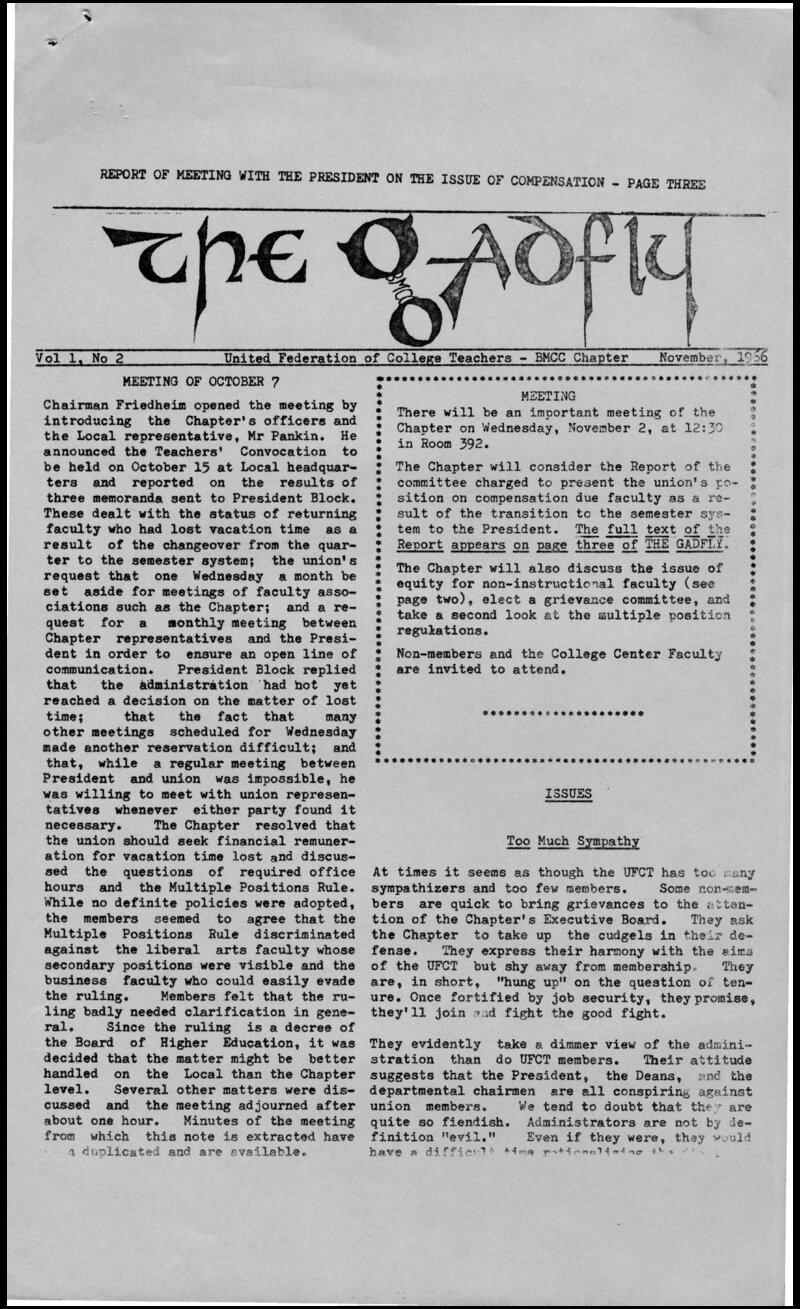
The Gadfly, November 1966
Item
Vv
“4
REPORT OF MEETING WITH THE PRESIDENT ON THE
ol 1, No 2
MEETING OF OCTOBER 7
Chairman Friedheim opened the meeting by
introducing the Chapter's officers and
the Local representative, Mr Pankin. He
announced the Teachers’ Convocation to
be held on October 15 at Local headquar-
ters and reported on the results of
three memoranda sent to President Block.
These dealt with the status of returning
faculty who had lost vacation time as a
result of the changeover from the quar-
ter to the semester system; the union's
request that one Wednesday a month be
set aside for meetings of faculty asso-
ciations such as the Chapter; and a re-
quest for a monthly meeting between
Chapter representatives and the Presi-
dent in order to ensure an open line of
communication. President Block replied
that the administration ‘had hot yet
reached a decision on the matter of lost
time; that the fact that many
other meetings scheduled for Wednesday
made another reservation difficult; and
that, while a regular meeting between
President and union was impossible, he
was willing to meet with union represen-
tatives whenever either party found it
necessary. The Chapter resolved that
the union should seek financial remuner-
ation for vacation time lost and discus-
sed the questions of required office
hours and the Multiple Positions Rule.
While no definite policies were adopted,
the members seemed to agree that the
Multiple Positions Rule discriminated
against the liberal arts faculty whose
secondary positions were visible and the
business faculty who could easily evade
the ruling. Members felt that the ru-
ling badly needed clarification in gene-
ral. Since the ruling is a decree of
the Board of Higher Education, it was
decided that the matter might be better
handled on the Local than the Chapter
level. Several other matters were dis-
cussed and the meeting adjourned after
about one hour. Minutes of the meeting
from which this note is extracted have
a duplicated and are svailable.
United Federation of College Teachers ~ BMCC Chapter
WORKER AE SERRE ERE EE THERESE AEE HE REED
*
ISSUE OF COMPENSATION - PAGE THREE
ere
November, 1956
MEETING
There will be an important meeting of the
Chapter on Wednesday, November 2, at 12:30
in Room 392.
The Chapter will consider the Report of the
committee charged to present the union's ro-
sition on compensation due faculty as a re-
sult of the transition to the semester sys-
tem to the President. The full text of the
Report appears on page three of THE GADFLY.
The Chapter will also discuss the issue of
equity for non-instructional faculty (see
page two), elect a grievance committee, and
take a second look at the multiple position
regukations.
sotee
Non-members and the College Center Faculty
are invited to attend.
THPORH TR EHR EEK RETR
HHEREOEHEAAHELEHHRH SHEEP EDHHEERSE HR ERB ERED REED
PHESRPEHRHPHSHHAH HOT PSREAHRHER HD HEHE TORHEEO SS
ROMER REECE ERR RETAKE RRERE E RO R ERe
ISSUES
Too Much Sympathy
At times it seems as though the UFCT has toc wany
sympathizers and too few members. Some ron-iem-
bers are quick to bring grievances to the atten-
tion of the Chapter's Executive Board. They ask
the Chapter to take up the cudgels in their de-
fense. They express their harmony with the eims
of the UFCT but shy away from membership. They
are, in short, "hung up" on the question of ten-
ure. Once fortified by job security, they promise,
they'll join ead fight the good fight.
They evidently take a dimmer view of the admini-
stration than do UFCT members. Their attitude
suggests that the President, the Deans, end the
departmental chairmen are all conspiring against
union members. We tend to doubt that the» are
quite so fiendish. Administrators are not by de=-
finition "evil." Even if they were, they wovld
have a diffiertt tima retiennlieing the
res
of such a large percentage of the faculty. The union does have the weight of
numbers working in its favor.
Tenure should net stand between the faculty and the union membership. It is
a spurious consideration. The time to join the UFCT is now!
Ro ae oR RK OR Ok KK RO
A Question of Equity
Recently, upon the request of several members, we dispatched a memorandum to
the President acking for a clarification of the status and duties of non-
instructional faculty. We poi at in the absence of a well-defined
policy there were many unf: 3 rities } ~s * 4 Some worked
longer hours and enjoyed shorter vacations than others. The situation demanded
immediate attention.
In his reply the President expressed his concern. He indicated that the
Administrative Council of the Community Colleges would soon take up the issue.
In the interim it might be wise for the union to address itself to the problem
and suggest a policy. The *cgular_ faculty teaches up to fifteen hours per
week, Ideally, for every hour in class, they spend one outside in preparation.
Whether you employ the new math or the old or even some weird administrative
calculus, the total adds up to thirty. Certainly, non-instructional faculty
should not be required to spend more than thirty hours a week at their desks.
Equity dictates that they also enjoy the same vacation benefits as the
teaching faculty. Should the nature of their duties require an extra month
or two of work, they deserve an increment based upon their normal monthly
Wage.
The iesue is on the agenda of the next chapter meeting.
FRO RRO OIG K OR aC ae a ok ae
ES oo, Vddnesday
The free period between twelve and two o'clock on Wednesdays swells with
meetings and conflicting commitments. The administration has not put the time
to efficient use. Committees and departments compete for the presence of
the faculty by scheduling meetings for the same hour. Professor Schmidman,
the Chairman of the Department of Social Sciences, requested at the first
meeting of the Faculty Council that the administration establish a calendar
which would bring order to our chaotic Wednesdays. The union followed up
his suggestion by petitioning the President to set aside one Wednesday each
month for faculty associations. By the simple expedient of a memo, the admini-
stration could reserve the first Wednesday of every month for Faculty or
Council meetings, the second for Committee work, the third for the conduct of
departmental business, and the fourth for faculty associations. Hopefully,
the calendar would be flexible so that if an emergency arose, for example, the
President could convene the faculty council on the third or fourth Wednesday
instead of the first. Meanwhile, with nearly half the term behind us, we still
lack a calendar.
RRR EEK ERE ROKK KK
A Humane Policy
Some members of the faculty are up for tenure. The AAUP suggests that college
administrations notify faculty of the renewal or termination of their contracts
by Decembeis, The Association's suggestion is fact at many colleges and univer-
sities throughout the country. The policy is both wise and humane. The major
scholarly associations representing the various academic disciplines convene,
for the most part, late in Decembex. Most college and university departments
3
interview and hire at these conventions. If, by chance, the college decides to
terminate the contract of a faculty member up for tenure, it might well soften
the blow by serving notice in December rather than April. Early notice, with
the instructor's conventions ahead of him rather than behind, enables him to
exercise greater leverage in -~pardon the expression-- "the academic market-
place."' If we are to reduce teaching and scholarship to a marketable commodi-
ty, we should at least inform our appointment policies with a measure of
humanity.
REPORT OF UFCT COMMITTEE MEETING WITH PRESIDENT BLOCK AND OTHER MEMBERS
OF THE ADMINISTRATION - OCTOBER I} 1966
Subject: Remuneration for vacation time lost as a result of the
transition to the semester system.
The committee comprised of William Friedheim, Leigh Marlowe, and Anna Porter
met with President Block and Dean James on October 19, 1966 at 3:00 P.M.
I. The committee presented the motion passed upon by the Chapter on October 7,
1966 to the effect that remundwation in the form of money be paid to
faculty members for vacation time lost.
II. In response, President Block indicated that there were no funds available
to meet the committee's request. He added that the Board of Higher
Education fell under no legal obligation to provide remundration for vaca~
tion time lost as a result of the chnageover from the quarter system.
The by-laws do not stipluate vacation time normally due faculty. Hence,
legally, faculty members had no case. Finally, the President explained
that the administration would not be acting in good faith if it petitioned
the Board for the funds necessary to meet the union's request. President
Block stressed that the Board had originally approved of the transition
to the semester system with great reluctance. Originally, the Board had
designated the school as "experimental." The quarter system was the
school's most significant experiment. Hence, according to President Block,
the changeover was not "an easy pill for the Board to Swallow." A request
for funds to compensate faculty for time lost as a result of the transition
would not sit well, for obvious reasons, with the Board.
III. Dean James stated that the memorandum issued from his office in the form of
a chart on May 19, 1966 had been misconstrued. He pointed out that the chart
did not indicate that remundération would come in the form of money and he
and President Block expressed surprise that some faculty members had chosen
to interpret it in that light. The Dean, backed by the President, reminded
the committee that the faculty, at the time that it approved the modification
of the calendar, was apprised of the hardships which might result from the
changeover. It was implied, Dean James argued, that the faculty, alert to
possible hardships as a result of the transition, would take them in
stride. On its part, the administration would, where possible, seek to
remunerate the gaculty as justly as it could.
IV. The committee responded by making the following points:
A. Faculty contracted under the quarter system were party to a verbal
agreement with a member of the administration to the effect that they
would teach three out of four quarters (or nine of twelve months).
The committee indicated that at this juncture, it was not necessary
to debate the legality of such an agreement. Morally, the agreement
was and is binding.
B. The memorandum released by the Dean on May 19 was the first specific
indication by the administration that faculty members would lose
vacation thme as a result of the transition to the semester calendar.
While the memorandum did not mention money, it did promise just
remuneration.
; 4
V. The President noted that the faculty contracted as of September 1, 1965
were actually in most cases due less than the month designated on the chart
originally compiled by the Office of the Dean of Faculty. Normally, under
the quarter plan, the faculty would be due back late in September, not on
October 1. Hence, as a result of the switch, they were not due the full
month of September. And those called back before the start of classes
on September 19 were for the most part on duty for only two or three days.
Vi. The committee replied that while faculty were called back for only a few
days at the most, they were on call fow the time span between Labor Day
and the start of classes. A mere day of duty could throw off whatever
plans a faculty member had for a vacation or work during those two to
three weeks.
VII, The delegation, acting upon the Chapter's instructions, asked the President
how be planned to compensate the faculty. He outlined the following:
A. For those who have lost more than a month:
1. Possible assignment to Academic Advisement for one semester.
They could work full-time in academic advisement for part of
the serester and take vacation time due them for the remainder
of the term.
2. Or a reduction in class load. This would be compiled on the basis
of the average class load of the department in which the faculty
member teaches.
B, For those who have lost one month or less:
1. Freedom from college duties during intersession, as can be arranged
in each department. If Departmental meetings are necessary during
this period, they will be convened at the very end or very
beginning of the intersession.
VIII. The committee requested that President Block sign a copy of this memoran-~
dum indicating that it accurately reported his position. He granted the
request.
We present this memorandum to the Chapter for consideracion at its next meeting.
Respectfully submitted,
William Friedheim
Leigh Marlcwe
Anna Porter 10/25/66
Approved as corrected,
Murray H Block 10/26/66
<n ee ee
NOTE: We are presently conferring with Ralph Katz, the attorney for the UFCT, on
the legal implications of the compensation issue. We will report on the thrust
cf our discussions to the Chapter on Wednesday.
A comment or two is in order about our negotiations with the President. He made what
seened to te°a concession to those owed more than a month of vacation. But he
conditioned the concession with the word, "possibly." "Possibly" the college
will assign those due time in excess of a month to Academic Advisement. The
assignient is not definite. He indicated that he would instruct departmental
chairmen to free, if feasible, those owed a month or less from college duties
during the semester break. At best, this is a gesture, not compensation.
WPF
e)
SRO ORR ROR OR IOI OI IOI III IOI IOIOI IR GIGI IG IOI IIR IG IG III ak i i a tote
"The Forum is open to communications dealing with matters of general interest to the
college community from all faculty, students, non-instructional staff, clerical staff
and administratioa for whom public expression of their opinion may be otherwise
impossible. Communications must be signed by names will be withheld on request. "Ihe
Forum" is unedited except for length and views expressed are by no means necessarily
the view of THE GADFLY.
HEHEKHRKEREARRHREHHEEE
Co. ee 2 ee ee Te
FRIIS GOGO IIR USI ISIOI OI III III III III TOA RI AR dO aC rok
To. the Faculty,
Wh
*
ena young man or woman graduates from high s
n application to
college of his choice, he automatically signs away sc of 1 al rights.
infringement of some of these rights is necessary for tho university to function ef-
ficiently.
BMCC has very strict regulations in its effort to gain a reputation of which its studenis
and faculty can be proud. It is assumed that an employer, wren hiring a BMCC graduate ,
will be very eager to do so because of the firm dress regulations. It is also implied
that a school filled with properly dressed students will compensate for its low aca~
cemic standing. This is an unnecessary infringement on individual ite.
f have been told that the dress regulations in question will Help the imare of the
new college. However, I believe that the problem at hand is an academic one -to
cempensate for the low entrance requirements- ard while the solutic: is cbviously not
casy, T have a few suggestions.
t has been said that in an ideal university grades are not needed. Ideal students
eka to gain as much knowledge as they can, not only in the course of the semester
but throughcut their college careers. I don't believe in these ideals. Students
such as we have at BMCC thrive on competition. More incentive must be given these
students (who are mainly from culturally-deprived backgrounds) to get higher grades.
When they get higher grages, without conscicusly tr they will be obtaining
not only new knowledge, but the desire to go on outside the college
doors. Such incentives could be in the order awards for outstanding
achievement, given yearly, and not wher they graduate when it is too late. An honor
society should be established fox the whole school and within curricula. The Social
Sciences Department has already taken steps in tiis ection,
After this has been accomplished and a definite effort has deen made to raise the
scholastic level and increase competition, the school will have a desirable reputat
Then, when an employer is thinking of uiring a BMCC gradvate, he will not care if
potential employee went to school in a mini-skirt. When iearning is the main
concern (and it is synonomous with college.) don't dress regulations seem trivial
and not even worth the paper on which they are printed?
S
It was also been argued that BMCC is in a unique position, both geographically and
ecademically. Everyone realizes that we are situated in the middle of Manhattan
and that we have a majority of business students attendirg the college. I see no
reason why the above cannot hold true, even with this in mind. Peopie should have
enough sense to come into the middle of New York's business district dressed neatly
but if they don't, so what? We are not here to straighten out our hair but "to
straighten out the mess that's inside," to quote 'Enry 'Iggins:
We are young, granted, but I strongly assert that we are too old to accept the orders
that have been given from a college that translates the words 'ialma mater" too
literally. I'm in no rush to accept adult responsibiiitics by this present
definition now, so let me relish my youth and dirty duagareos.
Ellyn Diskin
Seconnd Year Student
CINEMA
FILMED SCRIPTURES
by Roger Dooley
The Bible
Those who on the basis of the famous names
involved have been looking forward to the
film over-ambitiously titled THE BIBLE as
one of the great religious pictures of all
time may as well be warned at once that they
are in for a major disappointment. Not that
it is sensational, tawdry, vulgar, or any of
the uther epithets usually flung at Holly-
wood Biblical epics; rather it fairly reeks
of self-conscious good taste, restraint, and
anxiety uot to offend a single viewer of any
sect -- apparently starting with the funda-
mentalists.
It is indeed irénic that in an era when for-
ward-looking theologians of all faiths have
been moving toward symbolic or allegorical
interpretations of the early chapters of Ge-
nesis, preducer Dino deLaurentis, director
John Huston, and script-writer Christopher
Fry have created a picturization so literal
as toraise doubts where none existed before.
One wonders, indeed, what Fry contributed,
since hardly a line is added to the standard
King James translation. While it is true
that thdse translators were of the same ge-
neration as Shakespeare, the crucial differ-
ence is that he was writing lines to be spo-
ken on stage by living actors. The stately
17th century rhetoric which can sound sv im-
pressive when read from a pulpit or intoned
in a solemn ritual, in d&adlogue form crushes
all life out of the actors. In scene after
scene, posed like figures in a mural ora
religious pageant, they must put across such
sprightly exchanges as "It has been written
that this is the will of the Lord," followed
(after a five second pause) by some snappy
comeback like "Even so."
Witheut asking for another Green Pastures (a
delightful view of the Old Testament as vi—
sualized by a Negro Sunday School class,
which conveyed more true religious spirit in
any scene than does THE BIBLE in its entire-
ty), one wonders whx the bare bones of the
familiar stories were not fleshed out with
enough vivifying detail to make them humanly
credible to skeptical audiences of the
1960's. As Huston's voice offscreen recites
the opening passages of Genesis, the visual
effects of the Creation are indeed impres-
sive despite an obtrusive musical accompani-
ment. Likewise, the Garden of Eden, seen
through a golden mist as in a Renaissance
painting, is pictorially promising -- but
Adam and Eee, generally glimpsed at a safe
distance, behave like zombies. Neither be-
fore, during, or after the fall do they give
the slightest indication that they know what
they are doing. If the producers feared the
incongruous effect of mixing modern dialogue
in with the standard text, surely they could
have used some passages from Milton's Para-
dise Lost (written in the same century as
the King James translation) to bring out
some of the dramatic possibilities inherent
in the fall of man.
On the other hand, the section on the Ark --
by far the most enjoyable segment of the
film -- is so dog-gened Disney-cute and
folksy, ene expects any moment to heara
fiddle strike up Turkey in the Straw. Hus-
ton himself makes a shrewd, foxy-grandpa
type Noah but the real interest lies in the
fantastically assorted pairs of animals mar-
ching peacefully into the Ark (a ramshackle
vessel, by the way, which scareely looks ca-
pable of holding them). Had Fry taken as
many liberties as did the writers of the me-
dieval cycle plays (in which Noah's wife is
always a comic shrew), this might have come
off even better than it does.
From here the picture runs downhill. An epi-
sode involving Stephen Boyd as a curious-
ly made-up Nimrod inspecting the Tower of
Babel is absolutely meaningless even to
those who know the story. The scenes in So-
dom and Gomorrah look as if they were photo-
graphed in a coal mine; the amount of pagan
revelry suggested is so minimal that one is
left wondering just what it was that so an-
gered the Lord. The cities are destroyed
off-screen, with a single shot of a mushroom
cloud -- symbolic, no doubt. What Lot's
wife turns into (literally, of course) looks
less like a pillar of salt than a toasted
marshmallow.
For the rest of the three hours' running
time, the story of Abraham drags intermina-
bly on, the events presented without the
slightest attempt to make them psychologi-
cally palatable to modern viewers. George C
Scott, nostrils flaring, snorts and snarls
up a storm to achieve a dramatic moment now
and then, without ever making Abraham seem
more than a self-righteous fanatic. Ava
Gardner, made up to look far older than she
is, iswasted in the thankless role of Sarah,
as is Peter O'Toole tripling in brass as
three angels.
As an illustrated accompaniment to a Sunday
School lecture on Genesis, this film would
no doubt be quite effective, especially in
the Bible Best (if it still exists). As a
super-colessal production, made with appa-
rently unlimited international resources, it
commits the one cinematic sin that renders
ai
any virtues irrelevant; it is lifeless, sta-
ic, unmoving in any sense of the word. If
it is not as bad as The Robe, The Big Fish-
exman, the last King of Kings, or many
others now enjoying the »sblivion they so
richly earned, it cannot compare with any
of a number of religious films which were al-
so dramatically engrossing: the silent Kingof
Kings, The Ten Commandments, Ben Hur, and
Barabbas, to name but a few. (DeMille, thous
Shouldst be living at this hour!) In short,
despite all its lofty aims and good inten-
tions (the kind Hell is paved with), for any
but the most naive audiences, THS BIBLE must
be described as "God-awful."
Gadfly
HEERHRRR ER REE
SR ROR ROR TORII OR OR RRR ROKR SOR kK
Members who wish to contribute items
to the next regular issue of The
should submit their copy tho
later than November 23.
SRR ARAL ORR ROR ROR Ok ROK Hk de
RHEE RHR HH EHH
ESSAY
THE MARVELOUS MIND MACHINE
by Leigh Marlowe
The celebration was underway inside, but there was still a throng milling about
the entrance.
at the rear of the second balcony.
So many people were jammed inside that seats could be found only
In the dim light on stage, to one side
of
time enormous Llob of color and opposite an Indian trio, Dr Timothy Leary held
forth from a brocade couch.
was quite casual.
Aside from an excellent lavalier mike, his dress
Most of the audience could hardly be classified as youthful,
although a sizable minority wore pressed hair and unpressed clothes.
they were attentive, but not receptive: curious, for various reasons.
Generally,
After the
celebration (for that's what Dr Leary calls these comedy-variety acts) the crowd
‘ moved out, silent and orderly.
Had the star of the show been addressing a mental health tkam rather
than a cash audience, the conclusions that might be drawn would not
be particularly inspiring.
In my opinion, Dr Leary has made a major
breakthrough: in tne millennia since H. sapiens appeared on this
planet, no one has been able to communicate madness so effectively
and profitably.
I don't think, however, that one can attribute this
success entirely to the stupidity of the public or the coverage b¥
the mass media.
What is the nature of the appeal, bordering on chafisma, that Leary exerts?
His
Gishonorable discharge from the academic community is an experience that is widely
shared among the segment to which he appeals most.
given these words not only new meaning but new status.
His slogan, "Drop Out," has
To "Drop Out" in Leary's
lexicon is to be among the select few (if one becomes an acolyte in the new
religion.)
An alarming number of individuals dabble in drugs.
Leary's sanctions take
such behavior out of the reabm of lawlessness and thrill-seeking ("Turned
On" his slogan has it) and transmute it into a communion, for he con-
ceives of the giving and taking of drugs as a kind of sacrament.
To
proselytize the use of drugs is no longer to be a pusher, but to be a
"Tuned In" missionary to the heathen.
becomes a Hail Mary.
"Turn on, Tune in, Drop out"
Fah,
as
But religion is somewhat passé. After all, we've been told that God is dead.
Even if we are not too concerned about God Himself, we notice that chfirches
have become sanctuaries for bigots, that religious institutions are run like
Big Business, without suffering its censures or strictures (like taxes).
Mealy-mouthed hypocrites fix it with Father for themselves after the most trea-
cherous Machiavellianism. How can a new religion --the League for Spiritual
Discovery-- get off the ground?
Very simple. Instead of locating God out there in the cosmic soup
(it's full of space junk anyway), put Him in man. Everyman can thus
become a Christ, with built-in social, if not physical, martyrdom
guaranteed. The problem of finding God then, in Leary's words, re-
solves itself into going out of one's mind to come to one's senses.
Several issues still have to be séttled. The Puritan Ethos dies hard --even
harder than God-- in this country for more people give it lip-service. Thus, a
sensate religion has to be justified. It is in this regard that Leary's pitiable
deterioration is most evident. He completely garbles such topics as the history
of religion, the relation of religion to culture, the function of the nervous
system, and simple anthropological fact (e.g. according to Leary, the Indians
of the Southwest live in wigwams). By rewriting histor nd science, Leary
"proves" that the League for Spiritual Discovery is a return to Man's True
Religion.
The call to True Religion has been a common dodge among the holy, and
the revivalist spirit --Good Old Time Religion is another American
theme-- now rears its head in an exotic package. The shaman is a
well-known figure in all cultures. One might even go so far as to
say that Leary trots out his Ph.D. as a sheepskin stigmata to indicate
to his adherents that he has suffered in the mundane world. The boys
on Mad Ave couldn't have planned a better campaign.
I doubt whether Leary plotted to perpetmate such a hoax in any sense of tactics
and strategy. When it became clear to Leary and his colleagues that they were
never going to accomplish anything within the framework of scientific method
--which puts the burden of proof on the Believers-- he suffered a loss of faith
in the academic religion which had nurtured him. (I was present at a profes-
sional meeting addressed by Leary when his piéce de résistance, the "experiential
typewriter," embarrassingly failed to operate. That gadget never did get fixed
up properly.) For a while, Leary maintained that what he was doing was scienti-
fic, but his turn from psychology to theology is a tacit admission that what
he is trying to say cannot be said either in the laboratory or the clinic.
Some people regard Leary's founding of a religion as a fiendish scheme
to avoid prosecution for he can then claim his constitutional guaran-
tees. The League for Spiritual Discevery is not really a religion
since all known religions are based on some kind of relationship to
the sufernatural, however the supernatural may be defined, and the
League for Spiritual Discovery is much more concerned with the unnatural.
The best thing, best in terms of catapulting popularity, for Leary's
League would be to make him a bona fide martyr. The parallels would
be just too embarrassing for the rest of the community to explain away.
Besides, violating the Constitution is a sin in the religion of
Nationalism.
For those interested in starting a Biscourage and Stop Learyism movement (DSL),
for those who see him as an especially cerrupt Socrates planning a disastrous
Chilé¢ren's Crusade with the twentieth century touch (to mix metaphors), the
following suggestions are submitted:
1. The Blackout Tactic -- Simply enlist the coUperation of the mass media
in not disseminating publicity for Leary. Let them write about dogs, babies,
and murders. Or, make him pay the going rates, like, say, Rockefeller.
2. The Soofflaw Strategy -- Everytime Leary parks his gaudy hearse on the
street, get the Sanitmen to tow it away, gaily decorated with green tickets.
&
3. The Be Kind to Animals Ploy -- Get
céndition of the Herefords on Leary's
tality conflict.
4. A Pray-In --Convince leaders of
Bishops Sheen and Makarios, the chief
~-~-- Civil Liberties Union fight the ASPCA?
the ASPCA to investigate the deplorable __
estate in Millbrook. How could the
Such would induce a serious sentimen-
all creeds, e.g. Martin Luther King,
Hasidic Rabbi, some Muezzins from the
Black Muslims, Oral Roberts, etc. to pack the house at Leary's celebrations
and use their Good Magic against his Bad Magic.
rid of all idiocy at one strike.)
(Perhaps this way we'd be
5. If matters really get desperate, perhaps our good friends, the American
Management Association, could be induced to enforce the BMCC dress regulations
at the League's celebrations.
SATIRE
A
BMCC
PROFILE: NEW DEAN
("Profile is an adaptation of a column
number of ACTION, the journal of the
The chavter is pleascd to welcome the latest
addition t> the college administration, Lar-
sen Bloom, who has assumed the newly-created
post of Dean of Memoranda and Official
Charts. Dean Bioom will earn his $30,000
plus salary by cotrdinating and supervising
the velease and distribution of all college
MeMISe
Comfortably esconced in his mauve-—walled se-
cond floor office, Dean Bloom's ruggedly
handsome looks and ramrod posture belie his
military background. The fifty-year old
Dean comes to BMCC from the U.S. Army where
he held the rank of Brigadier-General and
versonally supervised every memorandum is-
sued from the Pentagon
since 1948, He was no
ten o'clock officer.
"Look at any army memo,
army memo,'' Dean
som told us, his steel
eyes twinkling,
initialed it."
as not left this
of personal in--
Lrement behind. When
ent Block offered
by Joseph Conlin
which will appear in the November
New York Local of the UFCT.)
all myself and don't want any secretary mes-
sing them up with typos."
Spotting typographical errors is one of Dean
Bloom's most gratifying duties. Sharing the
walls of his austere office with framed com-
mendations from four presidents is an old-
i fashioned sampler bearing his motto:
IF IT'S WORTH A MEMO
-AND IT IS-
IT'S WORTH AN ACCURATE MEMO
Another function of the new position will be
to adjust memo phraseology so that it con-
forms to standard usage as set in Dean
Making Memorable Memos,
Bloom's own book,
® peevide a full-time November, 1966000 oe Conlin, Shot yer
secretary, "Dean Bloom | Géntributers; Roger Dooley is a member of the English De-
politely declined. Mi partment, a novelist, and movie reviewer. Leigh Marlowe is a
leve memos," he says, | members of the Social Sciences Department. Mark A McCloskey
"they've been my life's | ig Professsr at BMCC and former Chairman of the New York
work and provided me a
great deal of satisfac--
tion over the years --
not to mention excite-
mento I'll handle them
ene e
State Youth Commission.
the head of THE GADFLY, teaches in the Art Department.
Rochelle Weinstein, who designed
Opinions expressed in signed articles are the writers' own and
not necessarily those of THE GADFLY or the Chapter.
ET
10
(Knopf, 1957). "Take a look at these," the
old soldier said, furiously shaking a sheath
of dittced messages dealing with student
dress regulations. "Sure, the idea is great
but the wording frankly stinks." Too many
monosyllables --I hate monosyllables in a
meno-- little use of capitals for emphasis,
and hardly a latinate technical term in the
slew of them. You can bet you'll see a lot
of nace wae in the future."
sa former gerieral, Dean Bloom is unlikely
to te anyone's yes-man. "President Block and
-stand each other perfectly," Bloom
8; leaning forward cver his desk,
¢ got no business with college policy but
“s olute control over memo format."' The Dean
veshed his blond-haired tan fist on his desk
o emphasize the point and then smiled as if
tvifle embarrassed by such enthusiasm.
"It's like this," he went on, "President
Block's personal memos get the identical
i by the basketball team's. If he
ent as
memo through here to be processed and
. I tell him it smells -~period. I
Lay favorites if this office is going
W
a
nel.
EF
1
oi
ek,
first policies is to double
e college consumption of mimeograph paper.
His own first official memo was to direct
that mo message be released on half-sheets.
"yf the college can squander money on sala-
ries," the Dean claims, ".: certainly cannot
protest paper purchases. If someone has a
simple announcement of, say, ten words, cen-
One of Bloom's
ter the damn thing on standard 8% by 11, I
cluttered up
Gonutt want faculty mailboxes
with scraps,
Bloom is also disturbed by what he calls the
administration's horse-and-buggy niggardli-
ness in issuing memoranda. "This place is
filled with fine minds," he said, beckoning
toward the business office, "when they have a
thought, I want that thought memorandized im-
mediately. When I walk past a departmental
office I want to see those pigeén-holes stuf-
fed 'til they'd like to bust at the seams."
As for long-range plans, Dean Bloom envisions
a moroccan-bound multi-volume facsimile edi-
tion (quarto-sized) of all BMCC memos. a
will be printed on fine parchment or Irish
linen and offered to faculty members at a
forty-percent discount. "Maybe we could work
out a salary check-off system for installment
purchase," he mused, pausing to jot the idea
down on one of a dozen handy stencils. In
the meantime he's preparing an anthology en-
titled "The Best of the Deans" which will be
free and available to students and faculty
in time for Christmas giving.
Dean Bloom is a member of the Elks and the
Staten Island Reform Democratic Club. He
speaks four languages and enjoys reading
Edna Ferber novels and small game hunting in
his spare time. He is married to the former
Sheila "Sunny" Twining of Philadelphia and
the father of three children: Randy, Craig,
and Melissa. "Randy already knows Xerox and
Thermofax,"' Dean Bloom beamed and one sees
that the no-nonsense administrator is also a
proud family man.
We look for big things from Dean Larsen
Bloom and welcome him to BMCC.
URBANIZATION by Mark A McCloskey
"Urbanization" was first delivered as an address before The Institute
for Religious and Social Studies of the Jewish Theological Seminary
of America during the winter of 1959-1960. It was subsequently pub-
It is printed here with the generous permission of the Institute.
and the distributor, Harper and Row, Inc.
My assignment is the dilemmas of contemporary youth: the dilemma being what the Scots
called a "Haflin," half boy and half man, and that dilemma in our time and place,
Recently I was asked to talk about "Panaceas for Delinquency," and being a non-believer
in panaceas, I had a hard time. By the nature of my inheritance, I am up one day and
down the next. It was one of my "down days" and I rejected belligerently the single
answers held by many good people to the problems of youth and problems of society.
When I read the newspaper the next morning I discovered my own delinquency and tele-
phone calls aggravated my misery. "Why on earth have you alienated everybody, the
public, the social workers, the educators and the psychiatrists, the religious
teachers, all down the line?" What I wanted to do was reject panaceas, not works
or professions. I never got to what I wanted most to do; that was to call for the
assembled effort, to point out that we were all involved and that the combined labor
and the combined operation of people is one of the best ways te serve young people
and ourselves. No one, and no one group can be left out of the talk of constant
changing and reordering our institutions on behalf of humans, and particularly
young humans.
Let me go back, for perspective, to my remembrances of life on the Chelsea water-
front where I spent all of my childhood and youth, and the first twenty years of my
apprenticeship as a social worker.
Tenement houses jammed together near the waterfront, rat and roach infested, cat and
dog odored, badly lit, badly venilated, foul sanitation and fire traps. Trains
grinding along Death Avenue. Roofs and backyards were to try clothes, fly pigeons,
and provide a place for the inherent need for games of chase. One-man bands and yard
singers provided small entertainment to a neighborhood that had the rhythm of life but
little of the meolody or harmony of good living.
The coal, milk, and vegetable yards, the slaughter and warehouses, were anonymous
stores from which the adventurous and needy could meet their needs: North River,
where we learned to swim and to pilfer from the scows tied up at the piers. The
family doctor was poorly paid and often unpaid. There was little faith in and much
fear of Bellevue. There was prevalent the myth of the black bottle that kept patients
from lingering too long. Milk stations with their pasteurized milk were slow in
coming and the neighborhood clinics were shabby. St. Mary's Hospital was a fine
haven for sick children. There were "soup'' schools and "diet" kitchens. The former
carried shame and the latter doused the pride of the woman who had learned to make
food "go a long way." Money for injured men and their families was gotten by
raffling off turkeys. The local political clubs provided occasional aid ef various
kinds and wealthy parishes opened up neighborhood clubs and missions. Case work
was just beginning and the private welfare agencies gave small amounts of money
after much investigation and others gave more and cut it off earlier. The skillful
and persistent needy knew their story and their way from one agency to another, but
their pickings were meager at best and the stigma was obvious. It was far better
to help yourself on the waterfront from the great and impersonal depositories and
warehouses. Those boys who were hustlers were counted good when they got supple-
mentary aid at the coal yards, the milk depots and the bread wagons. The produce
yards were for plucking and picking over partially damaged potatoes and onions.
Bread and pie wagons were legitimate prey.
fee
The street trades, shoe shining, errands, newspaper hawking, and odd jobs helped
out but there was always a wait "until he got his diploma." After seven years of
schooling the certificate was the equivalent of working papers, and diploma in
hand, the young ones fanned out to the labor market. The ads asked for strong,
willing boys. Few went to High School. The skhools of Chelsea were all prewar;
no play yards but yard toilets. Much of the schoolwork waé drill and unexciting.
Teachers were fair game, but all of them were sensitive to the rough road that the
pupils had travelled, and the teachers visited the homes of the troubled and trouble-
some children.
Play was sidewalk and street games, but adventure was in the chase games over the
roofs, through the cellars, over the backyards, ‘and off the piers in the summer.
The cops, janitors, and storekeepers were the pursuers. Those who hung out together
wenoned up for the often delirious excitement of chasing other neighborhood gaggs.
These little groups met in cellars, on roofs, in empty rooms or in the corner of a
stable. After one went to work, he could and usually did, join what was called a
"cellar club" by social workers. There were gang fights, some between nationality groups
groups, but often one end of the street against the other. Small battles were
waged on each avenue, on the way to school and again on the way home. The smaller
ones carried the books, the older ones used their fists. Roofs were ramparts from
which to throw anything from stones to bottles. There were few knife jobs; guns
were easy to get and were used by older, closely organized gangs. There seemed to
be less vandalism, just as much conflict and more thievery. Social study and sta-
tistics seemed to be in their infancy.
Looking back in that dark abyss, I am amazed that so many children grew to decency
and that so few were personally scarred. Survival alone was a struggle. The social
advances have been uneven, but the rot has stepped. Across the street from "Bed
Bug Rew" the hospital flats were built with outside stairs and fireppoofing.
In 1934, New York Housing Authority started what has become the second largest
municipal housing enterprise in the world. The women who followed homemaking as a
profession bsgan to get a proper place to do their job, but the decay of old houses
and the increase in population still outrun the public provision of housing.
The road was rough and there was little or no beauty alongside the road children
had to travel. There were few buildings in Chelsea that could lay claam to beauty
or dignity. The General Seminary, a few churches, some old private houses, and the
National Biscuit Company's glistening generators provided a smidgeon of beauty.
The ocaan liners lashed to their piers were lordly wives of men of war but the
barges and scows along the river were smelly and unlovely cfaft. The odors were
chcolate and tobacco, brewery and slaughter house compounded. The tenements had
their own noxious blend in the plaster, woodwork, and corners of the hall. It was
ugly, ugly! To look west, however, from the piers upon the broad, living, moving
North River, provided a bit of beauty, particularly at night when darkness shrouded
the ugliness and the tugs and liners with their lanterns and colored running lights,
were like grace notes to the full-throated blasts of the liners "sailing at
midnight." A Chelsea schild could lay awake deaming of going away someday aboard
one of those liners.
The art, music, and drama classes of the Settlement and the programs of the Church
and Mission branches were small islands in a sea of mediocre dreariness. When
Chelsea Park was built, the Settlement's Spring pageants with large singing and
dancing groups in gaily colored costumes brought together units from most of the
schools and other groups of the neighborhood.
Best aid of all, the fresh air "camps and farms" gave a temporary experience of
natural beauty, the shape of trees and hills, the smell and sight of grass and
8rowing things. The host of tenement children who came to Camp Felicia, in the twenty
summers our family "ran" the camp, made me understand how hungry children were for
natural, as well as manmade beauty and how cruel it is to starve them of it. If the
love of beauty goes undernourished in youth, it may go unfulfilled for life. If it
is cultivated when children are sensitive to all of their surroundings, one cannot
measure, one can only sense, the subtle civilizing effect and believe that it will
be a long-lasting defense against the damage wrought by ugliness.
The Settlement where I worked my apprenticeship was a battling institution. It
worked with the neighbors, step by step, for the demolition of a block of foul
tenements to make room for a public park (mostly concrete with few trees). The
Settlement's gymnasium was crowded with neighbors who chanted "we want a bath" and
-S
the public bath came, complete with swimming pool and gymnasium, the first Public
gymnasium in Chelsea. The struggle for a health station took longer and Elliott
Houses longer still. The Settlement and its neighbors worked for waman suffrage
and the whole range of social legislation to bolster an uneven economy and to make
up for the vicissitudes of slum life. The cultural and educational enterprises
of the Settlement were yeasty encouragement to the arts and learning. It provided~
a library and a dental clinic, at the same time forwarding the movement for dental
examinations in schools. Each new wave of immigrants was helped to learn aur common
language and get knowledge of our institutions.
Scales of values change from place to place and time to time with individuals, families,
and institutions. Currently segments of government, industry, and commerce are busy
setting up "codes of ethics."' Youth also has to go through the business of code
building. It is a slow process and it takes time to arrive at tules acceptable to
their elders, and like their elders, it is harder to abide by new rules than it is
to make them.
All oft the Settlement's enterprises and the other neighborhood undertakings were
helping to set rules and to set values. They worked with the homes, schools, and chure
ches in ttheir stand for decency in relation to each other, to property, and to legal
institutions.
To the dwellers in Chelsea had come a Body of people, a few professionals and many
volunteers who worked with more or less organization but with much warmth and desire.
By today's standards, the job was imperfectly "structured" but the program was
based on people working directly with people. I want here to escape from words like
dedication and consecration, and plump for people who "bother" about people. Young
people, particularly, have the most need and are the most difficult to "bother"
with. I do not frown upon my fellow professional social workers, but I set great
store by worriers --those who carry on the hand to hand, face to face struggle with
the young over a long haul. I respect the importance of organization, of research
and training, but I insist upon the primacy of those who "bother" and hold fast to
the child who needs warm help and strength.
There has been much talk about national purpose. It has been defined variously, and
some declare it can't be defined. Those who "bother" with youth in schools and out,
have to help them find purpose and motivation. Thinking is harder than physical
labor, and to be free in the search for truth, to pursue knowledge, to discover and
discipline talents, to work off a debt to one's country and the human race, to
establish a decent scale of values, to establish identity and assume responsibility
in our society, are difficult tasks. I believe they can be best gotten by contagion
and example rather than by talking and preaching. Youth can be challeneged by hardship
and labor more than it can by lush living.
The step by step piecemeal progress over long years is too expensive. I hope that
urban renewal and redevelopment plans will provide for the necessary safer streets,
libraries, health stations, neighborhood schools, and public welfare facilities.
Concommitant with the physical planning must go planning for social services. It
would be well to have at the heart of every neighborhood a multiple store of services,
where any and all families could get, not only the supportive service necessary for
decent living in congested neighborhoods, but the advice and counselling so readily
accessible and purchasable in better-advantaged neighborhoods. Parents should be
able to go for help of all kinds as readily as they go to a central market area
and they should be able to go uninhibited, confident that they will not be
possessed by fear, or passed along from one agency to another.
All neighborhoods have their share of "stumblers," mixed up and disturbed young
people. The help they need to get through the vestibule of adolescence should be
accessible, with removal from the community only as a last resort. We need badly to
pull together the neighborly nonprofessional help which can be summoned to mutual
support in all fields. It is hoped, too, that professionals will likewise be
moved to maintain residence nearer to the people for whom they work. One would
like to know that there would be no more "closed cases."
I hope that we could develop a "pride of place." The names of our neighborhoods
need not be labels of despair or fear. The shift from neighborhood decay to
all-around neighborhood development might well help to stabilize values, reduce
neighberhood conflict, promote mutual aid, and diminish rootlessness. By "pride
of place" we might encourage settling down rather than migrating constantly from
ene neighborhood to another.
re
The social advances since the turn of the century, through depressions and great
wars, are to me a source of encouragement.
The Cassandras don't win.
been won.
tions of the possibilities
variety of ways to work to
are challenging and varied
in the young strangers who
them with all their might.
young people. I subscribe
Causes I once thought were lost, have
To those with great faith and great concep-
of civilized life in a metropolis, there are an infinite
bring us nearer to the 'New Jerusalem." The problems
enough to rally workers with faith; those who believe
are always coming, coming, coming --and to work with
i do not subscribe to easy generalizations about
to the delight of living and working with them as they
face a "sea of trouble" in a time when their responsible elders have an even
greater tempest to brave.
Looking back over the road we have come, I know we can go ahead with confidence in
our youth, ourselves, and in our fundamental institutions.
ORGANIZATIONAL CHART by William Friedheim
What with every office in the college issuing spurious organizational charts, it is
high time that the truth be revealed. Herewith is the last word in such charts, the
union's versién (unexpurgated).
[Cosa Nostra |€- S88GsGs0s OGI0G8<, 29989999988 -y[ Mother of Union Boss]
[Union Boss *ESISHPIORISGTIIE
7 Cobgdinator of Union Pension
President
Fund
fs 33
{Rank & File |-- [Typist]
eeescne
.
.
Editor, the Goubd
Report
Tamanny Hall
Cotrdinator of Dress
as and Morals
Teaching facult I Avon Representative |
Non-Instructional
Faculty
*Also goes by title of chairman;
sometimes called "'shop Steward"
ee
[Cobrdinator of Sick Leave |
Chief Goon {~:
Assistant Goons
Gadfly Copyboys
Dean of the College
*
Cot§rdinator of Fire Drills
HER
Editor,
The Gadfl.
{
HEREH
KEY
Straight line
Dotted line
‘ Broken line
HD ISSH
Oe OK
: Student Body? ?
Dollar signs
Stars
Arrow
“4
REPORT OF MEETING WITH THE PRESIDENT ON THE
ol 1, No 2
MEETING OF OCTOBER 7
Chairman Friedheim opened the meeting by
introducing the Chapter's officers and
the Local representative, Mr Pankin. He
announced the Teachers’ Convocation to
be held on October 15 at Local headquar-
ters and reported on the results of
three memoranda sent to President Block.
These dealt with the status of returning
faculty who had lost vacation time as a
result of the changeover from the quar-
ter to the semester system; the union's
request that one Wednesday a month be
set aside for meetings of faculty asso-
ciations such as the Chapter; and a re-
quest for a monthly meeting between
Chapter representatives and the Presi-
dent in order to ensure an open line of
communication. President Block replied
that the administration ‘had hot yet
reached a decision on the matter of lost
time; that the fact that many
other meetings scheduled for Wednesday
made another reservation difficult; and
that, while a regular meeting between
President and union was impossible, he
was willing to meet with union represen-
tatives whenever either party found it
necessary. The Chapter resolved that
the union should seek financial remuner-
ation for vacation time lost and discus-
sed the questions of required office
hours and the Multiple Positions Rule.
While no definite policies were adopted,
the members seemed to agree that the
Multiple Positions Rule discriminated
against the liberal arts faculty whose
secondary positions were visible and the
business faculty who could easily evade
the ruling. Members felt that the ru-
ling badly needed clarification in gene-
ral. Since the ruling is a decree of
the Board of Higher Education, it was
decided that the matter might be better
handled on the Local than the Chapter
level. Several other matters were dis-
cussed and the meeting adjourned after
about one hour. Minutes of the meeting
from which this note is extracted have
a duplicated and are svailable.
United Federation of College Teachers ~ BMCC Chapter
WORKER AE SERRE ERE EE THERESE AEE HE REED
*
ISSUE OF COMPENSATION - PAGE THREE
ere
November, 1956
MEETING
There will be an important meeting of the
Chapter on Wednesday, November 2, at 12:30
in Room 392.
The Chapter will consider the Report of the
committee charged to present the union's ro-
sition on compensation due faculty as a re-
sult of the transition to the semester sys-
tem to the President. The full text of the
Report appears on page three of THE GADFLY.
The Chapter will also discuss the issue of
equity for non-instructional faculty (see
page two), elect a grievance committee, and
take a second look at the multiple position
regukations.
sotee
Non-members and the College Center Faculty
are invited to attend.
THPORH TR EHR EEK RETR
HHEREOEHEAAHELEHHRH SHEEP EDHHEERSE HR ERB ERED REED
PHESRPEHRHPHSHHAH HOT PSREAHRHER HD HEHE TORHEEO SS
ROMER REECE ERR RETAKE RRERE E RO R ERe
ISSUES
Too Much Sympathy
At times it seems as though the UFCT has toc wany
sympathizers and too few members. Some ron-iem-
bers are quick to bring grievances to the atten-
tion of the Chapter's Executive Board. They ask
the Chapter to take up the cudgels in their de-
fense. They express their harmony with the eims
of the UFCT but shy away from membership. They
are, in short, "hung up" on the question of ten-
ure. Once fortified by job security, they promise,
they'll join ead fight the good fight.
They evidently take a dimmer view of the admini-
stration than do UFCT members. Their attitude
suggests that the President, the Deans, end the
departmental chairmen are all conspiring against
union members. We tend to doubt that the» are
quite so fiendish. Administrators are not by de=-
finition "evil." Even if they were, they wovld
have a diffiertt tima retiennlieing the
res
of such a large percentage of the faculty. The union does have the weight of
numbers working in its favor.
Tenure should net stand between the faculty and the union membership. It is
a spurious consideration. The time to join the UFCT is now!
Ro ae oR RK OR Ok KK RO
A Question of Equity
Recently, upon the request of several members, we dispatched a memorandum to
the President acking for a clarification of the status and duties of non-
instructional faculty. We poi at in the absence of a well-defined
policy there were many unf: 3 rities } ~s * 4 Some worked
longer hours and enjoyed shorter vacations than others. The situation demanded
immediate attention.
In his reply the President expressed his concern. He indicated that the
Administrative Council of the Community Colleges would soon take up the issue.
In the interim it might be wise for the union to address itself to the problem
and suggest a policy. The *cgular_ faculty teaches up to fifteen hours per
week, Ideally, for every hour in class, they spend one outside in preparation.
Whether you employ the new math or the old or even some weird administrative
calculus, the total adds up to thirty. Certainly, non-instructional faculty
should not be required to spend more than thirty hours a week at their desks.
Equity dictates that they also enjoy the same vacation benefits as the
teaching faculty. Should the nature of their duties require an extra month
or two of work, they deserve an increment based upon their normal monthly
Wage.
The iesue is on the agenda of the next chapter meeting.
FRO RRO OIG K OR aC ae a ok ae
ES oo, Vddnesday
The free period between twelve and two o'clock on Wednesdays swells with
meetings and conflicting commitments. The administration has not put the time
to efficient use. Committees and departments compete for the presence of
the faculty by scheduling meetings for the same hour. Professor Schmidman,
the Chairman of the Department of Social Sciences, requested at the first
meeting of the Faculty Council that the administration establish a calendar
which would bring order to our chaotic Wednesdays. The union followed up
his suggestion by petitioning the President to set aside one Wednesday each
month for faculty associations. By the simple expedient of a memo, the admini-
stration could reserve the first Wednesday of every month for Faculty or
Council meetings, the second for Committee work, the third for the conduct of
departmental business, and the fourth for faculty associations. Hopefully,
the calendar would be flexible so that if an emergency arose, for example, the
President could convene the faculty council on the third or fourth Wednesday
instead of the first. Meanwhile, with nearly half the term behind us, we still
lack a calendar.
RRR EEK ERE ROKK KK
A Humane Policy
Some members of the faculty are up for tenure. The AAUP suggests that college
administrations notify faculty of the renewal or termination of their contracts
by Decembeis, The Association's suggestion is fact at many colleges and univer-
sities throughout the country. The policy is both wise and humane. The major
scholarly associations representing the various academic disciplines convene,
for the most part, late in Decembex. Most college and university departments
3
interview and hire at these conventions. If, by chance, the college decides to
terminate the contract of a faculty member up for tenure, it might well soften
the blow by serving notice in December rather than April. Early notice, with
the instructor's conventions ahead of him rather than behind, enables him to
exercise greater leverage in -~pardon the expression-- "the academic market-
place."' If we are to reduce teaching and scholarship to a marketable commodi-
ty, we should at least inform our appointment policies with a measure of
humanity.
REPORT OF UFCT COMMITTEE MEETING WITH PRESIDENT BLOCK AND OTHER MEMBERS
OF THE ADMINISTRATION - OCTOBER I} 1966
Subject: Remuneration for vacation time lost as a result of the
transition to the semester system.
The committee comprised of William Friedheim, Leigh Marlowe, and Anna Porter
met with President Block and Dean James on October 19, 1966 at 3:00 P.M.
I. The committee presented the motion passed upon by the Chapter on October 7,
1966 to the effect that remundwation in the form of money be paid to
faculty members for vacation time lost.
II. In response, President Block indicated that there were no funds available
to meet the committee's request. He added that the Board of Higher
Education fell under no legal obligation to provide remundration for vaca~
tion time lost as a result of the chnageover from the quarter system.
The by-laws do not stipluate vacation time normally due faculty. Hence,
legally, faculty members had no case. Finally, the President explained
that the administration would not be acting in good faith if it petitioned
the Board for the funds necessary to meet the union's request. President
Block stressed that the Board had originally approved of the transition
to the semester system with great reluctance. Originally, the Board had
designated the school as "experimental." The quarter system was the
school's most significant experiment. Hence, according to President Block,
the changeover was not "an easy pill for the Board to Swallow." A request
for funds to compensate faculty for time lost as a result of the transition
would not sit well, for obvious reasons, with the Board.
III. Dean James stated that the memorandum issued from his office in the form of
a chart on May 19, 1966 had been misconstrued. He pointed out that the chart
did not indicate that remundération would come in the form of money and he
and President Block expressed surprise that some faculty members had chosen
to interpret it in that light. The Dean, backed by the President, reminded
the committee that the faculty, at the time that it approved the modification
of the calendar, was apprised of the hardships which might result from the
changeover. It was implied, Dean James argued, that the faculty, alert to
possible hardships as a result of the transition, would take them in
stride. On its part, the administration would, where possible, seek to
remunerate the gaculty as justly as it could.
IV. The committee responded by making the following points:
A. Faculty contracted under the quarter system were party to a verbal
agreement with a member of the administration to the effect that they
would teach three out of four quarters (or nine of twelve months).
The committee indicated that at this juncture, it was not necessary
to debate the legality of such an agreement. Morally, the agreement
was and is binding.
B. The memorandum released by the Dean on May 19 was the first specific
indication by the administration that faculty members would lose
vacation thme as a result of the transition to the semester calendar.
While the memorandum did not mention money, it did promise just
remuneration.
; 4
V. The President noted that the faculty contracted as of September 1, 1965
were actually in most cases due less than the month designated on the chart
originally compiled by the Office of the Dean of Faculty. Normally, under
the quarter plan, the faculty would be due back late in September, not on
October 1. Hence, as a result of the switch, they were not due the full
month of September. And those called back before the start of classes
on September 19 were for the most part on duty for only two or three days.
Vi. The committee replied that while faculty were called back for only a few
days at the most, they were on call fow the time span between Labor Day
and the start of classes. A mere day of duty could throw off whatever
plans a faculty member had for a vacation or work during those two to
three weeks.
VII, The delegation, acting upon the Chapter's instructions, asked the President
how be planned to compensate the faculty. He outlined the following:
A. For those who have lost more than a month:
1. Possible assignment to Academic Advisement for one semester.
They could work full-time in academic advisement for part of
the serester and take vacation time due them for the remainder
of the term.
2. Or a reduction in class load. This would be compiled on the basis
of the average class load of the department in which the faculty
member teaches.
B, For those who have lost one month or less:
1. Freedom from college duties during intersession, as can be arranged
in each department. If Departmental meetings are necessary during
this period, they will be convened at the very end or very
beginning of the intersession.
VIII. The committee requested that President Block sign a copy of this memoran-~
dum indicating that it accurately reported his position. He granted the
request.
We present this memorandum to the Chapter for consideracion at its next meeting.
Respectfully submitted,
William Friedheim
Leigh Marlcwe
Anna Porter 10/25/66
Approved as corrected,
Murray H Block 10/26/66
<n ee ee
NOTE: We are presently conferring with Ralph Katz, the attorney for the UFCT, on
the legal implications of the compensation issue. We will report on the thrust
cf our discussions to the Chapter on Wednesday.
A comment or two is in order about our negotiations with the President. He made what
seened to te°a concession to those owed more than a month of vacation. But he
conditioned the concession with the word, "possibly." "Possibly" the college
will assign those due time in excess of a month to Academic Advisement. The
assignient is not definite. He indicated that he would instruct departmental
chairmen to free, if feasible, those owed a month or less from college duties
during the semester break. At best, this is a gesture, not compensation.
WPF
e)
SRO ORR ROR OR IOI OI IOI III IOI IOIOI IR GIGI IG IOI IIR IG IG III ak i i a tote
"The Forum is open to communications dealing with matters of general interest to the
college community from all faculty, students, non-instructional staff, clerical staff
and administratioa for whom public expression of their opinion may be otherwise
impossible. Communications must be signed by names will be withheld on request. "Ihe
Forum" is unedited except for length and views expressed are by no means necessarily
the view of THE GADFLY.
HEHEKHRKEREARRHREHHEEE
Co. ee 2 ee ee Te
FRIIS GOGO IIR USI ISIOI OI III III III III TOA RI AR dO aC rok
To. the Faculty,
Wh
*
ena young man or woman graduates from high s
n application to
college of his choice, he automatically signs away sc of 1 al rights.
infringement of some of these rights is necessary for tho university to function ef-
ficiently.
BMCC has very strict regulations in its effort to gain a reputation of which its studenis
and faculty can be proud. It is assumed that an employer, wren hiring a BMCC graduate ,
will be very eager to do so because of the firm dress regulations. It is also implied
that a school filled with properly dressed students will compensate for its low aca~
cemic standing. This is an unnecessary infringement on individual ite.
f have been told that the dress regulations in question will Help the imare of the
new college. However, I believe that the problem at hand is an academic one -to
cempensate for the low entrance requirements- ard while the solutic: is cbviously not
casy, T have a few suggestions.
t has been said that in an ideal university grades are not needed. Ideal students
eka to gain as much knowledge as they can, not only in the course of the semester
but throughcut their college careers. I don't believe in these ideals. Students
such as we have at BMCC thrive on competition. More incentive must be given these
students (who are mainly from culturally-deprived backgrounds) to get higher grades.
When they get higher grages, without conscicusly tr they will be obtaining
not only new knowledge, but the desire to go on outside the college
doors. Such incentives could be in the order awards for outstanding
achievement, given yearly, and not wher they graduate when it is too late. An honor
society should be established fox the whole school and within curricula. The Social
Sciences Department has already taken steps in tiis ection,
After this has been accomplished and a definite effort has deen made to raise the
scholastic level and increase competition, the school will have a desirable reputat
Then, when an employer is thinking of uiring a BMCC gradvate, he will not care if
potential employee went to school in a mini-skirt. When iearning is the main
concern (and it is synonomous with college.) don't dress regulations seem trivial
and not even worth the paper on which they are printed?
S
It was also been argued that BMCC is in a unique position, both geographically and
ecademically. Everyone realizes that we are situated in the middle of Manhattan
and that we have a majority of business students attendirg the college. I see no
reason why the above cannot hold true, even with this in mind. Peopie should have
enough sense to come into the middle of New York's business district dressed neatly
but if they don't, so what? We are not here to straighten out our hair but "to
straighten out the mess that's inside," to quote 'Enry 'Iggins:
We are young, granted, but I strongly assert that we are too old to accept the orders
that have been given from a college that translates the words 'ialma mater" too
literally. I'm in no rush to accept adult responsibiiitics by this present
definition now, so let me relish my youth and dirty duagareos.
Ellyn Diskin
Seconnd Year Student
CINEMA
FILMED SCRIPTURES
by Roger Dooley
The Bible
Those who on the basis of the famous names
involved have been looking forward to the
film over-ambitiously titled THE BIBLE as
one of the great religious pictures of all
time may as well be warned at once that they
are in for a major disappointment. Not that
it is sensational, tawdry, vulgar, or any of
the uther epithets usually flung at Holly-
wood Biblical epics; rather it fairly reeks
of self-conscious good taste, restraint, and
anxiety uot to offend a single viewer of any
sect -- apparently starting with the funda-
mentalists.
It is indeed irénic that in an era when for-
ward-looking theologians of all faiths have
been moving toward symbolic or allegorical
interpretations of the early chapters of Ge-
nesis, preducer Dino deLaurentis, director
John Huston, and script-writer Christopher
Fry have created a picturization so literal
as toraise doubts where none existed before.
One wonders, indeed, what Fry contributed,
since hardly a line is added to the standard
King James translation. While it is true
that thdse translators were of the same ge-
neration as Shakespeare, the crucial differ-
ence is that he was writing lines to be spo-
ken on stage by living actors. The stately
17th century rhetoric which can sound sv im-
pressive when read from a pulpit or intoned
in a solemn ritual, in d&adlogue form crushes
all life out of the actors. In scene after
scene, posed like figures in a mural ora
religious pageant, they must put across such
sprightly exchanges as "It has been written
that this is the will of the Lord," followed
(after a five second pause) by some snappy
comeback like "Even so."
Witheut asking for another Green Pastures (a
delightful view of the Old Testament as vi—
sualized by a Negro Sunday School class,
which conveyed more true religious spirit in
any scene than does THE BIBLE in its entire-
ty), one wonders whx the bare bones of the
familiar stories were not fleshed out with
enough vivifying detail to make them humanly
credible to skeptical audiences of the
1960's. As Huston's voice offscreen recites
the opening passages of Genesis, the visual
effects of the Creation are indeed impres-
sive despite an obtrusive musical accompani-
ment. Likewise, the Garden of Eden, seen
through a golden mist as in a Renaissance
painting, is pictorially promising -- but
Adam and Eee, generally glimpsed at a safe
distance, behave like zombies. Neither be-
fore, during, or after the fall do they give
the slightest indication that they know what
they are doing. If the producers feared the
incongruous effect of mixing modern dialogue
in with the standard text, surely they could
have used some passages from Milton's Para-
dise Lost (written in the same century as
the King James translation) to bring out
some of the dramatic possibilities inherent
in the fall of man.
On the other hand, the section on the Ark --
by far the most enjoyable segment of the
film -- is so dog-gened Disney-cute and
folksy, ene expects any moment to heara
fiddle strike up Turkey in the Straw. Hus-
ton himself makes a shrewd, foxy-grandpa
type Noah but the real interest lies in the
fantastically assorted pairs of animals mar-
ching peacefully into the Ark (a ramshackle
vessel, by the way, which scareely looks ca-
pable of holding them). Had Fry taken as
many liberties as did the writers of the me-
dieval cycle plays (in which Noah's wife is
always a comic shrew), this might have come
off even better than it does.
From here the picture runs downhill. An epi-
sode involving Stephen Boyd as a curious-
ly made-up Nimrod inspecting the Tower of
Babel is absolutely meaningless even to
those who know the story. The scenes in So-
dom and Gomorrah look as if they were photo-
graphed in a coal mine; the amount of pagan
revelry suggested is so minimal that one is
left wondering just what it was that so an-
gered the Lord. The cities are destroyed
off-screen, with a single shot of a mushroom
cloud -- symbolic, no doubt. What Lot's
wife turns into (literally, of course) looks
less like a pillar of salt than a toasted
marshmallow.
For the rest of the three hours' running
time, the story of Abraham drags intermina-
bly on, the events presented without the
slightest attempt to make them psychologi-
cally palatable to modern viewers. George C
Scott, nostrils flaring, snorts and snarls
up a storm to achieve a dramatic moment now
and then, without ever making Abraham seem
more than a self-righteous fanatic. Ava
Gardner, made up to look far older than she
is, iswasted in the thankless role of Sarah,
as is Peter O'Toole tripling in brass as
three angels.
As an illustrated accompaniment to a Sunday
School lecture on Genesis, this film would
no doubt be quite effective, especially in
the Bible Best (if it still exists). As a
super-colessal production, made with appa-
rently unlimited international resources, it
commits the one cinematic sin that renders
ai
any virtues irrelevant; it is lifeless, sta-
ic, unmoving in any sense of the word. If
it is not as bad as The Robe, The Big Fish-
exman, the last King of Kings, or many
others now enjoying the »sblivion they so
richly earned, it cannot compare with any
of a number of religious films which were al-
so dramatically engrossing: the silent Kingof
Kings, The Ten Commandments, Ben Hur, and
Barabbas, to name but a few. (DeMille, thous
Shouldst be living at this hour!) In short,
despite all its lofty aims and good inten-
tions (the kind Hell is paved with), for any
but the most naive audiences, THS BIBLE must
be described as "God-awful."
Gadfly
HEERHRRR ER REE
SR ROR ROR TORII OR OR RRR ROKR SOR kK
Members who wish to contribute items
to the next regular issue of The
should submit their copy tho
later than November 23.
SRR ARAL ORR ROR ROR Ok ROK Hk de
RHEE RHR HH EHH
ESSAY
THE MARVELOUS MIND MACHINE
by Leigh Marlowe
The celebration was underway inside, but there was still a throng milling about
the entrance.
at the rear of the second balcony.
So many people were jammed inside that seats could be found only
In the dim light on stage, to one side
of
time enormous Llob of color and opposite an Indian trio, Dr Timothy Leary held
forth from a brocade couch.
was quite casual.
Aside from an excellent lavalier mike, his dress
Most of the audience could hardly be classified as youthful,
although a sizable minority wore pressed hair and unpressed clothes.
they were attentive, but not receptive: curious, for various reasons.
Generally,
After the
celebration (for that's what Dr Leary calls these comedy-variety acts) the crowd
‘ moved out, silent and orderly.
Had the star of the show been addressing a mental health tkam rather
than a cash audience, the conclusions that might be drawn would not
be particularly inspiring.
In my opinion, Dr Leary has made a major
breakthrough: in tne millennia since H. sapiens appeared on this
planet, no one has been able to communicate madness so effectively
and profitably.
I don't think, however, that one can attribute this
success entirely to the stupidity of the public or the coverage b¥
the mass media.
What is the nature of the appeal, bordering on chafisma, that Leary exerts?
His
Gishonorable discharge from the academic community is an experience that is widely
shared among the segment to which he appeals most.
given these words not only new meaning but new status.
His slogan, "Drop Out," has
To "Drop Out" in Leary's
lexicon is to be among the select few (if one becomes an acolyte in the new
religion.)
An alarming number of individuals dabble in drugs.
Leary's sanctions take
such behavior out of the reabm of lawlessness and thrill-seeking ("Turned
On" his slogan has it) and transmute it into a communion, for he con-
ceives of the giving and taking of drugs as a kind of sacrament.
To
proselytize the use of drugs is no longer to be a pusher, but to be a
"Tuned In" missionary to the heathen.
becomes a Hail Mary.
"Turn on, Tune in, Drop out"
Fah,
as
But religion is somewhat passé. After all, we've been told that God is dead.
Even if we are not too concerned about God Himself, we notice that chfirches
have become sanctuaries for bigots, that religious institutions are run like
Big Business, without suffering its censures or strictures (like taxes).
Mealy-mouthed hypocrites fix it with Father for themselves after the most trea-
cherous Machiavellianism. How can a new religion --the League for Spiritual
Discovery-- get off the ground?
Very simple. Instead of locating God out there in the cosmic soup
(it's full of space junk anyway), put Him in man. Everyman can thus
become a Christ, with built-in social, if not physical, martyrdom
guaranteed. The problem of finding God then, in Leary's words, re-
solves itself into going out of one's mind to come to one's senses.
Several issues still have to be séttled. The Puritan Ethos dies hard --even
harder than God-- in this country for more people give it lip-service. Thus, a
sensate religion has to be justified. It is in this regard that Leary's pitiable
deterioration is most evident. He completely garbles such topics as the history
of religion, the relation of religion to culture, the function of the nervous
system, and simple anthropological fact (e.g. according to Leary, the Indians
of the Southwest live in wigwams). By rewriting histor nd science, Leary
"proves" that the League for Spiritual Discovery is a return to Man's True
Religion.
The call to True Religion has been a common dodge among the holy, and
the revivalist spirit --Good Old Time Religion is another American
theme-- now rears its head in an exotic package. The shaman is a
well-known figure in all cultures. One might even go so far as to
say that Leary trots out his Ph.D. as a sheepskin stigmata to indicate
to his adherents that he has suffered in the mundane world. The boys
on Mad Ave couldn't have planned a better campaign.
I doubt whether Leary plotted to perpetmate such a hoax in any sense of tactics
and strategy. When it became clear to Leary and his colleagues that they were
never going to accomplish anything within the framework of scientific method
--which puts the burden of proof on the Believers-- he suffered a loss of faith
in the academic religion which had nurtured him. (I was present at a profes-
sional meeting addressed by Leary when his piéce de résistance, the "experiential
typewriter," embarrassingly failed to operate. That gadget never did get fixed
up properly.) For a while, Leary maintained that what he was doing was scienti-
fic, but his turn from psychology to theology is a tacit admission that what
he is trying to say cannot be said either in the laboratory or the clinic.
Some people regard Leary's founding of a religion as a fiendish scheme
to avoid prosecution for he can then claim his constitutional guaran-
tees. The League for Spiritual Discevery is not really a religion
since all known religions are based on some kind of relationship to
the sufernatural, however the supernatural may be defined, and the
League for Spiritual Discovery is much more concerned with the unnatural.
The best thing, best in terms of catapulting popularity, for Leary's
League would be to make him a bona fide martyr. The parallels would
be just too embarrassing for the rest of the community to explain away.
Besides, violating the Constitution is a sin in the religion of
Nationalism.
For those interested in starting a Biscourage and Stop Learyism movement (DSL),
for those who see him as an especially cerrupt Socrates planning a disastrous
Chilé¢ren's Crusade with the twentieth century touch (to mix metaphors), the
following suggestions are submitted:
1. The Blackout Tactic -- Simply enlist the coUperation of the mass media
in not disseminating publicity for Leary. Let them write about dogs, babies,
and murders. Or, make him pay the going rates, like, say, Rockefeller.
2. The Soofflaw Strategy -- Everytime Leary parks his gaudy hearse on the
street, get the Sanitmen to tow it away, gaily decorated with green tickets.
&
3. The Be Kind to Animals Ploy -- Get
céndition of the Herefords on Leary's
tality conflict.
4. A Pray-In --Convince leaders of
Bishops Sheen and Makarios, the chief
~-~-- Civil Liberties Union fight the ASPCA?
the ASPCA to investigate the deplorable __
estate in Millbrook. How could the
Such would induce a serious sentimen-
all creeds, e.g. Martin Luther King,
Hasidic Rabbi, some Muezzins from the
Black Muslims, Oral Roberts, etc. to pack the house at Leary's celebrations
and use their Good Magic against his Bad Magic.
rid of all idiocy at one strike.)
(Perhaps this way we'd be
5. If matters really get desperate, perhaps our good friends, the American
Management Association, could be induced to enforce the BMCC dress regulations
at the League's celebrations.
SATIRE
A
BMCC
PROFILE: NEW DEAN
("Profile is an adaptation of a column
number of ACTION, the journal of the
The chavter is pleascd to welcome the latest
addition t> the college administration, Lar-
sen Bloom, who has assumed the newly-created
post of Dean of Memoranda and Official
Charts. Dean Bioom will earn his $30,000
plus salary by cotrdinating and supervising
the velease and distribution of all college
MeMISe
Comfortably esconced in his mauve-—walled se-
cond floor office, Dean Bloom's ruggedly
handsome looks and ramrod posture belie his
military background. The fifty-year old
Dean comes to BMCC from the U.S. Army where
he held the rank of Brigadier-General and
versonally supervised every memorandum is-
sued from the Pentagon
since 1948, He was no
ten o'clock officer.
"Look at any army memo,
army memo,'' Dean
som told us, his steel
eyes twinkling,
initialed it."
as not left this
of personal in--
Lrement behind. When
ent Block offered
by Joseph Conlin
which will appear in the November
New York Local of the UFCT.)
all myself and don't want any secretary mes-
sing them up with typos."
Spotting typographical errors is one of Dean
Bloom's most gratifying duties. Sharing the
walls of his austere office with framed com-
mendations from four presidents is an old-
i fashioned sampler bearing his motto:
IF IT'S WORTH A MEMO
-AND IT IS-
IT'S WORTH AN ACCURATE MEMO
Another function of the new position will be
to adjust memo phraseology so that it con-
forms to standard usage as set in Dean
Making Memorable Memos,
Bloom's own book,
® peevide a full-time November, 1966000 oe Conlin, Shot yer
secretary, "Dean Bloom | Géntributers; Roger Dooley is a member of the English De-
politely declined. Mi partment, a novelist, and movie reviewer. Leigh Marlowe is a
leve memos," he says, | members of the Social Sciences Department. Mark A McCloskey
"they've been my life's | ig Professsr at BMCC and former Chairman of the New York
work and provided me a
great deal of satisfac--
tion over the years --
not to mention excite-
mento I'll handle them
ene e
State Youth Commission.
the head of THE GADFLY, teaches in the Art Department.
Rochelle Weinstein, who designed
Opinions expressed in signed articles are the writers' own and
not necessarily those of THE GADFLY or the Chapter.
ET
10
(Knopf, 1957). "Take a look at these," the
old soldier said, furiously shaking a sheath
of dittced messages dealing with student
dress regulations. "Sure, the idea is great
but the wording frankly stinks." Too many
monosyllables --I hate monosyllables in a
meno-- little use of capitals for emphasis,
and hardly a latinate technical term in the
slew of them. You can bet you'll see a lot
of nace wae in the future."
sa former gerieral, Dean Bloom is unlikely
to te anyone's yes-man. "President Block and
-stand each other perfectly," Bloom
8; leaning forward cver his desk,
¢ got no business with college policy but
“s olute control over memo format."' The Dean
veshed his blond-haired tan fist on his desk
o emphasize the point and then smiled as if
tvifle embarrassed by such enthusiasm.
"It's like this," he went on, "President
Block's personal memos get the identical
i by the basketball team's. If he
ent as
memo through here to be processed and
. I tell him it smells -~period. I
Lay favorites if this office is going
W
a
nel.
EF
1
oi
ek,
first policies is to double
e college consumption of mimeograph paper.
His own first official memo was to direct
that mo message be released on half-sheets.
"yf the college can squander money on sala-
ries," the Dean claims, ".: certainly cannot
protest paper purchases. If someone has a
simple announcement of, say, ten words, cen-
One of Bloom's
ter the damn thing on standard 8% by 11, I
cluttered up
Gonutt want faculty mailboxes
with scraps,
Bloom is also disturbed by what he calls the
administration's horse-and-buggy niggardli-
ness in issuing memoranda. "This place is
filled with fine minds," he said, beckoning
toward the business office, "when they have a
thought, I want that thought memorandized im-
mediately. When I walk past a departmental
office I want to see those pigeén-holes stuf-
fed 'til they'd like to bust at the seams."
As for long-range plans, Dean Bloom envisions
a moroccan-bound multi-volume facsimile edi-
tion (quarto-sized) of all BMCC memos. a
will be printed on fine parchment or Irish
linen and offered to faculty members at a
forty-percent discount. "Maybe we could work
out a salary check-off system for installment
purchase," he mused, pausing to jot the idea
down on one of a dozen handy stencils. In
the meantime he's preparing an anthology en-
titled "The Best of the Deans" which will be
free and available to students and faculty
in time for Christmas giving.
Dean Bloom is a member of the Elks and the
Staten Island Reform Democratic Club. He
speaks four languages and enjoys reading
Edna Ferber novels and small game hunting in
his spare time. He is married to the former
Sheila "Sunny" Twining of Philadelphia and
the father of three children: Randy, Craig,
and Melissa. "Randy already knows Xerox and
Thermofax,"' Dean Bloom beamed and one sees
that the no-nonsense administrator is also a
proud family man.
We look for big things from Dean Larsen
Bloom and welcome him to BMCC.
URBANIZATION by Mark A McCloskey
"Urbanization" was first delivered as an address before The Institute
for Religious and Social Studies of the Jewish Theological Seminary
of America during the winter of 1959-1960. It was subsequently pub-
It is printed here with the generous permission of the Institute.
and the distributor, Harper and Row, Inc.
My assignment is the dilemmas of contemporary youth: the dilemma being what the Scots
called a "Haflin," half boy and half man, and that dilemma in our time and place,
Recently I was asked to talk about "Panaceas for Delinquency," and being a non-believer
in panaceas, I had a hard time. By the nature of my inheritance, I am up one day and
down the next. It was one of my "down days" and I rejected belligerently the single
answers held by many good people to the problems of youth and problems of society.
When I read the newspaper the next morning I discovered my own delinquency and tele-
phone calls aggravated my misery. "Why on earth have you alienated everybody, the
public, the social workers, the educators and the psychiatrists, the religious
teachers, all down the line?" What I wanted to do was reject panaceas, not works
or professions. I never got to what I wanted most to do; that was to call for the
assembled effort, to point out that we were all involved and that the combined labor
and the combined operation of people is one of the best ways te serve young people
and ourselves. No one, and no one group can be left out of the talk of constant
changing and reordering our institutions on behalf of humans, and particularly
young humans.
Let me go back, for perspective, to my remembrances of life on the Chelsea water-
front where I spent all of my childhood and youth, and the first twenty years of my
apprenticeship as a social worker.
Tenement houses jammed together near the waterfront, rat and roach infested, cat and
dog odored, badly lit, badly venilated, foul sanitation and fire traps. Trains
grinding along Death Avenue. Roofs and backyards were to try clothes, fly pigeons,
and provide a place for the inherent need for games of chase. One-man bands and yard
singers provided small entertainment to a neighborhood that had the rhythm of life but
little of the meolody or harmony of good living.
The coal, milk, and vegetable yards, the slaughter and warehouses, were anonymous
stores from which the adventurous and needy could meet their needs: North River,
where we learned to swim and to pilfer from the scows tied up at the piers. The
family doctor was poorly paid and often unpaid. There was little faith in and much
fear of Bellevue. There was prevalent the myth of the black bottle that kept patients
from lingering too long. Milk stations with their pasteurized milk were slow in
coming and the neighborhood clinics were shabby. St. Mary's Hospital was a fine
haven for sick children. There were "soup'' schools and "diet" kitchens. The former
carried shame and the latter doused the pride of the woman who had learned to make
food "go a long way." Money for injured men and their families was gotten by
raffling off turkeys. The local political clubs provided occasional aid ef various
kinds and wealthy parishes opened up neighborhood clubs and missions. Case work
was just beginning and the private welfare agencies gave small amounts of money
after much investigation and others gave more and cut it off earlier. The skillful
and persistent needy knew their story and their way from one agency to another, but
their pickings were meager at best and the stigma was obvious. It was far better
to help yourself on the waterfront from the great and impersonal depositories and
warehouses. Those boys who were hustlers were counted good when they got supple-
mentary aid at the coal yards, the milk depots and the bread wagons. The produce
yards were for plucking and picking over partially damaged potatoes and onions.
Bread and pie wagons were legitimate prey.
fee
The street trades, shoe shining, errands, newspaper hawking, and odd jobs helped
out but there was always a wait "until he got his diploma." After seven years of
schooling the certificate was the equivalent of working papers, and diploma in
hand, the young ones fanned out to the labor market. The ads asked for strong,
willing boys. Few went to High School. The skhools of Chelsea were all prewar;
no play yards but yard toilets. Much of the schoolwork waé drill and unexciting.
Teachers were fair game, but all of them were sensitive to the rough road that the
pupils had travelled, and the teachers visited the homes of the troubled and trouble-
some children.
Play was sidewalk and street games, but adventure was in the chase games over the
roofs, through the cellars, over the backyards, ‘and off the piers in the summer.
The cops, janitors, and storekeepers were the pursuers. Those who hung out together
wenoned up for the often delirious excitement of chasing other neighborhood gaggs.
These little groups met in cellars, on roofs, in empty rooms or in the corner of a
stable. After one went to work, he could and usually did, join what was called a
"cellar club" by social workers. There were gang fights, some between nationality groups
groups, but often one end of the street against the other. Small battles were
waged on each avenue, on the way to school and again on the way home. The smaller
ones carried the books, the older ones used their fists. Roofs were ramparts from
which to throw anything from stones to bottles. There were few knife jobs; guns
were easy to get and were used by older, closely organized gangs. There seemed to
be less vandalism, just as much conflict and more thievery. Social study and sta-
tistics seemed to be in their infancy.
Looking back in that dark abyss, I am amazed that so many children grew to decency
and that so few were personally scarred. Survival alone was a struggle. The social
advances have been uneven, but the rot has stepped. Across the street from "Bed
Bug Rew" the hospital flats were built with outside stairs and fireppoofing.
In 1934, New York Housing Authority started what has become the second largest
municipal housing enterprise in the world. The women who followed homemaking as a
profession bsgan to get a proper place to do their job, but the decay of old houses
and the increase in population still outrun the public provision of housing.
The road was rough and there was little or no beauty alongside the road children
had to travel. There were few buildings in Chelsea that could lay claam to beauty
or dignity. The General Seminary, a few churches, some old private houses, and the
National Biscuit Company's glistening generators provided a smidgeon of beauty.
The ocaan liners lashed to their piers were lordly wives of men of war but the
barges and scows along the river were smelly and unlovely cfaft. The odors were
chcolate and tobacco, brewery and slaughter house compounded. The tenements had
their own noxious blend in the plaster, woodwork, and corners of the hall. It was
ugly, ugly! To look west, however, from the piers upon the broad, living, moving
North River, provided a bit of beauty, particularly at night when darkness shrouded
the ugliness and the tugs and liners with their lanterns and colored running lights,
were like grace notes to the full-throated blasts of the liners "sailing at
midnight." A Chelsea schild could lay awake deaming of going away someday aboard
one of those liners.
The art, music, and drama classes of the Settlement and the programs of the Church
and Mission branches were small islands in a sea of mediocre dreariness. When
Chelsea Park was built, the Settlement's Spring pageants with large singing and
dancing groups in gaily colored costumes brought together units from most of the
schools and other groups of the neighborhood.
Best aid of all, the fresh air "camps and farms" gave a temporary experience of
natural beauty, the shape of trees and hills, the smell and sight of grass and
8rowing things. The host of tenement children who came to Camp Felicia, in the twenty
summers our family "ran" the camp, made me understand how hungry children were for
natural, as well as manmade beauty and how cruel it is to starve them of it. If the
love of beauty goes undernourished in youth, it may go unfulfilled for life. If it
is cultivated when children are sensitive to all of their surroundings, one cannot
measure, one can only sense, the subtle civilizing effect and believe that it will
be a long-lasting defense against the damage wrought by ugliness.
The Settlement where I worked my apprenticeship was a battling institution. It
worked with the neighbors, step by step, for the demolition of a block of foul
tenements to make room for a public park (mostly concrete with few trees). The
Settlement's gymnasium was crowded with neighbors who chanted "we want a bath" and
-S
the public bath came, complete with swimming pool and gymnasium, the first Public
gymnasium in Chelsea. The struggle for a health station took longer and Elliott
Houses longer still. The Settlement and its neighbors worked for waman suffrage
and the whole range of social legislation to bolster an uneven economy and to make
up for the vicissitudes of slum life. The cultural and educational enterprises
of the Settlement were yeasty encouragement to the arts and learning. It provided~
a library and a dental clinic, at the same time forwarding the movement for dental
examinations in schools. Each new wave of immigrants was helped to learn aur common
language and get knowledge of our institutions.
Scales of values change from place to place and time to time with individuals, families,
and institutions. Currently segments of government, industry, and commerce are busy
setting up "codes of ethics."' Youth also has to go through the business of code
building. It is a slow process and it takes time to arrive at tules acceptable to
their elders, and like their elders, it is harder to abide by new rules than it is
to make them.
All oft the Settlement's enterprises and the other neighborhood undertakings were
helping to set rules and to set values. They worked with the homes, schools, and chure
ches in ttheir stand for decency in relation to each other, to property, and to legal
institutions.
To the dwellers in Chelsea had come a Body of people, a few professionals and many
volunteers who worked with more or less organization but with much warmth and desire.
By today's standards, the job was imperfectly "structured" but the program was
based on people working directly with people. I want here to escape from words like
dedication and consecration, and plump for people who "bother" about people. Young
people, particularly, have the most need and are the most difficult to "bother"
with. I do not frown upon my fellow professional social workers, but I set great
store by worriers --those who carry on the hand to hand, face to face struggle with
the young over a long haul. I respect the importance of organization, of research
and training, but I insist upon the primacy of those who "bother" and hold fast to
the child who needs warm help and strength.
There has been much talk about national purpose. It has been defined variously, and
some declare it can't be defined. Those who "bother" with youth in schools and out,
have to help them find purpose and motivation. Thinking is harder than physical
labor, and to be free in the search for truth, to pursue knowledge, to discover and
discipline talents, to work off a debt to one's country and the human race, to
establish a decent scale of values, to establish identity and assume responsibility
in our society, are difficult tasks. I believe they can be best gotten by contagion
and example rather than by talking and preaching. Youth can be challeneged by hardship
and labor more than it can by lush living.
The step by step piecemeal progress over long years is too expensive. I hope that
urban renewal and redevelopment plans will provide for the necessary safer streets,
libraries, health stations, neighborhood schools, and public welfare facilities.
Concommitant with the physical planning must go planning for social services. It
would be well to have at the heart of every neighborhood a multiple store of services,
where any and all families could get, not only the supportive service necessary for
decent living in congested neighborhoods, but the advice and counselling so readily
accessible and purchasable in better-advantaged neighborhoods. Parents should be
able to go for help of all kinds as readily as they go to a central market area
and they should be able to go uninhibited, confident that they will not be
possessed by fear, or passed along from one agency to another.
All neighborhoods have their share of "stumblers," mixed up and disturbed young
people. The help they need to get through the vestibule of adolescence should be
accessible, with removal from the community only as a last resort. We need badly to
pull together the neighborly nonprofessional help which can be summoned to mutual
support in all fields. It is hoped, too, that professionals will likewise be
moved to maintain residence nearer to the people for whom they work. One would
like to know that there would be no more "closed cases."
I hope that we could develop a "pride of place." The names of our neighborhoods
need not be labels of despair or fear. The shift from neighborhood decay to
all-around neighborhood development might well help to stabilize values, reduce
neighberhood conflict, promote mutual aid, and diminish rootlessness. By "pride
of place" we might encourage settling down rather than migrating constantly from
ene neighborhood to another.
re
The social advances since the turn of the century, through depressions and great
wars, are to me a source of encouragement.
The Cassandras don't win.
been won.
tions of the possibilities
variety of ways to work to
are challenging and varied
in the young strangers who
them with all their might.
young people. I subscribe
Causes I once thought were lost, have
To those with great faith and great concep-
of civilized life in a metropolis, there are an infinite
bring us nearer to the 'New Jerusalem." The problems
enough to rally workers with faith; those who believe
are always coming, coming, coming --and to work with
i do not subscribe to easy generalizations about
to the delight of living and working with them as they
face a "sea of trouble" in a time when their responsible elders have an even
greater tempest to brave.
Looking back over the road we have come, I know we can go ahead with confidence in
our youth, ourselves, and in our fundamental institutions.
ORGANIZATIONAL CHART by William Friedheim
What with every office in the college issuing spurious organizational charts, it is
high time that the truth be revealed. Herewith is the last word in such charts, the
union's versién (unexpurgated).
[Cosa Nostra |€- S88GsGs0s OGI0G8<, 29989999988 -y[ Mother of Union Boss]
[Union Boss *ESISHPIORISGTIIE
7 Cobgdinator of Union Pension
President
Fund
fs 33
{Rank & File |-- [Typist]
eeescne
.
.
Editor, the Goubd
Report
Tamanny Hall
Cotrdinator of Dress
as and Morals
Teaching facult I Avon Representative |
Non-Instructional
Faculty
*Also goes by title of chairman;
sometimes called "'shop Steward"
ee
[Cobrdinator of Sick Leave |
Chief Goon {~:
Assistant Goons
Gadfly Copyboys
Dean of the College
*
Cot§rdinator of Fire Drills
HER
Editor,
The Gadfl.
{
HEREH
KEY
Straight line
Dotted line
‘ Broken line
HD ISSH
Oe OK
: Student Body? ?
Dollar signs
Stars
Arrow
Title
The Gadfly, November 1966
Description
This issue of The Gadfly features a report outlining a recent meeting between union committee members and BMCC's president regarding compensation issues. It also contains editorials, essays and film reviews contributed by faculty.The Gadfly was the newsletter of the BMCC chapter of the United Federation of College Teachers (UFCT). The UFCT and the Legislative Conference were the two main organizations that advocated for the concerns of CUNY faculty prior to their merging in 1972 to form the Professional Staff Congress (PSC).
Contributor
Friedheim, Bill
Creator
United Federation of College Teachers, BMCC
Date
November 1966
Language
English
Publisher
United Federation of College Teachers, BMCC
Rights
Creative Commons CDHA
Source
Friedheim, Bill
Original Format
Newspaper / Magazine / Journal
United Federation of College Teachers, BMCC. Letter. “The Gadfly, November 1966.”, CUNY DIGITAL HISTORY ARCHIVE, accessed July 8, 2026, https://stephenz.tailc22a4b.ts.net/s/cdha/item/172