el Coquí, Volume 8, Number 8, May 1978
Item
A News Publication of Hostos Community College
of the City University of New York
Cs
Oe
Volume 8, Number 8
May, 1978
Pia ti Badillo Letter Raises Hope
B) For Renovation of Facility
Says Mayor Will Give Go-Ahead
If Need is Justified
A group of students and faculty members. participate in a hunger strike on
Brooklyn Bridge side of City Hall in early May to gain attention for Hostos’
plight. Deputy Mayor Badillo met with the strikers and issued a letter raising
hope that the renovation of the 500 Grand Concourse facility will be approved.
Business Department to Expand
The Business and Accounting
Department is planning to expand the
business part of its curriculum and thus
double its enrollment to 500 students in
the fall, 1978 semester.
The expansion is in response to the ~
growth in white collar jobs in the New
York metropolitan area projected for
the 1980’s by the Bureau of Labor
Statistics and the director of its local
New York Office, Herbert Bienstock.
Developing the expanded curriculum
will be Prof. Fred Soussa, chairman of
the department, and Prof. Riccardo
Boehm, a member of the regular
teaching staff.
“We know there will be jobs out
there, lots of jobs in the years ahead.
What we have to do is pinpoint exactly
what sectors are growing and design
the curriculum for those job openings.
In other words, we’re going to fit the
program to the available jobs,’ said
Prof. Soussa.
Over the summer, Profs. Soussa and
Boehm will be surveying businesses,
business jounals and even the want ads
in local newspapers to determine what
jobs are available where. They expect
that their labor will ultimately translate
itself into expanded curricula in several
major areas: banking, insurance sales
and management, real
especially computer science, sectors of
the local economy which have shown
considerable vitality.
Graduates of the business com-
ponents of the Business and Ac-
counting Department will receive
associate in applied science (A.A.S.)
degreés, and will be prepared to either
begin working immediately or go on to
‘four-year colleges for bachelor’s
degrees.
The department presently offers an
A.A.S. degree in accounting which is
primarily geared for students who wish
to go on to four-year colleges for
bachelor’s degrees in accounting.
Generally, the ultimate goal of these
estate and*
students is to become certified public
accountants.
Last fall, the department initiated an
associate in arts (A.A.) program with a
concentration in accounting for
students who wish to begin work as
bookkeepers, clerks or junior ac-
countants immediately after
graduation.
Profs. Soussa and Boehm are
planning on integrating a cooperative
education component into the ex-
panded business program. Prof.
Boehm, in particular, will be in charge
of placing students in jobs related to
their area of business. These jobs will
be at banks, real estate agencies,
computer firms and the like.
Several businesses in the community,
including some banks, have expressed
interest in the cooperative education
venture. And they are particularly
interested in employing the program’s
graduates. For example, two
students—Felix Polanco and Alice
Porter—are already prime candidates
for jobs at such concerns as the
Bankers Trust. Company, thanks
largely to the reputation of the Hostos
Business and Accounting Department.
Much of the students’ classroom
instruction is supplemented in an
accounting laboratory which the
department has recently set up with
funds provided by a Vocational
Education Act grant. The laboratory
contains such late model equipment as
sophisticated calculators and remedial
business mathematics machines. It also
serves as a place for tutoring and
studying. -
In short, the Hostos Business and
Accounting Department is forging
ahead in its attempt to prepare its
graduates for the New York City of
1980’s. It is an attempt which parallels
and meshes nicely with the city’s and
the Federal Government’s plans to
revitalize the South Bronx.
Although recent developments
indicate that there is reason to be
optimistic that the sale of bonds for the
renovation of 500 Grand Concourse
will be approved by Mayor Edward
Koch after June 1, there is nevertheless
a pervasive feeling of anxiety at the
college that the issue was not resolved
earlier in the year, given the fact that
the needs of Hostos have been obvious
to anyone who is even remotely
familiar with the college.
The reason for hope came in the
form of a letter from Deputy Mayor
Herman Badillo to a group of students
participating in a hunger strike at City
Hall in early May to dramatize the
Hostos case. Although Mr. Badillo
made no formal guarantees, he did
state that ‘‘if the (City University’s)
master plan as submitted by Chan-
cellor Kibbee... after verification,
justifies the renovation of 500 Grand
Concourse, the Mayor would: then
approve it so that the Dormitory
Authority could go ahead with the
necessary renovations.”’
Of course, since early last fall,
Chancellor Kibbee and the City
University Administration have been
saying that the Hostos renovation
project would be a priority item in the
master plan. And, during several
meetings with Hostos students and
faculty, Deputy Mayor Badillo has
acknowledged that the Hostos
enrollment projections and the South
Bronx revitalization effort justify the
project. In addition, Mr. Badillo and
Mayor Koch were early on apprised of
the Hostos plight by members of their
staffs who visited the college. In short,
the ‘‘verification” of the Hostos
project was made some five or six
months ago. :
Therein lies the college community’s
deep concern: That in the face of
obvious need, the college’s plight was
neglected, and faculty and students
were almost literally made to run the
gauntlet to prove their case. The effect
is that final approval has been delayed
at least six months, and there will be a
corresponding delay in the ultimate
completion of the renovation. The 500
Grand Concourse building will not be
ready for occupation until the fall of
1980, at the very earliest.
As things stand now, the renovation
will have to be funded by. the sale of
Dormitory Authority bonds because
the Koch administration has neglected
a request made last November by the
City University, that it be» funded
through the city’s capital budget. On
the other hand, the mayor’s capital
budget proposal includes ‘recom-
mendations for renovations on other
CUNY campuses. : :
It is noteworthy that, while the
mayor, Controller Harrison Goldin
and City Council President Carol
‘Bellamy had made it clear to Chan-
cellor Kibbee that no decision on any
CUNY campus would be made without
the master plan, the Capital Budget
proposal, which has been issued well
before the master plan, contains
favorable recommendations for other
CUNY campuses. In short, the mayor
was indeed making decisions without
the master plan, and Hostos was being
(Continued on page 2)
CUNY Recommends Deferral of
Permanent Campus Development
A draft of the City University’s
master construction plan, released in
early May, held out hope for the
renovation of the 500 Grand Con-
course building, but, to’ the profound
dismay of the college community, it
recommended that plans for a _per-
manent campus be deferred until the
city develops a plan for the
revitalization of the South Bronx,
“‘Although we feel that this does not
preclude a permanent campus for
Hostos, we certainly would have
welcomed its inclusion in the master
plan, as that would have given the
concept more impetus,’’ said Acting
President Anthony Santiago.
Acting President Santiago added
that he hoped that those responsible
for shaping the revitalization plan will
include an Hostos campus. He said he
looked forward to the cooperation and
understanding of the Koch ad-
ministration and Deputy Mayor
Herman Badillo who is overseeing the
revitalization effort for the Koch
Administration. :
A recommendation on the Hostos
permanent campus was included in the
revitalization proposal submitted by
the Beame administration, but no such
recommendation appeared in the Koch
proposal. :
Deputy Mayor Badillo, however, has _
stated in several public forums that
Hostos will figure in the revitalization
effort, although he has not said that a
permanent campus is in store.
The proposal submitted by» the
Beame Administration recommended
the development of the Hostos-
shopping mall complex, the details of
which were developed in 1976-77 by the
college and the South Bronx Overall
Economic Develpment Corpofation.
Under that plan, Hostos would share
(Continued on page 3)
EL COQUI
May, 1978
De Lectoribus
On Being Male And
In Dental Hygiene
The following is a reprint of an
address by Isabelino Cruz, which Mr.
Cruz presented at the Dental Hygiene
Cupping Ceremony at Lincoln
Hospital in early May. Mr. Cruz is the
only male freshman in the Dental
Hygiene Program.
To me it is a great honor to have
been called upon on this occasion to
address this congregation.
This is especially so because Hostos
Community College and the Dental
Hygiene Department have giyen me the
Opportunity to pursue a career that,
upon graduation, will open certain
doors and will help me to have a better
life for ime ‘and my family.
i truby feel very happy because, from
the first time I set foot in the halls of
Hostos: Community. College, the
students; faculty and staff have made
me feel most welcome. But most
important is the fact that I have always
been positively and properly advised as
to the best way to go about obtaining
an education at Hostos.
“We must remove
sex stereotyping’
I have always been made to feel that
I am part of a community and that
feeling has persisted and manifested
itself to the point that I know that I am
truly a part of the Hostos Community
College family.
In addition, my role as a male in the
Dental Hygiene Program has come to
be of great importance, not only to me,
but also to the profession of dental
hygiene as a whole. For the last 72
years in the history of the profession,
men have not been encouraged to seek
careers in dental hygiene. I think,
however, that men must be encouraged
to feel that dental hygiene is as
available to them as it is to women. If
dental hygiene is to continue to grow,
sex stereotyping must be removed.
During the past 72 years there have
been no major changes in this respect
such as there have been in other health
delivery careers like nursing and
dentistry. Even though present trends
indicate that attitudes regarding men in
dental hygiene are changing gradually,
there should be a more rapid and
significant change. I am confident that
all of us who have been capped here
today have the kind of drive and
dedication needed to work toward
removing sex stereotyping from this
profession. I am. sure that if we are
successful we will benefit by it and the
public we serve will benefit by it also.
Small Business
Graduation Held
Nearly 150 students in the Minority
Small Business Rescue Project of the
Division of Community and Con-
tinuing Education received certificates
at an award ceremony on May 5 for
successfully completing courses or
seminars in the program. ,
The ceremony was held in the
Combo Room and. presided over by
Mr. Miguel P. Mendonez, director of
the program, and Acting President
Anthony Santiago, who, as director of
the Division of Community and
Continuing Education, started the
program five years ago. The guest
speaker was Mr. Edric C. Rose,
assistant regional director for Minority
Small Business in the state’s Small
Business Administration, Speaking on
behalf of the students were José
Anazagasty and Raul Tirado. Ms. Rita
D’Martino, a senior business con-
sultant with the New York State
Department of Commerce spoke to the
students on the rewards of owning and
operating a small business.
The Minority Small Business Rescue
Project has served well over a thousand
small business“operators since it began
operating in the spring of 1974. In
large part, its success is due to the
efforts of its faculty. They are: Messrs.
Jesse Hamilton, Américo Martinez,
William Miller, Miguel Rodriguez,
Johnny Torres, Victor Zabala and
Victor Rios. Also teaching in the
program. are members of Hosto’s
regular teaching staff. These are:
Profs. Patricia Parzych, Faye Carson,
Maria Kassab and Lucille Pruitt, all of.
the Secretarial Science Department
who teach a course in typewriting and |
office skills in the small
business program.
~ The program’s approach and_ of-
ferings have been fashioned to a great
extent under the guidance of its ad-
minority
Victor
Corporation); Dan DiMuro (Bankets’—
Guadarramos
AWARDS, MUSIC AND POETRY: The Modern Languages Department
combined its annual Spanish and French Awards Ceremony with a poetry
reading and a short concert on April 20. Certificates of merit were given to
outstanding student linguists. The poetry reading (lower left) was the latest
in the department’s series featuring young Hispanic poets. And the music
was provided by violinist Joshua Rodriguez (right) who is concertmaster of
the Juilliard School of Music’s student orchestra (he has been studying there
for the last four years on a scholarship). The mistress of ceremonies was
Prof. Judith Nowinski who, along with Prof. Orlando Hernandez (coor-
dinator of the poetry reading), is a faculty advisor to the Modern Languages
Club. (Photo by Ramon Rodriguez).
committee which includes:
Messrs. Ed Backmon (South Bronx
Overall Economic Development
Corporation), Felix Banchs- (National
Puerto Rican Forum), James Barrera
(National Puerto Rican Business and
Marketing Association), Jerome
Berman and Gilberto Montano (New
York State Business Adminsitration),
Cabaza (Gee-Gee Optical
visory
Trust Company), Gabriel
(New York Sate
Department of Commerce), Jesse
Hamilton (Hunts Point Local
Development), Ralph J. Pérez (deputy
regional director, U.S. Department of
Commerce), Porfirio Reynoso (Puerto
Rican Community Development),
Victor Rios (R & R_ Enterprises),
Richard Rodriguez (Lions Club, past
president), Fred Soussa - (Hostos
Community College), Johnny Torres
(Metro Spanish Merchants
Association) and Ms. Rita D’Martino
of the New Mos State sDcpariment of
Coninierce: eee
The Minority Small Business Rescue
Project is funded by a grant from the
New York State Education Depart-
ment under the Vocational Education
Amendment of 1968.
Badillo Letter...
(Continued from page 1)
forced to play by rules which applied
only to Hostos and no other CUNY
unit.
Assuming that the Dormitory
Authority bond sale is approved, a
question will still remain concerning
the total amount of the sale. The
renovation project, as it was designed
three years ago, will cost some $3 to $4
million. Anything less than that would
mean that some aspect of the
renovation will have to be dropped (a
gymnasium, for example). -
The question arises because, during
a visit to the college in April, Deputy
Mayor Badillo wondered whether the
renovation should actually cost as
much as has been projectd. He said
that the mere fact that classes were
being held in the 500 Grand Concourse
facility during the takeover indicated
that perhaps minimal alterations were
necessary. He particularly called into
question the need for structural
reinforcement of the building for
classroom use (one of the most costly.
aspects of the renovation).
Without the proper alterations,
however, the building could only
accommodate three or four classrooms
per floor for a minimum of 12 or a
maximum of 16 classrooms. Moreover,
it could not accommodate badly
needed study and lecture halls, a
library, or an auditorium. Given the
fact that the college will give up the
eight classrooms in the 151st Street
facility, the college would have a net
‘Santiago put it,
gain of four or eight classrooms once
the renovation is completed. Clearly,
that would not allow the college to
obtain the adequate interim facility
which it has so desperately tried to
acquire. ~ 3
As Acting President Anthony
“Anything less than
the complete renovation of the
building will be inadequate. We expect
that, when the bond sale is approved, it
will be at a level that will be adequate
with potential for growth.”
In short, as of this date, there is no
absolute guarantee for the renovation,
nor is there a guarantee that the
renovation will be completed as was
originally planned.
In the meantime, the movement to
secure the building has continued
apace. Assemblyman José Serrano of
the South Bronx has continued his
active support by urging prominent
elected. officials and community
leaders to express support for adequate
facilities for the college. Many letters
have been forwarded to the mayor as a
result of these efforts.
In addition, a group of faculty,
headed by Acting Dean of Faculty
Amador Muriel journeyed to
Washington in April to muster support
for Hostos. (Accompanying Dean
Muriel were Profs. David’ Barrie,
Carmen Marin and Fred Soussa.)They
were universally well received. Among
other things, they got pledges of
support, including letters, from the
following elected officials:
Congresswoman Shirley Chisholm,
Congressmen Robert Garcia, ‘Charles
Rangel, James Wright (the assistant
—a
majority leader), Mario Biaggi, Ed-
ward R. Roybal (a member of the
Appropriations Committee), and
Senator Dennis De Concini of Arizona
who is a member of the all-important
Appropriations Committee.
Senator De Concini’s subsequent
letter to Mayor Koch on behalf of
Hostos typifies the kind of support
which Hostos received in Washington.
He wrote: ‘‘I fail to comprehend your
reluctance to approve the renovation at
this point, especially considering
President Carter’s interest in the South
Bronx... The paralyzation ‘of this
critically needed action could appear
diametrically opposed to the wishes of
President Carter and the promises
which he so recently stated publicly to
the South Bronx community.”’
Hostos has also received some in-
valuable support from — faculty.
organizations and unions. Writing
Mayor Koch on Hostos’s behalf have
been the CUNY Women’s Coalition,
Thomas Y. Hobart, Jr., president of
the Néw York State United Teachers, —
and Irwin H. Polishook, president of
the Professional Staff Congress (PSC).
The PSC delegate assembly also passed
a resolution in Hostos’s favor which it
communicated to Mayor Koch. Ad-
ditional support has come from the
University Faculty Senate which passed
a similar resolution at a plenary
meeting on April 18.
The takeover of the 500 Grand
Concourse building by faculty and
students is still in progress, and the
college community has conducted
marches, vigils and a hunger strike at
City Hall to dramatize the Hostos
issue.
of the City University of New York
Cs
Oe
Volume 8, Number 8
May, 1978
Pia ti Badillo Letter Raises Hope
B) For Renovation of Facility
Says Mayor Will Give Go-Ahead
If Need is Justified
A group of students and faculty members. participate in a hunger strike on
Brooklyn Bridge side of City Hall in early May to gain attention for Hostos’
plight. Deputy Mayor Badillo met with the strikers and issued a letter raising
hope that the renovation of the 500 Grand Concourse facility will be approved.
Business Department to Expand
The Business and Accounting
Department is planning to expand the
business part of its curriculum and thus
double its enrollment to 500 students in
the fall, 1978 semester.
The expansion is in response to the ~
growth in white collar jobs in the New
York metropolitan area projected for
the 1980’s by the Bureau of Labor
Statistics and the director of its local
New York Office, Herbert Bienstock.
Developing the expanded curriculum
will be Prof. Fred Soussa, chairman of
the department, and Prof. Riccardo
Boehm, a member of the regular
teaching staff.
“We know there will be jobs out
there, lots of jobs in the years ahead.
What we have to do is pinpoint exactly
what sectors are growing and design
the curriculum for those job openings.
In other words, we’re going to fit the
program to the available jobs,’ said
Prof. Soussa.
Over the summer, Profs. Soussa and
Boehm will be surveying businesses,
business jounals and even the want ads
in local newspapers to determine what
jobs are available where. They expect
that their labor will ultimately translate
itself into expanded curricula in several
major areas: banking, insurance sales
and management, real
especially computer science, sectors of
the local economy which have shown
considerable vitality.
Graduates of the business com-
ponents of the Business and Ac-
counting Department will receive
associate in applied science (A.A.S.)
degreés, and will be prepared to either
begin working immediately or go on to
‘four-year colleges for bachelor’s
degrees.
The department presently offers an
A.A.S. degree in accounting which is
primarily geared for students who wish
to go on to four-year colleges for
bachelor’s degrees in accounting.
Generally, the ultimate goal of these
estate and*
students is to become certified public
accountants.
Last fall, the department initiated an
associate in arts (A.A.) program with a
concentration in accounting for
students who wish to begin work as
bookkeepers, clerks or junior ac-
countants immediately after
graduation.
Profs. Soussa and Boehm are
planning on integrating a cooperative
education component into the ex-
panded business program. Prof.
Boehm, in particular, will be in charge
of placing students in jobs related to
their area of business. These jobs will
be at banks, real estate agencies,
computer firms and the like.
Several businesses in the community,
including some banks, have expressed
interest in the cooperative education
venture. And they are particularly
interested in employing the program’s
graduates. For example, two
students—Felix Polanco and Alice
Porter—are already prime candidates
for jobs at such concerns as the
Bankers Trust. Company, thanks
largely to the reputation of the Hostos
Business and Accounting Department.
Much of the students’ classroom
instruction is supplemented in an
accounting laboratory which the
department has recently set up with
funds provided by a Vocational
Education Act grant. The laboratory
contains such late model equipment as
sophisticated calculators and remedial
business mathematics machines. It also
serves as a place for tutoring and
studying. -
In short, the Hostos Business and
Accounting Department is forging
ahead in its attempt to prepare its
graduates for the New York City of
1980’s. It is an attempt which parallels
and meshes nicely with the city’s and
the Federal Government’s plans to
revitalize the South Bronx.
Although recent developments
indicate that there is reason to be
optimistic that the sale of bonds for the
renovation of 500 Grand Concourse
will be approved by Mayor Edward
Koch after June 1, there is nevertheless
a pervasive feeling of anxiety at the
college that the issue was not resolved
earlier in the year, given the fact that
the needs of Hostos have been obvious
to anyone who is even remotely
familiar with the college.
The reason for hope came in the
form of a letter from Deputy Mayor
Herman Badillo to a group of students
participating in a hunger strike at City
Hall in early May to dramatize the
Hostos case. Although Mr. Badillo
made no formal guarantees, he did
state that ‘‘if the (City University’s)
master plan as submitted by Chan-
cellor Kibbee... after verification,
justifies the renovation of 500 Grand
Concourse, the Mayor would: then
approve it so that the Dormitory
Authority could go ahead with the
necessary renovations.”’
Of course, since early last fall,
Chancellor Kibbee and the City
University Administration have been
saying that the Hostos renovation
project would be a priority item in the
master plan. And, during several
meetings with Hostos students and
faculty, Deputy Mayor Badillo has
acknowledged that the Hostos
enrollment projections and the South
Bronx revitalization effort justify the
project. In addition, Mr. Badillo and
Mayor Koch were early on apprised of
the Hostos plight by members of their
staffs who visited the college. In short,
the ‘‘verification” of the Hostos
project was made some five or six
months ago. :
Therein lies the college community’s
deep concern: That in the face of
obvious need, the college’s plight was
neglected, and faculty and students
were almost literally made to run the
gauntlet to prove their case. The effect
is that final approval has been delayed
at least six months, and there will be a
corresponding delay in the ultimate
completion of the renovation. The 500
Grand Concourse building will not be
ready for occupation until the fall of
1980, at the very earliest.
As things stand now, the renovation
will have to be funded by. the sale of
Dormitory Authority bonds because
the Koch administration has neglected
a request made last November by the
City University, that it be» funded
through the city’s capital budget. On
the other hand, the mayor’s capital
budget proposal includes ‘recom-
mendations for renovations on other
CUNY campuses. : :
It is noteworthy that, while the
mayor, Controller Harrison Goldin
and City Council President Carol
‘Bellamy had made it clear to Chan-
cellor Kibbee that no decision on any
CUNY campus would be made without
the master plan, the Capital Budget
proposal, which has been issued well
before the master plan, contains
favorable recommendations for other
CUNY campuses. In short, the mayor
was indeed making decisions without
the master plan, and Hostos was being
(Continued on page 2)
CUNY Recommends Deferral of
Permanent Campus Development
A draft of the City University’s
master construction plan, released in
early May, held out hope for the
renovation of the 500 Grand Con-
course building, but, to’ the profound
dismay of the college community, it
recommended that plans for a _per-
manent campus be deferred until the
city develops a plan for the
revitalization of the South Bronx,
“‘Although we feel that this does not
preclude a permanent campus for
Hostos, we certainly would have
welcomed its inclusion in the master
plan, as that would have given the
concept more impetus,’’ said Acting
President Anthony Santiago.
Acting President Santiago added
that he hoped that those responsible
for shaping the revitalization plan will
include an Hostos campus. He said he
looked forward to the cooperation and
understanding of the Koch ad-
ministration and Deputy Mayor
Herman Badillo who is overseeing the
revitalization effort for the Koch
Administration. :
A recommendation on the Hostos
permanent campus was included in the
revitalization proposal submitted by
the Beame administration, but no such
recommendation appeared in the Koch
proposal. :
Deputy Mayor Badillo, however, has _
stated in several public forums that
Hostos will figure in the revitalization
effort, although he has not said that a
permanent campus is in store.
The proposal submitted by» the
Beame Administration recommended
the development of the Hostos-
shopping mall complex, the details of
which were developed in 1976-77 by the
college and the South Bronx Overall
Economic Develpment Corpofation.
Under that plan, Hostos would share
(Continued on page 3)
EL COQUI
May, 1978
De Lectoribus
On Being Male And
In Dental Hygiene
The following is a reprint of an
address by Isabelino Cruz, which Mr.
Cruz presented at the Dental Hygiene
Cupping Ceremony at Lincoln
Hospital in early May. Mr. Cruz is the
only male freshman in the Dental
Hygiene Program.
To me it is a great honor to have
been called upon on this occasion to
address this congregation.
This is especially so because Hostos
Community College and the Dental
Hygiene Department have giyen me the
Opportunity to pursue a career that,
upon graduation, will open certain
doors and will help me to have a better
life for ime ‘and my family.
i truby feel very happy because, from
the first time I set foot in the halls of
Hostos: Community. College, the
students; faculty and staff have made
me feel most welcome. But most
important is the fact that I have always
been positively and properly advised as
to the best way to go about obtaining
an education at Hostos.
“We must remove
sex stereotyping’
I have always been made to feel that
I am part of a community and that
feeling has persisted and manifested
itself to the point that I know that I am
truly a part of the Hostos Community
College family.
In addition, my role as a male in the
Dental Hygiene Program has come to
be of great importance, not only to me,
but also to the profession of dental
hygiene as a whole. For the last 72
years in the history of the profession,
men have not been encouraged to seek
careers in dental hygiene. I think,
however, that men must be encouraged
to feel that dental hygiene is as
available to them as it is to women. If
dental hygiene is to continue to grow,
sex stereotyping must be removed.
During the past 72 years there have
been no major changes in this respect
such as there have been in other health
delivery careers like nursing and
dentistry. Even though present trends
indicate that attitudes regarding men in
dental hygiene are changing gradually,
there should be a more rapid and
significant change. I am confident that
all of us who have been capped here
today have the kind of drive and
dedication needed to work toward
removing sex stereotyping from this
profession. I am. sure that if we are
successful we will benefit by it and the
public we serve will benefit by it also.
Small Business
Graduation Held
Nearly 150 students in the Minority
Small Business Rescue Project of the
Division of Community and Con-
tinuing Education received certificates
at an award ceremony on May 5 for
successfully completing courses or
seminars in the program. ,
The ceremony was held in the
Combo Room and. presided over by
Mr. Miguel P. Mendonez, director of
the program, and Acting President
Anthony Santiago, who, as director of
the Division of Community and
Continuing Education, started the
program five years ago. The guest
speaker was Mr. Edric C. Rose,
assistant regional director for Minority
Small Business in the state’s Small
Business Administration, Speaking on
behalf of the students were José
Anazagasty and Raul Tirado. Ms. Rita
D’Martino, a senior business con-
sultant with the New York State
Department of Commerce spoke to the
students on the rewards of owning and
operating a small business.
The Minority Small Business Rescue
Project has served well over a thousand
small business“operators since it began
operating in the spring of 1974. In
large part, its success is due to the
efforts of its faculty. They are: Messrs.
Jesse Hamilton, Américo Martinez,
William Miller, Miguel Rodriguez,
Johnny Torres, Victor Zabala and
Victor Rios. Also teaching in the
program. are members of Hosto’s
regular teaching staff. These are:
Profs. Patricia Parzych, Faye Carson,
Maria Kassab and Lucille Pruitt, all of.
the Secretarial Science Department
who teach a course in typewriting and |
office skills in the small
business program.
~ The program’s approach and_ of-
ferings have been fashioned to a great
extent under the guidance of its ad-
minority
Victor
Corporation); Dan DiMuro (Bankets’—
Guadarramos
AWARDS, MUSIC AND POETRY: The Modern Languages Department
combined its annual Spanish and French Awards Ceremony with a poetry
reading and a short concert on April 20. Certificates of merit were given to
outstanding student linguists. The poetry reading (lower left) was the latest
in the department’s series featuring young Hispanic poets. And the music
was provided by violinist Joshua Rodriguez (right) who is concertmaster of
the Juilliard School of Music’s student orchestra (he has been studying there
for the last four years on a scholarship). The mistress of ceremonies was
Prof. Judith Nowinski who, along with Prof. Orlando Hernandez (coor-
dinator of the poetry reading), is a faculty advisor to the Modern Languages
Club. (Photo by Ramon Rodriguez).
committee which includes:
Messrs. Ed Backmon (South Bronx
Overall Economic Development
Corporation), Felix Banchs- (National
Puerto Rican Forum), James Barrera
(National Puerto Rican Business and
Marketing Association), Jerome
Berman and Gilberto Montano (New
York State Business Adminsitration),
Cabaza (Gee-Gee Optical
visory
Trust Company), Gabriel
(New York Sate
Department of Commerce), Jesse
Hamilton (Hunts Point Local
Development), Ralph J. Pérez (deputy
regional director, U.S. Department of
Commerce), Porfirio Reynoso (Puerto
Rican Community Development),
Victor Rios (R & R_ Enterprises),
Richard Rodriguez (Lions Club, past
president), Fred Soussa - (Hostos
Community College), Johnny Torres
(Metro Spanish Merchants
Association) and Ms. Rita D’Martino
of the New Mos State sDcpariment of
Coninierce: eee
The Minority Small Business Rescue
Project is funded by a grant from the
New York State Education Depart-
ment under the Vocational Education
Amendment of 1968.
Badillo Letter...
(Continued from page 1)
forced to play by rules which applied
only to Hostos and no other CUNY
unit.
Assuming that the Dormitory
Authority bond sale is approved, a
question will still remain concerning
the total amount of the sale. The
renovation project, as it was designed
three years ago, will cost some $3 to $4
million. Anything less than that would
mean that some aspect of the
renovation will have to be dropped (a
gymnasium, for example). -
The question arises because, during
a visit to the college in April, Deputy
Mayor Badillo wondered whether the
renovation should actually cost as
much as has been projectd. He said
that the mere fact that classes were
being held in the 500 Grand Concourse
facility during the takeover indicated
that perhaps minimal alterations were
necessary. He particularly called into
question the need for structural
reinforcement of the building for
classroom use (one of the most costly.
aspects of the renovation).
Without the proper alterations,
however, the building could only
accommodate three or four classrooms
per floor for a minimum of 12 or a
maximum of 16 classrooms. Moreover,
it could not accommodate badly
needed study and lecture halls, a
library, or an auditorium. Given the
fact that the college will give up the
eight classrooms in the 151st Street
facility, the college would have a net
‘Santiago put it,
gain of four or eight classrooms once
the renovation is completed. Clearly,
that would not allow the college to
obtain the adequate interim facility
which it has so desperately tried to
acquire. ~ 3
As Acting President Anthony
“Anything less than
the complete renovation of the
building will be inadequate. We expect
that, when the bond sale is approved, it
will be at a level that will be adequate
with potential for growth.”
In short, as of this date, there is no
absolute guarantee for the renovation,
nor is there a guarantee that the
renovation will be completed as was
originally planned.
In the meantime, the movement to
secure the building has continued
apace. Assemblyman José Serrano of
the South Bronx has continued his
active support by urging prominent
elected. officials and community
leaders to express support for adequate
facilities for the college. Many letters
have been forwarded to the mayor as a
result of these efforts.
In addition, a group of faculty,
headed by Acting Dean of Faculty
Amador Muriel journeyed to
Washington in April to muster support
for Hostos. (Accompanying Dean
Muriel were Profs. David’ Barrie,
Carmen Marin and Fred Soussa.)They
were universally well received. Among
other things, they got pledges of
support, including letters, from the
following elected officials:
Congresswoman Shirley Chisholm,
Congressmen Robert Garcia, ‘Charles
Rangel, James Wright (the assistant
—a
majority leader), Mario Biaggi, Ed-
ward R. Roybal (a member of the
Appropriations Committee), and
Senator Dennis De Concini of Arizona
who is a member of the all-important
Appropriations Committee.
Senator De Concini’s subsequent
letter to Mayor Koch on behalf of
Hostos typifies the kind of support
which Hostos received in Washington.
He wrote: ‘‘I fail to comprehend your
reluctance to approve the renovation at
this point, especially considering
President Carter’s interest in the South
Bronx... The paralyzation ‘of this
critically needed action could appear
diametrically opposed to the wishes of
President Carter and the promises
which he so recently stated publicly to
the South Bronx community.”’
Hostos has also received some in-
valuable support from — faculty.
organizations and unions. Writing
Mayor Koch on Hostos’s behalf have
been the CUNY Women’s Coalition,
Thomas Y. Hobart, Jr., president of
the Néw York State United Teachers, —
and Irwin H. Polishook, president of
the Professional Staff Congress (PSC).
The PSC delegate assembly also passed
a resolution in Hostos’s favor which it
communicated to Mayor Koch. Ad-
ditional support has come from the
University Faculty Senate which passed
a similar resolution at a plenary
meeting on April 18.
The takeover of the 500 Grand
Concourse building by faculty and
students is still in progress, and the
college community has conducted
marches, vigils and a hunger strike at
City Hall to dramatize the Hostos
issue.
Title
el Coquí, Volume 8, Number 8, May 1978
Description
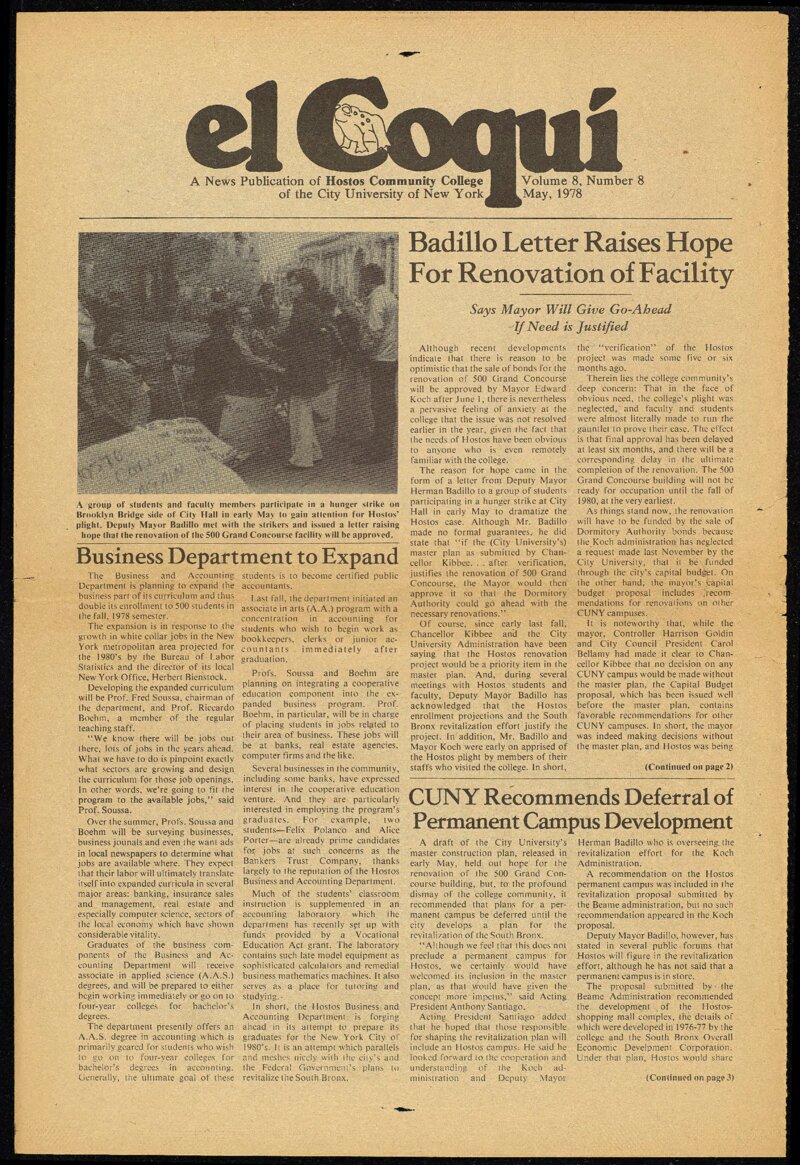
El Coquí was a college newspaper published monthly by the Office of College Relations and Development at Hostos Community College. This May 1978 issue featured a story announcing that Deputy Mayor Badillo had written a letter that offered some cause for optimism regarding the efforts to secure funding for the renovation of 500 Grand Concourse, a second building for the college. It also announced that the City University Master Plan recommended that the plans for a permanent Hostos campus be deferred to account for broader revitalization plans for the South Bronx.
By 1977, the third part of the campaign to save Hostos Community College had picked up momentum. Having extremely poor facilities, the college had acquired a second building across the street from its original location that would allow Hostos to expand. However, the 500 Grand Concourse building needed renovations to be useable but the college had been denied the funds necessary to prepare and occupy their second building. A fresh wave of organizing by students and faculty drove efforts to enable Hostos to continue to be a hub of opportunity for residents of the South Bronx.
By 1977, the third part of the campaign to save Hostos Community College had picked up momentum. Having extremely poor facilities, the college had acquired a second building across the street from its original location that would allow Hostos to expand. However, the 500 Grand Concourse building needed renovations to be useable but the college had been denied the funds necessary to prepare and occupy their second building. A fresh wave of organizing by students and faculty drove efforts to enable Hostos to continue to be a hub of opportunity for residents of the South Bronx.
Contributor
Meyer, Gerald
Creator
El Coquí, A News Publication of Hostos Community College of the City University of New York
Date
May 1978
Language
English
Publisher
Hostos Community College of the City University of New York
Rights
Obtained from Contributor - Copyright Unknown
Source
Hostos Community College Archives
Original Format
Newspaper / Magazine / Journal
El Coquí, A News Publication of Hostos Community College of the City University of New York. Letter. 2000. “El Coquí, Volume 8, Number 8, May 1978”, 2000, CUNY DIGITAL HISTORY ARCHIVE, accessed September 5, 2026, https://stephenz.tailc22a4b.ts.net/s/cdha/item/684