Action, November 1968
Item
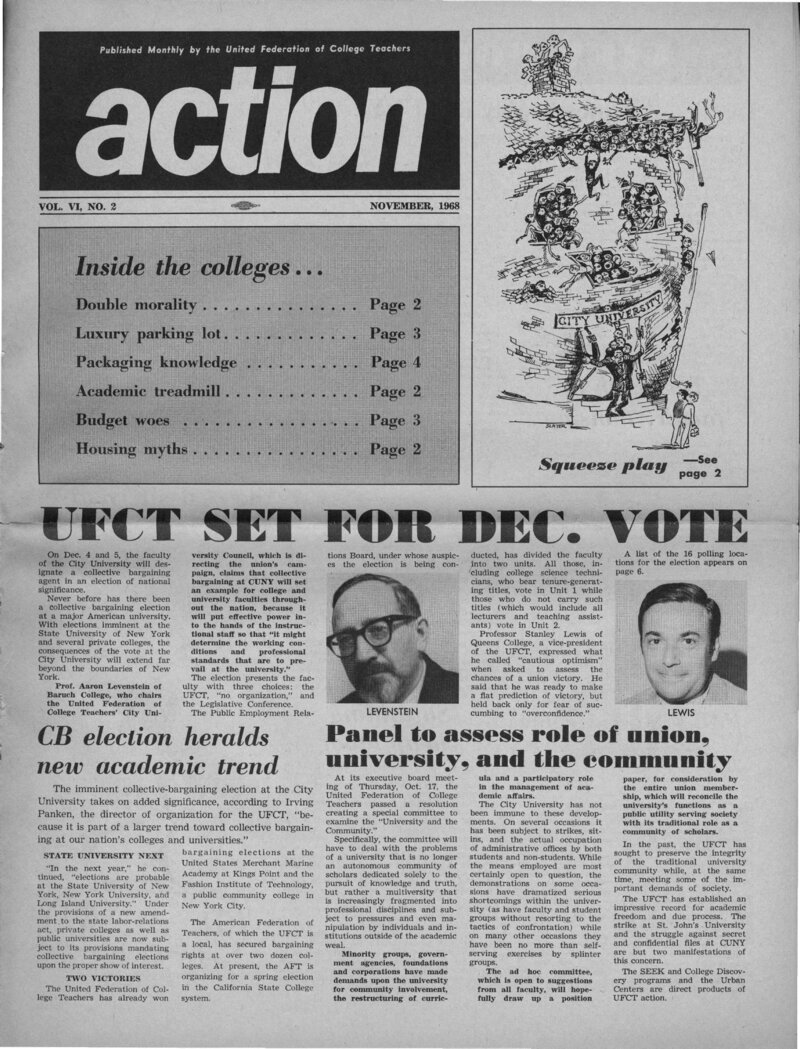
Published Monthly by the United Federation of College Teachers
VOL. VI, NO. 2
Budget woes —
~ Housing myths oe ek
Inside the colleges...
‘Double MOOPAHY 2. ca
Luxury parking lot. ce
Pockaving knowledge .......
: Academic treadmill... . 2:
ee ee ee
—UFCT SET
On Dec. 4 and 5, the faculty
of the City University will des-
ignate a collective bargaining
agent in an election of national
significance.
Never before has there been
a collective bargaining election
at a major American university.
With elections imminent at the
State University of New York
and several private colleges, the
consequences of the vote at the
City University will extend far
beyond the boundaries of New
York.
Prof. Aaron Levenstein of
Baruch College, who chairs
the United Federation of
College Teachers’ City Uni-
versity Council, which is di-
recting the union’s cam-
paign, claims that collective
bargaining at CUNY will set
an example for college and
university faculties through-
out the nation, because it
will put effective power in-
to the hands of the instruc-
tional staff so that “it might
determine the working con-
ditions and professional
standards that are to pre-
vail at the university.”
The election presents the fac-
ulty with three choices: the
UFCT, “no organization,” and
the Legislative Conference.
The Public Employment Rela-
CB election heralds
new academic trend
The imminent collective-bargaining election at the City
University takes on added significance, according to Irving
Panken, the director of organization for the UFCT, ‘“‘be-
cause it is part of a larger trend toward collective bargain-
ing at our nation’s colleges and universities.”
STATE UNIVERSITY NEXT
“In the next year,’ he con-
tinued, “elections are probable
at the State University of New
York, New York University, and
Long Island University.” Under
the provisions of a new amend-
ment to the state labor-relations
act, private colleges as well as
public universities are now sub-
ject to its provisions mandating
collective bargaining elections
upon the proper show of interest.
TWO VICTORIES
The United Federation of Col-
lege Teachers has already won
bargaining elections at the
United States Merchant Marine
Academy at Kings Point and the
Fashion Institute of Technology,
a public community college in
New York City.
The American Federation of
Teachers, of which the UFCT is
a local, has secured bargaining
rights at over two dozen col-
leges. At present, the AFT is
organizing for a spring election
in the California State College
system.
NOVEMBER, 1968
Page 2
«=. Page 3
... Page 4
~ os Page 2.
».. Pages
tions Board, under whose auspic-
es the election is being con-°
LEVENSTEIN
ducted, has divided the faculty
into two units. All those, in-
‘eluding college science techni-
cians, who bear tenure-generat-
ing titles, vote in Unit 1 while
those who do not carry such
titles (which would include all
lecturers and teaching assist-
ants) vote in Unit 2.
Professor Stanley Lewis of
Queens College, a vice-president
of the UFCT, expressed what
he called “cautious optimism”
when asked to assess the
chances of a union victory. He
said that he was ready to make
a flat prediction of victory, but
held back only for fear of suc-
cumbing to “overconfidence.”
Squeese play
page 2
FOR DEC. VOTE
A list of the 16 polling loca-
tions for the election appears on
page 6.
é
~ LEWIS
Panel to assess role of union,
university, and the community
At its executive board meet-
ing of Thursday, Oct. 17, the
United Federation of College
Teachers passed a_ resolution
creating a special committee to
examine the “University and the
Community.”
Specifically, the committee will
have to deal with the problems
of a university that is no longer
an autonomous community of
scholars dedicated solely to the
pursuit of knowledge and truth,
but rather a multiversity that
is increasingly fragmented into
professional disciplines and sub-
ject to pressures and even ma-
nipulation by individuals and in-
stitutions outside of the academic
weal.
Minority groups, govern-
ment agencies, foundations
and corporations have made
demands upon the university
for community involvement,
the restructuring of curric-
ula and a participatory role
in the management of aca-
demic affairs.
The City University has not
been immune to these develop-
ments. On several occasions it
has been subject to strikes, sit-
ins, and the actual occupation
of administrative offices by both
students and non-students. While
the means employed are most
certainly open to question, the
demonstrations on some occa-
sions have dramatized serious
shortcomings within the univer-
sity (as have faculty and student
groups without resorting to the
tactics of confrontation) while
on many other occasions they
have been no more than self-
serving exercises by splinter
groups.
The ad hoc committee,
which is open to suggestions
from all faculty, will hope-
fully draw up a _ position
paper, for consideration by
the entire union member-
ship, which will reconcile the
university’s functions as a
public utility serving society
with its traditional role as a
community of scholars.
In the past, the UFCT has
sought to preserve the integrity
of the traditional university
community while, at the same
time, meeting some of the im-
portant demands of society.
The UFCT has established an
impressive record for academic
freedom and due process. The
strike at St. John’s University
and the struggle against secret
and confidential files at CUNY
are but two manifestations of
this concern.
The SEEK and College Discov-
ery programs and the Urban
Centers are direct products of
UFCT action.
VIEWPOINTS
A squeeze play at CUNY
Overcrowding has become so pervasive at the
City University, that new facilities are often
rendered obsolete upon completion.
Because its budgets are embarrassingly inadequate,
expanding enrollment has severely overtaxed both
the physical and human resources of the university.
Over a seven-year period, from 1961 to 1968, during
which the city trimmed approximately $70 million
from the budgets submitted to it by the board of
higher education, enrollment has increased 59 per-
cent, from 97,984 to 152,776. For 1975, seven years
from now, the university projects a 79 percent in-
crease of some 114,000 students.
Expanding enrollment has moved with such un-
controllable acceleration that the goals of the
master plan have become no more than empty
promises.
The nine-hour teaching load projected by the plan
is no more than a distant. reality at most colleges,
where instructors on the average teach more than 12
hours a week,
The faculty enjoys few of the amenities nor-
mally accorded the instructional staff of a uni-
versity. They are crowded into tiny offices that
lack sufficient telephones, let alone, in some cases,
desks for each occupant, and are overburdened
The myth of
faculty housing
We quote in full what we consider to be a
revealing statement on faculty housing which
appeared in the 1968 Master Plan:
“Experience has shown that faculty members, es-
pecially younger persons, are reluctant to relocate
in New York City because of high rental costs and
the difficulty of finding suitable apartments near
several of the campuses. The situation is also acute
for full-time graduate students with limited means.
Recognizing that it must provide suitable housing for
faculty members and students, the board passed the
following resolution:
The distant future
“1. That the Board of Higher Education establish a
policy of providing housing for its college presidents
on or adjacent to the campuses and that a house
be provided for the chancellor.
“2. That housing is of vital importance in attracting
and maintaining a top college faculty and each college
should determine as quickly as possible the interests
and needs of its faculty and eligible staff and provide
in its future planning for campus and plant develop-
ment those arrangements which it believes to be most
desirable.
“Faculty housing would be self-supporting and
would not require tax levy funds.”
While the board has been very generous with $70,000
to $80,000 stipends for presidential housing (in the
distant suburbs rather than adjacent to the campuses
as directed), it has expended relatively little time or
money on self-supporting faculty residences (let alone
student dormitories), a shortcoming which the UFCT
pledges to correct should it be elected CB agent.
2
with petty and irritating clerical duties because
of lack of sufficient secretarial assistance.
The original master plan of 1964 programmed 120
square feet of office space per faculty member as its
goal for 1970. The board of higher education’s own
Statistics show that City College (57 square feet),
Hunter College (48), and Queens College (89), all had
less floor space per instructor in 1967 than they did
in 1965. At Queensborough, the total was 38.2. What
compounds all of this is that the statistics are deceiv-
ing, because they do not figure in full- or part-time
lecturers, but do include administrators who are often
housed in spacious accommodations.
The intermediate goal of one secretary for each
10 faculty members was realized in 1967 at only six
of the 13 units of the university, while the speci-
fied ratio of one telephone per two instructors is no
more than a paper standard at Staten Island Com-
munity, Queens, and City Colleges, where the 1967
ratios were one to nine, five, and seven.
Unfortunately, statistics usually obscure more
than they reveal. One need only visit an office
shared by 20 faculty at Brooklyn or City Col-
leges for dramatic proof of overcrowding. At
some colleges, status is measured by how many
drawers you have in a desk. Conferences with
students in these offices, to say the least, are
distracting.
If we are to read a moral into all these unfulfilled
goals, mythical standards and reams of statistics it is
that only an organized faculty working together
through collective bargaining will have the necessary
leverage to release funds from the bureau of the
budget to finance the University’s expansion.
That is why we ask you to vote UFCT.
| published monthly during
the academic year by the =
UNITED FEDERATION OF
COLLEGE TEACHERS
Local 1460, American
Federation of Teachers,
AFL-CIO
ark Avenue, So.,
New York, N.Y. 10010
- Tel.: 673-6310-11
EDITOR
PETER O'REIL
Signed articles an :
tisements do not neces-
sarily represent the view-
points or policies of the
UFCT,
Double standard
On Oct. 28, the Public Employment Relations Board
of New York State ruled that over 1,400 faculty at
the City University could cast two votes, one in each
unit, in the collective bargaining election scheduled
for Dec. 4 and 5.
Our opponents argued on behalf of the decision.
The UFCT, on the other hand, seriously questions
the morality of a double vote.
The PERB premised its original decision last spring
to divide the faculty into two election units on the
assumption that those who occupy tenure-generating
lines have a basic, full-time. commitment to their
employer, the university, while lecturers do not.
While we thought the logic was somewhat faulty last
spring, we are now totally confused because the
PERB’s new ruling reverses it.
‘Faulty logic or not, we do not quite understand
why a full-time instructor or professor, teaching an
extra course or two at night, should vote twice while
his colleagues cast a single ballot.
SIDNEY SCHWAR
Legislative Representa
Collective bargaining —
The individual faculty member exercises very
little control over the conditions under which
his profession is practiced, because he lacks the
organization and expertise to come to grips
with a university that is dominated by a top-
heavy administrative bureaucracy, increasingly
fragmented into various professional disciplines
and subject to all sorts of pressures and de-
mands from government, corporate, and com-
munity agencies which lie outside of the aca-
demic weal.
In the past, the chancellor of the City Uni-
versity has offered various faculty groups, in-
cluding the UFCT, the illusion rather than the
substance of power by offering to’ “negotiate”
with them. Lest one be deceived, these “negoti-
tions” were no more than consultations, for the
Sustaining
cheap labor
In rather revealing testimony last winter before the
Public Employment Relations Board, Bernard Mintz,
vice-chancellor for business affairs, admitted that it
is common practice at the City University to divert
funds budgeted for line positions to pay the salaries
of lecturers.
He claimed, albeit euphemistically, that this enabled
the university to sustain a system of cheap labor, for
the price of a lecturer is a lot lower than that of, say,
a professor.
To dramatize it in slightly different terms, the
university can hire two to four lecturers for the salary
of just one full professor.
The implications of such sleight-of-hand economics
are considerable and rather serious. They allow ad-
ministration to continue the contemptible practice of
denying promotions to members of the instructional
staff by claiming that sufficient lines are not available,
when actually they are. At the same time, they enable
the City University to continue underpaying a large
minority of its faculty, namely the lecturers.
If the UFCT is elected collective bargaining agent,
it will give the faculty the kind of leverage it needs
to pressure the bureau of the budget to release funds
to increase the salaries of lecturers, thereby freeing
all available tenure-generating lines for promotions.
the real alternative
chancellor and the board of higher education still
made all decisions unilaterally.
Only collective bargaining can provide the frame-
work within which the faculty can conduct real ne-
gotiations with administration.
Only collective bargaining can provide the faculty
with the means by which it can humanize a multi-
versity which has become increasingly bureaucratic
and mechanical in its responses to problems.
Collective bargaining: getting off
the academic treadmill
action’
Phe
$16.4 MILLION TRIMMED
Budget cutting begins all over again
All work and no play makes the academician
dull. Well not exactly. The UFCT does believe,
however, in occasionally mixing fun with business
UF CT calls for new look at City
University tenure procedures
United Federation of
College Teachers has called for
a reexamination of tenure pro-
cedures at the City University.
The new tenure law, which
was sponsored by the board of
higher education and which re-
cently passed the state legisla-
ture, mandates a five-year pro-
bationary period for all faculty
hired on tenure-generating lines
as of Sept. 1.
Without any prior consultation
with the faculty, the board of
higher education unilaterally
drew up the new tenure proposal.
The UFCT has criticized the
move because it effectively de-
prives the faculty of any say
over professional matters which
vitally affect their status.
While there may be compelling
arguments for either a shorter
or longer probationary period,
the UFCT nonetheless feels that
faculty, rather than administra-
tion, should deliberate and legis-
late upon such a matter.
INEQUITY
A basic inequity is built into
the new tenure proposal. Under
the law, the rank of instructor
is no longer a tenure-generating
line. Incumbent instructors, sub-
ject to the old law, still must
face the promotional hurdle to
reach the rank of assistant pro-
fessor. To correct this situation,
the UFCT has called upon the
board to promote all instructors
still on tenure-generating lines
to the rank of assistant profes-
sor.
INADEQUATE EVALUATION
One essential flaw in the
system is that it does not al-
low for adequate evaluation
of candidates for tenure.
For example, departments
with over 200 members still
operate with the traditional
November, 1968
five-man personnel and
budget committee. Members
of the P and B are con-
fronted with the impossible
task of observing all of their
colleagues on probation, even
though they themselves are
still teaching a full load.
Under such demanding con-
? -
as witnessed by its cocktail parties for new faculty
at Brooklyn (top) and Hunter (bottom) colleges.
ditions, evaluations are at
best cursory.
If elected collective bargaining
agent, the UFCT will call for a
full-scale reevaluation of tenure
procedures which will allow for
faculty participation in place of
decision making by unilateral
fiat of the board.
Funds for general
studies are trimmed
A letter allegedly written by
James E. Tobin, the dean of the
James Hughes, chairman of
the UFCT's pension and welfare
committee, has prepared a bro-
chure on pension pointers for
the faculty of the City Uni-
versity. It comprehensively deals
with all the welfare programs
open to members of the instruc-
tional staff. Any faculty wishing
a copy in advance of mass dis-
tribution can get one by writing
the UFCT at 300 Park Ave.
South or by calling (212) 673-
6310.
school of general studies at
Queens College, and addressed to
departmental supervisors, an-
nounced a 50-percent reduction
in evening division curricula be-
ginning with the spring semester.
The. Knightbeat, a student news-
paper, printed the statement.
Tobin’s initial reaction was not
to deny the cutback, but to claim
that it was not as extensive as
reported.
BACKS DOWN
In response to the mild furor
created by affected student and
faculty groups who had or-
ganized in protest, the admin-
istration backed down by stat-
ing that funds would be found
to fund the full program of the
general studies division. It ad-
mitted, however, that original-
ly funds indeed had been cut.
SECRET DECISION
The protesting groups claimed
that the initial decision to halve
the curricula was made secretly
and unilaterally by administra-
tion without any prior consulta-
tion. It is believed that the move
was part of a general plan to cut
back programs at all of the uni-
versity’s schools of general
studies.
Chancellor moves to slash
presidents’ fund requests
Albert Bowker, the chancellor
of the City University, has al-
ready cut the budget submitted
by his college presidents by
$16.4 million,
The request has yet to go be-
fore the bureau of the budget,
the city council, the board of
estimate, and Mayor John Lind-
say, who between them trimmed
last year’s budget by over $35
million.
Over the past six budgetary
periods, a total of $95.4 million
has been slashed from successive
budget requests.
Dr. Israel Kugler, president of
the United Federation of College
Teachers, in a statement pre-
pared for the board of higher ed-
ucation’s committee on finance
and facilities, commented that:
COUP DE GRACE
“All of this is as a result of
excessive ‘prudence’ on the
part of the university adminis-
tration, beginning with the col-
lege presidents cutting depart-
mental requests; the chancel-
lor cutting presidential re-
quests; the budget director cut-
ting the chancellor’s request;
and, finally, the mayor admin-
istering the coup de grace.”
He argued that the imminent
collective bargaining election dic-
LINDSAY
tated “the most liberal budget
request possible.” ‘To do other-
wise,” he admonished “is to gen-
erate conditions that will give
rise to inevitable crises.”
As he has done at past hear-
ings, Dr. Kugler pointed out that
the university’s conservatism in
drawing up budgets has made it
impossible to fulfill the goals es-
tablished by the master plan (see
analysis on page 2).
He estimated that another $95
million was necessary if the uni-
versity was to fulfill the goals of
the master plan.
LECTURERS LACK BENEFITS
While his analysis of the bud-
get was comprehensive in its ap-
proach, he devoted particular
BOWKER
attention to the plight of the lec-
turers who have not benefited
from the last two salary in-
creases and still are not covered
by faculty health and insurance
benefits. Lecturers’ salaries are
at the same level they were at
five years ago. To correct this
inequity, Dr. Kugler called for
an_ across-the-board increase of
40 percent, a move that would
cost the university just a little
more than $4 million.
Dr. Kugler was particularly
exercised because the board had
informed him and other inter-
ested parties of its hearings only
three working days in advance
and, worse yet, provided copies
of the proposed budget with only
two days notice. “I only can
conclude,” he said, “that such
high-handedness renders the
hearings no more than a mean-
ingless charade and holds the
faculty and other members of
the academic community in con-
tempt.” He argued that only col-
lective bargaining can provide a
meaningful antidote to such cyni-
cism.
$1 million slated by CUNY
for presidential housing
The board of higher education
has asked for $1 million for the
construction of a garage to house
the cars of students attending
Queensborough Community Col-
lege and another $1 million to
domicile the presidents of the
City University’s eight communi-
ty colleges.
$100-MILLION BUDGET
The requests were part of the
University’s $101,396,598 capital
budget recently submitted to the
City Planning Commission.
The New York Times attribut-
ed the following statement to
Porter R. Chandler, chairman of
the board, made in support of the
request of $1 million for presiden-
tial housing.
NEAR TRAGIC LOSS
“I almost lost a community
college president because he visit-
ed my summer place near Genes-
co and saw the fine residence
there of the president of the Col-
lege of Arts and Sciences of the
State University.
CHANDLER
“It made him quite unhappy
over the apartment he himself
pays for in the city.”
“) .. What all of this
means is that the
student is to respond to
learning stimuli much
like the veritable
Pavlovian dog.”
Alvin C. Eurich, ed., Campus 1980, The Shape
of the Future in American Higher Education
(Delacorte Press, 1968)
Campus 1980 is not a book that lends itself
readily to review. It is an anthology of dis-
parate essays that have been artificially
grouped together because, ostensibly, they all
seek to analyze the future of American edu-
cation.
Some of the essays are no more than warmed-
over chapters from other books to which the
various authors have added a few concluding
paragraphs of often vacuous prophecy about
the state of education in 1980. The anthology
represents both good writing and bad, the
views of technocrats and humanists and, in
short, nothing approaching a consensus.
Ironically, the value of such a work is its
very formlessness. The confusion of the essay-
ists reflects that of most all academicians—
myself included—over precisely what the
_ modern university is all about. In this sense,
the anthology’s lack of direction is instructive,
because it tells us a lot about the fragmenta-
tion and dependence of an academic commu-
nity which once functioned as an autonomous
whole.
CONTRADICTIONS
The contradictions over ends and means
which the contributors to this anthology have
so unintentionally dramatized are, in essence,
built into the very structure of the modern
multiversity, an institution which has been
left with the humanistic heritage of the me-
dieval academy, but which cannot reconcile its
inheritance with the demands that contem-
porary society imposes upon higher education.
At the risk of oversimplification, one could
argue that the authors of this volume, like
many of their academic peers, fall basically
into two categories: technocrats and human-
ists.
EDUCATIONAL PLUMBERS
While the indictment might seem unduly harsh, the
technocrats are nonetheless tied to a conception of
education which, at worst, makes them manipulative
and, at best, unwitting apologists for the status quo.
They subscribe to an ideological neutrality which
places them beyond considerations of morality and
reduces them to the status of educational plumbers.
They accept the structure of the multiversity as given,
and, such being the case, are obsessed with mechani-
cal problems such as the ‘Technology of Instruction”
(the title of one of the essays), organizing curricula,
financing programs, establishing ‘“interinstitutional
links” and what have you. They maintain that the
major problems of higher education are open to
technological solutions, a thesis which if pursued to
its absurd conclusion—as Clark Kerr has—would
mean that administration rather than teaching is
what higher education is all about. Unfortunately,
Kerr’s analysis of the multiversity has a shrill ring
of truth to it.
THE MANIPULATIVE ACADEMY
What is disturbing about the technocrats repre-
sented in Campus 1980 is that most of them view
education as a process by which students (and fac-
ulty) are manipulated so that they might fulfill needs
predetermined by society; a process in which the very
apparatus and techniques of educational management
assume greater significance than the actual give
and take of ideas.
In a rather frightening paper, entitled “Toward
a Developed Technology of Instruction—1980,” C. R.
Carpenter of Pennsylvania State University writes
in characteristically tortuous prose that:
“Teaching functions can be thought of as occurring
in different phases and relationships, There is a phase
concerned with the selection and formulation of the
objectives of instruction. This phase consists of de-
fining sequences of events which relate to changing
initial performances to terminal performances fol-
lowing instructions. Then comes the phase of select-
ing and ordering or organizing the materials for
presentation to learners for eliciting responses from
the learners. . . .”
ENTER PAVLOV
Enough! Roughly translated, what all this means is
that the student is to respond to learning stimuli
much like the veritable Pavlovian dog. Several of
the essayists in fact look at problems solely in terms
of cause and effect, stimuli and response, or, to use
the most current jargon, “input and output.”
Logan Wilson, president of the American Council
on Education, claims that if higher education is to
serve the national interest, we must first analyze the
university in terms of “cost effectiveness,” “cost
benefits,” “educational input and output,” and the
“social mechanisms for interinstitutional decision mak-
ing.” Unfortunately, these are mechanical concerns
which dwell on means to the exclusion of any con-
sideration of ends.
If the logic of contributor Joseph Cosand, president
of the Junior College District of St. Louis, prevails
at our nation’s community colleges, as I fear it un-
doubtedly will, they will become no more than as-
sembly lines, mass-producing mindless technicians.
The metaphor is actually Cosand’s and not mine,
as borne out by his prediction that “the technician
graduating from a community college or technical
institute will be recognized as a valuable acquisition.”
If these colleges are simply to package their gradu-
ates for consumption “by giants like Monsanto, Gen-
eral Motors, and General Electric, by hospitals and
dentists and retailers,’ they will condemn their stu-
dents, many of whom are drawn from ghetto areas,
to the status of passive functionaries serving an over-
bearing technology.
MIDDLE-CLASS LUXURY
Cosand, of course, is correct when he maintains that
community colleges perform a very necessary func-
tion by offering a variety of technical programs. A
liberal-arts education, after all, may well be a
middle-class luxury that students from poorer fami-
lies can ill afford. But then again, are these institu-
tions merely going to mold their students in the
image of General Motors and the local orthodontist,
or are they going to train them in more than just
techniques, essential as they are, so that they might
bring a humane skepticism and inquisitiveness to
their everyday lives?
To be sure, Cosand discusses values, but given the
subservience of his prototype community college to
the dominant institutions of our society, values in this
case translate into something: like dominant norms.
Neville Sanford, a professor of psychology at Stan-
ford, who tries to “evoke situational determinism” to
explain student activism, employs much the same
language as the other technocrats I have described.
His analysis, though, is not so crude as his use of the
word “determinism” suggests, but rather is informed
with good sociology and psychology. Moreover, his
attitude towards students is not manipulative; that
is, he is not advocating that we study the motivating
factors of student unrest for the rather cynical end of
changing the “determinants” of their behavior so
that it might conform with the accepted norms of
society. Rather, he argues that we must not only
teach these students, but must learn from them.
APOLOGISTS?
The anthology reprints two essays abstracted with
only slight revision from The Academic Revolution
action
by Christopher Jencks and David Riesman and the
much, and somewhat unfairly, maligned Uses of the
University by Clark Kerr. All three authors fit into
the technocratic mold which I have been describing,
but like Sanford, the high level of analysis they bring
to their essays sets them apart from the other con-
tributors. What is upsetting, though, is that the two
essays are essentially apologies for the university
as technocracy; that is, the university as an institu-
tion which places greater value on technical and pro-
fessional expertise—usually in the service of the
dominant institutions of society—than it does on the
humanistic traditions which defined the medieval
academy.
Of course Kerr is right when he contends that the
educator-technocrat (my term) cannot return to the
vernal groves of medieval academe, for he is a crea-
ture of a different environment, a creature so tied to
the public agencies and private corporations that fund
the multiversity that it is almost impossible to sever
the umbilical cord.
The medieval university, which was an autonomous
and organic community, has given away to a multi-
versity which is fragmented into many disciplines,
the primary loyalty of whose practitioners is to
what Kerr calls their “professional guilds” and out-
side agencies, associations and foundations rather than
the academy itself.
ACADEMIC ENTREPRENEURS
While Kerr did not necessarily create the metaphor
of “the university as producer, wholesaler, and retailer
of knowledge,” he has done much to extend it. In his
parlance, the academic entrepreneur exercises a good
deal of leverage, whether he be an administrator or
faculty member, precisely because he is peddling his
services and his knowledge to powerful institutions.
The faculty producer and the administrative sales-
man (selling is the essence of administration in the
modern ‘“‘marketplace of ideas’) are the true innova-
tors of the multiversity, according to his analysis, be-
cause it is their ingenious schemes that are financed
by the government and private foundations.
Kerr rather perceptively points out that the in-
ternal mechanisms of academic governance are in
fact obsolete, because real power lies outside of the
multiversity.
Kerr’s analysis of the multiversity is precise and
very much to the point. However, he deceives him-
self when he justifies the system on the basis of the
power wielded by his innovating academic entre-
preneurs. What they exercise is the illusion of power
rather than its reality.
They cannot innovate on their own terms but rather
must do so on those of agencies with the power of
the purse. After all, the defense department or the
Ford Foundation will not fund just any old project.
Hence, in the long run, these academicians are not
so much entrepreneurs as they are technicians serv-
ing the ends of institutions that lie outside of the
academic weal.
EXAGGERATED EMPHASIS
Jencks and Riesman argue, with impressive docu-
mentation, that the compartmentalization of the uni-
versity into various disciplines and the utilitarian
demands of the outside forces which constantly in-
trude upon the academic scene have resulted in an
exaggerated emphasis upon professional expertise and
graduate education. Even small and _ traditionally
liberal arts colleges pattern their curricula after what
the essayists call the “university college.” In effect,
these schools are looking beyond the once highly
cherished Bachelor of Arts degree by preparing their
students for entrance into prestigious graduate
schools.
Professors Jencks and Riesman point out that as the
graduate and professional schools have established
their hegemony over most of all aspects of higher edu-
cation, colleges that were once identified as Catholic,
female, Negro, Presbyterian, or what have you, have
lost their unique identities only to become part of
what the authors describe as a “meritocracy.” Ad-
November, 1968
mission standards are no longer premised on a stu-
dent’s background, but rather merit. As a result, the
students have come to assume many of the profes-
sional norms of their teachers.
MORAL NEUTRALITY
“The rise of meritocracy,” Jencks and Riesman
write, “brings with it what we call the national upper-
middle-class style: cosmopolitan, moderate, somewhat
legalistic, concerned with equity and fair play, aspir-
ing to neutrality between regions, religions, and eth-
nic groups.” While ostensibly the meritocracy draws
out, as the authors see it, the best in our students, it
nonetheless seems to promote a moral neutrality and
life style that allow our colleges to accommodate to
society without necessarily bringing a humane skep-
ticism to its values or ends.
William Birenbaum, former provost of Long’ Island
University and currently president of Staten Island
Community College, dramatizes the essential flaw of
this technocratic approach to the problems of higher
education when he writes:
“Much of what passes for future-think is an imag-
ination of what ‘the present would be like if it
‘worked right.’ It’s an imagination that counts heavily
on technological solutions to basic current problems
and assumes that an intelligent application of the
present technology would make things work right
and would keep the future under control. It’s an
imagination which avoids confronting the. political
causes of the present gaps between our technological
capacities and their application and steers clear of the
ideological implications of the technology itself.”
GRISLY REALITY
The humanists represented in this anthology, such
as William Arrowsmith, a classicist teaching at the
University of Texas, while acutely aware of what
Birenbaum calls the “ideological implications of our
technology,” nonetheless refuse to retreat from their
ivory towers to deal with the grisly reality of the
multiversity.
In his contribution, Arrowsmith makes an anguished
and compelling cry for a truly humanistic education
that will mold men rather than produce knowledge.
But Arrowsmith betrays a certain naiveté when he
claims that the humanities have declined because our
presidents, provosts, chancellors, and other knighted
administrators are, for the most part, dull and un-
imaginative men. He seems to labor under the de-
lusion that to reform education all we need do is
come up with some good ideas or creative programs.
Unfortunately, the faculty, fragmented as it is,
lacks the organization, and the administration and
outside agencies the inclination, to implement these
programs on anything but a limited and ineffectual
scale.
BUREAUCRATIC RESPONSES
Our universities can and have muted the cries of
the Arrowsmiths by offering a variety of programs
and even experimental curricula in the humanities.
Arrowsmith’s emphasis, for all of its moral force and
integrity, is somewhat misplaced. The real question
is how can our universities inform what have become
their increasingly bureaucratic and mechanical re-
sponses to the demands and problems of society with
a measure of humanism?
The heavies in this piece are not the technicians
and scientists. What is at issue is how we use our
science and technology; a science and technology
which, as many of the contributors have pointed out,
opens up vast possibilities for the future of higher
education? Before any of this can be realized, the
university must resolve its humanistic inheritance
with the demands that society places upon it as a
public utility.
Kerr is correct when he contends that the uni-
versity cannot function as an autonomous body im-
mune to the demands of the larger society. The
problem is that the university has related to the
larger agents of society on their terms rather than
its own. That is why its responses have become
mechanical and its humanistic traditions irrelevant.
IMPERSONAL FORCES
The university cannot respond on its own terms—
cannot address itself to ends rather than means—
because it no longer functions as a community. Fac-
ulty and students remain for the most part unor-
ganized before the awesome power of forces outside
the university and an entrenched and impersonal ad-
ministrative bureaucracy within it. They respond to
their plight existentially, if they are alienated, or as
technicians, if they have integrated into the ‘meri-
tocracy,” loyal to their professional disciplines rather
than to any articulated concept of the university as a
whole.
Three contributors to the anthology, Birenbaum,
John Gardner, and William Marvel, argue with an
appropriate sense of urgency that unless the university
reasserts itself as a community, it will continue to
pander to the outside influences that dominate it.
I think a college union is well placed to begin the
work of refashioning that community. It can bring
not only organization, but a sense of purpose to a
faculty that is fragmented and passive before the
larger and impersonal forces at work within the
university.
Without a union, the faculty may well be doomed to
a role of demeaning subservience.
(While William Friedheim is editor of action,
the views represented, as is the case in
any signed article, are those of the author
and not necessarily the UFCT. The prin-
cipal purpose of all the reviews printed in
action is to generate some kind of dialogue
on some of the larger issues confronting
higher education today. Toward this end, we
will print articles representing a great va-
riety of viewpoints.)
THE
JUDGE!
The need to cover the high cost of specialist care is
greater today than ever before.
Nevertheless, H.I.P. is still the only plan in this area
providing fully paid specialist services—in the office, hos-
pital and home..
WHAT H.LP. DOES
H.I.P.’s Medical Groups provide care and consulta-
tions by qualified specialists in fourteen basic specialties
—in and out of the hospital.
There are no specialist charges... no limit on visits
. no deductibles... no claim forms.
When needed in difficult cases, H.I.P. brings you the
services of specially qualified specialists and surgical
teams—also without cost to you!
AND THE OTHERS?
Compare H.I.P.’s broad coverage with the specialist
coverage given by the other plans available to City em-
ployee families.
We repeat...
YOU BE THE JUDGE!
HEALTH INSURANCE PLAN OF GREATER NEW YORK
He ea 625 MADISON AVENUE, NEW YORK, N.Y.10022
PERB sets 16
polling places
for CUNY vote
The Public Employment
Relations Board has released
a list of 16 polling places for
the collective bargaining
election to be held at the
City University on Dec. 4 and
ee
np
S
*
10.
li.
12.
13.
14.
15.
16.
They are as follows:
- BARUCH COLLEGE
Faculty Council Room
Room 903-5
BROOKLYN COLLEGE
Faculty Lounge
Room 2147
Boylan Hall
CITY COLLEGE AND THE
MANHATTAN URBAN
CENTER
Knittle Lounge
Shepard Hall
City College
. HUNTER COLLEGE
President’s Conference Room
Room 207
JOHN JAY COLLEGE OF
POLICE SCIENCE
Room 618
Police Academy
» LEHMAN COLLEGE
President’s Conference Room
Room 5—322
Shuster Hall
+ QUEENS COLLEGE
President’s Room
Dining Hall
» RICHMOND COLLEGE
Room 915
. BOROUGH OF
MANHATTAN
COLLEGE
Room A 212
134 West 51st Street
BRONX COMMUNITY
COLLEGE
Room 211
120 East 184th Street
KINGSBOROUGH
COMMUNITY COLLEGE-
MANHATTAN BEACH
“A” Building Auditorium
KINGSBOROUGH
COMMUNITY COLLEGE-
MID-BROOKLYN
Dean Lachman’s Office
Room 2 M
NEW YORK CITY
COMMUNITY COLLEGE &
BROOKLYN URBAN
CENTER
Room 305
Namm Hall
300 Jay Street
QUEENSBOROUGH
COMMUNITY COLLEGE
AND YORK
Clubhouse Conference Room
Oakland Building
Queensborough Community
College
STATEN ISLAND
COMMUNITY COLLEGE
Faculty Lounge
Room C109
DIVISION OF GRADUATE
STUDIES—DIVISION OF
TEACHER EDUCATION
AND UNIVERSITY
CENTRAL STAFF
Graduate Center
Room 415
UFCT
Fuel Oil Discount
One cent discount on each
gallon of #2 fuel oil
Low cost burner service
policies available
CENTRAL PETROLEUM
CORPORATION
325 Exterior Street
Bronx, N. Y. 10451
212-MO 9-4040
Deliveries to: N.Y.C., Nassau,
Suffolk, Westchester,
Metropolitan New Jersey
action
CUNY sabbatieals found insufficient
The City University’s master
plan for 1968 states that “Every
major university in the country
provides selected faculty mem-
bers with sabbatical leaves.
Leaves provide faculty members
with an added opportunity for
research and scholarly activity.
For Large
It also permits scholars to keep
abreast of the latest develop-
ments in their discipline.”
The UFCT heartily agrees with
that sentiment as it does with
most others expressed in the
master plan. But, like most all
of the other goals stated in that
ELECTIONS
unfortunate document, lack of
proper financing has rendered it,
to say the least, farcical.
The present budget allots a
miserly $250,000 for sabbati-
cals, a total which would allow
for one sabbatical a semester
per 83 full-time faculty, as op-
posed to the ratio of one to
six which prevails at most ma-
jor universities.
@ OFFICIAL UFCT
@ MAJOR APPLIANCE
@ DISCOUNT OUTLET
MEMBERSHIP PRICES QUOTED ARE UNBEATABLE
WASHERS
FREEZERS
1 i Sy
DRYERS -
RANGES -
STEREO
REFRIGERATORS
DISHWASHERS
¢ AIR CONDITIONERS +
© Featuring — All Famous Brand Names
PHONE ORDERS—I0 A.M.-6 P.M.
ERVICE
AVINGS
For Best
For Tremendous
CALL WITH MAKE AND MODEL NUMBER
JAMAICA GAS & ELECTRIC
42-24 BELL BOULEVARD
BAYSIDE, N. Y. BA.9-2853 BA 9-2400
Open Daily Till 9 p.m.; Wed. & Sat. Till 6 p.m.
Interested in TANGIERS/SPAIN . . $330.
CARIBBEAN . . $299. . . . MEXICO
. « $259 or MIAMI plus Cruise . . $229.
CHRISTMAS, 9 days—LONDON . . $249.
SKI—St. Moritz, Switzerland . . $300.
Write: Sandy Aibel, 172 Madison Ave.,
N.Y.C., or call MA 1-3667, OR 9-3175
and literature will be mailed
On All Periods of
FURNITURE
We Invite the Members of UFCT and their
Families to visit our Showroom.
EMPIRE STATE FEDERATION OF TEACHERS
1969 EUROPEAN CHARTER
New York - Paris - New York $239 July 5 to August 25
7 Weeks European Tour Available
(including flight)
All UFCT Members and Their Immediate Families Are Eligible
Details Available From: Prof. Morton Silverstein . . . Fashion Institute of Technology
227 West 27th Street, New York, N.Y. 10001 — Tel. 212—673-6310; Eve: 201—385-7538
¢
_ PAN AMERICAN JET
OFFICIAL
UFCT DISCOUNT
Approved By Executive Board
NEW CARS — Official UFCT car purchase plan...exactly $100 above dealers actual cost!
@ CARPETING — Specially negotiated discount prices on almost all national brands.
@ STEREO AND HI-FI — Stereo consoles, stereo cabinets and stereo components including
amplifiers, preamplifiers, tuners, turntables, speakers and speaker systems and tape
recorders.
@ DIAMONDS — Uncontested value at lowest possible price!
@ PIANOS— Direct factory arrangement for special discount prices. Factory showroom
located in New York.
@ CAMERAS AND PHOTOGRAPHIC EQUIPMENT — Cameras and accessories, movie cam-
eras, still and movie projectors, editing, copying and developing equipment, lenses and
a ADDITIONAL SERVICES
Credit terms arranged up to 3 years
at the LOWEST RATES in New York City.
eae DE Pe
Purnia (Cengoany He
Manufacturer's Distributors
Free Parking at: Sunrose Parking Lot, 24th St. cor. 6th Ave.
119 W. 24 St., New York City CHelsea 2-3354 - §
Hours: Daily 9:00 to 5:00, Thursday to 8:00 P.M., Saturday to 4:00 P.M.
oo
Special Service School Teacher Group
155 West 72nd Street, New York, N.Y. 10023
Telephone: 799-6800
FALL and WINTER TRAVEL PROGRAM
VETERAN’S DAY WEEKEND
Grand Bahama Hotel & Country Club
Nov. 8 (Eve) -Nov. 11
vow #1 Complete Package $139
THANKSGIVING PACKAGES Nov. 27-Dec. 1
16 #1 Grand Bahama Hotel & Country Club f kage $169
16 #2A _ King's Inn, Freeport Seu bea ted pa
Nassau-Paradise Island, Beach Inn
1S #5 Jamaica-Mahoe Bay Hotel
Te #3 Las Aladdin Hotel, Nov. 28 - Dec. |
Fi Hotel, Nov. 28- Dec, | and
Nov. 29 - Dec. 2
CHRISTMAS ABROAD
ROME (flight and transfer)
ROME (flight, HILTON HOTEL, Sightseeing)
ROME, FLORENCE (flight, transfers, deluxe
hotels and sightseeing)
ROME (flight plus FIAT 850 for entire
Complete
Complete Package $219
Complete Package $209
Complete Package $199
Dec. 20 (Eve)-Jan. 1
Complete Package $229
Complete Package $329
Complete Package $389
vacation $299 plus $35 and 3!/¢ km.
XM #I0A LONDON (flight and transfer) ete Package $199
XM'H108. “LONDON (Manic ond trantiers deli Ree eee
hotel, sightseeing)
LONDON (flight plus car rental)
ISRAEL: Dec. 21 - Dec. 31 or Dec. 22 - Jan. |
(Children under 12—Half fare)
Package including Haifa, Jerusalem and
Tel Aviv available as well as car rental
CHRISTMAS HOLIDAY PACKAGES
WEST END, GRAND BAHAMA ISLAND—
Grand Bahama Hotel
FREEPORT, GRAND BAHAMA ISLAND—
King's Inn Hotel
NASSAU, BAHAMAS, Anchorage Hotel
ACAPULCO, TAXCO, MEXICO CITY, First
class and deluxe hotels
ONE WEEK GALA VACATIONS
LAS VEGAS, HOLLYWOOD, PALM
SPRINGS, Dec. 20- Dec. 27
Barbados—Hilton Hotel, Dec. 21 - Dec. 28
CARIBBEAN FLY/CRUISE, San Juan, St.
Thomas, Guadeloupe
La Guira, Curacao, Dec. 21 - Dec. 28
SKI CHARTER To, ‘st. MORITZ
Complete Package $329
$199 plus $45.69 per
week—no mileage charge
Flight only $399
XM #10C
XM #8
Dec. 21-Jan. 1
XM #3
XM #4
XM #5
XM EH
Complete Package $319
Complete Package $36?
Complete Package $349
Complete Package $489
XM #20
XM #18
XM #19
Complete Package $269
Complete Package $359.50
From $299 for
XM #9 Complete Package
Dec. 21 - Dec. Complete Package $304
XM #I7 SPAIN, COSTA’ BEL SOL, Torremolinos es nN ihe . .
Dec.'21 - Dec. Complete Package $315 @ MAJOR APPLIANCES — Televisions, air-conditioners, refrigerators, freezers, dishwash-
SHORT CHRISTMAS VACATIONS
Freeport, Grand Bahama Island, King's Inn
Dec. 24- Dec. 27
Freeport, Grand Bahama Island, King's Inn
Dec. 27-Jan. |
Bermuda Castle Harbour, Dec. 24-Dec, 27
Please call for other Christmas trips to
Miami, Spain, Puerto Rico and Las Vegas
Please send application forms and further information on (Circle one or
more and paste on a postal card):
vow #1 JIG #2
ers, washing machines, dryers, disposals, ranges, radios, humidifiers, dehumidifiers,
XM #13 tape recorders and vacuum cleaners are available at slightly above wholesale.
XM #14
XM #12
Complete Package $169
Complete Package $244
Seat eee a @ FURNITURE — Complete lines of furniture at slightly above dealers actual cost.
@ CUSTOM DRAPERIES, UPHOLSTERY AND SLIP COVERS — Exclusive service group
only through United Buying Service. 13 locations throughout the metropolitan area.
@ FURS—A prominent fur manufacturer and supplier to major department stores is now
contracted to offer their products at discounts exclusive to United Buying Service. Furs
available include Mink, Beaver, Leopard, Muskrat, Broadtail, Alaskan Seal, Persian
1S #5 XM #1
XM #4 XM #6 XM #9 XM #10A
XM #12 XM #17 XM #20 XM #2A Lamb and a variety of Fun Furs.
TG #1 16 #3 Te #4 XM #10B LUGGAGE — Products of all leading manufacturers at special discount prices.
XM #5 XM #7 XM #8 XM #2B
XM #14 XM #18 XM #19 XM #10C
XM #3 XM #12
1855 Broadway, New York, N.Y. 10023
United paving Service Corporation § New York: (212) LT 1-9494, PL7-0007
New Jersey: (201) 434-6788
aay The Greatest Buying Power in Greater New York
NAME
ADDRESS
SCHOOL
PHONE
CITY
SCHOOL ADDRESS
CITY STATE ZIP
Available to all college faculty and their immediate families only
November, 1968 q
College teachers
and student power
Dear Sir:
It is ironic that just about the time that col-
lege teachers are beginning to gain some power
over the educational system in relation to the
administration, the growth of the student pro-
test movement is threatening to cut into this
power, and perhaps diminish the role of the
faculty even more than the administration has
done in the past.
When we have finally won collective bargaining
agreements with the administration and the boards of
trustees—and we will certainly do so in many colleges
in the next few years—will we then have to turn
around and share our power with student unions? I
think that we will, and I also believe that our rela-
tionship with students will be just as much a power
struggle as it is with administration, unless a funda-
mental change occurs in our attitude towards higher
education. Before outlining the change in attitude
that I would suggest, I would like to review briefly
the issues in the present conflict.
STUDENT NEEDS
The students, it would seem from both their state-
ments and their actions, want a curriculum which can
satisfy their personal, vocational and political needs.
And they want teachers who will devote their main
efforts to teaching such courses effectively. All of the
students, naturally enough, want preparation for a
job; most of them want some help (particularly from
the courses in humanities) in developing their out-
look and attitude; and an increasing number also
want specific knowledge (chiefly from the social sci-
ences), which help with social and political problems.
The members of the faculty, on the other hand,
would offer only those courses which they are pre-
pared to teach, and they believe that the students’
needs and interests should be developed to fit these
courses, and not the other way around. The faculty
also believes that the teachers’ main efforts should be
concentrated on developing their own mastery by
means of research and creative efforts, and that the
teacher’s work in the classroom is, at its best, an ex-
tension of his own intellectual development. Needless
to say, with such criteria of teaching effectiveness,
teachers can best be judged by their colleagues and not
by their students.
CONFLICT OR RECONCILIATION
If the issues are even approximately those outlined
here, it may seem that the conflict between faculty
and students can only become sharper as the stu-
dents gain a stronger voice in determining college
policies. But a different attitude is developing among
faculty members, particularly the younger ones; and
I would like to show how this new attitude can not
only be reconciled with student demands but also with
the best qualities of our intellectual (if not our aca-
demic) tradition.
Certainly, one of the better qualities of our intel-
lectual tradition, a tradition which lies beneath the
academic shell, is a continual questioning of what we
are doing. And this questioning of our academic in-
stitutions, as well as of our scholarship, has gone on
for some time, most notably in history and sociology,
but also in literature and philosophy.
It is not only the students, but the teachers, par-
ticularly the younger teachers, who are questioning
the value of much of the scholarship in their fields,
isn’t it
time :
YOU took
some action?
Letters
and, consequently, the standard curriculum which is
based on the value of that scholarship.
If, for example, the significant questions concerning
the uses of history deal with implicit values rather
than facts, then, it must follow that the standard
preparation for history majors must be revised so that
the mere accumulation of facts must be subordinated
to what might be called the philosophy of history.
In literature, to take another example, many
scholars are more skeptical than ever as to our ability
to give objective reasons for assigning greater literary
value to the classics than to contemporary works. And
if there can be a genuine question as to the intrinsic
excellence of Shakespeare, or Milton, Wordsworth, or
Dickens, are we really justified in our insistence that
the student master the classics before going on to the
modern writers?
And in the studying of all of the humanities, the
question that is becoming more persistent each year
is whether we are getting our students to do much
more than to master a large number of facts about
literature, or about history, or about philosophy, rather
than enabling them to think and feel the way the best
critics, historians and philosophers do.
In brief, the questions raised by some of the more
thoughtful teachers and scholars are parallel to the
questions raised by some of the more unlettered stu-
dents. Unlettered students might, sometimes, be more
prone to give simple answers to these difficult ques-
tions than do the scholars; but the fact that we are, to
some extent at least, asking the same questions
should allow some cooperation between us in revising
the curriculum.
SELF-INTEREST
But even if this is possible, even if teachers and
students can agree in theory that certain courses
should be dropped, that some courses should be taught
in a very different way, and that a teacher may be
doing more valuable work in a classroom than in the
collection of insignificant facts, can there be agree-
ment about the vested interests of teachers in these
outmoded courses and in their useless scholarship?
Certainly the self-interest of teachers no matter what
their theories, would prevent them from allowing some
student reforms even when these reforms are logical.
There is some truth in this objection, it would be
naive to expect us to give up the power and the
money that we have earned through long years of
scholarship. But it is here that a union can be of
particular help. Precisely because a union (UFCT or
any strong professional organization), can guarantee
the.tenure and seniority of teachers, the union can
also be free to cooperate with the needed reforms.
It is the unorganized teachers, teachers whose
tenure and seniority are at the mercy of boards of
trustees and their administrators, who will resist most
strongly any radical changes in curriculum and in
methods of teaching. They will resist because they
know how precarious their positions are; they realize
that whenever there is any strong pressure college
administrations and boards of trustees will blithely
sacrifice the interests of teachers. Teachers who are
dependent on the administrators for their rights will,
inevitably, continue their traditional role of defending
the status quo, no matter how outdated it may be.
But suppose that our tenure and. seniority were
guaranteed by a strong union, a union which had a
contract with the board of trustees? If we knew
that even the most radical changes would have to be
made with provision for our rights, would we still
be so adamant at any radical changes, particularly
changes which would allow greater power to the
students? Some of us would probably still be ada-
mant. But since an increasing number of teachers
are themselves extremely critical of their own gradu-
| want information []
| want to join ea
Name... =
Home Address...
City and State................ ne
College. é
Home Phone... ss
College Phone... ec emcee
Dept ne
Mail filled out coupon (please print) to UFCT, 300 Park Avenue
South, N. Y. 10010.
ELECTION
ISSUE
ate courses, of the grading system, of the required
courses, and of the administrative bureaucracy, a
large number of faculty members would ally them-
selves with the reform movement. Having no great
fears that the change in required course, grading pro-
cedures, teaching methods, and in the curriculum,
would endanger their jobs, even senior faculty mem-
bers might take an objective look at their profession
and try to assess, rationally, whether our traditional
education is really meaningful to intellectual progress.
In any case, it is only by close cooperation between
the established scholars, the younger scholars and the
students, that a constructive change can occur in our
profession. The students, and they are often the first
to admit it, need our experience just as much as we
need their honest and fearless responses. For we
want to bring about not just change for its own sake,
but a change that will make education intellectually
stimulating as well as socially relevant.
Of course, to accept changes that would challenge
our vested interests is never easy. But in the long
run, teachers will be happier if they accept rather
than resist those forces in society that propel us
towards a more democratic university. We must co-
operate not as timid employess who are frightened
about their tenure and their status, but as the leaders
of the university, confident of their own power, and
willing to share this power with the students so as to
make college teaching better for us as well as better
for the students.
The immediate task is to strengthen our own posi-
tion. within the university.by, joining UFCT. At the
same time, we must also invite students and radical
intellectuals to a series of forums, debates, informal
discussions, seminars, etc., designed to question all of
our traditional assumptions about education and to
agree upon specific changes that should be made.
LAWRENCE W. HYMAN
English Department
Brooklyn College
Ouch!
Dear Sir:
You have requested me to join your union. The
teaching conditions at BC are more inadequate than
any school where I have taught before.
1) Never before did I have to take a demotion in
rank because there were no “vacancies” at my rank.
2) Never before was I denied the necessary function
of having a phone to use at my disposal—a condition
which has hampered communication and efficiency.
3) Never before have I been given an office miles
away from my department and classes behind the li-
brary stacks—filthy, dirty, and filled up with piled-up
stored library books and the discarded boxed junk
from years ago of departed teachers,
4) Never before was I made to teach five straight
days all week—with no day off in which to do re-
search. In every other school in which I have taught
every teacher had a uniform schedule of three or four
days a week. Here some have a day off and many do
not. This is not fair. Some people must come to teach
only one or two classes. The scheduling is outrageous.
5) Never before have I taught in a place which
locks up every door—like an insane asylum. If I don’t
have the key necessary to go into the faculty lava-
tory—which I do not—I must use the students’ rest-
room. The conditions at BC are deplorable.
One has no place to park and must pay to park if
he is lucky enough to find a place open.
Why should I take a huge slice out of my salary
to pay dues to a union which allows such injustice?
Never before have I had a union in a college and
never before did I have such conditions. When I see
you able to cope with and change such inadequacies,
then maybe I will think of joining.
A NEW TEACHER
Brooklyn College
(The whole point of collective bargaining is that it
provides the faculty the mechanism by which it can
exercise leverage against administration to redress
these grievances. That is why we ask your vote in the
collective bargaining election.—Ed.)
action
VOL. VI, NO. 2
Budget woes —
~ Housing myths oe ek
Inside the colleges...
‘Double MOOPAHY 2. ca
Luxury parking lot. ce
Pockaving knowledge .......
: Academic treadmill... . 2:
ee ee ee
—UFCT SET
On Dec. 4 and 5, the faculty
of the City University will des-
ignate a collective bargaining
agent in an election of national
significance.
Never before has there been
a collective bargaining election
at a major American university.
With elections imminent at the
State University of New York
and several private colleges, the
consequences of the vote at the
City University will extend far
beyond the boundaries of New
York.
Prof. Aaron Levenstein of
Baruch College, who chairs
the United Federation of
College Teachers’ City Uni-
versity Council, which is di-
recting the union’s cam-
paign, claims that collective
bargaining at CUNY will set
an example for college and
university faculties through-
out the nation, because it
will put effective power in-
to the hands of the instruc-
tional staff so that “it might
determine the working con-
ditions and professional
standards that are to pre-
vail at the university.”
The election presents the fac-
ulty with three choices: the
UFCT, “no organization,” and
the Legislative Conference.
The Public Employment Rela-
CB election heralds
new academic trend
The imminent collective-bargaining election at the City
University takes on added significance, according to Irving
Panken, the director of organization for the UFCT, ‘“‘be-
cause it is part of a larger trend toward collective bargain-
ing at our nation’s colleges and universities.”
STATE UNIVERSITY NEXT
“In the next year,’ he con-
tinued, “elections are probable
at the State University of New
York, New York University, and
Long Island University.” Under
the provisions of a new amend-
ment to the state labor-relations
act, private colleges as well as
public universities are now sub-
ject to its provisions mandating
collective bargaining elections
upon the proper show of interest.
TWO VICTORIES
The United Federation of Col-
lege Teachers has already won
bargaining elections at the
United States Merchant Marine
Academy at Kings Point and the
Fashion Institute of Technology,
a public community college in
New York City.
The American Federation of
Teachers, of which the UFCT is
a local, has secured bargaining
rights at over two dozen col-
leges. At present, the AFT is
organizing for a spring election
in the California State College
system.
NOVEMBER, 1968
Page 2
«=. Page 3
... Page 4
~ os Page 2.
».. Pages
tions Board, under whose auspic-
es the election is being con-°
LEVENSTEIN
ducted, has divided the faculty
into two units. All those, in-
‘eluding college science techni-
cians, who bear tenure-generat-
ing titles, vote in Unit 1 while
those who do not carry such
titles (which would include all
lecturers and teaching assist-
ants) vote in Unit 2.
Professor Stanley Lewis of
Queens College, a vice-president
of the UFCT, expressed what
he called “cautious optimism”
when asked to assess the
chances of a union victory. He
said that he was ready to make
a flat prediction of victory, but
held back only for fear of suc-
cumbing to “overconfidence.”
Squeese play
page 2
FOR DEC. VOTE
A list of the 16 polling loca-
tions for the election appears on
page 6.
é
~ LEWIS
Panel to assess role of union,
university, and the community
At its executive board meet-
ing of Thursday, Oct. 17, the
United Federation of College
Teachers passed a_ resolution
creating a special committee to
examine the “University and the
Community.”
Specifically, the committee will
have to deal with the problems
of a university that is no longer
an autonomous community of
scholars dedicated solely to the
pursuit of knowledge and truth,
but rather a multiversity that
is increasingly fragmented into
professional disciplines and sub-
ject to pressures and even ma-
nipulation by individuals and in-
stitutions outside of the academic
weal.
Minority groups, govern-
ment agencies, foundations
and corporations have made
demands upon the university
for community involvement,
the restructuring of curric-
ula and a participatory role
in the management of aca-
demic affairs.
The City University has not
been immune to these develop-
ments. On several occasions it
has been subject to strikes, sit-
ins, and the actual occupation
of administrative offices by both
students and non-students. While
the means employed are most
certainly open to question, the
demonstrations on some occa-
sions have dramatized serious
shortcomings within the univer-
sity (as have faculty and student
groups without resorting to the
tactics of confrontation) while
on many other occasions they
have been no more than self-
serving exercises by splinter
groups.
The ad hoc committee,
which is open to suggestions
from all faculty, will hope-
fully draw up a _ position
paper, for consideration by
the entire union member-
ship, which will reconcile the
university’s functions as a
public utility serving society
with its traditional role as a
community of scholars.
In the past, the UFCT has
sought to preserve the integrity
of the traditional university
community while, at the same
time, meeting some of the im-
portant demands of society.
The UFCT has established an
impressive record for academic
freedom and due process. The
strike at St. John’s University
and the struggle against secret
and confidential files at CUNY
are but two manifestations of
this concern.
The SEEK and College Discov-
ery programs and the Urban
Centers are direct products of
UFCT action.
VIEWPOINTS
A squeeze play at CUNY
Overcrowding has become so pervasive at the
City University, that new facilities are often
rendered obsolete upon completion.
Because its budgets are embarrassingly inadequate,
expanding enrollment has severely overtaxed both
the physical and human resources of the university.
Over a seven-year period, from 1961 to 1968, during
which the city trimmed approximately $70 million
from the budgets submitted to it by the board of
higher education, enrollment has increased 59 per-
cent, from 97,984 to 152,776. For 1975, seven years
from now, the university projects a 79 percent in-
crease of some 114,000 students.
Expanding enrollment has moved with such un-
controllable acceleration that the goals of the
master plan have become no more than empty
promises.
The nine-hour teaching load projected by the plan
is no more than a distant. reality at most colleges,
where instructors on the average teach more than 12
hours a week,
The faculty enjoys few of the amenities nor-
mally accorded the instructional staff of a uni-
versity. They are crowded into tiny offices that
lack sufficient telephones, let alone, in some cases,
desks for each occupant, and are overburdened
The myth of
faculty housing
We quote in full what we consider to be a
revealing statement on faculty housing which
appeared in the 1968 Master Plan:
“Experience has shown that faculty members, es-
pecially younger persons, are reluctant to relocate
in New York City because of high rental costs and
the difficulty of finding suitable apartments near
several of the campuses. The situation is also acute
for full-time graduate students with limited means.
Recognizing that it must provide suitable housing for
faculty members and students, the board passed the
following resolution:
The distant future
“1. That the Board of Higher Education establish a
policy of providing housing for its college presidents
on or adjacent to the campuses and that a house
be provided for the chancellor.
“2. That housing is of vital importance in attracting
and maintaining a top college faculty and each college
should determine as quickly as possible the interests
and needs of its faculty and eligible staff and provide
in its future planning for campus and plant develop-
ment those arrangements which it believes to be most
desirable.
“Faculty housing would be self-supporting and
would not require tax levy funds.”
While the board has been very generous with $70,000
to $80,000 stipends for presidential housing (in the
distant suburbs rather than adjacent to the campuses
as directed), it has expended relatively little time or
money on self-supporting faculty residences (let alone
student dormitories), a shortcoming which the UFCT
pledges to correct should it be elected CB agent.
2
with petty and irritating clerical duties because
of lack of sufficient secretarial assistance.
The original master plan of 1964 programmed 120
square feet of office space per faculty member as its
goal for 1970. The board of higher education’s own
Statistics show that City College (57 square feet),
Hunter College (48), and Queens College (89), all had
less floor space per instructor in 1967 than they did
in 1965. At Queensborough, the total was 38.2. What
compounds all of this is that the statistics are deceiv-
ing, because they do not figure in full- or part-time
lecturers, but do include administrators who are often
housed in spacious accommodations.
The intermediate goal of one secretary for each
10 faculty members was realized in 1967 at only six
of the 13 units of the university, while the speci-
fied ratio of one telephone per two instructors is no
more than a paper standard at Staten Island Com-
munity, Queens, and City Colleges, where the 1967
ratios were one to nine, five, and seven.
Unfortunately, statistics usually obscure more
than they reveal. One need only visit an office
shared by 20 faculty at Brooklyn or City Col-
leges for dramatic proof of overcrowding. At
some colleges, status is measured by how many
drawers you have in a desk. Conferences with
students in these offices, to say the least, are
distracting.
If we are to read a moral into all these unfulfilled
goals, mythical standards and reams of statistics it is
that only an organized faculty working together
through collective bargaining will have the necessary
leverage to release funds from the bureau of the
budget to finance the University’s expansion.
That is why we ask you to vote UFCT.
| published monthly during
the academic year by the =
UNITED FEDERATION OF
COLLEGE TEACHERS
Local 1460, American
Federation of Teachers,
AFL-CIO
ark Avenue, So.,
New York, N.Y. 10010
- Tel.: 673-6310-11
EDITOR
PETER O'REIL
Signed articles an :
tisements do not neces-
sarily represent the view-
points or policies of the
UFCT,
Double standard
On Oct. 28, the Public Employment Relations Board
of New York State ruled that over 1,400 faculty at
the City University could cast two votes, one in each
unit, in the collective bargaining election scheduled
for Dec. 4 and 5.
Our opponents argued on behalf of the decision.
The UFCT, on the other hand, seriously questions
the morality of a double vote.
The PERB premised its original decision last spring
to divide the faculty into two election units on the
assumption that those who occupy tenure-generating
lines have a basic, full-time. commitment to their
employer, the university, while lecturers do not.
While we thought the logic was somewhat faulty last
spring, we are now totally confused because the
PERB’s new ruling reverses it.
‘Faulty logic or not, we do not quite understand
why a full-time instructor or professor, teaching an
extra course or two at night, should vote twice while
his colleagues cast a single ballot.
SIDNEY SCHWAR
Legislative Representa
Collective bargaining —
The individual faculty member exercises very
little control over the conditions under which
his profession is practiced, because he lacks the
organization and expertise to come to grips
with a university that is dominated by a top-
heavy administrative bureaucracy, increasingly
fragmented into various professional disciplines
and subject to all sorts of pressures and de-
mands from government, corporate, and com-
munity agencies which lie outside of the aca-
demic weal.
In the past, the chancellor of the City Uni-
versity has offered various faculty groups, in-
cluding the UFCT, the illusion rather than the
substance of power by offering to’ “negotiate”
with them. Lest one be deceived, these “negoti-
tions” were no more than consultations, for the
Sustaining
cheap labor
In rather revealing testimony last winter before the
Public Employment Relations Board, Bernard Mintz,
vice-chancellor for business affairs, admitted that it
is common practice at the City University to divert
funds budgeted for line positions to pay the salaries
of lecturers.
He claimed, albeit euphemistically, that this enabled
the university to sustain a system of cheap labor, for
the price of a lecturer is a lot lower than that of, say,
a professor.
To dramatize it in slightly different terms, the
university can hire two to four lecturers for the salary
of just one full professor.
The implications of such sleight-of-hand economics
are considerable and rather serious. They allow ad-
ministration to continue the contemptible practice of
denying promotions to members of the instructional
staff by claiming that sufficient lines are not available,
when actually they are. At the same time, they enable
the City University to continue underpaying a large
minority of its faculty, namely the lecturers.
If the UFCT is elected collective bargaining agent,
it will give the faculty the kind of leverage it needs
to pressure the bureau of the budget to release funds
to increase the salaries of lecturers, thereby freeing
all available tenure-generating lines for promotions.
the real alternative
chancellor and the board of higher education still
made all decisions unilaterally.
Only collective bargaining can provide the frame-
work within which the faculty can conduct real ne-
gotiations with administration.
Only collective bargaining can provide the faculty
with the means by which it can humanize a multi-
versity which has become increasingly bureaucratic
and mechanical in its responses to problems.
Collective bargaining: getting off
the academic treadmill
action’
Phe
$16.4 MILLION TRIMMED
Budget cutting begins all over again
All work and no play makes the academician
dull. Well not exactly. The UFCT does believe,
however, in occasionally mixing fun with business
UF CT calls for new look at City
University tenure procedures
United Federation of
College Teachers has called for
a reexamination of tenure pro-
cedures at the City University.
The new tenure law, which
was sponsored by the board of
higher education and which re-
cently passed the state legisla-
ture, mandates a five-year pro-
bationary period for all faculty
hired on tenure-generating lines
as of Sept. 1.
Without any prior consultation
with the faculty, the board of
higher education unilaterally
drew up the new tenure proposal.
The UFCT has criticized the
move because it effectively de-
prives the faculty of any say
over professional matters which
vitally affect their status.
While there may be compelling
arguments for either a shorter
or longer probationary period,
the UFCT nonetheless feels that
faculty, rather than administra-
tion, should deliberate and legis-
late upon such a matter.
INEQUITY
A basic inequity is built into
the new tenure proposal. Under
the law, the rank of instructor
is no longer a tenure-generating
line. Incumbent instructors, sub-
ject to the old law, still must
face the promotional hurdle to
reach the rank of assistant pro-
fessor. To correct this situation,
the UFCT has called upon the
board to promote all instructors
still on tenure-generating lines
to the rank of assistant profes-
sor.
INADEQUATE EVALUATION
One essential flaw in the
system is that it does not al-
low for adequate evaluation
of candidates for tenure.
For example, departments
with over 200 members still
operate with the traditional
November, 1968
five-man personnel and
budget committee. Members
of the P and B are con-
fronted with the impossible
task of observing all of their
colleagues on probation, even
though they themselves are
still teaching a full load.
Under such demanding con-
? -
as witnessed by its cocktail parties for new faculty
at Brooklyn (top) and Hunter (bottom) colleges.
ditions, evaluations are at
best cursory.
If elected collective bargaining
agent, the UFCT will call for a
full-scale reevaluation of tenure
procedures which will allow for
faculty participation in place of
decision making by unilateral
fiat of the board.
Funds for general
studies are trimmed
A letter allegedly written by
James E. Tobin, the dean of the
James Hughes, chairman of
the UFCT's pension and welfare
committee, has prepared a bro-
chure on pension pointers for
the faculty of the City Uni-
versity. It comprehensively deals
with all the welfare programs
open to members of the instruc-
tional staff. Any faculty wishing
a copy in advance of mass dis-
tribution can get one by writing
the UFCT at 300 Park Ave.
South or by calling (212) 673-
6310.
school of general studies at
Queens College, and addressed to
departmental supervisors, an-
nounced a 50-percent reduction
in evening division curricula be-
ginning with the spring semester.
The. Knightbeat, a student news-
paper, printed the statement.
Tobin’s initial reaction was not
to deny the cutback, but to claim
that it was not as extensive as
reported.
BACKS DOWN
In response to the mild furor
created by affected student and
faculty groups who had or-
ganized in protest, the admin-
istration backed down by stat-
ing that funds would be found
to fund the full program of the
general studies division. It ad-
mitted, however, that original-
ly funds indeed had been cut.
SECRET DECISION
The protesting groups claimed
that the initial decision to halve
the curricula was made secretly
and unilaterally by administra-
tion without any prior consulta-
tion. It is believed that the move
was part of a general plan to cut
back programs at all of the uni-
versity’s schools of general
studies.
Chancellor moves to slash
presidents’ fund requests
Albert Bowker, the chancellor
of the City University, has al-
ready cut the budget submitted
by his college presidents by
$16.4 million,
The request has yet to go be-
fore the bureau of the budget,
the city council, the board of
estimate, and Mayor John Lind-
say, who between them trimmed
last year’s budget by over $35
million.
Over the past six budgetary
periods, a total of $95.4 million
has been slashed from successive
budget requests.
Dr. Israel Kugler, president of
the United Federation of College
Teachers, in a statement pre-
pared for the board of higher ed-
ucation’s committee on finance
and facilities, commented that:
COUP DE GRACE
“All of this is as a result of
excessive ‘prudence’ on the
part of the university adminis-
tration, beginning with the col-
lege presidents cutting depart-
mental requests; the chancel-
lor cutting presidential re-
quests; the budget director cut-
ting the chancellor’s request;
and, finally, the mayor admin-
istering the coup de grace.”
He argued that the imminent
collective bargaining election dic-
LINDSAY
tated “the most liberal budget
request possible.” ‘To do other-
wise,” he admonished “is to gen-
erate conditions that will give
rise to inevitable crises.”
As he has done at past hear-
ings, Dr. Kugler pointed out that
the university’s conservatism in
drawing up budgets has made it
impossible to fulfill the goals es-
tablished by the master plan (see
analysis on page 2).
He estimated that another $95
million was necessary if the uni-
versity was to fulfill the goals of
the master plan.
LECTURERS LACK BENEFITS
While his analysis of the bud-
get was comprehensive in its ap-
proach, he devoted particular
BOWKER
attention to the plight of the lec-
turers who have not benefited
from the last two salary in-
creases and still are not covered
by faculty health and insurance
benefits. Lecturers’ salaries are
at the same level they were at
five years ago. To correct this
inequity, Dr. Kugler called for
an_ across-the-board increase of
40 percent, a move that would
cost the university just a little
more than $4 million.
Dr. Kugler was particularly
exercised because the board had
informed him and other inter-
ested parties of its hearings only
three working days in advance
and, worse yet, provided copies
of the proposed budget with only
two days notice. “I only can
conclude,” he said, “that such
high-handedness renders the
hearings no more than a mean-
ingless charade and holds the
faculty and other members of
the academic community in con-
tempt.” He argued that only col-
lective bargaining can provide a
meaningful antidote to such cyni-
cism.
$1 million slated by CUNY
for presidential housing
The board of higher education
has asked for $1 million for the
construction of a garage to house
the cars of students attending
Queensborough Community Col-
lege and another $1 million to
domicile the presidents of the
City University’s eight communi-
ty colleges.
$100-MILLION BUDGET
The requests were part of the
University’s $101,396,598 capital
budget recently submitted to the
City Planning Commission.
The New York Times attribut-
ed the following statement to
Porter R. Chandler, chairman of
the board, made in support of the
request of $1 million for presiden-
tial housing.
NEAR TRAGIC LOSS
“I almost lost a community
college president because he visit-
ed my summer place near Genes-
co and saw the fine residence
there of the president of the Col-
lege of Arts and Sciences of the
State University.
CHANDLER
“It made him quite unhappy
over the apartment he himself
pays for in the city.”
“) .. What all of this
means is that the
student is to respond to
learning stimuli much
like the veritable
Pavlovian dog.”
Alvin C. Eurich, ed., Campus 1980, The Shape
of the Future in American Higher Education
(Delacorte Press, 1968)
Campus 1980 is not a book that lends itself
readily to review. It is an anthology of dis-
parate essays that have been artificially
grouped together because, ostensibly, they all
seek to analyze the future of American edu-
cation.
Some of the essays are no more than warmed-
over chapters from other books to which the
various authors have added a few concluding
paragraphs of often vacuous prophecy about
the state of education in 1980. The anthology
represents both good writing and bad, the
views of technocrats and humanists and, in
short, nothing approaching a consensus.
Ironically, the value of such a work is its
very formlessness. The confusion of the essay-
ists reflects that of most all academicians—
myself included—over precisely what the
_ modern university is all about. In this sense,
the anthology’s lack of direction is instructive,
because it tells us a lot about the fragmenta-
tion and dependence of an academic commu-
nity which once functioned as an autonomous
whole.
CONTRADICTIONS
The contradictions over ends and means
which the contributors to this anthology have
so unintentionally dramatized are, in essence,
built into the very structure of the modern
multiversity, an institution which has been
left with the humanistic heritage of the me-
dieval academy, but which cannot reconcile its
inheritance with the demands that contem-
porary society imposes upon higher education.
At the risk of oversimplification, one could
argue that the authors of this volume, like
many of their academic peers, fall basically
into two categories: technocrats and human-
ists.
EDUCATIONAL PLUMBERS
While the indictment might seem unduly harsh, the
technocrats are nonetheless tied to a conception of
education which, at worst, makes them manipulative
and, at best, unwitting apologists for the status quo.
They subscribe to an ideological neutrality which
places them beyond considerations of morality and
reduces them to the status of educational plumbers.
They accept the structure of the multiversity as given,
and, such being the case, are obsessed with mechani-
cal problems such as the ‘Technology of Instruction”
(the title of one of the essays), organizing curricula,
financing programs, establishing ‘“interinstitutional
links” and what have you. They maintain that the
major problems of higher education are open to
technological solutions, a thesis which if pursued to
its absurd conclusion—as Clark Kerr has—would
mean that administration rather than teaching is
what higher education is all about. Unfortunately,
Kerr’s analysis of the multiversity has a shrill ring
of truth to it.
THE MANIPULATIVE ACADEMY
What is disturbing about the technocrats repre-
sented in Campus 1980 is that most of them view
education as a process by which students (and fac-
ulty) are manipulated so that they might fulfill needs
predetermined by society; a process in which the very
apparatus and techniques of educational management
assume greater significance than the actual give
and take of ideas.
In a rather frightening paper, entitled “Toward
a Developed Technology of Instruction—1980,” C. R.
Carpenter of Pennsylvania State University writes
in characteristically tortuous prose that:
“Teaching functions can be thought of as occurring
in different phases and relationships, There is a phase
concerned with the selection and formulation of the
objectives of instruction. This phase consists of de-
fining sequences of events which relate to changing
initial performances to terminal performances fol-
lowing instructions. Then comes the phase of select-
ing and ordering or organizing the materials for
presentation to learners for eliciting responses from
the learners. . . .”
ENTER PAVLOV
Enough! Roughly translated, what all this means is
that the student is to respond to learning stimuli
much like the veritable Pavlovian dog. Several of
the essayists in fact look at problems solely in terms
of cause and effect, stimuli and response, or, to use
the most current jargon, “input and output.”
Logan Wilson, president of the American Council
on Education, claims that if higher education is to
serve the national interest, we must first analyze the
university in terms of “cost effectiveness,” “cost
benefits,” “educational input and output,” and the
“social mechanisms for interinstitutional decision mak-
ing.” Unfortunately, these are mechanical concerns
which dwell on means to the exclusion of any con-
sideration of ends.
If the logic of contributor Joseph Cosand, president
of the Junior College District of St. Louis, prevails
at our nation’s community colleges, as I fear it un-
doubtedly will, they will become no more than as-
sembly lines, mass-producing mindless technicians.
The metaphor is actually Cosand’s and not mine,
as borne out by his prediction that “the technician
graduating from a community college or technical
institute will be recognized as a valuable acquisition.”
If these colleges are simply to package their gradu-
ates for consumption “by giants like Monsanto, Gen-
eral Motors, and General Electric, by hospitals and
dentists and retailers,’ they will condemn their stu-
dents, many of whom are drawn from ghetto areas,
to the status of passive functionaries serving an over-
bearing technology.
MIDDLE-CLASS LUXURY
Cosand, of course, is correct when he maintains that
community colleges perform a very necessary func-
tion by offering a variety of technical programs. A
liberal-arts education, after all, may well be a
middle-class luxury that students from poorer fami-
lies can ill afford. But then again, are these institu-
tions merely going to mold their students in the
image of General Motors and the local orthodontist,
or are they going to train them in more than just
techniques, essential as they are, so that they might
bring a humane skepticism and inquisitiveness to
their everyday lives?
To be sure, Cosand discusses values, but given the
subservience of his prototype community college to
the dominant institutions of our society, values in this
case translate into something: like dominant norms.
Neville Sanford, a professor of psychology at Stan-
ford, who tries to “evoke situational determinism” to
explain student activism, employs much the same
language as the other technocrats I have described.
His analysis, though, is not so crude as his use of the
word “determinism” suggests, but rather is informed
with good sociology and psychology. Moreover, his
attitude towards students is not manipulative; that
is, he is not advocating that we study the motivating
factors of student unrest for the rather cynical end of
changing the “determinants” of their behavior so
that it might conform with the accepted norms of
society. Rather, he argues that we must not only
teach these students, but must learn from them.
APOLOGISTS?
The anthology reprints two essays abstracted with
only slight revision from The Academic Revolution
action
by Christopher Jencks and David Riesman and the
much, and somewhat unfairly, maligned Uses of the
University by Clark Kerr. All three authors fit into
the technocratic mold which I have been describing,
but like Sanford, the high level of analysis they bring
to their essays sets them apart from the other con-
tributors. What is upsetting, though, is that the two
essays are essentially apologies for the university
as technocracy; that is, the university as an institu-
tion which places greater value on technical and pro-
fessional expertise—usually in the service of the
dominant institutions of society—than it does on the
humanistic traditions which defined the medieval
academy.
Of course Kerr is right when he contends that the
educator-technocrat (my term) cannot return to the
vernal groves of medieval academe, for he is a crea-
ture of a different environment, a creature so tied to
the public agencies and private corporations that fund
the multiversity that it is almost impossible to sever
the umbilical cord.
The medieval university, which was an autonomous
and organic community, has given away to a multi-
versity which is fragmented into many disciplines,
the primary loyalty of whose practitioners is to
what Kerr calls their “professional guilds” and out-
side agencies, associations and foundations rather than
the academy itself.
ACADEMIC ENTREPRENEURS
While Kerr did not necessarily create the metaphor
of “the university as producer, wholesaler, and retailer
of knowledge,” he has done much to extend it. In his
parlance, the academic entrepreneur exercises a good
deal of leverage, whether he be an administrator or
faculty member, precisely because he is peddling his
services and his knowledge to powerful institutions.
The faculty producer and the administrative sales-
man (selling is the essence of administration in the
modern ‘“‘marketplace of ideas’) are the true innova-
tors of the multiversity, according to his analysis, be-
cause it is their ingenious schemes that are financed
by the government and private foundations.
Kerr rather perceptively points out that the in-
ternal mechanisms of academic governance are in
fact obsolete, because real power lies outside of the
multiversity.
Kerr’s analysis of the multiversity is precise and
very much to the point. However, he deceives him-
self when he justifies the system on the basis of the
power wielded by his innovating academic entre-
preneurs. What they exercise is the illusion of power
rather than its reality.
They cannot innovate on their own terms but rather
must do so on those of agencies with the power of
the purse. After all, the defense department or the
Ford Foundation will not fund just any old project.
Hence, in the long run, these academicians are not
so much entrepreneurs as they are technicians serv-
ing the ends of institutions that lie outside of the
academic weal.
EXAGGERATED EMPHASIS
Jencks and Riesman argue, with impressive docu-
mentation, that the compartmentalization of the uni-
versity into various disciplines and the utilitarian
demands of the outside forces which constantly in-
trude upon the academic scene have resulted in an
exaggerated emphasis upon professional expertise and
graduate education. Even small and _ traditionally
liberal arts colleges pattern their curricula after what
the essayists call the “university college.” In effect,
these schools are looking beyond the once highly
cherished Bachelor of Arts degree by preparing their
students for entrance into prestigious graduate
schools.
Professors Jencks and Riesman point out that as the
graduate and professional schools have established
their hegemony over most of all aspects of higher edu-
cation, colleges that were once identified as Catholic,
female, Negro, Presbyterian, or what have you, have
lost their unique identities only to become part of
what the authors describe as a “meritocracy.” Ad-
November, 1968
mission standards are no longer premised on a stu-
dent’s background, but rather merit. As a result, the
students have come to assume many of the profes-
sional norms of their teachers.
MORAL NEUTRALITY
“The rise of meritocracy,” Jencks and Riesman
write, “brings with it what we call the national upper-
middle-class style: cosmopolitan, moderate, somewhat
legalistic, concerned with equity and fair play, aspir-
ing to neutrality between regions, religions, and eth-
nic groups.” While ostensibly the meritocracy draws
out, as the authors see it, the best in our students, it
nonetheless seems to promote a moral neutrality and
life style that allow our colleges to accommodate to
society without necessarily bringing a humane skep-
ticism to its values or ends.
William Birenbaum, former provost of Long’ Island
University and currently president of Staten Island
Community College, dramatizes the essential flaw of
this technocratic approach to the problems of higher
education when he writes:
“Much of what passes for future-think is an imag-
ination of what ‘the present would be like if it
‘worked right.’ It’s an imagination that counts heavily
on technological solutions to basic current problems
and assumes that an intelligent application of the
present technology would make things work right
and would keep the future under control. It’s an
imagination which avoids confronting the. political
causes of the present gaps between our technological
capacities and their application and steers clear of the
ideological implications of the technology itself.”
GRISLY REALITY
The humanists represented in this anthology, such
as William Arrowsmith, a classicist teaching at the
University of Texas, while acutely aware of what
Birenbaum calls the “ideological implications of our
technology,” nonetheless refuse to retreat from their
ivory towers to deal with the grisly reality of the
multiversity.
In his contribution, Arrowsmith makes an anguished
and compelling cry for a truly humanistic education
that will mold men rather than produce knowledge.
But Arrowsmith betrays a certain naiveté when he
claims that the humanities have declined because our
presidents, provosts, chancellors, and other knighted
administrators are, for the most part, dull and un-
imaginative men. He seems to labor under the de-
lusion that to reform education all we need do is
come up with some good ideas or creative programs.
Unfortunately, the faculty, fragmented as it is,
lacks the organization, and the administration and
outside agencies the inclination, to implement these
programs on anything but a limited and ineffectual
scale.
BUREAUCRATIC RESPONSES
Our universities can and have muted the cries of
the Arrowsmiths by offering a variety of programs
and even experimental curricula in the humanities.
Arrowsmith’s emphasis, for all of its moral force and
integrity, is somewhat misplaced. The real question
is how can our universities inform what have become
their increasingly bureaucratic and mechanical re-
sponses to the demands and problems of society with
a measure of humanism?
The heavies in this piece are not the technicians
and scientists. What is at issue is how we use our
science and technology; a science and technology
which, as many of the contributors have pointed out,
opens up vast possibilities for the future of higher
education? Before any of this can be realized, the
university must resolve its humanistic inheritance
with the demands that society places upon it as a
public utility.
Kerr is correct when he contends that the uni-
versity cannot function as an autonomous body im-
mune to the demands of the larger society. The
problem is that the university has related to the
larger agents of society on their terms rather than
its own. That is why its responses have become
mechanical and its humanistic traditions irrelevant.
IMPERSONAL FORCES
The university cannot respond on its own terms—
cannot address itself to ends rather than means—
because it no longer functions as a community. Fac-
ulty and students remain for the most part unor-
ganized before the awesome power of forces outside
the university and an entrenched and impersonal ad-
ministrative bureaucracy within it. They respond to
their plight existentially, if they are alienated, or as
technicians, if they have integrated into the ‘meri-
tocracy,” loyal to their professional disciplines rather
than to any articulated concept of the university as a
whole.
Three contributors to the anthology, Birenbaum,
John Gardner, and William Marvel, argue with an
appropriate sense of urgency that unless the university
reasserts itself as a community, it will continue to
pander to the outside influences that dominate it.
I think a college union is well placed to begin the
work of refashioning that community. It can bring
not only organization, but a sense of purpose to a
faculty that is fragmented and passive before the
larger and impersonal forces at work within the
university.
Without a union, the faculty may well be doomed to
a role of demeaning subservience.
(While William Friedheim is editor of action,
the views represented, as is the case in
any signed article, are those of the author
and not necessarily the UFCT. The prin-
cipal purpose of all the reviews printed in
action is to generate some kind of dialogue
on some of the larger issues confronting
higher education today. Toward this end, we
will print articles representing a great va-
riety of viewpoints.)
THE
JUDGE!
The need to cover the high cost of specialist care is
greater today than ever before.
Nevertheless, H.I.P. is still the only plan in this area
providing fully paid specialist services—in the office, hos-
pital and home..
WHAT H.LP. DOES
H.I.P.’s Medical Groups provide care and consulta-
tions by qualified specialists in fourteen basic specialties
—in and out of the hospital.
There are no specialist charges... no limit on visits
. no deductibles... no claim forms.
When needed in difficult cases, H.I.P. brings you the
services of specially qualified specialists and surgical
teams—also without cost to you!
AND THE OTHERS?
Compare H.I.P.’s broad coverage with the specialist
coverage given by the other plans available to City em-
ployee families.
We repeat...
YOU BE THE JUDGE!
HEALTH INSURANCE PLAN OF GREATER NEW YORK
He ea 625 MADISON AVENUE, NEW YORK, N.Y.10022
PERB sets 16
polling places
for CUNY vote
The Public Employment
Relations Board has released
a list of 16 polling places for
the collective bargaining
election to be held at the
City University on Dec. 4 and
ee
np
S
*
10.
li.
12.
13.
14.
15.
16.
They are as follows:
- BARUCH COLLEGE
Faculty Council Room
Room 903-5
BROOKLYN COLLEGE
Faculty Lounge
Room 2147
Boylan Hall
CITY COLLEGE AND THE
MANHATTAN URBAN
CENTER
Knittle Lounge
Shepard Hall
City College
. HUNTER COLLEGE
President’s Conference Room
Room 207
JOHN JAY COLLEGE OF
POLICE SCIENCE
Room 618
Police Academy
» LEHMAN COLLEGE
President’s Conference Room
Room 5—322
Shuster Hall
+ QUEENS COLLEGE
President’s Room
Dining Hall
» RICHMOND COLLEGE
Room 915
. BOROUGH OF
MANHATTAN
COLLEGE
Room A 212
134 West 51st Street
BRONX COMMUNITY
COLLEGE
Room 211
120 East 184th Street
KINGSBOROUGH
COMMUNITY COLLEGE-
MANHATTAN BEACH
“A” Building Auditorium
KINGSBOROUGH
COMMUNITY COLLEGE-
MID-BROOKLYN
Dean Lachman’s Office
Room 2 M
NEW YORK CITY
COMMUNITY COLLEGE &
BROOKLYN URBAN
CENTER
Room 305
Namm Hall
300 Jay Street
QUEENSBOROUGH
COMMUNITY COLLEGE
AND YORK
Clubhouse Conference Room
Oakland Building
Queensborough Community
College
STATEN ISLAND
COMMUNITY COLLEGE
Faculty Lounge
Room C109
DIVISION OF GRADUATE
STUDIES—DIVISION OF
TEACHER EDUCATION
AND UNIVERSITY
CENTRAL STAFF
Graduate Center
Room 415
UFCT
Fuel Oil Discount
One cent discount on each
gallon of #2 fuel oil
Low cost burner service
policies available
CENTRAL PETROLEUM
CORPORATION
325 Exterior Street
Bronx, N. Y. 10451
212-MO 9-4040
Deliveries to: N.Y.C., Nassau,
Suffolk, Westchester,
Metropolitan New Jersey
action
CUNY sabbatieals found insufficient
The City University’s master
plan for 1968 states that “Every
major university in the country
provides selected faculty mem-
bers with sabbatical leaves.
Leaves provide faculty members
with an added opportunity for
research and scholarly activity.
For Large
It also permits scholars to keep
abreast of the latest develop-
ments in their discipline.”
The UFCT heartily agrees with
that sentiment as it does with
most others expressed in the
master plan. But, like most all
of the other goals stated in that
ELECTIONS
unfortunate document, lack of
proper financing has rendered it,
to say the least, farcical.
The present budget allots a
miserly $250,000 for sabbati-
cals, a total which would allow
for one sabbatical a semester
per 83 full-time faculty, as op-
posed to the ratio of one to
six which prevails at most ma-
jor universities.
@ OFFICIAL UFCT
@ MAJOR APPLIANCE
@ DISCOUNT OUTLET
MEMBERSHIP PRICES QUOTED ARE UNBEATABLE
WASHERS
FREEZERS
1 i Sy
DRYERS -
RANGES -
STEREO
REFRIGERATORS
DISHWASHERS
¢ AIR CONDITIONERS +
© Featuring — All Famous Brand Names
PHONE ORDERS—I0 A.M.-6 P.M.
ERVICE
AVINGS
For Best
For Tremendous
CALL WITH MAKE AND MODEL NUMBER
JAMAICA GAS & ELECTRIC
42-24 BELL BOULEVARD
BAYSIDE, N. Y. BA.9-2853 BA 9-2400
Open Daily Till 9 p.m.; Wed. & Sat. Till 6 p.m.
Interested in TANGIERS/SPAIN . . $330.
CARIBBEAN . . $299. . . . MEXICO
. « $259 or MIAMI plus Cruise . . $229.
CHRISTMAS, 9 days—LONDON . . $249.
SKI—St. Moritz, Switzerland . . $300.
Write: Sandy Aibel, 172 Madison Ave.,
N.Y.C., or call MA 1-3667, OR 9-3175
and literature will be mailed
On All Periods of
FURNITURE
We Invite the Members of UFCT and their
Families to visit our Showroom.
EMPIRE STATE FEDERATION OF TEACHERS
1969 EUROPEAN CHARTER
New York - Paris - New York $239 July 5 to August 25
7 Weeks European Tour Available
(including flight)
All UFCT Members and Their Immediate Families Are Eligible
Details Available From: Prof. Morton Silverstein . . . Fashion Institute of Technology
227 West 27th Street, New York, N.Y. 10001 — Tel. 212—673-6310; Eve: 201—385-7538
¢
_ PAN AMERICAN JET
OFFICIAL
UFCT DISCOUNT
Approved By Executive Board
NEW CARS — Official UFCT car purchase plan...exactly $100 above dealers actual cost!
@ CARPETING — Specially negotiated discount prices on almost all national brands.
@ STEREO AND HI-FI — Stereo consoles, stereo cabinets and stereo components including
amplifiers, preamplifiers, tuners, turntables, speakers and speaker systems and tape
recorders.
@ DIAMONDS — Uncontested value at lowest possible price!
@ PIANOS— Direct factory arrangement for special discount prices. Factory showroom
located in New York.
@ CAMERAS AND PHOTOGRAPHIC EQUIPMENT — Cameras and accessories, movie cam-
eras, still and movie projectors, editing, copying and developing equipment, lenses and
a ADDITIONAL SERVICES
Credit terms arranged up to 3 years
at the LOWEST RATES in New York City.
eae DE Pe
Purnia (Cengoany He
Manufacturer's Distributors
Free Parking at: Sunrose Parking Lot, 24th St. cor. 6th Ave.
119 W. 24 St., New York City CHelsea 2-3354 - §
Hours: Daily 9:00 to 5:00, Thursday to 8:00 P.M., Saturday to 4:00 P.M.
oo
Special Service School Teacher Group
155 West 72nd Street, New York, N.Y. 10023
Telephone: 799-6800
FALL and WINTER TRAVEL PROGRAM
VETERAN’S DAY WEEKEND
Grand Bahama Hotel & Country Club
Nov. 8 (Eve) -Nov. 11
vow #1 Complete Package $139
THANKSGIVING PACKAGES Nov. 27-Dec. 1
16 #1 Grand Bahama Hotel & Country Club f kage $169
16 #2A _ King's Inn, Freeport Seu bea ted pa
Nassau-Paradise Island, Beach Inn
1S #5 Jamaica-Mahoe Bay Hotel
Te #3 Las Aladdin Hotel, Nov. 28 - Dec. |
Fi Hotel, Nov. 28- Dec, | and
Nov. 29 - Dec. 2
CHRISTMAS ABROAD
ROME (flight and transfer)
ROME (flight, HILTON HOTEL, Sightseeing)
ROME, FLORENCE (flight, transfers, deluxe
hotels and sightseeing)
ROME (flight plus FIAT 850 for entire
Complete
Complete Package $219
Complete Package $209
Complete Package $199
Dec. 20 (Eve)-Jan. 1
Complete Package $229
Complete Package $329
Complete Package $389
vacation $299 plus $35 and 3!/¢ km.
XM #I0A LONDON (flight and transfer) ete Package $199
XM'H108. “LONDON (Manic ond trantiers deli Ree eee
hotel, sightseeing)
LONDON (flight plus car rental)
ISRAEL: Dec. 21 - Dec. 31 or Dec. 22 - Jan. |
(Children under 12—Half fare)
Package including Haifa, Jerusalem and
Tel Aviv available as well as car rental
CHRISTMAS HOLIDAY PACKAGES
WEST END, GRAND BAHAMA ISLAND—
Grand Bahama Hotel
FREEPORT, GRAND BAHAMA ISLAND—
King's Inn Hotel
NASSAU, BAHAMAS, Anchorage Hotel
ACAPULCO, TAXCO, MEXICO CITY, First
class and deluxe hotels
ONE WEEK GALA VACATIONS
LAS VEGAS, HOLLYWOOD, PALM
SPRINGS, Dec. 20- Dec. 27
Barbados—Hilton Hotel, Dec. 21 - Dec. 28
CARIBBEAN FLY/CRUISE, San Juan, St.
Thomas, Guadeloupe
La Guira, Curacao, Dec. 21 - Dec. 28
SKI CHARTER To, ‘st. MORITZ
Complete Package $329
$199 plus $45.69 per
week—no mileage charge
Flight only $399
XM #10C
XM #8
Dec. 21-Jan. 1
XM #3
XM #4
XM #5
XM EH
Complete Package $319
Complete Package $36?
Complete Package $349
Complete Package $489
XM #20
XM #18
XM #19
Complete Package $269
Complete Package $359.50
From $299 for
XM #9 Complete Package
Dec. 21 - Dec. Complete Package $304
XM #I7 SPAIN, COSTA’ BEL SOL, Torremolinos es nN ihe . .
Dec.'21 - Dec. Complete Package $315 @ MAJOR APPLIANCES — Televisions, air-conditioners, refrigerators, freezers, dishwash-
SHORT CHRISTMAS VACATIONS
Freeport, Grand Bahama Island, King's Inn
Dec. 24- Dec. 27
Freeport, Grand Bahama Island, King's Inn
Dec. 27-Jan. |
Bermuda Castle Harbour, Dec. 24-Dec, 27
Please call for other Christmas trips to
Miami, Spain, Puerto Rico and Las Vegas
Please send application forms and further information on (Circle one or
more and paste on a postal card):
vow #1 JIG #2
ers, washing machines, dryers, disposals, ranges, radios, humidifiers, dehumidifiers,
XM #13 tape recorders and vacuum cleaners are available at slightly above wholesale.
XM #14
XM #12
Complete Package $169
Complete Package $244
Seat eee a @ FURNITURE — Complete lines of furniture at slightly above dealers actual cost.
@ CUSTOM DRAPERIES, UPHOLSTERY AND SLIP COVERS — Exclusive service group
only through United Buying Service. 13 locations throughout the metropolitan area.
@ FURS—A prominent fur manufacturer and supplier to major department stores is now
contracted to offer their products at discounts exclusive to United Buying Service. Furs
available include Mink, Beaver, Leopard, Muskrat, Broadtail, Alaskan Seal, Persian
1S #5 XM #1
XM #4 XM #6 XM #9 XM #10A
XM #12 XM #17 XM #20 XM #2A Lamb and a variety of Fun Furs.
TG #1 16 #3 Te #4 XM #10B LUGGAGE — Products of all leading manufacturers at special discount prices.
XM #5 XM #7 XM #8 XM #2B
XM #14 XM #18 XM #19 XM #10C
XM #3 XM #12
1855 Broadway, New York, N.Y. 10023
United paving Service Corporation § New York: (212) LT 1-9494, PL7-0007
New Jersey: (201) 434-6788
aay The Greatest Buying Power in Greater New York
NAME
ADDRESS
SCHOOL
PHONE
CITY
SCHOOL ADDRESS
CITY STATE ZIP
Available to all college faculty and their immediate families only
November, 1968 q
College teachers
and student power
Dear Sir:
It is ironic that just about the time that col-
lege teachers are beginning to gain some power
over the educational system in relation to the
administration, the growth of the student pro-
test movement is threatening to cut into this
power, and perhaps diminish the role of the
faculty even more than the administration has
done in the past.
When we have finally won collective bargaining
agreements with the administration and the boards of
trustees—and we will certainly do so in many colleges
in the next few years—will we then have to turn
around and share our power with student unions? I
think that we will, and I also believe that our rela-
tionship with students will be just as much a power
struggle as it is with administration, unless a funda-
mental change occurs in our attitude towards higher
education. Before outlining the change in attitude
that I would suggest, I would like to review briefly
the issues in the present conflict.
STUDENT NEEDS
The students, it would seem from both their state-
ments and their actions, want a curriculum which can
satisfy their personal, vocational and political needs.
And they want teachers who will devote their main
efforts to teaching such courses effectively. All of the
students, naturally enough, want preparation for a
job; most of them want some help (particularly from
the courses in humanities) in developing their out-
look and attitude; and an increasing number also
want specific knowledge (chiefly from the social sci-
ences), which help with social and political problems.
The members of the faculty, on the other hand,
would offer only those courses which they are pre-
pared to teach, and they believe that the students’
needs and interests should be developed to fit these
courses, and not the other way around. The faculty
also believes that the teachers’ main efforts should be
concentrated on developing their own mastery by
means of research and creative efforts, and that the
teacher’s work in the classroom is, at its best, an ex-
tension of his own intellectual development. Needless
to say, with such criteria of teaching effectiveness,
teachers can best be judged by their colleagues and not
by their students.
CONFLICT OR RECONCILIATION
If the issues are even approximately those outlined
here, it may seem that the conflict between faculty
and students can only become sharper as the stu-
dents gain a stronger voice in determining college
policies. But a different attitude is developing among
faculty members, particularly the younger ones; and
I would like to show how this new attitude can not
only be reconciled with student demands but also with
the best qualities of our intellectual (if not our aca-
demic) tradition.
Certainly, one of the better qualities of our intel-
lectual tradition, a tradition which lies beneath the
academic shell, is a continual questioning of what we
are doing. And this questioning of our academic in-
stitutions, as well as of our scholarship, has gone on
for some time, most notably in history and sociology,
but also in literature and philosophy.
It is not only the students, but the teachers, par-
ticularly the younger teachers, who are questioning
the value of much of the scholarship in their fields,
isn’t it
time :
YOU took
some action?
Letters
and, consequently, the standard curriculum which is
based on the value of that scholarship.
If, for example, the significant questions concerning
the uses of history deal with implicit values rather
than facts, then, it must follow that the standard
preparation for history majors must be revised so that
the mere accumulation of facts must be subordinated
to what might be called the philosophy of history.
In literature, to take another example, many
scholars are more skeptical than ever as to our ability
to give objective reasons for assigning greater literary
value to the classics than to contemporary works. And
if there can be a genuine question as to the intrinsic
excellence of Shakespeare, or Milton, Wordsworth, or
Dickens, are we really justified in our insistence that
the student master the classics before going on to the
modern writers?
And in the studying of all of the humanities, the
question that is becoming more persistent each year
is whether we are getting our students to do much
more than to master a large number of facts about
literature, or about history, or about philosophy, rather
than enabling them to think and feel the way the best
critics, historians and philosophers do.
In brief, the questions raised by some of the more
thoughtful teachers and scholars are parallel to the
questions raised by some of the more unlettered stu-
dents. Unlettered students might, sometimes, be more
prone to give simple answers to these difficult ques-
tions than do the scholars; but the fact that we are, to
some extent at least, asking the same questions
should allow some cooperation between us in revising
the curriculum.
SELF-INTEREST
But even if this is possible, even if teachers and
students can agree in theory that certain courses
should be dropped, that some courses should be taught
in a very different way, and that a teacher may be
doing more valuable work in a classroom than in the
collection of insignificant facts, can there be agree-
ment about the vested interests of teachers in these
outmoded courses and in their useless scholarship?
Certainly the self-interest of teachers no matter what
their theories, would prevent them from allowing some
student reforms even when these reforms are logical.
There is some truth in this objection, it would be
naive to expect us to give up the power and the
money that we have earned through long years of
scholarship. But it is here that a union can be of
particular help. Precisely because a union (UFCT or
any strong professional organization), can guarantee
the.tenure and seniority of teachers, the union can
also be free to cooperate with the needed reforms.
It is the unorganized teachers, teachers whose
tenure and seniority are at the mercy of boards of
trustees and their administrators, who will resist most
strongly any radical changes in curriculum and in
methods of teaching. They will resist because they
know how precarious their positions are; they realize
that whenever there is any strong pressure college
administrations and boards of trustees will blithely
sacrifice the interests of teachers. Teachers who are
dependent on the administrators for their rights will,
inevitably, continue their traditional role of defending
the status quo, no matter how outdated it may be.
But suppose that our tenure and. seniority were
guaranteed by a strong union, a union which had a
contract with the board of trustees? If we knew
that even the most radical changes would have to be
made with provision for our rights, would we still
be so adamant at any radical changes, particularly
changes which would allow greater power to the
students? Some of us would probably still be ada-
mant. But since an increasing number of teachers
are themselves extremely critical of their own gradu-
| want information []
| want to join ea
Name... =
Home Address...
City and State................ ne
College. é
Home Phone... ss
College Phone... ec emcee
Dept ne
Mail filled out coupon (please print) to UFCT, 300 Park Avenue
South, N. Y. 10010.
ELECTION
ISSUE
ate courses, of the grading system, of the required
courses, and of the administrative bureaucracy, a
large number of faculty members would ally them-
selves with the reform movement. Having no great
fears that the change in required course, grading pro-
cedures, teaching methods, and in the curriculum,
would endanger their jobs, even senior faculty mem-
bers might take an objective look at their profession
and try to assess, rationally, whether our traditional
education is really meaningful to intellectual progress.
In any case, it is only by close cooperation between
the established scholars, the younger scholars and the
students, that a constructive change can occur in our
profession. The students, and they are often the first
to admit it, need our experience just as much as we
need their honest and fearless responses. For we
want to bring about not just change for its own sake,
but a change that will make education intellectually
stimulating as well as socially relevant.
Of course, to accept changes that would challenge
our vested interests is never easy. But in the long
run, teachers will be happier if they accept rather
than resist those forces in society that propel us
towards a more democratic university. We must co-
operate not as timid employess who are frightened
about their tenure and their status, but as the leaders
of the university, confident of their own power, and
willing to share this power with the students so as to
make college teaching better for us as well as better
for the students.
The immediate task is to strengthen our own posi-
tion. within the university.by, joining UFCT. At the
same time, we must also invite students and radical
intellectuals to a series of forums, debates, informal
discussions, seminars, etc., designed to question all of
our traditional assumptions about education and to
agree upon specific changes that should be made.
LAWRENCE W. HYMAN
English Department
Brooklyn College
Ouch!
Dear Sir:
You have requested me to join your union. The
teaching conditions at BC are more inadequate than
any school where I have taught before.
1) Never before did I have to take a demotion in
rank because there were no “vacancies” at my rank.
2) Never before was I denied the necessary function
of having a phone to use at my disposal—a condition
which has hampered communication and efficiency.
3) Never before have I been given an office miles
away from my department and classes behind the li-
brary stacks—filthy, dirty, and filled up with piled-up
stored library books and the discarded boxed junk
from years ago of departed teachers,
4) Never before was I made to teach five straight
days all week—with no day off in which to do re-
search. In every other school in which I have taught
every teacher had a uniform schedule of three or four
days a week. Here some have a day off and many do
not. This is not fair. Some people must come to teach
only one or two classes. The scheduling is outrageous.
5) Never before have I taught in a place which
locks up every door—like an insane asylum. If I don’t
have the key necessary to go into the faculty lava-
tory—which I do not—I must use the students’ rest-
room. The conditions at BC are deplorable.
One has no place to park and must pay to park if
he is lucky enough to find a place open.
Why should I take a huge slice out of my salary
to pay dues to a union which allows such injustice?
Never before have I had a union in a college and
never before did I have such conditions. When I see
you able to cope with and change such inadequacies,
then maybe I will think of joining.
A NEW TEACHER
Brooklyn College
(The whole point of collective bargaining is that it
provides the faculty the mechanism by which it can
exercise leverage against administration to redress
these grievances. That is why we ask your vote in the
collective bargaining election.—Ed.)
action
Title
Action, November 1968
Description
This edition of Action announces the upcoming election of a "collective bargaining agent" for CUNY faculty. The faculty are set to choose between the UFCT (the publisher of this paper), the Legislative Conference, or no organizational representation at all. This issue also includes editorials regarding campus overcrowding and faculty housing, a book review, and letters to the editor.Action was the monthly newspaper of the United Federation of College Teachers, one of the two main organizations that advocated for the concerns of CUNY employees before the formation in 1972 of the Professional Staff Congress, the union that has since represented CUNY faculty and professional staff. During this period, Action was edited by Bill Friedheim, an outspoken professor at Borough of Manhattan Community College and one of the subjects of our oral history interview on radicalism at BMCC.
Contributor
Friedheim, Bill
Creator
United Federation of College Teachers
Date
November 1968
Language
English
Publisher
United Federation of College Teachers
Rights
Obtained from Contributor - Copyright Unknown
Source
Friedheim, Bill
Original Format
Newspaper / Magazine / Journal
United Federation of College Teachers. Letter. “Action, November 1968.”, CUNY DIGITAL HISTORY ARCHIVE, accessed July 8, 2026, https://stephenz.tailc22a4b.ts.net/s/cdha/item/165