"U.S. Court Rules Against City U. in Sex-Bias Suit"
Item
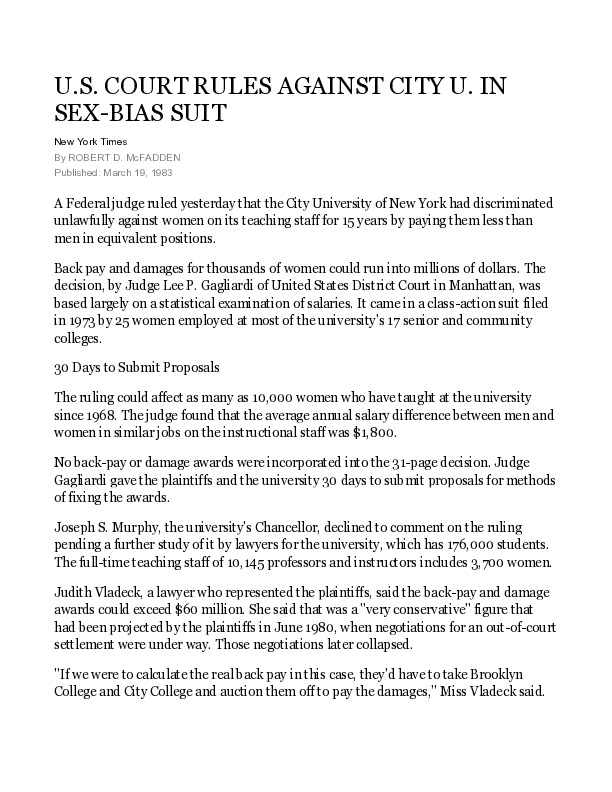
U.S. COURT RULES AGAINST CITY U. IN
SEX-BIAS SUIT
New York Times
By ROBERT D. McFADDEN
Published: March 19, 1983
A Federal judge ruled yesterday that the City University of New York had discriminated
unlawfully against women on its teaching staff for 15 years by paying them less than
men in equivalent positions.
Back pay and damages for thousands of women could run into millions of dollars. The
decision, by Judge Lee P. Gagliardi of United States District Court in Manhattan, was
based largely on a statistical examination of salaries. It came in a class-action suit filed
in 1973 by 25 women employed at most of the university's 17 senior and community
colleges.
30 Days to Submit Proposals
The ruling could affect as many as 10,000 women who have taught at the university
since 1968. The judge found that the average annual salary difference between men and
women in similar jobs on the instructional staff was $1,800.
No back-pay or damage awards were incorporated into the 31-page decision. Judge
Gagliardi gave the plaintiffs and the university 30 days to submit proposals for methods
of fixing the awards.
Joseph S. Murphy, the university's Chancellor, declined to comment on the ruling
pending a further study of it by lawyers for the university, which has 176,000 students.
The full-time teaching staff of 10,145 professors and instructors includes 3,700 women.
Judith Vladeck, a lawyer who represented the plaintiffs, said the back-pay and damage
awards could exceed $60 million. She said that was a "very conservative" figure that
had been projected by the plaintiffs in June 1980, when negotiations for an out-of-court
settlement were under way. Those negotiations later collapsed.
"If we were to calculate the real back pay in this case, they'd have to take Brooklyn
College and City College and auction them off to pay the damages,” Miss Vladeck said.
"Neither the plaintiffs nor I want to damage the City University," she continued. "The
plaintiffs are more concerned about change for the future. There is no point in a lawsuit
that deals only with the past. What we have sought all along was change, so that in the
future there would be no differential treatment of women and men."
The lawsuit was filed in 1973 under Federal civil rights statutes that prohibit
discrimination in the employment practices of publicly financed schools and other
institutions. It charged that the university discriminated against women not only in
salaries but also in hiring, promotions, fringe benefits and other employment practices.
Issues besides salary were not addressed in Judge Gagliardi's decision, though the class
represented by the plaintiffs includes women who applied for work on the teaching
staff. It was not clear what effect the ruling would have on those women.
The suit became known as the Melani case because the name of Lilia Melani, an
assistant professor of English at Brooklyn College, was the first name on the list of
plaintiffs. The defendants were the university and its policy-making Board of Higher
Education, which is now a 17-member board of trustees.
Before yesterday's ruling, Judge Gagliardi had defined the plaintiff class as "all women
now employed by the board of trustees as members of the professional instructional
staff at C.U.N.Y., or who at any time since October 1968 have been so employed or have
sought such employment."
The year 1968 was cited because laws at the time the suit was filed limited the number
of years for which awards of back pay could be made. Amendments to the law have
since removed that limit.
In contending that the salaries of women and men on the university's instructional staff
were discriminatory, the plaintiffs relied almost exclusively on statistical studies
conducted by Mark R. Killingsworth, a labor economist and professor of economics at
Barnard College.
The university contended that the statistics were an unreliable measure of the plaintiffs’
claims, and that the statistics were not in themselves sufficient to demonstrate a
discriminatory motive, which is an essential element in such a case.
Judge Gagliardi ruled, however, that the statistics were "convincing," and that the
statistical case "may constitute prima facie proof of an intentional pattern or practice of
discrimination."
SEX-BIAS SUIT
New York Times
By ROBERT D. McFADDEN
Published: March 19, 1983
A Federal judge ruled yesterday that the City University of New York had discriminated
unlawfully against women on its teaching staff for 15 years by paying them less than
men in equivalent positions.
Back pay and damages for thousands of women could run into millions of dollars. The
decision, by Judge Lee P. Gagliardi of United States District Court in Manhattan, was
based largely on a statistical examination of salaries. It came in a class-action suit filed
in 1973 by 25 women employed at most of the university's 17 senior and community
colleges.
30 Days to Submit Proposals
The ruling could affect as many as 10,000 women who have taught at the university
since 1968. The judge found that the average annual salary difference between men and
women in similar jobs on the instructional staff was $1,800.
No back-pay or damage awards were incorporated into the 31-page decision. Judge
Gagliardi gave the plaintiffs and the university 30 days to submit proposals for methods
of fixing the awards.
Joseph S. Murphy, the university's Chancellor, declined to comment on the ruling
pending a further study of it by lawyers for the university, which has 176,000 students.
The full-time teaching staff of 10,145 professors and instructors includes 3,700 women.
Judith Vladeck, a lawyer who represented the plaintiffs, said the back-pay and damage
awards could exceed $60 million. She said that was a "very conservative" figure that
had been projected by the plaintiffs in June 1980, when negotiations for an out-of-court
settlement were under way. Those negotiations later collapsed.
"If we were to calculate the real back pay in this case, they'd have to take Brooklyn
College and City College and auction them off to pay the damages,” Miss Vladeck said.
"Neither the plaintiffs nor I want to damage the City University," she continued. "The
plaintiffs are more concerned about change for the future. There is no point in a lawsuit
that deals only with the past. What we have sought all along was change, so that in the
future there would be no differential treatment of women and men."
The lawsuit was filed in 1973 under Federal civil rights statutes that prohibit
discrimination in the employment practices of publicly financed schools and other
institutions. It charged that the university discriminated against women not only in
salaries but also in hiring, promotions, fringe benefits and other employment practices.
Issues besides salary were not addressed in Judge Gagliardi's decision, though the class
represented by the plaintiffs includes women who applied for work on the teaching
staff. It was not clear what effect the ruling would have on those women.
The suit became known as the Melani case because the name of Lilia Melani, an
assistant professor of English at Brooklyn College, was the first name on the list of
plaintiffs. The defendants were the university and its policy-making Board of Higher
Education, which is now a 17-member board of trustees.
Before yesterday's ruling, Judge Gagliardi had defined the plaintiff class as "all women
now employed by the board of trustees as members of the professional instructional
staff at C.U.N.Y., or who at any time since October 1968 have been so employed or have
sought such employment."
The year 1968 was cited because laws at the time the suit was filed limited the number
of years for which awards of back pay could be made. Amendments to the law have
since removed that limit.
In contending that the salaries of women and men on the university's instructional staff
were discriminatory, the plaintiffs relied almost exclusively on statistical studies
conducted by Mark R. Killingsworth, a labor economist and professor of economics at
Barnard College.
The university contended that the statistics were an unreliable measure of the plaintiffs’
claims, and that the statistics were not in themselves sufficient to demonstrate a
discriminatory motive, which is an essential element in such a case.
Judge Gagliardi ruled, however, that the statistics were "convincing," and that the
statistical case "may constitute prima facie proof of an intentional pattern or practice of
discrimination."
Title
"U.S. Court Rules Against City U. in Sex-Bias Suit"
Description
Ten years after a class action lawsuit was filed in 1973 by 25 women faculty across CUNY campuses, a federal judge ruled that CUNY had "discriminated unlawfully against women on its teaching staff for 15 years by paying them less than men in equivalent positions." Popularly knows as the "Melani Case" because Brooklyn College Women's Studies Program co-coordinator Lilia Melani was the first plaintiff and organizer, the landmark case, born at Brooklyn College, affected the salaries of thousands of women employees of the university.
Creator
New York Times
Date
March 19, 1983
Language
English
Publisher
New York Times
Relation
5392
5482
5492
Rights
Obtained from Contributor - Copyright Unknown
Original Format
Article / Essay
New York Times. Letter. “‘U.S. Court Rules Against City U. In Sex-Bias Suit’”. 5392, CUNY DIGITAL HISTORY ARCHIVE, accessed September 5, 2026, https://stephenz.tailc22a4b.ts.net/s/cdha/item/985