The Gadfly, April 1968
Item
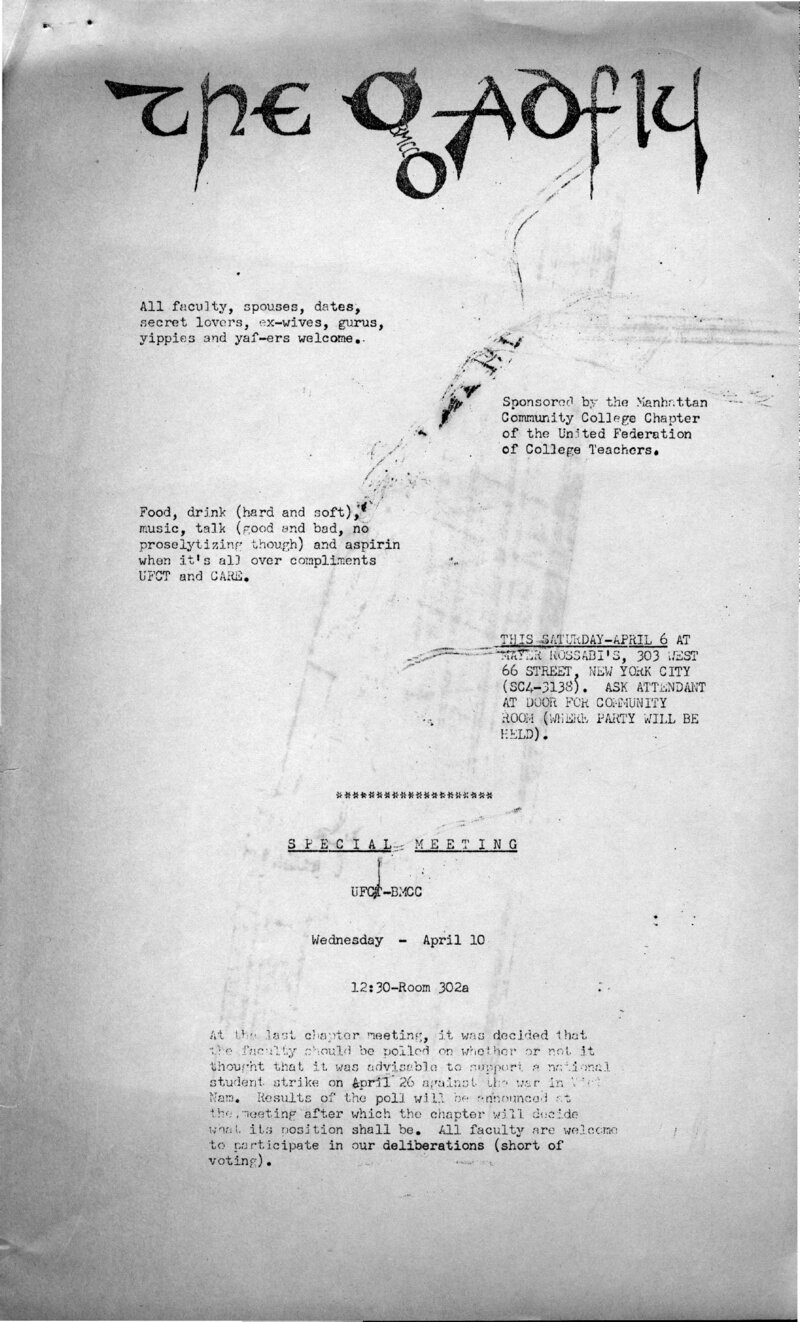
All faculty, spouses, dates,
secret lovers, ex-wives, gurus,
yippies and yaf-ers welcome,..
Sponsored by the Manhattan
Community College Chapter
of the United Federation
of College Teachers,
Food, drink tec and soft), E
music, talk (rood and bad, no $
proselytizing thovgh) and aspirin ‘ :
when it's al) over compliments cs Be :
UFCT and CARE,
uD aeaPRUL 6 at
MAYER NOSSABI'S, 303 WE
66 seeeer. view foaK cry
(SC4=3138). ASK ATTANDANT
AT DOOR FUR COMMUNITY
00 (hid, PARTY WILL BE
EELD) ¢
ay
MMA TER RH ER HK RK
SPEC TAL: MEETING
UFCP<-BMCC
Wednesday = April 10
12:30-Room 302a : 5 .
student. strike on gpril 26 against tbe wer in|
Nam. Results of the poli will be #nnonnced +
the neeting” after which the chapter will hibit i
ani. its position shall be. All faculty are welcame er ee
“ pete: in our deliberations hacks of
“aataad U«
a
The views expressed in the following article are Professor Rossabi's and not
necessarily those of the union. The Gadfly in keeping with the democratic procedure of
the UFCT invites expression of personal opinion from faculty on issues of concern to the
union.
PERSONAL VIEWPOINT
ON A REVOLUTIONARY PURPOSE FOR THE UNION: A REACTION by Mayer Rossabi
Joe Conlin's "On A Revolutionary Purpose for The Union," in last year's Gadfly, was
a welcomed article on the role of the union in our educational institutions. However, it
remains incomplete, since it only deals with general conditions and concentrates on the
activities of one segment of the system. It is the intent of this article to continue the
dialogue, add to the analysis by examining the contribution of other segments of the system,
and suggest a role for the union in the specific conditions of the institutions! functioning.
Insitutuional bureacracy has permitted distortion of purposes and goals; manipulation
of people; detachment and alienation from others and one's work, etc. In short, it is core
rupt. This festering corruption can only be stopped by revolution, says Conlin. A revo-
lution which will wrest the direction of the college from the administration, since the basis
for this condition is "A system which accepts an administration utterly without responsibility
to the faculty and devoted primarily to maintaining its existence, its power, its position,
its status, and not even secondarily ~ the interests of faculty and students." But the
administration is only one segment of the system, which includes the whole society; more
specifically, the faculty, the politicians (elected, appointed, and patronage recipients),
the public, and the students: what about their roles?
What of that portion of the faculty that abets and encourages this condition? It
corrupts and demeans itself by not fulfilling its responsibility in the educational process.
4 process which is not restricted to classroom teaching but which includes the concern,
provision, and maintenance of a viable democratic academic community of scholars and students.
These faculty members have forsaken this responsibility by giving up their individuality
(becoming yes men); by being parasites (living off the work of others, in either academic
or non-academic matters); by being manipulators (using others, including unions for selfish
ends); through ostrich-like behavior (burying themselves in esoteric research); and, self-
aggrandizing projects which blur the conditions under which teaching and learning is taking
place. These faculty members have a stake in the maintenance of the status-quo; corruption
in their institutions exists because they want it to, or allow it to exist. The plot then,
if there is one, is not simply of the administration's making but also of the faculty's
choosinge
Both the administration (of educational institutions) and the faculty however do not
function in isolation. They must contend with the politicians. For it is the bureaucrats
and politicians of the society who determine the rules of the game, They interfere dan-
gerously and openly in times of crises. But their presence is even more pervasive through
the extremely limiting laws and by-laws they impose on the institutions, Two examples of
their role in providing the conditions for the growth of corruption should be mentioned.
The first revolves around the whole process of promotions. Aside from the fact that
there are basic inequities in the criteria for promotion, the competition that develops for
the severely and arbitrarily limited number of 'Budget Lines! available is in itself cor-
rupting. It sets the stage for invidious inequality between faculty members, departments
and divisions.
The second example concerns the appointment, tenure, and power of administrators. The
faculty has little constraint over decision making pwers of administrators and no power over
their appointment or tenure. A position of power, which has little or no restraint to that
power, tends to corrupt the individual in that position. Even the most conscientious ad=
ministrator finds himself trapped by the system. This is not simply a result of "Reactionary"
administrators within the educational bureaucracy but is symptomatic of all bureaucracies
that permit, defacto or dejure, unlimited tenure and unrestrained power. The horror stories
Conlin wrote about are mild compared to occurences by the most enlightened administrators to
the most 'Progressive' or 'Liberal' organizations. Conditions then make it possible for the
administrator to use his position for his own benefit (materially or otherwise) and the
longer his separation from his original role as an educator, the greater the possibility for
his commitment to non-educational endeavors and goals.
Faced with this corrupt system Conlin advocates change - revolutionary changee Revol-
ution has great appeal, it is simple, clear, direct and all-inclusive. As a goal and a
theoretical frame-of-reference, I too, would advocate it, but unlike Conlin, I don't see it
as a struggle with administration, The struggle should be directed at the social system, its
emphasis lies outside the particular institution. The strength found in union is to be used
to bring about social justice through its struggle with corruption, Assuming, of course,
aoe
that in the struggle the union itself does not succumb to the corruption of its own bure
eaucracy. To protect against that eventuality, the union must promote an active membership
which decides its own fate within the context of social justices It is only then that the
demand for faculty power and 'Bread' and 'Butter' issues can make any sense, otherwise they
become cynical adaptations to a corrupt system. In short, the union's goal is the achievement
of self-determination, a necessary if not sufficient ingredient of any professions
Having dealt with the general or conceptual level, the attention is now focused on the
specific level; the distinction is imperative if action is to be effective. hat then is
the role of the union in the reality of the daily affairs of an institution?
One answer is the promotion of practices which help socialize humans within the academic
community. As a corollary, the removal of obstacles which interfere with the institution's
portion of the socialization process, i.e., the servicing of those humans called students.
The union is therefore not simply ‘against! conditions but also and primarily 'for' certain
conditions. Let us first explore some of the conditions the union should be against.
The revolutionary goals could and should be maintained but revolution is not feasible
and even destructive (in the sense of a temper-tantrum). Revolutions prevent us from dealing
with human beings, instead we deal with the 'other side', without any possibility of shades
in-between. This polarization of the institution detrimentally affects all interaction
within it, thereby eliminating the opportunities for developing and attaining the ideal
academic community. The union should be against what has been described as rigid compart—
mentalization, segregation, isolation, etc., as manifested in the following ways:-
1. To deal with administrators within the community, as abstractions,
when they are in fact men and woman. To deal indiscriminately with
administrators and their behavior is corrupt. It is part of that
corruption the union is struggling with in the bureaucracies of our
social system — the changing of people into objects. No respect should
be tendered to the administrator who manipulates, or who is engrossed
in self-aggrandizement through empire building, etc. But teachers are
not necessarily devoid of these or other corrupt traits and should be
similarly treated. To arbitrarily lump administrators in a mold and
to treat them as objects, can easily lend itself to 'administration-
baiting.' This tends to interfere with the initial focus of the union.
This displacement or diffusion of the focus opens the door for selfish
interests and concerns. Corruption whether by the administration, the
union, the individual, is still corruption.
2. To treat the institution's administrators as employers, for then they
become employers.
3. To treat colleagues in other divisions or departments as ‘representations!
of said divisions or departments.
4. To place various departments in a hierarchy.
5 To patronize students.
6. To compartementalize knowledge, teaching, and teachers through course
packaging.
The union is also against arbitrary decisions from any source.
What should the union be 'for'? The union should be for 'militant alertness! and active
participation by the members of the community. The union should:~
1. Assure proper communication (not oppressive memoranda) which will
keep the faculty informed of relevant aspects of the college. For
example, faculty council minutes and decisions; faculty rights
according to the by-laws; policies concerning decision-making re=
sponsibilities, etc.
2. Maintain two-way communication with administrators.
3 Stimulate greater involvement in the affairs of the college amongst
the faculty. Education does not only consist of the divulging of
facts in the isolation of the classroom. Faculty should be encouraged
to become advisors to student organizations, and to participate in
social and educational student activities. There should also be in-
volvement in committees, whether individuals are elected to the faculty
council or not. Faculty members should be concerned with the need for
more library space, academic standing, development, etc.
“le
4, Provide the leadership for educational innovation. Inter-relation
between the courses taken should be stressed, through core curricula
and team teachinge New courses should be offered which will permit
greater communication between faculty and students. For example, a
student could sign up for a course in 'Contemporary Issues,' attendance
being required. Any faculty member who wishes could sign up for
participation in such a course and their attendance would also be
required. The content of the course would evolve from the questions
which either the students or particpating faculty members (more than
one could be present) would raise and prepare fore
5. Critically evaluate and analyze the effectiveness by which students
are served. The “ffice of Institutional Research could be used to
check the relevance of certain course work to the students after
graduation, etc.
6. Review the goals and objectives of the institution.
7. Assure the dominance of the faculty in policy and decision making.
All of the above is easier said than done. Once revolution in the specific situation,
i.e., the day to day reality, is renounced, and the abstract administrators become clearly
defined individuals, the problem of mobilization arises. How can 'militant alertness' and
‘active participation’ of the membership be maintained? This becomes even more difficult with
the elimination of demagoguery, and the ability to ‘understand! why an individual administrator
act the way he does. The current practice of most unions in the country is for the leaders
to manipulate the membership; they prefer a dorman membership, which allows them a free hand,
using demagogic propaganda to prime the membership at appropriate times. This should be
totally unacceptable to a teachers union (or any other union). The union will have to put
a lot of its effort in creative attempts at remotivating the teachers to take an active
interest in the total process of education; hopefully this can be accomplished through pro~
vision of possible areas of participation. This also applies to member participation in union
activities. The autonomy of the individual chapter should be maintained.
In relating all this to B.M.C.C., the 'old timers! will readily admit that progressive
democratization of the institution has come about and that we are moving in the right dir-
ection. Compared to the past, we can feel the fresh air. To believe that this was solely
the result of the union chapter would be a delusion, which some might wallow away in. This
is not meant to belittle the activities of the chapter which proved to be extremely important
as catalyste
On the other hand, the belief by some administrators, isolated from the day to day
functioning, that B.M.C.C. is the epitomy of democracy, is just as delusionary, as indicated
by 'The Gadfly,' and by the activities of the union's grievance committee.
The Union chapter will of course continue to expose corruption and arbitrary behavior,
whether it is manifested by individual administrators and their faculty coteries, by faculty
members (union or non-union) or by any other segment of the college. Again, to the old timers
'The Gadfly! does not seem overly aggressive when put in the context of the college's history,
but, it has evoked, among a segment of the newer faculty (and some older ones), a negative
response because of what they feel is its unnecessarily harsh tones; maybe this feeling should
be taken seriously.
The union chapter should also maintain the precedent set by its enlightened and idealistic
leadership, of an open door policy and complete freedom of expression and debate within the
chapter. The prodding and prosletyzing of faculty has continued and the request for active
participation by the members still is its primary concern, even though many prefer not to share
the burdens and responsibilities, and only expect to be served.
As convinced as I am of the necessity for exposing corruption and arbitrary decision-
making, so am I also convinced that the union needs to support any attempts, but most
especially attempts by administrators, towards the realization of the democratic academic
community of scholars and students. Together we can make sure that the concentration remains
on the 'ends' rather than be distracted by the means, to the point that they will become our
ends, as exemplified by our bureaucracies.
secret lovers, ex-wives, gurus,
yippies and yaf-ers welcome,..
Sponsored by the Manhattan
Community College Chapter
of the United Federation
of College Teachers,
Food, drink tec and soft), E
music, talk (rood and bad, no $
proselytizing thovgh) and aspirin ‘ :
when it's al) over compliments cs Be :
UFCT and CARE,
uD aeaPRUL 6 at
MAYER NOSSABI'S, 303 WE
66 seeeer. view foaK cry
(SC4=3138). ASK ATTANDANT
AT DOOR FUR COMMUNITY
00 (hid, PARTY WILL BE
EELD) ¢
ay
MMA TER RH ER HK RK
SPEC TAL: MEETING
UFCP<-BMCC
Wednesday = April 10
12:30-Room 302a : 5 .
student. strike on gpril 26 against tbe wer in|
Nam. Results of the poli will be #nnonnced +
the neeting” after which the chapter will hibit i
ani. its position shall be. All faculty are welcame er ee
“ pete: in our deliberations hacks of
“aataad U«
a
The views expressed in the following article are Professor Rossabi's and not
necessarily those of the union. The Gadfly in keeping with the democratic procedure of
the UFCT invites expression of personal opinion from faculty on issues of concern to the
union.
PERSONAL VIEWPOINT
ON A REVOLUTIONARY PURPOSE FOR THE UNION: A REACTION by Mayer Rossabi
Joe Conlin's "On A Revolutionary Purpose for The Union," in last year's Gadfly, was
a welcomed article on the role of the union in our educational institutions. However, it
remains incomplete, since it only deals with general conditions and concentrates on the
activities of one segment of the system. It is the intent of this article to continue the
dialogue, add to the analysis by examining the contribution of other segments of the system,
and suggest a role for the union in the specific conditions of the institutions! functioning.
Insitutuional bureacracy has permitted distortion of purposes and goals; manipulation
of people; detachment and alienation from others and one's work, etc. In short, it is core
rupt. This festering corruption can only be stopped by revolution, says Conlin. A revo-
lution which will wrest the direction of the college from the administration, since the basis
for this condition is "A system which accepts an administration utterly without responsibility
to the faculty and devoted primarily to maintaining its existence, its power, its position,
its status, and not even secondarily ~ the interests of faculty and students." But the
administration is only one segment of the system, which includes the whole society; more
specifically, the faculty, the politicians (elected, appointed, and patronage recipients),
the public, and the students: what about their roles?
What of that portion of the faculty that abets and encourages this condition? It
corrupts and demeans itself by not fulfilling its responsibility in the educational process.
4 process which is not restricted to classroom teaching but which includes the concern,
provision, and maintenance of a viable democratic academic community of scholars and students.
These faculty members have forsaken this responsibility by giving up their individuality
(becoming yes men); by being parasites (living off the work of others, in either academic
or non-academic matters); by being manipulators (using others, including unions for selfish
ends); through ostrich-like behavior (burying themselves in esoteric research); and, self-
aggrandizing projects which blur the conditions under which teaching and learning is taking
place. These faculty members have a stake in the maintenance of the status-quo; corruption
in their institutions exists because they want it to, or allow it to exist. The plot then,
if there is one, is not simply of the administration's making but also of the faculty's
choosinge
Both the administration (of educational institutions) and the faculty however do not
function in isolation. They must contend with the politicians. For it is the bureaucrats
and politicians of the society who determine the rules of the game, They interfere dan-
gerously and openly in times of crises. But their presence is even more pervasive through
the extremely limiting laws and by-laws they impose on the institutions, Two examples of
their role in providing the conditions for the growth of corruption should be mentioned.
The first revolves around the whole process of promotions. Aside from the fact that
there are basic inequities in the criteria for promotion, the competition that develops for
the severely and arbitrarily limited number of 'Budget Lines! available is in itself cor-
rupting. It sets the stage for invidious inequality between faculty members, departments
and divisions.
The second example concerns the appointment, tenure, and power of administrators. The
faculty has little constraint over decision making pwers of administrators and no power over
their appointment or tenure. A position of power, which has little or no restraint to that
power, tends to corrupt the individual in that position. Even the most conscientious ad=
ministrator finds himself trapped by the system. This is not simply a result of "Reactionary"
administrators within the educational bureaucracy but is symptomatic of all bureaucracies
that permit, defacto or dejure, unlimited tenure and unrestrained power. The horror stories
Conlin wrote about are mild compared to occurences by the most enlightened administrators to
the most 'Progressive' or 'Liberal' organizations. Conditions then make it possible for the
administrator to use his position for his own benefit (materially or otherwise) and the
longer his separation from his original role as an educator, the greater the possibility for
his commitment to non-educational endeavors and goals.
Faced with this corrupt system Conlin advocates change - revolutionary changee Revol-
ution has great appeal, it is simple, clear, direct and all-inclusive. As a goal and a
theoretical frame-of-reference, I too, would advocate it, but unlike Conlin, I don't see it
as a struggle with administration, The struggle should be directed at the social system, its
emphasis lies outside the particular institution. The strength found in union is to be used
to bring about social justice through its struggle with corruption, Assuming, of course,
aoe
that in the struggle the union itself does not succumb to the corruption of its own bure
eaucracy. To protect against that eventuality, the union must promote an active membership
which decides its own fate within the context of social justices It is only then that the
demand for faculty power and 'Bread' and 'Butter' issues can make any sense, otherwise they
become cynical adaptations to a corrupt system. In short, the union's goal is the achievement
of self-determination, a necessary if not sufficient ingredient of any professions
Having dealt with the general or conceptual level, the attention is now focused on the
specific level; the distinction is imperative if action is to be effective. hat then is
the role of the union in the reality of the daily affairs of an institution?
One answer is the promotion of practices which help socialize humans within the academic
community. As a corollary, the removal of obstacles which interfere with the institution's
portion of the socialization process, i.e., the servicing of those humans called students.
The union is therefore not simply ‘against! conditions but also and primarily 'for' certain
conditions. Let us first explore some of the conditions the union should be against.
The revolutionary goals could and should be maintained but revolution is not feasible
and even destructive (in the sense of a temper-tantrum). Revolutions prevent us from dealing
with human beings, instead we deal with the 'other side', without any possibility of shades
in-between. This polarization of the institution detrimentally affects all interaction
within it, thereby eliminating the opportunities for developing and attaining the ideal
academic community. The union should be against what has been described as rigid compart—
mentalization, segregation, isolation, etc., as manifested in the following ways:-
1. To deal with administrators within the community, as abstractions,
when they are in fact men and woman. To deal indiscriminately with
administrators and their behavior is corrupt. It is part of that
corruption the union is struggling with in the bureaucracies of our
social system — the changing of people into objects. No respect should
be tendered to the administrator who manipulates, or who is engrossed
in self-aggrandizement through empire building, etc. But teachers are
not necessarily devoid of these or other corrupt traits and should be
similarly treated. To arbitrarily lump administrators in a mold and
to treat them as objects, can easily lend itself to 'administration-
baiting.' This tends to interfere with the initial focus of the union.
This displacement or diffusion of the focus opens the door for selfish
interests and concerns. Corruption whether by the administration, the
union, the individual, is still corruption.
2. To treat the institution's administrators as employers, for then they
become employers.
3. To treat colleagues in other divisions or departments as ‘representations!
of said divisions or departments.
4. To place various departments in a hierarchy.
5 To patronize students.
6. To compartementalize knowledge, teaching, and teachers through course
packaging.
The union is also against arbitrary decisions from any source.
What should the union be 'for'? The union should be for 'militant alertness! and active
participation by the members of the community. The union should:~
1. Assure proper communication (not oppressive memoranda) which will
keep the faculty informed of relevant aspects of the college. For
example, faculty council minutes and decisions; faculty rights
according to the by-laws; policies concerning decision-making re=
sponsibilities, etc.
2. Maintain two-way communication with administrators.
3 Stimulate greater involvement in the affairs of the college amongst
the faculty. Education does not only consist of the divulging of
facts in the isolation of the classroom. Faculty should be encouraged
to become advisors to student organizations, and to participate in
social and educational student activities. There should also be in-
volvement in committees, whether individuals are elected to the faculty
council or not. Faculty members should be concerned with the need for
more library space, academic standing, development, etc.
“le
4, Provide the leadership for educational innovation. Inter-relation
between the courses taken should be stressed, through core curricula
and team teachinge New courses should be offered which will permit
greater communication between faculty and students. For example, a
student could sign up for a course in 'Contemporary Issues,' attendance
being required. Any faculty member who wishes could sign up for
participation in such a course and their attendance would also be
required. The content of the course would evolve from the questions
which either the students or particpating faculty members (more than
one could be present) would raise and prepare fore
5. Critically evaluate and analyze the effectiveness by which students
are served. The “ffice of Institutional Research could be used to
check the relevance of certain course work to the students after
graduation, etc.
6. Review the goals and objectives of the institution.
7. Assure the dominance of the faculty in policy and decision making.
All of the above is easier said than done. Once revolution in the specific situation,
i.e., the day to day reality, is renounced, and the abstract administrators become clearly
defined individuals, the problem of mobilization arises. How can 'militant alertness' and
‘active participation’ of the membership be maintained? This becomes even more difficult with
the elimination of demagoguery, and the ability to ‘understand! why an individual administrator
act the way he does. The current practice of most unions in the country is for the leaders
to manipulate the membership; they prefer a dorman membership, which allows them a free hand,
using demagogic propaganda to prime the membership at appropriate times. This should be
totally unacceptable to a teachers union (or any other union). The union will have to put
a lot of its effort in creative attempts at remotivating the teachers to take an active
interest in the total process of education; hopefully this can be accomplished through pro~
vision of possible areas of participation. This also applies to member participation in union
activities. The autonomy of the individual chapter should be maintained.
In relating all this to B.M.C.C., the 'old timers! will readily admit that progressive
democratization of the institution has come about and that we are moving in the right dir-
ection. Compared to the past, we can feel the fresh air. To believe that this was solely
the result of the union chapter would be a delusion, which some might wallow away in. This
is not meant to belittle the activities of the chapter which proved to be extremely important
as catalyste
On the other hand, the belief by some administrators, isolated from the day to day
functioning, that B.M.C.C. is the epitomy of democracy, is just as delusionary, as indicated
by 'The Gadfly,' and by the activities of the union's grievance committee.
The Union chapter will of course continue to expose corruption and arbitrary behavior,
whether it is manifested by individual administrators and their faculty coteries, by faculty
members (union or non-union) or by any other segment of the college. Again, to the old timers
'The Gadfly! does not seem overly aggressive when put in the context of the college's history,
but, it has evoked, among a segment of the newer faculty (and some older ones), a negative
response because of what they feel is its unnecessarily harsh tones; maybe this feeling should
be taken seriously.
The union chapter should also maintain the precedent set by its enlightened and idealistic
leadership, of an open door policy and complete freedom of expression and debate within the
chapter. The prodding and prosletyzing of faculty has continued and the request for active
participation by the members still is its primary concern, even though many prefer not to share
the burdens and responsibilities, and only expect to be served.
As convinced as I am of the necessity for exposing corruption and arbitrary decision-
making, so am I also convinced that the union needs to support any attempts, but most
especially attempts by administrators, towards the realization of the democratic academic
community of scholars and students. Together we can make sure that the concentration remains
on the 'ends' rather than be distracted by the means, to the point that they will become our
ends, as exemplified by our bureaucracies.
Title
The Gadfly, April 1968
Description
This issue of The Gadfly includes announcements of upcoming union chapter meetings as well as a response, from BMCC Professor Mayer Rossabi, to the piece "On A Revolutionary Purpose for the Union," published in the May 1967 issue.The Gadfly was the newsletter of the BMCC chapter of the United Federation of College Teachers (UFCT). The UFCT and the Legislative Conference were the two main organizations that advocated for the concerns of CUNY faculty prior to their merging in 1972 to form the Professional Staff Congress (PSC).
Contributor
Friedheim, Bill
Creator
United Federation of College Teachers, BMCC
Date
April 1968
Language
English
Publisher
United Federation of College Teachers, BMCC
Rights
Creative Commons CDHA
Source
Friedheim, Bill
Original Format
Newspaper / Magazine / Journal
United Federation of College Teachers, BMCC. Letter. 1968. “The Gadfly, April 1968”, 1968, CUNY DIGITAL HISTORY ARCHIVE, accessed September 5, 2026, https://stephenz.tailc22a4b.ts.net/s/cdha/item/166