Lewis Catalog
Item
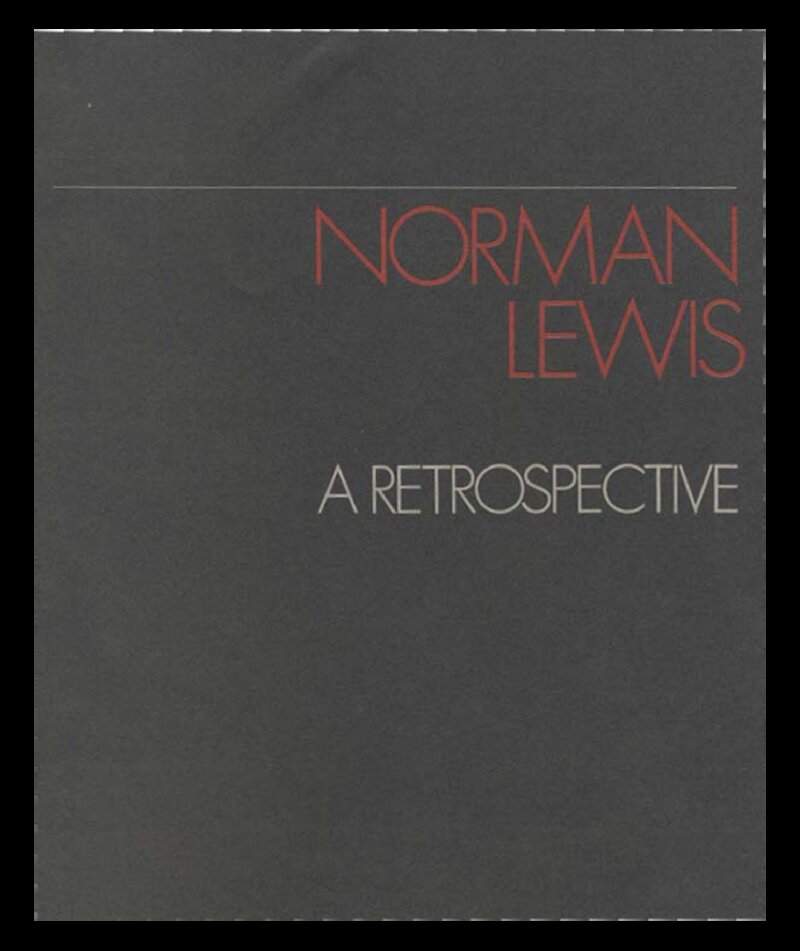
NORMAN
EWS
A RETROSPECTIVE
1976 All Rights Reserved
The Graduate School and University Center
of the City University of New York
33 West 42 Street, New York, N.Y, 10036
Exhibition coordination and installation by Ray Ring
Catalogue designed by Barry Disman
Photographs by Peter Harris
Printed at the Graduate School and University Center
NORMAN
LEVVIS
A RETROSPECTIVE
OCTOBER - NOVEMBER 1976
THE MALL
THE GRADUATE SCHOOL AND UNIVERSITY CENTER
OF THE CITY UNIVERSITY OF NEW YORK
ACKNOWLEDGEMENTS
Iwish to express my thanks to the artist for allowing me
accent ro his extensive personal archives, and for so
generously giving his time and inspiration to the project.
Thanks also to Louise Parks who shared with me the fruits
of her carlicr research among Mr, Lewis" papers.
The organization of this exhibition and catalogue was
undertaken as part of my study for a doctorate in Art
History at the City University of New York, and fam
therefore indebted, above all, to my supervisor, Professor
Milton W. Brown, Executive Officer of the Ph.D. Program
in Art History at the University, who conceived this project
and offered support and guidance throughout.
Thomas Lawean
FOREWORD
As part of a great urban university complex, the City
University of New York's Graduate Center is committed to
active participation in the city’s intellectual and cultural
life. The activities of the Graduate Center Mall are in part
an extension of the educational functions of the Graduate
School, utilizing the resources of its faculty, students, and
staff. Situated literally at the “crostroads” of the city, its
constituent audience is the working and transient popula-
tion of midtown Manhattan. The Mall was intended from
its inception as a cultural center for them as well as for our
own academic community and it has.offered.a wide range
of programs, free to the public, in music, theatre, and
dance, and exhibitions of art, architecture, and design. In
the short years of its existence, the Mall has become part of
the New York cultural scene and achieved a notable critical
acceptance for the variety and quality of its offerings.
The major thrust of the exhibition program of the Mall ts to
present current developments in the visual arts to a general
transient public, but it also serves the students in the Ph.D.
Program in Art History as a training ground in exhibition
practice and techniques, and as a facility where the results
of their research in the fields of Modern and American art,
to which the Program is dedicated, can be presented in
visual form. Although the financial resources of the Grad-
uate School and the physical character of the Mall are lim-
ited, we have also felt that the particular scholarly resources
of the Program offer a unique opportunity to supplement
the city’s already vast cultural range through occasional ma-
jor exhibitions of histone interest and perhaps more lasting
import, which other institutions might not undertake.
Among such are comprehensive or retrospective exhibitions
of older and established New York artists who have made a
significant contribution to American art, but, who, for varie
ous and unaccountable reasons, have not received the recog-
nition that is their duc, The present exhibition of the work
of Norman Lewis is such a case. A black artist who emerged
in Harlem during the “30s, along with so many others under
the aegis of the Federal Arts Projects, he has been part of
the American art scene for the past 40 years. Yet, he is
largely unknown to the art public and unrepresented in mia-
jor American collections. The exhibition is nota “discov
ery’ of Norman Lewis; he has had a long and distinguished
carcer as an artist and teacher, It is an opportunity for re-
assessment.
Milton W. Brown
Executive Officer
Ph.D. Program in Art History
TEXT BY THOMAS LAWSON
Fhat-the Thirties was a desperate decade throughour the
Western world is by now a well established historical cliché,
yet it was a period which paradoxtcally saw the carlicst
heroic attempts of American painters to become nore than
provincial imitators of European modernist styles. Initially
they did this by cmphasizing their provincial separateness
from the cosmopolitan art world ina move towards artistic
nationalism and isolationism similar to the trend in Federal
political and economic planning. Only gradually, as the
decade advanced, did more artists feel the confidence or the
necessity to build on the achievernents of European artists
rather than trying to ignore them. It was a time of intellec-
tual questioning and daring, during which artists were
forced into a recognition of their economic interdepen-
dence. As a result of simple physical need, artists began to
cooperate professionally, and became increasingly political
both in expression and in action, ‘There was political art and
there were political artists, in various unstable combina-
tions: and at the start of his carcer, Norman Lewis was a
political artist making political, though not propagandist, art.
As he developed, however, he began to separate political
content from his aesthetic concerns, Like many black art-
sts he was attracted to the idea of purely black art, but
found himself instead being absorbed into the mainstream
of modern art. As Hale Woodruff, the black painter who
had created, at Atlanta University, one of the most'vital
centers of black learning, wrote for an exhibition entitled
Patterns af American Calture. Contributions of the Negra,
held at the University of Michigan in 1956;
“The "Decade of the Depression’ may be marked as the
coming of age of the Negro artist. He became part of the
new and vital currents that gave fresh meanings to Ameri-
can art. Any racial elements that might have identified his
works were submerged in the mainstream of the general and
specific qualities of all are produced in this penod. His con-
cerns were thoce of all artists and the concerns of all artists
were his. He was now, as previously, simply an American
artist. To expect him to have been otherwise would have
been fruitless. His. aspirations toward full integration in
American life found expression in his art. This was, imevita-
bly, how it should have been.”
Lewis never lost his sense of political commitment, but
rather came to belicve that direct action was more useful
than a so-called polisical art directed ar a handful of friends
and connoisseurs with little or-no political weight, Like his
friend Ad Reinhardt, he soughr to separate the aesthetic
from the useful, seeing his paintings as contemplative rather
than didactic images; they were designed to please, not to
instruct. His mature work is sensual and sensitive in its evor
cation of an essentially emotional response to beauty.
Charmed and fascinated by the effects of sparkling light, on
city streets and in night clubs, or in the country, a5 it glints
on water and rock, as itis diffracted through leaves, Lewas
creates a body of work full of wonder and enjoyment.
Norman Wilfred Lewis was born in New York of parents
who had moved to the city from Bermuda. The family had
settled in Harlem, and Lewis’ father worked as a longshore-
man, eventually becoming a dock-forman. Lewis’ early life
was like thar of any other black youth in the city, and he
soon learned what it meant to be black and poor. With
little likelihood of steady employment, he learned to make
a living at poker and the pool table. {twas only natural that
he, along with many intelligent men of his generation,
should be attracted to the politics of communism, with its
promise of a betecr furure through the cooperative action
of the poor and oppressed. But if Lewis introduction to
radical politics was inevitable, his introduction to art was
fortuitous. One day in 1933, on his way home from the
pool room, he chanced by the studio of Augusta Savage,
looked in the window, and was intrigued by what he saw.
On impulse he stepped inside and was immediately en-
tranced by the atmosphere of creative energy. He decided
to stay and learn more, and so began his career as an artist.
At that time Savage's sculpture studio was fast becoming
the center of a growing movement among artists in Harlem
to create an art with a recognizably black identity. Between
1928 and 1933 five large-scale exhibitions of the work of
black artists had been sponsored by the Harmon Founda-
tion. These had helped present the major black artists like
Savage, Aaron Douglas, James Porter and Hale Woodruff to
a wider public and, at the same time, offered younger art-
ists early exposure to.an informed eritical response. At that
time, however, the Foundation, in its cagerness to present
an impression of artistic vitality in Harlem, often came un-
der attack for being too easily impressed with black subject
matter, regardless of the quality of execution. Romuare
Bearden, among many younger painters, felt this only cn-
couraged easy answers, poor echoes of styles that were not
only European, but white. This debate, running parallel to a
similar one within the larger context of American art asa
whole, flavored much of Lewis’ carly training. His work
through the Thirties and carly Forties, while he was still
secking a mature style of his own, oscillanes between the
extremes of an international abstract style and a local, illus-
trative realism, Like the Majority of American artists seck-
ing a specifically American style, Lewis was initially at:
tracted to a realism based on the indigenous tradition of the
Ashean school, 2 realism invigorated, in his case, by a know!-
edge of the work of the Mexican muralists, who were devel-
oping a simplified pictorial vocabulary suitable for making
propagandist art. But at the same time a growing awareness
of abstract stvles in Europe and in America led hum progres:
sively towards a less representational, more experimental
exp Meese.
Despite its aesthetic limitations, the Harmon Foundation
was primarily responsible for encouraging the tremendous
growth of the plastic arts in Harlem in the carly years of the
Depression, providing financial support for artists before
the Federal Arts Project went into operation. It helped
create a sense of community AMong artists, which in tum
helped foster a growing proféessionaliom, Still, this prolifera-
tion of artistic activity was noe without its drawbacks: and
Aaron Douglas, the father figure of the Harlem Renais-
sance, rather scathingly described the situation in the fol-
lowing terms:
“Harlem was sifted. Neither streets, homes, nor public insti-
tutions escaped. When unsuspecting Negroes were found
with a brush in their hands they were immediately hauled
away and held for interpretation. They were given places of
honor and bowed to with much ceremony. Every effort to
protest their innocence was drowned out with big mouthed
praise. A number escaped and returned 16 a more reason-
able existence. Many fell in with the game and went along
making meaningless and hollow gesrures with brush and
palete:”
It was during this period of enthusiaom thar Norman Lewit
walked into the studio of Augusta Savage, and he never did
escape.
Savage had returned to New York from Europe in 1932
with the idea of starting a community art school in Harlem.
With help from the Harmon Foundation, the Urban League,
and the Stave University of New York, she organized an
adult education project in her apartment on West 135th
Street. Lewis initially attended as an unskilled assistant,
sweeping floors and shifting clay. However, fired by the
enthusiasm of the place, he began to teach himself to draw
and paint, and discovered an unsuspected talent. His first
models were the magazine illustrators and, to a lesser ex-
tent, fine art reproductions. Savage herself, though an im
portant source of encouragement right through the Thirties,
was never Lewis’ teacher, primarily because he was never
really interested in sculpture.
He soon sought outa formal painting class, arrending the
John Reed Club Art School on a scholarship offered by
Robert and Lydia Gibson Minor The Club had been
founded in 1929, within days of the collapse of the Stack
Market, to organize artists and writers in the creation of a
revolutionary art which could be used as 2 weapon ina
revolutionary struggle. It was a popular meeting place for
left wing intellectuals during the early years of the Depres-
sion; and among its many educative projects, it sponsored a
free art class for poor students. Lewis’ teacher at the School
was Raphael Soyer, bur the superior abilities of the other
students $0 intimidated the beginner that he soon stopped
attending. However, he received his first chance to exhibit
through this class, when the John Reed Club organized a
group show on the theme of Munger, Fasctim and Wer in
December of 1933. And the following April, the Metro-
politan Museum sponsored an exhibition of the work of
uncmployed adult scudents who had been studying art for
less than a year. Lewis received his first public recognition
at this show when he won an honorable mention for an ail
painting called The Wanderer, This picture, which depicted
a destitute man-seated in the comer of a fence in an open,
snow covered field, attempting to warm himself before a
small fire in an old oil can, was painted in a loose, si ightly
distorted style clearly reminiscent of that of Soyer.
Just.as the art movement in Harlem was beginning to gather
momentum in terms of wider access to professional galleries
and exhibitions, the Depression threatened any possible
gain. However, the activities sponsored by the Harmon
Foundation and continued under the WPA not only al
lowed a certain level of stabiliry but actually encouraged a
growth of interest in the arts, Black artists had traditionally
suffered from a lack of significant private patronage, and
this pulblic funding allowed for an economic freedom hith-
erto unknown. For jt was in poor areas like Harlem that the
Roosevelt Administration's attempts.to lessen the impact of
unemployment by creating jobs for artists, musicians and
actors had its-most far-reaching impact, creating, in effect, a
“golden age” of cultural activity, a local renaissance. Artists
working in collaborative projects were cncouraged by their
peers te produce more work and to produce better work.
And a larger, more informed public was created through the
proliferation of performances, exhibitions, and educational
opportunities. Art centers grew up in Harlem, in Chicago, in
Memphis, and in New Orleans, and developed into impor:
fant community centers. And in offering free access to the
productions of the different arts, they not only stimulated
the expansion of these arcs but also created an effective
program in public education,
One of the first of these centers grew up around Savage's
studio in Harlem as aresult of the energetic campaigning of
both Savage and her chicf assistant and eventual successor,
Gwendolyn Bennett. In March 1935, an exhibition of Ne-
gro art was staged in the 138 Streer YWCA in response to
the question, “Does New York need an Art Center?”; and
Lewis, who was now working at the studio as a teacher un-
der the WPA, helped in its organization. As a resule, more
Federal funds became available and Savage was able to em-
ploy more teachers and enroll more students, leading her
eventually to move her studio to larger premises on West
123rd Street. Lewis himself believed the studia/art center to
be more useful as a community center than an art schoal,
considering it a place where all manner of social problems
might be attacked. And in a newspaper article covering the
opening of the Harlem Community Art Center, the official
name given the studi on its final move to the corner of
f2Sth Street and Lenox Avenue in 1937, Lewis is reported
as saying that he considered himself more a social welfare
worker than an art teacher.
“Pethaps unconsciously, the children of Harlem paint little
houses in big lawns and space between everything. Art is
the key to understanding children and their problems,”
Already, it seems, Lewis was beginning to question the effi-
cacy of art as an agent of social reform, seeing it more as an
indicator of the ills of society than as an active cure.
In February 1936 another exhibition was organized at the
Harlem YWCA, once again concentrating on the issue of
race. Exhibitors confined themselves to subjects connected
directly with their own race and tended to avoid using ab-
stract styles which might be understood as pale reflections
of white art. As a resul, the majority of artists exhibited
work based on the most retardataire of modernist styles.
Harlem genre scenes, crap shooters, colorful street life or
portraits of local characters covered the walls, all too-often
demonstrating an acceptance of awhite vision of black life.
Lewrs" work at this time still firned the ultimately senti-
mental tradition of those painters of black life like Hale
Woodruff and Aaron Douglas, who tentatively incorporated
modernist elements in their basically traditional compaosi-
tions. His paintings tended te be quict and undemonstra-
tive, usdally with single figures.or couples in introspective
poses. Yet despite an understandable reluctance to abandon
this regionalist tradition, with itscasily accepted sense of
social relevance, we find him now experimenting ever more
boldly with a Cubist inspired structure, breaking his subject
into planes of flat color. For while it is true that the simpli-
fication of form in avery early work like Girl with a Vellow
Mat, 1933, would not have been possible without the Cub-
ist precedent, the fragmentation of recognizable form in
Miadonna, 1934, is much more adventurous and prefigures
Lewis’ interest in a rhythmic, rather than architectonic,
space.
This openmindedness to the, by then largely accepted, in-
novations of the School of Paris also allowed Lewis to key
in more quickly than others to the important issue of Afri-
can art as a formal and iconographic source, Several black
painters sought auchenticity in a return to African tribal
culture, feeling that the legacy of ancestral arts offered a
ready-made racial heritage. However in 1940, Alain Locke,
one of the leading champions of black culture, sadly ad:
mitted thar, “when the younger Negro artists first became
aware of this heritage, a sudden hectic interest flared up
which led, unforrunately, to relatively superficial under-
standing and shallow artistic results. African art could yield
little through direct imitation,”
Lewis was one of the first to realize that the transformation
wrought on primitive art by, among others, Picasso and
Modigliani, was both more powerful and more useful than
this slavish imitation, From these painters he learned to
simplify his forms, and strengthen his color. More impor-
tantly, he learned the rhythmic possibilities of the angular
displacement of lines he found in Cubist composition, a
discovery which allowed him to go on to develop a visual
equivalent to the jazz music his brother played, And what
could be more closely identifiable with black American
culture than jare? By allowing himself to look hard av. mod-
em European painting, Lewis made the first steps towards a
mature style whieh could convincingly contain hie black
identity without losing its inteprity as modern art, Along
the way, he also discovered himself in the midst of the in-
creasingly bitter quarrel between realist and abstract artists,
a quarrel which, as it spread through the American art
scenic, inevitably drew Lewis into the mainstream of Ameri
can art.
During the years from 1935 until the ourbreak of the War,
Lewis was variously employed asa teacher under the aus-
pices of the Works Progress Administration. Originally with
Augusta Savage and then Gwendolyn Bennett at the Harlem
Art Center, he was-aleo given work ar P.5. 139. There he
supervised the children in the making of two large murals
depicting the freeing of the Negro slaves and their progress
since asa result of education: In 1937, he asked to be Sener
to Mexica; he found himself instead in Greensboro, North
Carolina, in charge of a small education project, But the
ractl tensions created by his position as supervisor grew
intolerable and within the year he was back in Harlem, once
again teaching at the Art Genter. Because of the uncertainty
of tenure in any of the Federal Arts Frojeces (most posi-
tions were assigned for only six months ara time), radical
artists quite carly formed an Arcsts’ Union, affiliated with
ihe GIO. The Union agitated not only for artists’ rights but
also joined in many CIO picket lines. It was.at union meet
ings that Lewis first met Ad Reinhardt and David Smith,
who were both vo become important friends. Through per-
sonal experience on the picker line, these three, alongwith
many other politically acute artists, began to feel that the
gap separating aesthetic and political action could not, and
should now, be bridged.
The artist 2s human being was obliged to remain politically
active, but che artis: as artist should only be concerned
with the problems of aesthetic expression and, of necessity,
the politics of the art world. In 1936 several American art-
ists who had been connected in various ways with the Euro-
pean abstract movement joined together, to combat the
apparent rejection of non-European abstraction by the ma-
jor American muscums. Among those carly members of
American Abstract Artists were Balcombe Greene, liya
Bolotowski, Burgoyne Diller, 1. Rice Pereira, and Carl Holry,
while Reinhardt and Smith joined the following year. Lew
was never a member of the organization, but was closely
associated with it and exhibited by inviration. Another
early member who exerted a brief influence on Lewis was
Vaclav Vytlacil, who gave aserics of lectures at the Harlem
Art Center which Lewis found particularly stimulating.
Lewis was never Vy tlacil’s pupil a5 such but ata time when
he was making his first tentative moves toward abstraction,
the European’s grisp of current developments must have
been valuable.
At the same time there was a growing concern abour the
cultural policies and implicarions of the rise of Fascism on
an intemational scale. Following along the lines of the
League of American Writers, a committee of artists, under
the chairmanship of Stuart Davis, was formed to prepare an
American Artists’ Congress against War and Fascism; and by
the autumn 114 artises had signed a call for such a meeting
to be held in New York on February 18, 1936, The re-
sponse was so widespread thar the meeting was finally ¢x-
tended to three days and some 360) artist-delegates ar-
tended. The sessions ended with a sense of cuphoria as the
delegates voted to form a permanent organization called the
American Artists’ Congress, with Max Weber as Chairman
and Stuart Davis as Execurive Secretary. Lewis was invited
to join, which he considered an honor, but despite the
undeniable prestige of the Congress, he continued to feel
that the Union and the Harlem Artists” Guild, which con-
centrated on the problems faced hy black artists, were more
valuable. The international situation was certainly: disquict-
ing, bur fora black artist living in Harlem there were more
pressing problems nearer home.
Although gradually moving towards a complete separation
of art and politics, Lewis continued to exhibit regularly in
Harlem in politically oriented group shows. In the spring of
1937, there was an exhibition of the Harlem Artists Guild
in the 115 Street Library, and the following year the Art
Center sponsored a show of 2) New York Negra Painters.
EWS
A RETROSPECTIVE
1976 All Rights Reserved
The Graduate School and University Center
of the City University of New York
33 West 42 Street, New York, N.Y, 10036
Exhibition coordination and installation by Ray Ring
Catalogue designed by Barry Disman
Photographs by Peter Harris
Printed at the Graduate School and University Center
NORMAN
LEVVIS
A RETROSPECTIVE
OCTOBER - NOVEMBER 1976
THE MALL
THE GRADUATE SCHOOL AND UNIVERSITY CENTER
OF THE CITY UNIVERSITY OF NEW YORK
ACKNOWLEDGEMENTS
Iwish to express my thanks to the artist for allowing me
accent ro his extensive personal archives, and for so
generously giving his time and inspiration to the project.
Thanks also to Louise Parks who shared with me the fruits
of her carlicr research among Mr, Lewis" papers.
The organization of this exhibition and catalogue was
undertaken as part of my study for a doctorate in Art
History at the City University of New York, and fam
therefore indebted, above all, to my supervisor, Professor
Milton W. Brown, Executive Officer of the Ph.D. Program
in Art History at the University, who conceived this project
and offered support and guidance throughout.
Thomas Lawean
FOREWORD
As part of a great urban university complex, the City
University of New York's Graduate Center is committed to
active participation in the city’s intellectual and cultural
life. The activities of the Graduate Center Mall are in part
an extension of the educational functions of the Graduate
School, utilizing the resources of its faculty, students, and
staff. Situated literally at the “crostroads” of the city, its
constituent audience is the working and transient popula-
tion of midtown Manhattan. The Mall was intended from
its inception as a cultural center for them as well as for our
own academic community and it has.offered.a wide range
of programs, free to the public, in music, theatre, and
dance, and exhibitions of art, architecture, and design. In
the short years of its existence, the Mall has become part of
the New York cultural scene and achieved a notable critical
acceptance for the variety and quality of its offerings.
The major thrust of the exhibition program of the Mall ts to
present current developments in the visual arts to a general
transient public, but it also serves the students in the Ph.D.
Program in Art History as a training ground in exhibition
practice and techniques, and as a facility where the results
of their research in the fields of Modern and American art,
to which the Program is dedicated, can be presented in
visual form. Although the financial resources of the Grad-
uate School and the physical character of the Mall are lim-
ited, we have also felt that the particular scholarly resources
of the Program offer a unique opportunity to supplement
the city’s already vast cultural range through occasional ma-
jor exhibitions of histone interest and perhaps more lasting
import, which other institutions might not undertake.
Among such are comprehensive or retrospective exhibitions
of older and established New York artists who have made a
significant contribution to American art, but, who, for varie
ous and unaccountable reasons, have not received the recog-
nition that is their duc, The present exhibition of the work
of Norman Lewis is such a case. A black artist who emerged
in Harlem during the “30s, along with so many others under
the aegis of the Federal Arts Projects, he has been part of
the American art scene for the past 40 years. Yet, he is
largely unknown to the art public and unrepresented in mia-
jor American collections. The exhibition is nota “discov
ery’ of Norman Lewis; he has had a long and distinguished
carcer as an artist and teacher, It is an opportunity for re-
assessment.
Milton W. Brown
Executive Officer
Ph.D. Program in Art History
TEXT BY THOMAS LAWSON
Fhat-the Thirties was a desperate decade throughour the
Western world is by now a well established historical cliché,
yet it was a period which paradoxtcally saw the carlicst
heroic attempts of American painters to become nore than
provincial imitators of European modernist styles. Initially
they did this by cmphasizing their provincial separateness
from the cosmopolitan art world ina move towards artistic
nationalism and isolationism similar to the trend in Federal
political and economic planning. Only gradually, as the
decade advanced, did more artists feel the confidence or the
necessity to build on the achievernents of European artists
rather than trying to ignore them. It was a time of intellec-
tual questioning and daring, during which artists were
forced into a recognition of their economic interdepen-
dence. As a result of simple physical need, artists began to
cooperate professionally, and became increasingly political
both in expression and in action, ‘There was political art and
there were political artists, in various unstable combina-
tions: and at the start of his carcer, Norman Lewis was a
political artist making political, though not propagandist, art.
As he developed, however, he began to separate political
content from his aesthetic concerns, Like many black art-
sts he was attracted to the idea of purely black art, but
found himself instead being absorbed into the mainstream
of modern art. As Hale Woodruff, the black painter who
had created, at Atlanta University, one of the most'vital
centers of black learning, wrote for an exhibition entitled
Patterns af American Calture. Contributions of the Negra,
held at the University of Michigan in 1956;
“The "Decade of the Depression’ may be marked as the
coming of age of the Negro artist. He became part of the
new and vital currents that gave fresh meanings to Ameri-
can art. Any racial elements that might have identified his
works were submerged in the mainstream of the general and
specific qualities of all are produced in this penod. His con-
cerns were thoce of all artists and the concerns of all artists
were his. He was now, as previously, simply an American
artist. To expect him to have been otherwise would have
been fruitless. His. aspirations toward full integration in
American life found expression in his art. This was, imevita-
bly, how it should have been.”
Lewis never lost his sense of political commitment, but
rather came to belicve that direct action was more useful
than a so-called polisical art directed ar a handful of friends
and connoisseurs with little or-no political weight, Like his
friend Ad Reinhardt, he soughr to separate the aesthetic
from the useful, seeing his paintings as contemplative rather
than didactic images; they were designed to please, not to
instruct. His mature work is sensual and sensitive in its evor
cation of an essentially emotional response to beauty.
Charmed and fascinated by the effects of sparkling light, on
city streets and in night clubs, or in the country, a5 it glints
on water and rock, as itis diffracted through leaves, Lewas
creates a body of work full of wonder and enjoyment.
Norman Wilfred Lewis was born in New York of parents
who had moved to the city from Bermuda. The family had
settled in Harlem, and Lewis’ father worked as a longshore-
man, eventually becoming a dock-forman. Lewis’ early life
was like thar of any other black youth in the city, and he
soon learned what it meant to be black and poor. With
little likelihood of steady employment, he learned to make
a living at poker and the pool table. {twas only natural that
he, along with many intelligent men of his generation,
should be attracted to the politics of communism, with its
promise of a betecr furure through the cooperative action
of the poor and oppressed. But if Lewis introduction to
radical politics was inevitable, his introduction to art was
fortuitous. One day in 1933, on his way home from the
pool room, he chanced by the studio of Augusta Savage,
looked in the window, and was intrigued by what he saw.
On impulse he stepped inside and was immediately en-
tranced by the atmosphere of creative energy. He decided
to stay and learn more, and so began his career as an artist.
At that time Savage's sculpture studio was fast becoming
the center of a growing movement among artists in Harlem
to create an art with a recognizably black identity. Between
1928 and 1933 five large-scale exhibitions of the work of
black artists had been sponsored by the Harmon Founda-
tion. These had helped present the major black artists like
Savage, Aaron Douglas, James Porter and Hale Woodruff to
a wider public and, at the same time, offered younger art-
ists early exposure to.an informed eritical response. At that
time, however, the Foundation, in its cagerness to present
an impression of artistic vitality in Harlem, often came un-
der attack for being too easily impressed with black subject
matter, regardless of the quality of execution. Romuare
Bearden, among many younger painters, felt this only cn-
couraged easy answers, poor echoes of styles that were not
only European, but white. This debate, running parallel to a
similar one within the larger context of American art asa
whole, flavored much of Lewis’ carly training. His work
through the Thirties and carly Forties, while he was still
secking a mature style of his own, oscillanes between the
extremes of an international abstract style and a local, illus-
trative realism, Like the Majority of American artists seck-
ing a specifically American style, Lewis was initially at:
tracted to a realism based on the indigenous tradition of the
Ashean school, 2 realism invigorated, in his case, by a know!-
edge of the work of the Mexican muralists, who were devel-
oping a simplified pictorial vocabulary suitable for making
propagandist art. But at the same time a growing awareness
of abstract stvles in Europe and in America led hum progres:
sively towards a less representational, more experimental
exp Meese.
Despite its aesthetic limitations, the Harmon Foundation
was primarily responsible for encouraging the tremendous
growth of the plastic arts in Harlem in the carly years of the
Depression, providing financial support for artists before
the Federal Arts Project went into operation. It helped
create a sense of community AMong artists, which in tum
helped foster a growing proféessionaliom, Still, this prolifera-
tion of artistic activity was noe without its drawbacks: and
Aaron Douglas, the father figure of the Harlem Renais-
sance, rather scathingly described the situation in the fol-
lowing terms:
“Harlem was sifted. Neither streets, homes, nor public insti-
tutions escaped. When unsuspecting Negroes were found
with a brush in their hands they were immediately hauled
away and held for interpretation. They were given places of
honor and bowed to with much ceremony. Every effort to
protest their innocence was drowned out with big mouthed
praise. A number escaped and returned 16 a more reason-
able existence. Many fell in with the game and went along
making meaningless and hollow gesrures with brush and
palete:”
It was during this period of enthusiaom thar Norman Lewit
walked into the studio of Augusta Savage, and he never did
escape.
Savage had returned to New York from Europe in 1932
with the idea of starting a community art school in Harlem.
With help from the Harmon Foundation, the Urban League,
and the Stave University of New York, she organized an
adult education project in her apartment on West 135th
Street. Lewis initially attended as an unskilled assistant,
sweeping floors and shifting clay. However, fired by the
enthusiasm of the place, he began to teach himself to draw
and paint, and discovered an unsuspected talent. His first
models were the magazine illustrators and, to a lesser ex-
tent, fine art reproductions. Savage herself, though an im
portant source of encouragement right through the Thirties,
was never Lewis’ teacher, primarily because he was never
really interested in sculpture.
He soon sought outa formal painting class, arrending the
John Reed Club Art School on a scholarship offered by
Robert and Lydia Gibson Minor The Club had been
founded in 1929, within days of the collapse of the Stack
Market, to organize artists and writers in the creation of a
revolutionary art which could be used as 2 weapon ina
revolutionary struggle. It was a popular meeting place for
left wing intellectuals during the early years of the Depres-
sion; and among its many educative projects, it sponsored a
free art class for poor students. Lewis’ teacher at the School
was Raphael Soyer, bur the superior abilities of the other
students $0 intimidated the beginner that he soon stopped
attending. However, he received his first chance to exhibit
through this class, when the John Reed Club organized a
group show on the theme of Munger, Fasctim and Wer in
December of 1933. And the following April, the Metro-
politan Museum sponsored an exhibition of the work of
uncmployed adult scudents who had been studying art for
less than a year. Lewis received his first public recognition
at this show when he won an honorable mention for an ail
painting called The Wanderer, This picture, which depicted
a destitute man-seated in the comer of a fence in an open,
snow covered field, attempting to warm himself before a
small fire in an old oil can, was painted in a loose, si ightly
distorted style clearly reminiscent of that of Soyer.
Just.as the art movement in Harlem was beginning to gather
momentum in terms of wider access to professional galleries
and exhibitions, the Depression threatened any possible
gain. However, the activities sponsored by the Harmon
Foundation and continued under the WPA not only al
lowed a certain level of stabiliry but actually encouraged a
growth of interest in the arts, Black artists had traditionally
suffered from a lack of significant private patronage, and
this pulblic funding allowed for an economic freedom hith-
erto unknown. For jt was in poor areas like Harlem that the
Roosevelt Administration's attempts.to lessen the impact of
unemployment by creating jobs for artists, musicians and
actors had its-most far-reaching impact, creating, in effect, a
“golden age” of cultural activity, a local renaissance. Artists
working in collaborative projects were cncouraged by their
peers te produce more work and to produce better work.
And a larger, more informed public was created through the
proliferation of performances, exhibitions, and educational
opportunities. Art centers grew up in Harlem, in Chicago, in
Memphis, and in New Orleans, and developed into impor:
fant community centers. And in offering free access to the
productions of the different arts, they not only stimulated
the expansion of these arcs but also created an effective
program in public education,
One of the first of these centers grew up around Savage's
studio in Harlem as aresult of the energetic campaigning of
both Savage and her chicf assistant and eventual successor,
Gwendolyn Bennett. In March 1935, an exhibition of Ne-
gro art was staged in the 138 Streer YWCA in response to
the question, “Does New York need an Art Center?”; and
Lewis, who was now working at the studio as a teacher un-
der the WPA, helped in its organization. As a resule, more
Federal funds became available and Savage was able to em-
ploy more teachers and enroll more students, leading her
eventually to move her studio to larger premises on West
123rd Street. Lewis himself believed the studia/art center to
be more useful as a community center than an art schoal,
considering it a place where all manner of social problems
might be attacked. And in a newspaper article covering the
opening of the Harlem Community Art Center, the official
name given the studi on its final move to the corner of
f2Sth Street and Lenox Avenue in 1937, Lewis is reported
as saying that he considered himself more a social welfare
worker than an art teacher.
“Pethaps unconsciously, the children of Harlem paint little
houses in big lawns and space between everything. Art is
the key to understanding children and their problems,”
Already, it seems, Lewis was beginning to question the effi-
cacy of art as an agent of social reform, seeing it more as an
indicator of the ills of society than as an active cure.
In February 1936 another exhibition was organized at the
Harlem YWCA, once again concentrating on the issue of
race. Exhibitors confined themselves to subjects connected
directly with their own race and tended to avoid using ab-
stract styles which might be understood as pale reflections
of white art. As a resul, the majority of artists exhibited
work based on the most retardataire of modernist styles.
Harlem genre scenes, crap shooters, colorful street life or
portraits of local characters covered the walls, all too-often
demonstrating an acceptance of awhite vision of black life.
Lewrs" work at this time still firned the ultimately senti-
mental tradition of those painters of black life like Hale
Woodruff and Aaron Douglas, who tentatively incorporated
modernist elements in their basically traditional compaosi-
tions. His paintings tended te be quict and undemonstra-
tive, usdally with single figures.or couples in introspective
poses. Yet despite an understandable reluctance to abandon
this regionalist tradition, with itscasily accepted sense of
social relevance, we find him now experimenting ever more
boldly with a Cubist inspired structure, breaking his subject
into planes of flat color. For while it is true that the simpli-
fication of form in avery early work like Girl with a Vellow
Mat, 1933, would not have been possible without the Cub-
ist precedent, the fragmentation of recognizable form in
Miadonna, 1934, is much more adventurous and prefigures
Lewis’ interest in a rhythmic, rather than architectonic,
space.
This openmindedness to the, by then largely accepted, in-
novations of the School of Paris also allowed Lewis to key
in more quickly than others to the important issue of Afri-
can art as a formal and iconographic source, Several black
painters sought auchenticity in a return to African tribal
culture, feeling that the legacy of ancestral arts offered a
ready-made racial heritage. However in 1940, Alain Locke,
one of the leading champions of black culture, sadly ad:
mitted thar, “when the younger Negro artists first became
aware of this heritage, a sudden hectic interest flared up
which led, unforrunately, to relatively superficial under-
standing and shallow artistic results. African art could yield
little through direct imitation,”
Lewis was one of the first to realize that the transformation
wrought on primitive art by, among others, Picasso and
Modigliani, was both more powerful and more useful than
this slavish imitation, From these painters he learned to
simplify his forms, and strengthen his color. More impor-
tantly, he learned the rhythmic possibilities of the angular
displacement of lines he found in Cubist composition, a
discovery which allowed him to go on to develop a visual
equivalent to the jazz music his brother played, And what
could be more closely identifiable with black American
culture than jare? By allowing himself to look hard av. mod-
em European painting, Lewis made the first steps towards a
mature style whieh could convincingly contain hie black
identity without losing its inteprity as modern art, Along
the way, he also discovered himself in the midst of the in-
creasingly bitter quarrel between realist and abstract artists,
a quarrel which, as it spread through the American art
scenic, inevitably drew Lewis into the mainstream of Ameri
can art.
During the years from 1935 until the ourbreak of the War,
Lewis was variously employed asa teacher under the aus-
pices of the Works Progress Administration. Originally with
Augusta Savage and then Gwendolyn Bennett at the Harlem
Art Center, he was-aleo given work ar P.5. 139. There he
supervised the children in the making of two large murals
depicting the freeing of the Negro slaves and their progress
since asa result of education: In 1937, he asked to be Sener
to Mexica; he found himself instead in Greensboro, North
Carolina, in charge of a small education project, But the
ractl tensions created by his position as supervisor grew
intolerable and within the year he was back in Harlem, once
again teaching at the Art Genter. Because of the uncertainty
of tenure in any of the Federal Arts Frojeces (most posi-
tions were assigned for only six months ara time), radical
artists quite carly formed an Arcsts’ Union, affiliated with
ihe GIO. The Union agitated not only for artists’ rights but
also joined in many CIO picket lines. It was.at union meet
ings that Lewis first met Ad Reinhardt and David Smith,
who were both vo become important friends. Through per-
sonal experience on the picker line, these three, alongwith
many other politically acute artists, began to feel that the
gap separating aesthetic and political action could not, and
should now, be bridged.
The artist 2s human being was obliged to remain politically
active, but che artis: as artist should only be concerned
with the problems of aesthetic expression and, of necessity,
the politics of the art world. In 1936 several American art-
ists who had been connected in various ways with the Euro-
pean abstract movement joined together, to combat the
apparent rejection of non-European abstraction by the ma-
jor American muscums. Among those carly members of
American Abstract Artists were Balcombe Greene, liya
Bolotowski, Burgoyne Diller, 1. Rice Pereira, and Carl Holry,
while Reinhardt and Smith joined the following year. Lew
was never a member of the organization, but was closely
associated with it and exhibited by inviration. Another
early member who exerted a brief influence on Lewis was
Vaclav Vytlacil, who gave aserics of lectures at the Harlem
Art Center which Lewis found particularly stimulating.
Lewis was never Vy tlacil’s pupil a5 such but ata time when
he was making his first tentative moves toward abstraction,
the European’s grisp of current developments must have
been valuable.
At the same time there was a growing concern abour the
cultural policies and implicarions of the rise of Fascism on
an intemational scale. Following along the lines of the
League of American Writers, a committee of artists, under
the chairmanship of Stuart Davis, was formed to prepare an
American Artists’ Congress against War and Fascism; and by
the autumn 114 artises had signed a call for such a meeting
to be held in New York on February 18, 1936, The re-
sponse was so widespread thar the meeting was finally ¢x-
tended to three days and some 360) artist-delegates ar-
tended. The sessions ended with a sense of cuphoria as the
delegates voted to form a permanent organization called the
American Artists’ Congress, with Max Weber as Chairman
and Stuart Davis as Execurive Secretary. Lewis was invited
to join, which he considered an honor, but despite the
undeniable prestige of the Congress, he continued to feel
that the Union and the Harlem Artists” Guild, which con-
centrated on the problems faced hy black artists, were more
valuable. The international situation was certainly: disquict-
ing, bur fora black artist living in Harlem there were more
pressing problems nearer home.
Although gradually moving towards a complete separation
of art and politics, Lewis continued to exhibit regularly in
Harlem in politically oriented group shows. In the spring of
1937, there was an exhibition of the Harlem Artists Guild
in the 115 Street Library, and the following year the Art
Center sponsored a show of 2) New York Negra Painters.
Title
Lewis Catalog
Contributor
GC Building, Design + Exhibitions
Ring, Ray
Creator
Lawson, Thomas
Brown, Milton W.
Date
1976
Language
English
Publisher
The Graduate School and University Center/The City University of New York
Rights
Copyrighted
Source
GC Building, Design and Exhibitions
Original Format
Book (excerpt)
Lawson, Thomas, and Brown, Milton W. Letter. 1975. “Lewis Catalog”, 1975, CUNY DIGITAL HISTORY ARCHIVE, accessed September 5, 2026, https://stephenz.tailc22a4b.ts.net/s/cdha/item/1692