The Graduate Student Advocate, vol 2 no 6
Item
Se
be educated; and whether an institution
Mario Cuomo’s proposed $500 tuition hike
CUNY Student Strike
COVERAGEB
Graduate
‘No More Lip Service
ree Academy Is now fo 80 into operation. The experiment is to be tried, whether the
phest education can be given to the masses; whether the children of the whole people
of learning, of the highest grade, can be suc-
isfully controlled by the popular will, not by the privileged few, but by the privileged
1849 Mission of the Free Academy (City College)
Acclose reading of all of the press releases issued by the Chancellor’s office and
ithe CUNY Board of Trustees will not reveal even the faintest resistance to Governor
and $92 million budget cuts, only the kind of
political lip-service now made famous by our “Education President”, George Bush. That
E is, though these two entities, which ostensibly represent our interests, always announce
their opposition, at no point do they ever detail a plan to oppose the assault on our univer-
== sity. Forexample, in an April 18 letter to the CUNY community, James Murphy and Ann
Reynolds state in the opening paragraph, that the Board of Trustees, College Presidents,
and Central Administration, “advocate the lowest possible tuition for our students.”
What does their advocacy entail? A tuition
increase of only $200? Where are their prin-
ciples and their dedication to the long-standing mission of the City University of New
York. Indeed, the fence-straddling character of their public rhetoric suggests that they
are prepared to actually accede to the mechanics of a narrowly determined legislative
process (defined by the Governor) which will include a vote to mask the decidedly un-
democratic assault ona public:insttution. Nowhere do Murphy and Reynolds state that
Planned Shrinkage of the CUNY System
by Tom Smith
The process of offering CUNY stu-
dents less education for more tuition is
once again accelerating. Mid-year, tuition
went up $200/year throughout CUNY.
while the budgets and course offerings of
many departments, especially in the arts,
were slashed. Now Cuomo is proposing
another $92 million cut in state aid, along
with another $500/year tuition hike.
The plan being put forth from the
CUNY administration to deal with
Cuomo’s austerity cuts is planned shrink-
__ age, What is “shrunken” in planned shrink-
ha
age is the commitments of city govern-
Ments and public universities to working
and poor people. Planned shrinkage is the
lanagerial strategy to selectively target
inking resources towards attracting
r revenues. In New York City,
for hospitals and fire companies is
ake way for an attractive down-
a, Revenues are spent to competi-
act new, greater revenues from a
and middle class clientele. New
uses its funds to make Times
attractive place for corporate
and yuppies to do business and
, thereby hoping to encourage
S and banks to invest in the
City economy rather than in
mi, CUNY is attempting to
CUNY this will mean the
campuses, services and what remains of
open admission and low tuition will be
“trimming the fat” and the need to maintain
academic “standards.”
Leading the pack in recession budget-
ing is the Hunter plan, designed by the
chairman of the Hunter College Senate
Budget Advisory Committee, Dr. Randy
Filer, a professor here at the Graduate Cen-
ter as well, which recommends that the
Hunter College student body be cut by 20
percent, while tuition and fees increase
over the next three years from $1450 to
$2,259 per year—nearly double Cuomo’s
figure! According to the Commiittee’s
statement, these steps are necessary “to
reverse recent trends that are undermining
the college’s ability to mect its mission and
provide the quality of education our stu-
dents deserve.”
Which students does Filer mean? :
When 20% of the students would be
dropped and the other 80% would have to
nearly double their already Herculean ef-
forts to pay for their tuition while still
studying during the remaining hours of the
week, how is CUNY made better able to
fulfill its mission? In Filer’s spoken pres-
entation, his and the Hunter Committee s
iler was
real purpose became clearer. Fi
ee continued on page 8
Editor's note: The following text is an ed-
ited version of an April 30th CUNY press
release.
In a closed session of the April
29th meeting of the CUNY Board of Trus-
tees, the Chair, James P. Murphy, an-
nounced the appointment of Dr. Frances
Degen Horowitz as President of the Gradu-
ate School and University Center, effective
September Ist, 1991.
Since 1978, Dr. Horowitz was
Vice Chancellor for Research, Graduate
Studies and Public Service and Dean of the
Graduate School at the University of Kan-
sas in Lawrence, Kansas. A psychologist
by training, and a specialist in child devel-
opment, particularly that of infants, her
scholarship is nationally recognized.
Dr. Horowitz was born and raised
in the Bronx and earned her B.A. in Phi-
losophy at Antioch College, her M.Ed. in
Elementary Education at Goucher Collge
and her Ph.D in Developmental Psychol-
ogy at the University of Iowa in 1959. She
joined the faculty of the University of Kan-
sas in 196land steadily rose through the
administrative ranks. She has held the
posts of Professor in the Department of
Human Development and Family Life and
the Department of Psychology, as well as
Senior Scientist in the Bureau of Child Re-
search and Associate Dean of the College
of Liberal Arts and Sciences. Dr. Horowitz
& Occupa tion
EGINS ON PAGE9
AIvocate
Dr. Frances Degen Horowitz Is Named
President Of The Graduate School
Volume 2
Number 6
established new research centers, increased
support for the arts and humanities,
strengthened interdisciplinary doctoral
programs and provided resources for their
development and was actively involved in
the recruitment of minority graduate stu-
dents. She has published more than 100
scholarly articles and has served on the
editorial and advisory boards of six schol-
arly journals.
She has served as a Ford Founda-
tion Fellow, and aconsultant to MacArthur
Foundation Fellows, and has held teaching
and research posts at universities in the
United States and Israel. She was also a
Fellow at the prestigious Center for the
Advanced Study of Behavioural Sciences
at Stanford University.
Chairperson Murphy stated that,
“Dr. Horowitz has a vision for graduate
education, a creative approach to research
and public seryices partnerships, and many
-
skills and talents that will serve the Gradu-
ate School and the entire university. We .
are very grateful to Trustee Calvin O.
Préssley who chaired the Search Commit-
tee, and all the members for their exem-
plary work.”
Dr. Horowitz succeeds Dr. Harold
M. Proshansky who died in December after
serving as President of the Graduate
School for 18 years. Dr. Steven Cahn has
served as Acting President in the interim.
Advocate Congratulates
The selection of Dr. Frances Degen Horowitz as the next President of the Graduate School is
@ Message of good tidings received during CUNY’s darkest hour. Dr, Horowitz’ experience in
and dedication to public education, as well as her sincere interests in student concerns are
Qualities that a CUNY president should always demonstrate. However, at this time, when
CUNY’s future looks bleak, and rumours abound that the Graduate School might be closed as
the first sacrificial victim of austerity logic, we need an administration that respects and recog-
ee ere Our attempts to defend our school. We are confident that
vem ye
PURE we Patt bite,
‘to oppose the proposed $500 tuition hike and $92 mil-
reduction of the budget. Graduate students gathered
on the steps of the New York Public Library at 41st street
_ and 5th Avenue and walked over to the Graduate Center at
00 a.m, By 7:15 the building had been shut down and
_ doors were barricaded and locked.
At the meeting of the previous evening, where the
occupation of the building was planned, it was also de-
cided to hold an open forum which would include a
referendum on the student occupation of the school.
As students arrived for work and classes, the
ranks of the strikers within the building swelled and
“picketers outside leafletted about the budget cuts ~
facing CUNY, and circulated petitions to the state
legislature. Over the next few days, well over a
hundred students became directly involved with the
takeover.
Approximately 300 students, staff and faculty
showed up to the first day's open forum where the
i
cation series, dubbed Liberation Education, that will be
ongoing, was initiated with a lecture on “Gays and Lesbi-
ans in Radical Struggle”, The Strike Committee also fa-
cilitated a joint meeting of the Part-Timers United and
Concemed Faculty who met in the auditorium to discuss
the strikes and other CUNY crisis matters.
Demands addressing CUNY-wide concerns as well as
concerns specific to the Graduate Center were formulated
and presented to the administration, including, in addition
to no $500 tuition hike, and no $96 million budget cut,
calls for no disciplinary action to be taken against students
Page 9
Reynolds meet with delegated representatives of the Ap?
committees from all CUNY campuses. Additional
mands were included at an open forum, swelling the final
list of demands to sixteen. :
Graduate student strikers first met with Graduate
School administrators on Friday, April 19; the fourth day
of the strike, to discuss apie Acting President
initially declared a deadline for leaving
p.m. af night, and though that was extended to 9 p.m.,
students decided to retain control of the building. At that
time, representatives of the Graduate Center student Swike
Committee felt that the main stumbling block to negotiat-
ing an end to the occupation was the refusal by our admini-
stration to publicly recommend or endorse the demand
that Reynolds meet with representatives of the strike com-
mittees from each of the CUNY campuses.
Several Graduate Center faculty, including Professor
Schneider of the Anthropology Depariment, Profes-
d Meyerson of Sociology, and Profes-
~~ sor Piven of Political Science, stepped foward to act
ie; as liasons between the students and administration.
the stalled negotia-
Their mediation helped to move S
tions and proceedings along.
On Tuesday, April 23, there was a break-through
in these negotiations, and student strikers and the
Graduate School administration reached an agree-
ment. The Strike Committee declared they would
leave the building at noon on Thursday, April 25 and
ina letter to the Graduate Center community, Acting
vote was taken by a large majority to remain in the
building. An open microphone was provided for
aie pbs
é
President Steven Cahn agreed to immediately set up
an ad- hoc committee of faculty members, students,
people to express their opinion of the action,
whether in support or opposition. Many speakers
aptly commented that the takeover and open forums
had created the largest gatherings and engendered
the greatest moment of mass participation they had
ever seen at the.Graduate School.
Open forums at 4:00 p.m. were a daily feature of the
takeover, as were nightly meetings inside the building for
those participating in the occupation. The open forums
continued to draw in excess of 200 people and decisions
de'by-Jarge majorities at these forums to continue
the occupation ona 24 hour basis. Meanwhile; teach-ins
were held in the mall on the nature of the budget crisis, and
we particular crisis facing CUNY and an altermative edu-
Art
He —
involved in the Graduate Center takeover; statements by
our Graduate Center administration that they will not
bring police onto our campus, and that they oppose the use
of police to end occupation on other CUNY campuses; and
the forumation of a plan by our administration to show
what they are going to do to escalate pressure on the legis-
lature to stop the budget cuts, tuition hikes and firing of
adjuncts. Also the students demanded that Chancellor Ann
for Revolution: The 12th Floor Crossover (4/16/91)
’ staff and administrators to develop a further plan for
effective action toward halting the proposed tuition
/ increases and budget cuts. In addition it was agreed
that Dean of Students, Floyd Moreland, would pro-
vide resources for students to continue their defense
of CUNY. The administration also promised to address
demands particular to the Graduate Center (numbers
3,4,5,6,7,11,13,14, and15).
The Strike Committee immediately declared a victory
and in their April 23 press release stated that, “thisisnotan |
end. . . rather this victory will be a foundation from which
to escalate pressure by other means. We will continue to —
continued on page 10
ie they are pursuing legislative alliances with CUNITY, attended the April 29th meeting
a New York City unions or with the budget of the Board of Trustees and asked how the
opposition, such as Assembly member Board and the Chancellor’s office will
5 Albert Vann and Senator Franz Leichter. oppose the Governor’s devasting budget
i Thus, in the same paragraph Murphy and proposals, thereby short-circuiting their
'. Reynolds state that, “Since the budget was_ evasive rhetoric. Instead of responding to
Ee proposed in January, we have testified on _ the students righteous questions, the Board
me numerous occasions before Albany and and the Chancellor shirked the responsibil-
New York City lawmakers against the tui- ity which they have assumed and skulked
oe tion proposal, financial aid cuts, andcuts at off to continue the meeting in “executive
Pe the community and senior colleges. We session”.
in daily mame with the legislative and CUNY students, staff, and faculty
alee : The legislative process in New should realize that the Board of Trustees,
Sates ae ay and we do not yet the Chancellor, and her inner circle have
aie sear sas 1-92. We hope that political and financial loyalities that are
cin foc r ins a will improve the antithetical to the mission of our university,
Se inn niversity and its stu- even in its current hobbled condition.
aa 7 io Ri of this last sen- Consider that the entire Board of Trustees
* by Murph chp 5 presumably are appointed, not elected, and that ten of
ee bebe ‘stad : oe simply the fifteen are appointed by the Governor,
Sa chem 9 a notactually in- while the Mayor selects the other five.
slude aaa mmunity. As Clearly, Ann Reynolds was, de facto, Goy-
: efully, the remaining six ernor Cuomo’s selection. Also consider
ity Paragraphs of this letter, issued at atime of that Ann Reynolds was a candidate with a
financial crisis, are about the student tainted record while Chancellor at Califor-
‘and the “legal” attempts (the courts nia State University who arrived to lead a
Cops) to break them. This letter, in crisis ridden CUNY without any political
ilar, then, is indicative of the bad ties or alliances in New York State. She is,
‘of both the Board of Trustees and the therefore, entirely beholden to the forces
"s office, which the student which appointed her. Finally, consider that
through the takeovers and protests James P. Murphy and Edith B. Everett, re-
- To underline their the spectively the Chair and Vice Chair of the
tives from the coalition Board of Trustees, are currently employ-
“strike committees, ecs of, respectively, Fleet/Norstar (a bank
dt
which just purchased S & L victim The
Bank of New England) and Gruntal &
Company, a New York Stock Exchange
member firm. Furthermore, Murphy is a
member of the City University Construc-
tion Fund, the major financial repository of
our tuition money (how are our tuition dol-
lars invested and distributed?). Given that
many of the counter budget-cut proposals
include tax increases for the wealthiest 5%
of New York State as well as New York
corporations, and the plugging of the many
loop-holes which allow for the shift of un-
taxed capital out of our state, we have to
understand that the non-actions of the
Board leadership and the Chancellor are
entirely in line with their considerable po-
litical and financial obligations.
We therefore call on the remain-
der of the Board of Trustees to push aside
all those who are not fully committed to the
mission of the City University of New
York and immediately implement the fol-
lowing recommendations as a gesture of
good-faith:
1). Give complete amnesty to all student
protesters. Again, the protests would not
have taken place if the Chancellor and the
Board of Trustees had acted in good-faith,
done the right thing, and decisively coun-
tered the Governor’s proposals. Further-
more, as they pursue disciplinary and
criminal proceedings against student pro-
testors, the Chancellor and the Board are
destroying the political and social fabric of
the CUNY campuses. Many of the pro-
testors are involved in student government,
campus newspapers, and various club ac-
tivities. Their actions are tantamount to the
destruction of all oppostion and the anti-
democratic consolidation of power.
2). Endorse Senator Franz Leichter’s
“Brother Can You Spare a Dime” tax in-
crease proposal and/or the “Tax the Rich”
proposal of the Black and Puerto Rican Sad
Legislative Caucus. These proposals call
for progressive taxation of New York
State’s wealthiest 5% to ensure that they
pay their fair share.
3). Provide logistical support for student
lobbying efforts. This should include
buses for an Albany rally, as well as tele-
phones, fax machines, and other communi-
cation equipment for outreach purposes.
4). Publicly and formally contact the local
unions, notably 1199’s Dennis Rivera and
DC 37’s Stanley Hill in order to declare an
anti-budget cut coalition.
5). Contact and mobilize all CUNY alumni
against the proposed tuition increase and
budget cuts.
6). Refuse to implement the tuition in-
crease.
7). Begin to democratize the CUNY power
structure, which must include the election
of the Board of Trustees and the elimina-
tion of all ties which compromise the integ-
rity of its members.
--Andrew Long, Tara McGann,
Michael Waldron
--
yar te
x
En
¥
a
_ port working people, women, and gays and
raising of minimum high school require-
The Graent
CUNY Strike News
“Strike Breaking
Arvocate
by Tara McGann
101
May 1991
at 80th SL
_ At SPM Thursday, April 18, the following at this time, high schools are incapable of
demands were reconfirmed. Thecontinued complying with her expectations, and
' occupation of the Graduate Center was also thereby fewer public school students will
) reconfirmed by an overwhelming majority. be able to obtain a college education.
The negotiation process has begun with
Graduate Center administrators.The 10.Governor Mario Cuomo should rescind
| Graduate Students’ continued takeover is his proposed CUNY budget cuts, tuition
_in solidarity with the student strikes at hikes and cuts in financial aid. Instead he
_ other CUNY campuses. should expand the State budget for health
{
ha
Se ; and education.
_ These are our demands by consensus.
Ree 11. End the freeze on new PhD. programs.
1. We insist that Chancellor Reynolds
meet with the delegated representatives of 12. CUNY should return to a policy of free
the strike committees from all CUNY cam- _ tuition.
puses.
. 13. The number of distinguished faculty
2. Statements by our Graduate Center ad- lines [parity of “central appointments”) in
ministration that they will not bring police each Graduate Center department should
or additional outside security forces onto be equally proportional to the number of
our campus, and a statement opposing the _ students in each of those departments.
_use of police to end occupations on other
CUNY campuses. 14. The CUNY administration should be
responsible for negotiating pay for the con-
3. The administration present a plan show- tract workers who are unable to work due
ing what they are going to immediately do_ to the strike.
.to escalate pressure on the legislature to
stop the budget cuts, proposed tuition 15. The appointment of Executive Officers
hikes, proposed termination of 800 adjunct should be done by program faculty, stu-
positions, and the decrease in state finan- dent, and staff committees.
cial aid. This plan should be presented at an
open forum of students and administrators
__ at the Graduate Center and in a public
4. The agreement reached between the PSC
and CUNY which specifies that CUNY
Graduate Center students be given priority
over other graduate students in all adjunct
hirings should be enforced.
16. No disciplinary action against people
involved in the Graduate Center takeover.
5. Mina Rees Library hours be substan-
tially extended, especially evening and
weekend hours. The budget of the library
be increased sufficiently to cover the ex-
penses of book and journal purchases, and
to support those services necessary for our
research neeeds.
6. The Graduate Center administration, and
each program, actively recruit students and
faculty, who would reflect the racial and
ethnic diversity of the City of New York.
Sufficient support should be provided to
ensure completion of degrees by these stu-
dents, and the accomplishment of tenure
for faculty.
‘J. The Graduate Center administration
should actively recruit from the CUNY
"system, and should ensure a greater repre-
_ sentation of lower-income people. The
_ Graduate Center should more actively sup-
lesbians.
8. Chancellor Reynolds should initiate a
plan showing what she is going to do to
escalate pressure on the legislature to stop
_ the budget cuts proposed tuition hikes, pro-
posed termination of adjunct positions, and
the decrease in financial aid.
Reynolds should rescind the
entering college students, since
TEE MINS eri 1Gt epitome isos Gist
WOE Yoda titans
The student occupations of CUNY
campus buildings that began April 8th at
City College, and swept 13 CUNY cam-
puses, were all but over by May Ist, 1991.
The CUNY administration seemed intent
on removing students from the buildings
by the end of the week ending April 27th.
Indeed, most of the buidings were given
back in a space of 48 hours, as court orders
were issued, arrests made, and counter-pro-
tests by other CUNY students were held on
Friday and Saturday April 26th and 27th.
At most of the campuses, however, stu-
dents voluntarily relinquished buildings.
When asked about how the court or-
ders were issued so closely together, Rita
Rodin of the Office of Public Relations for
CUNY said, “I doubt it was coincidental”
She explained that “the weekend was com-
ing up,” and this facilitated the flow of pa-
perwork through the legal beaureacracy.
The coincidence seemed also to signal the
administration’s desire for a fresh start on
the following Monday.
For two weeks prior the CUNY cam-
pus administrations and Board of Trustees
had been seeking temporary restraining or-
ders against the striking students; and desk
appearances were issued to strikers at sev-
eral campuses who ignored these orders,
including Lehman College, Bronx Com-
munity College, New York City Technical
College and Borough of Manhattan Com-
munity College. Currently 49 CUNY stu-
dents are facing disciplinary proceedings,
which could result in suspensions and ex-
pulsions, according to Rita Rodin.
The ways in which disciplinary and
legal actions were brought upon the strik-
ing students raises questions about the role
and autonomy of campus administrations
and the political relationship of the Board
of Trustees and Chancellor Ann Reynolds
to the CUNY student body. Specifically,
the questions raised are whether the proto-
col for dealing with the student strikers was
formulated from 80th street and passed
down as directives to campus administra-
tions, which seems patently the case, and if
this set up a system meant to bypass dia-
logue with the students and engagement
with their struggle. Rodin described a
“flow of command back and forth,” be-
tween 80th Street and the campus admini-
strations, and a “collaborative effort” in
decision making.
The Board of Trustees likes to remind
us of their commitment to the mission of
CUNY, and their efforts to defeat the
budget cuts, yet their first. last and only
concern was ending the occupations, and
ending them without having to grant de-
mands to students.. .
While according to Rita Rodin, each
campus president had the perogative to
make agreements with students as they saw
fit, over leaving buildings, she stated the
Chairman of the Board of Trustees and
Chancellor Ann Reynolds “did not want |
total and unconditional amnesty.” In a ’
May Ist article in Newstay~oneseporrer el
continued on next page |
Graduate Center Strikes Back
from page 9
work towards a progressive tax plan at the
state level which will provide for educa-
tion, health care and other human needs.
We continue to support the other CUNY }
strikers.” The Strike Committee also noted
that they had made gains by, “successfully
forc(ing) our administration to take a more
public stand and to actively struggle
against the budget cuts and tuition hikes
that could devastate CUNY, a responsibil-
ity which this administration has heretofore }
shirked.” |
After leaving the building, graduate
students continued their activities in sup-
port of the other ongoing strikes; leafletting
and letter writing at the Graduate Center:
bringing out contingents to demonstrations
against the state budget cuts; organizing !
lobbying of legislators: protesting at meet-
ings of the Board of Trustees; and at 8:00
a.m. on May 4, protesting at the Gracie
Mansion power breakfast between Gover-
nor Cuomo and Mayor Dinkins. The num-
bers of graduate students engaged in the
struggle against the budget cuts and tuition
hikes has increased geometrically since the
Occupation of the building. Recent! th
Graduate Student Strike Commi tg
named itself § rw ik |
i , tudents for Educational
ee 2 in order to link it with similarly
amed groups at the other CUNY cam-
Puses. Graduate student delegates continue
to attend meetings of the CUNY-wi
strike committees, CUNITY, and racers
dinate actions and protests, ac
that, “Some protesters Tuesday said
would surrender the buildings if City
College President Bernard Harleston
granted them amnesty. But Harleston re-
fused on orders by CUNY Chancellor W.
Ann Reynolds, (emphasis ours)” This
_ Seems lO suggest a more limited autonomy
for how campus administrations could
negotiate with their own students; they
could negotiate within the guideline that
‘they were not allowed to grant amnesty.
The arrangement that the City College
administration arrived at with its students
seems carved out of this limited sphere al-
lowed by. the Board. In an imaginative
twist, of the 49 CUNY students facing dis-
ciplinary procedures, the 22 who are City
College students will be forced to face
hearings or submit affidavits about their
activities in the strike, though none will
face punitive measures, according to the
Office of Public Relations of City College.
A press release from City College states,
“If the student participates in a discipli-
nary hearing, the President will stay the
penalty imposed by the committee until
the student graduates. . . If the student
admits to the charges in a signed affidavit,
no penalities will be assessed.”
When Rodin was informed that in
seeming contradiction to the strictures of
Reynolds, the CUNY graduate students
- had received a promise of no disciplinary
to respond to that.” Acting Provost
Marshall of the Graduate Center said, “I
don’t believe there’s a contradiction.” He
explained the bureaucratic logic wherein
unless some disciplinary action had al-
ready been taken, there was nothing to be
given amnesty for. “No amnesty needed to
be granted.” In light of the agreements
reached between City College and Gradu-
ate Center students and their administra-
tions, disciplinary actions taken against
other CUNY students would be vindictive
and inequitable. It would be hard for 80th
Street to argue that the campus administra-
tors were acting autonomously, as they
saw fit. Rather it would be a way of pun-
ishing students less able to defend them-
selyes—namely Community College stu-
dents.
Although the CUNY administration
refused to see the protests as strikes and
characterized them instead as illegal lock-
outs, their manner of dealing with the stu-
dents, particularly seeking court injunc-
tions, was very similar to management
dealings with striking workers, indicative
of their corporate ties and dispositions.
The CUNY administration immediately
_ responded aggressively; their strategy was
to delegitimate the aims of the protesters,
_ and the protestors themselves. Campus ad-
erated in near identical press releases
they would not tolerate the methods
en by the students that they character-
as counter-productive. A press release
n the Office of University Relations,
jeopardize next year’s finan-
rants. Administration
insisted that protesters rep-
of the student popula-
ae “More Strike
“Strike Breaking” 101 at 80th St.
is from page 10
students resorted to these actions only after
all other means had failed (means unsup-
ported by CUNY administration).
Not even willing to pronounce the lib-
eral truism, “we like your aims, but hate
your tactics”, the Board was careful to
commend nothing about the takeovers,
praising what they presented as outside of,
Or in Opposition to the strikes. A statement
from the Board to the New York City
Community, dated April 29, of course
states their opposition to the budget cuts
and tuition hikes, but makes clear, “While
we disapprove of the lockout tactics em-
ployed by some students, the Board of
Trustees applauds the efforts of all the stu-
dents who have voiced their concerns
peacefully and lawfully. We commend our
administrators for their tireless eforts to
restore calm on the campuses and let
classes proceed.” Nowhere does this letter
make explicit how they will oppose the
budget cuts and tuition hikes, but also
nowhere is there an engagement with the
student protestors. The image of the pro-
testors as hooligans was a barely concealed
tactic of the CUNY administration.
Chancellor Ann Reynolds has cate-
gorically refused to engage in dialogue
with students on these critical issues facing
CUNY; there have been no meetings be-
tween Reynolds and students, either prior
to the takeovers or since. The Board of
Trustees are quick to bring legal action and.
though a more cynical reading is that they
are uninterested in dialogue.
(At press time Chancellor Reynolds
plans to meet in a closed session with stu-
dents from the CUNY Internship Program
in Government and Politics to be televised
by CUNY t.v. Students involved in tuition
cut tuition hike opposition are not permit-
ted to attend.) Reynolds was, however,
willing to appear and talk with students
opposed to the takeovers. At the Borough
of Manhattan Community College, the
only campuses where the strike was ended
by fellow students, Chancellor Reynolds
was eager to congratulate the students who
smashed through the doors to end the occu-
pation. By official accounts, nursing stu-
denis who were upset over losing class
hours, which could jeopardize their certifi-
cation, broke through glass doors and barri-
caded doors. BMCC security, who were on
hand, had metal cutters available to cut
chains locking doors, thereby gaining en-
trance to the building. Chancellor Ann
Reynolds showed up within a short period
of time (she had been en route from a
Board meeting in Staten Island) to con-
gratulate the student strike breakers just in
time for the 7:00 evening news.
The BMCC students, according to a
student involved with the strike who de-
clined to give his name, had decided the
night before to leave the building and initi-
ate dialogue with their administration, and
had signalled this to the administration.
During the next 48 hours after the inci-
dent at BMCC, court orders were served
and arrests were made at Bronx Commu-
nity College, New York City Technical
College and Lehman College. At New
York City Tehnical College, a 2-year col-
lege in downtown Brooklyn, student strik-
ers reported that a demonstration of
SSS
at best slow to dialogue with the students; nounced this a
the express intent of breaking through the
barricades, as with BMCC. Again, many of
the students were nursing students. Strikers
say they spoke with these students, and the
situation was diffused. Later, a court order
was delivered, and police were brought on
campus to clear out the students and arrest
those who refused to leave.
It’s reprehensible that administrations
pul more energy into organizing students
against students than in fighting the budget
cuts and tuition hikes, and did not feel
compelled to open up all lanes of commu-
nications with the students whose aims
they perportedly share. Vice-President
Richardson of New York City Technical
College said his administration had offered
to meet with and negotiate with students,
though students. standin. y. ,
at the Graduate Center, our provost’s of-
Alas —_
Arts Wivente —<—--"""
Pagel
fice asked departments to mobilize stu- = —
dents to vote against the strike at the daily
4:00 p.m. meetings. The opposition never
appeared in substantial numbers.
Finally, the question is whether the
Board and Reynolds represent the interests
of CUNY. Although the Board congratu-
lates all those who engage in peaceful legal
actions, when asked if anyone from 80th
St. attended peaceful legal rallies on March
19, April 24 or April 30, opposing staic
budget cuts, Rodin said. “I’d have to find
out and call you back.” When asked if con-
sidering that the extensive lobbying and
letter writing has not worked so far,
whether the Board foresees the need for a
change of tactics, Rodin speaking for the
“L don’t know.”
presen
Cr
versity of New York.
Tala Vaur Desires for Reality
be educated; and whether an institution
Mario Cuomo’s proposed $500 tuition hike
CUNY Student Strike
COVERAGEB
Graduate
‘No More Lip Service
ree Academy Is now fo 80 into operation. The experiment is to be tried, whether the
phest education can be given to the masses; whether the children of the whole people
of learning, of the highest grade, can be suc-
isfully controlled by the popular will, not by the privileged few, but by the privileged
1849 Mission of the Free Academy (City College)
Acclose reading of all of the press releases issued by the Chancellor’s office and
ithe CUNY Board of Trustees will not reveal even the faintest resistance to Governor
and $92 million budget cuts, only the kind of
political lip-service now made famous by our “Education President”, George Bush. That
E is, though these two entities, which ostensibly represent our interests, always announce
their opposition, at no point do they ever detail a plan to oppose the assault on our univer-
== sity. Forexample, in an April 18 letter to the CUNY community, James Murphy and Ann
Reynolds state in the opening paragraph, that the Board of Trustees, College Presidents,
and Central Administration, “advocate the lowest possible tuition for our students.”
What does their advocacy entail? A tuition
increase of only $200? Where are their prin-
ciples and their dedication to the long-standing mission of the City University of New
York. Indeed, the fence-straddling character of their public rhetoric suggests that they
are prepared to actually accede to the mechanics of a narrowly determined legislative
process (defined by the Governor) which will include a vote to mask the decidedly un-
democratic assault ona public:insttution. Nowhere do Murphy and Reynolds state that
Planned Shrinkage of the CUNY System
by Tom Smith
The process of offering CUNY stu-
dents less education for more tuition is
once again accelerating. Mid-year, tuition
went up $200/year throughout CUNY.
while the budgets and course offerings of
many departments, especially in the arts,
were slashed. Now Cuomo is proposing
another $92 million cut in state aid, along
with another $500/year tuition hike.
The plan being put forth from the
CUNY administration to deal with
Cuomo’s austerity cuts is planned shrink-
__ age, What is “shrunken” in planned shrink-
ha
age is the commitments of city govern-
Ments and public universities to working
and poor people. Planned shrinkage is the
lanagerial strategy to selectively target
inking resources towards attracting
r revenues. In New York City,
for hospitals and fire companies is
ake way for an attractive down-
a, Revenues are spent to competi-
act new, greater revenues from a
and middle class clientele. New
uses its funds to make Times
attractive place for corporate
and yuppies to do business and
, thereby hoping to encourage
S and banks to invest in the
City economy rather than in
mi, CUNY is attempting to
CUNY this will mean the
campuses, services and what remains of
open admission and low tuition will be
“trimming the fat” and the need to maintain
academic “standards.”
Leading the pack in recession budget-
ing is the Hunter plan, designed by the
chairman of the Hunter College Senate
Budget Advisory Committee, Dr. Randy
Filer, a professor here at the Graduate Cen-
ter as well, which recommends that the
Hunter College student body be cut by 20
percent, while tuition and fees increase
over the next three years from $1450 to
$2,259 per year—nearly double Cuomo’s
figure! According to the Commiittee’s
statement, these steps are necessary “to
reverse recent trends that are undermining
the college’s ability to mect its mission and
provide the quality of education our stu-
dents deserve.”
Which students does Filer mean? :
When 20% of the students would be
dropped and the other 80% would have to
nearly double their already Herculean ef-
forts to pay for their tuition while still
studying during the remaining hours of the
week, how is CUNY made better able to
fulfill its mission? In Filer’s spoken pres-
entation, his and the Hunter Committee s
iler was
real purpose became clearer. Fi
ee continued on page 8
Editor's note: The following text is an ed-
ited version of an April 30th CUNY press
release.
In a closed session of the April
29th meeting of the CUNY Board of Trus-
tees, the Chair, James P. Murphy, an-
nounced the appointment of Dr. Frances
Degen Horowitz as President of the Gradu-
ate School and University Center, effective
September Ist, 1991.
Since 1978, Dr. Horowitz was
Vice Chancellor for Research, Graduate
Studies and Public Service and Dean of the
Graduate School at the University of Kan-
sas in Lawrence, Kansas. A psychologist
by training, and a specialist in child devel-
opment, particularly that of infants, her
scholarship is nationally recognized.
Dr. Horowitz was born and raised
in the Bronx and earned her B.A. in Phi-
losophy at Antioch College, her M.Ed. in
Elementary Education at Goucher Collge
and her Ph.D in Developmental Psychol-
ogy at the University of Iowa in 1959. She
joined the faculty of the University of Kan-
sas in 196land steadily rose through the
administrative ranks. She has held the
posts of Professor in the Department of
Human Development and Family Life and
the Department of Psychology, as well as
Senior Scientist in the Bureau of Child Re-
search and Associate Dean of the College
of Liberal Arts and Sciences. Dr. Horowitz
& Occupa tion
EGINS ON PAGE9
AIvocate
Dr. Frances Degen Horowitz Is Named
President Of The Graduate School
Volume 2
Number 6
established new research centers, increased
support for the arts and humanities,
strengthened interdisciplinary doctoral
programs and provided resources for their
development and was actively involved in
the recruitment of minority graduate stu-
dents. She has published more than 100
scholarly articles and has served on the
editorial and advisory boards of six schol-
arly journals.
She has served as a Ford Founda-
tion Fellow, and aconsultant to MacArthur
Foundation Fellows, and has held teaching
and research posts at universities in the
United States and Israel. She was also a
Fellow at the prestigious Center for the
Advanced Study of Behavioural Sciences
at Stanford University.
Chairperson Murphy stated that,
“Dr. Horowitz has a vision for graduate
education, a creative approach to research
and public seryices partnerships, and many
-
skills and talents that will serve the Gradu-
ate School and the entire university. We .
are very grateful to Trustee Calvin O.
Préssley who chaired the Search Commit-
tee, and all the members for their exem-
plary work.”
Dr. Horowitz succeeds Dr. Harold
M. Proshansky who died in December after
serving as President of the Graduate
School for 18 years. Dr. Steven Cahn has
served as Acting President in the interim.
Advocate Congratulates
The selection of Dr. Frances Degen Horowitz as the next President of the Graduate School is
@ Message of good tidings received during CUNY’s darkest hour. Dr, Horowitz’ experience in
and dedication to public education, as well as her sincere interests in student concerns are
Qualities that a CUNY president should always demonstrate. However, at this time, when
CUNY’s future looks bleak, and rumours abound that the Graduate School might be closed as
the first sacrificial victim of austerity logic, we need an administration that respects and recog-
ee ere Our attempts to defend our school. We are confident that
vem ye
PURE we Patt bite,
‘to oppose the proposed $500 tuition hike and $92 mil-
reduction of the budget. Graduate students gathered
on the steps of the New York Public Library at 41st street
_ and 5th Avenue and walked over to the Graduate Center at
00 a.m, By 7:15 the building had been shut down and
_ doors were barricaded and locked.
At the meeting of the previous evening, where the
occupation of the building was planned, it was also de-
cided to hold an open forum which would include a
referendum on the student occupation of the school.
As students arrived for work and classes, the
ranks of the strikers within the building swelled and
“picketers outside leafletted about the budget cuts ~
facing CUNY, and circulated petitions to the state
legislature. Over the next few days, well over a
hundred students became directly involved with the
takeover.
Approximately 300 students, staff and faculty
showed up to the first day's open forum where the
i
cation series, dubbed Liberation Education, that will be
ongoing, was initiated with a lecture on “Gays and Lesbi-
ans in Radical Struggle”, The Strike Committee also fa-
cilitated a joint meeting of the Part-Timers United and
Concemed Faculty who met in the auditorium to discuss
the strikes and other CUNY crisis matters.
Demands addressing CUNY-wide concerns as well as
concerns specific to the Graduate Center were formulated
and presented to the administration, including, in addition
to no $500 tuition hike, and no $96 million budget cut,
calls for no disciplinary action to be taken against students
Page 9
Reynolds meet with delegated representatives of the Ap?
committees from all CUNY campuses. Additional
mands were included at an open forum, swelling the final
list of demands to sixteen. :
Graduate student strikers first met with Graduate
School administrators on Friday, April 19; the fourth day
of the strike, to discuss apie Acting President
initially declared a deadline for leaving
p.m. af night, and though that was extended to 9 p.m.,
students decided to retain control of the building. At that
time, representatives of the Graduate Center student Swike
Committee felt that the main stumbling block to negotiat-
ing an end to the occupation was the refusal by our admini-
stration to publicly recommend or endorse the demand
that Reynolds meet with representatives of the strike com-
mittees from each of the CUNY campuses.
Several Graduate Center faculty, including Professor
Schneider of the Anthropology Depariment, Profes-
d Meyerson of Sociology, and Profes-
~~ sor Piven of Political Science, stepped foward to act
ie; as liasons between the students and administration.
the stalled negotia-
Their mediation helped to move S
tions and proceedings along.
On Tuesday, April 23, there was a break-through
in these negotiations, and student strikers and the
Graduate School administration reached an agree-
ment. The Strike Committee declared they would
leave the building at noon on Thursday, April 25 and
ina letter to the Graduate Center community, Acting
vote was taken by a large majority to remain in the
building. An open microphone was provided for
aie pbs
é
President Steven Cahn agreed to immediately set up
an ad- hoc committee of faculty members, students,
people to express their opinion of the action,
whether in support or opposition. Many speakers
aptly commented that the takeover and open forums
had created the largest gatherings and engendered
the greatest moment of mass participation they had
ever seen at the.Graduate School.
Open forums at 4:00 p.m. were a daily feature of the
takeover, as were nightly meetings inside the building for
those participating in the occupation. The open forums
continued to draw in excess of 200 people and decisions
de'by-Jarge majorities at these forums to continue
the occupation ona 24 hour basis. Meanwhile; teach-ins
were held in the mall on the nature of the budget crisis, and
we particular crisis facing CUNY and an altermative edu-
Art
He —
involved in the Graduate Center takeover; statements by
our Graduate Center administration that they will not
bring police onto our campus, and that they oppose the use
of police to end occupation on other CUNY campuses; and
the forumation of a plan by our administration to show
what they are going to do to escalate pressure on the legis-
lature to stop the budget cuts, tuition hikes and firing of
adjuncts. Also the students demanded that Chancellor Ann
for Revolution: The 12th Floor Crossover (4/16/91)
’ staff and administrators to develop a further plan for
effective action toward halting the proposed tuition
/ increases and budget cuts. In addition it was agreed
that Dean of Students, Floyd Moreland, would pro-
vide resources for students to continue their defense
of CUNY. The administration also promised to address
demands particular to the Graduate Center (numbers
3,4,5,6,7,11,13,14, and15).
The Strike Committee immediately declared a victory
and in their April 23 press release stated that, “thisisnotan |
end. . . rather this victory will be a foundation from which
to escalate pressure by other means. We will continue to —
continued on page 10
ie they are pursuing legislative alliances with CUNITY, attended the April 29th meeting
a New York City unions or with the budget of the Board of Trustees and asked how the
opposition, such as Assembly member Board and the Chancellor’s office will
5 Albert Vann and Senator Franz Leichter. oppose the Governor’s devasting budget
i Thus, in the same paragraph Murphy and proposals, thereby short-circuiting their
'. Reynolds state that, “Since the budget was_ evasive rhetoric. Instead of responding to
Ee proposed in January, we have testified on _ the students righteous questions, the Board
me numerous occasions before Albany and and the Chancellor shirked the responsibil-
New York City lawmakers against the tui- ity which they have assumed and skulked
oe tion proposal, financial aid cuts, andcuts at off to continue the meeting in “executive
Pe the community and senior colleges. We session”.
in daily mame with the legislative and CUNY students, staff, and faculty
alee : The legislative process in New should realize that the Board of Trustees,
Sates ae ay and we do not yet the Chancellor, and her inner circle have
aie sear sas 1-92. We hope that political and financial loyalities that are
cin foc r ins a will improve the antithetical to the mission of our university,
Se inn niversity and its stu- even in its current hobbled condition.
aa 7 io Ri of this last sen- Consider that the entire Board of Trustees
* by Murph chp 5 presumably are appointed, not elected, and that ten of
ee bebe ‘stad : oe simply the fifteen are appointed by the Governor,
Sa chem 9 a notactually in- while the Mayor selects the other five.
slude aaa mmunity. As Clearly, Ann Reynolds was, de facto, Goy-
: efully, the remaining six ernor Cuomo’s selection. Also consider
ity Paragraphs of this letter, issued at atime of that Ann Reynolds was a candidate with a
financial crisis, are about the student tainted record while Chancellor at Califor-
‘and the “legal” attempts (the courts nia State University who arrived to lead a
Cops) to break them. This letter, in crisis ridden CUNY without any political
ilar, then, is indicative of the bad ties or alliances in New York State. She is,
‘of both the Board of Trustees and the therefore, entirely beholden to the forces
"s office, which the student which appointed her. Finally, consider that
through the takeovers and protests James P. Murphy and Edith B. Everett, re-
- To underline their the spectively the Chair and Vice Chair of the
tives from the coalition Board of Trustees, are currently employ-
“strike committees, ecs of, respectively, Fleet/Norstar (a bank
dt
which just purchased S & L victim The
Bank of New England) and Gruntal &
Company, a New York Stock Exchange
member firm. Furthermore, Murphy is a
member of the City University Construc-
tion Fund, the major financial repository of
our tuition money (how are our tuition dol-
lars invested and distributed?). Given that
many of the counter budget-cut proposals
include tax increases for the wealthiest 5%
of New York State as well as New York
corporations, and the plugging of the many
loop-holes which allow for the shift of un-
taxed capital out of our state, we have to
understand that the non-actions of the
Board leadership and the Chancellor are
entirely in line with their considerable po-
litical and financial obligations.
We therefore call on the remain-
der of the Board of Trustees to push aside
all those who are not fully committed to the
mission of the City University of New
York and immediately implement the fol-
lowing recommendations as a gesture of
good-faith:
1). Give complete amnesty to all student
protesters. Again, the protests would not
have taken place if the Chancellor and the
Board of Trustees had acted in good-faith,
done the right thing, and decisively coun-
tered the Governor’s proposals. Further-
more, as they pursue disciplinary and
criminal proceedings against student pro-
testors, the Chancellor and the Board are
destroying the political and social fabric of
the CUNY campuses. Many of the pro-
testors are involved in student government,
campus newspapers, and various club ac-
tivities. Their actions are tantamount to the
destruction of all oppostion and the anti-
democratic consolidation of power.
2). Endorse Senator Franz Leichter’s
“Brother Can You Spare a Dime” tax in-
crease proposal and/or the “Tax the Rich”
proposal of the Black and Puerto Rican Sad
Legislative Caucus. These proposals call
for progressive taxation of New York
State’s wealthiest 5% to ensure that they
pay their fair share.
3). Provide logistical support for student
lobbying efforts. This should include
buses for an Albany rally, as well as tele-
phones, fax machines, and other communi-
cation equipment for outreach purposes.
4). Publicly and formally contact the local
unions, notably 1199’s Dennis Rivera and
DC 37’s Stanley Hill in order to declare an
anti-budget cut coalition.
5). Contact and mobilize all CUNY alumni
against the proposed tuition increase and
budget cuts.
6). Refuse to implement the tuition in-
crease.
7). Begin to democratize the CUNY power
structure, which must include the election
of the Board of Trustees and the elimina-
tion of all ties which compromise the integ-
rity of its members.
--Andrew Long, Tara McGann,
Michael Waldron
--
yar te
x
En
¥
a
_ port working people, women, and gays and
raising of minimum high school require-
The Graent
CUNY Strike News
“Strike Breaking
Arvocate
by Tara McGann
101
May 1991
at 80th SL
_ At SPM Thursday, April 18, the following at this time, high schools are incapable of
demands were reconfirmed. Thecontinued complying with her expectations, and
' occupation of the Graduate Center was also thereby fewer public school students will
) reconfirmed by an overwhelming majority. be able to obtain a college education.
The negotiation process has begun with
Graduate Center administrators.The 10.Governor Mario Cuomo should rescind
| Graduate Students’ continued takeover is his proposed CUNY budget cuts, tuition
_in solidarity with the student strikes at hikes and cuts in financial aid. Instead he
_ other CUNY campuses. should expand the State budget for health
{
ha
Se ; and education.
_ These are our demands by consensus.
Ree 11. End the freeze on new PhD. programs.
1. We insist that Chancellor Reynolds
meet with the delegated representatives of 12. CUNY should return to a policy of free
the strike committees from all CUNY cam- _ tuition.
puses.
. 13. The number of distinguished faculty
2. Statements by our Graduate Center ad- lines [parity of “central appointments”) in
ministration that they will not bring police each Graduate Center department should
or additional outside security forces onto be equally proportional to the number of
our campus, and a statement opposing the _ students in each of those departments.
_use of police to end occupations on other
CUNY campuses. 14. The CUNY administration should be
responsible for negotiating pay for the con-
3. The administration present a plan show- tract workers who are unable to work due
ing what they are going to immediately do_ to the strike.
.to escalate pressure on the legislature to
stop the budget cuts, proposed tuition 15. The appointment of Executive Officers
hikes, proposed termination of 800 adjunct should be done by program faculty, stu-
positions, and the decrease in state finan- dent, and staff committees.
cial aid. This plan should be presented at an
open forum of students and administrators
__ at the Graduate Center and in a public
4. The agreement reached between the PSC
and CUNY which specifies that CUNY
Graduate Center students be given priority
over other graduate students in all adjunct
hirings should be enforced.
16. No disciplinary action against people
involved in the Graduate Center takeover.
5. Mina Rees Library hours be substan-
tially extended, especially evening and
weekend hours. The budget of the library
be increased sufficiently to cover the ex-
penses of book and journal purchases, and
to support those services necessary for our
research neeeds.
6. The Graduate Center administration, and
each program, actively recruit students and
faculty, who would reflect the racial and
ethnic diversity of the City of New York.
Sufficient support should be provided to
ensure completion of degrees by these stu-
dents, and the accomplishment of tenure
for faculty.
‘J. The Graduate Center administration
should actively recruit from the CUNY
"system, and should ensure a greater repre-
_ sentation of lower-income people. The
_ Graduate Center should more actively sup-
lesbians.
8. Chancellor Reynolds should initiate a
plan showing what she is going to do to
escalate pressure on the legislature to stop
_ the budget cuts proposed tuition hikes, pro-
posed termination of adjunct positions, and
the decrease in financial aid.
Reynolds should rescind the
entering college students, since
TEE MINS eri 1Gt epitome isos Gist
WOE Yoda titans
The student occupations of CUNY
campus buildings that began April 8th at
City College, and swept 13 CUNY cam-
puses, were all but over by May Ist, 1991.
The CUNY administration seemed intent
on removing students from the buildings
by the end of the week ending April 27th.
Indeed, most of the buidings were given
back in a space of 48 hours, as court orders
were issued, arrests made, and counter-pro-
tests by other CUNY students were held on
Friday and Saturday April 26th and 27th.
At most of the campuses, however, stu-
dents voluntarily relinquished buildings.
When asked about how the court or-
ders were issued so closely together, Rita
Rodin of the Office of Public Relations for
CUNY said, “I doubt it was coincidental”
She explained that “the weekend was com-
ing up,” and this facilitated the flow of pa-
perwork through the legal beaureacracy.
The coincidence seemed also to signal the
administration’s desire for a fresh start on
the following Monday.
For two weeks prior the CUNY cam-
pus administrations and Board of Trustees
had been seeking temporary restraining or-
ders against the striking students; and desk
appearances were issued to strikers at sev-
eral campuses who ignored these orders,
including Lehman College, Bronx Com-
munity College, New York City Technical
College and Borough of Manhattan Com-
munity College. Currently 49 CUNY stu-
dents are facing disciplinary proceedings,
which could result in suspensions and ex-
pulsions, according to Rita Rodin.
The ways in which disciplinary and
legal actions were brought upon the strik-
ing students raises questions about the role
and autonomy of campus administrations
and the political relationship of the Board
of Trustees and Chancellor Ann Reynolds
to the CUNY student body. Specifically,
the questions raised are whether the proto-
col for dealing with the student strikers was
formulated from 80th street and passed
down as directives to campus administra-
tions, which seems patently the case, and if
this set up a system meant to bypass dia-
logue with the students and engagement
with their struggle. Rodin described a
“flow of command back and forth,” be-
tween 80th Street and the campus admini-
strations, and a “collaborative effort” in
decision making.
The Board of Trustees likes to remind
us of their commitment to the mission of
CUNY, and their efforts to defeat the
budget cuts, yet their first. last and only
concern was ending the occupations, and
ending them without having to grant de-
mands to students.. .
While according to Rita Rodin, each
campus president had the perogative to
make agreements with students as they saw
fit, over leaving buildings, she stated the
Chairman of the Board of Trustees and
Chancellor Ann Reynolds “did not want |
total and unconditional amnesty.” In a ’
May Ist article in Newstay~oneseporrer el
continued on next page |
Graduate Center Strikes Back
from page 9
work towards a progressive tax plan at the
state level which will provide for educa-
tion, health care and other human needs.
We continue to support the other CUNY }
strikers.” The Strike Committee also noted
that they had made gains by, “successfully
forc(ing) our administration to take a more
public stand and to actively struggle
against the budget cuts and tuition hikes
that could devastate CUNY, a responsibil-
ity which this administration has heretofore }
shirked.” |
After leaving the building, graduate
students continued their activities in sup-
port of the other ongoing strikes; leafletting
and letter writing at the Graduate Center:
bringing out contingents to demonstrations
against the state budget cuts; organizing !
lobbying of legislators: protesting at meet-
ings of the Board of Trustees; and at 8:00
a.m. on May 4, protesting at the Gracie
Mansion power breakfast between Gover-
nor Cuomo and Mayor Dinkins. The num-
bers of graduate students engaged in the
struggle against the budget cuts and tuition
hikes has increased geometrically since the
Occupation of the building. Recent! th
Graduate Student Strike Commi tg
named itself § rw ik |
i , tudents for Educational
ee 2 in order to link it with similarly
amed groups at the other CUNY cam-
Puses. Graduate student delegates continue
to attend meetings of the CUNY-wi
strike committees, CUNITY, and racers
dinate actions and protests, ac
that, “Some protesters Tuesday said
would surrender the buildings if City
College President Bernard Harleston
granted them amnesty. But Harleston re-
fused on orders by CUNY Chancellor W.
Ann Reynolds, (emphasis ours)” This
_ Seems lO suggest a more limited autonomy
for how campus administrations could
negotiate with their own students; they
could negotiate within the guideline that
‘they were not allowed to grant amnesty.
The arrangement that the City College
administration arrived at with its students
seems carved out of this limited sphere al-
lowed by. the Board. In an imaginative
twist, of the 49 CUNY students facing dis-
ciplinary procedures, the 22 who are City
College students will be forced to face
hearings or submit affidavits about their
activities in the strike, though none will
face punitive measures, according to the
Office of Public Relations of City College.
A press release from City College states,
“If the student participates in a discipli-
nary hearing, the President will stay the
penalty imposed by the committee until
the student graduates. . . If the student
admits to the charges in a signed affidavit,
no penalities will be assessed.”
When Rodin was informed that in
seeming contradiction to the strictures of
Reynolds, the CUNY graduate students
- had received a promise of no disciplinary
to respond to that.” Acting Provost
Marshall of the Graduate Center said, “I
don’t believe there’s a contradiction.” He
explained the bureaucratic logic wherein
unless some disciplinary action had al-
ready been taken, there was nothing to be
given amnesty for. “No amnesty needed to
be granted.” In light of the agreements
reached between City College and Gradu-
ate Center students and their administra-
tions, disciplinary actions taken against
other CUNY students would be vindictive
and inequitable. It would be hard for 80th
Street to argue that the campus administra-
tors were acting autonomously, as they
saw fit. Rather it would be a way of pun-
ishing students less able to defend them-
selyes—namely Community College stu-
dents.
Although the CUNY administration
refused to see the protests as strikes and
characterized them instead as illegal lock-
outs, their manner of dealing with the stu-
dents, particularly seeking court injunc-
tions, was very similar to management
dealings with striking workers, indicative
of their corporate ties and dispositions.
The CUNY administration immediately
_ responded aggressively; their strategy was
to delegitimate the aims of the protesters,
_ and the protestors themselves. Campus ad-
erated in near identical press releases
they would not tolerate the methods
en by the students that they character-
as counter-productive. A press release
n the Office of University Relations,
jeopardize next year’s finan-
rants. Administration
insisted that protesters rep-
of the student popula-
ae “More Strike
“Strike Breaking” 101 at 80th St.
is from page 10
students resorted to these actions only after
all other means had failed (means unsup-
ported by CUNY administration).
Not even willing to pronounce the lib-
eral truism, “we like your aims, but hate
your tactics”, the Board was careful to
commend nothing about the takeovers,
praising what they presented as outside of,
Or in Opposition to the strikes. A statement
from the Board to the New York City
Community, dated April 29, of course
states their opposition to the budget cuts
and tuition hikes, but makes clear, “While
we disapprove of the lockout tactics em-
ployed by some students, the Board of
Trustees applauds the efforts of all the stu-
dents who have voiced their concerns
peacefully and lawfully. We commend our
administrators for their tireless eforts to
restore calm on the campuses and let
classes proceed.” Nowhere does this letter
make explicit how they will oppose the
budget cuts and tuition hikes, but also
nowhere is there an engagement with the
student protestors. The image of the pro-
testors as hooligans was a barely concealed
tactic of the CUNY administration.
Chancellor Ann Reynolds has cate-
gorically refused to engage in dialogue
with students on these critical issues facing
CUNY; there have been no meetings be-
tween Reynolds and students, either prior
to the takeovers or since. The Board of
Trustees are quick to bring legal action and.
though a more cynical reading is that they
are uninterested in dialogue.
(At press time Chancellor Reynolds
plans to meet in a closed session with stu-
dents from the CUNY Internship Program
in Government and Politics to be televised
by CUNY t.v. Students involved in tuition
cut tuition hike opposition are not permit-
ted to attend.) Reynolds was, however,
willing to appear and talk with students
opposed to the takeovers. At the Borough
of Manhattan Community College, the
only campuses where the strike was ended
by fellow students, Chancellor Reynolds
was eager to congratulate the students who
smashed through the doors to end the occu-
pation. By official accounts, nursing stu-
denis who were upset over losing class
hours, which could jeopardize their certifi-
cation, broke through glass doors and barri-
caded doors. BMCC security, who were on
hand, had metal cutters available to cut
chains locking doors, thereby gaining en-
trance to the building. Chancellor Ann
Reynolds showed up within a short period
of time (she had been en route from a
Board meeting in Staten Island) to con-
gratulate the student strike breakers just in
time for the 7:00 evening news.
The BMCC students, according to a
student involved with the strike who de-
clined to give his name, had decided the
night before to leave the building and initi-
ate dialogue with their administration, and
had signalled this to the administration.
During the next 48 hours after the inci-
dent at BMCC, court orders were served
and arrests were made at Bronx Commu-
nity College, New York City Technical
College and Lehman College. At New
York City Tehnical College, a 2-year col-
lege in downtown Brooklyn, student strik-
ers reported that a demonstration of
SSS
at best slow to dialogue with the students; nounced this a
the express intent of breaking through the
barricades, as with BMCC. Again, many of
the students were nursing students. Strikers
say they spoke with these students, and the
situation was diffused. Later, a court order
was delivered, and police were brought on
campus to clear out the students and arrest
those who refused to leave.
It’s reprehensible that administrations
pul more energy into organizing students
against students than in fighting the budget
cuts and tuition hikes, and did not feel
compelled to open up all lanes of commu-
nications with the students whose aims
they perportedly share. Vice-President
Richardson of New York City Technical
College said his administration had offered
to meet with and negotiate with students,
though students. standin. y. ,
at the Graduate Center, our provost’s of-
Alas —_
Arts Wivente —<—--"""
Pagel
fice asked departments to mobilize stu- = —
dents to vote against the strike at the daily
4:00 p.m. meetings. The opposition never
appeared in substantial numbers.
Finally, the question is whether the
Board and Reynolds represent the interests
of CUNY. Although the Board congratu-
lates all those who engage in peaceful legal
actions, when asked if anyone from 80th
St. attended peaceful legal rallies on March
19, April 24 or April 30, opposing staic
budget cuts, Rodin said. “I’d have to find
out and call you back.” When asked if con-
sidering that the extensive lobbying and
letter writing has not worked so far,
whether the Board foresees the need for a
change of tactics, Rodin speaking for the
“L don’t know.”
presen
Cr
versity of New York.
Tala Vaur Desires for Reality
Title
The Graduate Student Advocate, vol 2 no 6
Description
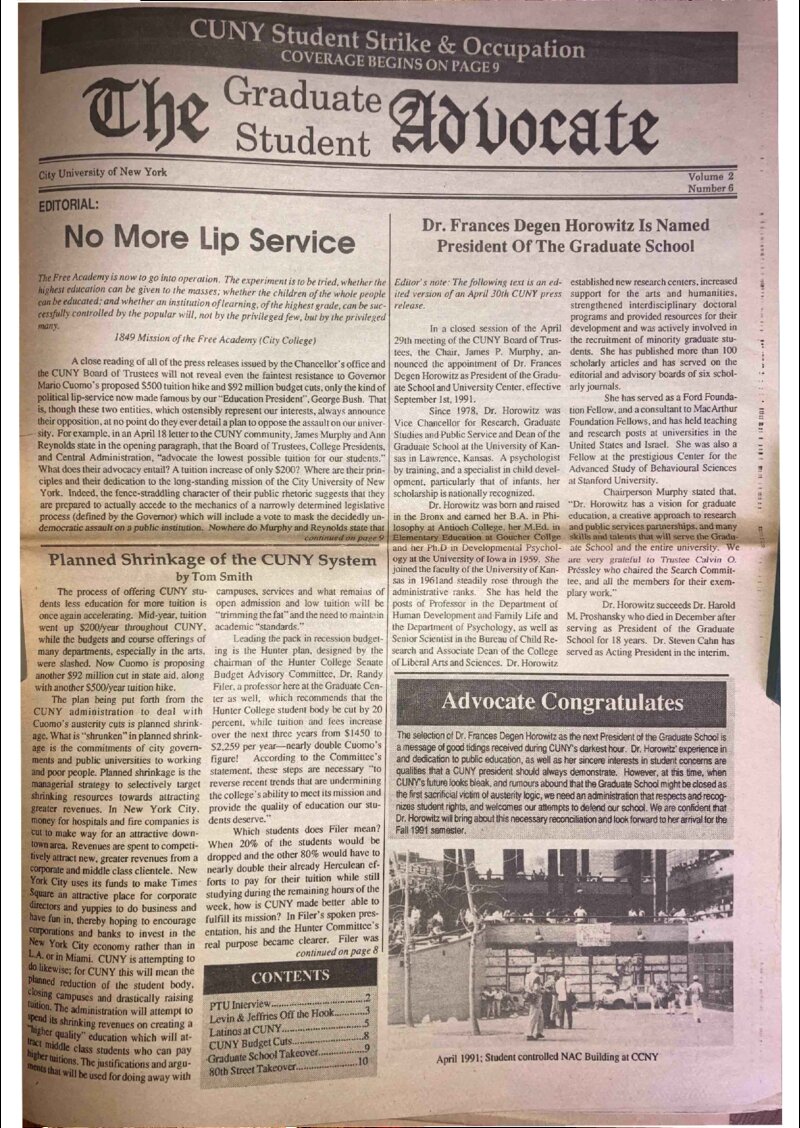
This 1991 issue of The Graduate Student Advocate, the newspaper of the graduate students at the Graduate Center, City University of New York (CUNY). Published six times per academic year, it included editorials, articles, interviews, and letters covering the CUNY Budget Cuts, Graduate School Takeover, the 80th Street Takeover and beyond. "Cuomo's Budget Cutting Hits CUNY," written by Pam Donovan, and "Planned Shrinkage of the CUNY System" written by Tom Smith, offered analysies on the effects the budget cuts would have on CUNY at large while spelling out the expected specific shrinkage on various campuses. In the "Graduate School Strikes Back!" and the "Graduate Center Student Update," Tara McGann and Andrew Long detailed the ongoing negotiations between students, faculty, and CUNY administrative, which eventually led to ending the Graduate Center takeover on April 25th. The Strike Committee declared victory and committed to continue supporting the CUNY strikers. The Graduate Center Student Strike Update enumerated the 16 consensus demands, which included a meeting between the delegated representative of the strike committee and Chancellor Reynolds.
The 1991 CUNY strikes were part of the larger story of austerity measures imposed on New York City and the community efforts to resist those measures. On April 16th, students mainly from the Graduate Center Anthropology PhD program occupied the Graduate Center in solidarity with a broader undergraduate mobilization across CUNY against the threat of steep tuition hikes, massive budget cuts, and faculty layoffs. What began as a one-day strike turned into a ten-day take-over in which students and faculty practiced forms of participatory democracy, discussed the root causes of the austerity problems being faced, and debated actions for change. Students often drew on CUNY’s history as the premier urban, public institution of higher education in the United States to argue that education was a right and that the proposed measures threatened working-class New Yorkers' ability to receive an education.
Contributor
MCCaffrey, Katherine
Creator
Graduate Center Students
Date
May 1991
Language
English
Publisher
Graduate Center
Rights
Copyrighted
Source
McCaffrey, Katherine
Original Format
Newspaper / Magazine / Journal / Catalogue
Graduate Center Students. Letter. 2000. “The Graduate Student Advocate, Vol 2 No 6”, 2000, CUNY DIGITAL HISTORY ARCHIVE, accessed September 5, 2026, https://stephenz.tailc22a4b.ts.net/s/cdha/item/1713