United Federation of College Teachers: BMCC Chapter Newsletter, October 1966
Item
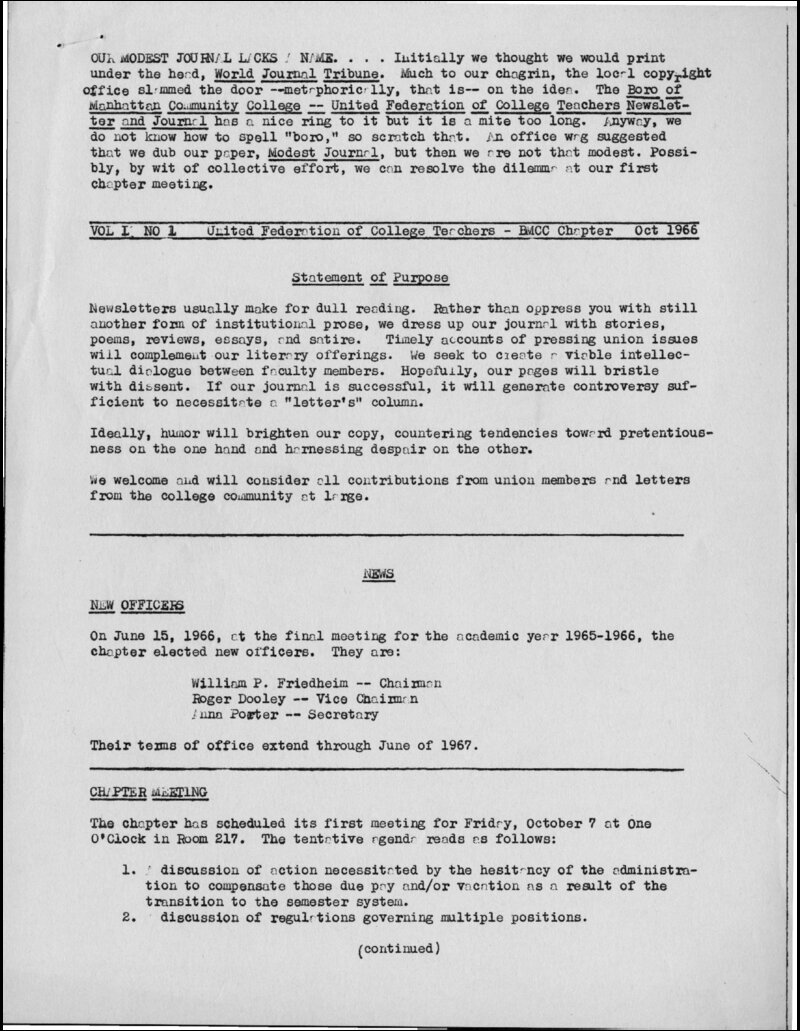
QUh MODEST JOURN/L L/CKS / N/M. . . . Initially we thought we would print
under the herd, World Journal Tribune. Much to our chagrin, the loc-1 copy;,ight
office sl:mmed the door --metrphoric:lly, that is-- on the ides. The Boro of
Manhattan Coumunity College -- United Federation of College Teachers Newslet-
ter and Journcl has a nice ring to it but it is a mite too long. Anyway, we
do not know how to spell "boro," so scratch that. in office wrg suggested
that we dub our poper, Modest Journ-l, but then we cre not that modest. Possi-
bly, by wit of collective effort, we can resolve the dilemm- at our first
chapter meeting.
VoL I NOL United Federotion of College Teschers - BMCC Chrpter Oct 1966
Statement of Purpose
Newsletters usually make for dull reading. Rather than oppress you with still
another form of institutional prose, we dress up our journol with stories,
poems, reviews, essays, cond satire. Timely accounts of pressing union issues
will complement our literory offerings. We seek to cieate - vieble intellec-
tunl diclogue between frculty members. Hopefuily, our pages will bristle
with dissent. If our journal is successful, it will generate controversy suf-
ficient to necessitate a "letter's" column.
Ideally, humor will brighten our copy, countering tendencies tow-rd pretentious-
ness on the one hand ond hernessing despair on the other.
We welcome aud will consider oll contributions from union members end letters
from the college coumunity ot lerge.
NEWS
NEW OFFICERS
On June 15, 1966, ct the final meeting for the academic yerr 1965-1966, the
chapter elected new officers. They are:
William P. Friedheim -- Chaimon
Roger Dooley -- Vice Chaim:.n
{una Porter -- Secretary
Their tems of office extend through June of 1967.
CH/PTER wikT1NG
The chapter has scheduled its first meeting for Fridry, October 7 at One
O*Clock in Room 217. The tentotive egend: reads es follows:
1. ' discussion of action necessitcted by the hesit-ncy of the cdministra-
tion to compensate those due psy and/or vacntion as a result of the
transition to the semester system.
2. discussion of regulrtions governing multiple positions.
(continued )
Page 2
3. The election of © permrnent grievance committee.
4. The election of delegrtes to the Executive Committee of the
New York locel.
5. The selection of a name for the union journal.
6. The selection of on editor for the joum-l.
7. Discussion of a membership drive.
8. Other business.
ISSUES
COmMPiLiiS/ TION DUE Fy CULTY
The sdministration has not moved with dispatch to compensate faculty members
due money or vacation time »s a result of the trensition to the semester
system. On September 19, the first day of classes, the union directed - com--
munication to the President requesting substantive infom-tion of the edmini -
stration's intentions to resolve the matter. The President replied on Monday,
October 3. He explained thet the press of administrative duties had delryed
his answer and prevented his office from examining the problem more thoroughly.
He relayed the information that the odministration was now pursuing the issue
in greater detoil.
it the first faculty meeting on Wednesday, September 28, the President spoke
to the problem euphemistically. Rather than compensation, he promised vee-tion
time which is due the feculty -s o matter of course. /cademic courtesy dictates
thot where possible the cdministration should spare the faculty of extra duties
during intersession. Kelief from o day of registrotion or = depsrtmental meet-
ing is not compensation for a month to two months of vacation. President
Block's presentation flew in the f:ce of the f-cts when he stated thet most
faculty members were not called back to the college before the strrt of clesses
on September 19. On September 6, the dey after labor dey, many faculty members
refurned to proctor placement examinrtions. Three proctors and one student
aide cdministered the examinrtions in each room. In mony rooms there were only
thirty students. To say the least, the use of faculty labor ~pprocched extro-
vagance. members of the English Department spent up to a week, in addition,
greding the tests. They came brck rlong with their colleagues from other
departments ¢ few days later to help with registration.
On top of this, the President sought to rationolize sway the problem of compen-
sation by insisting that vacations under the semester celender are more exten-
sive than those under the quarter system. True enough but the logic of the
statement is not persuosive. Longer vacations follow from longer hours. Under
the semester system, feculty members teach up to fifteen hours ¢ week, not ten
as was the case under the quarter plen. V:-cations ordinarily due under the
semester system by no means replace those owed --but never enjoyed-- under
the quarter crlendar.
(continued )
Page 3
COMPENS/ TION DUR FLOLTY (continued)
Finally the President fell back upon the old sdministrative ploy of “the report?
He told us that his office would issue o report comprehensively charting the
time owed each faculty member. On May 19, 1966, the Dean of Frculty released
a chart which efficiently detailed compensation due every member of the freulty
as o result of the changeover to the semester mode of operation. The chart
was so complete that it covered every conceiveble contingency. It was the end
product of « committce charged to study the problem. Now the President wishes
to sppoint another committee ond release yet another report.
/6 the chief cdministrotor of « growing college, President Block is caught up
in a maze of duties. He c-nnot oversee 711 sdministrative -ctivities directly.
It is understandable if he was unaware of the chert circul-ted by the Dean or
the chores assigned faculty before the. st-rt of clesses. President Block has
always impressed us -sS a man who is both rersonable and politic. sa result,
we find it.dirficult to comprehend his stand on this issue. Reluctcntly we
find it necessary thet the union tcke up the problem. It will be the first
order of business at our meeting on Friday.
THE FA.QULTY COUNCIL
The welcome establishment of a F: culty Council by no means preémpts the ground
of the union. A F culty Council does not operate in » vacuum. Nor does
democracy. The body politic of the Faculty Council must be nourished with
ideas from - variety of sources. The union cmong othex6must stand vigilonce
over its affairs.
Uudeniably the Council bears the mark of President Block's sincerity; a sin-
cerity manifest by the fulfilluent of © promise to provide the faculty a
particip-ting voice in the determination of college policy. The tem, "Frculty
Council," however, is somewhat of o misnomer. The Council represents sdmini-
stration a8 well eas frculty. Seven officers of the college and thirteen
departmental chairmen, who owe their status to administrative oppointment,
autometicrlly sit on the Council.
Given its autonomy from the -dministration, the union cnn act ©s - sounding
board for the frculty by refining issues for presentotion to the Council.
On occasion, the u.ion mey even take exception to the Council's decisions.
Democracy, after all, is not foshioned out of a dulling ef mediocre consensus,
but rather civilized cnd reasoned dissent.
THE NUMBERS Giws
Without suificient numbers, the Union, or eny other faculty -ssociation for
thot matter, counot set in motion qualit-tive progrems. Too often, prospective
members fall victim to circular reasoning. They conclude that without
sufficient membership, union «activity will mire in a nihilistic bog. By friling
(continued)
page 4
TH NUWBLRS Giz (continued)
to join, although syapathetic to the aims of the union, they create a
self-fulfilling prophecy. Some of the union's stretegies miscarry precisely
beceuse syfipathizers stop short of membership.
/s the new academic years begins, the union roll lists forty-five names.
Considering that the Chepter never proselytized aggressively in the past, as
it will this year, the number looms large. Last year the union effected the
opening of observation reports. In the coming months, buoyed by steady
growth, the UFCT can mark the way to a still more comprehensive and democratic
vision of Universitas at BuiCC.
Hold back no more? Join the UFCT now!
COmMENT
THE Union: ITS PiCE /T Buc 5 by William Friedhein
Genteel, middle-class biases often lead educators into the error that unions
are ill-fitted to an academic environment. The word "union" conjures up
scenes of unruly workers massed against menagement and conspiring through
tbhrikes, pickets, slowdowns, and even violence to force the machiuery of
industry to a halt. The image, although apocryphal, gives pause to the col-
lege teacher. His reluctance to sew the uiion label into his white collar is,
of course, not a phenomenon restricted to educational circles. shite collar
workers generally, prodded by » traditionally anti-union press, are quick to
tar the labor movement with a proletarian brush and identify with their
admiuistrative superiors. Tueir posture toward unions calcifies with a
conteupt bred of an obsession with st-rtus.
The U.ion in the Face of Overwhelming Bureaucracy
Iucreasingly, however, unions are entering the once off-limits domain of the
white-collar worker. Confronted by mammoth and ubicuitous bureaucracies,
professionals find themselves enmeshed in red tepe and estranged from those
who shape institutional decisions. Genuine communication between employer
and employee --or, in our case, between faculty and administration-- bends
before impersonal and administrative machinery. Bureaucracy becomea an end
unto itself, particularly when decisions are rationalized in the name of its
own efficiency. The greatest danger 8f bureaucracy is a totaliterianism,
not of humen direction, but of mechanistic oppression. /t its monolithic
worst, bureaucracy dehumanizes administrator and administered alike.
There is no bogey man here. The bl-me for the ills of bureaucracy are not
easily assigned nor should they be. The urgent question is: how does one in
(continued}
|
i
i]
page 5 .
THE UNION: ITS PLACE J.T BMCC (co:timed)
the face of an overwhelming bureaucracy transcend his alienetion and assert
his humanity. Increasing numbers of white collar workers have turned to labor
unions for an enswer.
&@ldor union such as the UFCT pulls as a counterweight against the centrrli-
zing tendencies of bureaucrecy. It draws the white-collar worker into deci-
sions which vitally affect him. Disaffection gives way to involvement. No
longer bandied about as the passive pawn of impersonal corporate processes,
the professional integrates more meaningfully with his work.
Unions are, of course, not immune to the cuncer of bureaucracy. The amorphous
administrative apparatus of labor often rivals thrt of management. slert to
the dangers of a top-heavy administration, the UFCT has sought to preserve the
autonomy of its local units by building into its structure protections against
centralized control. At BMCC, our chapter is master of its own house.
The Union as a Force for Democracy and Humanism
Specifically, the task before the union is contoured by two words: democracy
and humanisn. In concert with administration and students, the UFCT mst
press with humenistic zeal to democratize the college structure. In little
less than a year President Block has moved the school in this direction with
dedication and dispatch. We begin the semester with a newly constituted
faculty council and a promise, originelly tendered by the President to the
union and now founded in official college policy, to open all obersvation
reports. By example of its own conduct and by assiduously suggesting
progressive --albeit unconventional-- programs, the UFCT can help translete
the rhetoric of enlightened administration into a sanguine reality.
Neutralizing Pedantry and Pettiness
If the union's vision is myopic, restricted to wage and fringe benefits for
its members (as vitel as they are), its approach to the challenges of higher
education will harden into self-interest and mediocrity. The union must do
battle within and without its ranks against pedantry end pettiness. When
educators demand additional pay for teaching a make-up class necessitated by
a trcnbit strike, they demean their status as professionals with unbecoming
smallness. is dedicated teachers, the least they owe their students during
a period of crisis is an extra hour of their time without compensation.
(/n extra month or more cannot be dismissed so gretuitously) Conversely,
when treatment smacking of condescension or mistrust weighs heavily on the
morale of any wember of the college community, it is e matter which merits
more than a submissive mutter, a matter which buiks l-rge and most definitely
falls within the purview of a professionsl association of the UFCT. /.dmini-
strators who seem to tyrranize those under them with!a barrage of memoranda
usually do so unwittingly and armed with the best of intentions. Frequently,
words are misconstrued. By focussing on problems of communication --problems
which beset any large institution where necessity mothers bureacrecy-- the
union helps to open a free flowing and mature dialogue which can only lend
dignity to faculty and administration.
(continued)
page 6
THE UNION: ITS PLACE /T BMCC (contimed)
Exercising Leverege Outside the Establishment
The union and the administration are not naturally polarized at opposite ends
of the academic spectrum. In the sometimes syncial but nonetheless necessary
realm of politics, for example, the union can add needed leverage to sttempts
on the part of the college and the Board of Higher Education to mershell
government monies and public opinion behind enlightened programs. While the
union does not necessarily move in high administrative circles, if is ina
posiwion where it can touch some of the more sympathetic nerve ends of public
sensitivity to issues. It.ucan expase to publicity a decaying, overtaxed phy si-
cal plant such as Franklin Hall, a converted factory which blighted a temporary
campus of New York Cowmunity College ii Brooklyn. / woefully meager budget
had dictated continued use of the building. Obviously, no administrator was
comfortable with a facility so lacking in functional ond aesthetic amenities.
Neither was the college's faculty. . ~ In this case, the vagaries of public
budgeting had saddled the college's administrotion with an unwanted and
inadequate structure and, together with established protocol, blocked effective
action on its part to remedy the situetion. The union, unfeéppyered by any
necessary deference to the city fathers who feed the college its funds, mobil-
ized an effective publicity campaign to replace Franklin Hall. Its very
position outside the establishment enabled the union to wage the good and
successful fight for faculty, administration, and students.
The Paranoid Style of BMCC Politics
Phe union exhausts its usefulness only when its members revel in their own
alienation and seek solace in martyrdom. /t one point last year, communication
between faculty and sdministration broke down with tragic results. Both
sides spun couspiracy theories, usually unsubstantiated, about the other. The
whole nasty affair left a bitter after-taste. If faculty and administration
are to avert similar crises, lines of communication must at all cost remein
open. ‘t New..York Couwmunity College, President Block left behind him a record
of good relations with the UFCT, a record that stands as a model of cooperation
betWeen union and administration. The late President Dworkis before him, served
the UFCT in many capacities, including as Vice President of the New York Ci ty
focal. If history is a reliable gauge, the union and the administretion cen
and should pursue common humanistic and democratic goals in the true spirit of
ecumenicisn,.
CONTRIBUTORS
Charlotte Croman is a member of the Euglish Department of the
College.
Roger Dooley is also in the English Department, has written seve-
ral novels and is a professional movie reviewer.
Widlian Friedheim is a member of the Social Sciences Department
—~ant-Cheatimerof the BMCC Chapter of the UFCT.
Jesse Pavis is a member of the Sociel Eciences Department.
page 7
PORTRY
A
TWO Pow
st
by Cherlotte Groman
(Note: waxwell Bodenheim was a celebrated /merican poet of the 20th Century
who was umrdered in Greenwich Villoge in 1954.)
THE P/SSING OF wWXWELL BODENHEu vs HIS OWN
CONCEPT OF DE.TH
I.
I wonder is he now a silver bird j
In the black curls of death ? H
I wonder did he feel Death's kisses |
#nd hear Death's voice speak softly ?
-. poet he was, or so they said; H
+. prince, the papers wrote:
Born 1892 of woman,
Died 1954 of men.
|
|
II. |
|
+ thin, bent, weary, old man,
/shen and incoherent,
Not the lyries of the gods; !
Obscene, harsh, bitter sounds only |
Now came from this once darling. |
His heritage wos Israel,
His genius was words,
His pleasure was woman, {
/nd his destruction was wine.
The goat man played him
A song to Diouysus i
/nd a dirge for ‘chilles dead,
Rather his wings of wex
Soared too near the sun.
IIT.
Is he now a silver bird ? }
How much of a longing
Did Deeth's heart have 2
Was it raining,
The air cool and sweet ?
(continued)
page 8
ora shabby, furnished room
With light bulb on grimy chain ?
‘ shelter from the night -- “h!...
4 woman's eyes widened,
Her mouth formed a scream,
Her drunken mate, frightened,
Impotently frantic --
The black wings of the madman
Bore down with fury
ind the dark slave appeared:
Dagger and bullet found their quarry.
AFTERNOON IN APRIL
4 splach of light made gold of his hoir
Another deepened the blue of his eyes
i bleeding plaid of color shone at the tum
of his shoulder
4s his hand grasped the door jamb;
She saw the double lines of his lean prairie cheek
und heard the soft temperate sound of his voice
as he asked: "Is there any chance. . ?"
She sat stiffly upright in the old brown chair
/mid the gloom and pall of the late afternoon;
The shadow disembodied the sagging line of her head
£8 it turned swiftly toward the wall
‘s if to utter a sound
The fine lines of her mouth parted --
A heavy silence, then a closing of the door.
CINEMA
THE WORLD OF wALT DISNEY by Roger Dooley
Fantastic Voyage
In dramatizing science fiction, the visual possibilities of the screan, epparent
even to the earliest motie-makers, still remain unparalleled. With all the
resources of trick photogrephy enhanced by color and Cinemascope, becked by
expert technical advice, Twentieth Century -- Fox has come up with one of the
most diverting examples in years of this genre, the aptly (if not very intri-
guingly) nomed Fantastic Voyage. .1s in all good science fiction, once a single
premise is granted, everything else is completely realistic and convincing to
the tiniest detail. In this case the necessary hypothesis is that human beings
(continued)
page 9
and their equipment could be reduced, intact, to microscopic size and injected
by a hypocemic into the bloodstream of - living men. The victim is o scientist,
himself an expert in "miniaturization," about to defect to the West when
seriously injured by the other side -- so seriously that unless a blood clot
Can be Cleared from his brain, he will died taking his secret with him. Just
to make the stakes more hazardous, mini-turization lasts exactly one hour, so
the chosen team of five in their atomic-powered submarine must reach the brain,
destroy the clot by laser beam, and make their exit within those sixty minutes.
Needless to say, every conceivable unforeseen obstacle arises, from a repids-
shooting crisis through the temporarily stopped heart to a catastrophic noise
that occurs in the middle ear, to hostile .nti-bodies and menacing white cor-
puscles. vrhotographed with startling special effects (never the least unplea-
sant or repellent, the squeamish mey rest cssured), this would be splendid
cinematic entertsimment with any cast, but it boasts such stalwart perfomers
as Eduund O'Brien and Arthur 0'Connel among those tracking the voyage by radar,
and /rthur Kennedy, Stephen Boyd, and Donald Pleasance on the team within.
with cowmendable restraint, the producers refrained from using I've Got You
Under wy Skin as theme mesic or even trying to arrange a tie-in with Inéide
Daisy Clover.
The Fighting Prince of Donegal
Besides the now only occasional cartoons, the nature studies, and the family
type farces (usually starring Fred MacMurray or Hayley wills), Walt Disney has
for some years been producing, perhaps as a means of thuwing funds frozen in
England, a less publicized series of costume romances. The trademarks are a
script based on some minor British classic now in public domain (e.g. When
Kuighthod Was in Flower), authentic castles and countryside photographed in
lush color, frequent but not bloody swordplay, and a cast of those sterling
cheracter actors always available in England.
Having by now used 711 the more obvious materiel of British history, from
Robin Hood to Jacobite risings, the Disney craftsmen have now turned their
attention to the /nglo-Irish-Spanish situation as of 1587 --cert-inly not an
Over-used background. But if the mileu is not familiar, the story line cer-
tainly is. Here instead of Richard Todd as Rob hoy we have young Peter
Mcimery as ied Hugh, "The O'Donnell," hereditary leader of a turbulent Irish
clan just as ready to battle the O'Neills or the MacSweeneys as their tradi-
tional externoel enemies. Possibly to avoid offending English audiences, the
real villain is a sneering captain of the guard who, in the viceroy's absence,
acts on his own in clear opposition to the presumably benevolent Irish policy
of ‘ueen Elizabeth I.
Purists may also object that except for being kidnapped and imprisoned in Dhblin
Castle the events bear little resemblance to the life of the historic Hugh
O'Donnell -- but most audiences will find-- themselves pleasantly entertained,
perhaps the more so because évery twist of the plot is so delightfully predic-
table. The able cast mkes the dialogue sound much fresher than it is, espe-
cially icknery, who lends his routine role a sensitivity ond depth that suggest
another /lbert Finney or Peter O'Toole.
page 10
STORES
THE D/UGHTERS BY Jesse Pavis
The children lay on the grass and looked through the wire fence
at the ducks floating on the pound. The water was so dark that they could not
see the ducks’ paddles and they imagined that someone was pulling them along
by a string. The two girls leaned forward with their erms «bout each other
and their heads were so close together that their hair fell in one mass. Maria
was crying and her older sister nna was whispering to her. Sometimes ‘ina
would point to a duck but Maria would not tum her head.
"They're very pretty," Auna said. “Botter than either of us or
even Papa ever draws. Even pictures in a book are not like they are." Then
she turned and looked at Maria. "Why are you crying? I don't ery..."
"Sometimes you do..."
"Only at night when I'm in bed and hear Papa walking around the
house. Then I have to pull the covers over me so he and mother won't hear me.
after a while I stop and try to think of some way to please P-pa."
‘Why isn't he like us?" Maria asked her sister.
“Sometimes he comes home and I can hear him singing when he comes
up the steps.. Then he sits in the big chair in the parlor and asks us to
come and kiss him. But all this week and all last week, for such a long
time, he doesn't talk at all."
"Mama says he's tired."
"But why wasn't he tired before?" Maria continued. "I ask him
something and.he answers without looking at me and so low I can't hear what
he's saying. I try it again and then I stop. I don't want to hoor him
talk like that."
"But he's not angry."
"I know but I just don't understand him."
"I've told you already, Maria. He works.too hard and too long.
Every morning.he has to get up and work and every night he has to go to sleep
after dinner so he can work the next day. That's all he ever does. So he's
tired."
a “lama was telling him to find another job and he told her he
was lucky to get this one. She said he was going to wear himself out. And
he said, "Well, everybody has to live." I asked Mama if he cold ever get
an easier.job aud she just shook her head and then she shivered."
éfter Maria finished speaking she laid her head on the grass
and cried quietly to herself. Anna sat up. An old man was walking toward
them. She looked around. Other people were sitting on benches near the
pond and cars were driving slowly along the twisted lane. -inyway, the old
Man could hardly walk. He held a heavy stick in his two hands, and placing
it before him, pulled himself forward. Anna told her sister to look up as
the man came up to them. He sat down on the grass by the children and
placed the stick across his knees. He had long grey hair which was swept
back over his ears. He wore a red plaid shirt and blue overalls. He looked
kindly at the children and spoke to them.
"I was watching you and an old man like me sees things that
most people don't notice. I don't like to see such young girls like you
(continued)
page 11
THE DAUGHTERS (contimed)
unhappy. So I've come over here to ask you what's the matter." When he had
finished he bummed a song the children didn't know and watched them look at
each other.
"Who are you?" Maria asked.
"Well, I'm the duck keeper. I make sure that there's enough
food in the water. I take care of the sick ones. You didn't know thore
were any sick ducks? See that one?" he said, pointing toward a brown duck.
"I had him in my house for a whole weck. All the children around here
thought he was going to die.. But in a way, ducks are like people. Watch."
He leaned his face against the fence and called the duck. It
turned around and paddled toward him. "He likes you! " anna said. The
duck keeper was pleased and rested back on the grass.
"You're worrying about your parents," he said.
"It's Papa," Maria answered, shaking her head.
"It's probably not so bad as you make it," he told her. ‘"iWhen
you're young everything seems bigger than it really is."
"Papa's not happy. He never does anything he wants to do. and
it's been getting like that more and more. When he comes home he just sits
in the parlor chair, looking at the light fixture or out of the window and
not noticing anybody."
"fs lot of people are like that," the duck keeper said.
~"But we don't went him like that," Maria interrupted. "If he
were just like us, lying here watching the ducks through fence..."
"he used to come to the park," Anna said. "But then he acted
like he was sdeeping. We'd call him and he wouldn't hearus. His eyes
Were open but he wasn't looking at anything. If we tickled him enough, he'd
play rough with us for a while but soon he would just lie down again. Then,
even if we crawled over and jumped on his back, it wouldn't make him play.
So we'd just comb his hair or go off and play be ourselves."
"Then he's just too old," the duck keeper said.
"If he were as little as.you...." the duck keeper continued.
“Just like us," «nna said. "Then we could all crouch on our hands
and feet and chase each other around and-shake our mouths like bad dogs.
Then we could all watch the ducks. And if we got thirsty, we could all go
to the fountain and take turns holding the faucet for each other."
"and you'd really like that?" the duck keeper asked. "It
would have to.be all the time...even at home...even around your mother.
Would she like that?" he stoppcd and looked at the children. "She'd have
to know..." z
"What do you mean?” Anna Laughed.
"You think I'm playing," he said gently. “If you want your
Papa aS young.es you are, not only here in the park, but at home too, even
at dinner, I can make him young for you."
"Then he wouldn't have to work anymore?" Maria asked.
"Even if you could do it, how would we live? Somebody has to
earn money..." Anna said.
"Someone else would feed you all right," the duck tender answered
Anna. Then he stood up and leaned against his stick. "If you really want
your father young, you bring him here this Sunday, tomorrow. But don't tell
anyone. You decide." Then he placed the stick in front of him, leaned on
(continued)
page 12
THE DAUGHTERS (continued)
it and walked away. He beckoned to the brown duck and it paddled beside him
as he walked along the fence.
"We'll tell Pspa tonight that he's got to come here with us
tomorrow," Maria said. She held Anna's hand tightly and squeezed.
"What would Mema do, aria, if he really makes Papa as little
as We are?” .
"Just take care of all of us...."
"But that would be too much work for her, Maria."
"It'd be easier than it is now with Papa so sad."
"She'd be too lonesome if Papa were a child. He still sits ond
talks with wena sometimes, even now, or goes for a walk around the comer
with her..."
. "But she's always worrying about him and they never play and
laugh together. If he were little, she could just take care of him and not
worry so much."
"We'd better go home," Anna said, getting up and walking toward
the gate. "Don't tell Mema about the duck keeper. He's really just playing,
anyhow." 2
“ "Then why can't we tell her?"
"I don't know if she'd like it," una answered. Then she took
her sister's hand and broke into a run down the strvet.
That night Maria asked Pepa to go to the park with them tomorrow.
Anna tried not to watch when maria crawled into his lap and whispered that
they had a big surprise for him. Papa asked wlema what she knew about the
surprise. Maria tried to put her hands over his mouth but he held her down
and tickled her. Of course, mama knew nothing. She laughed though and
answered, "who kuows what your children will do?"
.~ Anna Walked quickly into her room aud pulled the door closed.
She stood next to it aud listened but no one was talking now. Perhaps she
should really tell her mother, regardless of what the duck keeper said.
But perhaps it would be better for mama and Papa if he were a child. She
didn't know what to do. She was afraid to tell her mother the secret, even
if the duck keeper was fooling them.
"anna, Anna," Mama called.
"I'm in my room getting something," Anna answered, quickly turm-
ing on the light.
She met her father in the hall; he was already going to bed and
he touselled her hair as he passed. Then she went into the parlor with Mama.
“What's really the matter with Papa?" she asked.
a "He just had a bad day, Ania."
Maria was nodding her head. inna sat down beside her mother and
put her ams around her. In a moment they heard Papa raise his window.
That night Ana tried to persuade Maria not to go to the park.
“why? Why?" Maria insisted.
- "I'm just afraid," Anna answered, sitting on Maria's bed and
watching the hall light spread.under their door.
"Papa will know what to do, "Wuria said, a little amazed. "I'm
Sleepy NOWs..e.e."
fmna.lay down in her own bed and tried to sleep. She saw her
father large, then small. Now he wes sitting in the parlor chair, drumming
(continued)
page 13
THE DsUGHTERS (continued)
his fingers on the am; now he was playing jump rope with them and her mother
Was Watching and clapping her hands. |
waria was already sleeping and the whole house was quiet. Anna |
thought she saw the duck keeper. He was standing in the water in the middle |
of the pond, pointing at her and laughing. All the ducks had twisted their |
bills and were laughing too.
The children and their father left for the park in the morning.
He walked between them, holding their hands and they almost pulled him along.
Maria reminded him that they had a surprise for him. He said, "Please tell
me, please tell me," and then walked on silently. |
When they entered the park the children were surprised not to j
find the duck keeper. They led their father to the place where they had met
the old man and sat down in the grass. Their father lay on the grass and |
shut his eyes. The children drew close together near the fence, whispered
to one another and then walked quickly away in different directions to look
for the duck keeper.
«ha walked to tue keeper's house but no one was home. She even
looked through the windows to make sure. Maria looked behind every tree and
at every bench. She met her sister coming form the keeper's house. "H: might i
come later," nna said, walking back to the duck pond. Maria didn't answer
her. She kicked the grass as she Walked and shook her head, wondering if
anna had really looked for him.
When they came back to the fence their father wes gone. sf.
young boy was standing with his back to them watching the ducks. They looked
ali around but they could not find their father. The boy turned to them. He
wore long corduroy trousers and a white starched shirt. His hair was black
ani uncombed.
"I was waiting for you," he said a little inpatiently, as if
they had been.aWay a long time. ,
Maria turned her back to him and moved away.
"who are you?" sina asked hin.
“Abthy," he said. "You're supposed to take me home."
Maria turned around.and came back to hin. "What do we want with
you?" ,
ey "Pl..ase, Maria," ssu.a interrupted her. "He's just playing
with you." | i
~ "No, I'm not. I'm really supposed to go home with you." He
picked up a handful of grass and laughed as he threw it over /mna's hair.
"If? you don't believe me, you can ask the duck keeper."
es “Where is he?" iia asked him, looking all around her.
"Right there, leaning over the fence. Don't you see him?"
Anna got up and followed Maria who was already munning toward
him. The duck keeper heard them coming and turned around. He leaned forward
on his stick so as to talk with them. "Come close, come close," he called
dovdly.
"Why did you fool us?" Moria shouted at hin.
He placed his finger on her lips and spoke softly to them. "The
little boy is your father." Then he laughed and hobbled away.
(continued)
eT oe
© page 14
THE DUGHTERS (continued)
Lbthy had followed the girls. "Now you believe me," he said.
He tripped Maria up and ran around jima, punching her lightly onthe
shoulders and chest. “Catch me, catch me," he laughed.
"Papa, Papal una cried. But .ibthy kept poking his fists
at her. Mcria rolled over in the grass and cought abthy's legs in her ams
and pulled him down. Jina ran away from them to look for the duck keeper.
But he was gone. Guie knew that she was going to cry ond she put her fingers
in her mouth. Ppa must be somewhere, she thought. She walked all around
the duck pond, stopping to look behind every tree and bush, calling her
father. She even walked back to the duck keeper's house and banged on the
door with a stone she had found in the road. She climbed on the porch
railing to look through the windows again. Then she walked slowly back
to Abthy and waria and stood behind a bench to watch them. They were
quarrelling.
"Ita gonna tell Msma on you, /bthy."
"She's my Mma too," Abthy answered, hitting Moria again on
the shoulder. .
i. Ba begsBR crying. She should have told her mother. The
duck keeper had not been playing with them. Sie was wrong even to listen
to what he said. She turned her back on /.bthy and Moria and went out of
the park.
#nna was still crying when she walked into her house. From
the kitchen her mother called to her. Anna ran in and threw herself against
her wother. Mama put her hands on her hair and stroked it. "Why are you
erying, Anna?" 4
"I'm sorry, I'm sorry," she said quickly, crying more loudly
now aud trembling. “i
"anna, 4nuna," her mother tried to comfort her. But panna
cried steadily, although her mother had picked her up and was kissing her
and rocking her in her ams. "What has happened, my darling? What has
happened? Where is Papa?"
But Anna would not answer. Outside she heard Abthy and Maria
Calling her as they came muning down the street.
under the herd, World Journal Tribune. Much to our chagrin, the loc-1 copy;,ight
office sl:mmed the door --metrphoric:lly, that is-- on the ides. The Boro of
Manhattan Coumunity College -- United Federation of College Teachers Newslet-
ter and Journcl has a nice ring to it but it is a mite too long. Anyway, we
do not know how to spell "boro," so scratch that. in office wrg suggested
that we dub our poper, Modest Journ-l, but then we cre not that modest. Possi-
bly, by wit of collective effort, we can resolve the dilemm- at our first
chapter meeting.
VoL I NOL United Federotion of College Teschers - BMCC Chrpter Oct 1966
Statement of Purpose
Newsletters usually make for dull reading. Rather than oppress you with still
another form of institutional prose, we dress up our journol with stories,
poems, reviews, essays, cond satire. Timely accounts of pressing union issues
will complement our literory offerings. We seek to cieate - vieble intellec-
tunl diclogue between frculty members. Hopefuily, our pages will bristle
with dissent. If our journal is successful, it will generate controversy suf-
ficient to necessitate a "letter's" column.
Ideally, humor will brighten our copy, countering tendencies tow-rd pretentious-
ness on the one hand ond hernessing despair on the other.
We welcome aud will consider oll contributions from union members end letters
from the college coumunity ot lerge.
NEWS
NEW OFFICERS
On June 15, 1966, ct the final meeting for the academic yerr 1965-1966, the
chapter elected new officers. They are:
William P. Friedheim -- Chaimon
Roger Dooley -- Vice Chaim:.n
{una Porter -- Secretary
Their tems of office extend through June of 1967.
CH/PTER wikT1NG
The chapter has scheduled its first meeting for Fridry, October 7 at One
O*Clock in Room 217. The tentotive egend: reads es follows:
1. ' discussion of action necessitcted by the hesit-ncy of the cdministra-
tion to compensate those due psy and/or vacntion as a result of the
transition to the semester system.
2. discussion of regulrtions governing multiple positions.
(continued )
Page 2
3. The election of © permrnent grievance committee.
4. The election of delegrtes to the Executive Committee of the
New York locel.
5. The selection of a name for the union journal.
6. The selection of on editor for the joum-l.
7. Discussion of a membership drive.
8. Other business.
ISSUES
COmMPiLiiS/ TION DUE Fy CULTY
The sdministration has not moved with dispatch to compensate faculty members
due money or vacation time »s a result of the trensition to the semester
system. On September 19, the first day of classes, the union directed - com--
munication to the President requesting substantive infom-tion of the edmini -
stration's intentions to resolve the matter. The President replied on Monday,
October 3. He explained thet the press of administrative duties had delryed
his answer and prevented his office from examining the problem more thoroughly.
He relayed the information that the odministration was now pursuing the issue
in greater detoil.
it the first faculty meeting on Wednesday, September 28, the President spoke
to the problem euphemistically. Rather than compensation, he promised vee-tion
time which is due the feculty -s o matter of course. /cademic courtesy dictates
thot where possible the cdministration should spare the faculty of extra duties
during intersession. Kelief from o day of registrotion or = depsrtmental meet-
ing is not compensation for a month to two months of vacation. President
Block's presentation flew in the f:ce of the f-cts when he stated thet most
faculty members were not called back to the college before the strrt of clesses
on September 19. On September 6, the dey after labor dey, many faculty members
refurned to proctor placement examinrtions. Three proctors and one student
aide cdministered the examinrtions in each room. In mony rooms there were only
thirty students. To say the least, the use of faculty labor ~pprocched extro-
vagance. members of the English Department spent up to a week, in addition,
greding the tests. They came brck rlong with their colleagues from other
departments ¢ few days later to help with registration.
On top of this, the President sought to rationolize sway the problem of compen-
sation by insisting that vacations under the semester celender are more exten-
sive than those under the quarter system. True enough but the logic of the
statement is not persuosive. Longer vacations follow from longer hours. Under
the semester system, feculty members teach up to fifteen hours ¢ week, not ten
as was the case under the quarter plen. V:-cations ordinarily due under the
semester system by no means replace those owed --but never enjoyed-- under
the quarter crlendar.
(continued )
Page 3
COMPENS/ TION DUR FLOLTY (continued)
Finally the President fell back upon the old sdministrative ploy of “the report?
He told us that his office would issue o report comprehensively charting the
time owed each faculty member. On May 19, 1966, the Dean of Frculty released
a chart which efficiently detailed compensation due every member of the freulty
as o result of the changeover to the semester mode of operation. The chart
was so complete that it covered every conceiveble contingency. It was the end
product of « committce charged to study the problem. Now the President wishes
to sppoint another committee ond release yet another report.
/6 the chief cdministrotor of « growing college, President Block is caught up
in a maze of duties. He c-nnot oversee 711 sdministrative -ctivities directly.
It is understandable if he was unaware of the chert circul-ted by the Dean or
the chores assigned faculty before the. st-rt of clesses. President Block has
always impressed us -sS a man who is both rersonable and politic. sa result,
we find it.dirficult to comprehend his stand on this issue. Reluctcntly we
find it necessary thet the union tcke up the problem. It will be the first
order of business at our meeting on Friday.
THE FA.QULTY COUNCIL
The welcome establishment of a F: culty Council by no means preémpts the ground
of the union. A F culty Council does not operate in » vacuum. Nor does
democracy. The body politic of the Faculty Council must be nourished with
ideas from - variety of sources. The union cmong othex6must stand vigilonce
over its affairs.
Uudeniably the Council bears the mark of President Block's sincerity; a sin-
cerity manifest by the fulfilluent of © promise to provide the faculty a
particip-ting voice in the determination of college policy. The tem, "Frculty
Council," however, is somewhat of o misnomer. The Council represents sdmini-
stration a8 well eas frculty. Seven officers of the college and thirteen
departmental chairmen, who owe their status to administrative oppointment,
autometicrlly sit on the Council.
Given its autonomy from the -dministration, the union cnn act ©s - sounding
board for the frculty by refining issues for presentotion to the Council.
On occasion, the u.ion mey even take exception to the Council's decisions.
Democracy, after all, is not foshioned out of a dulling ef mediocre consensus,
but rather civilized cnd reasoned dissent.
THE NUMBERS Giws
Without suificient numbers, the Union, or eny other faculty -ssociation for
thot matter, counot set in motion qualit-tive progrems. Too often, prospective
members fall victim to circular reasoning. They conclude that without
sufficient membership, union «activity will mire in a nihilistic bog. By friling
(continued)
page 4
TH NUWBLRS Giz (continued)
to join, although syapathetic to the aims of the union, they create a
self-fulfilling prophecy. Some of the union's stretegies miscarry precisely
beceuse syfipathizers stop short of membership.
/s the new academic years begins, the union roll lists forty-five names.
Considering that the Chepter never proselytized aggressively in the past, as
it will this year, the number looms large. Last year the union effected the
opening of observation reports. In the coming months, buoyed by steady
growth, the UFCT can mark the way to a still more comprehensive and democratic
vision of Universitas at BuiCC.
Hold back no more? Join the UFCT now!
COmMENT
THE Union: ITS PiCE /T Buc 5 by William Friedhein
Genteel, middle-class biases often lead educators into the error that unions
are ill-fitted to an academic environment. The word "union" conjures up
scenes of unruly workers massed against menagement and conspiring through
tbhrikes, pickets, slowdowns, and even violence to force the machiuery of
industry to a halt. The image, although apocryphal, gives pause to the col-
lege teacher. His reluctance to sew the uiion label into his white collar is,
of course, not a phenomenon restricted to educational circles. shite collar
workers generally, prodded by » traditionally anti-union press, are quick to
tar the labor movement with a proletarian brush and identify with their
admiuistrative superiors. Tueir posture toward unions calcifies with a
conteupt bred of an obsession with st-rtus.
The U.ion in the Face of Overwhelming Bureaucracy
Iucreasingly, however, unions are entering the once off-limits domain of the
white-collar worker. Confronted by mammoth and ubicuitous bureaucracies,
professionals find themselves enmeshed in red tepe and estranged from those
who shape institutional decisions. Genuine communication between employer
and employee --or, in our case, between faculty and administration-- bends
before impersonal and administrative machinery. Bureaucracy becomea an end
unto itself, particularly when decisions are rationalized in the name of its
own efficiency. The greatest danger 8f bureaucracy is a totaliterianism,
not of humen direction, but of mechanistic oppression. /t its monolithic
worst, bureaucracy dehumanizes administrator and administered alike.
There is no bogey man here. The bl-me for the ills of bureaucracy are not
easily assigned nor should they be. The urgent question is: how does one in
(continued}
|
i
i]
page 5 .
THE UNION: ITS PLACE J.T BMCC (co:timed)
the face of an overwhelming bureaucracy transcend his alienetion and assert
his humanity. Increasing numbers of white collar workers have turned to labor
unions for an enswer.
&@ldor union such as the UFCT pulls as a counterweight against the centrrli-
zing tendencies of bureaucrecy. It draws the white-collar worker into deci-
sions which vitally affect him. Disaffection gives way to involvement. No
longer bandied about as the passive pawn of impersonal corporate processes,
the professional integrates more meaningfully with his work.
Unions are, of course, not immune to the cuncer of bureaucracy. The amorphous
administrative apparatus of labor often rivals thrt of management. slert to
the dangers of a top-heavy administration, the UFCT has sought to preserve the
autonomy of its local units by building into its structure protections against
centralized control. At BMCC, our chapter is master of its own house.
The Union as a Force for Democracy and Humanism
Specifically, the task before the union is contoured by two words: democracy
and humanisn. In concert with administration and students, the UFCT mst
press with humenistic zeal to democratize the college structure. In little
less than a year President Block has moved the school in this direction with
dedication and dispatch. We begin the semester with a newly constituted
faculty council and a promise, originelly tendered by the President to the
union and now founded in official college policy, to open all obersvation
reports. By example of its own conduct and by assiduously suggesting
progressive --albeit unconventional-- programs, the UFCT can help translete
the rhetoric of enlightened administration into a sanguine reality.
Neutralizing Pedantry and Pettiness
If the union's vision is myopic, restricted to wage and fringe benefits for
its members (as vitel as they are), its approach to the challenges of higher
education will harden into self-interest and mediocrity. The union must do
battle within and without its ranks against pedantry end pettiness. When
educators demand additional pay for teaching a make-up class necessitated by
a trcnbit strike, they demean their status as professionals with unbecoming
smallness. is dedicated teachers, the least they owe their students during
a period of crisis is an extra hour of their time without compensation.
(/n extra month or more cannot be dismissed so gretuitously) Conversely,
when treatment smacking of condescension or mistrust weighs heavily on the
morale of any wember of the college community, it is e matter which merits
more than a submissive mutter, a matter which buiks l-rge and most definitely
falls within the purview of a professionsl association of the UFCT. /.dmini-
strators who seem to tyrranize those under them with!a barrage of memoranda
usually do so unwittingly and armed with the best of intentions. Frequently,
words are misconstrued. By focussing on problems of communication --problems
which beset any large institution where necessity mothers bureacrecy-- the
union helps to open a free flowing and mature dialogue which can only lend
dignity to faculty and administration.
(continued)
page 6
THE UNION: ITS PLACE /T BMCC (contimed)
Exercising Leverege Outside the Establishment
The union and the administration are not naturally polarized at opposite ends
of the academic spectrum. In the sometimes syncial but nonetheless necessary
realm of politics, for example, the union can add needed leverage to sttempts
on the part of the college and the Board of Higher Education to mershell
government monies and public opinion behind enlightened programs. While the
union does not necessarily move in high administrative circles, if is ina
posiwion where it can touch some of the more sympathetic nerve ends of public
sensitivity to issues. It.ucan expase to publicity a decaying, overtaxed phy si-
cal plant such as Franklin Hall, a converted factory which blighted a temporary
campus of New York Cowmunity College ii Brooklyn. / woefully meager budget
had dictated continued use of the building. Obviously, no administrator was
comfortable with a facility so lacking in functional ond aesthetic amenities.
Neither was the college's faculty. . ~ In this case, the vagaries of public
budgeting had saddled the college's administrotion with an unwanted and
inadequate structure and, together with established protocol, blocked effective
action on its part to remedy the situetion. The union, unfeéppyered by any
necessary deference to the city fathers who feed the college its funds, mobil-
ized an effective publicity campaign to replace Franklin Hall. Its very
position outside the establishment enabled the union to wage the good and
successful fight for faculty, administration, and students.
The Paranoid Style of BMCC Politics
Phe union exhausts its usefulness only when its members revel in their own
alienation and seek solace in martyrdom. /t one point last year, communication
between faculty and sdministration broke down with tragic results. Both
sides spun couspiracy theories, usually unsubstantiated, about the other. The
whole nasty affair left a bitter after-taste. If faculty and administration
are to avert similar crises, lines of communication must at all cost remein
open. ‘t New..York Couwmunity College, President Block left behind him a record
of good relations with the UFCT, a record that stands as a model of cooperation
betWeen union and administration. The late President Dworkis before him, served
the UFCT in many capacities, including as Vice President of the New York Ci ty
focal. If history is a reliable gauge, the union and the administretion cen
and should pursue common humanistic and democratic goals in the true spirit of
ecumenicisn,.
CONTRIBUTORS
Charlotte Croman is a member of the Euglish Department of the
College.
Roger Dooley is also in the English Department, has written seve-
ral novels and is a professional movie reviewer.
Widlian Friedheim is a member of the Social Sciences Department
—~ant-Cheatimerof the BMCC Chapter of the UFCT.
Jesse Pavis is a member of the Sociel Eciences Department.
page 7
PORTRY
A
TWO Pow
st
by Cherlotte Groman
(Note: waxwell Bodenheim was a celebrated /merican poet of the 20th Century
who was umrdered in Greenwich Villoge in 1954.)
THE P/SSING OF wWXWELL BODENHEu vs HIS OWN
CONCEPT OF DE.TH
I.
I wonder is he now a silver bird j
In the black curls of death ? H
I wonder did he feel Death's kisses |
#nd hear Death's voice speak softly ?
-. poet he was, or so they said; H
+. prince, the papers wrote:
Born 1892 of woman,
Died 1954 of men.
|
|
II. |
|
+ thin, bent, weary, old man,
/shen and incoherent,
Not the lyries of the gods; !
Obscene, harsh, bitter sounds only |
Now came from this once darling. |
His heritage wos Israel,
His genius was words,
His pleasure was woman, {
/nd his destruction was wine.
The goat man played him
A song to Diouysus i
/nd a dirge for ‘chilles dead,
Rather his wings of wex
Soared too near the sun.
IIT.
Is he now a silver bird ? }
How much of a longing
Did Deeth's heart have 2
Was it raining,
The air cool and sweet ?
(continued)
page 8
ora shabby, furnished room
With light bulb on grimy chain ?
‘ shelter from the night -- “h!...
4 woman's eyes widened,
Her mouth formed a scream,
Her drunken mate, frightened,
Impotently frantic --
The black wings of the madman
Bore down with fury
ind the dark slave appeared:
Dagger and bullet found their quarry.
AFTERNOON IN APRIL
4 splach of light made gold of his hoir
Another deepened the blue of his eyes
i bleeding plaid of color shone at the tum
of his shoulder
4s his hand grasped the door jamb;
She saw the double lines of his lean prairie cheek
und heard the soft temperate sound of his voice
as he asked: "Is there any chance. . ?"
She sat stiffly upright in the old brown chair
/mid the gloom and pall of the late afternoon;
The shadow disembodied the sagging line of her head
£8 it turned swiftly toward the wall
‘s if to utter a sound
The fine lines of her mouth parted --
A heavy silence, then a closing of the door.
CINEMA
THE WORLD OF wALT DISNEY by Roger Dooley
Fantastic Voyage
In dramatizing science fiction, the visual possibilities of the screan, epparent
even to the earliest motie-makers, still remain unparalleled. With all the
resources of trick photogrephy enhanced by color and Cinemascope, becked by
expert technical advice, Twentieth Century -- Fox has come up with one of the
most diverting examples in years of this genre, the aptly (if not very intri-
guingly) nomed Fantastic Voyage. .1s in all good science fiction, once a single
premise is granted, everything else is completely realistic and convincing to
the tiniest detail. In this case the necessary hypothesis is that human beings
(continued)
page 9
and their equipment could be reduced, intact, to microscopic size and injected
by a hypocemic into the bloodstream of - living men. The victim is o scientist,
himself an expert in "miniaturization," about to defect to the West when
seriously injured by the other side -- so seriously that unless a blood clot
Can be Cleared from his brain, he will died taking his secret with him. Just
to make the stakes more hazardous, mini-turization lasts exactly one hour, so
the chosen team of five in their atomic-powered submarine must reach the brain,
destroy the clot by laser beam, and make their exit within those sixty minutes.
Needless to say, every conceivable unforeseen obstacle arises, from a repids-
shooting crisis through the temporarily stopped heart to a catastrophic noise
that occurs in the middle ear, to hostile .nti-bodies and menacing white cor-
puscles. vrhotographed with startling special effects (never the least unplea-
sant or repellent, the squeamish mey rest cssured), this would be splendid
cinematic entertsimment with any cast, but it boasts such stalwart perfomers
as Eduund O'Brien and Arthur 0'Connel among those tracking the voyage by radar,
and /rthur Kennedy, Stephen Boyd, and Donald Pleasance on the team within.
with cowmendable restraint, the producers refrained from using I've Got You
Under wy Skin as theme mesic or even trying to arrange a tie-in with Inéide
Daisy Clover.
The Fighting Prince of Donegal
Besides the now only occasional cartoons, the nature studies, and the family
type farces (usually starring Fred MacMurray or Hayley wills), Walt Disney has
for some years been producing, perhaps as a means of thuwing funds frozen in
England, a less publicized series of costume romances. The trademarks are a
script based on some minor British classic now in public domain (e.g. When
Kuighthod Was in Flower), authentic castles and countryside photographed in
lush color, frequent but not bloody swordplay, and a cast of those sterling
cheracter actors always available in England.
Having by now used 711 the more obvious materiel of British history, from
Robin Hood to Jacobite risings, the Disney craftsmen have now turned their
attention to the /nglo-Irish-Spanish situation as of 1587 --cert-inly not an
Over-used background. But if the mileu is not familiar, the story line cer-
tainly is. Here instead of Richard Todd as Rob hoy we have young Peter
Mcimery as ied Hugh, "The O'Donnell," hereditary leader of a turbulent Irish
clan just as ready to battle the O'Neills or the MacSweeneys as their tradi-
tional externoel enemies. Possibly to avoid offending English audiences, the
real villain is a sneering captain of the guard who, in the viceroy's absence,
acts on his own in clear opposition to the presumably benevolent Irish policy
of ‘ueen Elizabeth I.
Purists may also object that except for being kidnapped and imprisoned in Dhblin
Castle the events bear little resemblance to the life of the historic Hugh
O'Donnell -- but most audiences will find-- themselves pleasantly entertained,
perhaps the more so because évery twist of the plot is so delightfully predic-
table. The able cast mkes the dialogue sound much fresher than it is, espe-
cially icknery, who lends his routine role a sensitivity ond depth that suggest
another /lbert Finney or Peter O'Toole.
page 10
STORES
THE D/UGHTERS BY Jesse Pavis
The children lay on the grass and looked through the wire fence
at the ducks floating on the pound. The water was so dark that they could not
see the ducks’ paddles and they imagined that someone was pulling them along
by a string. The two girls leaned forward with their erms «bout each other
and their heads were so close together that their hair fell in one mass. Maria
was crying and her older sister nna was whispering to her. Sometimes ‘ina
would point to a duck but Maria would not tum her head.
"They're very pretty," Auna said. “Botter than either of us or
even Papa ever draws. Even pictures in a book are not like they are." Then
she turned and looked at Maria. "Why are you crying? I don't ery..."
"Sometimes you do..."
"Only at night when I'm in bed and hear Papa walking around the
house. Then I have to pull the covers over me so he and mother won't hear me.
after a while I stop and try to think of some way to please P-pa."
‘Why isn't he like us?" Maria asked her sister.
“Sometimes he comes home and I can hear him singing when he comes
up the steps.. Then he sits in the big chair in the parlor and asks us to
come and kiss him. But all this week and all last week, for such a long
time, he doesn't talk at all."
"Mama says he's tired."
"But why wasn't he tired before?" Maria continued. "I ask him
something and.he answers without looking at me and so low I can't hear what
he's saying. I try it again and then I stop. I don't want to hoor him
talk like that."
"But he's not angry."
"I know but I just don't understand him."
"I've told you already, Maria. He works.too hard and too long.
Every morning.he has to get up and work and every night he has to go to sleep
after dinner so he can work the next day. That's all he ever does. So he's
tired."
a “lama was telling him to find another job and he told her he
was lucky to get this one. She said he was going to wear himself out. And
he said, "Well, everybody has to live." I asked Mama if he cold ever get
an easier.job aud she just shook her head and then she shivered."
éfter Maria finished speaking she laid her head on the grass
and cried quietly to herself. Anna sat up. An old man was walking toward
them. She looked around. Other people were sitting on benches near the
pond and cars were driving slowly along the twisted lane. -inyway, the old
Man could hardly walk. He held a heavy stick in his two hands, and placing
it before him, pulled himself forward. Anna told her sister to look up as
the man came up to them. He sat down on the grass by the children and
placed the stick across his knees. He had long grey hair which was swept
back over his ears. He wore a red plaid shirt and blue overalls. He looked
kindly at the children and spoke to them.
"I was watching you and an old man like me sees things that
most people don't notice. I don't like to see such young girls like you
(continued)
page 11
THE DAUGHTERS (contimed)
unhappy. So I've come over here to ask you what's the matter." When he had
finished he bummed a song the children didn't know and watched them look at
each other.
"Who are you?" Maria asked.
"Well, I'm the duck keeper. I make sure that there's enough
food in the water. I take care of the sick ones. You didn't know thore
were any sick ducks? See that one?" he said, pointing toward a brown duck.
"I had him in my house for a whole weck. All the children around here
thought he was going to die.. But in a way, ducks are like people. Watch."
He leaned his face against the fence and called the duck. It
turned around and paddled toward him. "He likes you! " anna said. The
duck keeper was pleased and rested back on the grass.
"You're worrying about your parents," he said.
"It's Papa," Maria answered, shaking her head.
"It's probably not so bad as you make it," he told her. ‘"iWhen
you're young everything seems bigger than it really is."
"Papa's not happy. He never does anything he wants to do. and
it's been getting like that more and more. When he comes home he just sits
in the parlor chair, looking at the light fixture or out of the window and
not noticing anybody."
"fs lot of people are like that," the duck keeper said.
~"But we don't went him like that," Maria interrupted. "If he
were just like us, lying here watching the ducks through fence..."
"he used to come to the park," Anna said. "But then he acted
like he was sdeeping. We'd call him and he wouldn't hearus. His eyes
Were open but he wasn't looking at anything. If we tickled him enough, he'd
play rough with us for a while but soon he would just lie down again. Then,
even if we crawled over and jumped on his back, it wouldn't make him play.
So we'd just comb his hair or go off and play be ourselves."
"Then he's just too old," the duck keeper said.
"If he were as little as.you...." the duck keeper continued.
“Just like us," «nna said. "Then we could all crouch on our hands
and feet and chase each other around and-shake our mouths like bad dogs.
Then we could all watch the ducks. And if we got thirsty, we could all go
to the fountain and take turns holding the faucet for each other."
"and you'd really like that?" the duck keeper asked. "It
would have to.be all the time...even at home...even around your mother.
Would she like that?" he stoppcd and looked at the children. "She'd have
to know..." z
"What do you mean?” Anna Laughed.
"You think I'm playing," he said gently. “If you want your
Papa aS young.es you are, not only here in the park, but at home too, even
at dinner, I can make him young for you."
"Then he wouldn't have to work anymore?" Maria asked.
"Even if you could do it, how would we live? Somebody has to
earn money..." Anna said.
"Someone else would feed you all right," the duck tender answered
Anna. Then he stood up and leaned against his stick. "If you really want
your father young, you bring him here this Sunday, tomorrow. But don't tell
anyone. You decide." Then he placed the stick in front of him, leaned on
(continued)
page 12
THE DAUGHTERS (continued)
it and walked away. He beckoned to the brown duck and it paddled beside him
as he walked along the fence.
"We'll tell Pspa tonight that he's got to come here with us
tomorrow," Maria said. She held Anna's hand tightly and squeezed.
"What would Mema do, aria, if he really makes Papa as little
as We are?” .
"Just take care of all of us...."
"But that would be too much work for her, Maria."
"It'd be easier than it is now with Papa so sad."
"She'd be too lonesome if Papa were a child. He still sits ond
talks with wena sometimes, even now, or goes for a walk around the comer
with her..."
. "But she's always worrying about him and they never play and
laugh together. If he were little, she could just take care of him and not
worry so much."
"We'd better go home," Anna said, getting up and walking toward
the gate. "Don't tell Mema about the duck keeper. He's really just playing,
anyhow." 2
“ "Then why can't we tell her?"
"I don't know if she'd like it," una answered. Then she took
her sister's hand and broke into a run down the strvet.
That night Maria asked Pepa to go to the park with them tomorrow.
Anna tried not to watch when maria crawled into his lap and whispered that
they had a big surprise for him. Papa asked wlema what she knew about the
surprise. Maria tried to put her hands over his mouth but he held her down
and tickled her. Of course, mama knew nothing. She laughed though and
answered, "who kuows what your children will do?"
.~ Anna Walked quickly into her room aud pulled the door closed.
She stood next to it aud listened but no one was talking now. Perhaps she
should really tell her mother, regardless of what the duck keeper said.
But perhaps it would be better for mama and Papa if he were a child. She
didn't know what to do. She was afraid to tell her mother the secret, even
if the duck keeper was fooling them.
"anna, Anna," Mama called.
"I'm in my room getting something," Anna answered, quickly turm-
ing on the light.
She met her father in the hall; he was already going to bed and
he touselled her hair as he passed. Then she went into the parlor with Mama.
“What's really the matter with Papa?" she asked.
a "He just had a bad day, Ania."
Maria was nodding her head. inna sat down beside her mother and
put her ams around her. In a moment they heard Papa raise his window.
That night Ana tried to persuade Maria not to go to the park.
“why? Why?" Maria insisted.
- "I'm just afraid," Anna answered, sitting on Maria's bed and
watching the hall light spread.under their door.
"Papa will know what to do, "Wuria said, a little amazed. "I'm
Sleepy NOWs..e.e."
fmna.lay down in her own bed and tried to sleep. She saw her
father large, then small. Now he wes sitting in the parlor chair, drumming
(continued)
page 13
THE DsUGHTERS (continued)
his fingers on the am; now he was playing jump rope with them and her mother
Was Watching and clapping her hands. |
waria was already sleeping and the whole house was quiet. Anna |
thought she saw the duck keeper. He was standing in the water in the middle |
of the pond, pointing at her and laughing. All the ducks had twisted their |
bills and were laughing too.
The children and their father left for the park in the morning.
He walked between them, holding their hands and they almost pulled him along.
Maria reminded him that they had a surprise for him. He said, "Please tell
me, please tell me," and then walked on silently. |
When they entered the park the children were surprised not to j
find the duck keeper. They led their father to the place where they had met
the old man and sat down in the grass. Their father lay on the grass and |
shut his eyes. The children drew close together near the fence, whispered
to one another and then walked quickly away in different directions to look
for the duck keeper.
«ha walked to tue keeper's house but no one was home. She even
looked through the windows to make sure. Maria looked behind every tree and
at every bench. She met her sister coming form the keeper's house. "H: might i
come later," nna said, walking back to the duck pond. Maria didn't answer
her. She kicked the grass as she Walked and shook her head, wondering if
anna had really looked for him.
When they came back to the fence their father wes gone. sf.
young boy was standing with his back to them watching the ducks. They looked
ali around but they could not find their father. The boy turned to them. He
wore long corduroy trousers and a white starched shirt. His hair was black
ani uncombed.
"I was waiting for you," he said a little inpatiently, as if
they had been.aWay a long time. ,
Maria turned her back to him and moved away.
"who are you?" sina asked hin.
“Abthy," he said. "You're supposed to take me home."
Maria turned around.and came back to hin. "What do we want with
you?" ,
ey "Pl..ase, Maria," ssu.a interrupted her. "He's just playing
with you." | i
~ "No, I'm not. I'm really supposed to go home with you." He
picked up a handful of grass and laughed as he threw it over /mna's hair.
"If? you don't believe me, you can ask the duck keeper."
es “Where is he?" iia asked him, looking all around her.
"Right there, leaning over the fence. Don't you see him?"
Anna got up and followed Maria who was already munning toward
him. The duck keeper heard them coming and turned around. He leaned forward
on his stick so as to talk with them. "Come close, come close," he called
dovdly.
"Why did you fool us?" Moria shouted at hin.
He placed his finger on her lips and spoke softly to them. "The
little boy is your father." Then he laughed and hobbled away.
(continued)
eT oe
© page 14
THE DUGHTERS (continued)
Lbthy had followed the girls. "Now you believe me," he said.
He tripped Maria up and ran around jima, punching her lightly onthe
shoulders and chest. “Catch me, catch me," he laughed.
"Papa, Papal una cried. But .ibthy kept poking his fists
at her. Mcria rolled over in the grass and cought abthy's legs in her ams
and pulled him down. Jina ran away from them to look for the duck keeper.
But he was gone. Guie knew that she was going to cry ond she put her fingers
in her mouth. Ppa must be somewhere, she thought. She walked all around
the duck pond, stopping to look behind every tree and bush, calling her
father. She even walked back to the duck keeper's house and banged on the
door with a stone she had found in the road. She climbed on the porch
railing to look through the windows again. Then she walked slowly back
to Abthy and waria and stood behind a bench to watch them. They were
quarrelling.
"Ita gonna tell Msma on you, /bthy."
"She's my Mma too," Abthy answered, hitting Moria again on
the shoulder. .
i. Ba begsBR crying. She should have told her mother. The
duck keeper had not been playing with them. Sie was wrong even to listen
to what he said. She turned her back on /.bthy and Moria and went out of
the park.
#nna was still crying when she walked into her house. From
the kitchen her mother called to her. Anna ran in and threw herself against
her wother. Mama put her hands on her hair and stroked it. "Why are you
erying, Anna?" 4
"I'm sorry, I'm sorry," she said quickly, crying more loudly
now aud trembling. “i
"anna, 4nuna," her mother tried to comfort her. But panna
cried steadily, although her mother had picked her up and was kissing her
and rocking her in her ams. "What has happened, my darling? What has
happened? Where is Papa?"
But Anna would not answer. Outside she heard Abthy and Maria
Calling her as they came muning down the street.
Title
United Federation of College Teachers: BMCC Chapter Newsletter, October 1966
Description
This is the inaugural issue of the the newsletter of the BMCC chapter of the United Federation of College Teachers (UFCT), which would later be named The Gadfly. During the 1960s, the UFCT and the Legislative Conference were the two main organizations that advocated for the concerns of CUNY faculty. The groups merged in 1972 to form the Professional Staff Conference, which represents CUNY faculty today.
Contributor
Friedheim, Bill
Creator
United Federation of College Teachers, BMCC
Date
October 1966
Language
English
Publisher
United Federation of College Teachers, BMCC
Rights
Creative Commons CDHA
Source
Friedheim, Bill
Original Format
Newspaper / Magazine / Journal
United Federation of College Teachers, BMCC. Letter. “United Federation of College Teachers: BMCC Chapter Newsletter, October 1966.”, CUNY DIGITAL HISTORY ARCHIVE, accessed September 5, 2026, https://stephenz.tailc22a4b.ts.net/s/cdha/item/173