Email Chain with Students
Item
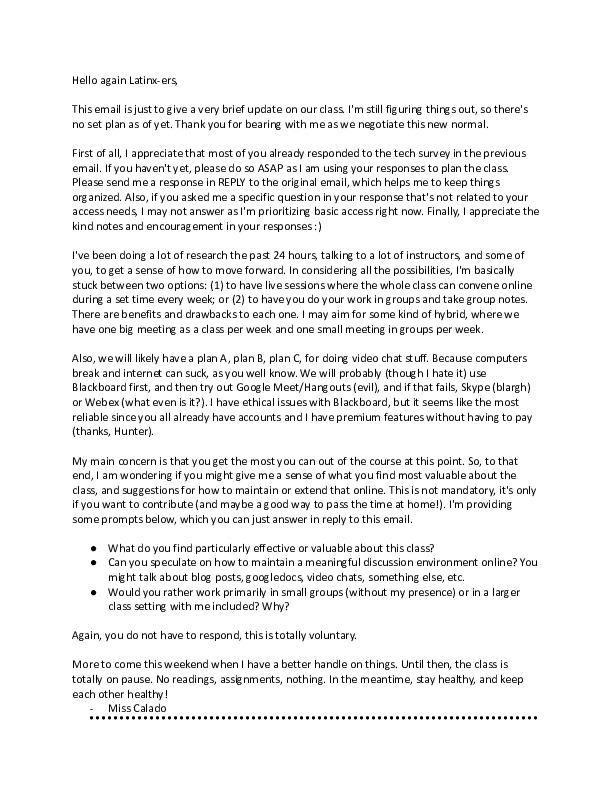
Hello again Latinx-ers,
This email is just to give a very brief update on our class. I'm still figuring things out, so there's
no set plan as of yet. Thank you for bearing with me as we negotiate this new normal.
First of all, | appreciate that most of you already responded to the tech survey in the previous
email. If you haven't yet, please do so ASAP as | am using your responses to plan the class.
Please send me a response in REPLY to the original email, which helps me to keep things
organized. Also, if you asked me a specific question in your response that's not related to your
access needs, | may not answer as I'm prioritizing basic access right now. Finally, | appreciate the
kind notes and encouragement in your responses :)
I've been doing a lot of research the past 24 hours, talking to a lot of instructors, and some of
you, to get a sense of how to move forward. In considering all the possibilities, I'm basically
stuck between two options: (1) to have live sessions where the whole class can convene online
during a set time every week; or (2) to have you do your work in groups and take group notes.
There are benefits and drawbacks to each one. | may aim for some kind of hybrid, where we
have one big meeting as a class per week and one small meeting in groups per week.
Also, we will likely have a plan A, plan B, plan C, for doing video chat stuff. Because computers
break and internet can suck, as you well know. We will probably (though | hate it) use
Blackboard first, and then try out Google Meet/Hangouts (evil), and if that fails, Skype (blargh)
or Webex (what even is it?). | have ethical issues with Blackboard, but it seems like the most
reliable since you all already have accounts and | have premium features without having to pay
(thanks, Hunter).
My main concern is that you get the most you can out of the course at this point. So, to that
end, | am wondering if you might give me a sense of what you find most valuable about the
class, and suggestions for how to maintain or extend that online. This is not mandatory, it's only
if you want to contribute (and maybe a good way to pass the time at home!). I'm providing
some prompts below, which you can just answer in reply to this email.
@ What do you find particularly effective or valuable about this class?
@ Can you speculate on how to maintain a meaningful discussion environment online? You
might talk about blog posts, googledocs, video chats, something else, etc.
e@ Would you rather work primarily in small groups (without my presence) or in a larger
class setting with me included? Why?
Again, you do not have to respond, this is totally voluntary.
More to come this weekend when | have a better handle on things. Until then, the class is
totally on pause. No readings, assignments, nothing. In the meantime, stay healthy, and keep
each other healthy!
- Miss Calado
Responses:
Hi Professor,
First off, I highly appreciate your individualized attention to this matter and your extended
efforts to include student input in this matter. I hope you are well and staying healthy, mentally
and physically, during this trying time.
Though I understand your aversion with BB, I do think it is the most efficient method to continue
the class through distance learning. I highly agree with the Hybrid method suggestion. I suggest
that we have a live in class discussion on Mondays (so people can do their presentations and we
can participate in group discussion) and group discussion about the text via BB on Thursdays (
we'd ideally submit our annotations like usual, if we feel comfortable share it on BB discussion
board to have a basis of discussion etc). I believe the discussion elements of our class were
essential to clarifying the context of the reading and were instrumental to prioritizing key points.
I believe this can best be achieved through the hybrid method.
The feature Blackboard Collate or Blackboard Collaboration ( I forget what it’s called) is what
most of my teachers are using to host live classes. In this outlet, there are a ton of features we can
take advantage like presentation ( so you can add files or attachments so the class can see and I
think you can present a working document and have a note taker contribute to it, or just have the
note taker add comments into the chat section and just copy and paste it to our class page) One of
my teachers did a dry run today for the live class during normal class session times today and I
found it really helpful to test it out with him and ask questions. I also believe we should host the
live class sessions during normal class time.
I hope this was helpful to you in any way!
Hi Professor,
| hope you can get a handle on things quickly. | found that the GoogleDocs note taking during
discussions was one of the most effective parts of our classes. It helps keep our ideas organized
and keep track of them just in case someone misses something during the lecture. | also wanted
to add that | have a Professor who had to do remote classes a week before this new
development and has been using https://zoom.us/ for lectures and a bit of discussion since the
class can see and hear each other. It wasn't that bad of a lecture experience for the class as a
whole and | thought maybe you should look into it. Good luck.
1. I like the lecture portion of the class because I may not understand a text fully until a
discussion starts and lectures get me thinking more.
2. I used discussion board on Blackboard for my previous courses and it was useful. Sometimes
we would reply to other students on discussion board threads too. Some online courses I took in
previous years used voice thread on blackboard I think.
3. Both methods work.
Thank you!
Dear Ms. Calado,
What I find valuable are the group discussions. I find it helpful to be able to listen to the
thoughts and opinions of my peers in order to gain a clearer understanding of the reading. I also
find your guidance valuable as well because sometimes I find the readings do a good job at
highlighting multiple intersectional problems but sometimes I have a harder time seeing the big
picture.
To keep online discussions interesting, maybe we should set aside a specific time, like a
hour window or something where we'd all have to be online so we could discuss readings in real
time on chat? Might be hard to decide on a time since everyone has conflicting schedules but it's
worth a shot.
I honestly don't have a problem with either option, though it goes back to the timing of when
the classes would be. Personally, I live with my parents who meet the age gap that put them more
in danger of the virus, especially my mom who already is susceptible to respiratory like colds
and infections. Being an only child, I would be the one to run errands for them. So if anything,
groups would probably the more realistic option in order to accommodate everyone with jobs
and obligations.
Hope this helps.
Hi Miss Calado,
I'm sad that we won't have class anymore ©) but I'd like to offer my thoughts on your
questions.
1. What I really enjoyed about this class was the discussion aspect of it. Sadly this won't be
as easy as it was before but hopefully we'll find a way to discuss the readings we had
been assigned. | enjoyed listening to my peers' personal anecdotes and thoughts on the
readings. As someone who is a Latina, | find this class to be really valuable because it's
somewhere where | can learn about other people like me and how their life experiences
are similar or different to mine. It's amazing to learn about just how much work on
latino people is out there. | just really liked being able to read the readings and then
come to class and discuss them. Sometimes we related to the things we learned about
and other times they were things we weren't even really aware of. Either way | genuinely
enjoyed the things we discussed.
2. Googledocs is definitely one of the easier ways to maintain a class discussion in the
sense that it helped me when | missed class or didn't quite understand something. |
could just go into the class googledoc and read the notes from that day. | don't think this
will work as well for a live discussion just because it's not always clear who said what or
what is currently being added or what has already been written a while ago. Some
suggestions are Skype, Zoom, Discord, etc. | don't know of too many and I'm not sure my
peers will have access to any of these. | do however feel that it will need to be live or at
least a way we can respond in real time to have a successful discussion. For a previous
online class we used nowcomment.com to talk about readings. The professor uploaded
documents and students could highlight key phrases/passages they felt were important
and other students could reply with their thoughts.
| would rather work in a larger class setting with you included because although |
understand the readings, some of them are dense and | need clarification. Sometimes
my classmates understand the readings and are able to clarify for me but sometimes
they aren't. | think | would just like to have the extra clarification if needed. | can work in
a smaller group, but my preference is a larger class setting.
Stay safe and thank you for a great class so far! | know it's your first time teaching this class and
this isn't making it any easier but | think you were doing great and I've really enjoyed the way
you teach and the class so far!
1) What I find particularly effective about this class is how detailed the assignments are and how
we go over each reading.
2) I think Google docs can help bring meaningful discussions, we just have to label who said
what in it.
3) I like working in small groups but I'm fine with a larger group.
1.
It's hard to say what I find most valuable about the class. Probably first and foremost is
the reading assignments since I've never read any of these texts before, so expanding my
horizons is a good thing. But very closely related to that is the class discussions of the
text. I learn much from my classmates because their experiences and perspectives are so
different from my own.
My husband is currently enrolled in an online Master's program from Georgia Tech. He
says that the most effective tool for discussion with his classmates is Slack. He also uses
Slack for effective communication with his coworkers, as their company is split between
NYC and San Francisco. He also notes that, unlike many other discussion tools, it is easy
to use on a phone, which is perhaps more accessible to many people. Both his program
and my master's program (which made the switch from on-campus to online while I was
in the middle of my program), have also used discussion forums. In my case, instructors
required us to post a certain number of times per week (usually once) and reply to others
a certain number of times per week (usually 2-3). Daniel Hengel does something similar
for one of his projects. The project has three cycles throughout the semester. Once a
semester, a student is required to post to the class's blog. (He uses Wordpress.) The next
day, everyone else has to respond to a post. The day after that, everyone has to response
to a response. So, 1/3 of the time an individual student is producing content. 2/3 of the
time he or she is engaging with content produced by others. A modified version of that
might be helpful in this kind of situation.
3. I think that a hybrid model that mixes video chats with you and small group work is best.
Students engage better in small groups, therefore internalizing the concepts more
effectively. However, the availability of an "expert" is also important for students to feel
that they are being guided, not necessarily just expected to teach themselves. Many
students feel overwhelmed or cheated if they have limited engagement with a professor.
Content delivery from professor to student can effectively take place asynchronously
(pre-recorded videos from the teacher), leaving synchronous online time for discussion or
questions/answers, both of which are crucial aspects of active learning. In some cases, it
might be advisable to measure in some way the students! grasps of material presented in
asynchronous videos to ensure that they're actually watching them. (In my experience
with a digital learning environment, I created quizzes created through Google Forms, but
short writing responses or something similar could also work effectively, similar to the
freewrites that you had us do in class.) Having some sort of asynchronous component is
probably important in a situation like this one. Not everyone will necessarily be able to
participate online at the appropriate time, even if they were previously available to be in
class at the same time. (For example, I was free during our class time because my son
was in preschool. But if the schools are shut down, my husband and I will have to
simultaneously deal with a 3-year-old with cabin fever while also working and studying
online in a relatively confined space. Though we would make every effort to prioritize
scheduled meetings, it is entirely conceivable that he would have a meeting scheduled at
the same time I had class discussion scheduled.) I would also note that it is much more
difficult for students to create community in small group discussions/projects online. It
would be an easier adjustment for students if you were to assign them to work with
people they already had discussions with in the classroom. To transfer group rapport
online is easier than to create it from scratch.
Sorry for the long answers, especially #3. My education training kicked in a bit for that question!
Whatever you decide will work fine for me. I have successfully managed online-only education
previously. Not all students can manage it as effectively, so I very much appreciate the challenge
you face in determining the best way forward.
I hope my perspective helps!
Thank you for such thoughtfulness in planning. Here are some responses to your questions...
e@ What do you find particularly effective or valuable about this class? | like how you
guide and push conversations. | also like how you introduce free writes for each class.
The questions that you ask are helpful in dissecting the text and sharing with partners
around us. And | like how you have particular sections of the reading that you have as
your goal to discuss. All of that makes the class interesting and alive.
@ Can you speculate on how to maintain a meaningful discussion environment online?
You might talk about blog posts, googledocs, video chats, something else, etc. |
wonder if, through googledocs, we could respond to a question or set of questions
that you ask based on the reading and then we are required to respond to a certain
number of others in the class. This gets students to pay attention to other comments.
e Would you rather work primarily in small groups (without my presence) or in a larger
class setting with me included? Why? | would prefer to work in a larger class setting
with you included because | like having your voice, knowledge/content background
and general direction steering the class. ©
* What do you find particularly effective or valuable about this class? -> The most important part
to me about this class is the different perspectives I get from a reading and how it could be
interpreted differently.
* Can you speculate on how to maintain a meaningful discussion environment online? You might
talk about blog posts, googledocs, video chats, something else, etc. -> I used to discussion posts
through blackboard and it was very useful, I am personally not a fan of video chatting because, I
would prefer blog/discussion posts.
* Would you rather work primarily in small groups (without my presence) or in a larger class
setting with me included? Why? -> Either or would work for me. As long as there is
communication amongst us (the students) and you.
Hope this helps a little :)
This email is just to give a very brief update on our class. I'm still figuring things out, so there's
no set plan as of yet. Thank you for bearing with me as we negotiate this new normal.
First of all, | appreciate that most of you already responded to the tech survey in the previous
email. If you haven't yet, please do so ASAP as | am using your responses to plan the class.
Please send me a response in REPLY to the original email, which helps me to keep things
organized. Also, if you asked me a specific question in your response that's not related to your
access needs, | may not answer as I'm prioritizing basic access right now. Finally, | appreciate the
kind notes and encouragement in your responses :)
I've been doing a lot of research the past 24 hours, talking to a lot of instructors, and some of
you, to get a sense of how to move forward. In considering all the possibilities, I'm basically
stuck between two options: (1) to have live sessions where the whole class can convene online
during a set time every week; or (2) to have you do your work in groups and take group notes.
There are benefits and drawbacks to each one. | may aim for some kind of hybrid, where we
have one big meeting as a class per week and one small meeting in groups per week.
Also, we will likely have a plan A, plan B, plan C, for doing video chat stuff. Because computers
break and internet can suck, as you well know. We will probably (though | hate it) use
Blackboard first, and then try out Google Meet/Hangouts (evil), and if that fails, Skype (blargh)
or Webex (what even is it?). | have ethical issues with Blackboard, but it seems like the most
reliable since you all already have accounts and | have premium features without having to pay
(thanks, Hunter).
My main concern is that you get the most you can out of the course at this point. So, to that
end, | am wondering if you might give me a sense of what you find most valuable about the
class, and suggestions for how to maintain or extend that online. This is not mandatory, it's only
if you want to contribute (and maybe a good way to pass the time at home!). I'm providing
some prompts below, which you can just answer in reply to this email.
@ What do you find particularly effective or valuable about this class?
@ Can you speculate on how to maintain a meaningful discussion environment online? You
might talk about blog posts, googledocs, video chats, something else, etc.
e@ Would you rather work primarily in small groups (without my presence) or in a larger
class setting with me included? Why?
Again, you do not have to respond, this is totally voluntary.
More to come this weekend when | have a better handle on things. Until then, the class is
totally on pause. No readings, assignments, nothing. In the meantime, stay healthy, and keep
each other healthy!
- Miss Calado
Responses:
Hi Professor,
First off, I highly appreciate your individualized attention to this matter and your extended
efforts to include student input in this matter. I hope you are well and staying healthy, mentally
and physically, during this trying time.
Though I understand your aversion with BB, I do think it is the most efficient method to continue
the class through distance learning. I highly agree with the Hybrid method suggestion. I suggest
that we have a live in class discussion on Mondays (so people can do their presentations and we
can participate in group discussion) and group discussion about the text via BB on Thursdays (
we'd ideally submit our annotations like usual, if we feel comfortable share it on BB discussion
board to have a basis of discussion etc). I believe the discussion elements of our class were
essential to clarifying the context of the reading and were instrumental to prioritizing key points.
I believe this can best be achieved through the hybrid method.
The feature Blackboard Collate or Blackboard Collaboration ( I forget what it’s called) is what
most of my teachers are using to host live classes. In this outlet, there are a ton of features we can
take advantage like presentation ( so you can add files or attachments so the class can see and I
think you can present a working document and have a note taker contribute to it, or just have the
note taker add comments into the chat section and just copy and paste it to our class page) One of
my teachers did a dry run today for the live class during normal class session times today and I
found it really helpful to test it out with him and ask questions. I also believe we should host the
live class sessions during normal class time.
I hope this was helpful to you in any way!
Hi Professor,
| hope you can get a handle on things quickly. | found that the GoogleDocs note taking during
discussions was one of the most effective parts of our classes. It helps keep our ideas organized
and keep track of them just in case someone misses something during the lecture. | also wanted
to add that | have a Professor who had to do remote classes a week before this new
development and has been using https://zoom.us/ for lectures and a bit of discussion since the
class can see and hear each other. It wasn't that bad of a lecture experience for the class as a
whole and | thought maybe you should look into it. Good luck.
1. I like the lecture portion of the class because I may not understand a text fully until a
discussion starts and lectures get me thinking more.
2. I used discussion board on Blackboard for my previous courses and it was useful. Sometimes
we would reply to other students on discussion board threads too. Some online courses I took in
previous years used voice thread on blackboard I think.
3. Both methods work.
Thank you!
Dear Ms. Calado,
What I find valuable are the group discussions. I find it helpful to be able to listen to the
thoughts and opinions of my peers in order to gain a clearer understanding of the reading. I also
find your guidance valuable as well because sometimes I find the readings do a good job at
highlighting multiple intersectional problems but sometimes I have a harder time seeing the big
picture.
To keep online discussions interesting, maybe we should set aside a specific time, like a
hour window or something where we'd all have to be online so we could discuss readings in real
time on chat? Might be hard to decide on a time since everyone has conflicting schedules but it's
worth a shot.
I honestly don't have a problem with either option, though it goes back to the timing of when
the classes would be. Personally, I live with my parents who meet the age gap that put them more
in danger of the virus, especially my mom who already is susceptible to respiratory like colds
and infections. Being an only child, I would be the one to run errands for them. So if anything,
groups would probably the more realistic option in order to accommodate everyone with jobs
and obligations.
Hope this helps.
Hi Miss Calado,
I'm sad that we won't have class anymore ©) but I'd like to offer my thoughts on your
questions.
1. What I really enjoyed about this class was the discussion aspect of it. Sadly this won't be
as easy as it was before but hopefully we'll find a way to discuss the readings we had
been assigned. | enjoyed listening to my peers' personal anecdotes and thoughts on the
readings. As someone who is a Latina, | find this class to be really valuable because it's
somewhere where | can learn about other people like me and how their life experiences
are similar or different to mine. It's amazing to learn about just how much work on
latino people is out there. | just really liked being able to read the readings and then
come to class and discuss them. Sometimes we related to the things we learned about
and other times they were things we weren't even really aware of. Either way | genuinely
enjoyed the things we discussed.
2. Googledocs is definitely one of the easier ways to maintain a class discussion in the
sense that it helped me when | missed class or didn't quite understand something. |
could just go into the class googledoc and read the notes from that day. | don't think this
will work as well for a live discussion just because it's not always clear who said what or
what is currently being added or what has already been written a while ago. Some
suggestions are Skype, Zoom, Discord, etc. | don't know of too many and I'm not sure my
peers will have access to any of these. | do however feel that it will need to be live or at
least a way we can respond in real time to have a successful discussion. For a previous
online class we used nowcomment.com to talk about readings. The professor uploaded
documents and students could highlight key phrases/passages they felt were important
and other students could reply with their thoughts.
| would rather work in a larger class setting with you included because although |
understand the readings, some of them are dense and | need clarification. Sometimes
my classmates understand the readings and are able to clarify for me but sometimes
they aren't. | think | would just like to have the extra clarification if needed. | can work in
a smaller group, but my preference is a larger class setting.
Stay safe and thank you for a great class so far! | know it's your first time teaching this class and
this isn't making it any easier but | think you were doing great and I've really enjoyed the way
you teach and the class so far!
1) What I find particularly effective about this class is how detailed the assignments are and how
we go over each reading.
2) I think Google docs can help bring meaningful discussions, we just have to label who said
what in it.
3) I like working in small groups but I'm fine with a larger group.
1.
It's hard to say what I find most valuable about the class. Probably first and foremost is
the reading assignments since I've never read any of these texts before, so expanding my
horizons is a good thing. But very closely related to that is the class discussions of the
text. I learn much from my classmates because their experiences and perspectives are so
different from my own.
My husband is currently enrolled in an online Master's program from Georgia Tech. He
says that the most effective tool for discussion with his classmates is Slack. He also uses
Slack for effective communication with his coworkers, as their company is split between
NYC and San Francisco. He also notes that, unlike many other discussion tools, it is easy
to use on a phone, which is perhaps more accessible to many people. Both his program
and my master's program (which made the switch from on-campus to online while I was
in the middle of my program), have also used discussion forums. In my case, instructors
required us to post a certain number of times per week (usually once) and reply to others
a certain number of times per week (usually 2-3). Daniel Hengel does something similar
for one of his projects. The project has three cycles throughout the semester. Once a
semester, a student is required to post to the class's blog. (He uses Wordpress.) The next
day, everyone else has to respond to a post. The day after that, everyone has to response
to a response. So, 1/3 of the time an individual student is producing content. 2/3 of the
time he or she is engaging with content produced by others. A modified version of that
might be helpful in this kind of situation.
3. I think that a hybrid model that mixes video chats with you and small group work is best.
Students engage better in small groups, therefore internalizing the concepts more
effectively. However, the availability of an "expert" is also important for students to feel
that they are being guided, not necessarily just expected to teach themselves. Many
students feel overwhelmed or cheated if they have limited engagement with a professor.
Content delivery from professor to student can effectively take place asynchronously
(pre-recorded videos from the teacher), leaving synchronous online time for discussion or
questions/answers, both of which are crucial aspects of active learning. In some cases, it
might be advisable to measure in some way the students! grasps of material presented in
asynchronous videos to ensure that they're actually watching them. (In my experience
with a digital learning environment, I created quizzes created through Google Forms, but
short writing responses or something similar could also work effectively, similar to the
freewrites that you had us do in class.) Having some sort of asynchronous component is
probably important in a situation like this one. Not everyone will necessarily be able to
participate online at the appropriate time, even if they were previously available to be in
class at the same time. (For example, I was free during our class time because my son
was in preschool. But if the schools are shut down, my husband and I will have to
simultaneously deal with a 3-year-old with cabin fever while also working and studying
online in a relatively confined space. Though we would make every effort to prioritize
scheduled meetings, it is entirely conceivable that he would have a meeting scheduled at
the same time I had class discussion scheduled.) I would also note that it is much more
difficult for students to create community in small group discussions/projects online. It
would be an easier adjustment for students if you were to assign them to work with
people they already had discussions with in the classroom. To transfer group rapport
online is easier than to create it from scratch.
Sorry for the long answers, especially #3. My education training kicked in a bit for that question!
Whatever you decide will work fine for me. I have successfully managed online-only education
previously. Not all students can manage it as effectively, so I very much appreciate the challenge
you face in determining the best way forward.
I hope my perspective helps!
Thank you for such thoughtfulness in planning. Here are some responses to your questions...
e@ What do you find particularly effective or valuable about this class? | like how you
guide and push conversations. | also like how you introduce free writes for each class.
The questions that you ask are helpful in dissecting the text and sharing with partners
around us. And | like how you have particular sections of the reading that you have as
your goal to discuss. All of that makes the class interesting and alive.
@ Can you speculate on how to maintain a meaningful discussion environment online?
You might talk about blog posts, googledocs, video chats, something else, etc. |
wonder if, through googledocs, we could respond to a question or set of questions
that you ask based on the reading and then we are required to respond to a certain
number of others in the class. This gets students to pay attention to other comments.
e Would you rather work primarily in small groups (without my presence) or in a larger
class setting with me included? Why? | would prefer to work in a larger class setting
with you included because | like having your voice, knowledge/content background
and general direction steering the class. ©
* What do you find particularly effective or valuable about this class? -> The most important part
to me about this class is the different perspectives I get from a reading and how it could be
interpreted differently.
* Can you speculate on how to maintain a meaningful discussion environment online? You might
talk about blog posts, googledocs, video chats, something else, etc. -> I used to discussion posts
through blackboard and it was very useful, I am personally not a fan of video chatting because, I
would prefer blog/discussion posts.
* Would you rather work primarily in small groups (without my presence) or in a larger class
setting with me included? Why? -> Either or would work for me. As long as there is
communication amongst us (the students) and you.
Hope this helps a little :)
Title
Email Chain with Students
Description
In this email exchange from early March 2020, an adjunct instructor discussed student needs and concerns with their Latinx Studies class regarding converting the course to an online format. These frank dialogues revealed how much course design relied upon student-instructor rapport. Through this artifact, we see the pertinent focuses of students and adjunct faculty at the onset of the switch to remote learning: compromises with technology platforms, desire for community, focuses on faculty communication.
This item is part of the City University of New York (CUNY) Distance Learning Archive, a group project developed as part of Prof. Matthew K. Gold's Spring 2020 Knowledge Infrastructures seminar in the Ph.D. Program in English at The Graduate Center, CUNY, in partnership with the Interactive Technology and Pedagogy Certificate Program. The project's goal was to resist or trouble the discourse of catastrophe around the shift to online learning caused by the COVID-19 pandemic by documenting the lived experiences of students, faculty, and staff across CUNY's 25 campuses. Further, the project wanted to document the moment of crisis response by taking a critical approach to educational technology.
This item is part of the City University of New York (CUNY) Distance Learning Archive, a group project developed as part of Prof. Matthew K. Gold's Spring 2020 Knowledge Infrastructures seminar in the Ph.D. Program in English at The Graduate Center, CUNY, in partnership with the Interactive Technology and Pedagogy Certificate Program. The project's goal was to resist or trouble the discourse of catastrophe around the shift to online learning caused by the COVID-19 pandemic by documenting the lived experiences of students, faculty, and staff across CUNY's 25 campuses. Further, the project wanted to document the moment of crisis response by taking a critical approach to educational technology.
Creator
Calado, Filipa
Date
March 2020
Language
English
Rights
Creative Commons Attribution
Source
CUNY Distance Learning Archive
Calado, Filipa. Letter. 2020. “Email Chain With Students”, 2020, CUNY DIGITAL HISTORY ARCHIVE, accessed September 5, 2026, https://stephenz.tailc22a4b.ts.net/s/cdha/item/1796