Covid-19 and the Escalating Mental Health Crisis among Bipoc and Immigrants
Item
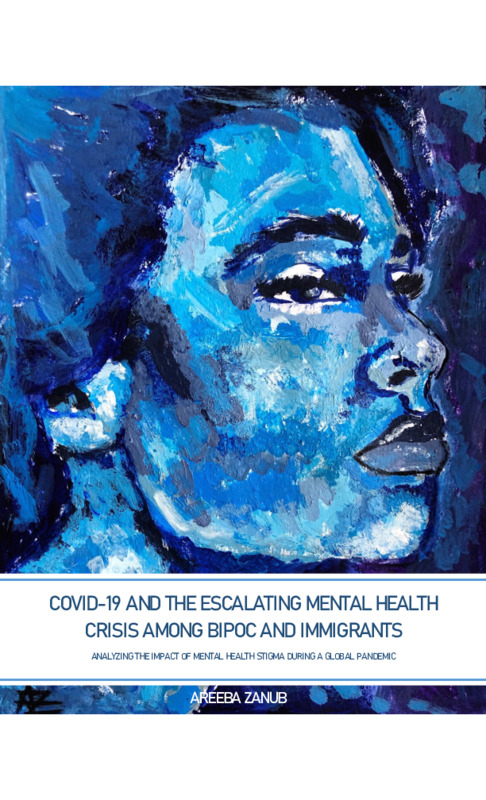
COVID-19 AND THE ESCALATING MENTAL HEALTH
CRISIS AMONG BIPOC AND IMMIGRANTS
ANALYZING THE IMPACT OF MENTAL HEALTH STIGMA DURING A GLOBAL PANDEMIC
COVID-19 AND THE ESCALATING
MENTAL HEALTH CRISIS AMONG
BIPOC AND IMMIGRANTS
ANALYZING THE IMPACT OF MENTAL HEALTH STIGMA DURING A GLOBAL PANDEMIC
AREEBA ZANUB
EXECUTIVE SUMMARY
The purpose of “COVID-19 and the Escalating Mental Health Crisis among BIPOC and
Immigrants” is to analyze the already existing socioeconomic conditions in BIPOC and
immigrant communities that perpetuate mental health stigma and are also causes for the rising
mental health crisis during the COVID-19 pandemic. The research project aims to investigate
generational trauma and its correlation to the pressurizing notion of the ‘essential worker,’ how
the silence of trauma creates stigma, and the lack of representation and affordable mental health
resources for low-income BIPOC and immigrants.
@Sg FTA 2 Fs PY
10.
11.
12.
13.
TABLE OF CONTENTS
I VaY e060 Ce! 6 C0) 0 an ne 6
Poem: “i remember the sky being so blue and the sun being so bright”............. 0... eceeeee ence eeeenee 7
ADXICLY. 00... e cece cee ce ence ne ene ence neces ene ene ene eneeneeneeteneeneeneensenseeseeuesssssscsisestesetsssesseeseese®
IO 628 00: 9
The Unspoken: Mental Health and the South-Asian Community...............eseseeseesteeee eeeeeeerreeeee LO
Defining and Exemplifying Generational Trauma..................ceceeeeceee eee ene tense ene eneneeeerees 12
The 1947 British India Partition and South-Asian Generational Trauma. ..............::sssseeceeeeeeteees 13
Generational Trauma, Expectations, and Stigma................e cece eee e eee ee eee ee ene eee ents ene eneneen en 16
8.1 Analyzing the Responses............cccccecec ec ee cece eee ee nee e eee cece ee nent nett eect sees eee tnee et eeeeeenen suas 19
A Brief Snapshot of Mental Healthcare for BIPOC and Immigrants....................eceeeee eee ee ees 20
SON BAY A 5,6 0161 0 (011 20
9.2 Data and Studies........ 0... ceeccec eee eec nec neeneec eee eenecceeeeeteeceeeeenseceeeeneceseeeeeceseneeeeeaeeneeeeenees 22
COVID-19 through the Framework of BIPOC and Immigrant Mental Health........................ 23
Mortality, Unemployment and Healthcare Systems during a Global Pandemic.............:ceeeeeeeees 25
The Mental Health of the Essential Worker............ 0... cceceececeee ec eee ee eneee eens eens eeneeeenenes 26
Findings and Conclusion. ...............e cece eee e cee ce ence nee eeceeee tne eneeneeneeeeeeeneeneeeeeneensneen en 31
Appendix: Methodology....................5. 32
Acknowledgements.................ecceeeeeees 40
Bibliography.................eccceeeeeee eee eees 41
1 INTRODUCTION
It still felt like March when May began.
After a while in quarantine with no social interaction, the days started to blend in; my
mind remained in darkness for most of them.
It was as if the loneliness caved in more and more every week that I did not step outside;
my anxiety worsening each week.
As the conditions of the COVID-19 pandemic worsened, so did the hopelessness and
uncertainty.
And I think that was the most terrifying thing—the uncertainty.
It was the uncertainty of my family members being able to work again and those who
were working, if they would remain safe.
The uncertainty of older family member’s health who were isolated and sick; who could
not take care of themselves.
The uncertainty of receiving and affording physical and mental healthcare in times when
both are most at risk.
I still feel uncertain about these things.
I still go through some of my days overthinking about the pandemic.
There is no uncertainty that there is a rising mental health crisis, especially for BIPOC
and immigrant communities.
However, retaining focus on mental healthcare disparities during a global pandemic
means investigating the discriminations that existed within conversations and fields of mental
healthcare prior because, that is where I and many other BIPOC and immigrant’s stories of
healthcare, socioeconomic pressures, mental health stigma, generational trauma, etc. begin.
2 i remember the sky being so blue and the sun being so bright
by Areeba Zanub
at 12: i awakened on the floor, a bright light emerged from the darkness.
my science teacher hovering over me: you fainted, it’s going to be okay.
this can't be happening right now, i hyperventilate.
at the hospital they make me follow a light: you had an anxiety attack.
my parents say: fhe ambulance, the emergency room, this Is going to cost us. eat more and may
then you'd stop being so weak.
at 15: i awakened on the floor, a bright light emerged from the darkness.
my math teacher hovering over me: we heard a loud bang, and you were on the floor. we called the
nurse.
this can’t be happening right now, i hear a laugh, i hyperventilate and it happens all over again.
the nurse walks in: do you want me to call your parents?
i say: no, / just need a few minutes to calm down.
i skip class the next day.
1 week later: my doctor refers me to a cardiologist; i mentioned how before i fainted my heart was
racing.
at the end, an intern at the cardiologist speaks: do you ever feel lonely? or nervous?
i dont know how to reply, no one has ever asked me this before. i don’t feel comfortable speaking
with my mom in the room.
the final verdict from dr. cardiologist. nothing is wrong with your heart. things like this happen—
maybe it was because your scarf on your head made you feel hot and you fainted from a hot flash?
still, nothing is wrong with your heart.
at 16: iam in my mosque praying. i shake asi rise from prayer; as i contemplate my existence. iam
overwhelmed and i collapse.
a brown woman in black, picks me up and says: where /s your mom?
isay: / don’t know, i just had an anxiety attack and fainted.
she: you are too young for that. no darling, it is because you are so slim, it makes you weak. come
on, eat something.
she drags me towards the food table.
at 18: in my college elevator, alone. i’m beginning to believe that i am being closed in and imagine
images of the elevator falling. no one can hear my screams. i hyperventilate.
it opens, thank God.
i ran to the first floor, onto the field towards the campus bench.
i awakened and the sun rays hit my eyes.
1 week later: at the community doctor’s office. i admire the Pakistani flag above the height chart. i
feel safe.
my mom leaves the room so ican speak to dr. community alone.
i say: /am struggling. | convince myself that {am dying, | know fam not but once the thought
emerges, it really feels like it.
my doctor: light chuckle, /t7// be over by your 20's. by the way, you are missing a few vaccines.
3 ANXIETY
From flashes of failure, shame, weakness, and trauma my body embedded the sensations I was
perceiving in those instances as conditions of danger. And when I encountered resemblances of
those physical sensations in unrelated moments, the same reactions I experienced during my
trauma would recur.
My body became a sensor of possible danger, always on high alert.
The heart race always came with an uncomfortable familiarity, I knew it so well that the
moment it would begin, I expected failure. The anxiety would eventually move from my heart
into my stomach, and then collapse into hypersensitivity.
Things would become too loud and pain would feel sharper.
My breathing would become harder to control—it felt like being backed onto the edge of
a cliff, until there was no room left—I would just fall and break down.
The aftermath was even more difficult as I felt extreme embarrassment and shame.
In this shame and embarrassment, the worries of having another anxiety attack would
begin looming. I became tormented by the sheer thought that pain is inevitable in life and that the
days aren’t certain before they've begun—that I could possibly encounter failure and wouldn't be
able to handle it when it came and the cycle would always continue.
However, the hardest thing is when you expect everyone to understand but instead you
are received with indifference; a plethora of psychological and emotional invalidation in forms
of backhanded advice, subtle disregard, or simple ignorance.
I expected this empathy from my Pakistani community but I was shown the latter.
4 STIGMA
I remember times when I would break down in tears from being anxious and being unable to
control my stream of negative thoughts, I was told by family that I was too sensitive; that I made
it difficult for myself, that I was ungrateful for my life.
How are you going to be able to SUrVIVE in the future?
You're going to miss out on life If you keep thinking that way.
Stop being so Wi eak, there are so many things you're going to have to go through.
And there were other times when I would desperately try to explain that deep down, I
know I can get through it, but every single part of me has convinced me that I cannot, and I was
told by friends that I was weak and overreacting.
Everyone has issues, your life is better than others. You're ungrateful.
Stop complaining all the time, you bring this negative energy to yourself.
It’s always some new problem with you.
And the time when I was seeing my community doctor for a checkup, I built up the
courage to ask for help, surely a doctor would understand, so I began trying to explain to her that
my anxiety was exhausting and debilitating—I was told that I would grow out of it in my 20s and
it was just a phase.
And because of invalidating instances like these, for a long time I refrained from sharing
my emotional experiences with members of my community.
9 THE UNSPOKEN: MENTAL HEALTH & THE
SOUTH-ASIAN COMMUNITY
The disappointment was hard to bear for it was my community where I first searched for comfort
and validation for my mental health because of the way I saw mosques filled with hugs and
kisses, community gatherings filled with the benevolence of strangers who despite not knowing
each other, knew each other. We were family as we were bound by the same national roots and
all congregated in a foreign land, trying to make a home. We understood each other's struggles
and often shared similar stories of Pakistan and immigrating to New York. In times of physical
sickness, we would pray for each other, offer aid and support.
Community felt like “a dance of strangers in my blood,” for Fatimah Asghar describes it
best in her poem “If They Should Come for Us, “my people my people I can’t be lost/when I see
you my compass/is brown & gold & blood...for the fire my people my people/the long years
we’ve survived” (Asghar).
My people, I have always thought them strong, for they are—they have endured the pain
and suffering of partition, immigration, economic struggle, and loss and still came out of it alive.
Still, I feel there is something missing in our conversations of generational struggle, suffering
and resilience: the proper awareness, the acknowledgement, or even the conversation of mental
health—I’m speaking about the unspoken.
I’m speaking about the countless number of Brown children whose mental health have
gone unnoticed or have been neglected, who've been left undiagnosed and then, untreated.
I'm speaking about the countless number of Brown women who were abused for years
under their own roof, the same ones who were neglected and shamed, who were told to stay quiet
because what will people say?
I'm speaking about the countless number of Brown fathers, homesick and lonely in their
empty American apartments, counting the days until their wife and children are granted visas, the
same ones who were told that tears on a man are a sign of weakness.
I’m speaking about the older generation, the ones who fled during the 1947 British India
Partition, the ones who witnessed massacres, rape and famine, the ones who didn’t process
trauma in their lifetimes amidst all the fight for their land and freedom, the ones who were forced
to live with it and then struggled to explain their sorrow to their children.
I’m speaking about the lack of connection and trust, the unresolved trauma and
generational pain, and the ideologies formed from pain that become embedded in our
worldviews—that we must be strong.
I’m speaking about this because it is bigger than my own mental health being
disregarded, as I have come to realize our neglect of our own generational trauma is our biggest
barrier of speaking about mental health without stigmatization.
10
ean / osatanetae
wd Fire ne
Areeba Zanub, ‘my people my people,’ 2019 Photograph.*
*| took these photographs in Wadi-us-Salaam (Valley of Peace), Iraq; the largest cemetery in the world. | went to
Iraq in 2019 on a group trip with families from my mosque--we got to see where our lineage originates from
alongside the traumatic history of our people.
11
6 DEFINING AND EXEMPLIFYING
GENERATIONAL TRAUMA
Generational trauma is rooted from traumatic experiences that have manifested behavioral
disorders. These emotional and social behavioral disorders that are rooted from this trauma are
passed down (Zurich). Studies have shown that epigenetics play a role in trauma as well, as
trauma can leave a chemical mark on genes and alter the mechanisms of functioning proteins
(Carey).
“The Legacy of Trauma” by Tori DeAngelis for the American Psychological Association
discusses Professor Brent Bezo’s study on generational trauma in Ukrainian children and the
effects that this trauma manifested in social and emotional behaviors:
People spontaneously shared what they saw as transgenerational impacts
from that time, including risky health behaviors, anxiety and shame, food hoarding,
overeating, authoritarian parenting styles, high emotional neediness on the part of
parents and low community trust and cohesiveness—what many described as living
in “survival mode” (Social Science & Medicine, Vol. 134, 2015). “Each generation
seemed to kind of learn from the previous one, with survivors telling children, ‘Don’t
trust others, don’t trust the world,’” says Bezo. (DeAngelis)
In Stephanie C. Jones’ dissertation “Being Black and Depressed Double Sucks,” Jones
states that the National Alliance for Mental IIIness (NAMI) found that Black Americans
perceptions of mental illness as negative are traced back to “slavery, during which Black
communities were conditioned to swallow their emotions and hold generational burdens of
secrets, lies, and shame. Avoiding emotions was a survival technique, which has now become a
cultural custom for Black Americans and a subsequent obstacle to dealing with depression”
(Jones). Jones states Black people may show shame in the face of these perceived negative
emotions and thus, avoid them.
Another example is that of Cambodians fleeing from the Khmer Rouge. Cambodians
endured violence, starvation, rape, familial seperation, etc. However, many Cambodian refugees
avoided speaking about their traumatic experiences, creating a transgenerational trauma from the
silence and the refusal to confront pain and seek treatment. These behaviors are reflected through
the transmission of PTSD from Cambodian parents to Cambodian children (Lin, et al.)
“‘Intergenerational trauma can negatively impact families as a result of:
Unresolved emotions and thoughts about a traumatic event
Negative repeated patterns of behavior including beliefs about parenting
Untreated or poorly treated substance abuse or severe mental illness
Poor parent-child relationships and emotional attachment
Complicated personality traits or personality disorder
Content attitude with the ways things are within the family” (Hill)
SOK wWNH™
12
7 THE1947 BRITISH INDIA PARTITION AND
SOUTH ASIAN GENERATIONAL TRAUMA
The 1947 Partition Archives document the oral histories and memories of those who witnessed
the 1947 British India Partition:
“The sharing of lived memories over social media, millions of times has helped create a ‘critical
mass’ acknowledgement of the human suffering that resulted from Partition. As a result, we
are watching a change in the tide of public consciousness. We are watching as memories of
Partition are becoming accepted in the mainstream and drawing attention from popular
filmmakers, media makers, news organizations and educators” (1947 Partition Archives)
The 1947 Partition Archives are important as they reflect millions of other stories that are
unspoken and untold by South-Asians. I have collected some of the descriptions of these stories
of war, famine, bloodshed, etc. from The 1947 Partition Archives’ oral histories to reflect how
dire the need for therapeutic conversation and representation of the South-Asian past and
collective consciousness is in order to the prevent the cycle of silence that leads to stigmatization
from continuing.
“More than the love for my birthplace, | have fear of it. | can never forget those awful days of
Partition.”
—Oral history with Taj Begum, 2017 February 6.
“She put all three children in the family jeep and they headed for Amritsar.On the journey, Mrs.
Vikram Singh saw the dead lying in ditches along the road and floating in the canals. She clearly
remembers the limbs of the butchered bodies. Even now, she says, the images are vivid. Her
mother tried to cover her daughter's eyes with her dupatta to protect her from the scenes.”
—Oral history with Baljit Dhillon Vikram Singh, 2016 January 1.
“Taji believes that the generation today is suffering from a culture of individualized lifestyles.
“The isolation and the restlessness we have comes from that culture. We need to bring back the
days when it was considered normal for people in one mohallah to get together in one place and
share their happiness and sorrows like a joint family system.”On nostalgia concerning their
childhood at Amritsar, they say: “There is nothing compared to memories of one’s birthplace,
the home one grows up in, and friends from the mohallah one used to play with. No one wants
to be forced out of their houses all of sudden. The pain of losing home is unbearable, especially
when we really had no choice in the matter. It makes me very sad to think of our lost childhood,
even today.”
—Oral history with Mai Taji, 2016 January 16.
“Chopra recalls seeing young girls throwing themselves into wells to protect their honor, and
seeing dead bodies strewn along the train tracks. Once they arrived at Ferozepur, Ravi and his
family spent ten nights in a refugee camps, where there was no hygiene, and life was
miserable...Today, Ravi has still not been able to go back to his home in Pakistan,”
—Oral history with Ravinder Kumar Chopra, 2011 April 2.
“Many other nations had situations like ours, but no blood shed like the one we saw, half a
million lost lives. It’s hard to imagine how neighbors living next to each other became enemies,
we became like animals, | saw people being killed, houses being burned, bodies of the people
flowing in the canals and people being shot in trains.” He saw this happen everywhere, in
Punjab and it was a horrible scene. He says that he saw ladies weeping and men being killed on
the streets of Patiala and that “one can’t imagine how a human can be so wild.”
—Oral history with Sardar Tarlochan Singh, 2012 January 15.
14
Areeba Zanub, Generational Burnout, 2020, Prismacolor colored pencils on paper.
8 GENERATIONAL TRAUMA, EXPECTATIONS
AND STIGMA
BIPOC and immigrants who struggle with mental health disorders struggle with label avoidance.
Label avoidance in relation to mental health stigma is that many who struggle with mental health
fear being perceived as weak or in a negative manner if we publicly speak up about it (Ciftci).
This very fear for BIPOC and immigrants who struggle with their mental health is rooted from
being seen as weak in a society whose expectations formed from generational trauma from
poverty, war, discrimination, etc. rely heavily on the usefulness of an individual—if they are able
to work, be successful members and survive (American Psychiatric Association).
“Survival, expectations, and employment” by Baran et al. collected data on the lived
experience of refugees and immigrants within the United States, the data showed that many of
these communities have a “complex trajectory of expectations, adversity, turning points, and
status changes as refugees attempt to “make it” in the United States” (Baran et al.). The pressure
of culturally normative expectations of socioeconomic prosperity for immigrants once they reach
the United States hinders these individuals from confronting their pain, as their mental health
issues might go against their expected strength.
Consequently, stigma is part of what makes mental health related issues more long-
lasting because it works alongside socioeconomic factors and prevents these individuals from
coping more so, believing that their mental health matters (DHHS). Stigma discredits a lived
experience through silence and thus, makes that experience complex as the individual then
begins resisting the confrontation of their own trauma. This continues the cycle of silence and
repression, leading to negative behavioral complexities becoming cultural norms like the lack of
trust and expectations of raising solely strong individuals.
Stephanie C. Jones’ dissertation “Being Black and Depressed Double Sucks” researches
mental health stigma for Black people. Jones finds that Black people, more than white and
Latinx, isolate themselves from those who outwardly displayed symptoms of their mental health
issues, “out of fear of being stigmatized because of proximity” (Jones). Similarly, a study
conducted by Deepa Rao, Joseph Feinglass, and Patrick Corrigan, “Racial and ethnic disparities
in mental illness stigma” found that Black people and Asian people perceived those with mental
illness as more dangerous and consequently had more stigma for them. Rao et al. also found that
those who feared stigmatization feared receiving it from members of their own community rather
than other races (Rao, et al.).
16
To further exemplify personal experience of BIPOC and immigrant individuals, I
surveyed a few who identify with these communities and have struggled with mental health
stigma.
“| believe my community does not acknowledge mental health related issues...! believe this
because for years the people of the Dominican community (at least the older people in my
family) have trouble grasping the fact that their kids and grandkids can have such a thing as
anxiety, depression, etc. It’s like they know what it is but they just brush it off”
—Lailah, 20, Brooklyn, NY
“As a Muslim-Albanian | have struggled discussing mental health issues with family members.
As far as they were concerned it was just me being a teenagerv...! have felt scared and shamed.
As a person who seeked therapy due to the worsening of my mental health, | was constantly
told | don’t need it and that I’m overreacting. Despite clear signs of anxiety and depression | was
always brushed off and blamed for the downward spiral of my illnesses.”
—Anonymous #1, 20, Brooklyn, NY
“There are people who can speak up, but there is a majority of people who are afraid to. This is
because they feel like they won't be understood. Most people will assume that someone is just
having a “bad day...” I’ve had times in my life where I’ve felt unsure about speaking up about
what I’m feeling inside... There were people who used to tell me that it's just a passing phase
and I'll get over it.”
—Anonymous #2, 20, NY
“| do feel that my community does not acknowledge mental health issues. | think that it comes
from our parents not having someone who to talk to about their mental health issues so they
tend to ignore ours. Living in a predominantly Hispanic community, we tend to ignore our
feelings because there are a lot more problems to worry about it...| have felt ashamed to talk
about my emotional wellbeing because not everyone within my community takes mental health
issues seriously or thinks that you are victimizing yourself. | have talked to my parents about my
mental health and | am lucky enough to say that they understand and are looking for the best
ways to help me. But if | go to anyone else like an aunt, uncle, or an older family friend, they
would laugh or say that our generation is weak minded...”
—Jacqueline, 20, Brooklyn, NY
“| attended private schools contained within my own community for elementary and high
schools and received almost no education on mental illness or any such matters. | believe my
community does have resources—particularly therapy—available to those who need it, but |
personally was never able to even identify if | was struggling with a mental illness because it
was and is not something that we spoke about and thus | was severely lacking in adequate
knowledge on the matter...Mostly, in my experience, people regard mental health as an
exaggeration. If you are depressed you are just sad and implicitly weak. If you have OCD,
organized and perhaps paranoid and implicitly weak, though no one would tell you they think
17
you are weak. Suicidal thoughts are unheard of; self-harm is unheard of. | have never met or
heard of amember of my community struggling with mental illness to this extent, which does
not surprise me because exposure on such matters can harm an individual's chances to marry
well (a prominent concern for many of my friends and relatives).”
—Anonymous #3, 20, Brooklyn, NY
18
8.1 ANALYZING THE RESPONSES
What I learned from these responses is that immigrant and BIPOC communities know about the
existence of mental disorders such as depression and anxiety, as they are common. But the lack
of overall conversations and openness about mental health hinders them from broadening this
scope and accepting the existence of other mental disorders. Yet, the respondents that identified
depression and anxiety as something they have struggled with, still felt that their mental health
was brushed off and seen as trivial, an “overreaction” as Anonymous #1 says, “ I was constantly
told I don’t need it [therapy] and that I’m overreacting.” This is similar to Jacqueline’s response,
“not everyone within my community takes mental health issues seriously or thinks that you are
victimizing yourself.”
To begin serious conversations about mental health in our communities, we must accept
that mental health disorders exist and that every experience for every individual is unique, like
responses to traumatic events. But, this uniqueness does not diminish the importance for
acknowledgment.
From my own cultural experience in the South-Asian community, mental illness is
sometimes perceived as a passing phase that can be subdued easily if one is continuously hopeful
and willing. This perception is harmful as various mental health disorders diminish feelings of
hope and confidence in overcoming one's struggles. Furthermore, this perception can lead a
person who is struggling with mental health issues into self-blaming practices and doubts in their
own mental strength and abilities. These ways of thinking about mental health further
perpetuates stigma in receiving proper treatment as it hinders individuals from truly believing
that their mental health issues need to be addressed.
Areeba Zanub, Lineal Boundaries, 2020, Acrylic on paper.
19
9 ABRIEF SNAPSHOT OF MENTAL
HEALTHCARE FOR BIPOC & IMMIGRANTS
The larger issue that is reflective of this lack of knowledge of mental health within BIPOC and
immigrant communities, is the lack of access to affordable mental healthcare services (Sorkin et.
al.) as well as the lack of representation and resources that are inclusive of BIPOC and
immigrants and their intersectionality.
9.1 MY EXPERIENCE
I was not able to afford therapy until I was in my second year of college (before the COVID-19
pandemic). Before this, I would use school based counseling centers. However, the experience of
being culturally misunderstood remained the same for both my school counselors and my
experience with therapy outside of school.
Overall, I felt that my school counselors regarded teenage mental health issues as passing
phases that were due to us still maturing; mental health issues were not taken as seriously as they
should have been. The first time I was sent to a counselor was in middle school, my parents were
called up because my counselor felt that I had anger issues. Instead of working with me through
them, my counselor critiqued the way I was raised to my father. She never spoke to me again or
followed up on why I was so angry—in fact I was struggling and was full of resentment during
that time.
In high school, I was reported to a guidance counselor by a teacher because I wrote about
my experiences with depression in a personal narrative essay. The guidance counselor asked me
about my experiences; if I still struggle with those things. She ended up giving me a piece of
paper with a list of recommendations of psychologists near my area—all of which I could not
afford. I told her my insurance would not cover for these psychologists, so she referred me to the
school social worker/student counselor. I feared being honest with him about what I was actually
going through because my parents did not know that I was seeing a student counselor and I
didn’t want to say anything that would make him call my parents.
I still continued seeing him despite this fear. Often times he would forget my name, I
understand that he probably had a lot of students he would speak to but confusing my name,
Areeba, with other Muslim-girl names like Fatima just didn’t sit right with me. It also made me
feel like he was not actually listening to what I was saying sincerely. In fact, a lot of assumptions
would be made about my identity or what I was struggling with. He would assume that I was
dealing with racism directed towards me and that was the reason why I needed counseling and
was sent to him—I wasn’t struggling with racism at the time at all, nor did I bring this up in any
of our meetings myself. My counselor would also make assumptions of my lived experience
20
through negative stereotypes about Muslim and Brown women—that I am oppressed at home
because of my religion (he would often times give motivational speeches about breaking free
from my religion and culture). After that I began feeling more uncomfortable than I had ever
been so I just stopped showing up and emailed my guidance counselor that I no longer needed
counseling and that I am fine.
In my first year of college, I reached a breaking point with my mental health, during this
time I was able to afford a therapist outside of school counseling centers. However, I had a
similar experience with being misunderstood, but this time my cultural foundations were rejected
as valid truths. I would try to explain certain parts of my culture, why I can/can’t do certain
things or why I view the world the way I do. I would be told that it was ridiculous or to not
include these aspects (my religious and cultural views) in making decisions, when in reality they
were inherent to my life’s circumstances; opportunities, relationships, values, familial
connections, etc.
Consequently, finding a balance between a therapist who is inclusive of my cultural and
religious truths while also validating my mental health is hard because there really aren’t that
many people that look like me in mental healthcare fields or therapists that understand where I
am coming from culturally.
the stigma of exposing family secrets or accessing mental health resources, the lack of a
language for ‘trauma’ or a lack of access to trauma treatment resources, and the pressures
of a new work/family balance that limit the time available to ‘sit’ with one’s own grief.”
(Ellefsen)
It is apparent that the healthcare system is inherently built on racial bias through
decisions made for BIPOC individuals being driven by conscious and unconscious ways of
thinking, as well as, systemic factors like the healthcare system not being inclusive to the needs
of BIPOC patients—innately rooted from structurally racist histories of wellness systems.
“Race-based exclusion from health, educational, social, and economic resources,
translates into socioeconomic disparities experienced by Black and African American
people today. Socioeconomic status, in turn, is linked to mental health: people who are
impoverished, homeless, incarcerated, or have substance use problems are at higher risk
for poor mental health.” (MHA)
BIPOC and immigrants are more likely to live in low-income neighbourhoods with less
access to healthcare and healthier food; they have higher rates of chronic conditions with less
resources to treat them—factors that are part of the worse health outcomes for BIPOC and
factors that take a toll on the mental wellbeing for BIPOC and immigrants.
“The non-profit think tank The Aspen Institute defines this [structural racism] as 'a system in
which public policies, institutional practices, cultural representations, and other norms work in
various, often reinforcing ways to perpetuate racial group inequity' — with or without intentional
bias on the part of individual participants” (Igmen, Zuckerman)
21
9.2 DATA AND STUDIES
e Kaiser Health News outlines data collected from data taken from 37
million individuals in all 50 states of the US with commercial PPO health
insurance, they found that spending for substance abuse treatment was
only 0.9% of total health care spending (2017) and for mental health
treatment it was only 2.4%.
e Inthe National Comorbidity Study, 47% of respondents with mood,
substance-use, and/or anxiety disorder who believed they would benefit
from mental health care told the NCS that they did not have health
insurance as the reason for not receiving care (Sareen et al).
e “The Agency for Healthcare Research and Quality (AHRQ) reports that
racial and ethnic minority groups in the U.S. are less likely to have access
to mental health services, less likely to use community mental health
services, more likely to use emergency departments, and more likely to
receive lower-quality care.” (AHA)
e The CDC notes in Health Equity Considerations and Racial and Ethnic
Minority Groups that racial and ethnic minority groups are more likely to
be uninsured than non-Hispanic whites. What amplifies this lack of
unaffordability is the economic issues that surrounds healthcare such as,
transportation, childcare, work vacations as well as social issues like
language bariers, cultural differences between patients and providers,
and historical and current discrimination in healthcare systems. (CDC)
e The American Psychological Association notes in data taken in 2015 that
86 percent of psychologists in the U.S workforce were white, 5% Asian,
5% Hispanic, 4% Black/African-American and 1% as multiracial or other
racial/ethnic groups (Luona et. al.). Without proper representation of
racial/ethnic groups in therapeutic environments, patients can feel a lack
of relation and have lower retention rates in therapy (R.C. Kessler et al.)
22
10 COVID-19 THROUGH THE FRAMEWORK OF
BIPOC & IMMIGRANT MENTAL HEALTH
BIPOC and immigrants have higher rates of trauma and persisting mental health related issues
due the prevalence of socioeconomic tensions like immigration, lack of healthcare,
unemployment, discrimination, generational trauma, etc. As a consequence, psychopathology
rates are as high as 40% in low-income BIPOC neighbourhoods (Jones, et al.).
The reason why the conversation about mental health care is important now more than
ever is because the way we handle trauma from COVID- 19—our resilience—is innately
impacted by the way mental health stigma functioned within our communities prior to the
pandemic; innately rooted from unhealed generational trauma which formed the expectations for
BIPOC and immigrant workers and also the systemic racial inequalities of healthcare.
“a
cw o>
Te
ay
~~
_—
Vd
Areeba Zanub, 7urn the Other Cheek, 2020, Acrylic stencil on paper.
23
Has the COVID-19 pandemic impacted your mental well-being in a negative way? You
may choose to elaborate or further describe how and why.
“The pandemic has impacted my mental health deeply. Before the quarantine | had stopped
going to therapy and stopped taking medication because | thought | didn’t need it, not because |
felt better, but because I’ve been told by people who are not professionals that | don't need
them, and | believed them. Being stuck at home has caused me to go through spirals. Some days
I’ll be really happy and some days | can’t get out of bed and | just cry all day. “
—Lailah, 20, Brooklyn, NY
“Yes, | used school and seeing friends as a distraction from my mental health. Being stuck home
has forced me to face my demons, and temporarily made my mental health worse.”
—Anonymous #1, 20, Brooklyn, NY
“| don’t think the pandemic impacted my mental well-being, but it has made me feel nervous
and unsafe. | feel like going out is a risk, but staying at home all day is a bigger risk. | do like my
peace at home, but there’s only so much you can do. When you’re alone, it just leaves your mind
to wander.”
—Anonymous #2, 20, NY
“| think the COVID-19 pandemic did impact my well being in a negative way because | felt that |
had all this free time to do more than what | usually do. | think we all completely forgot the fact
that we were in the middle of a pandemic and it’s okay to not feel okay and to want to rest.”
—Jacqueline, 20, Brooklyn, NY
“Certainly. The feeling of enclosure in an anxiety/panic attack waiting to happen. The absence
of routine or even the ability to engage in an external routine is concerning. The apocalyptic
warping of norms feels alien and terrifying. The deaths, the gloomy unpredictability, the political
helplessness, the economic catastrophe—the mood is extremely upsetting.”
—Anonymous #3, 20, Brooklyn, NY
24
11 MORTALITY, UNEMPLOYMENT AND
HEALTHCARE SYSTEMS DURING A GLOBAL
PANDEMIC
Though stress, anxiety, depression and all around mental deterioration during the pandemic is a
normal response to the isolative effects of quarantine, constant circulation of death tolls and,
fearful media headlines, the stress will hit harder in BIPOC and immigrant communities. This is
due to the fact that the COVID-19 pandemic has amplified the already existing systemic racial
inequalities—the poverty levels, the lack of resources in low-income BIPOC communities, the
lack of healthcare, etc.
The conditions of higher mortality and higher unemployment rates, as well as, being
more prone to the economic, social, political, and physiological effects of COVID-19, the
negative impacts on mental health and levels of depression and anxiety amplify for BIPOC and
immigrants.
To add on to the pressure, mental healthcare is currently halted as access to both
pharmacological and psychological mental healthcare treatments has become disrupted in
BIPOC and immigrant communities, and because of isolation many who have previously dealt
with loneliness because of immigration, adjustment issues, discrimination and, mental health
disorders have felt it increase (Rothman, et. al., 2020)—further provoking the long-term mental
health consequences from the pandemic (Vinkers et al.).
As a consequence of this inequality of proper treatment, prevention, and protection from
infection for BIPOC and immigrants, the rates for COVID-19 fatalities are highest among these
communities, specifically, Hispanic and Black communities in New York State and the United
States as a whole. According to the New York State Department of Health, the preliminary data
for racial disparities amongst confirmed cases in New York City shows that Hispanics make up
34% of coronavirus deaths (29% of population) and Black people make up 28% of deaths (22%
of population) (NYCDOHMH). In the United States as a whole, the CDC notes that
hospitalization rates due to COVID-19 are highest among highest among non-Hispanic
American Indian or Alaska Native and non-Hispanic Black persons, then by Hispanic or Latino
persons (CDC).
"The racial disparities that remain in society and in systems of care, including lack of access to mental
health services in BIPOC communities, must be not only recognized but also addressed with solutions,
especially during the COVID-19...If the barriers that BIPOC communities encounter are considered in a
mental health framework, it would lead to more effective outcomes,"
-- Debra L. Wentz, PhD, President and CEO of the New Jersey Association of Mental Health and
Addiction Agencies, Inc. (NJAMHAA)
25
12 THE MENTAL HEALTH OF THE ESSENTIAL
WORKER
BIPOC and immigrants have always been the backbone of the United States. Before the
pandemic we were expected to maintain and prosper communities—anything less was a sign of
weakness—as our generational trauma has often caused us to repress our pain and embody only
strength in the face of pain.
Qualitative research collected by Hammonds and Kerrissey in “A Survey of Essential
Workers’ Safety and Security During COVID-19” records the responses of essential
workers in response to stress:
“Shoppers are becoming more belligerent and less friendly. | cry almost every shift. Please be
kind to retail workers.”
“We're overloaded with customers, but we're trying our best. We're exhausted — essential feels
a lot like sacrificial.”
“We are all feeling burned out.”
“| just want a day off. I’m tired.”
“Wish customers knew how hard we are trying and how stressed we are. I’ve had a couple of
days that I’ve gone home and just cried the whole way home because | am so stressed and just
keep getting yelled at and have people take their frustrations out on me day after day...”
“None of us signed up for this. Yes, we are healthcare workers and of course we will take care of
these patients because we are healthCARE workers. But this is very different, it is uncertain, and
it is scary. The hospital calls us “heroes” yet apparently doesn’t think we deserve hazard pay.
Our sacrifices, coming into work everyday to a Covid positive unit, uncertain of what effect this
will have on us/our family - seems to be undervalued and underappreciated. As if just because
we’re healthcare workers, we’re automatically expected to do this. Expected to put any concern
for ourselves and our families aside. And because we’re “expected” to do this, we don’t deserve
hazard pay or proper compensation. This doesn’t just take a physical toll; this isn’t only
physically exhausting. This job has become emotionally and mentally draining-- we are getting
burned out at an increasing rate”
(Hammonds, Kerrissey)
26
A survey | conducted among 3 essential workers and their experiences; “Has being an
essential worker during COVID-19 impacted your mental wellbeing?”
“| only worked the weekends and every weekend | would have to go in at 6am and constantly
clean my area which | didn’t mind at all but | ALWAYS had to clean because of the customers
didn’t think it was clean they would complain and hassle me about it. And | guess because of the
pandemic, the customers are super antsy and restless so | guess that makes them extra rude
and impatient because if | took too long making their order | would for sure hear about it and
constantly being told I’m taking too long and being yelled at by customers made my anxiety
worse cause after a while | would just try to finish everything as fast as | can and because Home
Depot was one of the few businesses open during the earlier months when Covid hit so there
would be SO many people coming in and out of the store and | usually opened by myself so |
would take the customers’ orders and do them myself for bourse before someone else clocked in
so | wouldn’t have time to go to the bathroom or drink water and it would stress me out so
much. Also, because there would be so much people, some customers thought they could get
away with taking of their masks and not being held accountable and | was told that whenever |
see someone without a mask | would have to stop them and give them one that we had in a box
under the paint desk and some of them would get so mad and | would have to straight up argue
with them and that was always so exhausting cause like | can argue about it with them in a
“nice way” sort of like obviously | couldn’t scream at them or anything because | would get in a
lot of trouble so | would have some man or woman screaming in my face while I’m trying to
calmly tell them that they need to wear their mask or I’m going to have to get someone to kick
them out of the store and being yelled at gives me so much anxiety it gets bad so | would come
home and have a little panic attack before | do anything else. also management wouldn’t let me
sit down at all during my shift until i had a break so | got blisters on my feet so when I got home
| would be so unproductive and | would just lay in bed and when | lay in bed | THINK and it
makes my mental health so much worse because | would constantly think about the day”
—Lailah, 20, Brooklyn, NY
27
Has being an essential worker during COVID-19 impacted your mental wellbeing?
(cont.)
“During the COVID-19 outbreak, the severity of the virus had impacted my life and those close to
me. With no work being available we all had to apply for unemployment, myself and my
mother. It got us by but with no work we were keeping busy at home, and only went out for
necessities we needed for the house. Not being able to see loved ones made me nervous for
their health, and made me worried about potentially being a carrier for the virus and not
knowing about it. It was hard to find stuff to do at home, being inside all day can really make
you feel cooped up and flustered. Once | did return to work, | found myself being very paranoid
every day. Worried about coming into contact with someone who is sick, especially working so
close to body parts all day long. As soon as I’d get home I’d throw off my uniform and shower,
worried that | might spread bacteria around. I’ve also found that I’ve been cleaning obsessively
at work, as part of the new policy, and for my own wellbeing. It is a lot to handle sometimes. But
being able to work again has made my mind calm down a bit. COVID-19 is not over yet, which
still keeps me concerned.”
—Anonymous #2, 20, NY
“Yes Covid-19 has impacted my mental health in a negative way. Since the beginning of this
pandemic many of my coworkers decided to quit or “take a break” leaving me and a very few
workers to fill in those long boring hours. It was almost impossible to request a day off due to
short staff which was ridiculous because we want to spend time with our family or just relax at
home...the short staff was such a problem at work it was impossible to get a vacation. The
amount of times | had to beg to get a vacation was ridiculous. And hours after hours made me
want to quit my job because it was the same long schedule every single day. And fight broke out
in my job too with customers because of the six feet rule. Like that’s such a small store relax or
stay home. It was ridiculous what | had to go through and till this day it’s still pretty difficult”
—Rocky, 20, Brooklyn
28
The term “essential worker” has now been noted to many of the jobs majority BIPOC and
immigrants hold. During the time of this pandemic we are regarded as “heroes,” adding to the
pressure of the constant reliance of BIPOC and immigrants to remain strong and uphold
communities. “Heroes” and our work recognized as “essential” yet, we live without the benefits
of being deemed as such and still are the most economically at risk.
Before the pandemic, immigrant Asian and Latinx New Yorkers were more likely to
work in low-wage sectors like service jobs—food, personal care and accommodation—these
industries were the most impacted by COVID-19 in business shutdowns and business volume
(Lew). Citywide unemployment rates were at 21.1 percent among Asian residents, 22.7 percent
among Latinx residents, also 23.7 percent among Black residents and only 13.9 percent among
white residents in New York (Lew). The rates were also reflected nationwide, 13.8 percent of
Asian workers, 14.5 percent of Latinx workers, and 15.4 percent of Black workers nationwide
were unemployed nationwide (Lew).
Mental Health America outlines the impacts of COVID-19 and BIPOC communities,
stating that many BIPOC and immigrants are essential workers, therefore they do not have the
luxury to remain home and quarantine. The additional fears and anxieties of possibly being prone
to getting the coronavirus, adds onto the stress of being an essential worker.
“Economic power is saying, if I’ve got wealth, ‘Hell no, I’m not coming into work in a pandemic, ’”
Hamilton of Ohio State said. ‘Political power is saying, ‘We won’t tolerate certain people in certain
sectors having to put themselves at risk. We just won’t tolerate it.’ The combination of political
and economic insecurity makes certain people more vulnerable than others.’” (Lowrey)
The pressure that comes with being a support for a community like service jobs, bodega owners,
drivers, community care centers, etc. is not reciprocated back to us. During this pandemic,
essential workers still work with lower wages, low benefits, and low healthcare protection with
no paid sick leave or paid personal leave (Damian et al., Hammonds and Kerrissey)
KFF Health Tracking Poll collected data whose results noted that, essential workers
report having more difficulty affording necessities, such as credit card bills, utilities, and food; 1
in 4 essential workers report having difficulties in affording basic household needs and expenses
(Kearney, Mufiana). Similarly, key findings in “A Survey of Essential Workers’ Safety and
Security During COVID-19” by the Labor Center University of Massachusetts Amherst found
the low wage workers were 2 to 3 times more likely to lack access to safety measures of COVID-
19 like masks, hand sanitizer, and regular hand-washing (Hammonds, Kerrissey).
Furthermore, Studies have shown that about half of essential workers (49%) and a
statistically similar share of non-essential workers (58%) have stated that the COVID-19
pandemic has caused them to experience at least one negative effect which include sleeping and
appetite issues, increased drug and alcohol use, or worsening chronic health problems (Kearney,
Mufiana).
29
Areeba Zanub, Essential, 2020, Photograph*
*Manhattan, New York City
30
13. FINDINGS & CONCLUSION
There is an increasing mental health crisis among BIPOC and immigrant communities alongside
a reduced access to therapy and unrelieved mental health stigma.
The narrative of mental health stigma is being challenged by this project by raising the
question and beginning the conversation about the influence of unconfronted generational trauma
in mental health stigma—the silencing and repressing of trauma, creating the notion of the purely
strong community that can continuously keep pushing in the face of pain. This stigma alongside
the lack of affordable mental healthcare and lack of representation of BIPOC and immigrant
communities creates a cyclic situation where the individual feels emotionally rejected by their
community and once they step out of their community to receive help (after crossing the barrier
of affording healthcare services), they are combatted with cultural rejection and
un/consciousness racism by biased healthcare workers.
From investigating this topic from narratives, surveys, studies and data, long-term
systematic limits and barriers for BIPOC and immigrants in healthcare and socioeconomic
settings are exposed. I found that essential workers need affordable, accepting and representative
mental healthcare systems now more than ever. Essential workers, prior to the pandemic and
during, are made up of majority BIPOC and immigrant individuals—the same individuals who
are more likely to have mental health issues related to socioeconomic distress, generational
trauma, stigma, etc., less likely to have access to mental health services because of unaffordable
healthcare, and more likely to receive lower-quality care because of un/conscious racial biases
within healthcare systems (AHA).
COVID-19 targeted our physical health, but the effects of the pandemic amplified pre-
existing social, economic, and political inequalities BIPOC and immigrants have endured—as a
consequence— BIPOC and immigrant mental health has worsened.
During this time, our focus needs to be retained on our mental wellbeing. Validating
community resources, therapeutic clinics, systems of care, etc. that are diverse, represent, and
communicate the intersectional issues endured by BIPOC and immigrants need to begin forming
for us to collectively share our experiences without stigmatization and to increase our social
connectedness during this global pandemic. Additionally, representative and inclusive resources
that address mental health and educate BIPOC and immigrant individuals who might not have
had a previous understanding of it because of the lack of teaching and conversation within their
own community, barriers of dialect, finance, stigma etc. need to begin forming. These public
health services, and more specifically mental health services should be culturally representative
rather than standard and uniform; expressing and considering the role of local contexts of BIPOC
and immigrant communities such as population, community, family, socio-economic issues,
immigration, etc. when approaching healthcare. With the change of economic, healthcare and
social systems that concern and control BIPOC and immigrant mental health outcomes within
the United States, mental health stigma can begin unfolding and the worldviews that developed
from unprocessed generational trauma—the lack of trust, the repression of pain, the need to be
continuously strong, the invalidation for anything less than strong, etc. can begin breaking.
31
APPENDIX: METHODOLOGY
POEM
“1 remember the sky being so blue and the sun being so bright” is part of the ‘self-narrative’
portion of the research project. The poem contains the themes of struggling with mental health,
unaffordable healthcare, invalidation and biases by healthcare workers, and mental health
stigma—all my own experiences. The poem intends to capture a brief synopsis of the self-
narrative and research that will follow about these very themes.
ARTWORK/PHOTOGRAPHY
My artwork (4) is the visual expression of my narrative. It is featured to symbolically represent
themes of mental health, stigma, silence and generational burden. Additionally, my photography
(2) shows the physical realities of the research.
Areeba Zanub, I’ve Always Dreamt of Living, 2019, Acrylic on paper.
When I began writing this self-narrative, I looked back on I’ve Always Dreamt of Living, a
painting I drew last summer, during a time of loneliness and mental surrender. I spent that
summer in bed, unmotivated and emotionally battered; completely given up. The day I painted
I’ve Always Dreamt of Living, was a rare moment where I felt the need to physically release all
the stress, anger, and sadness. Ergo, this painting was created.
Consequently, the original introduction for “COVID-19 and the Escalating Mental Health
Crisis among BIPOC and Immigrants” was written based on this very painting but later
eradicated:
I imagine the body to be like a piece of clay—clouded with soot, dull and
lifeless when it first emerges into the temporal. As we move forward, the clay
molds itself with experiences of madness, ecstasy and sorrow; clays of other
colors, yellows and scarlets; lilacs and indigos. This is life—our bodies
being mottled with arrays of experience, both pleasant and wicked. Though, some
colors become dimmed as the clay keeps molding; they fade from being overcome
with sharper blues and oranges, or they simply are forgotten in our minds. But the
clay itself—the body itself—remembers what was there; where, when and how it
felt pain and pleasure, from whom and why.
Our bodies remember trauma.
Areeba Zanub, ‘my people my people,’ 2019, Photograph.
The title ‘my people my people’ is based on the poem referenced in 5, “Standing on Two
Boundaries, “ titled, “If They Should Come for Us” by Fatimah Asghar, a Pakistani-Kashmiri-
American poet and screenwriter. The photos are of 3 sections of Wadi-us-Salaam (Valley of
Peace), Iraq; the largest cemetery in the world. I went to Iraq in January of 2019 with my mother,
grandmother, aunt and cousin alongside many families from my mosque. We visited many
historical sites that are said to be of our ancestral heritage—that heritage filled with war,
violence, and trauma. The morning of the day I was going to visit the cemetery, I was extremely
32
anxious. The cemetery itself was a maze, we were told not to wander off because one could
easily get lost. There were tombstones piled on others, some graves were littered with plastic and
graffiti.
Areeba Zanub, Generational Burnout, 2020, Prismacolor colored pencils on paper.
Generational Burnout was drawn the last week of June 2020, specifically for this research
project. The woman in the photo’s face is illuminated but the background surrounding her is
slowly darkening, inevitably to reach her face—like a match slowly burning out. The drawing
exemplifies generational trauma slowly catching up to a person; a moment of realization that
takes a mental toll on oneself.
Areeba Zanub, Lineal Boundaries, 2020, Acrylic on paper.
Lineal Boundaries was one of the first “real” abstract pieces I’ve created compared to the realism
that I have always done. The faces are intended to be free from form and convention, though
they are each covering their faces with their hands, each surrounded by a black outline, and each
conformed by broken red barriers. The piece intends to raise the question—can we truly be free
from mental and generational burden?—as each figure after the other loses more, and more of
the red barrier, begins to reveal more and more of their face; the last figure’s eyes full in contact
with the viewer compared to the first whose eyes’ are closed.
Areeba Zanub, Turn the Other Cheek, 2020, Acrylic stencil on paper.
Turn the Other Cheek, was created specifically for this project. It shows an impression of three
tired eyes, each darker than the other, within the background. And in front of the blue
impressions are two red side profiles, opposite each other, smiling. The abstract piece intends to
represent the silencing of trauma overtime and the facade of strength that cover’s this trauma.
Areeba Zanub, Essential, 2020, Photograph
Essential was taken a while after quarantine in Manhattan, New York City. The narrow corner
around SoHo was completely empty, only a construction worker was taking a smoke break and
another who is sitting against the building next to them. Street photography is always planned for
me, I just happened to be in the right place at the right time. However, the editing that was done
for this photo was intentional—the construction worker facing the light while the darkness is
behind him; essential workers as the foundations for not only this country, but our preservation
throughout this pandemic.
SELF NARRATIVE
My self-narrative is most prominent in the beginning of the research project in order to
contextualize the research that follows—though my own experiences and opinions are embedded
throughout the project to continue referencing and validating the lived experiences of I and many
others.
ORAL HISTORIES
Oral Histories from the public The 1947 Partition Archives via Standford Libraries was used to exemplify
generational trauma within the South-Asian collective consciousness that is often repressed and unheard
of within our own community as well as Western media and education.
33
REMOTE INTERVIEW/SURVEY
A survey was given out to 5 students from BIPOC and/or immigrant communities through a
virtual questionnaire made through JotForm. I reached out to individuals through social media,
posting a brief summary of my project alongside an invitation asking those who would like to
participate to directly message me. 5 individuals responded and were asked the following
questions:
1. Has the COVID-19 pandemic impacted your mental well-being in a negative way? You
may choose to elaborate or further describe how and why.
2. Has being an essential worker during COVID-19 impacted your mental wellbeing?
3. Do you feel your community lacks proper awareness or does not acknowledge mental
health related issues? You may choose to elaborate or further describe how and why.
4. Have you ever personally felt ashamed, scared, or stigmatized by your community in
regards to your own emotional and psychological wellbeing? You may choose to
elaborate or further describe how and why.
5. What are some emotionally invalidating statements you have been told when opening up
about your mental health? You may choose to elaborate or further describe by who, how
and why it made you feel invalidated.
6. Have you ever felt culturally misunderstood by a mental healthcare worker before? You
may choose to elaborate or further describe how and why.
7. Do you feel that there are not many mental healthcare resources for members of your
community? You may choose to elaborate or further describe how and why.
Interviewees consented to the following:
e [am participating in a project that will be published for the SSRC, Brooklyn College and
the Brooklyn Public Library
e My answers will be available to the general public and researchers for further use
e Iwill not be videotaped or voice recorded
e Ido not have to share any identifying information if I do not want to
e Ican choose to omit my participation at any time
e Ido not have to answer any questions that I do not want to
Only some of the answers were used and collected for the qualitative portion of my research
project.
All the answers to the surveys are as follows:
Lailah, 20, Brooklyn, NY
Has the COVID-19 pandemic impacted your mental well-being in a negative way? You may choose to
elaborate or further describe how and why.
The pandemic has impacted my mental health deeply. Before the quarantine I had stopped going to
therapy and stopped taking medication because I thought I didn’t need it, not because I felt better, but
because I’ve been told by people who are not professionals that i don’t need them, and I believed them.
Being stuck at home has caused me to go through spirals. Some days I'll be really happy and some days I
can’t get out of bed and I just cry all day.
“Has being an essential worker during COVID-19 impacted your mental wellbeing?”
I only worked the weekends and every weekend I would have to go in at 6am and constantly clean my
area which I didn’t mind at all but I ALWAYS had to clean because of the customers didn’t think it was
34
clean they would complain and hassle me about it. And I guess because of the pandemic, the customers
are super antsy and restless so I guess that makes them extra rude and impatient because if I took too
long making their order I would for sure hear about it and constantly being told I’m taking too long and
being yelled at by customers made my anxiety worse cause after a while I would just try to finish
everything as fast as I can and because Home Depot was one of the few businesses open during the
earlier months when Covid hit so there would be SO many people coming in and out of the store and I
usually opened by myself so I would take the customers’ orders and do them myself for bourse before
someone else clocked in so I wouldn’t have time to go to the bathroom or drink water and it would stress
me out so much. Also, because there would be so much people, some customers thought they could get
away with taking of their masks and not being held accountable and I was told that whenever I see
someone without a mask I would have to stop them and give them one that we had in a box under the
paint desk and some of them would get so mad and I would have to straight up argue with them and that
was always so exhausting cause like I can argue about it with them in a “nice way” sort of like obviously
I couldn’t scream at them or anything because I would get in a lot of trouble so I would have some man
or woman screaming in my face while I’m trying to calmly tell them that they need to wear their mask or
I’m going to have to get someone to kick them out of the store and being yelled at gives me so much
anxiety it gets bad so I would come home and have a little panic attack before I do anything else. also
management wouldn't let me sit down at all during my shift until i had a break so I got blisters on my feet
so when I got home I would be so unproductive and I would just lay in bed and when I lay in bed I THINK
and it makes my mental health so much worse because I would constantly think about the day
Do you feel your community lacks proper awareness or does not acknowledge mental health related
issues? You may choose to elaborate or further describe how and why.
I believe my community does not acknowledge mental health related issues nor do they lack the proper
awareness. I believe this because for years the people of the Dominican community (at least the older
people in my family) have trouble grasping the fact that their kids and grandkids can have such a thing as
anxiety, depression, etc. It’s like they know what it is but they just brush it off.
Have you ever personally felt ashamed, scared, or stigmatized by your community in regards to your own
emotional and psychological well being? You may choose to elaborate or further describe how and why.
I don’t talk to my whole family about my mental health due to the fear of being judged and talked about
by them. I have only talked to the family members close to me about my mental health but even then, I do
not go into detail.
What are some emotionally invalidating statements you have been told when opening up about your
mental health? You may choose to elaborate or further describe by who, how and why it made you feel
invalidated.
A family member who’s extremely close to me once told me I was pathetic when my mental health was at
its lowest, as well as another close family member just laughing it off when I was going through a
complete downward spiral.
Have you ever felt culturally misunderstood by a mental healthcare worker before? You may choose to
elaborate or further describe how and why.
I don't think so.
Do you feel that there are not many mental healthcare resources for members of your community? You
may choose to elaborate or further describe how and why.
I honestly never even checked or have done any research on it.
35
Anonymous #1, 20, Brooklyn, NY
Has the COVID-19 pandemic impacted your mental well-being in a negative way? You may choose to
elaborate or further describe how and why.
Yes, I used school and seeing friends as a distraction from my mental health. Being stuck home has forced
me to face my demons, and temporarily made my mental health worse.
Do you feel your community lacks proper awareness or does not acknowledge mental health related
issues? You may choose to elaborate or further describe how and why.
Yes, as an Muslim-Albanian I have struggled discussing mental health issues with family members. As far
as they were concerned it was just me being a teenager. Regardless, they think people with mental health
issues are sick and/or crazy.
Have you ever personally felt ashamed, scared, or stigmatized by your community in regards to your own
emotional and psychological well being? You may choose to elaborate or further describe how and why.
T have felt scared and shamed. As a person who seeked therapy due to the worsening of my mental health,
I was constantly told I don’t need it and that I’m overreacting. I would be met with anger whenever I
discussed an upcoming therapy appointment. My mom would continuously tell me to just pray and it
would go away, she has never expressed genuine concern. Since my mom has always told me this and
forced religion upon me, it actually discouraged me from continuing to follow the religion and now I
struggle with my identity.
What are some emotionally invalidating statements you have been told when opening up about your
mental health? You may choose to elaborate or further describe by who, how and why it made you feel
invalidated.
My father always has told me that I just need to calm down in regards to my anxiety. My mom has told me
that I’m too dramatic and I need to mature. Despite clear signs of anxiety and depression I was always
brushed off and blamed for the downward spiral of my illnesses.
Have you ever felt culturally misunderstood by a mental healthcare worker before? You may choose to
elaborate or further describe how and why.
No I have not, I have stated that I’m not religious and do not follow the Albanian tradition.
Do you feel that there are not many mental healthcare resources for members of your community? You
may choose to elaborate or further describe how and why.
I believe that there are mental healthcare resources offered, but if a person chooses to seek resources or
a professional they are immediately shamed or frowned upon.
36
Anonymous #2, 20, NY
Has the COVID-19 pandemic impacted your mental well-being in a negative way? You may choose to
elaborate or further describe how and why.
I don’t think the pandemic impacted my mental well-being, but it has made me feel nervous and unsafe. I
feel like going out is a risk, but staying at home all day is a bigger risk. I do like my peace at home, but
there’s only so much you can do. When you’re alone, it just leaves your mind to wander.
“Has being an essential worker during COVID-19 impacted your mental wellbeing?”
During the COVID-19 outbreak, the severity of the virus had impacted my life and those close to me. With
no work being available we all had to apply for unemployment, myself and my mother. It got us by but
with no work we were keeping busy at home, and only went out for necessities we needed for the house.
Not being able to see loved ones made me nervous for their health, and made me worried about
potentially being a carrier for the virus and not knowing about it. It was hard to find stuff to do at home,
being inside all day can really make you feel cooped up and flustered. Once I did return to work, I found
myself being very paranoid every day. Worried about coming into contact with someone who is sick,
especially working so close to body parts all day long. As soon as I'd get home I'd throw off my uniform
and shower, worried that I might spread bacteria around. I’ve also found that I’ve been cleaning
obsessively at work, as part of the new policy, and for my own wellbeing. It is a lot to handle sometimes.
But being able to work again has made my mind calm down a bit. COVID-19 is not over yet, which still
keeps me concerned.
Do you feel your community lacks proper awareness or does not acknowledge mental health related
issues? You may choose to elaborate or further describe how and why.
I do feel that my community lacks proper awareness and does not really acknowledge mental health
related issues. I feel that my community will draw conclusions without finding the time to ask what’s
wrong, or give the person with mental issues a chance to open up about their issues. There are people
who can speak up, but there is a majority of people who are afraid to. This is because they feel like they
won't be understood. Most people will assume that someone is just having a “bad day”.
Have you ever personally felt ashamed, scared, or stigmatized by your community in regards to your own
emotional and psychological well being? You may choose to elaborate or further describe how and why.
I’ve had times in my life where I’ve felt unsure about speaking up about what I’m feeling inside. I have
friends who can truly understand me, but then there are others who don’t think my issues are worth being
upset about. There were people who used to tell me that it’s a passing phase and I'll get over it.
Do you feel that there are not many mental healthcare resources for members of your community? You
may choose to elaborate or further describe how and why.
I feel that my community has mental care resources, but not as much as there should be. I feel that more
locations for mental health should be opening up as well. I do not really see too many places to go to
around my neighborhood. I also think that there should be free resources for people who can’t afford
help. Anybody should be able to get help for mental issues, no one should have to deal with it on their
own,
37
Rocky, 20, Brooklyn
Has the COVID-19 pandemic impacted your mental well-being in a negative way? You may choose to
elaborate or further describe how and why.
Yes Covid-19 has impacted my mental health in a negative way.
“Has being an essential worker during COVID-19 impacted your mental wellbeing?”
Since the beginning of this pandemic many of my coworkers decided to quit or “take a break” leaving me
and a very few workers to fill in those long boring hours. It was almost impossible to request a day off
due to short staff which was ridiculous because we want to spend time with our family or just relax at
home...the short staff was such a problem at work it was impossible to get a vacation. The amount of
times I had to beg to get a vacation was ridiculous. And hours after hours made me want to quit my job
because it was the same long schedule every single day. And fight broke out in my job too with customers
because of the six feet rule. Like that’s such a small store relax or stay home. It was ridiculous what I had
to go through and till this day it’s still pretty difficult
Jacqueline, 20, Brooklyn, NY
Has the COVID-19 pandemic impacted your mental well-being in a negative way? You may choose to
elaborate or further describe how and why.
I think the COVID-19 pandemic did impact my well being in a negative way because I felt that I had all
this free time to do more than what I usually do. I think we all completely forgot the fact that we were in
the middle of a pandemic and it's okay to not feel okay and to want to rest.
Do you feel your community lacks proper awareness or does not acknowledge mental health related
issues? You may choose to elaborate or further describe how and why.
I do feel that my community does not acknowledge mental health issues. I think that it comes from our
parents not having someone who to talk to about their mental health issues so they tend to ignore ours.
Living in a predominantly hispanic community, we tend to ignore our feelings because there are a lot
more problems to worry about it.
Have you ever personally felt ashamed, scared, or stigmatized by your community in regards to your own
emotional and psychological well being? You may choose to elaborate or further describe how and why.
TI have felt ashamed to talk about my emotional well being because not everyone within my community
takes mental health issues seriously or think that you are victimizing yourself. I have talked to my parents
about my mental health and I am lucky enough to say that they understand and are looking for the best
ways to help me. But if I go to anyone else like an aunt, uncle, or a older family friend, they would laugh
or Say that out generation is weak minded.
Have you ever felt culturally misunderstood by a mental healthcare worker before? You may choose to
elaborate or further describe how and why.
e My past doctor completely ignored me when I told him I was nervous all the time and was having
deeply bad thoughts. He basically told me that it was just in my head and that it'll go away. He
never offered me help or given me resources to help me out in any way.
38
Anonymous #3, 20, Brooklyn, NY
Has the COVID-19 pandemic impacted your mental well-being in a negative way? You may choose to
elaborate or further describe how and why.
Certainly. The feeling of enclosure in an anxiety/panic attack waiting to happen. The absence of routine
or even the ability to engage in an external routine is concerning. The apocalyptic warping of norms feels
alien and terrifying. The deaths, the gloomy unpredictability, the political helplessness, the economic
catastrophe—the mood is extremely upsetting.
Do you feel your community lacks proper awareness or does not acknowledge mental health related
issues? You may choose to elaborate or further describe how and why.
Yes. I attended private schools contained within my own community for elementary and high schools and
received almost no education on mental illness or any such matters. I believe my community does have
resources—particularly therapy—available to those who need it, but I personally was never able to even
identify if I was struggling with a mental illness because it was and is not something that we spoke about
and thus I was severely lacking in adequate knowledge on the matter.
Have you ever personally felt ashamed, scared, or stigmatized by your community in regards to your own
emotional and psychological well being? You may choose to elaborate or further describe how and why.
My community is extremely particular. We have rather specific methods of living that can mostly be
attributed to heritage and adjustment upon arriving in the US. Because I was raised to abide by those
standards, I knew in most cases that discussing my mental health would benefit neither me nor my
family’s “reputation,” nor those I was speaking to. So I would not saw I felt ashamed or scared, but I
worry that if I had been honest to those who aren’t truly my friends I would have been distorted and
dismissed
What are some emotionally invalidating statements you have been told when opening up about your
mental health? You may choose to elaborate or further describe by who, how and why it made you feel
invalidated.
Mostly, in my experience, people regard mental health as an exaggeration. If you are depressed you are
just sad and implicitly weak. If you have OCD, organized and perhaps paranoid and implicitly weak,
though no one would tell you they think you are weak. Suicidal thoughts are unheard of; self harm is
unheard of. I have never met or heard of a member of my community struggling with mental illness to this
extent, which does not surprise me because exposure on such matters can harm an individuals chances to
marry well (a prominent concern for many of my friends and relatives).
Have you ever felt culturally misunderstood by a mental healthcare worker before? You may choose to
elaborate or further describe how and why.
Yes, but not maliciously. Because my community is somewhat small and not widely known, I find myself
having to clarify many misconceptions formed when I attempt to explain my culture.
Do you feel that there are not many mental healthcare resources for members of your community? You
may choose to elaborate or further describe how and why.
Of this, Iam not sure. My community is quite self-sufficient and so we maintain many resources—food
pantries, visits to nursing homes, youth programs, etc. But because mental health is not seen as an
appropriate topic of conversation except perhaps behind closed doors, I’m not even sure what resources
are available to me. We have guidance counselors and therapists, though I personally have never felt
comfortable speaking to those within my community about mental health concerns.
39
ACKNOWLEDGEMENTS
I would first and foremost like to thank the Social Science Research Council for funding the
Inequality Initiative: Autoethnographies of a Pandemic from Brooklyn’s Epicenter and helping
to relate the experiences of inequality in the United States before and during the COVID-19
pandemic through the eyes of Brooklyn College student researchers. I am grateful for this
opportunity in sharing my own narrative alongside many other important narratives from my
peers.
I would like to thank Alondra Nelson, President of the SSRC, for attending our
conference and listening to our experiences thank you for giving students the opportunity to
share their stories and for your recognition of our narratives.
I would like to thank Professor Jeanne Theoharis, Professor Joseph Entin, and Dominick
Braswell for giving me and my peers the opportunity to participate in the Inequality Initiative as
well as, supporting our project ideas, reading and reviewing drafts, and listening and
acknowledging our lived experiences throughout this program—thank you so much for your help
and support.
I would like to thank the participants that took part in the various surveys for this
project—as mental health and COVID-19 trauma are often times very hard to open up about, I
commend you for your courage in speaking about these very personal and important
experiences—thank you so much for participating.
40
BIBLIOGRAPHY
“Age adjusted rate of fatal lab confirmed COVID-19 cases per 100,000 by race/ethnicity group
as of April 6th, 2020.” NYC Health. Bureau of Communicable Disease Surveillance System,
2020. https://www1 .nyc.gov/assets/doh/downloads/pdf/imm/covid-19-deaths-race-ethnicity-
04082020-1 .pdf
Asghar, Fatimah. “If They Should Come for Us .” Poetry Foundation, Poetry Foundation,
www.poetryfoundation.org/poetrymagazine/poems/92374/if-they-should-come-for-us.
Begum, Taj. “Oral history with Taj Begum, 2017 February 6.” The 1947 Partition Archive via
Stanford Libraries. 11, August, 2020. https://exhibits .stanford.edu/1947-
partition/catalog/wb507sk3243
“BIPOC Mental Health Matters Even More during the COVID-19 Pandemic.” NJAMHAA, 2020,
www.njamhaa.org/2020-07-06-bipoc-mental-health-matters-even-more-during-the-covid-19-
pandemic.
“BIPOC Communities and COVID-19.” Mental Health America, 2020,
mhanational.org/bipoc-communities-and-covid-19.
“Black and African American Communities and Mental Health.” Mental Health America,
www.mhanational.org/issues/black-and-african-american-communities-and-mental-health
“Black, Indigenous and People of Color Mental Health: AHA.” American Hospital Association,
2020, www.aha.org/bipoc-mental-health.
“Bureau of Labor Statistics Data.” U.S. Bureau of Labor Statistics, U.S. Bureau of Labor
Statistics, data.bls.gov/timeseries/LNS 14000000.
Carey, Benedict. “Can We Really Inherit Trauma?” The New York Times, 2018,
www.nytimes.com/2018/12/10/health/mind-epigenetics-genes.html.
41
Chopra, Ravinder Kumar. “Oral history with Ravinder Kumar Chopra, 2011 April 2.” The 1947
Partition Archive via Stanford Libraries. 11, August, 2020. https://exhibits .stanford.edu/1947-
partition/catalog/ty839db5658
Ciftci, Ayse, Mental Health Stigma in the Muslim Community, purdue university Nev Jones and
Patrick W. Corrigan Illinois Institute of technology. Volume 7, Issue 1: Stigma, 2012 DOI:
http://dx.doi.org/10.3998/jmmh.1038 1607 .0007.102
Damian, April Joy, et al. “Mental Health Challenges Faced by Essential Workers during
COVID-19.” On Health, 13 July 2020, blogs.biomedcentral.com/on-health/2020/07/14/mental-
health-challenges-faced-by-essential-workers-during-covid-19/.
DeAngelis, Tory. The Legacy of Trauma. American Psychological Association, Feb. 2019,
www.apa.org/monitor/2019/02/legacy-trauma.
Ellefsen, B. “Asian American Immigrants and Generational Trauma.” Medium, Chiaroscuro
Theology, 15 Mar. 2017, medium.com/chiaroscuro-theology/asian-american-immigrants-and-
generational-trauma-b055a43f3b47.
ETH Zurich. "Hereditary trauma: Inheritance of traumas and how they may be mediated."
ScienceDaily. ScienceDaily, 13 April 2014
<www.sciencedaily.com/releases/2014/04/140413135953 htm>.
Gold, Jenny, and Kaiser Health News. “Affordable Mental Health Care Is Getting Even Harder
to Access.” U.S. News & World Report, U.S. News & World Report, 2019,
www.usnews.com/news/healthiest-communities/articles/2019-11-20/affordable-mental-health-
care-is-getting-harder-to-access.
Hammonds C, Kerrissey J. “We are not heroes because it is not a choice”: a survey of essential
42
workers’ safety and security during COVID-19. 2020.
https://www.umass.edu/Irrc/sites/default/files/W estern%20Mass %20Essential%20 W orker%20Sur
vey%20-%20May%202020.pdf
“Health Equity Considerations and Racial and Ethnic Minority Groups.” Centers for Disease
Control and Prevention, Centers for Disease Control and Prevention, 2020,
www.cdc.gov/coronavirus/2019-ncov/community/health-equity/race-ethnicity html.
Hill, Tamara. “How Can Mental Health Professionals Understand Intergenerational Trauma?”
ACAMEBH, Should Mental Health Professionals Understand Intergenerational Trauma?, 13 Aug.
2019, www.acamh.org/blog/intergenerational-trauma/.
Igmen, Aysa, and Rachel Zuckerman. “Racism Is a Public Health Crisis.” Advisory Board, The
Forum, 2020, www.advisory.com/research/global-forum-for-health-care-innovators/the-
forum/2020/06/racism-public-health-crisis.
Jackson, James S et al. “Race and unhealthy behaviors: chronic stress, the HPA axis, and
physical and mental health disparities over the life course.” American journal of public health
vol. 100,5 (2010): 933-9. doi:10.2105/AJPH.2008.143446
Jones, Deborah J., et al. “A Review of the Key Considerations in Mental Health Services
Research: A Focus on Low-Income Children and Families.” Couple and Family Psychology:
Research and Practice, vol. 5, no. 4, Dec. 2016, pp. 240-257. EBSCOhost,
doi:10.1037/cfp0000069.
Jones, Stephanie C. “Being Black and Depressed Double Sucks .” CUNY Bernard M Baruch
College , 2018,
https://academicworks.cuny.edu/cgi/viewcontent.cgi?article=1085&context=bb_etds
Juliana, Horowitz Menasce, et al. “Many Black, Asian Americans Say They Have Experienced
Discrimination Amid Coronavirus.” Pew Research Center's Social & Demographic Trends
Project, 27 July 2020, https://www.pewsocialtrends .org/2020/07/0 1/many-black-and-asian-
americans-say-they-have-experienced-discrimination-amid-the-covid-19-outbreak/.
43
Kearney, Audrey, and Cailey Mufana. “Taking Stock of Essential Workers.” KFF, 30 Apr. 2020,
www.kff.org/coronavirus-policy-watch/taking-stock-of-essential-workers/.
Lew, Irene. “Race and the Economic Fallout from COVID-19 in New York City.” Community
Service Society: Fighting Poverty, Strengthening New York , 2020,
www.cssny.org/news/entry/race-and-the-economic-fallout-from-covid-19-in-new-york-citty.
Lin, Nancy J., et al. “Education as Catalyst for Intergenerational Refugee Family
Communication About War and Trauma.” Communication Disorders Quarterly, vol. 30, no. 4,
Aug. 2009, pp. 195-207, doi:10.1177/1525740 108329234.
Lowrey, Annie. “Don't Blame Econ 101 for the Plight of Essential Workers.” The Atlantic,
Atlantic Media Company, 13 May 2020, www.theatlantic.com/ideas/archive/2020/05/why-are-
americas-most-essential-workers-so-poorly-treated/611575/.
Mental Health Disparities: Diverse Populations, American Psychiatric Association
www.psychiatry.org/psychiatrists/cultural-competency/education/mental-health-facts.
Office of the Surgeon General (US); Center for Mental Health Services (US); National Institute
of Mental Health (US). Mental Health: Culture, Race, and Ethnicity: A Supplement to Mental
Health: A Report of the Surgeon General. Rockville (MD): Substance Abuse and Mental Health
Services Administration (US); 2001 Aug. Available from:
https://www.ncbi.nlm.nih.gov/books/NBK44243/
Oppel, Richard A., et al. “The Fullest Look Yet at the Racial Inequity of Coronavirus.” The New
York Times, The New York Times, 5 July 2020,
www.nytimes.com/interactive/2020/07/05/us/coronavirus-latinos-african-americans-cdc-
data.html?smtyp=cur.
Rao, Deepa et al. “Racial and ethnic disparities in mental illness stigma.” The Journal of nervous
and mental disease vol. 195,12 (2007): 1020-3. doi:10.1097/NMD .0b013e318 15c046e
https://pubmed.ncbi.nlm.nih.gov/18091196/
R.C. Kessler et al., “Comorbidity of DSM-III-R Major Depressive Disorder in the General
44
Population: Results from the U.S. National Comorbidity Survey,” British Journal of Psychiatry
Supplement 30 ( 1996 ): 17 —30 https://pubmed.ncbi.nlm.nih.govw/8864145/
Sareen J, Jagdeo A, Cox BJ, Clara I, Ten Have M, Belik SL, et al. Perceived barriers to mental
health service utilization in the United States, Ontario, and the Netherlands. Psychiatr Serv.
2007;58(3):357—64. https://ps.psychiatryonline.org/doi/full/10.1176/ps.2007.58.3.357
Singh, Baljit Dhillon Vikram. “Oral history with Baljit Dhillon Vikram Singh, 2016 January 1.”
The 1947 Partition Archive via Stanford Libraries. 11, August, 2020.
https://exhibits .stanford.edu/1947-partition/catalog/nf096mt4744
Singh, Tarlochan Sardar. “Oral history with Sardar Tarlochan Singh, 2012 January 15.” The 1947
Partition Archive via Stanford Libraries. 11, August, 2020. https://exhibits .stanford.edu/1947-
partition/catalog/pm026jg3348
S Rothman, S Gunturu, P Korenis, The mental health impact of the COVID-19 epidemic on
immigrants and racial and ethnic minorities, QJM: An International Journal of Medicine,
heaa203, https://doi.org/10.1093/qjmed/hcaa203
Sorkin, Dara H, et al. “Barriers to Mental Health Care for an Ethnically and Racially Diverse
Sample of Older Adults.” Journal of the American Geriatrics Society, U.S. National Library of
Medicine, Oct. 2016, www.ncbi.nlm.nih.gov/pmce/articles/PMC593799 1/
“Table A-3. Employment Status of the Hispanic or Latino Population by Sex and Age.” U.S.
Bureau of Labor Statistics, U.S. Bureau of Labor Statistics, 7 Aug. 2020,
www.bls.gov/news.release/empsit.t03 htm.
Taji, Mai. “Oral history with Mai Taji, 2016 January 16.” The 1947 Partition Archive via
Stanford Libraries. 11, August, 2020.https://exhibits stanford.edu/1947-
partition/catalog/gy580tq7623
Vinkers, Christiaan H. “Stress Resilience during the Coronavirus Pandemic.” Science Direct,
2020,www-sciencedirect-com.ez-
proxy.brooklyn.cuny.edu/science/article/pii/S0924977X20301322?via%3Dihub.
45
Webb Hooper M, Napoles AM, Pérez-Stable EJ. COVID-19 and Racial/Ethnic Disparities.
JAMA. 2020;323(24):2466—2467. doi:10.1001/jama.2020.8598
46
os . ele .
wah S S R C Brookiyy ey, Inequality Initiative:
0
f New York Autoethnographies of a Pandemic
C lege from Brooklyn’s Epicenter
CRISIS AMONG BIPOC AND IMMIGRANTS
ANALYZING THE IMPACT OF MENTAL HEALTH STIGMA DURING A GLOBAL PANDEMIC
COVID-19 AND THE ESCALATING
MENTAL HEALTH CRISIS AMONG
BIPOC AND IMMIGRANTS
ANALYZING THE IMPACT OF MENTAL HEALTH STIGMA DURING A GLOBAL PANDEMIC
AREEBA ZANUB
EXECUTIVE SUMMARY
The purpose of “COVID-19 and the Escalating Mental Health Crisis among BIPOC and
Immigrants” is to analyze the already existing socioeconomic conditions in BIPOC and
immigrant communities that perpetuate mental health stigma and are also causes for the rising
mental health crisis during the COVID-19 pandemic. The research project aims to investigate
generational trauma and its correlation to the pressurizing notion of the ‘essential worker,’ how
the silence of trauma creates stigma, and the lack of representation and affordable mental health
resources for low-income BIPOC and immigrants.
@Sg FTA 2 Fs PY
10.
11.
12.
13.
TABLE OF CONTENTS
I VaY e060 Ce! 6 C0) 0 an ne 6
Poem: “i remember the sky being so blue and the sun being so bright”............. 0... eceeeee ence eeeenee 7
ADXICLY. 00... e cece cee ce ence ne ene ence neces ene ene ene eneeneeneeteneeneeneensenseeseeuesssssscsisestesetsssesseeseese®
IO 628 00: 9
The Unspoken: Mental Health and the South-Asian Community...............eseseeseesteeee eeeeeeerreeeee LO
Defining and Exemplifying Generational Trauma..................ceceeeeceee eee ene tense ene eneneeeerees 12
The 1947 British India Partition and South-Asian Generational Trauma. ..............::sssseeceeeeeeteees 13
Generational Trauma, Expectations, and Stigma................e cece eee e eee ee eee ee ene eee ents ene eneneen en 16
8.1 Analyzing the Responses............cccccecec ec ee cece eee ee nee e eee cece ee nent nett eect sees eee tnee et eeeeeenen suas 19
A Brief Snapshot of Mental Healthcare for BIPOC and Immigrants....................eceeeee eee ee ees 20
SON BAY A 5,6 0161 0 (011 20
9.2 Data and Studies........ 0... ceeccec eee eec nec neeneec eee eenecceeeeeteeceeeeenseceeeeneceseeeeeceseneeeeeaeeneeeeenees 22
COVID-19 through the Framework of BIPOC and Immigrant Mental Health........................ 23
Mortality, Unemployment and Healthcare Systems during a Global Pandemic.............:ceeeeeeeees 25
The Mental Health of the Essential Worker............ 0... cceceececeee ec eee ee eneee eens eens eeneeeenenes 26
Findings and Conclusion. ...............e cece eee e cee ce ence nee eeceeee tne eneeneeneeeeeeeneeneeeeeneensneen en 31
Appendix: Methodology....................5. 32
Acknowledgements.................ecceeeeeees 40
Bibliography.................eccceeeeeee eee eees 41
1 INTRODUCTION
It still felt like March when May began.
After a while in quarantine with no social interaction, the days started to blend in; my
mind remained in darkness for most of them.
It was as if the loneliness caved in more and more every week that I did not step outside;
my anxiety worsening each week.
As the conditions of the COVID-19 pandemic worsened, so did the hopelessness and
uncertainty.
And I think that was the most terrifying thing—the uncertainty.
It was the uncertainty of my family members being able to work again and those who
were working, if they would remain safe.
The uncertainty of older family member’s health who were isolated and sick; who could
not take care of themselves.
The uncertainty of receiving and affording physical and mental healthcare in times when
both are most at risk.
I still feel uncertain about these things.
I still go through some of my days overthinking about the pandemic.
There is no uncertainty that there is a rising mental health crisis, especially for BIPOC
and immigrant communities.
However, retaining focus on mental healthcare disparities during a global pandemic
means investigating the discriminations that existed within conversations and fields of mental
healthcare prior because, that is where I and many other BIPOC and immigrant’s stories of
healthcare, socioeconomic pressures, mental health stigma, generational trauma, etc. begin.
2 i remember the sky being so blue and the sun being so bright
by Areeba Zanub
at 12: i awakened on the floor, a bright light emerged from the darkness.
my science teacher hovering over me: you fainted, it’s going to be okay.
this can't be happening right now, i hyperventilate.
at the hospital they make me follow a light: you had an anxiety attack.
my parents say: fhe ambulance, the emergency room, this Is going to cost us. eat more and may
then you'd stop being so weak.
at 15: i awakened on the floor, a bright light emerged from the darkness.
my math teacher hovering over me: we heard a loud bang, and you were on the floor. we called the
nurse.
this can’t be happening right now, i hear a laugh, i hyperventilate and it happens all over again.
the nurse walks in: do you want me to call your parents?
i say: no, / just need a few minutes to calm down.
i skip class the next day.
1 week later: my doctor refers me to a cardiologist; i mentioned how before i fainted my heart was
racing.
at the end, an intern at the cardiologist speaks: do you ever feel lonely? or nervous?
i dont know how to reply, no one has ever asked me this before. i don’t feel comfortable speaking
with my mom in the room.
the final verdict from dr. cardiologist. nothing is wrong with your heart. things like this happen—
maybe it was because your scarf on your head made you feel hot and you fainted from a hot flash?
still, nothing is wrong with your heart.
at 16: iam in my mosque praying. i shake asi rise from prayer; as i contemplate my existence. iam
overwhelmed and i collapse.
a brown woman in black, picks me up and says: where /s your mom?
isay: / don’t know, i just had an anxiety attack and fainted.
she: you are too young for that. no darling, it is because you are so slim, it makes you weak. come
on, eat something.
she drags me towards the food table.
at 18: in my college elevator, alone. i’m beginning to believe that i am being closed in and imagine
images of the elevator falling. no one can hear my screams. i hyperventilate.
it opens, thank God.
i ran to the first floor, onto the field towards the campus bench.
i awakened and the sun rays hit my eyes.
1 week later: at the community doctor’s office. i admire the Pakistani flag above the height chart. i
feel safe.
my mom leaves the room so ican speak to dr. community alone.
i say: /am struggling. | convince myself that {am dying, | know fam not but once the thought
emerges, it really feels like it.
my doctor: light chuckle, /t7// be over by your 20's. by the way, you are missing a few vaccines.
3 ANXIETY
From flashes of failure, shame, weakness, and trauma my body embedded the sensations I was
perceiving in those instances as conditions of danger. And when I encountered resemblances of
those physical sensations in unrelated moments, the same reactions I experienced during my
trauma would recur.
My body became a sensor of possible danger, always on high alert.
The heart race always came with an uncomfortable familiarity, I knew it so well that the
moment it would begin, I expected failure. The anxiety would eventually move from my heart
into my stomach, and then collapse into hypersensitivity.
Things would become too loud and pain would feel sharper.
My breathing would become harder to control—it felt like being backed onto the edge of
a cliff, until there was no room left—I would just fall and break down.
The aftermath was even more difficult as I felt extreme embarrassment and shame.
In this shame and embarrassment, the worries of having another anxiety attack would
begin looming. I became tormented by the sheer thought that pain is inevitable in life and that the
days aren’t certain before they've begun—that I could possibly encounter failure and wouldn't be
able to handle it when it came and the cycle would always continue.
However, the hardest thing is when you expect everyone to understand but instead you
are received with indifference; a plethora of psychological and emotional invalidation in forms
of backhanded advice, subtle disregard, or simple ignorance.
I expected this empathy from my Pakistani community but I was shown the latter.
4 STIGMA
I remember times when I would break down in tears from being anxious and being unable to
control my stream of negative thoughts, I was told by family that I was too sensitive; that I made
it difficult for myself, that I was ungrateful for my life.
How are you going to be able to SUrVIVE in the future?
You're going to miss out on life If you keep thinking that way.
Stop being so Wi eak, there are so many things you're going to have to go through.
And there were other times when I would desperately try to explain that deep down, I
know I can get through it, but every single part of me has convinced me that I cannot, and I was
told by friends that I was weak and overreacting.
Everyone has issues, your life is better than others. You're ungrateful.
Stop complaining all the time, you bring this negative energy to yourself.
It’s always some new problem with you.
And the time when I was seeing my community doctor for a checkup, I built up the
courage to ask for help, surely a doctor would understand, so I began trying to explain to her that
my anxiety was exhausting and debilitating—I was told that I would grow out of it in my 20s and
it was just a phase.
And because of invalidating instances like these, for a long time I refrained from sharing
my emotional experiences with members of my community.
9 THE UNSPOKEN: MENTAL HEALTH & THE
SOUTH-ASIAN COMMUNITY
The disappointment was hard to bear for it was my community where I first searched for comfort
and validation for my mental health because of the way I saw mosques filled with hugs and
kisses, community gatherings filled with the benevolence of strangers who despite not knowing
each other, knew each other. We were family as we were bound by the same national roots and
all congregated in a foreign land, trying to make a home. We understood each other's struggles
and often shared similar stories of Pakistan and immigrating to New York. In times of physical
sickness, we would pray for each other, offer aid and support.
Community felt like “a dance of strangers in my blood,” for Fatimah Asghar describes it
best in her poem “If They Should Come for Us, “my people my people I can’t be lost/when I see
you my compass/is brown & gold & blood...for the fire my people my people/the long years
we’ve survived” (Asghar).
My people, I have always thought them strong, for they are—they have endured the pain
and suffering of partition, immigration, economic struggle, and loss and still came out of it alive.
Still, I feel there is something missing in our conversations of generational struggle, suffering
and resilience: the proper awareness, the acknowledgement, or even the conversation of mental
health—I’m speaking about the unspoken.
I’m speaking about the countless number of Brown children whose mental health have
gone unnoticed or have been neglected, who've been left undiagnosed and then, untreated.
I'm speaking about the countless number of Brown women who were abused for years
under their own roof, the same ones who were neglected and shamed, who were told to stay quiet
because what will people say?
I'm speaking about the countless number of Brown fathers, homesick and lonely in their
empty American apartments, counting the days until their wife and children are granted visas, the
same ones who were told that tears on a man are a sign of weakness.
I’m speaking about the older generation, the ones who fled during the 1947 British India
Partition, the ones who witnessed massacres, rape and famine, the ones who didn’t process
trauma in their lifetimes amidst all the fight for their land and freedom, the ones who were forced
to live with it and then struggled to explain their sorrow to their children.
I’m speaking about the lack of connection and trust, the unresolved trauma and
generational pain, and the ideologies formed from pain that become embedded in our
worldviews—that we must be strong.
I’m speaking about this because it is bigger than my own mental health being
disregarded, as I have come to realize our neglect of our own generational trauma is our biggest
barrier of speaking about mental health without stigmatization.
10
ean / osatanetae
wd Fire ne
Areeba Zanub, ‘my people my people,’ 2019 Photograph.*
*| took these photographs in Wadi-us-Salaam (Valley of Peace), Iraq; the largest cemetery in the world. | went to
Iraq in 2019 on a group trip with families from my mosque--we got to see where our lineage originates from
alongside the traumatic history of our people.
11
6 DEFINING AND EXEMPLIFYING
GENERATIONAL TRAUMA
Generational trauma is rooted from traumatic experiences that have manifested behavioral
disorders. These emotional and social behavioral disorders that are rooted from this trauma are
passed down (Zurich). Studies have shown that epigenetics play a role in trauma as well, as
trauma can leave a chemical mark on genes and alter the mechanisms of functioning proteins
(Carey).
“The Legacy of Trauma” by Tori DeAngelis for the American Psychological Association
discusses Professor Brent Bezo’s study on generational trauma in Ukrainian children and the
effects that this trauma manifested in social and emotional behaviors:
People spontaneously shared what they saw as transgenerational impacts
from that time, including risky health behaviors, anxiety and shame, food hoarding,
overeating, authoritarian parenting styles, high emotional neediness on the part of
parents and low community trust and cohesiveness—what many described as living
in “survival mode” (Social Science & Medicine, Vol. 134, 2015). “Each generation
seemed to kind of learn from the previous one, with survivors telling children, ‘Don’t
trust others, don’t trust the world,’” says Bezo. (DeAngelis)
In Stephanie C. Jones’ dissertation “Being Black and Depressed Double Sucks,” Jones
states that the National Alliance for Mental IIIness (NAMI) found that Black Americans
perceptions of mental illness as negative are traced back to “slavery, during which Black
communities were conditioned to swallow their emotions and hold generational burdens of
secrets, lies, and shame. Avoiding emotions was a survival technique, which has now become a
cultural custom for Black Americans and a subsequent obstacle to dealing with depression”
(Jones). Jones states Black people may show shame in the face of these perceived negative
emotions and thus, avoid them.
Another example is that of Cambodians fleeing from the Khmer Rouge. Cambodians
endured violence, starvation, rape, familial seperation, etc. However, many Cambodian refugees
avoided speaking about their traumatic experiences, creating a transgenerational trauma from the
silence and the refusal to confront pain and seek treatment. These behaviors are reflected through
the transmission of PTSD from Cambodian parents to Cambodian children (Lin, et al.)
“‘Intergenerational trauma can negatively impact families as a result of:
Unresolved emotions and thoughts about a traumatic event
Negative repeated patterns of behavior including beliefs about parenting
Untreated or poorly treated substance abuse or severe mental illness
Poor parent-child relationships and emotional attachment
Complicated personality traits or personality disorder
Content attitude with the ways things are within the family” (Hill)
SOK wWNH™
12
7 THE1947 BRITISH INDIA PARTITION AND
SOUTH ASIAN GENERATIONAL TRAUMA
The 1947 Partition Archives document the oral histories and memories of those who witnessed
the 1947 British India Partition:
“The sharing of lived memories over social media, millions of times has helped create a ‘critical
mass’ acknowledgement of the human suffering that resulted from Partition. As a result, we
are watching a change in the tide of public consciousness. We are watching as memories of
Partition are becoming accepted in the mainstream and drawing attention from popular
filmmakers, media makers, news organizations and educators” (1947 Partition Archives)
The 1947 Partition Archives are important as they reflect millions of other stories that are
unspoken and untold by South-Asians. I have collected some of the descriptions of these stories
of war, famine, bloodshed, etc. from The 1947 Partition Archives’ oral histories to reflect how
dire the need for therapeutic conversation and representation of the South-Asian past and
collective consciousness is in order to the prevent the cycle of silence that leads to stigmatization
from continuing.
“More than the love for my birthplace, | have fear of it. | can never forget those awful days of
Partition.”
—Oral history with Taj Begum, 2017 February 6.
“She put all three children in the family jeep and they headed for Amritsar.On the journey, Mrs.
Vikram Singh saw the dead lying in ditches along the road and floating in the canals. She clearly
remembers the limbs of the butchered bodies. Even now, she says, the images are vivid. Her
mother tried to cover her daughter's eyes with her dupatta to protect her from the scenes.”
—Oral history with Baljit Dhillon Vikram Singh, 2016 January 1.
“Taji believes that the generation today is suffering from a culture of individualized lifestyles.
“The isolation and the restlessness we have comes from that culture. We need to bring back the
days when it was considered normal for people in one mohallah to get together in one place and
share their happiness and sorrows like a joint family system.”On nostalgia concerning their
childhood at Amritsar, they say: “There is nothing compared to memories of one’s birthplace,
the home one grows up in, and friends from the mohallah one used to play with. No one wants
to be forced out of their houses all of sudden. The pain of losing home is unbearable, especially
when we really had no choice in the matter. It makes me very sad to think of our lost childhood,
even today.”
—Oral history with Mai Taji, 2016 January 16.
“Chopra recalls seeing young girls throwing themselves into wells to protect their honor, and
seeing dead bodies strewn along the train tracks. Once they arrived at Ferozepur, Ravi and his
family spent ten nights in a refugee camps, where there was no hygiene, and life was
miserable...Today, Ravi has still not been able to go back to his home in Pakistan,”
—Oral history with Ravinder Kumar Chopra, 2011 April 2.
“Many other nations had situations like ours, but no blood shed like the one we saw, half a
million lost lives. It’s hard to imagine how neighbors living next to each other became enemies,
we became like animals, | saw people being killed, houses being burned, bodies of the people
flowing in the canals and people being shot in trains.” He saw this happen everywhere, in
Punjab and it was a horrible scene. He says that he saw ladies weeping and men being killed on
the streets of Patiala and that “one can’t imagine how a human can be so wild.”
—Oral history with Sardar Tarlochan Singh, 2012 January 15.
14
Areeba Zanub, Generational Burnout, 2020, Prismacolor colored pencils on paper.
8 GENERATIONAL TRAUMA, EXPECTATIONS
AND STIGMA
BIPOC and immigrants who struggle with mental health disorders struggle with label avoidance.
Label avoidance in relation to mental health stigma is that many who struggle with mental health
fear being perceived as weak or in a negative manner if we publicly speak up about it (Ciftci).
This very fear for BIPOC and immigrants who struggle with their mental health is rooted from
being seen as weak in a society whose expectations formed from generational trauma from
poverty, war, discrimination, etc. rely heavily on the usefulness of an individual—if they are able
to work, be successful members and survive (American Psychiatric Association).
“Survival, expectations, and employment” by Baran et al. collected data on the lived
experience of refugees and immigrants within the United States, the data showed that many of
these communities have a “complex trajectory of expectations, adversity, turning points, and
status changes as refugees attempt to “make it” in the United States” (Baran et al.). The pressure
of culturally normative expectations of socioeconomic prosperity for immigrants once they reach
the United States hinders these individuals from confronting their pain, as their mental health
issues might go against their expected strength.
Consequently, stigma is part of what makes mental health related issues more long-
lasting because it works alongside socioeconomic factors and prevents these individuals from
coping more so, believing that their mental health matters (DHHS). Stigma discredits a lived
experience through silence and thus, makes that experience complex as the individual then
begins resisting the confrontation of their own trauma. This continues the cycle of silence and
repression, leading to negative behavioral complexities becoming cultural norms like the lack of
trust and expectations of raising solely strong individuals.
Stephanie C. Jones’ dissertation “Being Black and Depressed Double Sucks” researches
mental health stigma for Black people. Jones finds that Black people, more than white and
Latinx, isolate themselves from those who outwardly displayed symptoms of their mental health
issues, “out of fear of being stigmatized because of proximity” (Jones). Similarly, a study
conducted by Deepa Rao, Joseph Feinglass, and Patrick Corrigan, “Racial and ethnic disparities
in mental illness stigma” found that Black people and Asian people perceived those with mental
illness as more dangerous and consequently had more stigma for them. Rao et al. also found that
those who feared stigmatization feared receiving it from members of their own community rather
than other races (Rao, et al.).
16
To further exemplify personal experience of BIPOC and immigrant individuals, I
surveyed a few who identify with these communities and have struggled with mental health
stigma.
“| believe my community does not acknowledge mental health related issues...! believe this
because for years the people of the Dominican community (at least the older people in my
family) have trouble grasping the fact that their kids and grandkids can have such a thing as
anxiety, depression, etc. It’s like they know what it is but they just brush it off”
—Lailah, 20, Brooklyn, NY
“As a Muslim-Albanian | have struggled discussing mental health issues with family members.
As far as they were concerned it was just me being a teenagerv...! have felt scared and shamed.
As a person who seeked therapy due to the worsening of my mental health, | was constantly
told | don’t need it and that I’m overreacting. Despite clear signs of anxiety and depression | was
always brushed off and blamed for the downward spiral of my illnesses.”
—Anonymous #1, 20, Brooklyn, NY
“There are people who can speak up, but there is a majority of people who are afraid to. This is
because they feel like they won't be understood. Most people will assume that someone is just
having a “bad day...” I’ve had times in my life where I’ve felt unsure about speaking up about
what I’m feeling inside... There were people who used to tell me that it's just a passing phase
and I'll get over it.”
—Anonymous #2, 20, NY
“| do feel that my community does not acknowledge mental health issues. | think that it comes
from our parents not having someone who to talk to about their mental health issues so they
tend to ignore ours. Living in a predominantly Hispanic community, we tend to ignore our
feelings because there are a lot more problems to worry about it...| have felt ashamed to talk
about my emotional wellbeing because not everyone within my community takes mental health
issues seriously or thinks that you are victimizing yourself. | have talked to my parents about my
mental health and | am lucky enough to say that they understand and are looking for the best
ways to help me. But if | go to anyone else like an aunt, uncle, or an older family friend, they
would laugh or say that our generation is weak minded...”
—Jacqueline, 20, Brooklyn, NY
“| attended private schools contained within my own community for elementary and high
schools and received almost no education on mental illness or any such matters. | believe my
community does have resources—particularly therapy—available to those who need it, but |
personally was never able to even identify if | was struggling with a mental illness because it
was and is not something that we spoke about and thus | was severely lacking in adequate
knowledge on the matter...Mostly, in my experience, people regard mental health as an
exaggeration. If you are depressed you are just sad and implicitly weak. If you have OCD,
organized and perhaps paranoid and implicitly weak, though no one would tell you they think
17
you are weak. Suicidal thoughts are unheard of; self-harm is unheard of. | have never met or
heard of amember of my community struggling with mental illness to this extent, which does
not surprise me because exposure on such matters can harm an individual's chances to marry
well (a prominent concern for many of my friends and relatives).”
—Anonymous #3, 20, Brooklyn, NY
18
8.1 ANALYZING THE RESPONSES
What I learned from these responses is that immigrant and BIPOC communities know about the
existence of mental disorders such as depression and anxiety, as they are common. But the lack
of overall conversations and openness about mental health hinders them from broadening this
scope and accepting the existence of other mental disorders. Yet, the respondents that identified
depression and anxiety as something they have struggled with, still felt that their mental health
was brushed off and seen as trivial, an “overreaction” as Anonymous #1 says, “ I was constantly
told I don’t need it [therapy] and that I’m overreacting.” This is similar to Jacqueline’s response,
“not everyone within my community takes mental health issues seriously or thinks that you are
victimizing yourself.”
To begin serious conversations about mental health in our communities, we must accept
that mental health disorders exist and that every experience for every individual is unique, like
responses to traumatic events. But, this uniqueness does not diminish the importance for
acknowledgment.
From my own cultural experience in the South-Asian community, mental illness is
sometimes perceived as a passing phase that can be subdued easily if one is continuously hopeful
and willing. This perception is harmful as various mental health disorders diminish feelings of
hope and confidence in overcoming one's struggles. Furthermore, this perception can lead a
person who is struggling with mental health issues into self-blaming practices and doubts in their
own mental strength and abilities. These ways of thinking about mental health further
perpetuates stigma in receiving proper treatment as it hinders individuals from truly believing
that their mental health issues need to be addressed.
Areeba Zanub, Lineal Boundaries, 2020, Acrylic on paper.
19
9 ABRIEF SNAPSHOT OF MENTAL
HEALTHCARE FOR BIPOC & IMMIGRANTS
The larger issue that is reflective of this lack of knowledge of mental health within BIPOC and
immigrant communities, is the lack of access to affordable mental healthcare services (Sorkin et.
al.) as well as the lack of representation and resources that are inclusive of BIPOC and
immigrants and their intersectionality.
9.1 MY EXPERIENCE
I was not able to afford therapy until I was in my second year of college (before the COVID-19
pandemic). Before this, I would use school based counseling centers. However, the experience of
being culturally misunderstood remained the same for both my school counselors and my
experience with therapy outside of school.
Overall, I felt that my school counselors regarded teenage mental health issues as passing
phases that were due to us still maturing; mental health issues were not taken as seriously as they
should have been. The first time I was sent to a counselor was in middle school, my parents were
called up because my counselor felt that I had anger issues. Instead of working with me through
them, my counselor critiqued the way I was raised to my father. She never spoke to me again or
followed up on why I was so angry—in fact I was struggling and was full of resentment during
that time.
In high school, I was reported to a guidance counselor by a teacher because I wrote about
my experiences with depression in a personal narrative essay. The guidance counselor asked me
about my experiences; if I still struggle with those things. She ended up giving me a piece of
paper with a list of recommendations of psychologists near my area—all of which I could not
afford. I told her my insurance would not cover for these psychologists, so she referred me to the
school social worker/student counselor. I feared being honest with him about what I was actually
going through because my parents did not know that I was seeing a student counselor and I
didn’t want to say anything that would make him call my parents.
I still continued seeing him despite this fear. Often times he would forget my name, I
understand that he probably had a lot of students he would speak to but confusing my name,
Areeba, with other Muslim-girl names like Fatima just didn’t sit right with me. It also made me
feel like he was not actually listening to what I was saying sincerely. In fact, a lot of assumptions
would be made about my identity or what I was struggling with. He would assume that I was
dealing with racism directed towards me and that was the reason why I needed counseling and
was sent to him—I wasn’t struggling with racism at the time at all, nor did I bring this up in any
of our meetings myself. My counselor would also make assumptions of my lived experience
20
through negative stereotypes about Muslim and Brown women—that I am oppressed at home
because of my religion (he would often times give motivational speeches about breaking free
from my religion and culture). After that I began feeling more uncomfortable than I had ever
been so I just stopped showing up and emailed my guidance counselor that I no longer needed
counseling and that I am fine.
In my first year of college, I reached a breaking point with my mental health, during this
time I was able to afford a therapist outside of school counseling centers. However, I had a
similar experience with being misunderstood, but this time my cultural foundations were rejected
as valid truths. I would try to explain certain parts of my culture, why I can/can’t do certain
things or why I view the world the way I do. I would be told that it was ridiculous or to not
include these aspects (my religious and cultural views) in making decisions, when in reality they
were inherent to my life’s circumstances; opportunities, relationships, values, familial
connections, etc.
Consequently, finding a balance between a therapist who is inclusive of my cultural and
religious truths while also validating my mental health is hard because there really aren’t that
many people that look like me in mental healthcare fields or therapists that understand where I
am coming from culturally.
the stigma of exposing family secrets or accessing mental health resources, the lack of a
language for ‘trauma’ or a lack of access to trauma treatment resources, and the pressures
of a new work/family balance that limit the time available to ‘sit’ with one’s own grief.”
(Ellefsen)
It is apparent that the healthcare system is inherently built on racial bias through
decisions made for BIPOC individuals being driven by conscious and unconscious ways of
thinking, as well as, systemic factors like the healthcare system not being inclusive to the needs
of BIPOC patients—innately rooted from structurally racist histories of wellness systems.
“Race-based exclusion from health, educational, social, and economic resources,
translates into socioeconomic disparities experienced by Black and African American
people today. Socioeconomic status, in turn, is linked to mental health: people who are
impoverished, homeless, incarcerated, or have substance use problems are at higher risk
for poor mental health.” (MHA)
BIPOC and immigrants are more likely to live in low-income neighbourhoods with less
access to healthcare and healthier food; they have higher rates of chronic conditions with less
resources to treat them—factors that are part of the worse health outcomes for BIPOC and
factors that take a toll on the mental wellbeing for BIPOC and immigrants.
“The non-profit think tank The Aspen Institute defines this [structural racism] as 'a system in
which public policies, institutional practices, cultural representations, and other norms work in
various, often reinforcing ways to perpetuate racial group inequity' — with or without intentional
bias on the part of individual participants” (Igmen, Zuckerman)
21
9.2 DATA AND STUDIES
e Kaiser Health News outlines data collected from data taken from 37
million individuals in all 50 states of the US with commercial PPO health
insurance, they found that spending for substance abuse treatment was
only 0.9% of total health care spending (2017) and for mental health
treatment it was only 2.4%.
e Inthe National Comorbidity Study, 47% of respondents with mood,
substance-use, and/or anxiety disorder who believed they would benefit
from mental health care told the NCS that they did not have health
insurance as the reason for not receiving care (Sareen et al).
e “The Agency for Healthcare Research and Quality (AHRQ) reports that
racial and ethnic minority groups in the U.S. are less likely to have access
to mental health services, less likely to use community mental health
services, more likely to use emergency departments, and more likely to
receive lower-quality care.” (AHA)
e The CDC notes in Health Equity Considerations and Racial and Ethnic
Minority Groups that racial and ethnic minority groups are more likely to
be uninsured than non-Hispanic whites. What amplifies this lack of
unaffordability is the economic issues that surrounds healthcare such as,
transportation, childcare, work vacations as well as social issues like
language bariers, cultural differences between patients and providers,
and historical and current discrimination in healthcare systems. (CDC)
e The American Psychological Association notes in data taken in 2015 that
86 percent of psychologists in the U.S workforce were white, 5% Asian,
5% Hispanic, 4% Black/African-American and 1% as multiracial or other
racial/ethnic groups (Luona et. al.). Without proper representation of
racial/ethnic groups in therapeutic environments, patients can feel a lack
of relation and have lower retention rates in therapy (R.C. Kessler et al.)
22
10 COVID-19 THROUGH THE FRAMEWORK OF
BIPOC & IMMIGRANT MENTAL HEALTH
BIPOC and immigrants have higher rates of trauma and persisting mental health related issues
due the prevalence of socioeconomic tensions like immigration, lack of healthcare,
unemployment, discrimination, generational trauma, etc. As a consequence, psychopathology
rates are as high as 40% in low-income BIPOC neighbourhoods (Jones, et al.).
The reason why the conversation about mental health care is important now more than
ever is because the way we handle trauma from COVID- 19—our resilience—is innately
impacted by the way mental health stigma functioned within our communities prior to the
pandemic; innately rooted from unhealed generational trauma which formed the expectations for
BIPOC and immigrant workers and also the systemic racial inequalities of healthcare.
“a
cw o>
Te
ay
~~
_—
Vd
Areeba Zanub, 7urn the Other Cheek, 2020, Acrylic stencil on paper.
23
Has the COVID-19 pandemic impacted your mental well-being in a negative way? You
may choose to elaborate or further describe how and why.
“The pandemic has impacted my mental health deeply. Before the quarantine | had stopped
going to therapy and stopped taking medication because | thought | didn’t need it, not because |
felt better, but because I’ve been told by people who are not professionals that | don't need
them, and | believed them. Being stuck at home has caused me to go through spirals. Some days
I’ll be really happy and some days | can’t get out of bed and | just cry all day. “
—Lailah, 20, Brooklyn, NY
“Yes, | used school and seeing friends as a distraction from my mental health. Being stuck home
has forced me to face my demons, and temporarily made my mental health worse.”
—Anonymous #1, 20, Brooklyn, NY
“| don’t think the pandemic impacted my mental well-being, but it has made me feel nervous
and unsafe. | feel like going out is a risk, but staying at home all day is a bigger risk. | do like my
peace at home, but there’s only so much you can do. When you’re alone, it just leaves your mind
to wander.”
—Anonymous #2, 20, NY
“| think the COVID-19 pandemic did impact my well being in a negative way because | felt that |
had all this free time to do more than what | usually do. | think we all completely forgot the fact
that we were in the middle of a pandemic and it’s okay to not feel okay and to want to rest.”
—Jacqueline, 20, Brooklyn, NY
“Certainly. The feeling of enclosure in an anxiety/panic attack waiting to happen. The absence
of routine or even the ability to engage in an external routine is concerning. The apocalyptic
warping of norms feels alien and terrifying. The deaths, the gloomy unpredictability, the political
helplessness, the economic catastrophe—the mood is extremely upsetting.”
—Anonymous #3, 20, Brooklyn, NY
24
11 MORTALITY, UNEMPLOYMENT AND
HEALTHCARE SYSTEMS DURING A GLOBAL
PANDEMIC
Though stress, anxiety, depression and all around mental deterioration during the pandemic is a
normal response to the isolative effects of quarantine, constant circulation of death tolls and,
fearful media headlines, the stress will hit harder in BIPOC and immigrant communities. This is
due to the fact that the COVID-19 pandemic has amplified the already existing systemic racial
inequalities—the poverty levels, the lack of resources in low-income BIPOC communities, the
lack of healthcare, etc.
The conditions of higher mortality and higher unemployment rates, as well as, being
more prone to the economic, social, political, and physiological effects of COVID-19, the
negative impacts on mental health and levels of depression and anxiety amplify for BIPOC and
immigrants.
To add on to the pressure, mental healthcare is currently halted as access to both
pharmacological and psychological mental healthcare treatments has become disrupted in
BIPOC and immigrant communities, and because of isolation many who have previously dealt
with loneliness because of immigration, adjustment issues, discrimination and, mental health
disorders have felt it increase (Rothman, et. al., 2020)—further provoking the long-term mental
health consequences from the pandemic (Vinkers et al.).
As a consequence of this inequality of proper treatment, prevention, and protection from
infection for BIPOC and immigrants, the rates for COVID-19 fatalities are highest among these
communities, specifically, Hispanic and Black communities in New York State and the United
States as a whole. According to the New York State Department of Health, the preliminary data
for racial disparities amongst confirmed cases in New York City shows that Hispanics make up
34% of coronavirus deaths (29% of population) and Black people make up 28% of deaths (22%
of population) (NYCDOHMH). In the United States as a whole, the CDC notes that
hospitalization rates due to COVID-19 are highest among highest among non-Hispanic
American Indian or Alaska Native and non-Hispanic Black persons, then by Hispanic or Latino
persons (CDC).
"The racial disparities that remain in society and in systems of care, including lack of access to mental
health services in BIPOC communities, must be not only recognized but also addressed with solutions,
especially during the COVID-19...If the barriers that BIPOC communities encounter are considered in a
mental health framework, it would lead to more effective outcomes,"
-- Debra L. Wentz, PhD, President and CEO of the New Jersey Association of Mental Health and
Addiction Agencies, Inc. (NJAMHAA)
25
12 THE MENTAL HEALTH OF THE ESSENTIAL
WORKER
BIPOC and immigrants have always been the backbone of the United States. Before the
pandemic we were expected to maintain and prosper communities—anything less was a sign of
weakness—as our generational trauma has often caused us to repress our pain and embody only
strength in the face of pain.
Qualitative research collected by Hammonds and Kerrissey in “A Survey of Essential
Workers’ Safety and Security During COVID-19” records the responses of essential
workers in response to stress:
“Shoppers are becoming more belligerent and less friendly. | cry almost every shift. Please be
kind to retail workers.”
“We're overloaded with customers, but we're trying our best. We're exhausted — essential feels
a lot like sacrificial.”
“We are all feeling burned out.”
“| just want a day off. I’m tired.”
“Wish customers knew how hard we are trying and how stressed we are. I’ve had a couple of
days that I’ve gone home and just cried the whole way home because | am so stressed and just
keep getting yelled at and have people take their frustrations out on me day after day...”
“None of us signed up for this. Yes, we are healthcare workers and of course we will take care of
these patients because we are healthCARE workers. But this is very different, it is uncertain, and
it is scary. The hospital calls us “heroes” yet apparently doesn’t think we deserve hazard pay.
Our sacrifices, coming into work everyday to a Covid positive unit, uncertain of what effect this
will have on us/our family - seems to be undervalued and underappreciated. As if just because
we’re healthcare workers, we’re automatically expected to do this. Expected to put any concern
for ourselves and our families aside. And because we’re “expected” to do this, we don’t deserve
hazard pay or proper compensation. This doesn’t just take a physical toll; this isn’t only
physically exhausting. This job has become emotionally and mentally draining-- we are getting
burned out at an increasing rate”
(Hammonds, Kerrissey)
26
A survey | conducted among 3 essential workers and their experiences; “Has being an
essential worker during COVID-19 impacted your mental wellbeing?”
“| only worked the weekends and every weekend | would have to go in at 6am and constantly
clean my area which | didn’t mind at all but | ALWAYS had to clean because of the customers
didn’t think it was clean they would complain and hassle me about it. And | guess because of the
pandemic, the customers are super antsy and restless so | guess that makes them extra rude
and impatient because if | took too long making their order | would for sure hear about it and
constantly being told I’m taking too long and being yelled at by customers made my anxiety
worse cause after a while | would just try to finish everything as fast as | can and because Home
Depot was one of the few businesses open during the earlier months when Covid hit so there
would be SO many people coming in and out of the store and | usually opened by myself so |
would take the customers’ orders and do them myself for bourse before someone else clocked in
so | wouldn’t have time to go to the bathroom or drink water and it would stress me out so
much. Also, because there would be so much people, some customers thought they could get
away with taking of their masks and not being held accountable and | was told that whenever |
see someone without a mask | would have to stop them and give them one that we had in a box
under the paint desk and some of them would get so mad and | would have to straight up argue
with them and that was always so exhausting cause like | can argue about it with them in a
“nice way” sort of like obviously | couldn’t scream at them or anything because | would get in a
lot of trouble so | would have some man or woman screaming in my face while I’m trying to
calmly tell them that they need to wear their mask or I’m going to have to get someone to kick
them out of the store and being yelled at gives me so much anxiety it gets bad so | would come
home and have a little panic attack before | do anything else. also management wouldn’t let me
sit down at all during my shift until i had a break so | got blisters on my feet so when I got home
| would be so unproductive and | would just lay in bed and when | lay in bed | THINK and it
makes my mental health so much worse because | would constantly think about the day”
—Lailah, 20, Brooklyn, NY
27
Has being an essential worker during COVID-19 impacted your mental wellbeing?
(cont.)
“During the COVID-19 outbreak, the severity of the virus had impacted my life and those close to
me. With no work being available we all had to apply for unemployment, myself and my
mother. It got us by but with no work we were keeping busy at home, and only went out for
necessities we needed for the house. Not being able to see loved ones made me nervous for
their health, and made me worried about potentially being a carrier for the virus and not
knowing about it. It was hard to find stuff to do at home, being inside all day can really make
you feel cooped up and flustered. Once | did return to work, | found myself being very paranoid
every day. Worried about coming into contact with someone who is sick, especially working so
close to body parts all day long. As soon as I’d get home I’d throw off my uniform and shower,
worried that | might spread bacteria around. I’ve also found that I’ve been cleaning obsessively
at work, as part of the new policy, and for my own wellbeing. It is a lot to handle sometimes. But
being able to work again has made my mind calm down a bit. COVID-19 is not over yet, which
still keeps me concerned.”
—Anonymous #2, 20, NY
“Yes Covid-19 has impacted my mental health in a negative way. Since the beginning of this
pandemic many of my coworkers decided to quit or “take a break” leaving me and a very few
workers to fill in those long boring hours. It was almost impossible to request a day off due to
short staff which was ridiculous because we want to spend time with our family or just relax at
home...the short staff was such a problem at work it was impossible to get a vacation. The
amount of times | had to beg to get a vacation was ridiculous. And hours after hours made me
want to quit my job because it was the same long schedule every single day. And fight broke out
in my job too with customers because of the six feet rule. Like that’s such a small store relax or
stay home. It was ridiculous what | had to go through and till this day it’s still pretty difficult”
—Rocky, 20, Brooklyn
28
The term “essential worker” has now been noted to many of the jobs majority BIPOC and
immigrants hold. During the time of this pandemic we are regarded as “heroes,” adding to the
pressure of the constant reliance of BIPOC and immigrants to remain strong and uphold
communities. “Heroes” and our work recognized as “essential” yet, we live without the benefits
of being deemed as such and still are the most economically at risk.
Before the pandemic, immigrant Asian and Latinx New Yorkers were more likely to
work in low-wage sectors like service jobs—food, personal care and accommodation—these
industries were the most impacted by COVID-19 in business shutdowns and business volume
(Lew). Citywide unemployment rates were at 21.1 percent among Asian residents, 22.7 percent
among Latinx residents, also 23.7 percent among Black residents and only 13.9 percent among
white residents in New York (Lew). The rates were also reflected nationwide, 13.8 percent of
Asian workers, 14.5 percent of Latinx workers, and 15.4 percent of Black workers nationwide
were unemployed nationwide (Lew).
Mental Health America outlines the impacts of COVID-19 and BIPOC communities,
stating that many BIPOC and immigrants are essential workers, therefore they do not have the
luxury to remain home and quarantine. The additional fears and anxieties of possibly being prone
to getting the coronavirus, adds onto the stress of being an essential worker.
“Economic power is saying, if I’ve got wealth, ‘Hell no, I’m not coming into work in a pandemic, ’”
Hamilton of Ohio State said. ‘Political power is saying, ‘We won’t tolerate certain people in certain
sectors having to put themselves at risk. We just won’t tolerate it.’ The combination of political
and economic insecurity makes certain people more vulnerable than others.’” (Lowrey)
The pressure that comes with being a support for a community like service jobs, bodega owners,
drivers, community care centers, etc. is not reciprocated back to us. During this pandemic,
essential workers still work with lower wages, low benefits, and low healthcare protection with
no paid sick leave or paid personal leave (Damian et al., Hammonds and Kerrissey)
KFF Health Tracking Poll collected data whose results noted that, essential workers
report having more difficulty affording necessities, such as credit card bills, utilities, and food; 1
in 4 essential workers report having difficulties in affording basic household needs and expenses
(Kearney, Mufiana). Similarly, key findings in “A Survey of Essential Workers’ Safety and
Security During COVID-19” by the Labor Center University of Massachusetts Amherst found
the low wage workers were 2 to 3 times more likely to lack access to safety measures of COVID-
19 like masks, hand sanitizer, and regular hand-washing (Hammonds, Kerrissey).
Furthermore, Studies have shown that about half of essential workers (49%) and a
statistically similar share of non-essential workers (58%) have stated that the COVID-19
pandemic has caused them to experience at least one negative effect which include sleeping and
appetite issues, increased drug and alcohol use, or worsening chronic health problems (Kearney,
Mufiana).
29
Areeba Zanub, Essential, 2020, Photograph*
*Manhattan, New York City
30
13. FINDINGS & CONCLUSION
There is an increasing mental health crisis among BIPOC and immigrant communities alongside
a reduced access to therapy and unrelieved mental health stigma.
The narrative of mental health stigma is being challenged by this project by raising the
question and beginning the conversation about the influence of unconfronted generational trauma
in mental health stigma—the silencing and repressing of trauma, creating the notion of the purely
strong community that can continuously keep pushing in the face of pain. This stigma alongside
the lack of affordable mental healthcare and lack of representation of BIPOC and immigrant
communities creates a cyclic situation where the individual feels emotionally rejected by their
community and once they step out of their community to receive help (after crossing the barrier
of affording healthcare services), they are combatted with cultural rejection and
un/consciousness racism by biased healthcare workers.
From investigating this topic from narratives, surveys, studies and data, long-term
systematic limits and barriers for BIPOC and immigrants in healthcare and socioeconomic
settings are exposed. I found that essential workers need affordable, accepting and representative
mental healthcare systems now more than ever. Essential workers, prior to the pandemic and
during, are made up of majority BIPOC and immigrant individuals—the same individuals who
are more likely to have mental health issues related to socioeconomic distress, generational
trauma, stigma, etc., less likely to have access to mental health services because of unaffordable
healthcare, and more likely to receive lower-quality care because of un/conscious racial biases
within healthcare systems (AHA).
COVID-19 targeted our physical health, but the effects of the pandemic amplified pre-
existing social, economic, and political inequalities BIPOC and immigrants have endured—as a
consequence— BIPOC and immigrant mental health has worsened.
During this time, our focus needs to be retained on our mental wellbeing. Validating
community resources, therapeutic clinics, systems of care, etc. that are diverse, represent, and
communicate the intersectional issues endured by BIPOC and immigrants need to begin forming
for us to collectively share our experiences without stigmatization and to increase our social
connectedness during this global pandemic. Additionally, representative and inclusive resources
that address mental health and educate BIPOC and immigrant individuals who might not have
had a previous understanding of it because of the lack of teaching and conversation within their
own community, barriers of dialect, finance, stigma etc. need to begin forming. These public
health services, and more specifically mental health services should be culturally representative
rather than standard and uniform; expressing and considering the role of local contexts of BIPOC
and immigrant communities such as population, community, family, socio-economic issues,
immigration, etc. when approaching healthcare. With the change of economic, healthcare and
social systems that concern and control BIPOC and immigrant mental health outcomes within
the United States, mental health stigma can begin unfolding and the worldviews that developed
from unprocessed generational trauma—the lack of trust, the repression of pain, the need to be
continuously strong, the invalidation for anything less than strong, etc. can begin breaking.
31
APPENDIX: METHODOLOGY
POEM
“1 remember the sky being so blue and the sun being so bright” is part of the ‘self-narrative’
portion of the research project. The poem contains the themes of struggling with mental health,
unaffordable healthcare, invalidation and biases by healthcare workers, and mental health
stigma—all my own experiences. The poem intends to capture a brief synopsis of the self-
narrative and research that will follow about these very themes.
ARTWORK/PHOTOGRAPHY
My artwork (4) is the visual expression of my narrative. It is featured to symbolically represent
themes of mental health, stigma, silence and generational burden. Additionally, my photography
(2) shows the physical realities of the research.
Areeba Zanub, I’ve Always Dreamt of Living, 2019, Acrylic on paper.
When I began writing this self-narrative, I looked back on I’ve Always Dreamt of Living, a
painting I drew last summer, during a time of loneliness and mental surrender. I spent that
summer in bed, unmotivated and emotionally battered; completely given up. The day I painted
I’ve Always Dreamt of Living, was a rare moment where I felt the need to physically release all
the stress, anger, and sadness. Ergo, this painting was created.
Consequently, the original introduction for “COVID-19 and the Escalating Mental Health
Crisis among BIPOC and Immigrants” was written based on this very painting but later
eradicated:
I imagine the body to be like a piece of clay—clouded with soot, dull and
lifeless when it first emerges into the temporal. As we move forward, the clay
molds itself with experiences of madness, ecstasy and sorrow; clays of other
colors, yellows and scarlets; lilacs and indigos. This is life—our bodies
being mottled with arrays of experience, both pleasant and wicked. Though, some
colors become dimmed as the clay keeps molding; they fade from being overcome
with sharper blues and oranges, or they simply are forgotten in our minds. But the
clay itself—the body itself—remembers what was there; where, when and how it
felt pain and pleasure, from whom and why.
Our bodies remember trauma.
Areeba Zanub, ‘my people my people,’ 2019, Photograph.
The title ‘my people my people’ is based on the poem referenced in 5, “Standing on Two
Boundaries, “ titled, “If They Should Come for Us” by Fatimah Asghar, a Pakistani-Kashmiri-
American poet and screenwriter. The photos are of 3 sections of Wadi-us-Salaam (Valley of
Peace), Iraq; the largest cemetery in the world. I went to Iraq in January of 2019 with my mother,
grandmother, aunt and cousin alongside many families from my mosque. We visited many
historical sites that are said to be of our ancestral heritage—that heritage filled with war,
violence, and trauma. The morning of the day I was going to visit the cemetery, I was extremely
32
anxious. The cemetery itself was a maze, we were told not to wander off because one could
easily get lost. There were tombstones piled on others, some graves were littered with plastic and
graffiti.
Areeba Zanub, Generational Burnout, 2020, Prismacolor colored pencils on paper.
Generational Burnout was drawn the last week of June 2020, specifically for this research
project. The woman in the photo’s face is illuminated but the background surrounding her is
slowly darkening, inevitably to reach her face—like a match slowly burning out. The drawing
exemplifies generational trauma slowly catching up to a person; a moment of realization that
takes a mental toll on oneself.
Areeba Zanub, Lineal Boundaries, 2020, Acrylic on paper.
Lineal Boundaries was one of the first “real” abstract pieces I’ve created compared to the realism
that I have always done. The faces are intended to be free from form and convention, though
they are each covering their faces with their hands, each surrounded by a black outline, and each
conformed by broken red barriers. The piece intends to raise the question—can we truly be free
from mental and generational burden?—as each figure after the other loses more, and more of
the red barrier, begins to reveal more and more of their face; the last figure’s eyes full in contact
with the viewer compared to the first whose eyes’ are closed.
Areeba Zanub, Turn the Other Cheek, 2020, Acrylic stencil on paper.
Turn the Other Cheek, was created specifically for this project. It shows an impression of three
tired eyes, each darker than the other, within the background. And in front of the blue
impressions are two red side profiles, opposite each other, smiling. The abstract piece intends to
represent the silencing of trauma overtime and the facade of strength that cover’s this trauma.
Areeba Zanub, Essential, 2020, Photograph
Essential was taken a while after quarantine in Manhattan, New York City. The narrow corner
around SoHo was completely empty, only a construction worker was taking a smoke break and
another who is sitting against the building next to them. Street photography is always planned for
me, I just happened to be in the right place at the right time. However, the editing that was done
for this photo was intentional—the construction worker facing the light while the darkness is
behind him; essential workers as the foundations for not only this country, but our preservation
throughout this pandemic.
SELF NARRATIVE
My self-narrative is most prominent in the beginning of the research project in order to
contextualize the research that follows—though my own experiences and opinions are embedded
throughout the project to continue referencing and validating the lived experiences of I and many
others.
ORAL HISTORIES
Oral Histories from the public The 1947 Partition Archives via Standford Libraries was used to exemplify
generational trauma within the South-Asian collective consciousness that is often repressed and unheard
of within our own community as well as Western media and education.
33
REMOTE INTERVIEW/SURVEY
A survey was given out to 5 students from BIPOC and/or immigrant communities through a
virtual questionnaire made through JotForm. I reached out to individuals through social media,
posting a brief summary of my project alongside an invitation asking those who would like to
participate to directly message me. 5 individuals responded and were asked the following
questions:
1. Has the COVID-19 pandemic impacted your mental well-being in a negative way? You
may choose to elaborate or further describe how and why.
2. Has being an essential worker during COVID-19 impacted your mental wellbeing?
3. Do you feel your community lacks proper awareness or does not acknowledge mental
health related issues? You may choose to elaborate or further describe how and why.
4. Have you ever personally felt ashamed, scared, or stigmatized by your community in
regards to your own emotional and psychological wellbeing? You may choose to
elaborate or further describe how and why.
5. What are some emotionally invalidating statements you have been told when opening up
about your mental health? You may choose to elaborate or further describe by who, how
and why it made you feel invalidated.
6. Have you ever felt culturally misunderstood by a mental healthcare worker before? You
may choose to elaborate or further describe how and why.
7. Do you feel that there are not many mental healthcare resources for members of your
community? You may choose to elaborate or further describe how and why.
Interviewees consented to the following:
e [am participating in a project that will be published for the SSRC, Brooklyn College and
the Brooklyn Public Library
e My answers will be available to the general public and researchers for further use
e Iwill not be videotaped or voice recorded
e Ido not have to share any identifying information if I do not want to
e Ican choose to omit my participation at any time
e Ido not have to answer any questions that I do not want to
Only some of the answers were used and collected for the qualitative portion of my research
project.
All the answers to the surveys are as follows:
Lailah, 20, Brooklyn, NY
Has the COVID-19 pandemic impacted your mental well-being in a negative way? You may choose to
elaborate or further describe how and why.
The pandemic has impacted my mental health deeply. Before the quarantine I had stopped going to
therapy and stopped taking medication because I thought I didn’t need it, not because I felt better, but
because I’ve been told by people who are not professionals that i don’t need them, and I believed them.
Being stuck at home has caused me to go through spirals. Some days I'll be really happy and some days I
can’t get out of bed and I just cry all day.
“Has being an essential worker during COVID-19 impacted your mental wellbeing?”
I only worked the weekends and every weekend I would have to go in at 6am and constantly clean my
area which I didn’t mind at all but I ALWAYS had to clean because of the customers didn’t think it was
34
clean they would complain and hassle me about it. And I guess because of the pandemic, the customers
are super antsy and restless so I guess that makes them extra rude and impatient because if I took too
long making their order I would for sure hear about it and constantly being told I’m taking too long and
being yelled at by customers made my anxiety worse cause after a while I would just try to finish
everything as fast as I can and because Home Depot was one of the few businesses open during the
earlier months when Covid hit so there would be SO many people coming in and out of the store and I
usually opened by myself so I would take the customers’ orders and do them myself for bourse before
someone else clocked in so I wouldn’t have time to go to the bathroom or drink water and it would stress
me out so much. Also, because there would be so much people, some customers thought they could get
away with taking of their masks and not being held accountable and I was told that whenever I see
someone without a mask I would have to stop them and give them one that we had in a box under the
paint desk and some of them would get so mad and I would have to straight up argue with them and that
was always so exhausting cause like I can argue about it with them in a “nice way” sort of like obviously
I couldn’t scream at them or anything because I would get in a lot of trouble so I would have some man
or woman screaming in my face while I’m trying to calmly tell them that they need to wear their mask or
I’m going to have to get someone to kick them out of the store and being yelled at gives me so much
anxiety it gets bad so I would come home and have a little panic attack before I do anything else. also
management wouldn't let me sit down at all during my shift until i had a break so I got blisters on my feet
so when I got home I would be so unproductive and I would just lay in bed and when I lay in bed I THINK
and it makes my mental health so much worse because I would constantly think about the day
Do you feel your community lacks proper awareness or does not acknowledge mental health related
issues? You may choose to elaborate or further describe how and why.
I believe my community does not acknowledge mental health related issues nor do they lack the proper
awareness. I believe this because for years the people of the Dominican community (at least the older
people in my family) have trouble grasping the fact that their kids and grandkids can have such a thing as
anxiety, depression, etc. It’s like they know what it is but they just brush it off.
Have you ever personally felt ashamed, scared, or stigmatized by your community in regards to your own
emotional and psychological well being? You may choose to elaborate or further describe how and why.
I don’t talk to my whole family about my mental health due to the fear of being judged and talked about
by them. I have only talked to the family members close to me about my mental health but even then, I do
not go into detail.
What are some emotionally invalidating statements you have been told when opening up about your
mental health? You may choose to elaborate or further describe by who, how and why it made you feel
invalidated.
A family member who’s extremely close to me once told me I was pathetic when my mental health was at
its lowest, as well as another close family member just laughing it off when I was going through a
complete downward spiral.
Have you ever felt culturally misunderstood by a mental healthcare worker before? You may choose to
elaborate or further describe how and why.
I don't think so.
Do you feel that there are not many mental healthcare resources for members of your community? You
may choose to elaborate or further describe how and why.
I honestly never even checked or have done any research on it.
35
Anonymous #1, 20, Brooklyn, NY
Has the COVID-19 pandemic impacted your mental well-being in a negative way? You may choose to
elaborate or further describe how and why.
Yes, I used school and seeing friends as a distraction from my mental health. Being stuck home has forced
me to face my demons, and temporarily made my mental health worse.
Do you feel your community lacks proper awareness or does not acknowledge mental health related
issues? You may choose to elaborate or further describe how and why.
Yes, as an Muslim-Albanian I have struggled discussing mental health issues with family members. As far
as they were concerned it was just me being a teenager. Regardless, they think people with mental health
issues are sick and/or crazy.
Have you ever personally felt ashamed, scared, or stigmatized by your community in regards to your own
emotional and psychological well being? You may choose to elaborate or further describe how and why.
T have felt scared and shamed. As a person who seeked therapy due to the worsening of my mental health,
I was constantly told I don’t need it and that I’m overreacting. I would be met with anger whenever I
discussed an upcoming therapy appointment. My mom would continuously tell me to just pray and it
would go away, she has never expressed genuine concern. Since my mom has always told me this and
forced religion upon me, it actually discouraged me from continuing to follow the religion and now I
struggle with my identity.
What are some emotionally invalidating statements you have been told when opening up about your
mental health? You may choose to elaborate or further describe by who, how and why it made you feel
invalidated.
My father always has told me that I just need to calm down in regards to my anxiety. My mom has told me
that I’m too dramatic and I need to mature. Despite clear signs of anxiety and depression I was always
brushed off and blamed for the downward spiral of my illnesses.
Have you ever felt culturally misunderstood by a mental healthcare worker before? You may choose to
elaborate or further describe how and why.
No I have not, I have stated that I’m not religious and do not follow the Albanian tradition.
Do you feel that there are not many mental healthcare resources for members of your community? You
may choose to elaborate or further describe how and why.
I believe that there are mental healthcare resources offered, but if a person chooses to seek resources or
a professional they are immediately shamed or frowned upon.
36
Anonymous #2, 20, NY
Has the COVID-19 pandemic impacted your mental well-being in a negative way? You may choose to
elaborate or further describe how and why.
I don’t think the pandemic impacted my mental well-being, but it has made me feel nervous and unsafe. I
feel like going out is a risk, but staying at home all day is a bigger risk. I do like my peace at home, but
there’s only so much you can do. When you’re alone, it just leaves your mind to wander.
“Has being an essential worker during COVID-19 impacted your mental wellbeing?”
During the COVID-19 outbreak, the severity of the virus had impacted my life and those close to me. With
no work being available we all had to apply for unemployment, myself and my mother. It got us by but
with no work we were keeping busy at home, and only went out for necessities we needed for the house.
Not being able to see loved ones made me nervous for their health, and made me worried about
potentially being a carrier for the virus and not knowing about it. It was hard to find stuff to do at home,
being inside all day can really make you feel cooped up and flustered. Once I did return to work, I found
myself being very paranoid every day. Worried about coming into contact with someone who is sick,
especially working so close to body parts all day long. As soon as I'd get home I'd throw off my uniform
and shower, worried that I might spread bacteria around. I’ve also found that I’ve been cleaning
obsessively at work, as part of the new policy, and for my own wellbeing. It is a lot to handle sometimes.
But being able to work again has made my mind calm down a bit. COVID-19 is not over yet, which still
keeps me concerned.
Do you feel your community lacks proper awareness or does not acknowledge mental health related
issues? You may choose to elaborate or further describe how and why.
I do feel that my community lacks proper awareness and does not really acknowledge mental health
related issues. I feel that my community will draw conclusions without finding the time to ask what’s
wrong, or give the person with mental issues a chance to open up about their issues. There are people
who can speak up, but there is a majority of people who are afraid to. This is because they feel like they
won't be understood. Most people will assume that someone is just having a “bad day”.
Have you ever personally felt ashamed, scared, or stigmatized by your community in regards to your own
emotional and psychological well being? You may choose to elaborate or further describe how and why.
I’ve had times in my life where I’ve felt unsure about speaking up about what I’m feeling inside. I have
friends who can truly understand me, but then there are others who don’t think my issues are worth being
upset about. There were people who used to tell me that it’s a passing phase and I'll get over it.
Do you feel that there are not many mental healthcare resources for members of your community? You
may choose to elaborate or further describe how and why.
I feel that my community has mental care resources, but not as much as there should be. I feel that more
locations for mental health should be opening up as well. I do not really see too many places to go to
around my neighborhood. I also think that there should be free resources for people who can’t afford
help. Anybody should be able to get help for mental issues, no one should have to deal with it on their
own,
37
Rocky, 20, Brooklyn
Has the COVID-19 pandemic impacted your mental well-being in a negative way? You may choose to
elaborate or further describe how and why.
Yes Covid-19 has impacted my mental health in a negative way.
“Has being an essential worker during COVID-19 impacted your mental wellbeing?”
Since the beginning of this pandemic many of my coworkers decided to quit or “take a break” leaving me
and a very few workers to fill in those long boring hours. It was almost impossible to request a day off
due to short staff which was ridiculous because we want to spend time with our family or just relax at
home...the short staff was such a problem at work it was impossible to get a vacation. The amount of
times I had to beg to get a vacation was ridiculous. And hours after hours made me want to quit my job
because it was the same long schedule every single day. And fight broke out in my job too with customers
because of the six feet rule. Like that’s such a small store relax or stay home. It was ridiculous what I had
to go through and till this day it’s still pretty difficult
Jacqueline, 20, Brooklyn, NY
Has the COVID-19 pandemic impacted your mental well-being in a negative way? You may choose to
elaborate or further describe how and why.
I think the COVID-19 pandemic did impact my well being in a negative way because I felt that I had all
this free time to do more than what I usually do. I think we all completely forgot the fact that we were in
the middle of a pandemic and it's okay to not feel okay and to want to rest.
Do you feel your community lacks proper awareness or does not acknowledge mental health related
issues? You may choose to elaborate or further describe how and why.
I do feel that my community does not acknowledge mental health issues. I think that it comes from our
parents not having someone who to talk to about their mental health issues so they tend to ignore ours.
Living in a predominantly hispanic community, we tend to ignore our feelings because there are a lot
more problems to worry about it.
Have you ever personally felt ashamed, scared, or stigmatized by your community in regards to your own
emotional and psychological well being? You may choose to elaborate or further describe how and why.
TI have felt ashamed to talk about my emotional well being because not everyone within my community
takes mental health issues seriously or think that you are victimizing yourself. I have talked to my parents
about my mental health and I am lucky enough to say that they understand and are looking for the best
ways to help me. But if I go to anyone else like an aunt, uncle, or a older family friend, they would laugh
or Say that out generation is weak minded.
Have you ever felt culturally misunderstood by a mental healthcare worker before? You may choose to
elaborate or further describe how and why.
e My past doctor completely ignored me when I told him I was nervous all the time and was having
deeply bad thoughts. He basically told me that it was just in my head and that it'll go away. He
never offered me help or given me resources to help me out in any way.
38
Anonymous #3, 20, Brooklyn, NY
Has the COVID-19 pandemic impacted your mental well-being in a negative way? You may choose to
elaborate or further describe how and why.
Certainly. The feeling of enclosure in an anxiety/panic attack waiting to happen. The absence of routine
or even the ability to engage in an external routine is concerning. The apocalyptic warping of norms feels
alien and terrifying. The deaths, the gloomy unpredictability, the political helplessness, the economic
catastrophe—the mood is extremely upsetting.
Do you feel your community lacks proper awareness or does not acknowledge mental health related
issues? You may choose to elaborate or further describe how and why.
Yes. I attended private schools contained within my own community for elementary and high schools and
received almost no education on mental illness or any such matters. I believe my community does have
resources—particularly therapy—available to those who need it, but I personally was never able to even
identify if I was struggling with a mental illness because it was and is not something that we spoke about
and thus I was severely lacking in adequate knowledge on the matter.
Have you ever personally felt ashamed, scared, or stigmatized by your community in regards to your own
emotional and psychological well being? You may choose to elaborate or further describe how and why.
My community is extremely particular. We have rather specific methods of living that can mostly be
attributed to heritage and adjustment upon arriving in the US. Because I was raised to abide by those
standards, I knew in most cases that discussing my mental health would benefit neither me nor my
family’s “reputation,” nor those I was speaking to. So I would not saw I felt ashamed or scared, but I
worry that if I had been honest to those who aren’t truly my friends I would have been distorted and
dismissed
What are some emotionally invalidating statements you have been told when opening up about your
mental health? You may choose to elaborate or further describe by who, how and why it made you feel
invalidated.
Mostly, in my experience, people regard mental health as an exaggeration. If you are depressed you are
just sad and implicitly weak. If you have OCD, organized and perhaps paranoid and implicitly weak,
though no one would tell you they think you are weak. Suicidal thoughts are unheard of; self harm is
unheard of. I have never met or heard of a member of my community struggling with mental illness to this
extent, which does not surprise me because exposure on such matters can harm an individuals chances to
marry well (a prominent concern for many of my friends and relatives).
Have you ever felt culturally misunderstood by a mental healthcare worker before? You may choose to
elaborate or further describe how and why.
Yes, but not maliciously. Because my community is somewhat small and not widely known, I find myself
having to clarify many misconceptions formed when I attempt to explain my culture.
Do you feel that there are not many mental healthcare resources for members of your community? You
may choose to elaborate or further describe how and why.
Of this, Iam not sure. My community is quite self-sufficient and so we maintain many resources—food
pantries, visits to nursing homes, youth programs, etc. But because mental health is not seen as an
appropriate topic of conversation except perhaps behind closed doors, I’m not even sure what resources
are available to me. We have guidance counselors and therapists, though I personally have never felt
comfortable speaking to those within my community about mental health concerns.
39
ACKNOWLEDGEMENTS
I would first and foremost like to thank the Social Science Research Council for funding the
Inequality Initiative: Autoethnographies of a Pandemic from Brooklyn’s Epicenter and helping
to relate the experiences of inequality in the United States before and during the COVID-19
pandemic through the eyes of Brooklyn College student researchers. I am grateful for this
opportunity in sharing my own narrative alongside many other important narratives from my
peers.
I would like to thank Alondra Nelson, President of the SSRC, for attending our
conference and listening to our experiences thank you for giving students the opportunity to
share their stories and for your recognition of our narratives.
I would like to thank Professor Jeanne Theoharis, Professor Joseph Entin, and Dominick
Braswell for giving me and my peers the opportunity to participate in the Inequality Initiative as
well as, supporting our project ideas, reading and reviewing drafts, and listening and
acknowledging our lived experiences throughout this program—thank you so much for your help
and support.
I would like to thank the participants that took part in the various surveys for this
project—as mental health and COVID-19 trauma are often times very hard to open up about, I
commend you for your courage in speaking about these very personal and important
experiences—thank you so much for participating.
40
BIBLIOGRAPHY
“Age adjusted rate of fatal lab confirmed COVID-19 cases per 100,000 by race/ethnicity group
as of April 6th, 2020.” NYC Health. Bureau of Communicable Disease Surveillance System,
2020. https://www1 .nyc.gov/assets/doh/downloads/pdf/imm/covid-19-deaths-race-ethnicity-
04082020-1 .pdf
Asghar, Fatimah. “If They Should Come for Us .” Poetry Foundation, Poetry Foundation,
www.poetryfoundation.org/poetrymagazine/poems/92374/if-they-should-come-for-us.
Begum, Taj. “Oral history with Taj Begum, 2017 February 6.” The 1947 Partition Archive via
Stanford Libraries. 11, August, 2020. https://exhibits .stanford.edu/1947-
partition/catalog/wb507sk3243
“BIPOC Mental Health Matters Even More during the COVID-19 Pandemic.” NJAMHAA, 2020,
www.njamhaa.org/2020-07-06-bipoc-mental-health-matters-even-more-during-the-covid-19-
pandemic.
“BIPOC Communities and COVID-19.” Mental Health America, 2020,
mhanational.org/bipoc-communities-and-covid-19.
“Black and African American Communities and Mental Health.” Mental Health America,
www.mhanational.org/issues/black-and-african-american-communities-and-mental-health
“Black, Indigenous and People of Color Mental Health: AHA.” American Hospital Association,
2020, www.aha.org/bipoc-mental-health.
“Bureau of Labor Statistics Data.” U.S. Bureau of Labor Statistics, U.S. Bureau of Labor
Statistics, data.bls.gov/timeseries/LNS 14000000.
Carey, Benedict. “Can We Really Inherit Trauma?” The New York Times, 2018,
www.nytimes.com/2018/12/10/health/mind-epigenetics-genes.html.
41
Chopra, Ravinder Kumar. “Oral history with Ravinder Kumar Chopra, 2011 April 2.” The 1947
Partition Archive via Stanford Libraries. 11, August, 2020. https://exhibits .stanford.edu/1947-
partition/catalog/ty839db5658
Ciftci, Ayse, Mental Health Stigma in the Muslim Community, purdue university Nev Jones and
Patrick W. Corrigan Illinois Institute of technology. Volume 7, Issue 1: Stigma, 2012 DOI:
http://dx.doi.org/10.3998/jmmh.1038 1607 .0007.102
Damian, April Joy, et al. “Mental Health Challenges Faced by Essential Workers during
COVID-19.” On Health, 13 July 2020, blogs.biomedcentral.com/on-health/2020/07/14/mental-
health-challenges-faced-by-essential-workers-during-covid-19/.
DeAngelis, Tory. The Legacy of Trauma. American Psychological Association, Feb. 2019,
www.apa.org/monitor/2019/02/legacy-trauma.
Ellefsen, B. “Asian American Immigrants and Generational Trauma.” Medium, Chiaroscuro
Theology, 15 Mar. 2017, medium.com/chiaroscuro-theology/asian-american-immigrants-and-
generational-trauma-b055a43f3b47.
ETH Zurich. "Hereditary trauma: Inheritance of traumas and how they may be mediated."
ScienceDaily. ScienceDaily, 13 April 2014
<www.sciencedaily.com/releases/2014/04/140413135953 htm>.
Gold, Jenny, and Kaiser Health News. “Affordable Mental Health Care Is Getting Even Harder
to Access.” U.S. News & World Report, U.S. News & World Report, 2019,
www.usnews.com/news/healthiest-communities/articles/2019-11-20/affordable-mental-health-
care-is-getting-harder-to-access.
Hammonds C, Kerrissey J. “We are not heroes because it is not a choice”: a survey of essential
42
workers’ safety and security during COVID-19. 2020.
https://www.umass.edu/Irrc/sites/default/files/W estern%20Mass %20Essential%20 W orker%20Sur
vey%20-%20May%202020.pdf
“Health Equity Considerations and Racial and Ethnic Minority Groups.” Centers for Disease
Control and Prevention, Centers for Disease Control and Prevention, 2020,
www.cdc.gov/coronavirus/2019-ncov/community/health-equity/race-ethnicity html.
Hill, Tamara. “How Can Mental Health Professionals Understand Intergenerational Trauma?”
ACAMEBH, Should Mental Health Professionals Understand Intergenerational Trauma?, 13 Aug.
2019, www.acamh.org/blog/intergenerational-trauma/.
Igmen, Aysa, and Rachel Zuckerman. “Racism Is a Public Health Crisis.” Advisory Board, The
Forum, 2020, www.advisory.com/research/global-forum-for-health-care-innovators/the-
forum/2020/06/racism-public-health-crisis.
Jackson, James S et al. “Race and unhealthy behaviors: chronic stress, the HPA axis, and
physical and mental health disparities over the life course.” American journal of public health
vol. 100,5 (2010): 933-9. doi:10.2105/AJPH.2008.143446
Jones, Deborah J., et al. “A Review of the Key Considerations in Mental Health Services
Research: A Focus on Low-Income Children and Families.” Couple and Family Psychology:
Research and Practice, vol. 5, no. 4, Dec. 2016, pp. 240-257. EBSCOhost,
doi:10.1037/cfp0000069.
Jones, Stephanie C. “Being Black and Depressed Double Sucks .” CUNY Bernard M Baruch
College , 2018,
https://academicworks.cuny.edu/cgi/viewcontent.cgi?article=1085&context=bb_etds
Juliana, Horowitz Menasce, et al. “Many Black, Asian Americans Say They Have Experienced
Discrimination Amid Coronavirus.” Pew Research Center's Social & Demographic Trends
Project, 27 July 2020, https://www.pewsocialtrends .org/2020/07/0 1/many-black-and-asian-
americans-say-they-have-experienced-discrimination-amid-the-covid-19-outbreak/.
43
Kearney, Audrey, and Cailey Mufana. “Taking Stock of Essential Workers.” KFF, 30 Apr. 2020,
www.kff.org/coronavirus-policy-watch/taking-stock-of-essential-workers/.
Lew, Irene. “Race and the Economic Fallout from COVID-19 in New York City.” Community
Service Society: Fighting Poverty, Strengthening New York , 2020,
www.cssny.org/news/entry/race-and-the-economic-fallout-from-covid-19-in-new-york-citty.
Lin, Nancy J., et al. “Education as Catalyst for Intergenerational Refugee Family
Communication About War and Trauma.” Communication Disorders Quarterly, vol. 30, no. 4,
Aug. 2009, pp. 195-207, doi:10.1177/1525740 108329234.
Lowrey, Annie. “Don't Blame Econ 101 for the Plight of Essential Workers.” The Atlantic,
Atlantic Media Company, 13 May 2020, www.theatlantic.com/ideas/archive/2020/05/why-are-
americas-most-essential-workers-so-poorly-treated/611575/.
Mental Health Disparities: Diverse Populations, American Psychiatric Association
www.psychiatry.org/psychiatrists/cultural-competency/education/mental-health-facts.
Office of the Surgeon General (US); Center for Mental Health Services (US); National Institute
of Mental Health (US). Mental Health: Culture, Race, and Ethnicity: A Supplement to Mental
Health: A Report of the Surgeon General. Rockville (MD): Substance Abuse and Mental Health
Services Administration (US); 2001 Aug. Available from:
https://www.ncbi.nlm.nih.gov/books/NBK44243/
Oppel, Richard A., et al. “The Fullest Look Yet at the Racial Inequity of Coronavirus.” The New
York Times, The New York Times, 5 July 2020,
www.nytimes.com/interactive/2020/07/05/us/coronavirus-latinos-african-americans-cdc-
data.html?smtyp=cur.
Rao, Deepa et al. “Racial and ethnic disparities in mental illness stigma.” The Journal of nervous
and mental disease vol. 195,12 (2007): 1020-3. doi:10.1097/NMD .0b013e318 15c046e
https://pubmed.ncbi.nlm.nih.gov/18091196/
R.C. Kessler et al., “Comorbidity of DSM-III-R Major Depressive Disorder in the General
44
Population: Results from the U.S. National Comorbidity Survey,” British Journal of Psychiatry
Supplement 30 ( 1996 ): 17 —30 https://pubmed.ncbi.nlm.nih.govw/8864145/
Sareen J, Jagdeo A, Cox BJ, Clara I, Ten Have M, Belik SL, et al. Perceived barriers to mental
health service utilization in the United States, Ontario, and the Netherlands. Psychiatr Serv.
2007;58(3):357—64. https://ps.psychiatryonline.org/doi/full/10.1176/ps.2007.58.3.357
Singh, Baljit Dhillon Vikram. “Oral history with Baljit Dhillon Vikram Singh, 2016 January 1.”
The 1947 Partition Archive via Stanford Libraries. 11, August, 2020.
https://exhibits .stanford.edu/1947-partition/catalog/nf096mt4744
Singh, Tarlochan Sardar. “Oral history with Sardar Tarlochan Singh, 2012 January 15.” The 1947
Partition Archive via Stanford Libraries. 11, August, 2020. https://exhibits .stanford.edu/1947-
partition/catalog/pm026jg3348
S Rothman, S Gunturu, P Korenis, The mental health impact of the COVID-19 epidemic on
immigrants and racial and ethnic minorities, QJM: An International Journal of Medicine,
heaa203, https://doi.org/10.1093/qjmed/hcaa203
Sorkin, Dara H, et al. “Barriers to Mental Health Care for an Ethnically and Racially Diverse
Sample of Older Adults.” Journal of the American Geriatrics Society, U.S. National Library of
Medicine, Oct. 2016, www.ncbi.nlm.nih.gov/pmce/articles/PMC593799 1/
“Table A-3. Employment Status of the Hispanic or Latino Population by Sex and Age.” U.S.
Bureau of Labor Statistics, U.S. Bureau of Labor Statistics, 7 Aug. 2020,
www.bls.gov/news.release/empsit.t03 htm.
Taji, Mai. “Oral history with Mai Taji, 2016 January 16.” The 1947 Partition Archive via
Stanford Libraries. 11, August, 2020.https://exhibits stanford.edu/1947-
partition/catalog/gy580tq7623
Vinkers, Christiaan H. “Stress Resilience during the Coronavirus Pandemic.” Science Direct,
2020,www-sciencedirect-com.ez-
proxy.brooklyn.cuny.edu/science/article/pii/S0924977X20301322?via%3Dihub.
45
Webb Hooper M, Napoles AM, Pérez-Stable EJ. COVID-19 and Racial/Ethnic Disparities.
JAMA. 2020;323(24):2466—2467. doi:10.1001/jama.2020.8598
46
os . ele .
wah S S R C Brookiyy ey, Inequality Initiative:
0
f New York Autoethnographies of a Pandemic
C lege from Brooklyn’s Epicenter
Title
Covid-19 and the Escalating Mental Health Crisis among Bipoc and Immigrants
Description
Created by Areeba Zanub in Fall 2020, this digital capstone project examined the COVID-19 pandemic relationship to the rising mental health crisis of BIPOC and immigrant communities. In it, Zanub investigated the role of the "essential worker" with attention to the generational trauma and socioeconomic neglect faced by these underrepresented communities during the COVID-19 pandemic.
This item is part of the City University of New York (CUNY) Distance Learning Archive, a group project developed as part of Prof. Matthew K. Gold's Spring 2020 Knowledge Infrastructures seminar in the Ph.D. Program in English at The Graduate Center, CUNY, in partnership with the Interactive Technology and Pedagogy Certificate Program. The project's goal was to resist or trouble the discourse of catastrophe around the shift to online learning caused by the COVID-19 pandemic by documenting the lived experiences of students, faculty, and staff across CUNY's 25 campuses. Further, the project wanted to document the moment of crisis response by taking a critical approach to educational technology.
This item is part of the City University of New York (CUNY) Distance Learning Archive, a group project developed as part of Prof. Matthew K. Gold's Spring 2020 Knowledge Infrastructures seminar in the Ph.D. Program in English at The Graduate Center, CUNY, in partnership with the Interactive Technology and Pedagogy Certificate Program. The project's goal was to resist or trouble the discourse of catastrophe around the shift to online learning caused by the COVID-19 pandemic by documenting the lived experiences of students, faculty, and staff across CUNY's 25 campuses. Further, the project wanted to document the moment of crisis response by taking a critical approach to educational technology.
Creator
Zanub, Areeba
Date
September 2020 (Circa)
Language
English
Publisher
CDHA
Rights
Creative Commons CDHA
Source
CUNY Distance Learning Archive
Original Format
Curricular Material
Zanub, Areeba. Letter. “Covid-19 and the Escalating Mental Health Crisis Among Bipoc and Immigrants.”, CUNY DIGITAL HISTORY ARCHIVE, accessed September 5, 2026, https://stephenz.tailc22a4b.ts.net/s/cdha/item/1828