Preliminary Site Selection Report for the proposed Community College 7
Item
[=
ji
ie
ics
JO
>
=
re
i
Novembex 4,. 1968 o
TO: MR, AL VANi
FROM: MR. CHARLES S. WRIGHT
PLANNING CONSULTANT
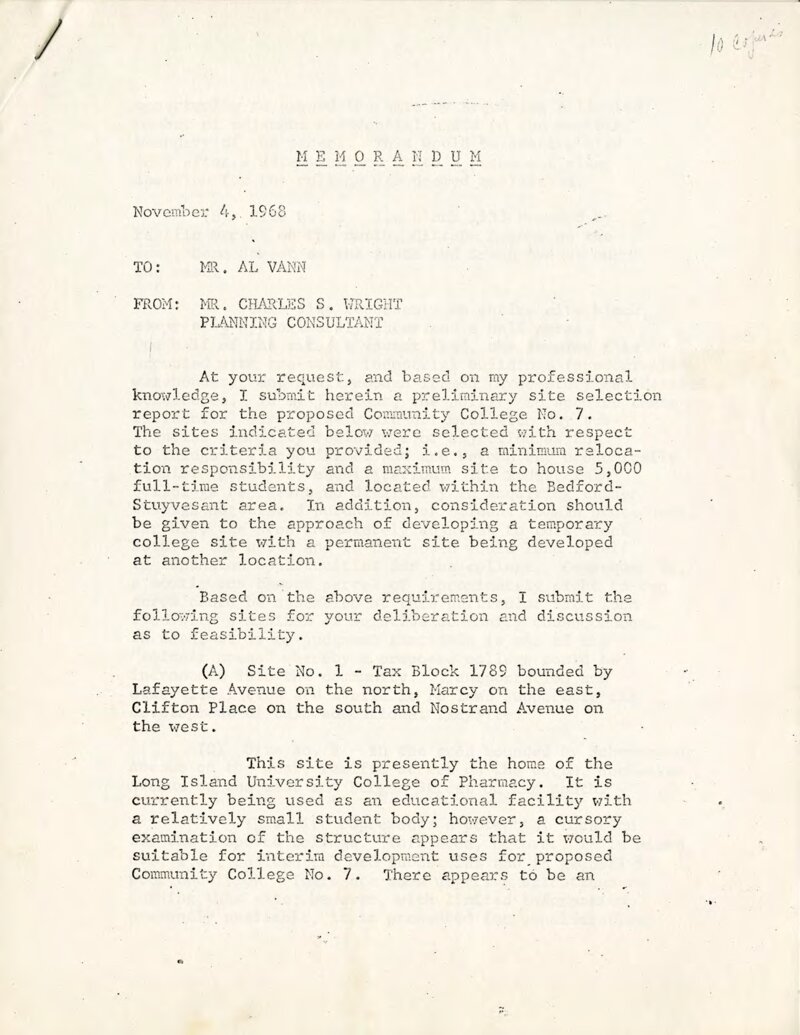
At your request, and based on my professional
knowledge, I submit herein a preliminary site selection
report for the proposed Community College No. 7.
The sites indicated below were selected with respect
to the criteria you provided; i.e., a minimum reloca-
tion responsibility and a maximum site to house 5,000
full-time students, and located within the Bedford-
Stuyve Sant area, tn addition, consideration should
be given to the approach of developt ng a temporary
college site with a permanent site being developed
at another location.
Based on the above requirements, I submit the
following sites for your deliberation and discussion
as to feasibility.
(A) Site No. 1 - Tax Block 1789 bounded by
Lafayette Avenue on the north, Marcy on the east,
Clifton Place on the south and Nostrand Avenue on
the west.
This site is presently the home of the
Long Island University College of Pharmacy. It is
currently being used as an educational facility with P
a relatively small student body; however, a cursory
examination of the structure appears that it would be
suitable for interim development uses for proposed
Commmity College No. 7. There appears to be an
at
-2«
opportunity to expand the site by acquiring a limited
number of adjacent residential units on the western
boundary of the parcel. This would be contemplated
only after a determination as to a permanent site
location for the college was deemed applicable.
(B) Site No. 2 - Tax Block 1133 bounded by
Pacific Street on the north, Classon Avenue on the
east, Dean Street on the south and Grand Avenue on
‘the west.
This site represents an entire city block,
comprising approximately three and a half acres.
One half of the site is vacant land, the remainder is
occupied with two-story industrial buildings (predominately
warehouses), and small wooden framed three-story residential
structures. In my judgment, the ability to acquire these
residential structures would not meet with any sub-
stantial community resistance or objection as the
buildings are wood framed and are beyond any economically
feasible point of rehabilitation. The industrial
buildings represent no difficulty in acquiring either
through negotiated purchasing or eminent domain procedures.
Further, the area immediately adjacent to this block
both to the north and to the south would lend itself
to expansion opportunities for the college. Consequently,
a contiguous campus parcel of approximately eight to ten
acres could be assembled at this particular site loca-
tion with a minimum of negative community consequences,
‘In deed, it is my judgment that this is one of the’
"softest areas" whereby a proposed college could be
introduced into the community, Transportation and
other facilities are available to lend support to the
development of this educational facility.
(C) Site No. 3 - in the area bounded by Schenectady
Avenue on the west, Pacific Street on the north, Rochester
Avenue on the east and Bergen Street on the south.
This site represents a potential location
for the proposed college. This area, however; is in mixed
use; i.e., residential and industrial and in general in
poor condition. There are some negative situations re-~
garding this site; however, with limited information
presently available, it is presented for consideration.
oa:
It is peripteral to the Fulton Park
Urban Renewal Project area which proposes the replace-
ment of a Boys High School immediately to the north.
Because of continued industrial use along Atlantic Avenue,
the college, if located here, would be surrounded with
industrial .uses; adjacent on the north is located a
municipal garage where Department of Sanitation trucks
are stored and repaired. Needless to say, this ‘high
traffic generating facility and accompanying obnoxious
‘odors would not create a desirable companion for an
educational institutional facility.
eb) -Si
ct
e No. 4 ~ Broadway Extension
I have recently conversated with Mr. Zeitlin
of the Linear City Development Program who suggested
that he would be highly interested in making the
commmity college a major development program at the
northern terminus of the Cross~-Brooklyn Expressway
Project - Linear City. He indicated that he would
attempt to make various grants, land acquisition and
possible air-rights platform | available to the
college at an absolute minimum cost. I suggested to
him that the Broadway Extension area was outside
‘of the Bedford-Stuyvesant community, and that the
Coalition on Educational Needs and Services was
committed to a tight educational and construction time
table, which may rule out future consideration of this
area; however, I would take it upon myself to introd uce
the proposal to the body.
RECOMIENDATIONS
In working on this project, it has come
to my attention that the Board of Higher Education
should have its own criteria and design objectives for
all of the facilities under its jurisdiction; consequent-
ly, I deem it necessary that you make contact with the
Architectural and Planning section of the Board of
Higher Education in order that we might begin to discuss
the college, as they see it, with the needs of the
community. Therefore, this report is preliminary and
a tentative one, and I request that it be-used in this
manner. However, it does make us aware of the fact-that
&)
-h
there are limited vacant spaces available to develop
this college in the community at the present moment.
questions I would like to
Some additiona
ification are: (1). Would land
address to you for clarif: fe)
acquisition. be effected ede: eminent domain procedures?
(2) What budget limitations would the Board of Higher
Education establish with respect to interim facilities?
Respectfully submitted,
CHARLES S, WRIGHT
ji
ie
ics
JO
>
=
re
i
Novembex 4,. 1968 o
TO: MR, AL VANi
FROM: MR. CHARLES S. WRIGHT
PLANNING CONSULTANT
At your request, and based on my professional
knowledge, I submit herein a preliminary site selection
report for the proposed Community College No. 7.
The sites indicated below were selected with respect
to the criteria you provided; i.e., a minimum reloca-
tion responsibility and a maximum site to house 5,000
full-time students, and located within the Bedford-
Stuyve Sant area, tn addition, consideration should
be given to the approach of developt ng a temporary
college site with a permanent site being developed
at another location.
Based on the above requirements, I submit the
following sites for your deliberation and discussion
as to feasibility.
(A) Site No. 1 - Tax Block 1789 bounded by
Lafayette Avenue on the north, Marcy on the east,
Clifton Place on the south and Nostrand Avenue on
the west.
This site is presently the home of the
Long Island University College of Pharmacy. It is
currently being used as an educational facility with P
a relatively small student body; however, a cursory
examination of the structure appears that it would be
suitable for interim development uses for proposed
Commmity College No. 7. There appears to be an
at
-2«
opportunity to expand the site by acquiring a limited
number of adjacent residential units on the western
boundary of the parcel. This would be contemplated
only after a determination as to a permanent site
location for the college was deemed applicable.
(B) Site No. 2 - Tax Block 1133 bounded by
Pacific Street on the north, Classon Avenue on the
east, Dean Street on the south and Grand Avenue on
‘the west.
This site represents an entire city block,
comprising approximately three and a half acres.
One half of the site is vacant land, the remainder is
occupied with two-story industrial buildings (predominately
warehouses), and small wooden framed three-story residential
structures. In my judgment, the ability to acquire these
residential structures would not meet with any sub-
stantial community resistance or objection as the
buildings are wood framed and are beyond any economically
feasible point of rehabilitation. The industrial
buildings represent no difficulty in acquiring either
through negotiated purchasing or eminent domain procedures.
Further, the area immediately adjacent to this block
both to the north and to the south would lend itself
to expansion opportunities for the college. Consequently,
a contiguous campus parcel of approximately eight to ten
acres could be assembled at this particular site loca-
tion with a minimum of negative community consequences,
‘In deed, it is my judgment that this is one of the’
"softest areas" whereby a proposed college could be
introduced into the community, Transportation and
other facilities are available to lend support to the
development of this educational facility.
(C) Site No. 3 - in the area bounded by Schenectady
Avenue on the west, Pacific Street on the north, Rochester
Avenue on the east and Bergen Street on the south.
This site represents a potential location
for the proposed college. This area, however; is in mixed
use; i.e., residential and industrial and in general in
poor condition. There are some negative situations re-~
garding this site; however, with limited information
presently available, it is presented for consideration.
oa:
It is peripteral to the Fulton Park
Urban Renewal Project area which proposes the replace-
ment of a Boys High School immediately to the north.
Because of continued industrial use along Atlantic Avenue,
the college, if located here, would be surrounded with
industrial .uses; adjacent on the north is located a
municipal garage where Department of Sanitation trucks
are stored and repaired. Needless to say, this ‘high
traffic generating facility and accompanying obnoxious
‘odors would not create a desirable companion for an
educational institutional facility.
eb) -Si
ct
e No. 4 ~ Broadway Extension
I have recently conversated with Mr. Zeitlin
of the Linear City Development Program who suggested
that he would be highly interested in making the
commmity college a major development program at the
northern terminus of the Cross~-Brooklyn Expressway
Project - Linear City. He indicated that he would
attempt to make various grants, land acquisition and
possible air-rights platform | available to the
college at an absolute minimum cost. I suggested to
him that the Broadway Extension area was outside
‘of the Bedford-Stuyvesant community, and that the
Coalition on Educational Needs and Services was
committed to a tight educational and construction time
table, which may rule out future consideration of this
area; however, I would take it upon myself to introd uce
the proposal to the body.
RECOMIENDATIONS
In working on this project, it has come
to my attention that the Board of Higher Education
should have its own criteria and design objectives for
all of the facilities under its jurisdiction; consequent-
ly, I deem it necessary that you make contact with the
Architectural and Planning section of the Board of
Higher Education in order that we might begin to discuss
the college, as they see it, with the needs of the
community. Therefore, this report is preliminary and
a tentative one, and I request that it be-used in this
manner. However, it does make us aware of the fact-that
&)
-h
there are limited vacant spaces available to develop
this college in the community at the present moment.
questions I would like to
Some additiona
ification are: (1). Would land
address to you for clarif: fe)
acquisition. be effected ede: eminent domain procedures?
(2) What budget limitations would the Board of Higher
Education establish with respect to interim facilities?
Respectfully submitted,
CHARLES S, WRIGHT
Title
Preliminary Site Selection Report for the proposed Community College 7
Description
On November 4, 1968, Charles Wright, Planning Consultant to the Bedford-Stuyvesant Coalition on Educational Needs and Services (B-SCEN) submitted a memo to Al Vann, chairman of the Negotiation Committee detailing four possible sites he had identified for the establishment of Community College 7. The location of the college was of central concern to the Bedford-Stuyvesant community, which had been publicly advocating for many years for a CUNY college to be located in Central Brooklyn, where it would be accessible to local Black and Puerto Rican youth. For reasons not documented in this collection, none of the four Bedford-Stuyvesant sites was selected for what became Medgar Evers College, which was ultimately built in the adjacent neighborhood of Crown Heights.
In February 1968, the City University of New York (CUNY) announced plans to establish a new “Community College 7 in or near Bedford-Stuyvesant. . . oriented to the Bedford-Stuyvesant Community and operated in consultation with the community.” Representatives of a broad network of Central Brooklyn community organizations engaged in an 18 months-long negotiation with CUNY Board of Higher Education officials over CUNY’s plans for its newly announced “Community College 7,” including discussions about the proposed school’s curriculum, who would lead it, and what role the community would play in the school’s governance. The role of the Bedford-Stuyvesant community in planning and determining the leadership of the college remained a central point of controversy between Central Brooklyn’s educational and civil society leaders and CUNY officials in the negotiations that followed.
Contributor
Woodsworth, Michael
Creator
Wright, Charles S.
Date
November 4, 1968
Language
English
Source
Donald Watkins Collection (Brooklyn Public Library)
Original Format
Memorandum/Press Release / Statement
Wright, Charles S. Letter. “Preliminary Site Selection Report for the Proposed Community College 7.”, CUNY DIGITAL HISTORY ARCHIVE, accessed September 5, 2026, https://stephenz.tailc22a4b.ts.net/s/cdha/item/2023